Shenzhen International: The Roads, the Parks and the Price of Growth
I. Revenue Up, Profit Down
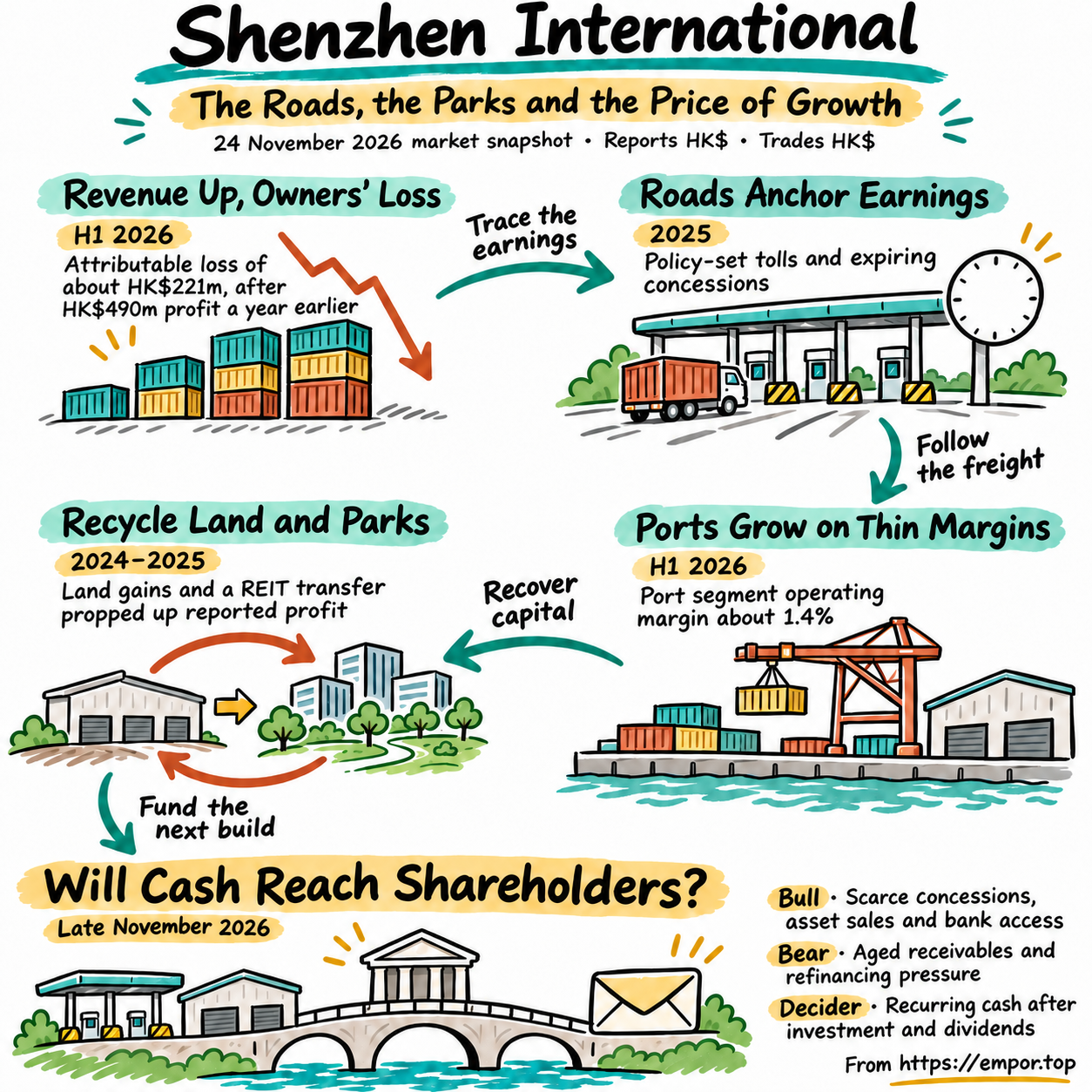
In late August 2026, Shenzhen International Holdings published a set of half-year numbers that seemed to describe two different companies. The first company was growing quickly. Revenue for the six months to June reached about HK$8.23 billion, up roughly 23% on the same period a year earlier, as cargo moved through its ports, trucks used its expressways and tenants filled its warehouses.1
The second company, the one that belongs to the people who own its shares, lost money. Profit attributable to shareholders turned into a loss of about HK$221 million, after a profit of about HK$490 million in the first half of 2025.1
Growing revenue and a shrinking bottom line are not unusual on their own. A company can sell more at lower margins, or spend ahead of demand, and still be on the right road. What made this result stranger was how far apart the two lines had moved, and how much of the gap sat below the operating business.
The company's own operating-profit line fell by about 32%, to roughly HK$819 million.1 Below that, losses on the fair value of investment properties, weaker results from associated companies and the steady weight of interest on a very large debt pile pushed the owners' line into the red.1
Not all of those culprits are the same kind of problem. The group holds some warehouses and parks as investment properties, assets kept to earn rent, and it marks them to an appraised value at each reporting date. When appraisers lower those values, the loss runs through profit even though no cash leaves the company, and in the first half of 2026 those fair-value losses were one of the reasons the line for other gains turned negative.1
That part is a paper loss, though it is also a signal about what buyers of logistics property would pay. The other two culprits are not paper. Weaker associates mean real businesses the group partly owns were earning less, and interest is paid in cash every month.
That gap is the mystery at the centre of this story. Did the business get worse, or did the accounting around it simply turn against it for six months? To answer that, the first task is to be precise about what is actually being owned.
Shenzhen International Holdings Limited, known in Chinese as 深圳国际, is a holding company incorporated in Bermuda whose shares have traded in Hong Kong since 25 September 1972.2 It is not the Shenzhen government, and it is not the whole of the city's state-owned infrastructure empire.
Its controlling shareholder is 深圳市投资控股有限公司 Shenzhen Investment Holdings Company Limited, usually shortened to SIHCL, which held about 43.2% of the shares in June 2026.1 Above SIHCL sits 深圳市国资委 Shenzhen SASAC, the municipal commission that oversees state-owned assets and acts as the company's de facto controller.3
Underneath the listed company is a further layer of ownership that matters enormously. The group's largest operating business, the toll-road operator 深圳高速公路 Shenzhen Expressway, is itself a listed company, and Shenzhen International owned only about 47% of it after Shenzhen Expressway issued new A-shares in 2025.3
Because Shenzhen International still controls that subsidiary, it adds all of the subsidiary's revenue, assets and debt into its own accounts. But it is entitled to less than half of the subsidiary's profit. A great deal of what looks like Shenzhen International's growth therefore arrives in the consolidated figures before it reaches the holding company's shareholders, and some of it never does.
So the August numbers put four questions on the table, and they will follow this story all the way to its end. The first is whether the logistics transformation the company has spent a decade building can earn dependable returns, not just bigger revenue.
The second is whether growth in partly owned subsidiaries actually reaches the listed company's owners. The third is whether the group can fund its heavy investment without making refinancing a permanent feature of the business. And the fourth is whether state control is a durable advantage, and what it leaves minority shareholders to watch.
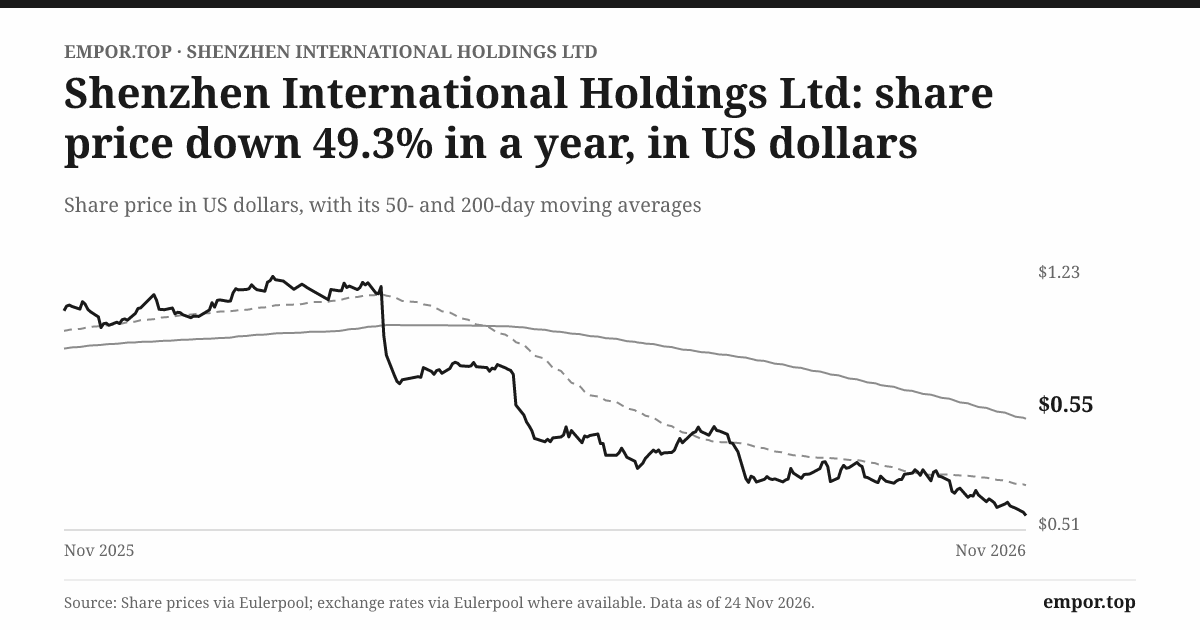
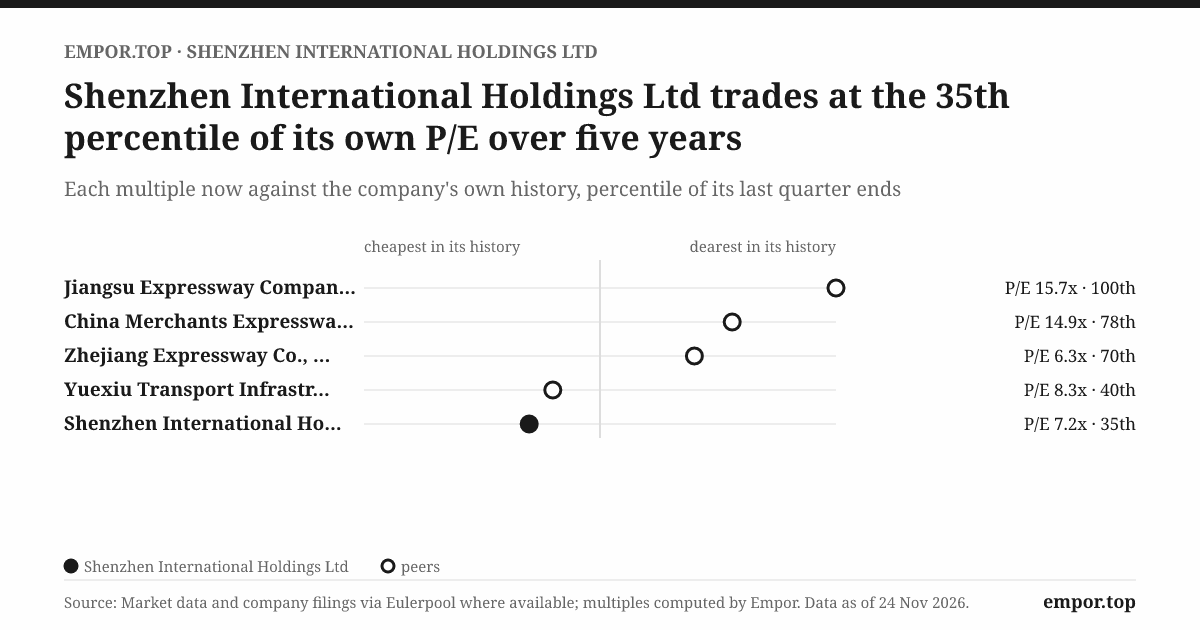
The share price suggests the market has already formed a view, though not a simple one. At HK$4.34 on 24 November 2026, the stock traded at about 7.2 times trailing earnings, almost exactly its five-year median of about 7.4 times.2 The dividend yield was about 10.6%.
Those numbers sound like a cheap, generous utility. Yet the same price implied a free-cash-flow yield of about negative 39%, because the cash the business generated after its capital spending was deeply negative relative to the size of the equity.
The whole company, counting its debt and the stakes held by outside investors in its subsidiaries, carried an enterprise value of roughly HK$74.5 billion, while the shares themselves were worth only about HK$11.1 billion.2 For every dollar of equity, there were nearly six more dollars of other people's claims standing in front of it or beside it.
That ratio explains why this is not a story about a toll-road operator, nor about a landlord. Shenzhen International is something more complicated: a state-backed infrastructure owner that has tried to weld roads, logistics parks, ports and land redevelopment into a single growth engine.
Each of those businesses has different economics, different customers and different ways of turning assets into cash. The story is about whether they hold together, and whether the engine's output arrives where the listed company's shareholders can collect it. To see how the machine was assembled, the story has to go back to the roads.
 Subscribe on LinkedIn
II. From Municipal Roads to a National Network
For most of its early life, the company that became Shenzhen International was a fairly obscure listed vehicle with a long pedigree and a short reach. The business that matters today was built much later, as Shenzhen's municipal government gathered transport assets into a vehicle that could raise capital in Hong Kong.2
The city around it was turning from a manufacturing frontier into one of the busiest export economies in the world, and every container that left a Shenzhen factory needed a road to the port and a warehouse along the way. The listed company's purpose became to own pieces of that flow.
The decisive turn came in 2008, when the group brought Shenzhen Expressway under its control.4 That move changed what kind of company Shenzhen International was. Before it, the group was a collection of logistics and transport interests. After it, the holding company had a controlling hand on a dual-listed toll-road operator traded in both Hong Kong and Shanghai, with a portfolio of expressways in and around one of China's richest cities.5 Toll roads became the earnings anchor, and they still are.
That distinction shapes every number that follows.
From the mid-2010s, the group expanded on two fronts at once. On the road side, Shenzhen Expressway added interests in expressways beyond Shenzhen during the 2015 to 2018 period, extending the network into other parts of Guangdong and other provinces.6 On the logistics side, Shenzhen International built and acquired logistics parks across a widening map of Chinese cities, pitching itself as a national network of hubs rather than a Shenzhen-only operator.64
Not every asset was wholly owned. Some roads sat inside Shenzhen Expressway, some were held through joint ventures, and some logistics projects were developed with partners. What the expansion did, unambiguously, was enlarge the group's operating footprint and the amount of capital tied up in it.
The expansion needed money, and the record shows where some of it came from. In 2014, the company placed new shares that raised nearly HK$2 billion.4 That was a meaningful equity raise for a company of its size, and it arrived at the start of the big build-out. The far larger source of funding came later and came as debt.
Total borrowings stood at roughly HK$16 billion at the end of 2014 and around HK$70 billion at the end of 2025, while debt rose from about 0.9 times shareholders' equity to about 2 times.3 Over the same years, the investments line on the balance sheet, covering stakes in associates, joint ventures and financial holdings, grew roughly ninefold.3 The placement was the first marker of an expansion that ended up being funded overwhelmingly with borrowed money.
Then, in 2018, came the year that showed both the strength and the strangeness of owning concessions in a city that keeps rebuilding itself. The Shenzhen government exercised its option to buy back the toll rights on four roads and paid compensation to the concession holders.7
For a city government, buying back a toll road is a way of turning a private toll into a public road; for the concession holder, it is a sale it did not initiate, on terms negotiated with the authority that also regulates it.
For Shenzhen International, that compensation contributed about HK$2.57 billion of profit attributable to shareholders, and the company paid a special dividend on the back of it.7 Profit attributable to shareholders that year was about HK$4.2 billion, which means the buyback alone accounted for roughly three-fifths of it.7
The 2018 buyback is often remembered as a high point, and it was a genuine monetisation: a government paid real money for rights the company owned. But it was not evidence that the ordinary business had accelerated. It was the opposite of recurring income.
A road that is bought back stops paying tolls, so the gain arrives once and the stream behind it ends. The episode also revealed something about the counterparty. The government that grants a toll concession can also end it, on terms it largely sets. That cuts both ways, as the toll-road business shows.
Step back and the decade of building looks like this. Revenue rose from about HK$6.4 billion in 2014 to about HK$16.35 billion in 2025, a compound growth rate of about 9% a year over eleven years.3 Profit attributable to shareholders, by contrast, was about HK$2.2 billion in 2014 and about HK$2.25 billion in 2025, essentially flat across eleven years.3
Return on invested capital, which measures operating profit after tax against all the money tied up in the business, slid from the mid-teens to about 3.6%. The company had become much larger without becoming more profitable for its owners.
It is tempting to conclude from that path that the company overpaid for what it bought. The record does not support such a sweeping verdict. The company has not published a consistent series of acquisition multiples, and its deals mixed toll concessions, warehouse assets, port operations and land rights that do not share one yardstick.
A road concession with fifteen years to run, a warehouse on freehold-like land use rights and a land-preparation project simply cannot be compared on a single price-to-earnings or price-to-traffic multiple. What can be said is narrower and still sharp: whatever the entry prices were, the combination of assets assembled since 2014 has earned a declining return on a rising pile of capital.
The asset history, in other words, is more durable than the profit trend. Shenzhen International owns things that are hard to replicate, in places where land and permits are scarce. But reported profit has repeatedly been transformed by events that happen once: a government buyback, a land transaction, an asset transferred to a fund.
That raises the test that will keep returning. When the company converts or sells an asset, does it recycle the capital into operations that earn more, or does it depend on one-time gains to keep reported profit growing? The place to start answering is the asset class that still produces most of the recurring money, the toll road.
III. A Toll Road Is a Contract with a Clock
Picture a container truck rolling up to a toll gate on one of Shenzhen's expressways at dawn. The barrier lifts, the fee is deducted electronically, and the driver is gone in seconds. The receipt looks trivial. Behind it sit a traffic count, a tariff approved by the provincial authorities, crews that resurface the asphalt and repair the bridges, and an operating right that the owner does not hold forever. Every one of those elements decides how much of that small fee becomes profit.
The economics are simple to state and hard to change. Revenue is traffic multiplied by the approved toll. From that, the operator pays to run and maintain the road, writes down the cost of the concession over its life and pays interest on the money it borrowed to buy or build it.
The owner of a toll road does not own the road in the way a family owns a house. It owns a contract that lets it collect fees for a fixed number of years, after which the road reverts to the state. That is why the asset is amortised: its accounting value is steadily written down towards zero as the expiry date approaches.
The amortisation schedule is not just bookkeeping. The most common method in Chinese toll-road accounting writes off the concession in proportion to the traffic expected over its remaining life, which means management has to forecast years of future traffic and revise those forecasts when reality changes.
Deloitte, the group's auditor, named the amortisation of toll-road operating rights as its key audit matter for 2025, precisely because the estimate depends on judgment about future traffic.3 A higher traffic forecast spreads the cost more thinly and lifts today's profit; a lower one does the reverse.
The toll-road business is the heaviest weight on the scale. In 2025, toll roads together with the general-environmental protection business produced about HK$10.10 billion of revenue, roughly 62% of the group's HK$16.35 billion, and about HK$2.69 billion of profit attributable to shareholders.38
That segment profit was larger than the whole group's attributable profit of about HK$2.25 billion, which tells a listener something important about the rest of the portfolio. Taken together, the other businesses, the head-office financing costs and the losses elsewhere subtracted value from what the roads earned.
Why did toll revenue grow? The company's own explanation is modest and specific. It credited the opening of the second phase of the 沿江高速 Coastal Expressway in June 2024, better connections with surrounding road networks and more favourable weather.3 None of those is a pricing story. Tolls in China are set by the authorities, not by the operator testing what drivers will pay, and the growth came from more vehicles using more road, not from charging each vehicle more.
The counterweight arrived in the same report. The gross-profit rate on the subsidiary's toll roads fell to about 45.1% in 2025, down by about 3.1 percentage points.3 The company attributed the decline to changes in amortisation on the 清连高速 Qinglian Expressway and the Coastal Expressway and to higher maintenance costs on the 水官高速 Shuiguan Expressway.3
In plain English, the roads carried more traffic but each dollar of toll kept less profit, because the cost of the contract and the cost of looking after aging pavement both rose.
Then the clock struck. The Shuiguan Expressway concession expired, and by June 2026 the group's headcount had dropped to about 7,801 from about 8,839 a year earlier, with the company attributing much of the reduction to that expiry.1 It is hard to find a cleaner illustration of what a concession is.
One day a road is producing tolls and employing staff; the next day it belongs to the public, and the revenue stops. Every toll road in the portfolio is moving along the same path, at a different point on its own timeline. Growth in toll profit therefore requires the company to keep buying, building or extending concessions just to stand still over the long run.
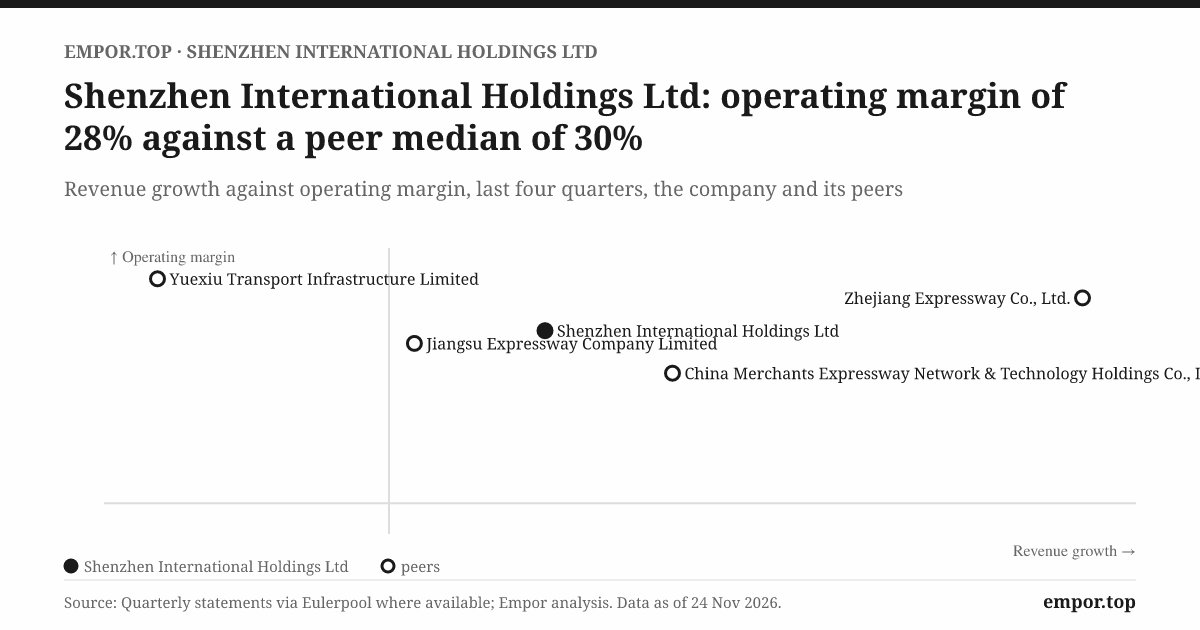
The competitive field needs to be described plainly. Shenzhen International competes for road assets and for traffic with other regional toll operators, including 越秀交通基建 Yuexiu Transport Infrastructure and 四川成渝高速公路 Sichuan Expressway, alongside many provincial state-owned operators. Shenzhen Expressway, its controlled subsidiary, is not an independent rival but part of the same group.
China's expressway sector is divided along provincial lines, and the company does not publish a comparable national market-share series. Nothing in the record supports calling it nationally dominant; it is a strong owner of important roads in and around one very rich city, plus a scattering of interests elsewhere.
Michael Porter's five forces sharpen what kind of advantage that is. The most powerful party in the industry is the government, which acts as both regulator and potential counterparty: it sets tariffs, approves concession terms and, as the 2018 buyback showed, can take back a road. In Porter's language, that gives the state a kind of supplier power over the most important input, the right to charge.
Road users, the buyers, have little choice on routes where a particular expressway is essential, but they can and do divert to free roads, rail or other expressways where alternatives exist. New entrants are held back by the enormous capital and the need for a concession, which is a real barrier. Substitutes, from high-speed rail for passengers to rail freight for some cargo, set a ceiling on how valuable a given road can become.
The result is an advantage that is real but bounded. A concession on a well-connected road in a dense economy is a scarce asset that a competitor cannot simply copy. But the owner does not control the price, does not control the term and does not control the government's decisions about neighbouring roads. The strength is the location and the licence, not pricing power.
That leaves the claim that the group owns a strategic network, the phrase that runs through its presentations. A network claim should show up in evidence: operating mileage that grows, traffic that grows faster than the regional economy, tariffs fully realised, concessions with long remaining lives and returns on invested capital above the cost of money. The group-level figures do not yet show superior returns.
Return on invested capital remained low, while return on capital employed was about 5.6% in 2025.3 Those are group-wide figures that blend roads with ports, parks and head-office debt, and the roads alone are surely better. But the group's own blended numbers do not let an outside investor prove that the network earns more than a collection of separately owned roads would.
The environmental half of the segment deserves a sentence of its own. Shenzhen Expressway has expanded into businesses such as clean energy and environmental services, and China Lianhe, the domestic credit-rating agency, cited those operations among the group's strengths.9 They broaden the base, but they do not change the central economics, which still depend on the tolls.
The verdict on this chapter is that toll roads remain the earnings anchor and the largest recurring profit pool, earned in a market with high barriers to entry. Concessions, network connections and traffic flows are a genuine infrastructure advantage.
The history narrows that advantage, though: tariffs are policy-set, margins are drifting lower as maintenance and amortisation rise, and concessions expire. The roads pay the bills. The question for the rest of the group is whether the logistics assets can grow into more than a collection of businesses sitting next to them.
IV. The Warehouse Network Meets the Trade Cycle
A truck pulls off the expressway and into a logistics park on the edge of Shenzhen. Inside the gates, the goods it carries might be stored for a week, sorted and repacked for e-commerce orders, cooled for a supermarket chain, or sent on to a port where they will be loaded onto a ship. The scene looks like a network in motion, and in a sense it is.
But a full warehouse and a busy quay are not the same thing as a profitable one. The landlord gets paid rent, the port gets paid handling fees, and the company that arranges the whole chain may be paid a sliver of the value of the goods. Which of those Shenzhen International earns determines whether this half of the business is a new engine or an expensive sideline.
The logistics side of the group is really several businesses wearing one jacket. Logistics parks earn rent from tenants and fees for related services, with warehouse leases running from one year to as long as twenty.3 Ports earn from loading, unloading and storing cargo, and from related supply-chain activity, some of which looks more like trading than like landlording.
Third-party logistics services depend on how much customers ship. And the transformation projects, where old parks are redeveloped or converted, recognise revenue and profit at milestones, so they arrive in lumps rather than streams. Lumping them together hides the fact that rent behaves like a toll, while supply-chain trading behaves like a distribution business.
In 2025, logistics parks generated about HK$1.66 billion of revenue and logistics services about HK$370 million, together roughly HK$2.03 billion and up about 11% on the year.38 Yet the combined segment reported a loss attributable to shareholders of about HK$55.8 million.8 Park profitability recovered, but unevenly, while the logistics services business remained loss-making.3 Revenue growth of 11% with a loss at the bottom is the first sign that network scale was not yet turning into profit.
The port business is where the growth story gets exciting, and where it most needs interrogating. Port and related services produced about HK$4.06 billion of revenue in 2025.3 In the first six months of 2026 alone, the segment brought in about HK$2.78 billion, almost double the same period a year earlier.1
On the surface, that looks like the logistics transformation finally finding its engine. Look one line lower, though, and the segment's operating profit for those six months was only about HK$39 million.1 That is a margin of about 1.4%. Set beside the 45% gross margin on the toll roads, it is a different universe.
A margin that thin is the signature of business where the company books the full value of what passes through its hands and keeps only a small spread. That can be a reasonable business, as large commodity traders and freight forwarders prove, but it is not a toll road and it is not a landlord.
It ties up working capital, it exposes the company to its customers' credit, and it can grow revenue very fast without growing profit at all. Until the port segment shows that higher volumes are lifting its margin, or that the revenue reflects repeat throughput rather than one-off trade flows, the surge is a revenue story, not yet an earnings story.
Customer concentration is not the obvious weakness. In 2025, no single customer accounted for 10% or more of group revenue.3 That spreads the risk of any one client walking away. But the company does not disclose its top-five customers' share of revenue, nor any supplier concentration, so an outside investor cannot tell whether a handful of trading counterparties dominate the port growth. Diversification at the group level, where tolls come from millions of drivers, does not say much about a single fast-growing segment.
The harder evidence lies in collections. Most trade receivables outside the toll business are due within 120 days, while toll income generally settles monthly.3 At the end of 2025, gross trade and bill receivables were about HK$3.07 billion, and about HK$1.21 billion of that had been outstanding for more than a year.3
By June 2026, gross receivables had climbed to about HK$3.66 billion, and the portion older than 365 days had risen to about HK$1.69 billion, an increase of roughly 40% in six months.1 The allowance set aside for expected credit losses grew from about HK$499 million to about HK$625 million.1 On a 120-day credit term, a receivable that is more than a year old is not slow; it is in dispute, stuck in a government payment cycle or at risk of not being paid at all.
There is one encouraging clue in the same notes. Contract assets the company expected to recover only after more than a year fell to about HK$906 million at the end of 2025, from about HK$1.88 billion a year earlier.3 Some long-dated project money was converting.
But the over-a-year receivables moved the other way, and over the full year 2025 debtor days, the number of days of revenue sitting in receivables, rose to about 139 from about 83 in 2024.3 Revenue that is booked but not collected is a promise, and the promises were piling up just as the port segment was growing fastest.
The competitive landscape helps explain why returns are hard to earn here. In warehousing, Shenzhen International faces specialist operators such as 普洛斯 GLP and Prologis, which have built large logistics-property platforms in China and compete for the same e-commerce, retail and manufacturing tenants.
In ports, the Pearl River Delta is home to heavyweights including 招商局港口 China Merchants Port and 盐田国际 Yantian International, which run some of the largest container terminals in the world. Against these rivals, Shenzhen International does not publish a group-wide occupancy premium, a tenant-retention advantage or a cost advantage. There is no market-share series in its reports that would allow anyone to rank it.
Porter's lens is less forgiving here than on the roads. Customers can multi-source logistics services easily, signing with several warehouse operators and freight forwarders at once. Landlords compete for tenants, so occupancy and rent depend on location and on how much new supply is built nearby. Supply-chain trading is lower-margin and working-capital-intensive by nature.
A national footprint and access to land through state relationships may help Shenzhen International win sites that others cannot. But to count as a moat, that access needs to show up in measurable outcomes: utilisation of the parks, rents achieved against market, cargo throughput per berth and, above all, cash collected from customers. The company's reports show the revenue; they do not yet show those outcomes with enough consistency to call the network superior.
The verdict for this chapter is that the logistics network is financially material and growing, especially in ports, but its economics are uneven. A segment that loses money in parks and services, and earns barely more than 1% in ports while its old receivables swell, has not yet proven it can be a durable profit engine.
The company says its answer is not just to fill the warehouses. It is to upgrade the parks, turn them into investable assets and sell or transfer them into funds. The test of that wager is whether monetisation funds better returns, or mainly makes earnings lumpier.
V. The Two Loops: Develop the Land, Recycle the Parks
For years, the South China Logistics Park was what its name promised: warehouses and yards serving the freight that flowed through Shenzhen. But Shenzhen is a city that keeps redrawing its own map, and land used for low-rise logistics in a growing urban district can be worth far more as something else.
Under a government-led plan, the park moved from being logistics property into a land-preparation project, in which the company prepares the site for redevelopment and is compensated as the land is handed over and re-planned.310 Separately, in 2024, the company took two of its logistics hubs and transferred them into the ChinaAMC-Shenzhen International REIT, a listed real estate investment trust in China that buys income-producing infrastructure from its sponsors.10
These two transactions are the clearest expression of how Shenzhen International now wants to be understood. Management calls the model a "dual closed loop".11 In ordinary words, there are two cycles. In the first, the company acquires or holds land, prepares and develops it, and captures the uplift when the land changes use.
In the second, it builds and stabilises logistics parks, injects or transfers them into funds such as REITs to recover the capital, and redeploys that money into the next park. In theory, the loops make the company a developer and recycler of infrastructure rather than a passive owner, and they allow it to grow without endlessly adding debt.
Put the results in sequence and the loops visibly moved the profit line. In 2024, profit attributable to shareholders rose sharply, helped by profit on land preparation and by the REIT transfer, which alone contributed about HK$587 million after tax.10
In 2025, the land-preparation programme produced gains of about HK$4.05 billion.3 And yet, even with that very large gain, profit attributable to shareholders fell by about 22%.3 That is the uncomfortable part. The land gain did not lift profit to a new level; it propped it up while other parts of the group lost ground.
The clearest way to see how much the headline profit depends on such events is to strip them out. In 2025, the group's profit before tax was about HK$4.50 billion.3 A line called "other gains, net", dominated by the land-preparation gain and offset by impairments and fair-value losses, contributed about HK$2.97 billion, roughly two-thirds of that total.3
Ordinary other income, such as interest and government grants, added only about HK$182 million.3 Take away the net other gains and pre-tax profit falls to roughly a third of its reported size. The price-to-earnings ratio of about seven times that the market quotes is therefore built partly on a gain that may not recur on the same scale next year.
A successful recycling model ought to leave fingerprints, and it is worth being specific about what they would look like. First, the proceeds from each transfer should exceed the carrying value of the assets sold by a margin that reflects real value creation, not just accounting revaluation. Second, the company should keep some continuing income after the transfer, through units it holds in the fund or fees it earns for managing the assets.
Third, and most important, the money recovered should be reinvested at returns higher than those of the assets sold. The filings provide transaction outcomes, the gains and the proceeds, but not enough evidence to show that recycling has raised the group's overall return on invested capital. Indeed, that return kept falling through the years in which the loops were running.
Benchmarking is tempting here too, and the same caution from the road acquisitions applies with more force. A toll concession, a warehouse portfolio and a land-preparation right are three different kinds of asset with three different ways of creating value.
When a filing gives a specific transfer value against a specific asset and date, it can be compared with similar transactions of the same type in the same period. Lumping the REIT transfer together with the land gain and the road acquisitions under one multiple would produce a number with no meaning.
The record also contains evidence against the loops working smoothly. In 2025, the logistics business recognised an impairment-related investment loss of about HK$436 million on an associate, a company it partly owned.3 That is the other side of building through stakes and partnerships: when an investee falters, the loss lands on the parent.
And the logistics-park transformation and upgrading business, the operating heart of the first loop, earned only about HK$160 million of revenue in 2025, despite the very large land gain recorded elsewhere in the group.3 The transformation story, measured by its own recurring revenue, is still small.
The newer themes in the company's presentations should be held at the same distance. Management speaks of intelligent logistics, cold-chain facilities and new-energy logistics as directions for investment.11 Research and development spending is not disclosed as a separate line in the annual or interim reports, and the company does not report utilisation, revenue, capital spending and returns for these initiatives in a way that would let an investor measure them.31 For now they are investment themes, not proven earnings engines. A cold-chain warehouse is a fine asset if it is full and paid for. The disclosure does not yet show which ones are.
Now look at how much capital the loops and the rest of the group consume. Capital expenditure in 2025 was about RMB9.4 billion, roughly HK$10.5 billion, equal to about 64% of the year's revenue.3 For 2026, the company expected to spend about RMB8.5 billion.1
At the end of June 2026, it had already signed contracts committing it to about HK$16.29 billion of future spending on property, plant and equipment, concession assets and land premiums.1 By comparison, operating cash flow in 2025 was about HK$4.52 billion.3 The group was spending more than twice what its operations produced in cash.
That arithmetic is why the strategy cannot be separated from the funding. The loops are meant to close in cash: capital goes out, assets are built, assets are sold or transferred, capital comes back, and the cycle repeats.
If the return leg of the loop is slower or smaller than the outbound leg, the gap has to be filled from somewhere. For Shenzhen International, that somewhere is mostly the debt market, and the next chapter is about what happens when the investment programme meets the repayment calendar.
VI. The Dividend Meets the Debt Calendar
On 30 June 2026, Shenzhen International's balance sheet carried about HK$36.30 billion of borrowings due within twelve months.1 Its current liabilities, everything due within a year, exceeded its current assets by about HK$15.01 billion.1 For most companies, that sentence would be alarming.
Management's answer, set out in the same report, was that the group had about HK$126.75 billion of unused bank facilities available to it, more than enough to roll over what was falling due.1 Both statements were true at once, and the tension between them is the financial heart of the company.
Think of a household with a large mortgage that has to be renegotiated every year rather than every twenty-five. As long as the bank is friendly and rates are reasonable, the arrangement works and the family can keep spending.
But every year the family is exposed to the bank's mood, and the family's own income never quite covers both the spending and the debt. That household is solvent, but it is not self-funding. The question for Shenzhen International is which of those two descriptions matters more over the next several years.
Start with the good news, because it is real. Over the twelve years from 2014 to 2025, the group generated about HK$49.5 billion of cash from operations, against about HK$35.4 billion of net profit attributable to shareholders.3 Cash from operations was roughly 140% of reported profit.
Part of that gap comes from the fact that toll roads charge large non-cash amortisation, about HK$3.5 billion of depreciation and amortisation in 2025 alone, and part reflects cash that flows to minority shareholders in subsidiaries.3 Either way, the operations themselves turn into cash well. This is not a company whose profits are imaginary.
The bad news is what happened after the operations. Over the same twelve years, free cash flow, meaning operating cash minus capital spending, was negative by about HK$23.4 billion.3 On top of that, the company paid about HK$21.8 billion in dividends, and its cash and short-term investments still rose by about HK$6.8 billion. Add those together and the group needed about HK$52 billion more than its operations provided after investment.
Borrowings rose by roughly HK$54 billion over the same period.3 Asset sales, government compensation and equity raised in subsidiaries filled some of the rest. The simplest honest summary is that, over twelve years, debt paid for the investment programme and, in effect, for the dividend too.
That context changes how the dividend should be heard. The payout ratio, dividends as a share of net profit, has ranged from about 18% in 2017 to about 178% in 2022, with a median of about 66% and a reading of about 92% for 2025.3 The yield is striking.
But a high yield is a statement about what the company paid relative to its share price, not about whether recurring free cash covered it, and for most of the past decade it did not. The company has also paid part of its dividends in new shares, issuing about 7.33 million shares through scrip dividends in the first half of 2026, which conserves cash and slightly dilutes holders who take cash.1
The debt calendar has been tightening rather than loosening. Borrowings rose from about HK$69.9 billion at the end of 2025 to about HK$75.6 billion by June 2026, an increase of nearly HK$6 billion in six months.31 At the end of 2025, about 47% of borrowings matured within one year, 37% in two to five years and only 16% beyond five years.3 Cash, meanwhile, fell from about HK$10.2 billion at the end of 2025 to about HK$8.1 billion in June.1
Long-lived assets like toll roads and logistics parks are being financed with a debt book that turns over very quickly. That is cheaper in a falling-rate environment, but it leaves the group exposed to refinancing conditions each year. One modest comfort is currency: about 95% of borrowings were in renminbi, matching the group's mainly renminbi income.3
The credit agencies have looked at the same facts and reached a measured view. 联合资信 China Lianhe affirmed the group's AAA domestic rating with a stable outlook in June 2025.9 Its rationale credited the broad logistics network, quality toll assets, environmental and clean-energy operations, government support and access to financing, while flagging high capital spending, a concentration of short-term debt and liquidity pressure.9
Internationally, the company's 2026 interim report disclosed that S&P had upgraded it to BBB+ and that Moody's rated it Baa2, both investment grade.1 The ratings are, in large part, a judgment about the state standing behind the company. They support access to funding, but they do not remove refinancing risk or say anything about whether the investment programme earns enough.
The cash the group held earned little. At the end of 2025, it had about HK$10.2 billion at the bank, and its short-term investments included about HK$2.7 billion of structured deposits with stated expected returns of roughly 0.6% to 2.3%.3
Holding a large cash cushion while carrying around HK$70 billion of debt is a rational choice for a company that must refinance every year, because the cushion buys time if a lender hesitates. But it has a cost: the group borrows at one rate and parks money at a lower one, and that spread is part of the financing drag that sits between the operating businesses and the owners.
The facility headroom and bond access matter. After the June period end, the company issued additional Panda bonds, renminbi bonds sold in mainland China by an issuer incorporated outside it.1 No covenant breach is disclosed in the 2025 annual report or the 2026 interim report. But unused facilities are a promise from banks, not cash in the till.
What an investor needs to watch is the actual availability of those lines, the cost of refinancing, and the maturities set against the committed capital spending and cash dividends. The contracted commitments of about HK$16.29 billion at June 2026 sit on top of the HK$36.3 billion of debt falling due.1
There are also contingent claims that are small relative to the debt but worth knowing about. At the end of 2025, the group disclosed pending litigation claims of about RMB862 million, including disputes over land and an infrastructure fund, and the directors said the outcomes could not be reliably estimated.3 The interim report showed claims of about HK$625 million in June 2026.1
The group had also guaranteed about HK$584 million of mortgages for buyers of its property projects and about RMB641 million of project-performance obligations for Shenzhen Expressway.3 None of these is large enough on its own to change the story, but they are reminders that land and property activity bring their own tails of risk.
A skeptical investor sitting across from management would ask two questions. If the capital spending programme has to be constrained, which projects are deferred first, and what does that do to the growth story? And if it is not constrained, what return threshold justifies borrowing more for a group whose return on invested capital is already in the low single digits?
Neither question implies distress. Both go to whether the funding model is a bridge to a better-returning business or a permanent way of life. And those questions lead directly to the people who decide, and to the shareholders who vote on whether to let them.
VII. A Controller, a New Board Seat and a Vote on Authority
Annual general meetings of state-controlled Hong Kong companies are usually quiet affairs. The controlling shareholder's votes are counted before anyone sits down, resolutions pass, and the poll results are filed on the exchange website a few hours later.
Shenzhen International's meeting for the 2025 financial year, whose results were published on 13 May 2026, followed that script on most items.12 On two, it did not. About 24% of the votes cast opposed the general mandate allowing the board to issue new shares, and about 17% opposed the reappointment of the auditor.12
Those numbers need translating, because they look smaller than they are. SIHCL alone held about 43% of the shares and would have voted with the board. If the controller is removed from the count, the opposition among the remaining shareholders who voted was considerably larger in proportion.
On the share-issue mandate, it is reasonable to infer that a substantial portion of the independent votes cast were against. Opposition to individual directors, by contrast, was much lower; only about 0.8% voted against the re-election of Wang Peihang, for example.12 Investors were not rejecting the people. They were rejecting specific powers.
The general mandate is a standard Hong Kong resolution that lets directors issue new shares, up to a fixed portion of the existing share capital, without returning to shareholders for each issue. Most companies ask for it every year, and many institutional investors vote against it as a matter of policy when the discount or dilution limits seem too generous. In Shenzhen International's case the objection has extra bite.
With the shares trading at about 0.3 times book value, any new equity issued near the market price would sell a dollar of the company's net assets for roughly thirty cents. For a group whose funding needs are as heavy as its capital spending, the authority to issue shares is not an abstraction. Minority holders were signalling that they did not want dilution to become a funding tool.
The vote on the auditor is harder to read. Deloitte issued an unmodified opinion on the 2025 accounts, with no emphasis-of-matter paragraph, and named toll-road amortisation as its key audit matter.3 Shareholders who voted against its reappointment did not publish their reasons, and the company did not report any disagreement with the auditor. What the vote shows is a minority of investors who wanted to send a signal about oversight, not evidence of an accounting problem.
Behind every vote sits the ownership chain. SIHCL's stake was remarkably stable, at about 43% in 2020 and about 43% by June 2026 as scrip dividends modestly diluted it.531 Through SIHCL, Shenzhen SASAC is the de facto controller.3 UBS was disclosed with about 6% in the 2025 annual report.3 The company does not report a total number of shareholders in its annual or interim reports.
State control brings real benefits: access to land, to government-led redevelopment like the land-preparation programme, to cheaper finance and to the implicit support that rating agencies count. It also places a steady stream of dealings with state-linked entities under scrutiny, and it means the minority holders' interests are protected mainly by disclosure, independent directors and their votes.
The related-party facts deserve to be kept in proportion. The group treats associates, joint ventures and other enterprises controlled by Shenzhen SASAC as related parties.3 At the end of 2025, amounts owed to associates were about HK$1.62 billion.3
Some advances from entities connected with the 前海 Qianhai development zone bore interest of about 3.5% and 2.9% and were repayable on demand, while balances with another entity, United Land, were interest-free and also repayable on demand.3 The company recorded about HK$1.39 billion of such balances offset against a dividend it was owed, and it disclosed small items such as about HK$14.2 million of service fees paid to an associate, Yunji Smart.3
The company says these transactions were on terms comparable with third parties or under government-set standards, and its directors reported no non-exempt connected transactions requiring shareholder approval.3 What the company does not disclose is the total of related-party purchases, sales or fees as a share of group revenue or costs, so there is no way to say what fraction of the business flows through state-linked counterparties. That absence is itself the governance point: the relationships are material, and the disclosure stops short of sizing them.
The people at the top have a long tenure and modest pay. 李海涛 Li Haitao has chaired the board since 2020, after serving as chief executive, and 刘征宇 Liu Zhengyu has been chief executive since 2021.3
Long tenures of this kind are common in Shenzhen's state-owned groups, where leaders are appointed through the controller's own personnel system rather than recruited by the board in an open search, and that shapes what accountability looks like: the chairman and the chief executive answer first to the shareholder that appointed them.
In 2025, Li received total remuneration of about HK$1.38 million and Liu about HK$1.44 million, including discretionary bonuses of about HK$829,000 and HK$800,000 respectively.3 Those are small sums for the leaders of a group carrying around HK$70 billion of debt, typical of state-owned enterprises, and the bonuses are discretionary rather than tied to a published formula of returns or cash flow.
Low pay protects shareholders from excess, but it does not by itself align management with minority owners; the remuneration note does not set out an incentive structure linked to return on capital or the share price.
There has been change around the edges. Executive director Dai Jingming left the board in January 2025, and the chief financial officer, Liu Xiuli, joined it as an executive director in November 2025.3 Putting the CFO on the board gives the finance function a formal voice at the moment when funding is the defining constraint.
Then came the newest arrival. On 24 August 2026, 利安人寿 Lian Life Insurance disclosed that it had increased its interest in Shenzhen International to 7%.[^13] On 30 October 2026, the company appointed Ji Lei, an investment director at Lian Life, as a non-executive director.13 The same set of board changes left four of the ten directors independent.14
It is a governance development to follow rather than a sign of activism: an insurer buying a high-yielding, state-backed infrastructure stock and taking a board seat fits the profile of a long-term income investor. But it does add a second large institutional voice in the boardroom, one whose interests as a minority holder are distinct from the controller's.
Management credibility, finally, is best judged by behaviour over time. The fair test is to set the strategy and capital-allocation claims in the 2024 and 2025 results presentations and the 2026 interim presentation against what was delivered: whether the capital spending stayed within the guidance, whether segment returns rose as the transformation progressed, and whether receivables were collected.1115
On that record so far, the company has been consistent in its narrative of a dual loop and a national network, and has delivered monetisation events when it said it would. It has not yet shown the recurring return improvement that the narrative implies, and the rise in aged receivables in the first half of 2026 ran against it.
The evidence supports stable control and meaningful, issue-specific dissent, not a broad shareholder revolt. The question is whether future capital decisions answer that dissent, and how the market is pricing the answer in the meantime.
VIII. What the Low Multiple Is Asking
On 24 November 2026, Shenzhen International's shares closed at HK$4.34, the lowest price of the previous twelve months and about 53% below the 52-week high of about HK$9.29.2 A fall of that size usually leaves a stock looking cheap on every measure.
Yet at about 7.2 times trailing earnings, the share price sat almost exactly at its five-year median of about 7.4 times. The earnings had fallen roughly as fast as the price. That is the first clue that the low multiple is not, by itself, a bargain signal; it is the market applying its usual skepticism to a smaller and less reliable profit.
The second clue is the price-to-book ratio of about 0.3 times. Investors were valuing each dollar of the company's net assets at roughly thirty cents. The arithmetic behind that is not mysterious. Return on equity was about 4.3% over the twelve months to June 2026, and return on invested capital about 3.1%.
A business that earns 4% on its equity, when investors can earn similar or better yields on far safer instruments, will trade well below book value until it shows it can earn more. The discount says less about whether the assets are good and more about whether they are earning what they are worth.
The third clue is the shape of the capital structure. Shenzhen International's equity was worth about HK$11.1 billion, while the enterprise value, which adds debt and the stakes held by outside investors in subsidiaries and subtracts cash, was about HK$74.5 billion.2 Equity is a thin slice on top of a very large structure.
That creates leverage in both directions. A modest improvement in the value or returns of the underlying assets would have a large proportional effect on the equity. A modest deterioration, or a rise in borrowing costs, would do the same in reverse. The share price falls of 2026 are a reminder of how sensitive the slice is.
The case for optimism is easy to build from real facts. The toll roads and logistics network sit in markets with high barriers to entry, in one of the richest urban regions in China. The port business is growing quickly. The company has repeatedly shown that its assets can be monetised, from the 2018 government buyback to the REIT transfer and the land-preparation gains.
Its operations have historically turned profit into cash well before capital spending. The controller is stable, the credit ratings are investment grade and the banks have offered more facilities than the company is using.
The case against is built from facts that are just as real. Revenue fell at about 3.4% a year and attributable profit at about 11% a year over the five years to 2025.3 Profit attributable to shareholders fell about 22% in 2025 even with a large land gain, and the first half of 2026 turned to a loss.31
Capital spending exceeds operating cash flow by a wide margin. Old receivables are growing, and nearly half of the debt matures within a year. The shareholder vote on dilution authority suggests at least some minority investors fear that equity will be used to plug the gap.
The dividend yield and the free-cash-flow yield tell the same story from opposite ends. A yield of about 10.6% means the company paid out a large amount relative to its market value. A free-cash-flow yield of about negative 39% means that, after paying for its investment programme, the group consumed cash equal to well over a third of that market value in a year.
Both can be true only because lenders fill the gap. A shareholder buying for the yield is, in effect, relying on the banks continuing to finance the capital programme, so that the dividend can keep flowing on top of it.
Peers provide context rather than a verdict. On 25 November 2026, Yuexiu Transport Infrastructure traded at about 8.2 times earnings and Sichuan Expressway at about 8.9 times.1617 Shenzhen Expressway, the controlled subsidiary, traded at about 12.6 times on the same date.18 Those businesses are more purely toll roads, with different concession profiles and reporting bases, so a lower multiple for Shenzhen International does not prove that it is mispriced.
The most revealing comparison is the last one. The market valued the subsidiary's earnings at a far higher multiple than the parent's, which is consistent with a holding-company discount for layered ownership, head-office debt and the lower-margin, less predictable logistics and land businesses that sit only at the parent level.
Hamilton Helmer's 7 Powers framework is a useful check here, provided it is used as a test rather than a label. Of the seven sources of durable advantage, one applies clearly: a cornered resource.
Toll concessions and scarce urban logistics land in Shenzhen are assets that competitors cannot simply build or buy, because they depend on government licences and land allocations. Scale economies may help in parts of the logistics network, where a wide footprint lets the company serve customers across cities. The other powers find little support in the evidence.
There is no sign of network economies, where each new user makes the service more valuable for others. There are few switching costs, since logistics customers multi-source and drivers can take other routes. Brand plays little role in an expressway toll or a warehouse lease.
Counter-positioning and process power, the advantages that come from a business model rivals cannot copy or from operating know-how that compounds, are not demonstrated in any public metric. The moat, in short, is a cornered resource whose owner does not control its price or its term, which is valuable but bounded.
Three measures would do most to change the verdict, and none of them is exotic. The first is toll-road traffic and the return earned on each concession, because the roads are the profit pool that funds everything else; in 2025 traffic grew while the toll gross margin fell to about 45%.
The second is operating profit in the port and park segments and how much of it arrives as cash; in the first half of 2026, ports earned about 1.4% on rapidly rising revenue while receivables older than a year climbed to about HK$1.69 billion. The third is free cash flow after capital spending and dividends, measured against the debt falling due within twelve months; that figure was deeply negative in 2025, against about HK$36 billion of short-term debt in June 2026.
There is one more question that the valuation is really asking, and it is about who captures the growth. Shenzhen Expressway remained consolidated after its parent's stake fell to 47.30%, which means its full revenue and growth still flow into the group's accounts.3 But in 2025, out of group profit of about HK$2.94 billion, about HK$695 million belonged to non-controlling interests.3
And when the first half of 2026 brought a 23% rise in group revenue, the owners' share was a loss. The more of the group's investment is funded through subsidiaries that raise their own equity, the more the growth is shared with other shareholders, and the less of it reaches the top.
IX. Business & Investing Lessons
Set three moments side by side. In 2018, the Shenzhen government paid to take back four toll roads, and about HK$2.57 billion of profit landed on Shenzhen International's shareholders.7 In 2025, a land-preparation programme on former logistics land produced about HK$4.05 billion of gains.3 In the first half of 2026, with revenue up by almost a quarter, the shareholders absorbed a loss.1 Each moment was real. Together, they teach lessons that belong to this company more than to any other.
The first lesson comes from the roads. A toll concession earns money every day that a truck passes the gate, and it does so for years, which is why investors prize it. A buyback earns money once, on the day the government pays. Both appear in the profit line, and in 2018 the one-off payment was larger than most of what the roads earned that year.
A concession is valuable because traffic returns tomorrow; a sale is valuable once. For investors, the wider point is that infrastructure owners in cities that keep reinventing themselves will repeatedly face the choice between a stream and a lump, and the reported profit cannot tell you which you are looking at unless you separate them yourself.
The second lesson comes from the cash-flow statement. Shenzhen International's operations converted profit into cash at roughly 140% across twelve years, a record most industrial companies would envy. Yet over the same period the group spent so much on new assets that free cash flow was negative by about HK$23 billion, and borrowing filled the gap for both the investment and the dividend.
Cash conversion before investment can look healthy while the investment programme still consumes more cash than the business earns. Founders and boards of capital-hungry businesses should hear that as a warning: a good operating cash ratio is the beginning of the analysis, not the end of it.
The third lesson comes from the warehouses and the quay. The group has a national logistics footprint, a growing port business and the language of a network in every presentation. But the parks and services lost money in 2025, the ports earned around a penny on each dollar of revenue in early 2026, and the receivables that should have turned into cash within four months were piling up past a year.
A network is not a moat until it improves occupancy, throughput, pricing or returns. The test of any network claim is whether it shows up in the numbers that customers, not management, control.
The fourth lesson comes from the REIT. When two logistics hubs moved into a listed fund in 2024, the company proved that it could turn a stabilised asset into cash at a profit of about HK$587 million.10 That is a valuable capability. But it is only half a loop.
The other half, reinvesting the proceeds into something that earns more than what was sold, is the part that creates long-term value, and it is the part the group's falling returns have not yet confirmed. Selling a good asset proves the asset was good; it does not prove the next one will be.
The final lesson is specific to the structure of the company. State-backed continuity helped Shenzhen International assemble assets that few private companies could: concessions in a booming city, land that the government chose to redevelop, cheap and plentiful bank credit.
But every layer between the asset and the listed shareholder takes a share, whether it is the minority holders of Shenzhen Expressway, the lenders who refinance each year or the partners in associates. A holding company is only as valuable as the bridge from consolidated growth to parent-level cash. For Shenzhen International's minority holders, that bridge is still under construction.
X. Epilogue
Tonight, at the end of November 2026, Shenzhen International stands at an unusual place for an infrastructure company: it has more assets, more financing capacity and more revenue than at almost any point in its history, and a share price at the bottom of its yearly range.
The story is not open on whether the company owns valuable things or whether banks will lend to it. It is open on whether the things it owns will earn enough, in cash, for the people at the top of the structure.
The next decisive moment is the 2026 annual results, which, following the pattern of recent years, should arrive in late March 2027.8 That report has three jobs. It must show what happened to the receivables, the roughly HK$1.69 billion that had been outstanding for more than a year in June.
If a meaningful share is collected, the port and logistics growth starts to look like real business; if more of it is provisioned, the first half's revenue surge will look, in hindsight, like revenue the company could not turn into cash.1
It must also show what happened to the capital programme. The company planned to spend about RMB8.5 billion in 2026 and had about HK$16.29 billion of contracted commitments in June.1 Spending close to plan while cash flow stays near 2025 levels would mean more borrowing.
Spending well below plan would protect the balance sheet but raise the question of which projects were deferred and what that means for growth. Either way, the next maturity schedule, the facilities actually drawn and the cash dividend paid should be read together, not in separate notes.
And it must, ideally, provide the bridge that investors have lacked. A clear earnings walk from recurring toll and logistics operations, through land-preparation gains, fair-value changes, associate results and non-controlling interests, down to the owners' line would let shareholders see how much of the reported profit is repeatable. The company's results presentations already show segment-by-segment figures; turning them into a single, consistent bridge would do more for credibility than any new strategic slogan.15
There is a quieter test in the boardroom. The next annual general meeting, expected in the spring of 2027, will show whether the dissent on the share-issue mandate and the auditor repeats, grows or fades.12 It will also be the first meeting since Lian Life's investment director joined the board.13
If the board answers the 2026 vote by narrowing its request for issuance authority, or by explaining how it would use new equity, that would be a sign that minority voices register. If the same resolutions return unchanged and the opposition grows, the gap between the controller's priorities and the minority's will have become a part of the story in its own right.
The thesis strengthens if the next set of results shows recurring returns rising and free cash flow after investment improving without more leverage: toll margins stabilising, port margins widening, receivables shrinking and debt falling as a share of equity.
It weakens if revenue keeps growing alongside low returns, aged receivables keep climbing and profit keeps depending on asset gains. The roads will keep carrying trucks either way. What remains uncertain is whether the cash from those trucks will get past the lenders, the minority shareholders and the next round of building before it reaches the owners.
XI. Outro
Go back to the August 2026 results. Somewhere in Shenzhen that summer, a container truck paid its toll, unloaded at a logistics park and sent its cargo on to a port, and every step showed up as revenue in Shenzhen International's accounts. Yet the listed company's owners were left with a loss.1
That is what makes Shenzhen International unlike a conventional toll-road operator or a logistics landlord: its promise depends on turning asset growth into recurring cash for the shareholders at the top. The question was never whether Shenzhen International could build more roads, parks and ports. It was whether the cash from all that building would finally arrive at the top.
References
-
Interim Report 2026 — Shenzhen International Holdings Limited, 2026 ↩↩↩↩↩↩↩↩↩↩↩↩↩↩↩↩↩↩↩↩↩↩↩↩↩↩↩↩↩↩
-
Annual Report 2025 — Shenzhen International Holdings Limited, 2026-04-17 ↩↩↩↩↩↩↩↩↩↩↩↩↩↩↩↩↩↩↩↩↩↩↩↩↩↩↩↩↩↩↩↩↩↩↩↩↩↩↩↩↩↩↩↩↩↩↩↩↩↩↩↩↩↩↩↩↩↩↩↩
-
Annual Report 2020 — Shenzhen Expressway Corporation, 2021-04-26 ↩↩
-
2015 Interim Results Presentation — Shenzhen International Holdings Limited, 2015-08 ↩↩
-
2018 Annual Results — Shenzhen International Holdings Limited, 2019-03-25 ↩↩↩↩
-
2024 Annual Report — Shenzhen International Holdings Limited, 2025-04-15 ↩↩↩↩
-
2025 Interim Results Presentation — Shenzhen International Holdings Limited, 2025-08-27 ↩↩↩
-
2025 AGM Poll Results — Shenzhen International Holdings Limited, 2026-05-13 ↩↩↩↩
-
Appointment of Non-Executive Director — Shenzhen International Holdings Limited, 2026-10-30 ↩↩
-
Board Changes — Shenzhen International Holdings Limited, 2026-10-30 ↩
-
Company Presentations — Shenzhen International Holdings Limited ↩↩
-
Yuexiu Transport Infrastructure Valuation Data — StockAnalysis ↩
 LinkedIn
 WhatsApp
 Reddit
 Hacker News
 Email
 Kindle
 RSS Feed
 Spotify
 Apple Podcasts
 Amazon Music
 Audible
 YouTube