China Merchants Expressway: The Toll Collector of Modern China
I. Introduction & Episode Roadmap
Somewhere on the G4 Beijing–Hong Kong–Macau Expressway, at three o'clock on a Tuesday morning, a fully loaded coal truck out of Shanxi rolls under a steel gantry at seventy kilometers an hour. There is no toll booth, no barrier arm, no attendant in a fluorescent vest. A radio chip on the windshield pings an overhead antenna, a cloud server in a data center hundreds of kilometers away debits an account, and the truck keeps moving. The driver never touches the brake. Multiply that silent transaction by hundreds of millions of vehicles a year, across more than 14,000 kilometers of trunk road, and you have one of the most quietly powerful cash machines in Chinese capitalism.
This is the business of 招商局公路网络科技控股股份有限公司 China Merchants Expressway Network & Technology Holdings Co., Ltd.—known to everyone in the market simply as 招商公路 China Merchants Expressway, ticker 001965.SZ, listed on the 深圳证券交易所 Shenzhen Stock Exchange.1 It is the single largest listed toll-road operator in China, and by the end of 2024 it invested in or operated toll roads and bridges spanning 14,785 kilometers across 22 provinces, autonomous regions, and municipalities—managing 25 expressways and one extra-large bridge outright, while holding equity in 16 other listed companies in the same industry.1
To understand why that matters, start with the canvas. China's national expressway network stretched past 180,000 kilometers by the mid-2020s—the largest high-speed road system ever built, the arteries through which the overwhelming majority of the country's freight tonnage and intercity travel flows.2 Roads carry the trucks; the trucks carry the economy. Whoever collects the toll on the busiest corridors owns a slice of Chinese GDP itself, indexed to industrial output and paid in cash, every single day.
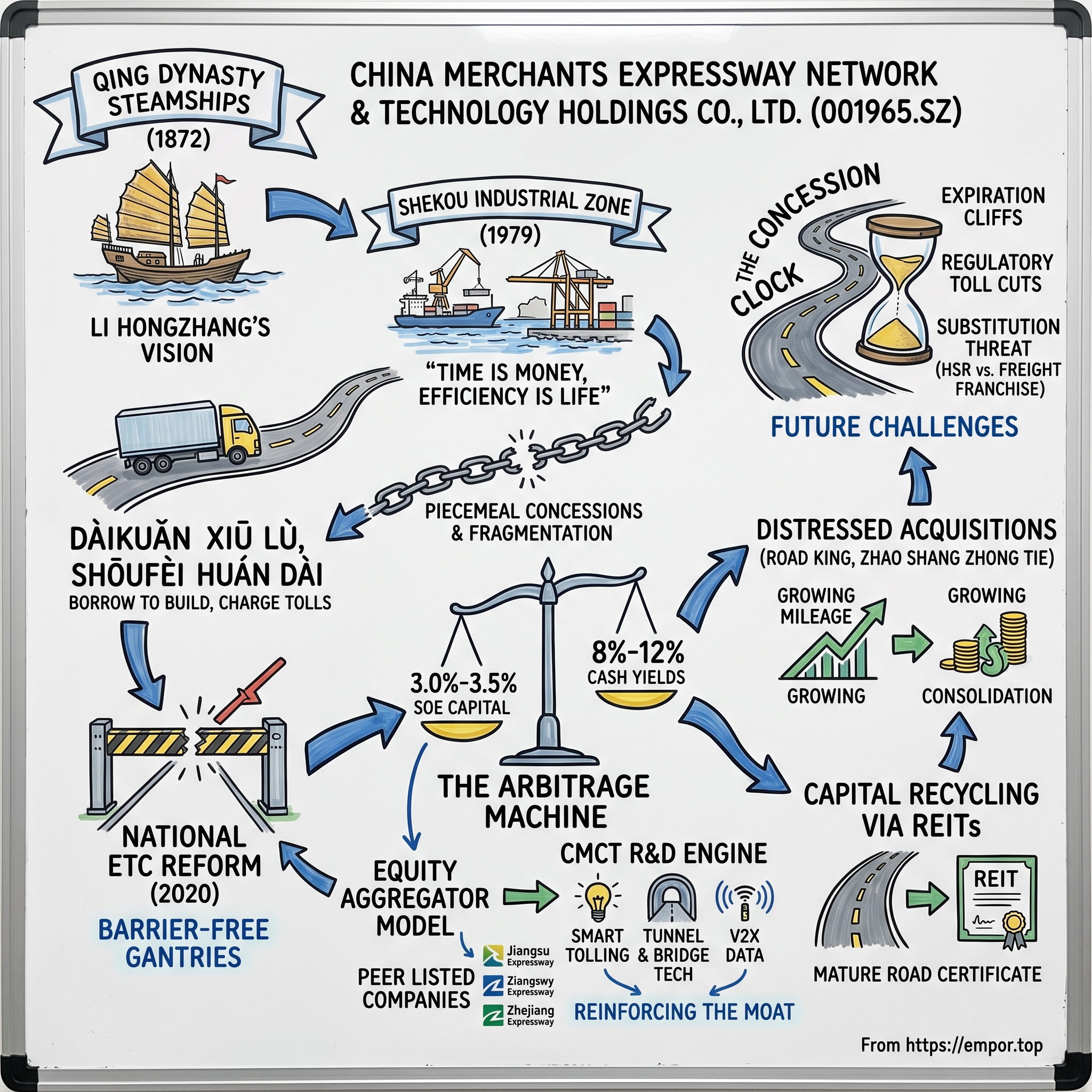
That barrier-free gantry the coal truck sailed under is itself a recent invention, and it is central to the story. As late as 2019, crossing China by road meant stopping at a manned toll booth every time you passed from one province into the next—hundreds of them nationwide, each a queue, a receipt, and a bottleneck. Then in a burst of top-down reform, Beijing ordered the provincial-border booths torn out and replaced with a national electronic toll collection network. On a single day, January 1, 2020, 487 toll stations across 29 provincial-level regions went dark, and the whole country switched from station-to-station charging to seamless, sectioned, cloud-computed tolling.2021 Within months, more than a hundred million drivers were paying without slowing down.21 For an operator like China Merchants Expressway, that reform did two things at once: it made the roads move faster and cheaper to run, and it turned toll collection into a software-and-data problem—exactly the terrain its in-house technology arm was built to own.
But calling China Merchants Expressway "a toll-road company" is a little like calling 伯克希尔 Berkshire Hathaway "a textile mill." The label is technically true and almost entirely misleading. What the company actually runs is closer to a national holding clearinghouse for toll cash flows—an equity aggregator that sits above the fragmented world of provincial road operators and pulls their dividend streams upward.
The core thesis, stated plainly. China Merchants Expressway is, at bottom, a balance-sheet arbitrage machine wearing the uniform of a highway operator. As a 中央企业 central state-owned enterprise (central SOE) inside the sprawling 招商局集团 China Merchants Group, it borrows at rates that hover around 3.0%–3.5%—among the cheapest capital available to any corporate borrower in China—and deploys that money into toll-road assets that throw off high-single-digit to low-double-digit internal rates of return.3 Buy an 8%–12% cash yield with 3% money, do it at national scale, and repeat. That spread is the whole game.
Three features make the machine distinctive. First, the equity-aggregator model: unlike a provincial operator locked into a single geography, China Merchants Expressway holds strategic stakes across a dozen-plus listed road operators nationwide, giving it exposure to corridors it does not directly control.1 Second, the cheap-capital advantage, which turns the company into a natural consolidator whenever a private developer or over-levered regional player is forced to sell. Third, a hidden technology arm—招商局重庆交通科研设计院有限公司 China Merchants Chongqing Transportation Research and Design Institute Co., Ltd. (招商交科 CMCT), a national engineering authority that designs tunnels, long-span bridges, and the smart-tolling systems that let that coal truck sail through the gantry without stopping.4
In market terms, this is not a small company hiding in a boring corner. By mid-2026 the shares traded around RMB 10 apiece, giving the group a market capitalization in the neighborhood of RMB 70 billion, with the stock having spent the prior year in a range roughly between RMB 8.7 and RMB 12.3 That valuation carries a specific personality. It does not swing on quarterly product cycles or viral growth; it grinds along on traffic data, interest rates, and the steady drip of dividends. Investors who own it are, for the most part, buying a claim on a slice of China's freight economy dressed up as a yield instrument—and understanding why that framing is both the appeal and the ceiling is the point of everything that follows.
A quick word on what this company is not, because the confusions are common. It is not the parent conglomerate—招商局集团 China Merchants Group is a vast state enterprise spanning ports, banking, shipping, and property, of which the listed road company is one publicly traded limb. It is not a construction contractor that builds roads for a fee and moves on; it owns the right to collect tolls for decades. And it is not a provincial road champion like 山东高速 Shandong High-speed or 宁沪高速 Jiangsu Expressway, each anchored to a home region—it is the national aggregator that sits above them, and in several cases owns pieces of them.
Where this story goes from here: we trace the improbable lineage from a Qing-dynasty steamship bureau to a Shenzhen-listed road empire; we dissect the 2016–2017 financial engineering that created the listed company; we open the hood on the capital-allocation playbook—the rollups, the valuation discipline, and the Belt-and-Road deal management walked away from; we size the segments and test the economics; we run the business through Hamilton Helmer's 7 Powers and Porter's 5 Forces; and finally we stress-test the bull case against the concession cliff, the toll-cut politics, and the bullet trains bearing down on the passenger business. Let us begin where China Merchants itself began—more than a century and a half ago, with coal, steamships, and a dying empire trying to modernize.
 Subscribe on LinkedIn
II. History & Founding Context: From Qing Dynasty Steamships to Expressway Infrastructure (1872–2000)
The oldest continuously operating Chinese corporate brand does not belong to a tech giant or a liquor house. It belongs, arguably, to a shipping bureau founded in the twilight of imperial China. In 1872, the reform-minded viceroy 李鸿章 Li Hongzhang, a central figure of the 洋务运动 Self-Strengthening Movement, chartered the 轮船招商局 China Merchants Steam Navigation Company to break the stranglehold that British and American firms held over China's coastal and river shipping.5 The idea was radical for the late Qing: a Chinese-run, commercially organized enterprise that could carry tribute grain, haul cargo, and keep freight revenue in Chinese hands rather than surrendering it to the treaty-port foreigners.
Dwelling too long on the nineteenth century would be indulgent; what matters is the DNA that survived. China Merchants became a pioneer of Chinese industrial modernity—an incubator of the country's first modern bank, its early coal mines, its telegraph lines, and its insurance ventures. The institutional habit that carried forward across 150 years was not shipping per se but a template: identify a piece of national infrastructure dominated by foreigners or fragmented among locals, build a commercially disciplined operator, and consolidate. That template is exactly what the modern toll-road business would replicate a century later.
The story then skips forward through revolution, war, and the planned economy to its true modern hinge point: 1979, and a strip of mud flats in Shenzhen called Shekou. Here the reformer 袁庚 Yuan Geng, a China Merchants executive with a soldier's bluntness and a reformer's nerve, was handed a mandate to build China's first export-oriented industrial zone. Yuan Geng was an unlikely revolutionary of commerce—a former intelligence officer who had spent years in the Party apparatus before being entrusted, in his sixties, with an experiment that could have ended his career had it failed. He ran Shekou with an impatience that scandalized the planners: he introduced piece-rate pay, competitive bidding, and management by results in a system that still equated profit with heresy. The slogan he hung over Shekou—"Time is money, efficiency is life" (时间就是金钱,效率就是生命)—became one of the defining phrases of the entire reform era, a jarring bit of capitalist candor in a country still nominally committed to central planning.5 It captured a worldview that would echo, decades later, in a company obsessed with the velocity of vehicles through a toll gantry and the return on every yuan of borrowed capital.
Shekou was where China Merchants relearned how to operate as a commercial enterprise rather than a state ministry, and where the group's appetite for building and running infrastructure—ports first, then roads—was rekindled. The port business taught China Merchants the essential lesson of infrastructure investing: that owning a chokepoint through which trade must flow is a licence to collect a fee on economic activity itself, insulated from the boom-and-bust of any single customer. A container terminal charges every ship; a toll road charges every truck. The conceptual leap from the one to the other was small, and the group made it naturally as China's 1990s road-building frenzy created a new category of chokepoint to own.
Through the 1980s and 1990s, as China Merchants Group expanded from ports and shipping into a diversified conglomerate spanning finance, real estate, and logistics, it began putting money into the physical arteries that a booming manufacturing economy suddenly needed. And here the story collides with one of the great financing puzzles of modern China.
The toll-road dilemma. By the early 1990s China desperately needed intercity highways, and the central government did not have the money to build them. Its solution was to import a mechanism the world's infrastructure financiers already knew well: the "Build-Operate-Transfer" concession, in Chinese 收费公路经营权 toll-road concession rights. A builder—often a local government vehicle, sometimes a joint venture with private or foreign capital—would fund and construct a road, then collect tolls for a fixed term of typically 25 to 30 years to recoup its investment and earn a return, after which the road reverted to the state. It was, in effect, a way to borrow against future traffic.
The policy that unlocked it all had a blunt, four-character name that every Chinese infrastructure official of the era could recite: 贷款修路,收费还贷 borrow to build the road, charge tolls to repay the loan. Local governments and their financing vehicles took out bank loans, poured concrete, and used the toll receipts to service the debt. It was a pragmatic fix for a poor country in a hurry, and it worked: China went from almost no expressways at the end of the 1980s to the largest network on Earth within a generation. The first modern expressway, connecting Shanghai to Jiading, opened in 1988; three decades later the map ran to six-figure kilometers. Few infrastructure build-outs in human history have moved that fast.
But the mechanism that was spectacular at building roads was disastrous at building a coherent system. Because concessions were awarded piecemeal by cities and by more than thirty provincial-level SOE road monopolies, China's expressway map grew as a patchwork of local fiefdoms—redundant toll booths at provincial borders, incompatible collection technology, and bottlenecks wherever one operator's corridor handed off to another's. A truck driving from Guangdong to Beijing might stop and pay a dozen times, at gates operated by a dozen unrelated entities using a dozen different systems. Every province had its own road champion; none had a national platform. The fragmentation was not a bug that regulators overlooked; it was the direct consequence of a financing model that pushed responsibility—and toll-collection rights—down to whoever could raise the money locally.
Into that fragmentation stepped China Merchants Group, assembling early joint-venture toll roads and, in 1993, founding the investment vehicle—Huajian Highway Investment Co., Ltd.—that would eventually become the listed China Merchants Expressway.1 Unlike a provincial operator, China Merchants had a national footprint and a central-SOE pedigree, which let it buy stakes in roads far from any single home turf. From the beginning, in other words, its identity was that of a portfolio holder rather than a local road builder—a distinction that would define everything the company became.
For roughly two decades that vehicle grew quietly inside the conglomerate, buying stakes in roads up and down the country. It was a captive state holding company: real assets, real cash flows, but no public listing, no market discipline, and no obvious way to recycle capital at scale. The question by the mid-2010s was how to convert this sprawling private portfolio into a public, permanently financed platform. The answer was one of the more elegant pieces of financial engineering in recent Chinese capital-markets history.
III. The Masterstroke Listing & Structure Creation (2016–2017)
Every reverse merger has a shell, and China Merchants had spotted its shell years in advance. But before the listing came a subtler move—one that revealed how management thought about the difference between owning roads and owning a road business.
Inflection point one: bolting on a national R&D engine (2016). In the run-up to the listing, China Merchants Group folded 100% of 招商局重庆交通科研设计院有限公司 CMCT into the highway platform.4 On paper this looked like a routine intra-group asset shuffle. In substance it was strategic. CMCT was no ordinary design house. Founded in 1965 as the Chongqing branch of the transport ministry's research academy and absorbed into China Merchants Group in 2000, it had become one of China's premier transportation-engineering authorities—home to the 国家山区公路工程技术研究中心 State Mountainous Highway Engineering Technology Research Center, the 公路隧道国家工程研究中心 Highway Tunnel National Engineering Research Center, and a national key laboratory for bridge structural dynamics, among more than twenty national- and provincial-level innovation platforms.6 It employed hundreds of senior engineers, including academicians of the Chinese Academy of Engineering, and plowed close to a tenth of its revenue back into research.6
Why does a toll collector need a tunnel-engineering laboratory? Because it converts the company from a passive holder of concessions into a firm that can design, build, upgrade, and digitize its own corridors—and sell that expertise to everyone else's. The engineering arm is what lets management argue, with a straight face, that this is a technology holding company and not merely a landlord charging rent on asphalt. Whether that argument holds up in the revenue mix is a question we will interrogate later; for now, note the intent.
The timing of the CMCT injection was not accidental. It landed just as China's transport ministry was gearing up for the nationwide ETC and free-flow-tolling reform that would arrive in 2019–2020. A design-and-technology institute with deep expertise in tolling systems, incident detection, and highway informatics was suddenly not a curiosity but a strategic weapon: when Beijing ordered every provincial-border booth ripped out and replaced with gantries and cloud servers, an operator that could engineer and deploy those systems in-house—and market them to peers—was positioned to profit from the very reform that upended the industry. Folding the national R&D authority into the listed vehicle gave China Merchants Expressway a claim on being the technology backbone of the country's road network, not just one more toll payer within it.
Inflection point two: the absorption merger of Huabei Expressway (December 2017). The shell was 华北高速 Huabei Expressway, formerly ticker 000916.SZ, a listed operator whose crown jewel was the Beijing–Tianjin Expressway. Huabei had a problem common to single-asset road companies: its concessions were aging, its geography was narrow, and its growth runway was short. What it did possess was something China Merchants coveted—a live listing on the Shenzhen main board.
The transaction architecture was a share-swap absorption merger. China Merchants Huajian, already a large shareholder, agreed in June 2017 to absorb the remaining 73.18% of Huabei it did not own, in an all-share deal valued at roughly RMB 4.5 billion for that tranche.7 Rather than Huabei acquiring assets, the private highway parent issued new A-shares, swallowed the listed shell, dissolved it, and had itself listed in its place. The regulator's M&A committee cleared the deal in October 2017, and on December 25, 2017, 华北高速 Huabei Expressway was delisted and dissolved while 招商公路 China Merchants Expressway began trading under ticker 001965.SZ.78
The elegance is worth pausing on. A backdoor listing let China Merchants avoid the queue and uncertainty of a conventional IPO—no small thing in a Chinese market where the regulator's approval pipeline could strand a candidate for years—gave the sellers of Huabei paper in a far larger and more diversified entity rather than cash, and—crucially—created something China had never had before: a single, cross-provincial, publicly traded highway platform that combined toll-road investment, direct operations, in-house research and design, and electronic toll collection technology (电子不停车收费系统 Electronic Toll Collection / ETC) under one balance sheet. The fragmented map suddenly had a national roll-up vehicle sitting on top of it, with public equity to fund the next decade of consolidation.
There is a neat piece of symmetry in the choice of shell. Huabei's declining, geographically narrow concession was precisely the kind of asset the new company was built to fix—a mature, single-region road with a shrinking runway. By absorbing it, China Merchants did not just acquire a listing; it demonstrated, in its very first act as a public company, the core competency it would spend the next decade selling to investors: taking a decaying road asset and folding it into a diversified national portfolio where the aggregate cash flow outlives any individual concession. The shell was not incidental to the strategy. It was a proof of concept.
So what did investors actually receive? Not a growth story in the venture sense, but a platform: cheap SOE capital, a national mandate, an engineering moat, and a listed currency with which to buy roads. What management did with that currency over the next seven years is the real test of the model—and the subject of the next act.
IV. The Capital Allocation Playbook: Rollups, Valuation Benchmarking, & Cross-Border Discipline
Here is where a toll-road company stops being boring. Strip away the asphalt and China Merchants Expressway is a capital-allocation shop, and capital allocation is where management teams reveal who they actually are. The record from 2018 onward reads like a case study in disciplined, opportunistic consolidation—punctuated by one high-profile decision to walk away.
The equity-aggregator model in practice. The base layer of the strategy is a portfolio of minority and majority stakes in China's best provincial road operators—names such as 宁沪高速 Jiangsu Expressway, 浙江沪杭甬 Zhejiang Expressway, 山东高速 Shandong High-speed, 皖通高速 Anhui Expressway, 四川成渝 Sichuan Expressway, and 中原高速 Henan Zhongyuan Expressway. By the end of 2024 the company held equity in 16 listed peers.1 The logic is subtle and worth spelling out: China's best toll corridors are already owned by entrenched provincial champions that will never sell control. You cannot buy Jiangsu's roads outright. But you can buy a slice of Jiangsu Expressway's stock, collect its dividends, and gain economic exposure to traffic you could never otherwise touch. The minority book is a way of renting the best assets in the country while reserving scarce capital for the situations where actual control is on the table.
There is a deeper elegance to the minority book that is easy to miss. Because China Merchants holds stakes in operators like 宁沪高速 Jiangsu Expressway, 浙江沪杭甬 Zhejiang Expressway, 山东高速 Shandong High-speed, 皖通高速 Anhui Expressway, and 四川成渝 Sichuan Expressway, it gains something no single operator has: a panoramic, real-time read on toll-road economics across the country's most important corridors.1 It sits on boards, sees the traffic data, and understands the transaction comps better than any outsider—which is precisely the intelligence advantage that lets it price acquisitions and know when a distressed seller's road is a bargain or a trap. The equity aggregator is not just collecting dividends; it is running the industry's best information network, and information is the raw material of disciplined dealmaking. And control, when it appears, usually appears because someone else is in trouble. Which brings us to the rollups.
Case study one — the step-acquisition of 招商中铁 Zhao Shang Zhong Tie (2019–2023). In 2019 China Merchants Expressway partnered with 工银投资 ICBC Investment to carve a package of expressway assets out of the railway conglomerate 中国中铁 China Railway Group, structured around Guangxi China Railway Expressway. China Merchants took 49%, ICBC 2%, and the two together bought 51% control—a classic use of a co-investor to share the check while the operator retains the wheel.9 The package was substantial: on the order of a thousand kilometers of road spread across seven provinces and regions.9 Then, in December 2023, China Merchants bought out ICBC's 2%, lifting itself to outright 51% control, renamed the vehicle 招商局中铁公路交通有限公司 China Merchants China Railway Expressway (招商中铁 Zhao Shang Zhong Tie), and—this is the key accounting move—consolidated the whole asset package onto its own balance sheet.
The consolidation is why 2024 revenue jumped 30.6% to RMB 12.71 billion.10 A minority stake shows up as a line of investment income; a controlled, consolidated subsidiary brings its entire top line onto your income statement. The same underlying roads, moved from the "associates" column to the "subsidiaries" column, transformed the reported scale of the company and added more than two thousand kilometers of net operated mileage across Guangxi, Henan, Shanxi, and Shaanxi. The maneuver is a reminder that a good chunk of this company's reported "growth" is deliberate financial architecture rather than organic traffic—a point a skeptical investor should hold onto when reading the headline numbers.
Case study two — distressed acquisitions and the 2023 buying spree. The best time to buy toll roads is when the sellers cannot afford to hold them, and 2023 delivered exactly that setup. China's property developers were in a liquidity crisis, and several had toll-road portfolios they needed to monetize. In November 2023 China Merchants Expressway agreed to acquire four mainland expressways—Baojin, Changyi, Longcheng, and Machao—from the Hong Kong-listed developer 路劲基建 Road King Infrastructure for roughly RMB 4.412 billion.1112 Around the same time it teamed with 浙江沪杭甬 Zhejiang Expressway to take a 60% stake in Hunan's 永蓝高速 Yonglan Expressway through a joint venture.11
What makes these deals interesting is the price. Management was reportedly buying at implied EV/EBITDA multiples in the mid-single digits and price-to-book ratios comfortably below the levels at which toll roads had historically traded hands in China. Buying high-cash-flow national arterial routes at a discount to replacement value, precisely because the seller was a stressed offshore developer, is the balance-sheet arbitrage thesis made concrete: cheap SOE money meeting forced sellers. That said, "distressed" cuts both ways—roads sold by struggling developers can carry weaker traffic profiles, shorter residual concessions, or deferred maintenance, and a disciplined analyst should treat the low multiple as a starting question, not a settled verdict.
Case study three — the Turkey walkaway (2019–2022). The most revealing capital-allocation decision of the era was one where China Merchants ultimately spent nothing. In late 2019 the company led a consortium of Chinese road operators—including Zhejiang, Jiangsu, Sichuan, and Anhui Expressway—to acquire 51% of Turkey's ICA, operator of Istanbul's Third Bosphorus Bridge (the Yavuz Sultan Selim Bridge) and the Northern Marmara Motorway, for about USD 688 million.1314 It was a marquee Belt-and-Road transaction: a Chinese consortium taking control of a landmark European crossing.
Then the world changed. The Turkish lira went into a tailspin, COVID-19 gutted traffic forecasts, and the debt-refinancing terms that underpinned the economics stopped making sense. By August 2021 the deal was widely reported to be on the verge of collapse, and in early 2022 the Chinese group terminated it.15 For a foreign investor, the bridge's toll revenue was denominated in a currency losing value by the month against the dollars in which its debt was owed—a textbook unhedged foreign-exchange mismatch. Rather than absorb that risk to protect a prestige deal, management walked. For a Chinese SOE operating under Belt-and-Road political expectations, publicly abandoning a signature overseas infrastructure acquisition is genuinely rare, and it is the single strongest data point in favor of taking management's professed discipline at face value.
The fourth pillar — recycling capital through REITs. A consolidator that only ever buys eventually runs into a wall: mature roads with dwindling concession life tie up capital that could be earning higher returns in newer corridors, and the balance sheet cannot absorb debt forever. China's answer, rolled out from 2021 onward, was the public infrastructure REIT—a vehicle that lets an operator sell a mature road's future cash flows to public investors, book the proceeds, and redeploy them, while often retaining a management role and a residual stake. In October 2024, China Merchants Expressway became one of the earliest highway operators to use it, floating the Anhui Bofu Expressway (亳阜高速) into a listed REIT that raised roughly RMB 3.5 billion.22 The road—a north-south freight and tourism corridor in northwestern Anhui—was chosen precisely because it was a stable, seasoned asset whose predictable tolls appealed to the yield-hungry buyers of a REIT.
Why this matters strategically is subtle but important. The REIT converts the company from a pure buy-and-hold accumulator into a recycler: it can crystallize the value of a maturing road at an attractive multiple, hand the concession-expiry risk to REIT unitholders, and roll the freed-up capital into the next distressed acquisition—all while continuing to collect management fees and technology revenue from the same road. It is, in effect, an exit valve bolted onto the arbitrage machine, and it directly addresses the single biggest structural weakness of the toll-road model, the wasting-asset problem we will dissect later. The skeptic's counterpoint is that REITs also let a company flatter its returns and headline growth by selling assets at the top and booking gains, so the quality of what gets recycled into matters at least as much as the elegance of what gets recycled out.
Myth versus reality. The consensus story on China Merchants Expressway is that it is a sleepy state utility—a bond with a stock ticker. The reality is more interesting and more double-edged. Myth: it is a safe, steadily growing toll collector. Reality: a meaningful share of its recent "growth" was manufactured by consolidating acquired subsidiaries onto the income statement, and the same year that revenue leapt, profit and margins fell—so the smoothness is partly an accounting surface over a genuinely cyclical, capital-intensive business. Myth: as an SOE, it overpays for trophy assets and plants flags for political reasons. Reality: the Turkey walk-away and the disciplined distressed buying suggest a management team that has, so far, behaved more like a value investor than a flag-planter. Myth: the concession clock makes it a slow-motion liquidation. Reality: the REIT toolkit and the extension-through-reinvestment playbook give it more levers to fight the clock than a static discounted-cash-flow model would assume—though none of those levers is free. Holding both the myth and the reality in view is the only honest way to read the company.
The through-line across all four pillars is the same: buy control only when the price is right, rent exposure through minority stakes everywhere else, recycle mature assets to fund the next move, and refuse to let strategic optics override financial logic. The next question is what all this deal-making actually produced in the operating business.
V. Segment-Level Economics & Current Operations
Picture the income statement as a three-lane highway. One lane carries almost all the traffic; the other two exist mostly to make the first lane run better. That is the shape of China Merchants Expressway's business, and it is worth walking each lane in turn.
The proportions. The dominant segment—toll-road investment and operation (投资运营)—accounts for the large majority of revenue and an even larger share of operating profit, because toll cash flows carry gross margins that dwarf the group's other activities. The expressway technology and design segment (网络科技/勘察设计), powered by CMCT and the smart-highway stack, is a materially smaller slice of revenue but a disproportionately important one for the story management wants to tell about margins and re-rating. And a thin third lane—ecosystem and service areas (交通生态/服务区)—covers service stops, EV charging, and maintenance, low-margin work that exists mainly to feed and support the core. Management does not disclose these splits with perfect stability year to year, and consolidation of 招商中铁 Zhao Shang Zhong Tie reshaped the mix, so the sensible posture is to treat the toll segment as roughly four-fifths of the business and the technology arm as the clear number two.
Lane one: the cash cow. The toll business generates the bulk of the company's roughly RMB 10 billion-plus in annual revenue and does so at gross margins that comfortably exceed half.10 The economics are almost unnervingly simple. A concession grants the exclusive right to charge vehicles for using a specific stretch of road; provincial transport bureaus set the rate schedule by vehicle class and tonnage; and the operator collects. The single most important nuance is the freight mix. A heavily loaded truck pays several times more per kilometer than a passenger sedan, which means the profitability of any given corridor is levered to industrial activity and logistics volumes far more than to holiday car travel. When Chinese factories hum and construction sites churn, the heavy trucks roll and the high-margin tolls flow; when industrial output softens, the most profitable traffic thins out first. The toll business is, in effect, a real-time meter on the goods economy of whichever provinces a road happens to cross.
That sensitivity showed up starkly in the divergence between revenue and profit. In 2024, even as consolidation drove the top line up more than 30%, attributable net profit fell about 21% to RMB 5.32 billion, and even stripping out one-offs, the underlying figure declined.10 The culprits management pointed to were a meaningful drop in gross margin, a sharp rise in financial expenses from consolidating 招商中铁 Zhao Shang Zhong Tie's debt, and a lower base of non-recurring gains versus a flattering prior year.10 The lesson for investors is uncomfortable but clarifying: adding roads through debt-funded consolidation can grow revenue and mileage while simultaneously compressing margins and loading the balance sheet with interest cost. Scale and profitability are not the same thing in this business, and 2024 was the year that gap became visible.
There is a second nuance worth internalizing about toll economics: the cost structure is almost entirely fixed. Once a road is built, the marginal cost of one more vehicle passing over it is essentially zero—no extra asphalt, no extra staff, no incremental input. That is what produces the fat gross margins, and it is also what makes the business so operationally leveraged in both directions. When traffic rises, almost every additional yuan of toll drops to profit; when a typhoon closes a corridor for three days, the revenue vanishes while the depreciation, the interest on the construction debt, and the maintenance crews all keep costing money. A toll road is a high-fixed-cost, near-zero-variable-cost machine, which is why weather events and holiday toll waivers hit this company harder than the modest-sounding number of lost days would imply.
Lane three: the ecosystem. The thinnest lane—service areas, fuel and food concessions, EV charging stations, and roadside maintenance—matters less for its own economics, which are low-margin, than for what it hints about the future. As China's vehicle fleet electrifies, the service areas dotting a 14,000-kilometer network become prime real estate for charging infrastructure, and the operator that controls the land controls the charging rent. It is optionality, not a profit center today, and management would be overselling it to call it more. But it is a reminder that a physical network of captive, high-traffic waypoints has uses beyond the toll gantry, and that whoever owns the road also owns the pit stops.
Lane two: the technology engine. This is the segment management most wants you to watch, and the one to scrutinize most skeptically. The centerpiece is a proprietary smart-highway platform—marketed as "Zhao Lu Tong 3.0" (招路通3.0)—deployed across thousands of kilometers to handle automated incident detection and free-flow, cloud-based tolling: the technology that lets our coal truck clear the gantry without slowing down. It helps to demystify what "smart highway" actually means, because the phrase is doing a lot of marketing work. Strip away the jargon and it is three practical capabilities. First, free-flow tolling: instead of a barrier that stops each car, overhead gantries read a transponder and a cloud system tallies the fare across sections of road, the same architecture the whole country adopted in the 2019–2020 ETC reform. Second, automated incident detection: cameras and sensors watch the road and flag a stalled truck or a pile-up in seconds rather than waiting for a driver to phone it in, which shortens closures and, not incidentally, protects toll revenue. Third, traffic and asset data: the network becomes a live sensor grid whose data can optimize maintenance, model congestion, and—eventually—talk to vehicles.
That last thread is the forward optionality: the V2X (vehicle-to-everything) smart-freight-corridor work in the Beijing–Tianjin–Hebei region, aimed at eventually supporting commercial autonomous trucking lanes. The plain-English version is a road that broadcasts to trucks—warning them of hazards ahead, coordinating their spacing, potentially letting them platoon nose-to-tail to save fuel and, someday, drive themselves. If autonomous freight becomes real, the operator that owns both the road and the roadside intelligence controls a toll booth on the future of logistics. The bull framing follows naturally: this arm turns a passive toll collector into a smart-transportation platform, expands blended margins, and justifies a higher valuation multiple than a pure infrastructure play. The neutral reading is that it remains a modest fraction of revenue, that "smart highway" and "autonomous freight" are still promises rather than proven profit centers, and that the burden of proof is on management to show the technology segment scaling into something that meaningfully moves group economics rather than functioning as an internal cost center with good marketing. Until the segment's revenue and margin visibly bend the group's numbers, a disciplined investor treats the technology story as free optionality attached to a cash-cow infrastructure business—valuable if it works, but not something to pay a premium for in advance.
What the most recent results say. The trajectory into 2025 reinforced the theme rather than resolving it. For full-year 2025 the company reported revenue of roughly RMB 13.3 billion—modest single-digit growth as the 招商中铁 Zhao Shang Zhong Tie consolidation annualized—while attributable profit stayed in the mid-RMB-4-billion range, still below the flattered 2023 peak.18 Strip away the consolidation and the disposal gains, and the underlying operating picture is one of a mature cash generator whose profits ebb and flow with freight volumes, weather, and toll policy rather than compounding briskly upward. That is not a criticism—it is the honest nature of the asset class—but it is the reason the equity has behaved more like a yield instrument than a growth stock, and why the argument for owning it rests on dividends and disciplined capital recycling rather than on a rising earnings curve.
Governance and the shareholder register. At the top sits the parent. 招商局集团 China Merchants Group controls upward of 68% of the equity, which delivers the twin benefits at the heart of the whole thesis—implicit state backing and the resulting access to ultra-cheap debt—while leaving a meaningful free float for institutional investors.1 Leadership turned over recently: in early 2026 the board completed a scheduled reshuffle, with Song Rong (宋嵘)—concurrently a vice general manager and chief legal officer of China Merchants Group—elected chairman and Yang Xudong (杨旭东) appointed general manager.1617 The capital-return record is the register's main attraction for its core owners: the company has sustained a payout ratio around half of earnings, and for 2024 proposed a cash dividend of RMB 4.17 per 10 shares.18 At a mid-single-digit dividend yield, the stock functions as a de facto bond proxy—which is precisely why Chinese domestic insurance capital (险资), forever hunting for stable long-duration yield to match its long-dated liabilities, treats it as a portfolio staple. The flip side of that bond-proxy identity is that the stock trades on yield and rates as much as on operating momentum, a dynamic the framework section will make explicit.
The 68% parent stake is a double-edged sword that any governance-minded investor should weigh honestly. On one edge, it is the source of the entire thesis: state control is what delivers the AAA credit halo, the cheap funding, and the pipeline of assets that a central SOE gets first look at. On the other, it concentrates power in a controlling shareholder whose objectives are not always identical to those of minority holders. Related-party transactions—buying assets from, or selling into, other arms of 招商局集团 China Merchants Group—are a permanent feature of an SOE's life, and while they can be perfectly fair, they warrant scrutiny because the counterparty sits on both sides of the table. The same is true of any pressure to support national policy goals, from Belt-and-Road ambitions to logistics-cost mandates, that a purely private operator could simply decline. Minority investors ride alongside the state here; most of the time that is a privileged seat, but it is never a seat with its hands on the wheel.
VI. Strategic Frameworks: Hamilton Helmer's 7 Powers & Porter's 5 Forces
Strip the company down to its competitive skeleton and ask the only question that matters for a long-term owner: what actually stops someone else from taking these profits? Two frameworks—Hamilton Helmer's 7 Powers and Michael Porter's 5 Forces—give complementary answers, and they largely agree.
Helmer's 7 Powers. The dominant power here is Cornered Resource. Each concession is an exclusive, government-granted right to charge for a specific ribbon of land for 25 to 30 years, and the land corridor itself is irreplaceable—you cannot route a competing expressway through the same mountain pass or river crossing, and no one can legally build a parallel toll road without provincial transport-bureau approval that will not be forthcoming. It is close to a legal-plus-geographic monopoly on a fixed piece of the earth's surface. The obvious limitation, which we will return to, is that a cornered resource with an expiry date is a wasting asset: the clock on every concession is always running down.
The second power is Scale Economies, but of an unusual, financial kind. The binding advantage is cost of capital. As a central SOE with a top-tier domestic credit profile, China Merchants can tap the bond market at rates that provincial and private peers cannot touch—issuing, for instance, "technology-innovation" perpetual corporate bonds to professional investors on the strength of an AAA rating.323 The mechanics of why this matters deserve a beat of explanation. Toll roads are valued off their cash flows discounted back to today; the lower your cost of capital, the more any given stream of future tolls is worth to you than to a higher-cost bidder. So when a stressed developer puts a road up for sale, the central SOE can rationally outbid every provincial rival and still earn its target return, simply because it discounts the same cash flows at a lower rate. A funding edge of even one to two percentage points, compounded across a 25-year concession, is not a rounding error—it is the mechanical engine of the entire arbitrage, and it is why consolidation naturally flows toward the cheapest balance sheet in the industry. Centralized procurement of tolling hardware and software through in-house CMCT reinforces the point at the operating level.
The catch, and it is the one a careful analyst keeps in the back pocket, is that this power is borrowed, not intrinsic. The cheap funding exists because the market treats China Merchants paper as quasi-sovereign, backed implicitly by the parent and ultimately the state. Should that implicit backing ever be questioned—through an SOE-reform shock, a broader sovereign-credit repricing, or a governance stumble at the group level—the funding edge could narrow, and with it the whole competitive advantage. Scale economies rooted in a credit halo are real but not unconditional.
To make the cornered-resource point concrete: imagine a mountain valley through which exactly one viable expressway route runs, and China Merchants holds the concession on it. A competitor cannot build a second road through the same valley—the geography forbids it, the land-use quota forbids it, and the transport bureau would never license a redundant parallel corridor that cannibalized traffic and toll revenue the state itself relies on. The monopoly is enforced by physics and by policy simultaneously. That is a far harder moat to breach than a brand or a patent, both of which can be out-innovated or worked around. What it cannot resist, uniquely, is time—and that single vulnerability, the expiry date, is why the whole framework ultimately bends back to the concession clock.
The third power is Process Power, embodied in CMCT's half-century of accumulated expertise in the genuinely hard problems of Chinese civil engineering: mountainous terrain, long-span bridges, and underwater tunnels.6 Building a kilometer of expressway through Guizhou's karst mountains or under a major river is not a commodity task; it demands specialized design capability that takes decades to accumulate and cannot be bought off a shelf, which is why CMCT's national research centers represent a genuine, if supporting, edge. Still, honesty requires proportion: this is more a moat around the operating business than a standalone profit machine. The remaining Helmer powers—network economies, switching costs, branding, counter-positioning—are largely absent, and saying so plainly matters. A driver does not choose China Merchants' road over a rival's out of loyalty; there is no rival, because there is no parallel road. The company's advantages are structural and financial, not behavioral, and an investor should not imagine a consumer-franchise moat where none exists.
Porter's 5 Forces. The forces analysis explains why the industry is structurally attractive and where the one real crack lies.
Threat of new entrants: negligible. The capital intensity is staggering, land-use quotas are tightly rationed by the state, and concessions are licensed, not competed for on the open market. Private capital simply cannot assemble a competing national road network.
Bargaining power of buyers: very low. Commuters and freight fleets pay a rate hardcoded into the electronic gantries. There is no negotiation, no volume discount, no shopping around for a cheaper lane.
Bargaining power of suppliers: low. Construction materials and civil-engineering contractors are abundant and commoditized in China, and CMCT internalizes much of the specialized design work that might otherwise confer supplier leverage.
Competitive rivalry: low. Toll roads are spatial monopolies. Two operators on two different corridors are not competing for the same car in the way two airlines compete for the same passenger; each simply meters its own stretch of asphalt.
Threat of substitutes: this is the exception, and it is moderate-to-high. China's 中国高铁 High-Speed Rail (HSR) network is a formidable substitute for long-distance passenger travel, and it has already siphoned a great deal of intercity car and coach traffic. The country built the world's largest bullet-train network over the same decades it built its expressways, and for a business traveler choosing between a four-hour drive and a ninety-minute train, the train increasingly wins. Against that, the freight franchise is far more defensible: rail cannot deliver door-to-door, cannot flex to a factory's just-in-time schedule, and cannot economically carry the countless small-batch, mixed-cargo loads that define modern e-commerce and manufacturing logistics. Short-to-medium-haul trucking remains structurally irreplaceable for most goods. So the substitution threat bites hardest precisely where toll margins are thinnest (passenger cars) and glances off where margins are fattest (heavy freight)—an asymmetry that is genuinely favorable, but not a reason to dismiss HSR entirely, because passenger tolls, thin margin or not, are still real revenue that the trains are quietly eroding.
Put the two frameworks together and the verdict is coherent: this is a structurally advantaged business with a powerful but time-limited moat and a financial edge that is real but dependent on continued cheap-SOE funding. Which is the perfect setup for the harder conversation—what could actually break the case.
VII. The Investment Story Spine, Risk Radar, & Skeptical Investor Stress Test
Every infrastructure business eventually confronts the same brutal arithmetic: the asset you are collecting rent on has an expiration date stamped on it. For China Merchants Expressway, the entire bull-versus-bear debate can be organized around whether the company can outrun that clock. Let us make the spine explicit.
Why this wins (the bull case). First, the balance-sheet arbitrage is not theoretical—it has been demonstrated repeatedly, most clearly in the 2023 distressed acquisitions, where cheap SOE capital met forced sellers and produced roads bought below historical transaction comps. As long as China's regional and private operators periodically hit liquidity walls, a national consolidator funded at 3% will be the natural buyer, and the funding edge is durable so long as the parent's credit standing holds. Compared with a pure provincial operator—which can only grow by building or buying within its home region, and which funds itself more expensively—China Merchants has both a wider hunting ground and a structurally lower cost of acquiring cash flows. That combination is genuinely difficult for any single-province peer to replicate, and it is the clearest evidence-based edge in the whole story. Second, the dividend moat: a mid-single-digit yield backed by contractual toll cash flows offers genuine downside protection and a natural buyer base in insurance capital, which is why the stock behaves like a bond proxy through equity-market volatility. Third, the technology optionality—if, and it is a real if, Zhao Lu Tong and V2X freight corridors mature into a scaled, higher-margin segment, the company could re-rate from infrastructure multiple toward something richer. Fourth, and increasingly, the capital-recycling flywheel: the REIT market gives it a repeatable way to monetize seasoned roads at full value and roll the proceeds forward, potentially lifting returns on equity without a commensurate increase in leverage—provided the REIT market stays open and priced attractively, which is not guaranteed through a downturn.
Why this might not (the bear case, and the activist's angle). The first and most fundamental risk is the concession expiration cliff. Toll rights are wasting assets; when a major route reaches the end of its 25-to-30-year term, the company faces a stark choice—lose the cash flow entirely, or pour heavy capital expenditure into reconstruction and expansion to justify an extension. Consider the mechanics concretely. A road bought or built with a 28-year concession is, in effect, a bond that pays coupons in the form of tolls and then matures to nothing—at expiry, the asset reverts to the state and the cash flow simply stops, unless the operator can negotiate an extension. Extensions in China are typically granted not for free but in exchange for a major reinvestment: widen the road from four lanes to eight, add interchanges, rebuild bridges, and the transport bureau may reset the clock. So the "renewal" of a mature road often requires spending a large fraction of what a new road would cost, which means the reported profitability of a seasoned, fully depreciated road flatters the true, through-cycle economics. This is why the weighted-average remaining concession life of the portfolio is arguably the single most important number an investor can track, and why the REIT toolkit—selling a mature road before the cliff rather than reinvesting through it—is such a consequential addition to the playbook. A road empire is only as valuable as the years left on its concessions, minus the capital it must sink to buy more years.
The second risk is regulatory toll policy. These are politically administered prices, and Beijing's standing directive to "reduce logistics costs for the real economy" (降低物流成本) points in exactly the wrong direction for a toll collector. That mandate can translate into forced rate discounts, expanded toll-free holiday windows (节假日免费通行, when passenger cars ride free on major holidays), or green-channel exemptions for agricultural goods—each of which compresses the top line through no fault of operations. The company's own prices are, ultimately, set by its regulator, and that regulator answers to a government that wants freight to be cheaper.
The third risk is macro freight cyclicality, the flip side of the freight franchise's strength. Because heavy trucks drive the high-margin revenue, any slowdown in manufacturing or property construction hits profit harder than a mileage chart would suggest—the 2024 margin compression was a live demonstration.
A skeptical long/short investor would press three further points. On capital allocation, the debt-funded consolidation of 招商中铁 Zhao Shang Zhong Tie grew revenue but shrank margins and lifted financial expense sharply—is management empire-building for reported scale, or genuinely compounding per-share value? The Turkey walkaway argues for discipline; the leverage trend argues for vigilance. On portfolio complexity, a sprawl of minority stakes across 16 listed peers plus dozens of consolidated and JV roads makes the true look-through economics genuinely hard to model, and complexity can mask underperforming assets; a determined activist would demand cleaner disclosure of asset-level traffic, margins, and remaining concession life rather than group aggregates that blur the winners into the laggards. On the bond-proxy trap, a stock owned largely for yield is acutely exposed to the direction of the 国债收益率 China Government Bond Yield; if domestic rates rose, both the relative attractiveness of the dividend and the arbitrage spread between borrowing cost and acquisition yield would narrow at the same time.
Reading management by its behavior. Credibility in this business is proved over years, not quarters, and the record so far is mixed-to-favorable. On the positive side: the company has set and largely held to a payout policy around half of earnings, has used REITs and co-investors to fund growth without recklessly ballooning the balance sheet, and—most tellingly—demonstrated the discipline to abandon a marquee overseas deal when the math soured, absorbing sunk costs and reputational cost rather than chasing a flag. That is the behavior of stewards, not empire-builders. On the cautionary side: the leap in leverage and financial expense from the 招商中铁 Zhao Shang Zhong Tie consolidation deserves ongoing scrutiny, and the practice of leaning on non-recurring gains and asset disposals to smooth reported profit means an investor must always separate the operating engine from the one-off boosts. The right posture is neither the shareholder-letter credulity that takes management's "technology platform" framing at face value, nor reflexive SOE cynicism, but a demand that each year's results be reconciled honestly against the prior year's promises—something the wide swing between the 2023 profit peak and the 2024 decline makes both necessary and, fortunately, easy to check.
The risk radar, ranked by mechanism. Policy and regulatory risk (high impact): directives on concession-extension rules or free-passage windows hit revenue directly and are outside the company's control. This is the risk that most distinguishes a Chinese toll operator from a Western one—the price is set by the same state that owns the controlling shareholder, and the state has competing objectives, chief among them lowering logistics costs to help exporters and manufacturers. When those objectives collide with toll revenue, the operator does not get a vote. Weather and climate risk (medium): severe winter ice, flooding, and typhoons force closures that simultaneously raise repair costs and erase daily toll revenue, a drag that showed up in early-2024 results; as extreme weather grows more frequent, this line item is trending the wrong way. Refinancing and spread risk (low-to-medium): rising rates or tighter credit would erode the funding advantage that the whole model rests on—less an existential threat than a slow squeeze on returns. Data and cybersecurity risk (emerging): as the company pivots from collecting coins to collecting data—vehicle movements, transponder accounts, real-time traffic across 22 provinces—it inherits the obligations and vulnerabilities of a data operator under China's tightening data-security regime. A breach or a misstep in handling sensitive movement data is a category of risk that barely existed for a toll company a decade ago and now sits quietly on the radar.
The three KPIs that actually matter. Cut through everything and an investor needs to track three things. First, average annual daily traffic and the freight ratio—total volume tells you demand, but the heavy-truck share tells you the quality of that demand and therefore the margin. Second, weighted remaining concession duration, the countdown clock on the entire asset base. Third, the pairing of net debt-to-EBITDA with the dividend-yield spread over the 10-year government bond—the first measures whether the consolidation binge is straining the balance sheet, the second measures whether the bond-proxy thesis still offers enough compensation over the risk-free alternative. Watch those three, and you are watching the business rather than the noise. Everything else—the smart-highway press releases, the quarterly weather swings, the headline revenue jumps from consolidation—is commentary around those three numbers. Traffic quality tells you what the roads are earning, remaining life tells you for how long, and the leverage-and-spread pairing tells you whether the arbitrage that justifies the whole enterprise is still intact. Get those right and the rest of the story explains itself.
VIII. Key Business & Investing Lessons
Step back from the roads and the ledgers, and three durable lessons emerge from the China Merchants Expressway story—lessons that travel well beyond Chinese infrastructure.
Lesson one: the power of the aggregator. China's toll-road industry was, and largely remains, a fragmented patchwork of provincial champions, each locked to its own geography. The insight that built this company was that the platform sitting above the fragmentation—able to hold minority stakes here, take control there, and recycle capital from mature, decaying corridors into higher-growth ones—can be worth more than any single operator beneath it. Aggregation is not glamorous, but in a fragmented industry with high barriers and stable cash flows, the consolidator's seat is a structurally advantaged place to sit. The caveat, visible in the 2024 numbers, is that aggregation funded by debt buys scale at the cost of margin and balance-sheet risk; the model works only when the buyer's cost of capital stays genuinely privileged.
Lesson two: capital allocation is proved by what you refuse to buy. It is easy to celebrate the deals a company closes—the Road King roads at distress prices were, on their face, a good use of the balance sheet. But the more telling decision was the Turkish bridge the consortium walked away from. Discipline is not a slogan; it is the willingness to eat the sunk costs and the reputational awkwardness of abandoning a marquee Belt-and-Road transaction when the currency math turns hostile. For a state-owned enterprise under political pressure to plant flags abroad, saying no was the harder and better call. Investors should weight walk-aways as heavily as acquisitions when judging a management team, because anyone can spend money.
There is a corollary to this lesson that applies to any investor evaluating an acquisitive company: watch what happens to per-share value, not headline scale. A management team can always grow revenue by issuing stock or taking on debt to buy assets; the harder and rarer skill is buying things that make each existing share worth more. China Merchants' distressed purchases at below-market multiples pass that test on paper, but the 2024 margin and leverage deterioration is a reminder that even good assets bought well can dilute quality if financed aggressively. The discipline of saying no, in other words, must extend past individual deals to the aggregate pace of empire-building—and the jury on that broader discipline is still out.
Lesson three: technology as moat reinforcement, not moat substitute. The decision to fold CMCT into the highway platform reflected a bet that pairing low-tech, capital-intensive concession assets with a genuine in-house engineering and smart-software capability creates operating synergies a pure financial holding company cannot replicate. The honest verdict is that this is a reinforcement of the core moat—better tolling, better construction, better cost control—rather than a new moat in its own right, and the market should hold management to a high bar before crediting the technology arm with a premium. Still, the direction is right: an infrastructure owner that also understands the technology reshaping its infrastructure is better positioned than one that merely collects rent and waits for the concession clock to run out.
IX. Guidance for Downstream Article Writers & Earnings Transcripts
For anyone updating this story as new disclosures arrive, a handful of filings and events carry the most analytical weight, and reading them against one another—rather than in isolation—is where the real insight lives.
The 2023 annual report and associated disclosures are essential for understanding the step-acquisition and financial consolidation of 招商局中铁公路交通有限公司 China Merchants China Railway Expressway (招商中铁). Pay attention to how management framed the move from a 49%-plus-2% structure to outright 51% control, and how the accounting shift from associate to subsidiary was expected to flow through the 2024 income statement.12 The first-half 2023 results, which showed net profit up about 17%, provide a useful pre-consolidation baseline against which to measure what changed.10
The 2024 annual report and earnings materials are where the tension in the story is sharpest. The task for any writer is to explain how revenue rose more than 30% while attributable profit fell more than 20% in the same year—the interplay of consolidation-driven top-line growth, gross-margin compression, a 60%-plus jump in financial expenses, weather-related closures, expanded toll-free days, and an unflattering comparison against a prior-year base inflated by non-recurring gains.1018 Do not let the headline mileage and revenue figures obscure the margin and leverage story underneath.
The late-2023 acquisition circulars detailing the roughly RMB 4.412 billion purchase of 路劲基建 Road King Infrastructure's mainland expressway portfolio, and the joint-venture acquisition of 永蓝高速 Yonglan Expressway, are the primary evidence for the distressed-buying thesis; the counterparty disclosures on the Hong Kong exchange are worth cross-checking against the company's own announcements for the cleanest read on price and asset quality.1112
The early-2022 termination of the Turkey ICA transaction is the clearest window into management's risk-management framework, and later commentary on cross-border strategy should be read against it.15 Finally, watch the evolving capital-structure moves—such as the 2026 disclosure of a partnered infrastructure perpetual-debt investment plan—for signs of how the company intends to keep funding acquisitions without straining the very credit profile that makes the whole arbitrage possible.19 The number to keep returning to, across every one of these documents, is the weighted remaining life of the concession portfolio; everything else is a story about how well management uses the years it has left.
References
-
Company Profile — China Merchants Expressway Network & Technology Holdings Co., Ltd. ↩↩↩↩↩↩↩
-
Policies & Highway Statistics — Ministry of Transport of the People's Republic of China ↩
-
China Merchants Expressway Network & Technology Holdings Co Ltd (001965.SZ) — Reuters ↩↩↩
-
China Merchants Chongqing Transportation Research and Design Institute Official Site — CMCT ↩↩
-
China Merchants Group Corporate Overview & Transport Division — China Merchants Group ↩↩
-
依托企业 / 大型科研设施 — 国家山区公路工程技术研究中心 (State Mountainous Highway Engineering Technology Research Center) ↩↩↩
-
Jia Yuan Assisted China Merchants Expressway's Merger by Absorption of Huabei Expressway by Share Swaps — Jia Yuan Law Offices ↩↩
-
China Merchants Huajian Highway Investment completed the acquisition of remaining 73.18% stake in Huabei Expressway — MarketScreener ↩
-
招商公路44亿再收购加码路网扩容 管理收费公路26条前三季盈利44亿 — 新浪财经 (Sina Finance), 2023-11-20 ↩↩
-
China Merchants Expressway Network & Technology Holdings Co Ltd's Net Profit Rose 17.1% in First Half of 2023 — Caixin Global, 2023-08-30 ↩↩↩↩↩↩
-
招商局公路网络科技控股股份有限公司 — Discloseable Transaction / Road King mainland expressway acquisition circular — HKEXnews, 2023-11-24 ↩↩↩
-
Road King Infrastructure disposal of mainland expressway asset package — HKEXnews / Road King Infrastructure, 2023-11-24 ↩↩↩
-
CMET-Led Group to Pay USD 689 Million for Turkish Expressway Assets — Yicai Global ↩
-
Chinese consortium plans to buy stake in Turkey's bridge, highway — Daily Sabah, 2019-12-24 ↩
-
Chinese Group Close to Terminating Turkey Expressway Deal — Bloomberg, 2021-08-22 ↩↩
-
招商局公路网络科技控股股份有限公司 第四届董事会第一次会议决议公告 (公告编号 2026-02) — Cninfo, 2026-01-09 ↩
-
China Merchants Expressway Network Technology Holdings Plans Infrastructure Perpetual Debt Investment Plan With Partner — Reuters/TradingView News, 2026 ↩
-
China to Eliminate Manned Toll Booths on Provincial Borders — Caixin Global, 2019-05-28 ↩
-
100 Million Chinese Drivers Now Pay Cashless Freeway Tolls — Caixin Global, 2019-08-06 ↩↩
-
招商公路:亳阜高速发行REITs 规模约40亿元 / 招商高速公路REIT 上市 (Bofu Expressway public REIT, raised ~RMB 3.5bn) — 招商局集团 (China Merchants Group), 2024-10 ↩
-
招商局公路网络科技控股股份有限公司 2025 年面向专业投资者公开发行科技创新可续期公司债券(第一期)信用评级报告 — 新浪财经披露 (CNSESZ disclosure), 2025-10-20 ↩
 LinkedIn
 WhatsApp
 Reddit
 Hacker News
 Email
Email Kindle
 RSS Feed
 Spotify
 Apple Podcasts
 Amazon Music
 Audible
 YouTube