MiniMax Group Inc: Can Intelligence Get Cheaper Faster Than It Gets More Expensive?
I. The Model That Has to Pay for Itself
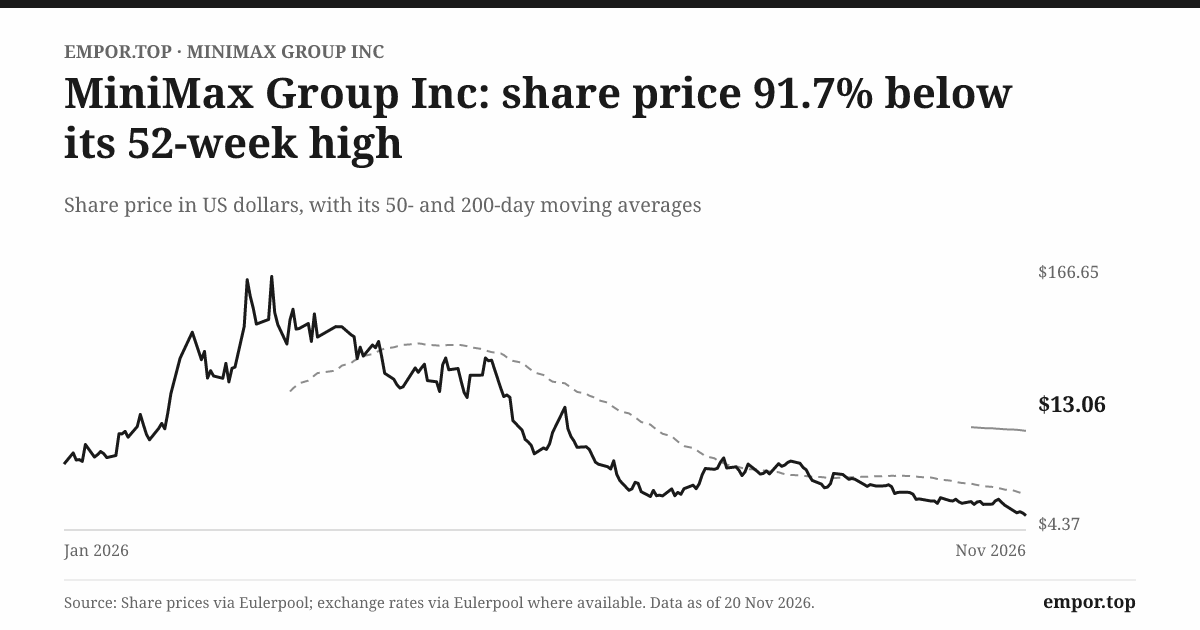
On Friday, November 20, 2026, the last trade of the week in MiniMax Group Inc's shares printed at HK$102.40.1 Eight months earlier, on March 18, the same shares had closed at HK$1,238.1 Few stocks travel that far in either direction in a single year. Fewer still fall more than nine-tenths of the way from their peak while the business underneath them is growing faster than at almost any point in its short life.
That is the puzzle at the centre of this story. In the first half of 2026, MiniMax brought in about US$117 million of revenue, almost four times what it had made in the same six months a year earlier.2 That half-year alone was larger than the whole of 2025, when the company recorded about US$79 million.23 Customers were not just arriving. They were arriving in numbers that would make most software companies envious. By July, the company's founder said, the volume of "tokens," the units of text and data that its models chew through for customers, had grown to twenty times its January level.4
And yet the losses grew too. MiniMax's adjusted net loss, which strips out share-based pay, accounting swings on financial instruments and listing costs, was about US$293 million in the first half of 2026, more than double the roughly US$139 million of the year before.2 The company made more money than ever and lost more money than ever in the same six months. In most industries, those two facts would point in opposite directions. In artificial intelligence, they can be the same fact viewed from two sides, because every new customer request has to be computed, and computing costs money.
So the question for anyone who wants to understand MiniMax is not whether people want what it makes. The record says they do. The question is whether the company can turn fast-growing demand for AI into a business that earns more than it spends to serve that demand. Put more sharply, it is whether intelligence can get cheaper to produce faster than customers' appetite for it makes it more expensive to supply.
The market's answer, at least on November 20, was expensive in one sense and sceptical in another. At that price, the company was worth about HK$35.8 billion, or roughly US$4.6 billion.1 Measured against its 2025 revenue, investors were paying almost 58 times sales, and the enterprise-value version of the same ratio stood at about 97 times.13 Those are numbers that only make sense if a buyer believes today's revenue is a small fraction of tomorrow's. At the same time, the shares had fallen below the HK$165 price at which the company sold stock to the public in January.51 A buyer at the IPO, ten months later, had lost more than a third of the investment. A buyer at the March peak had lost more than nine-tenths.
Four questions run underneath that price, and this story will keep returning to them. The first is whether revenue can scale faster than the two costs that dominate the income statement: compute for serving customers and the far larger research budget for training new models. The second concerns 阿里巴巴 Alibaba, which is at once an early investor, a customer and, increasingly, the landlord of MiniMax's compute. Is that relationship a highway to customers or a dependency that grows with every new token? The third is money. MiniMax raised capital at its listing and then, within six months, raised it again through new shares and a convertible bond that falls due in 2027. Can it fund the model race without repeatedly asking shareholders to share the pie with newcomers? The fourth is legal. The company's video-generation product, 海螺AI Hailuo AI, is one of its best-known creations, and it is also the subject of a copyright lawsuit brought by three of Hollywood's largest studios.67
A word on boundaries before the story begins. MiniMax Group Inc is a holding company incorporated in the Cayman Islands, and its figures cover the company and its subsidiaries as a single consolidated business with one reporting segment.8 It is not a subsidiary of Alibaba, and nothing in this story borrows the economics of Alibaba's cloud or AI businesses. Alibaba appears here as MiniMax's shareholder, supplier and customer, which is complicated enough.
The market is pricing a future AI platform, not present profits. Everything that follows is an attempt to test whether the usage MiniMax has attracted can become durable, collected revenue with economics that improve as it grows. To see why that test is so hard, it helps to go back to a moment when the company had no revenue at all.
 Subscribe on LinkedIn
II. The Lab That Put Its Models in People's Hands
In 2021, 闫俊杰 Yan Junjie walked away from one of the most prestigious jobs in Chinese artificial intelligence. He had spent more than six years at 商汤科技 SenseTime, the computer-vision pioneer that became one of China's best-known AI companies, and had risen to vice president and vice-head of its research institute.9 Before that, he had studied mathematics at Southeast University, earned a doctorate in artificial intelligence at the Institute of Automation of the Chinese Academy of Sciences, and carried out postdoctoral research at Tsinghua University.9 By the standards of his field, he was an insider's insider, a researcher who had helped an earlier generation of AI become a business.
That earlier generation is the right backdrop for what he did next. SenseTime's AI was mostly about seeing: recognising faces, reading licence plates, watching factory lines. It was sold to governments and large companies, project by project, and the business that grew around it was lumpy and heavily dependent on a few large buyers. Yan's new company, 稀宇科技 MiniMax, set out to build something different: general-purpose foundation models, the large neural networks that can write, converse, reason, speak and generate images and video. The company was founded in 2021 and began operating and developing its models in 2022, at which point it had no customers and no revenue.8
Yan brought SenseTime colleagues with him, and the leadership team still bears that imprint. Yun Yeyi, an executive director, spent five years at SenseTime in fundraising, strategy and new-business roles before joining him.9 Zhou Yucong, who now leads visual-model research and engineering and sits on the board, had a stint at SenseTime before working at Huawei and joining MiniMax in March 2022.9 Zhao Pengyu, the board's large-language-model research leader, came from Hulu's Beijing engineering arm in 2023 and was still in his twenties when he became a director.9 It is a young team by any measure. Yan himself is 36.9 Today he is chairman, chief executive and chief technology officer at once, an unusual concentration of roles that this story will return to when the question becomes who checks whom.10
The choice that defined MiniMax's early years was not technical. It was about where the models would meet the world. Many foundation-model labs, especially in their early years, sell almost entirely through an application programming interface, or API: a pipe through which other companies send requests and receive the model's answers, paying by usage. MiniMax built that pipe, which it calls the Open Platform. But it also built its own consumer products on top of its models and put them in people's hands directly.8
Two of those products became the company's calling cards. Talkie, and its Chinese-market sibling 星野 Xingye, are companionship and role-play apps in which users chat with AI characters, many of them created by other users.8 Hailuo AI, launched later, generates video clips from text prompts or images and became one of the more widely noticed AI video tools outside the United States.8 Alongside them, the company offered a general assistant under the MiniMax name. Pricing tells the story of the ambition. Monthly subscriptions ranged from about US$19 to US$69 for the MiniMax assistant, from about US$10 to US$200 for Hailuo, and from about US$1.50 to US$30 for Talkie.8
Why would a research lab bother with apps? The strategic logic is straightforward, and it is worth taking seriously. A model sitting behind an API learns only what developers choose to send it. A model inside a consumer product sees millions of real people trying to do real things, in many languages, and the company sees which features they come back for and which they abandon. Products, in other words, are both a revenue stream and a laboratory. They tell a model maker where its models work and what someone will actually pay to use. A cynic might add a third reason: a hit consumer app makes for a vivid fundraising story in a way that a token-billing dashboard does not.
MiniMax recorded about US$3.5 million of revenue in 2023 and about US$79 million in 2025.83 That is more than a twentyfold increase in two years, from a standing start. By the time of its first-half 2026 results, the company said it served more than 300 million users and more than a million enterprises and developers in more than 100 countries.4
Here the story needs a discipline that the AI industry often lacks. Downloads are not retention. Model releases are not recurring revenue. A demo that goes viral on social media is not a gross margin. MiniMax has shipped model after model, including open-weight releases that anyone can download, and it released a third-generation language model, MiniMax M3, in the first half of 2026 and a video model, H3, shortly after.4 Those are real technical achievements. But the company does not disclose the measures that would show whether users who try its products stay and pay more over time. It publishes no recurring-revenue share, no cohort retention, no net revenue retention for API customers and no price realisation per token.81011 The 300 million users are a count of reach, not of loyalty.
The early customer base, meanwhile, tells a story of a company outgrowing early dependence. In 2023, its five largest customers accounted for about 61% of revenue and the largest alone for 37%.8 By 2025 the top five were under a fifth of revenue and the largest about an eighth.10 That is real diversification, and it is the kind of change that tends to happen when a product finds a broad market rather than a single sponsor. It does not, by itself, say that customers are sticky. It says there are more of them.
There is a deeper limit on what this history can prove. MiniMax's commercial record begins in 2022. There is no decade of product cycles against which to test the management team's claims, no recession survived, no price war won and recovered from. The company that exists today has lived through one long boom in demand for generative AI and nothing else. When management says its products build lasting advantage, the honest response is that the record is too short to say yes or no. Rapid productization is proven. Durable retention and pricing power are not yet tested.
What the record does show is the moment when a young lab with a few hit apps needed something it could not build on its own: enormous amounts of computing power, and a partner rich enough to supply it. That partner was Alibaba, and the relationship it started in 2024 has become one of the most important facts about MiniMax's economics.
III. Alibaba Became the Customer—and the Cloud Bill
In March 2024, Alibaba led a financing round in MiniMax reported at about US$600 million, a deal that put one of China's largest technology groups behind a three-year-old startup.12 For MiniMax, the money mattered. For the industry, the signal mattered more. Alibaba was assembling stakes in several of China's most prominent model labs, and an investment from the country's leading cloud provider carried an implicit promise: access to the computing capacity that every foundation-model company needs and few can afford to own.
To understand why that access is so valuable, it helps to picture what a model lab actually buys. Training a large model means running thousands of specialised chips, mostly graphics processors, for weeks or months, adjusting billions of internal settings until the model gets good at predicting what comes next. Serving the model, which the industry calls inference, means running those chips again every time a user asks a question or generates a video. A lab can buy its own chips and build its own data centres, as the largest American companies do, or it can rent capacity from a cloud provider by the hour. MiniMax rents. Its property, plant and equipment amounted to less than US$4 million at the end of 2025, a rounding error for a company of its ambitions, because its compute is an expense that flows through the income statement rather than an asset on the balance sheet.103
That choice made Alibaba Cloud a central supplier. And the scale of the relationship, once MiniMax had to disclose it as a listed company, was striking.
The two-way street
Start with the money flowing from MiniMax to Alibaba. In 2024, MiniMax bought about US$9.4 million of services from Alibaba Group.10 In 2025, that figure jumped to about US$75.9 million.10 Put that next to the company's revenue for the same year, about US$79 million, and the comparison is almost uncomfortable: for every dollar customers paid MiniMax in 2025, the company paid roughly 96 cents to a single related supplier.10 The Alibaba bill was also equal to about 30% of MiniMax's research and development expense that year, and larger than its entire cost of sales.10 In the first half of 2026 alone, purchases from Alibaba's cloud reached about US$75.6 million, essentially matching the whole of the prior year in six months.13
Now the money flowing the other way. Alibaba is also a MiniMax customer, buying API access to its models. That stream has been small. MiniMax sold about US$0.03 million of services to Alibaba in 2024 and about US$0.32 million in 2025.10 In the first half of 2026, the API services MiniMax sold to Alibaba came to US$501,704.13
That last figure deserves a moment, because it is easy to misread. MiniMax disclosed historical amounts under the Master API Service Agreement in an August 2026 circular, and a quick reading could treat the number as US$501.7 million of transactions, which would make Alibaba by far MiniMax's largest commercial relationship. It is not. It is about half a million dollars of API revenue earned from Alibaba in six months, a sliver of the US$117 million MiniMax made in the period.132 The economic dependency runs overwhelmingly in one direction: MiniMax depends on Alibaba as a supplier of compute far more than Alibaba depends on MiniMax as a supplier of models.
MiniMax revised the annual caps on both agreements in the same circular, and the new numbers say a great deal about the company's plans without forecasting what will happen. Under Hong Kong's listing rules, a company must seek independent shareholder approval for the maximum value of recurring transactions with a connected party, and those caps act as ceilings. MiniMax raised the caps on its purchases of Alibaba Cloud services to US$300 million for 2026, US$400 million for 2027 and US$500 million for 2028.13 It raised the caps on API services sold to Alibaba to US$7.5 million, US$22 million and US$33 million for the same years.13 A cap is permission, not a prediction. But companies do not usually ask shareholders to approve half a billion dollars of annual cloud purchases unless they think they might need room to spend it.
What each side gets
There is a fair case for the relationship. Alibaba Cloud is one of the largest cloud platforms in Asia, with the capacity to serve a model lab whose demand can multiply in months, as MiniMax's token volumes did in 2026. MiniMax says it pays published prices and terms comparable to those offered to unrelated customers, and its prospectus described Alibaba's cloud pricing as standard published rates comparable with other providers.108 Some cloud suppliers gave the company 90-day payment terms, and as of June 2026 MiniMax owed Alibaba-related entities about US$43 million in trade payables, unsecured and interest-free, which is a form of short-term supplier financing that eases cash pressure.1110 For a company that does not own data centres, a well-capitalised supplier with spare capacity, in a country where access to the most advanced chips is restricted by American export controls, is genuinely valuable.
The other side of the ledger is concentration and bargaining power. In 2025, MiniMax's five largest suppliers accounted for about 58% of its purchases and the single largest for about 23%, and five subsidiaries of Alibaba's cloud holding company were among the top five.10 When a supplier provides a large share of the most important input, that supplier's pricing decisions, capacity allocation and priorities flow straight into the customer's margins. Alibaba is not a neutral utility. It develops its own Qwen family of models, offers them through its own cloud, and invests in other model labs. MiniMax's arm's-length pricing assertion may well be accurate; the point is that its cost structure, its capacity in a shortage and its leverage in a renegotiation all depend in part on a company that is also a competitor in the model market.
The relationship also creates a governance question that later chapters will return to. Transactions with a substantial shareholder require independent approval and independent non-executive directors' sign-off, and MiniMax put the revised caps to that process in the August circular.13 Those safeguards matter. They do not change the underlying arithmetic, which is that MiniMax's single largest cost relationship is with one of its own owners.
The verdict on this chapter is narrower than either the bull or the bear version. Alibaba is, today, primarily a cloud supplier to MiniMax, and a very large one. As a customer, it is a possible channel, and the higher API caps suggest both sides see room for it to grow, but the realised amounts are small. The test going forward is concrete. Watch actual cloud purchases against revenue, against research spending and against gross profit, and watch how much API revenue Alibaba actually generates against its cap. If cloud spending grows faster than revenue for long, MiniMax is renting its growth at a rising price. If revenue outruns it, the relationship is doing what a good supplier should.
But the cloud bill is only half of the cost story. The other half begins every time a customer sends a request, and the meter starts running.
IV. The Token Meter Starts Running
Sometime in the first half of 2026, a quiet line crossed on MiniMax's income statement. For most of its commercial life, the company's consumer apps had been its biggest source of revenue. In the six months to June, the business it calls the Open Platform and other AI-based enterprise services overtook them.2 Enterprise and developer revenue rose about eightfold, by 703%, to roughly US$74 million, and accounted for about 63% of everything the company made, up from about 30% a year earlier.2 The AI-native products, Talkie, Xingye, Hailuo and the MiniMax assistant, did not shrink. They roughly doubled, to about US$43 million.2 But the centre of gravity had moved from consumers to builders.
That shift changes how the company gets paid, and it is worth slowing down to see how.
On the consumer side, MiniMax earns money in three ways. Users pay subscriptions, buy prepaid credits or make in-app purchases, and the company sells online advertising inside its apps.8 Subscription revenue is recognised over the membership period, so a customer who pays for a year shows up as revenue spread across that year.8 On the enterprise side, the model is a meter. Developers and companies send requests through the API and pay by usage: by the token for text, by the clip for video.8 A token is roughly a fragment of a word; a long business document might run to tens of thousands of them, and an AI agent working through a coding task can consume millions. Some enterprise work is more bespoke, customised for a client or deployed on the client's own servers.8 Contract lengths and minimum commitments for major customers are not specified in the company's disclosures; large clients work under framework agreements and orders.8
The token surge shows how tightly revenue and cost are tied in AI unless each token gets cheaper to serve.4
Following the cost meter
So what did it cost to serve all that new demand? The first answer is gross margin, the share of revenue left after the direct costs of delivering the service, mostly compute for inference. In the first half of 2026, MiniMax kept about 18 cents of gross profit from every dollar of revenue, up from about 12 cents a year earlier.2 Management credited "improving infrastructure efficiency."4 That is a meaningful improvement, and it is evidence that the company is learning to serve requests more cheaply.
But the year-on-year comparison tells only part of the story. For the full year 2025, revenue of about US$79 million came with cost of sales of about US$59 million, a gross margin of roughly 25%.311 Because the first half of 2025 ran at about 12%, the second half of 2025 must have run well above 30%. Set against that, the first half of 2026 was not a continuation of steady improvement. It was a step back from the prior six months, even as it beat the same period a year earlier. The likeliest explanation, given the mix shift, is that API and enterprise usage, priced competitively and growing explosively, carried thinner margins than the business it was replacing, or that the company priced aggressively to win share. The company does not break out gross margin by product line, so the cause cannot be pinned down from its disclosures. What can be said is that the gross margin trend is not the clean upward line the year-on-year headline implies.
The second answer is research and development, and here the numbers are of a different order. MiniMax spent about US$253 million on R&D in 2025, more than three times its revenue.103 In the first half of 2026, it spent about US$297 million, more than in the whole of the prior year, and most of the increase came from cloud costs for training new models.4 R&D grew about 139% year on year while revenue grew 283%, which is why management could say research spending was rising more slowly than sales.2 That is true and it is real progress: R&D fell from roughly six times revenue in 2024 to about two and a half times in the first half of 2026.102 But it still means that for every dollar of revenue, the company spent about two and a half dollars on building the next generation of models.
Put the pieces together and the shape of the business comes into focus. In the first half of 2026, gross profit was about US$21 million.2 Research spending was about US$297 million.2 Gross profit covered about 7% of the research budget, before a dollar of selling or administrative cost. Selling costs actually fell, to about US$27 million, because the company leaned on what it calls organic user growth rather than paid promotion, and administrative costs rose to about US$30 million.4 The hole is not in marketing. It is in the cost of staying at the frontier of model capability.
That leads to the key operating question for MiniMax, and arguably for every independent model lab. A frontier model is like a new aircraft: enormously expensive to design, then profitable only if it flies full for many years. The problem in AI is that the aircraft becomes obsolete in months, not decades, because a competitor releases something better or cheaper. A lab must therefore earn back its training spending quickly, through inference revenue, before the next model is needed. MiniMax's wager is that better models, better software and cheaper inference can make that cycle pay. Yan has a slogan for it: "Minimize the Cost, Maximize the Intelligence."4 The slogan describes the goal. The first-half numbers say the company is not there yet.
The field it plays on
MiniMax does not compete in a vacuum, and the competitive field is brutal. Among China's independent labs, it competes with 智谱 Zhipu, which trades internationally as Z.AI and listed in Hong Kong two days before MiniMax, with 深度求索 DeepSeek, whose low-cost open-weight models reset price expectations across the industry in early 2025, and with 月之暗面 Moonshot AI.14 Above them sit ecosystems far larger than any of the labs: Alibaba itself, 字节跳动 ByteDance with its Doubao assistant and its own models, 腾讯 Tencent, and, internationally, Google and OpenAI. Public revenue figures and market-share estimates across these companies are not measured on comparable bases, so any precise ranking would be false precision. What can be said is that MiniMax is one of a handful of Chinese independents with meaningful international reach, competing against giants that can bundle models into products used by billions of people and subsidise them from other profits.
That context matters for testing MiniMax's claimed edge. Model capability matters only if it wins paid usage, and capability leads in this industry have proven short-lived. Open weights cut both ways. Releasing a model that anyone can download widens adoption and makes MiniMax a default choice for developers who want to run models on their own hardware, but it also makes substitution easier, because a developer who can download MiniMax's model can download a rival's just as easily. The disclosures offer no retention series, price-realisation data or cost-per-token history that would show switching costs or a cost advantage competitors cannot match. Usage growth is evidence of a product people want to try; loyalty remains unproven.
The verdict on this chapter is therefore split. The mix shift toward APIs and enterprise services is real and large, but gross margin remains below 20% and slipped from the preceding half. Three numbers will settle the question: gross margin, research spending as a share of revenue, and operating cash flow, all watched as paid usage scales. Those numbers will be shaped partly by engineering. One of them could also be shaped by a courtroom.
V. Hailuo's Breakthrough Has a Courtroom Shadow
On September 16, 2025, Disney, NBCUniversal and Warner Bros. Discovery filed suit in federal court in Los Angeles against MiniMax and related entities.67 It was a remarkable alliance. The three studios compete fiercely for audiences and talent, but on this point they stood together: they alleged that Hailuo AI, MiniMax's video generator, had been built on their copyrighted works and would produce videos of their characters on request.6
The complaint is vivid in the way such documents are designed to be. The studios alleged that users could type a simple prompt and receive video clips featuring characters such as Darth Vader, the Minions, Shrek and other famous figures from their libraries, and that MiniMax had copied their works to train the models behind the service.67 They alleged that the company marketed Hailuo's ability to generate such content and profited from subscriptions to it.6 They sought damages and an injunction.6 These are allegations, and MiniMax has contested the case. But they go to the heart of what makes a video generator commercially valuable: the ability to make something a viewer wants to watch.
The case reached a procedural turning point on May 22, 2026, when the court denied motions to dismiss.15 It is important to be precise about what that means. A motion to dismiss asks a court to throw out a case at the start because, even if every fact the plaintiff alleges were true, it would not amount to a valid legal claim, or because the court lacks the power to hear it. Denying such a motion does not mean the court found that MiniMax infringed anything. It means the studios' claims are sufficient to proceed to the next stages, including discovery, in which each side can demand documents and testimony from the other. For a defendant, that is a costly and uncertain road. For the studios, it is the stage at which they can seek evidence about what data the models were trained on.
Why does this matter so much for a company whose largest business is now its API? Because Hailuo sits squarely within the AI-native products line that still produced about US$43 million in the first half of 2026, and because video generation is one of the most compute-intensive and potentially lucrative areas of generative AI.2 Creative tools live or die on the quality and appeal of their outputs. If a court eventually concludes that training on copyrighted films and shows without a licence is infringing, or that outputs resembling famous characters create liability, a video model's developer might need to license content, filter outputs more aggressively, restrict features or market more cautiously. Each of those responses could raise costs or reduce appeal. And enterprise customers, especially in advertising and entertainment, tend to avoid tools that carry legal uncertainty about the content they produce.
There is also a jurisdictional wrinkle worth noting. MiniMax is a Chinese-founded company that earns much of its revenue from users outside China, and it has to operate inside both American and Chinese legal and regulatory systems at once. A loss in an American courtroom would bear most directly on the markets where Hailuo sells subscriptions to international users, which are precisely the markets where its consumer revenue is concentrated.
What remains unknown is the price. At the end of 2025, MiniMax's subsidiaries were respondents in several intellectual-property disputes, and the company recorded no provision because it could not estimate the outcome or the damages.10 At June 2026, those disputes remained ongoing, still with no provision.11 That is a standard accounting treatment when a loss cannot be reliably estimated, and it means investors are left to judge the exposure without a number from the company. Statutory damages in American copyright law can be large when infringement is found to be wilful, and the studios have claimed many works. But any figure would be speculation until the case advances or settles.
The lesson for valuing Hailuo is not that the product is doomed. Many generative-AI companies face similar suits, and the legal questions around training data are unsettled across the industry. It is that product capability is not a moat in itself. The commercial test is whether customers keep paying for useful workflows that are also legally sustainable. A video tool that dazzles but cannot be used safely by a brand or a studio has a smaller market than its demos suggest.
Litigation costs money, and so does everything else in this story. Which raises the question of how much money MiniMax had, and what it gave up to get it.
VI. The IPO Bought Time; the Bond Put a Date on It
On January 9, 2026, MiniMax's shares began trading on the Hong Kong Stock Exchange under the stock code 0100, at an offer price of HK$165.58 The listing raised about HK$4.8 billion, or roughly US$620 million16, and the stock jumped on its debut, a sharp contrast with the more muted debut of Zhipu two days earlier.14 For a company that had been founded just five years earlier and had never made a profit, it was a validation, and it arrived at a moment of intense enthusiasm among Hong Kong investors for Chinese AI.
The enthusiasm kept building. Within ten weeks the share price had risen more than sevenfold, to its March 18 close of HK$1,238, about two weeks after the company published its first annual results as a listed business.13 At that level, the company was valued in the hundreds of billions of Hong Kong dollars on revenue of under US$100 million. Then the price began a long descent, through the spring, through the first-half results in August, and below the IPO price in mid-November.1 The business had not collapsed. The expectations had.
The prospectus was clear about the purpose of the IPO proceeds: most of the money would fund research and development, chiefly for large-model development, over the following years.8 That is a reasonable use of capital for a lab whose entire competitive position rests on the quality of its next model. But it also reveals the nature of the business. The IPO was not funding a factory or an acquisition with a predictable return. It was funding the training runs, the compute rental and the researchers that might, or might not, produce a model good enough to win the next round of customer demand.
Six months later, MiniMax returned to the market. On July 16, 2026, it completed a placement of about 35.6 million new Class A shares and the issue of HK$6.5 billion, roughly US$830 million, of zero-coupon guaranteed convertible bonds due in 2027.17 The speed of that return matters. A company that raises capital at its IPO and then raises again within half a year is telling investors that its spending plans have grown faster than its original funding, or that it wanted to strike while the market was willing. Either way, the placement diluted shareholders who did not participate. One substantial holder's stake, for example, fell from about 5.0% to about 4.4% without it selling a share.[^18]
Reading past the accounting noise
Before the listing, MiniMax's income statement was dominated by something that had nothing to do with AI. Like many venture-backed companies, it had issued convertible redeemable preferred shares to its early investors, and under international accounting standards those shares were carried as liabilities and marked to fair value. As the company's valuation soared, so did the value of the preferred shares, and the increase was booked as a loss. In 2025, that non-cash fair-value loss was about US$1.59 billion, which is why the company's reported net loss for the year was about US$1.9 billion on revenue of US$79 million.103 When the shares converted into ordinary shares at the listing, that distortion largely disappeared from future accounts.10 It also explains why the company's balance sheet showed negative shareholders' equity of about US$2.6 billion at the end of 2025 and why some valuation ratios computed from that balance sheet look strange: the preferred shares were counted as debt until they converted.3
The adjusted loss, which removes those swings, was about US$251 million in 2025.10 That is the better measure of the business, but it is still the measure of a business that loses a lot of money. And cash tells the same story: MiniMax's operations consumed about US$280 million of cash in 2025, broadly in line with the adjusted loss.3 There is no hidden profitability under the accounting. There is just less loss than the headline suggested.
The financial-instrument noise did not vanish entirely after listing. In the first half of 2026, the company still recorded about US$31 million of fair-value losses on financial liabilities among the items it adjusted out, along with about US$28 million of share-based pay.4 Share-based pay is the cost that adjusted figures most commonly obscure: it is not cash, but it is a real transfer of value from existing shareholders to employees, and in a company whose most valuable assets are its researchers, it is likely to remain substantial.
Runway against burn
Now set liquidity against the burn. At June 30, 2026, MiniMax held about US$1.32 billion in cash and investments, made up mostly of cash and cash equivalents with a sizeable portfolio of wealth-management products and other financial assets.114 That balance predates the July placement and bond. Against it, the adjusted net loss for the half-year was about US$293 million.2 On a simple reading, the June balance alone covered more than two years of losses at the first-half rate, and the July raise extended that. Bank borrowings had risen to about US$134 million, mostly unsecured working-capital loans in renminbi.11 No external credit rating has been published for the company.11
But simple runway arithmetic understates the challenge, because the burn is not stable. Research spending more than doubled in a year, and the cloud caps approved in August imply a company preparing to spend more. Working capital also consumed cash as the business grew: in the first half of 2026, receivables rose by about US$30 million and prepayments and other assets by about US$135 million.11 Trade receivables, at about US$11 million in December, had reached about US$39 million by June, all within one year of age.1011 Some of that is the natural result of enterprise sales, where customers pay after using the service. Some of it, especially the prepayments, may reflect advance payments for compute. The company does not disclose the composition in enough detail to say which. On the other side, contract liabilities, which represent customers paying in advance, rose from about US$7.5 million to about US$18 million, a sign that some customers are committing money before they consume.1011
Then there is the bond. A zero-coupon convertible pays no interest, which makes it look cheap. It is not free. If MiniMax's share price at maturity is above the conversion price, holders will convert into shares, diluting existing owners. If the share price is below it, holders will want their money back in 2027. With the shares at HK$102.40 in late November, well below the IPO price and far below the levels prevailing when the bond was issued, the second outcome looks more relevant than it did in July.117 The bond put a date on the funding question. Whatever happens to the share price, 2027 is when MiniMax will have to either issue shares or hand back cash.
A word on what MiniMax has not done with its capital. Its disclosures show no material acquisition-led expansion and no purchase price to benchmark against sector deals. The capital-allocation story is research, cloud compute, equity issuance and convertible financing. That is not a criticism; it is the honest shape of a model lab. But it means the only test of capital allocation is whether the models the money bought earn back what they cost.
Liquidity, then, is substantial, and the listing cleaned up the accounting. Cash does not remove operating burn; it does not undo dilution, and it does not make the 2027 decision go away. The person who will make that decision, and who will decide how much more to raise and on what terms, is the same person who founded the company. He also holds most of the votes.
VII. The Founder Holds the Votes
There is a particular kind of founder-controlled company that long-term investors have learned to love. The founder can ignore quarterly pressure, spend heavily on research that will not pay off for years, and resist the temptation to sell to the first bidder. There is another kind they have learned to fear. The founder can ignore shareholders entirely, approve transactions with friends, and keep spending long after the evidence says to stop. Weighted voting rights make both possible. Which one MiniMax is depends on how Yan uses the control he has kept.
As of June 2026, Yan held or controlled about 23% of MiniMax's issued share capital, but about 69% of the voting rights.11 He does it through Class B shares that carry ten votes each, against one vote for each Class A share held by everyone else.11 His voting power is roughly three times his economic stake, and because new shares issued in placements are Class A, the July capital raise diluted his economic interest without seriously threatening his control. Alibaba, by comparison, held about 39.7 million Class A shares, a stake in the low teens as a share of total capital, which carries far less voting weight than its economic interest might suggest.13[^18]
Hong Kong permits this structure for innovative companies, subject to safeguards. Certain matters, including connected transactions such as the revised Alibaba caps, require independent shareholder approval in which Class B shares vote only one vote each, and the board must include independent non-executive directors.13 Those safeguards are real. They do not change the fact that on most strategic questions, including who sits on the board, outside shareholders cannot outvote the founder.
Pay, roles and checks
Look next at incentives. Yan's own director pay was modest: about US$241,000 in 2025.10 But the aggregate remuneration of directors and the chief executive was about US$5.7 million, of which about US$3.6 million was equity-settled option expense and about US$0.7 million bonuses.10 Option expense is an accounting estimate of the value of awards granted, spread over their vesting period, not cash paid out; it can overstate or understate what executives eventually receive depending on the share price. Key-management compensation in the first half of 2026 was about US$3.4 million, more than double the prior-year period.11 The company's disclosures describe the share-incentive plans but do not set out the specific performance conditions, if any, that executives must meet for awards to vest, so it is not possible to say whether pay is tied to measurable outcomes like revenue, margin or cash flow.
The governance concentration goes beyond votes. That concentration extends to remuneration: Yan sits on the remuneration committee.10 A founder on the committee that sets executive pay is permitted, but it is a structure in which the person most affected by the decisions is in the room where they are made. The board included three independent non-executive directors after a change in August 2026.11
The audit evidence is cleaner. The 2025 auditor issued an unqualified opinion on the financial statements.10 It highlighted research and development expense recognition as a key audit matter, which means it considered the area among the most significant in the audit, given its size and the judgment involved in classifying costs.10 That is not an allegation of error. It is a signal that the line on which the company's entire strategy rests, the split between costs of serving customers and costs of building models, involves estimation that investors should understand. If compute used for inference were classified as R&D rather than cost of sales, for example, gross margin would look better than the economics deserve. There is no indication that this has happened. But for a company whose central question is whether serving customers is profitable, the boundary between those two lines is the one that matters most.
What the record says about credibility
Judging management credibility on a listing record of under a year is necessarily provisional. What can be tested is whether the company's own descriptions of its results match the numbers. In its first-half 2026 report, MiniMax emphasised that R&D was growing more slowly than revenue and that gross margin had improved.2 Both statements were accurate, though the picture was less flattering on a half-on-half basis and after adjusted losses more than doubled.23 The company did not hide those figures; it reported them. But its narrative selected the comparisons that flattered, which is common among companies of every kind and a reason for investors to do their own comparisons. MiniMax has not published formal financial guidance that could be checked against outcomes, so guidance discipline cannot yet be judged, and the absence of targets is itself a choice that keeps the company's narrative free of a scoreboard.
The June 2026 annual general meeting provides a bounded check on shareholder sentiment. All resolutions passed.18 With the founder controlling nearly seven-tenths of the votes, that outcome tells investors less than it would at a company with one share, one vote. A routine vote passing under weighted control is not proof of broad approval; it is proof that the founder voted for it.
The fair verdict is that founder control can protect a long, expensive technical program from impatient investors, and MiniMax's program is both long and expensive. But control also weakens outside shareholders' ability to challenge connected transactions or strategy. The short record does not yet establish guidance discipline, a history of explaining misses, or a proven capital-allocation skill. Trust will have to be earned through what the founder does with the money, not through how many votes he holds.
With the story's pieces now on the table, the demand, the cloud bill, the token meter, the lawsuit, the funding and the founder, it is time to ask the investor's hardest question directly.
VIII. Analysis & Bear vs. Bull Case
MiniMax's own claim is simple enough to fit on a banner. It delivers higher intelligence at lower cost, and in doing so it makes AI available to everyone.4 Against that claim stands a business whose revenue is accelerating, whose gross margin is still below 20%, and whose research spending in a single half-year was about two and a half times its revenue.2 Does the company have a credible reason to win from here, or is it one capable model maker among many, competing for scarce compute and fickle customer attention?
Start with the structure of the industry, because it sets the ceiling on what any participant can earn. Michael Porter's five forces offer a useful lens.
Rivalry is intense. In China alone, MiniMax competes with Zhipu, DeepSeek, Moonshot and others among the independents, and with the in-house models of Alibaba, ByteDance and Tencent. Internationally, where much of its consumer revenue comes from, it competes with OpenAI, Google, Anthropic, Meta's open models and a long tail of startups. Competitors release new models every few months, and price cuts for API access have been a recurring feature of the market since DeepSeek's low-cost releases in early 2025. When rivals cut prices and match capabilities quickly, returns tend toward the cost of capital or below.
The threat of substitutes is high. Open-weight models, including MiniMax's own, allow developers to run capable AI without paying an API provider at all. Larger platforms bundle models into products people already use, so an office worker may never seek out a separate AI assistant. For many tasks, last year's model is good enough and much cheaper.
Buyer power is meaningful. Enterprise and developer customers can and do use multiple APIs, routing requests to whichever model offers the best combination of quality and price for each task. The software that does this routing is cheap and widely available. MiniMax's falling customer concentration, from about 61% of revenue for the top five in 2023 to under a fifth in 2025, reduces the power of any single buyer, but it does not make buyers loyal.810
Supplier power is high, and in MiniMax's case concentrated. Cloud providers control access to the chips that every lab needs, and in China, American export controls make the most advanced chips harder to obtain. MiniMax's largest supplier is a related party that is also a model competitor, and its purchases from that supplier have grown faster than its revenue.1013
The threat of new entrants is mixed. Anyone can start a model lab with a good team and some funding, and new labs appear regularly. But training a frontier model and serving it at scale requires capital and compute on a scale that very few can assemble, which is why the field has been consolidating around companies with deep-pocketed backers or public-market access.
The combined picture is of an industry in which value is being created rapidly but is hard to capture. Customers benefit from falling prices and rising quality. Chip makers and cloud providers capture a large share of the spending. Model labs sit in between, under pressure from both sides.
Where a moat could come from
Hamilton Helmer's seven powers framework asks what structural advantage could let a company earn above-normal returns for a long time. It is worth running the argument once, in full, for MiniMax.
Scale economies are the most plausible long-run power for a model lab, because training costs are fixed and spread across all users: a lab that serves more customers can afford bigger models per dollar of revenue. MiniMax's token volume grew twentyfold in six months, which suggests it is gaining scale.4 But it is small compared with the giants it competes against, so on this measure it is the disadvantaged party, not the advantaged one.
Network effects are weak. One user's chat with an AI character does not make the product better for another user in the way a social network does, although user-generated characters in Talkie offer a modest version of the effect. Usage data can improve models, but the evidence that data advantages compound into lasting leads is thin across the industry.
Switching costs are low for API customers, who can redirect requests to another model by changing a few lines of code. They may be higher for consumer users attached to particular AI characters or for enterprises that have customised a model or deployed it on their own servers, but the company does not disclose retention data that would show it.
Counter-positioning, a business model incumbents cannot copy without harming themselves, does not clearly apply: the large platforms can and do offer the same products.
Cornered resources, such as unique data, talent or licences, are not evident. Talent moves between labs, and MiniMax's own leadership came largely from SenseTime. The Hailuo lawsuit, if anything, suggests the company's training data is a source of legal risk rather than exclusive advantage.
Branding has some value for Talkie and Hailuo among consumers, but brand power in AI tools has proven fragile when a better product appears.
Process power, an embedded organisational ability to do something better, is MiniMax's best case. The company has shipped capable models across text, speech and video on a budget much smaller than the largest American labs, and its gross margin improvement suggests it is learning to serve requests more efficiently.24 If that capability is durable and hard to copy, it could become a cost advantage. But process power only becomes a moat when it produces a measurable, persistent cost or quality lead. No disclosed cost-per-token series, price-realisation data or retention measure yet proves that.
The honest conclusion is that MiniMax's strongest possible powers are model capability, product execution and inference efficiency. Disclosed usage growth and an improving year-on-year gross margin support a case worth testing. There is not yet public evidence of durable switching costs, network effects or a cost advantage that competitors cannot match. The moat thesis is not rejected by the record. It is unproven, and narrower than the company's slogan implies.
The strongest bull case runs like this. MiniMax has built one of the few Chinese AI businesses with genuine international consumer traction, and it has done so on a fraction of the budget of its American rivals. Its Open Platform revenue grew about eightfold in a year, which suggests developers and enterprises are choosing its models in large numbers.2 Its consumer products also grew, roughly doubling, so the company is not simply trading one business for another.2 It serves users and enterprises across many countries, which diversifies it away from the hyper-competitive Chinese domestic market.4 Its gross margin improved against the prior year as revenue scaled, and research spending fell sharply as a share of revenue.2 It has more than a billion dollars in the bank, plus the July raise, so it can keep training models for years.1117 And if the industry consolidates, as many expect, the survivors with scale, reach and efficient operations could earn very attractive returns. On this view, today's losses are the price of entry into a market that could be enormous, and the share price collapse has given investors a far better entry point than the IPO did.
The strongest bear case is just as coherent. Research spending is still several times revenue. Gross margin, at below 20%, is modest, and it fell from the preceding half even as the company celebrated its year-on-year improvement.23 The adjusted loss more than doubled.2 Alibaba-related cloud purchases are large and growing, and the supplier is also a competitor.13 Model performance can be copied or displaced faster than customer habits can form, and the open-weight strategy makes substitution easier. The Hailuo lawsuit threatens a flagship product with unquantified exposure.1115 The company has already raised capital twice in six months and has a convertible bond falling due in 2027 with the share price well below where it was issued.171 And founder control means outside shareholders have limited ability to change course if things go wrong.11 On this view, MiniMax is a capable lab caught in an industry whose economics favour chip makers, cloud providers and giant platforms, and its revenue growth is mostly the growth of a subsidised workload.
The sceptic's question
A sceptical investor, the kind who shorts stocks for a living, would boil all this down to one question. Why should a customer choose MiniMax over a larger platform or a cheaper open-weight model, and what disclosed metric shows that customers stay or pay more after trying it? The filings do not yet answer it. They show that customers arrive. They do not show that customers stay.
That sceptic would also press on two specific points. The first is the boundary between cost of sales and R&D, which the auditor flagged as requiring judgment, because it determines how profitable serving customers appears.10 The second is the rise in prepayments and receivables, which consumed much more cash than the growth in contract liabilities provided.11 Neither is evidence of wrongdoing. Both are places where the economics could be less attractive than the headlines.
Out of everything in this story, three measures matter most. The first is gross margin, watched alongside cloud and research spending; its latest reading was about 18% in the first half of 2026, up from about 12% a year earlier but below the full-year 2025 level of about 25%.23 The second is the revenue mix and the evidence of repeat paid usage across enterprise and consumer lines; the Open Platform's share reached about 63% in the first half, up from about 30%, but the company does not publish retention data.2 The third is cash burn and collections as sales grow; operating cash outflow was about US$280 million in 2025, and receivables roughly tripled in the first half of 2026.311
Finally, the valuation. MiniMax listed in January 2026, so it has no meaningful five-year valuation history against which to compare today's multiples. At November 20 prices, the shares were about 38% below the HK$165 IPO price and about 92% below the March high.15 The headline price-to-sales ratio of almost 58 times uses 2025 revenue; measured against the twelve months to June 2026, which capture the first-half surge, the ratio is closer to the high twenties, broadly in line with market-data services that put it near 28 times.1 The enterprise-value ratio of about 97 times draws on a year-end 2025 balance sheet that still treated the preferred shares as debt, so it overstates the burden on today's shareholders.3 Market-data services put a basket of peers, including Zhipu and other technology names, at an average price-to-sales ratio of around three times, though peer sets and calculation methods differ.1
Even on the friendliest of those measures, the market is paying many times revenue for a company that loses more than it makes. That price requires substantial future growth and much better monetisation. MiniMax has evidence of demand, product reach and an improving year-on-year gross margin. It does not yet have a demonstrated durable moat or profitable unit economics. The investment case, stripped to its essentials, is a bet that the second will follow the first.
What, then, can founders and investors take from a company at this stage?
IX. Business & Investing Lessons
There is a moment in MiniMax's first-half 2026 results that captures the whole company. The Open Platform, the business of selling intelligence by the token, became its largest revenue stream, carrying nearly two-thirds of sales.2 In the same six months, research spending surpassed the whole of the previous year, and the cloud bill from a single supplier matched the prior year's total.213 The engine was running faster than ever, and so was the fuel gauge. That moment holds four lessons that belong to MiniMax and no one else.
The first lesson comes from the token meter. When Yan announced that token consumption had grown twentyfold between January and July, it sounded like a victory lap, and in one sense it was.4 But every one of those tokens had to be computed on rented chips, and the gross margin on serving them was below 20%. Software investors are trained to see usage growth as nearly pure upside, because the next user costs almost nothing. In AI, the next user costs real money, and the meter runs in both directions. In AI, growth is a workload before it is a profit. The question to ask about any AI company's usage numbers is not how fast they grow, but what each additional unit costs to serve and whether that cost is falling faster than the price.
The second lesson comes from Alibaba. When MiniMax's shareholders were asked in 2026 to approve cloud-purchase caps rising toward half a billion dollars a year, they were approving room for a company to grow its spending with one of its owners, a supplier that also sells competing models.13 That relationship provides capacity, credibility and a possible sales channel. It also concentrates bargaining power on the other side of the table. A strategic supplier can be a growth engine and a bargaining risk in the same contract. Founders who take money from a platform that also supplies their most important input should price that dual role into every forecast, and investors should watch the ratio of supplier spending to revenue as closely as they watch revenue itself.
The third lesson comes from the model releases. MiniMax has shipped a remarkable run of models across text, speech and video, including open-weight releases that put it on the map with developers worldwide.4 Hailuo was the most vivid of these, and it is now the subject of a federal lawsuit that has survived a motion to dismiss.15 Technical capability produced attention, users and a legal overhang all at once. A technical milestone is an option; repeat paid use is the exercise. The value of a model is not what it can do on release day but how many customers are still paying for it six months later, after a rival has released something comparable, and whether those customers can use it without legal risk.
The fourth lesson comes from the founder's votes. Yan controls about seven-tenths of MiniMax's votes with less than a quarter of its capital, and he has used that position to run an expensive, long-horizon research program while the company raised capital twice in six months.1117 That control may be exactly what a frontier lab needs to avoid short-term pressure. But control alone proves nothing about judgment. Long-term control earns trust through explanations, capital discipline and measurable progress, not through voting power alone. The investors who accept weighted voting rights are extending credit to the founder's judgment, and that credit should be repaid in transparent metrics, not just in model announcements.
There is one more thing worth saying about MiniMax's stage, and it is a limitation on all four lessons. The company's record is short, and it has lived through only one phase of the AI cycle, a phase of exploding demand and abundant capital. Its history supports a story of rapid commercialisation. It does not yet support a claim of proven resilience across a full model cycle, through a price war, a capital drought or a legal defeat. Those tests are still ahead, and some of them are already on the calendar.
X. Epilogue
MiniMax enters 2027 with a growing enterprise business, a cloud relationship approved to expand several-fold, a convertible bond that falls due within the year, and a lawsuit moving toward discovery. On the evening of November 23, 2026, its shares stood below their listing price, and the excitement that had carried them past HK$1,200 in March had evaporated.1 The next leg of the story will not be written by token counts or model launches. It will be written in four places.
The first is the gross margin line in the company's next results, set against the cloud bill. If gross margin climbs back toward and beyond the levels of late 2025 while Alibaba cloud purchases grow more slowly than revenue, the company will have shown that efficiency gains can outrun usage growth, the central bet of the whole enterprise. If gross margin stalls below 20% while the cloud bill swells toward its new caps, the company will have shown that it is buying growth at a price that may never fall far enough.
The second is cash and collections. The next annual report will show whether enterprise growth is bringing in repeat customers who pay on time, or whether receivables and prepayments keep absorbing cash faster than contract liabilities bring it in. A company selling intelligence on credit and paying for compute in advance has a working-capital problem layered on top of its operating loss; one that collects in advance and pays its suppliers later has a cushion.
The third is the 2027 bond. Its outcome will depend largely on where the share price stands against the conversion terms. Conversion would mean dilution but no cash outflow. Repayment would draw down the cash pile that funds the research program. Refinancing or another equity raise would extend the runway but add to the dilution already taken in July. Each path has a cost; none is free, and the founder's control means the choice will be his.
The fourth is the courtroom. The studios' case has survived its first major test, and discovery will now probe what MiniMax's models were trained on. A merits ruling against the company could constrain Hailuo's features or require costly licensing; a ruling for it, or a settlement on manageable terms, would lift one of the clouds over its consumer business. Procedural rulings along the way will make headlines, and investors should be careful to distinguish them from the eventual legal outcome.
Against these four tests sit the story's central questions. None of them is settled. The demand is proven. The economics are not. Tonight, that gap between the two is the whole investment case.
XI. Outro
Go back to the token meter from the beginning of this story, the one that registered twenty times the January volume in July. For most businesses, a meter spinning that fast would be a picture of pure success. For MiniMax, it is something more ambiguous. Each turn of the meter is a customer who wanted what the company built. Each turn is also a chip somewhere in an Alibaba data centre doing work that has to be paid for by a company that, so far, spends more than it earns.
MiniMax is trying to make intelligence abundant while depending on economics that are not yet proven abundant. It can keep making its models more capable and keep attracting more users, and the record says it is good at both. The lasting story depends on something the models cannot compute for themselves: who captures the value when every token has a cost.
References
-
MiniMax Group Inc. stock price, valuation and peer comparison — Investing.com ↩↩↩↩↩↩↩↩↩↩↩↩↩
-
Interim Results Announcement for the Six Months Ended June 30, 2026 — MiniMax Group Inc., 2026-08-26 ↩↩↩↩↩↩↩↩↩↩↩↩↩↩↩↩↩↩↩↩↩↩↩↩↩↩↩
-
Annual Results Announcement for the Year Ended December 31, 2025 — MiniMax Group Inc., 2026-03-02 ↩↩↩↩↩↩↩↩↩↩↩↩↩↩↩
-
MiniMax Announces First Half 2026 Financial Results — MiniMax, 2026-08-26 ↩↩↩↩↩↩↩↩↩↩↩↩↩↩↩↩
-
Final Offer Price and Allotment Results — MiniMax Group Inc., 2026-01-08 ↩↩↩
-
Complaint, Disney Enterprises, Inc. et al. v. MiniMax et al. — U.S. District Court, C.D. California, 2025-09-16 ↩↩↩↩↩↩
-
Disney, NBCU, WBD Sue Chinese AI Firm MiniMax — Axios, 2025-09-16 ↩↩↩
-
Global Offering Prospectus — MiniMax Group Inc., 2025-12-31 ↩↩↩↩↩↩↩↩↩↩↩↩↩↩↩↩↩↩
-
2025 Annual Report — MiniMax Group Inc., 2026-04-22 ↩↩↩↩↩↩↩↩↩↩↩↩↩↩↩↩↩↩↩↩↩↩↩↩↩↩↩↩
-
2026 Interim Report — MiniMax Group Inc., 2026-09-30 ↩↩↩↩↩↩↩↩↩↩↩↩↩↩↩↩↩↩↩↩
-
Alibaba Leads $600 Million Financing Round for Chinese AI Startup MiniMax — Fortune, 2024-03-05 ↩
-
Circular on Revised Annual Caps for Continuing Connected Transactions — MiniMax Group Inc., 2026-08-26 ↩↩↩↩↩↩↩↩↩↩↩↩
-
Chinese AI Startup MiniMax Pops in Hong Kong Debut — Caixin Global, 2026-01-09 ↩↩
-
Order Denying Motions to Dismiss, Disney Enterprises, Inc. et al. v. MiniMax et al. — U.S. District Court, C.D. California, 2026-05-22 ↩↩↩
-
China's AI Startup MiniMax Group Raises $619 Million in Hong Kong IPO — Reuters, 2026-01-08 ↩
-
Completion of Placing of New Shares and Issue of Convertible Bonds — MiniMax Group Inc., 2026-07-16 ↩↩↩↩↩
 LinkedIn
 WhatsApp
 Reddit
 Hacker News
 Email
 Kindle
 RSS Feed
 Spotify
 Apple Podcasts
 Amazon Music
 Audible
 YouTube