SenseTime Group Inc.: The First Profit That Wasn’t
I. The first profit that wasn’t
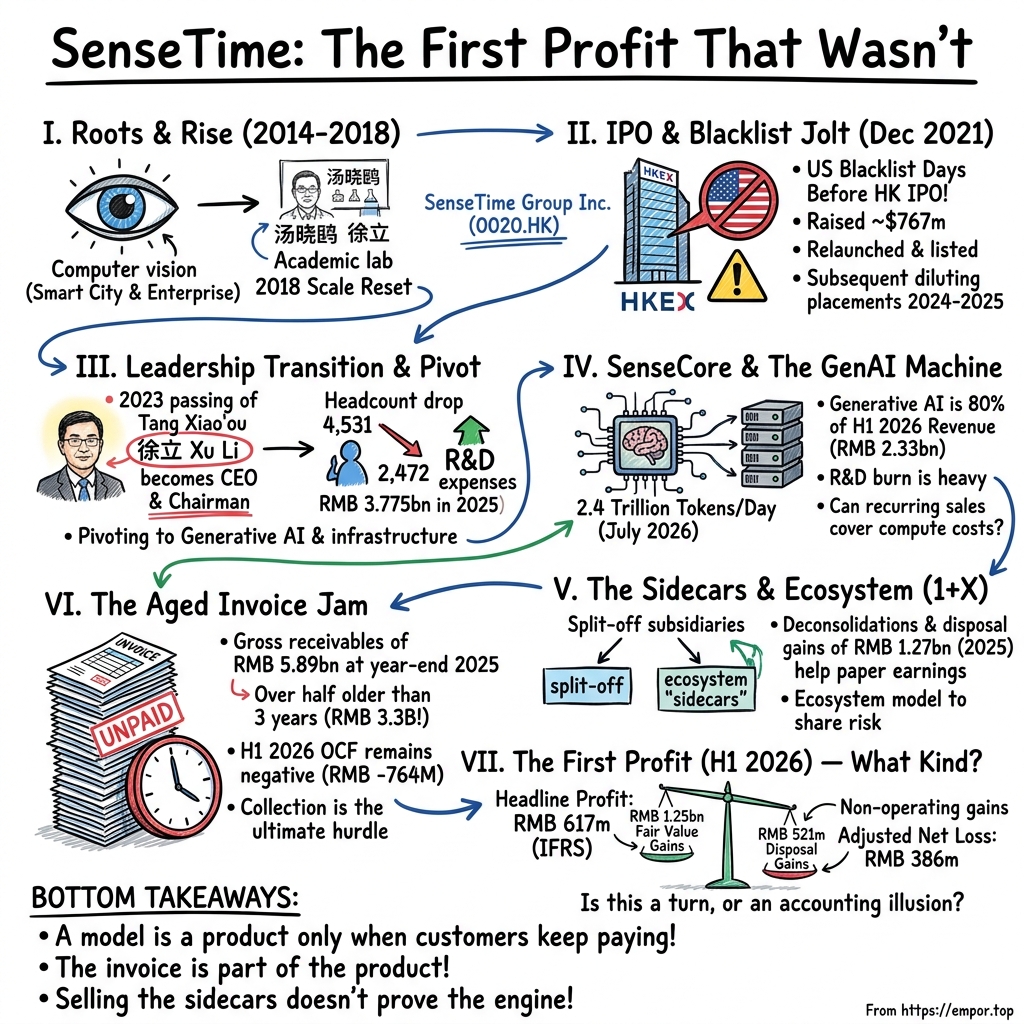
For five years as a listed company, SenseTime had published one kind of headline. Each results day brought another loss, sometimes enormous, sometimes merely large, always explained as the price of building artificial intelligence at scale in China. Then, in late August 2026, the headline changed. For the first half of the year, the company reported a profit under international accounting standards of about RMB617m, the first time since its 2021 listing that the bottom line had been black.1 Shareholders who had watched the stock lose most of its value since the listing finally had a number they could put on a slide.
The trouble started one line down. On the company's own adjusted measure, which strips out items that do not come from running the business, SenseTime still lost about RMB386m in the half.1 Its cash told the same story with less diplomacy: operating activities consumed roughly RMB764m in six months.2 A company that is truly at break-even does not burn three-quarters of a billion renminbi running its business. So where did the profit come from?
The answer sat in two places most investors skim past. The first was a gain of about RMB1.25bn from revaluing financial assets the company holds, a mark-to-market uplift on investments rather than money earned from customers.2 The second was about RMB521m of gains from disposing of subsidiaries, the accounting result of selling down or diluting stakes in businesses SenseTime had incubated, so that they stopped being consolidated and became associates instead.2 Add those two together and you get roughly RMB1.77bn of gains in a half-year in which the company reported RMB617m of profit. Take them away, and the old loss comes back into view.
That is not a scandal. Fair-value gains are real accounting entries, audited under rules that every listed company follows, and SenseTime published its adjusted figure right alongside the headline. But it does change the question. The first profit was evidence that SenseTime's portfolio had appreciated and that its ecosystem strategy could crystallize value on paper. It was not evidence that the business of selling AI had started paying for itself.
None of this means nothing improved. The commercial business was growing faster than it had in years. Revenue in the first half rose about 23% to roughly RMB2.91bn.1 Gross margin, the share of each sale left after the direct cost of delivering it, improved to about 41%.1 And the momentum carried into the autumn: revenue for the first nine months of 2026 rose about 30% to roughly RMB3.79bn, and gross margin across those nine months reached about 43%.4 Those are not the numbers of a company in retreat. They follow a full year, 2025, in which revenue grew about a third to roughly RMB5.0bn, the fastest growth SenseTime had managed in years.3
So the story SenseTime is telling the market is not fiction. It is incomplete. The company has reinvented itself, at least once and arguably twice, from a face-recognition specialist selling cameras and software to city governments into a generative-AI company selling models, computing capacity and the tokens that flow through them. The new business is bigger than the old one and growing faster. The open question is whether it is a better business, one in which customers keep paying, pay enough to cover the computing bill, and pay on time.
Three questions run through the rest of this story. Can recurring AI sales grow faster than the computing costs needed to deliver them? Are customer invoices turning into cash, or sitting for years on the balance sheet? And can Xu Li, the co-founder who has run the company since its early days, carry the strategy to self-funding without asking shareholders for yet more money?
One boundary is worth setting before the story begins. SenseTime Group Inc. is a holding company incorporated in the Cayman Islands and listed in Hong Kong. Every figure in this story refers to the consolidated group, including its operating subsidiaries in mainland China and the contractually controlled affiliated entities that Chinese technology companies commonly use to hold licences that foreign-owned firms cannot hold.3 When SenseTime "disposes of a subsidiary," the business does not vanish. It moves from inside that consolidated boundary to outside it, which is exactly what made the first half of 2026 look the way it did.
To understand why a company that once embodied China's AI ambitions needed a revaluation gain to show a profit, the story has to go back to a laboratory in Hong Kong, and to a professor who believed computers could learn to see.
 Subscribe on LinkedIn
II. The lab that tried to turn vision into infrastructure
In 2014, a research group at the Chinese University of Hong Kong did something that made the rest of the computer-vision world sit up. Its face-recognition system, trained with the then-new technique of deep learning, outscored human beings on a standard benchmark of matching faces in photographs. The lab was run by 汤晓鸥 Tang Xiao'ou, an MIT-trained professor of information engineering with a reputation as both a serious scholar and an unusually funny lecturer, the kind of academic who could make a room of engineers laugh and then hand them a problem that would take a decade to solve.5 Around him was a group of students and collaborators who would become the founding team of a company.
That company was SenseTime, founded in October 2014.5 Tang supplied the scientific reputation. 徐立 Xu Li, one of his doctoral students, became the operator and, eventually, the chief executive. 王晓刚 Wang Xiaogang, another member of the academic circle, became chief scientist.5 The bet was simple to state and hard to execute: that the algorithms emerging from university labs were good enough to be sold, at scale, into the real world, where cameras were multiplying faster than any human could watch them.
The timing was almost perfect. China in the mid-2010s was building surveillance and urban-management systems at an extraordinary pace, its smartphone makers wanted face unlock and beauty filters, banks wanted identity verification, and carmakers were beginning to think about driver monitoring. Each of those buyers needed the same core capability, a machine that could recognize what was in an image, and few of them could build it themselves. SenseTime set out to be the supplier of that capability across all of them, organizing the business around Smart City, Smart Business, Smart Life and Smart Auto.5
Investors noticed. Through a series of private rounds, SenseTime drew money from some of the best-known names in technology investing, including Alibaba, SoftBank's Vision Fund and Qualcomm, and became for a time one of the most valuable AI start-ups in the world.5 The company's pitch was not just that it had good algorithms. It argued that it was building infrastructure: a deep-learning platform and, later, a giant computing facility in Shanghai that would let it train models faster and cheaper than customers could alone. That word, infrastructure, would return again and again.
The way SenseTime actually made money, though, was less like infrastructure and more like a project business. Its 2021 prospectus described a mix of software licences, platforms bundled with hardware such as servers and cameras, and services to install and maintain them.5 A city government buying a video-analysis system did not pay a monthly subscription. It signed a project, waited for delivery, tested the system, and then formally accepted it. SenseTime recognized software revenue largely on delivery and acceptance, with maintenance and upgrades treated as separate obligations, typically lasting one to three years.3 That model had a consequence that investors underestimated. Revenue arrived in lumps, timed by when customers signed off, and cash arrived on the customer's schedule, which for public-sector buyers could be very slow indeed.
Here a warning about the long-run numbers is essential. Commonly circulated financial databases show this company with billions of US dollars of revenue and fat profits in 2014 to 2017, followed by a collapse of more than 95% in 2018. That series cannot describe SenseTime. A start-up founded in late 2014 did not earn several billion dollars a year with 30% operating margins in its first years, and the company's own prospectus describes a young, loss-making group rather than a cash machine.5 Those early figures almost certainly belong to a different entity mapped to the same ticker. Any chart claiming that SenseTime delivered a decade of growth or generated tens of billions of renminbi of operating cash should be discarded. The comparable history of the listed group begins in 2018.
From there, the record is clearer and more sobering. Revenue rose from about RMB1.85bn in 2018 to roughly RMB4.7bn in 2021, the year of the listing, as the vision business rode China's smart-city spending boom.5 Then it fell for two straight years, to about RMB3.4bn in 2023, as local-government budgets tightened, the pandemic disrupted projects and U.S. restrictions complicated the company's position.6 Only in 2024 did it begin to grow again, and only in 2025 did it surpass its 2021 peak, reaching about RMB5.0bn.3 Over the five years to 2025, revenue grew less than 8% a year compounded. For a company once valued as China's AI champion, that is the growth rate of a utility.
Losses, meanwhile, never stopped. Operating losses widened every year from 2018 through 2022 and stayed enormous in 2023, when the company lost far more than it sold.6 Some of the headline losses in the pre-IPO years were swollen by accounting changes in the value of preferred shares, a quirk of venture-backed companies that disappears at listing. But even stripping those out, SenseTime spent far more on research and on its people than its customers paid it.
What does the record say about the founding thesis? It supports the first half. Research excellence and early deployment did produce a real business: SenseTime became one of the leading suppliers of computer-vision systems in China, with customers in government, property, finance, phones and cars. It does not support the second half, that technical leadership would by itself translate into durable growth and margins. When the smart-city market slowed, SenseTime's leadership in algorithms did not protect its revenue. When customers took years to pay, its benchmark scores did not help collect the money. The lab had built a product. It had not yet built a business that funded itself.
That gap needed financing, and in December 2021, at exactly the moment SenseTime went to the public markets to close it, Washington intervened.
III. The blacklist landed the week of the IPO
By early December 2021, SenseTime's Hong Kong listing was all but done. The prospectus was filed on 7 December, offering 1.5bn shares at up to HK$3.99 each, a deal that aimed to raise roughly US$767m.57 Cornerstone investors had signed up. The bookbuilding was under way. Shares were due to begin trading the following week. Then, on 10 December, the U.S. Treasury Department added SenseTime to its list of Chinese military-industrial complex companies, a designation that barred Americans from buying or selling the company's publicly traded securities.8 Treasury cited the company's facial-recognition technology and its alleged use in surveillance of Uyghurs in Xinjiang. SenseTime called the allegations unfounded.
The IPO stopped within days. On 13 December, SenseTime postponed the listing because a deal marketed to global investors now had to be reworked to exclude Americans entirely.7 For a company that had spent seven years courting international capital, the moment was brutal in its timing. The shift from private AI lab to public-market story, the event meant to give SenseTime a pipe into public equity, had been interrupted by a government that many of its original investors called home.
Two different American measures are often blurred together in coverage of SenseTime, and the difference matters. In October 2019, the U.S. Commerce Department had added a SenseTime subsidiary in Beijing to its Entity List, a trade restriction that limits the export of American technology to the named entity without a licence.5 That measure was about supply: what SenseTime could buy. The December 2021 Treasury action was about capital: who could buy SenseTime. One threatened the company's access to American chips and software; the other threatened its access to American money. Investors who assumed the second was merely a repeat of the first underestimated how much the risk had widened.
The company moved quickly. It relaunched the offering with a supplemental prospectus on 20 December, kept the shares at the bottom of the original range at HK$3.85, and listed in Hong Kong before the end of the month.[^9] Cornerstone investors, mostly Chinese state-linked and domestic funds, stayed on. SenseTime had its listing, but it was a different listing from the one it had planned: a company now firmly in the orbit of Chinese capital, with a geopolitical asterisk printed next to its name.
The asterisk grew. In January 2025, the U.S. Defense Department included SenseTime on its list of Chinese military companies operating in the United States, alongside Tencent and battery maker CATL, a designation that several of the named companies publicly disputed.9 SenseTime said the listing would not materially affect its business, a claim that is plausible given how little revenue it earns in America. But "business impact" and "investor risk" are different things. Every new designation narrows the pool of global funds that can own the shares, weakens the case for overseas expansion, and adds another reason why a Chinese AI company may struggle to get the most advanced American chips. For a business whose new strategy depends on large-scale computing, that last point is not abstract.
What the listing did provide was a pipe to equity, and SenseTime used it heavily. In 2024 and 2025, the company completed four share placements, in June and December 2024 and in July and December 2025, issuing about 6.95bn new Class B shares in total.3 The last of these, in December 2025, sold 1.75bn shares at HK$1.80 each and raised net proceeds of about RMB2.89bn, which the company said it had fully deployed by the time it published its annual report.3 Placements are quick and cheap to execute, which is why companies under financial pressure favour them. They are also, for existing holders, a transfer: each new share issued at a discount to the hopes of earlier investors dilutes their claim on whatever SenseTime eventually earns.
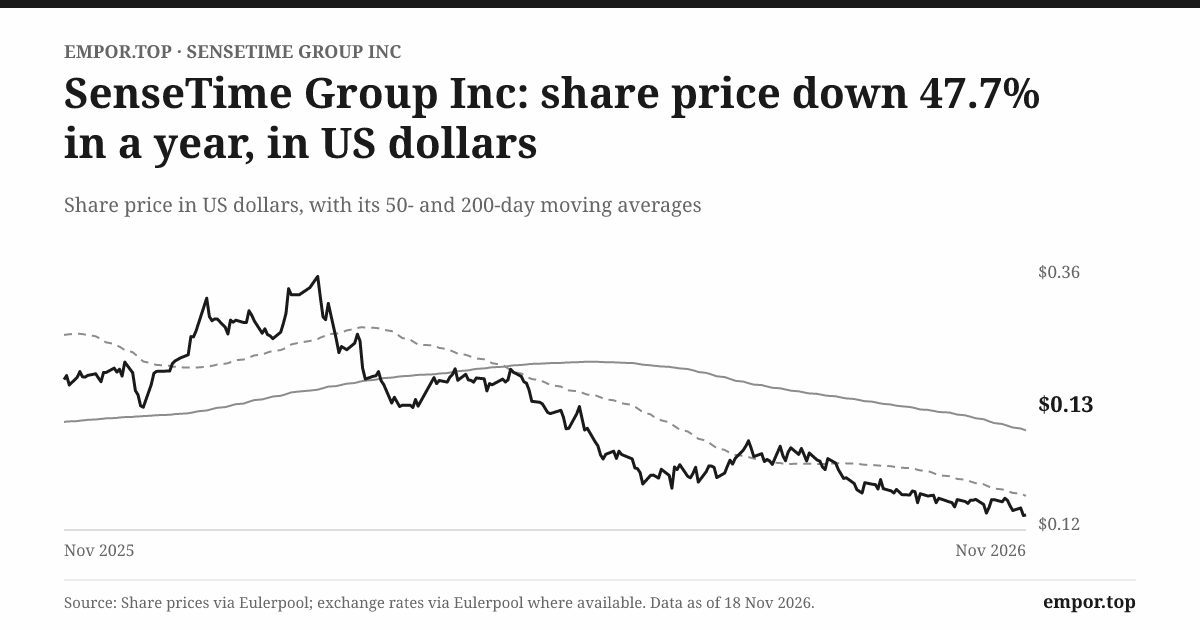
On 18 November 2026, the stock traded at the equivalent of about CN¥0.90, roughly half the price at which the December 2025 placement investors had bought, before allowing for currency and the difference between the Hong Kong-dollar and renminbi counters. Investors who wrote the cheque less than a year earlier were sitting on large losses. Those who had bought at the IPO had lost far more. The company's share count rose from about 37bn shares at the end of 2024 to about 40.4bn at the end of 2025, primarily from the placements.3
Did the money buy visible progress? Partly. The proceeds helped fund the computing capacity and model development behind the generative-AI pivot, and revenue in 2025 grew faster than in any recent year. But operating cash flow stayed negative in 2025 and again in the first half of 2026, which means new equity was still filling a gap that the business had not closed.2 The capital markets had kept SenseTime alive and investing. They had not yet been repaid with cash.
That raises the obvious question. What exactly was the money paying for, and why did the company need to change what it sold?
IV. When the old engine stopped paying for the new one
Picture the business SenseTime had built by 2022. In hundreds of Chinese cities, its software watched video feeds, counted traffic, flagged incidents and managed access to buildings. These were real systems doing real work. But the market for them was slowing. Local governments, squeezed by falling land-sale revenues and pandemic costs, were cutting budgets and paying old bills late. Computer vision itself was becoming a commodity, as dozens of rivals offered similar accuracy and as camera makers built recognition directly into their hardware. The engine that had carried SenseTime through its first eight years was losing power, just as the cost of staying at the frontier of AI was climbing.
Then, in November 2022, a chatbot built in San Francisco changed the industry's sense of what AI was. Within months, every major Chinese technology company announced a large language model. SenseTime moved fast. In April 2023, it unveiled its SenseNova family of foundation models and positioned its Shanghai computing facility, part of a platform it calls SenseCore, as the infrastructure that would let it train and serve them.6 Management argued that SenseTime was better placed than most to compete, because it had spent years building exactly the computing base that large models needed.
The industry shift deserves a plain explanation. In the computer-vision era, an AI company sold a specific capability—recognize this face, read this licence plate—and the customer bought it as a product, often bundled with hardware. A foundation model is something different: a general-purpose system trained on vast amounts of text, images and code that can be adapted to thousands of tasks. Its economics look less like software licences and more like a utility. The company pays up front to build a power station, here a model and the data centre that runs it, and then sells the output by the unit, in this case "tokens," the small fragments of text a model reads and writes. The more customers use it, the more revenue flows, but the more electricity, chips and depreciation the company consumes too.
Was the pivot a timely reinvention or a retreat from a weakening legacy business? The honest answer is both. The pivot was clearly driven by necessity: the old business was shrinking, revenue fell in both 2022 and 2023, and the company's computing investment needed a bigger use than vision models alone.6 But it was also well-timed, because SenseTime already owned large-scale computing capacity when Chinese companies were scrambling for it, and U.S. chip restrictions made domestic capacity more valuable.
At the level of reported revenue, the pivot has worked. Revenue grew about 11% in 2024 and about 33% in 2025, when it reached roughly RMB5.0bn.103 By the first half of 2026, generative AI had grown from a sideline into the business: it accounted for about RMB2.33bn of the RMB2.91bn of revenue, close to 80%, and more than doubled from a year earlier.1 In three years, SenseTime had in effect replaced its revenue base. Few companies manage that kind of mix shift without a collapse in the middle, and SenseTime's revenue dipped but did not collapse.
The cost of the bet, though, was enormous. Research and development expense was about RMB4.1bn in 2024, more than the company's entire revenue that year, and about RMB3.8bn in 2025, roughly three-quarters of revenue.103 None of that spending was capitalized as an asset in either year; all of it went straight through the income statement as an expense, which is a conservative accounting choice and one point in management's favour.3 But the scale tells you how far the business still was from self-funding. A software company spending three-quarters of its revenue on R&D, before sales, administration or the cost of delivering services, is not near profitability.
The more striking change was in people. SenseTime had about 4,531 employees at the end of 2023. By the end of 2025, it had 2,472, a reduction of nearly half in two years, while revenue rose.11 The cut continued into 2026: R&D expense in the first half fell about 17% to roughly RMB1.76bn, mainly because of lower employee costs.2 This is the other half of the pivot story, and it is rarely told. SenseTime did not grow into its cost base. It shrank its cost base towards its revenue, cutting the labour-intensive vision and project teams while the computing-heavy generative business grew.
That shift changes the shape of the costs as well as their size. A company built on engineers spends on salaries, which can be cut. A company built on data centres spends on servers, power and depreciation, which cannot be cut without shrinking the product. As SenseTime replaces one kind of cost with the other, its losses may narrow, but its fixed commitments become harder to escape. The company's own interim report noted that depreciation and operating costs of its AI data centres rose sharply as generative-AI services expanded.2
Management's newest language takes the story one step further. In 2026, SenseTime began talking about "agentic intelligence," AI systems that do not merely answer questions but carry out multi-step tasks, and about moving from pricing by token volume to pricing by task outcome.1 Outcome-based pricing is an appealing idea: instead of charging for the electricity, charge for the finished job, and capture more of the value created. It is also unproven. Customers have to trust the outcome, measure it, and agree to pay more for it than for raw tokens, and competitors with deeper pockets can offer the same idea for less. Until SenseTime discloses what its recurring revenue earns after compute costs, and how that figure moves across several reporting periods, "agentic" is a strategy to test, not proof that customers will pay.
That a founder-led company could reinvent itself this thoroughly in three years says something about its leadership. It also raises a question about who now holds that leadership, because the founder at the centre of the story did not live to see the pivot through.
V. When the founder died, the strategy stayed—and changed
On 15 December 2023, Tang Xiao'ou died of illness at the age of 55.12 He was SenseTime's founder, its controlling shareholder through his holding vehicles, an executive director and, for many in China's AI community, the field's most recognizable academic. The news reached investors on a Sunday through a short exchange filing.12 When trading resumed, the shares fell sharply, to what was then a record low.13 The market was asking the question every founder-led company eventually faces: was the founder the company?
In SenseTime's case, the answer was more nuanced than the share price suggested. Tang had been the face and the scientific conscience of the company, but he had not run it day to day. That job had long belonged to Xu Li, his former doctoral student, who had been chief executive for years and also served as executive chairman.12 Xu was, in many ways, the opposite profile from his mentor: less the celebrated scholar, more the builder, the person who translated research into products, negotiated with investors and stood in front of analysts. Tang's death removed a symbol. It did not remove the operator.
What it did change was the concentration of responsibility. Since late 2023, Xu Li has been central to almost everything SenseTime does: the strategy, the external narrative, the capital raising and the restructuring. The board says it combines the roles of chairman and chief executive deliberately, to maintain consistent leadership.3 That is defensible in a company going through rapid change. It also means there is no separate chairman to challenge the chief executive, and that the success or failure of the pivot is attached to one person to an unusual degree.
The governance structure reinforces that. SenseTime has a dual-class share structure, with Class A shares carrying weighted voting rights and Class B shares carrying one vote each.3 At the end of 2025, there were about 614m Class A shares against roughly 39.8bn Class B shares.3 Weighted voting rights mean that a small group of founders can retain decisive control over most matters even while owning a sliver of the economics; Hong Kong's rules carve out certain exceptions, such as changes to the constitution and the appointment of independent directors, where every share counts equally. The board has three independent non-executive directors, the minimum Hong Kong requires.3 For outside shareholders, who have supplied most of the capital, that structure is the price of admission.
Incentives are the next test. In 2025, SenseTime disclosed a conditional grant to Xu Li of 600m restricted share units, which remained unvested at the end of the year.3 A grant of that size ties the chief executive's wealth to the share price, which is the right direction. But it says nothing by itself about operating discipline. An executive rewarded for equity value can pursue it through cash generation, which compounds, or through narrative and revaluation gains, which do not. The company does not publish a role-by-role, multi-year pay series for its chief executive and chief financial officer; its annual report gives pay bands for the five highest-paid individuals instead, which makes it hard for shareholders to judge how pay has tracked results over time.3
So judge the management on behaviour, not titles. Since Tang's death, Xu Li's team has made three large moves. It completed the pivot. It cut costs. And it began "spinning off" ventures, selling or diluting stakes in businesses it had incubated, so that they could raise their own capital outside the listed company. Each of those moves is coherent with the others: concentrate the listed company on the core model-and-infrastructure business, shrink the cost base, and let the satellites fund themselves. That is a recognizable strategy, and it has been executed with some speed.
The test of credibility is whether management explains the consequences as clearly as it announces the moves. The first-half 2026 results release led with the profit, the revenue growth and the token volumes, and it also reported the adjusted loss.1 It introduced recurring revenue as a new measure but gave no recurring-revenue gross margin, no multi-year history and no unified definition of contract term.1 The interim results briefing was the natural place to settle the obvious questions: what exactly counts as recurring, how much of the headline profit came from gains, how computing costs would move as token volumes surged, and when operating cash flow would turn.14 The interim report supplied the arithmetic of those questions,2 but not the economic answer: how much the new recurring business earns after the cost of delivering it.
The 2025 annual results showed a similar pattern. The company explained that its narrower loss reflected revenue growth, cost cuts and the gains from deconsolidating subsidiaries, and that it had raised capital to fund AI infrastructure.1516 It did not set out a dated path to positive operating cash flow. Management has been consistent about direction. It has been less forthcoming about the measures that would let outsiders hold it to account.
That leaves a specific credibility test rather than a general verdict. Xu Li has kept the company coherent through a founder's death, an existential product shift and a deep restructuring. Whether that adds up to good stewardship depends on something he has not yet delivered: a business whose customers pay enough, and fast enough, to fund what it spends. And nowhere has that problem been more stubborn than in the oldest part of SenseTime's business, the invoices.
VI. The invoice that takes years to turn into cash
Imagine a district government in a Chinese city that bought a SenseTime video-analysis system a few years ago. The project was delivered. The system was tested and accepted. Under accounting rules, SenseTime recorded the revenue. The invoice went into the government's payment process, where it needed budget approval, then sign-off from several departments, then actual cash from a treasury already squeezed by falling land sales. Months became a year. A year became three. Nobody disputed that the money was owed. It simply did not arrive.
That scene, a composite drawn from how SenseTime itself describes the problem, sits at the heart of the company's financial history. SenseTime says its historical Smart City customers, especially those exposed to public-sector budgets, have faced budget constraints and lengthy internal approval and payment cycles.3 The company does not identify a named customer bankruptcy, a major customer loss or any unusual credit terms granted to a specific buyer.3 This is not a story of one bad debtor. It is a story of a whole customer class that pays slowly, and of a business model that recognized revenue on acceptance while waiting years for cash.
The numbers show the scale. At the end of 2025, SenseTime's gross trade receivables, the total amount customers owed it before any provision for bad debts, were about RMB5.9bn.3 Of that, roughly RMB3.3bn had been outstanding for more than three years.3 To put that in perspective, the stale portion alone was about two-thirds of a full year's revenue. Against the whole balance, the company held an impairment allowance of about RMB3.4bn, an admission in accounting form that much of what is owed may never be collected.3 Normal credit terms were mainly 90 to 270 days.3 Three years is not a slow payment. It is a different category of asset.
The auditor noticed too. PricewaterhouseCoopers, which issued a clean opinion on the 2025 accounts, listed the impairment of trade and other receivables as one of its key audit matters, alongside revenue recognized at a point in time.3 Those two items are linked. When revenue is booked on delivery and acceptance, and cash arrives years later or not at all, the judgment about how much to provide for bad debts directly shapes the reported loss. Every renminbi of provision reversed when an old invoice is finally paid flatters a future year; every renminbi added when hopes fade worsens it.
There is genuine improvement in this story, and it deserves its place. Debtor days, a measure of how many days of revenue are tied up in receivables, peaked at about 506 in 2022, which means customers owed SenseTime well over a year's worth of sales.6 By 2025, that figure had fallen to about 248.3 Part of the improvement came from collecting old balances and part from the changing mix of revenue, as generative-AI services, which tend to bill more regularly, grew relative to old projects. In 2025, receivables and prepayments released about RMB151m of cash, rather than absorbing it.3
But improvement is not resolution. By June 2026, net trade receivables had jumped to about RMB3.76bn from about RMB2.51bn six months earlier.2 Gross receivables had risen to about RMB7.0bn, and the portion older than three years was still about RMB3.3bn, barely changed.2 In other words, the old pile had not shrunk much, and a new pile was forming on top of it. Some of that is seasonal, because Chinese customers, particularly state-linked ones, tend to pay at year-end, and some reflects faster revenue growth. But a half-year in which receivables grew by about RMB1.25bn while operating cash flow was negative by about RMB764m shows where the cash went.2 The fast-growing generative business is not immune to the collection problem.
Customer concentration sharpens the point. In 2025, SenseTime's five largest customers generated about 39% of revenue, and the single largest about 19%.3 A customer representing nearly a fifth of sales has enormous bargaining power over price, delivery terms and, above all, payment timing. When a buyer of that size wants to pay late, a supplier in SenseTime's position has few options. Payment terms are, in effect, part of what is being sold.
A newer wrinkle sits in the related-party note. In 2025, SenseTime sold about RMB262m of products and services to related parties, about 5% of revenue, up from less than RMB10m a year earlier.3 Related-party trade receivables jumped to about RMB369m from about RMB14m.3 The explanation is mostly mechanical. After the 2025 disposals, sales to those companies that would previously have been eliminated inside the group became related-party revenue.3 That is legitimate. It also means a growing share of revenue now comes from companies that SenseTime partly owns and helped create, at prices the annual report does not explain with a general formula.3 A skeptical investor would want to know how much of the receivables growth comes from those former subsidiaries, and how quickly they pay.
The verdict is therefore mixed but clear. Collection efficiency is better than at the 2022 peak, which matters because it shows the company can collect some old balances and that the new business bills more cleanly. But the stale core of more than RMB3bn of three-year-old invoices remains, and the interim balance rose sharply. The decisive evidence will be how much of the June 2026 receivables turns into cash in the second half of the year, and how much has to be written off. Until then, every renminbi of reported revenue growth should be read with a question mark beside it: invoiced, yes, but collected?
The generative-AI business is supposed to be the answer to that question, a business where customers pay by usage, continuously, rather than by project, eventually. To see whether it is, follow the tokens.
VII. SenseCore puts compute on both sides of the ledger
In July 2026, SenseTime's computing platform was processing an average of about 2.4tn tokens a day, roughly 22 times the volume of a year earlier.1 It is a number designed to impress, and it does. A token is roughly a fragment of a word, so 2.4tn tokens a day is on the order of a trillion words read or written by machines every day for SenseTime's customers: chatbots answering questions, code assistants writing software, agents summarizing documents. The volume curve looks like the adoption curve of a successful consumer app.
But a token processed is not a renminbi earned, and a renminbi earned is not a renminbi kept. Every one of those tokens runs on a chip in a data centre that SenseTime has to buy or lease, power, cool and depreciate. That is the central tension of the new business: computing capacity sits on both sides of the ledger. It is what SenseTime sells, and it is what SenseTime spends. Whether the business works depends on the gap between the two.
Here is how the model works in practice, described as a chain rather than a product catalogue. SenseTime's foundation models, under the SenseNova brand, attract developers and enterprises who want to build AI into their products. Those customers send requests to SenseCore, the company's computing platform, which supplies both the raw computing power to train and run models and the token services that bill by usage.12 Around that core, SenseTime still sells software, hardware and implementation work that puts AI into specific enterprise workflows, from banks to carmakers to its legacy vision customers. Usage brings revenue, revenue funds more capacity, and capacity attracts more usage, if the price is right.
In the first half of 2026, this machine produced revenue of about RMB2.91bn, of which generative AI contributed about RMB2.33bn.1 SenseTime introduced a new recurring-revenue measure that period and reported about RMB1.15bn, about 39% of total revenue, up about 124% from a year earlier.1 And gross margin kept improving: in the first nine months of 2026, it reached about 43%.4
The recurring-revenue measure deserves careful reading. It is useful, because it shows that a large and rapidly growing share of SenseTime's business now comes from services customers use continuously, rather than projects they accept once. But it was introduced only in 2026, so there is no multi-year history to show whether it holds up through a downturn. SenseTime does not disclose a unified contract term, minimum commitment or pricing unit across the business, and it does not publish the gross margin of recurring revenue specifically.2 Recurring revenue at a thin margin could be worse than project revenue at a fat one. Without the margin, investors know the shape of the new business but not its quality.
The old vision business has not disappeared, and it deserves its proper scale. According to IDC data cited by the company, SenseTime held about 19.5% of China's private-deployment computer-vision market in the first half of 2026, the largest share in that segment.17 "Private deployment" means systems installed on the customer's own servers rather than run in a public cloud, which is what governments, banks and large enterprises often prefer for security reasons. That is a real position in a real niche. It is not leadership in the far larger markets where SenseTime's future is being decided: AI cloud computing and foundation models.
Those markets are a war, and SenseTime is not the biggest army. In cloud and AI infrastructure, it faces 阿里云 Alibaba Cloud, by far China's largest cloud provider, along with 百度智能云 Baidu AI Cloud and 火山引擎 Volcano Engine, the cloud arm of 字节跳动 ByteDance. Each has vastly larger data-centre footprints, deeper pockets and, crucially, distribution through their own consumer and enterprise businesses. In models, SenseTime competes with 腾讯 Tencent, with 深度求索 DeepSeek, whose low-cost open models upended pricing across the industry, with 智谱 Zhipu AI and with dozens of other developers. In the broader full-stack AI cloud market, SenseTime is much smaller than Alibaba, and market-share figures vary so much by definition and period that no single ranking settles where it stands.
What would make SenseTime win in that fight? Three things are plausible. Private deployment is one: customers who insist on keeping AI on their own premises want a vendor that can install and maintain it there, and SenseTime has years of experience doing so. Vision expertise is another: multimodal AI, models that understand images and video as well as text, plays to the company's historical strength. And its installed base is a third: customers already running SenseTime systems face some friction in switching, because their data, integrations and staff training are built around them.
What could break those advantages is just as visible. Large customers increasingly multi-source, using several model providers and switching between them as price and performance shift, which is easy to do when models are accessed through similar interfaces. Open models such as DeepSeek's allow customers to run capable AI without paying a model vendor at all. And inference prices, the price of running models, fell dramatically across China in 2024 and 2025 as the giants competed for share. The company does not publish customer retention, win-loss rates, price realization or customer-acquisition costs.2 Without those, the moat claims are reasonable hypotheses, not demonstrated facts.
It is worth separating capability from commercialization, because SenseTime's history shows how far apart they can be. Model releases, benchmark scores, token volume and demonstrations of AI agents are evidence that the technology works and that people are using it. The vision era proved that technology can work brilliantly while the business still loses money. The evidence that matters for the generative era is recurring gross profit and cash collections: whether customers pay enough, and promptly enough, to cover compute and service costs.
That brings the cost mechanism into focus. When token volumes grow 22-fold, recurring revenue can grow, but so do the depreciation of data-centre equipment, the cost of running servers and the spending on the next model generation. A 124% rise in recurring revenue against a 22-fold rise in tokens implies that the revenue per token fell steeply over the year, which is consistent with industry-wide price cuts and with SenseTime pricing aggressively to win volume.1 That is not necessarily bad. Utilities make money on scale, and gross margin has improved. But it means SenseTime is running fast to stay ahead of price deflation, and the race is against competitors whose data centres were paid for by advertising, e-commerce or social media.
The verdict on the new business is therefore narrow but positive. SenseTime has a meaningful position in private-deployment vision and a fast-growing generative-AI business with improving gross margin. The evidence supports product capability and customer demand. It does not yet support durable pricing power, retention or unit economics better than those of the platforms it competes with. And the company has been pursuing a second strategy alongside the first, one that has done more for its reported profits than its tokens have.
VIII. A portfolio of sidecars, bought with fresh equity
Through 2025, SenseTime did something that, in a single year's accounts, looked a lot like making money. It sold down or diluted its interests in several businesses it had built, lost control of them, and recognized substantial gains as they moved from subsidiaries to associates or joint ventures. Gains on subsidiary disposals reached about RMB1.27bn for the year.3 In one transaction, SenseTime received about RMB50m in cash and recognized a gain of about RMB938m, because accounting rules required it to remeasure the stake it retained at fair value.3
That single transaction is worth pausing on, because it captures the whole mechanism. When a company owns a subsidiary, it carries that business at the historical cost of its net assets, often very little for a young venture. When it gives up control, accounting rules treat it as if it had sold the entire business and bought back the retained stake at today's value. If outside investors have just put money into the venture at a high valuation, the retained stake is suddenly worth much more on paper, and the difference flows through the income statement as a gain. The company received RMB50m in cash. It booked nearly twenty times that as profit. Both numbers are correct. Only one of them can pay for a data centre.
The strategy behind these moves has a name inside SenseTime: "1+X."3 The "1" is the core listed company, which supplies the foundation models, the computing infrastructure and the shared technology. The "X" is a constellation of ecosystem companies, each focused on a vertical, cars, healthcare, consumer devices, robotics and others, that can raise money from outside investors, hire their own management teams and pursue their own markets. The logic is sound on its face. A listed company burning cash cannot fund every promising application of AI. By pushing ventures outside the consolidated group, SenseTime shares the financing burden, keeps an equity stake in the upside, and removes their losses from its own income statement.
It is also, in effect, a venture-capital model grafted onto an operating company. And venture portfolios are judged by what comes back. On that test, the record is incomplete. SenseTime has deconsolidated several businesses, recognized large non-cash gains and retained minority stakes.3 What it has not yet shown is substantial cash returned to the listed company from these ventures. The gains are real in accounting terms, but they are paper gains until someone pays cash for the retained stakes.
The balance sheet reflects this dual identity. At the end of 2025, SenseTime held about RMB13.2bn in cash and term deposits, a substantial cushion.3 It also held about RMB7.5bn of non-current financial assets measured at fair value through profit or loss, investments whose changing values flow directly into reported earnings.3 The company says it held no "significant" equity investments under the Hong Kong disclosure definition at year-end, while also disclosing those large fair-value holdings and strategic investments.3 The categories are distinct and should not be conflated, but the practical effect for investors is simple: a large portion of SenseTime's asset base moves with the private-market valuations of AI companies, and so does its profit. That is exactly what happened in the first half of 2026, when fair-value gains did most of the work behind the headline profit.2
It is worth being precise about what this is not. SenseTime has not been running an acquisition spree. The company has not disclosed a large purchase of another business in the period covered by its recent reports, so the usual test, whether it overpaid against industry purchase multiples, does not apply. The right comparison is with a venture investor: does the portfolio, over time, return more cash than it consumed? That is unknowable from the current disclosures, and the honest verdict is that the 1+X strategy is a plausible way to share risk, not yet a proven capital-allocation engine.
A skeptical activist would push harder on one point. The money that seeded those ventures came, ultimately, from SenseTime's shareholders, through the IPO and the placements of 2024 and 2025. The cash raised from those placements went into AI infrastructure and development, and some of the ventures it supported are now outside the group, with outside investors sharing the upside. Meanwhile, the listed company keeps reporting gains on those ventures as profit. The concern is not impropriety. It is that the investment risk sits with listed-company shareholders while the reporting makes the results look better than the operating business can yet justify.
There is also a question of what happens when the marks go the other way. Fair-value accounting is symmetrical. If China's AI start-up valuations fall, or if one of the ventures stumbles, the same mechanism that produced a profit in 2026 will produce losses, regardless of how the core business performs. A portfolio that inflates earnings in good markets will deflate them in bad ones.
Dilution sits right beside this strategy. The placements of 2024 and 2025 raised capital that funded both SenseTime's own AI build-out and, indirectly, the ecosystem around it.3 Each placement shifted part of the investment risk onto shareholders, who were asked to buy at progressively lower prices. A strategy that depends on new equity to fund the core while booking gains from the satellites can work. It works much better when the core starts producing cash.
Which brings the story back to where it began, to a half-year profit that the market wanted to believe, and to the question of what kind of profit it really was.
IX. First profit, but what kind?
The signal came before the results. In the weeks ahead of its August 2026 interim announcement, SenseTime issued a profit alert, telling the market that it expected to report a profit for the first half.1 For a company that had never reported a profitable half as a listed group, it was a moment worth announcing, and it was widely received as a turning point. Coverage framed it as evidence that generative AI had helped SenseTime reach profitability even as other Chinese AI developers struggled.18
Then the full results arrived, and the bridge from loss to profit became visible. Start with the business. Revenue grew; gross margin improved to about 41%; cost cuts, especially in staff, reduced the operating loss. That still left the core business in the red. Then add the gains: about RMB1.25bn from revaluing financial assets and about RMB521m from disposing of subsidiaries.2 Those gains carried the result across the line, to a reported profit of about RMB617m. Strip them out and add back the company's other adjustments, and you arrive at the adjusted net loss of about RMB386m.1 Profit and loss in the same half, depending on which lens you use.
The cash flow statement settles which lens matters more. Operating activities consumed about RMB764m in the first half.2 Fair-value gains and disposal gains are non-cash items, so they are added to profit in the accounts and then subtracted again when calculating cash flow. What remains is the cash reality: a business that, after paying staff, suppliers and computing costs, and after its receivables grew, used cash rather than generating it.
One tempting counter-argument should be dismissed quickly. Commonly circulated cumulative data show SenseTime generating several times more operating cash than net profit over twelve years from 2014. As the origin story made clear, the pre-2018 figures in that series do not describe this company. The comparable record since 2018 shows negative operating cash flow every single year. There is no long history of cash conversion here to fall back on.
Even the most recent full year needs a quality check. Operating cash flow in 2025 was negative about RMB301m, a large improvement on prior years, and the second half of 2025 was cash-positive.3 That improvement looked like the start of an operating turn. But look at what drove it. The company's payables, what it owed suppliers, rose by about RMB1.0bn during the year, which means SenseTime improved its cash position partly by paying its own suppliers more slowly.3 Receivables and prepayments released about RMB151m.3 Those are working-capital movements, not underlying profitability, and they can reverse. In the first half of 2026, they did: operating cash flow turned negative again.
The positive evidence deserves its full weight, because it is real. Revenue growth accelerated through 2026, to about 30% for the nine months.4 Gross margin improved from about 41% in the first half to about 43% across nine months, which suggests the third quarter was stronger still.4 The adjusted loss narrowed. Headcount fell while revenue rose. These are the signs of a business heading in the right direction, and a skeptic who ignored them would be making the opposite mistake to a bull who ignored the gains.
How did management handle the gap? For anyone listening to the results briefing, the tests that mattered were whether the company could quantify the operating contribution of recurring revenue, explain why cash flow lagged profit so badly, and clarify how dependent the headline was on gains.14 Management's prepared materials led with growth, gross margin and token volumes, and acknowledged the adjusted loss.1 The interim report quantified the fair-value and disposal gains and the cash outflow.2 What neither provided was the recurring-revenue margin or a dated path to positive operating cash flow, which are precisely the numbers that would turn the narrative into something investors could verify.
There is one more layer of support beneath the reported results, smaller than the gains but persistent. In 2025, SenseTime reported other income of about RMB432m, mainly government subsidies and tax refunds.3 Its treasury, the cash pile sitting mostly in US dollars, earned interest income of about RMB258m, which, after finance costs of about RMB201m on its bank borrowings, produced net finance income of about RMB57m.3 Set against a 2025 loss before tax of roughly RMB1.7bn, these sums are material. They are also not evidence of the economics of the AI business. Government grants reflect industrial policy, which can change; interest income reflects a cash pile that the company is spending down. Both make the reported loss smaller without saying anything about whether customers will pay enough for AI.
The verdict, then, is the one the opening scene implied. SenseTime has improved revenue growth and gross margin, and the direction of its cost base is right. But its reported profit is not yet a durable operating result. It is an accounting milestone built on portfolio marks and disposal gains, underneath which the business still loses money and still consumes cash. The decisive evidence will be several consecutive periods of positive operating contribution and operating cash flow without material investment or disposal gains. One half-year, however welcome, cannot provide that.
Which leaves investors with a harder question than "is SenseTime profitable?" The better question is: what would have to be true for it to become so, and what is the market currently betting?
Analysis & Bear vs. Bull Case
Picture the problem as an investor sees it on 18 November 2026. Here is a company growing revenue by about a third, with improving gross margins, a leading position in a niche of computer vision and a fast-growing generative-AI business. Its last reported profit depended on gains, its operating cash flow was negative, and it had issued billions of shares in two years. The stock has fallen about 62% from its 52-week high. What exactly is the market pricing?
The market values SenseTime at about 5.7 times its trailing sales and about 1.1 times its book value, and the stock trades on a trailing price-to-earnings ratio of about 102, with a free-cash-flow yield of minus 14.7%, figures built on the company's reported sales, equity and cash flows.32 Those numbers send contradictory signals, and it is worth explaining why. The P/E of 102 looks extravagant, but it is almost meaningless here: the "earnings" in its denominator are mostly investment marks and disposal gains, which can swing from profit to loss on the movement of private valuations. The price-to-book of 1.1 says investors value the company at roughly what its accounts say its assets are worth, a sign of deep skepticism for a technology company. The sales multiple and the negative free-cash-flow yield capture the real tension. At nearly six times sales, the market is still paying for growth and for the possibility of future margins. At minus 15% free-cash-flow yield, every year that possibility stays unrealized costs shareholders cash, which must eventually be replaced by more borrowing or more equity. The market is not pricing SenseTime as a failure. It is pricing it as an unproven bet whose clock is running.
The bull case begins with what SenseTime genuinely has. It combines vision models, private-deployment experience, owned computing infrastructure and generative-AI services in one company, a full stack that few Chinese AI developers outside the internet giants can match. Recurring revenue more than doubled, gross margin is improving, and token volumes are compounding, all of which suggest that customers are adopting the new stack and that the company is learning to run it more efficiently. Headcount cuts have shown that management will make hard decisions. The balance sheet, with about RMB13bn of cash and term deposits at mid-2026, provides runway.2 And U.S. restrictions on chips, which make domestic computing capacity scarce, could make SenseTime's owned infrastructure more valuable rather than less.
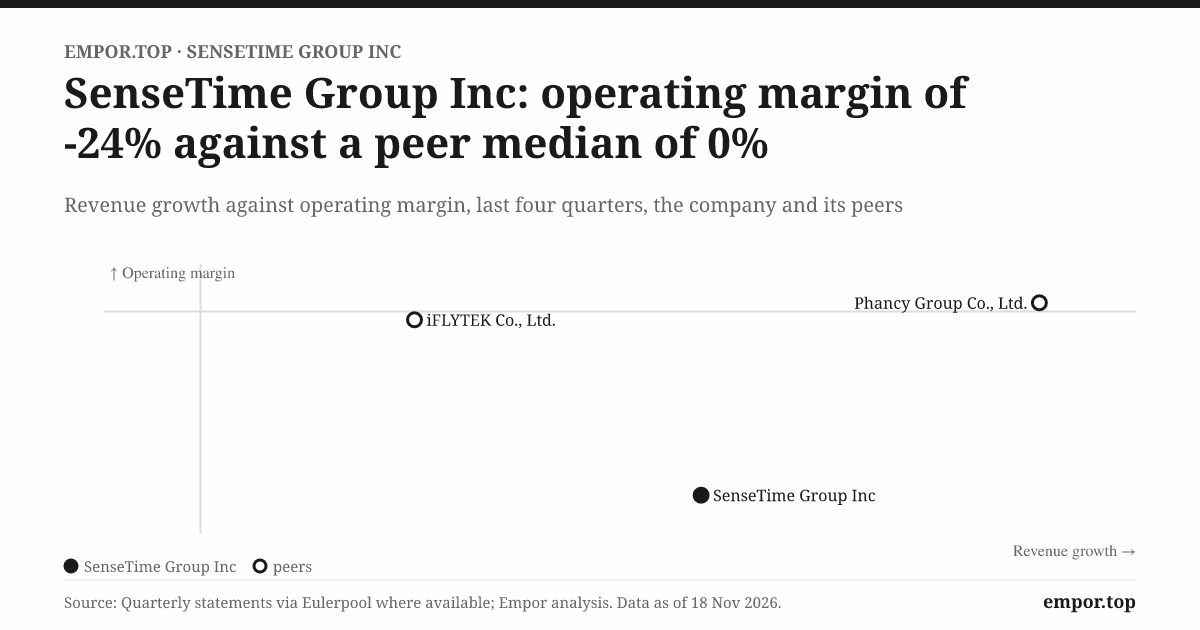
The bear case begins with what it lacks. Larger cloud and model competitors can bundle computing, models and distribution, and they fund their AI ambitions from profitable core businesses that SenseTime does not have. Open models and aggressive price cuts may reduce what customers will pay for a standalone model layer. The company's recurring revenue still has no disclosed margin, and it has repeatedly issued shares to fund itself. If cash generation lags much longer, the bear case does not require a collapse, only a slow erosion of per-share value through further dilution.
Michael Porter's five forces give that bear case structure. Buyer power is high: SenseTime's customer base is concentrated, and public-sector buyers have demonstrated their power by paying on their own schedule for years.3 Rivalry is intense: SenseTime competes with much larger cloud and model providers, many of whom are cutting prices to win share. The threat of substitutes is real and rising, because open models and multi-vendor deployments let customers replace one provider with another with modest effort. The threat of new entrants is moderated by capital requirements, because training frontier models and running large data centres costs billions, but that barrier also binds SenseTime, which must keep spending to stay in the game. Supplier power is the least visible force and potentially the most dangerous: SenseTime depends on advanced chips, and U.S. export controls constrain its access to the best of them. The company does not disclose its chip suppliers or the share of its capacity built on domestic versus foreign hardware.
Hamilton Helmer's seven powers ask a narrower question: what could give SenseTime durable advantage that competitors cannot copy? Most of the seven can be tested quickly. Process power, an advantage from organizational know-how in optimizing models and infrastructure, is plausible given SenseTime's decade of running large-scale training, but it is not yet demonstrated by sustained cost advantage; the improving gross margin is consistent with it, but so is industry-wide efficiency improvement. Switching costs may exist in deployed private systems, where customers' data and workflows are built around SenseTime, but the company does not publish retention or churn figures, so the strength of that power is unknown. Network effects, where each additional user makes the product more valuable for others, are not evident; an AI model gets better with more data, but that effect is weak and shared by all large providers. Scale economies favour the giants, not SenseTime. Counter-positioning, brand and cornered resources do not apply with any force. The honest summary is that SenseTime's moat is credible in private deployment, and unproven in the larger AI platform contest.
History provides the strongest test of the bull case's central claim, that technical capability will become commercial advantage. The vision business already tested that claim: SenseTime led on benchmarks, deployed widely, won market share, and still lost money and struggled to collect from its customers. The same management, the same research culture and, partly, the same customers are now being asked to do it again in generative AI. That record does not reject the bull case, because the new business has different economics, more usage-based, more recurring. But it narrows the claim: SenseTime's technical ability is not in doubt, and its ability to turn that ability into cash has not yet been demonstrated in either era.
Financial strength is the bulls' best defence and is real but finite. Cash and term deposits of about RMB13bn comfortably exceed bank borrowings of about RMB5.7bn, which are denominated in renminbi, carry interest rates between roughly 1.5% and 3.8%, and are secured by pledged property and other collateral.3 The company reports compliance with its loan covenants and expects no difficulty at the next test.3 The fact that it pays low interest rates on borrowings while earning interest on a mostly US-dollar cash pile is a sign of comfortable access to domestic credit. But negative operating cash flow means the cash cushion is being spent, and the recent pattern of placements shows that management has been willing to replenish it with equity rather than wait for operations to do so. Dilution remains a live risk, not a historical one.
Three measures will tell investors which case is winning. The first is recurring revenue's share of total revenue and, more importantly, its gross margin; the margin is not yet disclosed. The second is operating cash flow alongside the ageing of receivables.2 The third is the operating result excluding investment marks and disposal gains, which the adjusted net loss approximates.1 Those three numbers, moving in the right direction together for several periods, would turn the bull case from a hypothesis into a record.
The material risks follow directly from the story. Payment cycles and customer concentration could keep receivables high and cash flow negative. AI price competition and rising compute costs could squeeze margins on the new business even as volumes grow. Geopolitical restrictions could constrain chip supply and overseas access. The shift to recurring services carries execution risk, because selling usage-based AI requires different sales, pricing and support skills from selling projects. And further dilution is likely if cash generation lags. Each has already shown up in the company's record at least once.
That is the investment debate in full. What it teaches about building an AI company is a different and more durable question.
Lessons
The first lesson begins with the research lead SenseTime established in a Hong Kong laboratory in 2014. A decade later, its models were operating at scale. The hard part was never building the model. It was getting customers to keep paying for it, at a price above the cost of running it. Its recurring revenue still lacks a disclosed margin. For founders who believe a breakthrough is a business, and for investors who fund them on that belief, SenseTime offers the plainest version of the rule: a model is a product only when customers keep paying for it.
The second lesson lives in the drawer of a district finance office, where a SenseTime invoice sat for three years after the system it paid for had been delivered, tested and accepted. The company counted that revenue the day the customer signed off. It is still waiting for much of the cash. Debtor days have halved since 2022, but the oldest invoices remain. In the business of selling technology to governments, the payment terms are not an administrative detail. They decide whether growth funds the company or bleeds it. The invoice is part of the product.
The third lesson is the venture disposal that turned a small cash receipt into a large accounting gain. A year later, portfolio gains helped carry the company to its first half-year profit while the operating business still burned cash. Nothing about this was improper; all of it was disclosed. But it is a reminder that portfolio gains measure the market's enthusiasm for what a company has built, not the earning power of what it runs. Selling the sidecar can make the quarter. It cannot prove the engine.
The fourth lesson is the oldest. SenseTime's early lead in computer vision looked like a moat until the market slowed and larger rivals entered the AI race with deeper resources. SenseTime survived by reinventing itself, which is a real achievement. But the first reinvention did not make the second one easy, and the advantage it carries into the generative era is narrower than its history suggests. A research lead buys time, not immunity.
Epilogue
Tonight, SenseTime stands at the most interesting point in its public life: the business is growing, margins are rising, and it has reported a first profit that its adjusted figures and cash flow say the business did not earn.
The next moment that will decide the story is the 2026 annual report, due in the spring of 2027. It will show, for the first time, a full year of results after the first-half profit. If the full-year operating result, excluding fair-value and disposal gains, has improved substantially, and if operating cash flow has turned positive for the year, the bull case will have its first hard evidence. If the second half again leans on gains while operating cash flow stays negative, the first-half profit will look like what the skeptics already think it was: a moment created by accounting, not a turn in the economics.
The second moment is the next disclosure on recurring revenue. SenseTime has reported its share of revenue, but not its margin. If the company begins publishing the gross margin and operating contribution of its recurring business, and if those numbers improve alongside the token volumes, investors will finally be able to judge whether usage is turning into profit. If recurring revenue keeps growing while its economics stay hidden, the measure will remain a story rather than a test.
The third moment is collections. Receivables rose sharply in the first half, while the old core of invoices more than three years overdue remained. The year-end figures will show how much has been paid, how much written off, and how much simply aged further. A sharp year-end fall in receivables, with cash coming in from the old Smart City customers, would be the clearest sign that the collection problem is fading. Another rise would show that the new business has inherited the old one's worst habit.
The fourth moment is whether SenseTime funds its next stage of AI infrastructure without another material share placement. Recent placements have kept the company investing while diluting its owners. A year without one, financed by operations rather than by new shareholders, would mean more than any model launch.
Each of these moments maps onto the questions this story began with. Can recurring AI sales outgrow compute costs? Are invoices turning into cash? Can Xu Li's strategy deliver without more dilution? The answers are no longer years away. They are in the next two or three reports. And the tension that remains is not technical. Nobody doubts that SenseTime can build capable AI. What is still unproven is whether it can build a business that funds itself.
Outro
Somewhere in a data centre outside Shanghai, SenseTime's machines are counting tokens by the trillions.1 And somewhere in a government finance office, an old invoice is still waiting for approval. The two scenes sit inside the same company, and together they tell its story better than any income statement.
SenseTime began by teaching machines to see. It now sells them the capacity to think and act. The breakthrough that decides what it becomes will probably not come from what its models can do. It will come from whether customers pay for that capacity, pay enough, and pay on time.
References
-
First-Half 2026 Results Release — SenseTime, 2026-08-26 ↩↩↩↩↩↩↩↩↩↩↩↩↩↩↩↩↩↩
-
Interim Report 2026 — SenseTime Group Inc., HKEX, 2026-09-23 ↩↩↩↩↩↩↩↩↩↩↩↩↩↩↩↩↩↩↩↩
-
Annual Report 2025 — SenseTime Group Inc., HKEX, 2026-04-27 ↩↩↩↩↩↩↩↩↩↩↩↩↩↩↩↩↩↩↩↩↩↩↩↩↩↩↩↩↩↩↩↩↩↩↩↩↩↩↩↩↩↩↩↩↩↩↩
-
Business Update for the Nine Months Ended 30 September 2026 — SenseTime Group Inc., HKEX, 2026-11-18 ↩↩↩↩
-
Prospectus — SenseTime Group Inc., HKEX, 2021-12-07 ↩↩↩↩↩↩↩↩↩↩
-
Annual Report 2023 — SenseTime Group Inc., HKEX, 2024-04-25 ↩↩↩↩↩
-
SenseTime Postpones Hong Kong IPO After U.S. Blacklist — Reuters via Investing.com, 2021-12-13 ↩↩
-
U.S. Treasury Adds SenseTime to Investment Prohibition List — Federal Register, 2021-12-28 ↩
-
Chinese Tech Companies Protest U.S. Military-Linked Listings — AP, 2025-01-07 ↩
-
Annual Report 2024 — SenseTime Group Inc., HKEX, 2025-04-24 ↩↩
-
2025 Environmental, Social and Governance Report — SenseTime Group Inc., HKEX, 2026-04-27 ↩
-
Passing of Controlling Shareholder and Executive Director — SenseTime Group Inc., HKEX, 2023-12-17 ↩↩↩
-
Chinese AI Expert Tang's Sudden Death Throws SenseTime into Disarray — South China Morning Post, 2023-12-18 ↩
-
SenseTime H1 2026 Results Event Summary and Transcript — Quartr, 2026 ↩↩
-
Annual Results Announcement 2025 — SenseTime Group Inc., HKEX, 2026-03-24 ↩
-
SenseTime's Computer-Vision Market Position and 2026 Update — SenseTime, 2026-11-17 ↩
-
How Generative AI Helped SenseTime Turn a Profit — South China Morning Post, 2026 ↩
 LinkedIn
 WhatsApp
 Reddit
 Hacker News
 Email
 Kindle
 RSS Feed
 Spotify
 Apple Podcasts
 Amazon Music
 Audible
 YouTube