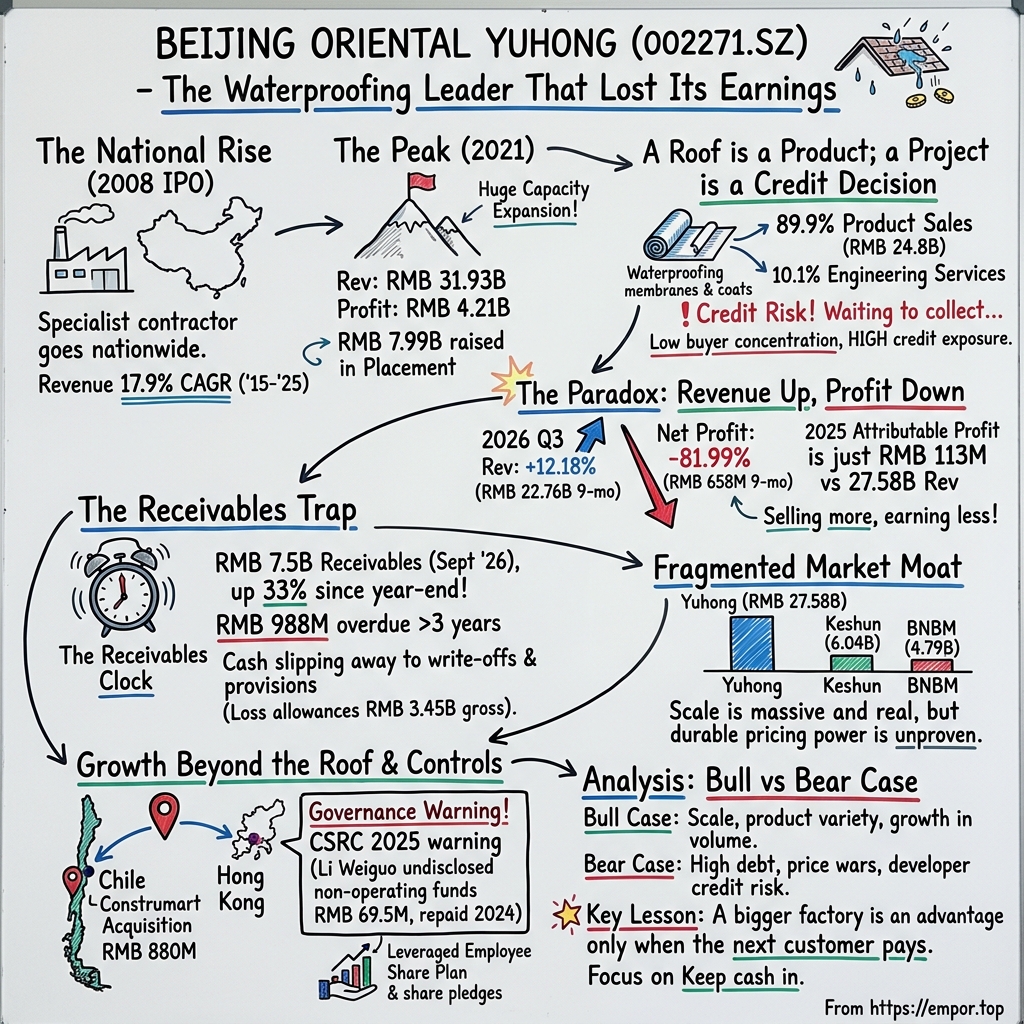
Beijing Oriental Yuhong: The Waterproofing Leader That Lost Its Earnings
I. Revenue Up, Profit Down
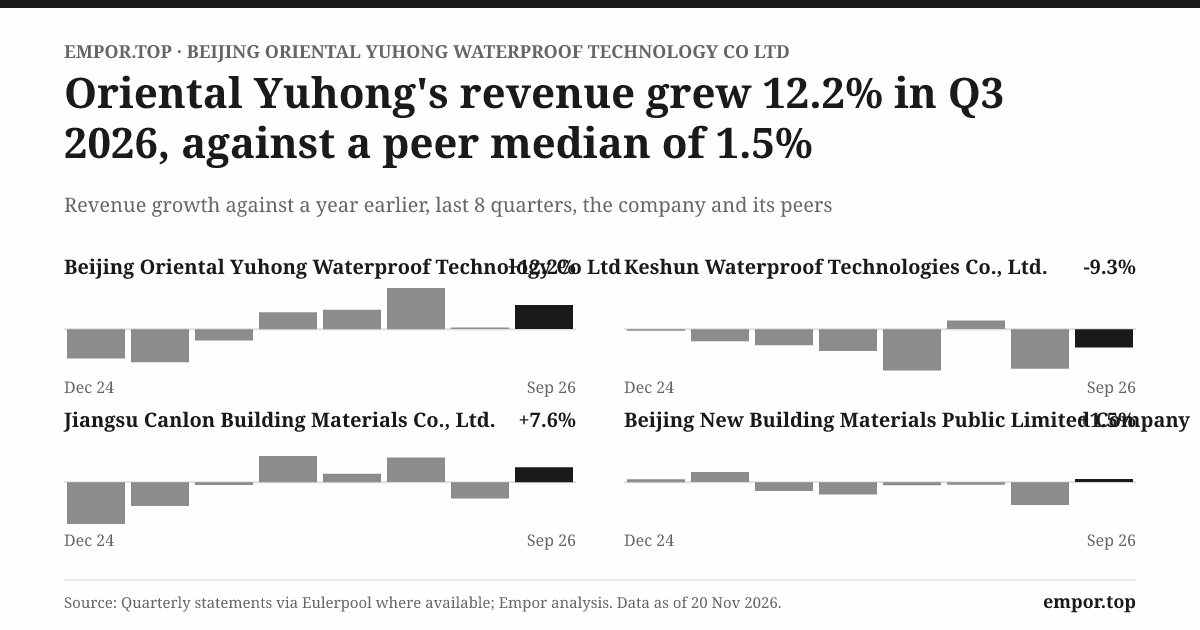
On the evening of 26 October 2026, China's largest listed waterproofing company published a quarterly report that seemed to argue with itself. In the top line, the story was recovery. Between July and September, 北京东方雨虹防水技术股份有限公司 Beijing Oriental Yuhong Waterproof Technology sold RMB 7.89 billion of membranes, coatings, mortars and building materials, 12% more than in the same quarter a year earlier.1 After three years in which the Chinese property market had shrunk beneath it, the company was selling more again.
Two lines further down, the story turned. Net profit attributable to shareholders for those three months was RMB 44 million, down 82% from a year earlier.1 On nearly RMB 8 billion of sales, the company kept roughly half a fen of every yuan for its owners. Even after stripping out one-off items, quarterly profit was RMB 69 million, down about three-quarters.1 Revenue rose; profit fell off a cliff.
The nine-month numbers made the paradox harder to dismiss as a bad quarter. From January to September 2026, revenue rose about 10% to RMB 22.76 billion, while attributable profit fell about 19% to RMB 658 million.1 The company was doing what every struggling manufacturer is told to do. It won volume, raised prices to pass on the cost of asphalt and pushed into new markets. It still earned less.
That gap matters more because of how far the company has fallen. In 2021, Oriental Yuhong earned about RMB 4.2 billion of profit on RMB 31.9 billion of revenue, a business that turned waterproofing, the least glamorous layer of a building, into one of the best-performing stocks on the Shenzhen exchange.2 By 2025, revenue was still a formidable RMB 27.58 billion, but profit attributable to shareholders had shrunk to about RMB 113 million.3 The scale survived. The earnings did not.
So the question at the centre of this story is not whether Oriental Yuhong is big. It plainly is. The question is whether bigness still produces dependable economics. Can the listed company recover the earnings model it had at the peak? Can it collect the money it is owed for product it has already delivered? And can the factories, retailers and overseas businesses it has bought or built since the boom earn a return on the capital shareholders put into them?
Waterproofing is a strange business to build a fortune on. In a finished building, it is invisible: a membrane under a roof, a coating in a basement, a layer of mortar behind a bathroom tile. On a construction budget it is a small line item.
Its value appears only when it fails, because a leak in a tower block, a subway tunnel or a hospital costs far more to fix than the material cost to install. That asymmetry is the industry's promise to a quality supplier. Buyers should be willing to pay for the brand they trust not to fail.
Oriental Yuhong's recent history tests that promise from the other direction. A supplier can be trusted by builders and still be hurt by them, because the builders are also its debtors. The rest of this story follows that tension from a Hunan schoolteacher's start-up to a national manufacturer, through the 2021 peak and the property collapse, into the receivables ledger, the price war, the overseas acquisitions and the regulator's warning. The investment case turns on one plain question: when this company sells a square metre of membrane, does that sale still turn into cash and profit?
 Subscribe on LinkedIn
II. The Contractor That Became a National Supplier
Before he sold waterproofing, 李卫国 Li Weiguo taught. Born in 1965 and a graduate of Hunan Agricultural College, he taught at a vocational secondary school in Changsha County from 1989, moved to the Hunan Economic Management College in 1992, and then spent two years at the Hunan provincial statistics bureau.4 In 1995 he left the state system and founded a small building-waterproofing contractor in Changsha. Three years later, on 30 March 1998, the company that became Oriental Yuhong was set up in Beijing, and Li has chaired it ever since.4
It was a move from a provincial city to the capital at the moment the capital was about to rebuild itself. The prospectus Oriental Yuhong filed ten years later reads like a tour of Beijing's Olympic-era skyline. The company listed the National Stadium, the "Bird's Nest"; the National Aquatics Centre, the "Water Cube"; the new CCTV headquarters; Terminal 3 at Beijing Capital International Airport; the Beijing–Tianjin intercity railway; and line after line of the city's subway among the projects it had supplied or waterproofed.4 For a business whose product is buried inside concrete, that list was the brand. If the Bird's Nest did not leak, a developer in Hebei had a reason to take the call.
The listing itself, on 10 September 2008, was modest. Oriental Yuhong sold 13.2 million new shares at RMB 17.33 each, leaving 52.76 million shares outstanding afterwards.4 Before the offering Li owned 55.61% of the company.4 In 2007 it had revenue of about RMB 484 million, up from RMB 175 million two years earlier, a fast-growing regional specialist that was still, by its own admission, heavily concentrated in Beijing.4
The prospectus warned that its plants could not meet demand in the peak season, that it needed to win share outside the capital, and that government curbs on property development could hurt demand.4 It also boasted strategic or long-term supply agreements with a roster of developers, including 万科 Vanke, Sino-Ocean, China Resources Land and Gemdale.4 Both the warning and the boast would come back to matter.
What the IPO changed was access to capital. Waterproofing, the company would later explain, has an economic transport radius of about 500 kilometres, because heavy rolls of bitumen membrane and drums of coating are expensive to haul.3 A Beijing plant cannot cheaply serve Guangzhou.
To be a national supplier, a waterproofing company has to be a national manufacturer, with factories, warehouses and sales teams in every major region. That takes money a private contractor cannot easily raise. Public equity, and the bank credit that a listed balance sheet attracts, let Li's company build plants across north, east, north-east, central, south, north-west and south-west China, and later abroad.3
It also let the company sell in more ways. By the end of 2007 Oriental Yuhong had signed more than 300 dealers, a first draft of a national distribution network alongside its direct sales to big projects.4 Over the next decade the dealer network, the direct-sales teams serving developers and contractors, and a growing retail channel for homeowners and small builders would become the company's real reach.
The numbers tell the momentum. Revenue grew from about RMB 5.3 billion in 2015 to RMB 27.6 billion in 2025, a compound rate of almost 18% a year, even though the last three years of that span went backwards.3 From the pre-IPO year of 2007 to the 2021 peak, sales multiplied about 66 times.42 By 2020, its membrane capacity of 478 million square metres a year was larger than that of any rival Dagong listed, with the next-largest at under 300 million.2 Few Chinese industrial companies of its era compounded so fast for so long.
That record is the bull case's foundation, and it is real: the company built something competitors did not. Yet the long expansion also leaves an uncomfortable question behind. A national factory network is an advantage when the country is pouring concrete. It is a fixed cost when it stops. Did Oriental Yuhong build a durable edge in waterproofing, or did it build capacity for a construction boom that has since ended? To answer that, it helps to look closely at what the company actually sells, and where in each sale the risk creeps in.
III. A Roof Is a Product; a Project Is a Credit Decision
Picture a residential project in a second-tier city. The developer's general contractor needs basements sealed, roofs membraned and bathrooms coated. A purchasing manager orders bitumen membranes and polyurethane coatings from Oriental Yuhong, perhaps through a local dealer, perhaps directly. The rolls arrive on a truck. They are laid, inspected, covered with concrete and forgotten. The supplier has delivered its product and booked its revenue. What it has not necessarily done is collect payment.
That gap between shipment and cash is the real anatomy of this business. In 2025, sales of products generated RMB 24.80 billion, or about 90% of revenue; engineering construction services, where the company or its subsidiaries actually install waterproofing, generated RMB 1.86 billion.3
Waterproofing materials alone, the membranes and coatings, brought in RMB 19.17 billion, while mortars and powders, such as tile adhesives and putties, added RMB 4.23 billion.3 Products are priced by material and quantity, so revenue rises and falls with how many square metres and tonnes the company ships and what it can charge for them. Construction and design services are recognised as the work is performed.3
This is not a subscription business, and nothing in the company's disclosure dresses it up as one. Oriental Yuhong publishes no recurring-revenue share, no contract duration and no customer-retention figure.3 Buildings need re-waterproofing eventually, and the company has been pushing hard into repair and renovation work, but each job is still a fresh order. Demand is set by how much China builds and repairs.
The cost side is just as simple and just as unforgiving. In 2025, direct materials made up about 89% of the cost of the waterproofing products the company sold.3 Labour, power and factory overheads together were barely 6%.3 The single biggest input is asphalt, a petroleum product, followed by modifiers such as SBS rubber, polyester mats, emulsions and polymer resins.3 Gross margin therefore swings on the spread between what asphalt costs and what customers will pay for the finished membrane. When oil-linked inputs rise faster than the company can raise prices, margins compress almost immediately.
That leaves the third variable, and the one that broke the model: payment terms. Oriental Yuhong sells through three main channels. In 2025, the engineering channel, which serves construction projects through partners and dealers, was the largest at about 48% of revenue; retail, which reaches small builders and homeowners through dealers and stores, was about 36%; and direct sales to large developers and contractors were about 15%.3
Retail customers usually pay on shorter terms. Large project customers often negotiate longer ones, pay with commercial bills, or pay when they themselves are paid. Every extra yuan of project sales can therefore mean an extra yuan sitting in receivables for months.
Here a reassuring statistic needs care. The company's five largest customers accounted for only 3.72% of 2025 revenue.3 No single buyer can hold Oriental Yuhong hostage on price, and the loss of any one account is not existential. But low customer concentration is not the same as low credit risk.
Thousands of small project customers can all be exposed to the same weakening property market at once, and the largest debtors on the balance sheet can be far more concentrated than the largest customers in the income statement, as the receivables ledger would later show. Meanwhile the top five suppliers supplied about 19% of purchases, which reflects how much of the cost base depends on a few large petrochemical and materials producers.3
The company's own description of its industry adds a revealing note. In its 2025 annual report, Oriental Yuhong stated that the waterproofing-materials industry "has no obvious cyclicality", only seasonality from winter in the north and the rainy season in the south.3 That is a striking claim to make in a year when attributable profit sat near RMB 113 million, four years after a RMB 4.2 billion peak. What the record shows is not an acyclical industry but an industry tied to one of the most cyclical sectors in the world economy: Chinese residential construction.
So the useful way to understand Oriental Yuhong is as a manufacturer making two decisions with every big order. The first is a product decision: what to make, where and at what cost. The second is a credit decision: whom to trust and on what terms. For most of its history the first decision dominated, because developers were growing and paying. In 2021, at the top of the cycle, the company made its largest bet on the first decision just as the second was about to become the one that mattered.
IV. The 2021 Peak Built a Bigger Company—and a Bigger Obligation
In April 2021, 175.8 million new Oriental Yuhong shares began trading in Shenzhen.2 The company had sold them in a private placement that raised RMB 7.99 billion net, a sum about sixteen times the revenue the whole business had produced in the year before its IPO.2 Most of it was earmarked for production projects, with RMB 2.4 billion set aside to top up working capital.2 Institutional investors were eager. The stock had been one of the market's favourite plays on China's urbanisation, and the business was about to post its best year ever.
That year, revenue grew 47%.2 Operating margin was about 16%, and the company earned roughly 24.5% after tax on the capital invested in it.3 Those are returns that most industrial companies never touch. They were what made the company's expansion plan look rational: if each new plant earned anything like the group average, building more of them was an obvious use of money.
The building was relentless. Between 2019 and 2021, the company's annual membrane capacity rose from about 376 million to about 582 million square metres, while coatings capacity more than doubled to about 4.27 million tonnes.2 In 2021, the membrane lines ran above their nameplate capacity, at about 119% utilisation, a sign of how strong demand was.2
Coatings told a different story. The new coatings plants ran at only about 77% of capacity, because new bases and new products had not yet been fully absorbed.2 Net property, plant and equipment more than doubled between the end of 2020 and the end of 2025, to roughly RMB 12.6 billion.32
The rating agency 大公国际 Dagong International saw both sides at the time. Its 2022 report gave the company an AAA rating and praised its leading position, broad product range, technical strength and national footprint.2 It also marked the score down for reasons that now read like a forecast.
Dagong flagged that receivables were large and growing fast, that the company had exposure to developers that had already defaulted, that it had many projects under construction with long build times, and that some waterproofing capacity ran at low utilisation with a declining sell-through rate.2 It warned specifically about the operating risk of "rapid expansion" if the industry environment changed.2
The environment changed almost immediately. Property sales and starts in China began falling in the second half of 2021 as the government's curbs on developer leverage bit, and the developers that had been Oriental Yuhong's best customers became its riskiest debtors. Within four years, the operating margin that had been 16% in 2021 was about 1.1%, and the return on invested capital had fallen from about 24.5% to about 0.7%.3 Revenue had dropped only about 14% from the peak. Profit had collapsed by more than 97%.
That disproportion is the signature of operating leverage. A manufacturer with plants, depreciation, sales teams and overheads sized for a RMB 32 billion business does not save those costs when sales slip. Depreciation alone reached about RMB 1.04 billion in 2025.3 When price pressure and bad debts are layered on top, a modest revenue decline becomes a profit collapse. The capacity the placement funded was not wasted in a physical sense; the plants exist and ship product. But the returns that justified building them have not come back.
The cash record sharpens the point. Across the twelve years from 2014 to 2025, Oriental Yuhong generated about RMB 21.9 billion of operating cash flow, comfortably more than its RMB 19.4 billion of cumulative net profit.3 Then it spent most of it on plants.
After capital expenditure, free cash flow over those twelve years added up to only about RMB 1.5 billion.3 Over the same period, the company paid about RMB 12.1 billion of dividends, roughly eight times the free cash it generated.3 The gap was filled by equity raised from investors, most dramatically the 2021 placement, and by borrowing.
In other words, shareholders who bought into the 2021 placement were partly funding dividends paid to all shareholders, including the controlling one. That is not unusual for a fast-growing company that raises capital to expand, but it changes how the payout should be read. Dividends of that scale signal confidence only if the business behind them can fund them. Here, the free cash flow could not, and much of the capacity built with outside money is now earning close to nothing.
The boom gave Oriental Yuhong a national reach no rival matched. It also tied the company to customers and projects whose economics were about to change. The question that followed was how much of the profit collapse was the market's doing, and how much was the company's.
V. From RMB 4.2 Billion of Profit to a Thin Margin
Imagine the problem from a regional sales manager's chair in late 2021. A large developer that has bought membranes from Oriental Yuhong for years is still ordering, but its payments are slipping. It starts paying in commercial acceptance bills, IOUs that may or may not be honoured. Then it offers apartments or other property instead of cash.
The manager can keep shipping and hope the developer survives, or cut it off and watch a competitor take the order and the risk. Multiply that decision across thousands of projects and hundreds of developers, and the next four years of Oriental Yuhong's income statement begin to make sense.
The developers in question were not hypothetical. At the end of 2021, the company had RMB 353 million owed by procurement platforms of 中国恒大 China Evergrande and RMB 70 million owed by platforms of 华夏幸福 China Fortune Land Development, both of which had defaulted, and Dagong noted clear collection risk on those balances.2 They were the visible tip of a wider exposure to the property sector that the company had cultivated since its prospectus advertised its developer contracts.
The profit record after 2021 follows a recognisable shape. Attributable profit halved to about RMB 2.1 billion in 2022, edged up to about RMB 2.3 billion in 2023 as revenue briefly rose, then fell by about 95% in 2024 to about RMB 108 million.5 In 2025 it was roughly RMB 113 million, barely above that floor.3 Revenue in 2025 was down only 1.7% from 2024, yet the company still could not produce meaningful earnings.3
Four mechanisms did the damage, and they stacked on top of one another. The first was demand. Fewer new homes meant fewer basements and roofs to seal, and Oriental Yuhong's waterproofing-materials revenue fell about 7% in 2025 alone.3 The second was price. When the company's waterproofing volumes topped 800 million square metres, an investor asked why the segment's revenue still fell; management replied that 2025 product prices were lower than a year earlier, and that volume and price together explained the decline.6
Gross margin slipped about a point in 2025 to 24.8%, which management attributed to price adjustments and product mix.3 For comparison, Dagong's figures put gross margin at about 37% in 2020 and about 31% in 2021.2 The company had given up more than ten points of gross margin in five years.
The third mechanism was credit. As developers failed, the company had to provide for receivables it might never collect. In 2025, credit losses on trade receivables were about RMB 987 million and impairment on contract assets about RMB 87 million, together nearly ten times the year's attributable profit.3 The fourth was fixed cost, which amplified the damage.
Management did cut what it could. Selling expenses fell almost 18% in 2025, with promotion, staff pay, advertising and consulting all trimmed.3 Research and development spending fell about 14%, from RMB 586 million to RMB 503 million, and the R&D headcount dropped from 669 to 568.3 Those cuts supported earnings, but they also raise a quieter question. A company that argues its products and technical service justify a premium is spending less on the research that is meant to underpin them.
The most telling line in the 2025 accounts sits below operating profit. That year Oriental Yuhong booked RMB 322 million of "other gains", made up mostly of RMB 255 million of government subsidies and RMB 65 million of extra VAT input-tax credits.3 Profit before tax for the whole group was RMB 247 million.3 Without the subsidies and tax credits, the company would have lost money before tax. A business that had earned billions from making and selling waterproofing was, in 2025, profitable largely because of policy support.
How much of this was the market, and how much the company? The market's share is obviously large. The Chinese property downturn has been one of the deepest housing contractions any major economy has seen, and every supplier to it has suffered. Rival 科顺股份 Keshun Waterproof lost about RMB 535 million in 2025, mostly because of asset impairments and credit losses on receivables.7
But the size of Oriental Yuhong's own decline, and the specific choices behind it, mean macro cannot carry all the blame. The company had leaned heavily on developer and project customers going into the downturn, as Dagong's receivables warnings at the peak make clear. It chose to build capacity ahead of demand, even when Dagong was already flagging low utilisation. It chose to keep paying large dividends from capital it had raised. Those were decisions, not weather.
Management's account of the recovery has been consistent in its themes and sparse in its numbers. In the online session after the 2025 results, in April 2026, it told investors that the industry's supply side was clearing fast, that leading firms were gaining share from a "Matthew effect", and that first-quarter volumes of its main products were up year on year.6 It pointed to water conservancy, urban renewal, old-house renovation and industrial and energy projects as pockets of structural demand.6
When investors asked directly how much property-related impairment remained, and how much more credit and asset impairment to expect, the answer both times was a single sentence: the company would follow accounting standards and provide prudently.6 When asked whether its third price increase would land at the low end of its range, it said it would weigh raw-material costs, reasonable plant margins and market conditions.6
By late October 2026, after the weak third quarter, chairman Li struck a more emphatic tone in a meeting with fund managers. "The most difficult period for the company has passed," he said, citing revenue growth, falling receivables and steadily improving operating quality.8
Asked about asphalt, which had stayed expensive, management said the company was buying to need rather than stockpiling, that it and other leading firms had issued several price-increase notices, and that "because of the pace at which customers' orders are executed, the effect of the price adjustments will appear gradually".8 That is a plausible explanation for a lag between cost and price. It is also an admission that price increases had not yet restored margins.
The nine-month accounts let the claim be tested. Between January and September 2026, gross profit rose by roughly RMB 675 million year on year, and gross margin improved from about 25.2% to about 25.8%.1 The pricing and volume story was real at that level. But almost all of that gain was absorbed before it reached shareholders.
Selling and administrative costs rose by about RMB 250 million, partly as acquired retailers entered the accounts; financial expenses jumped about 77% to RMB 212 million because of higher interest, lower interest income and currency losses; government subsidies fell by about RMB 100 million; and impairment charges swung against the company by more than RMB 400 million, as a small reversal a year earlier turned into a RMB 317 million asset-impairment charge on contract assets and other non-current assets.1 Operating profit fell from about RMB 1.09 billion to RMB 935 million.1
That decomposition matters because it locates the problem. The product engine has stabilised: Oriental Yuhong is selling more and making slightly more on each sale before overheads. What keeps profit down is the cost of carrying the past and financing the future. Old balances are still being written down, borrowing costs are higher, and subsidies are no longer filling the gap. Which raises the sharper question the profit line cannot answer by itself. If profits are impaired, are collections improving because customers are paying, or because the old balances are simply being written off?
VI. The Receivables Clock Is Still Running
Somewhere in the notes to Oriental Yuhong's 2025 annual report sits a number that sums up the hangover of the property boom. At the end of the year, about RMB 988 million of the company's trade receivables were more than three years old, up from RMB 299 million a year earlier.3
Of that, RMB 815 million was between three and four years old.3 Do the arithmetic backwards and those invoices date from 2021 and 2022, the peak and the first year of the bust. Material shipped to building sites when the boom was at its height was, years later, still unpaid.
The full ledger is larger. At the end of 2025, trade receivables plus contract assets, which are amounts earned on projects but not yet billable, came to RMB 10.27 billion gross.3 Against that, the company held RMB 3.45 billion of loss allowances.3 Put simply, Oriental Yuhong had already conceded that about a third of what it was nominally owed on these balances might never arrive. That is an enormous provision for a manufacturer, and it is the most important number for understanding why profit collapsed while revenue held up.
The risk is also more concentrated than the income statement suggests. The five largest debtors accounted for about 20% of that combined RMB 10.27 billion balance, and the company had set aside RMB 1.07 billion against them alone.3 Customers that individually look small on the sales line loom large on the balance sheet. The company does not name them, but the pattern, set against the developer exposures Dagong documented in 2021, points to the sort of large property groups whose payment chains broke.32
Accounting receivables are not cash. A receivable is a promise, and a provision is the company's estimate of how much of that promise will be broken. When a supplier books a bad-debt charge, the gross balance does not disappear; the expected loss is set aside. When it later writes the balance off, both the receivable and the allowance shrink, and a ratio such as debtor days improves without a single yuan arriving.
Some balances are also settled with things other than cash. China's construction suppliers have often accepted apartments, parking spaces and commercial bills in lieu of payment, and those assets then have to be valued and, sometimes, impaired. When investors asked Oriental Yuhong in April 2026 how much impairment remained on its investment property and other non-current assets, a category that can hold such settlement assets, the company declined to quantify it.6
Here the headline ratio needs a careful reading. Debtor days, the receivables balance expressed as days of revenue, fell from a peak of 212 in 2022 to 128 in 2025, the lowest figure in more than a decade.3 On its face, that is a genuine improvement, and part of it is real. The company has shifted its mix toward retail channels that pay faster, tightened credit, and in its own words put "risk control first", with credit approval and customer screening up front.8 Operating cash flow was about RMB 3.55 billion in 2025, roughly 30 times net profit.3
But two caveats keep that improvement from settling the question. The first is how much of the operating cash flow came from non-cash charges. In 2025, the cash-flow reconciliation added back RMB 1.57 billion of impairment and RMB 1.04 billion of depreciation.3 A big impairment depresses profit without touching cash, so a large gap between cash flow and profit is partly a symptom of the write-downs themselves. The second caveat is the use of bills.
In the fourth quarter of 2025, revenue rose about 10% year on year, yet cash received from sales fell about 25%; an investor asked whether the gap reflected bills of exchange that had been endorsed straight to raw-material suppliers and therefore dropped off the balance sheet.6 Management confirmed that it had endorsed receivable bills to suppliers in that quarter and derecognised those that qualified.6 That practice is legal and common. It also means some apparent shrinkage in receivables reflects bills passed down the supply chain rather than cash collected from customers.
Then 2026 began to move the ledger the other way. By 30 September, accounts receivable had risen to RMB 7.50 billion, up 33% from the start of the year, which the company attributed to higher revenue.1 Some of that is seasonal, since Chinese construction suppliers typically collect most heavily at year-end. Yet nine-month credit-impairment losses were RMB 789 million, higher than a year earlier, and asset-impairment losses were another RMB 317 million.1 The company was simultaneously growing new receivables and providing for old ones at a rate of more than RMB 1.1 billion in nine months.
In October, chairman Li told visiting fund managers that the scale of receivables was being steadily reduced.8 The third-quarter balance sheet published days earlier showed receivables up a third since December.1 Both statements can be partly true, if the chairman meant gross exposure over a longer span or net of seasonal effects, but the company did not reconcile them for investors.
The most useful disclosure would be simple to describe. For each age bucket of receivables, how much did the company collect in cash this year, how much did it write off, and how much did it newly provide? Oriental Yuhong publishes the ageing table and the movement in allowances, but it does not publish cash recoveries from its highest-risk balances, so outsiders cannot tell how much of the improvement in ageing comes from developers paying and how much from balances being written off or settled in kind.3 Until it does, the receivables clock keeps running, and collection quality remains an unresolved part of the case.
All of this connects to the competitive question. A national sales network is an asset only if it wins work on terms that eventually get paid. Which brings the story to the market Oriental Yuhong dominates, and whether that dominance still buys anything.
VII. The Moat in a Fragmented Market
Stand in the shoes of a project engineer choosing waterproofing for an underground car park. The specification sets minimum standards for thickness, elongation and root resistance. Dozens of manufacturers can meet them on paper. Some are local plants with a few production lines and aggressive prices.
Some are national brands with test reports, application engineers and the ability to deliver thousands of rolls on schedule to a site three provinces away. The cheaper membrane saves money today. If the car park leaks in five years, the repair will involve breaking concrete, pumping water and arguing about who pays. The engineer is weighing performance, supply reliability and price against the cost of failure.
That is the scene on which Oriental Yuhong's moat is supposed to rest, and the industry structure gives it real substance. Waterproofing in China has long been fragmented, with large numbers of small regional producers, quality problems and counterfeit or non-standard product.2 New national standards have pushed in the other direction.
Dagong noted that industry rules required new modified-bitumen membrane lines to have capacity of at least 10 million square metres a year, and BNBM's 2025 report describes the implementation of new mandatory technical and safety codes for waterproofing materials.29 Tighter standards raise the cost of being small and favour scale producers with testing and quality systems.
Against its listed peers, Oriental Yuhong is the giant. In 2025 its waterproofing-materials revenue was RMB 19.17 billion, compared with RMB 4.66 billion for Keshun, whose total revenue across all products was RMB 6.04 billion, and RMB 4.79 billion for the waterproofing division of 北新建材 BNBM, a diversified building-materials group whose total sales were RMB 25.28 billion.379 On waterproofing alone, Oriental Yuhong is roughly four times either rival.
It is also more profitable at the gross level: its waterproofing materials earned a gross margin of about 26.9% in 2025, against about 18.8% for BNBM's waterproofing products.39 Keshun lost money outright in 2025, while BNBM grew its waterproofing sales about 3% as Oriental Yuhong's fell about 7%.793 Those comparisons cut both ways. Scale is clearly worth something, but the second-largest diversified competitor was taking ground while the leader shrank.
Market share is harder to pin down. Management repeatedly says the industry is consolidating and that the "head companies" are gaining share, but it does not publish a share figure that can be compared year to year, and no consistent industry total is available in its filings.63 The share claim is therefore a thesis, not a demonstrated fact. The strongest evidence for it is that Oriental Yuhong's volumes grew while the industry, by BNBM's account, shrank in 2025.96 The strongest evidence against it is that the company gave up price to get those volumes.
The five forces frame the battlefield, and each points to a specific pressure rather than a generic one. Rivalry is intense because the industry has many producers, high fixed costs and a shrinking market, a combination that turns every plant manager's incentive toward filling lines at almost any price. Buyer power is significant even though no single customer is large: construction buyers can solicit bids from several vendors on every project, and large developers have historically dictated payment terms, which is how a buyer exercises power without being concentrated.
Supplier power is real at the commodity level, since asphalt and petrochemical inputs make up the bulk of costs and the top five suppliers provide nearly a fifth of purchases.3 Oriental Yuhong has tried to blunt that by integrating upstream into non-woven fabrics, specialty films, VAE emulsions and redispersible powders.6 The threat of substitutes is modest: nobody is replacing waterproofing with software, and alternatives such as different membrane chemistries tend to come from the same manufacturers. New entrants are deterred by standards and scale but not by any legal barrier, as the industry's long tail of small producers shows.
Hamilton Helmer's 7 Powers framework helps sort which advantages are durable. The clearest is scale economies: a national footprint of plants within that 500-kilometre transport radius gives Oriental Yuhong lower logistics costs and broader coverage than any rival can match, and purchasing scale should help on asphalt.3 There is a softer version of branding. For large public projects and high-risk applications, a reputation that runs back to the Bird's Nest and Terminal 3 has value, and the company is now pushing a premium "鳐龙" product line.64
Counter-positioning and network effects do not apply. Switching costs are weak: a contractor can pick a different supplier for the next project with no penalty, and low customer concentration means the company's revenue is spread across buyers who are free to multi-source. Cornered resources are limited, though the company's ownership of mining rights for mortar raw materials in Jiangxi and Guangxi may help that business.8 Process power, the accumulated know-how of application engineering and system design, is plausible but hard to verify from outside.
The record is the real test. If scale and brand formed a strong moat, Oriental Yuhong should have been able to hold price in a downturn and let weaker rivals absorb the volume loss. Instead, its gross margin fell from the high 30s to the mid 20s over five years, its waterproofing prices declined in 2025, and its profit all but disappeared.236
Retail-channel gross margin, the channel most associated with brand, fell more than five points in 2025 to about 31.6%.3 The evidence supports a scale and execution advantage: the company still earns more per yuan of waterproofing revenue than BNBM and has remained profitable while Keshun lost money. It does not support a claim of pricing power or customer lock-in.
The 2026 numbers suggest the price war may be easing at the margin. In the first half, waterproofing-materials gross margin recovered to about 29.5%, a little over a point higher than a year earlier, after several rounds of price increases that leading firms announced together.108 That synchronised pricing, if it holds, would be the first evidence in years that the industry's leaders can pass costs through. It would also be evidence about the industry's discipline rather than Oriental Yuhong's unique power.
The revised claim, then, is narrower than the company's. Scale is real; durable pricing power is unproven. The decisive test is whether margins and collections improve through a full year of revenue growth. And if the domestic market cannot provide that growth, management has a second answer: go abroad.
VIII. The Chile Bet and the Search for Growth Beyond the Roof
In July 2025, with domestic profits near zero, Oriental Yuhong signed a deal to buy a chain of building-materials stores on the other side of the Pacific. The target was Construmart, a Chilean retailer with 31 stores, which Oriental Yuhong bought outright for about US$123 million, or roughly RMB 880 million at the time.1112 For a waterproofing manufacturer that had built its fortune selling to Chinese developers, it was an unusual purchase: a home-improvement retail chain in a country of 20 million people, more than 18,000 kilometres from Beijing.
Construmart's numbers explain both the logic and the doubts. In 2024 it reported revenue of about RMB 2.09 billion, but net profit of only about RMB 35 million, a net margin under 2%.1113 Net assets at the end of May 2025 were about RMB 520 million.13 The announced price equated to about 11.1 times Construmart's 2024 EBITDA, falling to about 8.3 times on the seller's forecast for 2025.11 The business news outlet Jiemian reported that, measured against Construmart's net assets, the deal "looks like it was not a bargain".13
Is 11 times EBITDA expensive? A useful benchmark is Sika's 2019 purchase of Parex, a French maker of mortars and facade products, for an enterprise value of CHF 2.5 billion. Sika paid 11.3 times Parex's expected 2019 EBITDA, a multiple that it said fell below 8.5 times once a planned CHF 80 to 100 million of annual synergies were included.14 On headline multiples, Oriental Yuhong's price sits in the same neighbourhood. The comparison is imperfect in important ways.
Parex was a manufacturer with 74 plants in 23 countries and a 16% EBITDA margin; Construmart is a regional retailer with thin margins.1411 Sika had decades of experience integrating acquisitions and quantified its synergies publicly. Oriental Yuhong has not published a synergy target for Construmart. The multiple neither proves an overpayment nor a bargain. What will settle the question is whether the Chilean business earns more under its new owner than it did before.
The strategic logic is channel access. Instead of building a brand from scratch in Latin America, Oriental Yuhong bought shelves. The company can place its own waterproofing, mortars and coatings in Construmart's stores and supply the chain from its Chinese manufacturing base, which management describes as filling a supply-chain gap at the retailer.812 The Chile deal was part of a broader push the company calls "overseas first", built on what it describes as three engines: trade, investment and acquisitions.6
Earlier in 2025 it had bought two Hong Kong building-materials businesses, including the retailer Man Cheong.12 In 2026 it closed the purchase of 60% of Novakem, a Brazilian supplier of cement and concrete additives, and pushed products into Home Depot in Mexico.8 It has also been building factories in places such as Malaysia, the United States, Saudi Arabia and Canada.12
The most recent example was smaller. In July 2026, a Hong Kong subsidiary completed the purchase of The Universal Hardware & Plastic Factory, a Hong Kong business bought from the Belgian plastics group Aliaxis and members of the Ho family for an enterprise value of HK$164.1 million; including estimated net cash and working-capital adjustments, Oriental Yuhong paid HK$215.4 million.15 Each deal is modest on its own. Together they amount to a deliberate change in what the company is.
The revenue impact has been dramatic. Sales from Hong Kong, Macau and other countries outside mainland China were about RMB 1.59 billion in 2025, about 5.8% of the total.6 In the first half of 2026, overseas revenue more than tripled to RMB 1.77 billion, almost 12% of the group.10 More than RMB 1 billion of that came from overseas building-materials retailing, mainly Construmart and the Hong Kong acquisitions.10
That number reframes the 2026 recovery. In the first half of the year, total revenue rose about 9.6%. Revenue inside mainland China rose less than 1%.10 Most of the growth that management presented as a turnaround came from businesses it had bought, not from a revival of the core domestic market.
Within China, the retail channel grew sharply while engineering sales were flat, which suggests the company was reallocating effort toward faster-paying customers rather than seeing broad demand return.10 Management, to its credit, said as much when explaining first-quarter growth, citing the consolidation of Man Cheong and Construmart alongside new retail product categories.6
The capital record is the other half of the test. Investing cash outflow nearly doubled to RMB 1.79 billion in 2025, mainly because of acquisitions, at the same time as cash and equivalents fell from about RMB 6.8 billion to about RMB 3.56 billion.3
In the first nine months of 2026, the company spent another RMB 225 million net on acquiring businesses and RMB 656 million on fixed and long-term assets, while construction in progress rose about 50% because of overseas plant building.1 Short-term borrowings rose from about RMB 4.74 billion at the start of the year to RMB 5.67 billion by September.1
What management has not provided is the scorecard. When asked in April 2026 for the revenue and profit of its DAW coatings subsidiary, the company referred the investor to the annual report.6 In October it described the overseas business as still in an "early investment phase", with revenue and spending in local currencies and no large profits or dividends yet, which it said was why currency risk was manageable.8
It said Construmart's revenue had grown steadily and that it was outperforming local peers despite a weak Chilean economy, and that Novakem's revenue and profit had grown quickly.8 None of those statements came with numbers. Channel access and acquired revenue are not the same as returns on capital.
So the overseas push is best treated as a real option with real execution risk. It may become a second engine. It has also, so far, mainly added revenue and costs at a time when the company's cash was falling. The question of whether that capital is being spent wisely brings the story back to the people who decide how it is spent, and to the most uncomfortable chapter in the company's recent history.
IX. Li Weiguo's Company, and the Test of Its Controls
On 11 August 2025, the Beijing bureau of the 中国证监会 China Securities Regulatory Commission published a short decision naming Oriental Yuhong, its chairman Li Weiguo, its then-president 张志萍 Zhang Zhiping, board secretary 张蓓 Zhang Bei and chief financial officer 徐玮 Xu Wei.16 Its findings were blunt.
From February 2023 to May 2024, the company had provided RMB 69.5 million to its controlling shareholder, Li himself, through loans to sales staff and transfers by finance staff: RMB 20 million in 2023 and RMB 49.5 million in 2024.16 The regulator classified it as non-operating occupation of company funds by a related party. The money had all been returned by May 2024, but the company had not disclosed it in time.16
The decision did not stop there. It listed a series of accounting problems: revenue on some photovoltaic-module sales recognised on a gross basis when that was not accurate; revenue on some engineering projects recognised at the wrong time; intermediary fees on some projects mis-accounted; inaccurate accounting and disclosure of debt restructurings involving assets accepted in settlement of debts; prepayments improperly used to reduce receivables; and some other receivables placed in the wrong age bucket.16 The bureau issued a warning letter, entered it into the capital-market integrity database and ordered a written remediation report within ten working days.16
The distinction matters. This was not ordinary related-party trade, which exists at Oriental Yuhong but is small: in 2025 the company bought about RMB 542 million of goods from Beijing Gaoneng Times Environmental Technology, a company under Li's control, about 3.1% of purchases, and made related-party sales of about RMB 108 million, about 0.4% of revenue.3
The CSRC's finding was about cash leaving the company for the controller's benefit through an indirect route, without disclosure. Against a revenue base of more than RMB 27 billion, RMB 69.5 million is tiny. As a test of controls, it is not. Several of the accounting errors also touched the exact areas where investors most need to trust the numbers: when project revenue is recognised, how settlement assets are valued and how receivables are aged.
The man at the centre of it remains the defining figure of the company. Li has chaired Oriental Yuhong since 1998.4 At the end of 2025 he held 20.28% of the shares, and, together with his concert party 李兴国 Li Xingguo, his brother, held 20.74%.34 The founder who once taught at a vocational school had become one of Beijing's best-known private industrialists, and his reputation was tied to a company whose share price had multiplied many times over. The share price decline that followed has also reshaped his own finances.
That story runs through the employee share plan of 2021. At the peak, the company's staff plan bought about 49.5 million shares, roughly 2% of the company, at an average price of about RMB 55.78, using a one-to-one leveraged structure with financing from Haitong Securities.5 Li personally guaranteed the participants against losses.5 By 2023 the plan had sold about 96% of its holding at prices far below cost, and National Business Daily estimated the realised loss at no less than RMB 900 million.5
Li then sold shares repeatedly, in early 2024, in late 2025 and again between March and May 2026, when he sold about 71.3 million shares for roughly RMB 1.08 billion.5 The company told investors the 2026 sales were mainly to meet his guarantee to the employee plan and repay share-pledge loans.6 By the end of September 2026 his stake had fallen to 17.30%, with 70.4 million shares still pledged, down from 212.3 million at the end of 2025.13
There is something to credit in that sequence: a controlling shareholder honouring a personal guarantee to employees is not common. But it also means the company's largest owner has been a persistent seller for more than two years, and that the company's capital-allocation choices have unfolded alongside his personal need for liquidity. In 2024 the company bought back about 47.6 million shares for about RMB 600 million and later cancelled them.3
In 2024 and 2025 it paid dividends far above its profit, including an interim dividend in 2025 of RMB 9.25 per ten shares, about RMB 2.2 billion, at a time when attributable profit for the full year was about RMB 113 million.133 Those payouts went to all shareholders, including Li, who had pledged shares and a personal guarantee to honour.
Nothing in the record shows that the payouts were made to help Li, and the board approved them under its normal process. Yet investors are entitled to weigh payout decisions against the fact that the controlling holder was simultaneously selling stock and repaying share-backed loans.
Management changed during this period. 杨浩成 Yang Haocheng, born in 1973 and a graduate of Hunan University, joined the company in 1998, the year it was founded in Beijing, and worked his way up through the engineering department, regional leadership in south China and the manufacturing group before becoming president in 2024.3 He is, in other words, a company lifer from the same Hunan network as the founder, not an outside turnaround specialist.
Xu Wei, the CFO named in the CSRC decision, came up through the finance department and has held the role since 2015.3 In 2025 Yang's disclosed pay rose to RMB 2.76 million from RMB 1.68 million, while Xu earned RMB 950,000 and Li RMB 360,000.317 None of those sums is large for a company of this size. The governance problem is not lavish pay. It is that the controls failed on the founder's watch and that the same core finance team remains in place.
Two later events offer data points, though neither is decisive on its own. The 2025 annual report was postponed from its original disclosure date; the company said some matters for board review needed further study and were not yet finalised, and the report finally appeared in mid-April 2026.183 Delays are not evidence of misconduct, but in a year following a regulatory warning on accounting, they are worth noting.
The auditor then issued an unmodified opinion, while naming revenue recognition on product sales and the impairment of receivables and contract assets as key audit matters.3 At the annual meeting on 8 May 2026, every resolution passed, but 2.71% of the participating minority votes opposed the 2025 financial accounts and 2.73% opposed reappointing the auditor.19 Those are small protests, though notable for resolutions that usually pass almost unanimously.
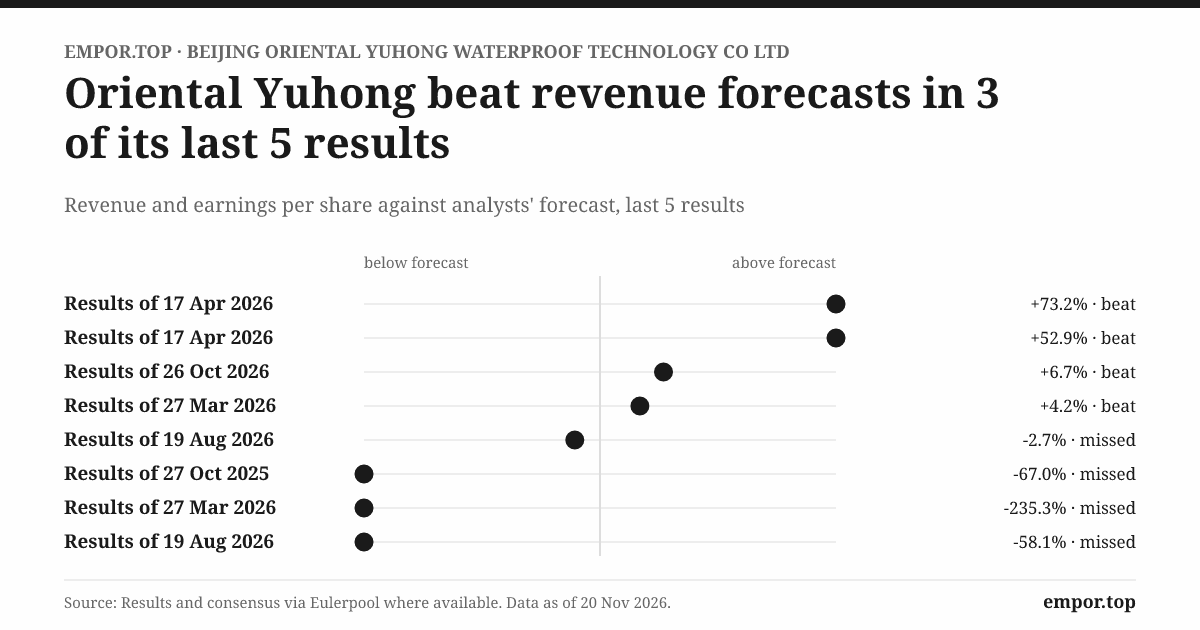
The live investor sessions sharpen the picture of how management communicates. In April 2026, the president, the CFO, the board secretary and an independent director answered online questions; they gave precise figures on first-quarter revenue, overseas share and shareholder numbers, but generic sentences on how much impairment remained.6
In the half-year meeting in August, the company reported first-half revenue of about RMB 14.87 billion, up 9.6%, alongside channel and segment growth figures.10 And in October, Li returned to the front of the room himself, hosting dozens of fund managers and analysts at the company's waterproofing museum in Beijing's Yizhuang district and declaring that the hardest period was over.8 Across all three, management quantified growth readily and quantified risk rarely.
Repayment of the occupied funds and a clean audit opinion are genuine remediation evidence. The regulator's findings, the audit focus on exactly the areas it flagged and the measurable minority dissent keep the control question open. It will close only when remediation is independently demonstrated over several reporting cycles, with no new undisclosed related-party flows and no restatements in revenue or receivables. Which leaves investors to weigh all of this against a share price that has already fallen a long way.
X. Analysis & Bear vs. Bull Case
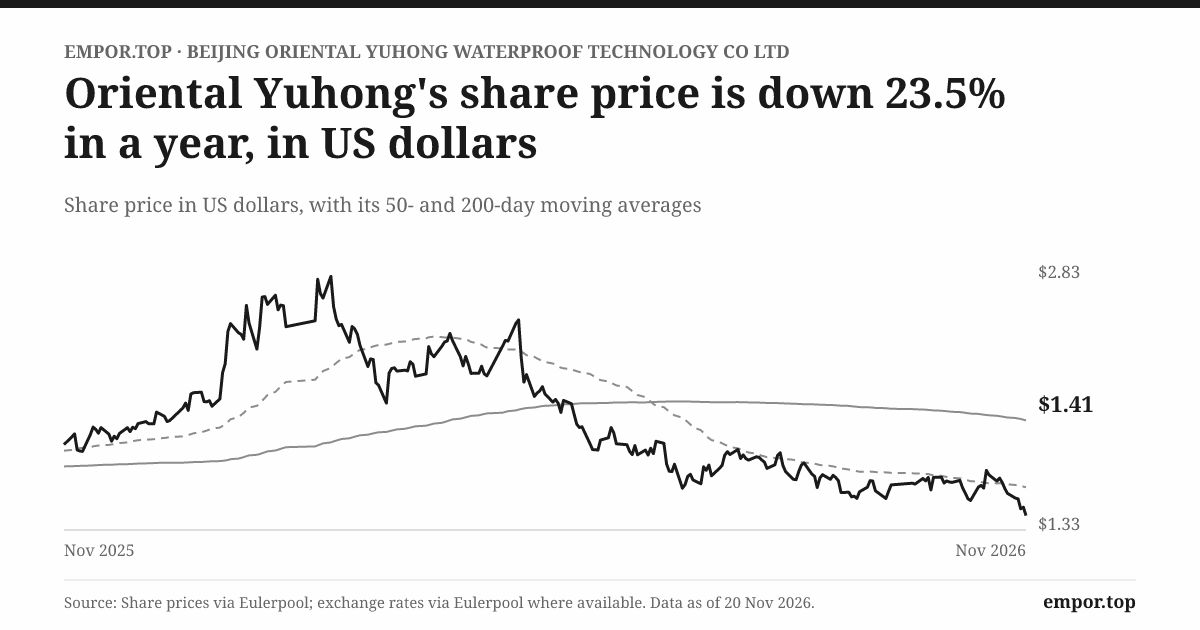
On 20 November 2026, Oriental Yuhong's shares closed at RMB 9.42, the low of the past year and half the 52-week high of RMB 18.90, valuing the company at about RMB 26.2 billion. Six months earlier, when Li was finishing his share sales, the stock had stood at about RMB 15.58.5 The third-quarter report, and the evidence that revenue growth was not translating into profit, had taken more than a third off the price.
The valuation now says two contradictory things at once. On sales, the stock looks cheap: about 0.9 times revenue, and about 1.3 times book value. On earnings, it looks extraordinarily expensive: about 185 times trailing profit, against a five-year median near 30 times, for an earnings yield of about half a percent.
Enterprise value is about 32 times EBITDA and about 71 times operating profit. Neither set of multiples settles anything on its own. A low sales multiple is only cheap if margins come back; a high earnings multiple is only expensive if they do not. What the market price appears to assume is that some recovery is likely, but not that the 2021 economics return.
There is one apparently strong number: a trailing free-cash-flow yield of about 10.7%. It deserves the same scepticism as debtor days. Free cash flow has been flattered by large non-cash impairments, by tighter working capital and by bill endorsements, and it has not been enough to cover dividends and acquisitions without falling cash and rising short-term borrowing.31 A business with that yield and genuinely spare cash would not be adding to short-term borrowing while it buys retailers.
The bull case begins with what the company still has. It is the largest specialist in Chinese waterproofing, around four times its listed rivals, and has some 300,000 retail outlets, of which about 20,000 have been converted to a service model.3798
Its diffuse customer base, supply clearing as weaker rivals fail, and joint price increases by leading firms in 2026 support the recovery case.78 Gross margin in its core products is recovering.10
Retail and repair work, which management says is the fastest-growing category domestically, pays faster and depends less on developers.8 Overseas, acquisitions have given it channels in Chile, Hong Kong and Brazil, and if overseas revenue reaches scale, management argues, profitability will improve.8 In this version, 2024 and 2025 were the floor: impairments from the developer era are largely provided for, prices are recovering, and a company with a RMB 27 billion revenue base can rebuild operating margin toward high single digits, which at today's price would mean a much lower earnings multiple.
The bear case reads the same facts with more weight on the trend. Profit fell in the first nine months of 2026 despite revenue growth, and fell sharply in the third quarter.1 Domestic revenue barely grew in the first half; the growth came largely from acquisitions with thin margins.10 Impairment provisions remain over a billion yuan in nine months, receivables rose by a third, and the company declines to quantify what remains.16 Asphalt remains expensive and price increases arrive with a lag.8
Financing costs are rising while cash is lower than at any time in years and short-term debt stands at RMB 5.67 billion, alongside RMB 1.02 billion of long-term borrowings and RMB 862 million of current maturities.1 The company had RMB 9.72 billion of unused bank facilities at mid-2026 and no reported covenant breach, so this is not a liquidity crisis.10
But it is a balance sheet that has been run harder than its earnings justify. In the bear version, Oriental Yuhong becomes a large, low-margin distributor and manufacturer whose scale lets it survive, but not earn its cost of capital.
A skeptical activist would focus on four questions. The first is capital allocation. Why pay dividends far beyond profit, and buy foreign retailers, while short-term borrowing rises and the core business earns close to nothing? An activist would likely ask management to set an explicit hurdle rate for overseas deals, publish the returns of each acquired business, and tie dividends to free cash flow after acquisitions rather than to past habit.
The second is whether to reduce short-term debt before expanding further abroad. The third is disclosure, especially the cash recoveries from aged receivables and the carrying value of assets accepted in lieu of payment. The fourth is governance: an independent review of controls after the CSRC findings, and a clear separation between the controlling holder's personal finances and company capital decisions.
The risk radar is specific. Chinese construction demand and developer credit remain the dominant variable, because they drive both volume and collection risk. Asphalt and petrochemical prices drive gross margin, and in 2026 they rose faster than prices for much of the year.68 Overseas expansion adds integration, currency and country risk; the company already has material balances in US dollars, Chilean pesos and other currencies, and currency translation losses contributed to higher financial expenses in 2026.31
A subsidiary also faces an international arbitration filed by the Italian company FARE, and the company has authorised up to RMB 500 million of guarantees for downstream dealers, none drawn as of April 2026.3 Artificial intelligence is not a threat to the product: no model replaces a membrane. The plausible effects of technology are on production efficiency, logistics and the company's digital tools for dealers, where Oriental Yuhong is investing.8
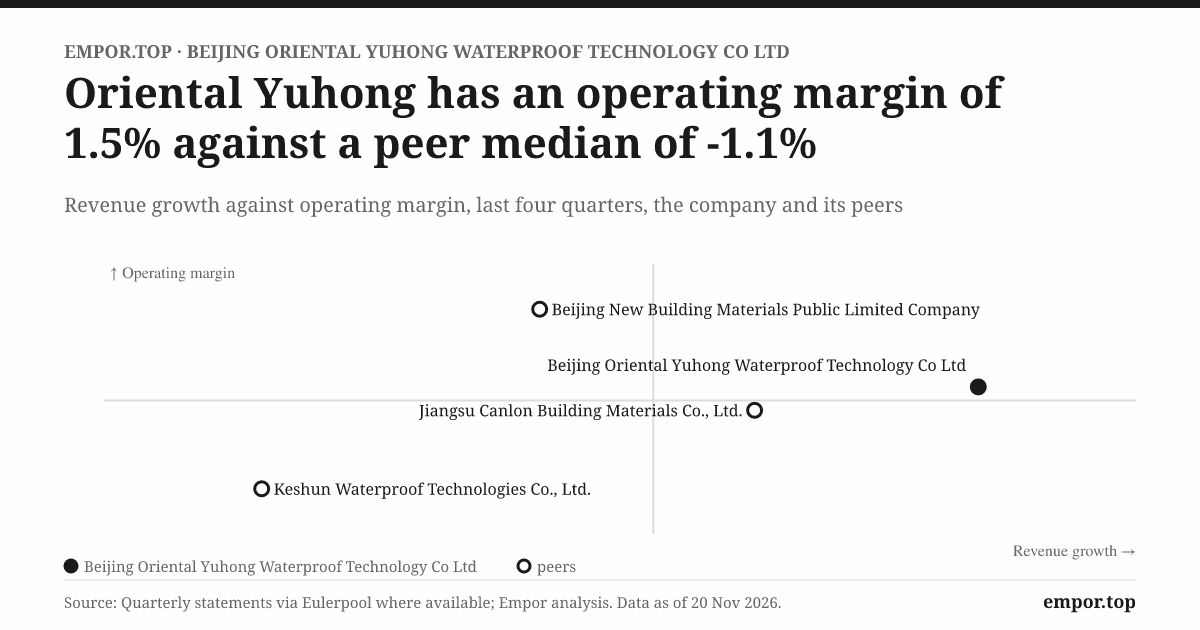
Three measures will tell the story better than any statement. The first is operating margin, read alongside gross margin. Gross margin has recovered to around 26% for the first nine months of 2026, but operating margin was only about 1.8% in the third quarter and about 1.1% for 2025.13 The gap between the two is where impairments, financing costs and overheads live, and it is the gap that has to close.
The second is whether cash recovered from aged receivables outpaces new impairment charges; the direction of both will show whether the developer-era losses are truly behind the company.31 The third is free cash flow after dividends and acquisitions, which needs to turn positive for the balance sheet to stop deteriorating.3
The investment spine is now clear enough to state. There is a credible case that Oriental Yuhong wins on scale and supply capability: it is the largest, best-distributed producer in an industry where those advantages matter more as standards tighten and weak rivals exit. The history narrows that claim. Scale did not protect price, did not protect the company from its customers' failures, and did not stop returns collapsing. What is missing is proof that the advantage translates into durable returns on capital. The next year will show which version is right.
XI. Playbook: Business & Investing Lessons
Go back to the spring of 2021. New shares from a RMB 8 billion placement were trading in Shenzhen, membrane lines were running above capacity, and the company was about to report the best year in its history.2 Every decision made in that room looked reasonable on the numbers in front of it. Oriental Yuhong's story is what happens when a company sizes its factories, its customer credit and its payouts for the peak, and then has to live with them in the trough.
The first lesson is about the customer behind the factory. Oriental Yuhong built capacity to serve demand that was real, but much of it came from developers whose ability to pay depended on a credit boom. When the developers broke, the plants stayed and the invoices aged.
Capacity is only as valuable as the creditworthiness of the next order it fills. For founders, that means pricing credit risk into every expansion plan, not treating it as a collections problem for later. The line this company earns is simple: a bigger factory is an advantage only when the next customer pays.
The second lesson is about the ratios investors use to reassure themselves. Debtor days fell from 212 to 128 in three years, a headline that would normally signal a cleaner balance sheet.3 Yet the ledger remained impaired, some receivables were cleared by endorsing bills to suppliers, and the regulator found that receivables had been aged incorrectly.3616
A ratio can improve because money arrived, because old balances were written off, or because the paper was passed along the supply chain. Only the first is a recovery. A falling debtor-days figure is not a cash recovery until the old balances arrive.
The third lesson is about acquisitions as a substitute for growth. When the core market stalled, Oriental Yuhong turned to overseas acquisitions. The Construmart multiple sat close to what Sika paid for Parex.1114 But Sika published synergy targets and had decades of integration experience. Oriental Yuhong's acquisitions mainly added revenue at thin margins, and it has not yet shown what they earn. An acquisition multiple is a starting price, not proof of value.
The fourth lesson is about trust as a product. For a company asking shareholders to fund a multi-year recovery, controls are not a compliance footnote. The RMB 69.5 million the CSRC found flowing to the chairman was small against revenue, and it was repaid.16
But it came alongside accounting errors in revenue timing and receivables, a delayed annual report and a controlling shareholder selling stock to meet his own obligations.16185 Each by itself might be explained. Together they raise the discount any outside investor applies to management's forecasts. Control is part of the product when investors are asked to fund a long recovery.
The last lesson is the one only this company can teach. Oriental Yuhong's entire value proposition is that it keeps water out: its membranes are trusted on the Bird's Nest, subway tunnels and airport terminals because they do not let anything through. Its finances, by contrast, have leaked. Cash flowed out as dividends beyond free cash flow, into plants that now earn little, into receivables that may never be collected and, briefly, to the founder without disclosure. Waterproofing protects buildings from water; investors still need to see that the company's own cash defences work.
XII. Epilogue
Tonight Oriental Yuhong stands at an unusual point. The recovery case has real evidence behind it.1108 The latest results complicate it.1 The next few results days will decide which one is the story.
The first moment comes with the 2026 annual report, due in the spring of 2027. It will show whether the fourth quarter, traditionally the company's strongest collection period, turned the 33% rise in receivables back into cash, and whether the year's impairment charges were the tail of the developer era or a new wave.
If full-year attributable profit recovers meaningfully above the RMB 113 million of 2025 on higher revenue, without a leap in impairments, the recovery case gains its first real proof. If profit falls again despite revenue growth, the bear case that Oriental Yuhong sells more while earning less will have a full year of evidence behind it.
The second moment is margin. Management has told investors that its price increases will show up gradually as orders are executed.8 The 2026 first-half gross margin in waterproofing, about 29.5%, suggests the increases are sticking.10 The question for 2027 is whether that gross improvement finally survives the journey to operating profit, with impairments, financial costs and overheads all moving in the right direction at once.
The third moment is disclosure about the overseas businesses. Construmart has been in the accounts since 2025, Novakem and Universal Hardware since 2026. Investors need to see their revenue, operating profit and cash returns reported separately, and set against the capital and debt used to buy and build them. A company that describes its overseas arm as still in an early investment phase should at least be able to show what that investment is earning.8
And the last unresolved item is trust. The CSRC asked the company for a remediation report within ten working days in August 2025.16 Whether those remediation controls actually work has not yet been independently shown to the market. Each clean year will narrow the governance discount; any relapse would widen it sharply.
Set against the story's central questions, the evidence today points one way on scale and the other on returns. Oriental Yuhong has kept its position in a shrinking market. It has not yet shown that the position is worth owning at the economics it currently earns. The tension that remains is whether a company that spent a decade building capacity can spend the next one proving that capacity pays.
XIII. Outro
Somewhere in Beijing, the Bird's Nest still sheds rain the way its builders intended, its waterproofing layers long since buried under steel and concrete. That is the quiet promise Li Weiguo's company has sold for almost three decades: you will never see its work, and that is how you will know it worked.
The shareholders of Oriental Yuhong are now waiting for the same proof in the accounts. The company is selling more rolls of membrane, to more places, than at almost any time in its history. What it has not yet shown is that it can keep the cash from those sales from seeping away. A waterproofing leader that can keep water out of the world's buildings has one more seal to make: its own.
References
-
2026 Third Quarterly Report — Beijing Oriental Yuhong, Shenzhen Stock Exchange, 2026-10-26 ↩↩↩↩↩↩↩↩↩↩↩↩↩↩↩↩↩↩↩↩↩↩
-
2022 Credit Rating Report on Beijing Oriental Yuhong — Dagong International, 2022 ↩↩↩↩↩↩↩↩↩↩↩↩↩↩↩↩↩↩↩↩↩
-
2025 Annual Report — Beijing Oriental Yuhong, CNINFO, 2026-04-17 ↩↩↩↩↩↩↩↩↩↩↩↩↩↩↩↩↩↩↩↩↩↩↩↩↩↩↩↩↩↩↩↩↩↩↩↩↩↩↩↩↩↩↩↩↩↩↩↩↩↩↩↩↩↩↩↩↩↩↩↩↩↩↩↩↩↩↩↩↩
-
Initial Public Offering Prospectus — Beijing Oriental Yuhong, CNINFO, 2008-08-29 ↩↩↩↩↩↩↩↩↩↩↩↩↩
-
The Cost of Oriental Yuhong's Employee Share Plan — National Business Daily, 2026-05-14 ↩↩↩↩↩↩↩
-
Investor Relations Activity Record: 2025 Results Online Briefing — Beijing Oriental Yuhong, CNINFO, 2026-04-29 ↩↩↩↩↩↩↩↩↩↩↩↩↩↩↩↩↩↩↩↩↩↩
-
Keshun Waterproof 2025 Annual Report — Sina Finance, 2026 ↩↩↩↩↩
-
Investor Relations Activity Record, Meeting of 2026-10-29 — Beijing Oriental Yuhong, CNINFO, 2026-11-01 ↩↩↩↩↩↩↩↩↩↩↩↩↩↩↩↩↩↩↩↩↩
-
2026 Half-Year Report — Beijing Oriental Yuhong, CNINFO, 2026-08-20 ↩↩↩↩↩↩↩↩↩↩↩
-
Announcement on the Acquisition of Construmart S.A. — Beijing Oriental Yuhong, Sina Finance, 2025 ↩↩↩↩↩
-
The Construmart Deal and Oriental Yuhong's Overseas Expansion — Southern+, 2025-08-02 ↩↩↩↩
-
Why the Construmart Deal Raises a Return Question — Jiemian News, 2025-08-06 ↩↩↩↩
-
Announcement on Completion of the Acquisition of The Universal Hardware & Plastic Factory — Beijing Oriental Yuhong, Shenzhen Stock Exchange, 2026-07-02 ↩
-
Decision to Issue Warning Letters to Beijing Oriental Yuhong, Li Weiguo, Zhang Zhiping, Zhang Bei and Xu Wei — CSRC Beijing Bureau, 2025-08-11 ↩↩↩↩↩↩↩↩↩
-
2024 Annual Report — Beijing Oriental Yuhong, CNINFO, 2025-02-28 ↩
-
Independent Directors' Doubts and Unverified Information: Annual Report Delays Signal Risk — Yicai, 2026 ↩↩
-
Resolutions of the 2025 Annual General Meeting — Beijing Oriental Yuhong, Shenzhen Stock Exchange, 2026-05-08 ↩
 LinkedIn
 WhatsApp
 Reddit
 Hacker News
 Email
 Kindle
 RSS Feed
 Spotify
 Apple Podcasts
 Amazon Music
 Audible
 YouTube