Beijing New Building Materials: The 70% Leader Looking for Its Next Act
I. The Leader That Couldn’t Stop the Slide
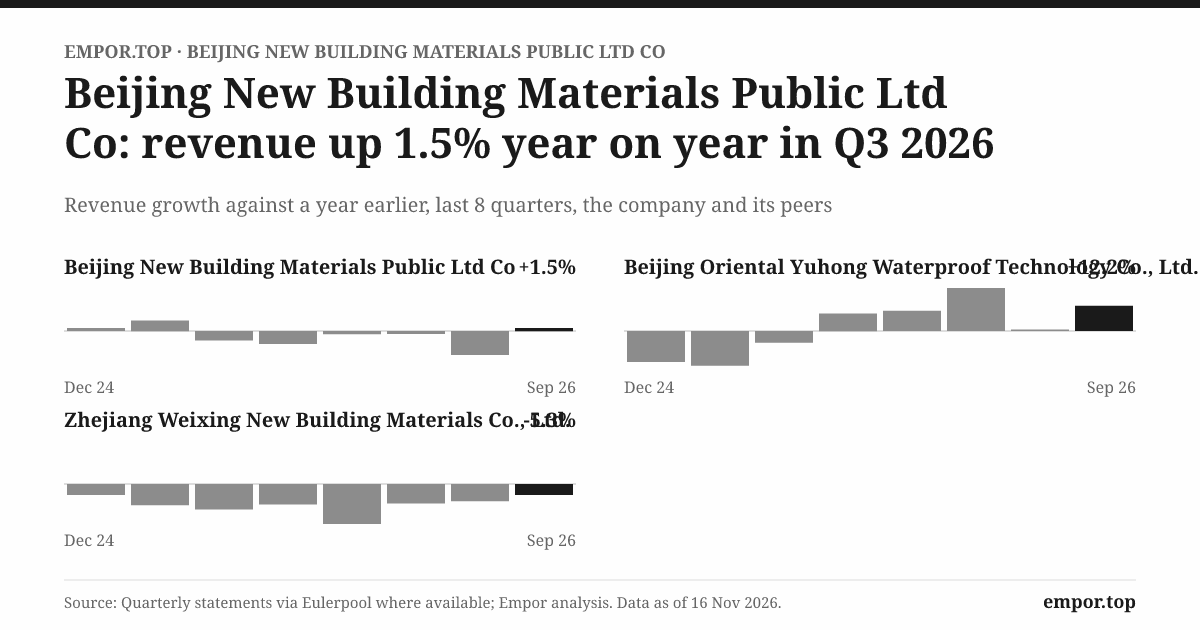
On 23 October 2026, Beijing New Building Materials published a set of third-quarter numbers that looked, for one line, like a turn. Revenue for the three months to September edged up about 1.5% on the same quarter a year earlier, the first year-on-year increase after four straight quarters of decline.1 Anyone who stopped reading there would have seen a recovery. Two lines lower the picture reversed. Operating profit fell about 12.7%, and net profit attributable to shareholders fell about 19.4%.1 The company had sold a little more and kept a lot less.
That gap between a top line that is holding and a bottom line that is not is the story of 北新建材 BNBM in 2026. It is also a strange place for this company to be, because BNBM is not a struggling challenger. By the end of 2023, according to S&P Global Ratings, it held about 70% of China’s gypsum-board market.2 In most industries a 70% share is the kind of position that lets a company set prices, ride out downturns and pick its moment to expand. BNBM has the share. It has also expanded. What it has not managed is to stop its profits from sliding.
The slide has been steady rather than dramatic. In 2025, revenue from gypsum board, the company’s defining product, fell 8.7%.3 Over the same year its coatings business, which it largely bought, grew revenue by about 23%.3 Over the first nine months of 2026, attributable net profit fell 26.4% against the same period a year before, on revenue that was down 4.2%.1 So the new businesses are growing, the old one is shrinking in value, and the whole enterprise is earning less each period than it did the period before. Profit is falling roughly six times faster than sales, which is what happens when prices weaken while costs do not.
That combination raises the three questions this story has to answer. The first is how durable the gypsum-board advantage really is. A company with that much of its market should, in theory, be able to defend its prices; the 2025 numbers suggest it could not, or chose not to. The second is whether the newer businesses, waterproofing and coatings, can earn their place, meaning produce profit and cash rather than simply add revenue to a group whose core is under pressure. The third is whether the team now running the company can turn a decade of expansion into returns that justify it.
Before going further, it helps to be precise about who is who, because Chinese state-owned industrial groups have a way of nesting companies inside companies with nearly identical names. The subject of this story is Beijing New Building Materials Public Limited Company, listed in Shenzhen under the code 000786 since 1997.3 It is a real operating company with its own plants, brands, balance sheet and minority shareholders. Above it sits 中国建材 China National Building Material Co., Ltd., which held 37.54% of BNBM’s shares at the end of September 2026, and above that sits China National Building Material Group, the ultimate state-owned controller.1
Everything in this story about revenue, cash, debt and returns refers to the listed company and its subsidiaries, not the wider group. That boundary will matter later, when the question turns to where BNBM keeps its cash and whose credit rating it can lean on.
The time horizon matters too. Viewed over twelve years, BNBM looks like an exceptional cash machine. From 2014 through 2025 it reported about CN¥28 billion of attributable profit and generated about CN¥36 billion of operating cash flow, meaning that for every yuan of reported profit, roughly 1.3 yuan arrived in the bank.3 Revenue over the decade to 2025 compounded at close to 13% a year, and profit at about 12.5%.3 Those are the numbers of a company that built something real.
But the same records show return on equity falling from close to 19% in 2017 to under 11% in 2025, and to about 8% over the twelve months to September 2026.31 Operating margin, which peaked near 25% in 2017, was 13% in 2025.3 The long record and the recent record point in different directions, and an investor has to decide which one describes the future.
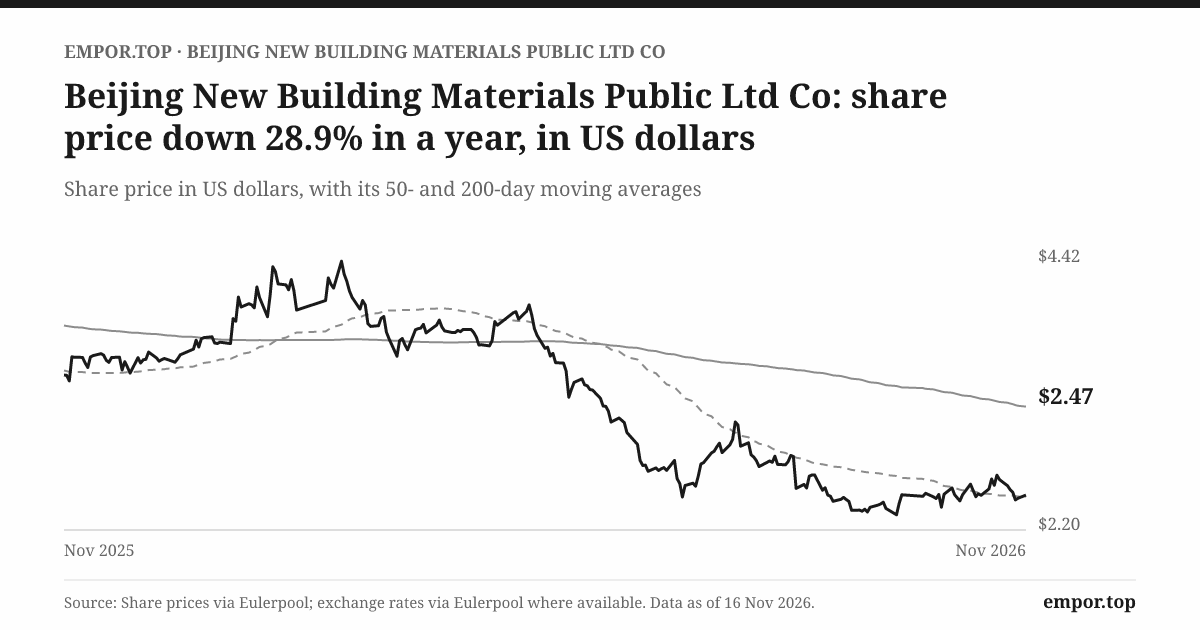
The market made its own guess. In mid-November 2026, BNBM’s shares traded about 44% below their 52-week high, valuing the company at roughly CN¥27 billion, almost exactly its book value. A company that controls seven-tenths of its home market is being priced as though its assets are worth what the accountants say and not a yuan more. To understand whether that is pessimism or realism, one has to start with what BNBM actually sells and how the money reaches it.
 Subscribe on LinkedIn
II. A Board, a Distributor, and a Construction Cycle
Picture a stack of gypsum boards on a pallet in a BNBM warehouse. Each sheet is a slab of gypsum, a soft mineral, sandwiched between layers of heavy paper. It is light enough for two workers to carry, cheap enough to waste a little on every job, and it is how most modern interior walls and ceilings are built. When a forklift loads that pallet onto a truck and the truck reaches a customer who confirms the delivery, BNBM books the sale.
That is the moment its revenue is recognised: when the goods leave the warehouse and the customer confirms receipt.3 There is no subscription, no maintenance contract, no software licence. A board is sold, and then the company needs to sell another one.
In 2025, BNBM sold about 2.15 billion square metres of gypsum board, down 1.1% from the year before.3 That is enough board to cover a square more than 46 kilometres on each side. Gypsum board alone produced 47.3% of the company’s revenue.3 Around it sits a product stack that has grown in layers. Light steel keel, the thin metal framing that the boards are screwed onto, belongs to the same light-building-materials segment.
Waterproofing materials, the membranes and coatings that keep water out of roofs, basements and bathrooms, form a second segment. Architectural coatings, which is to say paint for walls inside and outside buildings, form a third.3 All three are physical goods sold into construction and renovation. A developer putting up a tower block buys them; so does a contractor fitting out an office, and so does a family redecorating a flat.
What makes BNBM’s model distinctive is not the product but the route it takes to the customer. In 2025, 86.6% of revenue came through distributors.3 Most boards do not travel directly from BNBM to the builder; they pass through a dealer who holds stock, extends credit, arranges local delivery and knows which contractor is working on which job. That structure explains one of the more unusual numbers in BNBM’s disclosures: its five largest customers together accounted for about 1.6% of 2025 revenue.3 For a manufacturer of this size, that is remarkably diffuse. No single property developer, no single dealer, can hold BNBM hostage.
Diffuse does not mean safe, however. A long tail of customers spreads credit risk thinly, but it does not eliminate it, and in a property downturn many small customers can weaken at once. BNBM’s own receivables notes describe several anonymised debtors as in default or carrying repayment risk.4 The distributor model, which keeps any single relationship from mattering too much, also places a layer of businesses between BNBM and the end customer, and the health of that layer matters. When dealers carry too much inventory or face their own cash squeeze, they buy less, pay later or demand better terms.
That is why the demand side of this business is more complicated than the phrase “construction cycle” implies. Volumes depend on how much building and renovation is happening, but revenue depends on the price each square metre fetches, and profit depends on what it costs to make. Gypsum board production uses energy to dry the boards, with paper and gypsum as raw materials, so energy and input prices move margins directly.3 Distributor inventory can amplify swings: when dealers destock, factory sales fall faster than end demand; when they restock, the reverse. A gypsum-board maker is therefore exposed to three cycles at once: the building cycle, the cost cycle and the channel cycle.
There is also a list of things the company does not disclose, and each one narrows how far an investor can push the case. BNBM does not publish contract durations with its distributors, minimum purchase commitments, or the share of sales that recur from the same customers year after year.3 So when people describe the company’s distribution network as a moat, they are describing reach, which is real, but not lock-in, which the company has never shown. A dealer who stocks BNBM boards today could, as far as the public record shows, stock a rival’s boards tomorrow if the price or terms were better.
Two smaller details sharpen that picture. Because revenue is booked on confirmed delivery rather than over the life of a project, BNBM carries only a thin layer of contract assets, about CN¥160 million at the end of 2025, against a revenue base above CN¥25 billion.4 The business, in other words, does not build up large balances of work done but not yet billed, as a contractor would; its exposure sits instead in ordinary trade receivables owed by the dealers and builders who have already taken the goods.
And because so much of the selling is done by distributors, BNBM’s own view of end demand is filtered through their ordering behaviour. When the company tells investors what it sees in the market, it is partly describing what its dealers are willing to stock. The one thing that can be said with confidence is that BNBM’s network is wide and that its products are bulky, heavy and cheap relative to their weight, which makes local presence valuable.
The model, then, is simple to describe and hard to defend from first principles. BNBM is a manufacturer of physical building materials whose fortunes rise and fall with construction, renovation, channel health and above all price realisation. The question of how a company with that model came to own most of its market is a story about one decision made more than two decades ago.
III. The Decision to Make Gypsum Board the Center
BNBM’s roots go back to a state-backed building-materials production base in Beijing, a product of the era when China’s planners decided which factories would make what. Those origins explain its ownership but not its position. The decision that defined the modern company came in 2004, when management re-established gypsum board as its principal business after a period of intense competition in China’s building-materials market.5 It was a choice to stop being a general building-materials company and to become a specialist in one product, at exactly the time China’s construction boom was about to make that product one of the most widely used materials in the country.
It was a bet on a specific mechanism. Gypsum board is bulky and cheap. A truck full of it carries a lot of volume and not much value, so moving it long distances eats into margins quickly. That makes the economics local: the producer with plants close to every major market, running at high utilisation, can deliver at a lower cost than a rival shipping from further away. Scale in this business is not just about spreading head-office costs; it is about having a factory near the customer and enough volume to keep it busy. Add production know-how, brand recognition among contractors, and a dealer network that already stocks your boards, and the advantages compound.
BNBM built exactly that. By the end of 2024 it had about 3.56 billion square metres of effective production capacity, according to S&P, and by the end of 2023 S&P put its domestic market share at about 70%.2 It sells under several brands, including 龙牌 Dragon, 泰山 Taishan and 梦牌 Dream, which management describes as a complete product matrix spanning premium and mass-market boards.6 The company the rest of the industry measures itself against is an international one: Knauf, the German family-owned group, and Saint-Gobain, the French materials giant, both compete in China.
Domestic producers such as JASON and Shandong Baier fill out the field.2 No source comparable to S&P’s estimate gives current domestic market shares for those rivals, so how far behind they sit is not precisely known. What is clear is that BNBM is the scale leader by a wide margin.
The decade-long growth record that followed is meaningful but must be read carefully. Revenue grew close to 13% a year from 2015 to 2025, and profit at about 12.5%.3 Part of that came from building plants and selling more board. Part came from buying more of what it already partly owned, notably additional shares in Taishan Gypsum. And part came from adding entirely new businesses, waterproofing and later coatings.
BNBM does not separate organic growth from acquired growth across the full decade, so the compounding cannot be credited cleanly to the core franchise.3 That matters because the investor’s question is whether the core can keep compounding on its own, and the historical record blends the answer with acquisitions.
The cleanest test of the gypsum-board advantage is not market share. It is what happens to price when demand weakens. If a 70% share gave BNBM real pricing power, a downturn should show up mainly as lower volume with prices holding, because the leader would refuse to chase share downward. The 2025 numbers show the opposite. Gypsum-board volume slipped just 1.1%, while gypsum-board revenue fell 8.7% and the product’s gross margin fell 1.61 percentage points.3
Divide revenue by volume and the average realised revenue per square metre fell from roughly CN¥6.0 to about CN¥5.6, a decline of almost 8%.3 Some of that may reflect product mix, but most of it looks like price. BNBM kept its volume by accepting less for each board.
That is the honest shape of the moat. Run it through the lens of Michael Porter’s five forces and Hamilton Helmer’s seven powers, and the evidence sorts itself. Scale economies have support: the plant network, the capacity and the cost advantage of local production are real. Brand has support, given multiple recognised product lines. Distribution reach has support, given that most revenue flows through a broad dealer base. But switching costs are not established, because contractors and dealers can, as far as the disclosures show, change suppliers freely.
A cornered resource, such as exclusive access to raw gypsum or protected technology, is not established either. And the bargaining position against buyers, which should be strongest for a 70% leader, looks weaker than the share implies. When a company with that much of its market cannot hold its prices through a soft year, it suggests either that rivals price aggressively enough to force a response, or that BNBM chose volume over margin to keep its plants full.
Management’s own words point to the second explanation, at least in part. In July 2026 the company described its approach as keeping a dynamic balance between price, cost and profit on one side and volume, cost and profit on the other, pursuing a strategy of “high-end leadership and low-end blocking,” and aiming to lead industry prices toward repair.7 In plain terms, BNBM sells premium products at premium prices and uses cheaper lines to fight off low-cost competitors at the bottom of the market.
The word “repair” is revealing. A company with untouchable pricing power does not need to repair its prices. The scale advantage is real, but in 2025 it bought volume more than it bought price.
That tension, between owning the market and controlling its prices, goes back to the moment BNBM made its biggest bet on owning even more of it.
IV. The 2016 Taishan Deal: Buying More of the Core
Every scale strategy eventually confronts the question of whether to keep building or start buying. For BNBM, the answer in the mid-2010s was to buy more of a business it already knew intimately. 泰山石膏 Taishan Gypsum, based in Shandong province, was one of the country’s largest gypsum-board producers and already sat inside BNBM’s group as a subsidiary, but BNBM did not own all of it. In 2016 it issued 374.60 million new shares at CN¥11.20 each to acquire an additional 35% of Taishan Gypsum.5 At that price, the shares issued were worth about CN¥4.2 billion, which put a value on the whole of Taishan Gypsum at roughly CN¥12 billion.
This was not BNBM’s first trip to the equity markets in that period. Two years earlier, in 2014, it had sold 131.84 million shares in a private placement at CN¥16.08 each, raising about CN¥2.12 billion before costs.8 Taken together, those two deals issued more than 500 million new shares. For existing shareholders, that was meaningful dilution, accepted in exchange for a larger claim on the gypsum-board business and fresh capital to expand it. The 2016 deal in particular was paid in shares rather than cash, which spared BNBM’s balance sheet but spread its future profits across more owners.
The prices of those two issues tell their own small story. In 2014, outside investors paid CN¥16.08 for each new BNBM share.8 Two years later, the sellers of the Taishan stake accepted BNBM shares valued at CN¥11.20.5 The company had raised cash at a high price and then used its stock as currency at a much lower one. Whether that sequence favoured existing shareholders depends on what Taishan’s earnings turned out to be worth, but it shows that BNBM’s equity was not a fixed-value instrument in management’s hands; the market’s mood at the moment of each deal shaped how much of the company every transaction cost.
The logic of the Taishan deal was straightforward. BNBM already consolidated Taishan Gypsum, so buying more of it did not expand the company’s physical footprint or its market share. What it did was capture a larger portion of the profit those plants produced, profit that previously leaked out to minority holders. When the core business is the most profitable thing a company owns, buying more of it at a reasonable price is about as low-risk as acquisitions get. There is no integration challenge, because the business is already integrated. There is no question of strategic fit, because it is the strategy.
The result is visible in the numbers that followed. Net profit roughly doubled in 2017, rising about 100%, and BNBM’s return on equity reached nearly 19% that year, its peak over the last twelve.3 Operating margin hit about 25%.3 Some of that leap reflected a strong market and some reflected the larger share of Taishan’s earnings now flowing to BNBM’s shareholders. The company does not publish a bridge separating the two, so the exact contribution of the 2016 deal to that profit jump cannot be isolated. What can be said is that the years immediately after the deal were the best in the modern record.
There is a temptation, given that outcome, to treat the Taishan deal as proof that BNBM’s management knows how to allocate capital, and to extend that confidence to everything that came afterwards. That would be a mistake. Buying more of a business you already control, in your own core product, at a time of strong demand, is the easiest kind of capital deployment to get right. It tests very little of what a diversification strategy requires: picking a new industry, valuing a company you do not control, integrating different management and culture, and making a different product earn a return through a different sales cycle.
The Taishan deal is better used as a benchmark than as a verdict. It sets out what a successful capital deployment looked like at BNBM: money tied to the business with the highest margins, the strongest market position and the most predictable demand, and returns that rose afterwards. Any later move outside gypsum board has to clear a comparable bar.
Would a new business produce returns at least as high as the core? Would it strengthen the core’s position or at least not distract from it? And would it convert to cash at a rate that justifies the shares or cash spent to acquire it? Those are the questions BNBM’s later diversification would have to answer.
Before that, however, Taishan Gypsum brought the company something it had not bargained for: a decade of litigation in the United States.
V. The Lawsuit That Became a Second Business Problem
In the mid-2000s, a run of hurricanes along the U.S. Gulf Coast and a housing boom created a shortage of drywall in America. Builders turned to imports, and a large volume of Chinese-made gypsum board, some of it from Taishan Gypsum, went into new and rebuilt homes. Within a few years, homeowners in states such as Florida and Louisiana began complaining of sulfurous odours and corroded copper wiring and fixtures, and blamed the board. The claims were consolidated in federal court in New Orleans as MDL-2047, the Chinese-Manufactured Drywall Products Liability Litigation, before Judge Eldon Fallon.9
For a gypsum-board company that had never sold heavily into the United States, this was a strange burden to carry. Taishan contested jurisdiction and the claims for years, and the case dragged on across multiple phases.9 Its effect on BNBM was less about the money at any given moment than about the uncertainty it imposed: an open-ended liability in a foreign court, tied to the company’s most important subsidiary, with damages that were hard to estimate. For a business whose investment case rested on predictable domestic cash generation, that was a second business problem layered onto the first.
In 2019, Taishan Gypsum agreed to a class settlement reported at US$248 million to resolve the bulk of the claims, ending what Yicai described as a decade-long dispute.[^10] The court approved the class settlement in early 2020.9 But a class settlement does not bind everyone. Ninety plaintiffs opted out to pursue their claims separately. By the time of the 2026 third-quarter report, all 90 of those opt-out cases had concluded.1
One other case remained pending, and BNBM and Taishan Gypsum said they could not estimate the possible loss.1 The large litigation risk has therefore been retired, and what remains is a residual uncertainty: real, but small relative to a company with a market value near CN¥27 billion, and of a kind that the company has said it cannot quantify.
The settlement year also coincides with BNBM’s sharpest earnings collapse in the modern record. In 2019, attributable net profit fell about 82%.3 The shape of the income statement that year is telling. Operating profit was still substantial, but profit before tax was a fraction of it, which points to a large charge sitting below the operating line, and the effective tax rate that year jumped to about 30%.3 The timing and the pattern are consistent with litigation costs, yet the clean bridge, line by line, from the settlement to the 2019 result is not something BNBM sets out in a form that allows the full drop to be attributed to the lawsuit.
The responsible reading is that the litigation was a major factor in a very bad year, not that it explains every yuan of the decline.
What the episode teaches is that building a brand and exporting product can create liabilities that last far longer than the sales that caused them. Taishan Gypsum’s U.S. exports were a small, opportunistic slice of its business. The legal tail ran for more than a decade. That lesson is newly relevant because BNBM is again expanding abroad, this time by building plants in other countries rather than shipping board across oceans. Its overseas sales were about CN¥615 million in 2025, just 2.4% of revenue, but up about 47% on the year before.3
The company says it already has capacity in Tanzania, Uzbekistan and Thailand, and that the Thai project went into production and turned a profit in the same year.7 Overseas plants carry their own legal, currency and product-liability exposures, and the drywall saga is a reminder that those can surface years later.
On governance and accounting, the most recent signals are clean. BNBM’s 2025 accounts received a standard unqualified audit opinion, and the auditors flagged revenue recognition and goodwill impairment as key audit matters, which is to say the areas where judgement most affects the numbers.3 Revenue recognition matters for any distributor-heavy business, where timing of delivery and customer confirmation determines which year a sale lands in. Goodwill impairment matters because BNBM has paid premiums for acquisitions, and the accounting value of those premiums depends on management’s forecasts of the acquired businesses’ future profit. That second point leads directly into the biggest strategic shift in BNBM’s recent history: its decision to stop being a gypsum-board company alone.
VI. From One Core to “One Body, Two Wings”
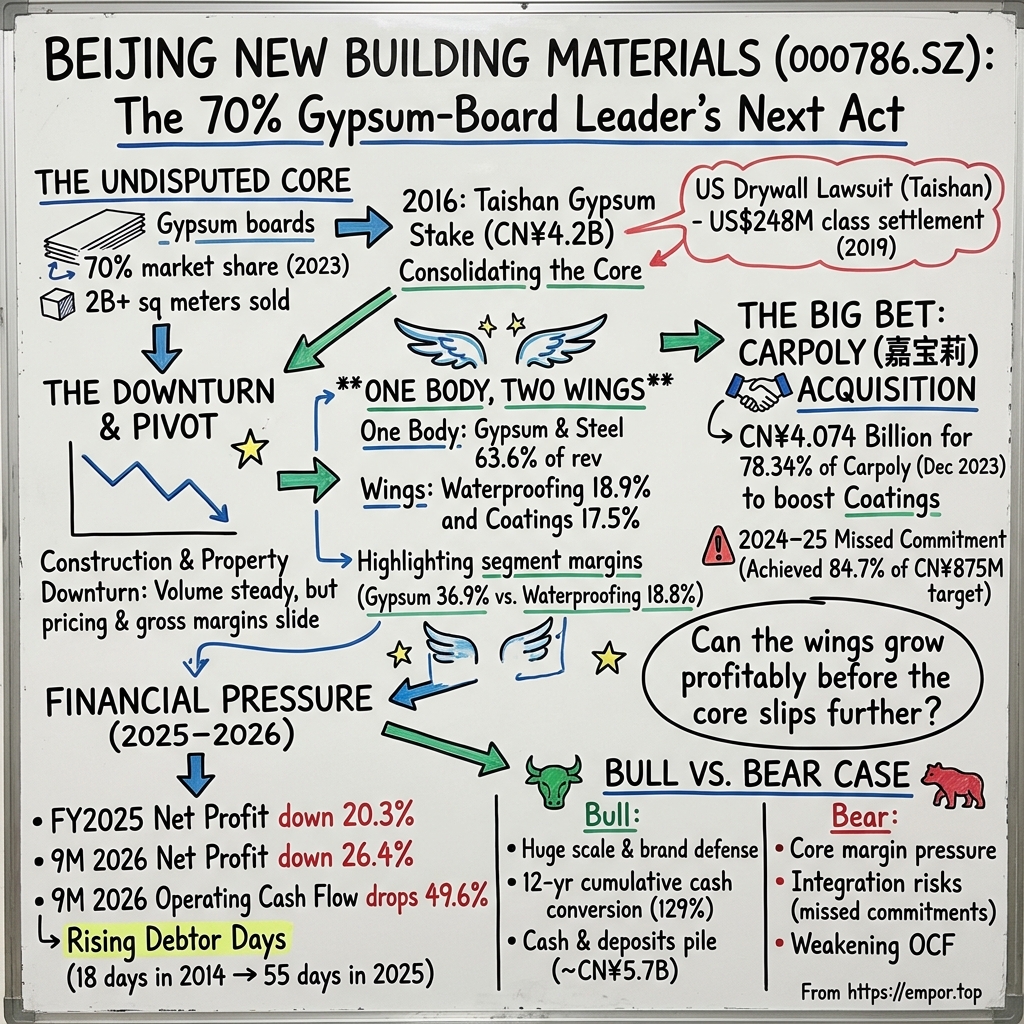
Chinese corporate strategy has a fondness for compact images, and BNBM’s is 一体两翼 “one body, two wings.” The body is gypsum board and the light building materials that go with it. The wings are waterproofing and coatings. The idea is that a company which already reaches tens of thousands of dealers and contractors with its boards can send more products down the same channels, so that a dealer who stocks BNBM board also stocks BNBM waterproofing membrane and BNBM paint, and a renovation crew that hangs the board also seals the bathroom and paints the wall with products from the same supplier.
By 2025, the wings had real weight. Light building materials still made up 63.6% of revenue, waterproofing 18.9% and coatings 17.5%.3 Put another way, more than a third of the company’s sales now come from businesses that did not define it a decade ago. The direction of travel was also clear in 2025: light building materials fell 8.7%, waterproofing grew 3.3%, and coatings grew about 23%.3 On revenue alone, the diversification looks like it is working, because the wings are growing while the body shrinks.
Revenue, however, is not where a manufacturer earns its keep. The gross margins tell a different story. Light building materials earned a segment gross margin of 30.7% in 2025; gypsum board on its own, which produced about CN¥12 billion of revenue, earned 36.9%.3 Coatings earned 32.9%, which is respectable.3 Waterproofing earned just 18.8%.3 Translate those margins into gross profit and the body still carries the company. Roughly speaking, light building materials produced about two-thirds of the group’s gross profit in 2025, gypsum board alone about three-fifths, coatings about a fifth and waterproofing barely an eighth.
For every CN¥100 of waterproofing revenue, BNBM keeps less than CN¥19 after the direct cost of making it, about half what it keeps on a gypsum board. The waterproofing wing is large, but it is the least profitable business in the portfolio by a wide margin.
That margin gap matters because it shapes what diversification can do. If the body loses gross profit and the wings replace it with revenue at lower margins, the company can grow sales and still shrink profit, which is close to what happened in 2025. Coatings is the exception: its margin is close to the core’s, so its growth adds meaningful profit. Waterproofing, by contrast, needs much more revenue to replace a yuan of lost gypsum-board gross profit.
Management’s view of the waterproofing industry explains why it is willing to live with that thin margin for now. In July 2026, the company told investors that waterproofing was returning to a more rational path, with market share concentrating among the leading producers and the balance between supply and demand improving; it pointed to repair work, residential building, old-town renovation and drainage and seepage control as areas with growth potential in China’s 十五五 15th Five-Year Plan period.7
It also said raw-material prices were stable and production costs controllable.7 Read plainly, the bet is that a consolidating industry will eventually let the survivors earn more. That is a reasonable thesis about industry structure. It is not yet visible in BNBM’s own waterproofing margin, and when asked in August whether it would raise waterproofing prices, the company declined to commit, saying only that it hoped to be a builder of a healthier industry ecosystem.6
Management’s pitch for why the wings will become more valuable is concrete. The company describes opening its gypsum-board channels to waterproofing and coatings, coordinating retail and e-commerce sales, and assembling a broader product set aimed at renovation, which is where it sees the most durable demand.3 In its August 2026 meeting with investors, the company said its coatings business was linking up with gypsum-board and waterproofing channels to accelerate distribution in first- and second-tier cities.6
In July it described the long-term demand drivers for gypsum board as urban renewal, secondary renovation, home-improvement retail, county and township markets and product substitution.7 The strategy hangs together. A renovation-focused, multi-product company that reaches into smaller cities through a shared dealer network is a coherent idea.
What the filings do not yet show is that the cross-selling has produced durable incremental returns. BNBM does not disclose how much waterproofing or coatings revenue comes through gypsum-board dealers, how many dealers carry all three product lines, or how much the shared channel lowers selling costs. The claim that the channels are shared is a plan; the evidence that sharing them earns more is not yet in the public record.
The company is spending to make the plan work. In 2025, research and development spending was about CN¥1.04 billion, or about 4.1% of revenue, almost all of it expensed rather than capitalised.3 Cash spent on plants, equipment and other long-term assets was about CN¥1.19 billion, roughly 4.7% of revenue, with projects including new capacity in Thailand, Hainan and Ningbo.3 The company employed 16,133 people at the end of 2025.3 Those are real investments, and the fact that almost all R&D is expensed is a conservative accounting choice.
But spending is an input, not an outcome. The question is whether the research becomes products that sell at better margins, and whether the capex adds capacity that customers fill at decent prices. BNBM’s spending has been roughly flat for two years, so there is no rising trend to point to either way.
That leaves the diversification thesis in a defined but unproven state. Coatings is now large enough and profitable enough to matter. Waterproofing has scale but thin margins. The body still dominates the economics. That test remains unproven. And the largest single bet on it was not built from scratch. It was bought.
VII. Carpoly: CN¥4 Billion for a Bigger Coatings Position
At the end of 2023, BNBM agreed to pay CN¥4.074 billion for 78.34% of 嘉宝莉 Carpoly, a Chinese coatings company with a national distribution footprint.[^11] It was the largest acquisition in BNBM’s modern history outside its own core, and it signalled a change in what the company wanted to be. The Taishan deal had bought more of the business BNBM already understood. Carpoly bought a business BNBM had to learn.
The rationale was clear enough. BNBM already had a coatings business, but it was small. Carpoly brought established brands, production capacity across several regions, and a dealer network of its own. The controlling shareholder’s disclosure described the deal as a way to expand the group’s coatings capacity and geographic coverage and to combine BNBM’s channels and procurement scale with Carpoly’s products.[^11]10 In theory, Carpoly’s paint could ride on BNBM’s gypsum-board dealers, and BNBM’s purchasing power could lower Carpoly’s raw-material costs. In theory, the combined company could offer a contractor walls and finishes from one supplier.
The price can be judged against the deal’s own terms. Paying CN¥4.074 billion for 78.34% implies a value for all of Carpoly’s equity of about CN¥5.2 billion. The sellers committed to a level of profit that justified that price: CN¥875 million of adjusted net profit across 2024 and 2025 combined, and about CN¥1.39 billion across 2024, 2025 and 2026.11 The two-year commitment averages CN¥437.5 million a year. Against that number, the implied equity value is about 11.9 times annual earnings, before taking account of Carpoly’s debt, cash and accounting adjustments.
That is not an outlandish multiple for a growing consumer-facing coatings brand, but it is a price that only makes sense if the committed profits arrive. There is no clean, same-basis transaction in the Chinese coatings industry to set beside it, so the fairest yardstick is the deal’s own promise.
And the promise was not met. Over 2024 and 2025, Carpoly delivered about CN¥741 million of adjusted net profit against the CN¥875 million commitment, a completion rate of 84.7%.11 The shortfall was about CN¥134 million. Under the purchase agreement, a miss of this kind triggers compensation from the selling shareholders, and the special audit review of the commitment set out the shortfall on which that compensation is calculated.11 BNBM’s 2025 report also said that the goodwill impairment test on the acquisition found no impairment.3
Both of those facts deserve to be read carefully, because neither substitutes for meeting the operating target. Compensation from sellers is a contractual remedy. It returns some value to BNBM, but it does not make Carpoly more profitable, and it is a one-time transfer rather than a recurring stream. The goodwill test is an accounting judgement that rests on management’s forecasts of Carpoly’s future profits; its finding that no impairment was needed means those forecasts still support the carrying value, not that the business is performing as promised. The plain reading is that Carpoly, in its first two years under BNBM, earned about 15% less than the sellers said it would.
There is a reasonable defence. Those two years were among the hardest in recent memory for Chinese building materials. Property construction was weak, prices were under pressure across the sector, and BNBM’s own core saw its profits fall over the same period. A coatings business delivering 85% of a pre-downturn forecast in a downturn is not a disaster. But the defence cuts both ways. Acquisitions are priced on the assumption that the buyer has accounted for the cycle. If a forecast made at the end of 2023 could not anticipate the conditions of 2024 and 2025, it raises the question of how the next forecast should be weighed.
Carpoly’s contribution to today’s BNBM is nonetheless real, as the coatings figures already suggest.3 In August 2026 the company said Carpoly’s consumer business was developing well, with new art and stone-effect paints and plans to broaden the range for the mass market.6
Growth has made the acquisition material. What growth has not yet done is prove that the acquisition earned its cost. A CN¥5.2 billion equity valuation needs a profit stream that, after integration costs and the opportunity cost of the capital, beats what BNBM could have earned by putting the same money into its core or returning it to shareholders.
The next piece of evidence is close. The third commitment year, 2026, implies about CN¥519 million of adjusted profit on the cumulative three-year target, a higher bar than either of the first two years.11 To meet the cumulative three-year promise, Carpoly would need to deliver that plus the CN¥134 million it missed. Whether it gets close, and what the reported profit, cash generation and return on capital of the acquired business look like afterwards, will say more about the wisdom of the deal than any strategy document.
Management’s own stated test for acquisitions, voiced in July 2026, is whether the company can get in, whether it is worth getting in, and whether it can win.7 Carpoly has answered the first. The second and third are still open.
Meanwhile, the business that paid for Carpoly was having its own hard year.
VIII. The Price Leader Meets a Slower Market
The 2025 annual report, released in March 2026, showed how much faster gypsum-board revenue fell than sales volume.3 The plants had run almost as hard as the year before, the trucks had carried almost as many boards, and the money had not followed.
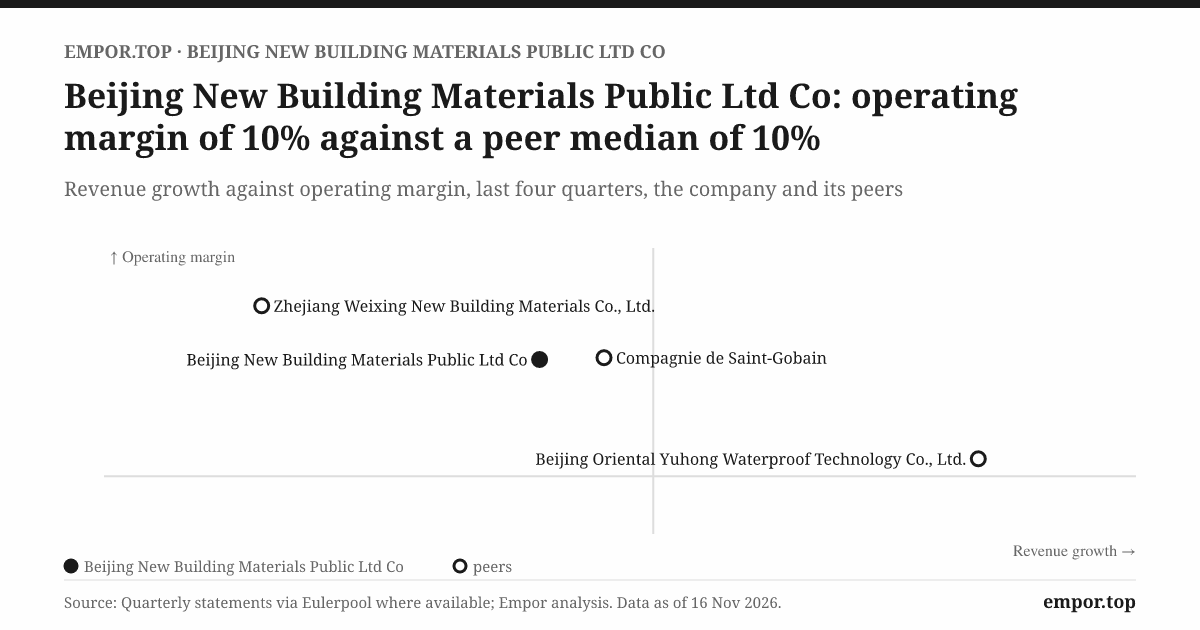
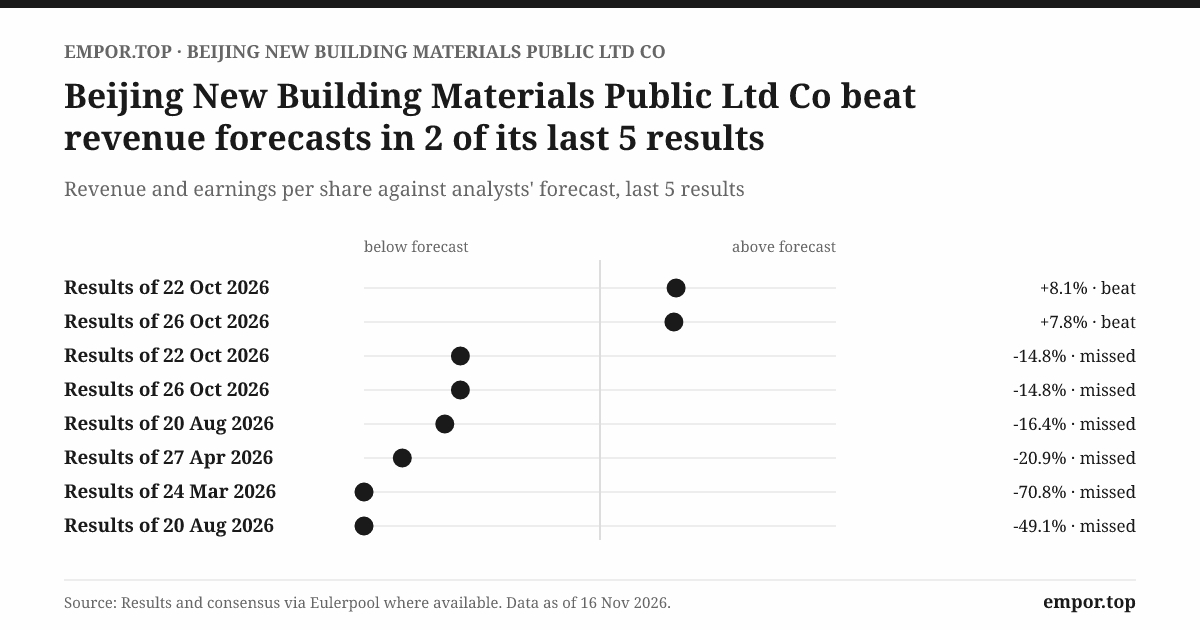
For the company as a whole, 2025 revenue fell about 2% and attributable profit fell about 20%, to roughly CN¥2.9 billion.3 Operating margin fell to 13%, from about 15% in 2024 and above 17% in 2023.3 Then 2026 made it worse. For the first nine months, revenue was down 4.2%, attributable profit down 26.4%, and operating cash flow down 49.6%.1 Quarterly operating margin, which had been around 15% to 20% in much of 2024, fell below 10% in the second and third quarters of 2026.1
The tempting explanation is that this is simply China’s property downturn arriving at a building-materials supplier, and that when construction recovers, BNBM will too. That story is partly true and partly too easy. If the problem were only demand, volume would have fallen first and hardest. It did not. Volume barely moved. What moved was price and margin. A downturn in which the leader keeps selling nearly as many boards but earns much less on each one is a downturn in pricing power, not just a downturn in demand.
The portfolio view sharpens the point. In the same year that gypsum-board revenue and margin weakened, coatings grew strongly and waterproofing grew modestly.3 The company is diversifying, as intended. But the wings are not yet large enough, or profitable enough in waterproofing’s case, to offset what the core is losing. Earnings have not stabilised, and the third quarter of 2026, with revenue up and profit down, suggests that even a return to sales growth will not automatically restore margins.
BNBM’s response has been stated clearly. Speaking to investors in August 2026, the company said it would deepen internal coordination, cut costs and pursue incremental growth.6 It described using its gypsum-board division to coordinate price control and shared channels while balancing volume and price; continuously optimising capacity, adjusting production across bases and cross-regional logistics to favour the lowest-cost lines; accelerating channel transformation toward lower-tier markets and home-improvement retail; launching new products such as Dragon’s Luban universal board and Taishan’s Phoenix premium board; and using acquisitions to strengthen its platform.6
Asked whether volume or price mattered more, the company answered that both did.6 Asked about the gypsum-board market’s long-run size, it said the industry could recover to its previous peak or beyond, citing lower per-capita consumption than in developed countries and room for growth in partition walls and renovation.6
Those answers are plausible, but they should be tested against the factors management controls. The first is price. BNBM is the price leader; when its prices fall, it is either following competitors down or choosing to defend volume. Either way, the 8% fall in average realised revenue per square metre was not something that happened to BNBM without its participation. The second is cost. Operating profit fell faster than gross profit, which means selling, administrative and other operating costs did not shrink in line with revenue; in 2025, employee cash payments rose about 12% even as customer receipts fell about 4%.3
The third is capacity. BNBM had about 3.56 billion square metres of capacity at the end of 2024 and sold about 2.15 billion square metres in 2025, which suggests its plants were running at around 60% of capacity on a simple comparison.23 A company with that much idle capacity has every incentive to cut prices to fill its lines, and so do its rivals. The decision to keep adding capacity overseas and in new domestic locations while existing plants run well below full has to be weighed against that.
The working-capital record adds a second line of caution. In 2014, BNBM’s customers paid in about 18 days on average. By 2022 that had stretched to about 60 days, and in 2025 it stood at about 55.3 The company had, over the decade, shifted from a business where customers paid almost immediately to one where they took nearly two months. Within the receivables book, about CN¥625 million of gross receivables were more than three years old at the end of 2025, including about CN¥172 million more than five years old.4
About CN¥400 million had been assessed individually, much of it from customers described as in default or at risk of not paying, and BNBM had set aside about CN¥240 million against that pool.4 Against total gross receivables of about CN¥2.8 billion, the company held a loss allowance of nearly CN¥500 million.4 That is a meaningful counterweight to the reassuring fact that no single customer is large. The broad customer base protects BNBM from any one failure; it does not guarantee that all those small customers will pay.
BNBM’s long record of cash conversion is a strength.3 In 2025 alone, operating cash flow of about CN¥4.2 billion comfortably exceeded attributable profit of about CN¥2.9 billion.3 But in the first nine months of 2026, operating cash flow nearly halved, to about CN¥777 million, and the company attributed the decline to higher cash paid for goods and services.1
In other words, BNBM spent more on inputs while collecting less, at a time when its prices were falling. Whether that is a temporary timing effect, such as stocking up on raw materials, or a structural squeeze will only be clear in the full-year numbers.
One more line on the income statement deserves a glance, because it shows how much of the remaining profit comes from the factories. In 2025, other income was about CN¥206 million, equal to roughly 6% of pre-tax profit of about CN¥3.3 billion; investment income added about CN¥28 million, and fair-value changes subtracted about CN¥18 million.3 These are not large enough to distort the picture, which is reassuring: the decline in BNBM’s earnings is a decline in its operating business, not a disappearance of one-off gains. It also means there is no cushion of non-operating income waiting to offset further pressure in the core.
The evidence does not support a pure cyclical reading. Volume held up while price fell, costs did not adjust, capacity is far from full, and cash conversion has weakened. A construction rebound would help, but a recovery thesis needs something more specific: evidence that BNBM can lift realised prices and margins in its core, not just sell more boards. That puts the spotlight on the people making those calls, and on what they do with the cash the company has built up.
IX. The Cash Pile, the Controller, and the New Chairman
At the end of 2025, BNBM held about CN¥1.46 billion of cash and about CN¥4.28 billion of trading financial assets, which the company said were mainly structured deposits, a kind of bank deposit whose return is linked to a market variable.3 Together that was more than CN¥5.7 billion of liquidity. Against it, reported borrowings were about CN¥537 million: CN¥430 million short-term and CN¥107 million long-term.3 Lease liabilities of about CN¥135 million sat separately and are better thought of as long-term rent than as funded debt.3 On any reasonable measure, BNBM had far more cash than borrowings.
One detail in that cash note deserves attention. Of the CN¥1.46 billion of cash, about CN¥770 million was deposited with China National Building Material Group Finance Co., a finance company owned by BNBM’s ultimate controller.3 Group finance companies are common in Chinese state-owned conglomerates. They pool cash across subsidiaries, lend it within the group and earn a spread. For a listed subsidiary, depositing cash there is convenient, and the finance company is regulated.
But it means that a meaningful portion of the money belonging to BNBM’s minority shareholders sits with an entity controlled by the majority shareholder, and its safety depends on the health of the wider group rather than on BNBM’s own operations. By the end of September 2026, the mix had shifted: cash rose to about CN¥2.3 billion and trading financial assets fell to about CN¥1.9 billion, mainly because structured deposits matured.1
The question of independence runs through BNBM’s related-party dealings too. In 2025, the company bought about CN¥62.5 million of goods from China National Building Material Group entities, about CN¥108 million from an affiliate called Zhejiang BNBM United Timber, about CN¥85 million of equipment and about CN¥54 million of testing, consulting and related services from related parties.3 The company described the pricing as market-based.
Measured against each purchase category, most of these amounts are small: under 1% for goods, but over 5% for equipment.3 No royalty or brand fee to the parent appears in the disclosures. On purchases, then, there is no sign of the parent extracting value from the listed company. The treasury exposure is the more material relationship.
The credit picture needs one correction to a common assumption. The nearest AAA credit rating, issued by Lianhe Credit Rating in June 2025, was assigned to Beijing New Building Materials Group Co., Ltd., a separate group entity, not the listed BNBM.12 Its validity period ended in June 2026.12 Investors should not transfer that rating to the listed company, which does not have a current issuer rating of its own in the public record. BNBM’s balance sheet is strong on its own terms, with net cash, so the absence of a listed-company rating is not a warning sign.
But it is a reminder to judge BNBM by its own credit and its own cash deployment, not by the reputation of its parent. BNBM does not publish a covenant headroom schedule for its borrowings either, so the terms of its debt cannot be assessed in detail; with borrowings this small relative to cash, that matters less than it would for a leveraged company.
Then there are the people deciding how to deploy that cash. In January 2025, 管理 Guan Li became chairman of BNBM, replacing 薛忠民 Xue Zhongmin; he also serves as general manager.3 The same day, 王佳传 Wang Jiachuan was appointed finance chief.3 Guan’s 2025 pre-tax pay was about CN¥2.35 million and Wang’s about CN¥660,000.3 These are modest figures by international standards for the head of a company with a market value near CN¥27 billion, which is typical of Chinese state-controlled enterprises, where executive pay is constrained. Guan personally fronted the company’s half-year results meeting with investors in August 2026, alongside Wang, independent director 王竞达 Wang Jingda and board secretary 李畅 Li Chang.6
Guan’s first full year as chairman coincided with a 20% fall in attributable profit. That is too short a period to judge him. He inherited the Carpoly acquisition, the capacity plan and a weakening market. But it also means that the record of the current leadership is mostly a record of decline, and the credibility of his plans will be built or lost in the next two years.
The incentive structure gives some signal. BNBM’s 2024 restricted-share plan granted shares to 332 employees, with reserved awards for 66 more.3 In 2026, after the performance targets attached to that plan were missed, the company proposed cancelling a portion of the shares. The proposal passed at a July 2026 shareholder meeting with almost all votes cast in favour; about 0.3% of participating minority-share votes opposed it.13 That the targets had teeth, and that the company cancelled shares rather than quietly rewriting the goals, is a point in favour of governance. That it was necessary at all reflects how far results fell short of what the plan assumed.
Across a longer span, the capital-allocation record has three distinct entries. The 2014 placement and the 2016 Taishan stake expanded the core and preceded the company’s best years. Carpoly broadened the portfolio but missed its first two-year commitment. Dividends have risen over time: the company says it has paid about CN¥10.7 billion in cash dividends since listing, and that its 2025 cash dividend ratio rose to about 40%.7 Over twelve years, dividends paid absorbed about 48% of free cash flow, and the rest went into building a cash pile that grew by about CN¥5 billion.3
That pile is the decision point. Management told investors in August 2026 that it would use external acquisitions to strengthen its platform capabilities, and in July that coatings would grow through both internal development and acquisitions.67 For a minority shareholder, the key question is whether the next acquisition will look more like Taishan or more like Carpoly.
Those minority shareholders are a more varied group than the word suggests. Behind China National Building Material’s 37.54%, the second-largest holder at the end of September 2026 was Taian Guotai Min’an Investment Group, with 6.63%; about half of its 112.9 million shares were pledged as collateral.1 Hong Kong Securities Clearing Company, the vehicle through which foreign investors buy Shenzhen shares via the Stock Connect link, held 4.99%, and in total the company counted 71,853 ordinary shareholders.1
The controlling stake did not change in share count between the 2025 annual report and the third-quarter report.13 Control is stable, and the parent has not pledged its shares. The pledge by the second-largest holder is worth watching only because forced sales by a pledging shareholder can add pressure to a falling share price; it has no bearing on BNBM’s operations.
There is a consistency to management’s communication across 2026 that is both reassuring and limiting. The strategy language was largely the same in the March annual report, the July investor meeting and the August results meeting.376 On specific questions, the answers were less precise. Asked in August whether waterproofing prices would rise, the company said pricing would depend on industry conditions, raw-material costs and market acceptance, and that its own operating pressure was relatively controllable.6
Asked in July whether the dividend ratio could increase, it described its policy principles rather than a target.7 BNBM has not published a quantified recovery plan, margin target or receivables-reduction goal in those materials. It has explained its strategy at length; it has not yet said how investors should measure it.
That leaves the final judgement where it belongs: with the numbers, and with what the market is paying for them.
X. Analysis & Bear vs. Bull Case
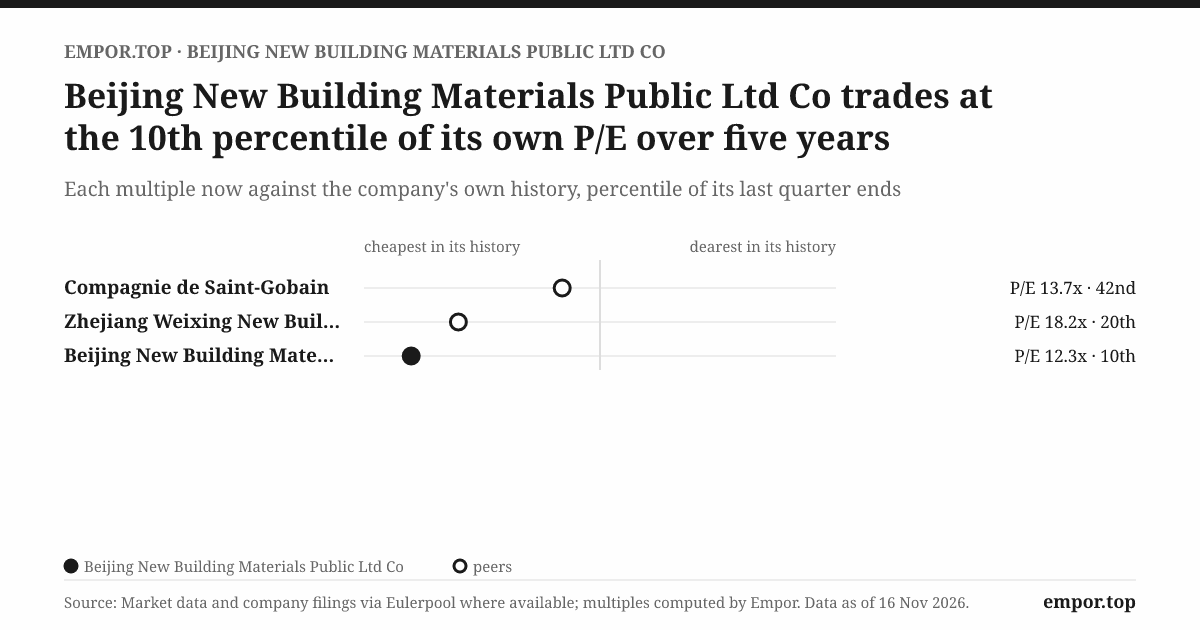
In mid-November 2026, BNBM’s share price stood at about CN¥16.49, roughly 44% below its 52-week high of about CN¥29.53. At that price, the shares traded at about 12.3 times trailing earnings, compared with a five-year median of about 13.7 times, and at roughly one times book value. The enterprise value, which adjusts for the company’s net cash, was about 7.4 times EBITDA. The dividend yield was about 4.2%. Trailing return on equity was about 8%, and return on invested capital about 9%.1
The tempting conclusion is that this is a cheap price for a market leader. The multiple is below its own recent history, the yield is decent, and the company is paying out a rising share of its profits. But the comparison with history is only meaningful if the business resembles the one the market was valuing over the past five years, and it does not quite.
Five years ago, BNBM earned returns on equity in the high teens. Today it earns about 8%. A company earning 8% on its equity, trading at one times book, is priced at about what it earns: an earnings yield of about 8% against a return on equity of about 8%.
That is a fair price for a business whose returns have stabilised at that level. It is a cheap price only if returns recover. The valuation, in other words, assumes the current returns persist rather than recover, and it is neither a margin of safety nor a trap on its own.
The bull case starts with scale. BNBM remains the largest gypsum-board producer in China by a wide margin, and that scale is backed by a national plant network, recognised brands and a broad dealer base. The twelve-year cash record is genuinely strong: operating cash flow exceeded cumulative attributable profit by almost a third. In 2025, free cash flow, operating cash less capital spending, was about CN¥3 billion, more than the company’s attributable profit.3
Coatings is growing quickly at a gross margin close to the core’s. The balance sheet has net cash. Dividends were paid every year in the modern record, and the company says the payout ratio is rising. If the property cycle turns, a company with this footprint and this cash generation should benefit.
The bear case starts with the same scale and asks why it is not working. Gypsum-board revenue and margins are falling faster than volume, which suggests that the 70% share does not confer the pricing power it should. Receivables have stretched from under three weeks to nearly two months over a decade, with a meaningful pool of old and doubtful debts.
Carpoly missed its first two-year profit commitment. Return on equity and return on capital are well below their recent history, and the first nine months of 2026 brought another sharp decline in both profit and operating cash flow. The company plans more acquisitions with a cash pile that, in part, sits with its parent’s finance company.
There is also a quieter point about the dividend that bears on both cases. Dividends paid in cash during 2025 equalled roughly half of that year’s attributable profit, because cash paid in a year largely reflects the previous year’s larger earnings.3 The company’s own measure, the payout declared against 2025 profit, was 40.12%.7 The headline yield of about 4% therefore rests on a payout ratio that is rising toward, but not yet at, half of a shrinking profit. If earnings keep falling, holding the dividend in yuan would push that ratio higher; cutting it would signal that management sees the decline as lasting. Either decision will say something about how the board reads the cycle.
Running the moat through Porter’s five forces sharpens the debate. Buyer power is fragmented: no customer accounts for a meaningful share of sales, which should favour BNBM. But fragmented buyers can still exert collective pressure on price through dealers who stock competing products, and 2025 showed that pressure at work. Supplier power is limited for gypsum, which is widely available, including as a by-product of power-station flue-gas desulphurisation, but energy costs, a major input, are set by markets BNBM does not control. The threat of substitutes is modest: gypsum board has few direct replacements for interior walls in China’s construction mix, and management sees board substituting for older materials as a growth driver.6
The threat of new entrants is low at scale, given the capital needed for plants, but rivalry among existing players is the force that bit hardest in 2025. With BNBM running at around 60% utilisation and competitors presumably facing similar idle capacity, every producer has an incentive to fill its lines, and price is the lever.
Through Helmer’s seven powers, BNBM has clear evidence for scale economies and a partial case for branding and distribution. It has no demonstrated switching costs, no network effects, no cornered resource and no evident process power that rivals could not copy. That is a respectable moat for an industrial company, but it is a moat that limits competitive damage rather than one that guarantees pricing. Scale economies protect cost position; they do not prevent a price war among scale players. The diversification adds a possible future power, counter-positioning or cross-selling, but the evidence for that is still management’s plan, not the company’s results.
Three numbers will decide which case prevails. The first is gypsum-board realised price and gross margin, alongside volume. Volume fell 1.1% in 2025 while revenue fell 8.7% and margin fell 1.61 points.3 Any recovery that does not show up here is not a recovery in the core. The second is the profit and cash conversion of the two wings, especially coatings. Coatings revenue grew about 23% in 2025 at a 32.9% gross margin, but profit after integration costs and cash generation are what count.3
The third is operating cash flow against attributable profit, along with aged receivables. Operating cash flow fell almost 50% in the first nine months of 2026, and CN¥625 million of receivables were more than three years old at the end of 2025.14 Those three readings, more than any strategy statement, will reveal whether BNBM is a cash-generative leader at a cyclical low or a lower-return company whose valuation already reflects that.
The decisive events are close at hand. The 2026 Carpoly commitment result will arrive with the 2026 annual report. The full-year gypsum-board numbers will show whether the fourth quarter brought any margin relief. And the company’s use of its cash, whether for another acquisition, higher dividends or continued capacity expansion, will show whether management’s capital allocation favours returns or growth. A company can grow its way to a lower return; it needs to show it can do the opposite.
XI. Business & Investing Lessons
There is a particular image that sums up BNBM’s 2025: boards heading from the factory to dealers as headquarters reviewed a disappointing acquisition. The image holds three lessons, and each belongs to this company.
The first is that scale can build a position, but only price realisation proves its power. BNBM spent two decades turning a 2004 decision into a 70% share of a national market. It has the plants, the brands and the dealers. Its 2025 results showed the limits of that position: price realisation fell even as volume held. Market share describes what a company has; price realisation describes what that position is worth when someone tests it.
For founders building a category leader, the lesson is that share alone is not a moat; it is a precondition for one. For investors, it means the first question about any dominant company is not how big it is, but what happened to its prices the last time demand softened. A market leader is not immune to a price war; sometimes it is the one with the most capacity to fill.
The second is that an adjacent business earns its place through returns, not just growth. Carpoly’s early results have yet to prove the acquisition’s returns.
The temptation in diversification is to measure success by the size of the new business. The right measure is whether the profit and cash it produces exceed what the same capital would have earned in the core or returned to shareholders. A bigger portfolio is only better when the cash follows.
The third is that cash conversion is a strength until working capital changes direction. BNBM’s long cash-conversion record has been strong, but receivables have stretched.
A long history of strong cash conversion is evidence of a good business model; it is not a guarantee that the model holds when the industry around it weakens. The time to watch the receivables is when the cash is still flowing, not when it stops.
And beneath all three sits a fourth, quieter lesson about the gap between a strategy and its proof. BNBM’s “one body, two wings” is coherent, but coherence is not evidence. The difference between a company that executes a strategy and one that describes it is in the numbers BNBM does not publish: cross-selling rates, wing-level profit, cash returned from acquisitions. When those numbers arrive, they will tell investors more than any number of compact metaphors.
XII. Epilogue
As 2026 enters its final weeks, BNBM stands in an unusual position: still the dominant producer of a product that will be needed as long as China builds and renovates interiors, still sitting on more cash than debt, still paying a dividend, and still not able to show that its profits have found a floor. The third-quarter report gave a hint of stabilisation at the top line and none at the bottom. The next set of results will not settle every question, but it will settle some.
The first checkpoint is the 2026 annual report, due in the spring of 2027. It will show whether the core price and margin pressure seen in 2025 eased, held or deepened. If realised revenue per square metre stabilises while volume holds, the case that BNBM’s scale still buys pricing power will look stronger. If price falls again, the case that the industry is locked in a capacity-driven price war, with the leader participating, will be hard to argue against.
The second checkpoint is Carpoly. Its third and final commitment year is the toughest test of the acquisition’s logic and price. Meeting the commitment, or coming close, would go a long way toward validating the deal. Missing it by a wide margin would leave BNBM with a growing coatings business that cost more than its earnings justify, and with a cash pile that management has said it intends to use for more acquisitions.
The third checkpoint is cash. Operating cash flow and the aged-receivables pool will show whether the 2026 cash squeeze was a timing effect or the start of a structural weakening. A full-year operating cash flow that recovers toward profit, and an old-receivables pool that shrinks through collection rather than write-off, would reaffirm the twelve-year record. A continued gap would weaken it.
There is a fourth, slower-moving checkpoint abroad. BNBM has said its international business will concentrate on Southeast Asia, Central Asia, Africa, and Europe and the Mediterranean, with gypsum board going first and the two wings following when the timing suits.7 That sequence is sensible: it exports the product BNBM knows best before the ones it is still learning. But it also means the overseas story repeats the domestic one in miniature. If the company can earn better returns on new plants in Tanzania, Uzbekistan or Thailand than on its idle capacity at home, international growth will add value.
If it simply adds more capacity to a business whose domestic plants are far from full, it will be one more way of growing revenue without growing returns. The domestic outlook management offered in July, that gypsum-board demand would stay broadly stable and improve over the 十五五 period, is a forecast; the next few years of volume and price will be the test of it.7
What would change the thesis? Sustained recovery in core margins, alongside coatings and waterproofing producing profit and cash that grow faster than their revenue, would support the view that BNBM is a cash-generative leader that diversified at a cyclical low and will emerge stronger. Continued declines in earnings and returns, more money spent on acquisitions that miss their targets, and further deterioration in working capital would support the opposite view: that BNBM has become a lower-return building-materials conglomerate whose scale no longer translates into the profits it once did.
The unresolved issue is simple to state and hard to answer. BNBM’s filings do not yet show whether its enlarged portfolio can earn an adequate return through the cycle. The company has built the body and attached the wings. It has not yet demonstrated that the whole thing can fly higher than the body did alone.
XIII. Outro
Go back to the pallet of gypsum boards being loaded onto a truck at a BNBM warehouse. BNBM has turned that ordinary product into one of the country’s most dominant industrial positions.
The question that hangs over that truck as it pulls away is no longer whether BNBM can sell the board. It is whether the company can make the board pay again, and whether the paint and waterproofing it now sells alongside can carry the scale it built with board into businesses where it does not yet lead. BNBM is a scale story still waiting for proof.
References
-
2026 Third-Quarter Report — Beijing New Building Materials Public Limited Company, 2026-10-23 ↩↩↩↩↩↩↩↩↩↩↩↩↩↩↩↩
-
Research Update: Beijing New Building Materials — S&P Global Ratings ↩↩↩↩
-
2025 Annual Report — Beijing New Building Materials Public Limited Company, 2026-03-26 ↩↩↩↩↩↩↩↩↩↩↩↩↩↩↩↩↩↩↩↩↩↩↩↩↩↩↩↩↩↩↩↩↩↩↩↩↩↩↩↩↩↩↩↩↩↩↩↩↩↩↩↩↩↩↩↩↩↩↩↩↩↩↩
-
2025 Financial Statement Notes — Beijing New Building Materials Public Limited Company, 2026-03-26 ↩↩↩↩↩↩
-
Company History and Capital Evolution — Beijing New Building Materials Public Limited Company, 2016-01-26 ↩↩↩
-
2026 Half-Year Investor Relations Activity Record — Beijing New Building Materials Public Limited Company, 2026-08-21 ↩↩↩↩↩↩↩↩↩↩↩↩↩
-
2026 July Investor Relations Activity Record — Beijing New Building Materials Public Limited Company, 2026-07-21 ↩↩↩↩↩↩↩↩↩↩↩↩↩
-
Non-Public Share Issuance Listing Sponsor Report — Beijing New Building Materials Public Limited Company, 2014-09-29 ↩↩
-
MDL-2047 Chinese-Manufactured Drywall Products Liability Litigation — U.S. District Court, Eastern District of Louisiana ↩↩↩
-
2024 Interim Report, Carpoly Acquisition Details — China National Building Material, 2024-08-27 ↩
-
2024–2025 Carpoly Performance Commitment Review — Beijing New Building Materials Public Limited Company, 2026-03-26 ↩↩↩↩
-
Issuer Rating Rationale — Lianhe Credit Rating, 2025-06-30 ↩↩
-
2026 First Extraordinary Shareholders’ Meeting Results — Beijing New Building Materials Public Limited Company, 2026-07-09 ↩
 LinkedIn
 WhatsApp
 Reddit
 Hacker News
 Email
 Kindle
 RSS Feed
 Spotify
 Apple Podcasts
 Amazon Music
 Audible
 YouTube