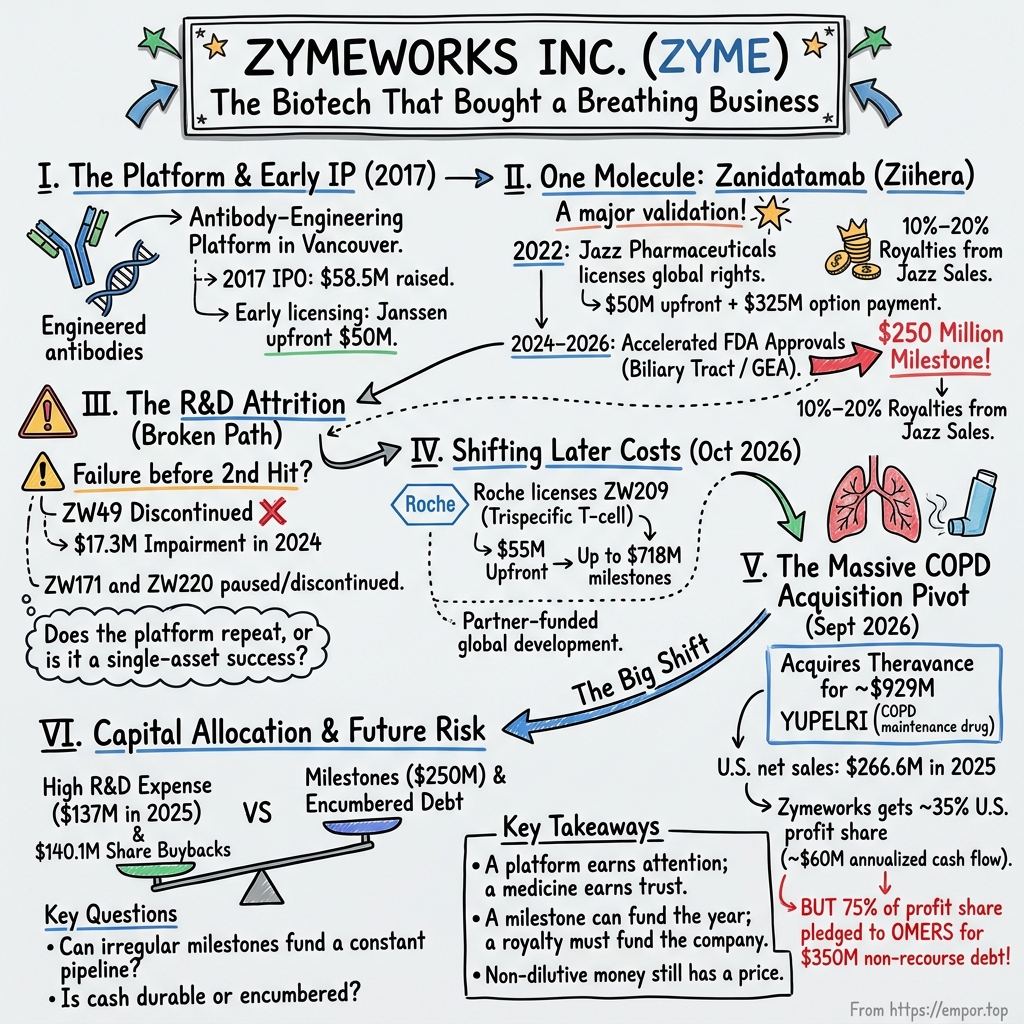
Zymeworks: The Biotech That Bought a Breathing Business
I. The $250 Million Question
On August 25, 2026, the U.S. Food and Drug Administration approved zanidatamab, sold as Ziihera, together with tislelizumab and chemotherapy as a first treatment for adults with HER2-positive cancer of the stomach and the junction where the stomach meets the esophagus.1 The drug was being sold in America by Jazz Pharmaceuticals, a company in Dublin. But it had been invented in Vancouver, in the laboratories of a much smaller company called Zymeworks, and that approval set off a contractual tripwire. Under the license it signed with Jazz, Zymeworks was owed $250 million the moment the FDA said yes.[^2]
For a company whose revenue in the whole of 2025 came to about $106 million, that was a single payment worth well over two years of sales.2 It looked like the moment every small biotech dreams about: the invention works, the regulator agrees, the partner pays.
Then, four weeks later, Zymeworks did something that did not fit the dream at all. On September 23, 2026, it completed the purchase of Theravance Biopharma, a company whose main asset was not a cancer drug or an antibody platform but YUPELRI, a once-daily nebulized medicine for chronic obstructive pulmonary disease, the lung condition better known as COPD.3 The price was about $929 million in cash.[^5] And to help pay for it, Zymeworks raised $350 million of notes from OMERS, the Ontario pension fund, secured against YUPELRI's own future cash flows.3
So here was the picture in the autumn of 2026. A company built to engineer unusual antibodies against cancer had just received the biggest single check in its recent history, and had promptly bought a respiratory business, using money borrowed against the respiratory business itself. To some investors it looked like a biotech growing up and buying a dependable income. To others it looked like a research company drifting into a different line of work, with the new income already partly promised to lenders.
That tension is the heart of this story, and it can be put as three questions. The first is scientific: can Zymeworks' engineering platform produce more than one medicine that reaches patients, or was zanidatamab a single brilliant hit? The second is financial: does owning a share of YUPELRI make the company's cash flow durable, or does the financing that came with it mean the cash is spoken for before it arrives? The third is about management: can the people running Zymeworks fund research, buy back shares and acquire assets all at once without starving the pipeline that was supposed to be the point of the company?
None of these questions can be answered by the headline numbers alone. The $250 million arrived once. It was collected in October, after the quarter in which it was booked.3 The royalties on Ziihera, by contrast, will arrive slowly, in proportion to what Jazz and its other partners actually sell. YUPELRI's cash comes in through a profit-sharing arrangement with Viatris, and three quarters of the U.S. portion is assigned to service the OMERS notes.3 Each income stream is real. Each is also smaller, slower or more encumbered than its headline.
What makes Zymeworks worth a long story is that it stitched together three very different kinds of business inside one listed company. It earns royalties on medicines that partners develop and sell. It runs an internal research operation that spent about $137 million in 2025.2 And it now owns a stake in an established respiratory drug. Whether that combination is a clever portfolio or an awkward compromise depends on how much cash each piece actually throws off, and how much of that cash Zymeworks gets to keep.
To understand how the company arrived at this point, it helps to go back to the original bargain on which Zymeworks was built: that a small lab in Vancouver could design better molecules than the giants, and then let the giants pay to finish the job.
 Subscribe on LinkedIn
II. The Platform Had to Pay for Itself
Zymeworks began in 2003 in Vancouver, British Columbia, at a time when the Canadian biotech scene was better known for promising science than for companies that lasted.4 Its founding idea was technical. Most antibody drugs at the time were variations on a simple shape: a Y-shaped protein whose two arms grab the same target. Zymeworks' scientists wanted to build antibodies whose two arms grabbed two different things, and they built computational and protein-engineering tools to do it.
The core of that toolkit was a platform the company called Azymetric.4 A useful way to picture it is a lock-and-key problem. If a scientist wants to bolt two different antibody halves together, the halves tend to pair up the wrong way, like socks from a laundry basket matching randomly. Zymeworks engineered the parts so that only the right halves would fit together, which made it practical to manufacture "bispecific" antibodies that behave like conventional ones in a factory. Around that core, the company added other engineering tools, including technology for attaching potent drugs to antibodies, the class of medicines known as antibody-drug conjugates.4
A platform like this is a strange asset for a small company to own. It is valuable only if it produces drugs, and producing drugs takes a decade and hundreds of millions of dollars per candidate. So from the beginning, Zymeworks pursued a dual strategy. It would develop a few of its own candidates, and it would license the platform to large pharmaceutical companies, which would pay upfront fees and promise milestones and royalties in exchange for the right to use the technology on their own targets.4
That model suited a small biotech for straightforward reasons. Big partners bring three things a Vancouver startup lacks: money, the infrastructure to run large global trials, and sales forces that can put a drug in front of oncologists in dozens of countries. Zymeworks would bring the engineering. If the partner's drug succeeded, Zymeworks would collect milestone payments along the way and a royalty on sales at the end. If it failed, the partner would have absorbed most of the cost.
By the time the company went public, the strategy had begun to show results. Zymeworks listed on the New York Stock Exchange and the Toronto Stock Exchange in April 2017, raising about $58.5 million in gross proceeds.4 It was not a giant raise, and it reflected a company that was still asking investors to believe in a toolkit rather than a product. At the time, its lead internal candidate was a molecule called ZW25, a bispecific antibody designed to attack HER2, a protein that drives certain breast, stomach and other cancers.4 That molecule was later renamed zanidatamab.
The numbers from that era tell the story of the model, and also its weakness. Revenue rose from about $11 million in 2016 to about $51.8 million in 2017.5 That looks like spectacular growth until one notices what drove it: a $50 million upfront payment from Janssen, the Johnson & Johnson pharmaceutical arm, for a license to the platform.5 Almost the entire year's revenue came from one signature on one contract.
This is the essential feature of platform licensing, and it is worth dwelling on because it never went away. A licensing company's revenue does not grow the way a software company's or a retailer's does. It jumps when a deal is signed or a milestone is hit, and then falls back. A great year can be followed by a terrible one without anything having gone wrong in the business. Zymeworks itself acknowledges the point in its filings, describing its revenue as having come primarily from non-recurring upfront, expansion and milestone payments.2 Over the long run, the record is a series of spikes: revenue reached about $412.5 million in 2022, then fell to about $76 million in each of 2023 and 2024 before recovering to about $106 million in 2025.2
Investors in this kind of company are therefore not really buying revenue. They are buying the probability that the platform produces a drug that sells. The licensing fees keep the lights on and act as an external vote of confidence, but they do not prove that the science turns into medicines. Each upfront payment is a partner betting money on the possibility of success, not success itself.
That distinction mattered more and more as Zymeworks grew. The company raised more equity, including a large public financing of about $320.8 million in January 2020, as its clinical programs became more expensive.[^8] Over its life, it has raised about $1.63 billion in net equity proceeds.3 That is the cost of keeping a discovery engine running when the engine's output arrives in lumps.
So by the start of the 2020s, the question hanging over the company was no longer whether large partners would pay to use its tools. Janssen and others had already shown they would. The question was whether any Zymeworks molecule would survive the brutal path from laboratory to pharmacy, and whether the company could afford to carry one there. The answer came from the molecule that had been sitting at the top of the pipeline since the IPO, and from the decision to hand it to someone else.
III. One Molecule Took the $325 Million Bet
By 2022, zanidatamab had become the most important thing Zymeworks owned, and also the most expensive. The drug's design was the platform's best argument. Most HER2 drugs, including the long-established trastuzumab sold as Herceptin, latch onto a single spot on the HER2 protein. Zanidatamab is "biparatopic": its two arms grab two different spots on the same HER2 protein.4 The idea is that by binding the target in two places at once, the antibody can cluster HER2 molecules together on the tumor's surface, pull them inside the cell and block their signaling more completely than a single-spot drug can. It is the difference between holding a door shut with one hand and with two.
The trouble was that proving the idea required large, late-stage trials in several cancers, each costing far more than Zymeworks could comfortably fund alone. In October 2022, the company made the decision that defined its next four years. It signed an agreement giving Jazz Pharmaceuticals exclusive rights to develop and commercialize zanidatamab across the United States, Europe, Japan and other territories outside the Asia-Pacific region already licensed to BeiGene.[^9]
The structure of the deal was its most interesting feature. Jazz paid $50 million upfront for an option.[^9] It could then look at the results of the pivotal biliary tract cancer trial before deciding whether to pay a further $325 million to keep the rights.[^9] If it walked away, the rights would revert to Zymeworks. If it stayed in, Zymeworks would remain eligible for up to about $1.4 billion in regulatory and commercial milestones and tiered royalties of between 10% and 20% on sales.[^9]
In other words, Jazz bought the right to see the data before committing real money. That is a careful way for a buyer to behave, and it meant the option exercise would carry information. When Jazz did pay the $325 million in late 2022, after the biliary tract data arrived, it was a meaningful external verdict.2 A sophisticated oncology company had looked at the clinical evidence and decided zanidatamab was worth a nine-figure check and a full commitment to late-stage development and commercialization.
It is worth being precise about what that verdict did and did not say. It validated a molecule. A partner with its own money at stake had judged that zanidatamab had a real chance of becoming a commercially meaningful drug. It did not validate the whole platform, and it did not prove that patients and doctors would actually use the drug once approved. Those questions would be answered later, in the market.
The deal also redrew the division of risk and reward. Zymeworks shed the most expensive part of the journey: the phase 3 trials, the regulatory filings, the manufacturing scale-up and the building of a commercial organization. That was a gift to its cash position, and it is the main reason revenue spiked to more than $400 million in 2022.2 But the company also gave up control. From then on, the drug's launch depended on Jazz's priorities, Jazz's sales force and Jazz's pricing decisions. Zymeworks learned how its own invention was doing largely from Jazz's quarterly reports.
The Asia-Pacific side of the story followed a similar pattern. Zymeworks had licensed regional rights for zanidatamab to BeiGene, now known as BeOne Medicines, in 2018.2 That partnership broadened the drug's reach into China and other Asian markets, where gastric cancer is far more common than in the West. But it too left a partner in charge of execution, with Zymeworks dependent on that partner's development and commercial choices.
There is a fair critique of the strategy. A company that out-licenses its best asset gives away much of the upside: the royalty range of 10% to 20% means that for every dollar of Ziihera sold in Jazz territories, Zymeworks keeps only a fraction. Had Zymeworks raised enough capital to commercialize the drug itself, it would own the whole margin. The counterargument is that it almost certainly could not have done so without punishing dilution, and that companies of its size that try to launch oncology drugs alone frequently stumble. Partnering converted an uncertain, capital-hungry bet into a smaller but much more likely stream of payments.
Which version of the story is right depends on how big the drug becomes. A partner's willingness to pay $325 million proves that the partner valued the molecule. Only approval, adoption and sales can prove what the molecule is actually worth. That proof began to arrive two years later, and it arrived in two very different cancers.
IV. Approval Was a Beginning, Not a Revenue Run Rate
In November 2024, the FDA granted zanidatamab accelerated approval, under the brand name Ziihera, for adults with previously treated HER2-positive biliary tract cancer, a rare and deadly cancer of the bile ducts and gallbladder.2 For Zymeworks, it was the first time a molecule born in its labs had become a medicine a doctor could prescribe. The word "accelerated" mattered: the FDA had approved the drug on the basis of tumor response rates, with continued approval contingent on confirmatory evidence. And biliary tract cancer is a small market. It was a beginning, not a business.
The bigger prize was always gastroesophageal adenocarcinoma, or GEA, the umbrella term for HER2-positive cancers of the stomach and the lower esophagus. These patients had been treated for more than a decade with trastuzumab plus chemotherapy, and more recently with combinations that add the immunotherapy pembrolizumab. Displacing that standard of care was the real test.
The phase 3 trial called HERIZON-GEA-01 was built to do exactly that. It compared zanidatamab plus chemotherapy, with or without tislelizumab, a PD-1 immunotherapy from BeOne, against the trastuzumab-based standard. The results led to first-line FDA approval in August 2026.1 At the ESMO cancer congress in October, Jazz presented the final formal analysis: zanidatamab plus chemotherapy reduced the risk of death by about 24% compared with trastuzumab plus chemotherapy, and with longer follow-up the three-drug regimen including tislelizumab showed a hazard ratio of about 0.65, which means roughly a 35% reduction in the risk of death.6 Median overall survival on the triplet reached about 27 months. Jazz described that as the longest survival ever reported in a phase 3 trial in this setting, and noted that nearly 40% of triplet patients were alive at three years versus about 23% on trastuzumab and chemotherapy.6
That is the evidence that separates a real drug from a promising one. Response rates show that tumors shrink. Overall survival shows that patients live longer, and it is the standard that regulators, doctors and payers trust most. Zymeworks' engineering idea, two arms on two spots, had produced a measurable survival advantage over the drug it was designed to improve upon.
The commercial picture is more modest, and it should be read carefully. Ziihera's net product sales in 2025, its first full year on the market in biliary tract cancer only, were about $24.8 million.2 In the third quarter of 2026, Jazz reported about $20.6 million of Ziihera sales.[^11] That quarter included only about five weeks after the first-line GEA approval, and September was Jazz's first full operating month of the new launch.6
On its third-quarter call on November 2, Jazz's management sounded like a company that believed it had a large drug on its hands. Chief executive Renée Galá called the GEA approval "a defining milestone" and reiterated Jazz's view that Ziihera has peak sales potential of $3 billion to $5 billion across HER2-expressing cancers.6 Sam Pearce, the chief commercial officer, offered early launch indicators: in September, the number of accounts ordering Ziihera for the first time tripled compared with August, about 80% of those new accounts came from community oncology clinics rather than academic centers, and average vial demand per selling day rose about 40% month over month.6
The analyst questions on that call were more revealing than the prepared remarks. One analyst noted that Ziihera had not been called out as a driver of Jazz's raised revenue guidance, and asked whether it was performing as expected. Jazz's chief financial officer answered that the launch was in line with expectations but, because it came late in the year, was not having a significant impact on 2026 guidance.6 Another asked how many patients were switching from the pembrolizumab-based regimen. Jazz said it did not have that level of detail and expected growth to come mainly from newly diagnosed patients, which means the ramp will be paced by how fast new patients present at clinics.6 Jazz also said it does not report sales by tumor type, because distribution channels do not tag vials by indication.6
That last point is important for anyone trying to track Zymeworks. The single most important driver of Zymeworks' long-term value is Ziihera sales in first-line GEA, and the company's own reporting cannot isolate them. Jazz framed the treatable U.S. first-line population as roughly 3,000 to 4,000 patients a year, and noted that even among HER2-positive patients who are tested, as few as about 65% receive a HER2-targeted therapy.6 That is a market where clinical superiority must translate into prescriber behavior one oncologist at a time.
The competitive landscape is crowded. Trastuzumab-based regimens remain the long-standing default, and pembrolizumab combinations hold a share of first-line care. In later lines of treatment, other HER2-directed medicines, most prominently the antibody-drug conjugate Enhertu, are established options, and Jazz is already testing zanidatamab in breast cancer patients who have progressed on that drug, with data expected in late 2027 or early 2028.6 Ziihera's survival data give it a strong argument. They do not give it a monopoly.
Jazz matters to Zymeworks in a way that is easy to underestimate. It has the oncology infrastructure, the payer relationships and the field force to push a drug into community clinics, and its call described clinical nurse educators, starter kits and preferred status on a leading oncology pathway.6 Zymeworks has none of these. Its fortunes depend on how hard Jazz pushes, and Jazz has its own portfolio, including sleep medicines and other oncology launches, competing for attention.
Asia carries its own version of the same story. BeOne had filed for approval of zanidatamab in first-line gastric cancer in China, and Zymeworks has said that approval would trigger a further $15 million milestone from BeOne.[^12] In China, where gastric cancer is far more common than in America, the size of the eventual royalty will depend on BeOne's pricing and reimbursement, and Galbraith acknowledged in May that pricing pressure outside the United States is likely to be greater than inside it.[^12]
That brings the story back to the $250 million milestone. It transformed Zymeworks' income statement in the third quarter of 2026.[^2] The recurring value lies in royalties, and royalties on $20 million of quarterly sales, at rates between 10% and 20%, are measured in single-digit millions. Even with very rapid growth, it will take time for Ziihera's royalty stream to resemble the scale of the milestone that announced its arrival.
Ziihera has therefore crossed both the regulatory and the commercial threshold, backed by phase 3 survival data that most oncology drugs never achieve. What it has not yet done is demonstrate a sales trajectory large enough to support the company built around it. The milestone was proof of approval. The royalty line is where proof of a business will appear, and it should be tracked separately from every milestone that comes along. Which raises an uncomfortable question about the platform behind it: if zanidatamab was the platform's proof, what happened to the molecules that came next?
V. The Platform's First Failure Came Before Its Second Hit
If zanidatamab was the platform's proudest child, its younger sibling was supposed to be the proof that the first had not been luck. The sibling was called zanidatamab zovodotin, known inside the company as ZW49. The idea was elegant and, in hindsight, very ambitious: take the same two-armed HER2 antibody and attach a toxic chemotherapy payload to it, turning a drug that blocks signals into a drug that also delivers poison directly into cancer cells. If zanidatamab could pull HER2 inside cells efficiently, the reasoning went, it should make an excellent delivery vehicle.
ZW49 was part of the same Asia-Pacific relationship with BeiGene that covered zanidatamab. That relationship changed in 2023, when the companies terminated BeiGene's rights to ZW49 and the program came back to Zymeworks.[^13] Zymeworks subsequently discontinued the program, and in 2024 recorded an impairment charge of about $17.3 million on acquired research assets related to it.2
An impairment is accounting's way of admitting that something the company paid for is worth less than the books said. The dollar amount was not large by the standards of Zymeworks' budget. What mattered was what it signified. A molecule built on the company's best-validated antibody, aimed at the same well-understood target, had not made it. The platform had produced a candidate that worked in the lab and did not work well enough in the clinic.
It is worth explaining why this happens, because it is the central risk in every company like Zymeworks. An engineering platform is a way of making candidates, not a way of guaranteeing outcomes. It can produce a molecule with exactly the shape, binding and stability its designers intended. It cannot guarantee that the molecule will be safe in human bodies, that it will kill tumors at a dose patients can tolerate, or that it will beat whatever drugs are already on the market by the time it finishes trials. Those questions are answered only by testing in people, and most candidates fail them. Industry-wide, the large majority of drugs that enter human trials never reach approval.
ZW49 was not the last setback. In September 2025, Zymeworks disclosed that it had discontinued ZW171, a T-cell engager, after completing the planned dose-escalation cohorts of its phase 1 trial.7 The company said further evaluation was unlikely to support the benefit-risk profile it wanted.7 That is a polite way of saying that at the doses studied, the balance of efficacy and side effects did not look good enough to justify further investment. The decision came at the earliest clinical stage, which limited the cost, and it is the kind of discipline investors should want. It is also another data point against the idea that the platform converts reliably into products.
A third program, ZW220, was paused as the company shifted resources elsewhere.2 Meanwhile, R&D spending stayed high. The company spent about $137 million on research and development in 2025, broadly in line with the prior two years, with the mix shifting away from late-stage and discontinued programs toward early-stage and preclinical work.2 In plain terms, Zymeworks kept paying to fill the top of the funnel even as candidates dropped out of the middle.
Management, for its part, did not frame the record as one of attrition. On the May 2026 earnings call, chief executive Kenneth Galbraith said the company had "demonstrated our ability to repeatedly extract high-quality assets from a single platform," pointing to zanidatamab, a partnered prostate cancer program at Johnson & Johnson, and the newer wholly owned antibody-drug conjugates.[^12] On the same call, the company presented early data for ZW191, an antibody-drug conjugate targeting folate receptor alpha, showing an overall response rate of about 56% in heavily pretreated platinum-resistant ovarian cancer patients across all doses in a phase 1 trial.[^12] It also unveiled a new family of preclinical antibody-drug conjugates carrying RAS-inhibiting payloads.[^12] And on the same call, it pushed the planned investigational new drug filing for another candidate, ZW1528, from 2026 to 2027, saying it wanted to understand competitors' clinical data in the same biology first.[^12]
These two narratives can both be true, but they are not equally proven. The early ZW191 data are encouraging. They are also phase 1 results in a small population, the stage at which ZW171 also looked worth pursuing until it did not. The company's record so far contains one approved molecule of its own design, a partnered program advancing at a larger company, and a series of internal candidates that were terminated, impaired, paused or delayed.
The fair conclusion is a narrowed version of the platform claim. Zymeworks has shown that it can design molecules that large partners want to license, and that at least one of them can beat the standard of care in a phase 3 trial. It has not shown that its internal pipeline turns technical capability into multiple products at a rate better than the industry's sobering average. That does not erase zanidatamab's success. It means the next proof must come from clinical progress: ZW191 advancing through dose optimization into later trials, partners funding development of newer candidates, and programs surviving long enough to generate meaningful data. Until then, the platform is best described as productive at creating options, and unproven at converting them.
Which is why the next deal mattered. If Zymeworks could persuade another large drugmaker to pay for an early candidate and take over the expensive later work, it would be showing the market a way to keep the upside of its science without carrying all of the attrition risk itself.
VI. Roche Buys an Option on the Next Generation
On October 23, 2026, Zymeworks announced that Roche had taken an exclusive global license to ZW209, a trispecific T-cell engager that had not yet been tested in a single patient.[^15]
To understand why that is unusual, it helps to understand what a trispecific T-cell engager is. The immune system's T-cells are capable of killing cancer cells, but they often fail to recognize tumors as threats. A T-cell engager is an antibody designed to grab a T-cell with one arm and a cancer cell with another, physically dragging the killer to its target. A trispecific adds a third arm, which Zymeworks designed to deliver an additional activating signal to the T-cell, the molecular equivalent of not just introducing the bodyguard to the intruder but also handing the bodyguard a stronger weapon. It is exactly the sort of multi-armed design that the company's engineering tools were built for.
Roche agreed to pay $55 million upfront and a further $40 million when a phase 1b trial begins.[^15] Zymeworks would also be eligible for up to $718 million in additional development, regulatory and commercial milestones, plus tiered royalties from the high single digits to the mid-teens on any eventual sales.[^15] Under the arrangement, Zymeworks would run the first part of the phase 1 trial, phase 1a, with Roche funding, after which Roche would take responsibility for subsequent global development and commercialization.[^15]
The structure echoes the Jazz deal, with an important difference. Jazz committed its large check after seeing pivotal data. Roche committed real money before any human data existed. That suggests one of two things: either Roche saw something in the preclinical package compelling enough to pay for early access, or competition for T-cell engager assets has become intense enough that large companies are willing to license earlier. Probably some of both.
The headline numbers need to be separated carefully, because biotech deal announcements are designed to make the total sound large. Of the roughly $813 million in potential payments, only $55 million was guaranteed on signing.[^15] The next $40 million depends on the program reaching phase 1b. The remaining $718 million depends on trial success, regulatory approvals and sales thresholds that, for a molecule that has not yet entered the clinic, may be many years away and may never arrive. ZW209's own history at Zymeworks offers a small caution: on the May call, Galbraith described it as ready for an investigational new drug filing and "still maintained as a potential IND in 2026."[^12] Timelines in early-stage drug development slip often, and partnering does not change the biology.
Is this a repeatable strategy? The evidence is mixed but more favorable than the pipeline record alone. Partner interest, including Roche's, is evidence of external demand for Zymeworks' engineering.2[^15] What converts that interest into durable value is clinical progress, and on that front the record includes zanidatamab's progress and ZW171's discontinuation. The Roche deal makes ZW209 a funded option with a credible partner. It does not make it a commercial asset.
Management laid out its reasoning at a portfolio-update webcast on October 27, 2026, in which it discussed the Roche agreement alongside the rest of its pipeline.[^16] The deeper discussion of the unpartnered programs has been promised for a research-and-development day planned for February 2027. That event will be a useful catalyst for detail on which internal candidates management intends to fund, and which it would prefer to partner. It will not, by itself, prove that any of those programs will generate revenue.
There is an underlying logic to the Roche deal that ties it to the company's broader shift. By licensing ZW209 early, Zymeworks reduced the amount of its own cash that would be needed to develop the asset, while retaining a royalty interest. That is consistent with what Galbraith and his new chief financial officer, Kristin Stafford, had been describing since the spring as an integrated model of "royalty aggregation" combined with an R&D engine.[^12] In that framing, Zymeworks is less a traditional drug developer and more a collector of royalty streams, some generated by its own labs and some acquired. The Roche license fits the first half of that description. The acquisition that closed a month earlier fit the second.
VII. The Biotech Bought a COPD Cash Flow
To understand why Theravance Biopharma was for sale, start with the morning of March 3, 2026. That was the day Theravance disclosed the phase 3 results for ampreloxetine, its experimental drug for a condition called symptomatic neurogenic orthostatic hypotension, a dangerous drop in blood pressure on standing that affects patients with certain neurological disorders such as multiple system atrophy.[^5] The trial disappointed. For a company that had spent years positioning ampreloxetine as its growth story, it was the kind of news that leaves a stock with little except the business it already had.
Theravance itself had a long and winding history. It was the biopharmaceutical business spun out in 2014 from the original Theravance, the company whose respiratory royalty interests became Innoviva, and over the following decade it had cycled through several pipeline bets while YUPELRI quietly became its commercial anchor.8 By 2026 the company was, in substance, a respiratory profit share with a research program attached, which made it a natural target for a buyer that wanted the first and could put a price on the second.
What it already had was YUPELRI, the brand name for revefenacin. YUPELRI is a long-acting muscarinic antagonist, or LAMA, a class of drug that relaxes the muscles around the airways so that patients with COPD can breathe more easily. Most LAMAs are delivered through handheld inhalers. YUPELRI is delivered through a nebulizer, a machine that turns liquid medicine into a mist the patient breathes through a mouthpiece over several minutes, and it is taken once a day.8 That matters for a specific group of patients: older people, people with weak lung function, and people with arthritis or cognitive difficulties who struggle to use handheld inhalers correctly. Theravance described YUPELRI as the only once-daily nebulized LAMA approved in the United States.8
Theravance did not sell YUPELRI alone. It co-commercialized the drug with Viatris, and the economics were split. Theravance received 35% of U.S. net profits from YUPELRI, plus royalties on sales outside the United States.8 In 2025, U.S. YUPELRI net sales reached about $266.6 million, up about 12% from the prior year.8 In the third quarter of 2026, U.S. net sales were about $71.5 million.3
In June 2026, Zymeworks agreed to buy the company. The offer was $17 per Theravance share in cash, plus a contingent value right, or CVR, entitling former Theravance shareholders to 80% of certain future proceeds if ampreloxetine is ever monetized.[^5] The cash consideration came to about $929 million.[^5] Zymeworks pointed to roughly $60 million of annualized cash flow from the acquired business at then-current run rates.[^5] Theravance's board put the transaction to its shareholders in a merger proxy that August, and the deal closed on September 23, 2026.93
The financing deserves as much attention as the purchase. OMERS provided $350 million of senior secured notes, which Zymeworks describes as non-recourse.3 The word "non-recourse" is often heard as "free," and it is not. It means that if YUPELRI's cash flows prove insufficient to repay the notes, OMERS can look only to the specified YUPELRI-related assets, not to the rest of Zymeworks. That is genuinely valuable protection for Zymeworks' other shareholders. But in exchange, 75% of the U.S. YUPELRI profit-share cash flows are assigned to service the notes.3 Until the notes are repaid, the lion's share of the very cash flow Zymeworks bought goes first to OMERS. The notes also carry prepayment premiums and customary covenants.3
Zymeworks' own cash contribution, after applying the cash it acquired inside Theravance, was about $217.5 million.3 There is also a possible offset: Theravance had a potential $100 million milestone linked to sales of TRELEGY, GSK's triple-therapy inhaler, on which it held economic interests, which could reduce the net cost of the deal if the relevant conditions are met.3 That milestone is conditional, and until it is received it should be treated as a possibility rather than an asset.
So was the price fair? There is a simple benchmark using management's own figure. Divide the roughly $929 million purchase price by the roughly $60 million of annualized cash flow, and the result is about 15.5 times. That is not obviously cheap for a single product whose growth was about 12% last year. It is also a rough comparison rather than a clean one, because Zymeworks did not buy all of YUPELRI's sales. It bought a minority profit share and a set of royalties, and the cash-flow figure is measured before the OMERS remittances that now absorb most of the U.S. stream. Measured after those remittances, the cash Zymeworks itself keeps in the near term is considerably smaller than $60 million a year.
The market-price comparison tells a different story. The $17 offer was about 22% above Theravance's closing price on March 3, the day of the ampreloxetine disclosure, and about 10% above its volume-weighted average price since then.[^5] That is a modest premium for a full takeover, and it suggests that Theravance's board was negotiating from weakness after the trial failure. From that angle, Zymeworks bought a cash-generating asset from a seller whose alternatives had just narrowed. And the CVR is a clever piece of structuring: if ampreloxetine somehow finds a future, former Theravance shareholders get most of the proceeds, but Zymeworks did not have to pay for that hope upfront.
The honest verdict is that the purchase is neither clearly a bargain nor clearly an overpayment on the evidence available today. Headline sales multiples are the wrong tool. The right tests will be the cash Zymeworks actually retains after OMERS is paid, whether YUPELRI keeps growing in a COPD market where patients and doctors have many inhaled alternatives, and how much integrating Theravance costs. None of that can be read from the third-quarter results, which included only seven days of Theravance's contribution.3
There is also a strategic question that the price cannot answer. Why should an antibody-engineering company own a stake in a respiratory drug at all? Management's answer, implicit in its "royalty aggregation" language, is that a dollar of durable cash flow is worth the same whether it comes from cancer or COPD, and that a stable product stream can fund riskier research.[^12] The skeptic's answer is that the acquisition diversifies the company's income only modestly once financing claims are deducted, while adding a commercial relationship, a lease footprint and an integration task to a company whose core skill has been science. Zymeworks' operating lease liabilities rose from about $18 million at the end of 2025 to about $53 million by the end of September 2026, principally because of Theravance's footprint.3 Neither answer is yet proven. What is clear is that the acquisition added another claimant to the company's cash, and by the autumn of 2026 there were already several.
VIII. The Cash Has More Than One Claimant
The clearest way to see Zymeworks' financial position is to imagine its cash as a pool with several pipes running out of it and a few, irregular pipes running in.
The biggest outflow has always been research. In 2025, the company spent about $137 million on R&D against about $106 million of revenue.2 That gap is normal for a biotech that is still investing in its pipeline, and it is the reason Zymeworks has historically needed outside capital. In the first nine months of 2026, R&D expense came to about $98 million, slightly lower than a year earlier as late-stage and discontinued programs wound down.3
The second claim on cash is new: the lenders. In the first quarter of 2026, Zymeworks raised $250 million from Royalty Pharma in a financing tied to a portion of its future Ziihera royalties; with the OMERS notes, that brought future-revenue financing raised in 2026 to $600 million.3[^12] Zymeworks accounts for both as liabilities related to the sale of future revenue, and estimated the Royalty Pharma arrangement's effective interest rate at about 9.7% as of September 30, 2026.3 In the first nine months of the year, the company recorded about $15 million of non-cash interest on these arrangements.3 Neither financing is conventional company-wide debt, and neither is free. Each moves part of a future income stream from shareholders to a financier in exchange for cash today.
The third claim is the shareholders themselves. In the first nine months of 2026, Zymeworks spent about $140.1 million buying back its own stock.3 Galbraith has defended the program forcefully. On the May call, he said that since starting repurchases in 2024 the company had retired about 8.3 million shares for about $155.8 million, at an average price near $18.70, more than 10% of its shares outstanding, and described the buybacks as an "attractive and accretive use of capital" given what he saw as a disconnect between market valuation and the long-term value of the company's royalties and pipeline.[^12]
The buybacks sat inside a funding promise. In May, Stafford said that the company's cash of about $404 million at the end of March, combined with roughly $440 million of anticipated regulatory milestones for Ziihera in GEA across the United States, Europe, Japan and China, would fund planned operations beyond 2028, even assuming the full $125 million repurchase authorization was used.[^12] That runway rested on approvals that had not yet happened, and on a plan that did not yet include a $929 million acquisition. The U.S. approval did arrive on schedule, which made the largest piece of that assumption come true. But the forecast was made before the company changed its shape, and it will need to be restated against the new one.
Put those pieces together and the pattern becomes visible. In the same nine months that Zymeworks raised $600 million by selling claims on future product revenue, it returned $140 million to shareholders through buybacks and paid the cash portion of a roughly $929 million acquisition. Operating activities consumed about $101.7 million of cash over the same period.3 A skeptical investor would ask a pointed question: is the company, in effect, borrowing against tomorrow's royalties to buy back stock today? Management's answer is that the stock was cheap relative to intrinsic value and that the financings were priced sensibly. The answer that will settle the matter is per-share value creation net of the financing claims, which can only be measured over years.
The income statement makes this harder to see, not easier. Zymeworks reported net income of about $84.5 million for the first nine months of 2026, almost entirely because the $250 million Jazz milestone was recognized as revenue in the third quarter.3 But the milestone had not yet been paid at the end of September; receivables rose by about $292 million in the period, mostly that single payment, and the cash arrived in October.3 At the end of the quarter, Jazz accounted for about 65% of the company's receivables.3 So the quarter showed a profit and a cash outflow at the same time. Neither is a guide to the future. The milestone will not recur, and the October collection will make the fourth quarter's cash flow look unusually strong for the same reason.
For that reason, the third quarter's earnings are not a repeatable earnings base. The recurring lines are Ziihera royalties, which are still small, and the retained portion of YUPELRI cash, which has barely begun to flow through Zymeworks' accounts. Everything else is either a milestone or a financing.
Who is making these decisions, and how well aligned are they with shareholders? Kenneth Galbraith, a veteran of the Canadian life-sciences industry who took over as chief executive in 2023, is both CEO and chair of the board, and the board names Susan Mahony as lead independent director.10 He reported holding about 1.29 million shares, or about 1.84% of the company, in the 2026 proxy.10 His reported compensation for 2025 was about $6.6 million, up from about $5.5 million in 2024, mostly in the form of stock awards.10 Shareholders supported the 2025 say-on-pay proposal with about 94% of votes cast.10 That is one data point of approval, not evidence that the capital-allocation choices will create value.
Ownership is concentrated in ways that matter. Holders of 5% or more collectively owned about 43.8% of the stock at the end of 2025, and directors, officers and their affiliates about 31.7%.2 The largest of those holders is EcoR1 Capital, whose funds held more than 22 million shares; EcoR1's founder, Oleg Nodelman, sits on the board, and the company amended EcoR1's pre-funded warrants in 2025.10 A large, long-term specialist holder on the board can be a strong source of discipline. It also means a small group of investors carries substantial influence over decisions such as buybacks and acquisitions.
The management team has been reshaped around the new strategy. Kristin Stafford joined as chief financial officer in the spring of 2026 and described her mandate as building "a novel strategy of royalty aggregation and growth," with a high bar for investment and possible changes to financial reporting to show returns on invested capital.[^12] The company also appointed a chief business officer, a head of R&D and a general counsel recruited from Pfizer.[^12] That is a team built for deal-making as much as for discovery.
The narrative arc across management's own communications is worth noticing. On the May call, Galbraith said the company had been "very active in external processes to assess potential acquisitions" but was "remaining disciplined" to find "the right price."[^12] Seven weeks later, the Theravance deal was announced.[^5] The second- and third-quarter results releases did not include earnings calls, so the June acquisition announcement and the October portfolio webcast carry most of the current strategic discussion.[^20][^2] Investors who want to test management's consistency must compare those events against the language of May, because the quarterly conversation with analysts has thinned out precisely as the strategy has become more complex.
So the company that emerges from 2026 is moving away from being a pure cash-burning research shop. It has royalties, a respiratory profit share and a large one-time milestone in hand. But its reported profits are not a clean picture of its cash, and much of its future commercial income has been pledged. The single most important number for a long-term investor is the cash Zymeworks retains after research spending and financing remittances. That number has not yet had a full year to show itself.
IX. Analysis & Bear vs. Bull Case
Imagine an investor sitting down in November 2026 with three numbers written on a notepad. The first is $250 million, the one-time payment Zymeworks earned when Ziihera was approved in first-line GEA. The second is $60 million, management's estimate of YUPELRI's annualized cash flow before the lenders take their share. The third is $137 million, what the company spent on research in 2025. The whole investment debate is contained in how those numbers relate. The first is large and will not happen again. The second is recurring but encumbered. The third is the bill that never stops.
The stock market's own verdict is the place to start. Zymeworks closed at $26.14 on November 20, 2026.11 With roughly 69 million shares outstanding as of November 6, that implies an equity value of about $1.8 billion.3 Against 2025 revenue of about $106 million, that is about 17 times trailing sales.2 The ratio is almost meaningless on its own, because 2025 revenue was a mix of milestones and early royalties, and 2026 revenue includes a single milestone more than twice the size of the whole prior year. What the price really reflects is the market's estimate of the present value of Ziihera royalties for years to come, the retained YUPELRI cash, the Roche option and the rest of the pipeline, minus the claims of Royalty Pharma and OMERS. Interestingly, Galbraith's buybacks were executed at an average near $18.70, while the stock now sits well above that, which suggests the market has, for now, moved toward his view of the company's value.[^12]11
To judge whether that value is durable, it helps to look at the industry's structure. Zymeworks sells two kinds of things: engineered drug candidates, which it licenses to larger companies, and rights to future product revenue, which it keeps or sells to financiers. In both markets, its counterparties are much larger and more powerful than it is. Jazz, BeOne, Roche and Johnson & Johnson bring trial capabilities, regulatory expertise and global sales forces that Zymeworks does not have, and those capabilities give them bargaining power. Jazz and BeOne determine much of zanidatamab's development and commercialization, including pricing, trial priorities and launch intensity. That is the central structural fact about the business: the company's most valuable asset is executed by someone else.
Run that through Michael Porter's five forces and the picture is sobering. Buyer power is high, because Zymeworks relies on a small set of large partners to license, develop and sell its molecules, and Jazz accounted for about 95% of trade receivables at the end of 2024 and about 65% at the end of September 2026.23 Supplier power is moderate: like most biotechs, the company depends on contract research and manufacturing organizations, but these are competitive markets. Rivalry is intense in both of its commercial arenas, with competing HER2 drugs in oncology and a wide range of inhaled maintenance therapies in COPD. The threat of new entrants is limited by the cost of clinical trials and regulatory approval, but that barrier protects approved products, not platforms; anyone with capital can try to engineer a bispecific antibody. And the threat of substitutes is constant, because in oncology a better drug can displace a standard of care within a few years, as Ziihera itself is trying to do to trastuzumab.
Hamilton Helmer's 7 Powers framework sharpens the question of the moat. Of the seven sources of durable advantage, only a few apply. There are no network effects and little scale economy in a business this size. Switching costs are low for partners, who can license molecules from many platforms, and moderate for doctors, who can switch regimens when evidence changes. Counter-positioning is not obvious. The plausible candidate is a cornered resource: patents on zanidatamab and the clinical evidence behind it. Those are genuinely valuable, because patent-protected drugs with overall-survival data are scarce. But they are product-specific. They protect a molecule, not the company's ability to make the next one. A process power argument would require evidence that Zymeworks' engineering methods reliably produce better candidates than competitors', and the record of ZW49, ZW171 and ZW220 does not yet support that claim. The moat is therefore narrow and tied to individual products, and will remain so until additional candidates reach approval and commercial scale.
That leads directly to the bull case, which deserves to be stated at its strongest. Ziihera has the clinical and regulatory support already described, and its commercial partner publicly sees $3 billion to $5 billion of peak sales potential and is testing the drug in breast cancer.6 Zymeworks is owed royalties of 10% to 20% on Jazz's sales and further milestones, and the company had earlier pointed to about $440 million of anticipated regulatory milestones tied to GEA approvals in the United States, Europe, Japan and China, of which the U.S. $250 million portion has now been earned.[^9][^12] Roche's willingness to pay $55 million upfront for a molecule that had never been tested in a human suggests that large companies still value what Zymeworks designs. YUPELRI adds a commercial product with a growing sales base and a defensible niche. And management has shown a willingness to stop programs that are not working, which preserves capital.
Now the bear case, also at its strongest. One approved medicine does not prove a repeatable platform. The company's own history includes the setbacks already described, and each of those programs once looked promising enough to fund. Ziihera's royalties, at current sales levels, are a small fraction of the company's annual R&D bill. The drug faces entrenched competition, and Jazz itself has said growth will be paced by newly diagnosed patients rather than rapid switching.6 Pricing outside the United States, which management itself expects to be tougher, will cap the value of the ex-U.S. royalty base. YUPELRI's cash, the asset meant to make the company sturdier, is three-quarters committed to OMERS in the United States, and Ziihera's royalty stream has a financier attached too. The company has, in effect, used its two most dependable income streams to raise capital, and spent a significant part of that capital on buybacks and an acquisition rather than on its own pipeline.
The competition question differs by business. In oncology, Ziihera must still win the habits of community oncologists who have used trastuzumab for over a decade, despite the survival evidence described earlier. In COPD, YUPELRI's nebulized once-daily delivery gives it a genuine niche among patients who cannot use handheld inhalers well.8 But it is a niche within a large market full of alternatives, and its growth depends on Viatris's commercial effort as much as on any decision Zymeworks makes.
An activist looking at this company would ask several pointed questions. Why should a research company with an engineering platform own a minority profit share in a respiratory drug, rather than simply returning capital or investing in its own pipeline? Why repurchase shares in the same year it sold claims on future revenue? Is the CEO-and-chair structure, combined with concentrated ownership by board-affiliated investors, the right governance for a company now making large capital-allocation decisions? And why did the company stop holding earnings calls after the first quarter of 2026, just as its strategy became more complex? None of these questions implies wrongdoing. Each is the kind of question a company pursuing a novel "royalty aggregation" model should expect to answer with numbers.
For anyone following the story from here, three measures matter more than any others. The first is Ziihera royalties and sales by indication and geography, the clearest test of whether the drug becomes a large commercial franchise. Jazz's latest reported sales were about $20.6 million in the third quarter of 2026, after $24.8 million for all of 2025, and it does not break out sales by tumor type.[^11]26 The second is YUPELRI's retained cash after OMERS payments, which has no meaningful reading yet because the business has been inside Zymeworks for only a few weeks. The third is operating cash flow after R&D and financing remittances, which was an outflow of about $101.7 million in the first nine months of 2026, distorted by an uncollected milestone.3
The risk radar is dominated by things specific to this company rather than the macro environment. Clinical failure is the first risk, as it is for every biotech, and the company's own record shows how often promising candidates stop. Partner execution is the second: Zymeworks depends on Jazz, BeOne, Roche and Viatris to develop, price and sell. Product uptake and competition are the third. And the fourth is the cost of having assigned future cash flows to finance growth. Neither the Royalty Pharma arrangement nor the OMERS notes carries a public credit rating, so investors must judge them from their terms: the share of cash assigned, the effective interest rate, prepayment premiums and covenants.3 On the governance and audit side, the 2025 annual report carried an unmodified audit opinion with no material weakness, and the company reports no legal proceedings it expects to be material, though integrating Theravance's controls is a monitoring point.23
Weighing all of this, the history narrows the bull case rather than rejecting it. Zymeworks has proven that it can invent a drug good enough to win a phase 3 survival trial and two FDA approvals. It has not proven that its platform produces multiple such drugs, or that its new portfolio of commercial streams leaves it enough retained cash to fund research without further financing. The claim that the company is becoming a durable royalty-and-product business is intact but unproven. What would confirm it is a full year in which Ziihera royalties grow meaningfully, YUPELRI's retained cash is visible, and another internal candidate advances into later-stage trials. What would falsify it is a year in which royalty growth disappoints, financing remittances absorb most of the commercial cash, and the pipeline continues to shed programs.
X. Business & Investing Lessons
Picture three moments side by side: Jazz’s commitment to zanidatamab, a sibling molecule’s failure, and the Theravance purchase. Each carries a lesson that belongs to this company in particular.
The first lesson is that a platform earns attention, but a medicine earns trust. Zymeworks’ engineering tools attracted partners and capital, but its first concrete proof came from zanidatamab. For founders, platforms are sold on potential, while companies are valued on products. Zymeworks’ own record shows how far apart those can be: one molecule went all the way, while others stopped at different points. For investors, the rule is to value the drugs, not the toolkit, and to let each new candidate earn its place one trial at a time.
The second lesson is that a milestone can fund the year, but a royalty has to fund the company. The $250 million milestone made the third quarter look extraordinarily profitable, but it will not recur. The royalty stream will grow only as sales grow. Biotech investors often treat milestones as evidence of success, which they are, and then extrapolate them as if they were earnings, which they are not. The companies that last are the ones whose recurring income eventually covers their recurring costs.
The third lesson is that non-dilutive money still has a price. The OMERS notes and the Royalty Pharma arrangement allowed Zymeworks to raise $600 million in a single year without issuing a share.3 That is a real advantage, and it protected existing shareholders from dilution. But the price was paid in future cash and financing costs.3 Non-dilutive financing does not shrink the pie into more slices; it hands a slice to someone else before the company eats. The question every investor should ask is not whether the money dilutes, but what share of the future it costs.
The fourth lesson concerns partnership itself. Partnering reduced Zymeworks’ development burden and almost certainly gave zanidatamab a better launch than the company could have managed alone. Buying Theravance added cash sooner than another decade of discovery would have. Neither move substitutes for the hard measurement of repeatable retained cash. A company can sign excellent deals and still fail to keep enough of what those deals produce. Zymeworks’ defining skill so far has been structuring partnerships around promising science. Its defining test is whether it can turn that skill into cash it actually keeps.
XI. Epilogue
Zymeworks enters the final weeks of 2026 in a position it has never occupied before. It owns a share of an approved cancer drug that has just won the largest indication it was designed for. It owns a stake in a respiratory product that sold more than a quarter of a billion dollars in the United States last year. It has a Roche-funded program heading toward its first patients. And it has lenders with claims on two of its most dependable income streams. The next eighteen months will determine whether those pieces add up to a durable business or a series of valuable but irregular events.
The first moment to watch is the company's first full reporting year with YUPELRI inside the consolidated business. That disclosure will show, for the first time, how much of YUPELRI's profit share actually reaches Zymeworks after Viatris's costs, OMERS's remittances and integration expenses. If retained cash is meaningful and growing, the acquisition will begin to look like the stabilizer management described. If it is mostly absorbed by debt service, the purchase will look more like a financing transaction than a diversification.
The second is Ziihera's trajectory after the 2026 approvals. Jazz's fourth-quarter and 2027 results will reveal whether the early launch signals translate into a steep sales curve. Investors will need to track royalties and milestones separately, by geography. A category 1 recommendation in treatment guidelines, which Jazz has sought based on the mature survival data, could help.6 So could approvals in Europe, Japan and China, each of which carries its own milestone.[^12]
The third is the pipeline. ZW191's dose-optimization data will show whether its early ovarian cancer responses hold up in a larger group of patients. ZW209's phase 1a trial will show whether Roche's early bet is rewarded, and the $40 million phase 1b payment will be the first sign.[^15] And the R&D day planned for February 2027 will reveal how management intends to prioritize internal programs now that the company has more commercial assets and more financing obligations. Each of these is a test of the platform claim. If another internal candidate reaches later-stage development, the argument that Zymeworks' engineering is repeatable will gain real support. If more programs are paused, the company will look increasingly like a royalty holder with a research department attached.
And then there is the TRELEGY-linked milestone, the potential $100 million that could reduce the Theravance deal's net cash cost if its conditions are met.3 Until it is received, it is a possibility. When and if it arrives, it will improve the arithmetic of the acquisition without saying anything about YUPELRI's operating return.
All of these moments point back to the questions this story began with. The answers will arrive in the slow, unglamorous numbers that biotech investors often overlook: the royalty line, the retained cash, the R&D bill and the share of each that belongs to someone else.
XII. Outro
Go back to the autumn of 2026: the cancer approval and the COPD acquisition seemed to belong to two different companies sharing one ticker. It may turn out to be the most honest picture of what Zymeworks has become.
Most biotechs are labs hoping to become pharmaceutical companies. Zymeworks is trying to become something rarer: a portfolio of cash flows that can fund its next invention. The $250 million arrived once. Everything after that depends on products that keep selling and on how much of their value the company manages to keep.
References
-
FDA Approves Zanidatamab-hrii and Tislelizumab-jsgr for HER2-Positive Gastric or Gastroesophageal Junction Adenocarcinoma — U.S. Food and Drug Administration, 2026-08-25 ↩↩
-
Form 10-K for fiscal year 2025 — Zymeworks Inc., 2026-03-02 ↩↩↩↩↩↩↩↩↩↩↩↩↩↩↩↩↩↩↩
-
Form 10-Q for the quarter ended September 30, 2026 — Zymeworks Inc., 2026-11-09 ↩↩↩↩↩↩↩↩↩↩↩↩↩↩↩↩↩↩↩↩↩↩↩↩↩↩↩↩↩↩↩
-
Final IPO Prospectus, Form 424B4 — Zymeworks Inc., 2017-04-27 ↩↩↩↩↩↩↩
-
Zymeworks Reports 2017 Year-End Financial Results — Zymeworks Inc., 2018-03-06 ↩↩
-
Jazz Pharmaceuticals Q3 2026 Earnings Call Transcript — The Motley Fool, 2026-11-02 ↩↩↩↩↩↩↩↩↩↩↩↩↩↩↩
-
Form 8-K: Discontinuation of ZW171 — Zymeworks Inc., 2025-09-02 ↩↩
-
Form 10-K for fiscal year 2025 — Theravance Biopharma, 2026-03-23 ↩↩↩↩↩↩
-
2026 Proxy Statement (DEF 14A) — Zymeworks Inc., 2026-10-26 ↩↩↩↩↩
-
Zymeworks Inc. (ZYME) Stock Price History — Yahoo Finance, 2026-11-20 ↩↩
 LinkedIn
 WhatsApp
 Reddit
 Hacker News
 Email
 Kindle
 RSS Feed
 Spotify
 Apple Podcasts
 Amazon Music
 Audible
 YouTube