Ermenegildo Zegna N.V.: The Mill, the Brands, and the Bet on Selling Direct
I. The Family Mill Goes Public
In the middle of December 2021, a company that had spent more than a century as a family affair in the hills of Piedmont became something it had never been before: a stock that anyone with a brokerage account could buy. The business combination between Ermenegildo Zegna and Investindustrial Acquisition Corp., a blank-cheque company listed in New York, closed on December 17, 2021, and the shares of the new Dutch holding company, Ermenegildo Zegna N.V., began trading on the New York Stock Exchange under the ticker ZGN.1 There was no roadshow of the classic kind, no book of orders built over two weeks, no opening-price drama from a syndicate desk. Instead, a proxy statement and prospectus had been filed with the SEC that August and declared effective in late November, and the shareholders of a special purpose acquisition company had voted to merge with a tailor.2
That route matters for the story because it tells you what the family wanted and what it was willing to give up. A SPAC deal let the Zegnas set terms in private with a sponsor, raise fresh money from a group of committed investors, and list without surrendering control. The F-1 that followed in January 2022 described 37.5 million ordinary shares sold to PIPE and offset-PIPE investors at $10 apiece, along with warrants that the company later settled.3 It also let the family keep a structure in which voting power could run ahead of economic ownership, which is a theme this story will come back to. Before the listing, the family separated real estate and certain other assets from the group through a demerger, so the company that went public was the fashion and textile operating business, not the whole family estate.2
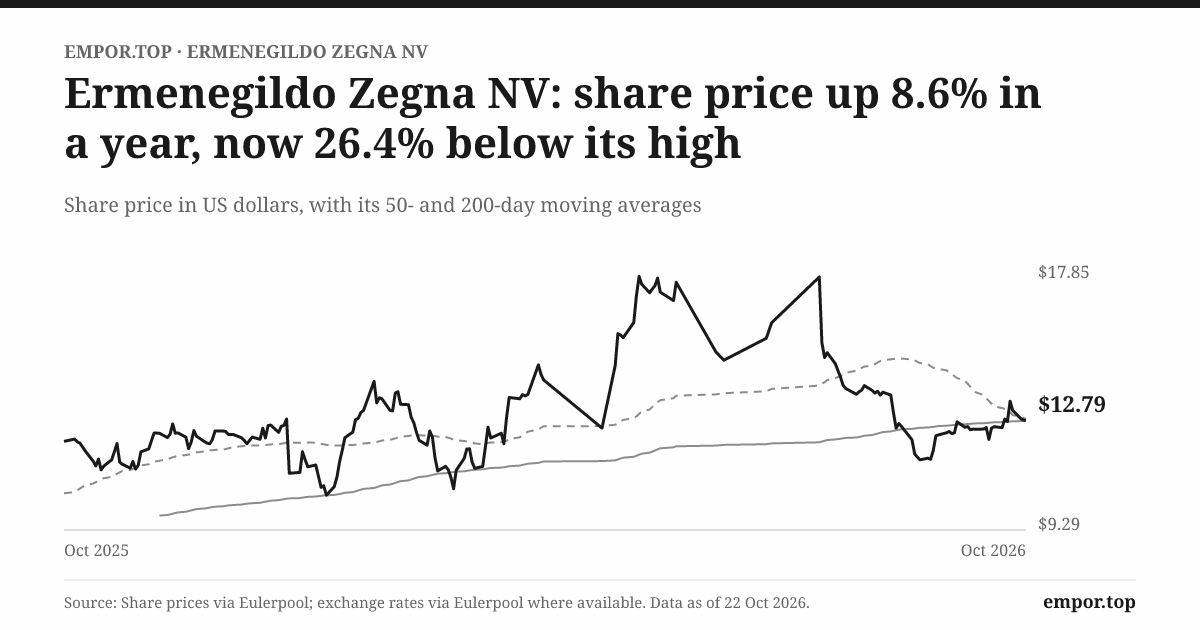
Ten months shy of five years later, the obvious question is whether the trip to New York was worth it for the outsiders who joined. On October 22, 2026, the shares closed at about $11.39, which is barely above the $10 at which the PIPE investors came in and roughly a quarter below the high of the past year. The company is worth about $3.7 billion on the market. For a group that has spent the intervening years buying out a fashion house, signing a long license on one of the most famous names in luxury, and converting itself from a wholesaler into a retailer, the share price has been a patient judge, and so far an unconvinced one.
The scale of what those investors own is easy to state. In 2025, the group generated €1.92 billion of revenue and employed 7,437 people.1 It operates through three branded businesses. ZEGNA, the founding brand, sits alongside a textile operation that weaves cloth for the group and for other luxury houses. Thom Browne, the American designer label Zegna bought into in 2018, is the second. TOM FORD FASHION, the ready-to-wear and accessories business it has run under license since 2023, is the third.1 ZEGNA is by far the largest. The other two are meaningful businesses in their own right, each with revenue in the hundreds of millions of euros, but neither yet carries the group.
Control, meanwhile, never left the family. Monterubello S.p.A., the Zegna family holding company, owned 56.9% of the ordinary shares and held 71.5% of the votes as of March 2026, thanks to special voting shares that reward long-term holders with extra votes.1 The listing changed the company's public status and its disclosure obligations; it did not change who decides.
Four questions run through everything that follows. The first is whether a company born as a wool mill can turn craft and history into genuine pricing power, the kind that shows up in what customers pay rather than in what the brand says about itself. The second is whether selling directly through owned stores, rather than through department stores and boutiques, will deliver the operating leverage that justifies the cost of running those stores. The third is whether the brands Zegna bought, above all Thom Browne, can recover the growth that justified their purchase prices. The fourth is whether family control remains aligned with the people who own the other shares.
The latest full year gave mixed answers before anyone even opened the detail. Revenue in 2025 fell 1.5% on a reported basis, but rose 1.1% on an organic basis once currency moves and changes in the business perimeter were stripped out.4 In other words, the underlying business grew slightly, and a stronger euro made it look as if it had shrunk. The brands diverged sharply, with ZEGNA growing, TOM FORD FASHION roughly flat and Thom Browne falling hard.4
Then, on the morning this story is written, came a better headline. The group reported third-quarter 2026 revenue of €433.8 million, up from €398.2 million a year earlier, and nine-month revenue of €1.42 billion against €1.33 billion.5 That is a growth rate of roughly 9% for the quarter and 7% for the nine months, a clear improvement on the stagnation of 2025. But the update was a revenue release and nothing more: no profit figure, no margin, no cash flow.5 The top line has turned. Whether the economics underneath it have turned with it is still unknown.
For investors, the boundary of the bet matters as much as its size. What is listed is a Dutch holding company and the operating group it consolidates, a group that owns factories, leases stores on three continents, pays royalties to Estée Lauder and carries put options over minority stakes in subsidiaries. The heritage is real, and the family's stewardship survived the listing intact. The test for public shareholders is narrower and harder: whether the money poured into brands, stores and factories earns returns that justify its cost. To understand why the family believes it will, the story has to go back to a small town in the Alps and a man who thought the best cloth in the world could be made there.
 Subscribe on LinkedIn
II. The Road From Trivero to the Wardrobe
Trivero is not where anyone would put a luxury empire if they were starting from a map. It is a scattering of hamlets on the slopes of the Biellese Alps, north of Turin, where the water runs soft off the mountains and where wool mills had operated for generations because that water was good for washing fleece. In 1910, a young man named Ermenegildo Zegna took over a family textile business there and set out to make fabrics that could compete with the finest English cloth.6 His ambition was specific and, for its time, slightly outrageous: buy the best raw wool directly from the source, in Australia and South America, spin and weave it in Italy, and put the name of the mill on the fabric itself.6
That idea, of a name stitched into the selvedge of a bolt of cloth, is the seed of everything that came later. Ermenegildo Zegna was not only a mill owner. He built roads, schools and a public swimming pool in Trivero, and planted hundreds of thousands of trees on the bare mountainside above the town.6 The forest he planted later became the Oasi Zegna, a protected nature area the family opened to the public in 1993.6 It is the sort of origin story luxury brands dream of, and the company tells it often. It deserves to be told briefly here, because it explains what the family thinks it is selling: not just a suit, but a continuous line from sheep to shop.
The history after that runs fast. The founder's sons, Aldo and Angelo, took the business international and pushed it beyond fabric into finished clothing, with ready-to-wear tailoring arriving in the 1960s.6 The group opened its own stores, starting in Paris in 1980, and became one of the earliest Western luxury brands in mainland China, opening in Beijing in 1991, years before most of its rivals.6 By the time the third and fourth generations ran the company, with Gildo Zegna, the founder's grandson, as chief executive, the business had become a global menswear house that still owned the mill where it started.6 More than 110 years on, the family is still there.
What owning the chain actually buys
The modern expression of that heritage has an Italian name: the Filiera, or supply chain. Over the past decade Zegna has built a cluster of specialist Italian textile makers around its own Lanificio, the original wool mill, taking stakes in or buying companies that do one thing exceptionally well: spinning, combing, dyeing, knitting, jersey. Among them are Bonotto, a fabric maker in the Veneto, and Dondi, a jersey specialist in which Zegna holds a majority stake with a put option over the rest.1 These companies serve the group's own brands and also sell to other luxury houses, which is why the textile business shows up inside the ZEGNA segment as a source of revenue rather than only as a cost centre.1
The strategic case for the Filiera is intuitive. A luxury house that controls its fabric can develop exclusive materials, react faster when a product sells out, protect quality and keep its know-how away from competitors. For a company whose central claim is that its clothes feel better because its cloth is better, owning the cloth looks like owning the moat.
The trouble is that the group has never put numbers on the advantage. It does not disclose a customer retention rate. It does not disclose price realization by brand, the measure that would show whether customers accept price increases without walking away. It does not quantify any cost advantage from owning the supply chain.1 Research and development spending is not disclosed either, though the company says more than 330 of its employees worked in research and development across the business at the end of 2025, and it recognized €4.1 million of government grants against those R&D costs.1 That is a meaningful team for a fashion company, and it says something about the seriousness of the fabric work. It does not say what the work earns.
So the honest verdict on the Filiera is that it creates product knowledge and supply-chain control that most fashion brands lack, and it gives the group a credible story about provenance. Whether that control improves quality, speed or cost enough to change what customers do is unproven by any disclosed metric. The only public evidence is the result: revenue growth, gross margins, store productivity and returns on capital. The gross margin, at about 67.5% in 2025, is respectable for luxury apparel and rose during the year.4 Returns on capital, by contrast, have stayed modest.
The customer's choice
Think about the buyer standing in a store in Shanghai, Dubai or New York, holding a cashmere jacket that costs several thousand dollars. Zegna is not the only house offering a story about Italian craft and exceptional materials. Loro Piana, now owned by LVMH, has made its name on the rarest fibres in the world. Brunello Cucinelli has built a brand around the humanist village of Solomeo and quiet luxury that commands premium prices. Prada, Moncler and the giant multi-brand groups compete for the same wallet and, just as importantly, for the same prime retail streets and the same department-store floor space.
That is a crowded field of companies all claiming some version of Made in Italy. In that field, provenance is close to table stakes rather than a differentiator. The Oasi Zegna, the founder's trees and the Trivero mill are genuine brand inputs. They help explain why a customer might walk into a ZEGNA store. They are not proof that the customer will pay more, return more often or stay loyal when a rival offers a newer story. The evidence that would prove pricing power is sustained organic growth, full-price sell-through and rising margins over a cycle, and that evidence is still incomplete.
Peer scale comparisons need care because the companies report on different calendars and perimeters, and Loro Piana does not publish standalone accounts at all. But it is fair to say that Zegna, at under €2 billion of revenue, is a mid-sized player in a market where the leaders are many times its size.
There is also a structural wrinkle that the Trivero story does not mention. About 72% of 2025 revenue was denominated in currencies other than the euro, up from 68% two years earlier.1 The dollar, the Chinese yuan, the UAE dirham, the yen and sterling together make up most of the business, while production and central costs are substantially in euros.1 The mill in the Alps sells to the world, and every movement in exchange rates passes through the accounts on the way.
For investors, the advantage that travels from Trivero to the wardrobe is real but bounded. It is knowledge of cloth, control of supply and a credible story about where the product comes from. It stops at the point where the customer decides. To get closer to that point, Zegna made the most consequential operating choice of its modern history: it decided to own the storefront too.
III. When ZEGNA Took the Storefront
Walk into a department store's menswear floor and you can see the problem every luxury brand faces with wholesale. The suits hang next to a competitor's suits. The sales associate works for the store, not the brand. When the season ends and stock is left, the store may mark it down, and the brand's carefully maintained price point ends up on a clearance rail. The brand sold the goods months earlier, at a wholesale price, and has little say in what happens next.
Now walk into a ZEGNA flagship. The lighting, the fabric swatches, the made-to-measure appointment, the associate who remembers a customer's shoulder measurements: all of it belongs to the brand. So does the full retail margin. So does the rent, the payroll, the inventory and the risk.
That trade-off is the centre of Zegna's modern strategy. In 2025, direct-to-consumer channels, meaning owned stores and e-commerce, generated 82% of the group's branded revenue, up from 77.6% a year earlier.4 In the first half of 2026 the share reached 86%.7 Wholesale, which once carried a much larger part of the business, keeps shrinking by design.
The commercial model is simple to describe. The group sells clothing, footwear, accessories and textiles. It earns revenue when control of a product passes to a customer: at the till in a store, on delivery of an online order, or when a wholesale partner takes the goods.1 Retail customers can return eligible items within 30 days, and the group carried a provision of €14.2 million for expected returns at the end of 2025.1 A small licensing business added only €3.1 million of third-party licensing revenue in 2025.1
The unit of revenue is a product or an order. There is no subscription, no multi-year service contract, and the filings do not disclose ordinary wholesale contract lengths or minimum purchase commitments.1 Customers may come back season after season, and loyal ones do, but no contract requires them to. Every quarter, the business has to win its revenue again.
The shift to direct retail has been steady and deliberate. The company has converted wholesale doors into its own stores, taken back franchise operations and pared back distribution through third-party retailers, most aggressively at Thom Browne.4 Each of those moves gives the group more control: over how the product is shown, over price discipline, and over the customer relationship and the data that comes with it.
Each of those moves also loads the group's own balance sheet. At the end of 2025, the company carried €731.6 million of IFRS 16 lease liabilities, the accounting expression of its store rents, against just €246.2 million of bank borrowings.1 It held a €23.7 million provision for restoring leased stores to their original condition when it leaves them.1 In 2025, it spent about €61 million of its €102.9 million of capital expenditure on its store network, after €77 million the year before.1 Think of a direct retail network as a fleet of shops that each have a fixed monthly bill whether or not a single jacket sells that month.
The margin puzzle
If direct retail is so valuable, why has group profit not leapt? The answer lies in the two cost lines that move in opposite directions when a brand goes direct.
Gross margin, the share of each euro of sales left after the cost of making the product, did improve. It rose to about 67.5% in 2025 from 66.6% a year earlier.4 That is the benefit of capturing the retail margin rather than handing it to a department store, and of selling more at full price.
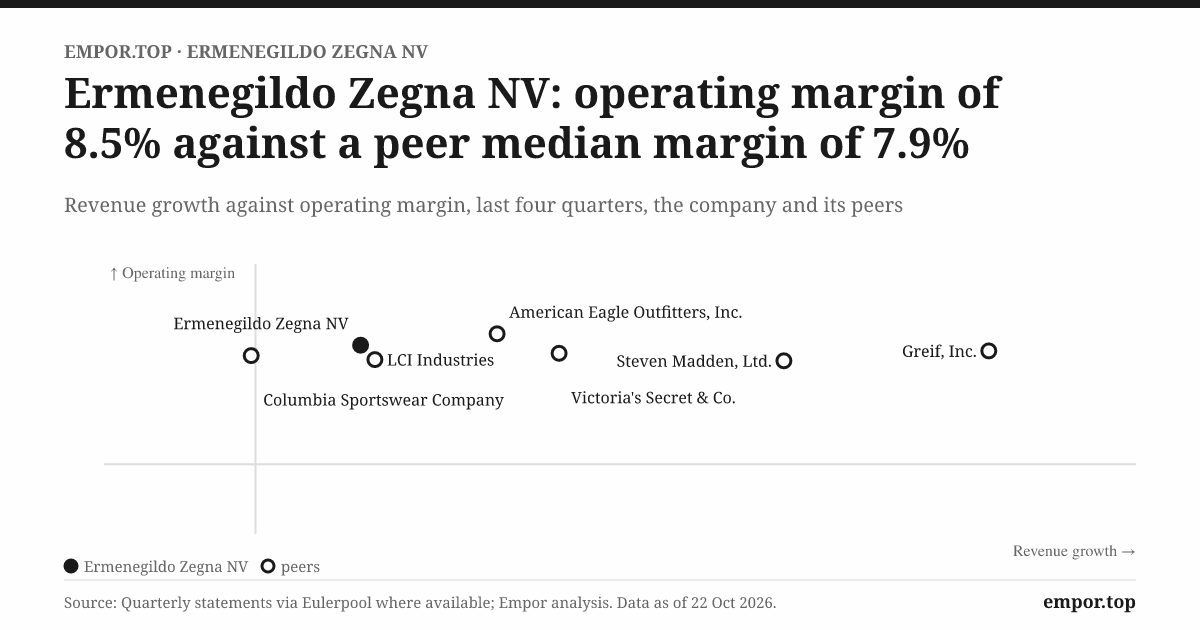
But selling, general and administrative expenses, which include store staff, rent-related costs, depreciation of the store network and head office, rose from about 51.8% of revenue to about 53.9%.4 So for every €100 of sales, the group kept roughly €1 more at the gross level and then spent roughly €2 more running the business. The improvement in product margin was more than consumed by the cost of the stores and the organization, at a time when reported revenue was falling. Operating profit for 2025 came in at €139.5 million, a single-digit share of revenue.1
That decomposition is the honest answer to whether the storefront pays. The direct model has improved the mix, and it does give the group the control it wanted. It has not yet produced consistent group-wide operating leverage. Operating leverage, in plain terms, is what happens when sales grow faster than fixed costs, so each extra euro of revenue drops more profit to the bottom line. A store network built for growth only pays off when the growth arrives. In 2025 it did not, so the fixed costs bit.
The first half of 2026 offered some relief. Adjusted operating profit, the company's own measure that excludes certain one-off items, rose to €74.5 million from €68.7 million a year earlier.7 That is progress, but on a modest base and measured by management's adjusted yardstick rather than the reported one.
There is a customer consequence to all this. A full-price ZEGNA store can protect presentation, keep discounting under control and build a relationship with a client who comes back every season. That is the bull case for direct retail, and it is a real one; it is the model the most successful luxury houses use.
An overbuilt network can turn a slowdown into pain. When foot traffic drops in a region, a wholesale brand simply ships fewer goods. A retail brand still pays the rent. In 2025, the group recorded store impairments, write-downs of store assets whose expected future cash flows no longer justify their book value, principally in Greater China and the rest of Asia-Pacific.1 Those write-downs are the accounting footprint of a store that opened on assumptions that did not hold.
Inventory is the other pressure. Under wholesale, the department store owns the risk on what it bought. Under direct retail, every unsold piece sits on Zegna's own balance sheet. Inventory absorbed cash again in 2025, a cost that shows up when the profits are traced into cash.
For investors, the tests for this strategy are concrete and measurable. Organic growth in direct sales, brand by brand, will show whether stores are drawing customers. Full-price sell-through, how much stock sells before markdowns, will show whether the product is right. SG&A as a share of revenue, and operating margin, will show whether the network is becoming more productive or merely more expensive. On the 2025 evidence, the strategy has delivered control and a better product margin, and has not yet delivered leverage. The brand where the direct-retail experiment has been both most aggressive and most painful is the one Zegna paid the most to buy.
IV. The Bet on Thom Browne
In 2018, Thom Browne was one of the most recognizable small brands in fashion. Its founder, the designer Thom Browne, had built a business on a single provocation: a grey suit cut deliberately small, with a cropped jacket, trousers that stopped above the ankle and a flash of sock. Add the red, white and blue grosgrain tab and the four bars stitched around a sleeve, and the silhouette was unmistakable from across a room. The brand had a cult following, a strong wholesale presence in department stores and specialty boutiques, and a runway show that was more theatre than catwalk.
That year, Zegna agreed to buy 85% of it. The price was about €344 million for the stake.2 Thom Browne's revenue that year was about €117 million.2 On an implied basis, valuing 100% of the equity, Zegna paid roughly €405 million for the whole business, or about three and a half times that year's sales. For a fast-growing, distinctive designer label, that was a demanding but not outlandish price in the luxury market of the time; acquirers routinely paid multiples of sales for brands with momentum. What the filings do not allow is a confident judgement that it was an overpayment: the company did not publish Thom Browne's profitability at the time of the deal, and comparable transaction economics are hard to pin down.
The investment thesis was clear enough. Zegna brought supply-chain depth, an Asian retail footprint, especially in China, and the capital to open stores. Thom Browne brought a distinct design language, an American fashion credential and a younger, more fashion-forward customer than the classic ZEGNA client. The aim was to take the brand beyond its signature tailoring and beyond its dependence on wholesale buyers, building it into a global luxury house with its own stores.
For several years, it worked. Revenue climbed to about €330 million in 20228 and €378 million in 2023.1 That is more than a tripling in five years from the acquisition-year base, a growth story most acquirers would envy. During that run, in 2021, Zegna bought another 5% of the company, taking its stake to 90%, with option arrangements covering the remaining 10%.2 The deal, in those years, looked like the second growth engine the family had wanted.
The turn
Then the line turned down, steeply and two years in a row. Thom Browne's revenue fell 16.8% in 2024 and a further 14.7% in 2025, ending 2025 at about €268 million.4 In two years the brand gave back about €110 million of annual sales, close to the entire revenue it had when Zegna bought it.
The company's explanation for 2025 was twofold. First, it had deliberately streamlined wholesale distribution, particularly in Europe, the Middle East and Africa, cutting the number of third-party retailers that carried the brand.4 Second, demand in Greater China remained weak.4 Management presented the wholesale cuts as a choice, a clean-up to protect brand positioning, rather than a failure of demand.
That explanation is partly right and partly incomplete. A brand can shrink its wholesale business deliberately, and that will lower revenue in the short run even if customers still love the product. But if the brand were healthy, its own stores and website should have taken up some of the slack. They did not: direct sales also failed to offset the wholesale decline in 2025.4 That is the more worrying signal. Channel clean-up moves sales from one bucket to another. Falling sales in the brand's own stores point to softer demand.
The second half of 2025 brought a leadership change at the brand too. Rodrigo Bazan, who had led Thom Browne as chief executive, served through August 2025, and Sam Lobban took over in September.1 On the third-quarter call in 2025, when the group's revenue fell short of what analysts had expected, the Thom Browne reset was a central part of the discussion.9 By the first-half 2026 call, management was still describing it as a turnaround in progress rather than a completed recovery.10
There is a quirk in the accounts that makes this story harder to read. Because Zegna wrote put options to the holders of the remaining Thom Browne shares, it carries a liability for the expected price of buying them out. When the brand's prospects fall, the expected price of that buyout falls too, and the reduction in the liability is booked as a gain.
In 2025, that gain was €22.1 million, part of €26.0 million of fair-value gains on written put options recorded in financial income.1 A further €14.7 million of foreign-exchange gain came from remeasuring the same Thom Browne put option for currency moves.1 Put plainly: the weaker Thom Browne looked, the less the group expected to owe its minority partners, and that showed up as income below the operating line. Anyone reading headline net profit without separating these items would see a business doing better than its brands were.
There is also a legal footnote. Thom Browne's long-running trademark dispute with adidas over striped designs remains an open litigation exposure, though legal fees have fallen, from €2.17 million in 2023 to €0.44 million in 2025.1
So what does the record say about the acquisition? It rejects the strongest version of the thesis, that Thom Browne was a reliable second growth engine. It supports a narrower version: Zegna proved it could scale the brand for a while, and the brand is still a business of more than a quarter of a billion euros in sales. Whether that business is now being reset to a healthier base or is in structural decline will be settled by two numbers: organic growth in its own stores and its adjusted operating profit. Until those turn, the price paid in 2018 looks expensive in hindsight, even if not demonstrably reckless when it was agreed. And by the time the Thom Browne trend turned, Zegna had already made a second, even more ambitious bet on someone else's name.
V. TOM FORD FASHION: A Long License, a Shorter Proof
On April 28, 2023, two deals closed on the same day, and between them they split one of the most famous names in fashion down the middle. The Estée Lauder Companies completed its acquisition of the TOM FORD brand, buying the trademarks and the intellectual property that sit behind the name.11 At the same moment, Zegna completed its purchase of Tom Ford International, the company that actually designed, made and sold TOM FORD menswear, womenswear, accessories and leather goods.12 Estée Lauder got the name. Zegna got the business that wore it.
That arrangement was unusual, and it is worth slowing down to understand what Zegna actually owns. Imagine buying a restaurant that is famous for its name, while someone else buys the name and rents it back to you. You run the kitchen, hire the chefs, sign the leases, choose the menu and keep the profit. You also pay the owner of the name every year for the right to put it over the door, and if you ever stop paying, or the contract ends without renewal, the sign comes down.
That is roughly Zegna's position. Under a long-term license, Zegna runs TOM FORD FASHION end to end: design, production, distribution and its own stores.12 The license runs for 20 years, with an automatic 10-year extension if certain conditions are met.1 Estée Lauder, which had built TOM FORD into one of the most profitable fragrance and beauty franchises in the world, owns the trademark and the broader intellectual property.11
Zegna had owned 15% of Tom Ford International since a partnership was agreed years earlier, and paid for the remaining 85% at a stated value of $150 million on a cash-free, debt-free basis.12 Estée Lauder's side of the transaction was far larger, valuing the brand at about $2.8 billion.11 It would be tempting to compare those numbers and conclude that Zegna got a bargain, but the comparison does not hold. Estée Lauder bought the trademark itself, the beauty business that was already its licensee, and the royalty stream the brand generates across categories. Zegna bought an operating fashion company that would now owe royalties to Estée Lauder. The two prices measure different things.
Nor was the fashion business a modest one. In 2025, TOM FORD FASHION generated revenue of about €317 million, larger than Thom Browne.4 For the group, that represents a meaningful second brand with genuine global recognition, run by a company that knows how to make tailored clothing. On the operating side, the fit was familiar: the two companies had worked together for years before the deal, which is how Zegna came to own its original minority stake.12
The contract under the business
The cost that makes this a different kind of asset is the royalty. Zegna disclosed minimum guaranteed royalties payable to Estée Lauder of $173.4 million, about €147.6 million, over the first ten years of the license, undiscounted as of the end of 2025.1 That works out at roughly €15 million a year on average, payable whether or not sales grow. On top of the minimum, royalties scale with sales.
On a business doing more than €300 million a year, a minimum of that size does not look onerous. The point is not that the royalty is unaffordable today. It is that it is fixed in a way that most costs in fashion are not. If TOM FORD FASHION's sales fell sharply, the minimum would not fall with them. Combine a guaranteed royalty with store leases and a central design studio, and the business carries a meaningful fixed-cost base that needs sales to keep up.
There is a second, subtler issue. The prestige of the TOM FORD name is not entirely in Zegna's hands. Estée Lauder's beauty business is far larger than the fashion business, and decisions about how the name is used in fragrance and cosmetics shape what customers think when they see it on a jacket. Zegna controls the clothing. It does not control the brand.
So far, the business has held steady rather than accelerated. TOM FORD FASHION revenue grew 0.8% in 2025.4 In the same year, the group recorded store impairments, principally in Greater China and the rest of Asia-Pacific, where the fashion business had been expanding its own retail presence.1 Growth that flat, with write-downs on stores, is not a failure. It is also not yet the proof that the business can grow profitably under someone else's trademark.
The rest of the group's evidence suggests what to watch. Revenue growth is only the beginning; the measure that matters is adjusted operating profit after license costs, because a fashion business that grows sales while royalties and store costs grow faster is not creating value. Store returns, particularly in Asia, will show whether the retail rollout is pulling its weight. And the deeper question is whether TOM FORD FASHION can build a customer base that comes for the product, the cut and the craft, rather than renting the glamour of a name that someone else owns.
For investors, the verdict is clear but provisional. The deal gave Zegna control of design, production and distribution without paying for the trademark, and it bought a real business at a price that looks reasonable relative to its sales. In exchange, it took on a long contract with fixed minimum payments and a dependence on a name it does not own. With Thom Browne falling and TOM FORD flat, the group's results in 2025 rested increasingly on one brand, at precisely the moment the luxury cycle turned against the whole industry.
VI. The Portfolio Meets the Luxury Cycle
By the end of 2025, the three brands looked like three different companies. ZEGNA had grown. TOM FORD FASHION had barely moved. Thom Browne had shrunk sharply for the second year running. A portfolio is supposed to smooth out the bumps, so that when one brand stumbles another carries the load. In 2025, one brand did nearly all the carrying.
The ZEGNA brand generated about €1.18 billion of revenue in 2025, up 1.5% on the year.4 Add the textile business and other activities reported inside the same segment and the ZEGNA segment reached about €1.36 billion, roughly seven of every ten euros of group revenue.4 TOM FORD FASHION, at about €317 million, and Thom Browne, at about €268 million, together amounted to less than half of ZEGNA on its own.4
That arithmetic matters because it shows where the economic centre of gravity actually lies. The family's brand, the one with the mill and the century of history, is the business that pays the bills. The acquired brands, which were supposed to diversify the group across customers, styles and price points, are adding complexity and capital needs at a time when one of them is in reverse.
The geography of a slowdown
The luxury slowdown of 2024 and 2025 was not evenly spread. In Zegna's case, it hit hardest in the region where the company had been a pioneer. Revenue in Greater China fell 14.6% in 2025 on a reported basis.4 Some of that decline reflected currency, because the yuan weakened against the euro, but the underlying demand was also soft, and it fell on both Thom Browne and TOM FORD FASHION.
Being early into China, back in 1991, had once been one of the group's quiet advantages. It meant brand recognition, established stores and experienced local teams. By 2025 it also meant concentration. The yuan alone accounted for about 18% of the group's revenue by currency.1 When Chinese luxury consumers pulled back, whether because of property-market weakness, a cautious mood or a shift toward domestic and less conspicuous brands, an early mover with a large footprint felt it more than a latecomer would.
The 2026 numbers suggest a different picture. The October update showed revenue growing roughly 9% in the third quarter.5 But reported growth, organic growth and currency effects can pull in different directions, and the latest release does not provide the full brand and regional breakdown alongside profit. A stronger top line in 2026 is encouraging. It does not yet show whether the recovery is broad across the brands or whether ZEGNA is again doing most of the work.
It helps to understand why this business is so cyclical even though it sells to wealthy people. A ZEGNA suit or a Thom Browne cardigan is a discretionary purchase in its purest form: nobody needs it. Demand depends on the confidence of affluent consumers, on travel and tourism, which move luxury spending between regions as shoppers buy abroad, on local consumer sentiment in places like China, and on the health of department stores, which still matter for wholesale.
A runway show that goes viral can lift a brand's visibility. It does not by itself produce repeat purchases or profitable full-price sales. That gap between attention and economics is where many fashion brands fail, and it is where the group's evidence is thinnest: the company does not disclose repeat-customer rates or full-price sell-through by brand.
The clearest example of wholesale risk in 2025 came from an American institution. Saks Global, the parent of Saks Fifth Avenue and Neiman Marcus, filed for Chapter 11 bankruptcy protection. Zegna recorded a €10.1 million expected credit loss on the money Saks owed it.4 Shipments resumed in the first quarter of 2026, but the group has not disclosed what share of its sales went to Saks or how much of the debt it will ultimately recover.13 The episode is a reminder of why the shift to direct retail appeals to management: a brand that sells through its own stores does not have to worry about a retail partner going bust with its invoices unpaid. The episode also left a mark on the balance sheet that is worth following.
The group's currency exposure remains substantial.1 It hedges forecast foreign-currency sales with forward contracts and can adjust price lists, which smooths but does not remove the effect.1 Reported foreign-exchange results swung from losses of €5.3 million in 2023 and €11.3 million in 2024 to a gain of €9.0 million in 2025, but that 2025 gain included €14.7 million from remeasuring the Thom Browne put option.1 Strip that out and the trading hedges were negative. In the first half of 2026, foreign exchange produced a €3.1 million loss compared with a €10.2 million gain a year earlier.7 Currency is not the story of this company, but it can easily distort a reader's sense of whether the business is improving.
For investors, the conclusion is direct. ZEGNA is the economic centre of the group. Thom Browne and TOM FORD FASHION offer diversification and future growth potential, but recent results do not show a balanced portfolio; they show one strong brand supporting two that are still proving themselves. That raises an obvious question about money: how much cash does the whole operation actually generate, and where does it go?
VII. The Cash Behind the Brand Story
Here is a puzzle that should make any investor look twice. Add up Zegna's net profit over the eight years from 2018 to 2025 and it comes to about €218 million. Add up the cash generated by its operations over the same period and it comes to about €1.7 billion.1 Cash from operations was roughly eight times net profit. That looks either like a sign of extraordinary quality or a sign that something in the accounts deserves a closer look.
The truth is less dramatic than either extreme, and more useful.
The eight-year window includes two years of losses, 2020 and 2021, when the pandemic closed stores and the group booked heavy costs around its listing. Those losses drag down cumulative profit without a matching hit to cash. More importantly, a business that leases hundreds of stores carries large non-cash depreciation charges. Under the IFRS 16 accounting standard, a store lease is treated as an asset that depreciates over its term, plus a debt-like liability on which interest accrues. The depreciation reduces profit but is not a cash payment; the actual cash paid on leases shows up partly in financing activities instead. That alone opens a large gap between profit and operating cash flow, and it means operating cash flow flatters any retailer that leases heavily.
So the right way to read the eight-to-one ratio is not that Zegna conjures cash from nowhere. It is that its operating cash flow includes money that will go straight back out the door as lease payments, reported further down the cash-flow statement.
The most recent year makes the mechanics concrete. In 2025, cash from operations was €335.6 million, up from €279.1 million in 2024.1 Working capital pulled in several directions. Inventory absorbed €23.6 million as the group stocked its stores. Receivables took €3.0 million. Payables supplied €24.2 million, as the group took longer to pay its own suppliers. Other operating assets and liabilities absorbed €43.0 million.1 Add those up and working capital was a net drain of a little under €50 million, which tells you the cash strength of 2025 came from the business itself rather than from squeezing suppliers.
Below the operating line, cash went out for the bills that do not wait. Interest paid was €39.6 million and taxes paid €37.5 million in 2025.1 Lease interest of €27.0 million, part of the financial expenses, was more than twice the €11.1 million of interest on bank loans.1 The store network, in other words, costs the group more than twice as much in interest as its banks do.
Two definitions of free cash flow
There are two ways to measure free cash flow, and confusing them would mislead a reader. The simple one subtracts capital expenditure from operating cash flow. On that basis, Zegna generated about €1.1 billion of free cash flow over the eight years. The company's own measure goes further and also deducts lease-related payments, treating store rent as the operating cost it really is.1 For a retailer, the second definition is closer to economic reality. The first overstates what is genuinely free.
A rough illustration shows why it matters. In 2025, cash from operations less capex was about €233 million. The current portion of lease liabilities, a rough proxy for the principal the group must pay on store leases over the coming year, stood at about €141 million at year-end.1 Subtract that and the money truly left over for shareholders, debt repayment or acquisitions shrinks to something closer to €90 million. That is a back-of-the-envelope figure, not the company's, but it captures the order of magnitude.
Capital expenditure is the first claim on the cash. It was €77.9 million in 2023, €125.5 million in 2024 and €102.9 million in 2025, between about 4% and 6% of revenue.1 Most went into stores, around €61 million in 2025, with about €13 million on IT and the rest on manufacturing and other assets.1 In the first half of 2026, capex rose to €64 million from €54 million a year earlier, including investment in a new shoe-production plant in Parma that the group plans to have operating by the end of 2026.7 That is a business still building, not harvesting.
Dividends have been a small claim. Over the eight years, the company paid out about €134 million in dividends, around 12% of the simple free-cash-flow total. In 2025, the dividend absorbed about 31% of net profit, near the middle of its range over the period.1 The rest of the cash went to buying out minority shareholders, funding the TOM FORD deal, paying down debt and paying for leases.
The balance sheet reflects that discipline. At the end of June 2026, the group reported a net cash surplus of €59.6 million on its own measure, which excludes lease liabilities, and €190 million of undrawn committed credit lines.13 Its bank borrowings are mostly variable-rate, so interest costs move with the market, but the company reported no covenant breaches and no refinancing pressure.13 No credit rating agency publishes a rating on the group in its filings; its lenders' covenants and the company's liquidity are the available evidence.
For investors, the verdict is balanced. Zegna generates real cash, comfortably more than its accounting profit, and it has used that cash to invest and to keep its bank debt modest. But a large part of the apparent cash surplus is pre-committed to store leases, and the rest is going back into stores and factories whose returns are not yet proven. The return on invested capital was about 7% over the twelve months to June 2026, modest for a luxury business. The cash is there. The question is whether it is earning enough. And one part of the working capital deserves a sharper look, because it tells the story of who pays late.
VIII. Who Pays Late, and What the Receivables Reveal
Every wholesale shipment is a loan. When a ZEGNA truck delivers a season's worth of suits to a department store, the store does not pay on the spot; it pays on terms, often months later. For that interval, the brand is effectively financing its customer. Most of the time this is routine. When a customer gets into trouble, the loan can go bad.
At the end of 2025, Zegna was owed €250.1 million in gross trade receivables by its customers. It set aside €23.1 million as an allowance for amounts it did not expect to collect, leaving €227.1 million net, a little lower than the €248.8 million a year earlier.1 Those receivables sit almost entirely with wholesale partners, because retail customers pay at the till.
The more revealing figures are in how old those debts are. Of the gross total, €186.7 million was not yet due, which is normal. Another €36.2 million was up to 120 days overdue, and €9.7 million between 121 and 180 days overdue. Then there was €17.5 million more than 180 days overdue.1
Six months is a long time in fashion. A wholesale partner more than half a year behind on paying for last season's goods is either in serious financial difficulty or disputing the bill. Against that oldest bucket the group held an allowance of €8.4 million, leaving €9.1 million on the books as still expected to be collected.1 During 2025 the group added €12.7 million to its allowance and wrote off €3.0 million of debts it had given up on.1 It uses lifetime expected-credit-loss provisioning, meaning it estimates losses over the whole life of a receivable rather than waiting for a default, and it carries credit insurance on part of the book.1
The Saks shock
The Saks Global bankruptcy was the clearest recent example of that risk.4 The loss was meaningful: roughly a tenth of 2025 net profit attributable to shareholders.
Shipping resumed in the first quarter of 2026.13 The company also said its wholesale sales to Saks had fallen in 2025.1 It does not disclose how big Saks was as a customer, how much of the old debt it will ultimately recover, or how concentrated its wholesale book is more generally. The company does not name a customer accounting for more than 10% of revenue in its annual or half-year reports, nor does it give top-five or top-ten customer concentration.1
That silence makes it impossible to size the remaining wholesale credit exposure fully. If Saks was one of the group's two or three largest wholesale customers in the United States, the €10.1 million loss may be most of the problem. If other department stores are under similar strain, it may be a first instalment. The filings do not let an outsider tell which.
Debtor days, the number of days of revenue tied up in receivables, were about 50 in 2018, peaked at about 53 in 2024 and were still about 52 in 2025. At a time when wholesale is shrinking as a share of the business, you might expect receivables to shrink faster than revenue, and debtor days to fall. They have not. Part of the explanation may be the mix of wholesale customers that remain, part the timing of shipments, and part the textile business, which sells to other luxury houses on trade terms. The company does not break it down.
There is also a related detail that the balance sheet hides. The group does not report a separate line for unbilled revenue or contract assets; accrued income sits inside other current assets, which totalled €118.5 million at the end of 2025.1 For a business that recognizes revenue when goods change hands, that is not an obvious concern, but it is one more item an analyst would want to see broken out.
This is one credit-risk benefit of the group's move to direct retail. Saks illustrates exactly why that is attractive.
The lease and inventory risks of direct retail remain. Zegna has swapped one kind of credit risk for a larger exposure to its own execution.
For investors, the receivables tell a story of a controlled but not fully transparent wholesale book. The group identified the Saks problem, provisioned for it and insured part of its exposure. Yet aged balances remain meaningful, debtor days have not improved, and the lack of customer-concentration disclosure leaves outsiders guessing at the size of the remaining risk. Those disclosure choices, like many others, are ultimately made by the people who control the company, which brings the story back to the family.
IX. The Family Still Holds the Votes
Picture the annual general meeting of a Dutch company controlled from Italy. The resolutions are tabled, the proxies are counted, and the outcome is known before anyone votes. That is not a criticism; it is simply how the structure works. On June 26, 2026, every resolution at Zegna's annual meeting passed, including the appointment of a new chief executive.14 The meeting was a formality because one shareholder held most of the votes.
That shareholder is Monterubello S.p.A., the Zegna family holding company. It remained the majority owner and controlled a larger share of the votes than of the ordinary shares.1 A year earlier the figures had been 60.5% and 74.2%.1 The decline came mostly from the sale of treasury shares to Temasek, the Singapore state investor, in July 2025: 14.121 million shares at $8.95 each, about $126 million, which together with market purchases took Temasek to a disclosed stake of about 10%.1 The 2026 ownership table listed Monterubello with about 152.7 million shares, Strategic Holding Group with about 30.3 million and Temasek with about 27.2 million.1
The gap between Monterubello's share ownership and voting power comes from special voting shares, a device common among Dutch-domiciled companies with controlling families. Shareholders who register their ordinary shares and hold them for a set period receive extra voting shares, which carry votes but almost no economic value. The mechanism rewards loyalty. It also entrenches whoever is already loyal, which here means the family.
In practice, Monterubello would remain in control even if its economic stake fell well below half. The Indian-style categories of promoter, foreign institutional and domestic institutional holders do not apply to an NYSE-listed foreign private issuer; what matters is the beneficial-ownership table and the voting-power percentages, and those are explicit. The company does not disclose a comprehensive count of its shareholders; its annual report records only four US holders of record, a figure that reflects how brokers hold shares rather than how many investors own them.1
Concentrated control matters most where the controller and the company do business with each other. At Zegna, they do, but on a modest scale relative to the group. In 2025, related-party revenue was about €0.4 million, roughly 0.02% of group revenue. Related-party cost of sales was about €22.5 million, around 3.6% of total cost of sales, and related-party SG&A about €12.2 million, roughly 1.2% of the total.1
The largest recurring exposures are store and property leases from EZ Real Estate and Alan Real Estate, companies linked to the family, together with purchases and services from businesses associated with the Zegna family and the group, including Schneider Group and the textile finishers Finissaggio e Tintoria Ferraris and Pettinatura Verrone.1 EZ Real Estate is the natural heir of the property demerger before the listing: the family kept the buildings and the listed company rents some of them back. At the end of 2025, related-party balances included €72.5 million of non-current assets and €61.4 million of non-current liabilities.1 The related-party note also lists UBS Group, because Sergio Ermotti, the bank's chief executive, sits on Zegna's board; the group uses UBS for banking, securities, derivatives and guarantees.1
The company says these transactions are conducted on commercial terms consistent with normal market conditions and are reviewed under a policy that routes them to its independent Audit Committee.1 It does not publish transaction-by-transaction benchmarking. There is no parent-company royalty or management fee, which is the most common way controlling shareholders extract value in other markets.1 On the evidence, the related-party flows are small in proportion and properly governed on paper. They are persistent rather than one-off, which is exactly why independent review matters.
Gildo Zegna, the founder's grandson, has led the group for most of the past three decades and remains the family's public face. In 2025, his total compensation was €5.19 million, including a base salary of €2.01 million, a short-term incentive of €1.80 million and €0.77 million of performance-share compensation.1 That compares with group operating profit of €139.5 million and net profit attributable to owners of €109.5 million.1 His package was a little under 5% of attributable profit.
The structure of the pay matters more than the total. Under his 2025 to 2027 agreement, more than 80% of target compensation is at risk, half of the variable component is paid in shares, and 30% of at-target variable pay is linked to stock performance.1 He received 368,943 shares in 2025 from the 2022 to 2024 long-term incentive plan.1 That is a reasonable design for aligning a controlling family executive with outside shareholders. Its weakness is that the controlling family already has more exposure to the share price than any incentive plan can add; the incentives matter more for the professional managers below.
A new chief executive
Those professionals now run the business day to day. Gianluca Tagliabue, previously chief financial officer and chief operating officer, became acting group chief executive in January 2026 and was formally appointed CEO and an executive director at the June 2026 meeting, while Gian Franco Santhià was appointed group CFO.14 Tagliabue is an operator, a finance-and-operations executive rather than a designer or a family member, and his promotion signalled that the next phase is about execution: margins, stores, Thom Browne.
His credibility will be measured against the targets management has set. On the first-half 2026 call, management said it still considered the market consensus of about €195 million of adjusted operating profit for 2026 reasonable, though more challenging, and that the 2027 outlook remained at the lower end of its range.10 Those are statements, not results. The fact that the 2027 language had already slid to the lower end tells you something about how the past eighteen months have gone, and the year-end numbers will show whether the new team can hit the revised targets.
The 2025 annual meeting offered one of the few windows into outside shareholders' views. Dissent was low: 1.16% voted against Sergio Ermotti's re-election, 1.15% against Michele Norsa and 1.05% against Gildo Zegna, while Anna and Paolo Zegna each drew about 0.62% opposition.15 Those are small numbers, but they are small partly because the family's votes dilute everyone else's. Measured as a share of the outside votes alone, dissent would look several times larger, though still modest. The 2026 meeting release reported that all resolutions passed without publishing item-by-item percentages.14
The auditor's view is cleaner. Deloitte issued an unqualified opinion on the 2025 accounts and reported no material weakness in internal control over financial reporting.1 That is worth noting because the 2021 prospectus had disclosed material weaknesses in internal controls during the company's private years; those do not appear as current weaknesses in the latest audit.2
For investors, the verdict is that family control is explicit and durable, supported by an independent audit committee and incentive pay that ties management partly to the share price. The gap between economic ownership and voting control, combined with recurring related-party leases and purchases, means outside shareholders depend on disclosure and independent review rather than on their own votes. That dependence shapes how the market prices the stock, which is where the story turns next.
X. The Multiple Is Asking for Proof
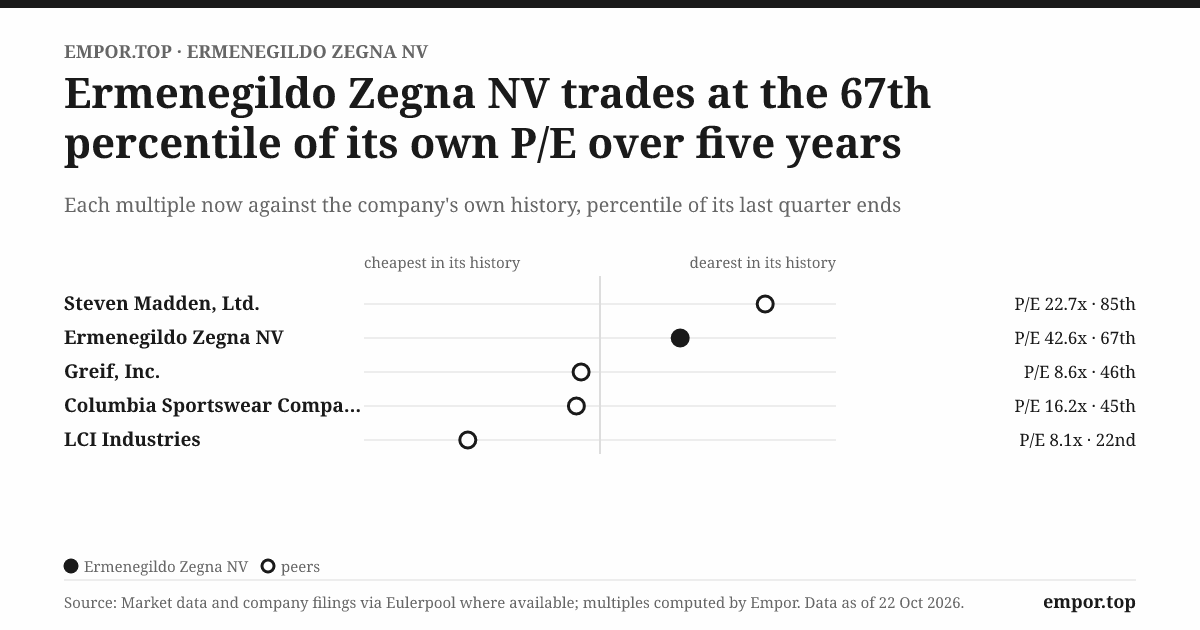
On October 22, 2026, a share of Ermenegildo Zegna traded at about $11.39, roughly 24% below its 52-week high of about $15.06. A share that has fallen a quarter from its peak usually looks cheap. This one does not. On trailing earnings it traded at about 42.6 times, well above its own five-year median of about 31.2 times. Measured by enterprise value against EBITDA, a measure that includes debt and leases and strips out depreciation, the multiple was about 10 times. Measured by free cash flow, using operating cash flow less capex, the yield was about 9.2%.
Those numbers point in different directions, and the reason they do is the most important thing to understand about the valuation.
The P/E is high because trailing earnings are low. Net profit in the four quarters to June 2026 fell, partly because the prior period had been flattered by financial and foreign-exchange gains, including the put-option gains that rose as Thom Browne's prospects fell.7 When earnings dip, the P/E rises even if the share price stays put. So the 42.6 times reflects depressed earnings as much as an optimistic price. Still, the market is clearly paying for a recovery: an earnings yield of about 2.3% is not what investors accept for a business they expect to stand still.
The free-cash-flow yield looks generous because it uses a definition that ignores lease payments. Subtracting store-lease principal, as the rough €90 million illustration for 2025 showed, cuts free cash flow substantially. On a lease-adjusted basis the yield is much lower, likely in the low single digits, which is far closer to what the P/E suggests. The cheap-looking cash yield and the expensive-looking earnings multiple are describing the same business through different lenses.
Returns on capital complete the picture. Over the twelve months to June 2026, return on equity was about 7.6% and return on invested capital about 6.8%. For a luxury company, those are modest. The best houses earn returns several times higher because customers pay high prices and the brands need relatively little capital to sell more. Zegna's returns look more like those of a well-run apparel manufacturer that also owns stores.
What stops a customer from walking
Strip away the heritage and ask the hard question: what stops a wealthy customer from buying a Brunello Cucinelli jacket instead of a ZEGNA one, or a Prada coat instead of a Thom Browne cardigan? Michael Porter's five forces give a useful frame.
Buyers, in this case luxury customers, can switch brands with no cost at all; nothing locks a client into ZEGNA beyond satisfaction and habit, and the company publishes no retention data to show how strong that habit is. Department stores, the intermediaries, have real bargaining power, and the Saks bankruptcy showed that power can turn into losses. Suppliers have been partly internalized through the Filiera, which reduces supplier power for the group's own brands, though third-party suppliers remain. New entrants face high barriers in reputation, retail locations and the capital needed to build stores, which protects incumbents of every kind, including Zegna's own rivals. Substitutes are everywhere, because the alternative to a luxury suit is not a cheaper suit but a watch, a trip or a different brand entirely, and tastes in menswear have been shifting toward more casual dressing for two decades.
Hamilton Helmer's seven powers framework narrows the case further. Two powers are plausible. Brand, the ability to charge more because of what the name means, exists at ZEGNA and to a degree at Thom Browne, though the company does not prove it with price-realization data. Process power, embedded know-how that rivals find hard to copy, is the most credible argument for the Filiera, with its century of cloth expertise and hundreds of R&D staff. The others are not demonstrated at group level. Scale economies are limited for a company several times smaller than the luxury leaders. Switching costs are near zero for consumers. Network effects, counter-positioning and cornered resources do not obviously apply; TOM FORD FASHION, indeed, rests on a resource that someone else owns.
So the moat claim survives in a narrower form: distinctive design, deep textile capability and controlled retail support differentiation, but customer lock-in, pricing power and a cost moat are thinly evidenced.
A snapshot from late March 2026 placed Zegna at about 23 times earnings, compared with about 21.9 times for Moncler, 36.2 times for Brunello Cucinelli and 12.7 times for Prada, and a luxury-peer median of about 21.4 times.16 Those numbers were measured on an earlier date and possibly different earnings periods from today's figures, so they are not a like-for-like ranking. They do suggest the market has priced Zegna in the middle of its peer group, below the purest quiet-luxury story and above the much larger Prada. Since then, earnings have dipped and the multiple has risen.
How the case could break, and how it could work
The bear case is not hard to write. Luxury demand, or China specifically, weakens again. Direct-retail costs rise faster than sales, so SG&A keeps climbing as a share of revenue. Thom Browne's decline continues into a third year. TOM FORD FASHION stays flat while minimum royalties and store costs erode its returns. And the fixed lease obligations, more than €700 million on the balance sheet, amplify every downturn.
The bull case is equally concrete. ZEGNA keeps growing organically, and its high direct-retail mix converts growth into higher margins as stores mature. Thom Browne stabilizes on a smaller, cleaner base without needing wholesale to grow again. TOM FORD FASHION turns its global name recognition into profitable growth. The 2026 revenue recovery becomes a profit recovery, and returns on capital move back toward the low-teens levels the group briefly reached in 2023.
An activist-minded investor would press on three points. Should the group keep funding three brands and more stores when one brand generates most of the economic value, or should it concentrate capital on ZEGNA and textiles? Should it slow investment and return more cash to shareholders, given that dividends have absorbed only a small part of free cash flow? And what evidence, beyond management statements about brand heat, would justify a premium earnings multiple for a company earning single-digit returns on capital? No active activist campaign has been disclosed, and with 71.5% of the votes in family hands, an activist would struggle to force change. But the questions do not disappear because the votes are concentrated.
Three numbers will answer most of them. The first is organic revenue and adjusted operating profit by brand, which reveals whether the recovery is broad. The second is direct-retail growth alongside SG&A as a share of revenue and the operating margin, which shows whether the stores are earning their keep; the group's higher direct-retail mix has yet to bring SG&A down as a share of revenue. The third is Thom Browne's revenue and adjusted operating profit, which shows whether the group's most expensive acquisition is mending; the brand has suffered a sharp revenue decline. The market's multiple is asking for proof on all three. The company has a few months to provide it, and some hard-earned lessons to draw on.
XI. Playbook: Business & Investing Lessons
A wool mill in the Alps became a global luxury group with stores on three continents, three brands and a listing in New York. Along the way it made choices that worked and choices that did not, and each leaves a lesson that belongs to Zegna in particular.
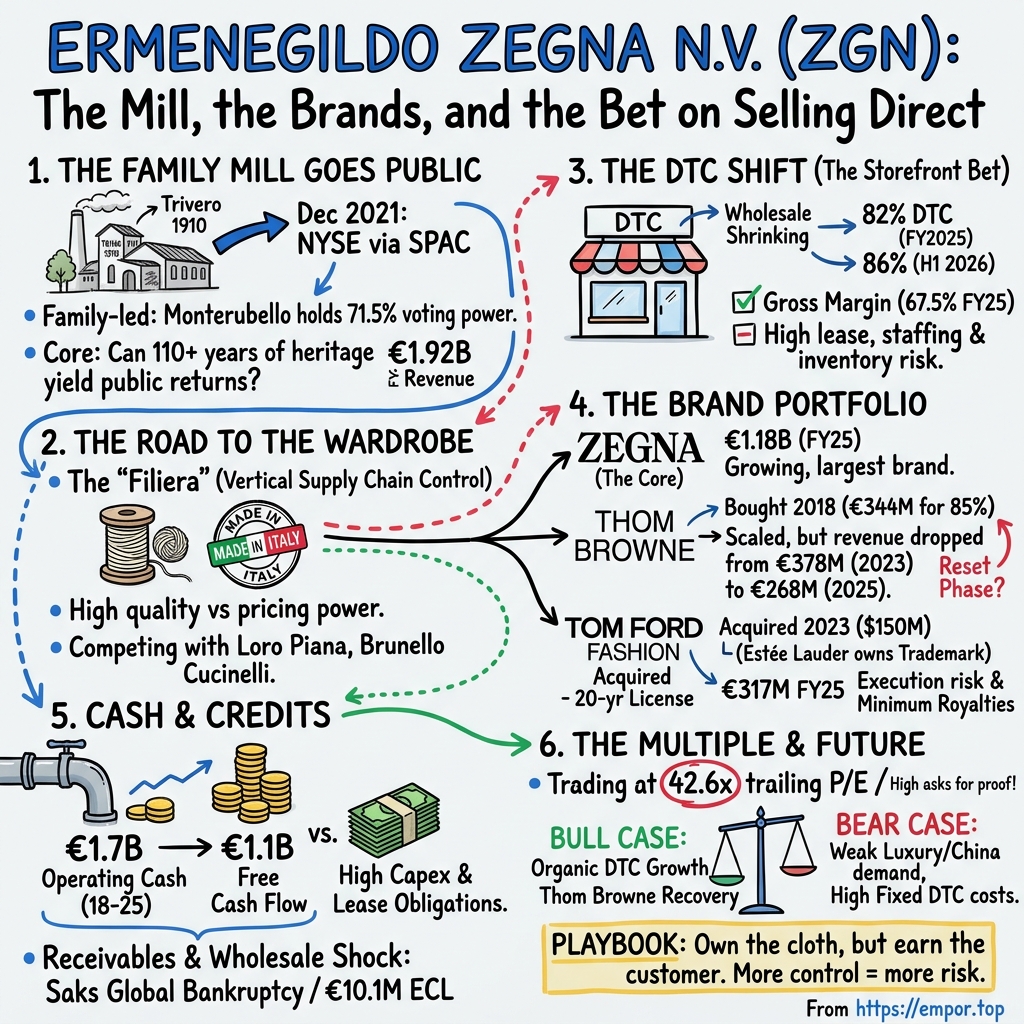
The first lesson is to own the cloth, but earn the customer. The Zegna family's expertise in fabric is real, and few fashion houses can match it. But the company's returns on capital show that owning the cloth does not automatically mean owning the customer. For founders and investors, the lesson is that vertical integration is a capability, not a moat; it creates value only when it changes what customers buy and what they pay. A mill is a means. The wardrobe is the end.
The second lesson is that a brand can grow fast and still turn. Thom Browne's rise and subsequent reversal show how quickly a growth story can change. Investors who judged the deal in 2023 would have called it a triumph; those judging it in 2025 would have called it a mistake. The lesson is that acquired brands in fashion should be judged over a full cycle, and that growth driven partly by wholesale expansion can reverse when the channel is cleaned up. A growth curve is a season, not a climate.
The third lesson is that more control means more responsibility. The shift from wholesale to direct retail gave Zegna what luxury brands crave: control of presentation, price and the customer relationship. It also moved rent, inventory and execution risk from department stores onto the company's own balance sheet. The Saks bankruptcy and China store impairments showed the risks on either side. Neither model is risk-free. A store you own is a promise you keep paying for.
The fourth lesson is that a famous name is a contract, not a moat. TOM FORD FASHION shows that distinction. The lesson for anyone buying a licensed business is to value it as an operating company with a fixed cost attached, not as a brand. Renting glamour is not the same as owning it.
The fifth lesson is that family patience needs public evidence. Concentrated family control can support the long horizons that luxury brands need: patience through slumps, willingness to invest in mills and forests that pay off over decades. But once outside shareholders join, patience has to be demonstrated through transparent related-party terms, measurable returns and honest explanation of misses. The family's votes protect its strategy from short-term pressure. Only results can protect its credibility.
Taken together, the lessons describe a company that has built an unusual chain from fibre to storefront, and is now discovering that each link must earn its keep.
XII. Epilogue
Tonight, the story stands at an interesting point. The morning's third-quarter update showed revenue growing again, about 9% in the quarter and about 7% across the first nine months of 2026.5 After a year in which reported revenue fell and one of the acquired brands shrank by about a seventh, that is a genuine change in direction. It is also, so far, only half the evidence. The update said nothing about profit, margins or cash.5
The next decisive moment is the full-year 2026 report, due early in 2027. It will show whether the revenue recovery became a profit recovery, and it will test the guidance management gave in September. On the first-half call, management described the consensus of about €195 million of adjusted operating profit for 2026 as reasonable but more challenging.10 If the group meets that figure on a recovering top line, it will suggest that the direct-retail model is finally producing leverage. If it falls short despite higher revenue, it will confirm that the store network is still absorbing more than it adds.
Three things will matter in that report. The first is ZEGNA's organic growth and whether the 86% direct-retail mix of the first half translates into a higher group margin, with SG&A falling as a share of revenue rather than rising.7 The second is Thom Browne: whether its revenue decline has ended, and whether it has returned to positive adjusted operating profit after the wholesale clean-up and under Sam Lobban's leadership. The third is TOM FORD FASHION's profitability after royalties, alongside the performance of its stores in Asia, where it took impairments in 2025.
There are smaller signals to watch too. The Saks Global situation will either resolve with a recovery on the old debt or require further provisions. The aging of receivables at the year-end close, especially the bucket over 180 days, will show whether the wholesale book is cleaning up as the channel shrinks. Debtor days, stuck at about 52, should start to fall if the shift to direct retail is working as intended.
Then there is the question of narrative consistency. In late 2025, the group reported a quarter that disappointed analysts and attributed much of the weakness to Thom Browne and China.9 By September 2026, the tone had shifted to recovery, but with the 2027 outlook pinned to the lower end of its range.10 Comparing those explanations with what the full-year report shows will reveal whether management's diagnosis was specific and accurate, or whether targets quietly moved. A management team that names its problems and then fixes them earns the benefit of the doubt. One that changes the explanation each quarter does not.
So the story enters 2027 with its central tension intact. The direction of revenue has improved. The quality of the margin, the profitability of each brand and the return on all the cash invested in stores and factories remain unproven. Those are the tests that will separate a channel-driven rebound from durable value creation.
XIII. Outro
Go back to Trivero, to the slopes where Ermenegildo Zegna planted his trees and built his mill in 1910. The water still runs off the mountains. The mill still weaves cloth. But the business it began is now judged by measures he could never have imagined: direct-retail mix, store productivity in Shanghai and Dubai, and the royalty terms on a name owned by a cosmetics company.7
What makes Zegna unusual among luxury portfolios is the attempt to connect every link, from the sheep's fleece to the folded jacket on a table in a store the company leases, under the control of a single family, now in its fourth generation, on a public stock exchange. Other houses own great brands. A few own mills. Very few try to own the whole chain and answer to public shareholders at the same time. The mill made the cloth; the next chapter must prove the group can make the return.
References
-
FY2025 Form 20-F — Ermenegildo Zegna N.V., 2026 ↩↩↩↩↩↩↩↩↩↩↩↩↩↩↩↩↩↩↩↩↩↩↩↩↩↩↩↩↩↩↩↩↩↩↩↩↩↩↩↩↩↩↩↩↩↩↩↩↩↩↩↩↩↩↩↩↩↩↩↩↩↩↩↩↩
-
F-1 Registration Statement — Ermenegildo Zegna N.V., 2022-01-19 ↩
-
FY2025 Results Release — Ermenegildo Zegna N.V. via SEC, 2026 ↩↩↩↩↩↩↩↩↩↩↩↩↩↩↩↩↩↩↩
-
Ermenegildo Zegna N.V. Reports Unaudited Revenue Results for the Third Quarter and Nine Months — MarketScreener, 2026-10-22 ↩↩↩↩↩
-
Ermenegildo Zegna Group History — Ermenegildo Zegna Group ↩↩↩↩↩↩↩
-
H1 2026 Results Release — Ermenegildo Zegna N.V. via SEC, 2026 ↩↩↩↩↩↩↩
-
Earnings Call Transcript: Ermenegildo Zegna Q3 2025 Misses Revenue Forecast — Investing.com, 2025 ↩↩
-
Ermenegildo Zegna H1 2026 Earnings Call Transcript — Stock Analysis, 2026-09-03 ↩↩↩↩
-
The Estée Lauder Companies Completes Acquisition of the TOM FORD Brand — The Estée Lauder Companies, 2023-04-28 ↩↩↩
-
Ermenegildo Zegna Group Completes Acquisition of the TOM FORD FASHION Business — Ermenegildo Zegna N.V. via SEC, 2023-04-28 ↩↩↩↩
-
H1 2026 Semi-Annual Report — Ermenegildo Zegna N.V. via SEC, 2026 ↩↩↩↩
-
2026 AGM Results — Ermenegildo Zegna N.V. via SEC, 2026-06-26 ↩↩↩
-
2025 AGM Voting Results — Ermenegildo Zegna N.V., 2025-06-26 ↩
-
Q1 2026 Fashion and Apparel Quarterly Review — Lincoln International, 2026-04-24 ↩
 LinkedIn
 WhatsApp
 Reddit
 Hacker News
 Email
 Kindle
 RSS Feed
 Spotify
 Apple Podcasts
 Amazon Music
 Audible
 YouTube