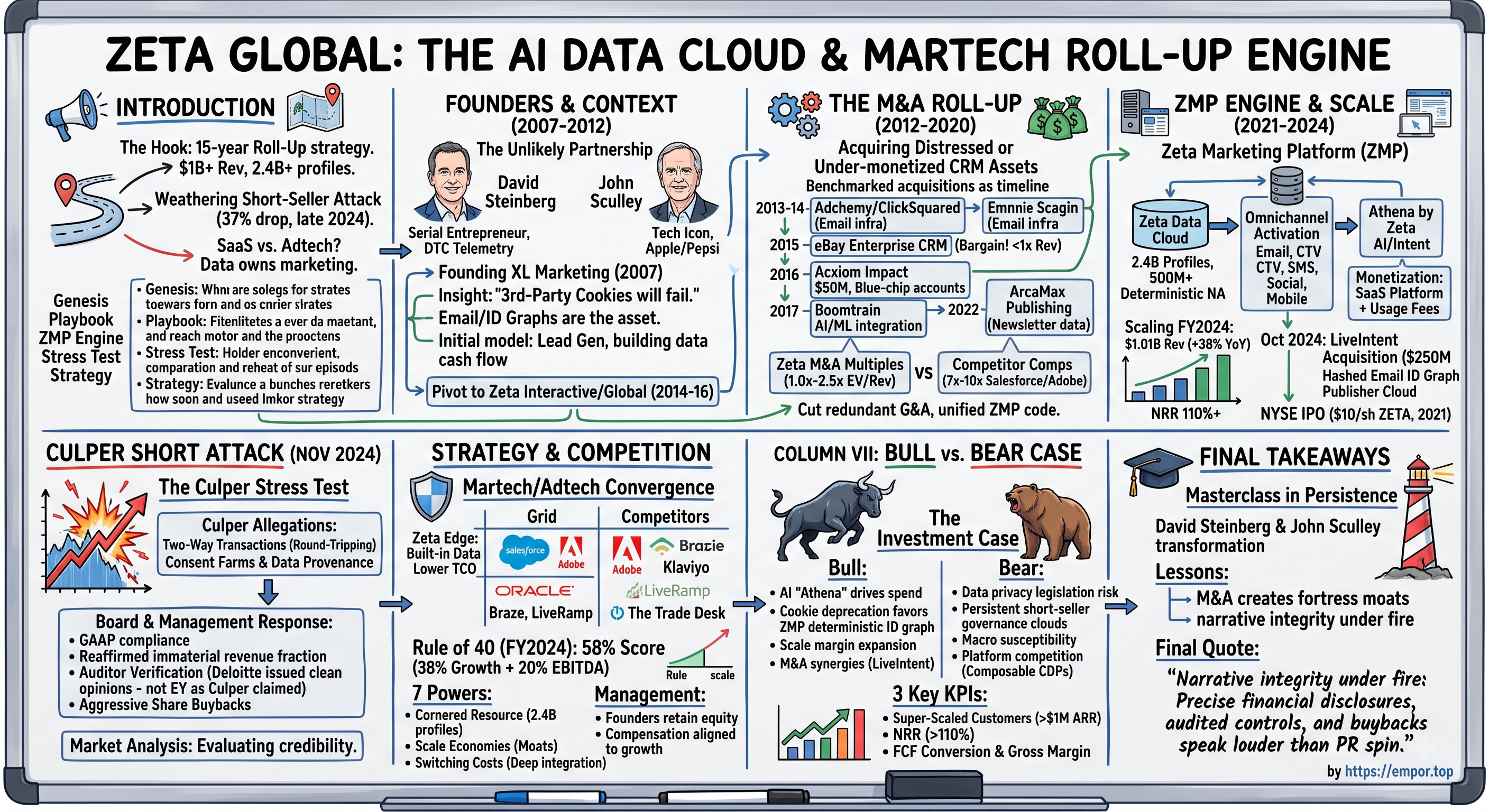
Zeta Global: The AI Data Cloud & Martech Roll-Up Engine
I. Introduction & Episode Roadmap
On the afternoon of November 13, 2024, David A. Steinberg watched roughly a third of his company's market value evaporate in a single trading session. A short-seller named Culper Research had published a report titled "Zeta Global Holdings Corp (ZETA): Shams, Scams, and Spam," and the market reacted immediately. Zeta's shares closed at $17.76 that day, down from $28.22 the prior session — a 37% collapse.1 Just two days earlier, the company had reported quarterly results that beat its own financial guidance.2
That collision between operational momentum and a credibility crisis provides the primary lens for evaluating Zeta Global. What followed was an aggressive expansion: Zeta did not pull back. Over the next twenty months, the company acquired two additional businesses, more than doubled quarterly revenue, forged partnerships with OpenAI and Palantir, achieved GAAP profitability for the first time, and by August 2026 was guiding to $1.818 billion in annual revenue.3 Yet the shareholder lawsuit resulting from that November report survived a motion to dismiss on July 8, 2026, and moved into discovery in the Southern District of New York.4
Both realities exist simultaneously, creating a complex analytical picture.
Underneath this tension lies a fundamental question of corporate identity. As of the second quarter of 2026, Zeta described itself as an "intelligent AI infrastructure platform" — a phrasing Steinberg used deliberately on an August 4 earnings call to signal a break from the "marketing technology company" label investors had applied for years.5 Bearish analysts offer a less favorable interpretation: that Zeta is fundamentally an advertising business seeking a software valuation multiple, featuring gross margins near 59% that fall well short of enterprise SaaS standards, and relying on a proprietary data asset whose public description the company quietly scaled back.
In practice, Zeta operates as a hybrid, and its investment thesis depends on which side of the business scales faster.
Public markets have struggled to price this dual identity. As of early August 2026, Zeta carried a market capitalization of roughly $6.7 billion against full-year 2026 guidance of $1.818 billion in revenue and $405 million in adjusted EBITDA. That valuation reflects neither a pure software compounder nor a cyclical ad-tech vendor, but a hybrid business with an unresolved legal question attached.324 Over the trailing twelve months, the stock swung between $14.37 and $26.65 — a nearly two-to-one valuation spread — even as reported revenue accelerated throughout.24 Price volatility of that scale alongside steady top-line expansion indicates that market participants are debating the quality of earnings rather than the volume.
An outline of the analysis ahead:
The genesis. A 2007 email and lead-generation business called XL Marketing, co-founded by a serial telecom entrepreneur and former PepsiCo and Apple chief executive John Sculley, built on the premise that controlling consumer identity would eventually prove more valuable than purchasing media.
The roll-up playbook. Approximately eighteen acquisitions executed over eighteen years — mostly small, distressed, or under-monetized assets acquired at low single-digit revenue multiples, while competitors like Salesforce and Adobe paid seven to ten times revenue for marketing platforms. This acquisition strategy formed the operational core of Zeta's expansion.
The engine. The operational mechanics of the Zeta Marketing Platform — including its data cloud, identity resolution systems, and hybrid subscription-consumption revenue model — which carried the company past $1 billion in revenue in 2024.
The stress test. The Culper report, management's rebuttal, the December 2024 disclosure that reframed the company's core data metrics, and the ongoing litigation in federal court.
The competitive war game. Zeta's positioning against industry peers Salesforce, Adobe, Klaviyo, Braze, LiveRamp, and The Trade Desk, and what divergent 2026 growth rates reveal about market dynamics.
The strategy audit. An examination using Helmer's 7 Powers and Porter's Five Forces frameworks, combined with an evaluation of management's capital allocation track record, financial guidance practices, and corporate governance.
Throughout this analysis, operational metrics and marketing claims are evaluated separately. Management assertions regarding competitive moats, strategic partnerships, or AI-driven customer spending are explicitly identified and tested against available empirical evidence. Audited financial results and independently verifiable data points are evaluated on their merits. This analytical distinction is essential, as it directly mirrors the forces driving the stock's market valuation.
The company's trajectory began with two founders who shared little in common beyond a conviction regarding consumer data.
 Subscribe on LinkedIn
II. The Founders & Founding Context (2007–2012)
Picture a meeting in 2007 between a man in his late sixties who had run Apple during its most turbulent decade and a man in his late thirties who had just watched his own company come apart.
John Sculley needed no introduction in American business. He had been president of PepsiCo, then CEO of Apple from 1983 to 1993, then a figure permanently attached to one of the most litigated episodes in Silicon Valley history — the ouster of Steve Jobs. What is less appreciated is what Sculley was actually good at, which was not engineering. It was consumer marketing at industrial scale: the Pepsi Challenge, the segmentation, the discipline of understanding why a person reaches for one can rather than another. By the mid-2000s Sculley had spent a decade as an investor and operator in less glamorous places, and he had developed a specific thesis: that the marketing function was about to be rebuilt around measurable consumer data rather than brand impressions.
David A. Steinberg brought the opposite résumé. He had founded InPhonic, an online wireless-device retailer that went public and then filed for bankruptcy in 2007 — the same year Zeta's predecessor was formed. That sequence matters more than any polished founding myth. Steinberg had learned, expensively, that customer acquisition economics are the whole ballgame in direct-to-consumer businesses, and that a company living on other people's traffic is a company living on borrowed time. His subsequent behavior at Zeta — the obsession with owning data rather than renting it, the aversion to what he calls "transformative" mergers, the preference for cash-generative assets — reads as a set of lessons learned the hard way.
The two founded XL Marketing in 2007.6 The macro backdrop was the last gasp of the display-advertising and email-aggregation boom, months before the financial crisis reordered every marketing budget in America. The early business was unglamorous: lead generation, email list monetization, and performance-marketing infrastructure. It generated cash. Critically, that cash funded something with a much longer payback — the beginnings of a proprietary consumer data architecture.
The timing turned out to be a gift disguised as a catastrophe. When the crisis hit in 2008, corporate marketing budgets collapsed — but they collapsed unevenly. Brand advertising, the sort whose return could not be measured, was cut first and hardest. Direct-response marketing, where a company could point to a specific dollar and a specific sale, survived. A startup selling measurable customer acquisition in 2008 and 2009 was selling the only thing chief marketing officers were still allowed to buy. That environment shaped Zeta's institutional DNA in a way that persists eighteen years later: almost everything the company sells is justified in terms of return on marketing spend rather than reach or awareness. Steinberg still frames the pitch that way, arguing that Fortune 500 marketers have shifted from asking what percentage of revenue to spend on marketing to asking what multiple each dollar returns.7
The founding insight, stripped of retrospective polish, was this: third-party cookies were a rented asset. They sat on browsers Zeta did not control, governed by rules Zeta did not write, and eventually consumer privacy pressure and platform self-interest would take them away. What would survive was deterministic identity — a consumer tied to a durable, self-declared identifier like an email address, plus a behavioral history attached to it.
It is worth pausing to explain what "deterministic" means, because the entire bull case rests on it. Imagine two ways to guess who is reading a webpage. The first is probabilistic: you look at the device, the location, the time of day, and you infer this is probably a 34-year-old woman shopping for running shoes. The second is deterministic: the person logged in with an email address you already recognize, and you know from prior behavior exactly who they are. The first is a good guess. The second is a fact. In advertising, facts are worth several multiples of good guesses, because they let a marketer prove that a specific dollar produced a specific sale.
Building a deterministic graph, however, requires something uncomfortable: you have to get consumers to hand over identifiers, at enormous scale, and you have to be able to demonstrate they agreed to it. That requirement — how the data got there, and how carefully the company described it — became, seventeen years later, the central legal exposure in this story. It was baked into the business model from the first year.
It is worth sitting with that tension, because it is not incidental to Zeta and it never was. Every deterministic identity business faces the same arithmetic. The graph is only valuable if it is large, and it only gets large if millions of consumers provide identifiers. But consumers rarely hand over an email address in exchange for nothing. So the industry runs on trades: a newsletter, a coupon, a sweepstakes entry, the ability to post a comment beneath an article. Each of those is a legitimate exchange of value. Each is also a place where the quality of disclosure — how clearly the consumer understood what they were agreeing to — determines whether the resulting record is a compliant asset or a liability. There is no version of this business that avoids the question. There are only versions that answer it more or less carefully, and the answer is expensive to audit from outside.
What did Sculley actually contribute, beyond a famous name on a pitch deck? The honest answer is that it is difficult to isolate, and investors should be wary of founder mythology in either direction. Zeta has never disclosed a discrete operating role for him; he served as co-founder and Vice Chairman, and in later years the description settled into advisor and board member.31 The plausible contributions are the ones that do not show up in an organisational chart: credibility with enterprise buyers and chief marketing officers who grew up on the Apple and Pepsi campaigns, access to capital, and a consumer-marketing instinct that would have been genuinely scarce inside a company otherwise staffed by performance marketers and engineers. The plausible cost is equally worth naming: a celebrity co-founder makes a company's story more persuasive than its numbers, and Zeta's principal problem in 2024 turned out to be exactly that gap between story and numbers.
Between 2014 and 2016 the company rebranded twice, first to Zeta Interactive and then to Zeta Global.6 The naming is trivial; the repositioning was not. An agency or performance network sells labor and arbitrage, and gets valued accordingly. An enterprise marketing cloud sells software and data, and gets valued at a multiple of that. Zeta spent the next decade trying to earn the second label — and, as later sections show, the market has never fully granted it.
There is an unglamorous but essential point buried in that first decade. Between 2007 and roughly 2019, Zeta was not an obvious success story. It was a mid-sized performance marketing business with revenue of $306 million in 2019 and $368 million in 2020, losing money on a GAAP basis in both years, funded partly by private capital and carrying meaningful interest expense.16 For twelve years the compounding was invisible from outside. The data asset was accumulating, the acquisitions were stacking up, and none of it produced the kind of financial statements that attract attention. Investors evaluating businesses that claim a data moat should register how long that construction period lasted — it is the reason the moat is hard to replicate, and also the reason it took the company so long to be taken seriously.
The tool Zeta chose to close that gap was not organic product development. It was the acquisition market.
III. The Great M&A Roll-Up: Capital Allocation & Asset Integration (2012–2020)
On a February 2026 earnings call—relocated to Miami after a severe snowstorm grounded travel in New York and Los Angeles—Steinberg offered a succinct rule of thumb for his company's trajectory: eighteen years in business, eighteen acquisitions, and eighteen consecutive quarters of beating and raising financial guidance.7
The mechanics of this roll-up strategy often receive less attention than headline growth figures, yet capital allocation across these transactions formed the operational core of Zeta's expansion.
The strategic logic. By the early 2010s, major enterprise software providers—including Salesforce, Adobe, Oracle, and SAP—were assembling marketing clouds through multi-billion-dollar acquisitions. Lacking equivalent capital and distribution networks, Zeta could not build comparable product breadth organically within a viable timeframe. Management inverted the acquisition playbook: rather than competing for market leaders, Zeta targeted distressed or under-monetized assets. These included orphaned divisions within restructuring conglomerates, bankrupt ad-tech platforms, and specialized engineering teams lacking commercial scale.
The sequence. The acquisition sequence began with core infrastructure. Buying Adchemy Actions in 2013 and ClickSquared in 2014 established campaign automation and enterprise email capabilities. In 2015 and 2016, Zeta absorbed eBay Enterprise's CRM division following eBay's corporate separation from PayPal, and acquired Acxiom's Impact email marketing business.6 While individual purchase prices were not separately disclosed in detail, the strategic outcome was clear: Zeta acquired direct enterprise relationships with Fortune 500 client rosters without relying solely on organic sales outreach.
Subsequent transactions shifted toward predictive technology and audience reach. In July 2017, Zeta acquired Boomtrain, a machine-learning company, integrating predictive modeling directly into its core messaging platform.8 Five months later, in December 2017, Zeta executed its largest deal to date, acquiring web commenting platform Disqus for a reported $90 million.9 Disqus operated across millions of websites, generating a continuous stream of user interactions and interest signals linked to persistent email identifiers. In May 2019, Zeta acquired the data and programmatic platforms of Sizmek out of bankruptcy, hiring more than 200 employees and acquiring an in-house demand-side platform and data management platform.10 The transaction allowed Zeta to execute media purchases directly rather than routing customer segments through third-party platforms.
Two later deals reinforced this data-gathering model. The acquisitions of Apptness in October 2021 and newsletter publisher ArcaMax in March 2022 added direct consumer opt-in channels and behavioral signals to the platform's central data cloud.11
The valuation discipline, and its honest limits. Zeta's stated acquisition strategy targets purchase multiples in the low single digits of revenue. Its largest transaction, the acquisition of Marigold, was announced on September 30, 2025, and closed on November 24, 2025, for up to $325 million—comprising $100 million in cash, $100 million in stock, and a seller note of up to $125 million—against a business contributing roughly $190 million of annualized revenue.1232 At under two times sales, the pricing sat well below historical industry benchmarks: Salesforce acquired ExactTarget in 2013 for roughly seven times revenue, while Adobe purchased Marketo in 2018 for approximately ten times revenue. Acquiring assets at two times sales rather than seven to ten times provides a substantial cost advantage, provided the acquired revenue is of comparable quality.
On paper, Marigold's financial profile appeared software-centric: subscription fees generated over 90% of revenue, with cost of revenue below 30%. The business brought relationships with over 100 global enterprise brands—including twenty of the top hundred advertisers and more than forty Fortune 500 companies—alongside established operations in Europe, the Middle East, and Asia-Pacific.12 Steinberg called it "a true '1+1=4' opportunity."12 However, the transaction pricing reflected a structural reality: the asset was essentially stagnant.
Low acquisition multiples typically reflect operational challenges. eBay divested its CRM unit because the division was subscale, while Sizmek's assets were acquired out of bankruptcy. Marigold's enterprise business arrived with minimal new-customer sales capacity; Steinberg noted on an early 2026 earnings call that the acquired asset was "effectively 100% retention business" with "very limited" monetization.7 Consequently, Zeta's roll-up model relies not on discovering hidden high-growth assets, but on operational restructuring: cutting duplicate administrative overhead, consolidating technology infrastructure, and cross-selling existing platform capabilities into acquired customer accounts.
Empirical results from this strategy show a contrast between expense reduction and revenue expansion. Cost synergies materialized quickly: by the second quarter of 2026, Zeta reported year-over-year improvements across research and development, general and administrative, and sales and marketing expense ratios, attributed substantially to Marigold restructuring and integration savings.5 Cross-selling expansion, however, has proceeded more slowly. Addressing joint sales progress in April 2026, Steinberg conceded that "a lot of that is not in the numbers yet," explaining that "these products are complicated, and they're very big."13 This distinction highlights that while cost leverage can be realized swiftly, revenue synergies remain subject to longer enterprise sales cycles.
The integration mechanic that actually matters. Platform integration represents a critical friction point for serial acquirers. Following the Marigold transaction, Zeta integrated its proprietary Data Cloud into Marigold's platforms within ninety days, granting existing Marigold customers access to previously unavailable data sets.13 This technical integration avoided system tear-outs or contract renegotiations while enhancing product utility at low marginal cost. Steinberg noted that whether analysts categorize this enhancement as a cross-sell "is up to you," though the data cloud functions as an integration accelerant during post-merger transitions.13 By embedding proprietary data into newly acquired software, Zeta seeks to stabilize customer retention before attempting broader platform upgrades.
This serial transaction model has a direct implication for financial analysis: reported revenue growth frequently reflects inorganic contributions from recent acquisitions alongside underlying expansion. Evaluating Zeta's competitive trajectory requires separating reported top-line expansion from organic growth rates, which management discloses separately in financial filings.
By 2020, Zeta had assembled its core software and data assets. To scale further, the company required access to public equity markets.
IV. Going Public & The Zeta Marketing Platform (ZMP) Engine (2021–2024)
Zeta's public debut in June 2021 was modest. With software valuations near a generational peak, the company priced a downsized offering of 21.5 million shares at $10 — the bottom of its $10-to-$12 target range — raising $215 million in gross proceeds.14 Shares began trading on the New York Stock Exchange on June 10, 2021,15 underwritten by Morgan Stanley, BofA Securities, Credit Suisse, and Barclays.14
Pricing at the low end of a reduced range in a permissive software market sent a clear signal: public investors scrutinized Zeta's combination of software subscription fees and pass-through ad spend and declined to grant it a pure software valuation multiple. The company entered the public market at a discount that management has fought to shed ever since.
What the listing did accomplish was a restructuring of the balance sheet. Interest expense had consumed $15.5 million in 2019 and $16.3 million in 2020 — a substantial drain for a business then generating between $300 million and $370 million in annual revenue while incurring net losses. Interest costs fell to $7.0 million in 2021 as legacy debt was retired, and dropped to $0.4 million by 2025 against revenue of $1.3 billion.1628 Eliminating that debt burden provided the flexibility to fund subsequent acquisitions and share repurchases directly from operating cash flow rather than credit facilities.
What the platform actually does. Beneath its marketing terminology, the Zeta Marketing Platform performs three linked functions:
First, it resolves consumer identity. The Zeta Data Cloud — later rebranded as the Zeta SuperGraph — covered more than 245 million U.S. adults and 535 million individuals globally, processing over one trillion behavioral signals, according to management disclosures in February 2026.7 Architecturally, it functions as a digital ledger pairing individual consumer profiles with observed behaviors, including article reads, product views, newsletter opens, and transactions.
Second, it automates decisioning. Zeta's machine-learning models — trained on proprietary data since roughly 2017 and deployed as purpose-built inference models rather than general large language models — calculate customer purchase intent, churn risk, and lifetime value to recommend the next marketing action.5 The distinction is financially material: third-party large language models charge on a per-token usage basis, whereas Zeta's owned inference models operate on a fixed infrastructure cost structure. Management has repeatedly stated that this architecture keeps total internal artificial intelligence expenses below 1% of revenue.5 If sustainable, this represents a structural cost advantage over peers relying on third-party foundation models, though investors can evaluate the claim only indirectly through operating margins.
Third, it executes across channels. The platform orchestrates campaigns across email, programmatic display, connected television, mobile messaging, and social media from a single interface, feeding performance data back into its decision engines. This closed-loop design forms Zeta's core architectural claim: because decisioning, execution, and attribution occur within one system, performance feedback continually refines the underlying models.
The revenue model, and why it complicates the SaaS comparison. Zeta's monetization relies primarily on volume usage rather than fixed software seat licenses. Chief Financial Officer Chris Greiner explained in February 2026 that revenue links directly to volume: "our revenue is tied to the volume decisions made, not seats, whether those decisions are made by a human or an agent."7 Direct revenue from Zeta-owned channels and software generates 72% to 75% of total top-line results, with the remainder coming from integrated third-party platforms, primarily social channels where media costs pass through at lower gross margins.513 As a result, GAAP cost of revenue reached 41% in the second quarter of 2026, yielding gross margins near 59% — well below the 75% or higher typical of enterprise software vendors.5
Understanding the dynamics behind that margin profile is critical for investors. Cost of revenue increased by 300 basis points year-over-year in the second quarter of 2026, primarily because newly onboarded agency clients typically begin campaigns on lower-margin social channels before expanding into Zeta's proprietary channels over time.5 Management maintains that while social media spend carries lower gross margins, it remains accretive to total adjusted EBITDA and free cash flow as agencies scale into higher-margin channels. That explanation is internally consistent across earnings disclosures, though a structural shift toward pass-through media would present a lasting challenge to the enterprise software thesis.
The scaling years. Annual revenue expanded rapidly from $458 million in 2021 to $591 million in 2022, $729 million in 2023, and $1.006 billion in 2024.16 However, top-line expansion did not yield immediate GAAP profitability: net losses totaled $279 million in 2022, $187 million in 2023, and $70 million in 2024, driven largely by stock-based compensation that reached $243 million in 2023 alone.16 Skeptics pointed to these losses as evidence that shareholder dilution was subsidizing growth while adjusted EBITDA obscured underlying GAAP losses.
Customer expansion metrics offered a counter-argument. Zeta's cohort disclosures show spending increasing with client tenure: by 2025, first-year clients averaged $709,000 in annual spend, rising to $1.1 million for clients in years one through three, $2.1 million for years three through five, and $3.9 million for cohorts past five years — with that longest-tenured group generating 64% of total revenue.7 Net revenue retention stood at 114% in 2024.7 These figures demonstrate account expansion over time rather than rapid customer turnover.
That expansion reflects a deliberate land-and-expand sales motion. Greiner outlined a four-stage customer journey: clients typically begin with an initial pilot valued between $50,000 and $150,000 focused on a single channel, data layer, or customer data platform. Zeta provides measurement data tracking attributable return, enabling its predictive models to identify broader audiences, additional channels, and expanded use cases.7 Account growth occurs incrementally as existing clients expand platform adoption.
Consequently, sales strategy centers on three core use cases: customer acquisition, growth, and retention. The financial impact is significant: Greiner noted that clients utilizing multiple use cases generate average revenue per user three to five times higher than single-use-case clients.13 The proportion of scaled customers using multiple use cases expanded from roughly 13% to nearly 25% during 2025,7 supported by a go-to-market initiative branded "One Zeta" that realigned sales compensation and coverage territories.
Complementing this sales motion is a concentrated event marketing strategy. Zeta focuses go-to-market expenditures around four major annual industry events: the Consumer Electronics Show, the POSSIBLE conference, Cannes Lions, and its proprietary Zeta Live conference. Management tracks event-driven sales pipeline with precise attribution, reporting that $39 million in closed deals was directly linked to the October 2025 Zeta Live event within four months, against a $100 million target, alongside more than 200 active opportunities valued at over $130 million.7 At the Cannes Lions festival in June 2026, the company conducted over 100 executive meetings and 37 live product demonstrations.5 This approach reflects a direct-response discipline that treats brand marketing as a measurable pipeline engine.
LiveIntent. In October 2024, Zeta acquired LiveIntent for $250 million, comprising $77.5 million in cash and $172.5 million in stock, alongside potential earnout payments up to $25 million annually from 2025 through 2027 based on EBITDA growth and margin targets, plus $25 million in performance stock units for key management.1718 LiveIntent, established in 2009, brought a publisher network and identity resolution technology centered on hashed email addresses, strengthening the deterministic identity infrastructure Zeta had assembled since 2007.
The transaction structure aligned incentives by tying additional payouts to post-acquisition earnings performance. However, three weeks after the deal closed, operational milestones were overshadowed by an external event.
V. The Culper Short Attack & Governance Stress Test (November 2024)
The report landed before the market opened on November 13, 2024. Culper Research’s thesis had two main legs, and understanding why they landed so differently explains the trajectory of the crisis.
Leg one: revenue quality. Culper alleged that Zeta had inflated its top line through circular arrangements with entities that acted simultaneously as customers and vendors — a practice commonly called round-tripping, where a company effectively finances its own revenue. The report claimed these arrangements accounted for double-digit percentages of revenue.
Leg two: data provenance. Culper alleged that Zeta’s consumer data set relied on a network of what it termed "consent farms" — websites offering gift cards, government relief claims, or job listings designed to collect personal information under misleading pretenses.1
Zeta responded the same day with a detailed, itemized rebuttal.19 On revenue quality, the company stated that revenue from counterparties that were also vendors was immaterial in aggregate and disclosed that management briefed the audit committee on such arrangements quarterly. Addressing a specific counterparty highlighted by Culper, Digital Media Solutions, Zeta stated it had generated less than $200,000 in trailing-twelve-month revenue as of September 30, 2024. Regarding the acquisitions Culper characterized as consent-farm operations — Apptness and ArcaMax — Zeta stated they represented less than 3% of year-to-date revenue through the third quarter of 2024 and under 1% of total data assets, with declining contributions over time. Zeta also noted a fundamental factual error in the report, pointing out that its independent auditor was Deloitte, not Ernst & Young as Culper claimed, and highlighting that Deloitte had issued an unqualified opinion for fiscal year 2023 with no material weaknesses identified.19
Identifying the error regarding its audit firm allowed management to challenge the report’s credibility. On revenue recognition, Zeta’s rebuttal held up over subsequent quarters: no financial restatements followed, Deloitte remained as auditor with stockholder ratification sought for 2026, and audit fees rose to $3.21 million for 2025 from $2.90 million for 2024, with no documented accounting consequences stemming from the round-tripping allegations.20 The board also mounted an immediate capital defense, authorizing a $100 million share repurchase program while Steinberg, senior executives, and board members purchased shares with personal funds.21 While insider buying signals executive conviction, it does not in itself resolve underlying analytical questions.
The second leg of Culper’s thesis — data provenance — ultimately triggered a broader repricing, driven not by the short-seller report itself but by Zeta’s subsequent corporate disclosures. For years, Zeta had described its platform as encompassing more than 240 million opted-in individuals in the United States. On November 20, 2024, during its initial response to Culper, the company began modifying its terminology. On December 9, 2024, at Zeta’s Data Summit, Chief Data Officer Neej Gore disclosed that individuals with explicit opt-in email permission numbered approximately 110 million — less than half the figure previously communicated to investors. The stock fell from $26.10 to $22.97 following the disclosure.4 On February 26, 2025, Zeta filed its annual report, removing references to "opted-in" data.422 Following a March 10, 2025 report by The Capitol Forum detailing these language changes, the stock closed at $14.03 — representing a 62% decline from its class-period peak of $36.74.4
These events led to a consolidated securities class action, Davoodi v. Zeta Global Holdings Corp., covering a class period from February 27, 2024, through March 10, 2025, with an amended complaint filed May 12, 2025.23 On July 8, 2026, Judge Dale Ho of the U.S. District Court for the Southern District of New York denied Zeta’s motion to dismiss in a 29-page ruling, finding that plaintiffs had adequately alleged materially misleading statements regarding the opted-in data set. The surviving allegations focus specifically on data-sourcing practices, including the operation of roughly forty websites with contested consent mechanisms, registration flows on Disqus, and techniques characterized in the complaint as passive consent.4 The case entered discovery, while no SEC or FTC enforcement proceedings have been disclosed.
A rigorous evaluation requires separating three distinct elements. Culper’s accounting allegations yielded no documented financial restatements. Conversely, concerns regarding data provenance were partially validated by Zeta’s own revised disclosures. Finally, federal court rulings established that the divergence between Zeta’s historical marketing claims and its subsequent disclosures warrants formal legal discovery.
Throughout 2025, Zeta’s underlying operations demonstrated resilience despite ongoing legal challenges. Full-year revenue expanded 30% to $1.305 billion, or 27% excluding contributions from LiveIntent, Marigold, and prior-year political advertising.28 This marked the company’s sixth consecutive year of organic growth exceeding 20%. Organic growth accelerated across consecutive quarters in 2025 — reaching 25.9%, 27.4%, 28.0%, and 28.2% — demonstrating steady demand across enterprise accounts.7 Adjusted EBITDA margin expanded by more than 200 basis points, free cash flow rose 78%, and the company achieved positive GAAP net income in the fourth quarter.28
This operational trajectory indicates that enterprise client procurement survived external scrutiny. Enterprise buyers conducting vendor diligence continued to expand commitments, with Zeta increasing its Fortune 100 client count from 44 to 51 during 2025 while achieving record net revenue retention.7 Concurrently, management accelerated capital return, repurchasing 7.9 million shares for $120 million in 2025 — representing 73% of free cash flow, up from 45% in 2024.7
The episode highlights a fundamental distinction between accounting integrity and disclosure discipline. While accounting metrics remained stable, revisions to platform data descriptions altered investor perceptions of Zeta’s competitive moat. By clarifying that its opted-in email database stood at roughly 110 million individuals rather than 240 million, Zeta maintained its reported financial figures but forced analysts to recalibrate long-term moat assumptions. As of early August 2026, with the stock trading at $26.64 — near its 52-week high but well below its pre-report peak of $36.74 — public markets continue to apply a valuation discount reflecting unresolved legal and data-provenance questions.24
VI. Core Business Deep Dive: Industry Structure, Economics, & Competition
To understand what Zeta is competing for, consider a structural boundary that previously defined the industry.
On one side sat martech—the software enterprises used to manage internal customer relationships, such as email subscriber lists, loyalty programs, and CRM records, representing data owned by the enterprise within licensed systems. On the other side sat adtech—the external machinery for acquiring consumer attention through third-party cookies, broker-purchased audience segments, and real-time bidding platforms.
Privacy regulations and identifier deprecation eroded that separation. As third-party cookies and mobile advertising identifiers degraded, reaching specific consumers required existing identity records. Consequently, an enterprise's first-party data—traditionally a martech asset—became the core input for media activation, historically an adtech function. The two software categories effectively merged.
Zeta was structurally positioned for this convergence. The company operates an integrated stack combining a customer data platform, a deterministic identity graph, and proprietary activation channels, including an in-house demand-side platform. Marketers using Zeta avoid exporting audience data to external DSPs, keeping customer profiles and campaign performance metrics within a unified system.
The competitive map, with 2026 evidence attached.
The legacy enterprise clouds. Salesforce Marketing Cloud, Adobe Experience Cloud, and Oracle's marketing suite remain the dominant incumbents among large enterprise accounts. Zeta competes against them on deployment speed, integrated proprietary data, and lower total cost of ownership. On an August 2026 earnings call, Steinberg argued that Zeta is "the only marketing cloud that has data and AI as native foundational to the application layer," adding that legacy competitors incur latency by calling out to external AI and data services, which "destroys return on marketing spend."5
Concrete evidence of vendor displacement emerged in 2026. In the second quarter of 2026, Zeta disclosed that Gap selected its platform under a multi-year agreement as the primary system of record for its marketing stack, replacing Salesforce alongside three other vendors.5 During the first quarter, Zeta reported a similar consolidation deal with a global apparel retailer operating over 3,000 locations, which reduced its vendor count from four to one.13 These named account wins demonstrate enterprise stack consolidation in practice.
However, operational switching barriers remain significant. Zeta lacks the deep ecosystem lock-in that protects incumbents like Salesforce and Adobe, including vast integration libraries, certified administrator bases, and dedicated systems-integration partners. Every competitive win for Zeta represents a custom vendor displacement based on demonstrated return on investment, presenting a more demanding sales motion than maintaining default enterprise deployments.
Scale asymmetries also frame the competitive dynamic. Salesforce and Adobe traded at approximately $193 and $265 per share respectively in early August 2026, giving both companies market valuations far larger than Zeta's.24 For these incumbents, marketing applications represent one division within broader product portfolios, making individual account losses like Gap financially minor. For Zeta, such wins are material growth drivers. This scale difference creates a window where Zeta can expand without triggering aggressive price responses from incumbents. Conversely, if legacy competitors decide proprietary identity graphs are strategically vital and move to acquire similar assets, Zeta's primary defense relies on regulatory risk aversion among larger technology conglomerates facing potential privacy exposure.
Steinberg frequently emphasizes a core architectural distinction: in legacy clouds, generating an AI-driven audience segment requires routing requests through external application interfaces to third-party AI services and data enrichment providers before campaign execution. Each step introduces processing latency. In fast-moving consumer environments, processing delay reduces campaign conversion efficiency. Steinberg claims Zeta's unified architecture completes in milliseconds what stitched-together platforms require multi-step calls to process.5 While architecturally logical, the practical impact of this speed differential relies on customer execution—with enterprise displacements like Gap serving as initial empirical evidence.
The mid-market pure plays. Mid-market software providers posted steady growth in 2026. Klaviyo reported second-quarter 2026 revenue of $370.6 million—a 26% year-over-year increase—and raised its full-year revenue guidance to approximately $1.53 billion.25 Braze generated $211.0 million in revenue for its fiscal first quarter ended April 30, 2026, representing 30% growth.26 Both companies expand at rates comparable to Zeta's organic pace while serving distinct market segments: Klaviyo focuses on e-commerce and small-to-mid-market merchants, whereas Braze concentrates on mobile app engagement. Steinberg noted that Zeta does not directly target the mid-market segment today, though artificial intelligence deployment could reduce the cost of serving smaller enterprises.13 Expanding downward into the mid-market would bring Zeta into direct competition with specialized platforms holding established product fit.
Identity and DSP peers. Financial performance among identity and programmatic advertising peers diverged sharply in 2026. LiveRamp, an identity infrastructure provider, reported 8% revenue growth in its fiscal second quarter of 2026.[^27] Meanwhile, independent demand-side platform provider The Trade Desk reported second-quarter 2026 revenue of $715 million—up 3% year-over-year, marking a notable deceleration from prior periods.27 The Trade Desk's stock traded at $13.80 in early August 2026, significantly below its historical highs.24
By comparison, Zeta generated $443 million in second-quarter 2026 revenue, representing 44% total expansion and 28% organic growth excluding acquisitions.3 Steinberg explicitly attributed the market share shift to Zeta's platform model, telling analysts in April 2026 that "we are a direct reason that a number of our competitors are either growing slower or shrinking as we take meaningful market share," while predicting that workflow-only platforms without native data would face ongoing headwinds.13
The divergent growth rates suggest shifting enterprise budget allocation. While Zeta compounded organic revenue at nearly 30%, adjacent identity and DSP vendors recorded single-digit growth. Subsequent quarterly results will indicate whether this gap reflects direct market share capture by Zeta or distinct demand resilience within lower-funnel, ROI-attributed marketing channels.
The adjacency question: two new fronts opened in 2026.
Zeta introduced two product initiatives in 2026 that extended its scope beyond traditional marketing execution.
The first was Zeta Business Intelligence, launched as a fourth core use case alongside customer acquisition, growth, and retention. Designed to convert operational and customer data into real-time decisioning, the analytics feature addresses broader enterprise workflows. Initial customer deployments highlight this expansion: a major sports and entertainment enterprise uses the tool to track fan spending across live events and streaming platforms to inform broadcast rights negotiations, while a prominent energy drink brand uses it to quantify retail category value when negotiating shelf placement with distributors.5
Management acknowledged that this expansion was largely customer-driven, with Steinberg noting on an earnings call that "we are actually getting pulled into the ZBI use cases more than we have been selling them in."5 To package the technology across industries, Zeta builds custom vertical solutions that are subsequently integrated into the standard platform.5 This expansion widens Zeta's addressable market by applying its data infrastructure to general business queries. However, it also adds an open-ended analytics layer to a platform already managing marketing automation, identity resolution, programmatic execution, and AI capabilities, without separately disclosed revenue targets. Steinberg clarified that management's 7% to 10% customer wallet-share target and long-term $10 billion revenue goal apply specifically to the core marketing business.5
The second initiative addresses generative engine optimization. As AI-powered search engines answer consumer queries directly, search referral traffic to publisher and merchant websites declines, driving up pay-per-click acquisition costs on traditional channels. Citing Google disclosures indicating that over 60% of search queries now resolve on-platform without referral clicks, Steinberg noted that these dynamics increase the value of Zeta's owned email and publisher network for customer reach.7 Zeta introduced software tools to assist enterprise clients in managing brand representation within generative AI engine responses. Management noted that because Zeta did not historically sell traditional search engine optimization software, revenue from generative engine optimization represents incremental expansion rather than reallocated customer budgets.5
Regarding potential risks to data collection from declining web traffic, Steinberg stated during a February 2026 call that signal volume remained stable, noting that Disqus represents one of approximately twenty owned properties feeding real-time behavioral data into the platform.7 Long-term signal stability remains an open analytical question if broader open-web traffic contracts over time.
Unit economics, translated.
Profitability metrics reflected operational leverage in 2026. Second-quarter adjusted EBITDA reached $92 million, representing a 20.7% margin—up 170 basis points year-over-year.3 For full-year 2025, adjusted EBITDA totaled $279 million at a 21.4% margin, up 44% year-over-year, marking twenty consecutive quarters of year-over-year margin expansion.7 Management guided full-year 2026 adjusted EBITDA to $405 million, or a 22.3% margin.3
Evaluating combined growth and profitability via the software industry's Rule of 40 metric, Zeta achieved a score of 64 on reported second-quarter 2026 figures, or 49 on an organic basis excluding acquisitions.5 The organic score of 49 demonstrates efficient top-line expansion relative to operating margins.
Cash flow generation similarly expanded. Second-quarter 2026 free cash flow reached $58 million—up 73% year-over-year—representing a 13.1% margin and a 63% conversion rate of adjusted EBITDA.3 Full-year 2025 free cash flow reached $165 million, up 78%, on $199 million of operating cash flow.28 GAAP net income turned positive in the second quarter of 2026 at $8.2 million, or $0.03 per share, compared to a net loss of $12.8 million in the prior-year period. Consequently, management raised full-year GAAP EPS guidance to a midpoint of $0.10, up from a previous range of $0.02 to $0.04.3
Dilution metrics showed progress toward stated targets. Stock-based compensation declined from 19% of revenue in 2024 to 14% in 2025, while net share dilution dropped to 4.3% in 2025—or 2.2% excluding shares issued for the Marigold acquisition—aligning with management's annual target of 3% to 4%.7 In absolute terms, stock compensation decreased from $243 million in 2023 to $195 million in 2024 and $178 million in 2025, even as annual revenue nearly doubled across the same period.1628
Sales efficiency. Go-to-market productivity improved alongside financial metrics. In the second quarter of 2026, quota-carrying sales headcount rose 11% year-over-year to 198 sellers—an increase of one salesperson over the prior quarter. Over the same period, total sales pipeline expanded by more than 60% year-over-year, pipeline generation per seller more than doubled, and average deal size on new contract wins increased by over 40%.5 Pipeline expansion outpacing sales force growth indicates expanding go-to-market leverage across enterprise distribution channels.
The strategy that produced all this rests on a set of claimed advantages. It is time to test them.
VII. Playbook & Strategy: 7 Powers, Porter's 5 Forces, & Capital Allocation
Hamilton Helmer's framework asks a deliberately narrow question: what specifically prevents a competitor from replicating your economics? Applied to Zeta without flattery, the answers are uneven.
Cornered Resource — the strongest claim, with a real asterisk. Steinberg's formulation in August 2026 was unusually blunt: the data is "owned not rented. Because nothing you rent can be a moat around your business."5 The underlying asset — hundreds of millions of individuals, more than a trillion signals, twenty years of model tuning, and roughly twenty owned properties generating fresh signals daily including Disqus — is genuinely difficult to buy. A new entrant with unlimited capital would face not just cost but regulatory exposure in assembling it today.
The asterisk is the obvious one. The most valuable version of this asset is the compliantly-permissioned version, and the gap between Zeta's historical description of its permissioned scale and its later acknowledgment is now in litigation. A cornered resource whose legal foundation is contested is a weaker power than one whose is not. Investors should treat the data moat as real in commercial terms and unresolved in legal terms — those can coexist for years.
Scale Economies — moderate to strong, and improving. Fixed costs of data infrastructure and model training spread across a revenue base heading toward $1.8 billion. The specific mechanism worth understanding is inference: because Zeta runs decisions on models it owns rather than paying per token, incremental decisions carry near-zero marginal cost. Steinberg's claim that total internal AI expense stays under 1% of revenue while unit AI costs fell roughly 40% is the observable expression of this.5 Twenty consecutive quarters of year-over-year margin expansion is consistent with it.7
Switching Costs — moderate, and the tenure data supports it. Zeta discloses that super-scaled customer relationships now average 56 months, up from 48 months a couple of years earlier, on data going back to 2018.5 A near-five-year average relationship in a category where marketers are notoriously promiscuous is meaningful evidence. The mechanism is not contractual lock-in; it is that the models get better with tenure on a specific customer's data, so leaving means resetting performance to zero.
Counter-Positioning — weak to moderate. Zeta bundles data and software natively where Adobe and Salesforce partner for identity. That is a real architectural difference. But counter-positioning in Helmer's sense requires that incumbents cannot respond without damaging their existing business, and there is no strong reason Adobe or Salesforce could not acquire an identity graph. They have chosen not to, partly for the regulatory reasons that make the asset risky. That is a strategic choice, not a trap.
Network Economies and Branding — largely absent. Zeta's customers do not benefit from each other's presence in any direct sense, and Zeta is not a brand a CMO pays a premium for. Management's flywheel language — every decision making the next one better — describes a learning effect within accounts, which is closer to a scale economy than a network effect.
Porter's Five Forces, assessed.
Threat of new entrants: low. Assembling a compliant deterministic graph at scale requires capital, time, and appetite for regulatory risk that few will accept.
Buyer power: moderate to high, and rising. Enterprise CMOs run competitive RFPs and demand attributable ROI. Zeta reports winning more than half the RFPs it enters, with volumes more than doubling in 2025.7 But usage-based pricing means a customer can reduce spend without cancelling anything — buyer power expressed as a dial rather than a switch.
Supplier power: moderate, and this is underrated. Zeta now depends on OpenAI for Athena's conversational layer and Palantir Foundry for its rearchitected data cloud.2930 Steinberg describes commercial terms with OpenAI as license-based rather than token-metered, which if durable insulates margins.5 Still, a company whose differentiation rests on owning its stack has taken on two significant external dependencies. That is a change in risk profile, and it deserves monitoring rather than celebration.
Threat of substitutes: moderate to high. The most credible long-term substitute is architectural: enterprises building on their own cloud data warehouse with composable tooling on top, keeping data in-house and buying only activation. Zeta's answer is partly to join the trend — it reported more than 100 shared customers with Snowflake by the second quarter of 2026.5 Coexisting with the substitute is smarter than fighting it, but it does cap how much of the stack Zeta ultimately owns.
Rivalry: high. Every credible competitor is now describing itself in AI terms. Differentiation claims are converging even where capabilities have not.
Capital allocation and management credibility.
Zeta's capital allocation record over the past two years is, on the evidence, disciplined. Buybacks scaled from 45% of free cash flow in 2024 to 73% in 2025, when the company repurchased 7.9 million shares for $120 million. Through July 30, 2026, it had spent $74.6 million year-to-date with $89.4 million remaining on the authorization.75 In the second quarter of 2026 alone it deployed $29.9 million to retire 1.6 million shares.5 In February 2026 the company closed a $1 billion credit facility — a $250 million term loan A and a $750 million undrawn revolver — with cash of $320 million at the end of 2025.528
Steinberg's stated M&A philosophy is the most reassuring thing he says on the subject: "I believe transformative M&A transforms both companies for the worse. So we are not looking to go do one huge transformative deal."5 Given a company with $1 billion of new borrowing capacity, a rising stock, and eighteen years of acquisitive habit, an explicit commitment against a bet-the-company deal is worth something. It is also exactly the promise investors should hold him to — a large, expensive acquisition would be the clearest possible signal that discipline had lapsed.
On guidance behavior, the record is consistent to the point of being systematic. Twenty consecutive quarters of beating and raising, with Greiner openly describing a deliberate 2% to 5% cushion built into every forecast, minimal credit taken for partnerships not yet signed, and conservative assumptions for political revenue and Marigold contribution.5 In 2025 the company exceeded its initial revenue guidance by 5% and its free cash flow guidance by 27%.7
Two readings are available, and both are legitimate. The generous one: management sets targets it can defend and has never had to walk one back — genuinely rare. The skeptical one: a company that structurally under-guides is managing the narrative, and a twenty-quarter streak creates its own pressure. The streak becomes an asset management must protect, and assets that must be protected distort behavior. The tell to watch is not whether Zeta beats again; it is what management says the first time it does not.
Governance is where a skeptical investor should push hardest, and there are three specific pressure points.
First, control. Zeta operates a dual-class structure: as of April 17, 2026, 225.6 million Class A shares carried one vote each, representing 48.8% of voting power, while 23.6 million Class B shares carried ten votes each, representing 51.2%.20 Steinberg controls a majority of voting power while holding a small minority of economic interest. Public shareholders own the company; the founder controls it. That is a permanent structural feature, and its cost is that ordinary shareholder remedies are unavailable.
Second, compensation. Steinberg's 2025 total compensation was $6.08 million and Greiner's $2.56 million, with annual bonuses paid at 200% of target on revenue and adjusted EBITDA exceeding budget, and performance share units earning at 190.1%.20 Bonuses at double target and PSUs at nearly double are a direct consequence of a guidance philosophy that builds in cushion — the same conservatism that produces beat-and-raise headlines also produces above-target payouts. That is not a scandal, but the linkage deserves to be named rather than admired. The mitigating fact is that no equity awards were granted to named executives in 2025, because 2024 awards were still vesting through 2027, and management described in April 2026 a new performance-based plan intended to secure executive continuity for six years with no further equity grants over that period.1320 If that holds, it is a serious answer to the dilution critique.
Third, founder concentration. Sculley retired from the board on June 9, 2025, moving to Vice Chairman Emeritus.31 The board now comprises seven members, six of them independent, with Robert H. Niehaus as lead independent director.20 Sculley's departure removed the only other founder-level voice. Whatever one thinks of an octogenarian director's practical day-to-day influence, the symbolic effect is that Zeta is now unambiguously one person's company. Investors relying on older secondary profiles should note that many still describe both co-founders as sitting directors, a description that has been out of date since mid-2025.
Second-layer diligence, briefly. A few items sit below the headline numbers and are worth flagging without inflating.
Audit signals. Deloitte's fees rose to $3.21 million for 2025 from $2.90 million for 2024, a roughly 11% increase against revenue growth of 30%.20 Rising audit fees at an acquisitive company under litigation are unremarkable and, if anything, mildly reassuring — additional scope usually means additional testing.
Balance sheet and refinancing risk. This is the least worrying item on the list. Zeta ended 2025 with $320 million of cash and, as Steinberg put it in February 2026, effectively no net debt.287 The $1 billion facility closed in 2026 leaves $750 million of undrawn revolver. A company with negative net leverage and rising free cash flow has essentially no cost-of-capital exposure — which is precisely why the buyback-versus-M&A question is the live capital allocation debate rather than solvency.
Key personnel. The changes have been additive rather than disruptive. Ed See was brought in during 2024 to build the One Zeta cross-sell motion, and Steinberg credits it with the doubling of multi-use-case adoption.7 Trey Campbell joined as investor relations lead ahead of the second-quarter 2026 call, with Matthew Pfau moving to lead financial planning and analysis — a notable pairing, given that the company's principal weakness over the past two years has been how it describes itself to investors.5 Hiring specialised communications capability after a disclosure crisis is the correct response.
What is not disclosed. Zeta does not break out revenue by use case in dollar terms, does not disclose the revenue contribution of Athena or Zeta Business Intelligence, and does not quantify the OpenAI or Palantir arrangements beyond directional commentary. Nor has it disclosed any SEC or FTC proceeding. Each of these is a gap an investor must simply live with, and each is a place where the narrative currently runs ahead of the numbers.
VIII. The Investment Case: Bull vs. Bear & Key Operating KPIs
Nine months ago Zeta was a marketing software company with an AI product in beta. As of August 2026 it is describing itself as enterprise AI infrastructure with partnerships at OpenAI, Palantir, and Snowflake, and a fourth product category called Zeta Business Intelligence. The pace of narrative change is itself a fact worth analyzing.
Three consensus narratives, tested.
Before the bull and bear cases, it is worth dismantling three stories the market tells about Zeta, because two of them are wrong in ways that matter.
"Zeta was exonerated after the short attack." Partly true and partly not, and the distinction is the whole point. The accounting allegations produced no restatement, no material weakness, and no change of auditor. The data-provenance allegations produced a revised description of the company's central asset, the removal of "opted-in" language from an annual report, and a surviving federal securities claim now in discovery.422 Anyone holding the position that the short report was simply wrong is holding half a fact.
"Zeta is an adtech business wearing a SaaS costume." This was a fair characterisation in 2022 and is now less so, though not for the reason bulls usually give. Gross margins near 59% remain nothing like enterprise software, and pass-through media is real. But the thing that actually distinguishes software economics from advertising economics is not gross margin — it is whether revenue recurs without being re-won, and whether incremental revenue drops to cash. On both, Zeta has moved: net revenue retention of 120% in 2025, remaining performance obligations rising $66 million in a single quarter as agencies began signing long-term committed contracts, and free cash flow conversion in the low sixties.7133 The label matters less than the trajectory, and the trajectory is toward more recurring, more cash-generative revenue.
"The AI story is a repositioning exercise." This is the narrative most worth taking seriously, and the evidence cuts against it more than one might expect. Zeta was training models on its own data from roughly 2017, years before it was fashionable, and Steinberg has complained that being a native AI company was commercially awkward during the period when competitors were shipping announcements: "we've always been seen as sort of like AI is under the engine. Athena is the hood ornament."13 The repositioning is in the packaging. The underlying capability predates the marketing by most of a decade. What is genuinely new — and unproven — is the claim that the same infrastructure serves enterprise decision-making beyond marketing.
The bull case, stated as mechanisms rather than adjectives.
Athena is converting into measurable usage. Announced at Zeta Live in October 2025, given an OpenAI-powered conversational layer at CES on January 5, 2026, and made generally available to all enterprise customers by the end of the first quarter, Athena reached the point by the second quarter where more than 40% of super-scaled customers were monthly users within 130 days of launch.7295 The disclosures Zeta introduced to measure it are unusually specific: roughly 20% of customers who have comprehensively adopted its AI tools account for about 70% of revenue; among super-scaled customers, the half who have comprehensively adopted drive 75% of that cohort's revenue; comprehensive adopters grew four times faster than the rest; and their year-to-date net revenue retention runs 400 basis points above the company average and more than 20 percentage points above customers still ramping.5 Also striking: 83% of customer interactions are now spoken rather than typed.5
Read carefully, this is correlation presented as causation, and Greiner was reasonably careful about that. Big spenders adopting more features is not the same as adoption causing them to spend more. But the retention differential is the harder number to explain away, and it is the one worth tracking.
Partnerships open doors Zeta could not open alone. The Palantir agreement, announced June 23, 2026, rearchitected Zeta's data cloud on Foundry — completed as of July 31, 2026 — and gave Zeta access to Palantir's enterprise relationships. Steinberg has said it "can drive more than $100 million in annual revenue to Zeta in the coming years."305 Two combined deals had closed by early August, with Steinberg noting he was running that pipeline personally and outside the reported figures because including it "would artificially skew our pipeline up too much."5 That candor cuts both ways: it is honest, and it means the opportunity is unquantified.
Cash conversion is inflecting. Guidance calls for $255 million of 2026 free cash flow at 63% conversion, against a 2028 model of $2.3 billion revenue, $573 million adjusted EBITDA at a 25% margin, and $371 million of free cash flow at 65% conversion, with 2030 targets of 30%-plus margins and better than 70% conversion.37 The 2026 targets are close enough to be testable within four quarters.
Internal AI leverage is real and measurable. Zeta reported that 89.6% of new code in the second quarter of 2026 was AI-generated through an internal tool called Spade, up from 75% in the first quarter — while still adding engineers.5 The relevant investor question is not whether the percentage is impressive but whether it shows up as faster product velocity at flat cost. So far the margin trajectory is consistent with it.
The bear case, in order of how much it should actually worry an owner.
The litigation and disclosure overhang is the most concrete risk. Discovery in a surviving securities class action means depositions, document production, and the possibility that internal material on data-sourcing practices becomes public. The financial exposure is unquantified. The reputational exposure runs to the asset the entire bull case rests on. Regulatory follow-on is possible — the practices at issue resemble those flagged in FTC work on data brokers — though no proceeding against Zeta has been disclosed.22
Margin structure limits the multiple. Gross margins near 59% mean Zeta will never screen as software on that line, and the mix shift toward agency-led social spend pushes cost of revenue up before Zeta-owned channels catch up.5 If agencies do not broaden into owned channels as reliably as management projects, the software re-rating never arrives.
Growth is heavily assisted. Reported growth of 44% in the second quarter becomes 28% excluding acquisitions.3 Both are strong, but the gap means the reported number overstates competitive momentum, and a serial acquirer eventually runs out of cheap assets — a point Steinberg has himself acknowledged, noting that smaller deals "just wouldn't move the needle for us at this point."5
New dependencies cut against the owned-stack story. Having argued for years that rented capability cannot be a moat, Zeta now relies on OpenAI for Athena's voice and Palantir for its data infrastructure. The commercial terms appear favorable today. They are still someone else's terms.
The composable architecture threat is slow but structural. The most patient bear argument has nothing to do with Zeta's execution. It is that large enterprises are consolidating their data into their own cloud warehouses — Snowflake, Databricks, the hyperscalers — and increasingly prefer tools that read from that warehouse rather than requiring data to be copied into a vendor's system. Composable customer data platforms exist precisely to serve that preference, and they are cheaper than a full marketing cloud because they do not carry the data. If that architecture becomes the enterprise default, Zeta's role narrows from operating system to activation layer, and activation layers command lower multiples than operating systems. Zeta's response has been to partner rather than resist — exceeding a hundred shared Snowflake customers by mid-2026 — and to argue that warehouses store and analyse while Zeta decides and acts.5 That is a sound answer for now. It also concedes the most valuable real estate, the data itself, to someone else's platform. Watch for whether Zeta's proprietary data continues to be a reason enterprises choose it, or becomes merely one input among several sitting in a warehouse the customer controls.
Macro and budget sensitivity remain untested at scale. Consumption-based revenue tied to marketing budgets is cyclical by construction. Management argues the opposite — that provable ROI makes Zeta counter-cyclical, with discretionary verticals showing the strongest pipeline growth during volatility.13 Nine of ten top verticals grew above 20% in 2025 and eight of ten in the second quarter of 2026, which is supporting evidence.75 But Zeta has not yet operated at this scale through a genuine advertising recession.
The concentration of story in one person. Steinberg is the narrator, the majority voting holder, the chief dealmaker, and now the personal owner of the Palantir pipeline. That concentration has produced twenty good quarters. It is also the single largest unhedged risk in the equity.
The activist's question. What would a skeptical concentrated investor push on? Not the growth — it is real. They would push on the distance between narrative velocity and disclosure. In roughly nine months Zeta went from marketing cloud to AI infrastructure to business intelligence platform, adding a fourth use case that management admits it is being "pulled into" rather than having planned.5 Each expansion is plausible. Together, they make it harder to hold management to any single yardstick — and a company whose category definition keeps widening is a company whose targets keep getting easier to hit. The counterweight, and it is a strong one, is that the 2028 model has been published with specific numbers and reaffirmed across multiple calls.
The three KPIs that matter.
Everything above compresses into three metrics. An investor tracking only these would miss very little.
1. Super-scaled customer count and ARPU, together. Zeta consolidated its quarterly KPI reporting onto these two for 2026 precisely because customers spending $1 million or more approached 90% of revenue in 2025 and delivered more than 90% of growth since 2020.7 They reached 197 super-scaled customers at $1.8 million quarterly ARPU in the second quarter of 2026, both growing 17%, against long-term model rates of 4% to 8% and 12% to 16% respectively.5 Count measures whether Zeta keeps winning displacement deals. ARPU measures whether it deepens them. Either one alone can mislead — count can rise while new entrants dilute the average, which is exactly what happened in 2025 and 2026 and which management explained by disclosing that first-year customers average around $700,000 while five-year customers approach $4 million.5
2. Net revenue retention. This reached a record 120% in 2025, up from 114% in 2024, against a stated target range of 110% to 115%.7 For a usage-priced business, NRR is the single cleanest read on whether the product is genuinely indispensable, because a dissatisfied customer reduces consumption long before it cancels. It is also the metric where the AI thesis is most falsifiable: if Athena adoption really drives expansion, aggregate NRR should stay above target as adoption broadens. If it drifts back toward 110% while adoption metrics keep improving, the causal story is wrong.
3. Free cash flow conversion, read alongside dilution. Conversion of adjusted EBITDA to free cash flow ran 63% in the second quarter of 2026 against a 65% target for 2028.37 This is the metric that adjudicates the oldest argument about Zeta — whether growth is real economics or accounting presentation. Paired with net dilution against the 3% to 4% target, it answers whether shareholders are actually accruing the cash the company generates or funding it themselves.
A note on what deliberately does not belong on that list. Reported revenue growth is the number Zeta leads with and the least informative of the lot, because acquisitions supply a large and variable share of it. Adjusted EBITDA margin is useful but largely mechanical at this point, having expanded year-over-year for twenty consecutive quarters. And the various Athena adoption statistics — voice interaction share, agentic interaction multiples, code automation percentages — are engaging but not yet tied to disclosed revenue, which makes them leading indicators at best and narrative at worst. The three metrics above have the property that they cannot be improved by better storytelling.
One quarter that would change the analysis. It is worth naming, concretely, what a bad print would look like, because a twenty-quarter streak makes it easy to stop imagining one. It would not be a revenue miss — the guidance cushion makes that unlikely. It would be a quarter where super-scaled customer count grew but ARPU stalled, retention slipped toward the bottom of the target range, cost of revenue stayed elevated on agency mix, and management explained the combination by pointing to a new category or partnership rather than to the underlying cohorts. That pattern would suggest Zeta was buying growth with lower-quality volume while the narrative moved to cover it. Nothing in the data through the second quarter of 2026 looks like that. But it is the specific shape investors should be watching for, rather than waiting for a headline miss that the guidance philosophy is designed to prevent.
IX. Epilogue & Final Takeaways
There is a narrative of vindication: following a short-seller attack, management bought shares, operational metrics continued compounding, and by the summer of 2026 the stock had recovered from $14.03 to near $27.424 The company logged twenty consecutive quarters of beating and raising financial guidance, secured partnerships with major enterprise artificial intelligence platforms, and recorded its first quarters of GAAP profitability.
That narrative remains incomplete.
Zeta's growth demonstrates a disciplined acquisition model: purchasing under-monetized assets at low valuations, integrating them systematically, and compounding returns over a multi-year horizon. Executing eighteen acquisitions over eighteen years—mostly at one to two times revenue while enterprise competitors paid seven to ten times—assembled a proprietary data asset of hundreds of millions of identified individuals and over a trillion behavioral signals that would be difficult for new entrants to replicate today. The operational evolution from a 2007 email lead-generation business to a vendor displacing Salesforce across major enterprise accounts like Gap highlights the long-term impact of this roll-up strategy, anchored by Steinberg's leadership through early business failures, a downsized initial public offering, and the late-2024 market fallout.
Yet the story also underscores the risk of disclosure friction. While Zeta's financial reporting survived intense market scrutiny without accounting restatements, its marketing descriptions regarding opted-in consumer data required internal revision. The resulting securities litigation centers not on core operational viability, but on the gap between historical platform claims and actual data provenance—a discrepancy that a federal judge ruled in July 2026 was sufficient to advance into formal legal discovery.
For corporate leadership, the episode demonstrates that marketing terminology in investor communications carries real legal liability. For market participants, the analytical discipline requires separating audited operational metrics from evolving corporate narratives. Zeta's super-scaled customer counts, net revenue retention rates, and free cash flow conversion rates carry clear audit trails. In contrast, its self-described market category has shifted multiple times within a nine-month span.
The forward analytical question is straightforward. Zeta's thesis depends on maintaining proprietary ownership of consumer data and inference models while competitors rely on third-party integrations. Mid-2026 performance data provides partial validation: organic growth of 28% outpaced key identity and programmatic peers growing at single-digit rates, indicating market share gains. Conversely, specific metrics could invalidate the thesis—including net revenue retention drifting toward the lower end of management's target range despite rising artificial intelligence adoption, gross margins remaining suppressed under lower-margin agency channel mix, or legal discovery uncovering facts that impair the core data cloud.
The broader strategic lesson lies in the roll-up mechanism itself. Zeta's primary advantage was not discovering high-growth targets, but developing a central data cloud capable of improving acquired product lines. Low acquisition multiples generate value only when the acquirer possesses a capability the seller lacks. While typical roll-ups purchase top-line revenue in search of cost synergies, Zeta acquired customer distribution networks to monetize through an existing proprietary asset—explaining how a strategy executed at under two times revenue achieved competitive compounding against platforms acquired at far higher multiples.
Concluding the August 2026 earnings call, Steinberg noted that major enterprise artificial intelligence providers had partnered with Zeta, asserting that "none of them would have trusted us if they did not trust our brand."5 The statement reflects management's effort over two years to restore institutional trust, supported by a partial recovery in equity valuation. Whether that market repricing remains justified will be determined by upcoming customer retention metrics and the resolution of ongoing litigation in federal court.
References
-
Zeta Global slumps as Culper Research takes short position — Reuters, 2024-11-13 ↩↩
-
Zeta Reports Third Quarter 2024 Financial Results — Business Wire, 2024-11-11 ↩
-
Zeta Global Reports 20th Consecutive "Beat and Raise" Quarter, Achieves the Rule of 64 and Generates Positive GAAP Net Income in 2Q'26 — Business Wire, 2026-08-04 ↩↩↩↩↩↩↩↩↩↩↩
-
Judge forces Zeta Global to face suit over 240 million opt-in claim — PPC Land, 2026-07 ↩↩↩↩↩↩↩
-
Zeta Global Second Quarter 2026 Earnings Conference Call — Zeta Global Investor Relations, 2026-08-04 ↩↩↩↩↩↩↩↩↩↩↩↩↩↩↩↩↩↩↩↩↩↩↩↩↩↩↩↩↩↩↩↩↩↩↩↩↩↩↩↩↩↩↩
-
Zeta Global Holdings Corp. Form S-1 Registration Statement — SEC EDGAR, 2021-05-24 ↩↩↩
-
Zeta Global Fourth Quarter and Full Year 2025 Earnings Conference Call — Zeta Global Investor Relations, 2026-02-24 ↩↩↩↩↩↩↩↩↩↩↩↩↩↩↩↩↩↩↩↩↩↩↩↩↩↩↩↩↩↩
-
Zeta Interactive Acquires Boomtrain — PR Newswire, 2017-07-18 ↩
-
Zeta Global acquires commenting service Disqus — TechCrunch, 2017-12-05 ↩
-
Zeta Global Closes Acquisition of Sizmek's Data and Programmatic Platforms — Zeta Global, 2019-05-01 ↩
-
Zeta Acquires ArcaMax to Enhance Data Cloud and Extend Zeta Marketing Platform Capabilities — Business Wire, 2022-03-21 ↩
-
Zeta Global to Acquire Marigold's Enterprise Business — Zeta Global, 2025-09-30 ↩↩↩
-
Zeta Global First Quarter 2026 Earnings Conference Call — Zeta Global Investor Relations, 2026-04-30 ↩↩↩↩↩↩↩↩↩↩↩↩
-
Zeta Global prices downsized IPO at $10, the low end of the range — Renaissance Capital, 2021-06-09 ↩↩
-
Zeta Announces Pricing of its Initial Public Offering — PR Newswire, 2021-06-09 ↩
-
Zeta Reports Fourth Quarter and Full Year 2024 Financial Results — Business Wire, 2025-02-25 ↩↩↩↩↩
-
Zeta Global to Acquire LiveIntent in a Highly Accretive Transaction — Business Wire, 2024-10-08 ↩
-
Zeta Completes Acquisition of LiveIntent — Zeta Global, 2024-10-21 ↩
-
Zeta Global Responds to Short-Seller Report — Zeta Global Investor Relations, 2024-11-13 ↩↩
-
Zeta Global Holdings Corp. Definitive Proxy Statement (DEF 14A) — SEC filing summary, 2026 ↩↩↩↩↩↩
-
Zeta Global Announces Intended Share Purchases by CEO and Members of Senior Leadership and Board of Directors — Business Wire, 2024-11-18 ↩
-
Zeta Global: Company Removes References to 'Opted-In' Data in 10-K Filing, Experts Question Data Collection Claims — The Capitol Forum, 2025-03-10 ↩↩↩
-
Davoodi v. Zeta Global Holdings Corp — Labaton Keller Sucharow case page ↩
-
Klaviyo Delivers Strong Q2 as Autonomous B2C CRM Strategy Gains Momentum — Klaviyo Investor Relations, 2026 ↩
-
Braze Reports Fiscal Second Quarter 2026 Results — Braze Investor Relations, 2025 ↩
-
Trade Desk Q2 2026 slides highlight growth drivers amid sharp slowdown — Investing.com, 2026-08 ↩
-
Zeta Global Reports 18th Straight "Beat and Raise" Quarter and Record Full Year 2025 Results — Business Wire, 2026-02-24 ↩↩↩↩↩↩↩
-
Zeta Global and OpenAI Team Up to Deliver Answer-Driven Marketing with Athena by Zeta — Zeta Global, 2026-01-05 ↩↩
-
Palantir and Zeta Global Announce Strategic Partnership to Build a Unified Data and AI Infrastructure for the Future of Marketing — Zeta Global, 2026-06-23 ↩↩
-
Zeta Global Honors Co-founder and Visionary Board Member, John Sculley, on His Retirement — Zeta Global, 2025-06-09 ↩↩
-
Zeta Global Increases 2025 and 2026 Guidance following the Completion of the Marigold Acquisition — Business Wire, 2025-11-24 ↩
 LinkedIn
 WhatsApp
 Reddit
 Hacker News
 Email
Email Kindle
 RSS Feed
 Spotify
 Apple Podcasts
 Amazon Music
 Audible
 YouTube