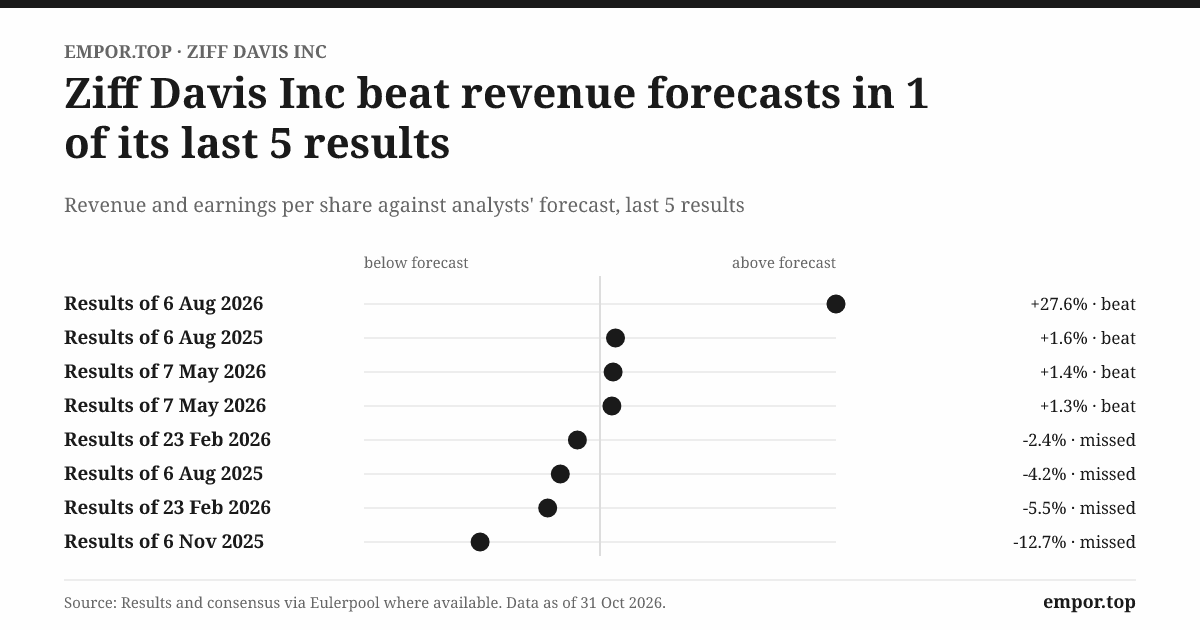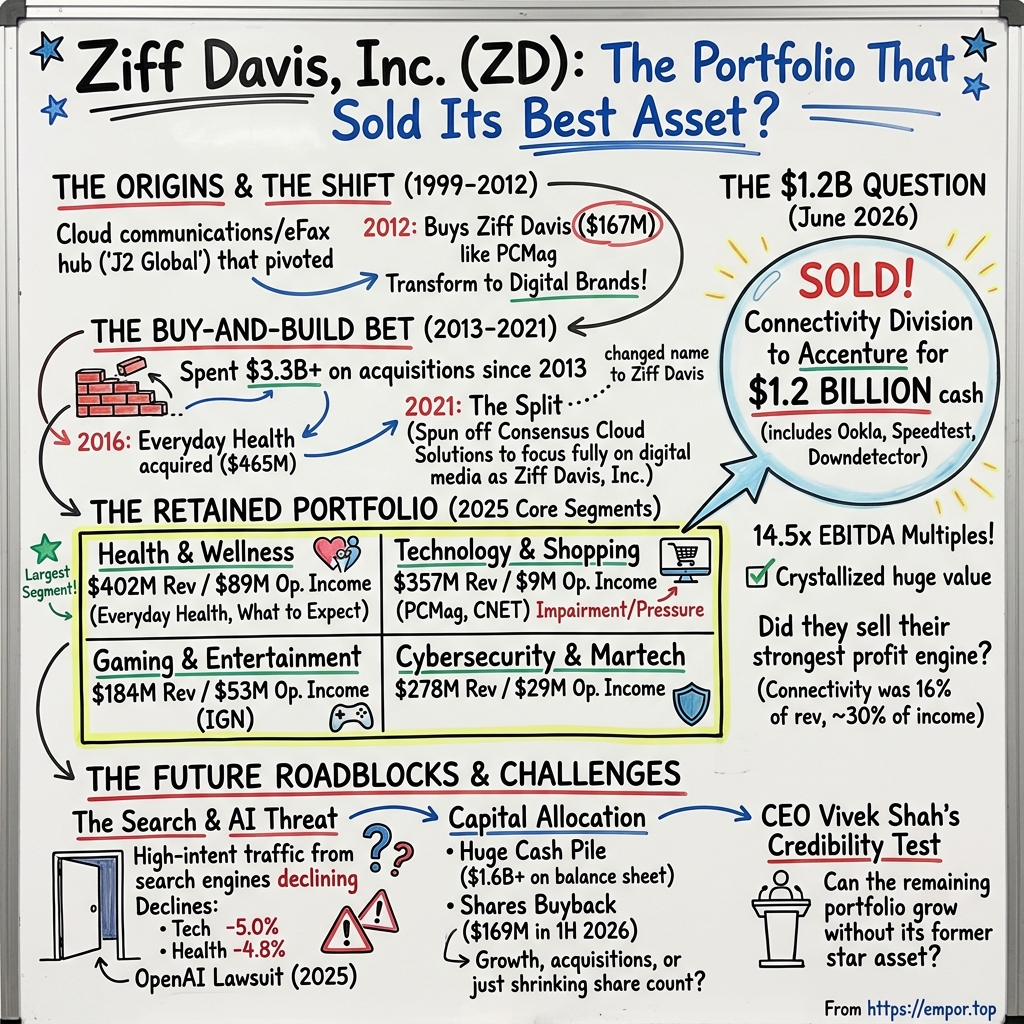
Ziff Davis, Inc.: The Portfolio That Sold Its Best Asset?
I. The $1.2 Billion Question
On June 17, 2026, a set of digital keys changed hands. Accenture, the consulting giant that sells transformation to the world's largest companies, took ownership of Ookla, the business behind Speedtest, the little circular gauge that hundreds of millions of people have watched spin while they wonder whether their internet provider is lying to them.1 With it went Downdetector, the website people open when their bank app, their game server or their email suddenly stops working, along with Ekahau and RootMetrics, two quieter tools that help companies design wireless networks and measure mobile coverage.2 Together they formed the division Ziff Davis called Connectivity. The price was about $1.2 billion in cash.2
It is hard to overstate how unusual that kind of exit is for a company that most investors think of as a collection of websites. Ziff Davis owns PCMag, CNET, IGN, Everyday Health, Mashable and a long list of other properties whose names are familiar and whose economics are not. Connectivity was different. It was measurement and data, sold to telecom operators, governments and enterprises, and it was the portfolio's best-performing profit engine. In 2025 it produced about 16% of the company's revenue but close to 30% of the operating income the company reported across its reportable segments.3 When a business that generates three out of every ten segment profit dollars leaves the house, the people who stay behind have to get used to a much smaller budget.
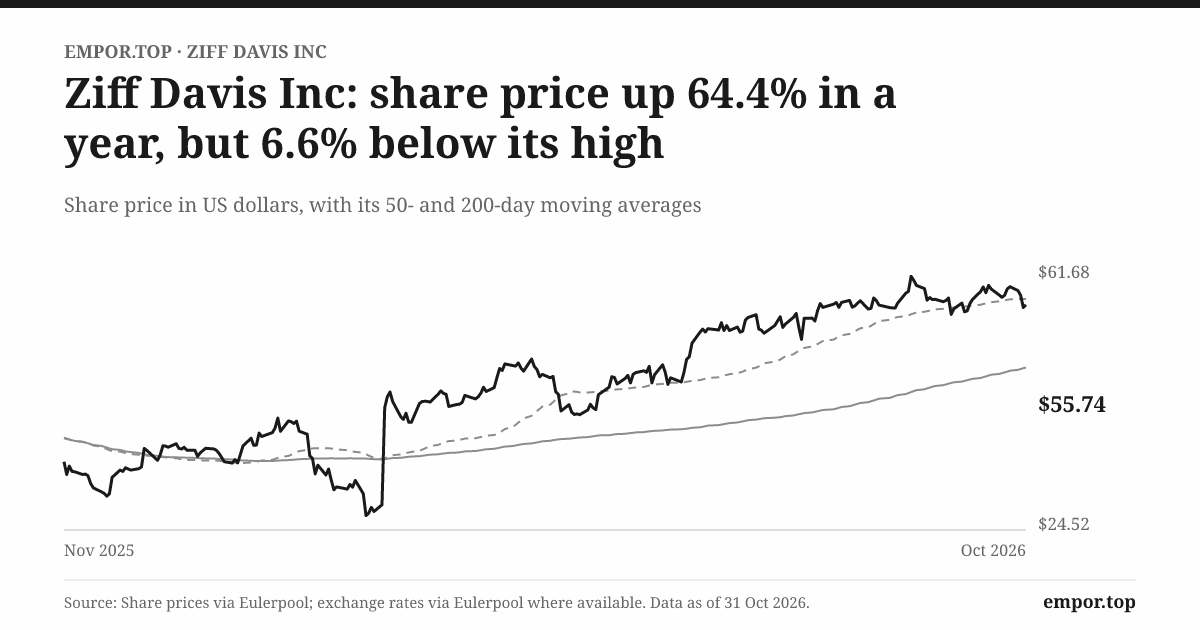
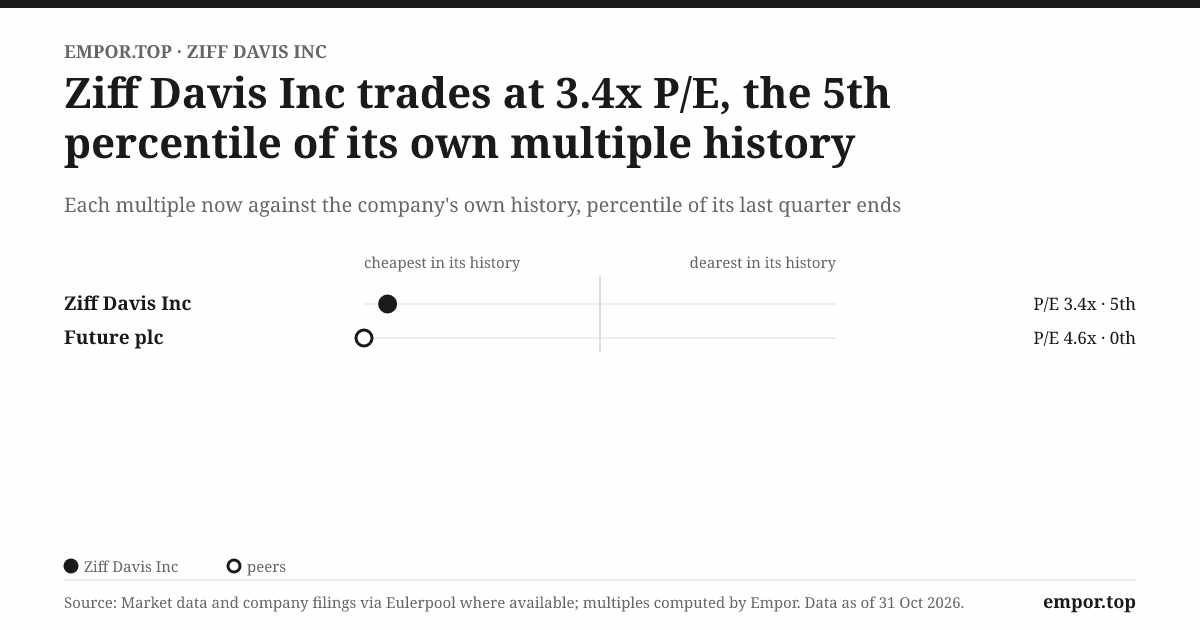
Now look at the scoreboard the market was staring at on October 31, 2026. The shares closed at about $55.74, within 7% of their 52-week high, giving the company a market value of about $2.2 billion. Trailing earnings per share were close to $17.70, which works out to a price-to-earnings ratio of about 3.1 times.4 For a company whose five-year median P/E was around 29 times, that looks like a pricing error so large it should be printed on a billboard. It is not an error. It is an accounting echo. In the June quarter alone, Ziff Davis reported $624 million of net profit, and nearly all of it came from the gain on selling Connectivity.1 The continuing business, the four segments Ziff Davis kept, reported an operating loss in that same quarter.1
That gap between a headline profit and the business underneath it is the subject of this story. Three questions sit on the table. The first is whether the sale was a strong realization of value, a disciplined seller cashing in an asset at the right price, or whether Ziff Davis sold the one division that could reliably grow. The second is whether the remaining businesses can grow at all while the way people find information shifts away from classic search, the channel that has fed digital publishers for two decades. The third is what management will do with the money: strengthen the company, buy new growth, or mainly shrink the share count.
Some housekeeping is needed before the story begins, because the name on the door has changed more than once. Ziff Davis, Inc. is the listed parent, traded on Nasdaq under the ticker ZD. Until 2021 the same company was called J2 Global and traded as JCOM.5 It is not a subsidiary of anyone; there is no controlling parent or private-equity owner pulling strings from above.3 Connectivity is now reported as a discontinued operation, which means its past results sit in a separate line and the continuing company is presented as four reportable segments: Technology & Shopping, Health & Wellness, Gaming & Entertainment, and Cybersecurity & Martech.1
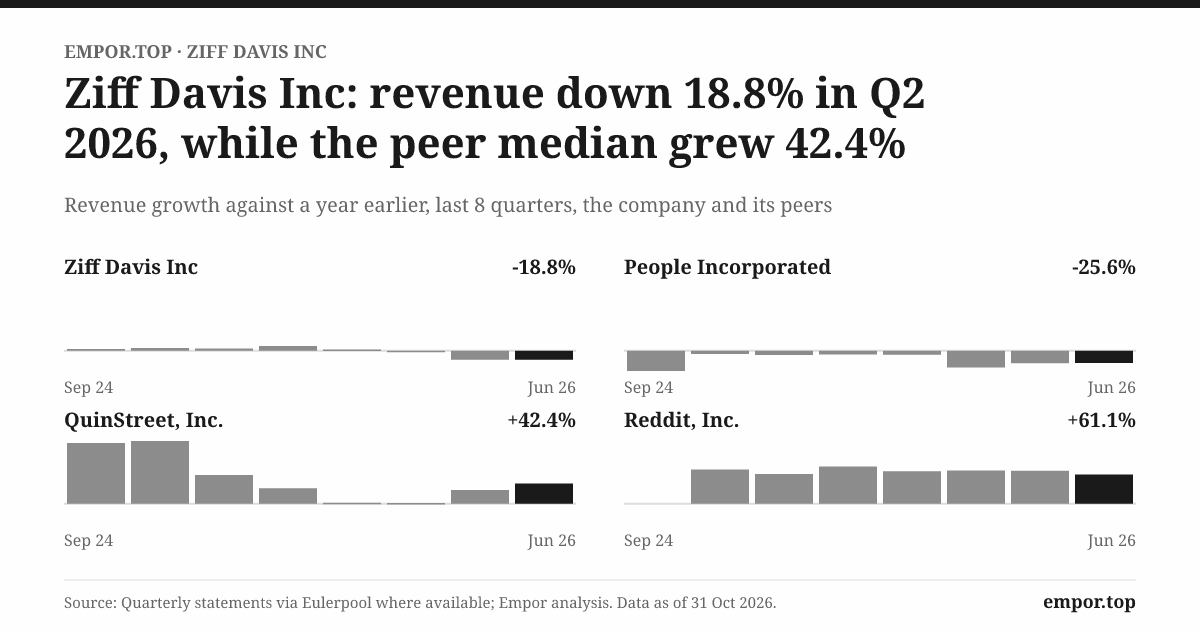
Those four segments are the company that shareholders actually own from here. And they arrived at the sale in uneven shape. In the June quarter of 2026, continuing revenue fell 2.7% from a year earlier.6 That is not a collapse. But it is not growth either, and it came in a period when management was asking investors to look through declines in its shopping business while it rebuilt distribution.
There is an old observation in corporate finance that cash is a wonderful anesthetic. A company that has just received a large check can pay down debt, buy back shares and fund experiments all at once, and for a while the results look healthier than the operating business underneath would justify. Ziff Davis now has that anesthetic in its bloodstream. About $1.6 billion of cash stood on its June balance sheet.1 Some of it is already spoken for by taxes and debt. Some of it has already been spent on buybacks. The rest represents a choice that will define the next chapter.
So the real question is not whether a 3.1 times P/E is cheap. It is what the continuing company earns, and whether that number can grow. To answer it, the story has to go back to a fax company that decided, a little more than a decade ago, that the future lay in owning a magazine publisher's websites.
 Subscribe on LinkedIn
II. The Fax Company That Bought a Media Portfolio
In the late 1990s, the fax machine was still an office fixture, a beige box that hummed and chirped and spat out curling sheets of thermal paper. J2 Global's insight was that most people did not want the box. They wanted the fax. Its eFax service gave a user a fax number whose incoming documents arrived as email attachments, which turned an awkward piece of hardware into a subscription delivered over the internet. The company went public in July 1999, at the height of the dot-com boom, with a prospectus filed that spring.7 Many of its peers from that IPO class vanished within two years. J2 survived, and it celebrated fifteen years as a public company in 2014.8
The reason it survived is the reason its later strategy made sense. Online fax was a sticky, recurring, high-margin subscription. Customers who built a business process around a fax number rarely ripped it out, and the cost of serving one more customer was tiny. That produced the kind of cash flow that private-equity firms dream about, and J2's management used it the way private-equity firms would: to buy more businesses. By 2014, the first year for which consistent data is easy to compare, the company was generating about $600 million of revenue with an operating margin around 31%.3 Few internet companies of its age could match that profitability.
The problem with a cash machine built on fax is that fax is not a growth market. Management could keep buying fax and cloud-communications competitors, and it did, but sooner or later it needed a second leg. That leg arrived in November 2012, when J2 Global agreed to buy Ziff Davis, Inc. for about $167 million.9
The Ziff Davis name carried history. It had been one of the great publishers of the personal-computer era, the house behind PC Magazine when that magazine was thick enough to stop a door. By 2012 the print empire was long gone, and what J2 bought was a set of websites: PCMag, ComputerShopper, ExtremeTech, Toolbox.com and Geek.com, among others.9 J2 said it expected the acquired business to contribute about $60 million of revenue in 2013.9 In other words, it paid less than three times expected revenue for a digital publisher with a recognized brand in technology reviews.
Why would a fax company want a tech-review site? The economic logic was more coherent than it sounds. A specialist website builds an audience with a specific intent. Someone reading a PCMag review of laptops is not browsing idly; they are about to spend money. That intent can be monetized in several ways at once. The page can carry display advertising. It can link to retailers and earn a commission when the reader buys, a model the industry calls affiliate commerce. It can capture leads for business-software vendors who pay to reach IT buyers. And it can sell subscriptions or data. Each of those revenue streams relies on the same asset: an editorial brand that a reader trusts enough to act on.
Equally important, the purchase came with a person. Vivek Shah had been running Ziff Davis before J2 bought it, and he stayed on to lead the media business inside the larger company.10 Shah had come up through digital media, including a senior role running digital businesses at Time Inc., and he brought a media operator's view of the world to a company run by people whose instinct was telecom-style cost control.10 The combination proved durable. Shah later became chief executive of the whole company, and he still holds that job.10
The scale of what followed is worth sitting with. That $60 million media contribution in 2013 became the seed of a business that, by 2025, reported about $1.45 billion of revenue, before Connectivity was sold.3 Of that, about $824 million came from advertising and performance marketing, and about $599 million from subscriptions and licensing, with a small remainder of other revenue.3 The fax business left the company in 2021, in a separation. What remains is a company whose largest revenue stream depends on audiences that arrive through the open internet.
That is the bargain at the center of Ziff Davis. A portfolio of niche properties spreads risk. If gamers lose interest in a console cycle, health readers might still be researching symptoms; if advertisers cut budgets, software subscriptions might hold. No single brand can sink the company. But every brand it buys comes with the distribution risk of its category, and most of those categories share the same front door: search engines, social platforms and app stores that Ziff Davis does not control. Diversification across brands is not diversification across gatekeepers.
There is also a cost-structure lesson hiding in the long-run numbers. The operating margin that stood near 31% in 2014 was about 14% in 2025.3 Some of that decline reflects the 2021 departure of the high-margin fax business, and some reflects the inherently lower margins of editorial content, which requires writers, editors, video producers and sales teams in a way fax servers never did. The transformation bought a larger opportunity set. It also bought a business with more people, more costs and less predictable revenue. The way J2 assembled that business was through a decade-long acquisition spree, and the spree is where the story turns next.
III. The Buy-and-Build Bet, and Its Write-Downs
On October 24, 2016, J2 Global announced the largest deal it had ever done. It agreed to buy Everyday Health, a publicly traded consumer and professional health-information company, for about $465 million.11 The price represented a 28% premium to Everyday Health's unaffected share price.11 Everyday Health brought websites for patients and parents, including What to Expect, the brand built around the best-selling pregnancy book, along with a business that marketed to physicians.
The deal was a statement of intent. J2's chief executive at the time, Hemi Zucker, said the Everyday Health acquisition, "our largest ever," would fuel more than $1.1 billion of revenue in 2017, balanced between the cloud and media segments.12 The formal guidance range was $1.13 billion to $1.17 billion of revenue.12 For a company that had reported $874 million of revenue in 2016, that meant roughly 30% growth in a single year, almost all of it bought rather than built.12 It was also a signal that the media business, a sideline in 2012, was now intended to be as large as the original franchise.
The buy-and-build model has a simple appeal. A company with steady cash flow buys smaller businesses at modest prices, strips out duplicate costs, plugs them into a shared sales force and technology stack, and earns a better return than the seller could alone. Ziff Davis has practiced this model for over a decade, and it says it has deployed about $3.3 billion on acquisitions since 2013.3 That figure has a striking twin. From 2014 to 2025, the company generated about $3.3 billion of free cash flow.3 Put plainly, nearly every free dollar the business produced over twelve years went back out the door to buy other businesses, and the company used borrowing, the occasional spin-off and cash on hand to fund dividends and buybacks around that core habit.
So the question is whether those purchases earned their cost. The honest answer is that the public record does not allow a clean scorecard for most of them. Ziff Davis rarely discloses target-level revenue or profit at the time of a deal, so outsiders cannot calculate the multiple it paid for most acquisitions, let alone compare it with prices paid by rivals for similar businesses. The Everyday Health price is known, and the premium is known. Whether that premium was rich or cheap against comparable health-media deals cannot be established from what the company has published.
What can be traced is the shape of the portfolio. After Everyday Health, the company kept adding: gaming properties around IGN, consumer tech titles such as Mashable, shopping and deals sites, email-marketing and cybersecurity software, and the network-measurement assets that would eventually make up Connectivity, centered on Ookla.13 By its 2020 analyst day, J2 was presenting itself to investors as a disciplined acquirer with a playbook, and the slides emphasized returns on invested capital and the breadth of its deal pipeline.13
The most recent big-name purchase shows both the appeal and the limits of the approach. In 2024, Ziff Davis bought CNET and related businesses from Red Ventures. Press reports put the CNET price above $100 million.14 Ziff Davis itself reported $365 million of total consideration for all its 2024 acquisitions combined.3 Four years earlier, Red Ventures had paid $500 million for a broader CNET Media Group package that included other properties.15 It is tempting to read that as Ziff Davis buying a famous brand at a fraction of its old price. The comparison is imperfect, because the 2020 package was larger and the intervening years included a hard advertising market and growing pressure on search referrals. Still, the direction is telling. The market price of a legacy tech-review brand fell sharply in four years, and that tells investors something about the value of the category Ziff Davis was buying into.
Then come the write-downs. In 2024, Technology & Shopping, the segment that houses PCMag and CNET, recorded an $85.3 million goodwill impairment.3 Goodwill is the accounting residue of paying more for a business than the book value of its assets; when a company impairs it, it is admitting that the expected future cash flows of the unit no longer support the price carried on the balance sheet. In 2025, Cybersecurity & Martech recorded a $17.6 million goodwill impairment.3 And in the June quarter of 2026, the continuing business took another $54.8 million goodwill charge.1 The auditor flagged goodwill impairment as a critical audit matter in the 2025 annual report, which is a formal way of saying that the judgments involved are significant and hard.3
These charges do not prove that any single acquisition was overpriced. Impairment tests run on reporting units that blend many purchases, and a unit can be impaired because the market for its services shrank after the deal, not because the buyer was careless. But they do narrow the claim. The record supports a meaningful acquisition capability: Ziff Davis has bought, integrated and run dozens of businesses, and one of them, Connectivity, was later sold for a large sum. It does not support a blanket claim that the machine reliably creates value on every turn. Repeated impairments in the same segment that absorbed CNET are the kind of evidence a long-term owner should weigh heavily, because they involve the same management team, the same category and recent years.
There is one more complication before anyone can judge the long-run results. In 2021 the company changed what it owned in a way that makes every growth rate before and after hard to compare. That separation is where the scoreboard was redrawn.
IV. The 2021 Split Changed the Scoreboard
In early October 2021, J2 Global shareholders woke up to find a new stock in their brokerage accounts. For every three J2 shares they held, they received one share of Consensus Cloud Solutions, the newly independent home of eFax and the rest of the cloud-fax business.5 On the same occasion the parent took on a new identity: J2 Global became Ziff Davis, and the ticker JCOM became ZD.5 The company distributed 80.1% of Consensus to its shareholders and kept a 19.9% stake for itself.16
The logic, as the board presented it when it approved the separation, was focus.16 Two very different businesses had been sharing one stock. Cloud fax was a slow-growing, high-margin subscription business that appealed to investors who wanted steady cash and could tolerate decline. Digital media was a faster-moving, lower-margin, advertising-sensitive business that appealed to investors willing to bet on audience growth. Under one roof, neither group got the stock it wanted, and management argued that each business would be valued more appropriately as its own company.
The split was also an act of financial engineering, in the neutral sense of the term. It returned value to shareholders as a separately traded stock rather than as a cash dividend, and it reshaped the parent's balance sheet. Ziff Davis's total borrowings fell from about $1.7 billion at the end of 2020 to about $1.2 billion at the end of 2021, while cash and short-term investments rose from under $200 million to more than $900 million.3 The retained 19.9% stake was itself a liquid asset the company could later sell, which made the separation a source of financial flexibility as well as strategic focus.
The scoreboard consequence is the part investors most often forget. Over ten years, the company's reported revenue grew at about 7.3% a year. Over five years, the rate was about 4.6%. Over the last three years, it was about 1.4%.3 Read naïvely, that looks like a business that has slowed steadily. Read correctly, it is a series that crosses at least two boundaries. The ten-year figure includes years when fax was part of the company and acquisitions were adding hundreds of millions of revenue. The 2021 spin removed a large, profitable business from the comparison. And in 2025, about $34.5 million of revenue came from businesses acquired that same year, which is growth that would not have existed without new purchases.3 None of these figures measures same-business, or organic, growth. The long-run rate is context, not a record of how well the underlying properties grew on their own.
What the split did make clear is what Ziff Davis is now being judged on. After 2021, there was no fax cash machine to cushion weak quarters in media. After June 2026, there is no Connectivity either. The value of the company rests on how the retained digital properties perform: the websites, the apps, the software subscriptions and the advertising relationships that sit in the four segments.
That raises the unresolved tension that runs through the rest of this story. The company's history is one of compounding through acquisitions. Its present requires the remaining portfolio to compound without them, or at least to compound faster than the cash spent on new purchases. If a portfolio only grows when it buys more, then its growth rate is really a measure of how much capital it deploys, and the return on that capital becomes the whole investment question. To see whether the retained portfolio can stand on its own, the next step is to follow the money through the businesses themselves, starting with the most basic question in media: who pays for the audience?
V. Who Pays for the Audience?
Picture a reader at a kitchen table on a weeknight. She has typed a question into her phone: which robot vacuum handles pet hair, or whether a fever in a toddler is serious, or how to beat a boss in the latest open-world game. A link sends her to a page owned by Ziff Davis. In the few seconds she spends there, the company has several chances to earn money. An advertisement loads beside the article. A "check price" button sends her to a retailer, and if she buys, Ziff Davis earns a commission. A software vendor may pay for her details if she signs up to download a guide. Or she may already be a subscriber to one of the company's paid products. Every one of those chances depends on the same thing: that she arrived at the page in the first place.
That is the economics of Ziff Davis in a single scene. The company groups its money into two broad buckets. Advertising and performance marketing, which includes display ads, affiliate commissions and lead generation, made up the majority of 2025 revenue.3 These streams rise and fall with traffic and with advertiser budgets, and they are sensitive to how search engines, social networks and app stores send users. Subscriptions and licensing, the second bucket, include fixed and usage-based fees for data access, software, resold email-security products and other services.3 Many of those contracts last a year or less, and the company generally bills upfront, which helps cash flow.3 Ziff Davis does not publish a single recurring-revenue percentage, so the subscription category is a useful but imperfect proxy for how much of the business renews on its own.
The four retained segments each sit at a different point on that spectrum, and 2025 showed where the profit actually came from.
Health & Wellness was the largest by both measures. It generated about $402 million of revenue and about $89 million of segment operating income in 2025.3 This is the house that Everyday Health built: consumer health properties including Everyday Health and What to Expect, along with businesses that reach physicians and other health professionals.3 Health information carries some natural advantages. Pharmaceutical marketers pay well to reach specific audiences, and a reader researching a condition is often more engaged than one skimming news. The segment's margin, a little over 20% before corporate costs, was the best in the retained portfolio.
Technology & Shopping is the segment most people picture when they hear the name Ziff Davis. It includes PCMag and CNET and a set of shopping and deals properties.3 It produced about $357 million of revenue in 2025, nearly as much as Health & Wellness, but only about $9 million of segment operating income after impairment charges and pressure on its traffic.3 The contrast between those two numbers is the single most revealing fact about the portfolio. The segment with the most famous brands earned almost nothing in 2025.
Gaming & Entertainment, built around IGN and related properties, generated about $184 million of revenue and about $53 million of segment operating income.3 That is a margin near 29%, the highest among the retained segments. Gaming audiences are passionate and loyal to particular outlets, and IGN's video and community presence gives it reach beyond the search box.
Cybersecurity & Martech is the most software-like piece. It combines email-security, privacy and backup tools with marketing software and services, and it generated about $278 million of revenue and about $29 million of segment operating income in 2025.3 That margin, around 10%, is modest for software, and the segment's goodwill impairment that same year suggests that some of the businesses inside it were worth less than the company had carried them at.3
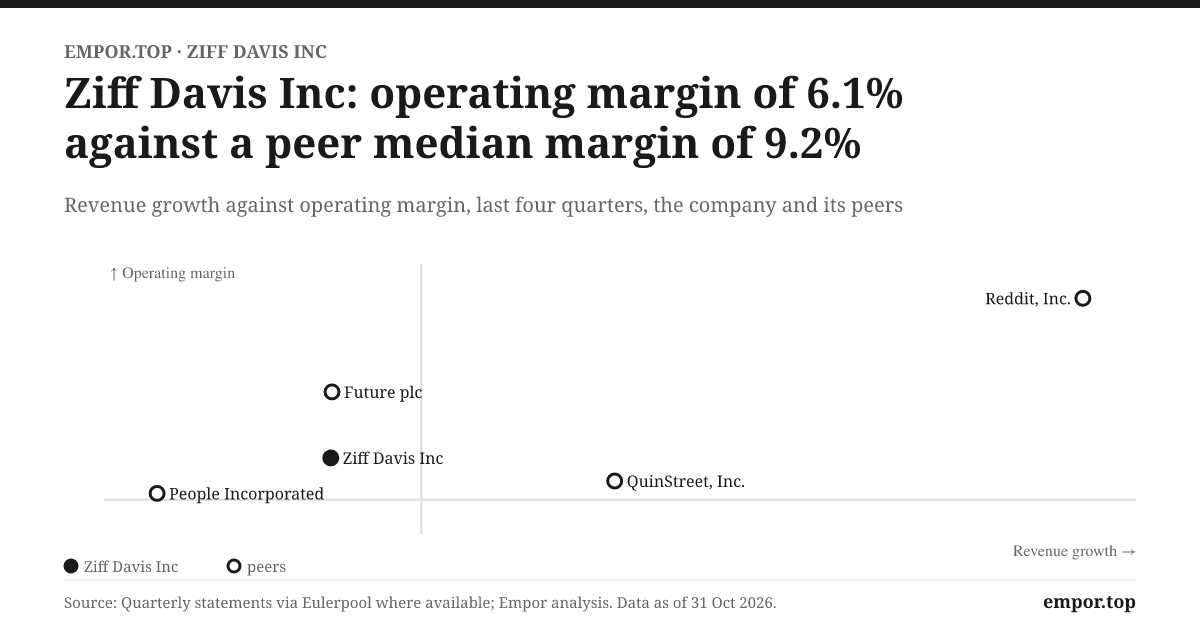
Add the four together and the retained segments generated about $180 million of segment operating income in 2025. That figure comes before roughly $73 million of corporate costs that sit outside the segments, such as headquarters, public-company expenses and shared functions.3 So the continuing company's operating contribution after corporate overhead was on the order of $107 million, on about $1.2 billion of revenue. That is a business with a high-single-digit operating margin, not the 31% the old fax company once enjoyed.
Who does Ziff Davis compete with for that kitchen-table reader? In technology reviews, Future plc's TechRadar and Tom's Guide chase the same searches for laptops and phones. Hearst's digital properties and People Inc., formerly Dotdash Meredith, compete across lifestyle, health and shopping. WebMD is the obvious rival in consumer health. In software, security and marketing vendors of every size compete for the same budgets. Ziff Davis does not disclose category market shares, so its relative position in each niche cannot be measured precisely from its filings. What can be said is that none of these markets is a monopoly, and that the most important competitor for attention is not another publisher. It is the search engine itself, which increasingly answers questions on its own pages.
Run the business through two classic frameworks once, briefly, and the shape of the moat becomes clearer. Michael Porter's five forces start with buyers, and Ziff Davis's buyers are advertisers and retailers who can move budgets to other publishers, to social platforms or to retail-media networks with a few clicks. The company says no single customer accounts for 10% of revenue, which spreads the risk, but also means no customer is locked in.3 Supplier power is unusual here, because the most important supplier is not a vendor of goods but the platforms that supply traffic: Google, Meta, TikTok, YouTube and the app stores. They set the rules, change them without negotiation and can redirect users to their own products. The threat of substitution is acute, because an AI assistant or a search-results summary can satisfy a reader's question without sending her to the page. Barriers to entry are low for content but higher for trusted, scaled brands with years of archived reviews and testing labs. Rivalry is intense.
Hamilton Helmer's seven powers framework asks which durable advantages a company holds. Ziff Davis has a credible claim to branding, in the sense that PCMag, IGN and What to Expect carry reputations that a new entrant cannot buy overnight. It has some claim to scale economies in its shared ad-sales, technology and affiliate infrastructure. It does not show strong switching costs: a reader can change websites instantly, and an advertiser can reallocate spending between campaigns. It does not show network effects in the classic sense, where each new user makes the product more valuable to the next. And it lacks a cornered resource, since the content it produces is not protected from imitation or summarization. The filings give no retention rates, pricing data or market-share trends that would establish a durable moat in the advertising-driven businesses.
So the honest verdict is that the brands are real, but brands only earn money when people still arrive and convert. Health & Wellness carried the portfolio in 2025, Gaming & Entertainment earned its keep, Cybersecurity & Martech made thin returns, and Technology & Shopping, the most famous name on the masthead, barely broke even. The proof of the moat is not in the logos. It is in whether the traffic keeps coming, and that is exactly where the pressure began.
VI. The Search Front Door Started to Close
On February 24, 2026, Ziff Davis's management team got on its fourth-quarter earnings call and said something that publishers rarely say so plainly. The hardest traffic to replace, they explained, is the shopper who arrives from a search engine already ready to buy.17 That reader has done the browsing; she has typed "best noise-cancelling headphones under $300" and clicked the first trustworthy review. The click from that review to a retailer is the most valuable moment in the affiliate business. Social video, newsletters and apps can bring people back to a brand, management acknowledged, but they do not fully replace that kind of high-intent search visit.17
When search engines and AI tools answer directly, a reader can get her answer without producing an ad impression or affiliate commission for a publisher.
That pressure falls hardest on Technology & Shopping. On that February call, management told investors to expect a double-digit percentage decline in Technology & Shopping revenue in 2026, and warned that the first quarter's margin would be lower as well.17 When analysts asked how quickly alternative channels could scale, the plan management described rested on building audiences across video, social platforms and direct relationships, without a date by which those channels would offset the search losses.17 It was a candid diagnosis, and a cautious prescription.
The first-quarter results, reported in late spring, confirmed the diagnosis. Technology & Shopping revenue fell 12.9% from a year earlier.18 Management highlighted progress elsewhere: AI-assisted tools were speeding up content production, and social video views for the shopping group had risen by more than 75%.18 Those are real operational facts. They are also inputs, not outcomes. A view on a short video platform is worth a fraction of a click from a search page where the reader is about to buy, and the platforms hosting those videos keep most of the advertising economics for themselves. When analysts asked about the durability of distribution and the monetization of new channels, the answers again pointed to growth in reach rather than in revenue.18 At the same time, Ziff Davis declined to provide full-year 2026 guidance, citing its ongoing review of value-creating opportunities.18
It is worth being precise about what the company is and is not saying. Its annual report identifies search traffic as important to its business and treats changes in how search engines and AI tools surface content among its risks.3 Management has talked about using AI internally to produce and update content faster, which can lower costs. But faster production of content does not solve a demand problem if fewer readers arrive to see it. A newsroom that can publish twice as many product reviews still needs someone to click on them, and the evidence so far measures the supply side of that equation far better than the demand side.
By the June quarter the picture had become more mixed and, in one sense, more worrying. Technology & Shopping revenue fell 5.0% year over year, a smaller decline than in the first quarter.6 But Health & Wellness, the segment that had carried the portfolio's profits in 2025, fell 4.8%.6 Gaming & Entertainment rose 0.9% and Cybersecurity & Martech rose 0.5%.6 Taken together, continuing revenue was down 2.7%.6 There is no unified growth story in those numbers. One segment is shrinking because of a known distribution problem; the largest profit segment has started to shrink as well; and the two segments that grew did so at rates below inflation.
A careful listener should resist two tempting readings. The first is that the moderation in Technology & Shopping's decline proves the strategy is working. A single quarter's improvement, set against an easier comparison and a management outlook that still pointed to a double-digit decline for the year, is not evidence that lost search revenue has been replaced. The second is that the Health & Wellness decline is the start of the same collapse. Health content may be affected by AI summaries, but the segment also includes professional marketing businesses with different drivers, and the company's quarterly disclosure does not break out how much of the decline came from traffic rather than advertiser spending. The fair conclusion is narrower: the company has not yet shown that any retained segment is growing meaningfully, and the clearest pressure point remains the one management named.
There is a legal dimension to the same problem. In April 2025, Ziff Davis and several subsidiaries sued OpenAI, alleging that the company had used their content without permission to train and power its AI products.19 The suit is part of a broader confrontation between publishers and AI developers over whether, and how, content creators should be compensated when their work feeds machine-generated answers. For Ziff Davis, the litigation is a strategic uncertainty rather than a financial asset. The company has not accrued any material gain or loss, and it cannot predict an outcome.3 A favorable ruling or settlement could create a licensing stream; an unfavorable one could confirm that publishers have little leverage over how their archives are used. Separately, the company is involved in litigation related to Google's advertising-technology practices, whose outcome is similarly uncertain.3
The evidence that would settle this chapter is specific. Over the first full year after the Connectivity sale, investors need to see organic revenue for each retained segment, meaning growth that excludes acquisitions, and some measure of affiliate conversion in Technology & Shopping. If social and video channels are producing revenue rather than just views, it should show up there. Until it does, the question of whether Ziff Davis can replace its search front door remains open, which makes the timing of the company's biggest strategic decision of 2026 all the more interesting. While the search door was closing, management sold the division that did not depend on it.
VII. The Business That Sold for 14.5 Times
The announcement came on March 3, 2026. Ziff Davis said it had signed a definitive agreement to sell its Connectivity division to Accenture for $1.2 billion in cash.2 The formal agreement had been filed with regulators a day earlier.20 Management described the price as 14.5 times Connectivity's trailing adjusted EBITDA minus capital expenditure, a measure of cash profit after the investment needed to keep the business running.2 Reuters noted the deal as a sizable move by Accenture into network intelligence and measurement.21 The transaction closed on June 17.1
What exactly did Accenture buy? Ookla is the heart of it. Its Speedtest apps and website let consumers measure their internet connection, and in aggregate those billions of tests form a dataset that telecom operators, regulators and analysts use to compare network performance. Downdetector aggregates user reports of service outages in near real time, which makes it a kind of public early-warning system for the internet. Ekahau sells tools that help engineers design and troubleshoot Wi-Fi networks. RootMetrics tests mobile networks by driving and walking routes with measurement equipment.2 Together these businesses sold data and software to enterprises, carriers and governments. For a consulting firm that advises telecom operators and builds networks for clients, the logic is easy to see: it bought proprietary measurement data and tools that it can combine with its services.
The economics show why this was the portfolio's crown jewel. In 2025, Connectivity generated about $231 million of revenue and about $76 million of segment operating income.3 That is an operating margin of about 33%, more than any retained segment. It was about 16% of the company's revenue but close to 30% of its segment operating income.3 And unlike the advertising-heavy segments, Connectivity's revenue came mostly from data licenses and software that customers renewed, and its audience did not depend on the search engines that were squeezing the shopping business.
Was 14.5 times a good price? On the face of it, the sale monetized a valuable, profitable division at a substantial stated multiple of cash profit, and it did so in cash from a strategic buyer with deep pockets. The multiple is far above what the stock market was paying for Ziff Davis as a whole before the deal. That gap is itself the point. For years, a sum-of-the-parts argument had circulated among investors: that the market was valuing the entire company at a media-company multiple while hiding a data business worth much more. The sale proved that at least one division could command a premium price in a private transaction.
Two caveats keep that conclusion bounded. The first is that the public record does not support attributing the whole $1.2 billion to a single acquisition. Connectivity was built over years through several purchases and internal investment, and the company has not disclosed a combined cost basis that would let outsiders calculate a return on the whole division. The second is that management's multiple uses an adjusted measure chosen by management. It is a reasonable way to describe a cash-generating business, but there is no independent set of directly comparable transactions in the public record that would show whether 14.5 times was a premium or a fair market price for network-measurement assets.
Then there is the cash bridge, which matters more than the headline. About $1.6 billion of cash stood on the June 2026 balance sheet, mostly reflecting the sale proceeds.1 That is a large number for a company with a $2.2 billion market value. But not all of it belongs to shareholders. On the second-quarter call, management said the cash was intended to cover upcoming tax obligations arising from the sale, as well as debt payments, before supporting broader capital allocation.22 The company had about $872 million of debt principal at the end of 2025, including about $149 million due in 2026, about $263 million of convertible notes due in 2028 and $460 million of senior notes due in 2030.3 A rough accounting shows how quickly a windfall gets spoken for: a meaningful tax bill on a large gain, near-term maturities and a pile of convertible debt that could be settled in cash or shares.
The portfolio question that follows is unavoidable. Before the sale, Ziff Davis had five segments and one of them was a high-margin data business. After the sale, it has four segments, a much larger cash balance and fewer earnings dollars. In 2025 terms, the retained segments' $180 million of segment operating income must now carry the full $73 million of corporate costs, which were previously spread across a larger base. Unless corporate costs shrink with the portfolio, the continuing company's margins look thinner than the old consolidated figures did.
That is the trade Ziff Davis made. It converted a growing, profitable, less search-dependent business into cash at an attractive price, and it kept the businesses whose revenue was declining. Whether that was wise depends almost entirely on what management does with the money. And the first answer arrived even before the deal closed.
VIII. The Buyback Is the First Answer
In the first half of 2026, while the Connectivity sale was moving toward closing and Technology & Shopping revenue was falling by double digits, Ziff Davis was in the market buying its own shares. It repurchased about 3.81 million shares for about $169 million over those six months.1 That nearly matched the roughly $170 million it had spent repurchasing about 4.76 million shares in all of 2025.3 In a single half-year, the company put as much money into its own stock as it had in the previous twelve months.
Buybacks are not new for this company, but they are the latest phase of a capital-allocation arc that has changed shape several times. Across 2014 to 2025, the company generated about $3.3 billion of free cash flow.3 It paid about $372 million of dividends during that period, all of them through 2019; from 2020 onward it paid none.3 Its cash and short-term investments rose by about $308 million over the twelve years.3 The rest went into acquisitions, debt repayment and repurchases. In other words, Ziff Davis was never a dividend story or a cash-hoarding story. It was a reinvestment story, and the reinvestment mostly took the form of buying businesses.
The two biggest portfolio decisions of the last five years, the 2021 spin-off and the 2026 sale, were not simply financial events. Each changed the boundary of the company. The spin handed shareholders a separate stock; the sale handed management a pile of cash. Both were ways of returning or reallocating capital that did not show up as dividends, and both reduced the size of the operating business that remained.
The buyback's logic is straightforward. If management believes the shares trade below their intrinsic value, buying them back transfers value from selling shareholders to remaining ones. Over the year to October 31, 2026, the stock traded between about $27 and about $60, so shares bought near the bottom of that range look very different in hindsight from shares bought near the top.4 The company has not disclosed the average price paid by quarter in a way that lets outsiders judge the timing precisely, beyond the half-year totals, which imply an average a little above $44 a share.1
The harder question is whether buybacks fit the business's operating prospects. In the June quarter, continuing revenue and adjusted EBITDA were both down from a year earlier, while the smaller share count helped support adjusted earnings per share.6 That is the classic pattern a skeptical investor watches for: per-share metrics rising because the denominator is shrinking rather than because the business is growing. It is not inherently wrong. A company with declining but cash-generative businesses can create real value by shrinking its share count at a low price. But it is a different investment proposition from the one the company has presented for most of its history, which was about building a growing portfolio.
A shareholder with an activist's eye, without implying that any activist campaign is under way, would ask a direct set of questions. Should management prioritize paying down the 2026 maturities and the convertible notes, reducing interest costs and risk? Should it reinvest in the retained businesses, perhaps in video, direct audience relationships or software, to replace lost search traffic? Should it return to acquisitions, its historical habit, at a time when its own goodwill impairments suggest that some past purchases have disappointed? Or should it keep buying back stock while the price reflects pessimism? Each choice says something about how management sees the future of the portfolio. The company had not, by the end of October 2026, published a full reconciliation of how it intended to split the proceeds among those uses.
There is a quieter capital-allocation choice that gets less attention than buybacks: how much the company spends on its own businesses. In 2025, Ziff Davis reported about $62 million of research and development and engineering expense, roughly 4% of revenue, slightly less than in the two previous years.3 Capital expenditure was about $119 million, roughly 8% of revenue, and much of it went into the technology and software that run the portfolio.3 Over the same period, headcount fell from about 4,200 at the end of 2023 to about 3,900 at the end of 2025, while revenue rose.23 That combination does not describe a company starving its businesses; it describes one investing in systems while running leaner teams. But it also does not describe a company spending aggressively to replace the search traffic its shopping business is losing. If the answer to the distribution problem is new products, new formats and direct relationships with readers, it will show up first in these lines, and so far it has not shown up as a step change.
The debt picture, at least, is grounded. The sale cash exceeded year-end 2025 debt principal by a comfortable margin.1 The revolving credit facility is scheduled to mature in June 2027.3 The filings reviewed disclose no covenant breach and no refinancing pressure.1 Ziff Davis does not cite an external credit rating in its annual report or quarterly filing. The near-term risk is not solvency. It is opportunity cost: the danger that a windfall gets spent on repurchases and deals that look good for a quarter but do not change the trajectory of a shrinking core.
What would settle the question is a capital-allocation reconciliation that shows, in one place, how much of the sale cash went to taxes, how much to debt, how much to buybacks, how much to acquisitions and how much remains, alongside continuing-operations free cash flow. Without it, investors are being asked to trust a management team's judgment about the most consequential pile of cash in the company's recent history. And trust, in a public company, is ultimately a question about the people at the top.
IX. Vivek Shah's Credibility Test
Vivek Shah has spent most of his career trying to make digital media pay. He carried the Ziff Davis business into the larger company and eventually took charge of the entire enterprise as chief executive.10 His partner in finance, chief financial officer Bret Richter, has served alongside him through the acquisitions, the 2021 separation and the 2026 sale.10 In the spring of 2026, Shah faced a different kind of test. He presented the Connectivity sale as value realization, proof that the company's assets were worth more than the market assumed. At the same moment, the company declined to give full-year guidance.18 Those two messages pull in different directions. One says the company knows what its assets are worth. The other says it cannot yet tell investors what the remaining ones will earn this year.
Incentives offer one lens. Shah's reported total compensation was about $11.8 million in 2025, including about $10.1 million in stock awards and about $656,000 in cash incentive pay.10 That was down from about $12.7 million in 2024 and far above the roughly $1.7 million reported for 2023, a swing that reflects how lumpy multi-year equity grants make the annual totals.10 The structure leans heavily on stock, and the long-term awards include relative total shareholder return measures that tie part of the payout to how Ziff Davis performs against other companies.10 Shah also owns about 1.07 million shares, roughly 2.83% of the company, which gives him a stake worth tens of millions of dollars at current prices.10 Whatever else can be said, the chief executive's personal wealth rises and falls with the share price.
Shareholders have not been uniformly satisfied. Support for the 2025 say-on-pay vote, the advisory vote on executive compensation, was only 68.4%.10 For large-cap American companies, support below 70% is widely treated as a warning sign that prompts engagement with investors. The board responded. The 2026 proxy said the company had changed the design of 2026 performance stock units to use a three-year performance period, after shareholder feedback that shorter periods rewarded short-term results.10 At the 2026 annual meeting, the compensation proposal passed with about 26.4 million votes for and about 3.7 million against, a much healthier margin.24 All directors other than Shah were determined to be independent under Nasdaq rules.10
The ownership register adds context. No single holder controls Ziff Davis. BlackRock held about 16.6% according to the proxy, Vanguard about 13.6%, Janus Henderson about 9.1%, Legal & General about 6.4% and Dimensional about 6.1%.10 Those are largely index and investment-management positions. The exception is Pale Fire Capital, which disclosed a 6.87% stake on a Schedule 13D, the form used by investors who may seek to influence a company.10 Pale Fire's filing does not mean a campaign is under way. It does mean that one significant holder has reserved the right to press management on strategy, and that the period after a large asset sale is precisely when such holders tend to speak up.
The most revealing test of management credibility is the comparison between what it said and what happened. Management's February warning of a double-digit decline in Technology & Shopping was borne out in the first quarter.1718 That is consistent: the company set an expectation and the result met it. Management deserves credit for naming the search problem early and plainly rather than blaming one-off factors. What has shifted is the scope of the guidance. A company that once issued confident annual revenue ranges, like the $1.1 billion-plus forecast that accompanied the Everyday Health deal, now declines to give a full-year number.1218 That may be prudent while the portfolio is being reshaped. It also leaves investors with less to hold management accountable to.
There is a difference between a controlled course correction and a narrative shift. A controlled correction acknowledges a problem, sets a plan with milestones and reports against them. A narrative shift changes the subject: from growth to value realization, from revenue to per-share earnings, from operating results to the size of the cash pile. Ziff Davis has done some of each. It has acknowledged the search problem honestly. It has not yet shown, in reported numbers, that new distribution channels are restoring revenue and margins, and its emphasis on the sale and the buyback risks letting the second story crowd out the first.
The audit record is clean within its limits. KPMG issued an unqualified opinion on the 2025 financial statements and reported that the company's internal control over financial reporting was effective.3 It identified revenue and goodwill impairment as critical audit matters, which reflects the judgment involved in those areas rather than any finding of error.3 No material weakness was reported in the 2025 filing.3 That is the baseline one would expect from a well-run public company, and it is worth having.
Shah's credibility, then, rests on a record of consistent candor about problems and a long history of buying, running and now selling digital assets. The remaining question is whether he can make the retained portfolio grow. The question for investors is whether the current share price already reflects that uncertainty, or whether it is still being flattered by a sale-inflated headline.
X. Analysis & Bear vs. Bull Case
On October 31, 2026, Ziff Davis shares closed at about $55.74, about 6.6% below their 52-week high and more than double their 52-week low.4 Somewhere in that rally is a market that has decided the Connectivity sale proved something. The question is what, exactly, it proved, and whether the price now reflects the business that remains or the windfall that just arrived.
Start with the market's own scoreboard, and then take it apart. The company's market value is about $2.2 billion. Subtract the cash and add back the debt, and its enterprise value, what a buyer would pay for the operating businesses alone, is about $1.5 billion.4 That enterprise value equals about 0.9 times trailing sales and about 6.6 times trailing EBITDA, and the shares carry a free-cash-flow yield of about 14%.4 On those numbers, the market appears to assume the continuing business will shrink, or at least never grow again. But every one of those trailing ratios mixes in the months when Connectivity was still part of the company, and some of them blend a cash balance that has not yet paid its tax bill. The cleanest way to read them is as rough boundaries, not precise measurements.
A rough piece of arithmetic makes the market's assumption more concrete. In 2025, the four retained segments earned about $107 million of operating income after the corporate costs they will now carry alone. An enterprise value of about $1.5 billion is roughly 14 times that figure, and the figure itself is likely to be lower in 2026, given the revenue declines already reported. Now set that beside the 14.5 times that Accenture paid for Connectivity. The two multiples are not the same measure: one is built on operating income after depreciation and amortization, the other on management's adjusted EBITDA less capital expenditure, and the enterprise value is computed before the sale's tax bill is paid, which flatters it. Even so, the comparison is sobering for anyone who hoped the sale would reveal a large hidden discount in the rest of the company. The market is not obviously pricing the retained portfolio as a bargain on its 2025 earnings. It is pricing it as a business whose earnings are expected to shrink, and the upside case depends on proving that expectation wrong.
The P/E deserves to be rejected outright as a continuing-earnings multiple. The trailing earnings behind the 3.4 times figure include about $700 million of first-half 2026 profit from discontinued operations, most of it the sale gain.1 Over the same six months, continuing operations lost about $53 million, partly because of the $54.8 million goodwill impairment in the June quarter.1 A price-to-earnings ratio built on a one-time gain says nothing about what the four retained segments can earn year after year. For a rough peer anchor, QuinStreet, a narrower performance-marketing company that also lives on online lead generation, traded at about 12.4 times earnings, 0.7 times sales and about 16 times EBITDA in October 2026.25 The business mixes differ too much for that to be a fair comparable, but it suggests that the market is not paying a premium for Ziff Davis's revenue relative to an adjacent business that faces similar distribution risks.
The bull case begins with what is real. Ziff Davis has a long history of generating cash. From 2014 to 2025, operating cash flow totaled about $4.2 billion against about $1.8 billion of net profit.3 Some of that gap came from large non-cash charges, including amortization of the intangible assets created by acquisitions and the goodwill impairments, and some came from timing in working capital.3 Even allowing for those factors, the company has consistently turned more cash into the bank than its income statement would suggest. The retained portfolio contains recognized properties in categories where expertise still matters, with Health & Wellness and Gaming & Entertainment among its stronger segments in 2025. Connectivity's sale showed that a division could command a premium price from a strategic buyer, lending some weight to the idea that other parts of the portfolio could also be worth more than the market implies. And the balance sheet, after taxes and debt, will be considerably stronger than it was a year ago, giving management room to reinvest, retire debt or repurchase shares from a position of strength.
The bear case begins with what is happening now. Technology & Shopping remains under pressure, with management expecting double-digit revenue declines in 2026. The June-quarter results also showed pressure beyond that segment. Reported revenue growth has slowed, and historical comparisons include acquisitions and businesses no longer in the company. Goodwill impairments also remain a concern, suggesting that the balance sheet may still carry values that need to come down. And there is no clean post-sale earnings multiple yet, which means anyone buying the stock is buying an estimate.
Then there are the second-layer details that a careful investor checks before trusting the cash-flow story. The company's debtor days, a measure of how long it takes to collect receivables, were about 168 days in 2025, up from 56 in 2014.3 On its face, that looks like a business struggling to get paid. The explanation is mostly mechanical. A gift-card processing business inside the portfolio collects money from third parties and passes it on to customers, net of a fee, and those flows create large settlement receivables. At the end of 2025, about $313 million of receivables were settlement balances, against about $347 million of ordinary trade receivables, and the matching settlement payables were about $469 million.3 Both sides of that ledger fell sharply by June 2026.1 So the debtor-days figure is not a pure measure of customers paying late. The company does not publish an aging schedule that separates trade receivables by how overdue they are, which leaves a small blind spot. The allowance for bad debts, about $9 million at the end of 2025, is modest relative to trade receivables.3
One more detail sits in the related-party note. Ziff Davis committed $200 million to the OCV Fund, an investment vehicle in which it owns about 77% of the equity, and the carrying value of that investment was about $100 million in June 2026.1 The company says no future capital calls or management fees are due.3 This is not a parent extracting value; it is a financial investment that has been marked down, and it is a small reminder that not every deployment of the company's cash has worked out.
The analytical conclusion is that the bull case is not wrong, but it is narrower than the headline numbers suggest. Ziff Davis has shown, over more than a decade, that it can buy, operate and sell digital assets, and that its businesses produce cash. What has not been shown is that the remaining portfolio can grow without platform-driven traffic, and the evidence from 2025 and 2026 points in the other direction for its largest consumer segments. The bear case is not a story of imminent distress. It is a story of slow erosion masked by financial events.
Three numbers will tell investors which story is winning. The first is organic revenue growth for the retained segments; continuing revenue was down about 2.7% in the June quarter, though that figure includes acquisitions.6 The second is Technology & Shopping revenue and margin, the clearest test of whether the search problem is being solved; its decline moderated in the June quarter after a sharper first-quarter drop.618 The third is continuing-operations free cash flow after taxes and debt payments, which will become visible over the coming quarters and will determine whether the buybacks are funded by the business or by the sale.
The investment spine, then, is this. Ziff Davis is a company that has repeatedly created and realized value through portfolio decisions: buying a magazine publisher's websites, spinning off its fax business, building and selling a data business. It is less clear that it has built a portfolio that compounds on its own. The market price is roughly a bet on which of those skills matters more from here. That framing points to the lessons the company's history teaches.
XI. Business & Investing Lessons
The same company bought PCMag's parent for about $167 million in 2012, paid about $465 million for Everyday Health in 2016, spun off its original fax business in 2021, rebuilt its portfolio with acquisitions and then sold Connectivity for about $1.2 billion in 2026.9112 Few public companies have changed shape so many times while keeping the same ticker, the same headquarters mindset and, broadly, the same leadership. That history carries lessons that belong to this company more than to any other.
The first lesson is that a famous brand is an asset, but a reliable route to its audience is the business. Ziff Davis owns PCMag, a name that was synonymous with computer reviews for generations, and CNET, one of the most recognized technology sites on the internet. In 2025, the segment that houses both earned about $9 million of operating profit on about $357 million of revenue.3 The brands did not fade. The front door did. When the shopper ready to buy stopped arriving from search, the brand's reputation could not by itself turn readers into commissions. For founders and investors, the lesson is to value an audience by the cost and reliability of reaching it, not by the fame of the name on the masthead.
The second lesson is that a sale price proves the buyer wanted the asset; only the next set of accounts proves what the seller built with the cash. Accenture's $1.2 billion check validated the value of Connectivity, and 14.5 times cash profit is the kind of multiple that sellers frame on the wall. But the price was paid for a business Ziff Davis no longer owns. What shareholders own now is the cash and the remaining portfolio, and their return will depend on what the cash buys: retired debt, repurchased shares at sensible prices, new businesses that grow, or deals that become the next impairment. The exit is the beginning of the accountability, not the end of it.
The third lesson is that acquisition discipline is a record, not a slogan. Ziff Davis says it has deployed about $3.3 billion on acquisitions since 2013, almost exactly the free cash flow it generated over the same span.3 That makes it a genuine serial acquirer, and the Connectivity sale shows that some of those purchases created substantial value. But the record also includes the $85.3 million impairment in Technology & Shopping in 2024, the $17.6 million charge in Cybersecurity & Martech in 2025 and another $54.8 million charge in the June quarter of 2026.31 And for most of its deals, the company has never disclosed the target's revenue or profit, so outsiders cannot judge what it paid. A serial acquirer that asks to be judged on its discipline should publish the evidence that would let investors judge it.
The fourth lesson is that cash can outlast earnings, but it cannot answer the strategy question. Over twelve years, Ziff Davis produced far more operating cash than net profit, and that cash funded acquisitions, debt repayment, dividends and buybacks.3 In the June quarter of 2026, its trailing earnings were inflated by a one-time gain into a P/E that makes the stock look absurdly cheap. Both facts are true at once, and neither tells you whether the business will be larger in five years than it is today. Cash generation buys time. It does not tell a company what to do with that time.
XII. Epilogue
Tonight, Ziff Davis is a company with a cash-rich balance sheet and four businesses that have shown mixed demand. The tax bill on the sale is coming due, and so are the debt maturities scheduled for 2026. The board is still mindful of shareholder scrutiny over pay and strategy.10
The first post-sale year starts from a mixed June-quarter baseline.6 Each of the next four quarterly reports will move it, and the direction matters more than the size of any single change.
Watch Technology & Shopping first. If the segment's decline continues to narrow and its margin recovers, it would suggest that social video, newsletters, apps and other channels are producing revenue rather than views alone. If the decline accelerates again, it would confirm that the search problem is structural for this segment and that its brands are worth less as traffic magnets than they once were. Management's guidance sets the bar; beating it would be the first real evidence of a turn.
Watch Health & Wellness next. Its June-quarter decline was the most worrying data point in the latest report. A return to growth would restore the portfolio's center of gravity. Continued declines would mean the company's largest profit pool is under the same pressure as its most famous brands, and the bull case would lose its foundation.
Then watch the smaller segments. Their June-quarter gains were slight, and they would need to grow much faster to offset softness elsewhere. Whether they can do so without acquisitions is a direct test of whether the portfolio can compound on its own.
Finally, watch the cash. The eventual reconciliation of the sale proceeds will reveal management's real view of the business. Heavy buybacks at rising prices would suggest management sees the shares as undervalued but has limited conviction in reinvestment. A large acquisition would signal a return to the old playbook, with all the impairment risk that implies. A disciplined split, with clear targets, would suggest a team that is building rather than harvesting.
That is the tension that remains. The cash and experienced management team give Ziff Davis room to act, but the next year of results will show whether the remaining businesses can grow as platforms redesign the internet's front door—or whether management is harvesting the portfolio it has.
XIII. Outro
The Speedtest gauge still spins. Millions of people will open it tonight to check whether their internet is as fast as they were promised, and they will neither know nor care that the business behind it now belongs to Accenture. That is the strange beauty of the sale.
What remains is a set of brands that once defined how people learned about computers, games and their own health, owned by the company that started life sending faxes to email inboxes and ended up buying the magazine publisher whose name it now wears. The lesson the company is living through is the one that will decide its next chapter. That distinction remains. Ziff Davis's defining asset is not any single website or app. It is the judgment to know which of its properties can still earn their way into the future, and the next set of accounts will show whether that judgment still holds.
References
-
Q2 2026 Form 10-Q — Ziff Davis, Inc., 2026-08-07 ↩↩↩↩↩↩↩↩↩↩↩↩↩↩↩↩↩
-
Ziff Davis Announces Definitive Agreement to Sell Connectivity Division to Accenture — Ziff Davis, 2026-03-03 ↩↩↩↩↩↩
-
2025 Form 10-K — Ziff Davis, Inc., 2026-02-24 ↩↩↩↩↩↩↩↩↩↩↩↩↩↩↩↩↩↩↩↩↩↩↩↩↩↩↩↩↩↩↩↩↩↩↩↩↩↩↩↩↩↩↩↩↩↩↩↩↩↩↩↩↩
-
Investor Relations Overview and Stock Information — Ziff Davis, accessed 2026-10-31 ↩↩↩↩↩
-
Spin-Off and Name/Ticker Change, J2 Global to Ziff Davis — Nasdaq Trader, 2021-09-21 ↩↩↩
-
Ziff Davis Reports Second Quarter 2026 Financial Results — Ziff Davis, 2026-08-06 ↩↩↩↩↩↩↩↩↩
-
Post-Effective Amendment Referring to the 1999 Prospectus — J2 Global SEC filing, 2014-06-10 ↩
-
j2 Global Celebrates 15th Anniversary of Initial Public Offering — J2 Global, 2014-07-31 ↩
-
j2 Global Acquires Ziff Davis, Inc. — Ziff Davis, 2012-11-12 ↩↩↩↩
-
2026 Proxy Statement — Ziff Davis, Inc., 2026-03-26 ↩↩↩↩↩↩↩↩↩↩↩↩↩↩↩
-
Everyday Health Acquisition Agreement Announcement — SEC filing, 2016-10-21 ↩↩↩
-
j2 Global Reports Fourth Quarter and Year End 2016 Results and Provides 2017 Outlook — J2 Global, 2017-02-09 ↩↩↩↩
-
J2 Global Board of Directors Approves Separation into Two Independent Publicly Traded Companies — Ziff Davis, 2021-09-21 ↩↩
-
Ziff Davis (ZD) Q4 2025 Earnings Call Transcript — The Motley Fool, 2026-02-24 ↩↩↩↩↩
-
Ziff Davis (ZD) Q1 2026 Earnings Call Transcript — The Motley Fool, 2026-06-01 ↩↩↩↩↩↩↩↩
-
Publisher Ziff Davis Sues OpenAI for Copyright Infringement — Reuters via Investing.com, 2025-04-25 ↩
-
Form 8-K, Agreement to Sell Connectivity Division — Ziff Davis, Inc., 2026-03-02 ↩
-
Ziff Davis to Sell Connectivity Division to Accenture for $1.2 Billion — Reuters via Investing.com, 2026-03-03 ↩
-
Ziff Davis (ZD) Q2 2026 Earnings Call Transcript — The Motley Fool, 2026-08-14 ↩
-
2026 Annual Meeting Vote Results, Form 8-K — Ziff Davis, Inc., 2026-05-07 ↩
-
QuinStreet Financial Ratios — Stock Analysis, accessed 2026-10-31 ↩
 LinkedIn
 WhatsApp
 Reddit
 Hacker News
 Email
 Kindle
 RSS Feed
 Spotify
 Apple Podcasts
 Amazon Music
 Audible
 YouTube