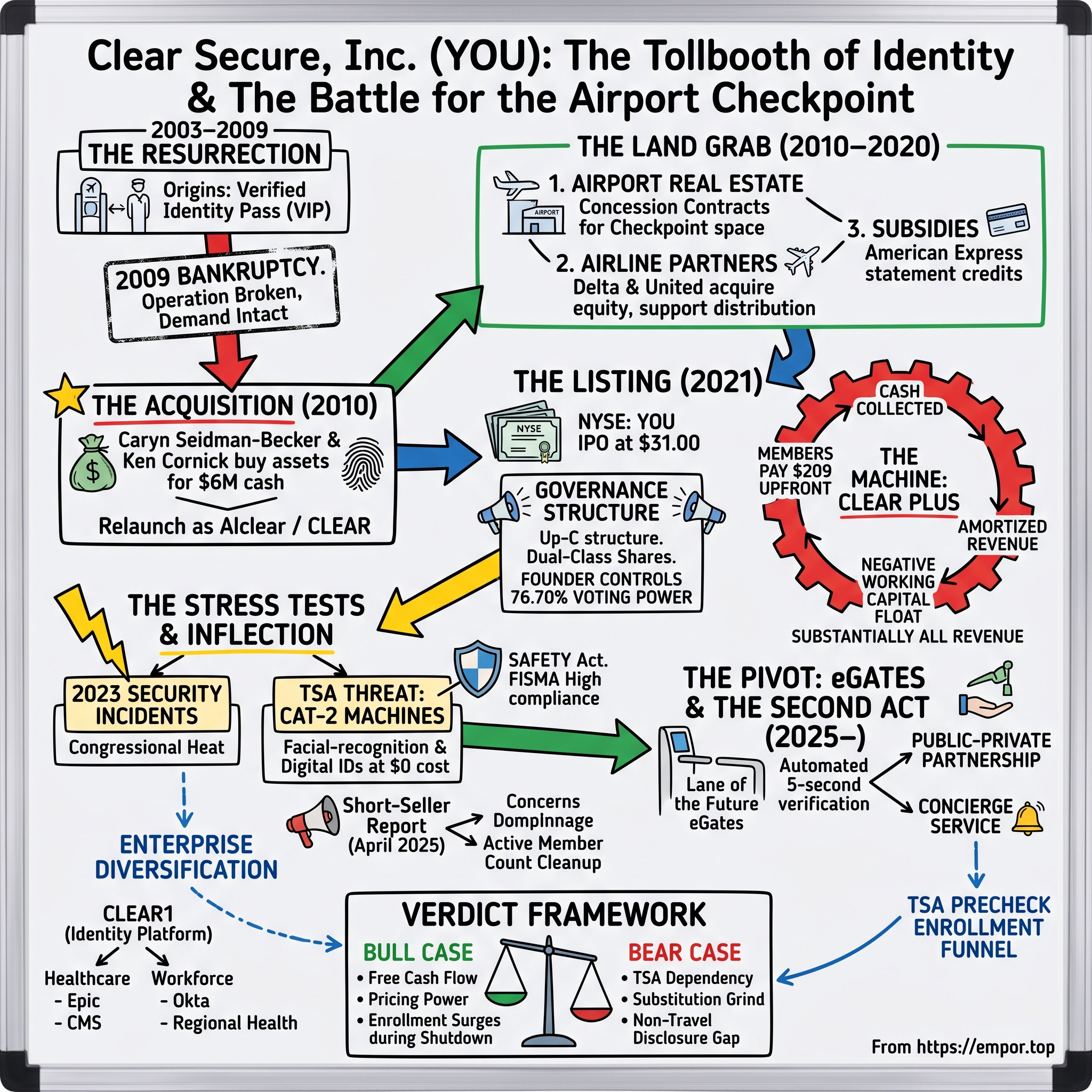
Clear Secure, Inc. (NYSE: YOU): The Tollbooth of Identity & The Battle for the Airport Checkpoint
I. Introduction & Episode Roadmap
In March 2026, the American airport checkpoint broke.
Funding for the Department of Homeland Security had lapsed in mid-February amid a standoff in Washington, and by the third week of March the consequences were visible in departure halls across the country. Transportation Security Administration officers were working without pay. Daily callout rates at checkpoints — the share of screeners who did not report for duty — climbed from approximately 4% before the shutdown to 11% nationwide, with individual airports exceeding 40% and 50%.1 On March 14, Houston Hobby recorded a single-day callout rate of 55%.1 Travelers missed flights, and wait times hit the longest levels in agency history.2 It took a presidential order on March 27 directing that TSA staff be paid out of existing funds before lines began to recede.2
For most of the travel industry, this was a severe disruption. For one company, it drove one of the strongest growth quarters in its history.
Clear Secure, Inc. — trading on the New York Stock Exchange under the ticker YOU — booked $291.7 million of business in the first quarter of 2026, up 40.8% year over year, and generated $185.5 million of free cash flow in three months, roughly double the prior-year figure.3 Its chief financial officer told analysts in May that growth had been trending above the prior quarter's pace before the shutdown, and that the crisis simply "further enhanced a strong quarter."4 Operational friction at public security checkpoints served as a direct demand driver for the paid private lanes operating alongside them.
That contrast underscores the unusual nature of the business model. CLEAR sells an annual subscription — $209 a year at list price — that lets members skip the manual identity-verification step of airport security.5 It does not screen bags or scan bodies. It performs a single targeted task: verifying identity faster than a human TSA officer checking a driver's license, then escorting members to the front of the physical screening queue. Approximately 8.2 million subscribers were paying for the service as of March 2026.3
The company's origins trace back to a distressed asset purchase. Two hedge fund managers acquired the assets of a failed airport fast-pass startup — the technology, the brand, and the fingerprint records of roughly 190,000 abandoned members — for $6 million in cash.6 Sixteen years later, that asset generated $900.8 million of revenue and $343.1 million of free cash flow in a single year, with no debt.7
The central strategic question in 2026 is whether CLEAR has built a durable enterprise or a temporary arbitrage on government operational friction.
CLEAR's competitive moat relies on friction — specifically, the friction of a chronically underfunded federal screening apparatus. Every dollar of its cash flow functions in practice as a premium on the limitations of a public service. Yet the federal entity controlling that friction is simultaneously CLEAR's regulator, landlord's landlord, and emerging technology partner. The TSA can require CLEAR members to show physical identification regardless, a rule it has already enforced at times. It can deploy its own facial-recognition readers to verify identity in seconds at zero cost to travelers. Alternatively, it can hand CLEAR the automation contract and let the company install the gates itself — as occurred in August 2025.8
Management's answer to these regulatory pressures is to broaden the company's positioning beyond travel. In recent earnings calls, founder and CEO Caryn Seidman-Becker described CLEAR as "the trusted standard and operating system for identity across both the physical and digital world," pointing to healthcare fraud, workforce verification, and AI-driven deepfakes as growth opportunities.9 Whether this strategy represents a genuine platform expansion or a narrative hedge against airport regulatory risk remains a primary question for investors.
The analysis follows this roadmap:
- The resurrection. How a post-9/11 startup went bankrupt in 2009, and why two investors recognized that underlying demand remained intact.
- The land grab. How airline equity, credit-card subsidies, and airport concession contracts established a physical real-estate distribution moat.
- The listing. A 2021 IPO during the travel reopening, an Up-C structure, and a founder who retains more than three-quarters of voting power.
- The machine. What actually generates the cash — upfront collection, negative working capital, and a cost structure frequently misread by investors.
- The stress tests. Security incidents, congressional letters, short-seller claims, and government-built technology that could diminish the need for CLEAR.
- The second act. Enterprise diversification through CLEAR1, TSA PreCheck enrollment, and whether non-airport verticals generate meaningful revenue or minor gains.
- The verdict framework. Evaluating the bull and bear cases through competitive frameworks, key valuation multiples, and critical forward-looking metrics.
The story begins with a bankruptcy.
 Subscribe on LinkedIn
II. The Phoenix Out of Bankruptcy: Verified Identity Pass to Alclear (2003–2010)
The idea was born in the anxious aftermath of September 11, 2001, and it belonged to a journalist.
Steven Brill, founder of Court TV and The American Lawyer, was not a security technologist. But after spending months reporting on the post-9/11 overhaul of U.S. national defenses, he developed a conviction that would prove both insightful and, for his enterprise, fatal: treating every traveler as an equal unknown misallocated scarce security resources. By pre-vetting frequent flyers through background checks, biometric registration, and identity cards, an expedited lane could move low-risk passengers faster and allow screeners to focus on the broader public.
In 2003, he launched Verified Identity Pass, and the consumer product carried a name that outlived every other part of the enterprise: Clear.6
Demand was immediate. Registered Traveler lanes opened at Orlando International Airport before expanding to other hubs. Members enrolled fingerprints and iris scans, drawn to a simple value proposition: pay an annual fee to bypass standard checkpoint lines.
The underlying operations, however, proved unsustainable. Hardware was costly and prone to failure; early smart cards and biometric readers malfunctioned frequently enough to delay priority lanes, undermining the product's core promise of predictability. Unit economics suffered because customer acquisition required physical kiosks and staff at each individual airport, selling a subscription that consumers viewed as discretionary. Furthermore, the regulatory framework remained ambiguous: while the federal Registered Traveler program permitted private operators inside checkpoints, it offered minimal clarity on how much screening could actually be streamlined.
When the 2008 financial crisis caused a sharp contraction in business travel—the core customer base—Verified Identity Pass ran out of capital. In June 2009, the company abruptly halted operations, leaving members without service, refunds, or clear answers regarding the security of their stored biometric data.
That operational failure created the opportunity for Caryn Seidman-Becker.
Her background differed from the typical technology entrepreneur. Raised in Maryland by two government employees, Seidman-Becker studied political science at the University of Michigan before launching a career in risk arbitrage—an investment discipline focused on merger spreads, deal structures, and managing bounded downside risks.6 At age 29, she founded her own hedge fund, Arience Capital, expanding its portfolio by 2007 to roughly $1.5 billion in assets with annualized net returns of approximately 12%.6 When the financial crisis unfolded, she liquidated most of the fund's holdings and returned capital to investors, positioning herself to pursue a new venture.
Together with her Arience partner, Ken Cornick, Seidman-Becker evaluated the defunct enterprise through a classic distressed-investing lens: the company was broken, but underlying customer demand remained intact. Travelers still wanted to bypass airport lines; the previous operator had simply failed to construct a profitable business model around that demand.
The acquisition process developed into a war of attrition against competing bidders. Seidman-Becker recalled overhearing rivals scrambling for financing during negotiations: "I hear them in the hallway on the phone trying to raise the money. They were dialing for dollars."6 She secured the assets with a $6 million cash offer, acquiring the technology, the brand, and the biometric enrollment records of roughly 190,000 former members.6 Reflecting on the immediate aftermath, Seidman-Becker later noted: "We went home that night and it was like having a new baby. You have no idea what you're doing."6
Acquiring the assets proved far simpler than the task that followed: persuading a federal security bureaucracy—which had just seen a private checkpoint operator collapse—that a newly capitalized private entity could reliably manage the function.
That regulatory hurdle shaped the architecture of the modern company. CLEAR operates today under the federal Registered Traveler Program governed by strict compliance standards akin to a defense contractor's: annual operational audits across every participating airport, a formal joint quality-assurance framework with monthly reporting to the TSA, information systems certified by DHS at a FISMA High rating, a dedicated Registered Traveler Security Overlay, continuous special-emphasis inspections, and system evaluations conducted by the DHS Science and Technology Directorate.5
Additionally, DHS certified CLEAR's core system as a Qualified Anti-Terrorism Technology under the SAFETY Act, providing legal liability protections in the event of a terrorist act.5
While these regulatory certifications generate no direct revenue, they constitute the foundation of CLEAR's operating model and create high barriers to entry for prospective competitors.
For businesses integrated into public-safety or regulated identity workflows, a compliance stack is not mere operational overhead—it is the operational license itself and the primary engine of compounding incumbency. Yet, as the company's subsequent growth demonstrated, it remains a license that the regulatory authority can alter at any time.
Securing regulatory clearance and reopening checkpoint lanes was only the initial phase. Scaling member enrollment to commercial volume required a distinct strategy.
III. Building the Airport Cash Machine: Re-launch, Airline Equity & Airport Real Estate (2010–2020)
The relaunch began where the original service had started: Orlando and Denver, in 2010.6 What followed was six years of methodical expansion—a period often glossed over, yet central to understanding why competitors have struggled to replicate the network.
It took CLEAR roughly six years to add its next sixteen airports.6
Adding sixteen airports in six years was less a technology rollout than a regulatory and permitting battle. Every location required an independent negotiation with a distinct local authority—a municipal aviation commission, a port authority, or a terminal-controlling airline—for physical space in the most congested area of an airport: the space directly ahead of the TSA document-check podium. Airport checkpoints hold virtually no spare capacity; allocating square footage to a private vendor reduces space available for standard queues, retail options, or agency equipment. Securing those footprints meant persuading public officials that granting lane access to a commercial entity serving fee-paying travelers advanced overall operational efficiency.
To align incentives, CLEAR structured its model as a concessionaire agreement, sharing a percentage of gross receipts—derived from member subscriptions and, in later years, TSA PreCheck enrollments—with host airports, retail venues, and partner airlines.5 The member revenue-share portion is typically prepaid to the airport when cash is collected, then capitalized and amortized over the subscription term, operating alongside a fixed base fee.5 In effect, CLEAR pays rent through a combination of upfront cash, top-line revenue sharing, and guaranteed minimum payments.
This structure creates two key strategic dynamics. First, revenue sharing aligns host airport finances directly with CLEAR's volume growth, supporting contract renewals. Second, because these arrangements are standard concessionaire agreements, counterparties retain the right to terminate contracts for cause or for convenience, as noted in company risk disclosures.5 At several locations, the contract counterparty is an airline rather than the airport authority itself.5 Consequently, the physical footprint functions as a real but contractually bounded moat.
In 2016, the network's expansion accelerated.
Delta Air Lines integrated CLEAR into its loyalty strategy, offering complimentary or discounted memberships to top frequent flyers while acquiring an equity stake in the enterprise. Delta secured an initial holding of roughly 5% following a $20 million funding round led by funds advised by T. Rowe Price, a stake that expanded to approximately 7% by 2019.10 United Airlines adopted a similar framework in July 2019, acquiring an equity position and incorporating CLEAR membership discounts into its MileagePlus program.11
These airline partnerships provided three assets that CLEAR could not easily purchase in the open market: political leverage, distribution, and structural validation. First, major carriers brought significant influence to municipal airport negotiations, advocating for expedited lanes to improve hub throughput. Second, direct access to carrier loyalty databases allowed CLEAR to market to tens of millions of frequent travelers at low customer acquisition costs. Finally, equity ownership by major airlines signaled operational stability to municipal authorities wary of vendor insolvency.
A third distribution driver emerged in 2019 through a partnership with American Express.5 Under the agreement, eligible premium cardholders receive statement credits covering all or part of a CLEAR Plus subscription.5 For American Express, the credit serves as a tangible, high-frequency benefit that justifies premium card annual fees. For CLEAR, the arrangement converts cardholder subsidies into active lane users, brand impressions, and identity-network profiles.
Financial disclosures clarify the mechanics of this arrangement: CLEAR's membership subscription revenue is reduced by the company's funded portion of credit-card benefits provided to members under the agreement, a figure that scales with total enrolled members in a given contract year.5 Rather than functioning as zero-cost distribution, the partnership represents subsidized distribution, where CLEAR absorbs a portion of the fee reduction directly against top-line subscription revenue instead of recording it as a marketing expense.
Despite the visibility of credit-card and airline subsidies, CLEAR's primary customer acquisition engine remains its physical presence inside airports. In-airport sign-ups accounted for 66% of new member additions in 2025, 64% in 2024, and 65% in 2023.5 Roughly two-thirds of new subscribers enroll at the checkpoint lane, converting travelers precisely at the moment of airport security friction.
This physical footprint represents CLEAR's primary operational moat. By the end of 2025, the company operated 166 CLEAR+ lanes across 60 airports, supported by 3,708 field Ambassadors and operational managers.5
A key structural feature of this footprint is physical exclusion. Once CLEAR occupies the floor space directly preceding a TSA document-checking podium, spatial constraints make establishing a secondary private biometric lane impractical. Airport authorities generally avoid split queue configurations that increase passenger confusion, leaving the incumbent vendor with a practical operational advantage during contract renewals. While not legally exclusive, these site-by-site concessions aggregate into a de facto national network.
When the COVID-19 pandemic halted air travel in 2020, the business model faced an unprecedented stress test. Despite domestic passenger volumes dropping by more than half, CLEAR reported 2020 revenue of $230.8 million—a modest decline reflecting upfront subscription collections and consistent renewals.28 Operating results turned negative as travel stalled, with the company generating an $18.9 million operating loss in 2020 that expanded to $114.9 million in 2021 as field operations re-staffed for travel recovery.287 However, the network remained intact: airports maintained concession agreements, deferred revenue provided cash liquidity, and lane positions were preserved.
This resilience underscored a fundamental operational characteristic: broad contractions in travel demand do not automatically dismantle the model. Instead, the primary vulnerabilities rest in regulatory policy and host agency decisions.
By 2021, CLEAR had built a subscription business anchored by physical real estate at high-friction travel bottlenecks, supported by airline equity partners and credit-card subsidy channels. As air travel rebounded, management prepared to take the enterprise public.
IV. The 2021 IPO, Up-C Structure & Capital Allocation Playbook
In retrospect, the timing of the initial public offering was remarkably favorable.
On June 29, 2021, CLEAR priced 13.2 million shares of Class A common stock at $31.00—above the marketed range of $27 to $30—generating gross proceeds of approximately $409.2 million.12
When trading opened the following morning on the New York Stock Exchange, the stock rose to $38.55, reached an intraday high of $42.10, and closed at $40.43. That 30% first-day pop valued the enterprise at roughly $5.8 billion.13
That valuation reflected future expectations rather than current earnings. For full-year 2021, CLEAR reported $254.0 million in revenue alongside an operating loss of $114.9 million.7 Investors were effectively buying a claim on the post-pandemic recovery of American air travel and an option on its long-term digital identity strategy at a cyclical high point in market valuations.
Behind the valuation, the company's corporate governance structure merits scrutiny.
CLEAR structured its listing as an Up-C. Under this arrangement, the public entity, Clear Secure, Inc., serves as a holding company whose primary asset consists of common units in the operating entity, Alclear Holdings, LLC.5 Clear Secure acts as the sole managing member, while pre-IPO owners retain their economic interests through Alclear units alongside low-economic, high-voting-power shares. The public holding company generates no direct revenue and relies entirely on cash distributions from Alclear to fund dividends, taxes, and corporate expenses.5
This structure creates tax advantages for pre-IPO owners. Under a Tax Receivable Agreement signed in June 2021, Clear Secure remits most of the value of specified tax benefits back to pre-IPO insiders as they exchange their units.5 Furthermore, tax distributions from Alclear to the holding company historically exceed its actual tax liabilities, leaving the board to determine how to allocate the excess capital.5
While common among Up-C listings and fully disclosed in public filings, this arrangement creates a continuous economic transfer from public shareholders to insiders, obscuring headline performance metrics. For example, in 2025 CLEAR reported consolidated net income of $168.1 million, but net income attributable to Clear Secure, Inc. was $109.2 million, translating to $1.12 in diluted earnings per share across roughly 97 million weighted diluted Class A shares.7 The difference reflects non-controlling interests held by founders and pre-IPO owners, making net income attributable to the public entity the relevant benchmark for public shareholders.
Governance power is similarly concentrated. The dual-class share structure assigns one vote per share to Class A and Class C stock, but twenty votes per share to Class B and Class D stock.14 As disclosed in the April 2026 proxy filing, Alclear Investments, LLC—the entity controlled by Seidman-Becker—held 14.50% of the economics on a fully exchanged basis but controlled 76.70% of the combined voting power.15 Directors and executive officers as a group held 15.64% of economic ownership while commanding 76.99% of the votes.15
With roughly one-seventh of the economic equity and over three-quarters of the voting rights, leadership is insulated from external governance pressure, including hostile takeover bids, proxy challenges, and binding shareholder votes. Evaluating the enterprise therefore depends heavily on assessing management's operational execution and capital discipline.
Despite this governance concentration, management's capital allocation strategy has prioritized shareholder returns. Rather than burning IPO capital on unprofitable customer acquisition, CLEAR generated substantial free cash flow and returned significant capital to investors. In 2025, the company returned over $240 million to shareholders, repurchasing 5.3 million shares for $106.3 million at an average price of $23.86 and reducing shares outstanding by 3% to 133.2 million.9 Since its IPO, total shares outstanding have declined by approximately 14 million, or 9%, contrasting with many technology listings from the same period.9 Meanwhile, stock-based compensation declined to 4.3% of revenue in 2025.9
Alongside its fourth-quarter 2025 earnings, the board increased the regular quarterly dividend by 20% from $0.125 to $0.15 per share, declared a $0.20 special dividend—both paid on March 24, 2026—and authorized an additional $125.0 million for share repurchases, expanding total remaining buyback capacity to roughly $250.3 million.7
In early 2026, however, management signaled a shift in capital deployment. During the first-quarter 2026 earnings call, with $800 million in cash and marketable securities on its balance sheet, leadership emphasized that the reserves provided "strategic flexibility" to accelerate investments in engineering, product development, brand marketing, and security, rather than introducing new capital return initiatives.4 Management projected that cash reserves would surpass $1 billion with zero debt by the end of 2026, prior to any additional capital returns.9 How leadership deploys this expanding cash balance represents a critical strategic test for the business.
Understanding how this cash accumulates so rapidly requires examining the underlying mechanics of CLEAR's subscription business model.
V. The Core Cash Engine: Anatomy & Economics of CLEAR Plus
A single sentence in CLEAR's annual report captures the essence of its financial architecture: "The Company derives substantially all of its revenue from subscriptions to its consumer aviation service, CLEAR+."5
Not a majority, but substantially all. Fifteen years after its relaunch and five years after its initial public offering, CLEAR remains, financially, a single-product enterprise selling a single subscription to American air travelers. Other offerings—including TSA PreCheck enrollment, CLEAR1, and Concierge services—are described in corporate filings as revenue streams "not significant to the Company's operating results."5 Any analytical assessment leading with the digital identity platform story highlights corporate strategy rather than current financial reality.
Analyzing the subscription model reveals how this cash engine operates.
The product and the price. CLEAR+ carries a list price of $209 per year per member, billed upfront, with a family plan allowing up to three additional members for $125 per year each, while children under 18 travel free with an adult member.5 Roughly 27% of paying active members were on a family plan at the end of 2025, essentially unchanged from 28% a year earlier.5 Discounted and subsidized rates flow through frequent-flyer programs with Delta, United, Alaska, and Hawaiian, as well as the American Express statement-credit arrangement, military discounts, and government rates.5
The float. Every subscription fee is collected in cash at the time of sale and recognized ratably over the subsequent twelve months. This accounting structure creates a defining characteristic of CLEAR's financial profile: a large and expanding deferred revenue balance that boosts cash flow relative to reported net income. As of December 31, 2025, deferred revenue reached $516.2 million, up from $439.8 million a year earlier, with the expansion in deferred revenue alone contributing $76.5 million to 2025 operating cash flow.5
This mechanism represents negative working capital in its purest form, effectively allowing customers to fund operations. As long as overall bookings expand, the float grows, generating upfront cash before services are delivered. This dynamic mirrors the float generated by insurance premiums and prepaid gift cards, though it carries a corresponding risk: if bookings contract, the cash inflow reverses. Consequently, management emphasizes bookings rather than revenue as the primary indicator of current cash generation, with revenue serving as an accounting lag realized over the following year.
The 2025 numbers. Revenue reached $900.8 million, up 16.9%, on total bookings of $977.2 million, up 17.2%.7 Operating income rose to $186.5 million, representing a 20.7% margin—a sharp reversal from an operating loss of $129.1 million as recently as 2022.7 Adjusted EBITDA reached $262.2 million, a 29.1% margin, up 480 basis points year over year.7 Operating cash flow totaled $372.5 million against capital expenditures of $29.3 million, yielding free cash flow of $343.1 million.5
That free cash flow figure translates to converting roughly 38 cents of every revenue dollar into cash. For a business employing 3,708 field staff across airport locations, such cash conversion reflects significant operational efficiency and remains a central pillar of the investment thesis.
Where the money actually goes — and the number the bulls get wrong. CLEAR reports revenue-share fees paid to airports—representing concession payments—as its cost of revenue, totaling $127.8 million in 2025, up 18%, split between a 22% increase in fixed airport fees and a 17% increase in per-member fees.5 On that basis, gross margin appears to be roughly 86%, resembling software industry economics.
However, operational realities reflect a hybrid model. Below the cost-of-revenue line, direct salaries and benefits for Ambassadors, field managers, and member support personnel totaled $192.6 million in 2025.5 These field teams are essential to delivering the core service. Categorizing these personnel expenses as cost of revenue, as short seller Spruce Point Capital did in 2025, gross margin drops to roughly 61.5%.16
Both accounting presentations are defensible and fully disclosed in public filings. From an analytical perspective, modeling CLEAR strictly as an 86% gross margin software subscription enterprise oversimplifies the business model. CLEAR functions as a labor-intensive service with software-like incremental economics: once field staffing is established at a checkpoint, enrolling an additional member carries minimal marginal cost, though establishing and maintaining physical airport presence requires substantial fixed expenditure.
Operating leverage has increasingly materialized in financial results. Direct salaries grew 11% in 2025 against revenue growth of 17%, with field personnel costs falling to 19.3% of revenue in the fourth quarter—an improvement of about 390 basis points year over year.9 Full-year general and administrative expenses grew at less than half the pace of top-line revenue, improving G&A as a share of revenue by more than ten percentage points over two years.9 Fourth-quarter adjusted EBITDA margin reached 33.2%, up 870 basis points.7
This margin expansion demonstrates that subscriber density across host airports is increasingly covering fixed operational overhead. Simultaneously, financial data indicates lower relative spending on product development: research and development expenses were $72.4 million in 2025, below the $74.4 million spent in 2023 despite revenue growing nearly 47% over that span.5 Short seller Spruce Point Capital flagged falling R&D as a red flag.16 Management's approach can be interpreted either as disciplined cost control or as margin expansion supported by reduced research investment. The durability of this cost structure will depend on whether planned 2026 product initiatives materialize as projected.
Pricing power — tested, and mostly passing. Management has raised the CLEAR+ list price repeatedly, most recently in 2025.4 Pricing elasticity metrics have remained broadly favorable: revenue grew 17% in 2025 on a member base that grew only 6%, meaning price and mix drove the majority of top-line growth.5 During the first-quarter 2026 earnings call, CFO Jen Hsu described a deliberately "more measured approach to price increases," consistent with 2025 actions.4 This strategy indicates deliberate management of pricing levers to balance yield and retention.
Pricing sensitivity is further mitigated by enterprise sponsorship. A significant portion of members incur no direct out-of-pocket costs because subscriptions are reimbursed through American Express card benefits. For these subscribers, list-price adjustments represent a bilateral contract negotiation between CLEAR and American Express rather than a consumer purchasing decision. While this structure insulates subscriber retention from price resistance, it introduces partner concentration risk.
The member number, and an asterisk. Active CLEAR+ members ended 2025 at 7.6 million, up 6%—a figure management disclosed "reflect[s] a one-time cleanup of lapsed accounts as part of a billing system transformation project undertaken during 2025," with no impact on revenue, cash flow, or any other financial measure.9 By the first quarter of 2026 the count had jumped to 8.2 million, up 13%.3
While corporate filings describe the adjustment as administrative housekeeping, the sequence coincides with external scrutiny. A short seller alleged in April 2025 that CLEAR was "potentially inflating its active member counts by extending the grace period after billing failure,"16 and later that year the company purged lapsed accounts during a billing-system migration. While the timing does not prove the allegation, an investor should treat pre-2026 membership data separately from post-cleanup metrics while monitoring future disclosures regarding active account definitions.
Beyond consumer adoption and financial mechanics, the company's long-term trajectory depends on counterparties whose interests do not always align with private checkpoint operations.
VI. The TSA Friction Point & The CAT-2 Threat: Security Breaches, Short Reports & Congressional Heat
In the summer of 2023, CLEAR learned the vulnerabilities of relying on a federal regulator as its primary supplier.
The issue stemmed not from technology, but human error. Over roughly thirteen months, news reporting detailed three security incidents in which the human layer of CLEAR's operations failed: a July case in which a man enrolled in CLEAR using another person's identification and a CLEAR employee waved him through a TSA checkpoint, following two earlier breaches in January and March where CLEAR employees escorted non-enrolled travelers through screening.17
Those failures struck directly at the company's core value proposition. CLEAR's entire claim to its physical concession space rests on verifying identity more reliably than the government. Documented instances of employees bypassing verification were not merely operational errors—they posed an existential threat to a brand built on trust.
Washington reacted swiftly. Members of the House Homeland Security Committee wrote to the TSA administrator citing security vulnerabilities and urging that all travelers, including CLEAR members, be required to present physical identification at checkpoints.17 In July 2023, the TSA drafted plans requiring additional identity verification for CLEAR subscribers.17 By August, following company pushback, the agency softened its stance, informing CLEAR that a smaller proportion of members would face additional vetting than originally planned.18
Even in its modified form, the policy directly undermined the product's value. CLEAR subscribers pay to eliminate steps at security. If a meaningful share of members complete a biometric scan only to be routed to a TSA officer to present a physical driver's license, subscribers are essentially paying $209 to complete the process twice. CLEAR's own risk disclosures acknowledge this dynamic directly, noting that if the TSA materially increases randomized reverification rates for CLEAR+ members or adjusts checkpoint workflows, member experience and retention could suffer.5
This dynamic illustrates the supplier-power challenge documented in the company's regulatory filings: CLEAR possesses minimal leverage against its primary regulatory overseer.
The bigger threat was not the letter. It was the machine.
While CLEAR managed its 2023 regulatory crisis, the TSA accelerated deployment of second-generation Credential Authentication Technology. A CAT-2 unit combines a document scanner with a digital camera. When a passenger inserts an ID or presents a digital credential, the system captures a live photo and uses facial matching to verify it against the image on the credential.19 The TSA maintains that photos captured by CAT-2 units are not stored or used for other purposes, and travelers retain the right to opt out in favor of manual verification.19
Concurrently, the TSA expanded acceptance of state-issued mobile driver's licenses stored in digital phone wallets, accepting digital IDs at checkpoints across a growing number of participating states.20
Considered alongside CLEAR's business model, these developments posed a direct structural challenge. CLEAR charges $209 annually to biometrically verify identity at airports. Meanwhile, the federal government began installing hardware across hundreds of checkpoints to verify identity biometrically at zero cost to travelers, using credentials already stored on smartphones.
That dynamic represents the bear case in its purest form—not as a theoretical risk, but as deployed infrastructure.
Enter the short seller. On April 30, 2025, Spruce Point Capital Management published a report titled "What Are YOU Hiding?" issuing a strong sell recommendation and targeting a 30% to 50% intermediate-term downside.16 The report combined strategic criticism with accounting analysis, alleging that reported gross margins of 85.8% masked a labor-heavy reality closer to 61.5%; that active member counts were inflated through extended post-billing-failure grace periods; that airline and American Express partnerships were weakening; that research and development spending was declining; that cash distributions to related parties exceeded internal investment by roughly $44 million over three years; and that the TSA's Touchless ID program threatened to render CLEAR obsolete.16 The short seller also highlighted governance concerns regarding insider stock sales and the chief accounting officer's professional background.16 CLEAR shares fell approximately 3.3% following the report's release.21
With time, the merits of those arguments have proven mixed. The gross margin critique offers an analytically sound framework for evaluating labor costs, and concerns over member-count definitions anticipated subsequent reporting adjustments. Critiques regarding related-party transactions and disclosures further illuminate the structural nuances of the Up-C model.
However, the core strategic thesis—that government technology would render CLEAR obsolete—has so far failed to materialize. How CLEAR navigated that risk represents a pivotal turn in the company's recent trajectory.
CLEAR did not fight the machine. It became the machine.
Rather than defending legacy kiosk pods and field staffing against government automation, CLEAR developed its own automated hardware and presented it to the TSA. In 2024, the company introduced its "Lane of the Future," deploying EnVe—enrollment and verification—hardware designed to deliver face-first verification roughly five times faster than legacy pods, supported by its NextGen Identity+ architecture.5 In 2025, it began installing physical eGates, integrating proprietary hardware and software to verify member identity in approximately five seconds before directing travelers into physical screening.5
On August 19, 2025, the TSA announced a public-private partnership to deploy eGates at airport checkpoints at no cost to taxpayers.8 Available to opting-in CLEAR+ subscribers, the gates perform real-time biometric matching comparing a traveler's face against their identity document and boarding pass, allowing verified passengers to bypass the TSA podium entirely.22 The pilot program launched at Hartsfield-Jackson Atlanta, followed by Reagan National and Seattle-Tacoma, where local officials framed the deployment around managing passenger volume ahead of the 2026 FIFA World Cup.23
Rollout expanded rapidly. CLEAR operated eGates across 10 airports by the end of the third quarter of 2025 and reached 37 locations by year-end, exceeding its internal target of 30.24 By the first quarter of 2026, eGates spanned over 50% of the airport network, with management targeting coverage above 80% by the end of the second quarter.4
Initial operational metrics appear positive: average CLEAR+ wait times dropped below one minute, Net Promoter Scores reached three-year highs, and satisfaction metrics ran noticeably higher among eGate users.4 On the fourth-quarter earnings call, President Michael Barkin noted that automating identity verification allows the company's 3,500 field Ambassadors across 60 airports to shift focus from passenger processing to customer service.9
This pivot effectively addressed immediate obsolescence risks, yet it introduces new strategic considerations. By transforming into the TSA's primary automation vendor, CLEAR has deepened its reliance on a single federal agency. A substantial portion of the enterprise's value remains tied to a regulatory partnership it cannot dictate—a partner capable of altering contract terms, insourcing identity verification, or granting equal access to competing providers. The eGate partnership converts an existential technology threat into a concentrated counterparty risk.
Then, in March 2026, external operational disruptions provided CLEAR with a powerful commercial catalyst.
VII. Beyond the Airport: CLEAR Verified, TSA PreCheck Funnel & M&A Diagnostics
During the March 2026 government funding lapse, when TSA officers worked without pay and employee callout rates spiked, CLEAR's field staff remained on duty. Chief Executive Caryn Seidman-Becker used her first-quarter earnings remarks to thank TSA officers directly and to describe the combination of field personnel, hospitality, and eGates as "a stabilizing force."4 Commercial results reflected that dynamic: the three-week checkpoint disruption helped generate the strongest bookings quarter in company history, with Chief Financial Officer Jen Hsu arguing that members who enrolled when the value proposition was "particularly evident" should demonstrate strong long-term retention.4
That retention premise remains unproven. Subscribers acquired during operational crises historically carry higher churn risk once standard conditions resume. Management counters that underlying demand was accelerating prior to the shutdown and that Net Promoter Scores reached multi-year highs independently.4 Consequently, subscriber retention among the 2026 shutdown cohort will serve as a key test of whether recent operational enhancements drive durable engagement.
Concurrently, management has expanded three initiatives aimed at broadening the enterprise beyond airport security line acceleration.
TSA PreCheck enrollment. On April 30, 2024, CLEAR became the TSA's third official PreCheck enrollment provider, joining IDEMIA and Telos.25 The company launched its enrollment service in February 2025, expanding availability to 61 airports and 340 retail locations nationwide by year-end, alongside online renewal processing.5 Transaction revenue is recognized net of fees remitted to the TSA and the Federal Bureau of Investigation.5
This arrangement creates an efficient customer acquisition funnel. Because TSA PreCheck represents the primary low-cost alternative for expedited screening, acting as an official enrollment agent allows CLEAR to capture transaction revenue from target air travelers while offering CLEAR+ as an opt-in upgrade during registration.5 Instead of competing directly against the federal program, CLEAR monetizes prospective subscribers at enrollment. During the first-quarter 2026 earnings call, Seidman-Becker emphasized the early stage of the rollout, noting, "we're really only 2 years into that program."4
CLEAR1. The business-to-business platform, formerly marketed as CLEAR Verified, provides multi-layered identity verification combining biometric, document, and device signals with verified data sources, allowing enterprise partners to customize verification thresholds based on organizational risk tolerance.15 Target markets focus on healthcare, workforce management, and government services.15
Management has highlighted strong growth metrics for CLEAR1. The fourth quarter of 2025 marked CLEAR1's largest bookings quarter to date, with bookings more than doubling year over year alongside a record number of new enterprise clients.9 Momentum continued into the first quarter of 2026, when bookings expanded roughly fivefold compared to the prior-year period, supported by nearly double the signed deal count and a record number of multi-year enterprise contracts.4 These agreements typically include minimum annual commitments that enhance multi-year revenue visibility.4 Anchor deployments include building an identity interoperability layer for the Centers for Medicare & Medicaid Services to combat healthcare fraud and waste, achieving a FedRAMP authorization milestone for federal agencies, integrating into Epic Systems' identity architecture, partnering with Okta, and onboarding regional health networks such as Mount Sinai.94
Despite reporting rapid growth rates and expanding contract counts for CLEAR1, management does not break out segment revenue or profitability. Annual filings confirm that revenue generated from non-aviation enterprise partners "have historically been immaterial" relative to total company results.5 High percentage growth on an unstated, modest baseline leaves the financial contribution of the enterprise business undefined.
While highlighting top-line booking metrics and client acquisitions is standard for early-stage enterprise ventures, assessing CLEAR1's financial impact remains difficult without segment revenue reporting. Until CLEAR provides explicit revenue figures and margin profiles for its enterprise business, market evaluation of the platform expansion relies primarily on management projections rather than reported operating results.
The enterprise strategy relies on network integration within regulated sectors. During the fourth-quarter 2025 earnings call, Seidman-Becker explained how integrating with public and private software architecture accelerates client adoption: embedding CLEAR1 within Epic's identity tools and the CMS interoperability layer lowers friction for individual health systems, noting that "because it is much easier to connect; you are already embedded in it."9 Management noted that an industry healthcare pledge initiative convened by CLEAR expanded from 60 participating organizations to nearly 600 within a single quarter, building a potential customer pipeline.9 This framework supports a land-and-expand commercial strategy, initially deploying identity verification across a health system's employee workforce before expanding to patient populations.9
While embedding technology directly into enterprise workflows aligns with industry standards for B2B software adoption, validating commercial execution requires standardized performance metrics. CLEAR has not disclosed net revenue retention or annual recurring revenue for CLEAR1, characterizing net retention metrics qualitatively as "very strong."4
Expanding into healthcare also alters customer demographic positioning. Seidman-Becker noted that newly onboarded CLEAR1 enterprise clients average roughly a 25% overlap with the company's existing air travel member base, and that reaching broader populations, such as Medicare beneficiaries, requires enrolling non-traveling consumers who receive the service without direct subscription charges.4 If successful, this strategy expands the identity network beyond frequent air travelers; conversely, acquiring non-paying users risks inflating account totals without driving recurring subscription revenue.
Concierge services. A secondary revenue initiative, CLEAR Concierge, offers personalized airport assistance starting at $99, allowing members to reserve dedicated field staff to meet them curbside and escort them through security to departure lounges or gates.4 Operating in 32 airports by the first quarter of 2026, management characterized the high-touch service as high-margin, noting that it had not yet launched in key metropolitan hubs including New York, Los Angeles, and San Francisco.4 The service repurposes field personnel freed up by automated eGate installations, serving as a test of management's ability to expand average revenue per member alongside standard subscriptions.
Platform membership scale. Rather than breaking out non-aviation revenue, management highlights Total CLEAR Members, which reached 38.0 million at year-end 2025 (up 31.5%) and expanded to 41.0 million by the first quarter of 2026 (up 31.3%).93 This aggregate figure primarily reflects non-paying platform users acquired through enterprise integrations and partner applications. While total membership measures overall network reach and supports partner acquisition, it serves as a measure of user engagement rather than direct financial monetization.
Capital allocation and acquisition record. Despite holding significant cash reserves, CLEAR's merger and acquisition activity has remained limited. The company acquired Whyline, Inc. in 2021 to secure virtual queuing technology for its mobile applications and establish international airport partnerships.5 In September 2023, it acquired Sora ID, Inc. to enhance identity verification capabilities within financial services.5 Business combinations required $3.75 million in cash in 2023, with no acquisition expenditures recorded in 2024 or 2025.5
This measured acquisition history contrasts with management's stated goal of establishing a broad identity platform. While holding $800 million in cash and marketable securities, the company has completed minimal external M&A over three years.4 This conservative posture can be interpreted either as capital discipline that avoids overpaying for unproven assets, or as a constrained deployment strategy in expanding enterprise identity capabilities. How management deploys its projected $1 billion cash reserve will clarify its long-term strategic approach.
Evaluating these allocation decisions requires examining corporate leadership, governance oversight, and historical execution against strategic commitments.
VIII. Management Credibility, Governance & Capital Allocation Audit
In February 2025, CLEAR announced that Ken Cornick—who had co-founded the company, negotiated its acquisition out of bankruptcy, and served as its president and chief financial officer—was leaving the executive suite.
Cornick stepped down from his executive role in March 2025, transitioning to an advisory arrangement, and did not stand for re-election as a director.1526 Michael Barkin, a director since 2019 and former executive vice president and chief financial officer of Vail Resorts, became president on March 31, 2025.26 Jen Hsu, previously head of corporate development and investor relations at Chewy, assumed the chief financial officer role on the same date.26
Executive transitions at founder-led firms can signal internal friction, and Cornick's departure occurred roughly two months before a short-seller report cited leadership turnover as a core vulnerability.16 Additional departures followed: General Counsel and Chief Privacy Officer Lynn Haaland resigned in April 2026.15 For a company whose operational license depends on privacy standards and regulatory compliance, the departure of its chief privacy officer represents a significant event, and management has not publicly disclosed a reason for her exit.
Countering concerns over turnover, the background of the new leadership team aligns closely with CLEAR's commercial model. Barkin brought experience from Vail Resorts, an enterprise similarly structured around upfront collection of annual pass subscriptions for access to capacity-constrained physical infrastructure. Hsu brought analytical experience from Chewy's subscription-based consumer platform. Furthermore, financial performance following the transition—marked by accelerating bookings, an 8.7-percentage-point expansion in fourth-quarter operating margins, and free cash flow exceeding initial targets—suggests operational continuity rather than organizational disruption.79
Testing management against its own record. Evaluating a founder-controlled enterprise requires assessing financial performance against guidance alongside narrative consistency over time.
On financial execution, management has consistently met or exceeded its public targets. Full-year 2025 free cash flow of $343.1 million exceeded official guidance.9 Initial 2026 free cash flow guidance was set at "at least $440 million" in February 2026, then raised after the first quarter to "at least $465 million"—representing projected year-over-year growth of at least 36%.94 Additionally, first-quarter 2026 revenue of $253 million surpassed the guided range of $242 million to $245 million.73
Concurrently, corporate positioning has evolved significantly. At the time of its 2021 public offering, CLEAR framed its value proposition around expedited airport travel. By the fourth quarter of 2025, Chief Executive Caryn Seidman-Becker was describing CLEAR as "an essential layer connecting and securing the physical and digital world," positioning the enterprise at "an important inflection point" in identity verification.9 By May 2026, management messaging had broadened further, framing identity as "the foundational infrastructure of a functioning economy" while emphasizing AI-driven fraud, deepfakes, and automated access control.4
Seidman-Becker addressed this shift directly during the first-quarter 2026 earnings call when asked about accelerated adoption of the CLEAR1 enterprise platform, acknowledging: "For a long time, I would tell you that we were a solution looking for a problem... and there's now problems looking for our solutions."4 This statement effectively conceded that the enterprise strategy struggled for years to establish clear product-market fit.
The critical analytical question is whether non-travel revenues will expand to match this broader platform narrative. While executive communications frame CLEAR as a digital identity infrastructure provider, financial filings confirm that airport subscription fees continue to generate substantially all company revenue. If enterprise revenue disclosures remain immaterial in coming quarters, the divergence between corporate narrative and financial reality will remain a central investment risk.
Analyst pressure and earnings call dynamics. Equity analyst inquiries during recent earnings calls have focused on the durability of growth following operational disruptions. During the February 2026 call, JPMorgan analyst Cory Carpenter queried management on potential operational risks associated with a federal government funding lapse, returning in May to ask whether surge demand during the TSA shutdown created a temporary demand "air pocket" for subsequent quarters.94 Similarly, Needham analyst Joshua Reilly questioned management regarding the proportion of trial versus fully paying members acquired during the checkpoint crisis.4
In response, Chief Financial Officer Jen Hsu cited second-quarter 2026 revenue guidance implying 27% growth at the midpoint, alongside multi-year high Net Promoter Scores, arguing that underlying member demand was "not masked" by a temporary three-week disruption.4 These responses provide measurable benchmarks that can be evaluated against second- and third-quarter 2026 financial disclosures.
Executive compensation and alignment. Executive incentive structures reflect both operational performance and the dynamics of founder control. For 2025, the compensation committee approved discretionary bonuses of $400,000 for Seidman-Becker, $250,000 for Barkin, and $150,000 for Hsu, citing second-half growth momentum in airport operations and the execution of the executive transition.15 Cornick's 2025 compensation included $26,737 in advisory service payments following his step-down.15
While cash bonuses remain modest relative to industry benchmarks, primary financial alignment stems from equity ownership. Seidman-Becker held an equity stake valued at approximately $1.1 billion at mid-2026 market valuations.6 While this substantial holding aligns founder wealth with long-term equity value, the concentration of voting control limits the governance leverage of independent board members regarding executive oversight and compensation decisions.
Governance structure and institutional ownership. Incremental governance changes have altered voting dynamics without shifting ultimate control. In June 2025, following Cornick's departure from the board, high-voting Class B and Class D shares held by his investment entity automatically converted into standard Class A and Class C shares, reducing the original founder super-voting bloc.15 In addition, the 2026 proxy statement asked shareholders to approve charter amendments eliminating select supermajority voting provisions.15 While these adjustments reduce structural entrenchment at the margin, Seidman-Becker continues to control 76.70% of total voting power while holding 14.50% of economic equity.15
To strengthen independent oversight, the company appointed Affirm Chief Financial Officer Rob O'Hare to the board and audit committee on July 30, 2026, expanding total board membership to ten.27
Institutional ownership figures from the April 2026 proxy filing reveal significant backing by major asset managers and prominent value investors. As of April 2026, BlackRock held 10.60% of Class A economic equity, Vanguard held 8.61%, and value investor William H. Miller III held an 8.08% position.15 Substantial participation by institutional and value-oriented investors suggests that prominent capital allocators view the company's free cash flow generation as sufficient to offset its dual-class governance discount.
With executive leadership and governance parameters established, the remaining analytical question concerns competitive durability: what structural moat protects CLEAR's core cash engine?
IX. Strategic Frameworks: Helmer's 7 Powers & Porter's 5 Forces
Stripping away corporate rhetoric about platforms and digital infrastructure leaves the fundamental strategic question for any enterprise: what structural mechanisms prevent competitors from replicating the business model?
Cornered resource — a defensible asset on a leased foundation. CLEAR's most defensible asset is physical: 166 lanes operating across 60 airports, secured through concession agreements with local aviation authorities and partner airlines.5 Checkpoint floor space is genuinely scarce; no secondary private queue can easily fit in front of a screening podium. A prospective rival cannot simply outbid the incumbent because the footprint is not sold on an open market—it is allocated by public authorities with extended procurement cycles and a strong bias toward an operator with an established compliance record.
However, a rented cornered resource carries inherently less security than an owned asset. These concession agreements contain standard provisions allowing termination for convenience.5 The physical network functions as a strong competitive barrier, but one bounded by contractual expiration dates that require continuous renewal.
Scale economies — local rather than global. The back-end verification architecture and compliance stack carry largely fixed costs, meaning each additional subscriber generates high incremental margins. That operational leverage helped drive direct field salaries down by roughly four percentage points as a share of revenue in 2025.9 Yet these scale economies accrue primarily at the individual airport level rather than across the entire national network. Entering a new airport requires deploying additional hardware, staffing field Ambassadors, and absorbing fixed operating costs before local volume yields efficiency. With CLEAR covering roughly 75% of total U.S. travel volume, extending the footprint into remaining airports introduces incremental margin drag.4
Network effects — two-sided utility rather than classical lock-in. The network effect operates in a focused, two-sided structure: expanding airport and venue coverage increases subscription value for travelers, while a platform reaching 41 million enrolled identities enhances appeal to enterprise partners seeking pre-verified users.3 However, air travelers do not benefit directly from other travelers joining the service in the manner of a social network or communications platform. The core consumer benefit reflects location density—similar to a fitness chain expanding its branch footprint. While enterprise integrations could eventually generate true cross-side network effects under a "verify once, use everywhere" model, that expansion currently relies on aggregate user volume rather than demonstrated segment revenue.5
Switching costs — behavioral friction over structural lock-in. An annual auto-renewing subscription offers modest inherent switching costs. Member retention relies instead on behavioral friction: automated billing settings, credit card subsidies that eliminate out-of-pocket costs, frequent-flyer status integration, and multi-user accounts. With 27% of active CLEAR+ members enrolled on family plans, canceling requires coordinated family decisions rather than a single individual choice.5 These mechanisms create effective retention barriers, though they remain behavioral incentives rather than technical lock-in.
Counter-positioning — an advantage transformed into vendor integration. Historically, CLEAR counter-positioned a private, technology-enabled lane against an underfunded public checkpoint queue. That dynamic shifted when federal authorities accelerated automated credential screening. Rather than competing directly against government automation, CLEAR integrated its eGate hardware into agency operations, converting itself into the primary automation vendor.8 This transition mitigated immediate technology obsolescence, but replaced counter-positioning leverage with structural counterparty reliance on a federal regulator.
Branding — established trust in biometric verification. Over sixteen years of operations, with approximately two-thirds of new subscribers enrolling in person at airport checkpoints, CLEAR built widespread consumer familiarity with biometric identity verification.5 That brand equity represents the key asset management seeks to leverage when marketing enterprise verification solutions to healthcare networks and government agencies—a consumer-facing trust profile that pure B2B software vendors struggle to replicate.
Evaluating the enterprise through Porter's Five Forces highlights how a single regulatory relationship shapes the broader competitive profile:
-
Supplier power: dominant. The TSA and municipal airport authorities function simultaneously as regulator, landlord, and technology partner. The 2023 identity-verification policy directive illustrated how rapidly a regulatory adjustment can alter checkpoint workflows and member processing times.1718 Regulatory and landlord authority represents the single most consequential competitive force facing the enterprise.
-
Threat of substitutes: significant but partially internalized. State-issued mobile driver's licenses, government CAT-2 facial matching, and expanding TSA PreCheck coverage continuously narrow the time savings CLEAR offers over standard screening.1920 CLEAR countered this threat by deploying its own automated eGate hardware across checkpoints, maintaining average member processing times under one minute and supporting higher satisfaction scores.4 While government identity technology remains a structural substitute, automated gate partnerships have partially absorbed that threat into core operations.
-
Buyer power: low among consumers, concentrated institutionally. Individual travelers possess minimal bargaining power and exhibit low price sensitivity, particularly when subsidized. However, enterprise partners—including American Express, Delta, and United—negotiate on behalf of millions of subscribers, with subsidized credit structures directly influencing realized subscription yields.5 While the February 2026 multi-year renewal with American Express eliminated immediate partnership expiration risks, management declined to disclose specific financial terms, stating only that the structure reflected mutual value.9 Consequently, future revenue-per-member trends will serve as the primary indicator of corporate pricing leverage in institutional renewals.
-
Threat of new entrants: low. High entry barriers protect the core airport business, including FISMA High security certifications, SAFETY Act designation, specialized compliance protocols, established airport concession agreements, and physical space constraints at screening checkpoints.5 Capital alone cannot overcome these regulatory and physical footprint requirements.
-
Competitive rivalry: segmented by market. In private expedited airport identity verification, CLEAR operates with no direct domestic competitor. In enterprise digital identity and verification services, however, it competes against established software vendors—including ID.me, iProov, Persona, and partner Okta—where enterprise segment revenue remains too small to evaluate independent market share.5
The composite competitive picture reveals a highly cash-generative enterprise anchored by a leased physical footprint, local scale economies, and behavioral retention mechanisms—yet bound to a single federal counterparty with the authority to redefine its operating model. It functions as a highly profitable tollbooth whose long-term durability depends on the regulator that controls the gate.
X. Investment Thesis: Bull vs. Bear Case & Key Operating Metrics
Why this wins from here.
The primary bullish argument for CLEAR relies not on its emerging identity platform, but on the durability and profitability of its core airport operation, which has demonstrated greater pricing power and capacity than market assumptions suggested two years prior.
First, cash generation provides structural downside protection. An enterprise converting nearly 38% of revenue into free cash flow, projecting at least $465 million in free cash flow for 2026, carrying zero debt, targeting more than $1 billion in liquid reserves by year-end, and actively repurchasing shares presents a resilient financial profile.49 While macroeconomic downturns may suppress booking growth, upfront subscription collections and a debt-free balance sheet prevent solvency strain.
Second, international expansion offers incremental volume. CLEAR currently covers roughly 75% of U.S. air travel volume, while recently opening enrollment to passport holders from 42 Visa Waiver countries—an inbound passenger segment with few competing expedited screening options ahead of major events such as the 2026 FIFA World Cup and the U.S. Semiquincentennial.4 Extending the domestic network alongside this international cohort provides commercial runway independent of enterprise software adoption.
Third, revenue per member has multiple expansion levers. The CLEAR Concierge service, priced from $99, operated in 32 airports as of the first quarter of 2026 while remaining unlaunched in major metropolitan markets including New York, Los Angeles, and San Francisco.4 Additionally, TSA PreCheck enrollment processing remains in its initial rollout phase,4 while family plan adoption accounts for 27% of active members.5 Each mechanism offers a path to higher yield per account without requiring net new subscriber growth.
Finally, automated eGate deployments support subscriber retention. Initial operational metrics indicate that eGates shortened checkpoint wait times during the second half of 2025, aligning with management projections that hardware automation would enhance member retention.49
What breaks it.
The counterparty. The business model remains intrinsically dependent on the TSA. Mandated adjustments to randomized identity reverification rates, alterations in eGate operating protocols, unfavorable public-private contract renegotiations, or operational security breaches comparable to 2023 incidents could immediately impair product utility, as acknowledged in company risk disclosures.5 This regulatory reliance represents an unhedged core risk.
The substitution grind. Government deployment of CAT-2 facial scanners and state-issued mobile driver's licenses need not eliminate CLEAR's time savings entirely to diminish subscription utility; even a modest reduction in relative wait-time advantages could weaken consumer willingness to pay the $209 annual list price.1920 Such substitution pressure would likely manifest gradually through declining retention rates and constrained pricing power rather than a sharp quarterly drop.
Concentration. American Express, Delta Air Lines, and United Airlines influence a substantial portion of the active subscriber base, with American Express cardholder subsidies directly offsetting top-line subscription revenue.5 While management secured a multi-year renewal with American Express in 2026, specific financial terms remain undisclosed.9
The disclosure gap. Revenue generated by the CLEAR1 enterprise platform is not reported separately and remains categorized in SEC filings as immaterial relative to total consolidated results.5 Concurrently, management discontinued three key performance indicators beginning in 2026—total cumulative platform uses, annual CLEAR+ gross dollar retention, and annual CLEAR+ member usage—consolidating reporting around three headline metrics.9 While leadership cited reporting simplification, removing gross dollar retention and usage metrics during the same period as the lapsed-account cleanup reduces external visibility into underlying member retention and engagement trends.
The cyclical and geopolitical layer. As a discretionary travel service, demand remains sensitive to overall passenger volumes, corporate travel budgets, and airline ticket pricing. Management noted during its May 2026 earnings call that it was monitoring jet fuel prices and broader economic conditions, while reporting no immediate impact on booking trends.4
Valuation and expectation risk. Following a significant equity re-rating—with market estimates valuing the company at roughly $7.6 billion in June 2026, compared to its $4.5 billion valuation at listing and lower levels during 2025 short-seller scrutiny—future operational execution is increasingly priced into the stock.616 Consequently, the valuation discount that existed when markets feared immediate government automation obsolescence has narrowed.
One accounting note for the diligent. Reported GAAP net income was $225.3 million in 2024 (reflecting a $158.6 million non-cash tax benefit) compared to $168.1 million in 2025 (which included a $37.9 million tax expense).5 Unadjusted year-over-year net income comparisons distort underlying operating trajectory, while management projects a normalized GAAP tax rate of 18% to 20% for 2026.9
The metrics that matter.
Investors evaluating company trajectory should focus on three primary operating indicators:
1. Total bookings. Total bookings reflect upfront cash collections and serve as a leading twelve-month indicator of recognized subscription revenue. This metric captured both the 25.4% growth in the fourth quarter of 2025 and the 40.8% surge in the first quarter of 2026 well before deferred revenue was recognized on the income statement.73 Bookings represent the most immediate measure of demand shifts or pricing friction.
2. Active CLEAR+ members. Active subscriber counts provide the clearest measure of core customer retention and pricing elasticity, particularly following the March 2026 TSA shutdown enrollment surge. Evaluating sequential active member growth—adjusted for the 2025 lapsed-account cleanup—indicates whether price adjustments impact volume.93
3. Free cash flow — read against CLEAR1 disclosure. Free cash flow validates the negative working capital subscription model and represents management's primary forward guidance metric.9 However, free cash flow figures should be evaluated alongside enterprise segment disclosures: until management breaks out CLEAR1 revenue and operating margins, cash generation remains driven primarily by airport subscriptions rather than enterprise identity adoption.
XI. Epilogue & Playbook Lessons
There is a photograph that ought to exist from the night in 2009 when two hedge fund investors won an auction for a failed company's fingerprint database. Nobody involved could have described what they bought as anything more than a bet that travelers hate waiting in lines.
Sixteen years later, that bet has produced a business generating nearly a billion dollars in annual revenue, converting more than a third of that top line into free cash flow, with its founder's remaining equity stake valued at over $1 billion.67 The initial $6 million purchase price is now a rounding error against a single quarter's cash generation.
Three lessons extend beyond this single enterprise.
Broken balance sheets, intact demand. The core insight of the CLEAR acquisition was the separation of two dynamics investors habitually conflate. Verified Identity Pass failed on capital structure, hardware reliability, and timing. It did not fail on consumer demand—the members remained, and the operational pain point was permanent. Distressed opportunities of this quality are rare precisely because most corporate failures are demand failures wearing a balance sheet costume. The discipline lies in distinguishing one from the other.
Cash discipline is a strategy, not an accounting outcome. CLEAR's most unusual trait among 2021-vintage public listings is that it shrank its share count while growing.9 The negative working capital model made that expansion possible, but many subscription businesses squander their float. Collecting cash upfront, keeping capital expenditures modest, and returning capital rather than chasing unproven acquisitions produced compounding that top-line revenue growth alone could not deliver. The primary open question is whether that discipline survives contact with a $1 billion cash balance and a stated ambition to build broader identity infrastructure.
Regulatory co-opetition is a permanent condition, not a phase. The most instructive sequence in this story spans 2023 to 2025: a regulator publicly disciplined the company, built technology that threatened to render it obsolete, and then partnered with it to deploy that technology at no cost to taxpayers.178 There was never a clean adversarial relationship to win or lose—only a primary counterparty whose incentives had to be continuously realigned. Companies operating inside public infrastructure do not defeat their regulators; they maintain their utility to them. That represents a distinct discipline from conventional competitive strategy, and it never ends.
That leaves the question this business has faced since its bankruptcy acquisition, one that remains without a definitive answer.
CLEAR built a private toll road inside a public building. The road is profitable, traffic is growing, and the landlord has agreed to let CLEAR install the automated gates. Yet the toll is collected on friction that the landlord is actively working to eliminate, and the underlying lease can be terminated for convenience. Whether YOU is ultimately valued as durable identity infrastructure or as an unusually well-run airport concession depends on a single unresolved question: can CLEAR generate material, disclosed revenue outside the airport before its checkpoint advantage narrows? Everything else—the margins, the float, the share buybacks, the eGates—is the story of a company buying itself time to find out.
References
-
Oversight Hearing — DHS Shutdown Impacts — Transportation Security Administration, 2026-03-25 ↩↩
-
6 weeks, 3 missed paychecks and hourslong lines: what the shutdown has looked like for agents and passengers — CNN, 2026-03-31 ↩↩
-
CLEAR Announces First Quarter 2026 Financial Results — Clear Secure, Inc., 2026-05-06 ↩↩↩↩↩↩↩↩
-
CLEAR (YOU) Q1 2026 Earnings Call Transcript — The Motley Fool, 2026-05-07 ↩↩↩↩↩↩↩↩↩↩↩↩↩↩↩↩↩↩↩↩↩↩↩↩↩↩↩↩↩↩↩↩
-
Clear Secure, Inc. Form 10-K for the fiscal year ended December 31, 2025 — SEC EDGAR, 2026-02-25 ↩↩↩↩↩↩↩↩↩↩↩↩↩↩↩↩↩↩↩↩↩↩↩↩↩↩↩↩↩↩↩↩↩↩↩↩↩↩↩↩↩↩↩↩↩↩↩↩↩↩
-
Caryn Seidman Becker Bought Clear Out Of Bankruptcy. Now She's A Billionaire. — Forbes, 2026-06-03 ↩↩↩↩↩↩↩↩↩↩↩↩
-
CLEAR Announces Fourth Quarter and Full Year 2025 Financial Results — Clear Secure, Inc., 2026-02-25 ↩↩↩↩↩↩↩↩↩↩↩↩↩
-
TSA eGates public-private partnership enhances traveler experience — Transportation Security Administration, 2025-08-19 ↩↩↩↩
-
Earnings call transcript: Clear Secure Q4 2025 earnings beat forecasts — Investing.com, 2026-02-25 ↩↩↩↩↩↩↩↩↩↩↩↩↩↩↩↩↩↩↩↩↩↩↩↩↩↩↩↩↩↩
-
Clear Secure cleans up with $409m IPO — Global Corporate Venturing, 2021 ↩
-
United buys stake in biometric screening firm Clear — CNBC, 2019-07-29 ↩
-
CLEAR Secure, Inc. Announces Pricing of Initial Public Offering — Clear Secure, Inc., 2021-06-29 ↩
-
As Clear Secure Takes Off In $4.5 Billion IPO, CEO Caryn Seidman-Becker Eyes A 'Frictionless' Future — Forbes, 2021-06-30 ↩
-
Clear Secure, Inc. Form 424B4 (IPO Prospectus) — SEC EDGAR, 2021-06-30 ↩
-
Clear Secure, Inc. Definitive Proxy Statement (DEF 14A) — SEC EDGAR, 2026-04-22 ↩↩↩↩↩↩↩↩↩↩↩↩
-
Clear Secure, Inc. — "What Are YOU Hiding?" Strong Sell Research Opinion — Spruce Point Capital Management, 2025-04-30 ↩↩↩↩↩↩↩↩
-
TSA plans additional airport screening step for Clear customers — The Washington Post, 2023-07-12 ↩↩↩↩↩
-
TSA pulls back on additional ID checks for Clear travelers — The Washington Post, 2023-08-10 ↩↩
-
Biometrics Technology — Transportation Security Administration ↩↩↩↩
-
Participating States and Eligible Digital IDs — Transportation Security Administration ↩↩↩
-
Clear Secure shares fall amid Spruce Point short report — Investing.com, 2025-04-30 ↩
-
TSA ushers in automated security checkpoints with Clear biometric gate partnership — Biometric Update, 2025-08 ↩
-
CLEAR to launch biometric 'eGates' at Seattle airport to speed security in time for World Cup — GeekWire, 2025 ↩
-
CLEAR's Identity Platform Reaches 38 Million Members as eGate Network Expands to 37 Airports — ID Tech Wire, 2026 ↩
-
CLEAR becomes TSA's third official TSA PreCheck enrollment provider — Transportation Security Administration, 2024-04-30 ↩
-
CLEAR Announces Leadership Transition: Michael Barkin Joins as President, Jen Hsu Named CFO, and Ken Cornick to Step Down — Clear Secure, Inc., 2025-02-26 ↩↩↩
-
Clear Secure, Inc. Form 8-K (Appointment of Director) — SEC EDGAR, 2026-07-30 ↩
-
Clear Secure, Inc. Form S-1 Registration Statement — SEC EDGAR, 2021-06-07 ↩↩
 LinkedIn
 WhatsApp
 Reddit
 Hacker News
 Email
Email Kindle
 RSS Feed
 Spotify
 Apple Podcasts
 Amazon Music
 Audible
 YouTube