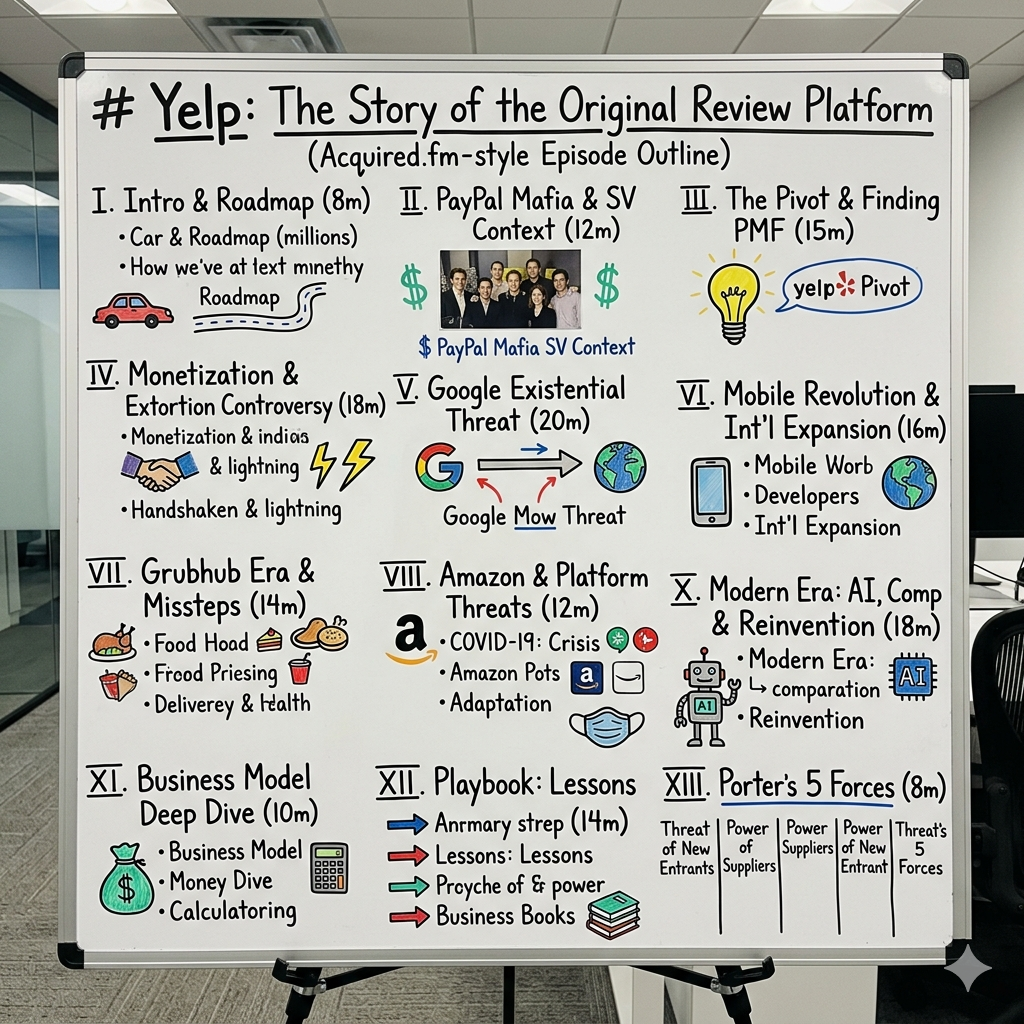
Yelp: The Story of the Original Review Platform
I. Introduction & Episode Roadmap
There is a verb in American English that no marketing budget could have manufactured: "Yelp it." For more than two decades, that phrase has been shorthand for a particular kind of consumer behavior—the moment of hesitation before committing to a plumber, a Thai restaurant, or a dentist in an unfamiliar neighborhood. Yelp did not invent online reviews, but it created the template that the entire local search economy still runs on: crowdsourced opinions, star ratings, photos of someone's pad thai, and a relentless insistence that authentic consumer voice matters more than paid placement.
By the numbers, the platform is formidable. More than 330 million cumulative reviews. Revenue that crossed the billion-dollar threshold and reached roughly $1.47 billion in 2025. A profitable, cash-generative business with over 90 percent gross margins and a stock that, as of early 2026, trades at a single-digit forward price-to-earnings ratio. On the surface, it looks like a company that won. Underneath, the story is far more complicated.
How did a platform built on the fragile currency of user-generated reviews survive an all-out assault from Google, weather a decade of extortion allegations from angry merchants, ride the mobile revolution at exactly the right moment, stumble through a food delivery experiment, and then face the existential question of whether AI-powered search would render its entire model obsolete? That is the arc we are going to trace.
This story begins where many of Silicon Valley's best stories begin: at PayPal. It runs through the messy early days of Web 2.0, through an IPO that was part ambition and part defensive fortification, through pandemic devastation and recovery, and into the current moment where Yelp finds itself simultaneously profitable, undervalued by many metrics, and deeply uncertain about its future. Along the way, we will examine the network effects that built its moat, the strategic decisions that widened or narrowed it, and the fundamental question every investor in platform businesses must answer: when your moat depends on the quality of content that strangers create for free, how durable is it really?
The themes that run through Yelp's history—platform power, distribution dependence, the tension between serving consumers and monetizing merchants, and the challenge of growing when your core product already serves its purpose well—are relevant to anyone thinking about marketplace businesses, local commerce, or the future of search itself.
 Subscribe on LinkedIn
II. The PayPal Mafia & Silicon Valley Context (2004)
In the lore of Silicon Valley, the "PayPal Mafia" is the closest thing the tech industry has to a graduating class. After eBay acquired PayPal in 2002 for $1.5 billion, a diaspora of engineers, product managers, and executives fanned out across the Valley and built an astonishing roster of companies: LinkedIn, YouTube, Tesla, Palantir, Yammer, Slide, and—more quietly than most—Yelp.
Jeremy Stoppelman was a twenty-six-year-old engineer at PayPal, a Harvard graduate who had started in the engineering trenches and worked his way up to vice president of technology. His co-founder, Russel Simmons, was a fellow PayPal engineer, the kind of quiet builder who preferred writing code to pitching venture capitalists. Neither of them fit the mold of the charismatic founder-CEO that the Valley was beginning to worship. Stoppelman was earnest, stubborn, and deeply opinionated about product quality. Simmons was technical and pragmatic. Together, they had watched Peter Thiel, Elon Musk, Max Levchin, and Reid Hoffman operate at close range, absorbing lessons about scale, network effects, and the power of removing friction from everyday transactions.
What made the PayPal alumni so prolific was not just talent—it was a shared operating philosophy. They had built a payments company inside a payments company, essentially creating a parallel financial system by solving a narrow, urgent problem (eBay fraud) and expanding from there. That pattern—start with a specific pain point, build an elegant solution, then ride network effects outward—would become the playbook for an entire generation of startups.
Stoppelman's pain point arrived in the form of a bad case of the flu. Sick at home in San Francisco, he tried to find a doctor online and discovered that the internet, for all its sophistication in 2004, was essentially useless for finding a good local professional. The Yellow Pages were dying. Citysearch existed but was curated by editorial teams, not real users. Google could tell you that a doctor existed, but not whether that doctor was any good.
He and Simmons pitched an idea to Max Levchin, their former PayPal colleague who was now running an incubator. The concept was not reviews—it was an email-based referral system. Users would email friends asking for recommendations for doctors, plumbers, or restaurants, and the system would aggregate those recommendations into a useful database. Levchin invested a million dollars from his incubator fund, and MRLPalCo—yes, that was the entity's actual name—gave birth to Yelp in October 2004.
The timing was exquisite, though they did not know it yet. The internet in 2004 was undergoing a philosophical revolution. Web 2.0—a term coined by Tim O'Reilly—was emerging as the defining paradigm. The idea was radical at the time: instead of professionals creating content for passive consumers, the users themselves would generate the content. Wikipedia was proving that crowds could build an encyclopedia. Flickr was showing that amateur photographers could create a visual commons. Blogger and LiveJournal were turning everyone into a publisher.
The specific problem Yelp would eventually solve—information asymmetry in local services—was enormous and essentially unsolved. Think about what it was like to find a good restaurant in 2004. A restaurant could put up a beautiful website and advertise in the local paper, but a consumer had no reliable way to know if the food was actually good, if the service was slow, or if the health inspector had concerns. Zagat existed for fine dining, but it was a paid guidebook updated annually—hardly useful for finding a Tuesday night takeout spot. For professions like plumbing or dentistry, the problem was even worse. Consumers were making high-stakes decisions—who should fix the pipes in my house, who should drill into my teeth—based on essentially no information beyond a Yellow Pages listing and a prayer.
Economists call this "information asymmetry"—the seller knows the quality of their service, but the buyer does not. In academic terms, it creates a "lemons problem" where bad providers can masquerade as good ones because consumers cannot distinguish between them before purchasing. The Yellow Pages, which generated over $14 billion in annual revenue at their peak, profited from this asymmetry by selling ads to businesses regardless of quality. A terrible plumber and an excellent one paid the same rate for the same-sized ad. That gap between what businesses claimed and what consumers experienced was the market that Yelp would fill, even though they initially had no idea they were going to fill it.
III. The Pivot & Finding Product-Market Fit (2004–2006)
The email referral system was, by any honest account, a flop. Users dutifully sent emails to friends asking for doctor recommendations, but the response rates were anemic and the whole process felt clunky. Stoppelman and Simmons watched their metrics and felt the deflation that every founder knows—the product was technically working but nobody cared.
Then something unexpected happened. Buried in a corner of the site was a feature that allowed users to write reviews unprompted—not in response to a friend's email, but simply because they had something to say about a business they had visited. The volume was small at first, but the engagement was different. These reviewers were not filling out a form because someone asked them to. They were writing because they wanted to. Some wrote passionate multi-paragraph essays about their favorite taco truck. Others wrote scathing takedowns of rude waiters. The writing was raw, personal, and—crucially—interesting to read.
This was the pivot moment that defines Yelp's history. Stoppelman and Simmons recognized that the real product was not the email referral tool; it was the reviews themselves. Users wanted to share their experiences, and other users wanted to read them. The decision to abandon the referral model and rebuild the entire platform around user-generated reviews was not easy. Levchin's investment had been predicated on the referral concept. The pivot meant admitting that the original thesis was wrong and betting everything on an emergent behavior that was still tiny in scale.
They made the bet. Throughout 2005 and into 2006, the team rebuilt Yelp as a review-first platform. The design decisions they made during this period would prove prescient. Each reviewer got a profile page with a real name and photo, turning anonymous opinions into a social identity. Reviews were not just text—they included star ratings, "useful/funny/cool" votes, and eventually photos. The platform encouraged personality, humor, and detail in ways that competitors like Citysearch never attempted.
The geographic expansion strategy was deliberate and unglamorous. Rather than launching nationally and hoping for organic growth, Yelp expanded city by city, starting with San Francisco. Each new market required a dedicated community manager who organized events, recruited early reviewers, and built the local culture from scratch. This was expensive and slow, but it meant that when Yelp launched in a new city, it arrived with enough content to be immediately useful—a critical threshold for any user-generated content platform.
The most distinctive innovation of this era was the Yelp Elite Squad. Before the tech industry had coined the term "gamification," Yelp was gamifying reviews with remarkable sophistication. Elite members were prolific reviewers who earned a coveted badge on their profile, invitations to exclusive parties at local restaurants and bars, and a social status within the Yelp community that carried surprising weight. The parties were legendary—free food, open bars, a sense of belonging to an exclusive club. Yelp spent meaningful money on these events because they solved a chicken-and-egg problem that kills most user-generated content platforms: how do you get enough content to attract users before you have enough users to generate content?
The Elite Squad created a corps of dedicated, high-quality content creators who wrote reviews not for money but for status, community, and free drinks. It was a brilliant hack. While competitors relied on paid content teams or thin, low-quality user submissions, Yelp was building a volunteer army of passionate local experts who genuinely cared about the quality of their writing.
The early competitive landscape was fragmented and weak. Citysearch had been around since 1995 but was editorially curated and felt corporate. InsiderPages, another review site, lacked Yelp's social features and community energy. Google had not yet entered local reviews in any serious way. The weakness of the competition gave Yelp the runway to build its network effects in peace—a luxury that few startups enjoy and even fewer recognize while they have it.
By late 2006, the flywheel was spinning. More reviews attracted more readers. More readers attracted more reviewers. More content made the platform more useful, which drove more traffic, which made it more attractive for businesses to claim their pages and engage with customers. The network effects were not theoretical—they were visible in the data, in the growing review counts, in the expanding city launches, and in the organic traffic growth that increasingly came from Google searches for local businesses landing on Yelp pages.
The SEO advantage was particularly powerful during this period. When someone searched Google for "best pizza in Brooklyn" or "plumber near me San Francisco," Yelp pages dominated the organic results. Google's algorithm rewarded sites with rich, frequently updated, user-generated content—exactly what Yelp was producing at scale. Each new review was effectively a piece of search-optimized content that drew traffic from Google, which attracted more users, who wrote more reviews. The company was, inadvertently, building one of the most effective SEO engines on the internet, and this organic Google traffic was free—a subsidy from the search engine that would later become Yelp's most dangerous competitor.
The company had found product-market fit not through brilliant strategy but through the humility to abandon a failing idea and follow the users toward something better. The venture capital community took notice. Yelp raised $10 million in Series B funding in 2005 and $15 million in Series C in 2008, with investors including Bessemer Venture Partners, DAG Ventures, and Benchmark Capital. By the time the company raised its final private round, it was valued at over $500 million—a remarkable trajectory for a platform built on free content from unpaid contributors.
IV. Monetization & The Extortion Controversy (2007–2010)
In 2007, Yelp's offices in San Francisco hummed with the energy of a company that had figured out the product but not the business model. The platform was growing beautifully—millions of reviews, millions of visitors, a passionate community—but revenue was essentially zero. Venture capital was funding the operation, and investors were patient, but the fundamental question loomed: how do you make money from content that other people create for free?
The answer Yelp arrived at was advertising, but not the kind that Google had perfected. Instead of automated, auction-based ads, Yelp built a high-touch local sales force. Think of it as the Yellow Pages model reborn for the internet: representatives called small business owners—dentists, auto mechanics, restaurant owners—and pitched them on premium advertising packages. For a monthly fee, a business could get a sponsored listing that appeared at the top of search results, an enhanced profile page that removed competitor ads and highlighted photos, and the ability to add a call-to-action button.
The model was deliberate. Google's self-serve advertising was efficient but impersonal—a small business owner had to navigate a complex interface to set up campaigns, choose keywords, and manage budgets. Many local business owners lacked the time or sophistication for that. Yelp's salespeople offered a simpler proposition: pay us a flat monthly fee and we handle everything. It was more expensive per dollar of advertising delivered, but the white-glove service was appealing to a dentist who just wanted more patients, not a crash course in digital marketing.
The sales machine worked. Revenue grew rapidly. But the model created a structural tension that would haunt Yelp for years. The salespeople were calling the same business owners who were already receiving reviews—some glowing, some devastating—from Yelp users. Imagine being a restaurant owner who has just received a scathing one-star review about cockroaches in the kitchen, and then getting a phone call from a Yelp sales representative offering to "help" with advertising. The timing was often terrible, and the optics were worse.
This is where the extortion narrative took root. Business owners began claiming—loudly, publicly, and persistently—that Yelp was running a protection racket. The accusation was specific and damning: if you paid for advertising, Yelp would promote your positive reviews and suppress the negative ones; if you refused, Yelp would do the opposite, hiding good reviews and surfacing bad ones. "Pay us or we'll destroy your reputation" was the way merchants described it. The allegation spread like wildfire across small business communities, in newspaper columns, on social media, and eventually in courtrooms.
Yelp denied the allegations categorically and consistently. The company explained that it used an automated recommendation algorithm to filter reviews, and that this algorithm sometimes removed legitimate positive reviews and occasionally left questionable negative ones. The filtering was designed to combat fake reviews—a real and growing problem—but its side effects created patterns that looked suspicious to business owners who were already primed to distrust the platform.
The investigations that followed were extensive. The Federal Trade Commission examined Yelp's practices. Multiple class action lawsuits were filed. A rigorous study by Harvard Business School professor Michael Luca and a colleague examined whether there was evidence that Yelp manipulated reviews based on advertising relationships. The Ninth Circuit Court of Appeals ruled in 2014 that even if Yelp did manipulate review visibility based on advertising, it would not constitute extortion under existing law—a ruling that infuriated merchants but effectively ended the legal threat.
The academic evidence generally supported Yelp's position. The Harvard studies found no systematic evidence that advertising status influenced which reviews were filtered. But the absence of evidence did not kill the narrative. The extortion myth persisted because it was intuitively plausible—of course a company that makes money from businesses and also controls those businesses' reputations would be tempted to connect the two—and because individual anecdotes were powerful even when they did not add up to a pattern.
A documentary filmmaker named Billion Dollar Bully even produced a feature-length film about the allegations in 2019, giving disgruntled business owners a platform and amplifying the narrative further. Business owners who appeared on the film described feeling helpless—their livelihoods affected by anonymous reviewers, with Yelp as the opaque intermediary that seemed to hold all the power. Whether the allegations were true in aggregate was almost beside the point. The perception had hardened into received wisdom among a significant segment of the small business community, and changing it would prove nearly impossible.
The deeper issue was structural. Yelp had built a platform that served two masters with fundamentally different interests. Consumers wanted honest, unfiltered reviews. Businesses wanted to look good. When the platform filtered reviews—even for legitimate reasons like detecting fake content—it was impossible to satisfy both sides. Every filtered review was a victory for quality in the eyes of Yelp's trust team and evidence of corruption in the eyes of the affected business owner.
This controversy shaped Yelp's trajectory in ways that went far beyond legal costs. It poisoned the company's relationship with a significant fraction of its potential advertising customers. It gave competitors—particularly Google, which had its own local review product—an opening to position themselves as fairer alternatives. And it created a permanent undercurrent of distrust that made Yelp's sales force less effective and its brand more complicated than it needed to be.
The irony is that the trust issue may have been more damaging to Yelp's business than any competitive threat. A restaurant owner who believes—rightly or wrongly—that Yelp is manipulating reviews based on advertising spend is not just a lost customer; they are an active detractor who tells other business owners not to advertise on the platform. In a world where local business owners talk to each other at chamber of commerce meetings, industry conferences, and in online forums, negative word-of-mouth among merchants can spread just as virulently as negative reviews among consumers. The extortion narrative became, in effect, a one-star review of Yelp itself, written by its own potential customers.
For investors, the extortion saga is a case study in how perception can become more powerful than reality, and how a two-sided marketplace can be undermined by the very tension between its two sides.
V. The Google Existential Threat (2010–2014)
In a conference room at Yelp's San Francisco headquarters sometime in 2010, the executive team confronted a reality that must have felt like watching a hurricane approach on radar. Google—the company that controlled the front door to the internet—was building its own local business review product. Not as a side project. Not as an experiment. As a strategic priority.
Google's entry into local search had been gradual but unmistakable. Google Maps had launched in 2005. Google Places followed, giving businesses free listings with basic information. Then came Google+ Local in 2011, which attempted to merge social networking with local business information. But the move that truly terrified Yelp was what Google called "Search Plus Your World"—the integration of Google+ content, including local reviews, directly into Google's search results, above the organic links where Yelp pages had historically appeared.
The implications were devastating and simple. Yelp's traffic—and therefore its entire business—depended overwhelmingly on Google search. When someone typed "best sushi near me" into Google, the search engine historically sent that user to Yelp, where they would read reviews and—hopefully—click on ads. But if Google started answering the "best sushi near me" question directly on the Google search results page, using its own reviews and ratings, why would the user ever click through to Yelp?
Stoppelman responded with unusual aggression for a company of Yelp's size. He became one of the most vocal critics of Google's behavior in Silicon Valley, testifying before the U.S. Senate Judiciary Committee's antitrust subcommittee and filing formal complaints with regulators in both the United States and Europe. In one particularly pointed Senate appearance, he described Google's behavior as "the digital equivalent of a department store putting its own brand products at eye level while hiding competitors' products in the basement." Yelp accused Google of three specific practices: scraping Yelp's content to populate its own local listings, demoting Yelp's organic search results to favor Google's own products, and using its monopoly in search to leverage its way into the local market.
The philosophical question at the heart of this fight was profound and remains relevant to this day: can any company truly compete when its rival controls the distribution channel? It would be like a television network trying to compete with the cable company that decided which channels appeared on the dial. Yelp could have the best product, the most reviews, the most engaged users—but if Google decided to show its own results first, Yelp's superiority was irrelevant. This is what Ben Thompson of Stratechery has called "aggregation theory" in reverse—when the aggregator itself becomes the competitor, the suppliers of content have no recourse.
In Europe, regulators were receptive. The European Commission launched a formal investigation into Google's search practices that would eventually result in billions of dollars in fines. In the United States, the story was different. The FTC investigated Google's conduct in 2013 and, in a decision that stunned Yelp and its allies, essentially cleared Google with minor concessions. Internal FTC documents later leaked revealed that the staff had recommended suing Google, but the commissioners overruled them. Stoppelman publicly called the outcome a betrayal.
Yet Yelp survived. This is the surprising part of the story, and it contains lessons for anyone thinking about platform competition. Despite Google's overwhelming advantage in distribution, Yelp maintained its position for several reasons. First, the quality and depth of Yelp's reviews were genuinely superior to Google's during this period. Google's reviews were thinner, less detailed, and less trustworthy—users could tell the difference. Second, Yelp had built real brand equity. People "Yelped" things, and that verb carried trust that Google's local product could not easily replicate. Third—and this is perhaps the most underappreciated factor—Yelp's mobile app was excellent, and the smartphone revolution was creating a new distribution channel that was not entirely controlled by Google.
The IPO in March 2012 was part defense strategy, part offensive move. Going public at a valuation of roughly $1.5 billion gave Yelp the financial resources to fight Google, the visibility to press its antitrust case in public, and the currency (stock) to make acquisitions. The offering priced at $15 per share and popped 64 percent on its first day—a sign that public market investors, whatever their concerns about Google, believed Yelp had built something defensible.
The stock would prove volatile in the years ahead, but the IPO itself accomplished its immediate purpose: it established Yelp as a permanent player in local search, not a startup that could be quietly crushed. The Google fight would continue for years, and in many ways it continues today. But the period from 2010 to 2014 was the existential crucible. Yelp entered it as a company that might have been destroyed. It emerged as one that, while permanently constrained by Google's power, had proven it could survive as an independent entity. The question of whether survival was the same as thriving would only become clear later.
VI. The Mobile Revolution & International Expansion (2011–2015)
In 2010, Yelp's mobile app accounted for a sliver of the company's total traffic. By 2013, more than half of all searches on Yelp happened on a smartphone. That shift—from desktop to pocket—was the single most important technological transition in Yelp's history, and the company navigated it with a speed and competence that many larger tech companies failed to match.
The reason mobile mattered so intensely for local search is almost self-evident. Nobody plans a restaurant visit from their desktop at 3 p.m. and then drives there at 7 p.m. anymore. They walk down a street, feel hungry, pull out their phone, and search for something nearby. Local search is inherently a mobile activity—the query happens at the moment and location of need. A company that could not deliver a fast, intuitive, location-aware experience on a five-inch screen was dead in local search, regardless of how good its desktop product was.
Yelp invested aggressively. The app featured check-in deals, where users could unlock discounts by checking in at a business—a feature clearly inspired by Foursquare's playbook. Photo uploads from phones added a visual dimension that reviews alone could not capture. The "Nearby" feature used GPS to surface businesses within walking distance. Each of these features sounds obvious in retrospect, but in 2011 and 2012, many companies were still treating mobile as a shrunken version of their desktop site rather than a fundamentally different product.
During this period, Yelp reportedly turned down a $550 million acquisition offer from Google. The irony was rich: the company Yelp accused of trying to destroy it through anticompetitive behavior also wanted to buy it. Stoppelman and the board rejected the offer, believing that Yelp's independent value would far exceed the offer price. That decision looked brilliant for a few years as the stock climbed past $90 in 2014, and considerably less brilliant afterward as it fell into the twenties and thirties for extended periods.
International expansion during this era was ambitious but ultimately underwhelming. Yelp launched in more than thirty countries across Europe and Asia, but the results varied dramatically. In markets like the United Kingdom and Germany, Yelp gained some traction, though it never achieved the dominance it held in U.S. cities. The fundamental challenge was cultural: review behavior varies enormously across cultures. Americans, with their tradition of consumer advocacy and public complaint, are unusually willing to write detailed negative reviews of businesses. In many European and Asian cultures, public criticism of a business—especially a small, family-owned one—carries social stigma that makes users reluctant to participate.
Local competitors also presented challenges. TripAdvisor dominated travel and restaurant reviews in many markets. Foursquare had a loyal user base. In Asia, platforms like Dianping (now part of Meituan) in China and Tabelog in Japan were entrenched incumbents with local expertise that Yelp could not easily replicate.
The acquisition strategy during this period reflected a company searching for its next growth lever. In 2013, Yelp acquired SeatMe, a small restaurant reservation platform, for a reported $12.7 million. The logic was straightforward: if Yelp could help users not just find restaurants but book tables at them, the platform could capture transaction revenue and deepen engagement. SeatMe was a small bet, but it signaled Yelp's ambition to move beyond advertising into transactions—a theme that would recur repeatedly, with mixed results.
Then, in 2015, came the deal that would define Yelp's mid-decade strategy: the acquisition of Eat24, a food delivery platform, for $134 million. The delivery wars were just beginning—Grubhub was growing rapidly, DoorDash was a scrappy startup, and Uber had not yet launched Uber Eats. Yelp saw an opportunity to integrate ordering directly into its platform, turning a "find a restaurant" experience into a "find a restaurant and order food" experience. It was a logical extension of the Yelp value proposition, and the delivery market was exploding. The question was whether Yelp had the operational DNA and the capital to compete in what would prove to be the most capital-intensive subsector of consumer tech.
VII. The Grubhub Era & Strategic Missteps (2015–2017)
The Eat24 acquisition looked smart on paper. For $134 million, Yelp acquired a functioning food delivery marketplace with an established user base and restaurant partnerships. Integrated into Yelp's platform, Eat24 would let users seamlessly move from reading reviews to ordering food—a vertical integration play that promised to increase engagement, add a revenue stream beyond advertising, and make Yelp stickier for both consumers and restaurants.
The reality was more brutal than the strategy deck suggested. Food delivery, as the entire tech industry would learn over the following years, is a business of relentless economics. Every order requires coordination between a restaurant, a driver, and a consumer, with margins thin enough to disappear if any part of the chain operates inefficiently. Customer acquisition costs are high because consumers are promiscuous—they will use whichever app offers the best discount—and driver supply is a constant logistical challenge. Yelp was a software company with ninety-percent-plus gross margins trying to operate a logistics business where unit economics were negative.
The competition was not standing still. DoorDash, backed by billions in venture capital, was burning cash to grab market share with a ferocity that Yelp could not match. Uber launched Uber Eats in 2015, leveraging its existing driver network and brand awareness. Grubhub, the public market leader, was scaling rapidly. Against these opponents—each willing to subsidize deliveries at levels that defied conventional business logic—Yelp's $134 million acquisition budget and modest operating cash flow were inadequate.
By 2017, the conclusion was inescapable. Yelp sold Eat24 to Grubhub for $287.5 million—more than double what it had paid—in a deal that was simultaneously a financial win and a strategic concession. The profit was real and welcome. Yelp's shareholders were better off by $153 million, and the company could refocus its resources on its core advertising business. But the sale also represented an admission that Yelp could not compete in transactions, that the dream of becoming a full-stack local commerce platform was beyond its reach.
The strategic question that hung in the air after the Eat24 sale was uncomfortable: should Yelp have invested more? If the company had raised additional capital, committed to losing money for longer, and fought for delivery market share, could it have emerged as a serious competitor in a market that would eventually be worth tens of billions of dollars? The counterfactual is impossible to resolve, but the question speaks to a persistent tension in Yelp's strategy between fiscal discipline and growth ambition. The company has consistently chosen profitability over aggression, and the Eat24 episode exemplified both the wisdom and the limitation of that approach.
Stoppelman's continued leadership through this period is worth examining. By 2017, he had been CEO for thirteen years—an extraordinarily long tenure in an industry where founders are often replaced within five years. His long-term presence provided strategic consistency and deep institutional knowledge, but it also meant that Yelp's identity was tightly bound to one person's vision. Unlike companies where a founder was pushed out (Twitter, Uber) or stepped aside voluntarily (Google), Yelp under Stoppelman remained committed to the same fundamental thesis: that high-quality user-generated reviews, monetized through local advertising, constituted a defensible business. The Eat24 detour was the exception; the return to core after selling it was the rule.
Activist investors took notice of both the stock's underperformance and the Eat24 proceeds. SQN Investors, a firm led by Amish Mehta that accumulated more than four percent of Yelp's shares, publicly called for a board overhaul and explored strategic alternatives including a sale of the company. Yelp hired Evercore as a defense advisor and resisted the pressure. SQN eventually exited entirely, but the episode highlighted a recurring dynamic: public market investors who believed Yelp's assets were worth more than the stock price implied, and a management team that believed independence was the path to realizing that value.
Yelp made another acquisition in 2017 that received far less attention: Nowait, a restaurant waitlist management platform. Like SeatMe before it, Nowait represented Yelp's attempt to embed itself more deeply in the restaurant experience—not through delivery, but through the operational infrastructure of dining. The acquisition was small in dollar terms but significant as a signal that Yelp had not given up on transactions; it was just looking for lower-capital-intensity ways to participate.
VIII. The Amazon & Platform Threats (2015–2020)
The second half of the 2010s brought a realization that should have been obvious but somehow still felt shocking: every major technology company wanted a piece of local search, and each one had advantages that Yelp could not match.
Amazon launched Amazon Local, a deals service, and briefly partnered with Yelp on restaurant delivery. More importantly, Amazon's expanding ecosystem—Prime, Alexa, Amazon Home Services—encroached on Yelp's territory by offering consumers ways to find and book local services without ever thinking about reviews. When a homeowner could say "Alexa, find me a plumber" and get a booked appointment through Amazon Home Services, the entire Yelp discovery-to-decision pipeline was bypassed. Amazon's approach was fundamentally different from Yelp's: instead of helping consumers research and choose, Amazon aimed to eliminate the research step entirely by pre-vetting providers and guaranteeing the transaction. For consumers who valued convenience over choice, this was compelling.
Facebook's threat was subtler but equally dangerous. The social network had the world's most comprehensive social graph—it knew who your friends were and where they had eaten. Facebook Pages gave every local business a free presence on the platform. When Facebook added review functionality and local business search features, it offered something Yelp could not: recommendations from people you actually knew, embedded in a platform you were already using for hours each day.
Apple Maps, which launched disastrously in 2012, improved steadily and began integrating review content from multiple sources. For the hundreds of millions of iPhone users who opened Maps to navigate to a restaurant, Apple's aggregated reviews—pulled from Yelp, TripAdvisor, and its own sources—made Yelp one option among many rather than the definitive authority.
Perhaps the most culturally significant threat came from Instagram and, later, TikTok. These visual-first platforms transformed how younger consumers discovered local businesses. A twenty-two-year-old in 2019 was more likely to find a new restaurant through an Instagram food photo or a TikTok video than by searching Yelp. A thirty-second TikTok of a chef torching a crème brûlée, viewed by millions, could drive more foot traffic to a restaurant than a hundred five-star Yelp reviews. This was not a feature competition that Yelp could win by improving its app—it was a generational shift in how people consumed information about the physical world.
The data confirmed what was visible in consumer behavior. Internal surveys and third-party research consistently showed that younger demographics—Gen Z in particular—were far less likely to use Yelp as a discovery tool and far more likely to rely on social media recommendations. Yelp's core user base was aging with the company, and the platform was not replacing departing users with younger ones at a sufficient rate. This demographic challenge is subtle but potentially more threatening than any single competitor, because it suggests that Yelp's relevance could erode gradually rather than collapse suddenly.
The "unbundling" of Yelp's value proposition was also underway. OpenTable dominated restaurant reservations. ClassPass owned fitness class discovery. Thumbtack and Angi carved out home services. Rover had pet services. Zocdoc had doctor appointments. Each of these vertical specialists offered a deeper, more tailored experience in their specific category than Yelp's horizontal platform could match. Yelp was a mile wide and an inch deep in many categories, while competitors were an inch wide and a mile deep.
This is a classic pattern in platform economics. Aggregators that serve broad categories are vulnerable to "unbundling" by specialists who serve narrow categories better. Craigslist was unbundled by dozens of startups, each taking one category—apartments (Zillow), jobs (Indeed), dating (Tinder), stuff for sale (OfferUp)—and building a superior experience. Yelp faced the same dynamic: its breadth was an advantage for consumers who used it casually, but a disadvantage against competitors who invested all their resources in a single vertical.
The fundamental problem—the one that would define Yelp's challenge for the foreseeable future—was that traffic growth was slowing while competition was intensifying. For a company whose revenue depended on selling advertising to small businesses, traffic was the feedstock. Every user who discovered a restaurant through Instagram instead of Yelp, or who booked a plumber through Amazon instead of Yelp, represented an ad impression that would never be monetized. The moat was still there—330 million reviews is an enormous content asset—but the water level was dropping. Investors who had watched Yelp for years began to wonder whether the company's best days were behind it, even as the business remained solidly profitable.
IX. COVID-19: Crisis & Adaptation (2020–2021)
On March 19, 2020, California's governor issued a statewide stay-at-home order. For Yelp, a company whose entire reason for existence was helping people find and visit local businesses, the order was the equivalent of an airline being told that no one would be flying for the foreseeable future.
The financial impact was immediate and severe. Revenue in the second quarter of 2020 plummeted by more than sixty percent compared to the prior year. Local businesses—Yelp's advertising customers—were shutting down en masse. Many could not pay their Yelp advertising bills because they had no revenue. The company tracked business closures in real time on its platform, and the numbers were staggering: by September 2020, Yelp had marked over 163,000 businesses as closed, with roughly 60 percent of those closures appearing permanent.
The existential question was not rhetorical: if people could not leave their homes, was local search dead? The entire premise of Yelp—helping consumers make decisions about physical businesses—seemed obsolete in a world where physical interaction was dangerous.
Yelp's response was swift and, in several cases, genuinely creative. The product team added COVID-19 safety attributes to business listings—information about mask requirements, outdoor seating, contactless delivery options—that turned Yelp into a practical tool for navigating the pandemic rather than a relic of pre-pandemic life. In a matter of weeks, Yelp became one of the most reliable sources for basic questions that suddenly mattered enormously: Is this restaurant open? Do they offer takeout? Is the patio heated? These questions had never been relevant at scale before, and Yelp moved faster than Google to surface them.
The company launched an "Open for Business" initiative that gave small businesses free access to premium features, positioning Yelp as an ally of the local business community at a time when that community was in crisis. The initiative was partly altruistic and partly strategic—keeping businesses engaged with the platform during a period when many could not afford to advertise ensured that Yelp's advertiser base would survive to spend money again when conditions improved.
The platform also added virtual service categories—video consultations with doctors, lawyers, and trainers—reflecting the rapid shift toward remote everything. Delivery and takeout features were expanded and given prominent placement. These pivots were not revolutionary in isolation, but collectively they demonstrated an organizational agility that larger, more bureaucratic companies often lack.
The recovery, when it came, was stronger and faster than almost anyone predicted. As vaccines rolled out in 2021 and restrictions eased, pent-up demand for local experiences exploded. People were desperate to eat at restaurants, get haircuts, visit gyms, and do all the things they had been denied for a year. Yelp was the platform they turned to for rediscovering their neighborhoods, and revenue rebounded sharply.
But COVID also accelerated trends that threatened Yelp's long-term position. The delivery habit—ordering food through DoorDash, Uber Eats, and Grubhub—became deeply entrenched. Online ordering for restaurants, which Yelp facilitated but did not dominate, became an expectation rather than a novelty. The pandemic compressed years of digital adoption into months, and much of that adoption benefited competitors who had invested more heavily in transactional capabilities.
The pandemic also changed how people worked, which changed where they searched for local businesses. Remote work meant that many consumers were spending more time in suburban and rural areas, away from the dense urban cores where Yelp's coverage was strongest. The geography of local search was shifting, and Yelp's traditional strength in cities like San Francisco, New York, and Chicago was less decisive than it had been.
Internally, the crisis forced financial restructuring. Yelp cut costs aggressively, reducing its workforce by approximately 1,000 employees—roughly 20 percent of staff—in April 2020 and furloughing hundreds more. The layoffs were concentrated in the sales organization, where the collapse of local advertising spending had made many positions immediately redundant. Executive compensation was temporarily reduced. Office leases were renegotiated or abandoned as remote work became the default.
The cultural impact was significant. Yelp's identity had always been rooted in community—the Elite Squad, the local events, the in-person energy of its sales teams. A company built on connecting people with local experiences was now a fully remote workforce selling advertising for businesses that might not survive the year. The dissonance was palpable.
For investors, the COVID period revealed both Yelp's resilience and its limitations. The company proved it could survive a catastrophic demand shock, cut costs efficiently, and emerge profitable. But it also showed that Yelp's recovery ceiling was lower than its pre-COVID trajectory—revenue came back, but growth did not accelerate the way it did for many other tech platforms that benefited from pandemic-driven digital adoption. Shopify's revenue more than doubled during the pandemic. Zoom became a verb. Peloton became a phenomenon. Yelp merely survived—and survival, while admirable, did not generate the kind of returns that investors in tech companies have come to expect. The crisis was survived. The structural questions remained.
X. The Modern Era: AI, Competition & Reinvention (2021–Present)
By 2023, Yelp's strategic narrative had crystallized around a single bet: services. The company had watched its restaurant, retail, and other categories plateau and, in some quarters, decline. But home services—plumbers, electricians, contractors, house cleaners—were growing consistently, driven by a homeowner economy where aging housing stock, remote work renovations, and chronic skilled labor shortages kept demand high.
The numbers tell the story. Services advertising revenue reached $948 million in 2025, growing eight percent year-over-year and representing roughly 68 percent of total advertising revenue. The company logged sixteen consecutive quarters of double-digit growth in services before the rate moderated. Meanwhile, the restaurants, retail, and other category declined six percent, reflecting both macro headwinds in dining and the structural shift of discovery away from review platforms and toward social media and delivery apps.
The "Request-a-Quote" feature became the centerpiece of Yelp's services strategy. Instead of simply reading reviews and calling a plumber, users could submit a request describing their project—"I need a bathroom remodel, approximately 80 square feet, replace tub with walk-in shower"—and Yelp would match them with relevant professionals who would respond with quotes. This moved Yelp up the value chain from discovery to lead generation—a higher-monetization activity that made the platform more valuable to service professionals and stickier for consumers. For the service professional, this was meaningfully more valuable than a generic ad impression: it was a qualified lead from a consumer with stated intent and a specific project. For Yelp, it meant the platform was participating in the transaction flow, not just the awareness stage.
Then came the AI earthquake. When ChatGPT launched in November 2022 and rapidly became the fastest-growing consumer application in history, the implications for search-dependent businesses like Yelp were immediately apparent. If consumers could ask an AI assistant "find me a good plumber in Brooklyn" and get a synthesized answer drawing on review data, ratings, and availability—without ever visiting Yelp's website or app—the traffic that supported Yelp's entire advertising model could evaporate.
Yelp's response has been multifaceted. The company launched "Yelp Assistant," an AI-powered chatbot that guides users through the process of finding and engaging with local businesses through conversational interaction. Request-a-Quote submissions through the Assistant grew more than 400 percent year-over-year in 2025 and represented roughly five percent of all Request-a-Quote projects, with full rollout expected by end of Q1 2026. The company also introduced AI-generated review highlights—summaries of what reviewers said about specific aspects of a business—and enhanced natural language search capabilities.
On the business-facing side, Yelp launched "Yelp Host" in the third quarter of 2025, an AI-powered phone answering service for restaurants. Since launch, it had answered more than 190,000 calls and handled thousands of reservations monthly, offering small businesses AI capabilities that they could never afford to build themselves.
The Hatch acquisition in early 2025 was the most significant deal since Eat24. For approximately $300 million—$270 million in cash plus $30 million in employee retention—Yelp acquired an AI-powered lead management and communication platform for service professionals. Hatch was growing revenue at 70 percent annually with roughly $25 million in annual recurring revenue, though it was modestly cash-flow negative.
To understand why this matters, consider the journey of a typical Yelp lead for a home services professional. A homeowner requests a quote for a kitchen remodel. Yelp sends the lead to several contractors. The contractors who respond fastest and most professionally are most likely to win the job. But many small business owners are terrible at lead management—they are busy installing cabinets, not checking email. Hatch's AI-powered platform automates the initial response, follows up with leads, schedules appointments, and tracks the communication pipeline. For a contractor, this can mean the difference between converting 20 percent of leads and converting 40 percent. For Yelp, it means advertisers get more value from their spend, which improves retention and willingness to pay higher prices. The strategic logic was to deepen the value Yelp provided to service professionals beyond advertising—helping them not just get leads but manage and convert those leads through AI-automated communication.
Perhaps the most strategically significant recent development was the data licensing agreement with OpenAI. Yelp's corpus of 330 million reviews and more than 500 million photos represents one of the largest proprietary datasets of local business information in the world. As AI models become more capable and more hungry for high-quality training data, Yelp's content library becomes a potential revenue stream independent of advertising—a hedge against the very disruption that AI threatens to cause. Other revenue, which includes data licensing, grew 17 percent in 2025.
The competitive landscape remains daunting. Google Maps reviews have become ubiquitous and good enough for many consumers, even if they lack the depth and personality of Yelp reviews. TikTok has emerged as a discovery platform for younger demographics who may never develop the Yelp habit. Instagram continues to be a visual-first alternative for restaurant and retail discovery.
Full-year 2025 results showed a company that was profitable but decelerating. Revenue of $1.465 billion grew just 3.7 percent. Net income of $145.6 million represented a healthy 9.9 percent margin. The company generated significant free cash flow and returned $292 million to shareholders through buybacks, reducing the share count by roughly 10 percent. The stock, however, told a different story—trading near $24, well below its 52-week high of $41, reflecting investor concerns about the slowing growth trajectory and the uncertain AI landscape.
Management's guidance for 2026 did little to ease those concerns. Revenue is expected to be roughly flat at $1.455 to $1.475 billion, while adjusted EBITDA is guided to $310 to $330 million—meaningfully below 2025's $369 million—as the company invests more heavily in AI capabilities. Stoppelman has framed this as a deliberate trade: investing today in the AI transformation to ensure Yelp remains relevant tomorrow.
The question investors face is whether this investment will pay off or whether Yelp is spending to stay in a race it cannot win. The stock trades at roughly 10.6 times trailing earnings and 6.6 times enterprise value to EBITDA—valuations that suggest the market has modest expectations. If Yelp's AI investments reignite growth, the stock is cheap. If they merely slow the decline, it is a value trap.
The contrast with how other companies have navigated similar transitions is instructive. When Netflix faced the streaming revolution, it cannibalised its own DVD business and invested aggressively in content—accepting years of negative free cash flow to build a new competitive position. Yelp's approach has been more conservative: investing in AI while maintaining profitability and returning cash to shareholders. Whether this conservatism reflects prudent stewardship or insufficient ambition depends on whether you believe the AI transition is an incremental evolution or a wholesale disruption of how consumers find local businesses.
XI. Business Model Deep Dive & Unit Economics
Yelp's business model is, at its core, deceptively simple: aggregate free content created by users, attract consumers to that content, and then sell advertising to the businesses that those consumers are searching for. The execution of this model, however, involves layers of complexity that determine whether the economics work.
Revenue is overwhelmingly advertising-based. In 2025, advertising accounted for roughly $1.39 billion of $1.47 billion in total revenue—about 95 percent. The remaining five percent comes from "other" revenue: subscriptions, data licensing agreements like the OpenAI deal, and residual transaction fees. The advertising itself splits into two categories: services (68 percent of ad revenue and growing) and restaurants, retail, and other (32 percent and declining).
To understand what this means in practice: a local plumber might pay Yelp several hundred dollars per month for a premium advertising package. That package puts the plumber's listing above organic results when consumers search for plumbers in their area, removes competitor ads from their business page, and adds features like a call-to-action button and verified license badges. The plumber stays because the leads convert into paying jobs. If the plumber calculates that Yelp advertising generates more revenue than it costs—which Yelp's sales team works hard to demonstrate through analytics dashboards—the plumber keeps paying. If not, they churn.
The sales model is high-touch and expensive. Yelp employs a large local sales force—roughly 2,500 salespeople at peak, though the number has been reduced through efficiency improvements and automation—that calls small business owners, explains the value proposition, and closes deals for monthly advertising packages. This model produces strong revenue per account but carries high customer acquisition costs and inherent scalability limitations. A software company's dream is zero-marginal-cost distribution; Yelp's sales model requires hiring and training humans to convince other humans to spend money, one phone call at a time. The company has worked to automate more of the sales process—self-serve advertising products, online onboarding—but the high-touch model remains dominant, particularly for larger accounts.
The gross margin, however, is extraordinary—consistently above 90 percent—because the "cost of goods sold" for a platform that hosts user-generated content is essentially just server costs. The company does not pay for the reviews that constitute its product. This is the magic and the vulnerability of user-generated content platforms: the content is free, but you have no control over its quality, quantity, or continued production.
Operating margins have improved significantly as the company has matured. From the low single digits in the early 2010s, operating margins reached 12.6 percent in 2025, with adjusted EBITDA margins around 25 percent. The improvement reflects both revenue growth and cost discipline—the workforce reductions during COVID, office consolidations, and efficiency improvements in the sales organization.
One of the most revealing metrics is revenue per paying advertising location. Despite total paying locations declining 3 percent in 2025 to 496,000, total revenue grew because each location was spending more. The company has been shifting its advertiser mix toward larger, multi-location businesses that spend more per account and churn less frequently. This is a classic maturation pattern: as the easy small-business customers are exhausted, the company moves upmarket toward higher-value accounts. The risk is that this shift has natural limits—there are only so many large multi-location service businesses—and that the declining number of paying locations signals a shrinking addressable customer base rather than a strategic upgrade.
Capital allocation has been heavily weighted toward buybacks. The company repurchased $292 million in stock in 2025 at an average price of $33.29 per share—well above the current trading price of roughly $24—and authorized an additional $500 million buyback in February 2026. The buyback strategy reflects management's belief that the stock is undervalued and that returning cash to shareholders is preferable to investing in growth initiatives with uncertain returns. Critics would note that the 2025 buybacks were made at prices significantly above where the stock trades today, destroying value in hindsight.
The comparison to other local platforms is instructive. OpenTable takes a per-reservation fee—typically $1 to $2.50 per seated diner—giving it transaction-based revenue that scales directly with usage. Angi (formerly Angie's List) combines advertising with lead generation fees, charging service professionals per lead rather than a flat monthly rate. Google's local product is monetized through its broader search advertising ecosystem, making it effectively free for users and cross-subsidized by the most profitable business model in the history of technology. Yelp's pure advertising model, dependent on a declining number of paying locations and growing revenue per account, sits in an uncomfortable middle ground: too dependent on a single revenue source for comfort, too profitable to justify the risk of radical transformation.
The capital return story deserves emphasis. Since initiating its buyback program, Yelp has returned billions of dollars to shareholders through repurchases, consistently reducing the share count. In 2025 alone, the company spent $292 million buying back stock—roughly 20 percent of its current market capitalization—at an average price of $33.29. The share count fell from roughly 75 million to 67 million, a 10 percent reduction in a single year. This aggressive buyback has propped up earnings per share growth even as absolute earnings growth has moderated. Whether this represents savvy capital allocation or a company with no better use for its cash is a question each investor must answer for themselves.
XII. Playbook: Business & Investing Lessons
Yelp's two-decade journey offers a collection of strategic lessons that transcend the specifics of local search and apply to platform businesses broadly.
The first and perhaps most important lesson is about building community before monetization. Yelp spent years investing in its Elite Squad, community events, and user experience before seriously pursuing advertising revenue. This patience—funded by venture capital that believed in the long game—allowed the platform to build a content moat before the pressure of quarterly earnings targets could distort product decisions. The contrast with companies that monetize aggressively too early and alienate users in the process is stark. Facebook followed a similar playbook—reaching a billion users before fully turning on the advertising machine—and it worked spectacularly. The companies that tried to monetize before building a loyal user base mostly became footnotes.
The second lesson is about the durability and limitations of user-generated content as a competitive moat. Three hundred thirty million reviews is an extraordinary asset that took twenty years and millions of contributors to build. No competitor can replicate it overnight. But the moat has proven to be narrower than it appeared. Google built a comparable review database by leveraging its distribution dominance and making it effortless for any Google user to leave a review. The lesson: content moats are real but vulnerable to competitors who control the distribution channel through which that content is discovered.
The third lesson concerns the perils of two-sided marketplaces where one side actively dislikes you. Yelp's relationship with merchants has been adversarial since the extortion controversy, and that tension has limited the company's ability to monetize its merchant side. Compare this with platforms like Shopify, where merchants love the product, or Airbnb, where hosts generally view the platform as a partner rather than an adversary. When half of your marketplace resents you, growth becomes significantly harder.
Platform risk—the dependence on Google for traffic—is the fourth lesson and perhaps the most cautionary. Yelp has spent over a decade fighting Google's dominance in distribution, and while the company has survived, it has never overcome the fundamental asymmetry. Any business that depends on another company for its distribution is, in some sense, a tenant rather than an owner. The lesson is not that platform dependence is always fatal—Yelp is still here—but that it permanently constrains growth and strategic optionality.
The "build vs. buy" decisions at Yelp provide a fifth lesson. The Eat24 acquisition was a "buy" decision that initially seemed smart and ultimately failed, not because the logic was wrong but because the capital requirements of food delivery exceeded what Yelp could sustain. The Hatch acquisition in 2025 represents a more measured approach—buying capability in AI-powered lead management that deepens the existing business rather than expanding into an entirely new one. The lesson: acquisitions that extend your core are safer than acquisitions that diversify you into capital-intensive adjacencies.
The mobile timing lesson is perhaps underappreciated. Yelp's aggressive investment in mobile in 2011 and 2012—before many companies had taken mobile seriously—gave it a critical distribution channel that was not controlled by Google. The Yelp app, downloaded directly by users, represented direct consumer access that Google could not gate. Companies that were late to mobile in local search—and there were many—never caught up.
Stoppelman's long tenure as CEO illustrates both the advantages and risks of founder-led companies. The advantages are consistency of vision, deep institutional knowledge, and willingness to make long-term bets that a hired CEO might not. The risks are strategic calcification, insufficient challenge to established thinking, and the possibility that the skills required to build a company are different from those required to reinvent it. Whether Stoppelman's continued leadership is an asset or a liability is a question that the next few years will answer.
The importance of vertical integration in local deserves its own reflection. Yelp's attempts to move deeper into specific verticals—restaurant reservations with SeatMe, food delivery with Eat24, waitlist management with Nowait—all followed the same pattern: logical strategic rationale, reasonable acquisition price, and ultimately insufficient scale to compete with purpose-built vertical players. The lesson is that horizontal platforms face an inherent disadvantage against vertical specialists, because the specialist can optimize every aspect of its product for one specific use case while the horizontal player must spread its resources across many. OpenTable built an entire business around restaurant reservations. Yelp tried to add reservations as a feature. The feature could never match the product.
Finally, Yelp teaches a lesson about what happens when network effects plateau. Network effects are powerful during the growth phase—more reviews attract more users, which attract more reviews. But once the platform reaches a certain scale, the incremental value of additional reviews diminishes. The 330 millionth review is less valuable than the 330th. When the flywheel slows, the company must find new sources of growth, and Yelp's struggles to expand beyond its core—into delivery, transactions, and international markets—show how difficult that transition can be. The power of brand in a world of algorithmic distribution also bears consideration. "Yelp it" is a rare and valuable brand asset—but brand alone cannot overcome distribution disadvantages when the distribution is controlled by a competitor. Google decides what users see first when they search. If Google chooses to show its own results, Yelp's brand only matters to the subset of users who bypass Google entirely and go to Yelp directly. That subset is real and valuable, but it is not growing.
XIII. Porter's Five Forces Analysis
The competitive dynamics surrounding Yelp become clearer through Michael Porter's framework, which reveals a business facing pressure from nearly every direction. For a company that pioneered its category, the forces arrayed against it are unusually formidable—and understanding them is essential for anyone evaluating whether Yelp's current valuation reflects fair value or opportunity.
The threat of new entrants into local business reviews is theoretically low—building a database of 330 million reviews is a massive undertaking—but practically high because the entrants are not startups; they are Google, Apple, Facebook, and TikTok. These companies do not need to build review databases from scratch; they can leverage their existing user bases to generate review content as a feature within their broader platforms. Google Maps reviews, which benefit from the billion-plus users of Google's ecosystem, have reached a scale and quality that make them a viable alternative to Yelp for most consumers. The barrier to entry is high for startups but irrelevant for tech giants.
The bargaining power of suppliers—in Yelp's case, the users who create reviews—is a nuanced consideration. Individually, no single reviewer has any leverage over Yelp. Collectively, however, reviewers can "multi-home" by posting reviews on Google, TripAdvisor, and other platforms simultaneously, which erodes Yelp's content exclusivity. The shift of younger demographics toward visual platforms like Instagram and TikTok for local discovery suggests that the next generation of "reviewers" may never contribute to Yelp at all, creating a long-term content supply risk.
Buyers—the small businesses that purchase advertising—have limited individual bargaining power. A single dentist or plumber cannot meaningfully pressure Yelp on pricing. But collectively, merchants have demonstrated their power through organized resistance, negative publicity about the extortion allegations, and ultimately by declining to advertise. The declining number of paying advertising locations, which fell to 496,000 in 2025, suggests that buyer resistance is a real constraint on growth. Large multi-location businesses have more leverage, and Yelp's strategic shift toward these accounts reflects the platform's need to serve buyers with greater bargaining power.
The threat of substitutes is the most severe force acting on Yelp. Substitutes are everywhere: Google Maps for reviews, Instagram for visual discovery, TikTok for viral recommendations, DoorDash for restaurant ordering, Thumbtack for home services, and increasingly AI chatbots for synthesized local information. Each substitute addresses a portion of Yelp's value proposition, and collectively they offer consumers a fragmented but comprehensive alternative. The fundamental question is whether Yelp's integrated experience—reviews, photos, quotes, booking—is more valuable than the sum of these specialized alternatives.
Competitive rivalry is intense and asymmetric. Yelp competes against companies with R&D budgets, user bases, and distribution advantages that dwarf its own. Google's parent company Alphabet spent more than $45 billion on R&D in 2024. Yelp spent roughly $400 million on total operating expenses in the same year. The rivalry is not between equals; it is between a specialist and several generalists who happen to have orders of magnitude more resources. That Yelp has survived this rivalry for over a decade is a testament to its product quality and brand. That the stock trades at a fraction of its historical highs suggests the market believes survival is not the same as victory.
XIV. Hamilton's Seven Powers Analysis
Hamilton Helmer's Seven Powers framework provides a more granular assessment of Yelp's strategic position, examining the specific sources of competitive advantage that allow a company to sustain superior returns. For Yelp, the picture is one of eroding advantages across nearly every dimension.
Scale economies exist but are moderate. Yelp's fixed costs—engineering, product development, corporate overhead—are spread over a large user and review base, giving it cost advantages over smaller competitors. But the platform does not exhibit the extreme scale economics of pure software businesses like Microsoft Office or Google Search, because the local sales force introduces variable costs that scale with the number of advertising customers. Each new advertising customer requires human effort to acquire and retain. This is a fundamental constraint: Yelp's business model is part software (high-margin, scalable) and part services (lower-margin, labor-intensive), and the services component prevents the kind of operating leverage that investors love in pure software companies.
Network effects are Yelp's strongest power, but they operate asymmetrically. On the content side, the network effect is clear: more reviews make the platform more useful, which attracts more users, which attracts more reviewers. On the merchant side, however, the network effect is weak or nonexistent—a restaurant does not benefit from more plumbers being on the platform. This one-sided network effect is weaker than the two-sided network effects enjoyed by platforms like Airbnb, where more hosts attract more guests and vice versa.
Counter-positioning was Yelp's original superpower. When the company launched, it was counter-positioned against the Yellow Pages—a user-generated, digital, free platform versus an advertiser-supported, print, paid directory. Incumbents could not respond without cannibalizing their existing business. But the Yellow Pages died not because of Yelp but because of the internet broadly, and today Yelp faces its own counter-positioning threat from AI-powered search tools that can synthesize review data without sending users to Yelp's platform.
Switching costs are low for consumers and moderate for businesses. A consumer can switch from Yelp to Google Maps with zero friction—there is no data lock-in, no learning curve, no cost. For businesses, switching is somewhat harder because their Yelp profile represents years of accumulated reviews that cannot be transferred. But businesses can and do advertise on multiple platforms simultaneously, meaning that Yelp does not enjoy the high switching costs that characterize truly defensible business software.
Branding remains a meaningful power. "Yelp it" is part of the American lexicon, a distinction shared with very few companies (Google, Uber, FedEx). This brand recognition translates into direct traffic—users who type "yelp.com" or open the Yelp app rather than searching Google—which provides a distribution channel independent of Google's algorithm. But brand power is not growing. Younger consumers are less likely to "Yelp it" and more likely to check Instagram or ask a friend.
The review database might appear to be a cornered resource, but it is not truly proprietary. Google has built a comparable database. TripAdvisor has extensive reviews in travel and dining. And increasingly, AI models trained on publicly available data can access and synthesize review content regardless of its original source. The data licensing deal with OpenAI is an interesting development—it monetizes the database directly—but it also highlights the risk that Yelp's content may be more valuable to AI companies than to Yelp itself.
Process power through the Elite Squad and community management was once distinctive but has become less relevant as the program has scaled back and as user-generated content has become ubiquitous across platforms. What was innovative in 2006—gamified reviewing, community events, social profiles for reviewers—is now table stakes. Every platform from Google to Amazon to Tripadvisor has some version of these features.
The overall assessment is sobering. Yelp's moat has narrowed significantly from its peak. Network effects remain its strongest defense, but they are insufficient against competitors who control distribution—Google, Apple—or who offer fundamentally different discovery modalities—TikTok, Instagram. The company is not defenseless, but it is playing defense more than offense, and the trajectory favors its larger competitors.
XV. Bear vs. Bull Case
The divergence between Yelp's fundamental business metrics—profitable, cash-generative, strong brand—and its market valuation—a $1.5 billion market cap, down from its historical highs of over $5 billion—reflects a genuine debate about the company's future. Both sides of this debate have merit, and the resolution will depend on factors that are genuinely uncertain. Here is the case for each.
The bear case begins with structural decline. Google owns the entry point to local search for the majority of consumers, and every improvement Google makes to its local product reduces the probability that a user clicks through to Yelp. The data supports this concern: Yelp's app unique devices declined 2 percent in 2025, and ad clicks fell 7 percent. These are not cyclical fluctuations; they represent a secular trend of Google capturing more of the local search journey within its own ecosystem. Revenue growth has decelerated from 12 percent in 2023 to 5.6 percent in 2024 to 3.7 percent in 2025, with 2026 guidance implying essentially flat performance. That trajectory—not the absolute level—is what concerns bears most.
Social media compounds the threat. Instagram and TikTok have become the primary discovery platforms for restaurants, bars, and retail among consumers under thirty. This is not a feature Yelp can replicate—it reflects a generational preference for visual, video-first content over text-based reviews. As this cohort ages into peak local spending years, Yelp's user base will age with them unless the platform can attract younger users, and there is limited evidence that it can.
The AI threat is the most existential of all. Large language models can synthesize thousands of reviews into a concise recommendation in seconds. If a consumer can ask ChatGPT "what's the best Italian restaurant in the West Village" and get a thoughtful, personalized answer, the incentive to open Yelp and scroll through reviews diminishes dramatically. The OpenAI data licensing deal provides revenue but also enables the very disruption that threatens Yelp's core model—a genuinely uncomfortable paradox.
On the business side, bears point to failed expansion attempts—delivery, transactions, international—as evidence that Yelp cannot grow beyond its core. Paying advertising locations are declining, falling 3 percent in 2025. The company cannot compete with Big Tech R&D budgets—Alphabet alone spent more than 30 times Yelp's entire revenue on R&D in 2024—and has limited pricing power with small business customers who view advertising as a discretionary expense. The historical trading multiples tell their own story: Yelp's stock peaked above $90 in 2014, and a decade later trades in the mid-twenties, a decline of roughly 75 percent that reflects the market's diminishing confidence in the company's growth prospects.
The bull case starts with durability. Yelp has been declared dead or dying multiple times—when Google entered local, when social media rose, when the pandemic hit—and it has survived every time. The brand remains strong: "Yelp it" is still a verb, a piece of cultural shorthand that no amount of advertising could create artificially. The review database is the most comprehensive collection of local business feedback in the United States, and it took twenty years and millions of voluntary contributors to build. No competitor, no matter how well-funded, can replicate that history overnight.
The financial profile is compelling. The stock trades at roughly 10.6 times trailing earnings, 6.6 times enterprise value to EBITDA, and offers a free cash flow yield north of 16 percent. The company sits on $319 million in cash with minimal debt, has a current ratio of nearly 3.0, and generates enough cash to fund both AI investments and aggressive share repurchases. The $500 million buyback authorization announced in February 2026 alone represents more than a third of the company's current market capitalization. If the business merely stabilizes at current levels, the mathematical effect of shrinking the share count at current prices could be significant for per-share value.
The services category is genuinely growing and represents a large addressable market. Home services—plumbing, electrical, HVAC, roofing, landscaping—is a hundreds-of-billions-of-dollars market in the United States, and Yelp's services advertising revenue of $948 million represents a small fraction of total local business advertising spend. The Request-a-Quote model and the Hatch acquisition position Yelp as a lead generation platform for service professionals, not just a review site, and lead generation commands higher monetization than brand advertising.
AI could be a tailwind rather than just a headwind. If Yelp successfully integrates AI into its platform—through the Assistant chatbot, Yelp Host, AI-generated summaries, and smarter matching—it could offer a better user experience than the current review-scrolling paradigm while maintaining its direct relationship with consumers. The data licensing opportunity is nascent but real: Yelp's 330 million reviews and 500 million photos are exactly the kind of high-quality, domain-specific data that AI companies need and are willing to pay for.
The M&A optionality is worth noting. At a $1.5 billion market cap with $319 million in cash, Yelp would be a feasible acquisition for dozens of potential buyers—Google (if regulators allowed it), Amazon, Apple, a private equity firm, or even a strategic buyer like Booking Holdings. The review database, the brand, the profitable cash flows, and the advertiser relationships have clear strategic value that might exceed the current stock price. Consider the precedent: Booking Holdings acquired OpenTable in 2014 for $2.6 billion, valuing it at roughly 10 times revenue at the time. Even at a much more modest multiple, an acquirer could justify a significant premium to Yelp's current trading price.
The valuation case is straightforward: the stock trades at levels typically associated with businesses in secular decline, yet the company continues to generate record revenue, double-digit returns on equity, and enough free cash flow to buy back a tenth of its shares annually. Either the market is right that Yelp's best days are behind it, or it is pricing in too much pessimism about the AI transition and not enough credit for a durable, profitable franchise with a strong brand. The answer likely depends on whether you believe Yelp's 330 million reviews and deep local business relationships constitute a genuine competitive advantage in a world where AI is reshaping how consumers discover the physical world around them.
The key metrics that matter most for tracking Yelp's trajectory going forward are two: services advertising revenue growth rate, which indicates whether the company's strategic pivot to its strongest category is working; and paying advertising location count, which reveals whether the customer base is stabilizing, growing, or continuing to shrink. These two numbers, more than any others, will determine whether Yelp's story from here is one of reinvention or managed decline.
XVI. Epilogue & The Future
In February 2026, Yelp reported its full-year 2025 results: record revenue of $1.465 billion, record net income of $145.6 million, and over fifty-five new product features launched during the year. The company also reported that it had identified and filtered nearly 500,000 suspected AI-generated fake reviews in 2025—a new front in the trust war that has defined Yelp since its inception. The irony is sharp: AI is simultaneously the tool Yelp uses to detect fake reviews, the technology it deploys to improve its product, and the force that threatens to disintermediate its entire business model. Stoppelman outlined three strategic pillars for 2026: reconceiving the platform around "answers and actions," delivering AI tools to help local businesses operate more efficiently, and extending Yelp's reach across the emerging AI ecosystem.
At the Morgan Stanley Technology, Media and Telecom Conference in early 2026, Stoppelman elaborated on the vision, arguing that Yelp's first-party data—reviews written by real humans about real experiences—is becoming more valuable, not less, in an era flooded with AI-generated content. The argument has a certain logic: as the internet fills with synthetic text, the provenance and authenticity of Yelp's human-written reviews could become a differentiator rather than a commodity. Whether this thesis proves correct will likely determine Yelp's relevance in the next decade.
The stock's recent trajectory tells its own story. From a 52-week high of $41.22, shares have fallen to roughly $24—a decline of more than 40 percent—driven by slowing revenue growth and the market's anxiety about AI disruption to search-dependent businesses. The new $500 million buyback authorization, if fully executed at current prices, would retire roughly a third of the outstanding shares. Management is clearly signaling that it believes the stock is undervalued. Whether the market agrees will depend on whether the company can demonstrate that its AI investments translate into reaccelerated growth.
The acquisition question lingers. At current valuations, Yelp is financially digestible for any major tech company or large private equity firm. The regulatory environment, however, complicates the most obvious acquirer—Google—whose history of antitrust conflict with Yelp would make such a deal politically and legally fraught. A private equity buyer could take the company private, cut costs further, and harvest cash flows, but that would likely mean reduced investment in AI and product development at the worst possible time. An acquisition by a company like Amazon, Apple, or Booking Holdings would make strategic sense but would require a willing seller, and Stoppelman has historically resisted sale processes.
The AI search paradigm shift is the defining uncertainty. If AI assistants become the primary interface through which consumers make local decisions, the question is whether Yelp becomes a data supplier to those assistants—monetized through licensing deals—or an integrated platform that uses AI to improve its own consumer experience. The company is betting on both simultaneously: licensing data to OpenAI while building its own AI-powered features. Whether both bets can succeed, or whether licensing data to AI platforms inevitably undermines the reason consumers visit Yelp directly, is an open question.
What would it take for Yelp to reaccelerate growth? The honest answer is that the company would need to crack one of the problems it has failed to solve for a decade: either meaningfully expand beyond the U.S. market, successfully integrate transactions into its platform, or find a way to attract younger users who currently discover local businesses through social media. Each of these is achievable in theory and has proven elusive in practice.
The local search market is enormous—estimated at hundreds of billions of dollars in annual spending by local businesses on marketing and advertising—and Yelp's $1.5 billion in revenue represents a tiny share. The opportunity is real. The question is whether Yelp, with its specific history, capabilities, and constraints, is the company that can capture more of it. The services pivot is the most promising avenue: the home services market alone represents over $600 billion in annual spending in the United States, and digital penetration remains relatively low compared to categories like travel or retail. If Yelp can establish itself as the definitive platform for connecting homeowners with service professionals—the way Booking.com became definitive for hotels—the growth opportunity is substantial.
But "if" is doing a lot of work in that sentence. The same opportunity attracts Google, Amazon, Angi, Thumbtack, and a host of venture-backed startups, each with their own theory of how to win in local services. Yelp's advantage is its brand, its review database, and its installed base of service professionals. Its disadvantage is its size relative to competitors who can outspend it on marketing, technology, and subsidies by orders of magnitude.
There is also the leadership succession question. Stoppelman has led Yelp for over twenty-one years—making him one of the longest-tenured founder-CEOs in public technology. His recent stock sales, while modest in absolute terms, have been noted by market observers. At some point, whether through his own choice, board action, or acquisition, Yelp will have a different leader. Whether that transition brings fresh strategic thinking or destabilizes a company that has been shaped by one person's vision for two decades is unknowable but worth considering.
Yelp's story is, in the end, a story about pioneering a category and then watching as the world caught up. The company invented the modern local review experience. It built a community of passionate contributors. It survived Google's onslaught, the extortion allegations, a pandemic, and the rise of social media as a discovery tool. It remains profitable, well-capitalized, and strategically coherent under founder leadership that has endured for more than two decades.
But pioneering a category and dominating it are different things. Yelp proved that user-generated reviews could transform local commerce. It did not prove that the company that created the model would be the one to own it at scale. The review platform that a flu-stricken PayPal engineer dreamed up in 2004 still exists, still works, and still helps millions of people make decisions about the physical world around them. Whether that is enough—whether being good, profitable, and relevant is sufficient in a world where competitors are enormous, AI is transforming search, and younger consumers discover the world through video rather than text—is the question that defines Yelp's next chapter. The biggest surprises in the Yelp story are worth cataloguing: the company survived an all-out assault from Google, the most powerful company on the internet. It could not crack transactions despite multiple attempts. And it stayed independent for more than two decades, resisting acquisition offers and activist pressure alike. Those surprises, taken together, paint a portrait of a company that is tougher than it looks, more limited than it wishes, and more interesting than its stock price suggests.
XVII. Further Reading & Resources
Top 10 Long-Form Links & Books:
-
"The Airbnb Story" by Leigh Gallagher — For comparison on how a different two-sided marketplace built trust, managed regulatory challenges, and scaled a platform business
-
Harvard Business Review: "Marketing Malpractice: The Cause and the Cure" by Clayton Christensen — On targeting jobs to be done, the framework that explains why Yelp won the review job but struggled with adjacent ones
-
Yelp S-1 Filing (2012) — The original IPO prospectus, essential reading for understanding the business model as it was conceived before public market pressures reshaped priorities
-
"Platform Revolution" by Geoffrey Parker, Marshall Van Alstyne, Sangeet Paul Choudary — The definitive academic treatment of network effects, with frameworks directly applicable to Yelp's competitive position
-
FTC Investigation Documents on Google/Yelp (2013) — Primary sources on the antitrust questions that defined a decade of Yelp's strategic posture
-
Michael Luca's Harvard Business School Research — Multiple rigorous papers on Yelp's impact on restaurant revenue, review manipulation dynamics, and the economics of online reputation
-
"The Cold Start Problem" by Andrew Chen — The network effects playbook that explains both how Yelp solved the cold start problem with its Elite Squad and why that solution has become less effective over time
-
Yelp's Annual Reports (2015-2025) — Track the strategic pivots from delivery to services, the financial restructuring during COVID, and the emerging AI strategy across a decade of filings
-
Benedict Evans' Essays on Local Search and Aggregation Theory — Strategic frameworks for understanding why aggregators like Yelp are powerful in theory but vulnerable to distribution gatekeepers in practice
-
"Blitzscaling" by Reid Hoffman — PayPal Mafia context, scaling strategies, and the philosophy of prioritizing speed over efficiency that informed Yelp's early growth but not its later conservatism
 LinkedIn
 WhatsApp
 Reddit
 Hacker News
 Email
Email Kindle
 RSS Feed
 Spotify
 Apple Podcasts
 Amazon Music
 Audible
 YouTube