Xencor: The Antibody Platform Waiting for Its Drug
I. Eleven patients, five confirmed responses
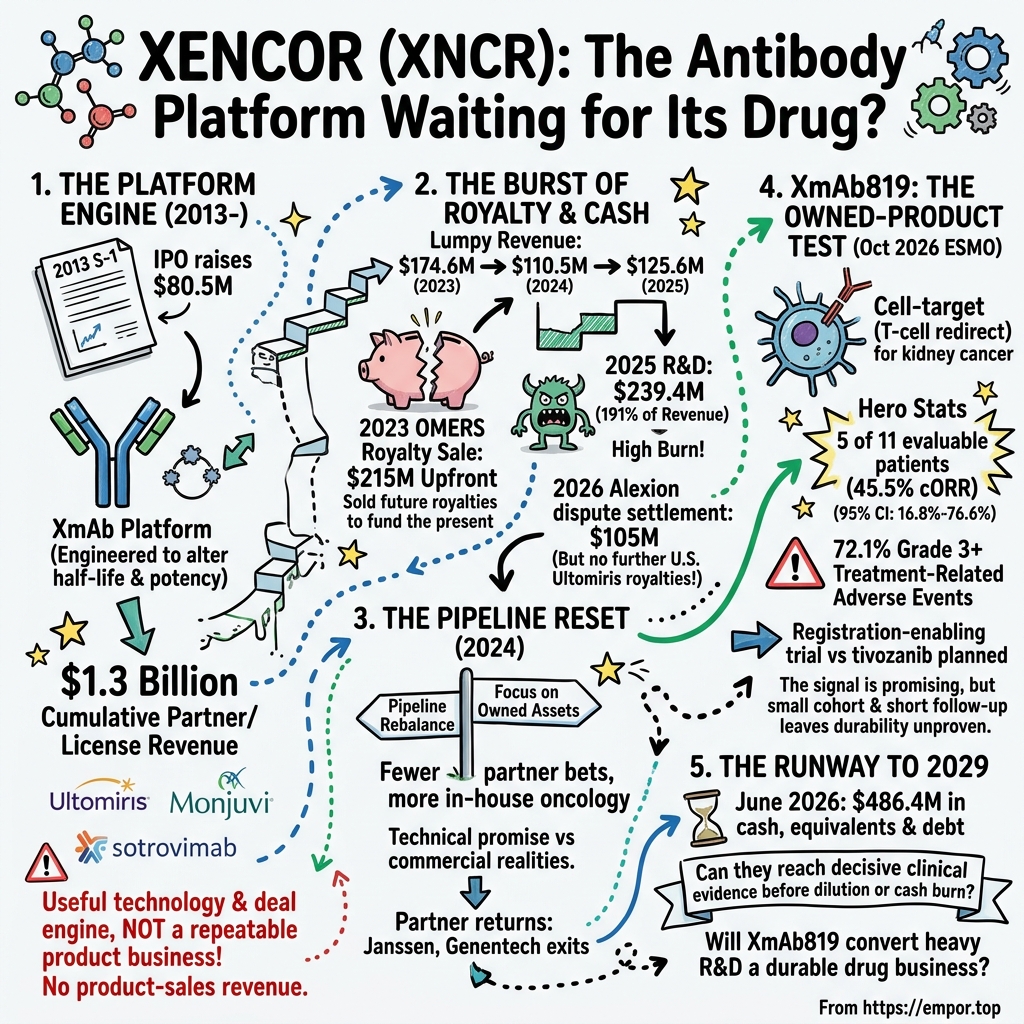
On a Sunday in late October 2026, a slide went up at the European Society for Medical Oncology congress showing a small cluster of kidney-cancer patients. There were eleven of them, all treated at the same dose of an experimental drug called XmAb819, and all had already run through the standard arsenal for their disease. Five of them had tumors that shrank by enough, and for long enough, to count as confirmed responses.1
Xencor, the Southern California company behind the drug, used that cohort to make a decision it had been building toward for years. It named 400 micrograms per kilogram of body weight as its proposed Phase 3 dose, and it sketched a registration-enabling trial against an approved kidney-cancer pill called tivozanib.1
For a company that has spent nearly three decades designing antibody parts for other people's medicines, it was the clearest statement yet that it intends to own a drug of its own.
The headline number was a 45.5% confirmed response rate. The number underneath it mattered more. With only eleven patients, the statistical confidence interval stretched from about 17% to about 77%.2 Put plainly, the true response rate could be a modest one-in-six or a remarkable three-in-four, and this cohort alone cannot say which. One more or one fewer responder moves the headline by about nine percentage points.
The company paired that with a second, gentler signal. About six months into follow-up, the estimated share of patients alive without their cancer progressing stood at 82%, and more than seven in ten were still on treatment at the October data cut.1
That is encouraging. It is also the kind of estimate that tends to drift as more patients reach the later months, because the patients who stay longest in a study are, by definition, the ones it has watched the shortest time.
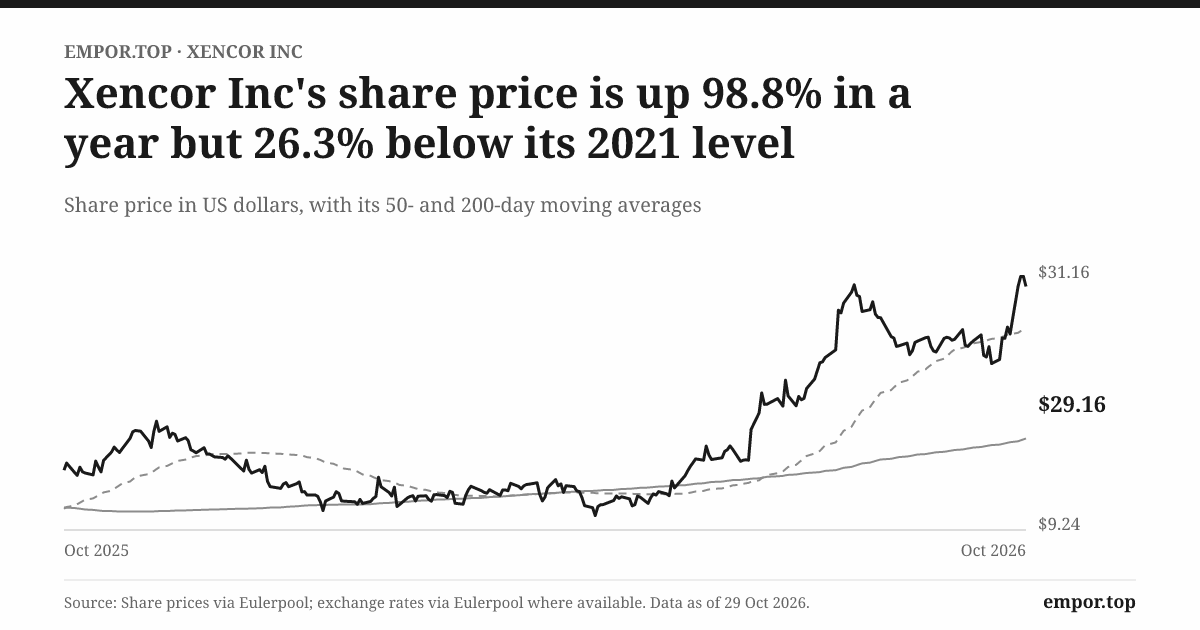
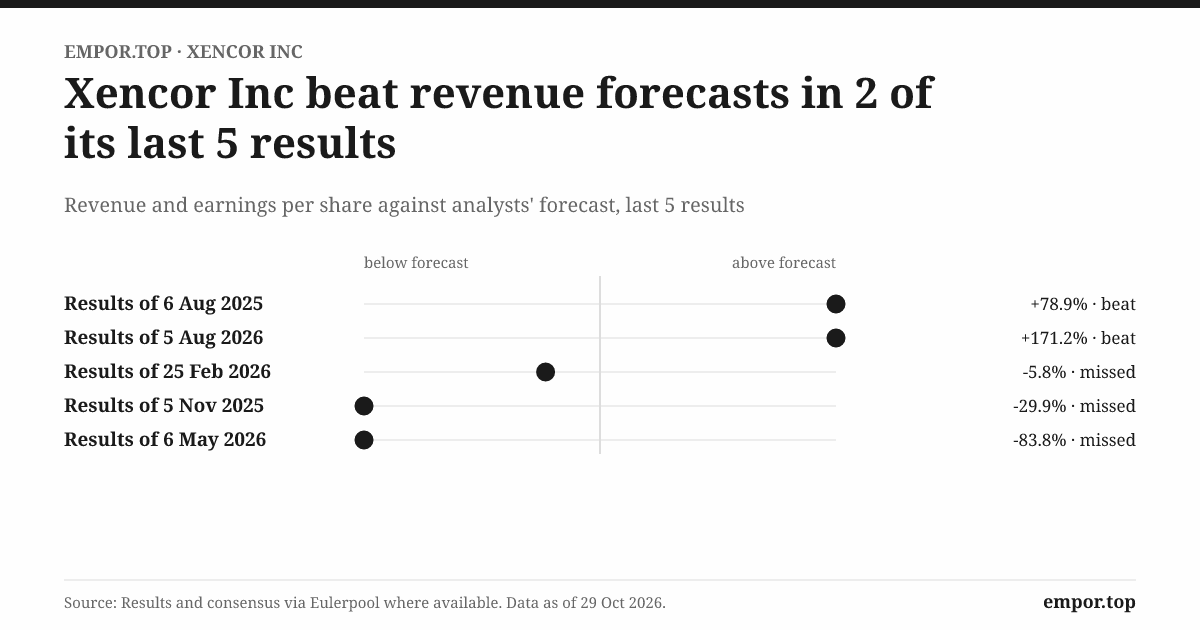
The stock market did not wait for the drift. On October 29, Xencor's shares closed at about $29, within 3% of their 52-week high and nearly three times their low of about $10 over the previous year.[^3] That valued the company at roughly $2.1 billion.[^3] The business underneath that price has no product-sales revenue of its own and had lost $2.17 a share over the four quarters to June.3
So the question this story has to answer is not whether XmAb819 looks interesting. It plainly does. The question is whether Xencor has finally found the clinical candidate that can turn an engineering platform into a durable drug business, or whether this is another promising milestone in a company history full of them.
Three threads run through that question. The first is conversion: Xencor spends far more on research than it earns, and the case for the company depends on that spending becoming revenue that repeats. The second is dependence: most of what Xencor has ever earned has come from a handful of large partners, paid in bursts when those partners chose to advance a drug or when their drugs sold.
The third is time: the company has cash to run for several more years, but the trial that will settle XmAb819's fate has not started yet, and the question is whether it can reach decisive data without selling more of its future or diluting its shareholders.
There is one more question the response rate cannot answer, and it is the commercial one. XmAb819 sits in a dose-finding study. Between here and a prescription lie a conversation with the U.S. Food and Drug Administration, a randomized trial that has to be designed, funded and enrolled, a readout, and then a launch into one of oncology's more crowded markets. The company says it is targeting the start of that randomized trial by the end of 2027.1 Every step costs money, and every step can fail.
To understand why the market would pay $2 billion for a company at that stage, and why a careful investor might hesitate, the story has to go back to what Xencor actually built, and to the strange position it has occupied ever since: its engineering is inside medicines that patients take every day, and almost none of the economics of those medicines belong to it.
 Subscribe on LinkedIn
II. The engineering platform looked like the product
In 1997, two scientists at the California Institute of Technology, Bassil Dahiyat and Stephen Mayo, founded a company around a computational idea: that proteins could be designed, not just discovered.4 Mayo's lab had been working on algorithms that predicted how changes to a protein's amino-acid sequence would change its shape and stability.
Dahiyat, the co-founder who ran the company, took the idea out of the lab and into a business. The company began its first therapeutic antibody programs in 2002 and signed its first license for its antibody technology in 2004.4
Dahiyat has been chief executive since 2005, more than two decades in a role where few founders last that long.5 His defining instinct, visible across two decades of filings, is that of an engineer: he talks about molecules as designable objects, and his company's pitch has always been that better design produces better drugs.
That conviction is the company's great strength. It is also, as this story will show, the source of its recurring challenge, because a well-designed molecule and a commercially successful drug are not the same thing.
To see what Xencor built, picture an antibody as a Y-shaped tool. The two arms grab a target, say a protein on a cancer cell. The stem, called the Fc domain, is the handle that the immune system grabs.
The Fc domain decides how long the antibody survives in the blood, whether it calls in killer cells, and whether it switches immune activity up or down. Xencor's insight was that the handle is nearly identical across antibodies, so a tweak to it can be reused across many drugs.6
Its engineered handles, branded XmAb, stayed more than 99.5% identical to natural antibodies while changing their behavior.6 By the time of its stock market debut, Xencor described three main variants. One extended an antibody's half-life by improving how it is recycled in the body, a technology called Xtend.
One boosted the antibody's ability to kill target cells. One dampened immune activity by engaging an inhibitory receptor.6 Later the company added a scaffold for bispecific antibodies, molecules with two different arms that can grab a tumor cell with one hand and a T cell with the other.4
The beauty of the model was that a pharmaceutical company with an antibody already in development could license one of these handles, swap it in, and potentially get a better drug: longer-lasting, more potent, or easier to dose. The partner would fund the expensive work of trials and sales. Xencor would collect an upfront fee, milestone payments as the drug advanced, and a royalty if it reached the market.
That was the promise Xencor sold to public investors in December 2013. The initial public offering sold about 14.6 million shares at $5.50, raising $80.5 million before costs.6 Its license roster at the time included Boehringer Ingelheim, CSL, Janssen, Merck and Alexion, with three partner programs in Phase 1 and four more in preclinical work.6
The prospectus also disclosed something sobering: Xencor had accumulated a deficit of about $224 million since 1997.6 A company of engineers had spent sixteen years and nearly a quarter of a billion dollars getting to the starting line.
The platform did convert, and the proof is unusually concrete. In December 2018, Alexion's Ultomiris became the first approved antibody to incorporate an XmAb technology.7
Ultomiris is essentially a longer-lasting version of Alexion's earlier blockbuster Soliris, used for rare blood and immune disorders, and Xencor's Xtend handle is what allowed Alexion to dose it far less often.7 For patients facing a lifetime of infusions, fewer trips to the clinic are a real improvement in daily life. For Alexion, it protected a franchise.
The Alexion relationship shows how small these deals looked at the start. In January 2013, Alexion signed an option and license agreement to use Xtend against up to six targets over a five-year research term.4 The early payments were modest: a $500,000 milestone in March 2015, a $4 million option fee in November 2015, and a $3 million milestone later that year.4
Nobody reading those figures would have guessed that the same agreement would, a decade later, produce Xencor's largest revenue stream and its most consequential legal dispute. Platform licensing works like that. The seed is cheap and the harvest, if it comes, arrives years later on the partner's schedule.
A second product followed. Tafasitamab, originally licensed to MorphoSys in 2010 and built on Xencor's cell-killing Fc variant, won accelerated U.S. approval as Monjuvi in July 2020 for a form of relapsed lymphoma, and gained a second approval in follicular lymphoma in June 2025; it is now commercialized by Incyte.84
A third, the COVID-19 antibody sotrovimab, also drew on Xtend.8 Xencor says three marketed medicines have been developed with its engineering, and the company reports about $1.3 billion of cumulative revenue from partnership and technology-license arrangements through 2024.82
That is real validation. Most platform companies never see a single partner product reach patients. But there is a distinction between what the technology achieved and what Xencor kept. On Ultomiris, Xencor's royalty is in the low single digits as a percentage of sales.8
On tafasitamab, the original deal set royalties in the high single digits to low teens.4 Alexion, MorphoSys and Incyte captured the drug economics, as they should: they paid for the trials, built the sales forces and took the risk. Xencor earned a sliver of a large pie, and it earned it only as long as its partners chose to keep the pie growing.
At the end of 2025, Xencor employed 260 people full time, and 212 of them worked in research and development.8 It still reported no revenue from selling a product. Those two facts together describe the company better than any slogan. It is an engineering organization of real depth that has, for nearly thirty years, monetized its skill through other companies' medicines.
The deals also taught investors to read headline numbers carefully. In September 2015, Amgen licensed a Xencor bispecific for a $45 million upfront payment and up to $355 million in milestones, with royalties in the high single to low double digits.4
The MorphoSys deal on tafasitamab carried up to about $299 million of further milestones on top of what had already been paid.4 Industry insiders call those contingent figures biobucks, because most of them are only ever paid if everything goes right. The upfront cash is real. The rest is an option the partner holds, and partners exercise options only when it suits them.
The licensing trade-off cuts both ways. Licensing spared Xencor the costs of late-stage trials and commercial launches that have bankrupted many young biotechs. It also handed partners the decision about which programs lived and which quietly died. A partner might stop a program for reasons that had nothing to do with Xencor's engineering, such as a portfolio reshuffle, a competing internal asset or a change of chief executive, and Xencor would have no vote.
So the platform is commercially real, and the evidence for it is in pharmacies. What that evidence does not establish is a repeatable, high-margin product business owned by Xencor. It establishes a technology and deal engine whose output arrives on other companies' schedules. The next question is what that engine has actually delivered in cash, year by year, and how steady those deliveries have been.
III. The royalty checks arrived in bursts
Imagine running a company where your three most important customers change every couple of years, and where each of them can, with a single portfolio decision, double or erase a year of your revenue. That is a fair description of Xencor's top line.
In 2023, Xencor reported about $175 million of revenue.9 The biggest contributor was Janssen, at about $78 million, followed by Alexion at about $65 million.8 A year later, revenue fell to about $110 million, and Janssen had dropped off the leader board entirely; Alexion led with about $58 million, followed by Amgen at $30 million.8
In 2025, revenue recovered to about $126 million, and the top two were Alexion at $70 million and Incyte at about $52 million.8 Together, those two partners accounted for about 97% of the year's revenue.8
This is not a subscription business, and it does not pretend to be. The economic chain runs like this. Xencor licenses a technology or a drug candidate to a partner and collects an upfront fee. The partner runs a trial, and when the drug reaches a predefined point, such as starting a Phase 3 study or filing for approval, Xencor earns a milestone.
If the drug is approved and sold, Xencor collects a royalty on sales. Each link in that chain depends on the partner's spending choices, the drug's clinical results, and the partner's commercial success.
The milestones are the bursts. The royalties are meant to be the steady base. In 2025, Xencor reported about $45 million of milestone revenue and about $80 million of royalties.8 Most of Incyte's contribution that year came as milestones, in a year when Monjuvi expanded into follicular lymphoma, while Incyte's Monjuvi royalties to Xencor were about $10 million.8 Milestones are by nature one-time events; the same payment does not arrive twice.
Then there is the quiet twist in the royalty line. Of that $80 million, the $70 million attributed to Alexion was largely noncash for Xencor.8 In 2023, Xencor had sold the rights to most of its future Ultomiris royalties to a Canadian pension fund, the Ontario Municipal Employees Retirement System, better known as OMERS.8
Under the accounting for that sale, Xencor continued to report the royalties as revenue, while the cash went to OMERS to pay down what was effectively a loan. Investors reading a royalty line of $80 million could easily assume it represented $80 million of cash coming in. It did not.
Concentration showed up on the balance sheet as well. At the end of 2025, two customers accounted for 91% of Xencor's receivables, up from 76% a year earlier.8 The company's standard payment terms run 30 to 60 days, and it recorded no material allowance for bad debts.8 In ordinary times, a big pharmaceutical company paying its royalty statements is about as safe a credit as exists. The problem is that 2026 was not ordinary.
By June 2026, the receivables had grown to about $42 million, and almost $38 million of that was estimated royalties due from Alexion.3 Even that figure was not entirely Xencor's: about $12.6 million of it was payable straight on to OMERS.3 A single receivable line, in other words, carried the company's largest customer, its largest dispute and its royalty lender all at once.
In March 2026, Alexion told Xencor that it owed no additional royalties on U.S. sales of Ultomiris and would make no further U.S. payments.10 Alexion is part of AstraZeneca, and Ultomiris is one of the most important drugs in its rare-disease portfolio. For Xencor, the consequence was immediate.
Because the disputed royalties could no longer be counted on, the company reduced the revenue it recognized from them to zero, which knocked about $6.6 million off first-quarter royalties.3 First-quarter revenue collapsed to about $4.5 million, down 86% from a year earlier.3 The quarter's net loss widened to about $129 million, deepened by losses on Xencor's stock holdings.3
The dispute ended in a settlement on July 29, 2026.10 Alexion agreed to pay $105 million in two equal installments of $52.5 million, the first of which was expected in August 2026 and the second within fourteen days after the agreement's first anniversary.10 Royalties on Ultomiris sales outside the United States continue under the original 2013 license.10 But after the settlement, Alexion has no further obligation to pay royalties on U.S. sales of Ultomiris.10
The settlement should be read in two directions at once. It resolved a legal fight and a collection risk with one of Xencor's two largest counterparties, and it turned an uncertain stream into a fixed sum. Xencor recognized about $27.6 million of royalty revenue in the second quarter for U.S. Ultomiris sales through June, and said it would recognize the remaining $77.4 million of the settlement in the third quarter.3 That will make the third quarter, when it is reported, look unusually strong.
Read the other way, the settlement closed the door on the U.S. portion of a royalty stream that had contributed most of the $70 million of Alexion revenue in 2025. A recurring income source became a lump sum. Any investor who extrapolates the 2025 revenue mix, or the inflated third quarter of 2026, into the future is extrapolating something that no longer exists in that form.
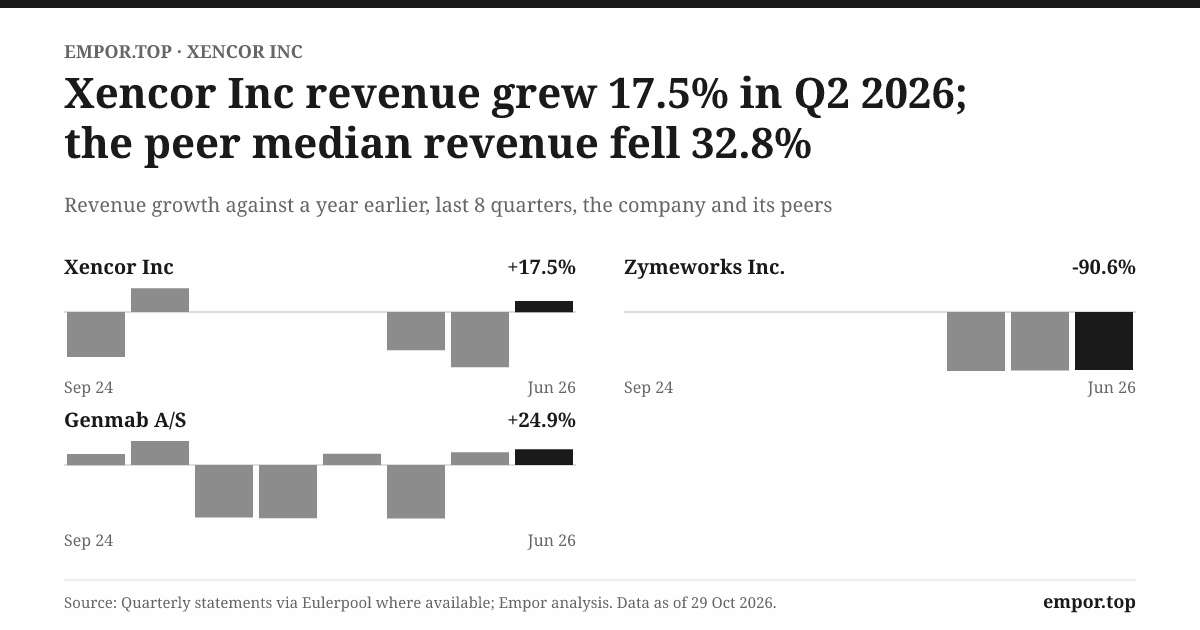
The second-quarter recovery in reported revenue, up about 17.5% from a year earlier, tells the same story in miniature.3 It included the $27.6 million Alexion catch-up and a $10 million milestone from Zenas BioPharma for submitting a marketing application for obexelimab, a drug that traces back to Xencor's own lab.3 Strip those out, and the royalty base was small. Incyte's Monjuvi royalties for the quarter were about $3.9 million.3
Other partners were leaving too. Janssen had already returned its rights to plamotamab, a lymphoma bispecific, in 2024.8 In March 2026, Xencor disclosed that Genentech, part of Roche, had terminated their collaboration effective September 2026.11
Roche had removed the only active product under that collaboration from its pipeline, and Xencor itself had opted out of sharing development costs in 2024.11 That deal had begun in 2019 with a $120 million upfront payment for an engineered cytokine.7 Seven years later, it ended without a product.
There are counterweights. Monjuvi continues to sell, and Xencor's share of those royalties should improve, because the slice it sold to OMERS was capped and that cap was reached in the second quarter of 2026.3 Royalties on Ultomiris outside the United States remain. And several partner programs, including Amgen's prostate-cancer bispecific xaluritamig and Zenas's obexelimab, are in late-stage development with milestones and, if approved, royalties attached.8
But the business question is unresolved and important. Which partner products can replace the economics of U.S. Ultomiris, and when do their milestones turn into royalties? Until that is answered, Xencor's partner income is better understood as a series of events than as a base. And because the company had already sold part of that base before the dispute, the next question is what it got in exchange.
IV. Xencor sold part of the future to fund the present
By 2023, Xencor had a problem that every research-heavy biotech eventually faces. Its research budget had grown to about $254 million a year, far larger than its partner revenue.9 It sold royalty streams on two approved drugs to raise cash.
OMERS paid $192.5 million upfront for the Ultomiris royalties and $22.5 million for Monjuvi royalties up to a cap.8 Together that was $215 million of cash in hand, and Xencor did not have to issue a single share of common stock to get it.
The appeal of this kind of deal is easy to understand. A royalty is a promise of money spread out over many years, subject to the partner's sales performance and patent life.
A pension fund with a long horizon and an appetite for steady, drug-linked returns will pay a lump sum for that promise. The biotech gets cash today to fund trials that might create far more value than the royalty itself. If the trials work, it looks like a brilliant trade.
But the cash was not free, and the accounting makes that visible. U.S. rules treated the sale as debt, because Xencor kept a continuing involvement in generating the royalties. At the end of 2025, the outstanding liability stood at about $120 million.8
Xencor estimated the implied interest rate at about 24% on the Ultomiris portion and about 17% on the Monjuvi portion.8 Those are expensive rates of funding, more like venture debt to a risky borrower than a cheap bond. In 2025 alone, about $76 million of royalties flowed to OMERS, and Xencor recorded about $32 million of noncash interest expense on the arrangement.8
A simpler way to see it: Xencor sold its Ultomiris and Monjuvi royalties to a lender whose effective return, on the company's own estimates, ran close to a quarter a year on the larger stream.
Every dollar those drugs earned for Xencor during the life of the deal went first toward repaying that lender. The $215 million bought runway, and the cost of that runway was paid in future royalty dollars that would otherwise have funded the very pipeline the deal was meant to support.
The Alexion settlement complicates the picture further. It replaced the U.S. portion of the royalty stream with a fixed sum, part of which is payable onward to OMERS.3 By the end of June 2026, the liability had fallen to about $105 million.3
How the rest of the obligation is ultimately measured, and how much of the settlement Xencor keeps, are now some of the most consequential accounting judgments in its books. The auditor had already flagged the carrying value of the royalty-sale liability as a critical audit matter for 2025, the auditor's way of saying it required especially difficult judgment.8
The OMERS deal was one of several capital choices, and it helps to see them together. Xencor has not built its trajectory through large acquisitions; its money has gone into internal research and development. To pay for that, it has used three tools: sell royalties, issue equity, and hold stakes in other biotechs, often received through partnerships.
The equity tool came out in 2024. Despite having told investors in February 2024 that it had about $697 million and runway into 2027, Xencor raised about $201 million that year through a sale of common stock and pre-funded warrants, after issuance costs.128
The company also set up a $200 million at-the-market program in 2023, which allows it to sell shares gradually, but it reported issuing no shares under it through 2025.8 In February 2026, it filed a universal shelf registration, which permits future issuance but does not itself mean any shares were sold.8
The third tool, biotech stock holdings, has been the most volatile. Xencor licensed obexelimab to Zenas BioPharma and received equity in the young company. When Zenas shares rose in 2025, Xencor booked about $87 million of unrealized gains in other income, enough to nearly offset its operating loss for the year.8
Then, in the first half of 2026, those shares fell, and Xencor recorded about $34 million of losses on its equity securities, although a partial rebound in the second quarter clawed some of that back.3 In 2024, it had written down a private biotech investment by about $20 million.13
These stakes are a two-edged treasury choice. They can create real value when partners succeed, and they align Xencor with the companies developing its molecules. But they also mean that a significant part of the reported profit and loss each year swings on other companies' stock prices. In 2025, without the Zenas gains, the year's loss would have been close to twice as large. That is not a measure of how Xencor's own business performed.
The long view is sobering. At its listing in 2013, Xencor had accumulated a deficit of about $224 million.6 By June 2026, after the partner products, the milestones, the royalty sale and the equity raises, the accumulated deficit had grown to about $947 million.3
Over the twelve years to 2025, the company's free cash flow added up to a negative figure of roughly half a billion dollars. The platform has generated a great deal of revenue for a company of its size; it has never generated enough to pay for the ambition it funds.
So what is the real cash picture? At the end of June 2026, Xencor held about $486 million in cash, equivalents and marketable debt securities, mostly government bonds.3 Separately, it held about $79 million of marketable equity securities, largely the Zenas stake.3 The first figure is the runway. The second is a volatile asset that could help, but cannot be counted on at any particular value.
The broad measures sometimes applied to companies, such as days of receivables and cash conversion cycles, mean little here. Xencor has no inventory, its receivables are mostly royalty and milestone claims from a few partners, and its payables reflect clinical-trial vendors. The honest measure of its health is simple: how much cash it uses each year to run its research, and how much partner cash comes in to offset it. In 2025, operating activities used about $135 million.8
That brings the capital-allocation test into focus. Can Xencor fund the next clinical step from the liquid assets it already holds, plus whatever partners pay, without repeating an expensive royalty sale or diluting shareholders? The answer depends on which programs it chooses to fund. And that brings the story back to the pipeline, and to the long, winding history of how Xencor has chosen, and been forced to choose, which molecules to back.
V. The pipeline reset came after years of clinical possibility
In February 2024, Bassil Dahiyat opened Xencor's year-end call by announcing a narrowing. The company was focusing its pipeline and discovery work on T-cell engagers, he said, because of growing evidence that they could work in solid tumors, and it would reduce investment in its cytokine drug candidates.12
Two earlier-stage programs would wind down their Phase 1 work. Pressed on one of them, he described the pause as primarily driven by strategy rather than data, and said it was the right time to reassess resources and watch how the field developed.12
Later that year, management went further, describing a rebalancing of the portfolio toward candidates that better used Xencor's protein-engineering strengths while reducing exposure to biological uncertainty.13 The language is worth slowing down on, because it is unusually candid for a biotech. It amounts to an admission that some of the bets had depended on biology that Xencor could not engineer around, such as whether a new immune pathway would turn out to matter in patients at all.
The scale of spending behind those bets was large. Research and development ran at about $254 million in 2023, $228 million in 2024 and $239 million in 2025, while annual revenue moved between about $110 million and $175 million.98 In 2025, research spending was almost twice revenue. Over those three years, the company lost about $126 million, $233 million and $92 million.8 The 2025 loss looked smaller largely because of the Zenas gains, not because the research engine had become cheaper.
To judge whether the reset improves the odds, it helps to look at what happened to Xencor's earlier promising candidates, because the company's history is a long lesson in the gap between technical progress and commercial ownership.
The first case is XmAb5871, the immune-dampening antibody that was Xencor's lead candidate at its 2013 listing. At the time, Amgen held an option to license it for rheumatoid arthritis after a planned Phase 2b study.6 That collaboration ended, and Xencor moved the drug away from rheumatoid arthritis and toward IgG4-related disease, a rare inflammatory condition, and lupus.4
By 2018, the lupus trial had missed its primary endpoint, though it showed encouraging signals on secondary measures, and a small IgG4-related disease study had produced strong results: all twelve patients who completed it met the primary endpoint.7 Xencor then said it was looking to continue development "with a partner."7
That partner turned out to be Zenas, which developed the drug as obexelimab. In early 2026, a Phase 3 trial in IgG4-related disease met its primary endpoint, and Zenas filed for approval, triggering the $10 million milestone that showed up in Xencor's second quarter.83 It is a genuine success story for the molecule.
But notice the shape of it: Xencor engineered the drug, ran it through early trials, pivoted its indication when the first plan did not pan out, and then handed it to someone else to finish. If obexelimab reaches patients, Xencor will collect milestones and royalties; Zenas will own the drug.
The second case is XmAb7195, an antibody designed to clear the allergy-linked protein IgE, aimed at asthma. It reached clinical testing and lowered free IgE below detectable levels in 90% of subjects, but a dose-limiting drop in platelets appeared at the highest dose.4 By 2018, Xencor was seeking a partner to continue development.7 The program never became a Xencor product.
The third case is plamotamab, a bispecific that pulls T cells toward lymphoma cells. It was part of a large bispecific collaboration with Novartis, which returned the program in a notice effective June 2019.7 It later became part of a collaboration with Janssen, which returned its rights again in 2024.8 Xencor is now testing plamotamab in rheumatoid arthritis instead, an entirely different disease.8
A molecule that two pharmaceutical partners chose to give back is now being repurposed for a third indication. That may yet work. It is also a pattern.
The same Novartis collaboration carried a sharper warning. In February 2019, another of its T-cell engagers, XmAb14045, was placed on partial clinical hold after two patient deaths.7 T-cell engagers are powerful precisely because they unleash the immune system, and that power can turn on the patient. It is worth holding that memory next to every safety table Xencor now publishes.
The Genentech cytokine collaboration belongs in the same file: Xencor opted out of cost-sharing in 2024, before Roche ended the program in 2026.711 That outcome was consistent with the February 2024 decision to pull back from cytokines.
None of this means Xencor's engineering is weak. Partner programs have advanced, too. Amgen's xaluritamig, a bispecific for advanced prostate cancer that uses Xencor technology, is now in Phase 3 testing, and obexelimab is under review.8 These are meaningful validations from companies that have every incentive to drop programs that do not work. But neither is yet a durable sales stream for Xencor, and the economics Xencor will collect from them are set by license terms, not by Xencor's ambitions.
So what did reducing exposure to biological uncertainty mean in practice? On the evidence of what was stopped, it meant leaving cytokines, pausing programs whose payoff depended on less-proven biology, and concentrating money on two main bets: T-cell engagers for solid tumors, led by XmAb819, and a set of antibodies for autoimmune and inflammatory disease.
The development of a checkpoint-blocking antibody called vudalimab was paused in 2025.8 The capability Xencor retained was its core skill: designing antibody formats, such as the bispecific scaffolds that let one molecule grab two targets in precise proportions.
The inflammatory bet is larger than it looks from the outside. Xencor's lead autoimmune candidate, XmAb942, targets a protein called TL1A, an area where several big pharmaceutical companies have spent heavily, and it began a Phase 2b study in ulcerative colitis in the third quarter of 2025.8
The company describes an estimated half-life of more than 71 days, an engineering edge that could allow very infrequent dosing.8 In the second quarter of 2026, Xencor spent about $14 million directly on XmAb942, compared with about $8 million on XmAb819.3 The cancer drug got the headlines; the colitis drug got more of the money.
That is a reasonable portfolio decision, but it matters for how investors weigh the story. Long lists of candidate names can create an illusion of optionality. The useful way to weigh them is by stage, by who pays for them, by what Xencor would actually keep, and by how much cash each needs to reach a decisive result. By that measure, Xencor's owned pipeline today rests on two programs, XmAb819 and XmAb942, with several earlier-stage efforts behind them.
The 2024 reset is a credible course correction. It stopped things, which is the harder half of any reset, and it concentrated resources. But its success is unproven. The company's history narrows the claim that a strong engineering platform reliably produces commercial drugs.
It has reliably produced molecules that advance, get partnered, get returned, and sometimes get approved by someone else. The evidence threshold for Xencor now is not another milestone. It is repeatable conversion from research to trials to approval to material revenue that Xencor itself controls. Which is exactly why the October data on XmAb819 mattered so much.
VI. XmAb819 gives Xencor its clearest owned-product test
Kidney cancer has been one of oncology's success stories of the past two decades, which is precisely what makes it hard to break into. Patients with advanced clear-cell renal cell carcinoma, the most common type, now typically receive an immune checkpoint inhibitor, often in combination with a pill that blocks blood-vessel growth, known as a VEGFR tyrosine kinase inhibitor.
Many do well for a time. But when the cancer progresses after those treatments, the options thin out, and responses to later-line therapies tend to be modest.
That is where XmAb819 was tested. The patients in its expansion cohorts had received a median of three prior lines of therapy, and every one of them had already been treated with both a checkpoint inhibitor and a VEGFR inhibitor.2
About a third had also received a newer class of drug that blocks a protein called HIF-2 alpha.2 More than nine in ten were in intermediate or poor prognostic risk groups.1 These were patients whose disease had beaten the best available medicines.
The drug's design is where Xencor's engineering heritage shows. XmAb819 is a T-cell engager: one end binds CD3 on the patient's T cells, and the other binds ENPP3, a protein found on the surface of most clear-cell kidney cancers.1 The idea is to drag killer T cells directly onto tumor cells. The problem with many such drugs is that their target also appears, at lower levels, on healthy tissue, so they attack the wrong cells too.
Xencor's answer was a format it calls 2+1: two arms that grab the tumor target and one that grabs the T cell.1 Think of it as a lock that needs two keys turned at once. A cell with only a little ENPP3 on its surface can engage one arm but struggles to hold both, so the molecule binds weakly and moves on.
A tumor cell crowded with ENPP3 engages both arms tightly. Dahiyat described the format as designed to let antibodies bind more avidly and selectively kill cells with higher antigen density.1 In biology, as in real estate, density changes the economics. Across the screened patients, about 96% had tumors that tested positive for ENPP3.2
The study, a Phase 1 trial known as XmAb819-01, enrolled 119 patients across eleven dose levels, with 68 of them in expansion cohorts at 100, 200 and 400 micrograms per kilogram.2 At the lowest expansion dose, nine of thirty evaluable patients responded, about 30%.
At the middle dose, eleven of twenty-five responded, about 44%. At the top dose, five of eleven, about 45%.2 Every one of the confirmed responses at the top dose was a partial response, meaning substantial tumor shrinkage but not complete disappearance.2
Those numbers deserve a careful reading. They do show a step up from the lowest dose to the two higher ones. They do not show much difference between the middle and the top dose, and the top-dose cohort is the smallest of the three.
Xencor chose 400 for reasons beyond response rate, including the depth and durability it is seeing with longer exposure, and the company plans to report at least twenty efficacy-evaluable patients at that dose in the first half of 2027.2 Until then, the claim that 400 is clearly the best dose rests on a small sample.
The practical details matter for a drug that someone will eventually have to sell. XmAb819 is given intravenously every two weeks, with a half-life of about eight days, and Xencor plans to test dosing every three weeks.2 It is also running a separate escalation study of an under-the-skin version, with results expected in the first half of 2027.1 Responses took a median of about 2.7 months to appear.2
Less flattering details appear in the company's own presentation: three suspected dose-preparation errors occurred before Xencor introduced a new formulation, and one patient who received roughly ten times the intended exposure suffered a grade 4 cytokine release syndrome and was excluded from the expansion analysis.12 Those are the kinds of operational wrinkles that a global trial across many hospitals must iron out.
Durability is where the encouraging signals are strongest, and most immature. At the October data cut, the median progression-free survival at 400 had not been reached, and the estimated six-month progression-free survival was 82%.1
Across the expansion cohorts, nineteen of twenty-five responders were still responding, and one patient's partial response had deepened into a complete response by week 42, still ongoing at sixteen months.2 But median follow-up at 400 was only about six months.2 Kaplan-Meier estimates built on short follow-up often fall as more patients reach later time points.
Safety is the cost side of the ledger, and it is not trivial. Across the 68 expansion patients, about 72% had a severe, grade 3 or higher, side effect that investigators judged related to treatment.1 The most common severe events were spikes in liver enzymes, each affecting roughly a third of patients, and rash in about a fifth.2
Cytokine release syndrome, the immune storm that is the signature risk of T-cell engagers, occurred in about two-thirds of patients, but was severe in only about 6% and mostly confined to the early priming doses.2
The company's framing is that these effects are manageable. The liver-enzyme spikes were described as asymptomatic and transient, with a median resolution of about a week and no discontinuations; the rash was attributed to the drug hitting ENPP3 on certain immune cells in the skin and was managed with antihistamines and steroids.12 Only about 6% of patients stopped treatment because of a related side effect, and there were no treatment-related deaths.2
That discontinuation rate is a meaningful point in the drug's favor, because in a late-line setting patients and doctors will tolerate side effects that come and go if the drug keeps working. But a 72% rate of severe related events still means intensive monitoring, extra clinic visits and premedication that includes steroids and, before the first priming dose, the anti-inflammatory drug tocilizumab.2 That is a real burden for patients and for the oncology practices that would administer it.
Then comes the comparison. Xencor's proposed control arm is tivozanib, an approved VEGFR inhibitor. The company cites data from a subgroup of a trial called TiNivo-2, in which third-line patients on tivozanib had a response rate of about 10.5% and a median progression-free survival of about 5.4 months, with about 41% of patients estimated to be progression-free at six months.2
Set beside XmAb819's numbers, the gap looks dramatic. It should be read as trial-design context, not as a head-to-head result. Patients in different studies differ in subtle ways, and Xencor itself labels such cross-trial comparisons illustrative.2
The registration-enabling trial is the real test. Xencor proposes a global randomized study of XmAb819 alone versus tivozanib in patients who have already received a checkpoint inhibitor and a VEGFR inhibitor.2 Its primary endpoints are progression-free survival, measured by independent reviewers who do not know which drug patients received, and overall survival.2
The study is designed to detect a hazard ratio of about 0.70, meaning roughly a 30% reduction in the risk of progression, and it includes an interim analysis.2 Xencor's goal is full approval in second- or third-line treatment, subject to further discussions with the FDA, and the company targets starting the trial by the end of 2027.12
On the October 26 webcast, analysts probed the path. One asked how many patients a faster, accelerated-approval route in the latest-line setting might need; the investor relations head pointed to a rule of thumb of roughly 100 patients for a safety database, and Dahiyat called accelerated approval "very achievable."14
Xencor said it would discuss such a pathway with the FDA for patients who have exhausted standard care, citing a 45% response rate among 42 patients who had received a checkpoint inhibitor and at least two VEGFR inhibitors.1
Among the 23 patients who had also received a HIF-2 alpha inhibitor, the most heavily treated group, the response rate was lower, at about 35%.1 That gradient is what one would expect as patients exhaust more options, and it is a reminder that the latest-line population is both the easiest regulatory door and the hardest clinical setting.
Another analyst asked whether the randomized trial was really aimed at accelerated approval; the answer was that it is a full-approval study, with accelerated approval as a secondary path.14 The end-of-Phase 1 meeting with the FDA is planned for the first half of 2027.2
How big is the prize? Xencor estimates that about 9,200 U.S. patients in 2025 were treated after a checkpoint inhibitor and at least two VEGFR inhibitors, and it puts the global kidney-cancer drug market at about $11.7 billion a year.2 Those are company estimates, and the market includes entrenched, well-studied competitors and other developers working on next-generation approaches.
A late-line monotherapy in kidney cancer can be a meaningful product; becoming a large one would likely require moving into earlier lines and combinations, which Xencor says it wants to explore, starting with checkpoint-inhibitor combinations.14
The verdict on XmAb819 is clear enough to state. The signal is promising enough to justify a randomized trial, and the mechanism is a genuine expression of what Xencor does best. But the estimate at the chosen dose is imprecise, the follow-up is short, and the safety burden is real.
The milestone that matters is not the next conference poster. It is a properly powered randomized study that shows a clinically meaningful benefit with a tolerable safety profile. That study costs money and time, which raises the next question: does Xencor have enough of both?
VII. The runway reaches 2029; the proof points come sooner
On the same day it presented the XmAb819 data, Xencor told the Securities and Exchange Commission something it had not said before: based on current operating plans, it expected to have cash to fund its research and operations into 2029.15 In the same filing, it added the standard caution that it may use its capital sooner than it currently expects.15
That date has moved around, and the movement is part of the story. In February 2024, Dahiyat said Xencor ended 2023 with $697 million and expected runway into 2027.12 The company then raised about $201 million of equity during 2024.8 In July 2026, as it announced the Alexion settlement, Xencor said its cash would last through 2028.10 Three months later, the horizon stretched into 2029.15
There are reasonable explanations for each change. The 2024 equity raise added cash. The Alexion settlement added $105 million. Pipeline focus reduced some spending. But investors should notice the pattern: runway extensions have come partly from new money and one-time receipts, not only from burning less. The 2029 date is management's forecast, built on assumptions about trial spending and partner receipts that outsiders cannot inspect.
The starting point is solid. At the end of June 2026, Xencor held about $486 million of cash, cash equivalents and marketable debt securities.3 In its second-quarter outlook, the company expected to end 2026 with $420 million to $440 million.[^17]
Operating activities used about $135 million in 2025.8 If that pace held, the cash would last well beyond three years. But the pace will not hold if XmAb819 enters a global randomized trial, which typically costs far more per patient than a Phase 1 study, and if XmAb942's colitis program advances too.
Dahiyat, the company's longtime chief executive, has led Xencor through its years as a private platform company, its listing, its partnership boom and its current pivot.5 He holds about 2.45% of the company's shares, and directors and executive officers together hold about 5%.5 That is meaningful alignment: a founder whose personal wealth rises and falls with the stock.
The outside owners are telling, too. BlackRock, PRIMECAP and Vanguard held roughly 15%, 14% and 10% respectively in early 2026 disclosures, alongside specialist biotech investors including RTW at about 8.5%, EcoR1 at about 6% and Biotechnology Value Fund at about 5%.5
Specialist funds of that kind tend to own a stock for a specific clinical thesis, which means the register is full of holders who will read the next XmAb819 data with the same scrutiny as the analysts on the call. The company had just 163 holders of record, a reminder that most shares sit in institutional and brokerage accounts.8
His pay has fallen as the losses persisted. Total compensation fell from about $8.0 million in 2023 to $5.5 million in 2025.5 Shareholders supported the most recent say-on-pay vote with about 98% of votes cast.5
In June 2026, they also approved a four-million-share increase to the company's 2023 equity incentive plan, which, against roughly 74 million shares outstanding, represents about 5% of potential future dilution from stock awards alone.53 Stock compensation has run at about $50 million a year, a real cost that never shows up as cash leaving the building but does show up as a growing share count over time.8
The management team around him has changed. Bart Jan Cornelissen became chief financial officer in April 2024, and the former chief development officer, Nancy Valente, left in June 2025.5 Those changes came during a period that tested the company's financial controls.
That test is worth spelling out. Xencor restated its 2023 financial statements and three 2024 quarters after identifying material weaknesses in its internal controls, specifically over accounting for non-routine transactions such as the royalty sale, and over tax legislation.8 A material weakness means there was a reasonable possibility that a significant error would not be caught.
Management reported that the weaknesses were remediated by the end of 2025, and the auditor, KPMG, issued a clean opinion.8 KPMG still flagged accrued research costs, which depend on estimates of how far along clinical trials are, as a critical audit matter; it had also flagged the royalty-sale liability, which has become more complex since the Alexion settlement.8 Accrued research costs are an area where judgment, not arithmetic, determines the reported numbers.
A skeptical investor would ask how management behaved when the news was bad. The first quarter of 2026 is the test case: the Alexion dispute sharply reduced reported revenue.3
The company resolved the dispute within four months, and its disclosures laid out the mechanics in detail.103 That is a reasonable outcome. It is also a reminder that the company's largest royalty stream was exposed to a counterparty's reinterpretation of its obligations, a risk that the earlier revenue figures did not reveal.
The other credibility test is consistency. In February 2024, the strategy was to focus on T-cell engagers for solid tumors.12 In October 2026, the company's flagship is a T-cell engager for a solid tumor, and it has a dose, a trial design and a timeline. That is a coherent arc. The more demanding comparison will come next year, when Xencor reports the full 400 dose cohort, meets the FDA and prices the randomized trial.
The measurable tests are concrete. The first is year-end 2026 liquidity against the $420 million to $440 million range Xencor guided to. The second is the cost and timing of XmAb819's next trial once it is designed.
The third, harder to measure but just as important, is whether management updates its plan when the evidence changes, rather than defending the plan it already announced. Those three tests will say more about this team than any single response rate. And they lead naturally to the broader question investors face: what, exactly, is the market paying for?
VIII. Analysis & Bear vs. Bull Case
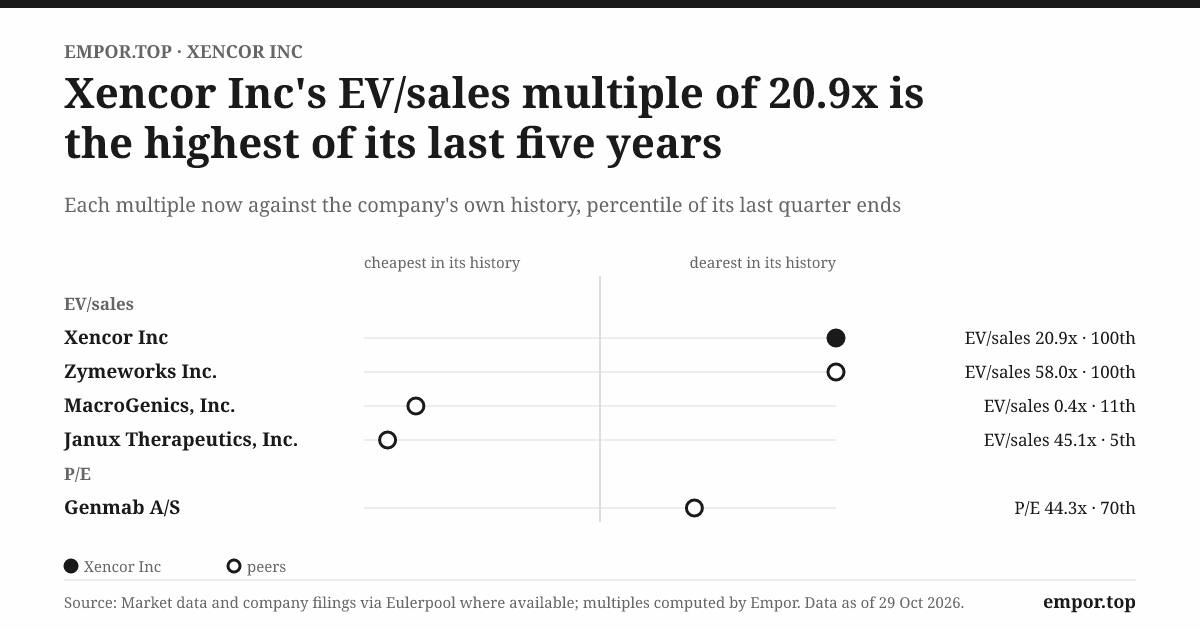
At about $29 a share, the market values Xencor at roughly twenty times its revenue over the past four quarters.[^3] For a profitable software company, that would be a premium multiple. For a biotech with no product sales, negative earnings and revenue that swings with partner decisions, it is something different: a price on the probability that future clinical and partner success turns into cash flows that do not exist today.
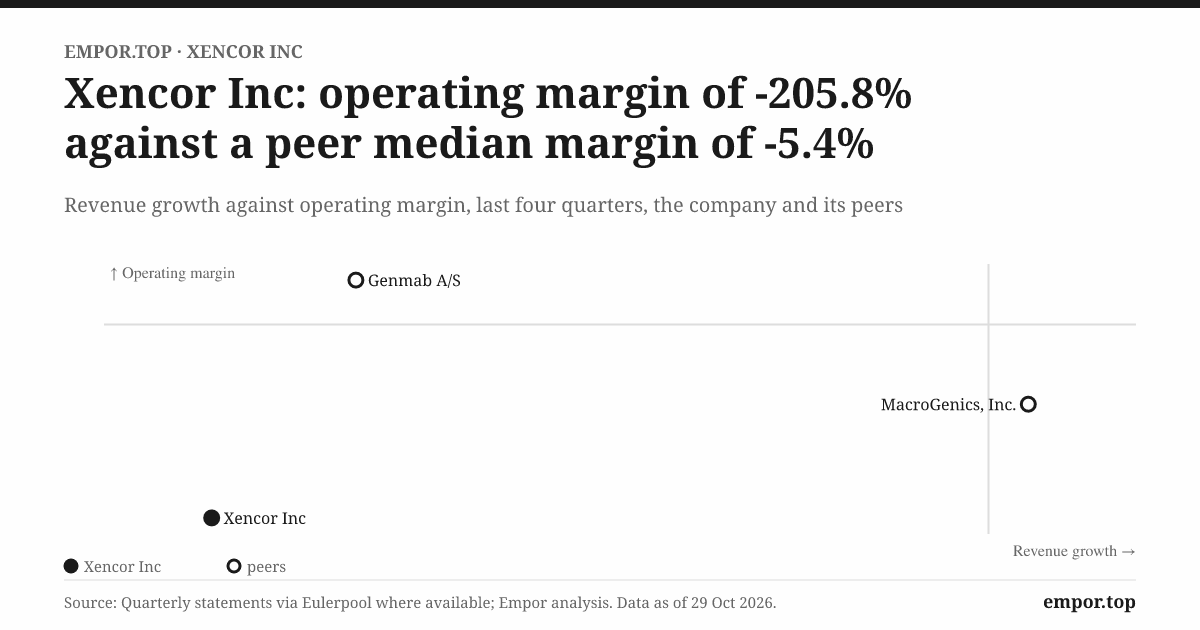
The current financial picture is stark. Xencor lost about $2.17 a share over the four quarters to June 2026.3 Its free cash flow, measured against its market value, is negative by nearly 10%. Research spending in 2025 was almost twice revenue.8 Two partners provided about 97% of 2025 revenue, and the largest of them has since stopped paying U.S. royalties.810
A quoted price-to-earnings ratio sometimes still attached to the stock refers to the twelve months to September 2022, a period of partner-driven profit; it says nothing about today's earnings. Price-to-sales and price-to-book, at roughly 20 and 4.4 times, are context, not fair-value anchors.[^3]
The bull case is not hard to articulate. Three marketed medicines developed with Xencor's engineering and late-stage partner programs such as Amgen's xaluritamig in Phase 3 and Zenas's obexelimab under regulatory review support the platform case; those programs carry milestones and royalties.8
XmAb819 has shown a potentially differentiated signal in a hard-to-treat cancer, with a format built to address the central weakness of T-cell engagers in solid tumors. XmAb942 gives a second shot in a large inflammatory market. And the company has close to half a billion dollars in liquid assets, plus settlement cash still to come, to fund its key trials.
The bear case is equally concrete. Xencor has no product-sales revenue after nearly three decades. Its research intensity is very high, its revenue is concentrated and episodic, and its largest recurring royalty stream has just been converted into a one-time payment.
Clinical attrition is the norm in oncology, especially for drugs moving from small single-arm studies into randomized trials. Royalty monetization has been expensive, and dilution, through equity raises or stock compensation, is an ever-present possibility. The holdings in partner biotechs add volatility rather than stability.
To decide between those cases, it helps to examine the structure of Xencor's industry. The most important force is buyer power. Xencor's main buyers have historically been large pharmaceutical companies, and they hold most of the cards. They control development budgets, trial design, commercialization and, as Novartis, Janssen and Roche showed, the decision to hand programs back. Xencor's 2025 revenue concentration and its 2026 dispute with Alexion are direct evidence of that bargaining power.
Substitutes are abundant. Antibody engineering is no longer rare: other companies offer half-life extension technologies, bispecific formats and T-cell engager platforms, and newer modalities such as antibody-drug conjugates, cell therapies and radiopharmaceuticals compete for the same patients and the same partner budgets.
Barriers to entry exist in the form of deep expertise, patents and the capital needed to run clinical trials. But those barriers protect the right to compete, not the right to win. They do not ensure that any particular molecule succeeds or earns attractive economics.
The moat question, in the sense of Hamilton Helmer's framework of durable powers, follows from that. Xencor has a cornered resource of sorts in its patents and engineering know-how, and some process power in its ability to design complex antibody formats reliably. But the record does not show pricing power over partners, switching costs that lock them in, or a repeatable internal commercialization advantage.
Partners have walked away from Xencor programs repeatedly, which is the opposite of switching costs. Its royalty rates, low single digits on Ultomiris and up to the low teens on tafasitamab, suggest that partners captured most of the value the engineering created.84
So the moat conclusion is that Xencor has technical validation and partner access, but not yet a demonstrated economic moat. The technology is good enough that others pay for it. It is not yet scarce enough that they must pay a lot for it, or that Xencor can capture drug-level economics on its own.
The bullish optionality deserves a stress test against the company's own history. The marketed partner products are real proof that Xencor's engineering can reach patients. But the history of XmAb5871, XmAb7195, plamotamab and the Genentech cytokine shows how often technical progress stopped short of Xencor-owned revenue.
Taken together, that record narrows the optionality claim rather than rejecting it: Xencor's molecules frequently advance, but its historical rate of converting its own candidates into products it sells is zero. XmAb819 is the first realistic chance to change that rate. Optionality is real, but a portfolio of options is worth what it costs to exercise them, and the exercise price here is a global randomized trial.
The risks worth watching are specific. Clinical efficacy and toxicity sit at the top, since XmAb819's next data and the randomized trial will set the company's value. Partner decisions and terminations follow, because they can shift milestones and royalties without warning. Concentration and royalty collection come next, as the Alexion episode showed. Dilution and expensive financing matter if the runway proves shorter than forecast.
The volatility of equity holdings will keep distorting reported results. And the accounting judgments around accrued trial costs and the royalty liability need to stay clean after the restatement. Technology-driven disruption in drug discovery, from artificial intelligence for example, may reshape the industry over time, but it is not what will decide this company's next three years.
An activist looking at Xencor would likely ask a handful of hard questions. Why spend roughly twice revenue on research before the lead asset has randomized data? Why sell royalties at an implied rate near a quarter a year? Why hold volatile partner stocks with runway capital?
And why, in the latest quarter, did the inflammatory program receive more direct spending than the cancer program? Management has answers to each: the research spending builds the pipeline, the royalty sale avoided dilution, the stakes came with partnerships, and XmAb942 targets a large market. Whether those answers are right will show up in outcomes, not arguments.
Three numbers will tell investors most. The first is XmAb819's response durability and safety at the selected dose, which today rests on a 45.5% confirmed response rate in eleven patients and an 82% six-month progression-free estimate on short follow-up.1
The second is operating cash burn and liquidity against the 2029 runway claim, starting from about $486 million in June and a guided $420 million to $440 million at year-end.3[^17] The third is partner revenue and cash collections, split into recurring royalties, milestones and settlements, because 2026 will be full of settlement revenue that will not repeat.
The skeptical investor's question is the right one to end on. What evidence would justify spending another year of pipeline cash before the lead asset has randomized data?
The honest answer is that Xencor is asking investors to trust that its engineering, proven in other companies' drugs, will work in its own, and to fund that test on the strength of eleven patients and a decade of near-misses. That is not an unreasonable bet. It is simply a bet, and the market at around twenty times sales is pricing it more as an expectation.
Business & Investing Lessons
Xencor's Xtend engineering is the reason a patient with a rare blood disorder can take Ultomiris far less often than its predecessor required.7 It is a real gift to patients, and it was built in a lab in Southern California. Yet the company that built it never sold a dose, never saw the patient, and in 2026 settled for a lump sum on the U.S. royalties.
The first lesson is that a technology can reach the market even when its inventor does not own the customer. For founders, licensing is a way to survive; it is not a way to capture value. For investors, the question is never only whether the technology works, but who stands between the technology and the cash.
The second lesson comes from the OMERS deal. Xencor turned two royalty streams into $215 million of cash at once, at an implied cost close to a quarter a year on the larger stream.8 The money funded research. It also meant that every dollar Ultomiris and Monjuvi earned for Xencor during the deal went first to the lender.
A future cash stream is capital only once; sell it today and it cannot fund tomorrow. Royalty financing is a legitimate tool, but it is a loan disguised as a sale, and its cost should be weighed against the dilution it avoids, not treated as free runway.
The third lesson is the one the October 2026 slide will be remembered for. Five responses in eleven patients is a striking result; the confidence interval around it spans from mediocre to extraordinary.2
Xencor's own history shows how many promising early signals, from XmAb7195's IgE suppression to plamotamab's early lymphoma data, did not turn into products the company owned. A response rate can open the door; only durable, controlled outcomes keep it open. Investors who confuse the first with the second tend to pay for both and receive one.
The fourth lesson belongs to the 2024 reset. Xencor stopped cytokines, paused programs whose biology was uncertain, and concentrated money on T-cell engagers and inflammatory disease.12 That kind of decision is harder than it looks, because each stopped program has advocates, sunk costs and a story about what might have been.
A pipeline is a portfolio of hypotheses, and a good reset is measured by what it stops as much as what it starts. The proof that the reset worked will not be the programs it saved. It will be whether the survivors deliver.
The fifth lesson ties the others together. Platform validation, clinical validation and shareholder economics are three different achievements. Xencor has strong evidence for the first, in drugs on pharmacy shelves. It has promising evidence for the second, in a small kidney-cancer cohort.
The third, a business whose revenue repeats and whose economics belong mostly to its own shareholders, remains an unfinished test. Many platform companies conflate the three. Xencor's story is a reminder that each must be earned separately, and that the last is the one investors are actually paid for.
Epilogue
Tonight, Xencor stands at an inflection that it has approached before but never quite reached. It has a proposed dose and trial plan for XmAb819, a stated cash runway into 2029 and a share price near its 52-week high.115[^3] What it does not yet have is the evidence that decides whether any of that becomes a business.
The next year will supply a great deal of it. In the first half of 2027, Xencor plans to report results from a larger cohort at the 400 dose.2
If the response rate holds near what the first eleven showed, and if the progression-free estimate survives longer follow-up, the case for the randomized trial strengthens considerably. If the response rate drifts toward the lower end of its confidence interval, or if severe side effects accumulate with longer treatment, the story changes before the big trial even begins.
In the same half-year, the company plans its end-of-Phase 1 meeting with the FDA.2 What the agency says about the tivozanib control arm, the endpoints and any accelerated-approval path will shape the trial's cost, size and timing. Then, by the end of 2027, Xencor intends to start the trial itself.1 That would mark the company's move from proving a drug can work to proving it works better than an approved alternative.
The money will tell its own story along the way. When Xencor reports its third-quarter results, they will include about $77 million of settlement revenue that will not recur.3 The year-end cash balance will show whether the company hit its $420 million to $440 million guide.[^17]
About a year after the July settlement, the second $52.5 million installment from Alexion falls due.10 And partner programs will produce their own news: Zenas's obexelimab application and Amgen's xaluritamig Phase 3 trials could move Xencor's milestone and royalty outlook in either direction.8
What would move the verdict? Durable efficacy and manageable toxicity in the larger XmAb819 cohort. Credible trial execution, on time and within a budget the company can afford without selling more of its future. And a partner revenue mix that depends less on episodic milestones and legacy royalties, and more on drugs that are still growing.
Until those results arrive, the commercialization claim remains plausible but unproven. The balance sheet buys time; only clinical evidence can turn that time into value.
Outro
Return to that slide in October: five confirmed responses among eleven patients.1 That is the same engineering already validated in other companies' medicines, while Xencor reported no product revenue of its own.8
That history makes Xencor unlike a conventional biotech story.
Its wager is something harder: that the engineering behind other companies' medicines can become the foundation of medicines, and economics, of its own. The distance between the engineered molecule and the patient's treatment has always been where the value lay. For the first time, Xencor is trying to cross it alone.
References
-
Xencor Presents Phase 1 Dose-Selection Data for XmAb819 and Potential Registration Path — Xencor, Inc., 2026-10-25 ↩↩↩↩↩↩↩↩↩↩↩↩↩↩↩↩↩↩↩↩
-
XmAb819 ESMO 2026 Webcast and Corporate Presentation — Xencor, Inc., 2026-10-26 ↩↩↩↩↩↩↩↩↩↩↩↩↩↩↩↩↩↩↩↩↩↩↩↩↩↩↩↩↩↩
-
Form 10-Q for Q2 2026 — Xencor, Inc., 2026-08-05 ↩↩↩↩↩↩↩↩↩↩↩↩↩↩↩↩↩↩↩↩↩↩↩↩↩↩
-
Form 10-K for FY2015 — Xencor, Inc., 2016-02-25 ↩↩↩↩↩↩↩↩↩↩↩↩
-
Definitive Proxy Statement — Xencor, Inc., 2026-04-27 ↩↩↩↩↩↩↩↩
-
Form 10-K for FY2025 — Xencor, Inc., 2026-02-25 ↩↩↩↩↩↩↩↩↩↩↩↩↩↩↩↩↩↩↩↩↩↩↩↩↩↩↩↩↩↩↩↩↩↩↩↩↩↩↩↩↩↩↩↩↩↩↩↩↩↩
-
Form 8-K: Alexion Ultomiris Royalty Settlement — Xencor, Inc., 2026-07-29 ↩↩↩↩↩↩↩↩↩
-
Form 8-K: Termination of Genentech Agreement — Xencor, Inc., 2026-03-09 ↩↩↩
-
Q4 2023 Earnings Call Transcript — Xencor, Inc., 2024-02-27 ↩↩↩↩↩↩
-
XmAb819 ESMO 2026 Webcast Q&A Transcript — Xencor, Inc., 2026-10-26 ↩↩↩
-
Form 8-K: XmAb819 Update and Cash Runway — Xencor, Inc., 2026-10-26 ↩↩↩↩
 LinkedIn
 WhatsApp
 Reddit
 Hacker News
 Email
 Kindle
 RSS Feed
 Spotify
 Apple Podcasts
 Amazon Music
 Audible
 YouTube