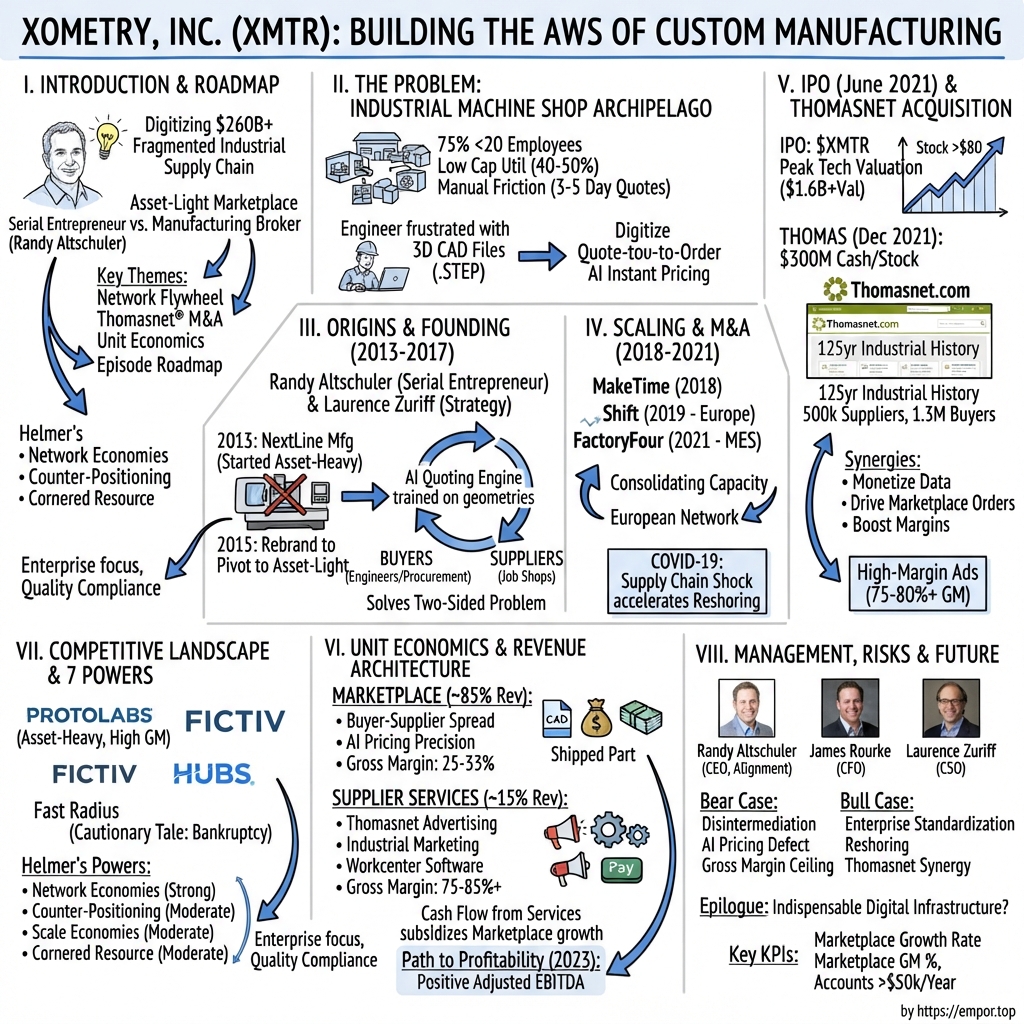
Xometry, Inc. (NASDAQ: XMTR): Building the Amazon Web Services of Custom Manufacturing
I. Introduction & Episode Roadmap
On the morning of May 7, 2026, Xometry's executives dialed into a first-quarter earnings call from Gaithersburg, Maryland—a Washington, D.C., exurb known more for biotech laboratories and federal contractors than industrial software. The quarterly metrics showed momentum, with revenue up 36% year over year, marking a third consecutive quarter of accelerating growth.1 More notable, however, was an announcement buried in the prepared remarks. German industrial software provider Siemens had agreed to embed Xometry's pricing and manufacturability engine directly into its Xcelerator software platform, backed by a roughly $50 million investment in newly issued Xometry equity.2
Xometry's stock rose 39% during that trading session.3 For a business that spent much of the preceding four years associated with peak 2021 market valuations, the reaction marked a sharp shift in market sentiment. By mid-August 2026, shares traded near $89, compared with a 52-week low of $35.86, putting the company's market capitalization at roughly $4.8 billion.4
That surge represents the headline narrative. The underlying question is what fundamentally changed within the business.
The pitch, and the counter-pitch
Xometry operates a two-sided marketplace for custom-manufactured parts. An engineer uploads a 3D CAD file—a digital blueprint for a bracket, housing, or turbine component—and receives a firm price and delivery date within seconds. Xometry then routes the job to one of more than 5,000 independent machine shops, sheet-metal fabricators, 3D-printing bureaus, and injection molders across 50 countries, pays the supplier, and earns the spread.5 The company owns no manufacturing facilities. Conceptually, it functions as an Amazon Web Services for physical parts: rather than purchasing capital equipment, customers rent idle factory capacity while the platform manages matching and routing.
The bullish investment thesis centers on market scale and software adoption. Management estimates the global custom manufacturing market at roughly $275 billion, of which Xometry claims less than 1% penetration.5 Much of the sector still relies on manual quote requests and multi-day email exchanges. In theory, each completed transaction feeds the pricing model, strengthening network effects as order volume grows.
The bearish counter-argument focuses on business model constraints. Xometry is not a high-margin software business with 80% gross margins; it acts as a transaction principal, buying parts wholesale and reselling them at marketplace gross margins in the mid-30s.6 The company has yet to record a GAAP profit as a public entity, reporting a 2025 net loss of $61.8 million compared to $50.4 million in 2024.[^7] Meanwhile, its second operating segment, formed through a $300 million acquisition, has contracted for four consecutive years. Additionally, the platform faces disintermediation risk if buyers and suppliers establish direct relationships after an initial match.
Three questions this story turns on
Does the flywheel actually spin, or is this a broker with better software? The distinction is critical for long-term margin potential. A traditional brokerage relies heavily on sales headcount to grow, whereas a true marketplace expands gross margins alongside volume. Xometry's marketplace gross margin rose from approximately 25% four years ago to about 35% in 2025—a trend management cites as evidence that its pricing algorithms are improving.7 Whether margins can expand further toward management's long-term target of 35% to 40% serves as a core test of the platform's economics.
Was the Thomas acquisition sound capital allocation or financial cosmetics? In December 2021, near the peak of growth-equity valuations, Xometry acquired industrial directory publisher Thomas for $300 million in cash and stock.[^9] While the transaction provided an immediate boost to consolidated gross margins, the acquired business has seen revenue decline every year since. Evaluating this purchase provides an objective benchmark for management's capital allocation history.
Is the 2025–26 acceleration durable or cyclical? Four consecutive quarters of accelerating revenue growth represent a significant operational shift.5 However, this expansion coincided with a rebounding manufacturing PMI, tariff-driven supply chain reshoring, and elevated demand in defense hardware and robotics. Isolating company execution from broader macroeconomic tailwinds is essential to assessing Xometry's underlying growth rate.
The road ahead
This analysis traces Xometry from co-founder Randy Altschuler's background—spanning Princeton, Blackstone, a business-process outsourcing firm in Chennai, and two congressional campaigns on Long Island—through the company's 2013 founding under an initial business model that proved unworkable. It follows Xometry through its 2021 initial public offering, the acquisition that shaped its capital-allocation record, the subsequent 2022–2023 valuation contraction, and its ongoing effort to achieve profitability. Finally, it examines the current landscape under a chief executive hired from Wayfair, as a $275 billion custom manufacturing market long resistant to software adoption begins to shift online.
It begins with why that market resisted digitization for so long.
 Subscribe on LinkedIn
II. The Problem: The Industrial Machine Shop Archipelago
Picture a machine shop in suburban Ohio. Eleven employees. Four CNC milling machines—computer-controlled cutting tools that carve parts out of solid metal blocks—each costing between $80,000 and $400,000. The owner is fifty-eight, learned the trade from his father, and completes his quotes at a desk covered in printed drawings, usually after six p.m. because daytime hours belong to the shop floor.
A request for quote arrives by email: a stainless steel manifold, twenty units, tolerances within one-thousandth of an inch. To price the job, the owner must estimate setup time, required cutting tools, spindle speed through that specific alloy without burning an end mill, bar stock requirements, secondary fixturing steps, and an hourly shop rate based on current queue density. Three to five days later, he emails back a PDF with a single dollar figure.
Multiply that workflow across roughly half a million small and mid-sized manufacturers in the United States alone.8 The result is an industrial archipelago: thousands of capable, isolated operations, each with expensive machinery running well below capacity, operating without a shared network.
Why the friction is structural, not lazy
It is tempting to view this fragmentation as an industry failing to modernize. That interpretation misreads the underlying economics. Quoting a custom part is inherently complex because every job is unique. A traditional retailer prices a static inventory unit once; a machine shop prices a geometric shape it has never manufactured and may never see again.
The pricing challenge is fundamentally geometric. Two parts of identical weight and material can differ tenfold in cost if one features a deep, narrow pocket requiring fragile tooling and reduced feed rates. A human estimator holds that operational intuition in his head. Because that knowledge is difficult to codify into traditional software, the industry resisted automation for decades—and why machine learning, designed to approximate complex functions that defy explicit rules, offered a potential technical fit.
The friction creates operational drag on both sides of the market.
On the supply side, the shop owner manages highly volatile order flow. In quiet months, he bids aggressively to cover fixed overhead, watching machinery sit idle. In peak months, he turns away work he lacks the capacity to schedule. Capital equipment—the largest asset on his balance sheet—remains underutilized for extended periods. With sales responsibilities falling solely on the owner, geographic reach is limited to local relationships.
On the demand side, an engineer at an aerospace or medical-device manufacturer faces a complementary problem. She may require a prototype bracket one week and a production run of the same component a year later. Sourcing requires identifying suppliers, auditing quality certifications, completing procurement onboarding, and managing purchase orders across fragmented vendors. The administrative cost of onboarding a supplier often exceeds the value of the part being purchased, driving engineers to rely repeatedly on familiar shops regardless of price.
Historically, traditional manufacturing brokers filled this gap using manual networks to match buyers with suppliers. While brokers provided discovery, they introduced opaque markups and maintained high overhead in sales and estimation headcount, preventing brokerage from scaling into a high-margin business model.
What a marketplace changes
The digital opportunity in custom manufacturing extends beyond placing an industrial catalog online. It involves replacing manual estimation with a predictive model trained on historical manufacturing outcomes.
The operational model resembles insurance underwriting. An underwriter prices risk by evaluating historical claims data across millions of policies. Similarly, Xometry calculates part pricing by estimating a supplier's production cost using data from past jobs—including historical fabrication errors. If a part proves more difficult to machine than predicted, that operational feedback informs subsequent pricing for similar geometries. Management describes this mechanism as a feedback loop where production-floor data returns to the quoting engine so that "every part that gets produced helps make the next quote stronger."5
If the algorithm performs as intended, three outcomes occur concurrently: buyers receive instant pricing rather than waiting days; suppliers gain curated order flow suited to their specific machinery, increasing utilization; and platform gross margins expand over time as improved price accuracy reduces margin slippage on misquoted jobs.
This framework represents the core thesis of digital manufacturing platforms. However, similar models have historically struggled with execution challenges in custom industrial markets. Whether Xometry can sustain this flywheel depends on execution—which brings the analysis to the co-founder who spent thirteen years attempting it.
III. Origins & Founding: From OfficeTiger to NextLine (2013–2017)
Randy Altschuler's background differed from that of a traditional manufacturing founder. Born in New York City in 1970, he graduated from Princeton, spent a Fulbright year at the University of Vienna, earned an MBA from Harvard Business School, and began his career in finance: first in investment banking at Donaldson, Lufkin & Jenrette, then in real estate private equity at Blackstone.9
In 1999, Altschuler shifted to entrepreneurship, co-founding OfficeTiger, a business-process outsourcing firm that shifted back-office labor—including document production, financial research, and transaction support—from Western corporate offices to India. OfficeTiger expanded to approximately 4,500 employees before being acquired by printing giant RR Donnelley in 2006.9 In 2001, he co-founded CloudBlue, an electronics recycling business, which was sold in 2013.9
Between those corporate exits, Altschuler ran two unsuccessful campaigns for Congress in New York's 1st Congressional District in 2010 and 2012.9 The eastern Long Island district contained thousands of small business owners, providing Altschuler with direct exposure to the operational and financial constraints facing local manufacturers and commercial operators.
The DNA that mattered
The strategic bridge connecting OfficeTiger to Xometry was the concept of stranded capacity. OfficeTiger monetized skilled labor whose output was far more valuable when connected to global demand than to local markets. Building OfficeTiger required creating the operational apparatus necessary to establish institutional trust across distant counterparties—including standardized quality control and service-level guarantees that allowed Fortune 500 clients to outsource critical tasks overseas.
Custom manufacturing presented a parallel structural problem, substituting idle machinery for underutilized labor. The primary barrier to digitization was not data security, but counterparty trust: whether an unfamiliar machine shop could deliver precision parts on schedule and to specification. In 2013, Altschuler co-founded Xometry alongside Laurence Zuriff, who brought a capital-markets and investment background to the partnership; the two remained the company's founding pair through the IPO and beyond.10
The wrong idea first
Initially incorporated as NextLine Manufacturing before rebranding to Xometry, the business launched with a conventional operating model: purchasing CNC machines and 3D printers to operate as an efficient, technology-enabled job shop.
That asset-heavy approach reflected standard industry practice, but it carried structural financial limitations. Revenue in an asset-heavy model is bounded by installed equipment capacity, requiring ongoing capital expenditures to expand. Furthermore, returns on invested capital remain tied to shop floor utilization. Because custom manufacturing demand fluctuates across varied fabrication processes—including CNC milling, sheet metal stamping, injection molding, and additive manufacturing—owning hardware requires purchasing specialized machinery that remains idle during off-peak periods. Under this model, capital efficiency declines as equipment footprint expands.
Xometry subsequently pivoted to an asset-light marketplace model, liquidating its manufacturing equipment to operate purely as an orchestration layer. This strategic shift removed balance-sheet constraints on growth. Manufacturing capacity expanded through supplier onboarding rather than equipment acquisitions, process offerings broadened without capital deployment, and capital returns were uncoupled from factory utilization rates.
The pivot created a structural financial buffer: platform growth became decoupled from balance-sheet debt and fixed overhead. During manufacturing downturns, an asset-light platform routes lower job volumes without absorbing unallocated factory overhead, whereas asset-heavy competitors must absorb fixed equipment depreciation and facility costs regardless of demand.
Solving the cold start
Developing an instant-quoting engine required both software engineering and marketplace liquidity. Early technical development focused on training pricing models against part geometries, material specifications, tolerances, surface finishes, and historical shop bidding data. However, establishing initial transactional volume posed a commercial challenge on both sides of the market.
To drive early adoption, Xometry implemented a model of asymmetric risk absorption. Rather than acting as a traditional commission-based broker connecting buyers and sellers for a fee, Xometry inserted itself as the transaction principal. The platform provided buyers guaranteed pricing and delivery timelines prior to securing a supplier, while offering suppliers guaranteed payment and pre-specified orders without sales overhead.
These dual guarantees exposed Xometry to pricing risk: if an automated quote underestimated production costs, Xometry absorbed the margin shortfall. This principal model explains why the company operates at gross margins in the mid-30s rather than the high margins typical of pure software platforms. However, assuming transaction risk was essential to overcoming mutual distrust between enterprise buyers and independent machine shops.
By absorbing pricing friction and acting as a transaction principal, Xometry established its marketplace mechanics while setting the structural parameters for its long-term margin profile. With the operational architecture in place, the company turned its focus to scaling network volume.
IV. Scaling the Marketplace & Strategic M&A Era (2018–2021)
By 2018, Xometry had established a working product, an expanding supplier network, and backing from a diverse group of investors. Venture firms including Foundry Group, Highland Capital Partners, and T. Rowe Price invested alongside corporate venture arms BMW i Ventures and GE Ventures. The inclusion of industrial strategic investors signaled that major manufacturers viewed Xometry not merely as a high-growth platform, but as an operational solution for internal supply-chain bottlenecks.
Revenue in 2019 reached $80.2 million.[^7] The company remained unprofitable, entering a three-year period of rapid expansion and acquisition.
Buying supply, then geography, then software
Management's inorganic strategy during this period focused on acquiring critical marketplace assets sequentially: network capacity, geographic reach, and supplier workflow software.
The first priority was supply. In 2018, Xometry acquired MakeTime, a competing CNC marketplace, to absorb its network of Midwestern machine shops. In two-sided marketplaces, acquiring a competitor secures liquidity rather than simple sales volume. Combining supplier networks increases available manufacturing capacity for buyers while providing more order volume for suppliers, strengthening overall network density.
The second priority was geography. In 2019, Xometry acquired Munich-based digital manufacturing firm Shift, establishing the foundation for Xometry Europe and testing whether the digital marketplace model could scale internationally. Results have been mixed: management has consistently described international unit economics—gross margin and gross profit structure—as similar to the U.S., while conceding that segment profitability lagged badly.7 The international segment was still running an adjusted EBITDA loss of $3.3 million in the second quarter of 2026, though that represented an improving 9.6% of revenue versus 11% a year earlier.5 Seven years after the acquisition, European operations continue to weigh on consolidated profitability.
The third priority was supplier software. In November 2021, Xometry acquired FactoryFour, a cloud-based manufacturing execution system that tracks jobs on the factory floor. This technology became the foundation for Workcenter, Xometry's quote-to-cash operational software for suppliers.
While modest in transaction size, the FactoryFour acquisition carried strategic weight. A marketplace that only distributes purchase orders remains vulnerable to supplier churn. A platform that embeds itself into a shop's scheduling, communication, and financial workflow creates significant switching costs. By 2025, Xometry launched a Workcenter mobile app, enabling shop owners to manage jobs from the factory floor and—tellingly—manage their cash flow through the platform.7 Controlling the operational workflow strengthened platform retention and deepened supplier relationships.
The pandemic accelerant
The COVID-19 pandemic in 2020 exposed structural vulnerabilities across global manufacturing supply chains. Operations reliant on single-source overseas vendors faced widespread disruption, while medical equipment manufacturers required rapid production at unprecedented scale. Simultaneously, procurement managers working remotely turned to digital platforms that could provide instant quoting and delivery guarantees.
These tailwinds accelerated top-line growth. Revenue rose from $80.2 million in 2019 to $141.4 million in 2020, and reached $218.3 million in 2021—nearly tripling over two years.[^7] Net losses also expanded, rising from $31.0 million in 2019 to $61.4 million in 2021, as the company invested heavily to capture market share.[^7]
Evaluating this expansion requires distinguishing structural market adoption from temporary demand acceleration. While the pandemic permanently shifted buyer behavior toward domestic reshoring and digital procurement, it also generated a temporary pull-forward in order volume. Separating baseline growth from cyclical momentum was challenging in real time, laying the groundwork for subsequent valuation adjustments.
In June 2021, driven by rapid revenue growth and strong market appetite for digital platforms, Xometry moved to file for its initial public offering.
V. The June 2021 IPO & The $300M Thomasnet Acquisition
By the standards of mid-2021, Xometry's initial public offering was relatively restrained. The company priced 9.17 million shares at $44.00 on June 30, 2021—above its raised $38-to-$42 target range—raising roughly $300 million at a valuation near $1.6 billion.11 The stock surged past $80 in subsequent months as public markets assigned high growth multiples to a platform generating $218 million in annual revenue while posting a $61 million net loss.[^7]
Six months after listing, armed with fresh capital and elevated equity value, management made the defining capital-allocation decision in the company's history.
The deal
On December 8, 2021, Xometry announced an agreement to acquire Thomas, publisher of Thomasnet.com, for $300 million on a cash-free, debt-free basis, comprising approximately $198.5 million in cash and $101.5 million in Xometry Class A common stock.[^9] The transaction closed the following day.12
The acquisition brought in a unique legacy asset in American industry: an industrial directory with roots dating to the late 19th century. Thomas had successfully transitioned from printed green buyers' guides into a digital sourcing platform serving more than 1.3 million registered users—including 93% of the Fortune 1000—and hosting over 500,000 listed commercial and industrial suppliers while generating more than 20 million annual sourcing sessions.[^9]
Management built its strategic case for the deal on three pillars:
Leg one: gross margin accretion. Thomas sold advertising and marketing services to suppliers seeking visibility—a high-margin business with gross margins above 70%, compared to Xometry's marketplace gross margins then in the mid-20s. Integrating Thomas promised to expand consolidated gross margins immediately.
Leg two: buyer-intent data. Thomas tracked procurement search queries from hundreds of thousands of industrial buyers regardless of transaction completion, offering a proprietary demand-generation dataset.
Leg three: audience cross-selling. The plan aimed to convert Thomasnet's non-transactional visitor traffic into active Xometry marketplace transactions at minimal customer acquisition cost.
Management explicitly outlined its targets: the acquisition was projected to be immediately accretive to gross margin and adjusted EBITDA margin, while accelerating Xometry's timeline to full-year profitability, then targeted for 2023.[^9]
The autopsy
Evaluating the transaction begins with valuation. Thomas contributed $4.1 million in revenue between the December 9 close and the end of 2021.12 On an annualized basis, the business was generating approximately $75 million to $80 million in revenue—aligning with the $77.9 million that Xometry's supplier services segment recorded in 2022, its first full year of ownership.13
That run-rate implied Xometry paid roughly four times revenue for a mature, slow-growing directory and advertising service near the peak of 2021 valuations. By comparison, mature ad-supported directories historically traded at low-single-digit revenue multiples. While the purchase price was high, funding one-third of the consideration with elevated stock equity mitigated cash outlay.
Subsequent operating performance highlighted structural headwinds. Supplier services revenue declined steadily from $77.9 million in 2022 to $68.7 million in 2023, $59.6 million in 2024, and $57.0 million in 2025.13 The segment contracted every year under Xometry's ownership, representing a cumulative drop of roughly 27%. Management attributed a portion of the decline to intentional exits from lower-margin non-core lines, such as a tools-and-materials business. However, segment revenue continued to soften into 2026, falling 3% year over year in the second quarter to $13.9 million.14
While the first strategic pillar—gross margin accretion—delivered as intended, audience cross-selling has been harder to verify. Years after the acquisition, management does not report specific metrics on Thomasnet users converting into marketplace buyers, and marketplace buyer growth has primarily relied on core product and marketing channels that management discusses without referencing Thomas.5
Furthermore, the initial timeline to profitability slipped. Full-year adjusted EBITDA profitability, originally targeted for 2023 at the time of the announcement, was not achieved until 2025—two years behind schedule.7 On a GAAP basis, the company has yet to reach profitability.[^7]
The fair reading
A complete assessment shows the transaction yielded nuanced results. The supplier services segment continues to generate high-margin gross profit that supports ongoing marketplace investment. Moreover, the asset provided tangible value in Xometry's partnership with Siemens, where the Thomas supplier directory is being integrated into Siemens Supplyframe to source complete bills of materials across electronic and mechanical components.2
At the same time, the broader record reflects clear execution challenges: Xometry acquired a contracting asset at peak-cycle valuation, missed its initial profitability timeline by two years, and has yet to demonstrate the cross-selling synergies central to the original thesis. On its second-quarter 2026 earnings call, management stated it was "ever more confident about inflecting the revenue curve" and restoring supplier services to year-over-year growth in the second half of 2026.5 Delivering on that inflection represents an immediate test of execution.
The transaction illustrates a broader operating pattern: management's strategic directional vision has often proven sound, even as its projections regarding timing and magnitude have tended toward optimism. Within 15 months of closing the acquisition, that optimism encountered the realities of a broader industrial slowdown.
VI. Segment Anatomy, Financial Architecture & Unit Economics
Understanding Xometry's trajectory requires examining how the business generates revenue—a structure less exotic than its algorithmic positioning suggests.
Two businesses in one company
The Marketplace segment serves as the company's core engine, contributing roughly $215 million of the $229 million Xometry generated in the second quarter of 2026—approximately 94% of total revenue.14 Its underlying mechanics are straightforward: a customer pays Xometry for a custom component, Xometry pays a supplier to manufacture it, and the difference represents gross profit.
This operates as a principal model rather than an agency structure—a fundamental distinction in the company's financial architecture. Rather than charging a transaction commission, Xometry captures a spread while assuming execution and pricing risk on both sides of the trade. Marketplace gross margin reached 34.7% in the second quarter of 2026, remaining flat sequentially against a long-term target range of 35% to 40%.145
The Supplier Services segment—comprising the acquired Thomas business, Workcenter software, and supplier financial services—contributes the remaining revenue at significantly higher margins. Economically, it functions as a high-margin gross profit cushion, providing capital to fund marketplace technology and sales expansion. While that funding role remains intact, segment revenue growth has continued to contract.
How the pricing engine actually makes money
At the center of Xometry's margin expansion thesis lies its algorithmic pricing engine.
When generating an automated quote, the system makes two simultaneous predictions: estimating the price a buyer will accept and the cost a qualified supplier will require. The spread between those figures determines platform gross margin. Overpricing risks losing customer conversion; underpricing risks supplier rejection or delayed, off-specification delivery. Rather than optimizing a static pricing table, the engine solves a constrained matching problem in real time across thousands of daily transactions.
Machine-learning models perform a direct operational role in this process. In the second quarter of 2026, management deployed an updated cost-prediction model evaluating part geometry, material properties, surface finishes, and batch assembly context—yielding a roughly 15% improvement in CNC cost-prediction accuracy.5 Concurrently, an adaptive sourcing model dynamically prices orders for suppliers using a "partner suitability score" derived from machine capabilities, quality track records, and on-time delivery metrics.5 Additionally, a context-aware recommendation tool—which infers from part application data whether a component requires specialized tolerances—achieved buyer acceptance rates exceeding 85%.5
The adaptive sourcing model illustrates the primary driver of margin efficiency. By identifying the shop best equipped for a given job—matching machine specifications, quality certifications, and available capacity—Xometry can route work at lower supplier cost while preserving shop profitability. Under this framework, margin expansion stems not from vendor fee extraction, but from eliminating operational mismatch waste.
Empirical evidence supporting this dynamic remains promising yet incomplete. Marketplace gross margin expanded from approximately 25% four years prior to nearly 35%.7 In the first quarter of 2026, marketplace gross margin rose 290 basis points year over year alongside accelerating top-line growth.1 In the second quarter, however, gross margin remained flat sequentially even as revenue growth reached 45%.14 Management characterized the margin trajectory as a strategic trade-off, forecasting higher gross margins in the second half of the year.5 Alternatively, the flattening margins could indicate price concessions to drive volume. Subsequent quarterly results will demonstrate which interpretation holds.
The buyer economics
Two core operational metrics summarize demand dynamics. Active buyers reached 89,557 in the second quarter of 2026, representing a 20% year-over-year increase and 3,976 net additions—the highest quarterly net gain in ten quarters.14 Simultaneously, marketplace revenue per active buyer grew 21%, driven by expanding customer wallet share.5
Expanding spend per customer reflects product integration rather than mere customer acquisition. Increasing account depth indicates enterprise clients are shifting broader procurement volume onto the platform rather than using Xometry solely for spot prototyping. Meanwhile, marketplace advertising expenses fell to a record low of 3.4% of marketplace revenue.5 Combining buyer acquisition and spend-per-buyer growth with declining marketing intensity provides clear evidence of strengthening unit economics.
The 2023 reset — and a correction to the record
Narratives surrounding Xometry's market history frequently mischaracterize its 2023 valuation adjustment, framing it as a single-day collapse following a first-quarter earnings report.
The actual market repricing occurred on March 1, 2023, when Xometry reported fourth-quarter 2022 results—revenue of $98.2 million, up 46%, and gross profit up 72%—alongside first-quarter guidance of $100 million to $102 million that implied revenue growth decelerating to 20%–22%.15 While absolute results met expectations, the slowing growth trajectory triggered a sharp stock sell-off.
When first-quarter 2023 results were released on May 10, revenue of approximately $105 million exceeded guidance, and the stock rose roughly 35% in a single trading session.16 Margin pressure remained evident—overall gross margin slipped to 37.4% from 38.7%, and full-year adjusted EBITDA guidance worsened to a loss of $24 million to $26 million—yet the immediate market response was positive.16
Clarifying this timeline highlights the underlying driver of the downturn. The sell-off reflected a growth deceleration as pandemic-era demand pull-forward normalized and the manufacturing PMI fell below 50. Over the subsequent two years, management focused on capturing operating leverage in a subdued macroeconomic environment. The 2023 gross margin compression was primarily driven by revenue mix—as faster-growing, lower-margin marketplace revenue diluted the shrinking, higher-margin services business—rather than structural deterioration in marketplace unit economics. Throughout that period, underlying marketplace gross margins continued to expand.
The financial recovery progressed gradually over several quarters. Full-year adjusted EBITDA recorded a loss of $9.7 million in 2024 before turning positive at $18.5 million in 2025, marking the first full year of adjusted profitability in company history.7 Operating cash flow for 2025 reached $6.1 million.7
For institutional investors, the core takeaway from 2023 concerns business model resilience: during an industrial downturn, an asset-light platform's operating margins compressed while its balance sheet remained protected from idle facility write-downs. That structural stress test provides the backdrop for evaluating the competitive landscape that emerged.
VII. Competitive Landscape, Industry Structure & 7 Powers Analysis
If industrial-technology investors had been polled in 2021 on which company would lead digital manufacturing by 2026, the consensus answer would have been Protolabs. The incumbent possessed an established brand, owned manufacturing facilities, demonstrated profitability, and held a twenty-year head start.
By 2025, Protolabs generated $533.1 million in revenue, representing 6.4% annual growth, with a gross margin of 44.5%.17 In contrast, Xometry generated $686.6 million, up 26%.[^7]7 The asset-light challenger surpassed the asset-heavy incumbent and expanded roughly six times faster.
That financial divergence highlights the core competitive dynamic in the sector, though the comparison requires nuanced interpretation.
The field
Protolabs (NYSE: PRLB) remains the primary benchmark. Its hybrid model combines highly automated in-house facilities for quick-turn production with an asset-light partner network. Its overall gross margin—around 44.5%, roughly ten percentage points above Xometry's marketplace margin—reflects earnings captured from both physical manufacturing and transaction brokering.17 However, that margin relies on heavy capital investment and remains constrained by fixed capacity. Protolabs cannot fulfill orders requiring machinery it does not own, nor can it reduce capacity during downturns without absorbing idle factory overhead.
Recognizing the necessity of a broader model, Protolabs acquired 3D Hubs for $280 million in January 2021, later rebranding the unit as Protolabs Network.[^20]17 The network business generated approximately $26.5 million in revenue in the fourth quarter of 2025, representing nearly 18% growth.17 Consequently, the incumbent's fastest-growing division closely resembles Xometry's core model, even while representing a small fraction of Protolabs' overall revenue.
This dynamic provides a classic example of counter-positioning: Protolabs cannot aggressively migrate clients toward its asset-light network without risking the factory utilization that supports its 44.5% gross margin and capital investments. The incumbent's core strength acts as a strategic constraint. Nevertheless, counter-positioning offers only temporary protection, eroding as installed assets depreciate and the challenger's asset-light approach matures into an industry standard.
Fictiv, a venture-backed private competitor, operates a similar marketplace network targeting enterprise prototyping and production orders. While private entities lack public financial reporting, their presence introduces pricing competition, as unlisted players can maintain aggressive pricing strategies without immediate profitability requirements.
Fast Radius provides an instructive counterpoint. A SPAC-backed digital manufacturer that committed heavily to asset-heavy production, the company filed for Chapter 11 bankruptcy in November 2022.18 Its failure offers empirical support for the structural risk outlined earlier: attempting to fund capital-intensive factory operations while chasing tech-platform expansion leaves a business vulnerable during manufacturing contractions.
Paperless Parts presents a distinct strategic dynamic by providing automated quoting software directly to independent machine shops—effectively software-enabling individual suppliers rather than aggregating them into a unified marketplace. If machine shops independently develop rapid quoting capabilities, a portion of Xometry's pricing advantage diminishes. While this represents a gradual rather than an immediate risk, it addresses the underlying market fragmentation directly rather than competing for buyers.
The 7 Powers read
Network economies — strong, and strengthening. Expanding buyer demand increases machine shop utilization, while a larger supplier base improves lead times, pricing balance, and supply chain resilience for buyers. For example, management cited an enterprise robotics client requiring roughly 200 complex components on a tight deadline, which Xometry fulfilled by distributing production across 40 network suppliers simultaneously.5 Capturing that scale of flexible capacity exceeds the capability of any single machine shop or asset-heavy competitor.
Cornered resource — moderate, and subject to debate. Management contends that over a decade of transaction data—covering geometry, manufacturability, supplier certifications, shop capabilities, and production outcomes—creates an unrivaled competitive advantage.5 The Siemens agreement offers notable validation, as the industrial software provider opted to integrate Xometry's pricing engine rather than build a proprietary solution, investing $50 million in Xometry equity concurrently.2 However, data returns in predictive pricing eventually experience diminishing marginal utility, meaning rivals require functional parity rather than data equivalence to compete effectively.
Switching costs — weak to moderate, but increasing among enterprise accounts. While an engineer purchasing a single prototype faces minimal switching friction, enterprise buyers integrating Xometry into enterprise resource planning (ERP) systems and bills of materials incur higher transition costs. Management noted that major client accounts are increasingly tied to recurring production orders rather than spot prototyping, shifting the platform's role from a spot-market vendor to core procurement infrastructure.7
Scale economies — moderate. Amortizing fixed software development costs across higher transaction volumes and leveraging bulk shipping and materials arrangements provide operational efficiency, though scale economies remain secondary to network density.
Process power — emerging. The closed-loop feedback mechanism connecting factory-floor outcomes back to the pricing engine presents a structural barrier. Replicating this system requires processing millions of historical transactions to calibrate cost models—a time-based barrier built on accumulated order history over time.
Porter's five forces, honestly
Buyer power: high. Enterprise procurement teams systematically push for volume discounting and strict ISO and AS9100 quality certifications. As Xometry's revenue concentrates in enterprise accounts—with four clients spending at least $10 million each in 2025—customer pricing leverage increases.7
Supplier power: moderate. While individual machine shops lack market leverage, marketplace viability depends on ongoing supplier participation, and shops face minimal friction to join competing platforms. Xometry mitigates supplier churn by providing operational tools, consistent job routing, and payment guarantees.
Threat of substitutes: high. The primary substitute remains the traditional status quo: direct relationships with local machine shops. Management acknowledged that the majority of custom manufacturing remains sourced within a 30-to-50-mile radius of buyers.5 That dynamic represents both an untapped growth opportunity and an enduring preference for regional supplier ties.
Threat of new entrants: moderate. Liquidity and transaction history present higher barriers to entry than initial software capital. However, potential entry by major industrial software providers represents an ongoing strategic consideration.
Rivalry: moderate. Given low digital penetration across the custom manufacturing market, platforms primarily compete against traditional offline procurement methods rather than bidding against rival digital networks for market share.
Xometry's competitive standing rests on a multi-year supplier network and a validated pricing engine backed by industrial partner investment. This position sets up the key operational question: how leadership guides the company through its next phase of growth.
VIII. Management, Governance, Incentive Structure & Capital Allocation
On February 24, 2026, alongside fourth-quarter financial results, Xometry announced that co-founder Randy Altschuler would step down as chief executive on July 1 to become executive chair, with President Sanjeev Singh Sahni succeeding him as CEO.19 The leadership change was notable for its compressed timeline: Sahni had joined the company just thirteen months earlier, in January 2025.19
The incoming CEO
Sahni previously managed B2B e-commerce and enterprise sales at Wayfair, bringing a consumer-internet operational background rather than traditional manufacturing experience. Upon joining Xometry, he assumed oversight of global operations, product development, and technology.19 Board Chairman Fabio Rosati characterized the succession as the outcome of "a formal and collaborative succession review," while Altschuler described the timing as intentional, noting that with the company "on a clear and increasingly profitable trajectory, this is the ideal time to transition leadership."19
Sahni's background clarifies Xometry's strategic emphasis. Across multiple earnings calls, his central thesis has been that industrial procurement should emulate consumer e-commerce. He has regularly argued that traditional industrial buying—marked by cumbersome software, multi-step checkouts, and multi-day quoting delays—is being superseded by the expectations of a younger cohort of digitally native engineers and procurement professionals.15
This consumer-retail approach directly shapes Xometry's platform enhancements: simplified reordering for injection-molded parts that carries forward technical configurations and routes orders to the existing toolholder; a "Name Your Part" feature enabling clients to align platform listings with internal part numbers; and integrated design consultation scheduling within the checkout process.51 Sahni summarized the strategy by noting that "friction is the only thing standing between a first order and a habit."5
However, whether an executive with a consumer-retail background can successfully navigate an industrial marketplace through an economic downturn remains untested, as Sahni's initial tenure has coincided entirely with a period of accelerating top-line growth.
The founder who didn't leave
Executive chairmanships can represent either a structured leadership transition or a governance complication in which a founder retains strategic influence without direct operational accountability. On the fourth-quarter 2025 earnings call, Altschuler explicitly stated that as "the largest individual long-term shareholder... I'm not going anywhere," indicating his focus would shift to strategic growth initiatives and corporate partnerships.7
William Blair analyst Brian Drab raised the governance question during the call, observing that market participants harbored "some anxiety... about the succession."1 Ten weeks later, Xometry announced its strategic agreement with Siemens—a corporate partnership matching the profile Altschuler had outlined. On the subsequent first-quarter earnings call, Drab revisited the topic, asking whether "partnerships, plural" signaled additional transactions; Altschuler responded that he anticipated further agreements.1
This progression provides initial validation for the division of executive responsibilities, demonstrating a material commercial agreement delivered shortly after the transition announcement.
Chief Financial Officer James Miln has managed the financial strategy supporting this phase of growth, overseeing the balance-sheet management detailed below.
Capital allocation: an improving record
While cumulative acquisition spending across MakeTime, Shift, FactoryFour, and Thomas surpassed $350 million—yielding a mixed operational track record—Xometry's recent balance-sheet management demonstrates increased capital discipline.
In June 2025, Xometry issued $250 million of 0.75% convertible senior notes due 2030 and used approximately $216.7 million in cash to repurchase roughly $201.7 million in principal of its 1.00% notes due 2027, extending debt maturities by three years at a lower interest rate.20 To mitigate potential equity dilution, the company executed a capped call transaction with an initial cap price of $63.35—representing a 75% premium over the prevailing share price—and repurchased 220,994 shares of common stock for approximately $8 million.20 The refinancing resulted in a non-recurring $16.4 million loss on debt extinguishment, accounting for the elevated $26.4 million net loss reported in the second quarter of 2025.21
Following the subsequent rise in share value, management executed an equity offering in June 2026, pricing 2,647,059 shares at $85.00 to generate approximately $225 million in gross proceeds—netting $248 million including the underwriters' overallotment option—and ending the second quarter with $517 million in cash and marketable securities, which included Siemens' $50 million equity investment.2214
This sequence—refinancing debt while share prices were low and raising equity following a valuation recovery—strengthened corporate liquidity. However, capital deployment plans remain uncommitted. Management has outlined a preference for "selective, disciplined tuck-in M&A" targeting existing service categories and geographies rather than new market adjacencies, though CFO Miln noted that options remain open.5 In response to an inquiry from Cantor Fitzgerald analyst Troy Jensen regarding potential capital equipment purchases, leadership declined to endorse asset acquisitions.5 Maintaining a $517 million liquidity reserve against projected full-year adjusted EBITDA of approximately $60 million leaves Xometry with substantial cash reserves, placing the onus on management to deploy capital productively.
Guidance discipline: a genuine reversal
A notable operational shift has occurred in management's financial forecasting approach, which previously faced criticism for overly optimistic projections.
In February 2026, management issued full-year revenue growth guidance of "at least 21%."7 In May, leadership raised the target to 27%–28%,1 and in August increased guidance to 33%–34% revenue growth alongside adjusted EBITDA targets of $60 million to $62 million.5 This sequence represented three upward revisions within six months.
The consecutive increases reflect either operational acceleration or an intentionally conservative forecasting strategy. During the first-quarter earnings call, Craig-Hallum analyst Greg Palm observed that initial annual guidance implied "a major deceleration in net adds" and stagnant revenue per buyer. Altschuler responded directly, stating, "we're not seeing anything that would imply deceleration, but we're being smart here."1
This conservative posture reflects a strategic adjustment for a management team that missed its initial 2023 profitability target before achieving adjusted EBITDA profitability in 2025. While under-promising lowers execution risk, successive guidance raises off a conservative baseline represent calibrated management expectations rather than unexpected operational windfalls.
Equity dilution and non-cash expenses also remain key factors in assessing profitability. Stock-based compensation totaled approximately $11 million in the first quarter of 2026, representing roughly 6% of revenue.7 Meanwhile, total diluted shares increased from 47.2 million in 2022 to 53.1 million in the second quarter of 2026—a cumulative expansion of approximately 12% prior to the full inclusion of the June equity offering.[^7]14 Because adjusted EBITDA excludes stock-based compensation, reported operating metrics reflect higher profitability than GAAP earnings.
IX. Activist & Skeptical Investor Stress Test (Bear vs. Bull Case)
Evaluating Xometry at $89 per share—roughly 6.5 times forward revenue for a company that has yet to post a GAAP net profit—requires weighing contrasting market arguments. Both institutional short-sellers and long-only growth investors bring substantive evidence to the debate.
The bear case
1. Disintermediation remains an unproven structural risk. The primary structural question facing the business is whether buyers and suppliers will bypass the platform once initial contact is made. After a buyer discovers a capable machine shop through Xometry, receives quality parts, and establishes direct communication, both parties face financial incentives to execute repeat orders directly, avoiding Xometry's mid-30s gross margin spread.
Because Xometry does not disclose customer leakage metrics, disintermediation cannot be measured directly from public filings. Mechanically, the platform mitigates leakage through anonymized order routing, centralized quality assurance, payment processing, and enterprise ERP integrations. Furthermore, multi-supplier orders requiring complex orchestration—such as an enterprise robotics project distributed across 40 network suppliers—cannot be easily replicated through a direct relationship.5
However, disintermediation risk is concentrated in high-volume, repeatable production runs—the exact market segment management is targeting for growth. A skeptical view holds that Xometry's long-term gross margin ceiling is effectively constrained by the maximum markup buyers will pay before moving procurement direct to vendors.
2. Gross margin math presents a double-edged sword. Because Xometry acts as a principal, committing to a buyer price before securing a supplier, the platform absorbs costs when jobs are underquoted. While mispricing errors generally offset across high transaction volumes, gross margins remain vulnerable to model inaccuracies in complex, custom geometries. In the second quarter of 2026, marketplace gross margins remained flat sequentially even as top-line growth accelerated to 45%, suggesting that recent volume expansion may have been supported by price concessions.14
3. Long-term margin targets remain unproven. Marketplace gross margins expanded by roughly 10 percentage points over four years, driven primarily by eliminating gross pricing inefficiencies.7 However, advancing further toward management's 35% to 40% long-term target becomes increasingly difficult. Squeezing additional margin requires either raising prices for buyers—increasing disintermediation risk—or lowering payouts to suppliers, which risks supplier churn to competing networks. While management maintains that algorithmic matching will unlock further operational surplus, reaching the upper end of that range remains unverified.
4. Recent growth reflects cyclical tailwinds. Management has cited a recovering manufacturing PMI as a broader industry tailwind.5 Additionally, Executive Chair Randy Altschuler noted that accelerating growth was not driven by temporary tariff-related pull-forward, arguing that a macroeconomic recovery would serve as an incremental tailwind rather than the primary growth catalyst.7 However, historical performance during 2022 and 2023 demonstrated that platform demand decelerates sharply during industrial slowdowns. Underwriting sustained 40% growth requires assessing performance across a full industrial cycle, including periods of contracting manufacturing activity.
5. Balance-sheet exposure and market short interest. Additional operational and market factors warrant scrutiny. The contracting supplier services segment carries goodwill that has not been written down, though continued top-line contraction could eventually force an impairment charge. Short interest stood at approximately 6.1% of outstanding shares as of mid-2026—reflecting notable market skepticism, though modest relative to high-growth tech peers.23 Finally, holding a $517 million cash reserve places high capital-allocation demands on a management team with an uneven acquisition history.
The bull case
1. Enterprise adoption demonstrates deepening integration. Account expansion among large buyers provides concrete evidence of platform stickiness. Accounts spending at least $50,000 annually reached 2,039 in the second quarter of 2026, up 23% year over year, with a record 175 net additions.14 Accounts spending over $500,000 exceeded 140 by year-end 2025, up from roughly 100 a year earlier, while four accounts generated at least $10 million in spend.7
This enterprise momentum reflects an operational shift. Enterprise clients rarely route $10 million in annual procurement through a third-party platform solely for spot prototyping. As Altschuler highlighted, these larger accounts are "certainly more heavily weighted towards production" and increasingly embedded directly within client bills of materials.7 Once a component configuration is specified in enterprise procurement systems, switching costs rise significantly, driving long-term customer retention.
2. The Siemens partnership offers high-volume validation. Integrating Xometry's pricing engine into Siemens' software ecosystem provides direct access to an engineering user base that Altschuler noted "dwarfs ours."1 Converting even a small fraction of Siemens users into platform buyers could structurally lower customer acquisition costs.
However, management excluded Siemens-related revenue from 2026 guidance, projecting operational impact to begin in 2027, while second-half 2026 guidance carries higher product development costs associated with integration.51 Furthermore, the agreement is non-exclusive, allowing Xometry to partner with other CAD platforms while leaving Siemens free to develop alternative sourcing tools over time.1
3. Operating leverage is demonstrably improving. Recent financial results show expanding operating efficiency. In the second quarter of 2026, non-GAAP operating expenses grew 19% year over year against 41% revenue growth—expanding at less than half the pace of top-line revenue growth.5 Sales and marketing expenses fell 320 basis points to 13.2% of marketplace revenue.5 Adjusted EBITDA margin reached 6.2%, while the U.S. marketplace segment achieved 9.0%, demonstrating the profitability potential of the consolidated business as international operations mature.5
4. Physical AI creates a naturally aligned demand pool. The growth of robotics, autonomous systems, and defense hardware has created a fast-growing cohort of buyers with distinct procurement habits. These hardware teams iterate rapidly, are staffed by digitally native engineers, and lack legacy vendor relationships.5 For these customers, an online manufacturing marketplace serves as a default procurement path rather than a novel alternative.
The synthesis
The bull and bear cases do not fundamentally dispute the underlying operational facts; rather, they disagree on duration and sustainability.
The bear case acknowledges Xometry's operational execution while contending that terminal gross margins are capped and current growth rates are cyclically inflated. The bull case acknowledges macroeconomic tailwinds while arguing that enterprise integration, the Siemens distribution channel, and physical-AI demand make Xometry a multi-year market share gain story in an industry that remains 99% unpenetrated by digital platforms.
Resolving this debate requires observing sustained marketplace gross margin expansion through a period of decelerating revenue growth. Demonstrating expanding margins while top-line growth normalizes would provide definitive evidence separating a compounding digital marketplace from a traditional manufacturing broker benefiting from a cyclical industrial upswing. That empirical test remains ahead.
X. Playbook: Business & Investing Lessons
Beyond its specific history, Xometry's trajectory offers four transferable lessons for industrial software and digital marketplace investing.
Lesson 1: B2B marketplaces must absorb friction, not just route around it. The simplified marketplace model—connecting buyers and sellers, taking a fee, and generating software-like margins—has consistently faced obstacles in industrial categories where counterparties cannot easily absorb risk from unfamiliar partners. Xometry addressed this friction by acting as a transaction principal, offering guaranteed pricing and delivery timelines to buyers while providing pre-specified orders and guaranteed payment to suppliers.
That structural choice carries permanent trade-offs: gross margins in the mid-30s rather than high software margins, alongside balance-sheet exposure to mispriced jobs. The corresponding benefit is market adoption. In categories with significant trust deficits, platforms often must transition from matchmakers into transaction principals, meaning valuation frameworks should emphasize gross profit dollar growth and spread trajectory rather than software-as-a-service multiples.
Lesson 2: M&A can improve reported margins without improving the underlying business. In December 2021, acquiring Thomas immediately lifted Xometry's consolidated gross margin. Nearly five years later, the acquired revenue base has contracted by roughly a quarter, promised cross-selling synergies have not visibly materialized, and public markets evaluate the business primarily on core marketplace growth rather than blended gross margins.135
The strategic takeaway is that mix-shift adjustments differ from operational improvements, and public markets eventually distinguish between them. When evaluating an acquisition justified on margin accretion, the key question is whether the acquired revenue stream can expand or whether it represents a transient step-up. In Xometry's case, while the directory segment contracted under platform ownership, the asset later provided structural utility as part of the company's enterprise software integration with Siemens.
Lesson 3: Asset-light architecture provides structural resilience during downturns. During the 2022–2023 industrial slowdown, Xometry's operating earnings compressed while its balance sheet remained protected from unallocated factory depreciation and idle facility costs. By contrast, competitor Fast Radius filed for Chapter 11 bankruptcy in late 2022 under the weight of asset-heavy capital commitments.18 Meanwhile, well-capitalized incumbent Protolabs maintained profitability but generated 6.4% revenue growth in 2025, compared with Xometry's 26% expansion.177
These contrasting outcomes illustrate the option value of an asset-light model during industrial contractions. An asset-light platform converts a cyclical downturn into a temporary earnings headwind, whereas an asset-heavy operator faces balance-sheet risk or degraded returns on capital. Over a full industrial cycle, that capital flexibility enables an agile challenger to gain market share against established incumbents.
Lesson 4: Algorithmic pricing operates as a margin driver with embedded risk. Instant quoting drives platform adoption by reducing multi-day estimation workflows to seconds. However, because each automated quote represents a binding price commitment prior to supplier contracting, the platform absorbs any cost underestimation.
Mitigating that pricing risk relies on continuous algorithm refinements—such as updated cost-prediction models, partner suitability scoring, and context-aware recommendation tools that identify specialized tolerance requirements.5 The broader insight is that in algorithmic pricing, accuracy gains translate directly into gross margin expansion. A durable competitive advantage stems not merely from the underlying code, but from the closed feedback loop connecting factory-floor outcomes back to the quoting engine. Competitors can license machine-learning models, but they cannot easily replicate accumulated transaction history.
For investors, operational risk increases when an automated quoting system expands into complex geometries, new industrial categories, or stringent quality certifications faster than its training data can adapt. As Xometry scales its enterprise presence in high-specification manufacturing, monitoring pricing accuracy and marketplace gross margin trajectory remains essential to assessing long-term operational performance.
XI. Epilogue & Key KPIs to Watch
Five years after its public debut, Xometry has evolved into a different enterprise from the one that listed—and a distinct one from the narrative outlined in its 2021 bullish pitch.
The initial pitch framed Xometry as a high-growth marketplace layering lucrative advertising revenue on top of transaction volume. Instead, the advertising business has contracted every year under platform ownership. What sustained expansion was a more incremental operational shift: expanding marketplace gross margins by roughly ten percentage points through improved price prediction, embedding into enterprise procurement workflows, and scaling supplier density across 50 countries to offer flexible capacity that no individual factory could match.75
By the second quarter of 2026, that strategy generated four consecutive quarters of accelerating revenue growth, delivered the company's first full year of positive adjusted EBITDA, supported full-year 2026 adjusted EBITDA guidance of $60 million to $62 million, and pushed the business toward a $1 billion annualized revenue run rate.5 At the same time, Xometry continues to report GAAP net losses, operates an unprofitable international division, and commands a market valuation that requires top-line acceleration to persist.
What has fundamentally shifted is corporate optionality. Supported by $517 million in cash and marketable securities, a refinanced debt structure, a strategic equity and software partner in Siemens, and a chief executive focused on streamlining user experience, Xometry possesses greater strategic flexibility than it did during the 2023 downturn.14219 What remains unchanged is the central economic test: whether a principal-model marketplace can sustain an expanding gross margin spread as order volume scales.
The three metrics that matter
Marketplace revenue growth. As supplier services revenue continues to contract, marketplace growth represents the core driver of consolidated performance. Marketplace revenue expanded 45% year over year in the second quarter of 2026, with management guiding to approximately 37% growth for the full year—implying moderation in the second half.5 The key operational question is whether growth normalizes toward the high 20s as year-over-year comparisons toughen, or if Siemens integration drives incremental transaction volume starting in 2027. Evaluating top-line performance alongside the manufacturing PMI will demonstrate whether expansion reflects structural market-share gains or cyclical momentum.
Marketplace gross margin. This metric serves as the primary test of whether algorithmic pricing creates genuine economic efficiency. Marketplace gross margin reached 34.7% in the second quarter of 2026, aligning near the lower bound of management's long-term 35% to 40% target range.145 Continued margin expansion during periods of revenue moderation would validate the platform's pricing flywheel. Conversely, if gross margin stalls in the mid-30s while top-line growth accelerates, it would suggest the platform is acquiring market share through price concessions rather than matching gains.
Accounts spending at least $50,000 annually. High-volume accounts offer the clearest measure of whether Xometry is transitioning from a spot-prototyping service into core procurement infrastructure. Active accounts in this tier reached 2,039 in the second quarter of 2026.14 As the foundation of the enterprise sales funnel—from which $500,000 and $10 million client accounts emerge—net additions in this category provide an early indicator of platform embedding, which directly influences customer switching costs and disintermediation risk.
What would falsify the thesis
Three potential developments would challenge the bullish narrative: first, a plateau or reversal in marketplace gross margins during periods of strong top-line growth, signaling that spreads are bounded by counterparty tolerance rather than expandable via software; second, delays in the Siemens integration beyond 2027 without material order volume, recasting a strategic partnership as a promotional announcement; and third, an industrial slowdown demonstrating that recent acceleration was driven primarily by cyclical demand rather than market-share gains.
Conversely, the investment thesis gains support if enterprise account growth continues compounding through macroeconomic softening, if supplier services revenue inflects back to growth in the second half of 2026 as management projects, and if international operations achieve adjusted EBITDA breakeven to demonstrate global unit economics.
Xometry launched with a vision to digitize global manufacturing capacity for any engineer with a 3D model. Relative to an estimated $275 billion addressable market, the platform accounts for less than 1% of total transaction volume.5 That figure highlights both the extent of remaining runway and the broader reality that custom manufacturing remains largely offline. Whether industrial procurement systematically shifts to digital platforms—and whether Xometry maintains its lead as that transition unfolds—defines the central outlook for the decade ahead.
References
-
Xometry Q1 2026 Earnings Call Transcript — Xometry, Inc., 2026-05-07 ↩↩↩↩↩↩↩↩↩↩↩
-
Siemens and Xometry to expand supply chain intelligence — Siemens, 2026-05-07 ↩↩↩↩
-
Why Xometry (XMTR) Is Up After Siemens' $50M Xcelerator Deal — Simply Wall St, 2026-05 ↩
-
Xometry Q2 2026 Earnings Call Transcript — Xometry, Inc., 2026-08-04 ↩↩↩↩↩↩↩↩↩↩↩↩↩↩↩↩↩↩↩↩↩↩↩↩↩↩↩↩↩↩↩↩↩↩↩↩↩
-
Xometry Q4 and Full Year 2025 Earnings Call Transcript — Xometry, Inc., 2026-02-24 ↩↩↩↩↩↩↩↩↩↩↩↩↩↩↩↩↩↩↩
-
Xometry touts generating $1 billion in revenue for U.S. manufacturers — Digital Commerce 360, 2025-04-18 ↩
-
Xometry Form S-1 Registration Statement (IPO Prospectus) — SEC.gov, 2021-06-04 ↩
-
Xometry IPO Raises $300 Million, Valuing Custom Manufacturing Marketplace at $1.6B — Forbes, 2021-06-30 ↩
-
Xometry Form 8-K Current Report: Acquisition of Thomas — SEC.gov, 2021-12-08 ↩↩
-
Xometry Form 10-K Annual Report for FY 2023 — SEC.gov, 2024-03-01 ↩↩↩
-
Xometry reports record $229.3 million in Q2 2026 revenue, up 41% YoY — VoxelMatters, 2026-08-04 ↩↩↩↩↩↩↩↩↩↩↩↩
-
Xometry Reports Fourth Quarter and Full Year 2022 Results — GlobeNewswire, 2023-03-01 ↩
-
Why Xometry Stock Skyrocketed Today — The Motley Fool, 2023-05-10 ↩↩
-
Protolabs Reports Financial Results for the Fourth Quarter and Full Year 2025 — Proto Labs Inc ↩↩↩↩↩
-
Digital Manufacturer Fast Radius Files for Chapter 11 Bankruptcy — Wall Street Journal, 2022-11-08 ↩↩
-
Xometry begins a transition to a new CEO — Digital Commerce 360, 2026-02-24 ↩↩↩↩↩
-
Xometry Announces Convertible Debt Refinancing and Closing of $250 Million of 0.75% Convertible Senior Notes Offering — GlobeNewswire, 2025-06-12 ↩↩
-
Xometry Reports Record Second Quarter 2025 Results — GlobeNewswire, 2025-08-05 ↩
-
Xometry Announces Pricing of Public Offering of Class A Common Stock — Xometry, Inc., 2026-06-01 ↩
 LinkedIn
 WhatsApp
 Reddit
 Hacker News
 Email
Email Kindle
 RSS Feed
 Spotify
 Apple Podcasts
 Amazon Music
 Audible
 YouTube