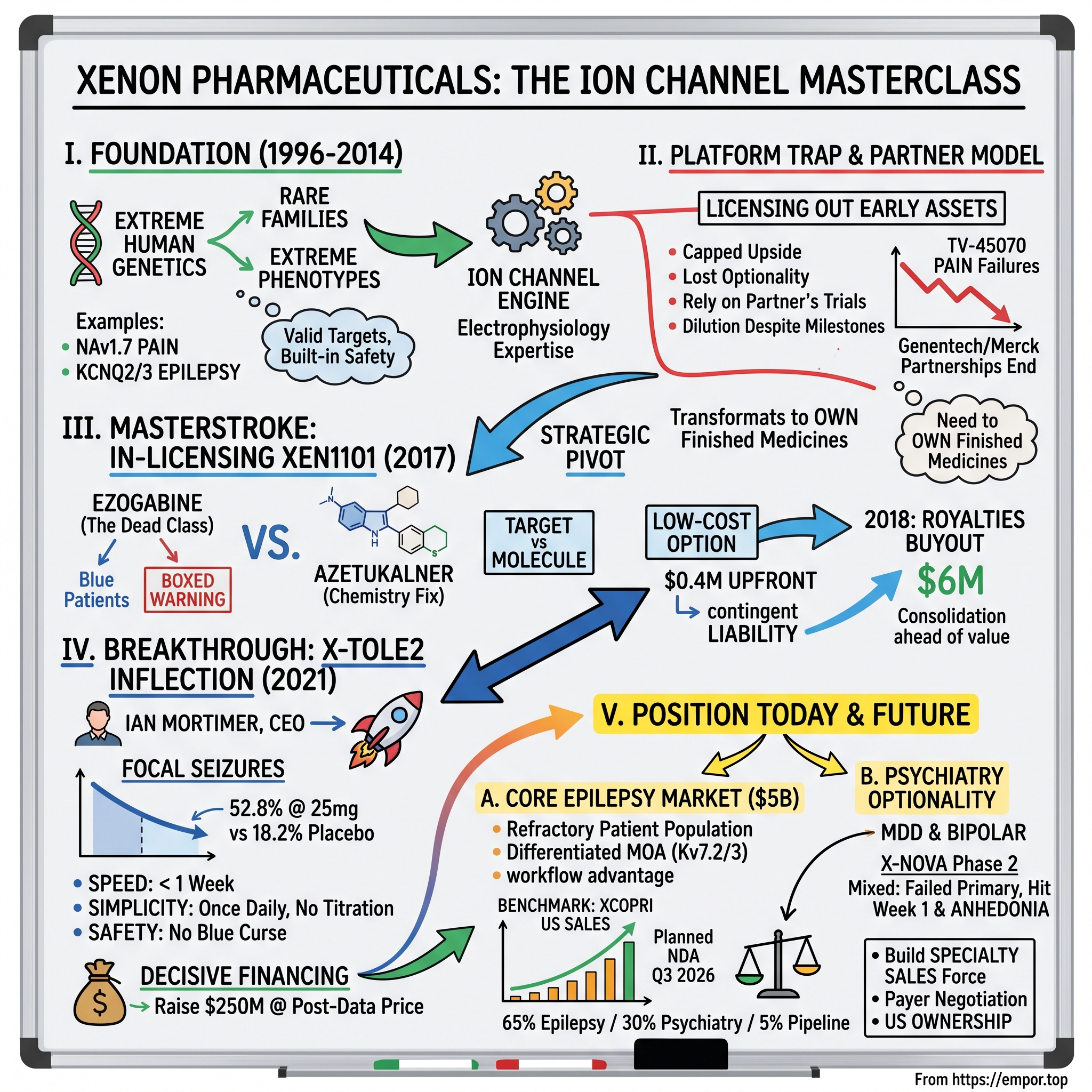
Xenon Pharmaceuticals: The Ion Channel Masterclass
I. Introduction & Episode Roadmap
In April 2017, a small Canadian biotech in the Vancouver suburb of Burnaby signed an asset purchase agreement that almost nobody in the pharmaceutical industry noticed. The upfront payment was $0.4 million, with roughly another $0.7 million in near-term milestones expected that same year — call it about a million dollars for a molecule that had been shuffled between three owners in eighteen months.1 The asset was a potassium channel opener called 1OP2198. It belonged to a drug class that had, by the standards of 2017, just been declared dead.
The reason it was dead is one of the great cautionary tales in modern neurology. A drug called ezogabine — sold as Potiga in the United States and Trobalt elsewhere — had been approved in 2011 as the first medicine of its kind for epilepsy. It worked. It also, over time, turned some patients' skin, nails, and the whites of their eyes a striking blue, and deposited pigment in their retinas. The FDA applied a boxed warning in 2013, the label was restricted, prescriptions collapsed, and by June 30, 2017 the drug was simply gone from the market.23 The industry drew the obvious conclusion: opening potassium channels in the brain was a bad idea.
Xenon Pharmaceuticals drew a different one. Its chemists argued that the blue patients were not a consequence of the mechanism — they were a consequence of the molecule. Ezogabine carried a particular chemical motif, a triaminoaryl core, that oxidised in the body and formed coloured dimers that accumulated in tissue. Change the chemistry, keep the biology.4 That distinction — target versus molecule — is the single most valuable idea in this story, and it is worth roughly everything Xenon is today.
Nine years later, on March 9, 2026, the company that made that bet reported topline results from a Phase 3 trial of the same molecule, now named azetukalner. In patients whose epilepsy had already defeated a median of five previous medicines, the high dose cut monthly seizures by 53.2% against 10.4% for placebo, with a p-value carrying eleven zeros after the decimal point.5 Xenon then raised over $800 million in the space of a few weeks and ended the first quarter of 2026 with $1.34 billion on the balance sheet.6 A New Drug Application to the FDA is planned for the third quarter of 2026.
Why ion channels are hard, and why that matters
Here is the layman's version. Every neuron in your brain is a tiny battery. It maintains an electrical charge across its membrane, and it fires by letting charged atoms — ions — rush across that membrane through protein pores called ion channels. Sodium channels are the accelerator: sodium rushing in makes a neuron fire. Potassium channels are the brake: potassium leaking out pulls the cell back toward rest, making it harder to fire again. A seizure is what happens when a population of neurons loses its brakes and fires in runaway synchrony.
So the theory of a Kv7 potassium channel opener is elegant to the point of being obvious: instead of blocking the accelerator — which is how most existing epilepsy drugs work — press the brake. The problem has never been the theory. It has been that ion channels come in dozens of closely related subtypes distributed across the heart, the gut, the muscles, and the brain, and they all look similar to a small molecule. Hit the wrong one and you cause cardiac arrhythmias, or paralysis, or worse. Ion channel drug discovery is a graveyard of compounds that worked beautifully in a dish and poisoned something important in a human.
What this story covers
The arc runs in four movements. First, two decades in which Xenon built a genuinely world-class discovery engine around rare families with extreme genetic phenotypes — and then handed most of the resulting value to partners. Second, the moment the company recognised that a business model of licensing out early assets was structurally incapable of producing the returns its shareholders needed. Third, the acquisition and re-engineering of azetukalner, followed by a leadership change and the October 2021 Phase 2b readout that doubled the stock in a single session. And fourth, the position today: a company with one asset carrying almost all of its value, a Phase 3 win in hand, a psychiatry programme that has not yet cleared its bar, and a commercial organisation that does not yet exist.
That last point deserves emphasis up front, because it defines the investment question. Everything Xenon has proven so far, it has proven in clinical trials. Nothing it has proven so far involves selling a drug. The company has never generated a dollar of product revenue. It reported a net loss of $102.3 million in the first quarter of 2026 alone.6 Between here and a self-funding franchise sit an FDA review, a DEA scheduling decision, a payer negotiation, and the construction from scratch of a specialty neurology sales force competing against companies with decades of relationships in the same accounts.
The science looks strong. The commercial thesis is, at this writing, entirely a forecast. Holding both of those thoughts at once is the whole job.
 Subscribe on LinkedIn
II. The Foundation: Extreme Genetics & The Ion Channel Frontier (1996–2014)
Picture a genetics clinic in Vancouver in the late 1990s, and a physician-scientist sitting across from a family whose members share something medically impossible. Perhaps they cannot feel pain — not "have a high tolerance," but genuinely cannot register a broken bone. Perhaps they have a form of epilepsy that runs through four generations in a pattern too clean to be coincidence. To most clinicians, these families were curiosities. To Xenon's founders, they were the most valuable data in the world.
Xenon Pharmaceuticals was incorporated on November 5, 1996, a spinout of the University of British Columbia founded by Simon Pimstone, Michael Hayden, and Johannes "JP" Kastelein.7 Hayden was the intellectual centre of gravity: a South African-born geneticist who had built one of the most respected medical genetics programmes in Canada and whose fingerprints appear on work that eventually contributed to Glybera, the first gene therapy approved in Europe.7 Pimstone, also South African-trained, would run the company for most of the next two decades. Kastelein was a Dutch lipidologist at Amsterdam's academic medical centre. What united them was a conviction that the fastest way to a valid drug target was not to screen millions of compounds against a guess, but to find humans in whom nature had already run the experiment.
The logic of extreme phenotypes
Pharmaceutical companies fail most often not because their molecule is bad but because their target is wrong — the protein they chose to block turns out not to drive the disease in humans. Human genetics offers a shortcut. If a family carries a mutation that destroys the function of a particular protein, and every member of that family is free of pain, then that protein is not a hypothesis; it is a validated pain target with a built-in safety read-out. Nature has already done the Phase 1.
This was Xenon's "Extreme Human Genetics" platform, and it pointed the company squarely at ion channels, because that is where the extreme phenotypes clustered. Loss-of-function mutations in the sodium channel Nav1.7 produce congenital insensitivity to pain. Gain-of-function mutations in the same channel produce inherited burning-pain syndromes. Mutations in the potassium channels KCNQ2 and KCNQ3 — the genes encoding Kv7.2 and Kv7.3 — produce inherited epilepsies of infancy. The genetics were unambiguous, and Xenon accumulated deep institutional expertise in the messy, slow craft of electrophysiology: patching individual cells, measuring currents in the picoampere range, screening compounds for selectivity across a family of near-identical proteins.
That expertise is real and it compounds. It is also, critically, not the same thing as a business.
Going public with a platform
Xenon priced its initial public offering of 4,000,000 common shares at $9.00 per share on November 5, 2014 — the company's eighteenth birthday — and began trading on the NASDAQ Global Market under XENE.8 The offering closed on November 10 alongside a concurrent private placement, for combined net proceeds of $38.2 million.9
Read that number again in context. Eighteen years of research, a platform with genuine scientific distinction, partnerships with several of the largest pharmaceutical companies on earth — and the public market valued the whole enterprise such that a routine IPO raised under $40 million net. That is not an insult to the science. It is the market pricing a specific structural fact: Xenon in 2014 was a company whose best assets were largely owned by somebody else.
The prospectus described a deep pipeline. What it could not describe was a single late-stage programme in which Xenon captured the majority of the economics. The discovery engine ran hot; the value flowed downstream to partners. For a scientist, that arrangement is validating — Teva, Genentech, and Merck do not sign agreements with laboratories they think are second-rate. For a shareholder, it is a slow leak.
The next decade would be spent learning exactly how slow.
III. The Platform Trap & The Big Pharma Partner Model
There is a particular kind of press release that biotech investors learn to read with suspicion. It announces a collaboration with a household-name pharmaceutical company. It cites an upfront payment, an eye-catching total in "potential milestones," and tiered royalties. The stock goes up. And then, quietly, over the following four to six years, the programme is deprioritised, or the trial is designed in a way the originator would not have chosen, or the partner reorganises its therapeutic-area strategy and the asset is orphaned inside a spreadsheet at a company with two hundred other spreadsheets.
Xenon spent roughly fifteen years living inside that press release.
Why the model is seductive
The appeal of out-licensing is real and it is not stupid. A discovery-stage company burns cash on chemistry and preclinical work. It can fund that burn in two ways: sell equity, diluting existing shareholders, or sell future economics to a partner who pays cash today. The second option looks free. No dilution, validation from a credible counterparty, someone else's balance sheet paying for Phase 2.
The hidden cost is optionality. When a small company licenses an asset, it surrenders three things simultaneously: the timing of development, the design of the trials, and the overwhelming majority of the upside if the drug works. What it retains is a mid-single-digit royalty on a product it no longer controls.
TV-45070: a case study in losing control
Xenon's most instructive partnership was with Teva Pharmaceutical Industries around TV-45070, a topical sodium channel blocker aimed at pain. The programme ran into the wall twice. In mid-2015, a Phase 2b study in osteoarthritis pain was halted after the compound failed to separate meaningfully from placebo.10 Development pivoted to postherpetic neuralgia — the persistent nerve pain that follows shingles — and in 2017 that Phase 2 study also failed to meet its endpoints, sending the stock down sharply in premarket trading.11
It is important to be fair about what this does and does not prove. Topical delivery to deep nerve tissue is genuinely hard. Pain trials are notorious for placebo responses that swamp real effects, because pain is subjective, fluctuating, and exquisitely sensitive to patient expectation. Neither failure necessarily invalidated the underlying Nav1.7 biology, which remains among the best human-genetically validated targets in medicine.
But that is precisely the analytical point. When a partner runs the trial, the originator absorbs the reputational and share-price damage of a failure while owning neither the decision that produced it nor the data that might explain it. Xenon's investors took the loss. Teva made the choices. And in the same period Xenon absorbed a second blow closer to home: XEN801, a sodium channel inhibitor for acne, missed its efficacy endpoints in a Phase 2 trial announced in March 2017, and the programme was dropped.12
Genentech, Merck, and the honourable dead end
The collaboration with Genentech on Nav1.7 pain compounds was, by any scientific standard, prestigious. It generated structural insights into how selective sodium channel blockade works and delivered milestone payments over several years.13 It did not, however, deliver a marketed product to Xenon shareholders. The therapeutic window in pain — the gap between the dose that relieves symptoms and the dose that causes numbness, cardiac effects, or motor problems — proved punishingly narrow, and the endpoints remained noisy.
The most economically significant partnership came late. In December 2019, Neurocrine Biosciences licensed XEN901, a selective Nav1.6 sodium channel inhibitor with potential in SCN8A developmental and epileptic encephalopathy, paying $50 million upfront — $30 million in cash and $20 million as an equity investment — plus milestone and royalty entitlements.14 It was a good deal. It was also, structurally, the same deal: Xenon did the hard early science, and somebody else would own the patient relationship, the pricing decision, and the compounding.
The realisation
Add it up and the arithmetic of the platform model becomes brutal. A discovery company running four partnered programmes might see one reach the market a decade later, at which point it collects perhaps a high-single-digit royalty on sales it did not generate. Meanwhile it has diluted shareholders anyway, because upfront payments never fully cover the burn. The upside is capped by contract; the downside is uncapped by biology.
Compare that to owning an asset outright. A single approved drug generating, hypothetically, $1 billion in annual sales returns roughly $70 million a year to a royalty holder and something on the order of ten times that, before commercial costs, to the owner. The distribution of outcomes is what matters: platform royalties produce respectable singles, and biotech shareholders are not compensated for singles. They are compensated for the rare asset that changes the company's category.
By the mid-2010s Xenon's leadership had internalised this. The strategic conclusion was to stop being a supplier of validated targets and become an owner of finished medicines — which meant finding an asset it could control from end to end, cheaply enough that a company with under $40 million of fresh IPO capital could afford it.
The asset it found was one nobody else wanted.
IV. The Masterstroke: In-Licensing XEN1101 & Curing Retigabine's Curse (2017)
The strangest thing about the ezogabine story is that the drug worked.
Approved in 2011, it was the first and only marketed medicine that treated epilepsy by opening Kv7 potassium channels — pressing the brake rather than blocking the accelerator. For patients whose seizures had defeated everything else, that novel mechanism mattered enormously. And then the reports started coming in: pigmentation changes in the retina, and a distinctive blue-grey discolouration of skin, nails, lips, and the sclera of the eye. In 2013 the FDA imposed a boxed warning covering retinal abnormalities, possible vision loss, and the discolouration, and restricted the indication.2 Physicians, understandably, stopped prescribing it. Usage never recovered, and GlaxoSmithKline discontinued supply after June 30, 2017.315
Imagine being a business development executive in 2017 pitching a Kv7 opener to an investment committee. The category's only precedent had a boxed warning for turning people blue and had just been pulled. There was no argument to be had; the meeting would end.
The chemistry underneath the catastrophe
Xenon's chemists asked a narrower question: what, specifically, produced the pigment?
The answer lay in ezogabine's molecular architecture. Its core was a triaminoaryl structure — a benzene ring decorated with three nitrogen-containing groups. That arrangement is chemically restless. Under oxidative conditions in the body it can lose electrons and convert into a quinone diimine, a reactive species that couples with itself to form larger, intensely coloured dimers. Those dimers are not efficiently cleared; they lodge in melanin-rich tissue — skin, and the retinal pigment epithelium at the back of the eye. Over years of continuous dosing, they accumulate. Hence the blue.4
An analogy: think of a cut apple browning on a counter. Certain molecules in the apple oxidise on exposure to air and polymerise into brown pigments. Ezogabine carried a chemical motif with an analogous vulnerability, and the pigments it formed had nowhere to go.
Crucially, none of that chemistry has anything to do with potassium channels. The oxidation happens on the scaffold, not at the site of pharmacological action. Which means the toxicity was, in principle, an engineering problem — remove the vulnerable motif, keep the channel-opening pharmacology, and the pigmentation should disappear with it. Related medicinal chemistry work has explicitly pursued modifications of that triaminoaryl "metabophore" precisely to avoid quinone diimine formation.4
That is the counter-consensus insight. Not "the market is wrong about Kv7," which is a slogan, but "the failure mode is structural and structure is fixable," which is a testable hypothesis.
The transaction
The molecule Xenon wanted had already been passed around. 1st Order Pharmaceuticals had acquired 1OP2198 from an affiliate of Valeant Pharmaceuticals under an asset purchase agreement dated October 30, 2015. On April 25, 2017, Xenon acquired it from 1st Order, assuming the financial obligations that ran back to Valeant — later Bausch Health — under the original agreement.16
The economics were startlingly small. Xenon paid $0.4 million upfront and expected to pay roughly $0.7 million in additional milestones during 2017. Layered behind that sat $1.0 million in clinical development milestones, up to $13.0 million in regulatory milestones, and up to approximately $33.6 million in sales-based and other milestones, plus a mid-to-high single-digit royalty on eventual commercial sales.1
So the honest version of the "$1.5 million molecule" story is this: the cash at risk was about a million dollars, and the fully loaded liability — royalties included — was meaningful but entirely contingent on success. Xenon was not buying certainty. It was buying a cheap option on a hypothesis that its own chemists were unusually well-equipped to evaluate. That is what asymmetric in-licensing actually looks like: not free money, but a price so low relative to the informational edge that being wrong costs almost nothing.
Clearing the encumbrance
Then came the move that separates competent dealmaking from excellent dealmaking.
Any downstream royalty is a permanent tax on a product's economics, and it compounds against the owner exactly when the product succeeds. A mid-to-high single-digit royalty on a hypothetical billion-dollar drug is $70 million or more, every year, forever. On September 10, 2018, with XEN1101 still an early clinical asset and therefore cheap to value, Xenon agreed to pay Bausch Health $6 million to extinguish all milestone payments and royalties owed under the original agreement — eliminating up to $40 million in future milestones plus the royalty stream entirely.1718
Six million dollars. The timing is the whole trick: Xenon bought out the encumbrance while the asset's probability of success was still low in the market's eyes but already higher in its own. When management later described azetukalner as wholly owned with global rights and no royalty burden, that claim traced back to a single cheque written before anyone was paying attention.
A fair sceptic will note the obvious: this looks brilliant because it worked. Had the Phase 2b failed, the $6 million would have been a small, forgettable write-off, and nobody would be telling this story. Process and outcome are not the same thing. But the process was sound on its own terms — a low-cost option on a differentiated mechanistic thesis, followed by cheap consolidation of economics ahead of the value inflection. That sequencing is repeatable in a way that luck is not.
What remained was to prove that removing the offending chemistry had not also removed the efficacy.
V. The Pivot & The Breakthrough: The X-TOLE Inflection (2021)
On the morning of October 4, 2021, Xenon shares roughly doubled, closing at $31.50.19 It was, by a wide margin, the most consequential day in the company's twenty-five-year history — and it arrived four months after the founder who had run the place for most of that time handed over the keys.
A deliberate, telegraphed succession
Biotech CEO transitions are frequently ugly: an abrupt resignation, a vague statement about pursuing other interests, an interim appointment. Xenon's was the opposite. On January 14, 2021, the company announced the transition alongside its milestone plan for the year, giving the market nearly five months of notice.20 At the annual meeting on June 3, 2021, Ian Mortimer — previously President and Chief Financial Officer — became President and Chief Executive Officer, and co-founder Simon Pimstone moved to the newly created role of Executive Chair of the board.21
Two details are analytically useful here. First, Mortimer was not an outsider brought in to fix a broken company; he had worked alongside Pimstone for seven years, most of that time as the person responsible for financing the transition away from the partnering model.21 Second, Pimstone did not leave. Retaining a scientific founder as Executive Chair while installing a finance-trained operator as CEO is a specific organisational bet: that the hard problems ahead were no longer primarily discovery problems but execution problems — running large registrational trials, managing regulatory process, financing a launch, and eventually building a sales force.
Whether that bet is correct is still being tested. What can be said is that the succession was planned, disclosed early, and produced no visible disruption to the clinical timeline, which is more than many peers manage.
The trial that changed the category
X-TOLE enrolled 325 randomised adults with focal epilepsy who were still having seizures despite ongoing treatment with one to three anti-seizure medications. This is the hardest population in the field: patients who have already demonstrated that the standard armamentarium does not control their disease.
The results, reported on October 4, 2021, showed a clean dose-response. Median monthly focal seizure frequency fell 52.8% on the 25 mg dose, 46.4% on 20 mg, and 33.2% on 10 mg, against 18.2% on placebo, with the monotonic dose-response relationship statistically significant at p<0.001.22 The findings were subsequently published in the peer-reviewed literature, which matters more than it might appear — peer review subjects a press release's claims to scrutiny by people with no economic stake in them.23
Three features drove the market's reaction as much as the headline number.
Speed. Seizure reduction appeared within the first week of dosing. Most anti-seizure medicines require weeks of gradual dose escalation before a patient knows whether the drug will help.
Simplicity. Once daily, taken with food, with no mandatory titration schedule. For a patient having several seizures a month, the difference between "you may know in a week" and "you may know in two months" is not a marketing nuance. It is the difference between one more failed attempt and a chance at control.
Absence of the curse. No skin discolouration. No retinal pigmentation. The adverse events that did appear — dizziness, somnolence — are the familiar central-nervous-system side effects that accompany essentially every effective anti-seizure medicine.
That last point is the one that re-rated the company. The chemistry hypothesis had been tested in humans and had held. A drug class that the industry had written off in 2017 was alive again, and Xenon owned it outright.
Converting a data point into a balance sheet
Good management teams do not merely celebrate positive data; they monetise it immediately, because the window between a strong readout and the next opportunity for something to go wrong is short and it never widens.
Xenon moved within weeks, pricing an underwritten public offering of 7,868,854 common shares at $30.50 apiece, together with pre-funded warrants, for gross proceeds of approximately $250 million.24 Note the price relative to the pre-data share price: the company was selling equity at roughly double where it had traded days earlier. Dilution priced after a positive catalyst is dramatically cheaper, per dollar raised, than dilution priced before one — and it is the only reliable way a clinical-stage company can fund a Phase 3 programme without surrendering rights to a partner.
The sequence — own the asset outright, generate the data, sell equity into the strength, fund the next stage yourself — is the entire strategic answer to the platform trap described earlier. It is also, in fairness, only available to companies whose data works. Xenon executed the playbook well; it also got the readout it needed.
By the end of 2021 the company had a wholly owned, de-risked, clinically differentiated asset, a fresh capital base, and a new CEO with a mandate to run it into Phase 3. What it did not yet have was any evidence about whether it could sell a drug — which is where the commercial question begins.
VI. Core Business Deep Dive: The $5B Epilepsy Market & Competitive Economics
A neurologist at a comprehensive epilepsy centre sees a version of the same patient every week. She is thirty-four. She has tried levetiracetam, then lamotrigine, then lacosamide, sometimes two at once. She still has four or five focal seizures a month, which means she cannot legally drive, has restructured her career around unpredictability, and lives with the knowledge that people with uncontrolled epilepsy face elevated mortality risk. The neurologist has, realistically, a handful of remaining options and no strong basis for choosing among them.
That patient is the market.
The shape of the opportunity
The Centers for Disease Control and Prevention estimated that 1.2% of the US population — about 3.4 million people, including roughly 3 million adults and 470,000 children — had active epilepsy in 2015, the highest figure recorded to that point.25 Roughly 30% to 40% of them are drug-resistant, meaning their seizures persist despite adequate trials of appropriate medications.26 Once a patient has failed two well-chosen drugs, the probability that a third will deliver seizure freedom drops sharply.26
That residual population — some hundreds of thousands of US patients concentrated in specialist practices — is the commercial target, and it has three characteristics that make it attractive. It is identifiable, because refractory patients funnel toward epileptologists and comprehensive epilepsy centres. It is concentrated, so a modest sales force can reach a large share of the prescribing. And it is desperate in the clinical sense: physicians treating it are actively looking for new mechanisms, which lowers the barrier to adopting an unfamiliar drug.
The widely cited multi-billion-dollar figure for the refractory epilepsy market is an analyst construct rather than a disclosed company number, and it should be treated as such. The more reliable evidence for market size is what a competitor is actually being paid.
The benchmark: Xcopri
That competitor is 에스케이바이오팜 SK Biopharmaceuticals, whose cenobamate — marketed in the US as Xcopri — is the most relevant comparison for azetukalner and the single most useful data point about what a differentiated new anti-seizure medicine can earn.
Xcopri's US sales have compounded rapidly. Quarterly US revenue rose from ₩133.3 billion in the first quarter of 2025 to ₩154.1 billion in the second and ₩172.2 billion in the third, and reached ₩197.7 billion — roughly $136 million — in the first quarter of 2026, up 48.4% year over year.272829 Annualised, that is a franchise running well above $500 million and still growing at close to 50%.
This is the most important number in the entire commercial analysis, and it cuts both ways.
The bullish reading: a single novel anti-seizure medicine, launched into the same refractory population Xenon is targeting, has demonstrated genuine and accelerating demand. The market pays for efficacy. The category is not saturated.
The bearish reading: it took years. Xcopri launched in 2020 and is only now approaching serious scale. Epilepsy is a slow, referral-driven, trust-mediated market where neurologists change one variable at a time and wait months to judge the result. Whatever azetukalner's label eventually says, the revenue curve will be a grind, not a spike — and Xenon will be funding a full commercial infrastructure from the first day of that grind.
There is a second layer to the Xcopri comparison. Cenobamate is highly effective but must be titrated over many weeks, a schedule imposed because rapid escalation was associated with serious hypersensitivity reactions, including DRESS syndrome. Every week of titration is a week in which the patient is not yet on an effective dose and may abandon the attempt.
On Xenon's Q1 2026 earnings call, analysts pressed management directly on cross-trial comparisons of seizure freedom rates against cenobamate. Management's response was to argue that X-TOLE2 enrolled a materially more treatment-resistant population than the historical cenobamate studies — a median of around thirteen seizures a month and five or more prior anti-seizure medications — and that in real-world practice Xcopri is rarely titrated to its highest approved dose.30 Both points are reasonable. Both are also, unavoidably, cross-trial comparisons, which are the weakest form of clinical evidence. No head-to-head study has been conducted, and absent one, any claim of superiority over cenobamate remains an inference rather than a finding.
The rest of the field
Above the specialist tier sits the generic layer: levetiracetam, lamotrigine, and their peers, available for a few dollars a month. These are not competitors for the refractory patient so much as the mandatory gate she passes through first — and their failure rate is precisely what generates the referral flow into specialty practice. UCB's franchise, built on lacosamide and brivaracetam, shaped a generation of prescribing habits and has been migrating toward generic exposure, which loosens incumbency but also resets payer expectations about what an epilepsy drug should cost.
The threat of substitutes is real but bounded. Neuromodulation devices — vagus nerve stimulation, responsive neurostimulation, deep brain stimulation — and resective surgery serve genuinely refractory patients. They are invasive, expensive, and require surgical candidacy. They sit downstream of pharmacotherapy rather than displacing it, and in practice most device patients remain on medication anyway.
The differentiation case, tested
Azetukalner's claimed advantages are a novel mechanism in a class of one, once-daily evening dosing, and no mandatory titration. Are these durable?
The mechanism is genuinely differentiated and, for now, uncontested — if approved, it would be the only Kv7 opener available for epilepsy.5 The dosing convenience is real but replicable; convenience is a feature, not a moat. The absence of titration is the most commercially interesting attribute, because it changes the physician's decision calculus: a drug that can be assessed in weeks rather than months lets a neurologist run more therapeutic attempts per patient-year. That is a workflow advantage, and workflow advantages tend to stick.
What would falsify the case: a labelled warning that forces titration after all; a safety signal emerging in longer-term or larger post-approval exposure; or payer step-edit requirements that force patients through cheaper alternatives before azetukalner can be prescribed, neutralising the speed advantage at the point of access.
The commercial build
Here the analysis must be careful, because the outline's premise deserves correction. On the Q1 2026 call, Chief Commercial Officer Darren Cline declined to specify sales representative headcount. Any figure in the range of 100 to 120 reps circulating in analyst models is an estimate, not company guidance — Xenon has not disclosed the size of its planned field force.30
What management did disclose is more textured. Medical science liaisons — the non-promotional field scientists who build relationships with key epileptologists ahead of a launch — had been deployed for nearly two years by that call, which is early by industry standards and suggests genuine planning rather than improvisation. The company had begun payer engagement, including at PCMA conferences. And Cline argued that recruiting would be advantaged by the long absence of new branded medicines in focal seizures, making Xenon an attractive destination for experienced launch talent.30
Management also stated it does not intend to build commercial infrastructure outside the United States, preferring to partner ex-US "when the appropriate time is right."30 That is a defensible capital allocation choice — US neurology is where the pricing is — but it means a material portion of the asset's global value currently sits in a deal that has not been negotiated, on terms that are unknown.
For investors, the honest summary is that the clinical differentiation is evidenced and the commercial capability is asserted. Those are different categories of confidence, and the gap between them is where the next two years of the story will be written.
VII. Future Optionality: Unlocking Neuropsychiatry & Anhedonia
Ask a psychiatrist what antidepressants are worst at, and a common answer is anhedonia — the flattening of pleasure. A patient on an SSRI may report that the crushing sadness has lifted while food still tastes like nothing, music no longer moves her, and time with her children registers as obligation rather than joy. Standard depression scales barely capture this. It is, for many patients, the symptom that most defines the illness and the one least addressed by six decades of pharmacology.
Xenon's psychiatry thesis begins there, and it begins with the same channel.
From seizures to reward circuitry
The bridge is anatomical. Kv7 channels are not confined to the cortical neurons that generate seizures; they are also expressed on dopaminergic neurons in the ventral tegmental area, a small midbrain structure that projects to the nucleus accumbens. That pathway is the brain's reward circuit — the system that assigns motivational value to experience.
The simplified logic runs like this: chronic stress appears to push VTA dopamine neurons into abnormal firing patterns, and this dysregulation is associated with anhedonic behaviour in animal models. A Kv7 opener stabilises those neurons' excitability — dampening the pathological firing pattern rather than flooding the system with more dopamine. It is a governor on an engine, not a bigger fuel pump.
This is mechanistically plausible and supported by preclinical and academic work. It is not the same as proven in humans, and the human data so far is genuinely mixed.
What X-NOVA actually showed
The Phase 2 proof-of-concept X-NOVA trial enrolled 168 patients with moderate-to-severe major depressive disorder, testing 10 mg and 20 mg against placebo. Reported on November 27, 2023, the results require precision.
The primary endpoint — change in the Montgomery-Åsberg Depression Rating Scale at week six — was not met. Placebo improved by 13.90 points, the 10 mg arm by 15.61, and the 20 mg arm by 16.94. The 3.04-point separation between 20 mg and placebo was clinically interesting and directionally consistent with a dose response, but it did not reach statistical significance, at p=0.135.31
Two secondary findings were more encouraging. At week one, the MADRS difference did reach significance — placebo improved 4.88 points versus 7.54 for the 20 mg arm, p=0.047 — suggesting rapid onset, which would be unusual and valuable in a field where conventional antidepressants take weeks. And on the Snaith-Hamilton Pleasure Scale, the anhedonia measure, the 20 mg arm separated from placebo at week six with p=0.046.31 Tolerability was broadly similar across arms.
The correct characterisation is therefore: a failed primary endpoint with a coherent supporting pattern. That is common in psychiatry and it is not disqualifying — but the outline's framing of X-NOVA as having "demonstrated clinically meaningful improvements" understates the miss, and any investor working from that framing is working from an incomplete picture.
The reason the miss is survivable is the placebo response itself. A 13.90-point placebo improvement is enormous. Depression trials routinely drown real drug effects in placebo response driven by regression to the mean, the therapeutic effect of frequent clinical contact, and patient expectation. Trial sponsors respond by enriching populations, tightening site selection, and enlarging sample sizes. Whether Xenon has done enough of that in Phase 3 is unknowable until the data arrive.
What is running now
Azetukalner is in Phase 3 in major depressive disorder through X-NOVA2 and X-NOVA3, with topline results from X-NOVA2 anticipated in the first half of 2027, and in bipolar depression through the X-CEED programme in Bipolar I and II patients.632 Bipolar depression deserves a note: it is arguably a harder commercial and clinical setting than MDD, since conventional antidepressants can precipitate mania and the available options are limited — meaning a mechanistically distinct agent with a clean psychiatric safety profile would face genuine unmet need, but also a demanding safety bar.
How much should psychiatry be worth today?
The outline suggests a rough split of roughly 65% of value in epilepsy, 30% in psychiatry, and 5% in early pipeline. That is a reasonable analytical convention, but it should be labelled as one — Xenon does not publish a sum-of-the-parts, and no such allocation is disclosed by the company.
What can be said with more confidence is the asymmetry. Epilepsy now rests on a completed, statistically overwhelming Phase 3. Psychiatry rests on a Phase 2 that missed its primary endpoint. Those are not comparable levels of evidence, and a valuation that assigns them similar confidence is making an aggressive assumption. If X-NOVA2 replicates the week-one and anhedonia signals at Phase 3 scale, the addressable population expands by an order of magnitude and the company's category changes. If it fails, epilepsy still supports the business — but a meaningful slice of the current market capitalisation was pricing something that did not happen.
The rest of the bench
Behind azetukalner sits a genuine, if early, pipeline: Phase 1 studies of XEN1701, a Nav1.7 candidate for pain, and XEN1120, a next-generation Kv7 compound, both expected to complete in the second half of 2026; and IND-enabling work on a Nav1.1 programme aimed at Dravet syndrome, a devastating childhood epilepsy.6
On the Q1 2026 call, analyst Paul Matteis pushed management on how the Nav1.7 safety concerns that sank earlier efforts in the field had been de-risked. Management pointed to Phase 1 receptor occupancy consistent with what human genetics would predict, and outlined planned acute pain proof-of-concept studies in post-surgical settings such as bunionectomy and abdominoplasty — while conceding the final design awaited the Phase 1 readout.30 That is an appropriately hedged answer, and the return to Nav1.7 is notable: the company is circling back to the biology that defined its first two decades, this time owning it.
None of this moves the valuation needle today. It matters for a different question — whether Xenon becomes a one-product company that eventually faces a patent cliff alone, or a neuroscience franchise with a refill mechanism.
VIII. Capital Allocation, Governance, & Management Credibility
In biotech, capital allocation is a narrower discipline than in most industries. There are no buybacks, no dividends, no acquisitions to bungle. There are exactly three decisions: which programmes to fund, when to sell stock, and whether to keep or trade away economics. Xenon's record on all three is now long enough to evaluate.
Timing the market, twice
The clearest window into management's financial instincts is the pattern of when it raises capital.
At the end of 2025, Xenon reported cash, equivalents, and marketable securities of $586.0 million, down from $754.4 million a year earlier, with full-year research and development expense of $300.9 million against $210.4 million in 2024 — the increase driven by the simultaneous Phase 3 programmes in epilepsy, MDD, and bipolar depression, plus headcount and stock-based compensation.32 Management guided at that point to a cash runway into the second half of 2027.32
Read that carefully, because it describes a company deliberately walking into a binary event with roughly eighteen months of cash. X-TOLE2's readout was imminent. Had it failed, Xenon would have faced a brutal financing environment with a shrinking runway. That is not conservatism; it is a calculated refusal to dilute shareholders at pre-data prices.
Then the data landed, and the company moved fast: $130 million raised under its at-the-market facility, followed by $707.6 million from a public offering, lifting the balance to $1.34 billion by March 31, 2026 and extending the runway from mid-2027 to 2029.632 Roughly $838 million of new capital, priced after the single most valuable de-risking event in the company's history.
This is the same manoeuvre executed after the 2021 Phase 2b readout, now at four times the scale. Two data points is a pattern: this management team does not raise into weakness if it can avoid it, and it raises decisively into strength. For shareholders, the mechanism is simple — every dollar raised at a post-catalyst price buys the same runway for materially fewer shares.
The counter-argument an activist would make is that the 2026 raise was larger than strictly necessary and pushes the runway well beyond the next major catalyst, which is a form of empire-building disguised as prudence. The rebuttal is that a company about to fund an FDA submission, a from-scratch commercial launch, and two Phase 3 psychiatry programmes needs to be able to say to every hire and every partner that funding is not a question. On balance the raise looks defensible, but the size does mean shareholders have pre-paid for a launch that has not yet been demonstrated.
The people
Ian Mortimer is a finance executive by training who spent seven years as Xenon's CFO before taking the top job. His tenure has been defined less by bold strategic pivots than by sequencing: the royalty buyout, the post-data financings, the decision to run three Phase 3 indications concurrently rather than sequentially, and the refusal to license US rights away. That last choice is the most revealing — it is precisely the temptation the old Xenon would have taken, and declining it commits the company to the hardest and most expensive path available. His narrative has been notably consistent across calls: own the asset, fund it internally, commercialise in the US, partner elsewhere later.
Dr. Christopher Kenney, Chief Medical Officer, has overseen the clinical programme through both X-TOLE readouts and X-NOVA. His most instructive public moment came on the Q1 2026 call, when analyst David Hong asked whether Xenon would pursue monotherapy trials to reach earlier treatment lines. Kenney's answer was blunt: "I don't see the upside of doing it, frankly," explaining that a monotherapy label expansion would require patient-versus-placebo designs from treatment initiation.30 Whether one agrees or not, it is a specific, reasoned, unhedged answer to a strategic question — the opposite of the evasive non-response that usually greets such queries. It also carries a real cost: declining monotherapy work means accepting a ceiling on the addressable population, at least initially.
Tucker Kelly became Chief Financial Officer effective October 15, 2025, arriving with more than twenty-five years in life sciences finance and, most recently, the CFO and treasurer role at Deciphera Pharmaceuticals.33 The hire's logic is legible in his background: Deciphera launched a commercial product, and Kelly's arrival preceded both the NDA submission and the largest financing in Xenon's history. Bringing in launch-experienced financial leadership roughly a year before commercialisation is what a company does when it intends to sell the drug itself.
Credibility, measured against prior statements
The most useful test of a management team is not what it says now but whether what it said three years ago came true.
Xenon said it would advance azetukalner into a broad Phase 3 programme across focal seizures, generalised seizures, and psychiatry — and it did, running X-TOLE2, X-TOLE3, X-ACKT, X-NOVA2, X-NOVA3, and X-CEED concurrently.6 It said the epilepsy readout would come in 2026, and it pre-announced the exact date, holding the topline call on March 9, 2026 as scheduled.5 It said it would fund development without licensing away the asset, and it has. Guidance on NDA timing has held at the third quarter of 2026 across multiple quarterly updates.632
Against that, the credibility ledger has debits. The X-NOVA primary endpoint miss was disclosed with the numbers intact — no burying — but the company's subsequent framing has emphasised the week-one and anhedonia signals over the failed primary, which is legitimate advocacy but not neutral description. And the company has repeatedly declined to quantify the commercial build, the expected sales force, or launch spending, leaving investors to model the largest upcoming cost line without guidance.30
On incentive alignment, Xenon uses equity grants extensively, including inducement awards to new hires under Nasdaq Listing Rule 5635(c)(4) — a July 2, 2026 grant to four new non-officer employees carried an exercise price of $60.30, the closing price on the grant date.34 Granting at-the-money options ties new employees' outcomes to share price appreciation from the date they arrive. The offsetting concern, common across clinical-stage biotech and worth watching in the proxy, is that heavy equity issuance to fund a commercial build creates persistent dilution that shareholders bear regardless of launch success.
With the balance sheet settled and the team in place, the question shifts from whether Xenon can fund the fight to whether it can win it.
IX. Strategic Position, Hamilton Helmer's 7 Powers, & Porter's 5 Forces
Strategy frameworks are most useful when they discipline enthusiasm rather than decorate it. Applied honestly to Xenon, they reveal a company with one strong power, one borrowed power, and several that do not yet exist.
Helmer's 7 Powers, applied
Cornered Resource — the real one. Helmer defines a cornered resource as preferential access to a coveted asset that independently enhances value. Azetukalner qualifies about as cleanly as anything in biotech. Xenon owns global rights outright, with the downstream royalty obligations extinguished. The patent estate around it is substantial: as of December 31, 2023 the company owned, co-owned, or licensed 16 issued US patents and 56 foreign patents, with over 370 pending applications.35 Critically, the composition-of-matter patents originally acquired were expected to expire between 2028 and 2029, but two US patents granted in 2021 cover four distinct crystalline forms of the drug substance — including the forms used in clinical development — and a method of enhancing bioavailability by dosing with or near food, expiring in 2040 and 2039 respectively.35
That structure deserves scrutiny rather than applause. Crystalline-form and food-effect patents are meaningfully weaker than a core composition-of-matter claim; generic challengers routinely attack them by developing alternative polymorphs or arguing obviousness. The practical exclusivity picture will depend on which patents ultimately anchor the Orange Book listing, what patent term extension is granted post-approval, and how the inevitable Paragraph IV litigation resolves in the 2030s. It is a real asset with real vulnerabilities, and describing it as a two-decade moat would be overstating the filing record.
Switching Costs — powerful, but not yet Xenon's. In epilepsy, switching costs are extraordinary. A patient who achieves seizure freedom on a regimen has enormous disincentive to change anything — the downside of a breakthrough seizure is loss of driving privileges, potential injury, and mortality risk. Neurologists know this and are correspondingly conservative.
Here is the uncomfortable symmetry: that same stickiness protects the incumbents Xenon must displace. High switching costs are a formidable moat after you have the patient and a formidable barrier before. Today, Xenon has no patients. The power is available to it, not possessed by it, and the conversion will be slow — which is exactly what the Xcopri revenue trajectory demonstrates.
Process Power — plausible, unproven externally. Xenon's electrophysiology and selectivity-profiling capability, built across three decades, is the kind of accumulated organisational know-how Helmer means. Screening compounds for selectivity across ion channel subtypes while avoiding hERG-mediated cardiac liability is genuinely difficult and not readily hired. The evidence for it is indirect: the Kv7 chemistry hypothesis was correct, and a follow-on Kv7 compound has reached Phase 1.6 Whether that capability produces a second commercial drug is the open question, and it is the difference between a process power and a fortunate one-off.
Absent powers. Scale economies do not apply — small-molecule manufacturing costs are trivial relative to revenue. Network economies do not apply. Branding power does not meaningfully apply in specialty prescribing, where data drives decisions. Counter-positioning is arguable at best; incumbents face no structural barrier to developing their own Kv7 compounds, only a time lag.
Porter's Five Forces, applied
Threat of new entrants: low near-term, moderate long-term. Running a registrational epilepsy programme requires several hundred million dollars, years of enrolment, and specialised regulatory expertise. But azetukalner's own success is an advertisement. Xenon's demonstration that Kv7 is druggable will attract capital to the mechanism, and a well-funded competitor starting today could plausibly reach the market in the 2030s.
Bargaining power of buyers: moderate to high, and rising. The buyer is not the neurologist; it is the pharmacy benefit manager. PBMs control formulary access and will demand rebates and step-therapy protocols requiring cheap generics first. High unmet need in refractory patients is genuine leverage — denying access to a patient having seizures is a poor look — but it does not exempt Xenon from the rebate economics that determine the gap between list and net price. And pricing has not been disclosed, so the single most important commercial variable is currently a blank.
Rivalry: moderate and intensifying. Direct rivalry with cenobamate will be fought on efficacy claims and dosing convenience rather than price, since both are branded agents in a market anchored by cheap generics. The genuine constraint is share of a neurologist's finite attention: a physician will try a limited number of new agents per year, and Xcopri already occupies one of those slots with several years of accumulated real-world experience behind it.
Bargaining power of suppliers: low. Azetukalner is a small molecule producible by contract development and manufacturing organisations in a competitive market. Supply chain concentration is a modest, monitorable risk — worth watching in the 10-K's disclosure of single-source dependencies — but not a strategic constraint.
Threat of substitutes: moderate. Neuromodulation devices, surgery, and dietary interventions serve overlapping populations but sit downstream. The more relevant substitution risk is not from a device but from the next mechanism: gene therapies and antisense oligonucleotides targeting specific monogenic epilepsies are advancing, and while they address narrow populations today, they represent a different category of durability.
The synthesis
Xenon's strategic position is strong in exactly one dimension — it owns, outright and for a period measurable in years rather than decades, the only asset in a validated new class. That is a real edge and it is not rhetorical. What it is not is a self-reinforcing business system. There is no flywheel here, no compounding data advantage, no distribution lock-in. The value must be extracted through conventional pharmaceutical commercialisation against entrenched competitors, within a patent window, by an organisation that has never done it.
Which brings the analysis to the things that could break.
X. Risk Radar & The Bear vs. Bull Stress Test
Every biotech story eventually arrives at the same question: what has actually been de-risked, and what merely feels de-risked because the last piece of news was good?
What is genuinely settled
The mechanism works in humans. The chemistry fix worked. The Phase 3 focal seizure trial succeeded, and it succeeded convincingly: 380 participants randomised, 374 in the safety and modified intent-to-treat populations, a 53.2% median seizure reduction at 25 mg versus 10.4% on placebo, and a 34.5% reduction at 15 mg — meaning both doses cleared the primary endpoint.36 Seizure freedom over the final four weeks reached 13.7% at the high dose against 4.0% on placebo; across the full twelve-week period it was 6.5% versus 0.8%.36 The open-label extension, presented at the American Academy of Neurology meeting in Chicago in April 2026, showed that among 131 participants treated for at least forty-eight months, 38.2% had achieved a stretch of twelve or more consecutive seizure-free months and 10.7% had gone four years or more.3637
Those long-term numbers matter more than the headline. They speak to durability and to real-world persistence — patients who stay on a drug for four years are patients who tolerate it. Note also the survivorship inherent in an open-label extension: the 131 long-term participants are self-selected responders, so these figures describe how well the drug works for those it works for, not the population average.
The safety profile in Phase 3 was consistent with the earlier study: dizziness in 20.5% of azetukalner patients versus 3.2% on placebo, headache 8.8% versus 6.4%, somnolence 8.8% versus 7.2%, and fatigue 7.6% versus 6.4%, with serious adverse events at 5.6% in the 25 mg arm against 2.4% on placebo.36 Dizziness at six times the placebo rate is not trivial and will appear prominently in any label, but it is within the range physicians accept for effective anti-seizure medicines.
What is not settled
Regulatory and scheduling. The NDA has not been submitted. Management's own timeline, articulated on the Q1 2026 call, anticipates approval around the end of 2027 or early 2028, reflecting a standard twelve-month review plus roughly three months for DEA controlled-substance scheduling.30 Scheduling is a real and underappreciated variable: many central nervous system drugs are scheduled, and the tier assigned affects prescribing friction, refill rules, and state-level requirements. Xenon has not disclosed an expected schedule, and the outcome will not be known until the DEA acts after approval. Label language is likewise unknowable — a warning that mandates titration or monitoring would erode the primary differentiator.
Commercial execution. This is the largest unhedged risk. Xenon must hire, train, and deploy a specialty field force; negotiate formulary access; build patient support and reimbursement infrastructure; and do it against competitors with established relationships in the same limited set of comprehensive epilepsy centres. The company has not disclosed the size, cost, or ramp of that build.30 Investors are being asked to underwrite an execution capability with no track record and limited disclosure.
Psychiatry. X-NOVA2 and X-NOVA3 carry meaningful risk given the Phase 2 primary endpoint miss and the punishing placebo dynamics of depression trials. A negative readout in the first half of 2027 would not endanger the company, but it would remove a large component of the current equity story.
Concentration. Essentially all of Xenon's value rests on one molecule. A safety signal emerging in broader exposure — the kind that only appears when tens of thousands of patients take a drug for years — would be existential rather than merely damaging. The ezogabine precedent is a reminder that ion channel drugs can develop long-latency problems invisible in twelve-week trials.
Financial trajectory. The cost base is expanding rapidly. Quarterly R&D reached $88.5 million and G&A $23.8 million in the first quarter of 2026, against $61.2 million and $19.0 million a year earlier.6 G&A is growing at roughly a quarter year over year before the sales force is even hired, which is the signature of a commercial build beginning to land in the income statement. The runway to 2029 is adequate but not indefinite, and it assumes the launch consumes capital roughly as planned.
The bear case, stated properly
A short-seller's argument would not attack the science. It would attack the price and the sequencing.
It would start with valuation: a company with no revenue, an accelerating loss, and an approval still eighteen months away trades on a discounted forecast of peak sales that assumes both a clean label and a successful launch. Any slippage — an FDA information request extending review, an unfavourable scheduling outcome, a payer requiring two step edits — pushes cash flows right and compresses the multiple immediately.
It would then argue that the Xcopri comparison cuts against Xenon. A differentiated agent with strong data took roughly five years to approach $500 million in annualised US sales.28 Applying that ramp to azetukalner implies meaningful losses through the end of the decade and probably at least one further equity raise — after which the 2026 raise looks less like fortress-building and more like the first instalment.
It would note that management has declined to quantify launch costs or sales force size, which limits the ability to model the company's largest future expense.30
It would press on the psychiatry premium: a Phase 2 that missed its primary endpoint is being valued alongside a Phase 3 that overwhelmingly hit, and depression is where confident biotechs go to be humbled.
And it would flag the patent structure — that the durable claims are polymorph and food-effect patents rather than a core composition-of-matter claim running to 2040, making the exclusivity tail more contestable than a headline expiry date suggests.35
The bull case, stated properly
The bull case does not require heroic assumptions, and that is its strength.
The efficacy is not incrementally better; on the placebo-adjusted measure it is the strongest reported in a pivotal focal seizure study to the company's knowledge.36 In a market where physicians switch patients precisely because the last drug did not work well enough, effect size is the product.
The dosing profile addresses a specific, articulated clinical frustration. A neurologist who can determine within a week or two whether a drug is helping runs a fundamentally different practice from one who must wait two months per attempt.
The economics are undiluted. Because of the 2018 buyout, every dollar of US revenue accrues to Xenon before commercial costs — no royalty, no profit share, no partner. Meanwhile the ex-US rights remain entirely unmonetised, representing genuine option value that a partnership could crystallise on Xenon's timetable rather than under duress.
And the mechanism is a platform rather than a product. The same channel biology extends to generalised tonic-clonic seizures through X-ACKT, to depression, to bipolar depression, and to a next-generation Kv7 compound already in Phase 1.6 Even partial success across those indications changes the company's category from single-product biotech to neuroscience franchise.
Weighing it
The disagreement between bull and bear is narrower than it appears. Both accept the drug works. Both accept the market exists. They differ on two variables: how fast a specialist neurology launch can ramp under real payer conditions, and how much credit psychiatry deserves before 2027 data.
Neither variable will be resolved by argument. Both will be resolved by observable events over the next twenty-four months — which is precisely why the KPI discipline that closes this story matters more than any narrative in it.
XI. Playbook: Business & Investing Lessons
Strip away the specifics of potassium channels and four transferable lessons remain — the kind that recur across industries whenever an asset's market price and its intrinsic value diverge because everyone is reading the same failure the same way.
Lesson 1: Separate the target from the molecule. When a first-in-class drug fails, the market efficiently prices in the failure and inefficiently prices in the generalisation. Ezogabine's pigmentation problem was attributable to a specific, identifiable chemical motif that oxidised and accumulated — not to the act of opening a potassium channel. Everyone could see the failure; almost nobody separated its cause from its category.4
The generalisable principle: when consensus condemns an entire category on the basis of one instance, ask precisely what failed. Was it the strategy or the execution? The technology or the business model built around it? The market or the entrant? A domain expert who can decompose a failure into its components frequently finds the discarded parts are fine — and this shows up far beyond drug development, in every industry where a high-profile flameout makes an entire approach unfundable for a decade.
Lesson 2: Buy the option when the option is cheap. Xenon's edge was not capital; it had almost none. It was informational — chemists who could evaluate the pigmentation mechanism better than anyone bidding against them, which is to say, better than nobody, because nobody was bidding. A roughly $1 million upfront commitment was small enough that being wrong would have cost the company nothing material.1
The structural lesson is about asymmetry, not conviction. A cheap option on a hypothesis you are unusually qualified to assess is a fundamentally different instrument from a large bet on a hypothesis you merely believe. The first can be repeated many times; the second cannot.
Lesson 3: Clean up the capital structure before the market notices. The $6 million paid to Bausch Health in 2018 to eliminate up to $40 million in milestones and the entire royalty stream was the highest-return capital allocation decision in Xenon's history — not because the sum was large but because the timing was.17 Royalty obligations are priced off perceived probability of success. Buying them out when that probability is low is cheap; buying them out afterwards is impossible.
The generalisable version: encumbrances on an asset — earn-outs, revenue shares, minority stakes, restrictive licences — are cheapest to clear when the asset looks least promising. Most managers wait until the value is proven, at which point the counterparty prices it accordingly.
Lesson 4: Raise into the news, not into the need. Xenon has now twice sold equity immediately after a positive catalyst rather than before one — roughly $250 million after the 2021 Phase 2b readout and roughly $838 million after the 2026 Phase 3.246 Both times it accepted the risk of entering a binary readout with a finite runway in exchange for a dramatically better price afterward.
This requires a specific kind of nerve, and it is not costless: had either trial failed, the company would have been financing into a collapsed share price. The discipline is not "always wait." It is understanding that the cost of capital for a clinical-stage company is set almost entirely by the last data point, and managing the calendar accordingly.
A fifth lesson lurks beneath the other four, and it is the one this story has not yet tested. Every advantage catalogued here — the mechanistic insight, the cheap option, the clean economics, the opportunistic financing — belongs to the domain of research and capital markets. None of it is commercial capability. Xenon has proven it can find, fix, fund, and validate a drug. Whether it can sell one is a different competence entirely, and the evidence for it does not yet exist.
XII. Epilogue & What to Watch
On July 1, 2026, Xenon's shares closed at $60.30 — the reference price for a routine grant of options and restricted share units to four new non-officer employees, disclosed under Nasdaq's inducement rules.34 It is the most mundane possible filing. It is also, quietly, the story in miniature: a company hiring people it did not need a year ago, at a share price that reflects a Phase 3 win, ahead of a launch that has not happened.
The next twenty-four months will convert a scientific achievement into either a commercial franchise or a cautionary tale about the distance between the two.
The catalysts
The NDA submission to the FDA for azetukalner in focal onset seizures is planned for the third quarter of 2026 — a matter of weeks from now — and management's guidance on that timing has been consistent across multiple quarterly updates.632 Acceptance of the filing, and the PDUFA date the agency assigns, will be the first hard external validation of the regulatory timeline.
Enrolment completion in X-TOLE3 outside Japan was expected during 2026, and the X-ACKT study in primary generalised tonic-clonic seizures continues enrolling roughly 160 patients.632 X-ACKT matters commercially out of proportion to its size: generalised seizures would broaden the eventual label into a second, distinct patient population.
The Phase 1 readouts for XEN1701 in pain and XEN1120, the next-generation Kv7 compound, are expected in the second half of 2026 — the first real evidence about whether the discovery engine can produce a follow-on.6
Topline data from X-NOVA2 in major depressive disorder is anticipated in the first half of 2027.6 Given the Phase 2 primary endpoint miss, this is the single highest-variance event on the calendar.
And running underneath all of it: the commercial build. Watch the senior hires, the field force disclosures if they come, and the trajectory of general and administrative expense, which will reveal the scale of the launch investment well before management describes it.
The three metrics that matter
Everything else is noise. Three things determine how this resolves.
First, the efficacy and responder profile that ultimately reaches the label. The median monthly seizure reduction and the proportion of patients achieving at least a 50% reduction, relative to placebo, are what a neurologist reads and what a payer negotiates against. The Phase 3 numbers are known; what matters now is how much of that separation survives into approved labelling, and whether X-TOLE3 and X-ACKT reproduce it in different populations. Consistency across studies is the signal; a single strong trial is a data point.
Second, the regulatory clock and the controlled-substance schedule. NDA acceptance, the assigned PDUFA date, any advisory committee, and the DEA's scheduling decision collectively determine when revenue begins and how much friction sits between a prescription and a filled bottle. A drug that reaches pharmacies three months later than modelled, in a more restrictive schedule than assumed, is a materially different asset — and this is the variable most likely to move first.
Third, the depression signal — specifically MADRS and SHAPS. In X-NOVA2 and X-NOVA3, the question is whether the drug can beat placebo on the primary depression scale at the standard timepoint, which it did not do in Phase 2, and whether the anhedonia separation replicates at scale. A clean win here reframes Xenon entirely. Another near-miss reduces it to an epilepsy company with a very good epilepsy drug — which, it is worth remembering, would still be a great deal more than what a million-dollar asset purchase in April 2017 had any right to produce.
References
-
Xenon Pharmaceuticals Inc. — Form 10-K FY2017 (XEN1101 acquisition terms), SEC, 2018 ↩↩↩
-
Seizure Medication Update: Ezogabine/Retigabine — Epilepsy Foundation ↩↩
-
Anticonvulsant Potiga Discontinued in June 2017 — NeurologyLive ↩↩
-
Modifications of the Triaminoaryl Metabophore of Flupirtine and Retigabine Aimed at Avoiding Quinone Diimine Formation — NCBI PMC ↩↩↩↩
-
Xenon Announces Positive Topline Data from Phase 3 X-TOLE2 Study of Azetukalner in Focal Onset Seizures (FOS) — GlobeNewswire, 2026-03-09 ↩↩↩
-
Xenon Reports Q1 2026 Financial Results and Provides Business Update — Xenon Pharmaceuticals / GlobeNewswire, 2026-05-07 ↩↩↩↩↩↩↩↩↩↩↩↩↩↩↩
-
From the incubator to the big leagues: Xenon Pharmaceuticals — National Research Council Canada ↩↩
-
Xenon Pharmaceuticals Announces Pricing of Initial Public Offering — GlobeNewswire, 2014-11-05 ↩
-
Xenon Pharmaceuticals Announces Closing of Initial Public Offering and Full Exercise of the Underwriters' Option to Purchase Additional Shares — Xenon Pharmaceuticals, 2014-11-10 ↩
-
Teva and Xenon Provide Update on TV-45070 Phase 2b Study in Osteoarthritis Pain — SEC / Xenon Pharmaceuticals, 2015 ↩
-
Teva and Xenon's Phase II trial of TV-45070 for PHN fails to meet endpoints — Clinical Trials Arena ↩
-
Xenon Pharmaceuticals Announces XEN801 Did Not Meet Efficacy Endpoints in Phase 2 Clinical Trial in Patients with Moderate to Severe Acne — GlobeNewswire, 2017-03-24 ↩
-
Xenon Pharmaceuticals Achieves Milestone in Genentech Collaboration to Discover Novel Pain Targets — Xenon Pharmaceuticals ↩
-
Neurocrine Biosciences and Xenon Pharmaceuticals Announce Agreement to Develop First-in-Class Treatments for Epilepsy — Neurocrine Biosciences, 2019-12-02 ↩
-
GlaxoSmithKline: Trobalt/Potiga Discontinuation — Important Reminder — ILAE ↩
-
Xenon Acquires Next-Generation Epilepsy Drug from 1st Order Pharmaceuticals — Genetic Engineering & Biotechnology News, 2017 ↩
-
Xenon Enters into Agreement to Buy Out Milestones and Royalties Related to its XEN1101 Program for $6 Million — T-Net News, 2018-09-17 ↩↩
-
Xenon frees itself of some XEN1101 milestone obligations — Fierce Biotech, 2018 ↩
-
XENE Stock: The Huge News Sending Xenon Pharmaceuticals Higher — InvestorPlace, 2021-10 ↩
-
Xenon Pharmaceuticals Outlines Key Milestone Opportunities and Planned Leadership Transition in 2021 — GlobeNewswire, 2021-01-14 ↩
-
Xenon Pharmaceuticals Provides Corporate Update Following its Annual Meeting of Shareholders — GlobeNewswire, 2021-06-03 ↩↩
-
Xenon Pharmaceuticals Announces Positive Topline Results from Phase 2b 'X-TOLE' Clinical Trial of XEN1101 for the Treatment of Focal Epilepsy — GlobeNewswire, 2021-10-04 ↩
-
Efficacy and Safety of XEN1101, a Novel Potassium Channel Opener, in Adults With Focal Epilepsy: A Phase 2b Randomized Clinical Trial — PubMed, 2023 ↩
-
Xenon Pharmaceuticals Announces Pricing of $250.0 Million Public Offering — Stock Titan, 2021 ↩↩
-
National and State Estimates of the Numbers of Adults and Children with Active Epilepsy — United States, 2015 — CDC MMWR / NCBI PMC ↩
-
New treatment options for people with drug-resistant epilepsy — UChicago Medicine ↩↩
-
SK biopharmaceuticals' Q1 earnings solid on strong US cenobamate sales — Korea Biomedical Review, 2025 ↩
-
SK biopharmaceuticals posts record Q3 earnings on surging Xcopri sales in US — Korea Biomedical Review, 2025 ↩↩
-
SK Biopharmaceuticals Q1 Operating Profit Jumps 250% on Cenobamate Growth — Seoul Economic Daily, 2026-05-07 ↩
-
Earnings call transcript: Xenon Pharmaceuticals Q1 2026 results — Investing.com, 2026-05 ↩↩↩↩↩↩↩↩↩↩
-
Xenon Pharmaceuticals Announces Topline Results from Phase 2 Proof-of-Concept X-NOVA Clinical Trial of XEN1101 in Major Depressive Disorder (MDD) — GlobeNewswire, 2023-11-27 ↩↩
-
Xenon Reports Q4 and Full Year 2025 Financial Results and Provides Business Update — GlobeNewswire, 2026-02-26 ↩↩↩↩↩↩↩
-
Xenon Announces Appointment of Tucker Kelly as Chief Financial Officer — GlobeNewswire, 2025-10-16 ↩
-
Xenon Pharmaceuticals Reports Inducement Grants Under Nasdaq Listing Rule 5635(c)(4) — GlobeNewswire, 2026-07-02 ↩↩
-
Xenon Pharmaceuticals Inc. — Annual Report on Form 10-K (intellectual property disclosures), SEC ↩↩↩
-
Xenon Presents Azetukalner Phase 3 X-TOLE2 Study Results and 48-Month Long-term Data in Focal Onset Seizures at 2026 AAN Annual Meeting — Stock Titan, 2026-04-19 ↩↩↩↩↩
-
Xenon Presents Azetukalner Phase 3 X-TOLE2 Study Results and 48-Month Long-term Data in Focal Onset Seizures at 2026 AAN Annual Meeting — GlobeNewswire, 2026-04-19 ↩
 LinkedIn
 WhatsApp
 Reddit
 Hacker News
 Email
Email Kindle
 RSS Feed
 Spotify
 Apple Podcasts
 Amazon Music
 Audible
 YouTube