Select Water Solutions: The Pipeline Bet
The water that follows every well
Somewhere in Lea County, New Mexico, a pump jack nods over a well that was drilled to find oil. What comes up the pipe is mostly something else. Ancient seawater, salty and laced with hydrocarbons and minerals, rises with every barrel of crude, and in the Permian Basin it rises in quantities that dwarf the oil itself.
Nobody wants it. Every barrel still has to go somewhere: into a truck, into a pipe, into a recycling pond, or back down a disposal well thousands of feet beneath the desert.
In the spring and summer of 2026, one of the largest public oil producers in that part of New Mexico made a decision about where its water would go for the next seven years. It signed an agreement committing to send at least 128 million barrels of produced water through a network owned by Select Water Solutions, a Houston-area company that most investors still file under "oilfield services."1 The operator went further.
It handed Select 14 of its own saltwater disposal wells across Eddy and Lea counties, wells it had come to see as more useful inside Select's system than inside its own.2 Select, for its part, agreed to build 19 miles of large-diameter pipeline to tie the new pieces together, at a project cost of roughly $25 million to $30 million, with service expected to begin within twelve months.1
That is the business in miniature. Producing oil and gas also produces water that must be moved, treated, recycled or disposed of, and the company that owns the pipes between the wellhead and the disposal well can, in principle, collect a toll on every barrel for years.
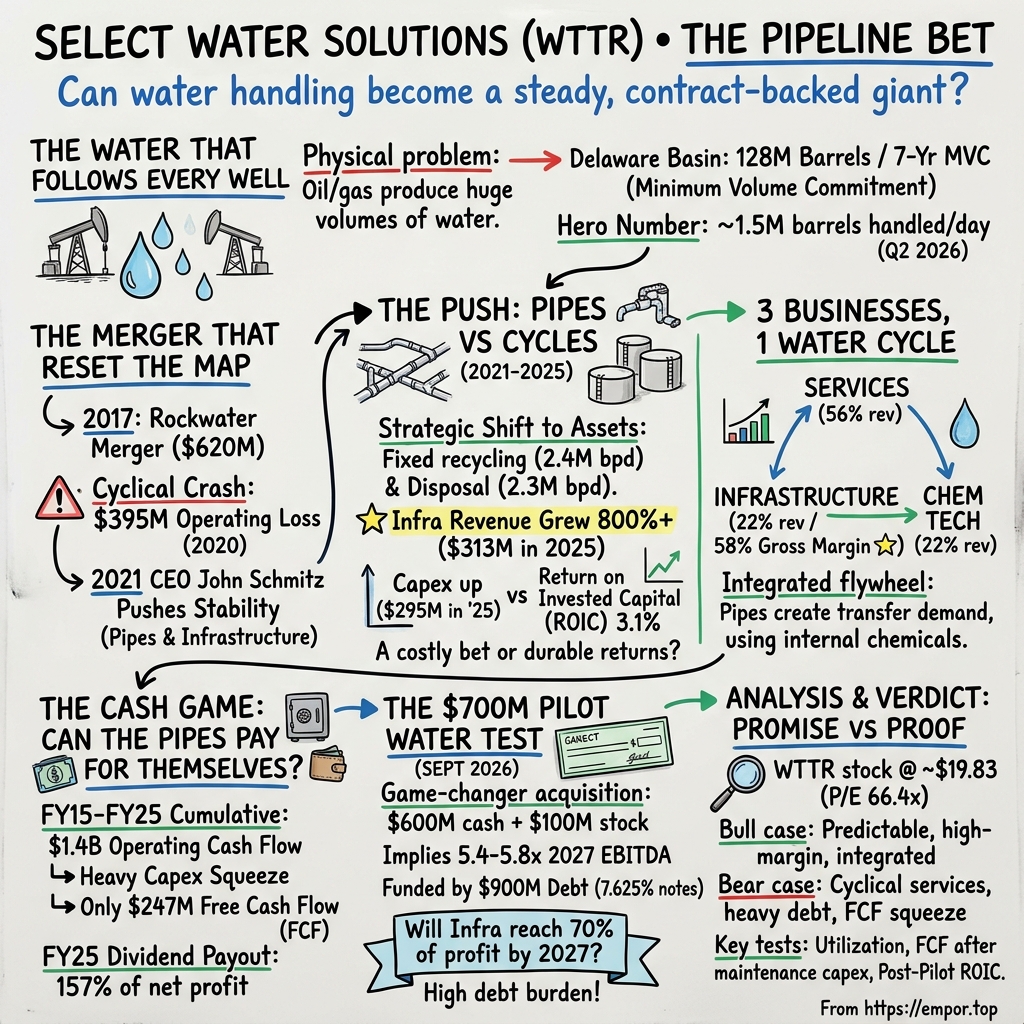
Select's Water Infrastructure segment handled about 1.5 million barrels of produced water a day in the June 2026 quarter, recycled or disposed.1 Spread evenly over seven years, the new commitment works out to roughly 50,000 barrels a day. It is meaningful, but it is a brick in a wall, not the wall.
Select has never been only a pipeline company. It sells water services at the wellsite: sourcing fresh water, laying temporary hose, hauling, monitoring and handling flowback. It makes and sells oilfield chemicals.
And it owns fixed infrastructure: pipelines, recycling facilities, storage and disposal wells. For most of its public life the first business paid the bills. The strategic push of the last five years, and the one management now describes as the company's future, is to make the third business the anchor.
The June 2026 quarter shows how far that push has come and how far it has to go. Water Infrastructure and Chemical Technologies both posted record revenue, $102 million and $96 million respectively.1 Yet the largest segment by sales was still Water Services, at about $198 million, the business most exposed to the rhythm of drilling and completion crews.1
The infrastructure segment earned a gross margin before depreciation and amortization of about 58%, more than twice the margin in the other two segments.1 In other words, the smallest of the three businesses by revenue was already the most important to profit, and management's plan is to make it more important still.
That plan raises three questions, and they will follow this story to the end. First, will the network earn durable returns, meaning returns above what the capital costs, after depreciation, after interest and after the next round of construction?
Second, can Select deepen the network through its pending $700 million acquisition of Pilot Water Solutions without making its balance sheet fragile? Third, can the company fund both the build and its dividend from the cash its assets generate, rather than from borrowing?
The case for optimism is visible in that New Mexico contract. An operator that owned its own disposal wells decided it was better off paying Select to handle its water and giving Select the wells. That is a customer voting with its assets. The case for caution is visible in the company-wide numbers.
In 2025 Select earned a return on invested capital of about 3%, and its free cash flow after capital spending was negative.3 A seven-year minimum-volume commitment is valuable only if the pipes and wells behind it earn an adequate return on what they cost to build.
That gap, between the promise of contracted water and the proof of contracted cash, is the story. To see why Select is betting the company on closing it, it helps to go back to the moment the company was assembled, and to the downturn that nearly took it apart.
 Subscribe on LinkedIn
The merger that reset the map
John Schmitz has spent his career building companies that sell things oil producers cannot do without. In 1983 he founded Brammer Supply, which he grew over roughly two decades into a wellsite services provider with more than 16 locations across Texas, Oklahoma and Louisiana.4
He co-founded Allied Production Solutions, which merged into Forum Energy Technologies in 2010, and ran the North Texas division of Complete Production Services until its sale to Superior Energy Services in 2012.4 He is the kind of operator who knows the yard, the truck and the supply house better than the trading floor, and the company he built next would carry that imprint.
That company began operations in 2007 as Peak Oilfield Services and became SES Holdings in July 2008, the operating entity at the center of Select to this day.45 Its specialty was water before the frack. Hydraulic fracturing pumps enormous volumes of water and sand into rock at high pressure, and by the time Select prepared for its public listing the volumes had exploded.
A horizontal well completed in 2009 needed about 75,000 barrels of water, roughly 575 truckloads; a modern well could need more than 500,000 barrels, and a multi-well pad more than 5 million.5 Somebody had to find that water, move it and manage what came back. Select made itself that somebody, claiming access to about 1.5 billion barrels a year from more than 350 sources.5
The business was also brutally cyclical. When oil prices collapsed in 2015 and 2016, Select's revenue fell from about $536 million to about $302 million, and it booked a net loss of roughly $314 million in 2016, much of it from impairments.5 Water solutions made up about 80% of that 2016 revenue.5 It was, in short, a services company, and services companies live and die with the frack calendar.
Select filed to go public as Select Energy Services in March 2017, after raising about $322 million in a private placement of Class A shares in December 2016.5 The listing came with an "Up-C" structure, a common arrangement for private-equity-backed companies. The public owns Class A shares in a holding company whose main asset is an interest in SES Holdings; legacy owners, including funds tied to the private-equity firm Crestview Partners, kept their units in SES Holdings and received Class B shares that carry votes but no economic rights.5
Those legacy units can be swapped for Class A shares, and two tax-receivable agreements oblige the company to pay the legacy holders 85% of certain tax savings.5 It is a structure that rewards the people who were there first, and it still shapes the company's ownership today.
Then came the move that reset the map. In July 2017 Select agreed to a stock-for-stock merger with Rockwater Energy Solutions, another water-focused services company with a chemicals business, valued at about $620 million at closing.6 The deal closed on November 1, 2017, with Select issuing about 37.3 million shares and lifting its share count to roughly 106 million.7
Rockwater's chief executive, Holli Ladhani, became chief executive of the combined company, and Schmitz moved to executive chairman.7 Ladhani declared that the combination created "the undisputed leader in the provision of water-related solutions."7
Rockwater changed Select's shape. It brought the chemicals business that survives today as Chemical Technologies, widened the services footprint and roughly doubled the company's scale. Revenue went from about $692 million in 2017 to about $1.5 billion in 2018.3
That jump matters for anyone reading Select's long-run record. A ten-year revenue growth rate of about 10% a year looks like steady compounding, but it runs straight through the merger, so it measures a company that bought its way to a different size, not one business growing organically.
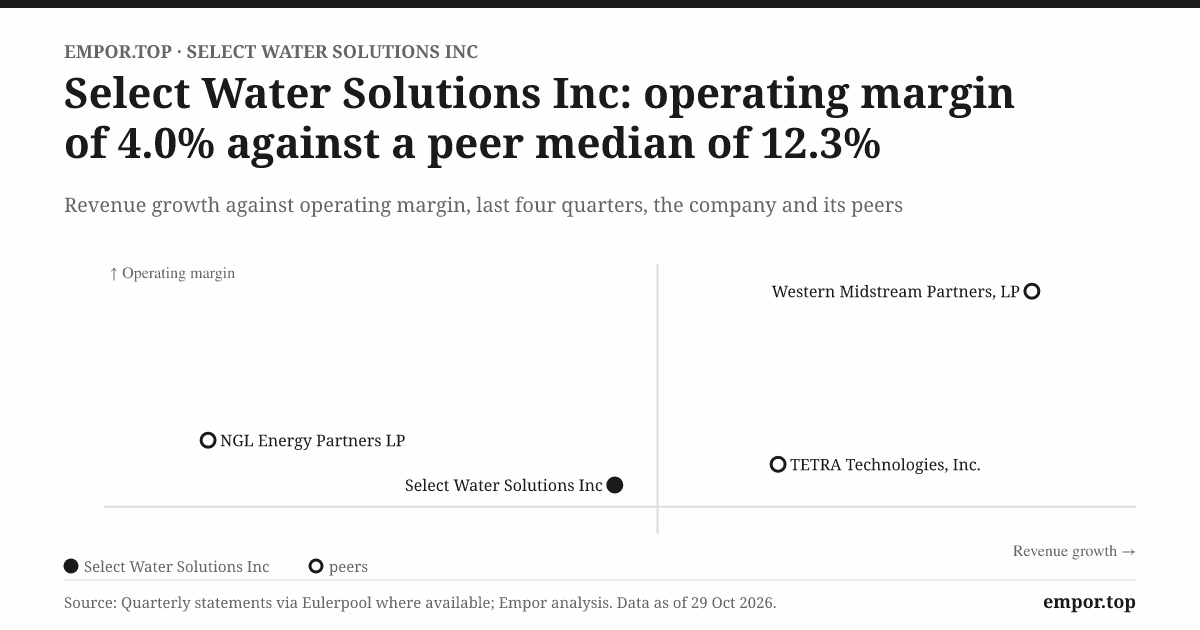
Scale also did not buy much margin. Even in 2018, the first full year after the merger, with revenue near its peak, Select earned an operating margin of only about 4%, and in 2019 that slipped below 2% as revenue fell about 15%.3
A services company of that size, in a good market, was keeping two to four cents of operating profit from each dollar of sales. That was the economics of selling labor and equipment by the day into an industry that could cancel the work by the week.
Scale did not buy stability either. The 2020 oil-price crash hit a company still built mainly around completion activity. Early that year a customer's bankruptcy left Select with prepaid water-rights costs and margin pressure, a reminder that a services provider's receivables are only as good as its customers' balance sheets.8
By year-end the company had written off goodwill and trademarks and was reporting an operating loss of roughly $395 million on revenue that had more than halved, to about $605 million.93 Headcount was down to about 2,000.9
The leadership changed with the cycle. Schmitz became chairman in January 2020 and, after Ladhani's departure, chief executive in January 2021.4 The Rockwater era had produced a larger company but not a steadier one.
Its public record from 2017 through 2021 included net losses in three of those five years, and only a sliver of profit in 2019.3 Whatever credit or blame belongs to that period, the strategy that matters for investors today is the one Schmitz has run since he took the top job.
That strategy began from a blunt diagnosis. A business that moves water to frack sites earns money only when crews are working, and loses it quickly when they are not. Produced water is different. It keeps flowing for the life of a well, whether or not anyone is drilling the next one.
If Select could own the pipes that carry it, the company might finally get off the completion treadmill. The next five years would be a deliberate attempt to build exactly that, and to find out what it would cost.
Pipes instead of another cycle
Picture the Northern Delaware Basin from the air. Pads of new wells dot the scrub, each one sending up water every day it produces. Between them run trenches where Select has buried large-diameter pipe, linking recycling facilities, storage ponds and disposal wells into something closer to a regional utility than a fleet of trucks.
Water from one operator's lease can be treated and sent to another operator's frack job; surplus can be stored, or injected underground if no one needs it. Management calls the idea "recycling first," and it describes the network acting as distribution hubs that "balance water longs and shorts" across the region.10
The pivot from services to that kind of system began in earnest after 2021. Management's own scorecard is dramatic. Between the start of 2021 and the end of 2025, Select says its Water Infrastructure revenue grew by more than 800%, while it recycled its billionth cumulative barrel of produced water.1011 By 2025 the segment produced about $313 million of revenue.11
That 800% figure deserves one asterisk. Select has redrawn its segment boundaries over the years, and the 2020 annual report counted roughly a fifth of revenue as Water Infrastructure under a broader definition than today's.9 The direction of travel is not in doubt; the precise multiple depends on where the starting line is drawn.
By the end of 2025 the physical base was substantial. Select reported about 2.4 million barrels a day of fixed recycling capacity, 2.3 million barrels a day of permitted disposal capacity and about 35 million barrels of storage.3
In 2025 alone it recycled more than 330 million barrels, up 18% on the year.10 Contracts lengthened too. Select added about 950,000 acres of new dedications in 2025 with an average term of about 11 years, including a ten- and seven-year Lea County agreement and a 15-year pipeline deal in the Rockies.11
The projects had a recognizable shape. In early 2025, for example, Select signed a 15-year agreement to build and expand recycling and pipeline infrastructure in the Northern Delaware, with a facility designed to add up to 120,000 barrels a day of throughput.12
In 2026 it closed on the Black River Ranch, a surface acquisition in Eddy County that management said would support future infrastructure development and generate surface and mineral income.2 Land, pipe, ponds and wells: the inventory of a utility, assembled one lease at a time. The workforce grew with it, from about 2,000 people at the end of 2020 to about 3,300 at the end of 2025.93
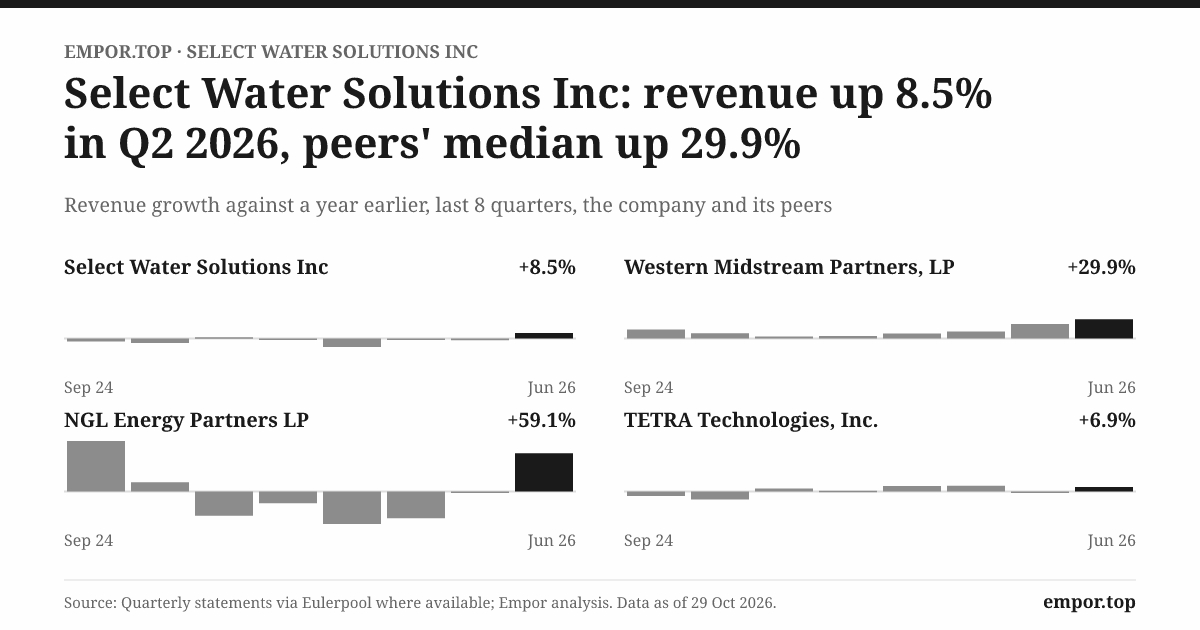
None of this came free. Capital expenditure, excluding acquisitions, rose from about $136 million in 2023 to about $295 million in 2025.3 Over the same span the company's revenue fell from about $1.6 billion to about $1.4 billion, down 3.1% in 2025 alone.3
Spending more than twice as much on assets while sales shrink is not automatically a warning sign. A company building toll roads must pour concrete before it collects tolls. But it changes the question investors should ask. The issue is no longer whether the infrastructure segment is growing; it plainly is. The issue is whether every additional dollar is earning more than it costs.
The record on that question, so far, is thin. Select's return on invested capital, measured company-wide, fell from about 8% in 2023 to about 3% in 2025.3 Those are company-wide figures, dragged down by the weaker services business, and some of the 2025 spending had not yet entered service. Still, the direction ran the wrong way while the capital base grew.
The most revealing test is what management promised and what happened. In February 2025 Select forecast that Water Infrastructure revenue and gross profit would grow 15% to 25% that year, and it set a goal for the segment to reach half of consolidated profitability on a standalone basis by the end of 2025.12
It guided to net capital spending of $170 million to $190 million, including $50 million to $60 million of maintenance.12 Schmitz said the backlog of infrastructure projects was "at an all-time high."12
The year came in differently. Infrastructure revenue grew about 8%, from about $291 million to about $313 million, well short of the bottom of the range.1112 Net capital spending reached about $279 million, roughly half again as much as the top of the original target.11
On the February 2026 call, an analyst asked about project timing that had slipped from late 2025 into 2026. Michael Skarke, then chief operating officer, put it down to "fairly minor delays," mainly in securing rights of way, and said those had been resolved.10 That is a concrete explanation, which counts for something.
It does not fully bridge a growth miss of that size, and the call did not offer a line-by-line reconciliation of why spending ran so far above plan. Part of the answer is that Select won new contracts and acquired assets during the year that were not in the original budget. That is a reasonable explanation for higher spending. It also means the original target was not a ceiling on anything.
The pattern repeated in 2026, in a more encouraging key on revenue and a less encouraging one on capital. In February management guided to 20% to 25% infrastructure growth and net capex of $175 million to $225 million.11 In May it raised the growth guidance to 25% to 30% and the capex range to $200 million to $250 million.13
In August it said infrastructure was tracking toward the top of that growth range, with second-quarter segment revenue up 26% on the year, and lifted net capex again, to $250 million to $290 million.21 In six months the midpoint of the spending plan rose by about a third.
Management's case is that each increase tracks new contract wins, and the 128-million-barrel award is evidence for that. Chris George, the chief financial officer, told analysts in August that maintenance needs remain around $60 million and that the business is "maintenance-light," with growth spending that will "limit our free cash flow potential this year" while building long-term contracted cash flows.2 He also signalled that 2027 could bring another year of heavy building, "probably a larger size than we might have otherwise anticipated."2
That candor is useful, and it should be read precisely. It means investors are being asked to accept two more years of heavy reinvestment before free cash flow is expected to step up, and George pointed to 2028 as the year that potential "can really accelerate."2 The evidence so far does not prove the build is wrong.
Contracts are getting longer, volumes are rising and the segment's margin has improved. What the record does show is that the build has outrun the proof of its returns, and that budgets set at the start of each year have not held.
So the claim that Select has turned itself into an infrastructure company holds up as a description of where the growth is. As a claim about where the returns are, it is not yet proven.
The test that would settle it is segment cash returns on the capital deployed, measured after the new Northern Delaware capacity fills up. And hovering over that test is the question the Pilot deal will make unavoidable: how much more capital must go in before these assets earn more than they cost?
Three businesses, one water cycle
Stand at a frac site in the Permian on a busy morning and the three halves of Select, or rather three thirds, are all in view. Lay-flat hose snakes in from a pond or a pipeline, carrying the fresh or recycled water the pumps will need. Tanks and lines are staged to take away the flowback that will surge out once the well is stimulated.
Somewhere on location, chemical totes hold the friction reducers and surfactants that make the water slick enough to push sand deep into the rock. Each of those jobs can be billed by a different company. Select wants to bill for all three.
How it gets paid differs sharply by business, and that difference is the heart of the investment case. Most service revenue is recognized as the work is done, by the day, the hour or the unit.3 Chemical sales are recognized when the product changes hands.3 Infrastructure revenue comes from water handling, pipeline and facility arrangements, and that is where the contracts with teeth live.3
The distinction is easiest to grasp as two kinds of agreement. Many Water Services contracts are price sheets: the customer agrees what it will pay if it uses Select, but promises no particular volume.3 If a rig is dropped, the revenue disappears.
Water Infrastructure agreements, by contrast, can include acreage dedications, in which an operator commits all the water from a defined area to Select's system, and minimum-volume commitments, under which the customer pays for an agreed volume or pays a deficiency fee for the shortfall.3 One is a menu. The other is closer to a lease.
In 2025 the menu still dominated. Water Services produced about 56% of revenue, with Water Infrastructure and Chemical Technologies each around 22%.11 The trend inside that mix told a clear story. Water Services revenue fell about 13% that year as activity softened, while Infrastructure rose about 8% and Chemicals about 19%.11
The economics tilt the picture much further. In the June 2026 quarter Infrastructure earned about 58 cents of gross profit before depreciation on every dollar of revenue; Water Services earned about 23 cents, and Chemicals about 20 cents.1 Translate that into dollars and the hierarchy flips. On about $102 million of revenue, Infrastructure produced roughly $59 million of gross profit before depreciation.
Water Services, on nearly twice the revenue, produced about $46 million. Chemicals produced about $19 million.1 Infrastructure was therefore just under half of segment gross profit in that quarter, close to the "50% of profitability" goal management had set for the end of 2025, but about six months late.
That margin is real, and it comes with a large caveat. "Before D&A" means before depreciation and amortization, including the depreciation on the very pipes and wells that generate it. A trucking business carries its costs mostly as wages and fuel, which appear above that line; a pipeline business carries them mostly as capital, which appears below it.
Comparing a 58% infrastructure margin with a 23% services margin flatters the infrastructure segment for exactly that reason. The fair comparison is return on capital, and Select does not publish segment-level returns on invested capital.
The chemicals story has its own momentum. Management attributes recent share gains to in-basin manufacturing, a rapid pace of new products and demand for higher-specification friction reducers and surfactants.2 Second-quarter 2026 chemicals revenue jumped 23% from the first quarter, and margins held despite higher oil-based raw-material costs.2
But management itself guided to a retreat, to $85 million to $90 million of revenue in the third quarter, based on customer schedules.1 Chemicals is a meaningful supporting business with real momentum. It is also sold into the same completion cycle as Water Services, and it is not the thesis.
The integration claim is where Select tries to make the three businesses more than the sum of their parts. The mechanism is concrete. A bigger pipeline network can create more demand for last-mile water transfer and hauling from Select's services crews.
Recycling facilities consume chemical treatment, including emulsion polymers Select makes itself.3 A customer that buys water, takeaway and chemistry from one supplier has one fewer vendor to manage and, potentially, a lower all-in cost per barrel.
The proof standard here should be high, and it is not yet met. Select describes the integrated advantage in its filings, but it does not publish what share of revenue is recurring or contracted company-wide, how many customers buy from more than one segment, or how often customers renew.3
Without those figures, the integration story is a plausible mechanism rather than a measured one. The contract that opened this story is the best evidence that integration works: the operator's recycling success with Select reduced its own need for disposal wells, which is why it handed them over.2 It is one data point, though a vivid one.
The decision to narrow Water Services points the same way. In September 2026 Select sold a 55% interest in its Peak Rentals business for about $41.5 million in cash and a $35.3 million seller note, keeping 45% and removing Peak from its consolidated results.14
The company had been evaluating strategic alternatives for Peak since 2025, and it had divested its OMNI business in the third quarter of that year.1011 Management is pruning the lower-return, more cyclical parts of the portfolio, which is consistent with what it says it is doing.
The strategy, then, depends on one thing above all: that the high-margin segment keeps taking a larger share of the profit pool. Whether it can depends not just on Select, but on whether customers and competitors allow it. That is the moat question.
Can Select make the water network hard to leave?
Return to the Northern Delaware contract and look at it the way the customer's engineers must have. They owned 14 disposal wells in Eddy and Lea counties. Those wells had become underused, because the operator was recycling more water through Select's system and injecting less into its own.2 It could have kept them as a backstop.
Instead, it conveyed them to Select under a seven-year contract that extended the network into Texas for the first time.12 Schmitz said the operator wanted to reserve capacity on a specific piece of pipe, which is why it agreed to a minimum-volume commitment rather than Select's usual acreage dedication.2
If that is what customer lock-in looks like, it is worth asking how common it is and what could undo it. Start with the battlefield.
Produced-water handling in the Permian is a fragmented, local business. Select competes with private regional water companies, with larger midstream and oilfield-service firms, and, most importantly, with its own customers, many of whom build and run their own water systems.3 Until late 2025 the most visible public specialist was Aris Water Solutions, which guided to handling about 1.15 million to 1.21 million barrels of produced water a day in 2025.15
In August 2025 Western Midstream agreed to buy Aris in a deal valued at about $2 billion including debt, and it completed the acquisition in October 2025.1617 The largest pure-play competitor is now part of a much bigger pipeline company with its own capital and customer relationships.
The scale comparison needs care. Select's 2.4 million barrels a day of year-end recycling capacity was roughly twice Aris's guided handling volume.315 But capacity is the size of the pipe, and throughput is the water actually flowing through it.
Western Midstream described Aris's produced-water handling capacity as about 1.8 million barrels a day, a figure much closer to Select's.16 Neither comparison is market share, and Select does not publish its share of basin water volumes.
Now run the forces that shape returns in a business like this, once and properly.
Buyer power is high, and Select's customer list shows why. Two customers each accounted for roughly 12% of 2025 revenue, and three customers made up about a third of year-end receivables.3 Customer concentration eased slightly from 2024, when the top two were about 13% and 11%.318
Concentration matters most when customers are large, sophisticated and able to build alternatives, which describes Permian majors and large independents exactly. Consolidation among Permian producers has only made the biggest buyers bigger.
The threat of substitution is also real, because the main substitute is the customer's own system. An operator can drill disposal wells, lay pipe and run its own recycling. The 14 wells Select received in New Mexico were built by a customer for precisely that purpose.2 Rivals, private and public, can also bid on new projects, and many of Select's service contracts guarantee no volume at all.3
Supplier power is modest; pipe, pumps and land are available, though rights of way can delay projects, as the 2025 slippage showed.10 Regulation cuts both ways. Management argues that tighter scrutiny of disposal and falling disposal availability favor a recycling-led network.10 That is a plausible tailwind. It also means the value of disposal capacity depends partly on rules Select does not control.
Against those pressures, Select has one credible source of power in Hamilton Helmer's terms: switching costs, reinforced by a kind of local scale economy. A pipeline already connected to a customer's wells is cheaper than any newcomer's, because the newcomer has to build. Acreage dedications and minimum-volume commitments can bind a customer to the network for years, and the connected system can lower its trucking and fresh-water costs.
Management describes the network as making Select "the cost-advantaged provider" in the region.10 Michael Skarke, now chief commercial officer, explained on the August call that Select sizes each expansion around an anchor customer but builds pipes 50% larger or even double, so that spare capacity can be sold to other operators.2 Each new connection makes the network denser and, in theory, cheaper per barrel to serve.
The other powers are weaker. Select has no network effect in the consumer sense; more customers make the system more efficient, but they do not make it more valuable to each other in a way a rival cannot replicate locally.
It has no brand power that lets it charge a premium, no proprietary process the filings quantify, and no cornered resource, unless one counts surface acreage and permitted disposal capacity, which are scarce but purchasable. Counter-positioning does not apply; the incumbents it competes with run the same model.
So the moat claim narrows. It is not a basin-wide moat. It is a set of local positions, each protected for the length of its contract and by the cost of building a rival line beside it. That is a real advantage, and it is also a bounded one.
The strongest test of a moat is what customers actually do. Select does not disclose retention rates, renewal rates, realized price premiums or utilization by system.3 Several pieces of evidence point in Select's favor. Customers have repeatedly conveyed assets to Select over the past couple of years, according to the CFO.2 Pricing improved in the infrastructure segment in 2026.2 Contract terms are getting longer.
Several pieces point the other way. Most of Select's revenue still comes from services and chemicals, where agreements typically carry no throughput guarantee. The right-of-first-refusal acreage, which management treats as option value, had not materially converted into dedicated acreage by mid-2026, Skarke acknowledged.2 And the customer that just made the largest commitment did so partly because it chose not to build itself, a decision it could reverse when the contract ends.
Then there is utilization, the quiet variable behind every pipeline return. Select handled about 1.5 million barrels a day in the second quarter of 2026, against roughly 2.4 million barrels a day of recycling capacity and 2.3 million of permitted disposal capacity at the end of 2025.13
That comparison is crude; not all permitted disposal is built, and capacity sits where it sits. But it signals a network deliberately built ahead of demand. Skarke framed the excess as "where I think you'll see the big win over the next couple of years."2 Excess capacity is optionality when it fills, and a depreciation charge when it does not.
The 128-million-barrel award is the strongest operating proof point Select has offered. It supports the contract thesis: a large public operator paid for certainty on Select's network rather than its own. It is still one award, roughly 3% of current segment volumes on an averaged basis, and it says nothing yet about system-wide pricing power.
The evidence, weighed, leaves the moat intact but unproven. Two signals would confirm it: customer concentration falling as more operators connect, and new links filling at returns that justify the capital. A failure to fill the oversized pipes, or a large customer bringing water back in-house, would falsify it. And that leads directly to the central financial question: can a 58% segment margin survive depreciation, interest and the next round of construction?
The cash has to pay for the pipes
In February 2026 Select closed its books on 2025 and reported something that looked healthy at first glance: about $215 million of cash from operations.3 Then came the other side of the ledger. Capital expenditure that year was about $295 million.3 The business had generated plenty of cash, and spent more.
That single year captures a puzzle that runs through Select's whole public history. Add up the eleven years from 2015 through 2025 and the company lost about $267 million in net terms. Over the same eleven years it generated about $1.4 billion of operating cash flow.3 How does a company lose money and still throw off that much cash?
The answer is depreciation, and it is the key to reading any asset-heavy business. When Select spends $100 million on a pipeline, the cash leaves immediately, but the income statement charges that cost gradually, year after year, as depreciation.
That charge reduces reported profit without costing any cash in the year it is booked. In 2025 depreciation, amortization and accretion came to about $180 million, several times the year's net income.3 Add it back, along with stock-based pay and other non-cash items, and losses on paper turn into cash in the bank.
The catch is that depreciation is not free money. It is a delayed bill for assets that wear out and must eventually be replaced. The honest measure of what the business produces for its owners is what remains after capital spending. On that measure, the eleven-year total shrinks from $1.4 billion to about $247 million of free cash flow.3 Roughly five-sixths of operating cash flow went back into the ground.
The recent years make the squeeze sharper. Free cash flow fell from about $149 million in 2023 to roughly minus $80 million in 2025 as capital spending surged.3
Even after counting about $15 million of asset-sale proceeds, which brought 2025 net capex to about $279 million, the year was cash-negative.11 Meanwhile, Select paid about $33 million to shareholders in dividends in 2025, and more once distributions to the legacy unitholders are included.3
That dividend is where the earnings and the cash tell different stories. Measured against net profit, the 2025 payout was about 157%: Select paid out more than it earned.3 That ratio exaggerates the problem in one way, because reported profit is depressed by depreciation.
It understates the problem in another, because the right comparison is free cash flow, and free cash flow was negative. The dividend in 2025 was effectively funded by borrowing. Over the full eleven years, dividends of about $92 million absorbed a bit more than a third of cumulative free cash flow, all of it since the payout began in 2022.3
Borrowing is what changed. For most of its public life Select carried very little debt; debt-to-equity sat around 0.1 for years.3 By the end of 2025 that ratio had jumped to about 0.46, with $320 million of real borrowings, a $250 million term loan and $70 million drawn on its revolver.3
Interest expense more than tripled, from about $7 million in 2024 to about $23 million in 2025.3 The bank facility required leverage no higher than 3.5 times and fixed-charge coverage of at least 1.0 times; Select was in compliance.3
Set against that capital, the returns look thin. Company-wide return on invested capital was about 3.1% in 2025, rising to about 4.4% over the twelve months to June 2026.319
Any reasonable estimate of Select's cost of capital is well above either figure; its new bonds alone, discussed shortly, carry a coupon of 7.625%.20 A business earning less on its capital than it pays to borrow is not yet creating value with that capital, however fast it is growing.
The first half of 2026 brought better news. Operating cash flow in the June quarter was about $87 million, a sharp improvement on the first quarter as working capital eased.12 Net capital spending was about $70 million, leaving roughly $17 million of free cash flow.1
But that free-cash-flow figure excludes acquisitions, and Select spent another $42 million that quarter on bolt-on deals for the infrastructure business and on buying out facility leases.2 It had spent about $29 million on Northern Delaware acquisitions in the first quarter as well.13 Counting those, the business was still consuming more cash than it produced. One quarter, however encouraging, cannot establish a new run rate.
Reported profit has its own quality problem, which runs in the opposite direction from depreciation. Select's 2025 pretax income was about $20 million.3 Inside that figure sat a gain of about $10 million from selling assets and divested businesses, including about $5 million from excess land, and a non-cash gain of about $15 million from remeasuring a business-combination item.3
Those two items alone exceed the year's pretax profit. Strip them out, and the business would have shown a small pretax loss in 2025, before counting other one-off charges, such as tax-receivable expense and investment losses, that ran the other way. That does not make the earnings fake; it makes them a poor guide to what the operations produce in a normal year.
Collections, at least, have improved. Debtor days, a measure of how long customers take to pay, fell from a peak of about 200 in 2017 to about 68 in 2025.3 The allowance for credit losses rose by only about $1 million in 2025.3
Select says its credit losses have historically followed customers' financial distress, sometimes bankruptcy, which is exactly what it experienced in 2020.38 With a third of receivables owed by three customers, that history matters more than the average.
The skeptic's question, then, is simple. Operating cash flow is real; it has funded more than a decade of investment. But the company has not yet shown it can fund its growth programme and its dividend from internally generated cash in the same year.
Management's answer is that the build phase will end, the pipes will fill, and free cash flow will expand from 2027 and especially 2028.2 That is a forecast, and the track record of the 2025 capital budget suggests treating forecasts of spending restraint with some care.
This is the point where the story stops being only about organic construction. In September 2026 Select chose to accelerate the strategy by buying an entire network, which would expand the asset base faster than any building programme, and would change the financing burden with it.
Pilot turns the strategy into a $700 million test
On September 24, 2026, Select announced the largest transaction in its history: an agreement to buy Pilot Water Solutions, a private water-midstream company with its core position in the Delaware Basin, for $700 million on a debt-free basis.21
The price would be paid as $600 million in cash and $100 million in Select Class A stock, with up to $15 million more in cash if operational milestones expected in early 2027 are met.21 Schmitz called Pilot "a leading private water midstream company" and said the deal advanced the goal of weighting Select's profitability toward Water Infrastructure.21 The company walked investors through the deal on a call the next day.22
On paper, Pilot is the kind of asset Select has spent five years trying to build. It brought more than 700 miles of pipeline, about 2.7 million barrels a day of active permitted disposal capacity plus another 0.9 million undeveloped, about 480,000 barrels a day of minimum-volume commitments and about 306,000 dedicated acres.21
More than 80% of its revenue was backed by long-term contracts averaging over seven years.21 Its produced-water volumes were expected to rise from about 850,000 barrels a day in the first half of 2026 to about 1 million in 2027.21
Combined, Select said, the two companies would handle more than 2.5 million barrels of produced water a day in 2027, carry more than 600,000 barrels a day of minimum-volume commitments, and have about 3.6 million acres under dedication or right of first refusal, with a weighted remaining contract life of about nine years.21
Nearly 90% of the combined minimum-volume commitments are underwritten by investment-grade customers, according to the company.21 Management projected that Water Infrastructure would represent about 70% of pro forma gross profit before depreciation by 2027.21 That figure measures segment gross profit, not net income or free cash flow, which is a distinction worth holding onto.
Now the deal math. Pilot expected adjusted EBITDA of $100 million to $110 million in 2026, rising to $120 million to $130 million in 2027, before any synergies.21 Divide the $700 million price by the 2027 figure and Select is paying about 5.4 to 5.8 times next year's earnings before interest, tax, depreciation and amortization.
Add the full $15 million earnout and the multiple edges up to about 5.5 to 6.0 times. Credit the $10 million to $15 million of annual cost synergies Select targets within 12 to 18 months and it falls to around five times.21
That looks cheap, and there is now a real benchmark. When Western Midstream agreed to buy Aris in August 2025, it paid about 7.5 times consensus 2026 EBITDA, a figure that already included its estimated cost synergies.16 On the face of it, Select is paying a lower multiple than a large midstream buyer paid for the most comparable public water business a year earlier.
But the face of it hides the most important detail. Pilot's growth from 2026 to 2027 comes mainly from a single new contract, a 175,000-barrel-a-day minimum-volume commitment.21 On Pilot's 2026 estimate, the multiple is closer to 6.4 to 7.0 times.
On that basis, much of the apparent discount to the Aris deal rests on one contract ramping on schedule. The Aris multiple also reflected a larger platform, a different contract mix and a buyer with a lower cost of capital. The comparison suggests Select is not overpaying on its own forecasts; it does not prove the purchase is a bargain.
Follow the financing next, because that is where the risk sits. Select secured debt commitments from J.P. Morgan and Bank of America at signing.21 On October 21, 2026, it issued $900 million of senior unsecured notes due 2034, carrying a 7.625% coupon.20 The issuer is Select Water Holdings LLC, a subsidiary.
The notes are guaranteed by the operating subsidiaries that guarantee the revolving credit facility, but not by the listed parent, Select Water Solutions, Inc., nor by SES Holdings.20 If the Pilot acquisition has not closed by March 1, 2027, or an extended outside date, the company must redeem every note above the first $450 million, meaning half the issue, at the issue price plus accrued interest.20
The interest bill tells the story in one comparison. At 7.625%, $900 million of notes costs about $69 million a year. In the summer of 2026, before the deal, management expected net interest of $4 million to $6 million a quarter, roughly $20 million a year.2 Part of the new debt will refinance existing borrowings, which stood at about $263 million in June, much of it a term loan at a rate near 7%.13
Even so, Select's annual interest cost looks set to rise by something like $40 million to $50 million, a large share of Pilot's projected $120 million to $130 million of 2027 EBITDA before Pilot's own depreciation and maintenance spending. Select filed pro forma statements in October showing the combined accounting picture.23 Management expects net leverage below 2.0 times at closing.21
The equity piece carries a quirk. The $100 million of stock will be priced at Select's 30-day average share price just before closing, and if the shares trade lower six months after closing, the sellers receive a cash true-up.21 At recent prices that is roughly five million new shares.
The true-up protects the sellers from a falling share price, which leaves Select's existing shareholders carrying more of that risk. If Select fails to complete the deal because of certain breaches on its side, it could owe the sellers a $35 million termination fee.14
How does this fit Select's record as a buyer? The Rockwater merger widened the company but did not make it steadier. Since then, Select has made a string of smaller bolt-on purchases, sold underutilized equipment and real estate, divested OMNI in 2025 and sold majority control of Peak Rentals in September 2026.1114
That is evidence of a management team willing to correct its portfolio. It is not enough, by itself, to show that acquired capital has earned its cost, because Select does not report returns on its past acquisitions.
The decisive scorecard will not be the synergy target or the 70% profit-mix figure. It will be the cash Pilot actually produces, the leverage the combined company actually carries, integration costs and the return on invested capital after closing. As of October 29, 2026, the acquisition is still pending, subject to customary conditions including antitrust clearance, with closing expected in the fourth quarter.21 The company's third-quarter call is set for November 9.24
Which raises the question of who is making this bet, and with what at stake personally.
A long-time CEO with a complicated ownership map
When John Schmitz opens an earnings call, the introduction tells you most of what you need to know about who runs Select. He is presented as founder, chairman, president and chief executive, all at once.2 He is 65.4
His style on calls is that of an operator rather than a financier: he talks about the operator who handed over its disposal wells, about "recycle first," about the network becoming "very important to the industry," and he leaves the arithmetic of returns and leverage to his CFO, Chris George.2
The story of the infrastructure pivot is his story, and it should be judged as such. Before taking the top job in January 2021, Schmitz was executive chairman while Holli Ladhani ran the company.4
The losses of 2020 and the decision to reorient toward fixed infrastructure belong to different chapters. Blaming Schmitz for the Rockwater-era volatility would be unfair. Crediting the earlier team for today's network would be equally wrong. The present strategy, its spending and the Pilot bet are his.
His incentives are worth reading closely, because they show what the board has asked him to deliver. About 84% of his target pay is at risk, and about half is tied to explicit performance measures.4 The annual cash bonus is weighted 40% to adjusted EBITDA and 30% to free cash flow, with small weightings for safety and for recycled-water volumes, alongside individual strategic goals.4
Long-term awards split evenly between restricted shares that vest over three years and performance shares based on Select's shareholder return relative to peers, with an absolute-return modifier.4 His reported 2025 compensation was about $4.88 million, nearly unchanged from 2024, in a year when net income fell to about $21.5 million from about $35.5 million.4
That design deserves credit for putting free cash flow inside the bonus. It also deserves scrutiny for what it leaves out. No element of the disclosed plan measures return on invested capital, the figure that would most directly test whether the infrastructure build is creating value. A management team can grow adjusted EBITDA by investing heavily, and the plan rewards that growth whether or not the capital earns its cost.
Ownership adds both alignment and complexity. Schmitz beneficially owned about 3.2% of Select's combined voting power as of March 2026.4 That is a meaningful personal stake for a company worth about $2 billion. Above him in the register sit the legacy owners from the private-equity era. SES Legacy Holdings held all 16.2 million Class B shares, about 11.7% of the combined vote, and Crestview was deemed to beneficially own about 14.5%.4 Those Class B shares carry votes but no direct economic rights; their economics live in SES Holdings units that can be exchanged into Class A shares, which means the Class B voting figure understates the potential supply of tradable stock.43
The legacy block has shrunk considerably since the listing. At the time of the 2017 filing, the legacy holding company held about 38.5 million Class B shares; by 2026 the count was 16.2 million.54 More than half of the legacy units have been exchanged over the years, and the remaining units are a known source of potential future supply. Large index and value managers, including Franklin Mutual, BlackRock, Dimensional and Vanguard, each held roughly 4% to 6% of the vote.4
The Up-C structure also keeps paying the people who were there at the start. The tax-receivable agreements cost Select about $5 million in 2025.3 Related-party dealings are larger. In 2025 Select bought about $29 million of goods and services from related parties, roughly 2.1% of revenue, including equipment rentals and services, management and consulting work, inventory and equipment.3
The proxy names several counterparties linked to insiders: pumps from Orteq, appraisal and tax consulting from Merit, services from MyWorkDoc, and about $122,000 of property rent paid to an entity owned by Schmitz and another insider.4 Schmitz also serves as chief executive of Endurance Lift Holdings, the parent of Bell Supply Company, and chairs an exploration company, roles he holds alongside running Select.4
None of this is unusual in an oilfield-services company founded by an industry lifer. The audit committee reviews related-party transactions, and the amounts are small relative to revenue.3
But Select does not state that these purchases were made on terms equivalent to arm's-length deals; it says results could have differed had the counterparties been unrelated.3 An activist would ask a straightforward question: as the company becomes an infrastructure business with long-lived contracts, should the CEO's other businesses be suppliers to it at all?
The board offers some balance. After the May 2026 annual meeting, six of its seven directors were independent, and Richard Burnett serves as lead independent director.4 Shareholders have been supportive: about 98% voted for the 2025 say-on-pay proposal.4 That is evidence of approval, not of results.
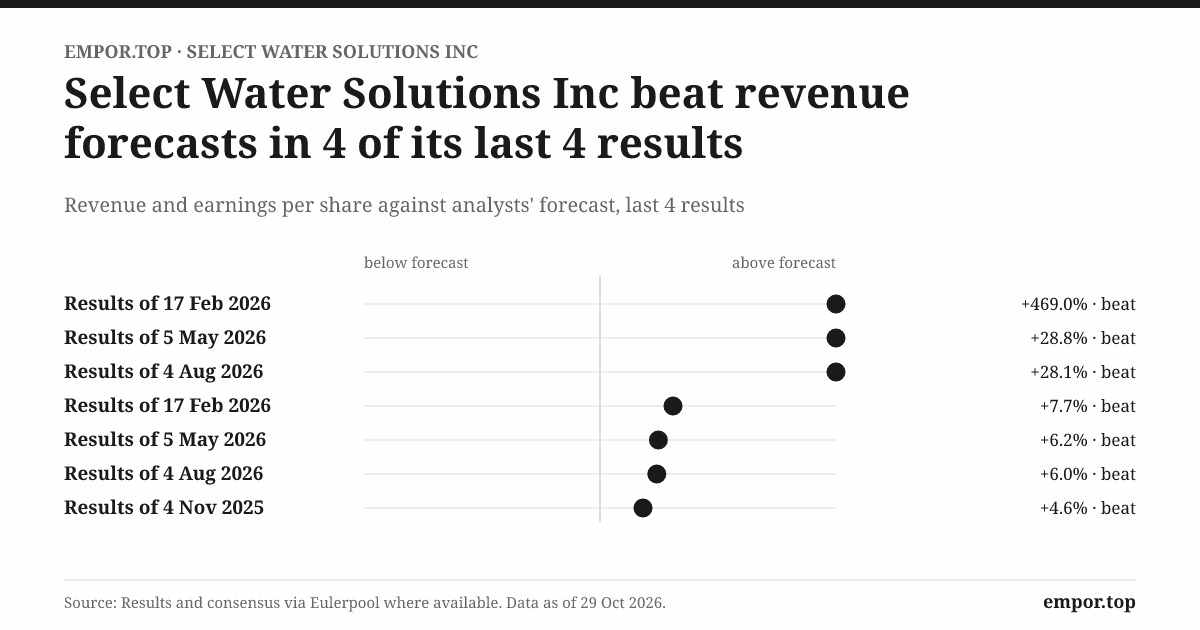
The fairest test of management is promises against outcomes, in both directions. On capital and infrastructure growth in 2025, Select fell short and spent more than planned, and its explanations were specific but incomplete. On near-term earnings guidance, it has recently done better than promised. Fourth-quarter 2025 adjusted EBITDA of about $64 million landed just above the top of its range.10
Second-quarter 2026 adjusted EBITDA of about $93 million beat the $77 million to $80 million guided in May by a wide margin, with all three segments outperforming.132 The pattern is a team that is conservative on quarterly earnings and expansive on capital. That is a common combination among builders, and it puts the burden of proof on returns rather than on any single quarter.
Analyst questions on the August call were notably friendly; the first began by calling the results "fabulous."2 Most questions asked how large the growth opportunity might be, not what it would return. The most revealing answers came anyway: that 2027 could bring another year of heavy growth spending, and that right-of-first-refusal acres had not yet converted.2
The governance tension, then, is clear enough. A chief executive with real equity exposure, a long operating record and the chairman's gavel is making the company's largest strategic bet. He is financing it with debt issued below the listed parent, with the cash flows of the combined network the ultimate source of repayment. Whether that bet pays shareholders depends on the price they pay to own it today.
Analysis & Bear vs. Bull Case
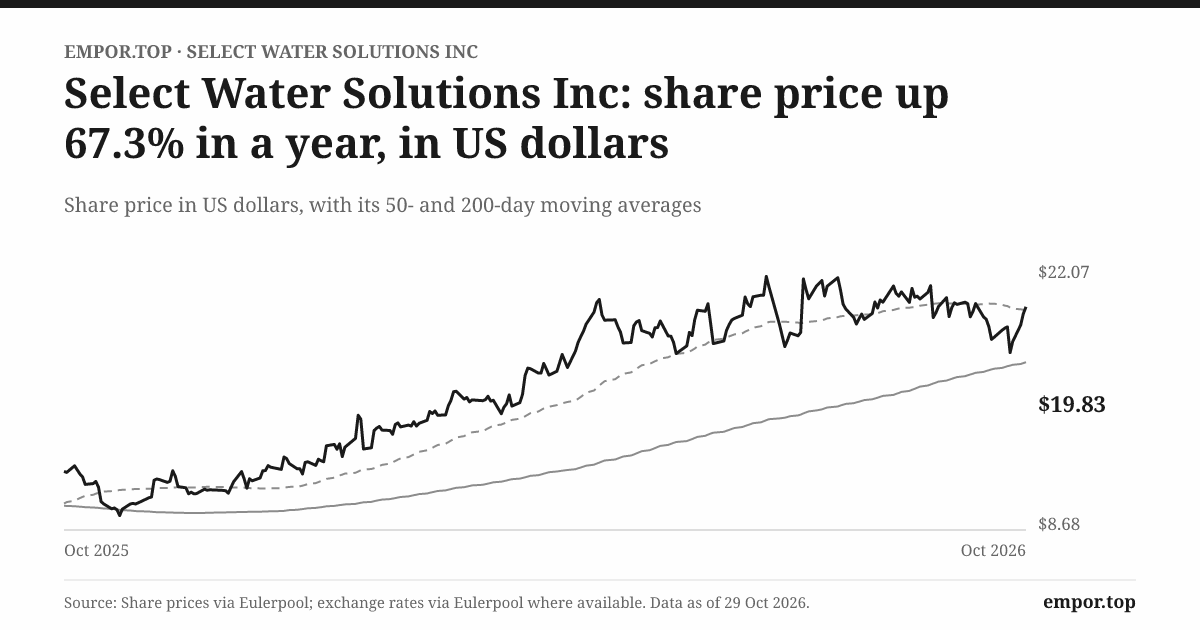
On October 29, 2026, Select's shares closed at $19.83, about 7% below their 52-week high of $21.35 and more than double their 52-week low of $9.40.24 The market valued the equity at about $2.1 billion and the whole enterprise, including net debt, at about $2.3 billion, before the Pilot financing and earnings enter the reported numbers.2419 Pilot has not closed. Third-quarter results are eleven days away. The stock has moved as though investors already believe in the network.
The bull case is not a fantasy, and it deserves to be stated at full strength. Water handling is essential: an oil well that cannot dispose of its water cannot produce. Select has assembled one of the larger water networks in the Permian, and Pilot would make it larger still. Its infrastructure segment earns gross margins near 58% before depreciation, growing roughly a quarter a year in 2026.12 Contracts are lengthening, customers are conveying their own assets into the system, and the pending combination would carry about nine years of weighted contract life, much of it underwritten by investment-grade producers.21
Management says the pipes have been deliberately oversized, so each additional customer lands on capacity that has already been paid for.2 If those pipes fill, returns on capital should rise sharply, and the earnings mix will look more like a midstream company than a service contractor. Add chemistry with growing share, a services arm that throws off cash in good markets, and royalty optionality from lithium and iodine extraction partnerships that management expects to begin contributing in 2027, and the bull sees a business the market still prices partly as oilfield services.102
The bear case rests on the record rather than the plan. Revenue fell in 2025. Capital spending more than doubled in two years. Company-wide return on invested capital was about 3% in 2025, and roughly 4% over the latest twelve months.319 Eleven years of free cash flow total about $247 million, small beside the capital deployed.
The 2025 dividend was not covered by free cash flow. The company has missed its own capital budgets two years running. And it is now adding $900 million of 7.625% debt to buy a network whose projected growth depends largely on one new contract ramping on time.2021
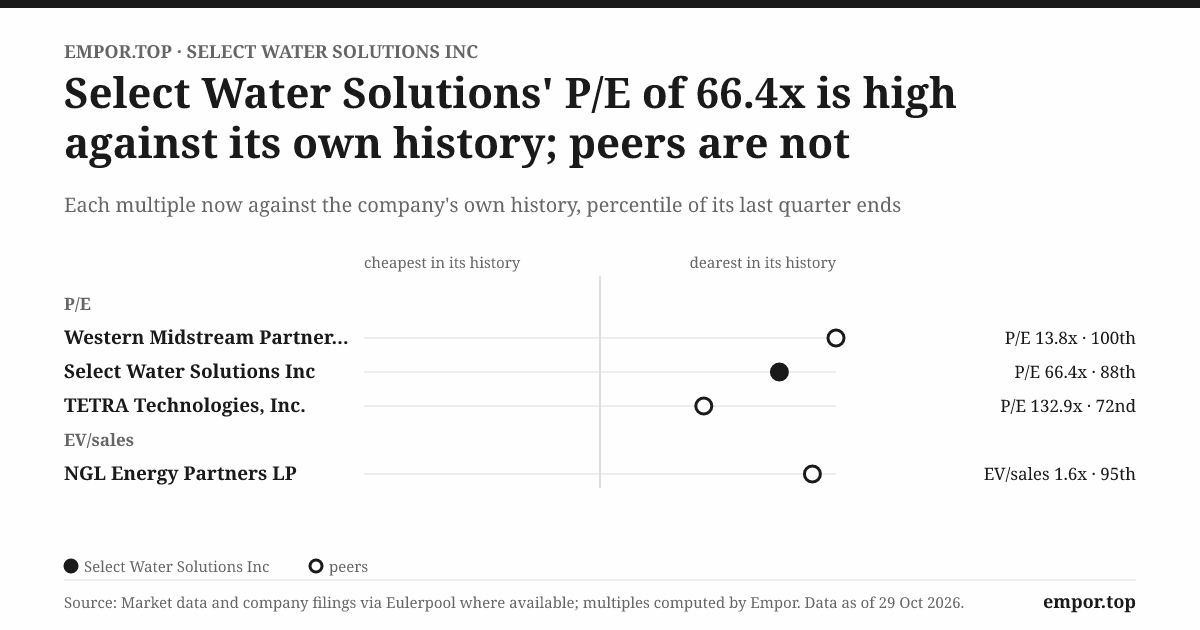
The valuation shows how the market is splitting the difference. On trailing earnings the stock trades at about 66 times, against a five-year median of about 21 times.24 That headline overstates the expense. Select's reported earnings are thin because of heavy depreciation, interest, tax-receivable payments and other charges, so price-to-earnings is the wrong ruler for an asset-heavy business in a build phase.
Enterprise value against trailing reported EBITDA, about 9.8 times, is more informative.24 On the second quarter's adjusted EBITDA annualized, the multiple is closer to six times.1 The dividend yields about 1.4%, while the free-cash-flow yield is about minus 4%.24
Set that beside the Western Midstream-Aris deal, done at about 7.5 times forward EBITDA including synergies, and Select does not look extravagantly priced for a water-midstream business.16 What the price does assume is that Select's earnings are on their way to being midstream-quality earnings, and that the capital behind them will eventually earn its cost. That is the transformation, not the proof of it.
A skeptical long-short investor would press on one question above all. If contracted infrastructure is the better business, why did company-wide return on capital fall to about 3% in 2025, and why was the dividend not covered by free cash flow after the build?
Management's answer is timing: assets under construction earn nothing until they are commissioned, and earnings lag spending by a year or more.2 That answer is plausible, and it is falsifiable. If the 2026 and 2027 capital programmes are in service and returns are still in the low single digits by 2028, timing will no longer explain it.
Select's moat is a smaller, local version: switching costs and route density on connected systems, bounded by customer bargaining power, insourcing and fragmented rivals.
Rivalry for new projects remains intense, and new entrants with midstream capital, as Western Midstream's purchase of Aris showed, can arrive overnight by acquisition.16 Pilot would expand Select's local positions, which strengthens the switching-cost argument where the systems overlap. It does nothing to reduce the bargaining power of a handful of very large producers.
Three measures can settle the dispute, and each has a current reading. The first is the infrastructure segment's gross profit before depreciation, alongside the volume of water it handles. In the June 2026 quarter that was roughly $59 million on about 1.5 million barrels a day, rising on both counts.1 The second is free cash flow after all capital spending, including bolt-on acquisitions.
It was about minus $80 million in 2025 and modestly positive in the June quarter before acquisitions, still negative after them.312 The third is post-Pilot net leverage and return on invested capital. Management expects leverage below 2.0 times at closing, and return on invested capital stood at about 4.4% over the latest twelve months, up from 3.1% in 2025.2119
A growing backlog and a strong segment margin are evidence of opportunity. They are not yet evidence that Select has converted its build into durable shareholder returns. The verdict on the bull case waits on those three measures, not on another capacity announcement. The stock's volatility, about 46% over the past year, and a peak-to-trough fall of about 51% within the last five years, are reminders of how quickly that judgment can swing.24
Playbook: Business & Investing Lessons
Every few months over the past two years, Select has stood in front of investors with a bigger number. A larger backlog, a raised growth range, a raised capital budget, and then a $700 million acquisition financed with $900 million of new bonds. Each step was defensible on its own. Taken together, they say something larger about building a business whose best assets are still being paid for.
A pipeline is a promise until the barrels arrive. The New Mexico commitment is exactly the kind of contract a water-midstream bull wants to see, and it took a customer's own disposal wells to secure it. But a minimum-volume commitment guarantees revenue, not return.
The pipe earns a good return only if other operators fill the rest. Founders and investors in any infrastructure business should look past contract length and ask about utilization, because the contract covers the anchor customer and the market has to pay for the rest.
The cash flow statement is where the growth story pays its bill. Select's long record shows how depreciation can make an asset-heavy company look worse on paper than in the bank, while reinvestment leaves far less for owners. Operating cash flow is the money the business makes. Free cash flow is the money it gets to keep. For a company in a build phase, the gap between the two is the price of the story.
Buying scale is not the same as buying returns. Pilot appears to come at a lower multiple than Western Midstream paid for Aris, and that is genuinely encouraging.
But a purchase at six times EBITDA financed at 7.625% has to clear its own hurdle: the acquired cash flow, after maintenance, integration and interest, has to exceed what the capital costs. Cheap entry multiples flatter the deal on announcement day. Return on invested capital, three years after closing, is where the deal is judged.
A target is useful only if the next update explains the gap. Select's infrastructure growth fell short of its 2025 target while net capital spending ran well above it; in 2026 it raised its capital budget twice by August. Growing companies will miss plans; the discipline lies in explaining each miss with a bridge, project by project and dollar by dollar, before asking investors to trust the next plan. Select's explanations have been specific about rights of way and new contracts, but not yet complete.
What makes these lessons Select's own is the market it operates in. Produced-water handling is fragmented, local and capital-hungry, and that kind of market can reward the company that connects the most wells to the densest network.
But density pays only when contracts and connections create utilization faster than depreciation, interest and the next construction cycle consume the margin. Select has proved it can grow the network. It has not yet proved that the growth creates value. Strategic growth and value creation are separate milestones, and the company has passed the first.
Epilogue
Tonight, as the calendar turns toward November, Select stands between two events that will start to answer the questions this story began with. The first is close. On November 9, 2026, the company will report its third-quarter results and hold its earnings call.24 Investors will compare the results with the outlook the company gave in August.1
A result in line would confirm that the June quarter was not a one-off. A miss in infrastructure would revive the doubts of 2025. Investors will also want the 2027 capital plan, after management hinted that it could be larger than expected, and a clearer account of where the 2026 spending went.2
The second event is the Pilot closing, expected in the fourth quarter once antitrust waiting periods lapse and other conditions are met.21 If the deal closes, the bond financing and seller protections will take effect.2021
If it does not close by March 1, 2027, or an extended outside date, Select must redeem half the notes, leaving it with debt but no Pilot.20
After closing, Pilot must deliver its 2027 forecast, which depends largely on the new contract ramping as planned, while Select must achieve its targeted cost synergies.21 The most useful disclosure will be whether those figures appear in cash, after interest and maintenance, not only in adjusted EBITDA.
Further out, the verdict rests on the same three measures: utilization, free cash flow and returns on invested capital. The mineral-extraction royalties, from lithium and iodine partnerships, may add to the picture from 2027, but they are early, and a partnership announcement is not yet a revenue stream.102
If all three tests pass, the story will have been a patient builder buying and pouring concrete through a soft patch, then collecting tolls. If they fail, it will have been a services company that borrowed to look like a midstream company. The record so far supports neither ending decisively. The unanswered question is whether Select can turn more water handled into more cash retained.
Outro
Go back to that barrel in Lea County, coming up the pipe alongside the oil. Before it can leave the basin, someone has to move it, clean it, store it or bury it, and the operator has to pay for every step.
For most of oilfield history that was a job for trucks and crews, hired by the day and dropped when the rigs went quiet. Select is betting that it can turn the job into an address: a network of pipes the water flows through for decades, regardless of who is drilling the next well.
About 1.5 million barrels a day already move through that network.1 The company that owns it earned a return of roughly 3% on its capital in 2025.3 The gap between those two numbers remains the whole story of Select Water Solutions. The barrel will keep flowing. The cash-flow statement will show who it ultimately pays.
References
-
Select Water Solutions Announces Second Quarter 2026 Financial, Operational and Strategic Updates — Select Water Solutions (SEC Exhibit 99.1), 2026-08-04 ↩↩↩↩↩↩↩↩↩↩↩↩↩↩↩↩↩↩↩↩↩
-
Second Quarter 2026 Earnings Conference Call and Webcast — Select Water Solutions, 2026-08-05 ↩↩↩↩↩↩↩↩↩↩↩↩↩↩↩↩↩↩↩↩↩↩↩↩↩↩↩↩↩↩↩↩↩↩
-
2025 Form 10-K — Select Water Solutions (SEC), 2026-02-18 ↩↩↩↩↩↩↩↩↩↩↩↩↩↩↩↩↩↩↩↩↩↩↩↩↩↩↩↩↩↩↩↩↩↩↩↩↩↩↩↩↩↩↩↩↩↩↩↩↩↩↩↩
-
2026 Definitive Proxy Statement — Select Water Solutions, 2026-03-24 ↩↩↩↩↩↩↩↩↩↩↩↩↩↩↩↩↩↩↩
-
Select Energy Services, Inc. Form S-1 — SEC, 2017-03-02 ↩↩↩↩↩↩↩↩↩
-
Select Energy Services Announces Completion of Merger with Rockwater Energy Solutions — Select Energy Services, 2017-11-01 ↩↩↩
-
Form 10-Q for the Quarter Ended March 31, 2020 — Select Energy Services (SEC), 2020-05-07 ↩↩
-
Fourth Quarter and Full-Year 2025 Earnings Conference Call and Webcast — Select Water Solutions, 2026-02-18 ↩↩↩↩↩↩↩↩↩↩↩
-
Select Water Solutions Announces Fourth Quarter and Full-Year 2025 Financial and Operational Results and Strategic Updates — Select Water Solutions, 2026-02-17 ↩↩↩↩↩↩↩↩↩↩↩
-
Select Water Solutions Fourth Quarter and Full-Year 2024 Results and 2025 Outlook — Select Water Solutions (SEC Exhibit 99.1), 2025-02-18 ↩↩↩↩↩
-
Select Water Solutions Announces First Quarter 2026 Financial, Operational and Strategic Updates — Select Water Solutions, 2026-05-05 ↩↩↩
-
Form 8-K: Pilot Water Purchase Agreement and Peak Rentals Sale — Select Water Solutions (SEC), 2026-09-24 ↩↩↩
-
Aris Water Solutions Reports Fourth Quarter and Full-Year 2024 Results and Provides 2025 Outlook — Aris Water Solutions, 2025-02-25 ↩↩
-
Western Midstream Second Quarter 2025 Results and Agreement to Acquire Aris Water Solutions — Western Midstream Partners (SEC Exhibit 99.2), 2025-08-06 ↩↩↩↩↩
-
Western Midstream Completes Acquisition of Aris Water Solutions — Pipeline & Gas Journal, 2025-10-16 ↩
-
Form 10-Q for the Quarter Ended June 30, 2026 — Select Water Solutions (SEC), 2026-08-05 ↩↩↩↩
-
Form 8-K: Issuance of 7.625% Senior Notes due 2034 — Select Water Solutions, 2026-10-21 ↩↩↩↩↩↩↩
-
Select Water Solutions to Acquire Pilot Water Solutions — Select Water Solutions (SEC Exhibit 99.1), 2026-09-24 ↩↩↩↩↩↩↩↩↩↩↩↩↩↩↩↩↩↩↩↩↩↩
-
Pilot Water Acquisition Call and Presentation — Select Water Solutions, 2026-09-25 ↩
-
Pilot Water Unaudited Pro Forma Condensed Combined Financial Statements — Select Water Solutions (SEC), 2026-10-13 ↩
-
Investor Relations: Stock Information and Events — Select Water Solutions ↩↩↩↩↩↩↩↩
 LinkedIn
 WhatsApp
 Reddit
 Hacker News
 Email
 Kindle
 RSS Feed
 Spotify
 Apple Podcasts
 Amazon Music
 Audible
 YouTube