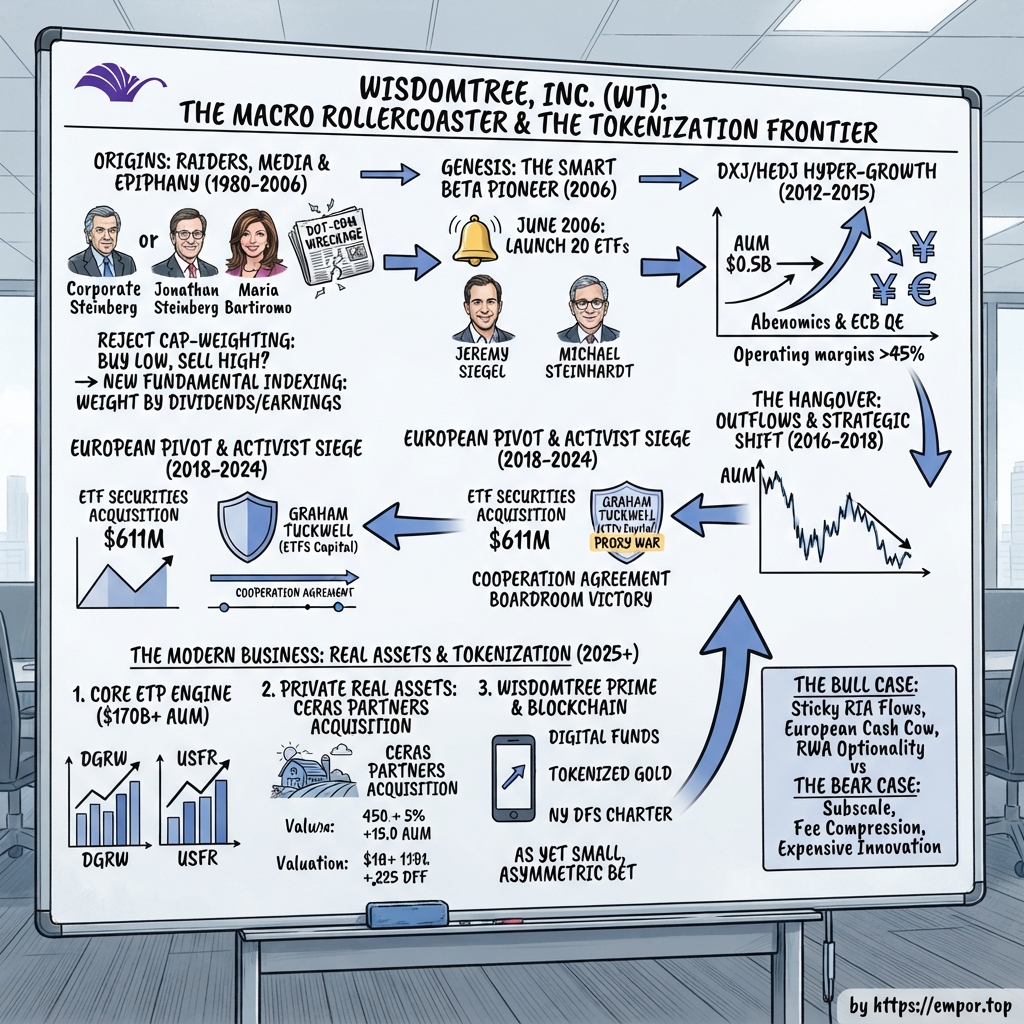
WisdomTree, Inc. (NYSE: WT): The Smart Beta Pioneer, The Macro Rollercoaster, and The Tokenization Frontier
I. Prologue: The Contrarian in the Indexing Church (0:00 – 0:15)
There is a peculiar cruelty to the economics of index investing. The product works spectacularly for the end investor, but the commercial reward for engineering it well is that a larger rival eventually gives it away for next to nothing. Vanguard's Dividend Appreciation ETF holds roughly $112 billion and charges four basis points. Schwab's U.S. Dividend Equity ETF holds a similar sum at six basis points. Between them, roughly a quarter of a trillion dollars in American dividend exposure is priced at a rounding error.
Now consider an asset manager that has spent two decades selling essentially the same concept—owning companies based on the cash they distribute rather than market capitalization—while continuing to command thirty-six basis points across more than $160 billion. That is WisdomTree. In July 2026, the firm reported exchange-traded product assets of roughly $163.0 billion, year-to-date net inflows of $10.3 billion, and a blended average advisory fee that remained anchored at 36 basis points.1 Its flagship U.S. product, the Quality Dividend Growth Fund, holds about $17 billion at 28 basis points—seven times the fee rate of Vanguard's competing fund, on one-fifth of the asset base.234
That pricing spread encapsulates the entire investment thesis. WisdomTree has never competed on price and has never attempted to do so. Instead, the firm has survived as an alternative to scale indexing: neither a market-cap-weighted beta factory nor an active stock-picking shop, but a rules-based product engineer targeting niches where allocators pay a premium because competing vehicles do not match the exact exposure. Some of those market windows have been massive yet fleeting. Others have proven modest but durable. The company's corporate history has largely been an exercise in learning, through volatile cycles, how to tell the two apart.
That dynamic frames the central debate over the business. The bull case contends that WisdomTree has established fee durability through where it competes rather than client inertia—anchored by European physical commodities, fast-to-market thematic exposures, model portfolios integrated into wealth-advisor workflows, and private real assets—yielding demonstrable operating leverage across the platform. The bear case argues that the firm's fee realization simply reflects a product mix that happens to align with the current macro regime. Critics note that WisdomTree previously mistook a cyclical surge for structural franchise growth at a comparable level of profitability, and argue that its newest strategic ventures are priced on narrative rather than tangible revenue. Both interpretations find support in the company's public disclosures. Evaluating them requires tracing the firm back to its origins.
The underlying paradoxes are stark. WisdomTree pioneered the discipline that the industry later branded "smart beta," only to watch S&P, MSCI, FTSE, Vanguard, and Schwab commoditize the methodology at fractional fee levels. The firm captured one of the largest viral flow surges in ETF history—pulling tens of billions of dollars into currency-hedged Japanese and European equity strategies—before watching the vast majority exit within two years after central bank policy shifted. It secured European commodity scale through an acquisition that succeeded operationally, yet sparked six years of boardroom conflict when the seller took equity, emerged as the firm's largest shareholder, and mounted repeated activist campaigns against leadership.
Today, amid what management describes as the opening phase of a transformed operating model, WisdomTree is managing three distinct businesses with minimal operational overlap: a global exchange-traded product platform, a private farmland asset manager acquired for $275 million in cash, and a tokenization venture that Chief Executive Officer Jonathan Steinberg has publicly asserted holds a billion dollars in value that equity markets fail to credit.56
The trajectory of that evolution covers several key inflection points:
- Saul Steinberg's corporate raider era, a financial publication lost in the dot-com bust, and the index intellectual property rescued from the liquidation.
- Jeremy Siegel, Michael Steinhardt, and the June 2006 rollout of twenty exchange-traded funds in a single trading day.
- The Abenomics currency-hedged trade, the rapid ascent of DXJ, and the liquidity contraction that followed.
- The ETF Securities transaction—the firm's primary European catalyst, which simultaneously armed its most persistent internal critic.
- Farmland strategies, advisor model allocations, tokenized money market funds, and their verifiable commercial traction.
- Analytical frameworks, operational falsification tests, and the performance thresholds required to validate the prevailing valuation.
The narrative begins where that initial capital was assembled—and where it was deployed.
 Subscribe on LinkedIn
II. Origins: From Corporate Raider Dynasty to Media Implosion (0:15 – 0:35)
In 1984, Saul Steinberg accumulated a stake in Walt Disney Productions and threatened a hostile takeover. Disney bought his shares back at a premium of almost $60 million, and in the process helped coin one of the most durable terms in the corporate lexicon: greenmail.7 Steinberg ran Reliance Group Holdings, a property and casualty insurer, for thirty-two years; Forbes once estimated his personal wealth above $600 million, while his annual compensation ran past $12 million in cash, benefits, and dividends.7 He was, in the most literal sense, an operator who generated capital by exerting financial pressure on public companies rather than by building them.
His son Jonathan grew up inside that world and chose a different path. He joined Bear Stearns as an analyst, authored Midas Investing in 1996, and built a financial publishing firm—Individual Investor Group—which produced Individual Investor and Ticker, serving as editor-in-chief from 1998 to 2004.8 The strategic logic fit the era. The 1990s bull market had created a mass audience of self-directed retail investors, and print periodicals were the primary vehicle to reach them. In June 1999, he married CNBC anchor Maria Bartiromo, whose live reporting from the floor of the New York Stock Exchange had made her the public face of that same retail trading boom.8 At the peak of that bull market, the Steinberg household sat squarely at the intersection of retail enthusiasm, financial media, and Wall Street capital.
Then the environment fractured—and it did so on both sides of the family simultaneously.
Two collapses, one year. Saul Steinberg's empire fell first. Reliance Group Holdings, overwhelmed by mounting workers' compensation liabilities, rapidly unraveled. He stepped down as chief executive in 2000, resigned as chairman in 2001, and the insurer filed for bankruptcy that same year, listing $12.6 billion of assets against $12.9 billion of debts.7 The 1980s-era architecture of corporate celebrity—the Park Avenue duplex, the art collection, and the greenmail fortune—came apart in public view. Years later, his own mother sued him over an unpaid debt of $4.7 million.7
The contrast between Saul Steinberg's career and what Jonathan Steinberg constructed in its wake is unmistakable. The father accumulated wealth by exerting external pressure on target companies and leveraging an insurance balance sheet. The son spent the next two decades building a recurring, fee-based asset management franchise anchored by academic advisory boards—only to ultimately find himself on the receiving end of aggressive campaigns by activist shareholders on his own register. Whether that evolution was a deliberate reaction or an accidental contrast, the structural divergence between the two models was absolute.
The wreckage. The son's business unraveled in that same year. When the dot-com bubble burst, financial print advertising collapsed faster than virtually any other commercial media category. On July 10, 2001, Individual Investor Group announced it was ceasing publication of the magazine and laying off roughly 90% of its staff. The firm sold its subscriber list to Kiplinger and accepted a five-year non-compete restriction on publishing print periodicals under the Individual Investor name. Jonathan Steinberg was unvarnished about the outcome, noting that the company "simply did not have the resources to continue publishing" and calling the decision painful.9
What mattered for the firm's future was what he retained. The company held onto its stock index licensing operation and its associated trademarks.9 Individual Investor had published proprietary stock indexes as editorial features—lists of equities selected by objective rules rather than by portfolio manager discretion. That small, almost incidental licensing sideline was the only asset that survived the liquidation. In 2002, the company renamed itself Index Development Partners; in September 2005, it became WisdomTree Investments.10 The corporate shell—SEC filer number 880631, originally incorporated in 1985—never changed. WisdomTree, managing more than $160 billion today, remains legally identical to that restructured print publisher, an institutional lineage recorded in its EDGAR filings.11
The idea that came out of the rubble. The conceptual insight was sharpened by the very market bubble that destroyed the publishing business. In a conventional market-capitalization-weighted index, a company's weighting is simply its share price multiplied by shares outstanding. As tech darlings like Cisco, Lucent, and Yahoo saw their valuations soar through 1998 and 1999, passive index funds mechanically bought more of their shares—not because the underlying enterprises had grown their earnings, but because their multiples had expanded. Meanwhile, cash-generative companies in traditional industries saw their index weightings shrink as their market valuations trailed. Cap-weighted indexes did not make a calculated bet to buy high and sell low; the arithmetic of price-weighting forced that dynamic automatically.
Steinberg's premise was that an asset manager could retain the fundamental advantages of indexing—transparent rules, low turnover, tax efficiency, and no single-manager key-man risk—while severing the mechanical link between a company's weighting and its prevailing share price. By weighting portfolio constituents by fundamental metrics that market exuberance cannot inflate, such as cash dividends paid or earnings generated, an index could introduce a disciplined annual rebalancing process. That mechanism systematically trimmed holdings whose share prices had outrun their fundamental metrics and added to those where valuations had compressed. WisdomTree's own registration statement later articulated the methodology plainly: weight companies "by a measure of fundamental value instead of market capitalization," using "cash dividends or earnings."10
It is worth clarifying what this argument asserted and what it did not. It was not an assertion that discretionary stock picking could reliably beat the market. Rather, it contended that the indexing industry's default weighting convention—market price—was an arbitrary design with an inherent behavioral flaw, and that anchoring weights to cash generation would deliver superior risk-adjusted returns over long horizons.10 That stood as a testable proposition, and one that researchers and rival asset managers would spend the subsequent two decades scrutinizing.
The wilderness. What is easily overlooked is how long the turnaround took. The magazine closed in the summer of 2001, but the firm's first exchange-traded funds did not list until June 2006. Five years elapsed in which the enterprise had negligible revenue, changed its corporate name twice—to Index Development Partners in 2002 and to WisdomTree Investments in September 2005—and relied on a business model that consisted of an index licensing operation and an unproven conviction.10
Surviving that gap required a recapitalization, an undertaking that meant persuading investors to fund a public shell whose prior operating business had completely failed.10 The pitch faced heavy skepticism in 2003. Exchange-traded funds were still a nascent product category dominated by a few plain-vanilla index trackers. The premise that a boutique newcomer could enter the market, charge a premium over incumbent indexers, and prevail on methodology struck most institutional allocators as an operational non-starter. The founder's recent track record was a painful media liquidation, and in the post-dot-com environment, the Steinberg surname carried more reputational friction than commercial prestige.
The underlying vulnerability of the concept, which would take years to fully surface, was that an easily testable index methodology is also an easily replicable one. There was no patent protection safeguarding fundamental weighting. There was only an entrepreneur holding a defunct magazine's intellectual property, a restructured balance sheet, and a quantitative thesis. What the enterprise needed next was institutional credibility—and substantial outside capital.
III. The Genesis of WisdomTree: Siegel, Steinhardt, and Fundamental Indexing (0:35 – 1:00)
Michael Steinhardt did not need the work. Over nearly three decades running Steinhardt Partners, he had compiled one of the most celebrated records in hedge fund history before shuttering the firm in 1995 to focus on philanthropy. When he agreed between 2004 and 2005 to serve as the anchor investor and chairman of a corporate shell whose principal operating history was a shuttered financial magazine, he contributed an asset far scarcer than venture capital.10
Jonathan Steinberg acknowledged that reality when Steinhardt retired from the board in October 2019 after fifteen years as chairman, noting that his "presence and belief in the company lent us instant credibility."12 That was not mere corporate boilerplate. An exchange-traded fund sponsor operates as a trust business packaged inside an investment product. Before an issuer can gather a single dollar of client capital, it must secure a custodian, a transfer agent, exchange listings, market makers committed to quoting its shares, and authorized participants equipped to handle creations and redemptions. Each of those institutional counterparties must assess whether the startup sponsor will remain solvent three years later. An accomplished Wall Street titan committing his personal capital answered that existential question far faster than any pitch deck.
Steinhardt's own verdict on the venture, delivered upon his departure, was characteristically unsentimental: "My investment has been returned many times over and today, WisdomTree is a leading player in the ETF industry."12 That assessment was accurate, while underscoring a recurring tension across the company's corporate arc: the sharp divergence between the windfalls realized by early company insiders and the returns experienced by long-term public shareholders.
The firm's second pivotal recruit provided academic legitimacy. Jeremy Siegel, the Wharton finance professor whose Stocks for the Long Run had become a foundational text for equity allocators, joined as senior investment strategy advisor and board member.10 Siegel's empirical research demonstrating the long-term outperformance of cash-generative, dividend-paying equities gave the fundamental-weighting premise an established intellectual lineage rather than the look of a marketing gimmick. For an asset manager selling non-traditional index strategies to financial advisors, attaching a renowned Wharton academic to the underlying methodology functioned directly as a distribution engine. Independent advisors routinely have to justify their portfolio allocations to clients and compliance committees; an endorsement from the professor who authored the standard textbook on equity investing offered an institutional defense that traveled easily across sales channels.
June 2006: twenty at once. In June 2006, WisdomTree launched its initial family of twenty fundamentally weighted ETFs.10 Bringing twenty funds to market on a single trading day was an aggressive operational gamble for an enterprise that had laid off nine-tenths of its workforce just five years earlier.
The operational complexity of that coordinated debut is easily overlooked. An exchange-traded fund is not an open-end mutual fund bought directly from the sponsor. It is a security that trades on a secondary exchange, where the market price tracks net asset value only because specialized intermediaries—authorized participants, typically major broker-dealers—have the institutional right to arbitrage price discrepancies by creating and redeeming shares in large creation units. When an ETF trades at a premium to its underlying portfolio, an authorized participant buys the underlying basket of stocks, delivers them to the fund trust in exchange for newly created ETF shares, and sells those shares into the open market, compressing the spread. When the fund trades at a discount, the process runs in reverse. The arbitrage mechanism is elegant, but it relies entirely on counterparties voluntarily committing balance-sheet capital. No broker-dealer is required to serve as an authorized participant for an unproven sponsor, and no specialist is obligated to maintain two-sided liquidity in an obscure fund with zero trading volume and minimal seed capital.
Consequently, each of the twenty funds required its own seed capital, regulatory prospectus, published index rules, calculation agent, exchange listing, and dedicated market-making commitments. Launching a single fund was a demanding project; deploying twenty simultaneously was an intentional effort at category creation. The move prevented gatekeepers from dismissing WisdomTree as a boutique novelty and forced financial media and custodial platforms to evaluate fundamental weighting as a comprehensive family of asset classes rather than an isolated experiment. A tentative rollout of one or two funds might have conserved capital, but it likely would have proved commercially fatal, as major broker-dealer platforms rarely allocate shelf space to an issuer with an incomplete lineup.
The commercial pitch boiled down to a straightforward premise: dividends matter. Rather than allocating capital to a company simply because its share price had surged in a speculative rally, an investor held it in proportion to the aggregate cash it distributed, reinforced by an annual rebalance that systematically trimmed positions whose market valuations had outrun their underlying cash payouts.
Historical falsification: was fundamental indexing ever a cornered resource?
The core thesis advanced at the firm's founding—and repeated in various formulations by leadership across two decades—was that proprietary index methodologies create a defensible franchise and enduring pricing power against plain-vanilla passive giants. Two decades of competitive evidence offer a direct test of that proposition.
The disconfirming evidence proved swift and decisive. Rob Arnott's Research Affiliates was commercializing fundamentally weighted RAFI indexes during the exact same period. Major benchmark providers like S&P, MSCI, and FTSE rapidly developed their own factor and dividend indexes, licensing them across the industry. Scale players then entered the space: Vanguard and Schwab launched competing dividend-focused ETFs and priced them aggressively at four and six basis points, respectively.34 WisdomTree, meanwhile, relies on third-party data vendors to calculate the metrics that feed its proprietary indexes—an operational dependency that later sparked regulatory friction, as Section VII covers.
The competitive tally twenty years later is unambiguous. WisdomTree's flagship U.S. dividend fund manages roughly $17 billion, while low-cost competing dividend vehicles from Vanguard and Schwab hold roughly $112 billion apiece.234 If fundamental index methodology had functioned as a defensible intellectual moat, capital allocations would have accrued to the boutique pioneer rather than to commoditized scale platforms.
The strategic claim must therefore be narrowed. Fundamental weighting was never an unassailable asset, an enforceable patent, or an insurmountable barrier to entry. What it actually secured for WisdomTree was early mindshare among independent financial advisors and an agile product development muscle—an institutional capability to design, structure, and list differentiated rules-based strategies faster than bureaucratic legacy managers could shepherd them through committee. That capability remains tangible: management introduced more than thirty new strategies in 2025 alone, spanning commodities, thematic themes, and tactical exposures.13 Yet operational agility represents a perishable speed advantage rather than a permanent structural moat, and it must be re-established each cycle. The definitive metric testing its persistence is not headline fee realizations, but organic net inflows into products brought to market within the prior thirty-six months. If newly launched vehicles fail to gather meaningful volume, the enterprise is left managing legacy assets exposed to structural fee pressure.
That distinction—between an enduring structural franchise and a temporary macro window—was precisely the lesson WisdomTree was about to spend the following decade learning.
IV. The Currency-Hedged Gold Rush: The DXJ & HEDJ Mania (1:00 – 1:25)
In December 2012, Shinzo Abe returned to power in Japan promising to break two decades of deflation through aggressive economic intervention. The program, soon christened Abenomics, rested on three policy pillars, but only one truly mattered to global capital markets: monetary easing on an unprecedented scale. In March 2013, Haruhiko Kuroda assumed leadership of the Bank of Japan and implemented Quantitative and Qualitative Monetary Easing, pledging to double the nation's monetary base.
The market response was immediate and powerful. The yen depreciated sharply against the U.S. dollar, and Japanese exporters—whose operational costs were rooted in yen while revenues flowed from dollars and euros—projected surging corporate earnings. The benchmark Nikkei 225 surged in response.
Yet American investors who bought the conventional exposure—an unhedged Japanese equity ETF—captured the local equity rally only to watch a substantial portion of those gains vanish as the proceeds were translated back into dollars. It was a classic cross-border investing dilemma: an allocator could be entirely correct about corporate equity performance but wrong on foreign exchange, particularly when currency depreciation was the primary engine lifting the underlying stocks.
WisdomTree had already engineered a solution. The Japan Hedged Equity Fund held shares in Japanese exporters while systematically selling yen forward contracts, allowing a dollar investor to capture the local equity return without currency drag.14
The underlying mechanics were straightforward. Consider an investor purchasing a commercial property in Tokyo. The objective is the rental cash flow, not a speculative wager on foreign exchange. Yet owning the physical asset inherently creates currency risk because the rents are paid in yen. A currency hedge is the financial equivalent of agreeing in advance to sell future yen cash flows at a fixed dollar rate. If the yen weakens, the dollar return is protected; if the yen strengthens, the potential currency gain is surrendered. Inside an exchange-traded fund, this structure is executed through rolling one-month forward contracts, refreshed monthly, with the net cost or benefit determined by the interest rate differential between the two currencies. Between 2013 and 2015, with U.S. interest rates exceeding Japanese yields, that spread created a modest tailwind: the hedge generated positive carry, effectively paying allocators to hold the position. Investors received the equity rally, foreign exchange protection, and positive carry inside a single ticker.
None of this was a novel financial concept; institutional desks and corporate treasurers had managed currency overlays for decades. The genuine innovation was packaging. WisdomTree transformed an institutional derivative strategy—which had historically required an ISDA master agreement, complex collateral mandates, and a dedicated trading desk—into an exchange-listed security that an independent financial advisor could execute in a standard brokerage account. That operational bridge defined the firm's most notable commercial successes: not inventing an asset class from scratch, but being first to package an institutional trade into a friction-free wrapper for wealth-management distribution. Yet that capability carried an inherent vulnerability: because financial wrappers cannot be patented, competing asset managers launched rival hedged-equity suites within two years.
What a viral flow event looks like. The fund transitioned from an overlooked niche vehicle into one of the largest and fastest-growing exchange-traded funds in the world, gathering tens of billions of dollars in assets.14
Then Mario Draghi provided the catalyst for a European sequel. Having pledged in 2012 to do "whatever it takes" to preserve the common currency, the European Central Bank launched broad sovereign bond purchases in January 2015. The euro weakened, export-oriented European equities rallied, and dollar-denominated investors confronted the exact dynamic they had navigated in Tokyo. WisdomTree deployed the same structural architecture with the Europe Hedged Equity Fund (HEDJ). By the peak of the inflows, the company acknowledged that DXJ and HEDJ had become its "two largest funds"—leaving the fortunes of an asset manager with dozens of offerings concentrated in two vehicles expressing two geographic variations of a single macroeconomic trade.16
The critical dimension was fee realization. WisdomTree maintained an expense ratio of 0.48% on DXJ, a pricing level the fund retains today.31 In an ETF industry where large, highly liquid equity strategies were rapidly compressing toward single-digit basis points, WisdomTree commanded nearly half a percentage point across tens of billions of dollars in mega-cap holdings. Allocators absorbed the fee because they were not purchasing passive market exposure; they were paying for an execution solution that would have been costlier and more cumbersome to assemble internally.
The financial impact was immediate. WisdomTree's U.S.-listed assets reached $51.6 billion by the end of 2015, a 31.5% annual increase powered by record net inflows of $16.9 billion. Full-year revenues climbed 62.7% to $298.9 million, while net income rose 31.1% to $80.1 million. The firm's consolidated pre-tax operating margin widened to 45.9% from 40.0%, and the U.S.-listed franchise operated at a 49.7% pre-tax margin.15
Yet the most telling metric in that earnings release was its blended average advisory fee, which held firm at 0.53%.15 In 2015, even as Vanguard and BlackRock accelerated the fee war across core asset classes, WisdomTree extracted fifty-three basis points across tens of billions of dollars in liquid equity exposures. It was not evidence of permanent pricing power, but rather the temporary monopoly economics of a proprietary trade wrapper.
At that stage of an asset manager's growth, operating leverage is potent. Absorbing ten billion dollars into an established exchange-traded fund requires negligible incremental operating overhead: index calculation, portfolio management, compliance oversight, and custodial rails are already operational. While advisory revenue scales directly with assets under management, operating expenses grow at a much slower pace dictated by personnel and marketing. Incremental margins on hot flow surges closely track gross margins. Equity markets responded accordingly: WisdomTree's stock traded in the low-to-mid $20s during the first half of 2015, having traded in the single digits only a few years prior.
The question nobody asked loudly enough. The underlying vulnerability was that every dollar of that growth reflected a directional policy thesis: that central bank divergence between the Federal Reserve and its foreign counterparts in Tokyo and Frankfurt would endure indefinitely. The products were smartly packaged, the distribution was disciplined, and the macro timing was fortuitous. Yet those advantages did not alter the commercial reality: allocators had not allocated long-term savings; they had rented a tactical macro position.
An asset management franchise built on a tactical trade does not accumulate sticky client assets. It accumulates counterparties. And when the macro catalyst reverses, counterparties leave.
V. The Hangover: Outflows, Fee Wars, and the European Pivot (1:25 – 1:50)
The unwind began almost the moment the peak was in. In late 2015, the Bank of Japan's monetary easing began to show signs of exhaustion. In January 2016, the central bank pushed its benchmark policy rate into negative territory, and the yen—which was supposed to continue depreciating—strengthened instead. The single macroeconomic assumption underpinning tens of billions of dollars in positioning ceased to hold.
There is no gentle way for this reversal to occur in an exchange-traded fund. There are no lock-ups, redemption gates, quarterly notice periods, or delicate conversations with client investment committees. An institutional allocator who decides at 10:00 a.m. to exit a position can be completely out by 4:00 p.m., with an authorized participant redeeming the shares in kind that same afternoon. The very liquidity that made the funds effortless to accumulate made them frictionless to abandon.
Worse, the liquidations were tightly correlated because every major holder was reacting to the same central bank statements. There was no diversifying investor base—no long-horizon pension fund rebalancing inward while a hedge fund trimmed exposure—because every participant in the strategy had arrived for the identical macro trade.
The financial statements recorded the contraction immediately. U.S.-listed assets ended 2016 at $40.2 billion, down 22.2% year over year, while global assets stood at $41.8 billion. Full-year revenues fell 26.6% to $219.4 million, and net income dropped from $80.1 million to $26.2 million. By the fourth quarter of 2016, the firm's pre-tax operating margin compressed to 16.8%, down from 46.7% a year earlier.16
That margin collapse demonstrated the mechanics of operating leverage running in reverse. The fixed-cost overhead that had made incremental revenue so profitable during the ascent did not contract when assets departed. Index licensing fees, headcount, distribution agreements, compliance infrastructure, and exchange listing fees remained in place. A 26.6% drop in revenue wiped out more than two-thirds of the firm's net income.
The blended fee reflected a quieter, structural pressure. The average advisory fee slipped from 0.52% in the fourth quarter of 2015 to 0.50% a year later—not an outright collapse, but the opening phase of a decade-long grind lower.16 Two distinct forces converged: aggressive fee reductions by incumbent indexers across core asset classes, and an internal shift in WisdomTree's product mix away from premium-priced hedged equities toward lower-fee domestic equity and fixed-income strategies.
Hot beta versus a sticky franchise. The structural contrast between transactional beta and a sticky asset franchise recurs throughout the firm's history. Vanguard's flagship equity funds absorb payroll contributions from 401(k) retirement accounts every two weeks regardless of market direction, from individuals who may not review their holdings for decades. BlackRock's core iShares sit within wealth-management model portfolios that wirehouse home offices rebalance rather than liquidate. Those capital flows do not express a short-term market forecast; they function as institutional plumbing.
A currency-hedged regional equity fund is the opposite of plumbing. Every dollar committed to it represents an active macroeconomic wager by an allocator monitoring foreign exchange volatility. The moment that thesis fractures, the holding transforms from an intentional allocation into a risk to be eliminated. WisdomTree had built extraordinary revenue upon the least sticky capital in the asset management industry, and its 2016 earnings reflected the cost of that exposure.
The enduring impact of that dynamic remains visible a decade later. DXJ still operates, pursues the same underlying strategy, maintains its 0.48% expense ratio, and manages roughly $7.4 billion—a fraction of the scale it achieved at the height of the Abenomics rally, despite subsequent periods where the yen depreciated sharply once more.31 Exchange-traded products that lose a thesis-driven investor base rarely recapture that momentum; they typically settle into permanently smaller franchises.
Equity markets drew the appropriate conclusion. By March 2020, during the initial COVID-19 market dislocation, WisdomTree's shares traded near $2, and the company went on to report a GAAP net loss of $35.7 million for that full year.11 That 2020 loss was not driven primarily by an operational breakdown—full-year revenues reached $249.9 million—but stemmed largely from balance-sheet obligations detailed in Section VI, which were themselves an outgrowth of how the company chose to diversify away from currency-hedged equities.
The slow years. The subsequent recovery resisted easy narrative compression. The turnaround required the better part of a decade, and for several consecutive years operating metrics remained subdued. Top-line revenues were $274.1 million in 2018, $266.5 million in 2019, and $249.9 million in 2020—marking three consecutive years well below the 2015 peak, accompanied by GAAP net losses in two of them.11
That protracted transition serves as a critical test of management's capacity to reposition the platform. While leadership diagnosed the vulnerability in 2016, tangible financial evidence of durable recovery did not emerge until 2021 and beyond. The historical record indicates that strategic realignments at WisdomTree have required roughly five years of flat-to-declining revenue before translating into demonstrable results—a precedent that warrants a comparable patience discount when evaluating the firm's ongoing expansions into private real assets and tokenization.
The prescription. Steinberg, joined in September 2019 by Jarrett Lilien as President and COO, converged on a diagnosis. Lilien brought direct operational experience managing concentrated balance-sheet and platform risk: he had served as President and COO of E*TRADE from 2003 to 2008, including a tenure as acting CEO through the peak of that brokerage's mortgage crisis, before founding a fintech venture firm, joining WisdomTree's board in 2008, and entering its executive ranks in 2017.17
The strategic response focused on three pillars:
- Developing non-cyclical core exposures—such as floating-rate Treasuries, quality dividend growth strategies, and fixed income—where an allocator's rationale is structural rather than tactical.
- Expanding geographic distribution so that flow volatility in any single market would not dominate corporate results.
- Entering European exchange-traded commodities and specialized products, where asset retention behaves differently: institutional allocations to physical gold and industrial metals sit within custody arrangements, benefit from distinct regional tax treatments, and exhibit far lower trading velocity than a tactical U.S. equity ETF in a brokerage account.
Executing that third pillar required an established European footprint that WisdomTree could not construct quickly from scratch. It required an acquisition.
VI. The Trojan Horse: The ETF Securities Acquisition & The Activist Siege (1:50 – 2:20)
Graham Tuckwell held a legitimate claim to pioneering an entire product category. In 2003, he launched the world's first gold-backed exchange-traded commodity and built ETF Securities into the preeminent European platform for physically backed commodity exposures. By 2017, he was preparing to sell the European franchise.
The acquisition closed on April 12, 2018. WisdomTree paid $253 million in cash alongside 30 million shares of common stock, representing total consideration of approximately $523 million based on the share price two days prior. The cash component was funded with $53 million from balance-sheet reserves and $200 million from a newly issued term loan. The transaction brought $17.6 billion in assets under management, expanded WisdomTree's global footprint to roughly $63.4 billion, and established the firm as the ninth-largest exchange-traded product sponsor globally and the largest independent operator in the sector.18
Why the industrial logic was right. European physically backed commodity products differ structurally from U.S. equity exchange-traded funds. They are generally issued as secured debt instruments backed by allocated bullion held in institutional vaults, governed by a distinct European regulatory regime, and integrated into specialized institutional custody and clearing workflows. Crucially, they command fee levels that have resisted the aggressive fee compression seen in equity beta. Investors holding physical gold in a European wrapper rarely churn allocations to capture a handful of basis points in fee savings: the operational friction of re-papering custodial arrangements is substantial, and the holding typically functions as a strategic macro hedge rather than a high-velocity trading instrument.
That structural friction was precisely the appeal. At an entry valuation of roughly 3% of acquired assets, WisdomTree was securing an asset base whose flow characteristics stood in direct contrast to the volatile currency-hedged equity strategies that had unwound two years earlier. The acquired franchise delivered on that premise. By year-end 2025, European-listed assets had expanded to $53.3 billion from $30.7 billion twelve months prior, powered by more than $6 billion in organic net inflows.5 Through the 2022–2023 inflation cycle and the subsequent commodity rally, the European business provided the platform's primary growth engine.
The part of the deal nobody put in the press release. The transaction consideration extended beyond cash and equity. WisdomTree also committed to deliver to ETFS Capital 9,500 ounces of physical gold annually through March 31, 2058, followed by 6,333 ounces each year thereafter—in perpetuity.19
The structural consequence was striking: the firm collected asset-management fees from clients holding gold exposure while remaining contractually obligated to deliver a perpetual stream of physical bullion to its deal counterparty. Under U.S. accounting standards, the present value of that perpetual liability had to be carried on the corporate balance sheet and mark-to-market remeasured through the income statement using forward gold curves and prevailing discount rates. Whenever gold prices climbed, WisdomTree's reported GAAP earnings deteriorated, irrespective of underlying operating performance. The obligation generated a GAAP expense of approximately $17.1 million in 2022 alone and stood at roughly $180 million on the balance sheet as of March 31, 2023.19 That liability served as the principal driver of the company's consolidated GAAP net loss in 2020, an operating year marked by a sharp gold rally.
Management ultimately moved to extinguish the contract. In May 2023, WisdomTree negotiated a buyout of the gold delivery obligations for approximately $137 million, funded with $50 million in cash and non-voting preferred shares convertible into 13.1 million common shares. The company disclosed that the settlement expanded operating margins by 530 basis points, added roughly $18 million to annual operating income, and proved approximately 15% accretive to consensus earnings per share.19 Steinberg characterized the transaction as one that "cleans up our balance sheet and reduces volatility in our quarterly GAAP financial results."19
Both realities coexisted: while the buyout represented value-accretive balance-sheet housekeeping, the requirement to execute it arose entirely from the financing terms conceded during the initial purchase five years earlier. Any assessment of management's transactional discipline must weigh both dimensions.
The activist arrives—holding the company's stock. The secondary consequence of financing the acquisition with equity was that Graham Tuckwell emerged as WisdomTree's largest shareholder—and Tuckwell was not an accommodating stakeholder. Through ETFS Capital, he mounted a sustained campaign arguing that leadership had failed to capture promised operational synergies, allowed corporate overhead to expand unchecked, and diverted scarce capital into speculative digital-asset ventures rather than optimizing the core exchange-traded franchise.
Round one, 2022. ETFS Capital partnered with hedge fund Lion Point Capital to prepare a formal proxy contest. WisdomTree avoided a floor vote by settling on May 26, 2022. The concessions were meaningful: two independent directors joined the board—former State Street Global Advisors chief investment officer Lynn Blake and ETFGI founder Deborah Fuhr—while the company terminated a shareholder rights plan adopted two months earlier, committed to pursue board declassification, and formed an Operations and Strategy Committee tasked with reviewing cost structures. At that stage, ETFS Capital controlled roughly 18.6% of combined voting and non-voting shares, alongside Lion Point's approximate 3.1% voting stake.20
Round two, 2023. The governance truce proved brief. Tuckwell nominated an alternative slate. At the annual meeting on June 16, 2023, shareholders elected five of WisdomTree's six candidates while approving only one of ETFS Capital's three nominees, Tonia Pankopf, decisively rejecting both Bruce Aust and Tuckwell himself. Steinberg's public commentary drew a firm boundary, asserting that stockholders had granted ETFS Capital "Board representation proportionate to its investment in WisdomTree, while decisively rejecting Graham Tuckwell as a director."21
Round three, 2024. ETFS Capital shifted its focus from board representation to executive replacement. In February 2024, the activist demanded the formation of a special board committee to explore strategic alternatives, including a potential sale of part or all of the firm, substantial capital distributions, and the replacement of senior management. The board rejected the demand.22 The ensuing proxy contest produced the most comprehensive public critique of the company's operating model. ETFS Capital, holding roughly 10% through 15.25 million common shares plus convertible preferred stock, argued that operating margins should have tracked 40% to 45% rather than the 28.5% reported; that management was absorbing excessive platform overhead; that domestic market share had eroded against mid-tier peers; that WisdomTree Prime, the direct-to-consumer digital wallet, generated negligible annualized revenue despite years of capital outlay; and that the firm's spot Bitcoin ETF had secured just 0.2% market share upon its January 2024 launch, ranking eighth among sponsors. The activist calculated an intrinsic value of $15.50 per share against a prevailing market price near $9.00.23
On June 12, 2024, shareholders voted to support the incumbent board, electing all nine WisdomTree nominees, including Steinberg, Chairman Win Neuger, and director Anthony Bossone—the three targets of the activist's challenge.24
How it actually ended. The conflict concluded neither through an executive settlement nor via an institutional sale. Instead, Tuckwell exited through the open market. ETFS Capital divested three million shares in December 2024 at an average price of $11.34 and continued trimming its position through 2025, reducing its ownership to roughly 3.6% of outstanding shares by August 2025.11 The activist neither secured operational control nor suffered a financial defeat, opting instead to liquidate into an appreciating equity price.
Historical falsification: is this management team a disciplined acquirer?
The claim can be evaluated directly against the transaction's multi-year operating record.
On the execution and capital-structuring ledger: the transaction diluted existing shareholders by roughly 30 million shares, placed an adversarial 18.6% owner on the share register, introduced an uncapped perpetual bullion delivery liability that distorted GAAP earnings for five years and required an additional $137 million and 13.1 million shares to unwind, and consumed executive attention and advisory costs across three consecutive proxy contests.
On the strategic and commercial ledger: the acquired business insulated WisdomTree's revenue base from swings in domestic equity sentiment, expanded European assets under management from $17.6 billion to $53.3 billion, and established a durable fee foundation across European commodities.518
The analytical takeaway is that strategic positioning and deal structuring require separate evaluation. WisdomTree demonstrated institutional foresight in identifying what to acquire—an asset class protected by structural fees and institutional inertia—alongside notable vulnerabilities in negotiating how to finance the purchase. The subsequent transactions in 2025 and 2026 provide the benchmark for determining whether that financing lesson was retained, with the earnout terms for Ceres and the capital structure of the Atlantic House deal serving as the critical tests.
VII. The Modern Business: FARMLAND, MODEL PORTFOLIOS, AND TOKENIZATION (2:20 – 2:45)
On the second-quarter 2026 earnings call, Steinberg opened by marking a milestone: twenty years had passed since the launch of the firm's initial twenty ETFs.25 The enterprise that reached that twentieth anniversary bore little resemblance to the one that started.
The numbers, and what they mean. WisdomTree closed June 2026 with $162.9 billion in assets under management—its sixth consecutive record quarter—representing a 7% sequential increase from March driven by market appreciation, net inflows, and the addition of Atlantic House. Second-quarter net inflows reached $3.1 billion, with European products attracting $2.1 billion while U.S. strategies gathered $1.0 billion. That lifted first-half inflows to $9.0 billion, translating to an annualized organic growth rate of roughly 13%. Quarterly revenues reached $177.2 million, up 57% year over year, while the adjusted operating margin expanded 900 basis points from the prior-year period to 42.6% for the quarter and 41.1% year to date. Adjusted earnings per share reached $0.31.2526 By July 31, 2026, exchange-traded product assets stood at $163.0 billion, with year-to-date net inflows climbing to $10.3 billion.1
Stripping away promotional sentiment reveals three meaningful operating dynamics. First, a double-digit organic growth rate is notable among publicly listed asset managers, many of whom have struggled to maintain positive organic flows. Second, the blended advisory fee remained steady at 36 basis points across consecutive quarters; following a decade-long slide from 53 basis points, the platform's mix shift into commodities, thematic exposures, and private real assets has counterbalanced core equity fee compression rather than merely buffering it.2515 Third, margin expansion has stemmed from platform operating leverage rather than aggressive cost containment: management raised discretionary spending guidance for 2026 to between $80 million and $86 million, up from $71 million, while projecting continued margin expansion supported by incremental operating margins exceeding 50%.5
That run built upon the baseline established in 2025: the firm closed that year with $144.5 billion in assets, $8.5 billion in net inflows, roughly 8% organic growth, full-year revenues of $493.8 million—up 15.4%—and an adjusted operating margin of 36.5%, an improvement of nearly 300 basis points.5 While European-listed assets grew from $30.7 billion to $53.3 billion and U.S.-listed assets reached $88.5 billion, the standout European debut was a Europe Defence UCITS ETF, launched in March 2025 amid continental rearmament, which management characterized as one of the most successful product rollouts in corporate history.5
That launch highlights the core capability claim introduced earlier: agile product development. No institutional benchmark provider mandated a European defense strategy in early 2025; WisdomTree identified the geopolitical inflection point and brought a wrapper to market ahead of larger rivals. The firm applied that same packaging agility to launch rare earths, quantum computing, and nuclear energy strategies. On the fourth-quarter 2025 earnings call, Global Chief Investment Officer Jeremy Schwartz noted that the rare earths fund expanded from $100 million in November 2025 to $700 million by late January 2026.5 The unresolved question is whether this responsiveness reflects a repeatable institutional edge or a fortunate run of thematic timing—precisely the distinction that appears skillful until a macro cycle turns.
Farmland. On October 2, 2025, WisdomTree completed the acquisition of Ceres Partners for $275 million in upfront cash, alongside an earnout of up to $225 million payable in 2030 contingent on multi-year revenue growth. Ceres managed approximately $1.8 billion across roughly 176,000 acres of U.S. row-crop farmland in twelve states, generating annualized net returns above 10% since inception. WisdomTree financed the upfront cash consideration through a convertible senior notes offering.6
The valuation multiple was striking: approximately 15% of acquired assets upfront, compared to the 1% to 3% of assets typical for traditional public asset management transactions and the roughly 3% WisdomTree paid for ETF Securities in 2018. Management's rationale rested on fee economics: private farmland strategies command base management fees an order of magnitude higher than liquid ETFs, complemented by performance fees, meaning the transaction multiple on revenue was far lower than the headline asset multiple suggested. Management stated that the acquisition immediately expanded consolidated annual revenue capture and operating margins by more than 200 basis points.5
The early operating results have proven instructive. In the fourth quarter of 2025, Ceres contributed $12 million in revenue, of which $7.1 million consisted of performance fees driven by land value appreciation and solar development projects across its acreage.5 In the second quarter of 2026, the unit generated $5.4 million in base management fees and $6.0 million in performance fees.25 Consequently, more than half of the acquired business's revenue contribution has derived from performance fees linked to periodic appraisals of illiquid real estate—a high-margin income stream, but one inherently cyclical rather than run-rate. Chief Financial Officer Bryan Edmiston effectively acknowledged that dynamic when advising analysts to model the business by multiplying assets under management by an assumed 7% to 8% return and a 15% performance fee capture rate.25 While a standard financial modeling convention, that revenue structure behaves very differently from recurring, daily-accrued ETF advisory fees.
Capital flow dynamics also warrant scrutiny. Ceres generated $75 million in net inflows during the first quarter of 2026 and roughly $5 million in the second quarter, a deceleration Edmiston attributed to a structural transition as the flagship fund closed to new capital ahead of Fund II's June launch.25 Lilien emphasized that Ceres had averaged 6% to 7% annual net organic inflows over the prior decade with zero years of net outflows across nearly two decades of operation.5 Yet that historical record reflects a boutique manager raising capital from its own specialized network rather than broad-scale cross-selling through WisdomTree's wealth-advisor channels. Management's disclosed pipeline of more than 100 interested prospective allocators representing over $100 million represents an encouraging start, but remains modest against a potential $500 million total acquisition cost.25
Model portfolios: the quiet compounder. What appears to be the least visible component of WisdomTree's platform may represent its most strategically significant. Model portfolio assets under advisement expanded to over $6 billion at year-end 2025 from $3.8 billion twelve months earlier, and reached $9 billion by mid-2026, with organic flows into models outpacing the broader exchange-traded fund franchise.525
The strategic significance goes beyond the headline asset totals. When an independent advisor integrates a WisdomTree model portfolio, the sponsor shifts from selling individual tickers to occupying the advisor's portfolio construction workflow. Client assets are committed to an overarching asset-allocation strategy rather than an isolated fund, and replacing that strategy requires re-papering client mandates. That operational stickiness represents the nearest equivalent to a structural switching cost in retail wealth management—the very mechanism BlackRock leveraged to entrench its core iShares lineup across institutional platforms. Lilien has been direct about the operational objective: to "increase the number of users and increase the assets per user."25 It is a methodical distribution expansion, but if sustained, it creates far greater flow durability than transactional product rollouts.
Tokenization, sized honestly. WisdomTree Prime launched as a retail digital wallet in 2023. In March 2024, the New York State Department of Financial Services granted the firm a limited-purpose trust company charter, authorizing fiduciary custody of digital assets, wallet administration services, and the issuance of regulator-approved stablecoins through WisdomTree Digital Trust Company.27 Concurrently, its institutional platform, WisdomTree Connect, began offering tokenized fund shares—primarily a tokenized money market fund—to corporate treasuries and institutions operating on public blockchains.
Stripped of technical jargon, the fundamental premise of tokenization is straightforward. In conventional market architecture, a fund share is an entry on a transfer agent's ledger that updates during standard business hours and settles over one to two days. A tokenized share is an identical legal claim registered on a public blockchain, enabling near-instantaneous settlement around the clock, with the capability to serve as institutional collateral or treasury reserves outside banking hours. On the second-quarter 2026 earnings call, Steinberg framed the value proposition around that structural mismatch, arguing that global financial markets increasingly operate continuously while traditional clearing plumbing remains tied to business hours, and that tokenization bridges that divide.25
The commercial reality, however, requires objective measurement. Digital asset assets under management reached approximately $770 million by year-end 2025, up from negligible levels a year earlier, as WisdomTree Connect expanded from four onboarded institutional clients to twenty-nine, with more than 3,500 unique digital wallets holding WisdomTree assets.5 Will Peck, head of digital assets, identified four primary commercial use cases: backing assets for stablecoins under emerging regulatory frameworks such as the GENIUS Act, corporate treasury yield management, tokenized collateral rails, and on-chain capital seeking regulated real-world asset exposure. The firm also filed regulatory applications for what would represent the market's first tokenized ETF wrapper.525 Yet the trajectory has not been uninterrupted: during the second quarter of 2026, digital asset assets experienced modest net outflows.25
Myth versus reality. The corporate narrative, championed by senior leadership, contends that WisdomTree houses a nascent billion-dollar digital assets enterprise within its traditional operations. Steinberg articulated that view during the earnings call, asserting that equity markets are "assigning billion-dollar valuations to companies focused on tokenized financial infrastructure," and arguing that WisdomTree's proprietary platform carries comparable standalone value that public markets have failed to incorporate into its stock price.25
The financial reality is far more constrained. The digital assets segment currently accounts for less than one-half of one percent of consolidated firm assets, is not broken out as a standalone operating segment or profit center, recorded net outflows in the most recent quarter, and derives its implied valuation from comparisons to private venture rounds and speculative market multiples. Peer multiples in an emerging, unproven sub-sector offer fragile analytical support for public equity valuation.
That distinction does not render the initiative devoid of value. A limited-purpose trust charter from New York regulators represents an institutional asset requiring meaningful capital and compliance infrastructure that few asset managers have secured. Twenty-nine institutional clients provide a functioning operational footprint. Yet the relevant historical precedent is the firm's demonstrated conversion rate from regulatory agility into commercial market share. WisdomTree brought a spot Bitcoin ETF to market in January 2024 alongside BlackRock and Fidelity—having accurately anticipated the regulatory opening—yet secured merely 0.2% of total category assets.23 Pioneer status in packaging does not guarantee commercial dominance, a dynamic the firm's own history has repeatedly illustrated.
For investors, the most disciplined framework is to treat tokenization as a long-dated call option whose ongoing development overhead is manageable for a business generating adjusted operating margins above 40%—while insisting that management demonstrate verifiable revenue disclosure rather than headline asset milestones before pricing that optionality into the equity.
VIII. Playbook: Strategy, 7 Powers & Operating Lessons (2:45 – 3:15)
Strip away the narrative and examine the fundamental question confronting any analyst: on what basis does an independent asset manager with a $3.8 billion market capitalization earn an economic profit in an industry containing two firms that manage more than ten trillion dollars apiece?
Running Helmer's 7 Powers honestly.
Switching costs — low in the U.S., meaningfully higher in Europe. This represents the sharpest structural asymmetry across the platform. A U.S. retail or advisory client seeking to swap a WisdomTree equity ETF for a Vanguard alternative pays a narrow spread, potentially absorbs a capital gains tax bill, and completes the trade in an afternoon. By contrast, a European institution holding physically backed commodity products navigates dedicated custodial arrangements, clearing relationships, regional tax treatments, and specialized operational workflows—frictions that may appear modest in isolation, but aggregate into meaningful inertia against switching sponsors. That structural friction explains why the European book, rather than the domestic equity lineup, serves as the platform's core cash-flow anchor. The advisor model portfolio business represents management's deliberate attempt to manufacture comparable operational stickiness in the United States.
Scale economies — moderate and, importantly, real. At $163 billion in assets under management, WisdomTree distributes index calculation expenses, exchange listings, legal and compliance infrastructure, and platform costs across a base large enough to generate incremental operating margins above 50%.5 That operational leverage is genuine and increasingly visible in reported earnings. Yet scale in asset management is relative: against multi-trillion-dollar indexing giants, WisdomTree remains subscale for the purposes of a pure price war. It cannot win a fee battle in core market-cap beta and wisely makes no attempt to do so.
Counter-positioning — historically strong, currently unproven. The firm's original counter-position was authentic: WisdomTree refused to distribute market-cap-weighted index funds when market capitalization was the unquestioned industry standard, compelling incumbent indexers into a methodological debate they preferred to avoid. The commercial windfall, as demonstrated during the smart-beta boom, proved narrower than the intellectual thesis. Management's current claimed counter-positioning centers on building investment products natively on public blockchains rather than wrapping traditional fund structures. Yet counter-positioning functions as a defensible power only when incumbent giants cannot respond without disrupting or cannibalizing their core business. It remains unproven that BlackRock or Fidelity face that constraint in tokenization—both have expanded into digital assets and tokenized cash vehicles without visible friction across their legacy franchises. For now, the counter-positioning claim remains an unvalidated hypothesis.
Cornered resource — weak to medium. The long-standing association with Jeremy Siegel conferred academic credibility rather than proprietary exclusivity, as academic research and advisory affiliations can be licensed across the industry. The New York limited-purpose trust charter stands as the strongest candidate: it represents a formal regulatory permission that competitors must individually qualify for and secure, and regulatory approvals are among the few assets in finance that cannot simply be duplicated with higher capital expenditure. Even so, a regulatory charter functions as a commercial beachhead rather than an unassailable fortress.
Branding — medium and narrowly held. WisdomTree commands strong brand equity among independent registered investment advisors and European institutional commodity trading desks, offset by negligible recognition among mainstream retail consumers. In an intermediated wealth-management distribution model, advisor mindshare is the most productive brand asset to possess. Yet that advisor dependency also leaves the firm with virtually no direct-to-consumer pull to insulate it from gatekeeper decisions—the exact strategic vulnerability WisdomTree Prime was designed to address, but has so far failed to close.
Process power and network effects — largely absent. Traditional asset management does not generate classical platform network effects where each marginal participant directly enhances utility for the rest of the user base. The closest proxy is secondary-market fund liquidity: a heavily traded, highly liquid ETF tightens bid-ask spreads and deepens order books, lowering transaction costs and attracting larger institutional allocators, which in turn reinforces liquidity. WisdomTree commands that liquidity advantage in a handful of flagship strategies, but the dynamic does not extend across the broader product catalog.
Porter, applied to a specific competitive position.
Rivalry: intense and structural. BlackRock, Vanguard, State Street, Invesco, Fidelity, Charles Schwab, and First Trust compete aggressively on expense ratios, institutional distribution, and product breadth simultaneously. Crucially, the competitive field is also consolidating: Goldman Sachs completed its acquisition of Innovator Capital Management on April 2, 2026, absorbing roughly $31 billion across 171 defined-outcome ETFs and expanding Goldman's ETF platform to approximately $90 billion.28 That transaction is doubly illuminating: it illustrates a mega-cap banking giant paying a premium for the precise structured-outcome capability WisdomTree acquired Atlantic House to secure, and—as an analyst pointed out to Steinberg directly—the valuation paid for that $31 billion asset base was not far from WisdomTree's own market capitalization on roughly five times the assets.5
Buyer power: severe. This represents the most critical yet underappreciated competitive force confronting the business. The decisive buyers are not individual retail investors, but wirehouse gatekeepers and custodian home-office research teams who control platform shelf space and extract revenue sharing, platform fees, and execution arrangements. WisdomTree's third-party distribution expense guidance of $17 million to $19 million for 2026 is the visible price of that access.5 A home-office gatekeeper's decision to reallocate shelf space or de-list a fund family constitutes an immediate revenue disruption that no proprietary index methodology can prevent.
Substitutes: high and rising. Direct indexing allows wealth advisors to replicate factor tilts inside separately managed accounts while harvesting individual tax losses; low-cost market-cap beta serves core asset-allocation requirements at near-zero fees; and institutional model portfolios from rival sponsors compete aggressively for the same advisor desktop real estate. WisdomTree's strategic counter has been to acquire stakes in the substitutes—securing custom direct-indexing technology through Quorus and defined-outcome capability through Atlantic House.529
Supplier power: modest but non-trivial. Index calculation agents, screening data vendors, custodial partners, and listing exchanges all extract economic rent from fund operations. Furthermore, as the SEC enforcement action explored in the following section demonstrates, structural reliance on third-party data providers constitutes an operational compliance exposure rather than a simple cost line.
New entrants: low barriers to launching, high barriers to gathering. The regulatory barriers to filing and launching a new exchange-traded fund are relatively low. The structural barrier to gathering institutional assets, establishing secondary liquidity, and clearing custodial shelf-space hurdles is exceptionally high. That distribution bottleneck shields established incumbents, including WisdomTree, from being displaced by the long tail of boutique entrants.
Three lessons that generalize.
First, do not confuse a cyclical macro trade for a permanent franchise. Product-market fit built upon central bank monetary divergence carries an expiration date outside management's control, and the operational leverage that accelerates earnings growth during a viral inflow surge compounds losses just as aggressively during the unwind.
Second, transaction consideration is an enduring strategic choice rather than a mere financing nuance. Funding an acquisition with common equity grants the seller an influential voting stake and a potential seat at the governance table. Conceding an exotic in-kind commodity delivery obligation burdens the corporate balance sheet with a decade of mark-to-market earnings volatility. WisdomTree's most consequential acquisition was strategically sound yet structurally expensive, requiring five years and $137 million in capital restructuring to fully neutralize.
Third, when an asset manager cannot compete on price, it must operate where fee levels are not the primary axis of competition. Physically backed European commodities, structured defined-outcome vehicles, agile thematic rollouts executed ahead of macro shifts, and private farmland assets all occupy specialized corners of wealth management where differentiated exposures support premium pricing. That framework constitutes WisdomTree's core anti-commoditization playbook—and provides the only coherent explanation for how the platform sustains an average fee of 36 basis points in 2026.
Whether the firm can sustain that fee capture as competitors encroach is the fundamental question the competing bull and bear theses must resolve.
IX. The Bear vs. Bull Case, KPIs & Risk Radar (3:15 – 3:45)
The equity has staged a sharp rerate. In early September 2026, WisdomTree shares traded near $24.89 against a 52-week range of $10.69 to $25.91, establishing a market capitalization of roughly $3.8 billion. On the second-quarter earnings call in July, Steinberg highlighted that year-to-date total shareholder return had surpassed 50% and that the company had outperformed its publicly listed traditional asset management peers over a five-year horizon—while continuing to insist that the shares remained "significantly undervalued" and that leadership was "fully committed to closing the valuation gap."25
The pattern in that framing is more revealing than the assertion. In January 2026, when the equity traded materially lower, Steinberg mounted a near-identical case, arguing that WisdomTree traded at a discount of seven to eight turns against the S&P 500 multiple and that public markets assigned zero value to its digital asset platform.5 Following a 50% advance, that narrative remained unchanged. While executive consistency is often a virtue, a valuation grievance that survives a 50% multiple expansion intact resembles a permanent corporate posture rather than a disciplined financial appraisal.
The bear case.
The foundational objection is that WisdomTree remains a subscale operator caught in a structural squeeze between two models it cannot replicate: the multi-trillion-dollar passive giants undercutting it on price, and the alternative asset managers commanding premium fees above it. In this view, the firm's fee realization is insulated by temporary product mix rather than a durable competitive moat—and product mix is inherently reversible. A significant portion of current fee resilience rests on commodity and thematic strategies that are fundamentally cyclical: metals accounted for roughly 28.5% of global assets under management at year-end 2025 following an 83% surge in metals strategy assets during a historic gold rally.5 An asset manager whose single largest product category is precious metals during a banner year for bullion has not insulated itself from macroeconomic sensitivity; it has simply swapped its macro variable.
The historical parallel is direct and cautionary: the enterprise has navigated this dynamic before. In 2015, WisdomTree also posted record net inflows, a 45.9% pre-tax operating margin, and premium fee realization. That cycle was propelled by a central bank policy divergence. Today's earnings expansion is driven by a commodity and geopolitical cycle across defense, rare earths, and physical bullion. The mechanism that fractured the operating model in 2016 was not fund liquidation or structural failure, but the sudden expiration of the underlying macro thesis. Nothing in the company's recent disclosures proves that its current metals and thematic holdings function as permanent portfolio plumbing rather than rented tactical trades. That structural vulnerability, far more than incremental fee compression, represents the primary threat of another cyclical retrenchment.
Second, corporate capital allocation now carries substantial structural obligations. The Ceres acquisition includes an earnout of up to $225 million payable in 2030 based on revenue targets. As of June 30, 2026, the balance sheet carried approximately $1.08 billion in total debt against $295 million in cash and $419 million in book equity, alongside $1.19 billion in goodwill and intangibles—leaving the company with negative tangible common equity and an asset base dominated by capitalized deal goodwill.11 Annual interest expense was guided to roughly $40 million for 2026.5 As a result, the equity profile is that of a leveraged operating company rather than the net-cash boutique of five years prior. Management has opportunistically retired debt—deploying $207.5 million in cash during the second quarter to extinguish $126.9 million in convertible notes principal—while initiating open-market share repurchases of roughly $29 million at an average price of $17.40.2526 While both maneuvers are disciplined, they compete for the same cash reserves required to fund the 2030 earnout.
Third, corporate governance carries unresolved questions. Management endured three consecutive annual proxy contests, rebuffed an activist demand for a comprehensive strategic review, and saw its principal challenger exit through the open market rather than at the ballot box. While stockholders endorsed the incumbent board in every contest, prevailing in a proxy vote is not synonymous with disproving the underlying critique. Indeed, the central thesis of ETFS Capital's campaign—that platform operating margins should track 40% to 45% rather than the 28.5% reported in 2023—has essentially been validated by management, which expanded adjusted operating margins to 42.6% in the second quarter of 2026.2325 The nuanced takeaway is that the activist identified the correct operational efficiency benchmark, even if shareholders preferred the incumbent executive team to deliver it.
Fourth, a notable compliance failure highlights an operational vulnerability. On October 21, 2024, the Securities and Exchange Commission charged WisdomTree Asset Management with disclosure misstatements and compliance failures involving three ESG-marketed ETFs. Between March 2020 and November 2022, fund prospectuses represented that the strategies would screen out companies involved in fossil fuels and tobacco, yet the funds continued to hold prohibited constituents—because the third-party screening data WisdomTree licensed captured only a portion of those enterprises, and the firm failed to acquire the supplemental data sets required to verify compliance. Without admitting or denying the findings, WisdomTree consented to a cease-and-desist order, an administrative censure, and a $4 million civil penalty.30
The monetary settlement was immaterial to earnings, but the operational breakdown was significant. A rules-based asset manager's fundamental value proposition is that algorithmic parameters are executed with precision; in this case, internal oversight failed to confirm that third-party data inputs accurately reflected stated prospectus mandates. For an enterprise whose commercial differentiation rests entirely on methodology, that lapse represents a meaningful reputational blemish. It warrants continued vigilance as the firm expands into thematic baskets, private real assets, and tokenized vehicles where screening integrity and reference data are even more critical.
The bull case.
The affirmative thesis does not require underwriting management's billion-dollar tokenization projections. It rests on four demonstrable operational realities:
First, the European platform provides a resilient, premium-fee foundation in physically backed commodity exchange-traded products reinforced by genuine custodial switching costs, having more than tripled in scale since its 2018 acquisition.518 In an environment defined by geopolitical fragmentation, energy transition metal requirements, and sustained central bank bullion accumulation, that asset base aligns with structural secular flows rather than transactional wagers.
Second, the firm's product development engine remains highly productive. WisdomTree brought more than thirty strategies to market in 2025 alone; its European defense fund became one of the fastest-scaling launches in corporate history, its rare earths fund grew sevenfold in a single quarter, and a specialized quantum computing strategy rapidly secured $150 million.5 The organization demonstrates an ongoing institutional ability to identify macro inflections and deploy regulated wrappers well ahead of bureaucratic legacy competitors.
Third, platform operating leverage is converting incremental revenue into operating profit in line with management's stated targets. The adjusted operating margin expanded from 36.5% across 2025 to 42.6% in the second quarter of 2026, driven by incremental operating margins exceeding 50%—even as leadership raised full-year discretionary spending guidance.525 Expanding profitability while simultaneously accelerating platform reinvestment fulfills the central operational commitment management outlined to shareholders.
Finally, the firm's net flow profile is far broader than in prior cycles. In 2015, two currency-hedged funds represented 43% of total assets; Schwartz noted that a decade ago, European and Japanese hedged strategies accounted for roughly 80% of the business, compared to today's distribution across domestic equities, international markets, fixed income, physical commodities, thematics, wealth models, and private real assets.5 That multi-asset diversification may not elevate the firm's theoretical earnings ceiling during a viral flow spike, but it significantly elevates the revenue floor—and it was a fragile revenue floor that precipitated the decade-long slump following 2015.
The three KPIs that matter.
Net organic flow rate, excluding market beta. Headline assets under management primarily reflect market appreciation. Net organic growth—which ran at roughly 8% in 2025 and expanded to an annualized rate of 12% to 13% through mid-2026—serves as the definitive test of whether the platform is capturing market share or merely riding broader asset inflation.51 This metric should be monitored separately across the U.S. and European franchises, which operate under fundamentally different commercial dynamics.
Blended average advisory fee, in basis points. The platform's average fee contracted from 53 basis points in 2015 to roughly 35 basis points over a decade of industry-wide price competition, before stabilizing between 35 and 36 basis points across 2025 and 2026.15525 Continued fee stability is the bedrock of the firm's anti-commoditization thesis. If fee realization resumes its downward drift while assets expand, the business is purchasing volume through discounting, signaling that higher-fee product mix shifts have ceased to offset core compression.
Adjusted operating margin. This stands as the clearest indicator of whether asset expansion is generating operating cash flow rather than overhead bloat. It was the central operational battleground of the proxy contest, the explicit benchmark leadership committed to deliver, and the mechanism that converts organic growth and fee stability into free cash flow.
Risk radar, restricted to what actually transmits.
Correlated market drawdowns: A simultaneous correction across global equities and physical commodities would immediately compress platform advisory revenues, while fixed corporate overhead—now burdened by the integration costs of two acquired operating platforms—would adjust with a lag, echoing the margin compression of 2016.
Incumbent fee pressure: Aggressive pricing reductions by Vanguard, BlackRock, or Schwab targeted directly at smart-beta and dividend factor strategies would directly threaten fee realization across the U.S. equity franchise, extending a decade-long historical pattern.
Capital structure and refinancing obligations: With more than $1 billion in debt, annual interest expense near $40 million, and a Ceres earnout obligation of up to $225 million maturing in 2030, capital costs and debt service constrain financial flexibility far more than during the debt-free post-2015 period.
Execution complexity: Leadership faces considerable operational bandwidth demands: integrating two acquired businesses concurrently, marketing Ceres Fund II, executing a pipeline of fifteen new exchange-traded products pledged across the U.S. and Europe over eighteen months, and funding the ongoing infrastructure build for digital asset tokenization.25
The ultimate falsification test for the bull case is not an isolated down quarter. It is a reporting period in which headline assets under management establish another record while organic net flows turn negative—an outcome that would demonstrate that broader market inflation, rather than franchise distribution, is powering the firm's growth.
X. Epilogue & The Investment Verdict (3:45 – 4:00)
There is a version of this story that is simply about persistence. An entrepreneur watches his financial publishing business collapse in the dot-com bust, salvages a proprietary stock index licensing operation from the liquidation, spends five years raising capital on the strength of an academic's research and a retired hedge fund legend's reputation, launches twenty funds on a single trading day in June 2006, catches one of the largest viral flow waves in ETF history, loses the vast majority of it when monetary policy shifts, buys a European commodity platform that stabilizes the firm while installing an adversarial shareholder who spends six years attempting to unseat him, survives three consecutive proxy contests, and, twenty years after that opening rollout, reports record assets and the highest operating margins in corporate history.
That is an extraordinary run, and it deserves to be stated plainly.
It must also be stated that corporate endurance is not synonymous with capital allocation skill, and the two require separate evaluation. The historical record supports a bounded verdict. Management has demonstrated a consistent ability to identify compelling product windows and strategic exposures: ETF Securities, European thematic wrappers, row-crop farmland, and structured defined-outcome vehicles. Historically, however, leadership has structured and financed those transactions less effectively, leaving the corporate balance sheet burdened with more than a billion dollars in total debt, negative tangible equity, and a substantial contingent earnout due in 2030.11 Whether transaction discipline has permanently improved remains an open question. Atlantic House was acquired for £150 million in upfront cash rather than dilutive equity, which marks a step in the right direction.29 The ultimate resolution of the Ceres earnout in 2030 will provide the definitive test.
On corporate governance, an objective assessment is less flattering to both sides than either camp acknowledges. Shareholders turned back Graham Tuckwell in three consecutive votes, and an immediate forced sale of the business would have proved value-destructive in light of the subsequent operating expansion. Yet the activist critique landed with precision. Operating margins expanded aggressively once external pressure was applied. The board was declassified, the poison pill dismantled, and five new independent directors were appointed over three years.20 Shareholder activism that fails at the ballot box yet successfully alters corporate behavior is not an operational failure; it is a demonstration of market discipline at work. Investors should view skeptically the assertion—frequent in executive commentary—that winning proxy votes invalidated the substance of the underlying operational critique.
The credibility scorecard. Evaluating a management team across full market cycles rather than through the lens of a single earnings report reveals a track record that splits cleanly in two.
On operational discipline, the evidence has strengthened and remains verifiable. Management guides explicitly on the operating levers within its control—a compensation-to-revenue ratio, a discretionary spending corridor, a gross margin target, and diluted share count—and has revised those targets in favor of shareholders rather than quietly resetting them. Entering 2026, the company lowered its compensation ratio guidance by two percentage points to 26% to 28%, doing so while expanding discretionary spending, arguing that the two moves were compatible because incremental operating margins exceeded 50%.5 Six months later, leadership reduced its diluted share count guidance after commencing share repurchases, while lowering its interest income guidance with direct rationale: cash previously earning money-market yield had been deployed to buy back stock.25 Explaining a voluntary reduction in guidance rather than obscuring a shortfall is a subtle indicator, but guidance transparency is where operational discipline becomes visible.
Executive responses to challenging questions have also been direct rather than evasive. When net inflows into Ceres decelerated from $75 million in the first quarter to roughly $5 million in the second, the chief financial officer attributed the drop to fund transition dynamics—as the flagship fund closed to new capital ahead of a successor vehicle's June launch—and provided analysts with an explicit modeling convention for performance fees rather than deflecting.25 Furthermore, shareholders have consistently approved say-on-pay advisory resolutions throughout the contested proxy period.24
On narrative discipline, the record is weaker, and two habits warrant sustained skepticism. The first is management's persistent assertion that public equity markets fundamentally undervalue the enterprise—an argument delivered in virtually identical phrasing before and after a 50% multiple rerate.525 A valuation grievance that fails to adjust to a significant run-up in the stock price resembles an entrenched promotional posture rather than an objective financial calculation. The second is the tokenization valuation thesis, which asks public investors to ascribe an implied billion-dollar valuation to an unsegmented, currently unprofitable business holding well under $1 billion in assets, solely because private venture rounds and digital-asset peers trade at speculative multiples. Both assertions represent corporate advocacy rather than empirical evidence. Both also emanate from a chief executive whose most concrete prior prediction in digital finance—that early entry into spot Bitcoin would yield meaningful commercial scale—resulted in a product capturing just 0.2% market share.23
One structural consideration belongs on an investor's monitoring list rather than in the final verdict. Jonathan Steinberg has led the company in various corporate incarnations since the 1990s, while founding chairman Michael Steinhardt departed in 2019 after fifteen years of board leadership.12 Jarrett Lilien has served as President and COO since 2019, operating as the administrative and execution anchor of the executive partnership.17 Long-term succession planning has not been addressed publicly in detail. For a founder-led enterprise carrying over a billion dollars in gross debt, an approaching earnout, and concurrent integrations across multiple acquisitions, that disclosure void represents an operational governance risk worth tracking rather than an acute crisis.
Ultimately, WisdomTree's investment thesis hinges on a narrower proposition than promotional narratives suggest. The question is not whether public blockchains will transform custody and settlement—they may, and WisdomTree has secured a viable regulatory foothold if that transition accelerates. Nor is it whether row-crop farmland represents a compelling real asset—it historically has. The central question is whether the capital flowing onto the platform today behaves like advisor model portfolios, which remain entrenched, or like currency-hedged equities, which departed en masse the moment the macro backdrop shifted. Two decades of operating history demonstrate that WisdomTree excels at identifying and catching viral market waves. They also demonstrate that the company has, once before, mistaken a temporary wave for a permanent structural tide.
The definitive evidence over the coming market cycle will emerge in the platform's organic flow rate through an environment that no longer favors precious metals, in whether the blended advisory fee holds near 36 basis points once commodity volatility normalizes, and in whether the private real asset and digital tokenization initiatives eventually report meaningful, recurring revenue rather than promotional asset totals. Those are the essential tests. They are verifiable, disclosed on a quarterly basis, and nothing in the corporate history to date justifies taking the outcome for granted.
References
-
WisdomTree Reports Monthly Metrics for July 2026 — WisdomTree, Inc., 2026-08-12 ↩↩↩
-
WisdomTree US Quality Dividend Growth Fund (DGRW) — expense ratio and total assets, Stock Analysis ↩↩
-
Schwab US Dividend Equity ETF (SCHD) — expense ratio and total assets, Stock Analysis ↩↩↩
-
Vanguard Dividend Appreciation ETF (VIG) — expense ratio and total assets, Stock Analysis ↩↩↩
-
WisdomTree Fourth Quarter 2025 Earnings Conference Call and Results Presentation, January 30, 2026 — WisdomTree, Inc. Investor Relations ↩↩↩↩↩↩↩↩↩↩↩↩↩↩↩↩↩↩↩↩↩↩↩↩↩↩↩↩
-
WisdomTree Completes Acquisition of Ceres Partners, Premier U.S. Farmland Investment Manager and Family Farmer Partner — WisdomTree, Inc., 2025-10-02 ↩↩
-
Saul Steinberg, corporate raider, 73 — The Philadelphia Inquirer, 2012-12-11 ↩↩↩↩
-
Who Is Maria Bartiromo's Husband? All About Her Marriage — People/AOL ↩↩
-
Individual Investor Magazine Ceases Publication — Writers Write, 2001-07-10 ↩↩
-
WisdomTree Investments, Inc. Form 10-12B Registration Statement — U.S. Securities and Exchange Commission, 2011 ↩↩↩↩↩↩↩↩
-
WisdomTree, Inc. EDGAR filing history, Forms 10-K, 10-Q and Schedule 13D/A — U.S. Securities and Exchange Commission ↩↩↩↩↩↩
-
Michael Steinhardt Retires from WisdomTree's Board of Directors — WisdomTree, Inc., 2019-10-23 ↩↩↩
-
WisdomTree Announces Fourth Quarter 2025 Results — WisdomTree, Inc., 2026-01-30 ↩
-
WisdomTree Japan Hedged Equity Fund (DXJ) profile and flow history — ETF.com ↩↩
-
WisdomTree Announces Fourth Quarter and Year End 2015 Results — WisdomTree Investments, Inc., 2016-02-05 ↩↩↩↩
-
WisdomTree Announces Fourth Quarter 2016 Results, Form 8-K Exhibit 99.1 — U.S. Securities and Exchange Commission, 2017-02-03 ↩↩↩
-
WisdomTree Names Jarrett Lilien as President and Chief Operating Officer — WisdomTree Investments, Inc., 2019-09-11 ↩↩
-
WisdomTree Completes Acquisition of ETF Securities' European Exchange-Traded Commodity, Currency and Short-and-Leveraged Business, Form 8-K Exhibit 99.1 — U.S. Securities and Exchange Commission, 2018-04-12 ↩↩↩
-
WisdomTree Announces 15% Earnings Accretive Settlement of Contractual Gold Payments — WisdomTree, Inc., 2023-05-10 ↩↩↩↩
-
WisdomTree Announces Board Expansion and Governance Enhancements — WisdomTree Investments, Inc., 2022-05-26 ↩↩
-
WisdomTree Stockholders Elect WisdomTree Director Nominees at 2023 Annual Meeting, Form 8-K Exhibit 99.1 — U.S. Securities and Exchange Commission, 2023-06-16 ↩
-
WisdomTree Board of Directors Rejects Proposals from ETFS Capital, Schedule 14A — U.S. Securities and Exchange Commission, 2024-02-26 ↩
-
ETFS Capital Limited Definitive Contested Proxy Statement (DEFC14A) — U.S. Securities and Exchange Commission, 2024-05-03 ↩↩↩↩
-
WisdomTree Announces Preliminary Voting Results of its 2024 Annual Meeting of Stockholders — WisdomTree, Inc., 2024-06-12 ↩↩
-
WisdomTree Second Quarter 2026 Earnings Conference Call, July 31, 2026 — WisdomTree, Inc. Investor Relations ↩↩↩↩↩↩↩↩↩↩↩↩↩↩↩↩↩↩↩↩↩↩
-
WisdomTree Announces Second Quarter 2026 Results — WisdomTree, Inc., 2026-07-31 ↩↩
-
WisdomTree Awarded Charter to Operate a Limited Purpose Trust Company — WisdomTree, Inc., 2024-03-22 ↩
-
Goldman Sachs Completes Acquisition of Innovator Capital Management — Goldman Sachs Asset Management, 2026-04-02 ↩
-
WisdomTree to Acquire Atlantic House Holdings Limited, Expanding Global ETF Lineup with Defined Outcome and Derivatives Capabilities — WisdomTree, Inc., 2026-03-16 ↩↩
-
SEC Charges Advisory Firm WisdomTree with Failing to Adhere to Its Own Investment Criteria for ESG-Marketed Funds — U.S. Securities and Exchange Commission, 2024-10-21 ↩
-
WisdomTree Japan Hedged Equity Fund (DXJ) — expense ratio and total assets, Stock Analysis ↩↩
 LinkedIn
 WhatsApp
 Reddit
 Hacker News
 Email
Email Kindle
 RSS Feed
 Spotify
 Apple Podcasts
 Amazon Music
 Audible
 YouTube