West Pharmaceutical Services: The Small Part Inside the Biggest Drugs
I. The component nobody sees
Picture the last injection you or someone you love received. A nurse lifted a small glass vial, flicked it once, and pushed a needle through a grey disc on top. Or perhaps there was no nurse at all: a patient at a kitchen table pressed a pen against their thigh, waited for the click, and went back to dinner. In both cases the medicine got the attention. It might have been a cancer antibody, a vaccine, a weight-loss drug or insulin, the product of a decade of research and a billion dollars of trials.
Nobody looked at the stopper.
That little grey plug, or the rubber plunger riding inside the syringe barrel, or the aluminum seal crimped over the vial's neck, is one of the least glamorous objects in modern medicine. It is also one of the most consequential. It touches the drug for months or years before anyone uses it. If it sheds a particle, leaches a chemical, lets in a trace of oxygen or fails to reseal after the needle goes through, the dose may be worthless, or worse. A drug company that has spent ten years developing a molecule cannot afford to discover that its closure is the weak link.
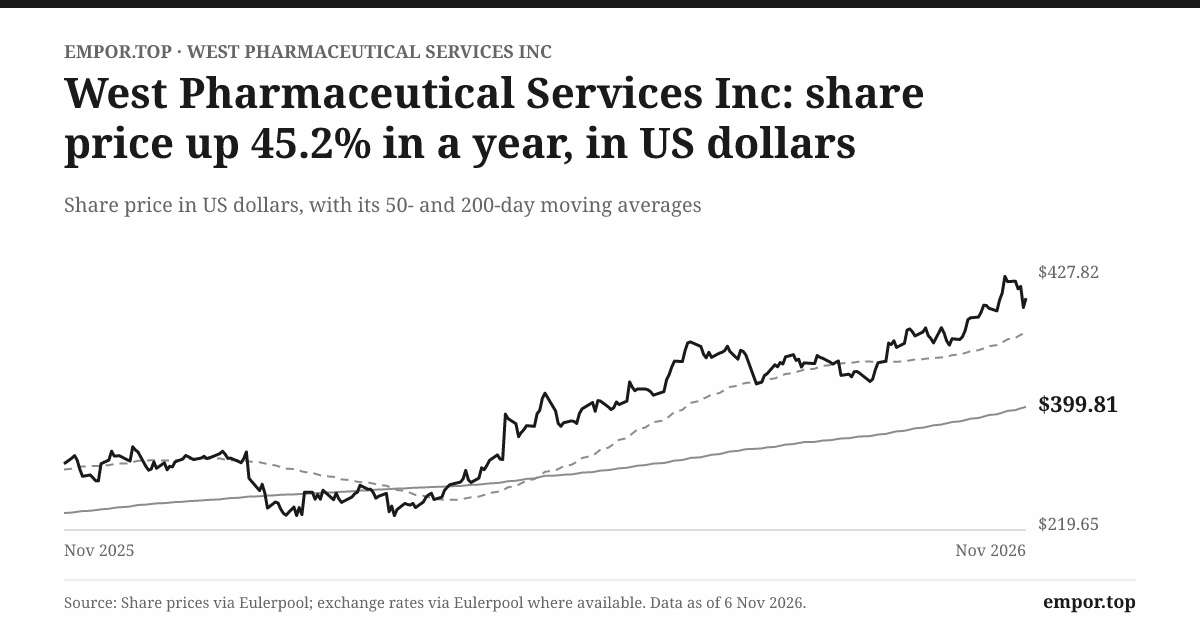
West Pharmaceutical Services makes those parts, and it makes a staggering number of them. The company says it delivers more than 41 billion components and devices every year from a network of about 50 sites, including 25 manufacturing plants, run by more than 10,000 people.1 Spread evenly, that is more than 110 million pieces a day. In 2025 those pieces added up to $3.07 billion of sales.1 On the evening of October 29, 2026, after the company reported a quarter that beat its own expectations and raised its outlook for the third time this year, the stock closed at about $404, its highest level in a year, and the market valued the company at roughly $29.3 billion.[^2]
That valuation is the puzzle at the heart of this story. Investors are paying almost nine dollars for every dollar of West's annual sales, a price normally reserved for software companies and luxury brands, not for a maker of rubber and plastic parts. The bet embedded in that price is that West is not really a parts maker at all. The argument goes like this: once a drug company has tested West's stopper with its drug, filed the combination with regulators and built a filling line around it, swapping that stopper for a cheaper one is slow, risky and expensive. West, in this telling, sits inside the regulatory dossier of the world's most important medicines, and that position should let it grow faster than its customers, charge more over time and turn a high share of profit into cash.
The record supports part of that story and complicates the rest. Over the past decade West's revenue grew at about 8% a year and its net profit at about 18% a year, a superb record for any industrial company.2 But over the three years to 2025, revenue crept up just 2% a year and net profit fell by about 5% a year, as customers who had hoarded components during the pandemic stopped ordering and drew down their stockpiles.2 In February 2025 the company issued a forecast so far below what Wall Street expected that the shares fell sharply before the market even opened.3 If being essential made a business steady, that should not have happened.
So the stakes are clear, and this story will keep returning to three questions. The first is whether regulation and qualification really make West hard to replace, or whether its biggest customers can still bargain, multi-source and time their orders to suit themselves. The second is whether West's most valuable products, its so-called high-value components, can keep growing after the post-pandemic hangover, and what the company's decision to sell its SmartDose wearable injector says about the returns on its ambitions in devices. The third is about people. West has a new chief executive, Michel Lagarde, who took over at the end of August 2026 and hosted his first full earnings call today.45 He inherits a sharp recovery. The company's recent history shows how quickly a recovery like that can be interrupted.
To understand why investors care so much about a grey disc, it helps to start where the company did, in a Philadelphia workshop a century ago.
 Subscribe on LinkedIn
II. A rubber company learns to follow the drug
Herman O. West did not have an easy start. His father left the family when Herman was 12, after two failed businesses, and the boy became the man of the household early.6 Associates later described him as "tough and sandpapery," a man with little time for yes-men who nonetheless listened carefully, and his motto was blunt enough to put on a factory wall: "Keep everlastingly at it."6
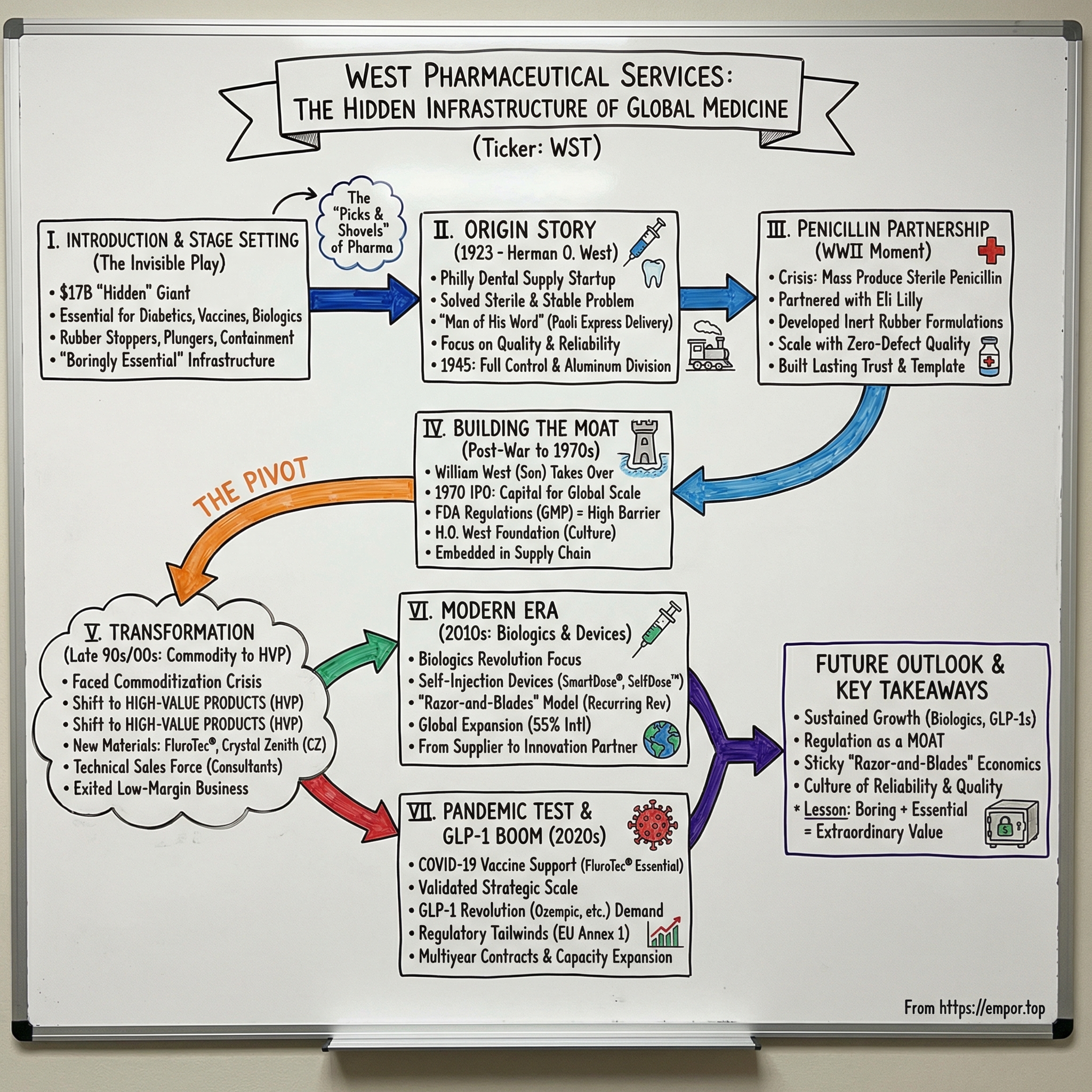
In 1923 he founded his company at a small site in Philadelphia, making rubber plungers for dental cartridges.6 It was a modest product with an important property: it had to sit against a medicine and push it out cleanly, every time. Soon West added aluminum seals at the other end of the site, and demand for those grew enough that he set up a separate aluminum division in 1945.6 From the beginning, then, the company lived at the point where a drug meets its container. That remains its focus.
The moment that turned a workshop into a trusted supplier came during the Second World War. Penicillin had gone from laboratory curiosity to battlefield necessity, and the United States government needed it produced and shipped in enormous quantities. West worked with Eli Lilly to supply penicillin in mass quantities for the government, providing the rubber closures that kept the drug sealed on its way to the troops.6 The company's own history includes a story that has the flavor of founder folklore: when trucks were late, Herman West reportedly carried boxes of product himself on the Paoli Express commuter train to make a delivery deadline.6 West calls it the company's first supply-chain innovation.
It is a good story, and it should be read for what it is. It comes from the company's own centennial telling, and it illustrates an identity rather than proving a moat. What it does capture is the habit that later became the business model: be the supplier a drug maker can count on when the stakes are highest. Eighty years later, when governments again needed billions of doses of a new medicine in a hurry, West found itself in a similar spot, with very different financial consequences during the pandemic.
The decades between the war and the turn of the century were mostly a story of steady expansion. West became a supplier of stoppers, seals and syringe components to drug companies around the world. It also formed a relationship that would prove strategically important: a partnership with the Japanese rubber specialist 大協精工 Daikyo Seiko, in which West owns a 49% stake and from which it exclusively licenses certain key value-added products and processes.2 Some of the coatings and polymer containers that today sit in West's most profitable product lines trace back to Daikyo technology. That dependence on a licensed partner is worth remembering; it is a source of differentiation West does not entirely own.
By the late 1990s West was a solid but unspectacular component maker. Its customers were large, its products were small and its growth tracked the volume of drugs being filled. The company could have stayed that way. Instead, at the start of the new century, management decided that selling rubber by the piece was not enough, and set out to sell the systems and devices that surround the drug as well.
III. The 2001 bet: sell more than rubber
In January 2015, West's executives stood before investors at a healthcare conference and told a story of transformation. The slide deck carried a banner celebrating 90 years of history, but the narrative that mattered began in 2001, when the company said it had launched a strategic shift "to become a leading global supplier of value-added pharmaceutical packaging systems and components."7 The scorecard was impressive. Sales had grown from about $376 million in 2001 to about $1.37 billion in 2013, which West described as an 11.4% compound annual growth rate.7 Inside that total, the company said, its high-value packaging products had grown about 11% a year over the previous five years, and its proprietary delivery-system products more than 20% a year.7
The logic of the shift was simple and, on paper, compelling. West already sold to nearly every large drug company in the world; by 2015 it said the top 50 pharmaceutical and biotech companies and the top 35 injectable biologics relied on West and Daikyo components.7 It already understood how rubber and polymers behave next to sensitive drugs. Why not climb the value chain, from the stopper on the vial to the device that mixes the drug, the safety system on the syringe and the injector the patient uses at home? Every rung up meant more engineering content, more dollars per dose and, in theory, deeper integration with the customer.
Two acquisitions in 2005 were the chess moves that made the strategy real.
The first and larger was The Tech Group, a Scottsdale, Arizona, maker of plastic components and assemblies for pharmaceutical, medical device and consumer customers, with operations in the United States, Puerto Rico, Ireland and Mexico.8 West completed the purchase on May 20, 2005, for $140 million including the retirement of debt, of which $14 million sat in escrow and depended on the business's performance over 2005 and 2006.8 Tech Group gave West something it lacked: the ability to injection-mold complex plastic parts and assemble devices at scale for other companies. It is the ancestor of today's contract-manufacturing business. West paid with cash on hand plus new bank and private-lender debt, and it held back a further $20 million in escrow for five years to cover the sellers' indemnities, a sign of how carefully it priced the risk of buying a business it did not yet know from the inside.8
The second was smaller and more surgical in its fit. Medimop Medical Projects, based in Ra'anana, Israel, made disposable devices for mixing, transferring and reconstituting injectable drugs, the clever little adapters that let a nurse combine a freeze-dried powder with its diluent without exposing either to the air.9 Its founder, Freddy Zinger, had left Teva in the mid-1980s and said the company had been profitable from its earliest days without bank loans or outside capital.9 West paid about $40 million in cash and stock for 90% of the company, with up to $1.8 million more contingent, and Zinger kept the remaining 10%.9 Medimop had about 20 employees, and West expected it to contribute about $8 million of sales in the second half of 2005.9
Run the rough arithmetic and Medimop cost around two and a half times its annualized sales. That is a crude yardstick, not an earnings multiple, and it tells an investor little on its own about whether the price was cheap or rich. Tech Group is harder still to judge: the filing announcing the purchase did not state the business's revenue.8 What can be said is that both deals fit the strategy, and that the capabilities they brought, device manufacturing and drug-transfer systems, still sit inside West today. By 2015, drug reconstitution and fluid-transfer products, Medimop's specialty, including the Mix2Vial transfer device, featured in West's list of proprietary products.7 Whether the two deals earned their cost of capital over twenty years is a question West's disclosures do not let an outsider answer, because neither business has been reported separately for many years. The goodwill on West's whole balance sheet was only about $110 million at the end of 2025, and the company recorded no goodwill impairment that year.2 That at least suggests no large acquisition has blown up on the books. It does not prove the purchases created much value.
The same 2015 deck also showcased a crop of homegrown device bets: the ConfiDose and SelfDose injectors, the éris safety system, NovaGuard needle protection and, notably, the SmartDose electronic wearable injector, for which West said it had development and supply agreements with four of the top ten biopharma companies.7 Hold on to that last item. Agreements with famous customers are not the same thing as a profitable product, and SmartDose's journey from that slide to a sale in 2026 is one of the most revealing episodes in West's modern history.
Over the following decade, the portfolio was reorganized into the shape investors see today. West now reports two segments: Proprietary Products, which covers everything West designs and sells under its own name, and a contract-manufacturing business, now branded West Vantage, which makes devices and components to customers' own designs.210 The question the 2001 bet raised, whether moving into systems and devices would make West more valuable or simply spread it more thinly, can now be answered with segment numbers. And those numbers point somewhere slightly unexpected: the money is still overwhelmingly in the rubber.
IV. The hidden factory behind every injection
Imagine a biologic drug, a fragile protein worth thousands of dollars a dose, sitting in a prefilled syringe in a refrigerator for two years. The rubber plunger at the back of that syringe has to do several contradictory things at once. It has to seal tightly enough to keep out bacteria and oxygen. It has to slide smoothly enough that an autoinjector's spring can push it the full length of the barrel in a few seconds. It must not release chemicals into the drug, and it must not shed a single visible particle. And it has to behave identically whether it was made in Pennsylvania, Ireland or Singapore, in January or July, because the drug company has validated its process around a specific part with specific properties.
That is the hidden factory behind every injection, and it explains how West makes its money.
The company's products sit on a ladder. At the bottom are standard products: conventional stoppers and seals made to established specifications, sold in very large volumes. One rung up are what West calls high-value product components, or HVP components. These are the same basic shapes, stoppers and plungers, but made to far stricter standards. Some are coated with a fluoropolymer film, sold under the FluroTec name, which acts like a nonstick barrier between rubber and drug. Some are washed and sterilized so the customer can drop them straight into a filling machine, the Westar line. Others go through automated vision inspection to catch defects, the Envision line, or are made under the most stringent particle and quality controls of all, the NovaPure line.71 A good analogy is the difference between a standard bolt and an aerospace-certified bolt: they look alike, but the second carries a pedigree, and the pedigree is what the customer is paying for.
Above the components sit HVP delivery devices, the self-injection and drug-administration systems West sells under its own brand, and polymer containers such as Crystal Zenith, a glass alternative made with Daikyo technology.25 Beside the whole ladder sits West Vantage, the contract-manufacturing business.10
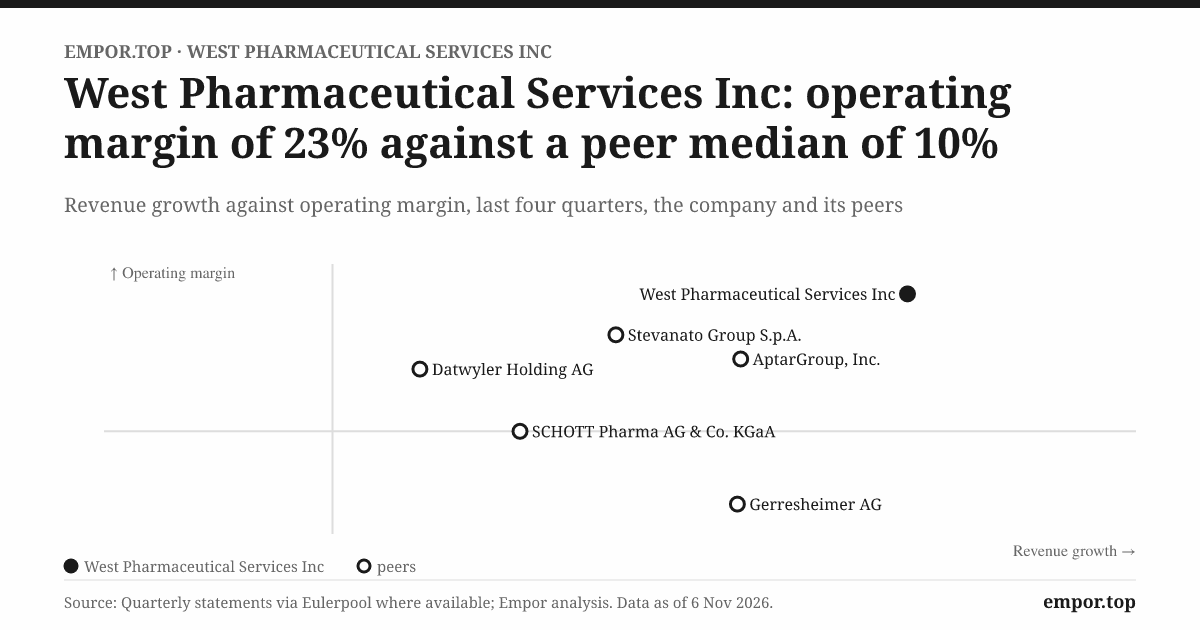
Now follow the money, because the segment numbers deliver a clear verdict on the 2001 strategy. In 2025, Proprietary Products generated about $2.49 billion of sales, about 81% of the company, and about $657 million of segment operating profit.2 The contract-manufacturing segment generated about $582 million of sales and only about $63 million of operating profit.2 Put differently, for every $100 of sales, the proprietary business kept about $26 as segment profit, while the contract business kept about $11. Proprietary Products produced roughly nine of every ten dollars of segment profit. Even after the costs West does not allocate to either segment, about $136 million in 2025, swollen by restructuring and other charges, the conclusion holds.2
That corporate line is worth a moment, because it is where much of the cost of the post-pandemic reset landed. Unallocated costs rose from about $80 million in 2024 to about $136 million in 2025.2 A restructuring plan launched in January 2025 cost about $18 million in severance, accelerated depreciation and lease charges; West also wrote down some elastomer assets and a $4.5 million investment, and preparing SmartDose for sale added roughly $8 million more.2 None of this is unusual for a manufacturer resetting its footprint after a boom. It does mean that West's consolidated margin in 2025 understates what its segments earn, and that investors should keep count of how often charges labelled one-time come back.
The high-value components are the engine within the engine. In the third quarter of 2026, HVP components alone brought in about $467 million, 53% of total company sales, up about 20% from a year earlier.10 A few years ago that line was under half the business; at the end of 2025 it was 48%.1 Every point of mix that shifts from standard parts and contract work toward HVP components lifts the company's margins, because a coated, washed, inspected stopper sells for far more than a plain one while using much of the same factory.
So the 2001 bet produced an uncomfortable answer. The move into contract manufacturing added scale and capabilities, and it still employs about 17% of West's workforce.2 But the high-return business is the old one, made better: the component, upgraded. West's own executives seem to see it the same way. On the third-quarter call, Lagarde described the core of the company as products and said West Vantage's job is to improve its mix toward higher-value work.5 That is a polite way of saying the contract business has to earn its place.
There is a common description of West as a "razor-and-blades" business, and it deserves care. The appeal is obvious: components are consumed every time a drug is filled, so each approved drug becomes a stream of repeat orders. But West does not disclose the length of its customer contracts, any minimum purchase commitments or the share of sales that recurs under long-term agreements.2 Revenue is recognized mostly when products ship.2 The repeat nature of the business is real in practice, but it rests on customers' production plans, not on contractual guarantees, a distinction that mattered enormously when those production plans changed after the pandemic.
What does it cost to run this machine? More than many investors assume. Making HVP components requires clean rooms, washing and sterilization lines and automated inspection equipment, and West spent heavily to add capacity. Capital expenditure was about $377 million in 2024, roughly 13% of sales, before falling to about $286 million in 2025, roughly 9%.2 Research and development is far smaller, about $74 million in 2025, or about 2.4% of sales, almost all of it in the proprietary business.2 That mix tells you what kind of company this is: less a laboratory, more a precision manufacturer whose investment goes into plants rather than patents. In 2026 the spending has fallen further. Management cut its full-year capital-spending forecast to $215–220 million, down from $250–275 million at the start of the year, and Lagarde said West will stay within a range of 6% to 8% of revenue, relying on automation and process improvement to squeeze more output from existing lines.105
The payoff from all that investment shows up in cash. Over the twelve years from 2014 through 2025, West reported about $4.1 billion of net profit and generated about $5.5 billion of operating cash flow, about a third more than its accounting earnings.2 After capital spending, it produced about $3.0 billion of free cash flow, and it paid only about $550 million of that out as dividends, under a fifth.2 Two things explain the gap between profit and cash. Depreciation on all those plants is a large noncash charge that gets added back, and stock-based compensation is another. But working capital can swing the other way: in 2025, inventory absorbed about $63 million of cash, while changes in other assets and liabilities, including the timing of incentive payments, released about $108 million.2 Long-run conversion is strong. In any single year, though, it can flatter or understate the underlying business.
The returns on that capital tell a story of their own. Return on invested capital climbed from the low teens in 2014 to a remarkable 34% in 2021, at the pandemic peak, then slid back to about 18% by 2025 as new plants came on line ahead of demand.2 That slide is the central operational question of this section. West has shown it can earn high returns when its plants are full of high-value work. It has also shown that capacity built for a boom can sit underused when demand pauses. Can West keep adding capacity and raising the value of each part without diluting its returns? To answer that, one has to understand why customers keep buying from West in the first place, and how much leverage that really gives it.
V. The moat is built at the customer’s filling line
That is the moat West's bulls describe, and it is a real mechanism. A stopper might represent a tiny fraction of a drug's cost, while the cost of a supply interruption or a regulatory delay could be enormous. Faced with that asymmetry, few drug companies will switch a qualified component to save a few cents. Regulation has, if anything, raised the stakes. The European Union's revised rules for manufacturing sterile medicines, known as Annex 1, took effect on August 25, 2023, and require manufacturers to implement a formal contamination control strategy and broader monitoring.11 For a supplier of washed, sterilized and inspected components, that is a tailwind: customers who need to prove contamination control have reason to upgrade from standard parts to higher-grade ones. West said it has added more than 200 HVP upgrade projects in 2026 alone, most of them so far in Europe, and on today's call management noted that draft U.S. guidance points in a similar direction.5
But a moat built on switching costs is not the same as a cornered market, and the evidence on West's bargaining position is more mixed than the bull story admits.
Start with competition. West names Datwyler and Aptar as competitors in proprietary components, and SMC, Phillips Medisize, Sharp and PCI Pharma Services among competitors in contract manufacturing.2 Widen the lens to containers and devices, the way Stevanato maps its own competitive field, and it fills out with Gerresheimer, Schott, BD, ニプロ Nipro, SHL, Ypsomed and West itself.12 These companies overlap only partly: some make glass, some make rubber, some make whole injectors. That patchwork is one reason no public filing provides a reliable, comparable market-share table for the whole industry, and West does not publish its own share of any product category. The claim that West dominates elastomer components for injectables is widely repeated, and its presence in the drugs of the top 50 pharma companies is consistent with it.7 But that is presence, not share, and presence is compatible with a customer buying from West and a competitor at the same time.
That is the second limit. Large drug companies have every incentive to qualify two suppliers for critical parts, precisely so that no single vendor can hold them hostage. Switching costs protect the incumbent on an existing drug; they do far less to guarantee who wins the next one, or how a customer splits volume between two qualified sources.
The third limit is concentration, and it has been rising. In 2025, one customer accounted for about 16% of West's sales, about $486 million, up from about 11% in 2023.2 That customer buys from both segments. West does not name it. The ten largest customers together accounted for 47.6% of 2025 sales.2 Given that West's GLP-1-related high-value revenue alone ran at just under 12% of total sales in the third quarter of 2026, and that injectable obesity and diabetes drugs are dominated by a small number of manufacturers, it is reasonable to suspect the big customer's growth is tied to that drug class.5 But West does not say so, and an investor should treat it as an inference, not a fact. What is a fact is that one buyer now accounts for roughly one dollar in every six West earns, and that buyer's bargaining power grows with its share.
The receivables data deserve a careful reading rather than an alarmist one. Debtor days, the number of days of sales sitting in unpaid invoices, rose from about 46 in 2014 to a peak of 70 in 2024, and stood at 68 in 2025.2 Receivables at the end of 2025 were about $574 million, against an allowance for expected credit losses of just $1.4 million, about a quarter of one percent.2 West does not disclose an ageing schedule or customer-specific overdue balances, and nothing in its filings suggests late payment or unusual credit terms for the large customer.2 In mid-2026, receivables rose about $145 million from year-end, which the company attributed to higher sales near the June balance-sheet date.13 The right reading is that the money is almost certainly coming; the question is how long West has to wait, because every extra day of credit is cash tied up in a customer's balance sheet rather than West's. Lengthening terms can also be a quiet form of price concession to powerful buyers. That is a signal to monitor, not a conclusion.
So where does that leave the moat? The best single piece of evidence came on today's call. West said price contributed just over 4 points of growth in the third quarter, while Lagarde said the long-term planning assumption remains 2% to 3% a year, with 2026 running a bit above that.5 A supplier that can raise prices every year, in a period when one customer's share is climbing, has some real power. But 2% to 3% is not the pricing of a monopolist; it is the pricing of a trusted incumbent whose customers accept modest increases rather than risk a switch. The history narrows the claim rather than rejecting it: qualification creates durable attachment to existing drugs and supports steady price increases, but it has not prevented customers from cutting orders sharply when it suited them, and it does not settle who wins the next generation of programs. The figure that would confirm or falsify the moat over the next few years is price realization staying in that 2% to 3% band while the largest customer's share stops rising. The post-pandemic order cuts provided the clearest stress test.
VI. The pandemic surge turns into an inventory hangover
In 2020 and 2021, the world's drug companies were terrified of running out of things. COVID-19 vaccines needed billions of vials and stoppers almost overnight, supply chains were snarled, and every procurement department learned the same lesson at once: the cost of having too little is far greater than the cost of having too much. So customers ordered heavily, and then ordered more.
West's numbers from that period look like a different company. Revenue jumped about 32% in 2021, to roughly $2.8 billion.2 Net profit nearly doubled to about $661 million, and operating margin reached almost 27%, nearly double where it had been five years earlier.2 The share price followed. Investors extrapolated the obvious story: an essential supplier, a new class of vaccines and biologics, a step change in demand.
Then the hangover arrived. Customers discovered they were sitting on months of components, and as vaccine demand faded they did the rational thing: stopped ordering and used up what they had. West's revenue grew little in 2022 and 2023, then shrank 2% in 2024.2 Operating margin slid from almost 27% to about 21% over three years, and net profit fell back toward $490 million.2 The company cut its outlook as destocking dragged on longer than expected.14 In early 2025 it also told investors it would not take part in the next-generation devices of two large glucose-monitoring customers in its contract business, a loss of future work that one shareholder's investor letter described as a surprise exit by two major customers.1514
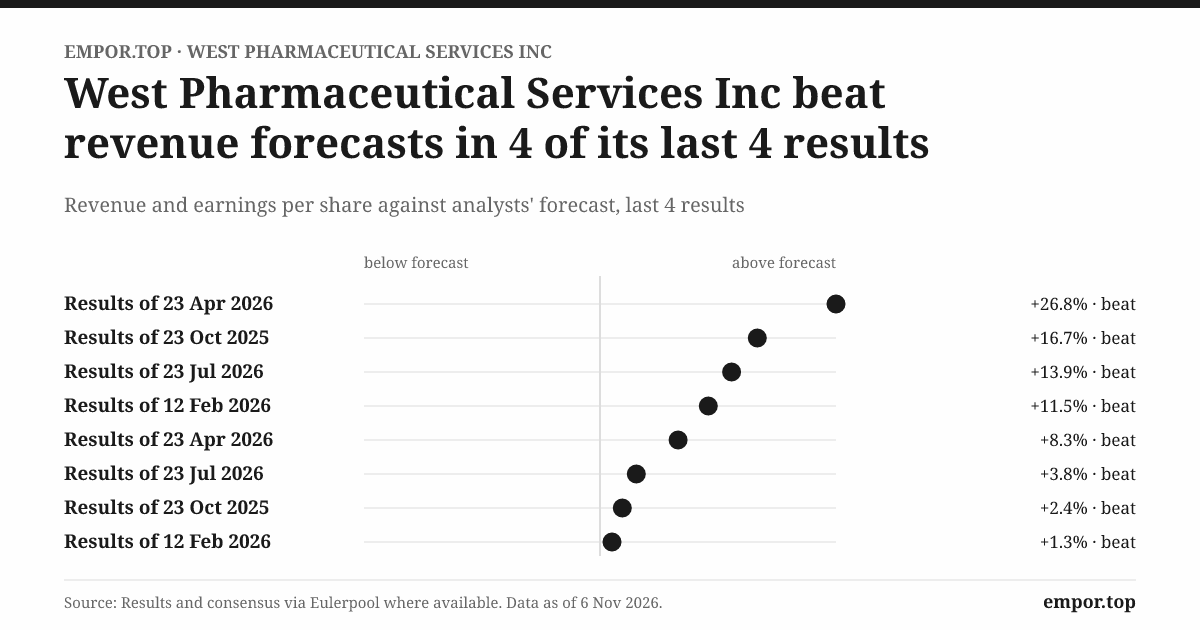
The low point for investor confidence came on February 13, 2025. West forecast 2025 adjusted earnings of $6.00 to $6.20 a share, far below analysts' average estimate of $7.44, and revenue of $2.88–2.91 billion against expectations of $3.04 billion.3 The shares fell about 18% in premarket trading.3 Eric Green, the chief executive, blamed biotech customers drawing down pandemic-era inventories and a strong dollar that shrank the value of overseas sales, while insisting that "the impact of destocking continues to moderate."3 Currency mattered more than a casual observer might think: more than half of West's sales come from outside the Americas, so a stronger dollar mechanically lowers reported revenue even when customers order the same number of parts.2
What did the hangover reveal? It disproved the simplest version of the bull thesis, the idea that an essential supplier must have essential, steady demand. West's parts are essential to each dose, but the timing of orders belongs to the customer, and customers can stockpile. A business whose products are consumed with production is still exposed to its customers' inventory cycle, the same whiplash that hits semiconductor and auto-parts suppliers. What the hangover did not disprove is the long-run demand. Over ten years, revenue still grew about 8% a year.2 The pandemic pulled demand forward and then pushed it back; it did not destroy it.
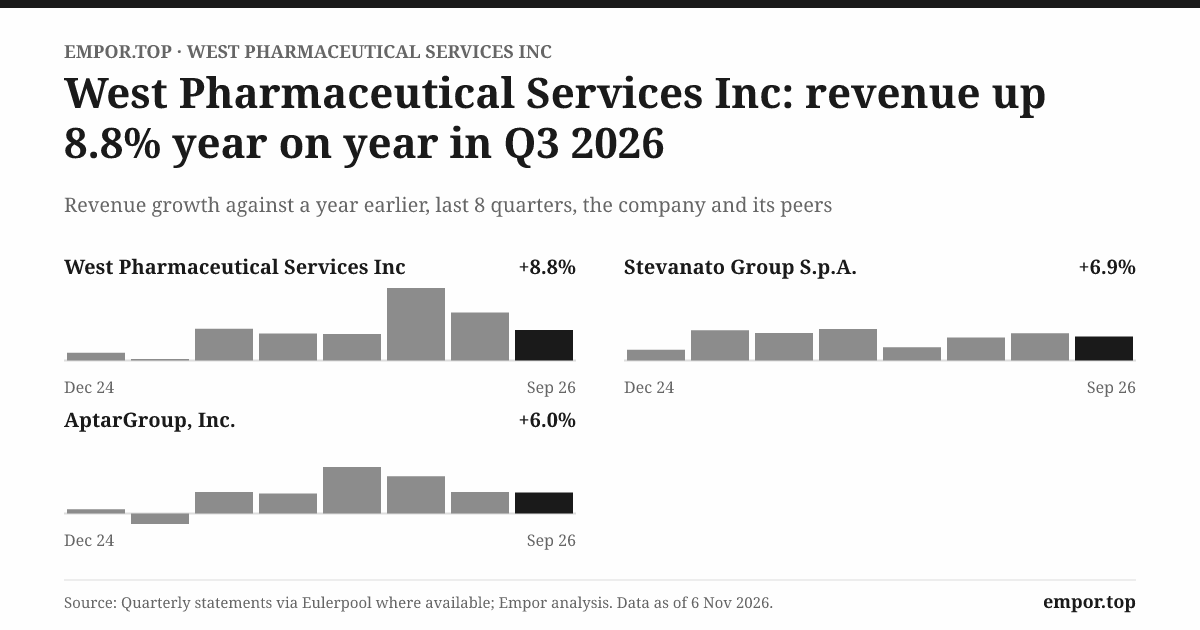
The recovery, when it came, came fast. Revenue grew about 6% in 2025, or about 4% excluding currency, driven mainly by high-value components.1 Even that recovery carried a reminder of how lumpy device revenue can be: sales of high-value delivery devices fell about 17% in the fourth quarter of 2025, because the year-earlier quarter had included a one-time $25 million incentive fee.1 Then 2026 broke open. First-quarter sales rose 21% reported and about 15% organically, meaning after stripping out currency and the SmartDose business West was selling.16 HVP components led the way, up almost 23% organically on demand for the washed and sterilized Westar and the premium NovaPure lines.16 Sales grew about 13% organically in the second quarter.17 And in the third quarter, reported today, organic growth was 11.9%, led by HVP components up 20%.10 West raised its full-year guidance after each of those quarters. In February it had forecast 5% to 7% organic growth and adjusted earnings of $7.85 to $8.20 a share; it now expects organic growth of about 11.3% to 11.6% and adjusted earnings of $9.38 to $9.48.110 That is an earnings forecast roughly 17% higher than where the year began.
The texture underneath the headline matters as much as the headline. Proprietary Products grew about 17% organically in the third quarter. West Vantage shrank about 7%.10 Part of the contract business's weakness reflects legacy programs rolling off, and part reflects the cyberattack West suffered in May. The company detected an intrusion on May 4, 2026, and three days later concluded it was a material incident: data had been stolen and some systems encrypted, and West took its on-premise systems offline around the world to contain the damage.18 West said manufacturing restarted in stages, and today management said revenue deferred by the incident had been fully recovered, though the disruption shifted timing between quarters in West Vantage.5 The company has not broken out the full cost; nonrecurring professional fees for the incident and certain legal matters are lumped together in an "other" line that totaled about $9 million in the first nine months.10 The episode is a reminder that a business promising never to interrupt supply depends on its own computer systems as much as its clean rooms. Over the first nine months of 2026, West Vantage's sales were essentially flat on an organic basis, while the proprietary business grew about 17%.10 The two halves of the company are now moving at entirely different speeds, which is exactly what the segment profits from 2025 would lead an investor to want.
The biggest question about the rebound is its breadth. GLP-1 drugs, the injectable obesity and diabetes medicines, are clearly a major engine. West's GLP-1-related high-value revenue was just under 12% of total sales in the third quarter and growing well into the 30s percent, according to finance chief Bob McMahon.5 But the non-GLP-1 part of HVP components also grew in the high teens, biologics revenue was up about 26% for the year so far, and sales in Asia-Pacific jumped 42%, led by India and China.5 McMahon pointed to expanded Medicare access, generic versions of older GLP-1 drugs outside the United States and next-generation molecules as reasons the class should keep growing.5 On today's call, an Evercore analyst asked directly whether any one-time items had boosted the GLP-1 business; Lagarde said nothing in the quarter was one-off.5 A UBS analyst asked whether roughly 10% was still the right planning assumption for GLP-1 growth, and Lagarde declined to confirm the figure, saying growth gets harder to compare against but that he remained bullish.5 That combination is encouraging but not conclusive. The growth looks broader than a single drug class, which matters, yet a heavy share of it rests on a handful of molecules made by a handful of companies, and the same concentration that drives growth today is the concentration that could amplify the next inventory cycle.
There is one more distortion in 2026's numbers, and it is large enough to deserve its own chapter. West spent more than a decade building a wearable injector. This year it sold it.
VII. SmartDose: build, commercialize, then sell
On January 12, 2026, West announced that it had agreed to sell the manufacturing and supply rights for its SmartDose 3.5mL on-body delivery system, together with the facilities that made it, to AbbVie for $112.5 million.[^20] The deal closed on July 1, 2026.19 West kept its other SmartDose versions, including a larger 10mL system still in development.[^20]
To understand why this was a surprising move, picture the device. SmartDose is a small wearable injector that sticks to a patient's skin and slowly delivers a dose too large or too viscous for a standard pen. It holds the drug in a separate prefillable polymer cartridge.19 For drugs that would otherwise require a trip to an infusion center, an on-body injector lets the patient take the dose at home. It was the kind of device West had pursued since its 2001 strategic shift, and West described itself as a pioneer of the technology.19 The development and supply agreements with leading biopharma companies were already in place by 2015.7
And SmartDose became a real product with real sales. West said it expected SmartDose 3.5mL to account for about 4% of its 2025 revenue.[^20] The device generated about $55 million of sales in the second half of 2025 alone.10 And it was still growing when West let it go. SmartDose 3.5mL brought in about $46 million in the first quarter of 2026 and $42 million in the second, then about $12 million in the third quarter around the handover: roughly $100 million in all for 2026.5 The agreement also let West collect additional project payments for milestones reached before closing.[^20] So this was not a science project that never shipped, a common fate for corporate device ambitions. It cleared the hardest bar: customers bought it, in volume.
Yet the economics were a different matter. When West laid out its 2025 outlook, management told investors the SmartDose device business was expected to be margin-dilutive that year.15 In other words, a decade-long effort produced a product with revenue but, at least during the period investors could see, profit margins below the rest of West's portfolio. When Green announced the sale, he framed it as the outcome of a portfolio review.[^20] Read alongside the margin guidance, the message seems clear: SmartDose was worth more to a drug company that wanted to own the manufacturing itself than it was to West as a supplier. The price points the same way. At the pace of the first half of 2026, SmartDose 3.5mL was selling at an annual rate of roughly $175 million; West accepted $112.5 million for the business, well under one year of its sales. Buyers do not usually pay so little for revenue that earns attractive margins, and sellers do not usually accept it.
The sale scrambles the comparability of West's numbers, and investors should strip it out. SmartDose 3.5mL sales were about $12 million in the third quarter, down from about $30 million a year earlier, and West expects none for the rest of the year.10 The company excludes those sales from its organic growth figures, which is why reported third-quarter revenue growth of about 9% sits below organic growth of about 12%.10 Management said the divestiture will create a headwind of about 2.9 points to reported growth in 2027.5
The profit side is distorted in the opposite direction. West booked a net gain of about $56 million on the sale in the third quarter.10 That is why reported operating profit was about $267 million, a 30.6% margin, while adjusted operating profit, excluding the gain and other items, was about $222 million, a 25.3% margin.10 Reported earnings per share were $3.02, adjusted earnings $2.66.10 The sale also carried a one-time tax cost of about $22 million.10 None of the gain is repeatable. Anyone who multiplies third-quarter reported earnings by four to estimate West's earning power will overstate it.
What does the episode say about West's ability to turn device technology into lasting economics? Less than either side would like. Bulls can point out that West built a product that a major drug company valued enough to buy, and that the adjusted 25% margin in the third quarter, up about four points from a year earlier, partly reflects shedding a dilutive line.5 Bears can point out that a strategy launched in 2001 to move West up the value chain produced, in its most visible device, a business West ultimately decided it should not own. Neither conclusion is supported by the numbers West publishes. The company has never disclosed SmartDose's cumulative investment, its lifetime profit or the book value of what it sold, so there is no way to calculate whether the $112.5 million price recovered what went in. The fairest reading is that SmartDose is evidence of portfolio change, not proof of failure or success, and that it lowers the confidence an investor should place in West's next device bet.
That next bet is already on the table. West continues to develop SmartDose 10 with partners, and management highlighted broad-based growth in other devices, including Crystal Zenith containers and drug-administration systems.5 It also launched a new prefilled-syringe system, Synchrony, in January 2026.2 Each of these deserves to be treated as optionality, not as a forecast, until it produces sustained sales at margins that look like the component business. SmartDose's history suggests the conversion from technical milestone to profitable product is slow and uncertain even when the milestone is reached.
The SmartDose sale was one of Eric Green's last big portfolio decisions. Within six months of announcing it, he had told the board he would retire, and West had found his successor.
VIII. A new CEO inherits a rebound—and a credibility test
On August 31, 2026, Michel Lagarde became West's president and chief executive.4 He arrived from Thermo Fisher Scientific, where he had been executive vice president and chief operating officer. Before that he was president and chief operating officer of Patheon, the contract drug manufacturer, and earlier still he was a managing director at the private-equity firm JLL Partners after a dozen years in finance at Philips.4 He has sat on the board of Vertex Pharmaceuticals since 2023.4 The résumé is that of an operator and integrator: someone who has run large networks of manufacturing plants for pharmaceutical customers, and who knows what those customers demand of suppliers because he has been one.
He replaced Eric Green, who had led West since April 2015. Green came from Sigma-Aldrich, where he ran the research-markets business, its largest unit; he was 45 when he took over from Donald Morel.20 Green's tenure spans most of the story so far: the steady compounding of the late 2010s, the pandemic boom, the hangover and the recovery. He told the board on March 6, 2026, that he intended to retire once a successor was hired.4 With the handover, West also split the roles of chairman and chief executive, which Green had combined; Robert Friel, the lead independent director, became chairman.4 For governance-minded investors, that separation is a modest but real improvement. Shareholders had shown some restlessness: at the 2026 annual meeting, about 4.6 million votes were cast against Green's re-election as a director, even as say-on-pay won more than 94% support in the prior year.2122
Green's own pay tracked the cycle, falling from about $9.4 million in 2023 to about $7.2 million in 2025 as net income slid from about $593 million to about $494 million.22 The finance seat had also turned over: Bob McMahon became chief financial officer on August 4, 2025, with reported compensation of about $11.8 million in his first year, swollen by a sign-on bonus, equity awards and nearly $700,000 of relocation and tax reimbursements.22 So by the end of this summer, both of the people who speak for West's numbers had been in their jobs for little more than a year, and one of them for two months.
Lagarde's package is substantial and designed to look forward. His base salary is $1.175 million, with a target annual bonus of 125% of salary and an annual long-term incentive award targeted at $10 million, split among performance shares, restricted stock and options.4 He also received a sign-on award worth about $6.9 million and a matching program: for every dollar of West stock he bought with his own money between his appointment and his start date, up to $2.5 million, he would receive matching restricted stock and options that vest only after five years.4 That matching grant is the most interesting design choice, because it ties a slice of his reward to personal capital at risk. It matters, because ownership by insiders is otherwise thin. Directors and executive officers as a group held less than 1% of the shares in the 2026 proxy, while the largest holders were index giants, Vanguard with about 13.5% and BlackRock with about 8.4%.22 West has no controlling shareholder. Alignment, in practice, runs through stock awards rather than through founders' fortunes.
The new chief executive inherits two legacies, and they pull in different directions.
The first is a recovery and a pile of cash. West generated about $469 million of free cash flow in 2025, and it has been returning capital aggressively.1 The record over recent years is worth tracing, because it shows a pattern. West bought back about $438 million of its stock in 2023 and about $561 million in 2024, years when earnings were falling, then slowed to $134 million in 2025.2 In February 2026 the board authorized a new $1 billion repurchase program, and West spent about $685 million under it in the first nine months of the year, about one and a half times all of 2025's free cash flow.210 Cash on the balance sheet fell from about $791 million at the end of 2025 to about $464 million at the end of September.10 The timing is notable too. West paid an average of about $244 a share in the first quarter and about $258 in the first half, but the roughly 0.6 million shares it bought in the third quarter cost, by a rough calculation from the company's share counts, around $380 apiece, not far below today's record price.161710 Buybacks, in other words, accelerated as the share price climbed. The dividend, meanwhile, remains small; the board raised it 18% this month to 26 cents a quarter, a yield of about 0.2%, and management said it marked the 34th consecutive annual increase.105
To fund the next phase, West refinanced. On October 26, 2026, it signed a new five-year unsecured credit agreement with a $750 million revolving line and a $200 million term loan, repaying the $130 million outstanding under its old facility.23 The agreement caps net leverage at 3.5 times earnings before interest, tax, depreciation and amortization, rising temporarily to 4 times after a qualifying material acquisition.23 West's leverage is nowhere near those limits; at the end of 2025 it had about $203 million of debt and no revolver borrowings.2 But the facility gives the company far more firepower than it has had, and the acquisition clause shows management wanted room to use it. Asked today about deals, Lagarde said organic growth comes first and the bar for acquisitions is very high.5 The next quarterly filing will show how much of the new capacity is drawn.
The second inheritance is a credibility test. Green's last full year began with the February 2025 guidance shock and ended with a run of beats and raises in 2026. That pattern cuts both ways. A company that set a 2026 target and then raised it three times is either conservatively guiding or poorly forecasting its own demand, and the post-pandemic hangover suggests visibility into customer ordering is genuinely limited. Lagarde now owns the forecast. His first guidance for a full year, due with fourth-quarter results in February 2027, will be the first real measure of his judgment.5
On today's call he gave a preview of his priorities. In his prepared remarks he described touring West's plants, including Eschweiler in Germany, where automation is expanding capacity, and meeting customers, and his central message was that West counts among its customers' preferred partners.5 Asked how he would deepen West's moat, he named closer strategic relationships with customers, including joint demand planning, and a sharper continuous-improvement effort using digital tools and automation.5 Joint demand planning is a telling phrase, because it addresses precisely the weakness the hangover exposed: if West can see its customers' production plans earlier, it can avoid building capacity for orders that evaporate. Asked about capital spending, he committed to the 6% to 8% of revenue range and said new finishing capacity for high-value components, built inside existing plants, takes 18 to 24 months to contribute meaningfully.5 These are concrete operating answers rather than slogans. But they are promises two months into a tenure, and the measure will be whether West's next downturn, whenever it comes, is milder than the last.
All of which brings the story to the question a buyer of the shares must answer today: what is all of this worth?
IX. Analysis & Bear vs. Bull Case
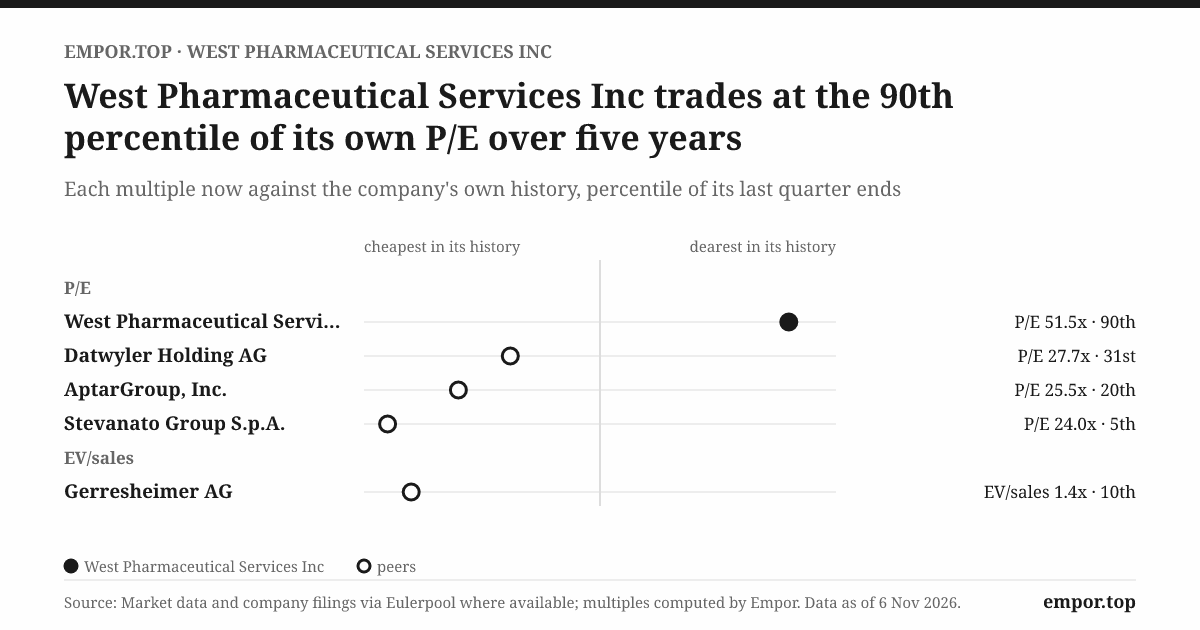
On the evening of October 29, 2026, West's shares sat at their 52-week high, about $404, up from a low near $231 within the past year.[^2] At that price the company is valued at about 52 times the last twelve months of reported earnings, against a five-year median of about 43.5 times.[^2]10 Enterprise value is about 32 times trailing earnings before interest, tax, depreciation and amortization, and the free-cash-flow yield, the cash generated for each dollar of share price, is about 1.5%.[^2]2
The headline multiple needs one adjustment before it means anything. Trailing reported earnings include the SmartDose gain, which flatters them, but they also include a weak late 2025, which depresses them. A cleaner reference point is the company's own outlook: on management's guidance of $9.38 to $9.48 of adjusted earnings for 2026, the shares trade at roughly 43 times this year's earnings, almost exactly the stock's five-year median.10[^2] Put simply, the market is not paying an unusual multiple for the recovered earnings. It is paying West's usual premium on earnings that management expects to jump by almost 30% this year, and it is assuming they will keep rising.5 For context, Stevanato traded at about 35 times earnings this month and AptarGroup at about 23 times, though both have different product mixes and neither is a clean comparison.2425 The premium over peers is the market's verdict that West's business is better. Whether that verdict is right is the whole case.
Work through the industry forces and the shape of the argument becomes clearer. The threat of new entrants into high-value elastomer components is low: a newcomer must build sterile plants, accumulate years of quality data and then persuade drug makers to bet a launch on an unproven supplier, a chicken-and-egg problem that protects incumbents. The threat of substitutes is modest but not zero; glass is giving ground to polymers in some applications, prefilled syringes are displacing vials, and wearable injectors compete with pens, but in each case the new format still needs a seal or plunger, and West sells into most formats. Supplier power is moderate: West depends on specialty rubber, polymers and, importantly, on licensed technology from Daikyo, its 49%-owned affiliate, an arrangement that gives it differentiation it does not wholly control.2 Rivalry is real but segmented, with Datwyler and Aptar competing most directly in components and a crowd of glass, device and contract makers around the edges.212
The Daikyo relationship deserves a closer look, because it sits in the most valuable part of the portfolio. West accounts for its 49% stake by taking its share of the affiliate's earnings, about $14 million in 2025, down from about $18 million in 2023.2 What West does not disclose is the value of products and technology flowing between the two companies, the royalties involved or the balances owed between them.2 An investor therefore cannot size how much of West's high-value franchise depends on a partner it does not control. Nothing in the record suggests the relationship is under strain; it is simply a dependency the numbers do not illuminate.
The force that decides West's economics is buyer power. Switching costs protect existing drugs, while concentrated customers retain leverage over new programs, payment terms and order timing.2 Pricing suggests a balance: West has enough power to keep prices rising, but not enough to dictate them.5
Hamilton Helmer's framework of seven durable sources of competitive advantage sharpens the picture. West's strongest are switching costs and a limited resource advantage in process know-how and Daikyo technology. It also has some scale economies and industrial reputation. It lacks network effects and counter-positioning, and a well-funded rival could copy its high-value product strategy. The result is a moat that is real but narrow: deep on existing drugs, shallower on new ones.
Now set the two cases against each other.
The bull case starts with the continued mix shift toward high-value components.10 The drivers behind that shift are long-lived trends, and customers are choosing higher-grade parts for existing drugs, not only new ones.511 Proprietary Products' outsized contribution to segment profit means gains in the core business show up powerfully in the bottom line.2 Cash generation has exceeded accounting profit over twelve years, the balance sheet carries little debt relative to equity, and capital spending is falling as a share of sales, which should widen free cash flow.25
The bear case starts with the hangover and the February 2025 forecast shock, which exposed the limits of management's visibility.23 The rebound's reliance on GLP-1 drugs and rising customer concentration leave it vulnerable to another inventory cycle.52 Debtor days remain above their level a decade ago.2 The SmartDose sale removes revenue and makes this year's earnings growth look better than the underlying business. The accelerated buyback at current prices raises a question: why is a company trading at over 40 times earnings spending more than its annual free cash flow repurchasing its own stock instead of holding the dry powder for the next downturn, when shares were last available at a fraction of today's price.10
Weighing the two, the evidence supports a narrower version of the bull thesis than the share price might imply. West's core component business has durable advantages, and 2026 shows those advantages translating into growth and margin when customers are buying. But the company's own record over the last five years rejects the idea that those advantages make its earnings smooth. A premium multiple on a cyclical-but-advantaged business is defensible; a premium multiple that assumes the cycle is over is not. The difference between those two descriptions will show up in three numbers. The first is whether HVP component growth can hold near its current pace as its share of sales rises.10 The second is whether customer concentration and payment terms stabilize, both of which have moved against West.2 The third is adjusted operating margin and cash conversion as SmartDose rolls out of comparisons; nine-month free cash flow is down about 5% on higher receivables and inventory.105 If those hold as the GLP-1 surge matures, the premium is earned. If they slip, history says the market will remember 2025 quickly.
A few quieter items belong in any diligence file. More than $570 million of West's year-end cash sat outside the United States.2 The company carried about $56 million of unrecognized tax benefits, positions tax authorities could still challenge, and its auditor, PwC, flagged income-tax accounting as a critical audit matter while giving clean opinions on both the financial statements and internal controls.2 West named no material pending lawsuit in its 2025 annual report.2 Currency remains a live swing factor: translation added about $56 million to reported 2025 sales and about $49 million in the first half of 2026, a tailwind that would reverse if the dollar strengthened.213 The May cyberattack also leaves the door open to later costs that the company has not quantified.18
X. Playbook: Business & Investing Lessons
There is a particular kind of company that wins by being invisible. Its customers notice it only when something goes wrong. West is the purest example on the stock market, and its century offers lessons that apply well beyond rubber.
The first lesson is that reliability earns a place in the process, but only performance keeps the economics. Herman West carrying boxes on the Paoli Express is a parable about showing up when it counts, and that reputation is what gets a component written into a drug's regulatory file. But once West was inside the file, it still had to keep earning the right to raise prices, to win the next molecule and to keep its share against a qualified second source. Being trusted is the entry ticket. Those modest annual price increases are what the trust is actually worth, and no more. Founders building suppliers to regulated industries should take that both ways: qualification is a moat, but it is a moat around last year's business, not next year's.
The second lesson is that a technology is not a business until customers keep buying it, and even then it may be a better business for someone else. SmartDose became a commercial product and drew a buyer, yet the company that built it decided it was worth more as a cheque than as a product line. For investors, SmartDose is a measuring stick for every device promise West makes from here: count the revenue, then ask about the margin, then ask who captures the value when a drug company would rather own the manufacturing itself.
The third lesson is that capacity is a wager on demand, and the customer holds the dice. The pandemic boom and hangover showed how quickly returns can fall when new plants come on line into a lull. The parts were just as essential the whole time. What changed was the customers' inventory. Any supplier whose product is consumed with production is, whatever its moat, partly a bet on its customers' stocking decisions. That is why Lagarde's talk of joint demand planning may prove to be his most important idea: the cheapest capacity is the capacity you never build for orders that never come.
The fourth lesson is that cash is the scorecard beneath the story. West's long-run cash conversion is strong, but customers are taking longer to pay and buybacks recently outran free cash flow by a wide margin. The scorecard is good. It is also the first place a change in bargaining power, or in management's appetite, would show up.
XI. Epilogue
Tonight West stands at an interesting hinge. The guidance has been raised for the third time this year.10 Organic growth remained strong in the latest quarter.10 SmartDose 3.5mL belongs to AbbVie now. A billion-dollar buyback is more than two-thirds spent, a new credit line sits unused in the background, and a chief executive two months into the job has just finished his first full earnings call.
The fourth quarter will be the first test, and management has already lowered the bar a little. It guided to fourth-quarter organic growth of about 6% to 7%, slower than any quarter this year, warning that high-value device sales would be lumpy against a strong comparison and that some contract-manufacturing revenue had been pulled forward into the third quarter.5 A quarter that lands inside that range would be consistent with a business normalizing to a healthy pace. A quarter that misses would revive the memory of February 2025.
The bigger moment comes in February 2027, when Lagarde issues his first full-year forecast. Management has already warned that the SmartDose sale will cut about 2.9 points from reported growth next year.5 The question underneath is how much of 2026's acceleration was West gaining ground and how much was customers finishing their destocking and refilling the pipeline. If 2027 organic growth holds near the company's long-term rate of the high single digits, led by HVP components and spread across biologics, Annex 1 upgrades and Asia rather than leaning on GLP-1 alone, the rebound starts to look like a new base. If growth falls back toward low single digits as the comparisons stiffen, 2026 will look like a recovery year, not a new trajectory.
Then there is the annual report itself. Next spring's 10-K will reveal whether the largest customer's share kept rising past 15.8%, whether debtor days and inventory days stretched as sales grew, and whether operating cash flow kept pace with profit once the receivables build of this year unwinds. It will show how much of the new revolver West drew down, and whether the buyback continued at record prices. And the next proxy will show how Lagarde's own matching purchases and performance awards are measured.
There is a quieter clock running in the factories. West is keeping capital spending restrained and relying on automation and existing plants to add capacity.105 That is the opposite of the pandemic-era playbook, when capital spending ran at about 13% of sales. If demand for high-value components keeps compounding at anything like 20%, West will have to choose between spending more and rationing its premium capacity, and either choice will reveal how confident Lagarde really is in the demand he describes. If demand cools, the restraint will look prescient, and the question will become whether the buyback money would have been better kept in reserve.
Each outcome maps onto one of the three questions this story began with. Steady price increases with a stable largest-customer share would mean qualification is translating into bargaining power. Broad HVP growth outside GLP-1 would mean the high-value franchise has more than one engine. And a first full-year forecast that West then meets, rather than raising three times or cutting once, would be the clearest sign that the new chief executive sees his customers' demand better than his predecessor could.
The central tension remains exactly where this story began. West makes a part that no drug can do without. Its customers still decide when they need it.
XII. Outro
Go back to that grey disc on top of the vial. The nurse pushes the needle through it without a glance. The patient never learns its name. If it does its job perfectly, which it almost always does, nobody in the room will think about it again.
That is West Pharmaceutical Services in one image: a century-old company whose parts are essential to some of the world's most valuable medicines, but whose business still runs on customers' timetables. The stopper is invisible. The economics behind it never are.
References
-
West Reports Fourth-Quarter and Full-Year 2025 Results, Exhibit 99.1 to Form 8-K — West Pharmaceutical Services, 2026-02-12 ↩↩↩↩↩↩↩↩
-
2025 Form 10-K — West Pharmaceutical Services, SEC, 2026-02-17 ↩↩↩↩↩↩↩↩↩↩↩↩↩↩↩↩↩↩↩↩↩↩↩↩↩↩↩↩↩↩↩↩↩↩↩↩↩↩↩↩↩↩↩↩↩↩↩↩↩↩↩↩
-
West Pharmaceutical forecasts 2025 results below expectations, shares drop — Reuters, 2025-02-13 ↩↩↩↩↩
-
Form 8-K: Michel Lagarde Appointment — West Pharmaceutical Services, SEC, 2026-06-01 ↩↩↩↩↩↩↩↩
-
West Pharmaceutical Services Q3 2026 Earnings Call Transcript — Investing.com, 2026-10-29 ↩↩↩↩↩↩↩↩↩↩↩↩↩↩↩↩↩↩↩↩↩↩↩↩↩↩↩↩↩↩↩↩
-
West's Progress Over the Past 100 Years and its History and Evolution — West Pharmaceutical Services, 2023-01 ↩↩↩↩↩↩
-
2015 Investor Presentation — West Pharmaceutical Services, SEC, 2015-01 ↩↩↩↩↩↩↩↩↩
-
Form 8-K: Acquisition of The Tech Group — West Pharmaceutical Services, SEC, 2005-05-25 ↩↩↩↩
-
West Pharmaceutical buys Medimop for $41.8m — Globes, 2005-07-06 ↩↩↩↩
-
West Reports Third-Quarter 2026 Results, Exhibit 99.1 to Form 8-K — West Pharmaceutical Services, 2026-10-29 ↩↩↩↩↩↩↩↩↩↩↩↩↩↩↩↩↩↩↩↩↩↩↩↩↩↩↩↩↩
-
Revised Annex 1 now effective — European Pharmaceutical Review, 2023-08-25 ↩↩
-
Stevanato Group 2025 Annual Report on Form 20-F — Stevanato Group, 2026 ↩↩
-
Q2 2026 Form 10-Q — West Pharmaceutical Services, SEC, 2026-07-23 ↩↩
-
West Pharmaceutical Services (WST) Fell on Lowered Guidance — Insider Monkey via Finviz, 2025-07-03 ↩↩
-
West Pharmaceutical Services Inc Earnings Call Analysis — TipRanks, 2025-02-14 ↩↩
-
West Reports First-Quarter 2026 Results, Exhibit 99.1 to Form 8-K — West Pharmaceutical Services, 2026-04-23 ↩↩↩
-
West Reports Second-Quarter 2026 Results, Exhibit 99.1 to Form 8-K — West Pharmaceutical Services, 2026-07-23 ↩↩
-
West Pharmaceutical says hackers stole data, encrypted systems — BleepingComputer, 2026-05-13 ↩↩
-
West completes sale of SmartDose to AbbVie — Drug Delivery Business News, 2026-07-02 ↩↩↩
-
Press release: Eric Green appointed Chief Executive Officer, Exhibit 99.1 to Form 8-K — West Pharmaceutical Services, SEC, 2015-04-15 ↩
-
2026 Annual Meeting Voting Results, Form 8-K — West Pharmaceutical Services, SEC, 2026-05-05 ↩
-
2026 Proxy Statement — West Pharmaceutical Services, SEC, 2026-03-12 ↩↩↩↩
-
Form 8-K: New Credit Agreement — West Pharmaceutical Services, SEC, 2026-10-26 ↩↩
 LinkedIn
 WhatsApp
 Reddit
 Hacker News
 Email
 Kindle
 RSS Feed
 Spotify
 Apple Podcasts
 Amazon Music
 Audible
 YouTube