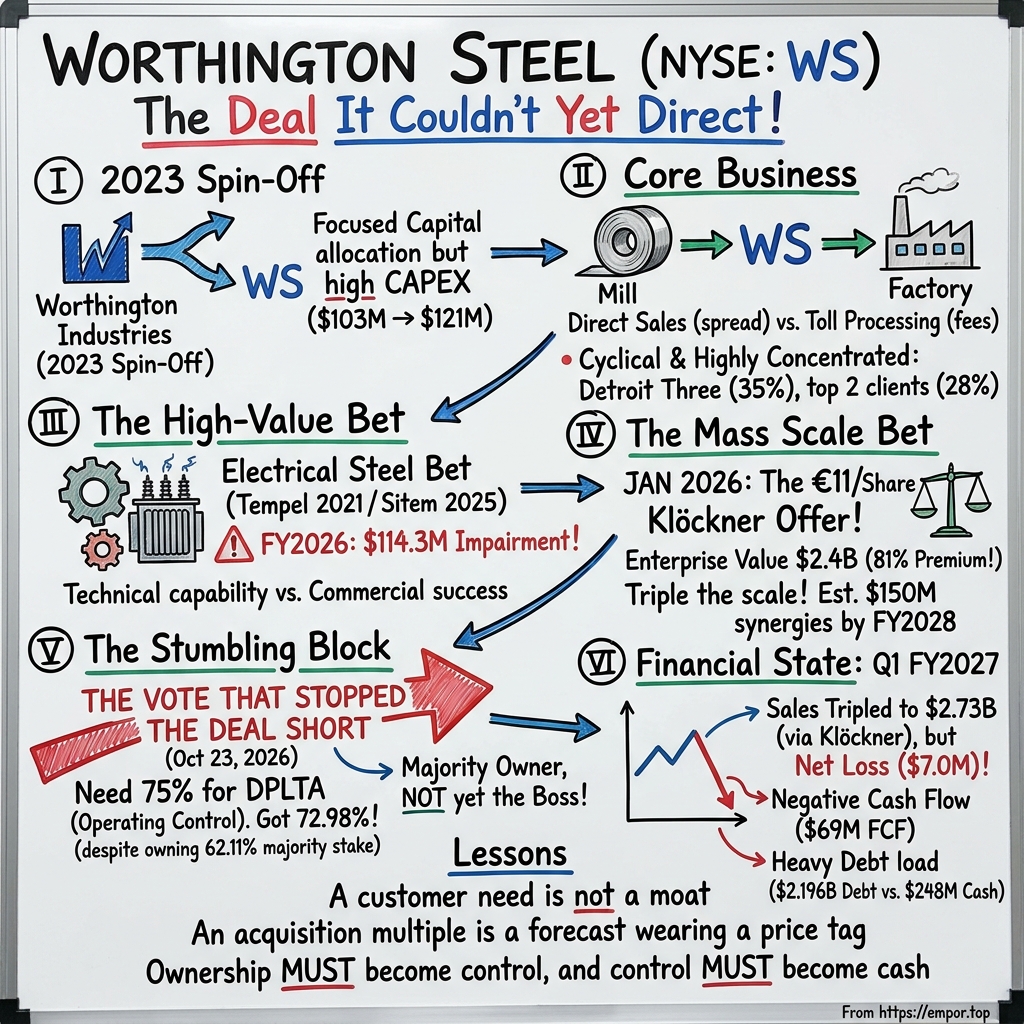
Worthington Steel: The Deal It Couldn't Yet Direct
I. The Vote That Stopped the Deal Short
On October 23, 2026, the shareholders of Klöckner & Co gathered in Düsseldorf for an extraordinary general meeting that, on paper, should have been a formality. Worthington Steel, the Columbus, Ohio steel processor, already owned most of the German metals distributor. It had paid for the shares, raised the debt, and since early June it had been folding Klöckner's results into its own accounts. Only one item remained: approval of a domination and profit transfer agreement, the German legal instrument that would let Worthington Steel give binding instructions to Klöckner's management and sweep its annual profits upstairs.1
The count came back at 72.98% in favour.2 In most boardrooms that is a landslide. Under German corporate law, an agreement of this kind needs at least three-quarters of the capital represented at the meeting, and 72.98% was about two percentage points short.23 The agreement did not take effect.1 Worthington Steel, holding 62.11% of Klöckner's shares at the end of its latest quarter, remained the majority owner of a company it still could not simply direct.3
That gap between owning a company and running it is the clearest way into Worthington Steel's story today. On the income statement, the deal looks finished. Klöckner's sales, its employees and its debts now sit inside Worthington Steel's consolidated numbers, so the listed company that reported roughly $3.4 billion of revenue in its last fiscal year reported $2.7 billion in a single quarter once Klöckner arrived.43 On the legal map, the deal is unfinished. Klöckner's management board still runs Klöckner under German governance rules, and any order from Ohio is, in law, closer to a request.
The scale of what Worthington Steel now reports makes the gap more consequential. The company describes itself today as about 12,000 people across roughly 150 facilities, figures that include Klöckner and its affiliates.1 Before June it was a North American processor with a small European foothold and one dominant end market. Overnight it became the parent of a European-rooted distributor with a different culture, a different customer base, its own supervisory board and its own lenders. Owning that structure is one thing. Making it behave like one company is another, and the October meeting decided, for now, that Worthington Steel would have to do it the slow way.
Small arithmetic sharpens the point. If Worthington Steel voted its full stake, its own shares alone made up at least 85% of the "yes" votes. A 62.11% holder can only reach 72.98% of the votes cast if attendance was very high and some outsiders voted yes; even at full attendance, fewer than three in ten outside shares could have supported the agreement. The vote was, in effect, a referendum among the remaining minority shareholders, and they said no.23
This matters because the whole investment case for the acquisition was built on direction: buying jointly, closing overlapping sites, combining back offices, deploying Worthington Steel's processing know-how into Klöckner's network. Management had promised $150 million of annual cost savings by fiscal 2028.5 Some of that can happen through ordinary cooperation between two companies under common ownership. Some of it, as S&P Global Ratings made explicit before the deal closed, assumed the legal control that the October vote withheld.6
So this episode asks three questions, and the answers do not all point the same way. The first is what Worthington Steel actually earns from processing steel, a business that sits between the giant mills and the factories that stamp car doors and wind motors, and whether that position is defensible. The second is why management, after a costly detour into electrical steel, decided to bet the company on a German distributor at a premium of roughly 80% to its share price. The third is whether the enlarged company can carry more than $2 billion of debt and still deliver the savings that justified the price, now that the instrument it planned to use has failed.35
One boundary runs through everything that follows. The story is about the listed Worthington Steel. Klöckner's revenue, its thousands of employees and its service centres on two continents are acquired scale. They make the company larger. They are not evidence that Worthington Steel's legacy business started growing faster, and the company itself said it could not yet present validated pro forma figures to compare the combined group like-for-like.7 To understand what was bought, and what it was bought with, the story has to start with the coil of steel arriving at a Worthington plant.
 Subscribe on LinkedIn
II. The Business Between the Mill and the Factory
Picture a coil of hot-rolled steel coming off a truck at a Worthington Steel plant in Ohio or Michigan. It weighs as much as a couple of family cars, wound tight like a roll of tape, and in its current form it is almost useless to the factory that will eventually buy it. The car-parts maker wants it slit into narrower strips, cut into flat blanks of a specific size, pickled to remove scale, or rolled thinner and harder to a tolerance a mill does not bother to hit. Worthington Steel exists in that gap. Its job is to turn mill-standard steel into the exact shape, gauge and surface a manufacturer needs, delivered when the customer's line needs it.
The family business behind this goes back to 1955, when John H. McConnell started Worthington Industries in Columbus as a steel processor; the steel business is the original Worthington, not a later add-on.8 Decades later the company still makes its money in two ways, and the choice between them on each order is the first thing an investor has to understand.
In the first model, called direct sales, Worthington Steel buys the coil from a mill, processes it and sells the finished product, generally priced per ton with selling prices linked to market steel prices. It earns the spread between what it paid and what it charged. In the second model, called toll processing, the customer already owns the steel. Worthington Steel processes it for a fee and never takes title to the metal.4 Think of a tailor. One tailor buys the cloth, makes the suit and sells it; another alters a suit the customer brought in. The first takes in far more money per job and also carries the risk that cloth prices fall while the bolt sits on the shelf. The second takes home a smaller cheque with no inventory risk, but only works when customers bring garments in.
That trade-off moved in a telling direction in fiscal 2026, the year that ended in May 2026. Direct sales rose to 64% of the legacy mix, from 57% a year earlier, while toll volumes fell.4 A shift toward direct sales raises revenue per ton, which flatters the top line, but it also means more of the company's earnings depend on owning steel through price swings. When an investor sees sales grow at a processor, the first question is whether the company processed more steel or simply took ownership of more of it.
Who holds the leverage
The customer list answers the question of who has the bargaining power. Automotive was 55% of fiscal 2026 sales, and the Detroit Three alone accounted for 35%. Two unnamed customers each represented 14% of sales, which means just two relationships produced more than a quarter of revenue.4 Customers generally place orders one at a time and can terminate them; some use blanket orders with periodic releases, and the company does not disclose any general minimum purchase commitment.4
Management offered a counterweight. On the October 2026 earnings call it said more than 90% of the legacy business was contractual.7 That sounds like a subscription, and it is not. A contract in this world usually fixes how a price will be calculated and which plant will supply which part; it does not oblige the carmaker to take a set tonnage if its assembly line slows. The same call showed how quickly that can matter: energy shipments fell 31% in the quarter after a customer shifted its sourcing.7 Contractual and committed are different words for a reason. What the contracts do provide is a pricing rhythm. When KeyBanc's analyst asked whether strong galvanised-steel spreads would last, Gilmore answered that with "90% or more" of the business contractual, the benefit would show up when the new contract season began on January 1.7 That is a revealing detail. Much of the legacy book reprices once a year, which smooths the pain when the market turns against the company and delays the gain when it turns in its favour. It is a buffer against volatility, not an escape from it.
The industry's shape makes the point from the other side. When Worthington Steel presented the Klöckner deal, it used Metal Center News' 2025 ranking of North American service-center sales. Reliance led with $13.8 billion of 2024 sales. Worthington Steel stood at $3.3 billion. A pro forma Worthington-Klöckner combination came to $7.5 billion.9 Those are sales figures, not market shares, and steel service is a fragmented business in which a buyer can choose between several processors or, for large enough volumes, buy straight from a mill and have it processed elsewhere.
Put that through Michael Porter's lens and the picture is uncomfortable for a processor. Buyers are concentrated and powerful; suppliers, the mills, are large and set the underlying price of the raw material; rivals are numerous; and the mill itself is a partial substitute. Hamilton Helmer's seven powers ask a narrower question: is there a scale economy, a switching cost, a cornered resource or a process advantage that lets this company earn more than its rivals for a long time? Worthington Steel's genuine capabilities sit in what Helmer would call process power. It can hit tight tolerances, run specialised lines such as pickling and tailor-welded blanks, and flex between direct and toll work as the market moves.10 Those capabilities help win work. What the disclosures do not show is exceptional customer retention, exclusivity, or a cost advantage over peers, the evidence that would turn a capability into a moat.
The fairest reading, then, is a real business with a modest edge. Worthington Steel does things that are hard to do well, for customers who value reliability. But its two largest customers can and do move volume, its end market is dominated by a cyclical industry, and the shift toward direct sales increases its exposure to the very steel prices it cannot control. The figures that would prove a stronger claim are the ones worth watching: processing spreads, the split of direct and toll volumes, and the concentration of the customer list.
That raises the tension that drives the rest of the story. If this is a cyclical processor with limited pricing power, what made management believe that more scale, and a new kind of steel, could change the shape of its earnings? The answer starts with the cycle itself.
III. Steel Spreads Move With the Cycle
Fiscal 2023 was the year the cycle showed its teeth. Steel prices had soared after the pandemic, as mills restarted slowly and demand came roaring back. Then they came down, and a processor holding inventory bought at high prices had to sell products into a falling market. Inside Worthington Industries, the Steel Processing segment still reported about $3.5 billion of sales that year, but its adjusted operating profit fell to about $122 million, down roughly $82 million from the year before, as lower average steel prices squeezed spreads.11
That single year captures the mechanism better than any long average. A processor's revenue rises and falls with the price of steel because it passes the metal through to customers. Its profit depends on something else: the spread between buying and selling, and the value of whatever inventory it holds while prices move. When prices rise, steel bought cheaply is sold dear and the company books inventory-holding gains. When prices fall, the same coil becomes a loss. The business is a bit like a grocer whose fridge is full of produce whose wholesale price changes every week. Good management can keep the fridge lean, but cannot stop the price from moving.
The long record shows that rhythm. Back in fiscal 2016 the former parent's steel segment had about $1.8 billion of sales and $112 million of operating income. By fiscal 2018 those figures were about $2.3 billion and $153 million.12 By fiscal 2023, sales had nearly doubled from the 2016 base while operating profit, after its fall, had barely moved.11 Scale grew. Earnings did not climb with it in any smooth line.
There is a caveat in reading that history. The figures through fiscal 2023 belong to a segment of a larger company, with allocated overheads and different reporting rules; the figures from fiscal 2024 belong to a standalone issuer. They are context, not a clean ten-year series for the company listed today.114 At its 2024 investor day, Worthington Steel showed the same story another way, charting how inventory days and steel prices had swung across earlier cycles.10 The company was effectively telling investors that its earnings would always carry some of the market's volatility.
The standalone years confirm it. Sales were about $3.4 billion in fiscal 2024, slipped to about $3.1 billion in fiscal 2025 and came back to about $3.4 billion in fiscal 2026.4 That round trip, a decline and a recovery to almost exactly the starting point, is the cycle in miniature. And the recovery was not all organic. Fiscal 2026 included about $166 million of sales from Sitem, the Italian electric-motor laminations business acquired that year, while legacy direct-sale volume rose 5%.4
The more revealing detail sits inside the spread. Fiscal 2026 direct spreads benefited from a swing of about $26 million, from inventory-holding losses in the prior year to gains.4 That is not the company getting paid more for its work. It is the steel price helping. Any headline about improved processing economics in fiscal 2026 has to subtract that tailwind before it can claim stronger structural pricing. Attributable net income, meanwhile, collapsed from about $155 million in fiscal 2024 to about $111 million and then to just $8.5 million in fiscal 2026, for reasons that go beyond the cycle and that the next chapter explains.4
The conclusion from this history is straightforward. Worthington Steel has grown its scale, but the earnings that scale produces still rise and fall with steel prices, auto production and inventory timing. Nothing in the record yet shows a business that has escaped the cycle. Management knew this. Its answer, before Klöckner, was to move into a part of the steel chain where it believed the demand story was structural rather than cyclical: the steel that goes inside electric motors and transformers. Capability and demand, though, do not guarantee profitable commercialization.
IV. The Electrical Steel Bet—and Its Impairment
In December 2021, Worthington Industries announced it had acquired Tempel Steel, a Chicago-based maker of precision motor and transformer laminations, for about $272 million net of acquired cash.13 Laminations are thin, stamped sheets of a special silicon-bearing steel, stacked by the hundreds to form the cores of electric motors and transformers. Stack them well and the motor runs cooler and wastes less energy; stack them badly and it hums, heats and loses power. Every electric vehicle drive motor, every industrial motor and every grid transformer needs them.
The timing told the strategy. In late 2021 electrification was the most exciting phrase in industrial America. Carmakers were announcing electric-vehicle programmes, utilities were planning grid upgrades, and governments were pouring money into both. For a steel processor whose biggest customers were the Detroit Three, electrical steel offered something the core business lacked: a product tied to a long-term structural trend rather than the next swing of the steel price.13 The thesis became a central part of how the steel business presented itself to investors as it prepared for independence.10
Strategic fit, however, is not the same as attractive returns. A lamination business needs heavy investment in presses, tooling and engineering. It sells to the same powerful customers, mostly carmakers and industrial-equipment makers, and its volumes depend on electric-motor programmes that can be delayed, resized or cancelled. A bet on electrification was, underneath, a bet on the timing of other companies' product launches.
Worthington Steel pushed further. In June 2025 it completed the purchase of a 52% controlling stake in Sitem Group, an Italian maker of electric-motor laminations, giving it a European foothold in the same category.14 Sitem contributed about $166 million of sales in fiscal 2026, its first full year in the group.4 Adding Sitem was a way of saying the electrical-steel bet was a platform, not a single acquisition.
The year the write-down came
Then came the bill. In fiscal 2026 Worthington Steel recorded $114.3 million of impairments. The largest pieces sat in the Electrical Steel reporting unit: $53.8 million of goodwill and $58.4 million of long-lived assets.4 Goodwill is the premium a company pays above the value of an acquired business's identifiable assets, the price of its expected future profits. Writing it down is an accounting admission that the expected future profits now look smaller than what was paid. Writing down long-lived assets, the plants and machines, goes further: it says the equipment itself is not expected to earn back its carrying value.
A smaller charge said something similar about the company's innovation pipeline. In fiscal 2025, it wrote off a $1.3 million in-process research and development asset at its tailor-welded blanks business after concluding the technology could not be commercialized.4 The sum was small. The lesson was the same as the larger write-down's: technical capability had not turned into revenue on the timeline the original investment assumed.
These charges are the strongest disconfirming evidence in the company's own record against the idea that electrical steel is already a proven value-creating growth engine. They do not prove that Tempel was overpaid on the day it was bought, because conditions in electric-vehicle and motor markets changed after 2021, and impairment tests reflect current expectations, not original intent. They do not prove every electrical-steel asset failed; the business still operates and still serves motor and transformer customers. But they narrow the claim. What management presented as a structural growth vector has, on the company's own accounting, delivered less value than it cost.
The difficulty for an outside investor is that the company does not report the Electrical Steel business's revenue, margins or returns as a separate segment.4 So the evidence that would restore confidence has to be gathered indirectly. It would show up as operating commentary that names utilisation rates and customer programmes, as acquired-business results that management is willing to quantify, and above all as the absence of further impairments or restructuring in the category. Until then, electrical steel is best described as an option the company still holds, not a growth engine it has proven. The way management talks about it is a clue in its own right. On the October 2026 call, the first as a combined company, neither the prepared remarks nor the analysts' questions dwelt on electrical steel, Sitem or the transformer business; the conversation was about Klöckner, spreads, cash and the coming vote.7 A few years earlier, electrification had been the headline of the growth story. It is now a supporting player in a much larger one. That distinction matters because the people who made the bet were about to gain more freedom to make bigger ones.
V. Independence, With a New Capital-Allocation Mandate
On December 1, 2023, Worthington Steel began trading on the New York Stock Exchange under the ticker WS.15 There was no roadshow, no new money raised and no IPO price. Worthington Industries simply distributed one Worthington Steel share for every Worthington Industries share its holders owned, and kept nothing for itself.158 The former parent renamed itself Worthington Enterprises and kept the building-products and consumer businesses; the steel processor walked out the door as its own company, with a $150 million cash distribution paid to the former parent on the way.8
Spin-offs like this are a bet that two businesses are worth more apart than together. A steel processor and a maker of pressure cylinders and building products attract different investors, need different kinds of capital and move with different cycles. Separating them lets each be judged on its own terms. For the steel business, it also meant that, for the first time, its management team could set its own investment priorities without competing for capital inside a conglomerate.
The people who took that freedom were long-time insiders. Geoff Gilmore, who had led the steel business inside Worthington Industries, became chief executive, and Tim Adams became chief financial officer.8 Both have stayed in their roles since the separation.16 Their stated priorities were value-added processing, operational excellence, growth investments and disciplined capital allocation.8 Behind them sits a shareholder with a long memory: John P. McConnell, son of the founder, beneficially owned about a third of the company's shares, roughly 33.6%, according to the 2026 proxy.16 That stake gives the founding family considerable influence over any shareholder vote, which cuts both ways. It aligns a major owner with long-term value, and it means outside shareholders' votes carry less weight.
What the money went into
The first test of a newly independent management is what it does with the cash. Capital expenditure ran at about $103 million in fiscal 2024, $130 million in fiscal 2025 and $121 million in fiscal 2026.4 Management estimated that the legacy business needed only $40–45 million a year to maintain its existing plants. So roughly two-thirds of each year's spending went to growth: electrical-steel expansion and new capacity in Canada and Mexico.4 That is a company investing for expansion, not a mature processor harvesting cash.
The spin-off left a small financial cord to the former parent. Sales to Worthington Enterprises were about 2.2% of Worthington Steel's sales in fiscal 2026, around $76 million; the notes quantify these sales but do not specify how prices were set.4 At that scale, the related-party relationship is a disclosure point, not a risk to the investment case. The separation was cleaner than many. In its first fiscal year the company still carried about $38.5 million of corporate overhead allocated from the former parent for the months before the split; no such allocations appeared afterwards.4 Worthington Steel kept the right to use the Worthington name and the Worthington Business System, the company's long-standing operating philosophy of plant-level continuous improvement, under a royalty-free, perpetual licence.8 It walked away with its culture intact and without a recurring bill for it.
Pay is another lens on management behaviour. Gilmore's reported total compensation was about $7.2 million in fiscal 2026, up from about $5.3 million the year before and down from about $8.6 million in fiscal 2024, during which attributable net income fell sharply.164 The compensation includes equity and incentive awards that do not track annual earnings one-for-one, so the comparison is not a scandal. But it is a reminder that pay outcomes and shareholder returns can diverge. At the September 2026 annual meeting, say-on-pay passed easily, with about 42 million votes for and about 0.7 million against. Director Sidney Ribeau, by contrast, drew about 7 million votes against his re-election, a visible protest at a company where a single holder controls about a third of the shares.17 Neither vote is a verdict on the management team. Together they show that investors are watching.
The spin-off gave the steel business a clear mandate and the freedom to pursue it. The early record of that freedom is mixed. Above-maintenance spending and two acquisitions expanded the business, while the electrical-steel impairment and the written-off research asset show that not every deployment earned its cost. Neither the acquired businesses' returns nor a comparable combined-company growth series is yet visible in the company's disclosures. That was the record management carried into January 2026, when it announced the biggest bet in its history.
VI. The €11 Offer That Recast the Company
On January 15, 2026, Worthington Steel and Klöckner & Co announced that they had signed a business combination agreement. Worthington Steel would offer €11 a share in cash for the German metals distributor, which runs about 110 locations, employs more than 6,000 people and reported sales of about €6.6 billion in 2024.518 For a company with about $3.4 billion of annual sales, this was not a bolt-on. Klöckner was larger than its buyer, and the combination would more than double Worthington Steel's North American service-center sales on the company's ranking figures, taking them from about $3.3 billion to about $7.5 billion.9
The price was the first thing investors noticed. The offer implied an enterprise value of about $2.4 billion, an 81% premium to Klöckner's closing price on December 5, 2025, and a 98% premium to its undisturbed three-month average.59 In plain terms, Worthington Steel offered to pay almost twice what the market had been willing to pay for Klöckner a few months earlier. Klöckner's existing shareholders were being handed a large, immediate gain. Worthington Steel's shareholders were being asked to trust that the business was worth much more under new ownership than it had been worth on its own.
The deal was engineered to get done. Klöckner's management and supervisory boards welcomed the offer and said they intended to recommend it, and its chief executive, Guido Kerkhoff, called Worthington Steel "the ideal partner" for the company's long-term competitiveness.18 SWOCTEM GmbH, Klöckner's largest shareholder with about 41.5% of the shares, signed an irrevocable agreement to tender its whole stake, and the offer carried a minimum acceptance threshold of 65%.185 Fully underwritten bank commitments from Wells Fargo and Citigroup meant there was no financing condition.5 With one anchor holder locked in, the question was never whether Worthington Steel would end up owning most of Klöckner. It was how much of the rest it could gather, and what it could do with the company once it had it.
Why management wanted it
The strategic logic, as management told it, was about breadth. Legacy Worthington Steel processes carbon flat-rolled steel for a concentrated set of mostly automotive customers in North America. Klöckner brought a distribution network across Europe and North America, service centres that sell to a much wider base of industrial customers, and products well beyond flat-rolled carbon steel, including aluminium, stainless steel and long products such as bars and beams.189 On paper, the combination would dilute the auto concentration that defines the legacy business and give Worthington Steel's processing know-how a much larger network to work through.
The rankings slide made the ambition visible. Using Metal Center News figures for 2024, the combined company would have about $7.5 billion of North American service-center sales, behind Reliance at $13.8 billion and ahead of the proposed Ryerson and Olympic Steel combination at $6.5 billion.9 That would make Worthington Steel the number-two name on that list. It is worth being clear about what the comparison shows: a ranking by sales, which includes metal passed through at market prices. It does not establish market share in any particular product, and it says nothing about which of these companies earns the best return on its capital. Being second-largest by revenue in a fragmented, pass-through business is a statement about size, and size has never by itself guaranteed returns in steel distribution.
What the multiple really said
The price was justified with a pair of multiples. Worthington Steel said it was paying about 8.5 times Klöckner's trailing EBITDA, or about 5.5 times once $150 million of expected annual synergies were included, with those savings expected by fiscal 2028.59 Management also said the deal would be substantially accretive to earnings per share in its first full year, described the combination as roughly $9.5 billion of revenue with margins above 7% including synergies, and characterised the price as in line with market precedents.5 On leverage, it promised pro forma net debt of around 4 times EBITDA at closing including synergies, falling below 2.5 times within 24 months.5
That second multiple deserves a slow reading. The 5.5 times figure is not what Worthington Steel paid. It is what the price would look like if a future stream of savings arrived in full and on time. Those savings did not exist on the day the deal was signed, and the management team that would need to deliver them had never integrated a company of Klöckner's size. Neither the accretion claim nor the synergy figure has yet been validated by realised post-deal results. And the company's own materials did not provide an independent, like-for-like set of comparable transactions that would let an outsider test the "market precedents" claim. A premium of roughly 80% raises the stakes of execution: every euro of savings that fails to arrive makes the 8.5 times multiple the real one.
There was a second tension inside the agreement itself, and it is easy to miss. To win Klöckner's support, Worthington Steel accepted a set of commitments. Klöckner's European headquarters would stay in Düsseldorf. The company would continue to operate independently, managed by its current management board. There were no intended layoffs or site closures, and existing works-council agreements would stay in force.18 These are common features of friendly German deals, and they made the bid easier to accept. They also narrow the menu of savings. If the plan is not to close sites or cut jobs, the $150 million has to come mostly from purchasing, working capital, commercial cross-selling and process improvements, the "cost, operational, and commercial process synergies" the company described.5 Those are real levers in a distribution business that carries a lot of inventory. They are also the kind that take longest to prove. The same release said Worthington Steel would review a squeeze-out, a domination agreement or a delisting after the offer.18 The control instrument that later failed was part of the plan from the first day.
Financing turned the bet into a balance-sheet commitment. In June 2026, Worthington Steel issued $700 million of 7.75% secured notes due 2033 and drew a $500 million term loan, alongside assumed Klöckner debt and other facilities.3 A 7.75% coupon on secured debt is the price of borrowing for a company the market sees as sub-investment grade. S&P had made that judgement explicit in May, assigning a BB- rating with a stable outlook in connection with the financing. It cited scale, market position and diversification as strengths, and steel cyclicality, working-capital needs, integration risk and leverage as constraints.6
S&P's numbers are a forecast to test, not a conclusion. It projected leverage of about 5.5 times in fiscal 2027, falling below 4 times in fiscal 2028, with $250–300 million of annual free operating cash flow as synergies ramped.6 Those projections rested on assumptions that included synergies and legal control of the combined group. Both were still future events when the agency wrote. Set S&P's figure beside management's and the gap is itself informative: the company spoke of about 4 times at closing and below 2.5 times within two years, while the rating agency expected about 5.5 times in the first fiscal year and only dipped below 4 times in the second.56 The two forecasts were made on different definitions, so they are not a like-for-like contradiction, but they show how much of the deleveraging story depended on who was doing the assuming. So the deal Worthington Steel signed was, in effect, a promise that control would follow ownership and savings would follow control. By June, the ownership was in place.3 The control was not, and the route management expected to use to secure it was about to meet the Klöckner minority.
VII. Majority Owner, Not Yet the Boss
At the October 23, 2026 meeting, Klöckner shareholders were asked to approve a domination and profit transfer agreement, usually shortened to DPLTA, between Worthington Steel and Klöckner.1 The instrument is peculiar to German corporate law, and understanding it explains why a 62% owner could lose a vote it might have expected to win.
In a German public company, the management board runs the business on its own responsibility. A shareholder, even a majority one, cannot simply give it orders. A supervisory board appoints and oversees the managers, and the managers owe their duties to the company as a whole, including its minority shareholders and creditors. Once in force, the DPLTA would have allowed Worthington Steel to issue binding instructions to Klöckner's management, transfer Klöckner's annual profits to itself and, in exchange, accept the obligation to absorb any annual losses.3
As the vote showed, the outside shareholders who turned up were decisively against it. The agreement therefore did not become effective, and Klöckner continues to operate under its existing German governance framework.13
The road to that meeting had been methodical. The takeover offer closed on June 3. Klöckner's shares were delisted from the Frankfurt exchange on August 12, after a delisting tender offer, and the DPLTA itself was signed on September 8, subject to the October vote.71 Gilmore had told analysts that, if the agreement was approved and became effective, it would provide "a clear framework for operating control," with formal integration and synergy capture beginning in the first quarter of calendar 2027.7
The terms on offer to the holdouts were not trivial. On the October 7 call, the independent analyst John Tumazos asked what the agreement meant for the roughly 38% of Klöckner that Worthington Steel did not own. Gilmore explained that, once the agreement was approved and effective, minority holders could put their shares to Worthington Steel at €11, the original offer price, or stay in and receive a guaranteed annual cash payment of 6%, or €0.66 a share. Asked how long they could keep their shares, Tim Adams answered plainly: "They can hold forever if they choose to, sure."7 Delisting had already taken away the minority's liquid market. The agreement offered them a fixed exit or a fixed coupon in exchange for giving up any claim to Klöckner's future profits. Enough of them preferred to keep that claim, and the leverage that came with it, to block the deal.
Neither company has published who voted against or why, so the holdouts' motives are not disclosed. The structure of their choice, though, is clear. A minority owner who blocks a domination agreement keeps a legal shield: without one, the majority cannot direct the company to its own advantage, and Klöckner's managers must still act in the interest of all its shareholders. That shield is also a bargaining chip. Any future attempt at control, whether a second vote, a higher compensation offer or a purchase of more shares, now runs through the people who said no. Worthington Steel's own post-vote statement was brief: "For now," the company said, it would operate within the existing ownership and governance structure and pursue commercial, procurement, operational and strategic opportunities. "The path forward is clear," Gilmore added, "and we will begin work immediately."1
What has happened and what was promised
As the opening vote showed, accounting consolidation and legal control are different. Worthington Steel began consolidating Klöckner after acquiring control on June 3, 2026, and reports all of its sales, assets and debt.3 Without the DPLTA, Worthington Steel cannot instruct Klöckner's management to take actions that disadvantage Klöckner for the group's benefit, and it cannot sweep cash upward through a profit transfer. Joint purchasing, shared best practices and voluntary cooperation can proceed. Decisions that move value from one company to the other, such as rationalising overlapping sites or centralising cash, are much harder.
That constraint goes to the heart of the $150 million synergy target. Some savings are the kind two cooperative companies can achieve at arm's length. Others assume the parent can make decisions for the whole. S&P's deleveraging forecast explicitly assumed legal control.6 The failed vote does not make the target impossible. It does make the path slower and less certain, and it removes the option of using Klöckner's profits directly to service the debt raised to buy it.
The FY2027 first-quarter call, held on October 7, came before the vote, so it could not answer the question the vote posed. Adams told analysts then that "our previously communicated synergy and deleveraging targets remain unchanged," and that debt reduction would progress alongside synergy capture and working-capital improvement.7 Both statements were made on the assumption of an agreement that failed sixteen days later. The next calls will be the real communication test. Investors will listen for concrete explanations of which savings can proceed under the current legal framework, which must wait, whether the synergy timetable changes and whether the company intends to try again for a control agreement or pursue a different legal route.
The vote left Worthington Steel with most of Klöckner's results, its debt and its integration challenge, but without the authority it sought. Its first full quarter as owner shows what that looks like in the numbers.
VIII. The First Quarter: Sales Up, Earnings Down
On October 6, 2026, Worthington Steel published its first quarterly results with Klöckner inside them. The headline sales number would have made any growth investor sit up. Sales for the quarter to August 31 were about $2.7 billion, more than three times the year before.19 Then came the bottom line: a net loss from continuing operations attributable to the company's shareholders of about $7 million.193
The two figures are reconcilable, and the reconciliation is the whole lesson of the quarter. Of the $2.7 billion in sales, about $1.8 billion came from Klöckner, which was consolidated for nearly the whole period.3 Legacy Worthington Steel sales rose about 9%, a respectable figure in its own right but nothing like the 212% headline increase.19 The jump in revenue was acquired scale. It said nothing about organic acceleration.
Underneath the sales growth, the legacy business went backwards. Its operating income fell by about $16.5 million year over year, primarily because of higher selling, general and administrative costs and acquisition-related professional fees.19 Running the deal, in other words, was absorbing management's attention and the legacy business's profits at the same time. The legacy operations themselves were steady rather than strong. They shipped about 921,000 tons, down about 1%, on about $954 million of sales. Automotive direct shipments rose 4%, heavy truck and other transportation jumped 39%, agriculture rose 40%, construction fell 9% and energy fell 31% on that customer's sourcing switch.7 Inventory-holding gains added about $12 million, and management guided to another $10–15 million in the second quarter.7 The steel price, once again, was quietly helping.
The bottom line also carried a set of one-time items. Acquisition expenses were about $23 million, the company booked a roughly $16 million loss on remeasuring the Klöckner shares it had owned before the takeover, and it wrote off about $6 million of deferred tax assets.7 Strip those and other adjustments out and management's adjusted earnings were $0.57 a share, against $0.77 a year earlier.7 Even on management's preferred measure, the first quarter as a much larger company produced less profit per share than the last quarter as a smaller one.
Klöckner's own margin was distorted by acquisition accounting. When a company buys another, it marks the target's inventory up to fair value on the acquisition date. When that inventory is sold, the higher book value flows through cost of goods sold, compressing the gross margin even though nothing about the underlying business has changed. Klöckner's first-quarter gross margin carried an inventory fair-value step-up of about $43 million.3 That charge is temporary; Adams said only a limited residual impact would remain in the second quarter.7 Management reported adjusted EBITDA of about $111 million and argued that adding back the step-up gave about $150 million, "more representative" of the combined business.7 When the Seaport analyst Martin Englert asked for Klöckner's normalised earnings and a split between North America and Europe, Adams said there was no segment data to give and "there's no pro forma available that's been vetted."7 So the best available clue to the combined group's earning power is one adjusted quarter, partly flattered by inventory gains, for a business that management itself could not yet present like-for-like.
Following the cash
Cash tells a more persistent story than earnings. Before the acquisition, Worthington Steel generated operating cash flow of about $200 million in fiscal 2024, about $230 million in fiscal 2025 and about $201 million in fiscal 2026.4 The fiscal 2026 figure arrived against a consolidated net loss of about $13 million, because impairments were non-cash charges and because releasing about $47 million of inventory brought money in.4 That pattern shows a business that turns profits into cash reasonably well in a stable year, but whose cash conversion swings with inventory and steel prices.
The first quarter showed the other side of that swing. Operating cash flow was negative by about $6 million and free cash flow was negative by about $69 million, as working-capital needs and higher inventory prices consumed cash.319 Capital spending was about $63 million in the quarter, split roughly evenly between the legacy business and Klöckner, and management's planning estimate for the full combined fiscal year was $160–180 million.7 Klöckner was also marketing its Becker Stahl-Service business for sale, with most of the net proceeds expected to go to debt reduction.7 An asset sale is a reasonable way to accelerate deleveraging. It is also a reminder that the first lever being pulled is disposal, not operating cash. A distributor like Klöckner carries large inventories and receivables, so when steel prices rise, it needs more money to fund the same volume. That is normal for the industry. It is also the opposite of what a company with new debt would like to see in its first quarter.
The debt is the real weight. At August 31, total borrowings were about $2.2 billion, up from about $257 million at the end of May, and about $542 million of that was in current maturities and short-term borrowings.34 Interest expense rose to about $39 million in the quarter, already a large figure against the legacy business's quarterly operating profit.3 The new $550 million revolving credit facility was undrawn, which provides a buffer. But some of the acquired facilities had very limited headroom, including about $3 million under a Mexican facility and about $3 million under the German securitisation programme.3 A cash balance of about $248 million sits alongside those obligations. It is a cushion, not a substitute for the cash flow needed to service the debt.
Operating leases, worth about $379 million, add a further fixed commitment, though they are separate from funded borrowings and should not be confused with them.3 Taken together, the balance sheet has gone from conservative to stretched in a single quarter, which is exactly what S&P's BB- rating anticipated.6
The October 7 call was short, with only three analysts asking questions, and the contrast between what management could and could not quantify was its most informative feature.7 On the legacy business, Gilmore was expansive. He attributed resilient direct tonnage to share gains in heavy truck, agriculture and automotive, said the company had probably missed another 30,000 tons because of supply constraints, and told KeyBanc's Samuel McKinney that the sustainability of galvanised-steel spreads above $200 a ton was "an absolute go" given tight supply and limited imports. Those are confident claims about a market management does not control, and the January contract season will be the first test of them.7 On the combined group, the answers stopped at what had not yet been vetted. Net debt stood at about $1.9 billion, and management said it would not report a trailing leverage ratio until it had a full year of Klöckner results.7 That gap between scale and comparability is fair for a first quarter. It will not be fair for long. Investors will need to see, within a few quarters, how much of the combined group's earnings come from Klöckner, how much from the legacy business and how much from savings that are actually delivered. Those three numbers are the core of the investment debate.
IX. Analysis & Bear vs. Bull Case
Here is the company in one image. A business that reported about $3.4 billion of annual sales in its last full year now owns most of a company that generated about $1.8 billion of sales in a single quarter, and it cannot yet direct that company under the agreement it sought.431 Everything about the investment case flows from whether that tension resolves.
The bull case begins with complementarity. Worthington Steel's strengths lie in specialised processing for demanding manufacturers: pickling, slitting, tailor-welded blanks and electrical-steel laminations.10 Klöckner's strengths lie in breadth: a far wider base of industrial customers, many product categories and a footprint across Europe and North America.18 If the two can be combined, Worthington Steel's processing know-how could move into a much larger customer base, and Klöckner's distribution could give the legacy business access to markets beyond automotive. Combined purchasing should improve terms with mills. Overlapping administrative costs can be reduced, and Worthington Steel's operating playbook, the system of plant-level improvement it carried out of the former parent, could be applied across a far larger network.8
The bull case also rests on the cycle. Both companies have spent recent years working through lower steel prices and weak industrial demand. If the cycle turns, inventory gains would flow through a much larger base, cash generation would rise and the leverage S&P projected could fall quickly. The $150 million synergy target, if achieved, would make the effective price closer to the 5.5 times multiple management advertised, a respectable price for a business with Klöckner's reach.9
The bear case is built from facts already on the record. The legacy business depends on automotive for more than half of sales, on the Detroit Three for more than a third and on two customers for more than a quarter.4 Its earnings swing with steel prices and inventory timing, and its best recent year for spreads was flattered by an inventory-holding swing.4 Its earlier move into electrical steel has already produced a large impairment.4 Its new acquisition was bought at a large premium with expensive secured debt, its first quarter as owner produced a loss and negative free cash flow, and the legal instrument it planned to use to control the target has failed.31
An activist looking at this company would focus on three things. The first is capital allocation. The record across the current management regime is an electrical-steel platform, assembled through Tempel before the spin and Sitem after it, that has already been written down, followed by the largest acquisition in the company's history at a premium of about 80%. The burden of proof for "disciplined" capital allocation now sits with management. The second is disclosure. Without segment reporting for electrical steel or a comparable combined-company series, investors cannot yet judge returns on the money already spent. The third is governance. With a founding-family holder controlling about a third of the shares, and the company itself a majority owner of a German company with minority shareholders who just voted against it, the question of whose interests are being served in each decision becomes unusually important.162
Run the full Porter analysis on the enlarged company and the bear case gains weight. Buyer power remains high: the legacy business's customer concentration has not changed, and Klöckner's many small customers can choose among numerous distributors. Supplier power is significant: the mills set the price of the raw material and are much larger than any processor. Rivalry is intense in a fragmented market. The threat of substitution is real, because large customers can buy direct from mills. Barriers to entry are moderate: building a service center requires capital but not unique technology.
Helmer's framework is more generous in one place. Scale economies in purchasing and logistics are a plausible power for the enlarged company, because the combined sales of about $7.5 billion should give it more leverage with mills than either company had alone.9 But scale economies only become a power if they translate into a lasting cost advantage that rivals cannot match. Reliance, at nearly twice the combined sales, already has that scale. Process power, Worthington Steel's real strength, applies mainly to its legacy specialised processing. Switching costs exist where Worthington Steel is qualified on a carmaker's part, but the 31% shift in energy shipments shows that customers can and do move.7 Branding, network economies, cornered resources and counter-positioning do not apply in any meaningful way.
The verdict is that the enlarged company has a plausible path to cost advantage through scale, but no proven moat. Neither company's disclosed history shows sustained pricing power above the cycle. The bear case is stronger until three things are demonstrated: legal control or an effective alternative, organic earnings growth separated from acquisition effects and debt reduction funded by operating cash flow.
Assessing management means looking at behaviour over time rather than at any single statement. The chief executive and finance chief have been in place since the spin-off and have consistently described their priorities.816 They have spent above maintenance, as they said they would. They have also made acquisitions that have not yet earned their cost, and they have taken on a large integration with a constraint they did not plan for. Their pay is substantially incentive- and equity-based, which aligns them with shareholders in principle, but pay outcomes have not tracked earnings in a straight line.16 The key test from here is whether guidance is revised transparently as integration costs and control constraints become clearer. There is already a small sign of how loosely the central number can travel. The January announcement described $150 million of annual "cost, operational, and commercial process synergies."5 When Tumazos asked about inventory turns on the October call, Adams referred to "$150 million of working capital synergies" and an ambition to replicate the inventory improvements the legacy business had achieved over 15 years.7 A one-time release of working capital and a recurring annual cost saving are very different things for a valuation; the first pays down debt once, the second adds to earnings every year. Investors are entitled to a precise account of which is which, and how much of each the failed vote now puts at risk.
There is one structural point in the bull case's favour that the call surfaced. Gilmore said that about 99% of Klöckner's North American purchases came from domestic mills.7 In a market shaped by trade protection and limited imports, a supply chain built on domestic steel reduces one source of volatility, although it also ties the combined company more closely to the pricing power of a small number of large American mills. And Adams explained that legacy margins were higher than Klöckner's because of value-added work such as galvanising and pickling, which the company intends to bring to Klöckner's customers once synergies are captured.7 That is the most concrete version of the integration thesis: take Klöckner's customer reach and sell it Worthington Steel's higher-value processing. It is also, by management's own sequencing, a plan that waits on synergy capture, and synergy capture was tied to an agreement that failed.
One subplot worth leaving out: artificial intelligence. Management described AI as an operations aid, used for decisions such as how much maintenance and repair inventory to hold, with buyers and maintenance teams confirming its recommendations.7 Nothing in the filings or the call establishes a material AI-driven revenue stream, AI-driven pricing or a threat to the processing model from AI. The story of this company is about steel, debt and control.
If an investor could track only three things, they would be these. The first is legacy processing economics: spreads, the direct and toll volume mix and customer concentration. Their latest reading shows direct sales rising to 64% of the mix with toll volumes falling, and two customers at 28% of sales.4 The second is realised Klöckner synergies against the $150 million target. The company has not yet reported realised synergies. The third is net debt against cash generation. At August 31, debt was about $2.2 billion, cash about $248 million and free cash flow negative for the quarter.3
The market has already taken a view on all of this. At the time of writing, Worthington Steel's shares traded around $35, giving the company a market value of roughly $1.8 billion, toward the lower half of a 52-week range of roughly $27 to $49.20 The equity is now smaller than the company's funded debt, and investors also have to account for the roughly 38% of Klöckner that belongs to other shareholders. That is the profile of a leveraged equity: modest changes in the operating outcome will produce large changes in what the shares are worth. A trailing earnings multiple is not meaningful while reported earnings are depressed by impairments, purchase accounting and transaction costs. Nor is the acquisition's synergy-adjusted multiple the stock's valuation. The useful comparison will come when normalised combined earnings and cash flow are visible. Until then, the share price appears to embed considerable doubt about whether the synergies, the control and the deleveraging will all arrive together.
One small capital-allocation choice shows how management is balancing those pressures. The board declared a quarterly dividend of $0.16 a share, payable on December 28, 2026.7 With about 50 million shares outstanding, that is roughly $8 million a quarter, or a yield a little under 2% at the current price.320 Against $2.2 billion of debt, the sum is modest, and keeping it signals confidence in cash generation. It is also money that is not reducing borrowings costing 7.75% on the secured notes. A skeptical investor would want to know, as the quarters pass, whether the dividend is being funded from operating cash or from the balance sheet.
X. Lessons From a Steel Processor's Big Bet
The scene that best captures this company's lessons is not the October vote. It is the moment, years earlier, when the electrical-steel thesis was at its brightest: a steel processor buying its way into the motors of the electric future, at the height of the enthusiasm for that future.13 Four years later, the company impaired much of that bet's goodwill and plant.4 The distance between those two moments is where the lessons live.
The first lesson is that a customer need is not a moat until the customer keeps choosing you. Worthington Steel's concentrated customer base and the movement of shipments show the limits of its position.47 For founders and investors, the test is not whether the customer depends on the product but whether the customer would find it hard to depend on someone else's.
The second lesson is that an acquisition multiple is a forecast wearing a price tag. Worthington Steel paid about 8.5 times Klöckner's trailing EBITDA and presented it as 5.5 times by counting synergies that did not yet exist.9 The October vote showed how fragile that forecast was: the legal instrument needed to deliver part of those savings failed by two percentage points.2 Every synergy-adjusted multiple contains an assumption about control, timing and execution. The buyer who forgets that is paying the higher price while advertising the lower one.
The third lesson is that technical capability is not commercialization. Worthington Steel can make laminations, but it also wrote off a research asset after concluding the technology could not be commercialized and took a large impairment in its electrical-steel business.4 Electrification may still prove a durable market for the company. But the record says capability alone did not get it there on time.
The fourth lesson is that a spin-off creates focus; it does not create returns. Independence gave Worthington Steel's managers control of their own capital allocation.15 Their investment record, including the Sitem acquisition and the larger Klöckner deal, is now being judged by public shareholders. Focus was the gift of separation. Returns are the responsibility that comes with it.
The fifth lesson belongs to the October meeting room: in Germany, control is granted, not bought. Worthington Steel secured the largest shareholder's support, won the boards' support, delisted the shares and offered the minority a fixed exit or a guaranteed coupon.187 It still fell short because enough shareholders voted against the agreement. For any buyer of a company with a stubborn minority, the cost of the final few percentage points belongs in the price from the first spreadsheet, not in a footnote after the vote.
XI. Epilogue
Tonight, Worthington Steel is a company with one quarter of consolidated Klöckner results behind it, a failed control vote less than a month old and an integration still largely ahead. It owns 62.11% of Klöckner.3 It owes about $2.2 billion.3 It has promised $150 million of annual synergies by fiscal 2028.5 None of those figures yet tells an investor whether the deal will be remembered as a platform or a burden.
The first moment to watch is the next attempt at legal control. Worthington Steel could seek a new DPLTA, increase its stake to make approval easier, or pursue a different legal arrangement. Each path has costs: buying more shares requires more capital, and a new vote requires winning over the minority that just said no. The arithmetic is unforgiving. Worthington Steel would need to own three-quarters of the capital represented at a vote for its own shares to meet the threshold, which means persuading or buying out a meaningful part of a minority that has already shown it is willing to hold an unlisted share rather than accept the terms on offer.23 Any improved offer would raise the effective price of the deal above the €11 that anchored the original multiple. Doing nothing keeps the price where it is and leaves the synergy plan running at the speed of voluntary cooperation. If the company secures effective control, the synergy case and S&P's deleveraging path regain their assumed foundation.6 If it does not, the company will need to show investors which savings it can achieve under the current framework and how quickly.
The second moment arrives on January 1, when the legacy contract season resets. Management told analysts that strong galvanised spreads would flow into the business as contracts reprice, and that automotive production was expected to be essentially flat, with no significant near-term inflection assumed.7 If spreads hold and the inventory-holding gains management guided to arrive, the legacy business will have its strongest argument yet that the core still works while the integration waits. If steel prices turn down instead, the same inventory mechanics that helped the first quarter will work in reverse, across a balance sheet now several times larger.
The third moment is the second-quarter report, the first to show Klöckner for a full quarter after the failed vote. Investors will look for realised synergies reported against the target, a clear split between legacy and acquired performance, interest costs that stabilise and the first evidence of debt repayment from operating cash. The fiscal first quarter showed negative free cash flow; a second consecutive quarter of cash consumption would intensify pressure on liquidity and on the rating.36 Progress on the Becker Stahl-Service sale, and whether its proceeds actually reduce Klöckner's debt, will be the clearest early signal that deleveraging can begin without waiting for the control question to be settled.7
The last question is slower. Does the enlarged company become less dependent on a handful of automotive customers? Does the electrical-steel business, after its impairment, start producing measurable returns? These are the measures of whether the strategy, not just the deal, works.
The tension that remains is simple to state and hard to resolve. The larger sales base is real. A stronger investment case is not yet proven. Legal control, demonstrable savings and cash-led debt reduction would close that gap. Without them, scale is just a bigger version of the same cyclical exposure, now carried on borrowed money. With them, the company would have something it has never had before: a breadth of products and customers that dilutes its dependence on Detroit, a network into which to sell its processing skill and the cash flow to pay down what it borrowed. Both futures are still available. The next few quarters will start to say which one the company is living in.
XII. Outro
Return to the meeting on October 23. Worthington Steel owned a majority of the shares in the room, but still lost the vote.23 Owning a business and directing it turned out to be different things.
That is the defining image of Worthington Steel now: a steel processor that made the biggest bet in its history and now has to make it pay, one quarter at a time, through cash flow, debt reduction and savings it has not yet delivered. Worthington Steel bought the scale; now it has to earn the authority and the returns.
References
-
Worthington Steel Announces Results of Kloeckner DPLTA Vote, Exhibit 99.1 — SEC, 2026-10-23 ↩↩↩↩↩↩↩↩↩
-
Extraordinary General Meeting 2026 Voting Results — Klöckner & Co SE, 2026-10-23 ↩↩↩↩↩↩↩
-
Worthington Steel Form 10-Q for the quarter ended August 31, 2026 — SEC, 2026-10-13 ↩↩↩↩↩↩↩↩↩↩↩↩↩↩↩↩↩↩↩↩↩↩↩↩↩↩↩
-
Worthington Steel Form 10-K for fiscal year ended May 31, 2026 — SEC, 2026-07-30 ↩↩↩↩↩↩↩↩↩↩↩↩↩↩↩↩↩↩↩↩↩↩↩↩↩↩↩↩↩↩
-
Worthington Steel to Acquire Klöckner & Co — Worthington Steel, 2026-01-15 ↩↩↩↩↩↩↩↩↩↩↩↩↩
-
Worthington Steel Rated BB- on Klöckner Financing Plan — S&P Global Ratings, 2026-05-18 ↩↩↩↩↩↩↩↩
-
Worthington Steel Q1 Fiscal 2027 Earnings Call Transcript — Stock Analysis, 2026-10-07 ↩↩↩↩↩↩↩↩↩↩↩↩↩↩↩↩↩↩↩↩↩↩↩↩↩↩↩↩↩↩↩
-
Worthington Steel Information Statement (Form 10, Exhibit 99.1) — SEC, 2023-11-09 ↩↩↩↩↩↩↩↩
-
Worthington Steel Acquisition of Klöckner & Co Investor Presentation — Worthington Steel, 2026-01-16 ↩↩↩↩↩↩↩↩↩
-
Worthington Steel Investor Day Presentation — Worthington Steel, 2024-05 ↩↩↩↩
-
Worthington Industries Form 10-K for fiscal year ended May 31, 2023 — SEC, 2023 ↩↩↩
-
Worthington Industries Form 10-K for fiscal year ended May 31, 2018 — SEC, 2018 ↩
-
Worthington Industries Acquires Tempel Steel, Exhibit 99.1 — SEC, 2021-12-01 ↩↩↩
-
Worthington Steel Completes Acquisition of Controlling Equity Stake in Italy-Based Sitem Group — Worthington Steel, 2025-06-03 ↩
-
Worthington Steel Separation Completion, Form 8-K — SEC, 2023-12-01 ↩↩↩
-
Worthington Steel 2026 Proxy Statement — SEC, 2026-08-14 ↩↩↩↩↩↩
-
Worthington Steel Annual Meeting Voting Results, Form 8-K — SEC, 2026-09-23 ↩
-
Klöckner & Co and Worthington Steel Sign Business Combination Agreement — Klöckner & Co, 2026-01-15 ↩↩↩↩↩↩↩↩
-
Worthington Steel Reports First Quarter Fiscal 2027 Results — Worthington Steel, 2026-10-06 ↩↩↩↩↩
-
Worthington Steel Stock Information — Worthington Steel, 2026-11-21 ↩↩
 LinkedIn
 WhatsApp
 Reddit
 Hacker News
 Email
 Kindle
 RSS Feed
 Spotify
 Apple Podcasts
 Amazon Music
 Audible
 YouTube