John Wiley & Sons: The Knowledge Business That AI Wants to Read
I. The $462 Million Bet on What AI Reads
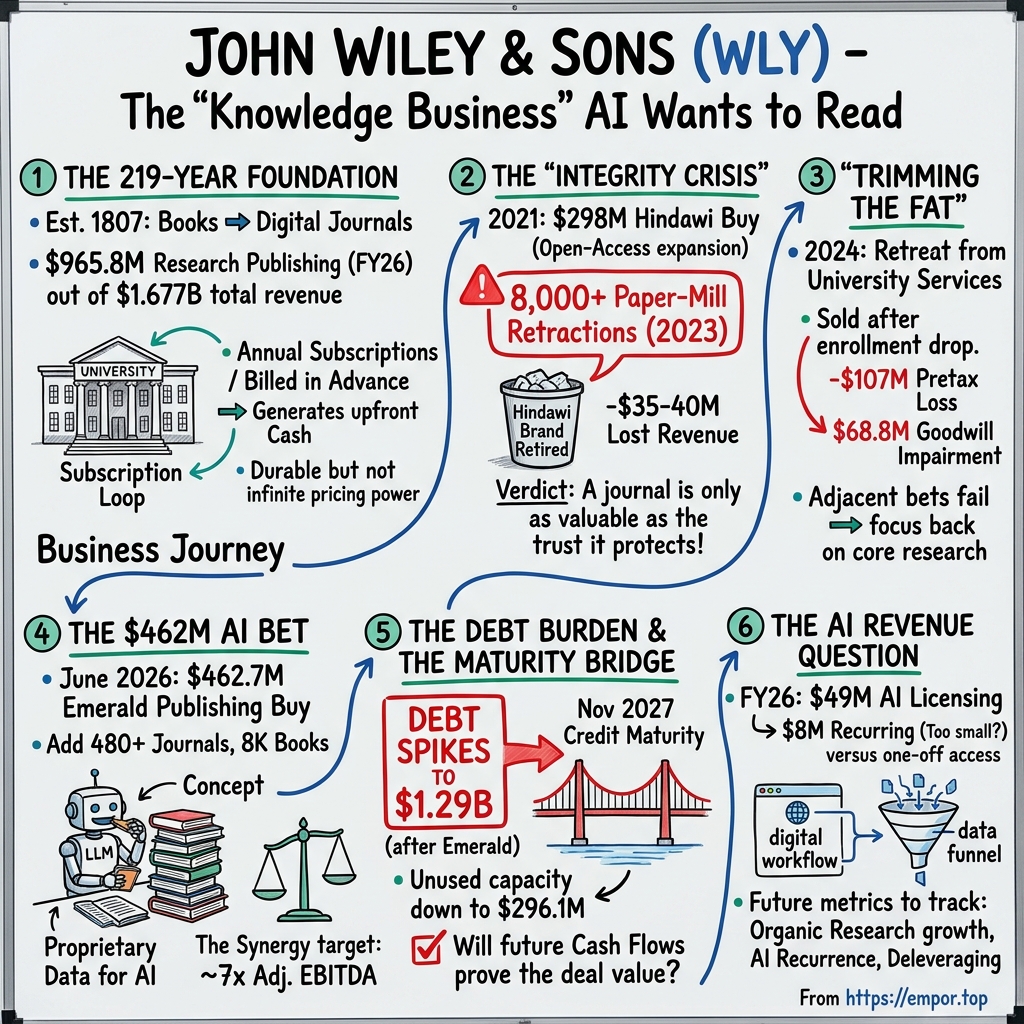
On June 1, 2026, a subsidiary of John Wiley & Sons completed the purchase of a publisher in Leeds, in the north of England, that most people outside a university library have never heard of. Emerald Publishing brought with it more than 480 peer-reviewed journals, around 8,000 books and some 3,000 business teaching cases, and Wiley paid about £337.5 million for it, roughly $452 million at that day's exchange rate.2 By the time the lawyers finished the customary adjustments, the preliminary consideration on Wiley's books had become $462.7 million.3
The announcement framed the deal in the language of the moment. This was not just a publisher buying a smaller publisher. It was, in management's telling, a way to deepen Wiley's store of proprietary, peer-reviewed content in an economy where artificial intelligence systems are hungry for exactly that kind of material.7 The pitch is easy to grasp. Large language models have already read the open internet. What they have not read, at least not legally, is the vetted research locked behind publishers' paywalls. Whoever owns that material owns something the AI companies want.
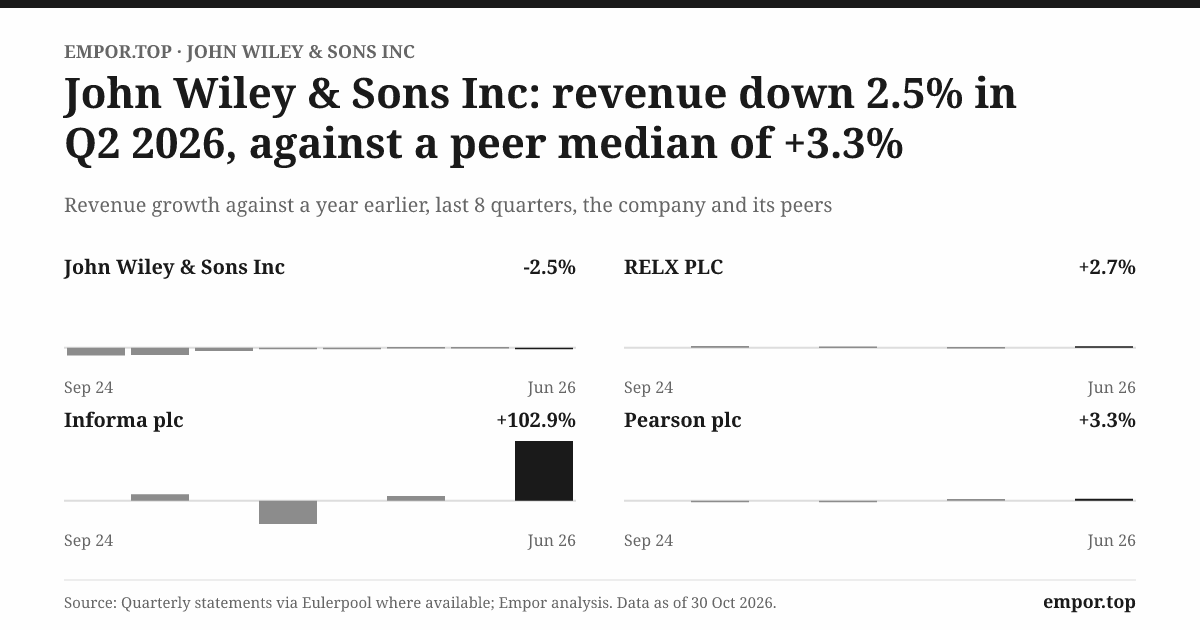
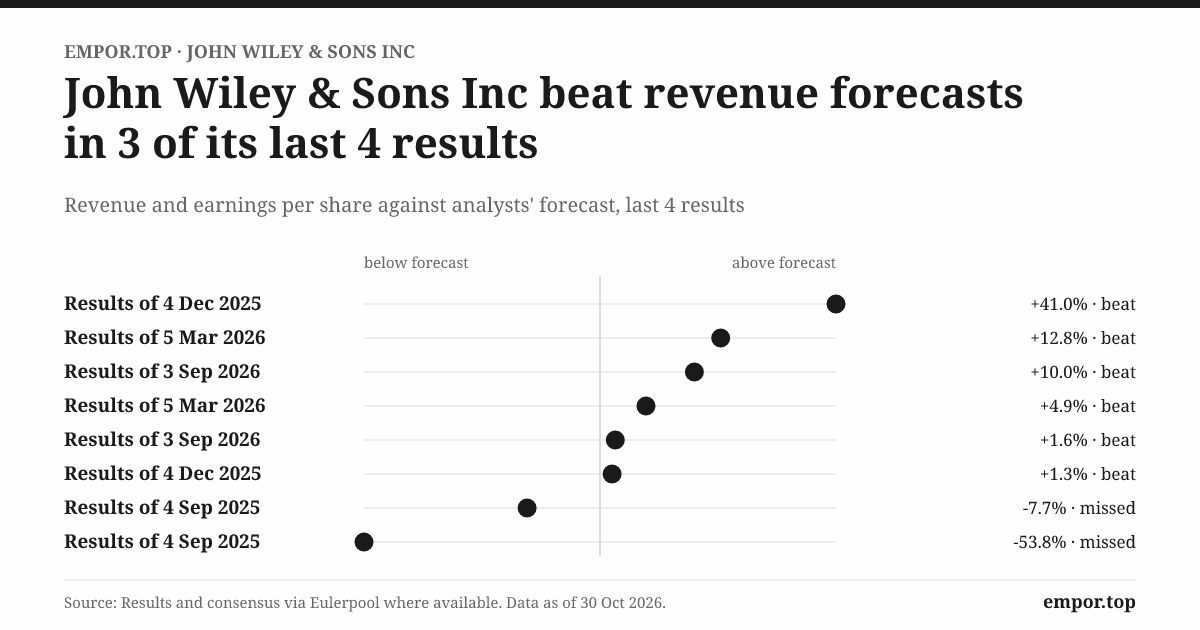
Then came the first quarter that included Emerald. In the three months to July 31, 2026, Wiley reported revenue of about $386 million, down about 2.5% from a year earlier, and operating profit of just $2.9 million.3 A year before, the same quarter had produced about $34 million. On a GAAP basis the company lost money, about 23 cents a share, which management attributed largely to restructuring charges and acquisition and integration costs.5 The balance sheet had changed shape too. Total debt stood at about $1.29 billion, almost double the $683 million Wiley owed at the end of April, and the unused room on its credit lines had fallen from about $607 million to about $296 million.3
Part of that collapse in profit is the calendar, and part of it is the deal. The quarter from May to July is always Wiley's weakest, because the journal year is renewed and billed around the turn of the calendar year and revenue from those annual licenses is recognized as the year unfolds. In the same quarter of 2023, 2024 and 2025, Wiley's operating margin ran between about 5% and about 9%, well below the full-year figure.1 So a thin July quarter is normal. A margin below 1% is not, and the difference is mostly the bill for restructuring, Emerald's acquisition costs and the start of integration.5 That is the kind of cost that management describes as temporary, and it may be. But it is also the first visible price of a strategy that will be judged on cash, and it arrived before most of the benefits.
That collision is where this story starts. On one side sits a promise: proprietary research, licensed into AI models and woven into data products, becoming a new engine for a company whose old engines have sputtered. On the other side sits the price: borrowed money, spent while the core business is still proving it can grow at all. In the fiscal year that ended in April 2026, Wiley's AI revenue reached $49 million, up from $40 million the year before. But only about $8 million of it was recurring.7 The rest came from one-time deals to let AI developers train on Wiley's content. That is a meaningful line, but it is not yet a business you can bank on renewing.
The scale of the company makes the stakes concrete. Wiley reported about $1.68 billion of revenue in fiscal 2026, and its Research Publishing business, the journals, contributed about $966 million of that.1 Total revenue was essentially flat on the year, down about 0.1%.1 Reported net income more than doubled to about $221 million, which sounds like a turnaround until you notice that about $70 million of it came from releasing a reserve against US deferred tax assets, an accounting event rather than an operating one.1
So the questions that animate the rest of this story are not abstract. Can research subscriptions and AI licensing offset the stagnation in the rest of Wiley? Will Emerald earn back what was paid for it, and leave enough room for Wiley to refinance a credit agreement that matures in November 2027?3 And does the content advantage Wiley talks about translate into pricing power, or merely into a large, respectable archive?
This is a bet on the future value of research content, made by a company whose recent revenue record is weak and whose borrowing room has narrowed. Whether that bet works is the story. To understand why Wiley believes it can, you have to go back to how a small New York printer ended up selling access, not paper.
 Subscribe on LinkedIn
II. A 219-Year-Old Company Learns to Sell Access
Wiley's history began in 1807, when Charles Wiley opened a print shop in New York.1 The early decades were the ordinary hustle of American publishing: printing for others, then publishing, then building a list. Over the nineteenth and twentieth centuries the firm drifted toward the material that would define it, science, engineering and technical books, the kind of titles that do not top bestseller lists but stay on engineers' shelves for decades. By the time Matthew Kissner became its president and chief executive in July 2024, a press release noted that he was only the fifteenth person to hold the job in the company's then 217-year history.19 Few companies anywhere can say that. Even fewer have stayed under the control of the founding family across that span; the Wiley family still holds roughly 63% of the voting power through a separate class of shares.9
The more important transformation was quieter, and it happened in the shift from books to journals. A book is sold once. A journal is a subscription. It arrives issue after issue, and the institutions that pay for it, university libraries, hospitals, corporate research labs, pay year after year, because a scientist who needs the latest work in their field cannot easily wait or go without. Over time Wiley assembled a large portfolio of scholarly journals, many of them published in partnership with learned societies that supply the editors, the reviewers and the reputation, while Wiley supplies the editorial systems, production, distribution and sales.1
Then the internet changed what the product was. A journal used to be a physical issue on a library shelf. Now it is a searchable, licensed archive, delivered through an online platform and paid for under a contract that grants a whole campus access. The customer did not really change. It is still, more often than not, a university library, a consortium of libraries, or a research institution. But what that customer buys has become access to a database of knowledge rather than a stack of paper, and access is something a publisher can price, bundle and renegotiate in ways that a shelf of bound volumes never allowed.
The payment path explains why investors have long liked this business. Wiley's journal subscriptions are generally fixed-price annual licenses, billed and collected in advance.1 A library pays before the year's articles have been published, let alone read. Some agreements are written to cover several years, but Wiley accounts for them as one-year contracts, because each year still requires confirmation and negotiation.1 That accounting choice is a small, revealing detail. It means the company itself does not treat a multi-year agreement as a locked-in revenue stream; it treats it as a relationship that has to be renewed.
Research Publishing generated about $966 million in fiscal 2026,1 making it the largest and most profitable part of the company, and the reason anyone talks about Wiley as an information business rather than a book publisher.
Here lies the first tension in the story. Wiley calls these subscriptions recurring, and in a billing sense they are. Cash comes in every year, in advance, from institutions that have been customers for decades. But recurring billing is not the same thing as a contract that cannot be broken. University budgets shrink. Library consortia negotiate hard. Governments and research funders push for research to be free to read. Every year, the renewal is a decision someone makes, and the company does not disclose renewal rates or price realization in a way that would let an outsider measure how sticky those decisions are.
So the durable asset is not a warehouse of books, or even a pile of articles. It is a set of recurring institutional relationships built on assembling, editing and distributing specialized knowledge. Its economics depend on renewals and on trust. To see how much power Wiley actually holds inside those relationships, you have to walk into the room where the deal gets made.
III. The Journal Deal That Pays Before the Article Is Read
Picture a negotiation that happens every year somewhere in the world. A university library, or more often a consortium representing dozens of libraries, sits across from a publisher's sales team. The library wants access to a portfolio of journals for its faculty and students, and increasingly it also wants its own researchers' papers to be published open access, free to read for anyone, without paying a separate fee each time. The publisher wants a price that reflects the value of thousands of journals and the archive behind them. Meanwhile, in a lab on the same campus, a researcher finishes a paper and submits it to one of those journals. If it survives peer review, it may end up behind the subscription wall, or it may be published open access with a fee paid by a grant, by the university, or under the very agreement being negotiated down the hall.
That is the machine Wiley's Research business runs on, and it has three main revenue streams. The first is subscriptions and so-called transformative agreements, sometimes called read-and-publish deals, in which an institution pays one price for both reading Wiley's journals and publishing its researchers' work open access. The second is open-access publication fees, paid per article. The third is a smaller set of research services and data products.1 Authors contribute the research itself, and their peers contribute the reviewing, mostly unpaid. Wiley contributes the journals' brands, the editorial and peer-review systems, the production, the online platform and the global sales force. In fiscal 2026, this business produced more than half of Wiley's revenue.1
The most elegant part of the machine is the cash. Because libraries pay up front, cash often arrives before Wiley has recognized the revenue. At the end of April 2026, Wiley carried about $451 million in contract liabilities, mostly deferred subscription revenue, which is money already collected for services still to be delivered.1 Think of it as a magazine subscription on an institutional scale: the reader has paid for the year, and the publisher owes the issues. Much of the cash is collected by subscription agents, intermediaries who gather payments from libraries and generally remit them between December and April.1 The effect over a long period is striking. From fiscal 2015 through fiscal 2026, Wiley reported about $1.1 billion of cumulative net profit but about $3.6 billion of cash from operations.1 Part of that gap comes from non-cash charges, such as amortization of acquired journals and repeated impairments, being added back. Part comes from the subscription model's habit of collecting before delivering. Either way, the cash record is stronger than the earnings record, which is one of the most persistent features of this company.
That cash advantage has a limit worth stating plainly. It is not a pile of free money. Over the same period, Wiley's cash and short-term investments fell by about $411 million, as free cash flow went into dividends, buybacks, acquisitions and debt service.1 The machine generates cash reliably; what the company has done with that cash is a separate question, and the rest of this story keeps returning to it.
One small number deserves a closer look, because it shows the machine is not frictionless. A decade ago, Wiley's receivables equaled about 29 days of revenue. By fiscal 2026, after peaking above 60 days around 2019, they stood at about 53 days, or roughly $244 million.1 Some of that change reflects the shift in mix, away from print and toward institutional deals and open-access fees that are invoiced differently, and some reflects the timing of agent remittances. Wiley sets aside a provision for expected credit losses but does not publish an aging table or a roll-forward of write-offs.1 Nothing in the filings suggests a collection problem. The point is simply that the ideal of the subscription model, customers paying before anything is delivered, describes the journal core better than it describes the whole company, and the gap between the two has widened over time.
How strong is Wiley's position in this market? Start with the comparison everyone in scholarly publishing makes. Elsevier, the scientific publishing arm of RELX, reported about £2.7 billion of Scientific, Technical and Medical revenue in 2025, with an adjusted operating margin of about 38%.10 Springer Nature reported about €1.93 billion of total 2025 revenue, of which its Research segment contributed about €1.52 billion, growing about 7.4% on an underlying basis.11 Wiley's research business is substantial, but it is smaller than both. Elsevier's STM revenue is roughly two and a half times Wiley's Research revenue, and Springer Nature's research arm is about one and a half times as large. The mix differs too: Elsevier owns more databases, analytics and clinical tools, while Wiley leans more heavily on journals published with societies.
Scale matters in this business because a library negotiating with a publisher is buying a bundle, and the bigger the bundle, the more painful it is to walk away from. But the forces around Wiley are not as friendly as the phrase "research is indispensable" suggests.
Consider the buyers. Individual customers are diffuse. No single subscription agent accounts for more than 10% of Wiley's revenue, and agents collectively account for about 19%.1 On the book side, no single customer exceeds 6% of revenue, and the top ten account for about 12%.1 That sounds like low concentration. But in journals, buyers aggregate. Library consortia bargain on behalf of dozens or hundreds of institutions, and national negotiating bodies can, and sometimes do, let a deal with a large publisher lapse rather than accept its terms. The concentration that matters is not one named customer; it is the organized buyer.
Consider the suppliers. The authors and the societies that own many journals are, in a real sense, the source of the product. A society can move its journal to another publisher when its contract comes up. Authors can choose where to submit, and the prestige of a journal travels with its editors and its community, not with the publisher's logo. Consider the substitutes. Open-access publishers, preprint servers and institutional repositories give researchers other ways both to publish and to read. None of these has broken the subscription model, but each caps how hard a publisher can push.
Then there are switching costs. Journal archives, embedded editorial systems and long relationships with societies create real friction. A library cannot easily replace decades of Wiley journals with something else, and a society does not lightly uproot its editorial workflow. But the proof that would turn friction into a measurable lock-in, renewal rates, retention by customer cohort, price increases achieved at renewal, is not something Wiley publishes on a company-wide basis. Without it, the honest conclusion is narrower than the bull case would like.
Wiley has scale, a large journal portfolio and embedded workflows. The evidence supports durable distribution and content relationships. It does not establish unlimited pricing power or weak buyers. The places where the moat would break are visible: institutional cancellations or tougher renegotiations, slower subscription price increases, societies and authors migrating elsewhere, and growth in published content that fails to convert into recurring revenue. One more break point is less obvious, and it is the one Wiley discovered the hard way. A journal portfolio is only worth what readers believe about what it publishes. In 2021, Wiley bought a company that would test that belief.
IV. The $298 Million Hindawi Deal Meets a Trust Crisis
In January 2021, Wiley announced it would buy Hindawi, a fully open-access publisher, for $298 million.12 The logic was simple and, at the time, widely shared. The future of scholarly publishing was tilting toward open access, where authors or their funders pay to publish and anyone can read for free. Hindawi had built a portfolio of roughly 200 open-access journals and a reputation for efficient, technology-driven publishing at scale. Wiley presented it as a fast-growing research publisher that would expand its open-access portfolio and accelerate a shift that funders and governments were pushing anyway.12
On paper, it fit perfectly. Open access turns the economics of a journal inside out. Instead of selling access to readers, the publisher charges a fee for each published article. That means growth comes from publishing more articles, and a publisher that can process submissions efficiently can grow quickly. Hindawi was good at exactly that.
The problem was what "efficient" can hide. Over the following two years, it became clear that several Hindawi journals had been infiltrated by paper mills, operations that manufacture fake or low-quality research papers and sell authorship to academics under pressure to publish. Paper mills exploit a specific weakness: special issues, collections of papers organized by guest editors, where the normal editorial oversight can be weaker. If a guest editor is compromised, or if peer review is faked through invented reviewer accounts, a flood of fraudulent papers can pass through what looks like a legitimate process.
The consequences arrived in waves. In March 2023, Clarivate removed 19 Hindawi journals from its Web of Science index, which matters because many universities judge where their researchers should publish by whether a journal is indexed there.13 In May 2023, Wiley closed four Hindawi journals it said had been heavily compromised by paper mills.13 Hindawi paused its special-issues program, and the pause itself cost money, an initial $9 million hit, because special issues had been a large source of the article volume that drove fees.13 By December 2023, Hindawi had described a process for retracting more than 8,000 articles.14 Nature reported that more than 10,000 research papers were retracted across the industry in 2023, a record, and that Hindawi journals accounted for the bulk of them.15
The December 2023 earnings call, covering Wiley's second fiscal quarter of 2024, was where management stopped describing the problem as a pause and started describing it as an ending. Kissner, then interim chief executive, told investors that Wiley expected $35 million to $40 million of lost Hindawi revenue in the fiscal year, and that the quarter had already shown an $18 million revenue decline compared with a year earlier.13 He said it was time to sunset the Hindawi brand and fully integrate its roughly 200 journals into Wiley's portfolio of about 2,000.13 Liz Ferguson, who ran research publishing, attributed the quarterly hit to the volume decline that followed the publishing pause, and said no additional journal closures were planned.13 The prepared remarks and the answers lined up on the size of the damage. What they could not offer was a firm date by which submission volumes would recover, because that depended on researchers' willingness to trust the journals again.
It is worth being precise about what this episode proves. It was not a minor stumble. A $298 million acquisition, bought to be a growth engine, ended up costing tens of millions of dollars of annual revenue, generating a mass retraction that made international headlines, and losing its name. Wiley had earlier, in June 2023, described the special-issue problems and their effect on its outlook on its fiscal fourth-quarter call.16 The CEO who had championed the company's growth strategy, Brian Napack, departed later that year, and Kissner moved from the board into the interim role.9
But it is also not proof that Wiley's entire research portfolio is impaired. The Hindawi journals were a distinct, recently acquired set of titles with a specific operating model. Wiley's core subscription journals, many published with long-standing societies, did not suffer the same collapse. And in fiscal 2026, Research revenue grew about 5%, which suggests the business has absorbed the shock.9 The fair conclusion is narrower in both directions. Open access was a real strategic direction, and Wiley was right to want more of it. But Hindawi's commercial record was compromised by an integrity failure that the acquirer did not catch quickly enough, and the episode rejects the idea that buying scale automatically strengthens a content advantage. Scale bought without the controls to protect it can damage the very thing being sold.
The test since then has been whether the controls that failed were repaired, whether submissions and journal reputations recovered, and whether institutions kept renewing. The growth in Research revenue is encouraging evidence on the last point. Wiley does not publish a separate measure of research-integrity outcomes, such as retraction rates across its portfolio, that would let outsiders confirm the first.
That trust question carries straight into Emerald. More content helps Wiley only if editorial quality and customer confidence hold. Before getting there, though, Wiley's record contains a second, very different growth bet that also ended in a write-down, one that had nothing to do with fraud and everything to do with choosing a market.
V. When the University Services Bet Came Apart
In the 2010s, one of the hottest ideas in education was the online program manager. Universities wanted to offer online degrees but lacked the marketing muscle, the technology and the student-recruitment machine to do it at scale. Companies stepped in to provide all three, typically in exchange for a share of the tuition revenue the programs generated. Wiley built such a business, which it called Wiley University Services, and for a time it looked like a natural extension of a company that already served universities through textbooks, journals and courseware.
The appeal was real. A revenue-share contract with a university can run for years, and if the online program grows, the provider grows with it. For a publisher looking for growth beyond print, this was a way to sit closer to the student and the tuition dollar. But the model carried exposure that a journal subscription does not. Revenue depended on partner enrollments, which depend on how many students sign up for a particular online master's program. It depended on pricing, which came under pressure as more universities and more providers competed for the same online students. And it depended on winning new partner contracts, which became harder as regulators, lawmakers and universities themselves grew more skeptical of tuition-sharing arrangements.
Wiley's own forecasts captured the deterioration. In fiscal 2024, it recorded a further goodwill impairment of about $68.8 million in the business after projected enrollments, new partner additions and cash flows weakened.17 Goodwill is the premium a company pays above the book value of what it acquires, and impairing it is an admission that the business will not generate the future cash once expected. In November 2023, Wiley agreed to sell University Services to a rival, Academic Partnerships, in a deal Kissner described as an important step toward "a simpler, more focused Wiley."18 The sale completed in early 2024, and Wiley recorded a pretax loss of about $107 million on it.17
Two distinctions matter here. The first is between the cash Wiley received and the accounting loss. A loss on sale does not mean Wiley paid someone to take the business away; it means the price received was below what the business was carried at on the books, after years of acquisition accounting and investment. Part of the consideration came as a seller note, a loan to the buyer, which Wiley later sold; the interest income that disappeared with it is one reason Wiley's other income turned into a small expense in fiscal 2026.1 The second distinction is between divestiture and improvement. When a company sells a shrinking business, its revenue falls and its margins may rise, but that is subtraction, not organic progress. A large part of the decline in Wiley's revenue from about $2.1 billion in fiscal 2022 to about $1.7 billion in fiscal 2025 came from selling businesses, not from losing customers in what remained.1
Set this beside the longer record and the shape becomes clear. Over the decade from fiscal 2016 to fiscal 2026, Wiley's revenue declined about 0.3% a year, which is to say that, through acquisitions, divestitures, Hindawi and University Services, the company ended up roughly where it started.1 Meanwhile, capital spending, much of it on software, platforms and digital content, fell to about $65 million in fiscal 2026 from about $77 million the year before.6 Lower capex can mean discipline, or it can mean a company harvesting rather than building. Wiley does not report a standalone research and development figure, so outsiders have to infer the balance from capitalized software and product spending.
What did management learn? To its credit, Wiley did respond to evidence that the business was deteriorating, impairing it, then selling it, rather than pouring in more money in hope of a turnaround. But the impairments and the sale show that adjacent growth bets can consume meaningful value before management exits. The University Services episode and the Hindawi episode failed in different ways, one through market economics and one through quality control, but together they make the same point. Strategic fit is easy to describe and hard to monetize. So when Wiley, having shrunk itself to a simpler company, spent almost half a billion dollars on another acquisition in 2026, the burden of proof was always going to be on the cash returns, not on the story.
There is one more lesson buried in the sequence, and it concerns speed. The forecasts for University Services weakened over several years before the business was sold, and the Hindawi problems were visible in indexing decisions and journal closures for months before the brand was retired. In both cases, Wiley acted, but it acted after the damage had become large enough to show up in impairments and lost revenue. A management team that has learned from those episodes would set measurable milestones for its next bets, publish them, and report against them. For Emerald, management has done part of that, naming a synergy target and a year in which the deal should start adding to free cash flow. For AI, it has begun splitting recurring from one-time revenue. Whether those milestones are met, and how quickly the company reacts if they are not, is the real test of what was learned.
VI. Emerald: More Journals, More Debt, Less Room
When the Emerald deal closed on June 1, 2026, the filing said the purchase price had been funded from Wiley's cash on hand.2 That sentence is technically true and economically incomplete. At the end of April, Wiley held only about $76 million in cash and short-term investments.1 The cash it used came, in practice, from drawing on its credit agreement, and total debt had risen sharply by the end of July.3
Why Emerald? Emerald's catalog leans toward business, management, social sciences and education, the fields that teach future executives and public servants, with its library of business teaching cases as a distinctive extra.2 For Wiley, that broadens a Research portfolio that has historically been strongest in science, technology and medicine. Management also pitched the deal as an extension of its AI strategy.7 Added to the roughly 2,000 journals Wiley already published, Emerald takes the combined portfolio toward 2,500 titles and adds a portfolio built on long relationships with business schools and social-science departments around the world.
The economics, as management described them on the fourth-quarter call in June, came to about seven times Emerald's adjusted EBITDA once roughly $30 million of targeted annual cost synergies are included.7 EBITDA is a rough measure of operating cash before interest, taxes and the accounting charges for depreciation and amortization, and seven times is not an outlandish multiple for a steady publishing asset. But the "including synergies" qualifier carries a lot of weight. The multiple is low only if Wiley strips out the costs it expects to cut, mostly by folding Emerald's back office, platforms and production into its own. Before synergies, the price is meaningfully richer. Acquirers almost always target synergies; the record of hitting them on time is mixed across industries, and Wiley's own recent acquisition record, as Hindawi showed, gives no special reason to assume the best case.
The purchase-price allocation in the July-quarter filing assigned about $292 million of the price to acquired intangible assets, such as journal titles, customer relationships and content.3 Those intangibles will be amortized over time, which is one reason Emerald will look less profitable under GAAP than under the adjusted figures management prefers. In its first partial quarter inside Wiley, Emerald contributed about $13.3 million of revenue and about $1.2 million of net income.3 On the call, CFO Craig Albright said Emerald's adjusted EBITDA of about $5 million in the period carried a margin above the Research segment average, and that integration was tracking ahead of plan.5 Two months is far too short to judge a deal, but those first numbers at least match the plan rather than undercutting it.
Management's own projections define the test. Wiley expected Emerald to contribute about $78 million of revenue over the 11 months of fiscal 2027 it would own the business, and to add about 10 cents of adjusted earnings per share.7 The same projections said the deal would dilute free cash flow by about $15 million in fiscal 2027, because of integration costs and interest on the borrowings, and would only become accretive to free cash flow in fiscal 2028.7 That is an honest disclosure, and it matters. The deal improves adjusted earnings almost immediately, but it makes Wiley's cash position weaker before it makes it stronger. For a company whose investment case rests partly on cash generation, that sequencing is the whole ballgame.
A rough worked example shows why. Suppose Wiley borrowed most of the roughly $460 million it paid at the weighted average rate on its debt of a little over 5%. That implies an interest bill on the acquisition debt in the low-to-mid $20 millions a year. Emerald's projected revenue of about $78 million for 11 months, at a margin a little above the Research segment's near-30% adjusted EBITDA margin, implies adjusted EBITDA somewhere in the mid-$20 millions for the period.75 Before synergies, in other words, Emerald's operating cash roughly covers the interest on the money used to buy it, and leaves little over for taxes, integration and capital spending. The $30 million of targeted synergies is what turns the deal from a break-even into a return. That is why the synergy line is not a footnote in this story. It is the deal.
Currency adds a smaller wrinkle. Emerald was priced in sterling and earns much of its revenue outside the United States, while Wiley reports in dollars and had no open foreign-exchange forward contracts at the end of April 2026.21 A weaker pound would shrink Emerald's dollar contribution without anyone at Leeds doing anything differently, and a stronger one would flatter it. Investors reading Emerald's results should look for the constant-currency figures management provides rather than the reported ones.
Now the balance sheet. At the end of April 2026, Wiley owed about $683 million net of issuance costs and had about $607 million of unused borrowing capacity.1 By the end of July, the weighted average interest rate on the debt was about 5.2%.3 Before the deal, Wiley had reported net debt of about 1.4 times adjusted EBITDA.6 After it, management put the figure at about 2.7 times.5 Most of the debt is variable-rate, partly hedged by $300 million of interest-rate swaps.1 And the amended credit agreement under which most of it sits matures in November 2027.3 Wiley reports compliance with its covenants, and nothing in its filings suggests a breach.3 The issue is timing. Within about a year, Wiley will need to refinance or extend its main borrowing facility, and lenders will be looking at how much of Emerald's promised cash has actually arrived.
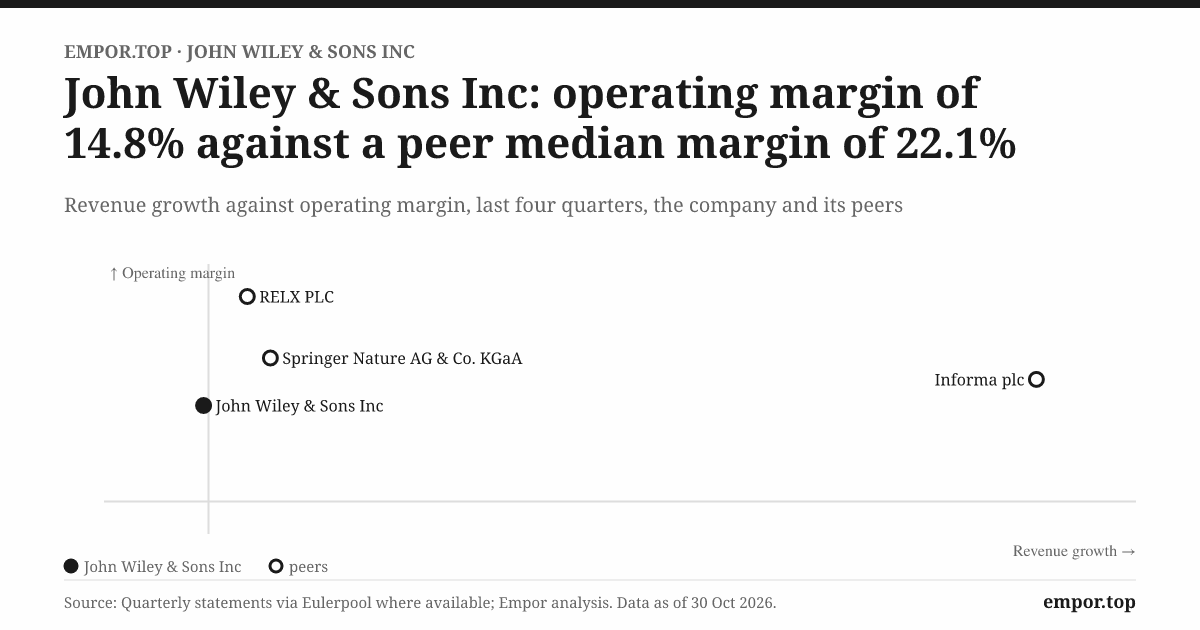
A comparison with peers helps calibrate ambitions without pretending they are direct deal comparisons. In the July quarter, Wiley's Research segment, now including Emerald, earned an adjusted EBITDA margin of about 29.6%, up about 1.3 points from a year earlier.5 RELX's Elsevier, which reports adjusted operating margin rather than EBITDA, earned about 38% on a far larger STM business.10 Springer Nature's group adjusted operating profit was about €544 million on €1.93 billion of revenue, roughly 28%.11 The measures are not identical, and Elsevier's mix includes high-margin databases, but the picture is consistent: Wiley's research business is respectable, not best in class, and closing the gap with Elsevier would require both scale and product mix that Emerald alone does not supply.
So the verdict on Emerald is still open, but the conditions for closing it are unusually clear. The deal adds relevant research scale, and management says it extends Wiley's proprietary content for AI. The stated seven-times multiple does not by itself establish a bargain, because it depends on synergies not yet achieved. What will settle it is visible within the next 18 months: Emerald's retention and renewal economics, whether the $30 million of synergies show up in cash rather than only in adjusted earnings, how quickly net leverage comes down, and the terms on which Wiley refinances in November 2027. Which brings the story back to the reason management gave for paying the price in the first place: AI.
VII. The CEO's AI Revenue: License Fee or New Business?
Matthew Kissner talks about AI the way an old-line publisher might talk about the arrival of a new, very rich reader. On successive earnings calls through fiscal 2026, he described a strategy with two halves. The first is licensing Wiley's trusted content into AI workflows: letting the developers of large language models train on peer-reviewed research, or feeding that research into the tools that scientists, doctors and engineers use to ask questions. The second is building Wiley's own AI-powered data products on top of its archive.8 In January 2026, Wiley created a new executive role, a Chief AI and Data Analytics Officer, to drive the effort.9
The numbers are real, and they have grown quickly from a standing start. AI revenue more than doubled, from about $23 million in fiscal 2024 to about $49 million in fiscal 2026.97 For a company whose total revenue barely moved over a decade, a line that more than doubled in two years is the kind of thing that gets attention. But inside that line sits the distinction that matters most for investors. Of the $49 million in fiscal 2026, only about $8 million was recurring, revenue from subscriptions, data feeds or licenses expected to renew.7 In fiscal 2025 the recurring portion had been about $1 million.8 The remainder came from what management calls model training deals: one-time agreements in which an AI developer pays for access to a body of content to train a model.
It helps to think about the difference with a simple analogy. A model-training deal is like selling the rights to photocopy an entire library once. The buyer gets what it needs, and there is no obvious reason it will come back next year unless there is new material worth having or the license has to be renewed to keep using it. A recurring arrangement is more like a subscription to a newspaper: the reader pays every year because the value lies in what keeps arriving. Wiley's archive grows every year, so there is a plausible argument that model developers will need fresh licenses for fresh research. But plausible is not proven, and the company has not disclosed how its training deals are priced, how usage is measured, or how many have renewed.
The first quarter of fiscal 2027 offered the newest reading. Wiley reported about $14 million of AI revenue, of which Kissner said $10.5 million came from model training and $3.5 million was recurring.5 He said another roughly $14 million was already contracted for the following two quarters, that recurring AI revenue was growing two to three times over the prior year, and that Wiley was aiming for more than $50 million of AI revenue for the full year.5 That is a more specific answer than many companies give about AI, and specificity counts in management's favor. But even on management's numbers, three-quarters of the quarter's AI revenue was the one-time kind. The comparison across calls told a consistent story: the total kept growing, the recurring portion grew faster, and the recurring portion remained small.
The quarter also exposed the volatility that one-time deals create. Wiley's Learning segment, which houses books, courseware and professional content, had booked some of its AI licensing revenue in the prior year, and when those deals did not repeat at the same level, the comparison suffered. Wiley attributed Learning's 7% revenue decline in fiscal 2026 partly to "lower AI licensing revenue," alongside macro headwinds and retail softness.9 In the first quarter of fiscal 2027, Learning revenue fell about 20%, to about $93 million, with both its academic and professional halves down about a fifth, as softer retail and corporate assessment demand compounded the tough AI comparison.5 When a revenue line is lumpy, it boosts growth in the year a big deal lands and then becomes a headwind the next year. That is not a criticism of selling licenses; it is a description of what nonrecurring revenue does to a company's growth rate.
Keep the economics in proportion. Even $50 million is about 3% of Wiley's revenue, and the recurring portion is a fraction of a percent of the total. The AI line is meaningful as an emerging business, but it cannot yet carry the investment case on its own. On reinvestment, Wiley does not report a standalone research and development line; the closest visible proxy is capital expenditure, mostly capitalized software, platforms and digital content, which was about $65 million in fiscal 2026 and has been trending down.6 Wiley capitalizes much of this spending and amortizes it over about three years, so the cost shows up in the income statement with a lag.1 That makes it hard for an outsider to judge how much the AI push really costs, and therefore how profitable each AI dollar is.
There is also a two-sided risk here that Wiley itself acknowledges in its risk factors.1 AI could create a durable licensing market for authoritative material, a world where every serious AI system pays publishers for the right to draw on vetted research. But AI could also change how customers access and value Wiley's existing products. If a researcher can ask an AI assistant to summarize the literature, perhaps the library needs fewer full-text subscriptions. If students learn from AI tutors, perhaps they buy fewer textbooks and less courseware. Learning's weakness may already reflect some of that, though Wiley attributes it to market conditions. The same technology that makes Wiley's content valuable to model builders could make it less necessary to some of the readers who pay for it today.
The conclusion is straightforward. AI is a plausible future growth vector because Wiley owns specialized research content and already has the licensing infrastructure, the rights management and the sales relationships to sell it. Current evidence is small and mostly nonrecurring. It proves commercial activity, not a scalable moat or a durable revenue stream. Technical access, such as a model trained on Wiley content, a data feed or a pilot with a large technology company, is not the same thing as recurring, profitable revenue, and Wiley's own history of converting promising initiatives into sustained revenue is mixed. The forward test is measurable: recurring AI revenue as a share of the AI total, organic constant-currency Research growth once Emerald is excluded, and any evidence that AI licenses renew. Whether those numbers move depends heavily on the person who has staked his tenure on them.
VIII. Matthew Kissner's Turnaround, Tested by Cash and Pay
Matthew Kissner did not arrive at Wiley as an outsider with a turnaround reputation. He arrived, in effect, from the boardroom. Before taking the top job, he had spent more than two decades with Wiley in leadership, board and consulting roles, including as board chair and as a group executive, and he had held leadership positions at Pitney Bowes, Bankers Trust, Citibank and Morgan Stanley before that.19 His background is in finance and operations rather than publishing or technology, which helps explain the style of his tenure: simplify the portfolio, cut costs, focus on margins and cash. When Brian Napack left in the autumn of 2023, in the middle of the Hindawi crisis and the University Services retreat, Kissner became interim chief executive, and in July 2024 the board, chaired by Jesse Wiley, made the appointment permanent after what it described as a global search.19 The chair called him "an experienced C-suite operator and Wiley veteran."19
That choice says something about the board. A family-controlled company in a difficult moment chose continuity and operational discipline over a strategic outsider. The bet was that Wiley's problem was not a lack of assets but a lack of focus, and that the right move was to sell what did not fit, tighten what remained, and then, only then, look for growth.
Judged on the operating record, the first half of that plan delivered. Wiley's operating profit rose from about $205 million in fiscal 2023 to about $277 million in fiscal 2026, and its operating margin rose from about 10% to about 16.5%, even as revenue fell.1 Cash from operations recovered to about $261 million in fiscal 2026, and Wiley's own free cash flow measure rose about 55% to about $195 million.6 (A stricter calculation that subtracts all capital expenditure from operating cash puts it nearer $177 million; the direction is the same.1) Those are real improvements in the efficiency of the business, and they came from management decisions: divestitures, restructuring and cost cuts.
The headline earnings number, though, overstates the inflection. Fiscal 2026 net income of about $221 million included a deferred-tax release.1 Strip it out and net income would have been roughly $150 million, a solid improvement on the prior year's $84 million but not the near-tripling the headline suggests. Even that comparison is flattered by fiscal 2025's restructuring and divestiture charges. The plain conclusion is that Kissner's team has improved margins and cash flow from a low base, but has not yet shown that it can grow the business.
How is the team paid for that record? Kissner's reported compensation rose from about $3.4 million in fiscal 2024, a partial year that began with his interim appointment, to about $6.6 million in fiscal 2026.9 Of the fiscal 2026 total, about $4.2 million came in stock awards and about $1.3 million in annual incentive pay.9 CFO Craig Albright received about $2.2 million.9 The incentive design, as the proxy describes it, ties a large share of pay to performance measures such as adjusted earnings, cash flow and revenue, and pays a large part in shares.9 That design rewards exactly the things that improved: margins and cash, while revenue was flat. A skeptic would note that adjusted earnings measures, by construction, exclude the restructuring and acquisition charges that have dominated Wiley's GAAP results for years.
Ownership puts the pay in context. Kissner beneficially owned 86,594 Class A shares, plus unvested awards.9 At October's share price of about $51, that stake is worth a little over $4 million, meaningful personal exposure but modest compared with the Wiley family's position.9 The family retains voting control through Class B shares, which elect most of the board.9 For outside shareholders, this means management is accountable first to the family, and the family has historically prized continuity.
The September 24, 2026 annual meeting provided a snapshot of how outside shareholders see it. Say-on-pay passed with more than 99% of votes cast in favor, and PricewaterhouseCoopers was ratified as auditor with almost no opposition.20 But the director elections told a more pointed story. Class A shareholders, the outside investors who elect only three of the nine directors, withheld about 39% of their votes from director David Dobson and about 20% from the other two Class A nominees.20 The Class B nominees, including Kissner and Jesse Wiley, were elected with negligible opposition because the family's votes decide those seats.20 Wiley gave no explanation for the Dobson vote in its filing. Withhold votes of that size are unusual and signal dissent from a significant portion of outside holders, even if they cannot change the outcome.
On the audit, PwC gave an unqualified opinion on the fiscal 2026 statements and flagged research subscription revenue recognition as a critical audit matter, meaning it required especially significant audit effort, not that it was wrong.1 There was no emphasis-of-matter paragraph or reported material weakness.1
Credibility now rests on what Kissner and his team do next. On calls, the team has given relatively specific, checkable answers on AI and Emerald.57 What the calls have offered less of is a concrete plan for reversing Learning's decline beyond pointing to market conditions, and a detailed account of how and when Wiley intends to refinance its credit agreement.5 On the first-quarter call, analysts pressed on how Research growth compared with peers, on the timing of the AI deals already contracted, and on whether Emerald had produced any surprises since closing; management's answers on the first two were numerical and on the third reassuring rather than detailed.5 That pattern, precise on the businesses that are working, more general on those that are not, is common across companies, and it is worth watching as the Learning decline continues. Management has delivered cost and cash-flow improvement. Whether it can deliver organic growth, cash generation after Emerald and debt reduction at the same time is the question the stock price is trying to answer.
IX. The Company's Case—and the Skeptic's Case
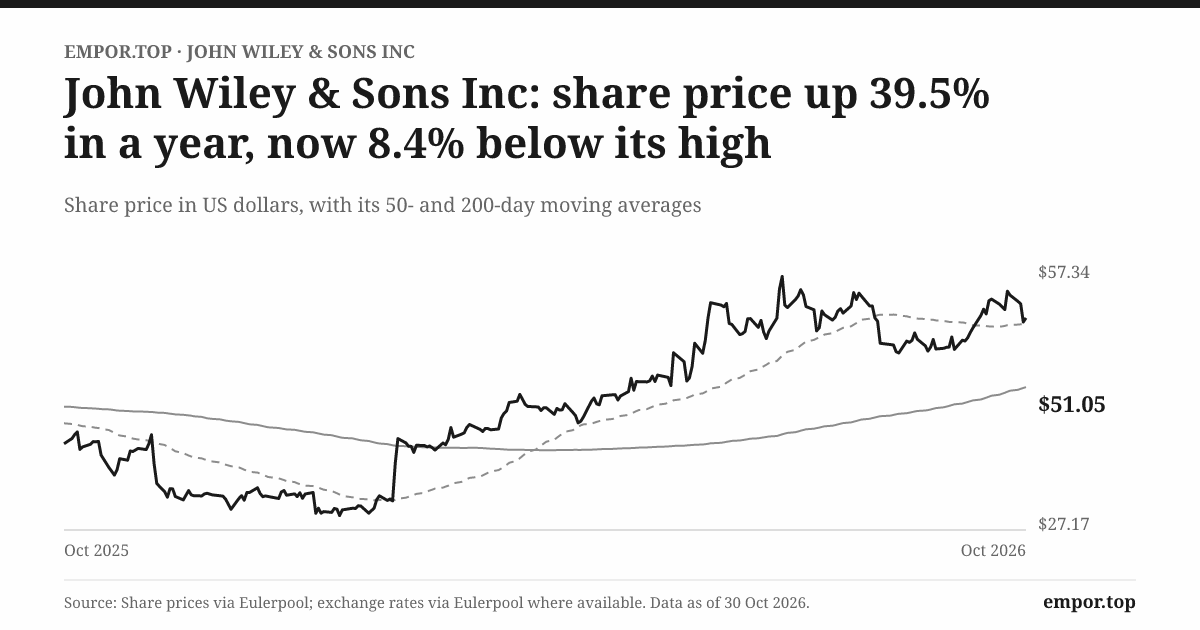
On October 30, 2026, Wiley's Class A shares closed at about $51. That is about 8% below their 52-week high, but almost 80% above their 52-week low of about $29. The share price has traveled a long way in a short time, and it has done so with volatility of about 37%, unusually high for a 219-year-old publisher. Over the past five years, at its worst, the stock fell by half.
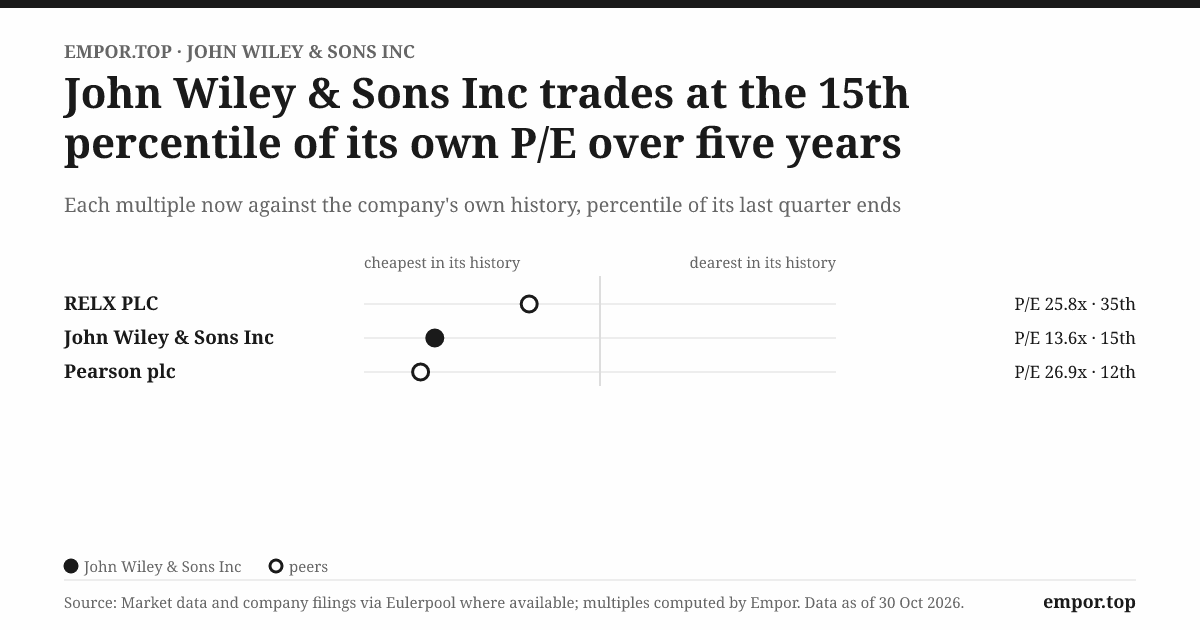
At that price, the market values Wiley at about $2.7 billion, and including debt, at an enterprise value of about $4 billion. The shares trade at about 13.6 times trailing earnings, against a median of about 20.9 times over the past five years, an earnings yield of about 7.3%. They also offer a dividend yield of about 2.8% and a free-cash-flow yield of about 7.9%. On enterprise value, Wiley trades at about 10.4 times EBITDA. Taken at face value, that looks cheap relative to the company's own history. But the denominator needs care. Trailing earnings include the $70 million tax release, so on normalized earnings the multiple is meaningfully higher than 13.6. And the enterprise value now includes the debt taken on to buy Emerald, while trailing EBITDA includes only two months of Emerald's contribution. A fair reading is that the market is pricing Wiley as a business with modest growth, improved margins, more leverage and a credible but unproven new revenue line, which is roughly what the evidence describes.
Two readings of one company
Start with the bull case, argued at its strongest. Wiley's research portfolio, institutional relationships and editorial infrastructure support the case, as do its recent growth and margin performance.95 Management guided to mid-single-digit Research growth and low to mid-single-digit organic revenue growth for the company in fiscal 2027.5 Emerald adds content in fields where Wiley was thin, at a price that looks reasonable if the synergies arrive. AI may create an incremental licensing market for vetted research, a market Wiley is well positioned to sell into. And the dividend, paid for decades, is now covered more comfortably by earnings, with a payout ratio of about a third in fiscal 2026 against a historical median near half.1 If Research keeps growing mid-single digits, Learning stabilizes, AI recurring revenue compounds and Emerald deleverages the balance sheet on schedule, today's price will look like the low point of a reset.
Now the bear case, also at its strongest. Over five years, revenue has declined about 2.9% a year, and over ten years about 0.3% a year.1 Some of that decline is portfolio pruning, but the remaining Learning segment fell about 7% in fiscal 2026 and about 20% in the first quarter of fiscal 2027.95 AI recurring revenue is a small fraction of total AI revenue, which is itself small. Wiley has a record of growth acquisitions that disappointed, and it has just made another, larger one with borrowed money. Its net leverage roughly doubled, its borrowing headroom halved and its main credit facility matures in about a year.53 On this reading, the low multiple is not a bargain but a fair price for a business that has shrunk for years and is now asking investors to trust it with more leverage.
Holding these cases up against the industry's competitive forces sharpens the judgment. Rivalry in scholarly publishing is concentrated among a handful of large players, Elsevier, Springer Nature, Wiley and Taylor & Francis among them, and competition takes the form of bundles, society contracts and open-access deals rather than price wars. That is a relatively benign structure. Buyer power is moderate to high because libraries organize into consortia and negotiate together, and because university budgets are finite.1 Supplier power, from authors and societies, is real: they provide the content and the prestige, and a society can take its journal elsewhere. The threat of substitutes, from open-access repositories, preprints and, newly, AI summaries, is growing. The threat of new entrants is low for subscription portfolios built over decades but higher in open access, where a startup can launch journals quickly, as Hindawi's own history showed.
Hamilton Helmer's framework of seven sources of lasting advantage gives a second lens. Wiley has some scale economies, because a large portfolio spreads the cost of platforms, sales forces and editorial systems across many journals, but Elsevier's scale is larger still. It has moderate switching costs, archives and embedded workflows that make cancellation painful, although Wiley does not publish the retention data that would prove their strength. It has a form of network economies in its best journals, because prestige attracts the best papers, which attracts more readers and citations, which reinforces prestige, but much of that prestige belongs to the journals and the societies, not to Wiley's corporate brand. Its archive could be described as a cornered resource, especially if AI licensing becomes a durable market, although competitors have archives of their own. Process power, the editorial discipline that makes research trustworthy, is exactly what Hindawi called into question. Counter-positioning, where an incumbent cannot copy a rival's model without harming itself, does not favor Wiley; if anything, open-access startups once counter-positioned against subscription publishers. The honest scorecard is that Wiley has real but moderate advantages in scale and switching costs, a potentially valuable archive, and no single power strong enough to guarantee pricing.
Peer results reinforce the gap: Elsevier's STM margin is higher, and Springer Nature's Research growth faster.105119 Wiley is a solid number three in a concentrated industry, not a leader that can set terms.
Buybacks on borrowed money
A skeptical investor would push on capital allocation first. Hindawi's integrity crisis and the University Services impairments are two different ways that growth bets disappointed, one through broken controls, the other through deteriorating market economics. Emerald's strategic rationale is coherent, but disclosed returns, not rationale, are what would justify it. The same investor would ask about the order of operations. In fiscal 2026, Wiley paid about $74 million in dividends and repurchased about $100 million of stock, together roughly equal to its free cash flow.1 In the first quarter of fiscal 2027, even while borrowing heavily for Emerald, it repurchased another $15 million of shares, leaving about $192 million remaining under its authorization.3 Buying back shares with what is, at the margin, borrowed money is a choice that makes sense only if management is confident about future cash flow and the refinancing. If that confidence is misplaced, the buybacks will have been paid for with balance-sheet flexibility.
The same investor would ask about governance. The dual-class structure leaves outside investors unable to change control or force a strategic review, a concern reflected in September's withhold votes.20 And they would ask about disclosure: Wiley does not report the metrics needed to test whether the research moat and AI investment are working.
There are no large legal clouds to add to the list. Wiley said pending litigation at the end of April 2026 was not expected to have a material effect on its financial position, and it carried about $10 million of unrecognized tax benefits, a routine reserve for tax positions that could be challenged.1 The accounting judgments that matter most are the ones already in this story: when subscription revenue is recognized, how intangible assets from acquisitions are valued and amortized, and when a goodwill balance has to be impaired. The last of those has been tested twice in three years, and Emerald's new intangibles will be the next balance to watch.3
Weighing all of it, the bull case has a real foundation in research scale, advance subscription cash, improving margins and new licensing opportunities. The bear case has stronger near-term evidence: a shrinking revenue base, Learning weakness, AI revenue that is still mostly nonrecurring, a prior acquisition-related integrity failure and reduced refinancing headroom. Neither the low multiple nor the strategic narrative settles the question. Post-deal cash conversion does.
Three measures will reveal which case is winning. The first is organic constant-currency Research revenue growth, which was about 5% in fiscal 2026 and about 6% for research publishing excluding Emerald in the first quarter; management guides to mid-single digits.95 If it holds, the core of the bull case holds. The second is recurring AI revenue, about $8 million in fiscal 2026 and about $3.5 million in the first quarter alone, which management says is growing two to three times a year.75 If it compounds, AI becomes a business; if it stalls, it remains a series of license fees. The third is free cash flow and whether net leverage, about 2.7 times after Emerald, falls through the November 2027 refinancing.5 If leverage falls toward management's comfort range while cash flow recovers, Emerald will have paid for itself. If it does not, the refinancing will be negotiated from weakness.
X. Lessons from the Publishing Ledger
Every year, a library decides whether to renew a journal subscription. Wiley's long arc is the story of who captures the value of that renewal, and what the company has learned, sometimes painfully, about keeping it.
The first lesson comes from Wiley's subscription model: cash arrives before the articles are published, but only if libraries keep renewing. For investors in any subscription business, the lesson is to look past billing and ask for retention, because a prepayment is a promise of next year's negotiation, not proof that it will go your way.
The second lesson comes from Hindawi. Wiley's experience showed that a research publisher's content is only as valuable as the peer review protecting it. The wider point for anyone acquiring a content business is that diligence on growth rates is not enough. The question is how the growth was produced, and whether it will survive the scrutiny of the people who rely on it.
The third lesson runs through University Services and into Emerald. University Services fit Wiley's relationships with universities, but that fit did not stop enrollments from softening, pricing from tightening and goodwill from being written off. Emerald fits Wiley's research portfolio, and management has explained the fit persuasively. A strategic fit is a hypothesis; cash returns are the proof. The wider lesson is that a company with a poor acquisition record does not earn the benefit of the doubt on its next deal by describing it well. It earns it by reporting, deal by deal, what the cash actually did.
The fourth lesson belongs to the newest chapter. Wiley's archive gives it a seat at the table with AI developers. It does not tell Wiley what the meal is worth. Most of its AI revenue so far has come from one-time training deals; the recurring part is small. Owning the source material gets you into the conversation. Recurring customer value keeps you there. For founders and investors in any content-rich business, the lesson is that being needed once is not the same as being needed every year, and only the second builds a business.
XI. Epilogue
Tonight, Wiley stands at a point where the next year of results will answer questions that its strategy has posed for most of a decade. Emerald is inside the company, and the company says its integration is running ahead of plan. Debt is roughly double what it was in the spring. The full-year outlook for fiscal 2027, organic revenue growth of low to mid-single digits and adjusted earnings per share between about $4.60 and $5.05, was reaffirmed after the July quarter.54 And a credit agreement that holds most of Wiley's borrowings matures in November 2027.3
The moments that will decide the story are already on the calendar. Each quarterly report through fiscal 2027 will test whether Research growth holds once Emerald is stripped out, whether Learning stabilizes and whether recurring AI revenue grows alongside total AI revenue.5 The year-end results will show whether Emerald meets the revenue and adjusted earnings contribution management projected, and whether its free-cash-flow dilution is greater or less than expected.7 And then, sometime before November 2027, Wiley will announce how it has refinanced, on what terms and at what cost.
What would change the thesis? Sustained organic growth in Research, a stabilizing Learning segment, recurring AI revenue that compounds and leverage that falls toward management's comfort range would strengthen the case that Wiley has turned a period of retreat into a platform for growth, and that Emerald was bought at the right time. Flat research growth, persistent Learning declines, AI revenue that remains mostly one-time, or cash shortfalls that leave the refinancing to be negotiated from a weaker position would confirm the bear case: that Wiley borrowed against a future it had not yet shown it could build.
Some things the filings cannot yet answer. No one outside the company knows how much of AI licensing will turn out to be recurring, because the market for licensed research in AI is too new to have a renewal history. Emerald's returns will also take years to establish, through renewals, synergies and the gradual compounding of a journal portfolio. The decisive evidence will be organic research growth and cash generation after integration, not acquisition scale or AI announcements alone. Until that evidence arrives, Wiley remains a company with a very old asset, a new pitch and a deadline.
XII. Outro
Go back to the library negotiation, the one that happens every year, somewhere in the world. On one side of the table sits an institution deciding whether to pay, in advance, for another year of access to a body of research. On the other sits a company that started as a print shop in 1807, survived two centuries of changing technology, and now wants its archive to be read not only by scientists and students but by machines.
What makes Wiley unlike another publisher with an AI pitch is not the size of its archive or the cleverness of its strategy. It is the accumulated relationship between published knowledge and the institutions that pay to find and use it, a relationship built slowly, damaged once badly, and renewed one year at a time. Its future depends on proving that relationship can grow in a world where the way people read is changing. Wiley has spent two centuries publishing knowledge; the next chapter depends on whether it can keep earning trust—and charge for what comes next.
References
-
John Wiley & Sons, Inc. Form 10-K for fiscal year 2026 — SEC, 2026-06-24 ↩↩↩↩↩↩↩↩↩↩↩↩↩↩↩↩↩↩↩↩↩↩↩↩↩↩↩↩↩↩↩↩↩↩↩↩↩↩
-
John Wiley & Sons, Inc. Form 10-Q for the quarter ended July 31, 2026 — SEC, 2026-09 ↩↩↩↩↩↩↩↩↩↩↩↩↩↩
-
Wiley Reports First Quarter 2027 Results, Q1 in Line With Expectations and Full Year Outlook Reaffirmed — Wiley, 2026-09-03 ↩
-
Wiley (WLY) Q1 2027 Earnings Call Transcript — The Motley Fool, 2026-09-09 ↩↩↩↩↩↩↩↩↩↩↩↩↩↩↩↩↩↩↩↩↩↩
-
Q4 FY2026 Earnings Call Transcript — Wiley, 2026-06-16 ↩↩↩↩↩↩↩↩↩↩↩↩
-
John Wiley & Sons, Inc. 2026 Proxy Statement — SEC, 2026-08-13 ↩↩↩↩↩↩↩↩↩↩↩↩↩↩↩↩↩
-
Springer Nature FY 2025 results press release — Springer Nature, 2026-03-17 ↩↩↩
-
Wiley Announces the Acquisition of Hindawi — Wiley, 2021-01-05 ↩↩
-
Wiley to stop using "Hindawi" name amid $18 million revenue decline — Retraction Watch, 2023-12-06 ↩↩↩↩↩↩
-
Hindawi reveals process for retracting more than 8,000 paper-mill articles — Retraction Watch, 2023-12-19 ↩
-
More than 10,000 research papers were retracted in 2023 — Nature, 2023-12 ↩
-
John Wiley & Sons FY2023 Q4 Earnings Call Transcript — MarketBeat, 2023-06-15 ↩
-
John Wiley & Sons, Inc. Form 10-K for fiscal year 2024 — SEC, 2024 ↩↩
-
Academic Partnerships Announces Acquisition of Wiley University Services — Wiley, 2023-11-14 ↩
-
Wiley Appoints Matthew Kissner as President and CEO — Wiley, 2024-07-10 ↩↩↩↩
-
Annual Meeting Voting Results Form 8-K — SEC, 2026-09-24 ↩↩↩↩
 LinkedIn
 WhatsApp
 Reddit
 Hacker News
 Email
 Kindle
 RSS Feed
 Spotify
 Apple Podcasts
 Amazon Music
 Audible
 YouTube