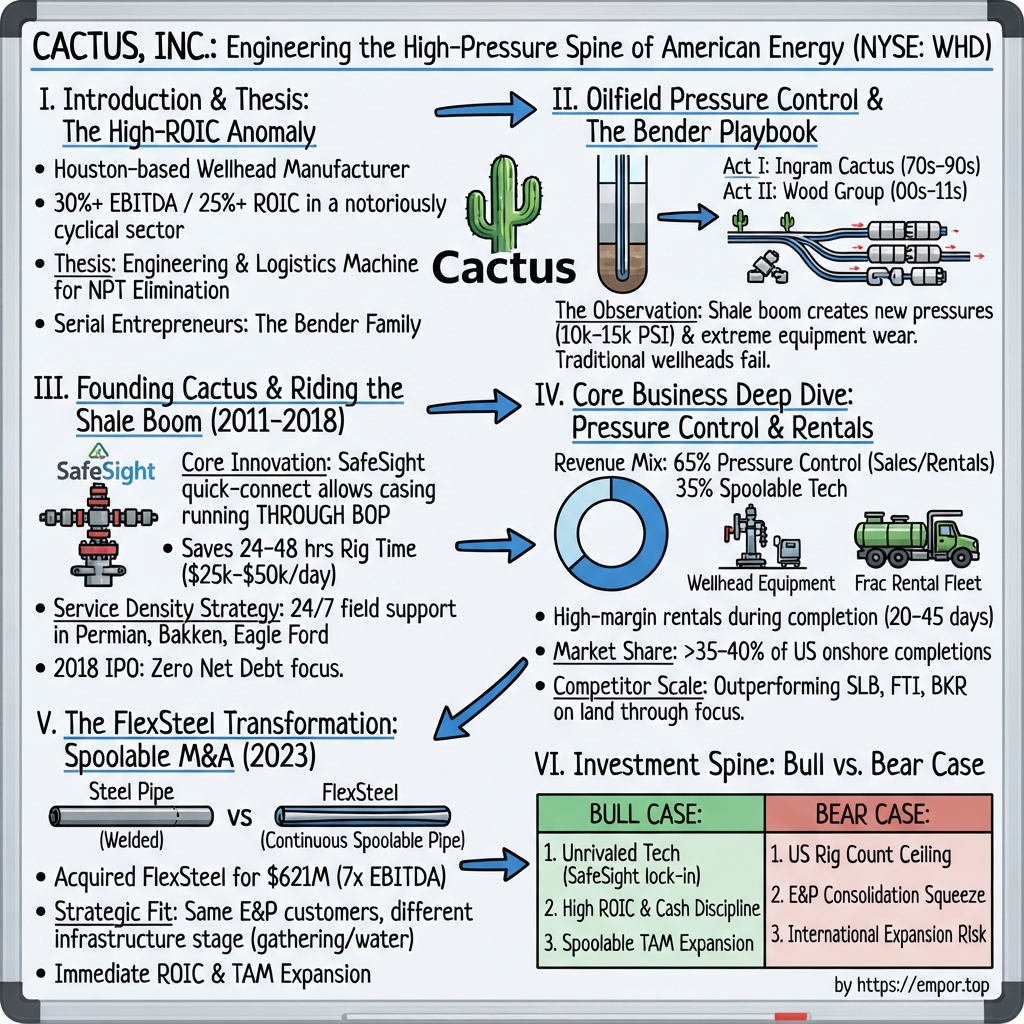
Cactus, Inc.: Engineering the High-Pressure Spine of American Energy
I. Introduction & Episode Roadmap (10 Minutes)
Picture a drilling pad in the Midland Basin at three in the morning. The rig floor is lit like a stadium. Two miles below, a steel casing string is being lowered into a hole that will eventually turn horizontal and run another three miles sideways through rock that has been waiting sixty million years to be disturbed. At the top of that hole sits a piece of forged steel roughly the size of a beer keg. It costs a fraction of what the well costs. And if it fails, the well — a $15 million capital commitment — becomes a fire, an environmental incident, and a headline.
That piece of steel is a wellhead. The company that supplies more of them to American shale operators than anyone else is Houston-based Cactus, Inc., which trades on the New York Stock Exchange under the ticker WHD.1
Here is the anomaly worth examining. Oilfield services is one of the great capital incinerators of modern industrial history. Between the 2014 crash, the 2020 collapse, and the long grind of investor-imposed capital discipline that followed, the sector spent a decade failing to earn back its cost of capital. Yet Cactus closed the fourth quarter of 2025 with an adjusted EBITDA margin of 32.7% and a balance sheet carrying $494.6 million of cash against essentially no bank debt.23 Those are not generic oilfield-services numbers; they are specialty-industrial numbers, generated by a business whose revenue directly tracks how many wells American exploration and production companies choose to drill in a given quarter.
The core thesis is that Cactus is not a generic oilfield services provider. It operates as an engineering and logistics business whose product happens to be sold to drillers, and whose primary value proposition is eliminating non-productive time — NPT, in industry shorthand — on wells where every hour of rig downtime costs an operator tens of thousands of dollars. Cactus essentially sells operational risk insurance disguised as hardware, capturing its premium through equipment margin.
That is the central claim. The critical question is whether empirical evidence supports it, and where that logic begins to fray.
In 2026, the Cactus story is no longer straightforward. In January, the company closed a transaction that fundamentally altered its scope: acquiring a 65% controlling interest in Baker Hughes' Surface Pressure Control business — rebranded as Cactus International — for $344.5 million in cash.112
Overnight, a company built on dominating American shale absorbed a sprawling, historically under-managed international footprint focused in Saudi Arabia, Abu Dhabi, Kuwait, and Qatar. The transaction closed just weeks before Middle East conflicts closed the Strait of Hormuz, forcing shipments onto circuitous overland routes.3 Consolidated adjusted EBITDA margin fell from 32.7% to 25.8% in a single quarter.3 While purchase accounting explained part of the drop, operational headwinds accounted for the rest.
A second strategic pillar lies underneath: the $621.5 million acquisition of FlexSteel in 2023, a spoolable-pipe manufacturer that became the highest-margin and fastest-growing division of the company.78 In the second quarter of 2026, Spoolable Technologies delivered a 39.9% adjusted segment EBITDA margin, outpacing the legacy wellhead business.12 The diversification strategy delivered clear results, though it also invites scrutiny regarding whether success in one transaction can be replicated internationally.
Leadership continuity adds another layer. Scott Bender and Joel Bender have built and monetized surface pressure control businesses three separate times across four decades: Ingram Cactus, sold to Cooper Cameron in 1996; Wood Group Pressure Control, sold to General Electric in 2011; and Cactus itself, founded in 2011 and taken public in 2018.45
Repeated success in industrial businesses is rare. Executing the same playbook three consecutive times in the exact same niche is rarer still, raising the question of whether the competitive advantage stems from proprietary technology, a distinct operating structure, or executive experience in navigating industry cycles.
Analyzing Cactus requires evaluating which elements of its competitive moat are backed by observable evidence — customer retention, field metrics, cost structure, and financial disclosures — and which reflect management narrative awaiting further validation.
Three specific conditions would challenge the central thesis. First, if Pressure Control product revenue begins tracking the U.S. rig count one-for-one rather than outperforming it, the premium-content narrative loses foundation. Second, if the acquired international operation cannot approach legacy Cactus margins within two years, the acquisition will have expanded revenue at the expense of earnings quality. Third, if the company's flat organizational structure proves to be an artifact of single-market execution rather than a scalable global model, the international expansion faces structural resistance. Each condition is measurable and serves as a benchmark throughout this analysis.
The roadmap begins with an examination of wellhead mechanics and field criticalities, followed by the multi-decade Bender operating model. The story moves through the company's founding, counter-cyclical market share gains during the 2014–2016 downturn, and its 2018 public offering. Subsequent sections analyze segment economics — product sales, frac rentals, and field services — alongside the capital allocation of the FlexSteel deal and the higher-risk Baker Hughes joint venture. Finally, the analysis evaluates management execution, tests competitive frameworks, runs an operational stress test, and concludes with key metrics defining the investment thesis.
Understanding why a forged piece of steel at the top of a hole commands such strategic weight requires looking closely at its role on the rig floor.
 Subscribe on LinkedIn
II. Oilfield Pressure Control & The Multi-Decade Bender Playbook (15 Minutes)
Think of an oil well as a very long straw punched into a pressurized reservoir. Everything below ground consists of steel casing and cement. Everything above ground — the valves, flanges, seals, and control assemblies that regulate fluid flow — is pressure control equipment. The wellhead serves as the critical transition point: the structural anchor that suspends casing strings, seals the annular spaces between them, and provides the mounting interface for the blowout preventer during drilling and the production tree afterward.
By analogy, the wellhead is where a two-mile pipe under thousands of pounds of pressure meets the surface world. It must maintain structural integrity while crews work nearby, heavy equipment is repeatedly mounted and unmounted, and a fracturing spread pumps abrasive sand slurry through it at high velocity.
Hydraulic fracturing subjects this hardware to severe mechanical strain. A modern frac spread pumps water, chemicals, and millions of pounds of sand into a well at pressures exceeding 10,000 pounds per square inch across multiple stages over several days. Sand acts as an abrasive, while rapid pressure cycling induces structural fatigue, simultaneously flexing and eroding valves, flanges, and seals. When operations move to an adjacent well on a multi-well pad, the equipment is disconnected, relocated, reassembled, and pressure-tested again. Across a four- or six-well pad, this sequence severely tests design tolerances established in an earlier era of vertical drilling.
When a wellhead fails, the financial and operational consequences dwarf the cost of the hardware itself. A leak requires days of costly remediation, a severe component failure can destroy the well, and a catastrophic event threatens worker safety and triggers regulatory action. This economic asymmetry — a modest-cost component protecting a multi-million-dollar well commitment — underpins the pressure control business and explains why operators pay a premium for hardware they trust.
Scott Bender learned this business during a volatile period in oilfield history. A 1975 Princeton engineering graduate with a Texas MBA earned two years later, he became president of Ingram Cactus Company in 1986, with his brother Joel — a Washington University engineer with a University of Houston MBA — running operations.4 Ingram Cactus formed through the merger of a 1970s wellhead equipment subsidiary and Ingram's petroleum services division, entering the market during one of the most severe downturns in American energy history.
That background heavily influenced management's operating philosophy. The Benders ran the business through the 1986 oil price crash and the extended slump that followed, a period in which the U.S. rig count dropped by roughly three-quarters and half of the industry's equipment suppliers went out of business. Managing through that contraction instilled a lasting commitment to balance-sheet conservatism. The financial principles that later defined Cactus — maintaining target zero net debt, self-funding operations through downturns, and acquiring assets when competitors were constrained — grew directly out of navigating that prolonged depression.
Ingram Cactus was sold to Cooper Cameron in 1996. That first venture demonstrated what happens to an agile equipment supplier when absorbed into a large industrial conglomerate. Design decisions move to central committees, product lines are standardized, and field response times — previously a primary differentiator — become line items to be optimized. Decades later, discussing why Cactus believed it could improve the surface pressure business acquired from Baker Hughes, Scott Bender highlighted this structural contrast on a public earnings call, noting that Cactus operates with a much flatter organization than any of its large competitors, and Baker was no exception, nor was FMC, nor Schlumberger's Cameron unit.3
The Cooper Cameron transaction also underscored the importance of product architecture. Wellheads operate as integrated systems whose components must interface with neighboring equipment and existing field tools. Once an operator's crews train on a specific architecture and deploy compatible running tools, the incumbent supplier establishes operational lock-in. Controlling product design protects client relationships, whereas allowing product suites to be rationalized by a corporate portfolio committee risks handing that control away item by item.
Act II ran from 2000 to 2011, when Scott Bender served as president of Wood Group Pressure Control and Joel as senior vice president.4 During this period, they built a high-margin pressure control business within a major British engineering group just as American drilling transformed. The development of horizontal drilling and multi-stage hydraulic fracturing in the Barnett Shale, followed by expansion into the Bakken, Haynesville, and Permian basins, reshaped onshore production. Wood Group sold its pressure control operations to General Electric in 2011 as part of GE's oilfield equipment expansion, though the specific purchase price for the unit was not publicly disclosed.
A subsequent non-compete period allowed management to analyze changing field dynamics before establishing Cactus. Traditional vertical wells presented relatively straightforward pressure control requirements: crews drilled a hole, set casing, completed specified zones, and initiated production. Horizontal wells with multi-stage fracturing created entirely different physical demands. Surface pressures reached levels legacy equipment was not built to withstand continuously, while connection cycles and pressure tests multiplied.
Simultaneously, the widespread adoption of pad drilling — where a single rig drills multiple wells sequentially on one site — made wellhead installation a continuous, time-sensitive operation conducted beneath an active blowout preventer stack.
Legacy wellhead designs required workers to manually install lock screws, perform hazardous hot work, and repeatedly dismantle the blowout preventer stack to land casing strings. These steps consumed expensive rig time and placed personnel in hazardous locations beneath suspended equipment. While minor delays were manageable on a single vertical well drilled over three weeks, they created major operational bottlenecks on multi-well pads where rigs drilled multiple wells in the same timeframe.
This operational shift redefined commercial purchasing behavior. For vertical wells, wellheads were largely catalog items bought on price and immediate availability. Unconventional shale development turned equipment selection into an operational efficiency driver. Purchasing decisions shifted toward drilling superintendents and completions managers focused on eliminating rig downtime and maintaining pad schedules. Equipment suppliers organized around traditional catalog sales were ill-equipped to serve customers focused primarily on cycle times.
The Benders concluded that the industry's established wellhead architectures were misaligned with modern shale drilling techniques. Because large incumbent suppliers had not redesigned their product lines to address these high-pressure, pad-drilling demands, a market gap opened — providing the foundation for the launch of Cactus.
III. Founding Cactus & Riding the Unconventional Shale Boom (2011–2018) (15 Minutes)
In 2011, with the non-compete clock running and the shale build-out accelerating, Scott and Joel Bender founded Cactus Wellhead, LLC with backing from Cadent Energy Partners, a private equity firm focused on energy services.45 Cadent's involvement runs deeper than a capital line: Stephen Tadlock, who joined Cactus in 2017 and would later serve as chief financial officer, came directly from a partnership at Cadent, bringing a private-equity discipline about returns on deployed capital that shows up in how the company still talks about its rental fleet.4
The founding proposition was a clean sheet of paper. Not an incremental improvement to a legacy catalog, but a wellhead system designed from scratch for pad drilling and multi-stage completions.
The product that resulted is called SafeDrill. Strip away the marketing and what it does is straightforward. It is a single-piece, multi-bowl wellhead that you drill through — meaning the entire assembly is installed once and remains in place, with the casing hangers landed from above rather than requiring the blowout preventer to be removed and reinstalled between casing strings.6 The lock screws that traditionally clamped each casing hanger in place — dozens of them, each installed by hand by a technician standing beneath the stack — are replaced by an internal lock ring.6 The casing hangers rotate, so casing can be landed even when downhole obstructions would otherwise force a workaround.6 There is a quick-connect feature for rapid BOP installation, and the design is compatible with offline cementing during pad operations.6
Translated into operator economics: fewer hours of rig time consumed per well, fewer leak paths, and — critically for an industry that reports incident rates to investors — fewer occasions when a person has to stand in the hazardous zone beneath suspended equipment with a wrench.
That last point deserves emphasis, because it is the part of the value proposition that is hardest for a competitor to counter with price. An operator's health-and-safety statistics are reported publicly, scrutinized by institutional shareholders, and increasingly tied to executive compensation. A procurement manager who saves fifteen thousand dollars on wellheads and inherits a recordable injury has made a bad trade that will be visible to their board. The commercial logic of premium pricing in this niche runs through the operator's risk committee at least as much as through its engineering department.
Cactus built the manufacturing base to match: a plant in Bossier City, Louisiana, supported by a sourcing operation in China that gave the company a cost structure the American incumbents could not easily replicate.2 That structure would become both an advantage and, a decade later, a liability when tariffs arrived.
Then the market broke.
The 2014–2016 oil crash was among the sharpest demand shocks the oilfield has experienced. Global majors and the large service companies saw revenue fall by 40% to 60%. Cactus was not immune — revenue bottomed at $155.0 million in 2016, and the company posted a net loss that year.18 But what happened next is the part that matters analytically. Revenue more than doubled to $341.2 million in 2017 and reached $544.1 million in 2018.18 The company did not merely recover with the market. It came out with a materially larger share of it.
The mechanism was specific and worth understanding, because it is the closest thing to hard evidence for the moat. When oil prices collapse, E&P companies do not stop drilling entirely — they stop drilling marginal wells and redirect every remaining dollar toward maximizing productivity per lateral foot and minimizing cycle time.
Efficiency stops being a nice-to-have and becomes the only lever available. A wellhead system that reliably saves a day of rig time per well is worth more, not less, when your capital budget has been cut in half. Cactus's product went from being a premium option in a boom to being an obvious choice in a bust.
That is an unusual counter-cyclical property, and it is genuinely rare in oilfield equipment. It should not, however, be over-generalized. It applies to the product sale — the permanent wellhead installed on a new well. It applies much less to the rental fleet, as the company would demonstrate uncomfortably in 2025.
The pattern repeated in 2020, which is the better stress test because the shock was faster and deeper. Revenue fell from $628.4 million in 2019 to $348.6 million in 2020 — a 45% decline, roughly in line with the industry.18 What did not happen is instructive. The company remained profitable, generated free cash flow, and finished the year with more cash than it started, having spent 7% of revenue on capital expenditure rather than the 9.5% of the prior year.18 A business with high fixed costs and a leveraged balance sheet does not do that. A business whose costs are substantially variable — outsourced manufacturing, a service network that scales with headcount, a rental fleet that can be idled rather than fed — does. That variable cost structure is the least glamorous part of the Cactus story and arguably the most important to how it behaves in a downturn.
Alongside the product, Cactus built the second half of the model: service density. Rather than sell equipment through distributors and let operators fend for themselves, the company established its own service centers across the major basins, staffed with its own field technicians, running 24/7.2 By 2025 the network spanned the United States, Canada and Australia, with rental and service operations in the Middle East and select international markets, supported by over 1,500 employees worldwide.2
This is expensive and unglamorous, and it is the part of the business that a spreadsheet-driven competitor consistently under-invests in. When a completions manager at two in the morning has a problem on a pad, the question is not which vendor has the better engineering white paper. It is who can get a qualified technician to the location before the rig starts charging for standby.
Physical proximity is a moat that compounds quietly and cannot be bought in a quarter. It is also, notably, the one advantage that does not appear anywhere on a balance sheet — which is part of why it survives.
One footnote to the growth story is worth recording, because it reframes the 2026 international push as a second attempt rather than a first. Cactus was never purely domestic. By the early 2020s the company had rental and service operations in Australia — strong enough that a particularly good Australian quarter measurably moved consolidated rental revenue.3 It made product shipments into Europe following a regional award, and it spent 2023 working through ownership structures for a Middle East manufacturing presence, with testing and trials targeted for that year and approvals to follow.3 Progress was real but slow, and Bender was explicit about why: the binding constraint in the largest international markets is the requirement for indigenous manufacturing, which cannot be solved by shipping product from Louisiana.3
That constraint is the cleanest explanation for why Cactus eventually paid $344.5 million for a business it could have tried to build. Local manufacturing, local qualification with national oil companies, and decades of installed base are not things a well-run American company can bootstrap in a decade. They can only be bought. Whether the price was right is a separate question from whether buying was the right form of entry — and on the second question, the company's own fifteen-year record of slow organic international progress is the argument.
On February 12, 2018, Cactus, Inc. priced its initial public offering: 23,000,000 shares of Class A common stock at $19.00, the top of the marketed range, listing on the NYSE.20 Proceeds were used to fully repay the outstanding $251.0 million term loan and to distribute $216.4 million to certain legacy owners of Cactus LLC.20 The company emerged from the offering with a deliberately conservative capital structure and a stated intention to fund itself through cycles rather than through credit facilities.
The IPO also embedded a structural complication that persists today: an Up-C structure, in which the public entity holds a controlling interest in an operating LLC alongside legacy holders, coupled with a tax receivable agreement obligating cash payments to those legacy holders as tax benefits are realized. In the fourth quarter of 2025 alone, Cactus made a $23 million cash TRA payment.3 It is a real, recurring claim on free cash flow that a casual reading of the cash flow statement can miss, and it is the kind of complexity that a skeptical investor is entitled to price.
With public currency, a clean balance sheet, and a product taking share, the question shifted from whether Cactus could win the niche to what the niche was actually worth.
IV. Core Business Deep Dive: Pressure Control & Frac Rental Economics (25 Minutes)
Tracing cash flow across the life cycle of a single shale well clarifies where Cactus captures value. When the rig arrives, Cactus sells the operator a SafeDrill wellhead system that remains permanently attached to the wellbore—a product sale. Weeks later, when the fracturing spread arrives, the site requires temporary high-pressure equipment: frac valves, zipper manifolds to route pressure between wells on the pad, and monolines to transport slurry. Cactus rents this hardware. Throughout both phases, Cactus technicians install, test, maintain, and retrieve the assemblies—generating field service revenue. Finally, once the well is completed, a production tree is installed for the multi-decade life of the well, marking another product sale.
In fiscal 2025, product sales generated roughly 76% of total revenue, rentals contributed 8%, and field service and other items accounted for 16%.2 This distribution demonstrates that Cactus is fundamentally a manufacturing and distribution enterprise with a rental offering attached, rather than a rental company that manufactures equipment.
The three revenue streams behave differently during industry downturns, as demonstrated in 2025.
Product sales proved resilient. In the second quarter of 2025, as the U.S. land rig count declined, product sales fell less than the drop in average rig count.3 By the fourth quarter, Pressure Control revenue increased 5.8% sequentially, driven by higher product content per rig followed—allowing Cactus to capture more revenue per active rig even as total rig activity contracted.3 Management reported that the U.S. Pressure Control unit performed at its highest operational level since company inception.3 Longer lateral lengths and higher pressure requirements generated greater equipment content per well, preventing operator consolidation from diluting revenue capture per rig.
Rentals exhibited sharper cyclical exposure. In the second quarter of 2025, Pressure Control revenue declined 5.5% sequentially, driven primarily by the rental segment, where pricing historically softens disproportionately during demand pullbacks.3
By the third quarter of 2025, with active frac crew counts running more than 10% below the prior quarter's average, management idled rental assets rather than deploying equipment at depressed rates.3
This capital allocation choice reflects both discipline and structural limitation. On one hand, idling equipment demonstrates a refusal to pursue revenue at the expense of return on capital—a key distinction of disciplined industrial management. On the other hand, it confirms that the rental fleet lacks the pricing power of the core wellhead product. Frac rental hardware functions more like a commodity, competing against regional providers where pricing quickly erodes during market contractions. Consequently, Cactus cannot be viewed as fully insulated from broader energy cycles.
Field service represents 16% of revenue but serves a vital strategic function. Gross margins for field service run below product and rental levels. In the first quarter of 2023, service margins compressed further when Cactus increased technician compensation to prioritize workforce retention.3 Rather than reflecting operational inefficiency, field service operates as the primary support mechanism for customer retention. Dedicated field technicians ensure rapid on-site response during high-stress completions, making competitive technician compensation a direct investment in customer relationships rather than a structural margin defect.
The rental fleet also represents the most capital-intensive element of the Pressure Control segment. Frac trees, zipper manifolds, and monolines require substantial capital deployment and recurring maintenance between installations. In the first quarter of 2023, rental gross margins fell 200 basis points due to elevated redeployment costs.3 While segment economics remain strong during periods of high utilization and stable day rates, declining frac activity quickly creates cost absorption drag. Management's policy of idling unused fleet assets prevents asset overhang from undermining broader segment pricing, though it reinforces that rental revenue remains the company's most volatile financial stream.
A key shift in financial disclosure warrants attention. Cactus previously disclosed its quarterly U.S. wellhead market share. In the first quarter of 2023, market share reached a record 43.3%, with rigs followed increasing approximately 6% despite a declining U.S. land rig count.3 During that earnings call, management discontinued reporting market share metrics, citing a revised segment reporting structure that consolidated business lines.3 While restructuring provides an operational rationale, the change eliminated the most direct metric tracking competitive positioning just as business complexity increased. Investors must now estimate market share through management commentary regarding rigs followed and product content per well, reducing analytical visibility.
The competitive landscape functions as a barbell. At one end are global oilfield conglomerates. TechnipFMC offers a direct comparison as a major surface and subsea equipment provider, generating a trailing return on invested capital of roughly 24% that exceeds Cactus's recent metric.17 Schlumberger's Cameron division maintains an extensive global installed base, while Baker Hughes operated as a direct surface pressure competitor until January 2026, when it converted its business into a 35% joint venture stake with Cactus. At the opposite end of the market are component suppliers and regional manufacturers. Forum Energy Technologies illustrates the lower-tier economics, generating negative trailing return on invested capital while carrying higher debt leverage relative to earnings than Cactus.19
Structural constraints limit competitors at both ends of this market. Global conglomerates possess engineering depth and international credentials but maintain diversified portfolios where surface pressure control competes for capital against subsea, digital, and turbomachinery divisions. This organizational structure slows field response times in fast-paced U.S. land basins. Conversely, low-cost regional suppliers offer aggressive pricing but lack the scale required to fund comprehensive basin service networks, creating an entry barrier that stabilizes the middle market.
Cactus occupies this central position by combining specialized engineering and rapid field execution, positioning itself above commodity suppliers while maintaining operational focus that larger conglomerates rarely match in U.S. land operations.
This commercial positioning explains why operators pay premium prices. Wellhead hardware represents a small fraction of total well expenditure, yet equipment failure introduces massive downside risks, including rig standby costs, environmental remediation, and regulatory exposure. Consequently, operators prioritize equipment reliability and rapid field response over modest hardware savings. This purchasing behavior is reflected in Cactus's consistent ability to expand revenue content per rig even when clients trim overall exploration budgets.
However, customer concentration presents an escalating risk. A single customer accounted for 17% of total revenue in 2025, up from 15% in 2024 and 10% in 2023.2 Ongoing consolidation among exploration and production companies has concentrated purchasing power among fewer, larger operators. As a result, procurement decisions by major customers exert growing influence over Cactus's revenue stability.
Supply chain geography introduces a secondary structural challenge. Cactus's reliance on Chinese manufacturing, historically a cost advantage, encountered significant trade policy headwinds. By 2026, the company faced a 75% total tariff on most goods imported from China—comprising a 25% duty under Section 301 and a 50% rate under Section 232—alongside an additional 10% Section 122 duty on specified items.3 The June 2025 doubling of the Section 232 steel tariff rate from 25% to 50%, implemented without prior notice, directly compressed gross margins and forced the company to transition toward higher-cost alternative suppliers, including domestic manufacturers.3 To mitigate trade policy risk, Cactus expanded manufacturing capabilities in Vietnam, secured API certification, and began substituting Chinese production. However, transition progress has been gradual: Vietnam imports accounted for roughly 15% of U.S. Pressure Control imports by the third quarter of 2026, targeting approximately 40% of Far East shipments.13
These trade friction headwinds demonstrate how supply chain models optimized under earlier trade policies face ongoing geopolitical exposure. While management has executed strategic adjustments across international facilities, tariff impacts highlight broader margin sensitivities across core operations.
This operational baseline sets up the strategic acquisition that fundamentally altered the company's trajectory.
V. The FlexSteel Transformation: Spoolable Technologies & Strategic M&A (20 Minutes)
On January 3, 2023, with the U.S. rig count softening and competitors repairing damaged balance sheets, Cactus announced the acquisition of FlexSteel Technologies Holdings.7 The transaction was structured as a $621.5 million upfront cash payment, alongside a contingent earnout of up to $75.0 million tied to revenue growth targets.8 The deal closed weeks later on February 28, 2023.9
For a company whose identity had centered on surface wellheads, acquiring a pipe manufacturer marked a major strategic shift that initially drew market skepticism.
The timing revealed two distinct strategic choices. First, Cactus announced the agreement in early January before annual client budgets were finalized and while broader sector sentiment was deteriorating—countering the industry pattern of acquiring assets at cycle peaks. Second, completing the transaction within eight weeks indicated that due diligence had been underway long before the public announcement.
FlexSteel carried a distinct technical heritage. Founded in 2003 with full production beginning in 2005, its core technology derived from Wellstream, a British manufacturer of subsea flowlines and flexible risers designed for dynamic offshore environments.22 The concept traces back to flexible pipelines deployed across the English Channel during World War II. FlexSteel adapted these subsea spoolable designs for onshore applications, manufacturing the product at a 420,000-square-foot facility in Baytown, Texas.22
The manufacturing and installation processes differ fundamentally from conventional pipe. Standard gathering lines rely on rigid steel joints, typically 30 to 40 feet long. Installing them requires manual field welding, radiographic inspection of each joint, anti-corrosion coating, and trench preparation—a slow, labor-intensive process where welds and soil-contact points serve as primary corrosion failure locations.
FlexSteel addresses these vulnerabilities with a continuous, spoolable composite pipe featuring an inner thermoplastic liner wrapped helically in flat steel reinforcement strips and covered by a high-density polyethylene outer sheath.10 Transported on large reels, the pipe unrolls directly into trenches, requiring connections only at terminal ends rather than every 40 feet. The inner plastic liner isolates fluid from steel to eliminate internal corrosion, while the external sheath shields the steel core from environmental decay.
For operators, the operational savings are concrete: installation proceeds 40% to 80% faster than jointed steel, reducing installation costs by roughly 50% by eliminating field welding, inspection, custom coating, and heavy bedding equipment.10 The product suite ranges from 2-inch to 10-inch diameters, with pressure ratings reaching up to 3,000 psi depending on size.10
However, common industry descriptions overestimate continuous reel lengths. While market commentary frequently cites 10,000-foot continuous spools, actual specifications vary by diameter: a reel package holds approximately 6,600 feet of 2-inch pipe rated at 1,500 psi, but falls under 600 feet per package for high-pressure 10-inch product.10 Larger pipe diameters yield shorter spool lengths and require more frequent connections. This distinction is critical as the company targets midstream expansion, where larger-diameter applications offer narrower installation cost advantages over jointed steel than standard small-diameter gathering lines.
The transaction aligned directly with Cactus's core commercial model: monetizing equipment that compresses operational schedules and reduces field labor risk. Rather than diversifying away from its core strategy, management extended the high-margin, time-saving value proposition from the wellhead to field transportation.
Management grounded the acquisition logic in customer overlap. On a post-closing earnings call, Chief Executive Scott Bender noted that every operator purchasing a Cactus production tree must connect it to downstream facilities using spoolable composite pipe, jointed steel, or competing products.3 While FlexSteel's primary domestic clients already overlapped with Cactus, Cactus maintained roughly five times as many active customer accounts as FlexSteel, providing a direct cross-selling opportunity.3
Management also acknowledged sales friction, noting that FlexSteel primarily sells to facility engineers, whereas legacy Cactus equipment targets drilling and completions superintendents.3 Overcoming these distinct purchasing channels required navigating different decision-makers within the same operator organizations.
Evaluating the transaction valuation shows disciplined capital allocation. The $621.5 million upfront price represented approximately six times FlexSteel's year-to-date 2022 annualized adjusted EBITDA as of September 30.8 This multiple sat at the lower end of contemporaneous valuations for high-margin oilfield equipment and midstream assets, coming in below the roughly seven-times multiple cited in initial market commentary.
Financing was structured to preserve balance sheet strength. Cactus funded the purchase using $165.6 million in net proceeds from a January 2023 equity offering, $155.0 million in credit facility borrowings, and cash on hand.8 By the first-quarter 2023 earnings call, management had already repaid $60 million of the term loan since quarter-end and stated its intention to return to a net cash position within the year.3 The company met that commitment: cash stood at $133.8 million against modest finance lease obligations by year-end 2023,18 expanding to $494.6 million in cash with zero bank debt by late 2025.2
Three years post-closing, operational metrics confirm strong execution. In the second quarter of 2026, the Spoolable Technologies segment generated $105.5 million in revenue while delivering a 39.9% adjusted segment EBITDA margin—roughly 12 percentage points above the legacy Pressure Control segment in the same period.12 The unit set a record for international product sales in 2025, establishing itself as the company's primary growth engine.313 In July 2026, the division booked approximately $80 million in international orders with shipments scheduled to begin in the fourth quarter, building on roughly $30 million in Latin American awards secured earlier that year.133
Two key catalysts govern ongoing growth. First, expanding regulatory approval under updated Pipeline and Hazardous Materials Safety Administration (PHMSA) regulations has permitted composite spoolable pipe in larger-diameter, higher-specification midstream applications previously restricted to jointed steel.13 Second, international expansion remains underway: building Eastern Hemisphere manufacturing capacity will take approximately two years but could eventually push international sales to around 40% of Spoolable revenue, while a planned expansion at the Baytown facility provides a 20% capacity increase in the interim.13
These expansion plans represent forward-looking initiatives rather than completed results. While FlexSteel's domestic cash generation and segment margins have justified the original purchase price, its long-term growth thesis hinges on executing international manufacturing expansion.
The transaction structure also incorporated risk-sharing provisions. Up to $75.0 million was payable as a contingent earnout no later than the third quarter of 2024 if FlexSteel met revenue growth targets.8 Conditioning a portion of the purchase price on realized performance reduced downside risk and demonstrated management's disciplined approach to M&A negotiations.
FlexSteel's integration provided Cactus with financial flexibility and high-margin earnings, creating the operational foundation for a significantly larger and more complex international expansion.
VI. Current Management, Governance & Capital Allocation Track Record (15 Minutes)
If you listen to a Cactus earnings call, the thing you notice first is that Scott Bender does not sound like a public company CEO.
Asked in July 2025 how he intended to turn around a business he was buying from Baker Hughes, he began his answer by saying it was going to involve offering his opinion about how Baker had run the company, then interrupted himself to check whether his general counsel was kicking him under the table.3 Asked in February 2026 to forecast the rig count, he volunteered that most analysts were modeling an exit somewhere around 510 and that his own number was roughly 490, adding that he is always very concerned when prices are supported largely by geopolitical factors because they can change so rapidly.3 Three months later, after the world had changed, he opened by noting he had been the outlier at 490 and was now moving to roughly 525.3
That specific behavior — publicly stating a number, publicly stating it was below consensus, and then publicly revising it with the reasoning attached — is a meaningful credibility signal. It is the opposite of the macro-blame pattern where management describes an unforecastable environment and declines to commit.
The more rigorous test of credibility, though, is not how a CEO sounds when things are going well. It is what he does when he misses.
In June 2025, Cactus affirmed Pressure Control margin guidance in the range of the low-to-mid thirties. The quarter came in materially below that. On the following call, an analyst asked directly whether the June affirmation had failed to account for the tariff increase and the legal costs. Management did not deflect. Bender gave three specific causes, in order: the Section 232 steel rate had been unexpectedly doubled on June 4 with no notice, after guidance was set; the company had shifted to higher-cost alternative suppliers including U.S. sources to guarantee delivery, and that inventory turned faster than expected; and the planned cost recovery from customers had to be paused because oil prices fell in April and May, so operators were asking for price relief rather than accepting increases.3
That is a well-constructed answer, and it is worth naming why. Each cause was falsifiable, externally verifiable, and specific about timing. One of the three — the decision to source from higher-cost suppliers — was an internal choice management owned rather than an external event it blamed. And the answer came with a forward commitment: Bender stated that the second and third quarters would represent the trough of Pressure Control margins for the cycle, barring further tariff changes or a sharper activity decline.3 Consolidated Pressure Control margins did improve from that point.12 Making a falsifiable forward call immediately after a miss, and then meeting it, is roughly the strongest available evidence of forecasting discipline in a public company.
The team has also changed considerably, and the changes are worth mapping because the outline most investors carry is out of date. Scott Bender transitioned from President and CEO to Chairman and CEO in August 2023. Joel Bender moved from Senior Vice President and COO to President and Director. Steven Bender — Scott's son, a Rice English and Hispanic Studies graduate with a Texas MBA who had run the rental business at Wood Group before joining Cactus at inception — advanced from VP of Operations to Chief Operating Officer, and in May 2026 additionally took on the role of CEO of the Spoolable Technologies segment.54 Stephen Tadlock moved from CFO to CEO of the FlexSteel business in October 2023, and in January 2026 was appointed CEO of Cactus International.54 Jay Nutt joined as Executive Vice President and CFO in June 2024, arriving from ChampionX where he had been CFO, with prior finance roles at TechnipFMC and FMC Technologies.4
Two observations follow. First, Cactus's approach to integrating acquisitions is to take the executive who successfully absorbed the last acquisition and hand them the new one — Tadlock ran FlexSteel's integration, then was assigned the far harder Cactus International turnaround. That is a rational use of a scarce internal capability, and it is the sort of thing a company only does if it believes integration skill is a person rather than a process.
Second, the bench is now genuinely three Benders deep, and succession beyond Scott Bender is not clearly resolved. He remains Chairman and CEO at an age where most founders have transitioned. The company has built a structure that could function without him; it has not yet demonstrated that it does. For a business whose competitive advantage has been repeatedly attributed to a flat organization and a particular commercial instinct, that is not a governance footnote — it is one of the two or three things most worth watching.
On alignment, the numbers are substantial. As of February 13, 2026, Scott Bender reported beneficial ownership of approximately 12.2% of Class A common stock on an as-exchanged basis, and Joel Bender approximately 12.4%, with the family holding company Cactus WH Enterprises accounting for roughly 12.1% of that overlapping total.21 Management collectively owns roughly 13% of the business.21 Incentive design reinforces it: 2025 annual bonuses were tied primarily to adjusted EBITDA, operating capital employed as a percentage of revenue, and total recordable incident rate, with long-term incentives combining performance stock units based on return on capital employed with time-based restricted stock.21
That is a well-constructed set. Tying bonus to capital employed relative to revenue is unusual and specifically anti-empire-building — it penalizes exactly the working-capital and fleet bloat that destroys returns in oilfield services. Including incident rate is consistent with a company whose product is sold on safety.
Now the harder question: does the reported return actually match the narrative?
Cactus is frequently described as a 25%-plus ROIC business. On the company's own return-on-capital-employed framing, used for compensation purposes, the figures are strong. On a standard invested-capital calculation, the picture is more nuanced. Return on invested capital was approximately 30% in 2018 and 20% in 2019 — the pre-acquisition years when the balance sheet was small and lean. It fell to roughly 8% in the 2020–2021 downturn, recovered to about 16% in 2023, and then declined to roughly 14% in 2024 and 11% in 2025 as the capital base expanded through acquisition and cash accumulated.18
This is not evidence of deterioration in the underlying business — margins held up remarkably well through 2025 — but it is evidence that the headline ROIC number requires definitional care, and that acquiring businesses at real prices has structurally lowered the reported return even where it raised absolute earnings. An investor who anchors on 25%-plus without checking the denominator is anchoring on the 2018 company.
The capital allocation record itself is defensible on behavior. Dividends have been raised for four consecutive years, most recently a 7% increase to $0.15 per Class A share announced in July 2026, following an 8% increase to $0.14 the prior year.123 Capital expenditure has been managed counter-cyclically: guidance was cut during 2025 as activity softened, landing at $39 million for the year, then held at $40–50 million for 2026 despite absorbing an entire international business, before being raised to $55–65 million once demand improved.312 The company did not commit capital into a declining market and then explain it afterward.
Which makes the Baker Hughes transaction the real test. Announced June 2, 2025, Cactus agreed to acquire 65% of Baker Hughes' Surface Pressure Control business, with Baker Hughes retaining 35% and Baker Hughes CEO Lorenzo Simonelli framing it as portfolio optimization enabling a sharper focus on core growth areas.11 The transaction closed January 1, 2026, at a cash purchase price of $344.5 million on a debt-free, largely cash-free basis, with the joint venture retaining approximately $70.0 million of minimum cash.2
The structure contains a feature that deserves far more attention than it typically gets. From the second anniversary of closing, Baker Hughes has the right to put its remaining 35% to Cactus or the joint venture, and Cactus has a corresponding call — priced at six times trailing adjusted EBITDA.2 Based on the company's own disclosure, that obligation has been estimated in the range of $530 million to $660 million.2 There are additional scheduled payments of $10.0 million on the first anniversary and $14.5 million when Baker Hughes ceases to be a member.2
Read that carefully. Cactus has not bought a business for $344.5 million. It has bought 65% of a business for $344.5 million and simultaneously written a contingent obligation to buy the rest, at a formula price, on a clock it does not fully control.
The consequence is a peculiar kind of symmetry. If the turnaround works and EBITDA rises, the put price rises with it — Cactus pays more for its own success. If the turnaround fails, the put price falls, but Cactus owns a broken asset. The structure is not unreasonable, and it let Cactus take control without paying full freight upfront. But it converts a portion of future free cash flow into a pre-committed use, and any assessment of the company's capital allocation flexibility from 2028 onward has to account for it.
The early operating evidence on the integration has been better than the timeline. Management targeted $10 million of annualized synergies within a year of closing, raised that to $15 million by the first quarter, then raised the range again — a further 33% increase off a $15–20 million base — by the second quarter, with the organizational restructuring substantially complete.313 Those are headcount and structure synergies, achieved by flattening what Bender described as a business with some bloat in the way it was organized.3
The larger prize is supply chain, and management has been consistently, almost repetitively, honest about its timing: because Cactus International is a project business where material is ordered nine to fifteen months ahead of delivery, the pre-close backlog must burn off before Cactus's lower-cost sourcing shows up in margin. Management has said since the first quarter of 2026 that meaningful supply chain savings should not be expected before the second half of 2027.313 They have not moved that goalpost. That consistency is itself the data point.
What management has not yet demonstrated is the thing that matters most: that the acquired business can earn returns anywhere near legacy Cactus. Bender's own framing on the first-quarter call was that the company remains in the early stages of the transformation necessary for Cactus International to improve margins and returns consistent with long-term expectations.3 That is an appropriately humble statement about a business that, on the company's own account, had been under-prioritized by its previous owner in West Africa, the Far East, and across the aftermarket franchise built on the legacy Vetco Gray installed base.3
The setup, then: a management team with a strong record of doing what it said, holding a large personal stake, that has just made the largest and least proven bet of its history into the most geopolitically unstable region on earth.
VII. Strategic Frameworks: Porter's 5 Forces & Hamilton Helmer's 7 Powers (10 Minutes)
During the fourth-quarter 2025 earnings call, an analyst asked about the aftermarket service opportunity within the newly acquired international business. Chief Executive Scott Bender responded that legacy Vetco Gray — the brand Baker Hughes had absorbed decades earlier — held a massive installed base. He noted that while the aftermarket represents the highest-margin segment of the pressure control business, Baker Hughes had largely neglected it, particularly across dominant historical positions in West Africa and the Far East.3
Regardless of whether that assessment is entirely fair to Baker Hughes, it illustrates the structural failure mode Cactus aims to exploit: a major conglomerate under-serving a valuable installed base because corporate priorities displace field-level customer focus. The relevant question is whether exploiting this operational gap reflects a durable competitive advantage or merely temporary outperformance.
Strategic frameworks are only useful when allowed to deliver uncomfortable conclusions. Applied rigorously to Cactus, they reveal a mixed picture — robust competitive advantages in its mature domestic operations, offset by structural weaknesses across its expansion vectors.
An analysis using Hamilton Helmer's Seven Powers highlights these dynamics.
Switching costs represent the company's most defensible power, though their scope is narrower than commonly assumed. For an operator, changing wellhead vendors requires retraining rig crews, managing tooling incompatibilities, adopting new field procedures, and accepting unquantified execution risks on a multi-million-dollar well commitment. This advantage is borne out by customer behavior: Cactus increased equipment content per rig even as clients curtailed overall capital spending.3 However, these switching costs attach specifically to the wellhead architecture, where crew familiarity and installed equipment create operational lock-in. They apply far less to rented fracturing hardware, which explains why rental pricing collapsed during the 2025 slowdown while product revenue held steady.
Process power serves as a second key differentiator, driven by organizational structure rather than proprietary technology. High basin-level service density, strategically staged inventory, continuous technician dispatch, and decentralized decision-making allow local branch managers to resolve operational issues without corporate delays. Management's assertion that Cactus maintains a significantly flatter structure than its major competitors aligns with the company's decade-long history of taking market share from three global conglomerates on U.S. land.3 Whether this organizational model can successfully translate to a Middle East joint venture operating under national oil company procurement frameworks in Saudi Arabia, Abu Dhabi, and Kuwait remains unproven.
Cornered resource is the weakest of the company's potential powers. While Cactus holds proprietary intellectual property surrounding its SafeDrill lock-ring design and FlexSteel composite pipe, key technologies face legal challenges. Cameron International filed active patent infringement litigation against the SafeLink frac flow system, seeking past royalties and damages. Cactus recorded $5.1 million in legal expenses and reserves in a single quarter to address these claims, and the jury trial originally scheduled for June 2025 was postponed without a new date set as of the third-quarter 2025 filing.3 Although Cactus has filed counter-claims against Cameron and Schlumberger Technology Corporation, IP actively contested by a larger competitor functions as an operational liability rather than an exclusive asset.
Scale economies are moderate. As the leading wellhead supplier in U.S. land basins, Cactus benefits from fixed-cost absorption across a large installed base and high utilization of its dedicated manufacturing facilities. However, its overall scale remains a fraction of global peers like SLB, Baker Hughes, or TechnipFMC. Furthermore, recent trade disruptions demonstrated that the company's historical cost advantage stemmed primarily from overseas sourcing choices rather than structural scale, leaving margins vulnerable to sudden tariff adjustments.3
The three powers Cactus lacks are equally illuminating. The business features no network economies, as wellhead adoption by one operator provides no direct utility to another beyond general reputation. It possesses no consumer-style branding power, as procurement managers buy based on documented reliability and field response times rather than brand prestige. Finally, any initial counter-positioning has largely dissipated. In 2011, major conglomerates could not adopt drill-through wellheads without cannibalizing legacy catalog lines; today, competitors offer their own drill-through systems, narrowing Cactus's advantage to operational execution and service density — a maintained capability rather than a structural barrier.
This distinction dictates how investors should assess long-term moat durability. Structural powers persist passively, whereas maintained advantages demand continuous capital investment in personnel, inventory, and response times. The moment management attention drifts, operational advantages erode — precisely the vulnerability Cactus diagnosed in the international business acquired from Baker Hughes.
An evaluation under Porter's Five Forces reinforces these conclusions.
Threat of new entrants: low. The primary barrier is customer risk aversion rather than capital requirements. Because wellhead failure threatens multi-million-dollar well commitments, operators refuse to deploy unproven equipment from new vendors to capture modest hardware savings. Furthermore, replicating a basin-wide service network requires years of unprofitable field operations before achieving the service density necessary to command premium pricing.
Consequently, customer risk tolerance — rather than balance-sheet scale — forms a durable barrier to entry that cheap competitor capital cannot easily displace.
Bargaining power of buyers: moderate and rising. Exploration and production consolidation has concentrated purchasing power among fewer, larger operators. Company disclosures show customer concentration increasing, with a single client expanding from 10% to 17% of total revenue within two years.2 Management acknowledged that operators frequently withhold forward activity assumptions to prevent price adjustments, and when crude prices softened in 2025, clients aggressively requested price relief rather than accepting tariff-related cost pass-throughs.3 This buyer leverage directly constrains operating margins.
Bargaining power of suppliers: low to moderate. Forged steel manufacturing remains fragmented across suppliers in the U.S., China, and Vietnam. However, trade policy has effectively acted as a supplier with absolute pricing power, imposing non-negotiable cost increases through sudden tariff revisions.
Threat of substitutes: low in core pressure control, as surface equipment remains structurally necessary for hydrocarbon extraction regardless of completion techniques. Conversely, in the Spoolable Technologies segment, FlexSteel acts as the primary substitute, actively displacing traditional jointed steel pipe. This substitution dynamic creates a growth trajectory independent of overall rig activity.
Competitive rivalry: moderate, and structurally improved. The January 2026 transaction converted Baker Hughes from a direct surface pressure competitor into a 35% joint venture partner. By absorbing an international rival's business line, Cactus reduced head-to-head competition while securing immediate access to Middle Eastern markets.
In summary, Cactus maintains a highly defensible, evidence-backed position in U.S. land pressure control, complemented by a fast-growing, less cyclical spoolable pipe franchise. However, its operational moat remains far more geographically and product-concentrated than its expanded global revenue profile suggests, leaving international execution as the central variable in its ongoing thesis.
VIII. Current Risk Radar & Skeptical Investor Stress-Test (10 Minutes)
In April 2026, Scott Bender spent a portion of a public earnings call describing shipping logistics around the Arabian Peninsula. The Strait of Hormuz was closed, forcing Cactus to route equipment along circuitous maritime routes and overland pathways. When asked when normal shipping might resume, Bender declined to offer a firm timeline, citing a backlog of roughly 1,600 vessels against a peak clearance rate of about 120 per day, with priority likely going to oil exports and food imports.3
That situation illustrates the operational reality of evaluating Cactus in August 2026: an enterprise with a strong domestic core, a clean balance sheet, and a newly acquired operating base situated within an active geopolitical crisis.
The risk radar highlights six key items driven by distinct operational mechanisms.
U.S. land activity remains the earnings anchor. Even after the international acquisition, the American onshore drilling and completion cycle drives most of the company's economics. The critical metric is not the rig count itself — Bender has repeatedly noted that wells drilled, not rigs, is the proper proxy because efficiency gains continuously increase wells per rig.3 The debate remains active: management raised its expectation from roughly 490 U.S. onshore rigs to approximately 525 within a single quarter after commodity prices firmed.3 A sustained move below the mid-400s would pressure both product volumes and rental utilization simultaneously.
A nuance within this primary risk is easily misunderstood. Drilling efficiency has improved almost every year for a decade and continues to advance. When asked in early 2026 what inning the industry was in, Bender remarked that he receives the question annually, that observers repeatedly assume gains are exhausted, and that industry participants are regularly surprised.3 Higher efficiency yields more wells per rig. For an equipment provider paid per well rather than per rig, efficiency gains serve as a tailwind offsetting rig count declines. This explains why management budgets based on wells drilled — and why a falling rig count presents a less threatening signal for Cactus than for service providers selling rig-days. Consequently, the core downside risk is not fewer active rigs, but fewer total wells drilled.
E&P consolidation is compressing the customer base. The primary risk is not price discounting — Cactus has defended margins through premium tiering and higher content per well. Instead, the threat is architecture standardization. If a consolidated operator chooses to standardize its wellhead specifications around a competitor's design, the customer loss creates a materially larger revenue drop than it would have in 2020, a vulnerability reinforced by rising customer concentration disclosures.2
Middle East exposure is now structural, not incidental. Cactus International's primary markets sit in countries directly exposed to regional conflict. In the first quarter of 2026, backlog declined from year-end 2025 levels as multi-year contract negotiations with a major Middle Eastern customer stalled and ordering activity slowed alongside the conflict.3 Management cautioned that backlog could fall further.3 Total company backlog stood at $455.8 million by the end of the second quarter of 2026, with a significant majority tied to the international pressure control business.12 Bender also raised specific concerns regarding Qatar, noting that with export capacity severely constrained, the country's incentive to produce additional natural gas remains uncertain without available sales channels.3
Tariff and supply chain friction acts as a persistent margin tax. Transitioning production to Vietnam offers genuine mitigation, but the process remains gradual. Tariff refunds following Supreme Court rulings on IEEPA duties have been modest — totaling roughly $10 million in the second quarter of 2026, or about 15% of tariffs paid during that period — while Section 301 and Section 232 duties remain unaffected and the refund process itself remains uncertain in both timing and amount.133
Working capital and cash quality warrant closer examination. The acquired Cactus International business carried an elevated volume of unbilled accounts receivable for work completed but not yet invoiced.3 Management noted that accelerating customer invoicing will require several quarters of process adjustments.3 Separately, of the $365.8 million cash balance reported at the end of the second quarter of 2026, $92.5 million was designated to complete legal entity restructurings with Baker Hughes and is offset by a corresponding payable.12 While neither item indicates insolvency, both demonstrate that headline cash figures overstate immediate liquidity, requiring investors to adjust free cash flow conversion models accordingly.
Minority interests reduce shareholder earnings capture. This accounting dynamic alters how consolidated headline figures translate into equity value. Net income calculations now require deductions for Baker Hughes' 35% stake in the joint venture as well as a noncontrolling partner's interest in the Saudi Arabian subsidiary, on top of the existing Up-C structure in which public Class A shares represented roughly 87% of equity ownership at the end of the first quarter of 2026.3 As a result, a given level of consolidated EBITDA yields less net income per Class A share than it did in 2024. Comparing current EBITDA growth directly to pre-acquisition periods without accounting for noncontrolling deductions overstates actual per-share earnings improvement.
Evaluating these risks leads directly to the core arguments skeptical investors and short sellers present against the company.
"Is Cactus at peak margins in a maturing Permian?" The bear case contends that Cactus's historical profitability reflected an exceptionally favorable environment: a surging Permian Basin, a low-cost Chinese supply chain, and a period when SafeDrill enjoyed clear technological differentiation. Tariffs have eroded the low-cost manufacturing advantage, operator consolidation is squeezing pricing power, and the U.S. rig count remains structurally constrained. From this perspective, the decline in consolidated adjusted EBITDA margin from 32.7% in the fourth quarter of 2025 to 25.8% in the first quarter of 2026 was not merely a purchase-accounting artifact, but a preview of normalized blended earning power.3
The counter-evidence is specific. The first-quarter margin drop largely reflected the consolidation of a lower-margin international unit during a period of acute regional shipping disruption; consolidated margins recovered to 29.5% by the second quarter of 2026 as operating leverage, cost synergies, and tariff cost recoveries materialized.1213 Furthermore, revenue content per rig continued to expand, while Spoolable Technologies — approaching a quarter of total revenue — delivers higher margins than legacy pressure control with lower direct sensitivity to rig counts.
The structural counter-argument is even stronger. A flexible, variable cost structure combined with a net cash balance sheet enables Cactus to generate positive free cash flow at activity levels far below current conditions. This cash generation capability was proven in 2020, when annual revenue dropped to $348.6 million and the business still produced cash.18 While skepticism regarding peak margins is legitimate, concerns regarding financial distress or cash burn are unsupported by empirical evidence.
"What are the implications for future capital allocation?" A sharper critique focuses on forward capital obligations. Cactus holds a put/call agreement covering the remaining 35% interest in the joint venture at a formula multiple, representing a potential cash commitment estimated between $530 million and $660 million.2 For a company generating several hundred million dollars in annual operating cash flow, this obligation represents a major capital claim. It restricts management's ability to simultaneously execute share repurchases, fund international spoolable manufacturing facilities, and expand dividend payouts. Clarifying how this future buyout will be funded remains a key open question for management.
"How transparent is financial reporting?" Discontinuing explicit U.S. market share reporting, combined with Up-C tax receivable agreement obligations and noncontrolling interest deductions for both the Baker Hughes joint venture and the Saudi Arabian entity, increases analytical complexity.3 While these structures comply with reporting standards, they make underlying economic performance harder to evaluate precisely at a time when business operations have grown significantly more complex.
This dynamic — an enterprise expanding its operational footprint while its financial structure becomes more intricate — frames the central analytical challenge facing investors.
IX. The Investment Spine: Bull vs. Bear Case (10 Minutes)
In February 2026, an analyst at Piper Sandler asked Scott Bender whether investors should expect 2027 performance to match the 2025 financials Baker Hughes reported for the surface pressure business Cactus had acquired. Bender responded with notable restraint, explaining that although Baker reported under GAAP, Cactus accounts for operations differently and had underwritten the transaction well below Baker's reported 2025 figure. He cautioned that expectations should be tempered before noting that 2027 performance would likely land above the midpoint between 2025 and 2026 levels.3
A chief executive explicitly telling analysts that a seller's reported figures overstate what was acquired—and that the transaction was priced accordingly—provides a candid baseline. It suggests the investment thesis should be evaluated not on promotional projections, but on testable operational milestones.
Strip away peripheral noise and the investment case for Cactus reduces to three primary questions, each tied to a specific financial metric.
The first is whether Cactus continues expanding revenue capture per American well. Rather than tracking the U.S. land rig count in isolation, the critical indicator is Pressure Control product revenue relative to active rigs followed, alongside management guidance on equipment content per well. Because Cactus discontinued reporting market share metrics after reaching a record 43.3% in early 2023, tracking competitive positioning requires calculating revenue intensity per rig.3 The key operational indicator is whether Pressure Control product revenue declines less than active rig counts during downturns and expands faster during recoveries. That outperformance pattern held through 2025.3 Should product revenue begin tracking overall rig activity one-for-one, the thesis that operators pay a premium for cycle-time reduction loses structural support.
The second is whether Cactus International can achieve legacy Cactus operating margins. The primary metric is the Pressure Control segment's adjusted EBITDA margin. Legacy domestic operations historically delivered margins in the low-to-mid 30% range, whereas consolidated Pressure Control margin guidance for the third quarter of 2026 was set at 22% to 24%.13 This margin gap quantifies the turnaround hurdle. Management confirmed that organizational restructuring synergies are largely realized, while procurement and supply chain savings are not expected to materialize until the second half of 2027.313 The operational benchmark requires Pressure Control margins to expand toward the upper 20% range through 2027 and reach the 30% threshold by 2028. If segment margins remain constrained in the low 20s, the $344.5 million acquisition—combined with the contingent put obligation—will have expanded international revenue while diluting overall earnings quality, failing to match the financial return delivered by FlexSteel.
The third is whether Spoolable Technologies scales into a global franchise. The core metric is non-U.S. revenue as a percentage of total segment sales, evaluated against management's target of reaching approximately 40% following a two-year manufacturing build in the Eastern Hemisphere.13 Order bookings serve as the leading indicator: the segment secured roughly $30 million in Latin American awards during the second quarter of 2026 and booked approximately $80 million in international orders in July 2026.313 This division maintains the clearest path to outrunning overall drilling activity because its growth relies on displacing traditional jointed steel pipe rather than tracking rig counts.
Three common assumptions regarding the company warrant clarification before weighing the investment cases:
Myth: Cactus operates as a consistent 25%-plus ROIC enterprise. Reality: that return profile reflected a single-product domestic business operating with a lean capital base. On a standard invested-capital calculation, return on invested capital has compressed into the low teens as acquisitions expanded the asset base.18 Operational execution remained disciplined, but capital deployment expanded the denominator.
Myth: the rental fleet generates resilient, recurring revenue that buffers downturns. Reality: rental operations represent the smallest and most volatile revenue stream. Rental pricing softens disproportionately during activity pullbacks, prompting management to idle equipment to protect rate structures rather than maximize fleet utilization.3 Financial resilience stems from equipment content per well, not rental fleet volume.
Myth: the FlexSteel acquisition insulated Cactus from the drilling cycle. Reality: the transaction diversified the product catalog, expanded the customer contact base to facility engineers, and extended geographic reach. However, spoolable pipe deployed for gathering lines remains linked to completion activity. Genuine cycle decoupling depends on broader midstream adoption and international expansion, which remain in early stages.13
The bull case rests on three primary pillars. First, Cactus demonstrated across the 2014–2016 crash, the 2020 contraction, and the 2025 slowdown that it expands market share and revenue content per well during industry downturns, providing empirical evidence that operators prioritize non-productive time reduction when capital budgets tighten. Second, the company maintains a cash-net balance sheet, a flexible cost structure, and a disciplined capital allocation history, exemplified by acquiring FlexSteel at roughly six times EBITDA during a market pullback. Third, Cactus now operates a broader portfolio comprising a domestic surface pressure franchise, a higher-margin spoolable pipe division, and an international platform positioned in Middle Eastern markets where long-term drilling expansion is projected.
The bear case highlights substantial structural risks. U.S. land drilling remains mature and consolidated, with management acknowledging a flat to declining long-term onshore rig trajectory. Purchasing power has concentrated among larger exploration companies, evidenced by a single customer generating 17% of revenue and operators resisting tariff-related price increases during commodity pullbacks. Furthermore, the international expansion operates within an active geopolitical conflict zone, entered with elevated unbilled receivables, and entails a contingent put buyout obligation estimated between $530 million and $660 million without a detailed funding roadmap. Additionally, key frac flow intellectual property faces ongoing litigation from a major competitor, while return on invested capital has steadily moderated as capital deployment expanded the asset base.
The upside scenario depends on whether the company's operational efficiency model proves transferable across business lines and geographies. That value proposition successfully expanded from wellhead systems into spoolable pipe, where reducing installation time and field hazard exposure generated a 39.9% segment margin. If management applies that same operational discipline to an international franchise previously managed as a corporate portfolio asset, Cactus could significantly expand its earnings base while maintaining cash generation through commodity cycles.
Conversely, the key downside risk stems from the difficulty of exporting process power into complex overseas markets. High service density, rapid technician dispatch, and decentralized decision-making developed over fifteen years within a single domestic operating environment. Replicating that organizational culture across Saudi Arabia, Abu Dhabi, Kuwait, Algeria, and West Africa—amid regional shipping disruptions, an active 35% joint venture partner, and a scheduled put option exercise window—presents a far higher execution challenge than previous domestic expansions.
X. Playbook & Epilogue (5 Minutes)
Three lessons travel beyond the oilfield.
Sell into asymmetry. The single most durable characteristic of the Cactus business is that its product costs a small fraction of what it protects. That asymmetry is what makes premium pricing survivable in a commodity industry, because the customer's rational calculation is never "what does this cost" but "what does failure cost."
The corollary is the useful part: the asymmetry is not uniform across a product line, and neither is the pricing power. It is why the moat is stronger in wellheads than in rented frac valves — the rental equipment is temporary and replaceable, so the asymmetry is weaker, and the price behavior in 2025 proved it. When evaluating any industrial supplier, the first question is what the customer loses when the product fails, relative to what the product costs.
Hold the balance sheet as a weapon, not a virtue. Cactus's net cash position is frequently described as conservatism. It is better understood as optionality. The company bought FlexSteel at approximately six times EBITDA in early 2023 because it could write a check when the sector was capital-constrained, and it accumulated $495 million of cash through a soft 2025 specifically to fund a $344.5 million international acquisition on January 1, 2026 without touching the credit markets.23 Balance sheet strength is only valuable if it is eventually spent on something. The discipline is not holding cash — it is the willingness to sit on it until the price is right, which requires enduring years of investors asking why the return on capital looks diluted by idle liquidity.
Niche depth beats conglomerate breadth — until the niche runs out. For fifteen years, Cactus won by being specialized and fast where SLB, Baker Hughes, and TechnipFMC were broad and slow. That is the lesson everyone takes from this story, and it is correct. But the more interesting observation is what happens next: having largely won the niche, Cactus has spent the last three years deliberately becoming broader — adding a second product line, a second continent, and a second set of decision-makers inside the same customers. The company that built its identity on being the opposite of a conglomerate is now assembling, carefully and at low multiples, a small one. Whether that discipline survives contact with a business four times harder to run than anything the team has integrated before is the question that will define the next decade.
The epilogue belongs to Scott Bender, who at the close of the first-quarter 2026 earnings call did something slightly unusual. Having taken questions on synergies, tariffs, Middle East logistics, and rig counts, he noted that nobody had asked him about the spoolable business, said he was particularly excited about it, and promised to report more next quarter.3 One quarter later, Spoolable Technologies grew 17.4% sequentially at a 39.9% margin, and management called it the growth engine.1213
Four decades into building and selling wellhead companies, the most telling thing about the man may not be the third act at all. It is that he was still trying to get analysts to look at the part of the business that nobody was watching.
References
-
Cactus Inc Files Annual Report (Form 10-K, FY2025) — StockTitan ↩↩↩↩↩↩↩↩↩↩↩↩↩↩↩↩
-
Cactus, Inc. Earnings Call Transcripts & Q&A Archives — Seeking Alpha ↩↩↩↩↩↩↩↩↩↩↩↩↩↩↩↩↩↩↩↩↩↩↩↩↩↩↩↩↩↩↩↩↩↩↩↩↩↩↩↩↩↩↩↩↩↩↩↩↩↩↩↩↩↩↩↩↩↩↩↩↩↩↩↩
-
Cactus, Inc. Investor Presentation (Form 8-K Exhibit 99.1) — Cactus, Inc., 2024-05-13 ↩↩↩↩
-
Cactus Announces Agreement to Acquire FlexSteel Technologies Holdings — Business Wire, 2023-01-03 ↩↩
-
Cactus to Buy FlexSteel for $621M, Expanding Oilfield Equipment Footprint — Natural Gas Intelligence, 2023-01-04 ↩↩↩↩↩
-
Cactus, Inc. Completes Acquisition of FlexSteel Technologies Holdings — Business Wire, 2023-02-28 ↩
-
FlexSteel — The Larger Diameter, Higher Pressure Spoolable Pipe — FlexSteel Pipeline Technologies ↩↩↩↩
-
Baker Hughes, Cactus Create Joint Venture for Surface Pressure Control Services — Baker Hughes, 2025-06-02 ↩↩
-
Cactus Announces Second Quarter 2026 Results — StockTitan, 2026-07-29 ↩↩↩↩↩↩↩↩↩
-
Earnings Call Transcript: Cactus Tops Q2 2026 Estimates — Investing.com, 2026-07-30 ↩↩↩↩↩↩↩↩↩↩↩↩↩↩↩
-
Cactus, Inc. Events & Investor Presentations — Cactus, Inc. ↩
-
TechnipFMC plc — Stock Quote & Financial Overview — Bloomberg ↩
-
Cactus, Inc. (WHD) Stock Financials & Quarterly Reports — The Motley Fool ↩↩↩↩↩↩↩↩
-
Forum Energy Technologies — Company Profile & Market Data — Reuters ↩
-
Form 10-K Annual Report for Fiscal Year Ended December 31, 2017 (IPO Registration Context) — Cactus, Inc., 2018-03-23 ↩↩
-
Cactus, Inc. Definitive Proxy Statement (DEF 14A) — U.S. Securities and Exchange Commission, 2026 ↩↩↩
-
FlexSteel Technologies Official Product & Technology Overview — FlexSteel Pipeline Technologies ↩↩
 LinkedIn
 WhatsApp
 Reddit
 Hacker News
 Email
Email Kindle
 RSS Feed
 Spotify
 Apple Podcasts
 Amazon Music
 Audible
 YouTube