Western Midstream Partners: The Midstream Cash Engine & The Delaware Basin Playbook
I. Introduction & Episode Roadmap
Picture the corporate equivalent of a custody battle, except the child is worth billions of dollars and moves several billion cubic feet of natural gas a day. It is the spring of 2019, and two oil supermajors are in a public brawl over Anadarko Petroleum, one of the great independent producers of the American shale era. Chevron has a signed deal. Occidental Petroleum, a company barely a third of Chevron's size, has decided it wants Anadarko badly enough to bet its own balance sheet — and Warren Buffett's checkbook — to steal it away. Somewhere inside that $55 billion transaction sits a publicly traded pipeline partnership almost nobody outside the energy world is talking about: Western Midstream Partners. It has its own ticker, its own unitholders, and roughly $8 billion of its own debt. And it is about to be traded like a poker chip in a game it did not ask to play.1213
That is the origin of the modern Western Midstream, or WES as the market calls it. But the more interesting story is not how it got caught in a takeover war. It is what happened afterward — how a gathering-and-processing arm that had spent its entire life as a captive subsidiary of Anadarko, run by Anadarko employees, on Anadarko's drilling schedule, with Anadarko as basically its only customer, severed that umbilical cord, hired its own people, cut its distribution in half during a pandemic, paid down its debt, and rebuilt itself into one of the highest free-cash-flow-yielding midstream businesses in North America. Today the partnership carries an equity value in the mid-teens of billions of dollars and generated over $1.5 billion of free cash flow in 2025.26
The central question. Here is the puzzle that makes WES worth a deep look. Midstream companies are toll roads for hydrocarbons — they get paid to move and treat other people's molecules. That is a wonderful business when the volumes keep coming. But we live in an era where exploration-and-production companies have found religion on capital discipline. They no longer grow production at all costs; they return cash to shareholders and drill within cash flow. So how does a toll road compound value when the traffic on it is deliberately being throttled by the very producers who feed it? And can WES do that while its controlling shareholder, Occidental Petroleum — a company that has spent years digging out from its own debt mountain — periodically threatens to dump its enormous stake onto the market?
This is a story about plumbing, but it is really a story about capital allocation, incentives, and independence. Here is the roadmap.
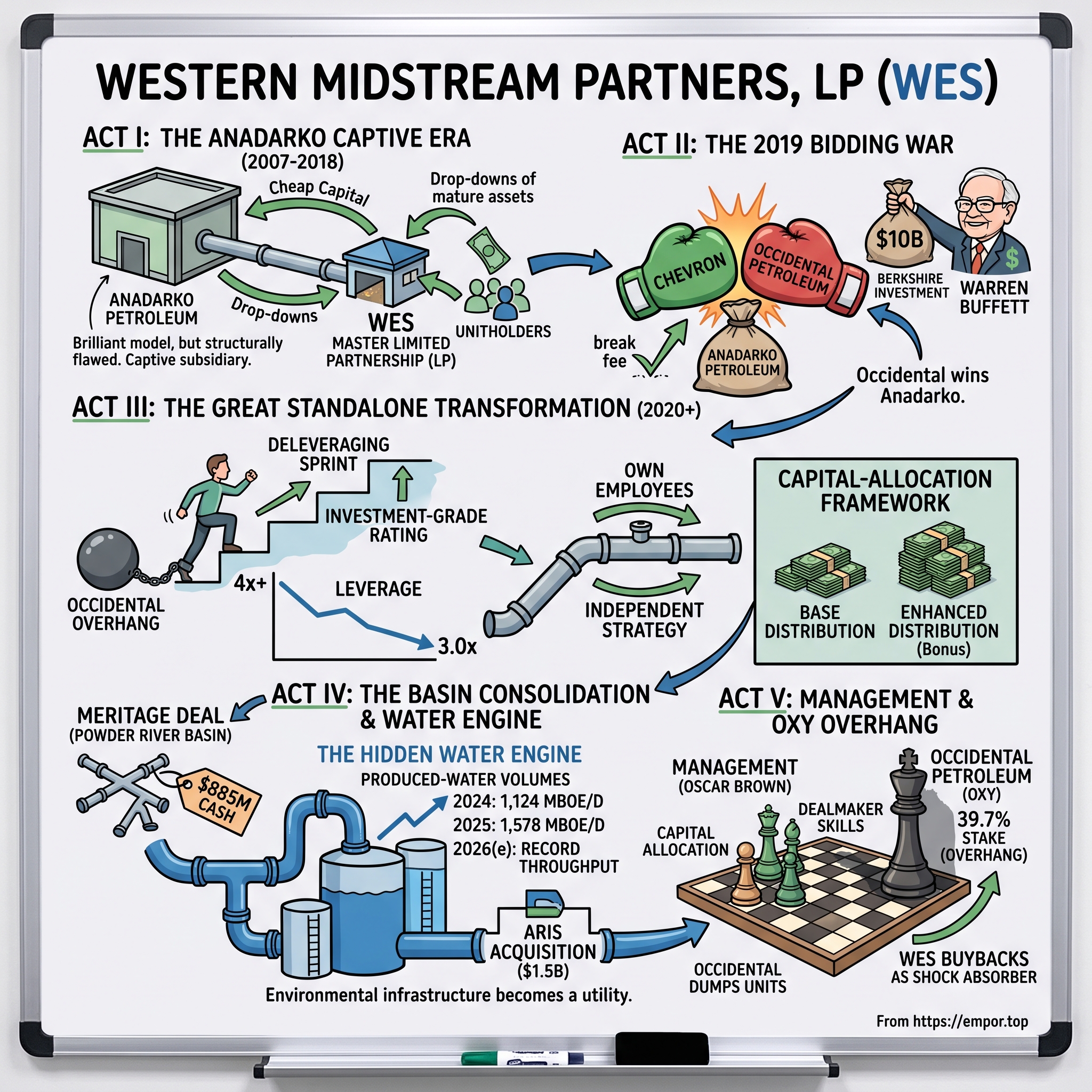
- Act I — The Anadarko Captive Era (2007–2018): How Anadarko built the pipes and progressively sold them down to a public partnership to raise cheap capital, and why that model was both brilliant and structurally flawed.
- Act II — The 2019 Bidding War: Chevron, Occidental, Vicki Hollub, Warren Buffett, and the accidental spin-off of a midstream giant.
- Act III — The Great Standalone Transformation: Deleveraging, operational independence, and the birth of a disciplined capital-return framework.
- Act IV — The Hidden Water Engine & Basin Consolidation: Why hauling and disposing of dirty saltwater in the Delaware Basin quietly became one of the best midstream businesses in America, and how the Meritage and Aris deals fit.
- Act V — Management, Governance & the OXY Overhang: Stress-testing capital deployment and sponsor alignment under CEO Oscar Brown.
- Act VI — Economics, Competitors, 7 Powers, and the Bull vs. Bear Case: Where the moat is real, where it is thinning, and what could break the thesis.
Throughout, the posture here is neutral. When management says WES will win, we will ask what evidence supports it and what would prove it wrong. Let's start where all captive midstream stories start: with an oil company that had a plumbing problem.
 Subscribe on LinkedIn
II. The Captive Arm: Anadarko & The Origins of Western Gas Partners
Every shale well is, in a sense, a race against its own plumbing. An operator can spend millions drilling and fracturing a well in West Texas, but if there is no pipe at the wellhead to carry away the gas, the associated liquids, and the torrents of saltwater that come up with the oil, that well cannot produce. In the worst case the operator has to "shut in" the well — leave high-margin barrels in the ground — because the takeaway simply isn't there. For an exploration-and-production company, that is the nightmare scenario: capital sunk, and no revenue to show for it.
The E&P midstream dilemma. This is why, historically, big producers built their own gathering-and-processing infrastructure instead of renting it. Third-party midstream providers existed, but they wanted their pound of flesh: aggressive minimum-volume commitments that forced the producer to pay whether or not the gas showed up, or fat fee margins that skimmed the economics of every molecule. A producer with a large, contiguous acreage position — exactly what Anadarko Petroleum held in Colorado's Denver-Julesburg Basin and the West Texas Delaware Basin — could reason that if the pipes were going to be built anyway, better to own them, control the drilling-to-first-flow timeline, and keep the midstream margin in-house.
But owning the plumbing ties up capital. Gathering systems, processing plants, and compression stations are expensive, long-lived assets that earn steady, boring, utility-like returns. Anadarko's investors wanted the company spending its capital on the exciting part — finding and producing oil and gas — not on parking billions in steel pipe earning a mid-single-digit yield. The elegant solution, pioneered across the industry in the 2000s, was the master limited partnership.
2007–2008: founding and IPO. Anadarko formed Western Gas Partners, LP in August 2007 and floated it on the New York Stock Exchange in May 2008 under the ticker WES.12 The initial public offering priced 18.75 million common units at $16.50 apiece, raising roughly $309 million.1 The MLP structure was the point: as a partnership, WES paid no entity-level corporate tax and passed its cash flow straight through to unitholders, which let it raise capital at a lower cost than a taxable corporation. Anadarko kept control — a 2% general-partner interest, all of the incentive distribution rights, and a 63.4% limited-partner stake — while pulling cash off the table.1 In a revealing detail of just how captive this arrangement was, WES used roughly $260 million of its own IPO proceeds to make a 30-year loan back to Anadarko at a fixed 6.5% rate.1 The public was, in effect, funding its own parent.
The assets that seeded WES at the IPO were a grab-bag of mature systems — six gathering systems, five gas-treating facilities, and one interstate pipeline spread across East Texas, the Rockies, the Mid-Continent, and West Texas.1 Notably, the crown-jewel basins that define WES today were not in the original portfolio. They came later, and they came via the mechanism that made this whole structure hum: the drop-down.
The drop-down machine. Here is how the captive model worked in practice. Anadarko built or acquired midstream assets on its own balance sheet, got them operating and generating cash, and then "dropped them down" — sold them — to WES. WES paid with a mix of cash (often raised by issuing new units or debt) and equity handed back to Anadarko. Anadarko recycled the cash into drilling; WES got a bigger asset base and more distributable cash flow; public unitholders got a growing distribution. In August 2010, WES bought the Wattenberg gathering system in Colorado's DJ Basin for $498 million.3 In March 2015, it acquired a 50% interest in the Delaware Basin JV gathering system in a cleverly structured deal that valued the asset at roughly eight times its 2018–2019 average EBITDA — a clean window into the multiples changing hands, generally in the range of seven to eight-and-a-half times cash flow.4 And in the largest drop-down of all, announced in November 2018, Anadarko agreed to sell substantially all of its remaining midstream assets to WES for about $4.0 billion, including DJ Basin oil systems, a Wattenberg processing plant, and the water-handling business that would later become a star.5
The DJ Basin around the Wattenberg field gave WES a dense, oil-rich, largely fee-based cash cow. The Delaware Basin gave it something more explosive: as hydraulic fracturing unlocked stacked pay zones across the Permian, wells produced enormous volumes of associated gas and — crucially — staggering quantities of saltwater, both of which needed to be gathered, processed, and disposed of at scale. Hold that thought about water; it becomes the whole ballgame later.
It is worth pausing on why the MLP wrapper made this drop-down machine so powerful, because the tax structure is not a footnote — it is the engine. A traditional C-corporation pays tax at the entity level, then its shareholders pay tax again on dividends: the classic double taxation that raises a company's true cost of capital. A master limited partnership pays no entity-level tax at all; its income and deductions flow through to the unitholders, who are treated as partners in the business. For a slow-and-steady infrastructure asset that generates large non-cash depreciation deductions, that structure is close to ideal — much of the distribution comes back to investors as tax-deferred return of capital rather than currently taxable income. That tax efficiency let WES pay out a higher yield than a comparable corporation could, which in turn let it raise equity cheaply, which in turn let it keep buying assets from Anadarko. The incentive distribution rights layered on top were the sponsor's turbocharger: they entitled the general partner to an escalating slice of the marginal distribution — as much as half of every incremental dollar in the top tier — which gave Anadarko a powerful reason to keep dropping assets down and pushing WES's payout higher. The structure was, in short, an elegant flywheel for the sponsor. Its weakness was that a flywheel built to maximize the sponsor's take is not the same thing as a business built to maximize the public unitholder's per-unit return, and that tension would eventually have to be resolved. It was, in 2019, but not by choice — and the resolution stripped out those very incentive distribution rights in a simplification completed in February 2019 — when Western Gas Equity Partners merged with the operating partnership and the combined entity was renamed Western Midstream Partners, LP — that predated the takeover war.37
The flaw in the model. For all its financial elegance, the captive structure had a rot at its center: WES did not really run itself. It had no employees of its own. At the end of 2013, 382 Anadarko employees provided full-time support to WES operations, seconded to the partnership under a services agreement, working the plants and pipelines under Anadarko's operational direction.6 A separate holding vehicle, Western Gas Equity Partners (ticker WGP), was floated in December 2012 at $22 per unit purely to hold the general-partner economics and incentive distribution rights — another layer of Anadarko control monetized for cash.7 The board answered to Anadarko. The commercial strategy answered to Anadarko. And most consequentially, WES's growth capital was governed by Anadarko's drilling schedule rather than by independent, risk-adjusted return analysis. If Anadarko wanted to drill, WES built pipe to meet it, whether or not that was the best use of a marginal dollar. It was a machine built to serve the parent's capital needs first and its public unitholders' returns second.
That structural subordination was tolerable as long as Anadarko was healthy and independent. But in April 2019, Anadarko stopped being independent — and the captive suddenly had no idea who its master would be.
III. The 2019 Anadarko Mega-Bidding War & The Crisis of Independence
On April 12, 2019, Chevron announced it had agreed to buy Anadarko for about $33 billion in equity value, or roughly $50 billion including debt, at $65 per share in a mix of stock and cash.9 For a few days it looked routine — a supermajor absorbing a well-run independent to bulk up in the Permian. Then Vicki Hollub blew it up.
Hollub, the president and chief executive of Occidental Petroleum, was a career Oxy geologist who had spent decades in the Permian Basin and believed — with an intensity that would define the rest of her tenure — that Occidental could squeeze more value out of Anadarko's West Texas rock than Chevron ever could. On April 24, 2019, she made a competing proposal at $76 per share, split evenly between cash and Occidental stock, valuing Anadarko well above Chevron's bid.10 The problem was that Occidental was far smaller than Chevron, and to fund a mostly-cash offer of that size it needed to reach for extraordinary financing. So Hollub flew to Omaha.
Enter Berkshire. On April 30, 2019, Berkshire Hathaway committed to invest $10 billion in Occidental, contingent on Oxy winning Anadarko.10 In exchange Berkshire received 100,000 shares of cumulative perpetual preferred stock carrying an 8% annual dividend, plus warrants to buy up to 80 million Oxy shares at $62.50 apiece.10 It was a classic Buffett deal — expensive, structurally senior, and impossible to refuse if you were desperate. Hollub was not desperate, exactly, but she was determined, and the 8% preferred was the price of that determination. Critics would spend years arguing that Occidental had overpaid for both the financing and the target. Chevron, for its part, decided the prize was not worth an auction. On May 9, 2019, CEO Michael Wirth declined to raise Chevron's bid, walked away, and collected a $1 billion break fee, delivering the memorable line that "winning in any environment doesn't mean winning at any cost."11 Occidental completed its acquisition of Anadarko on August 8, 2019, in a transaction valued at roughly $55 billion including assumed debt.12
The collateral asset. What did any of this have to do with a gas-gathering partnership? Everything, because WES was the largest non-core asset Occidental inherited. Hollub wanted Anadarko's Permian oil acreage. She emphatically did not want to be the controlling sponsor of a public midstream MLP carrying billions in its own debt — an asset that consolidated onto Occidental's already strained balance sheet. Upon closing, Occidental found itself holding roughly 55% of WES's limited-partner units and, through the general partner, 100% control of the partnership.13 Overnight, WES had a new master it barely knew, and that master's overriding priority was cleaning up a balance sheet that had just ballooned.
The separation. What happened next was the pivotal act in WES's history, and it is easy to miss because it was buried in the fine print of restructuring agreements. In December 2019, WES and Occidental negotiated a set of deals designed to make WES a genuinely standalone company.14 The workforce that had always been employed by Anadarko, and then Occidental, was transferred directly onto WES's own payroll — for the first time in its life, the partnership had its own people. Occidental agreed to provide only limited administrative shared services for a transition period. And the partnership agreement was amended to expand unitholder rights, including — remarkably for a controlled entity — the right to remove and replace Occidental as general partner.14 Occidental deconsolidated WES from its financials and signaled it intended to bring its stake below 50%. The captive was, at least on paper, being set free — not out of Occidental's generosity, but because an independent, self-running WES was worth more to Occidental as a monetizable asset than a consolidated one dragging debt onto its books.
The double whammy of 2020. WES got its independence and then, almost immediately, got tested to the breaking point. In March 2020, COVID-19 collapsed global oil demand; by late April, U.S. crude futures briefly traded negative as storage filled. Producers across the Permian and DJ Basin shut in wells and slashed activity, and WES's throughput came under real pressure as 2020 wore on. The unit price, which had been in the low teens in early March 2020, cratered below $4 during the last week of that month, touching an intraday low near $3.8 Layered on top of the operational shock was a governance fear that was arguably worse: Occidental had emerged from the Anadarko deal with roughly $40 billion of debt and a wall of near-term maturities.16 The market openly worried that a cash-strapped Occidental would either squeeze WES on contract terms or dump its 55% stake into the open market to raise cash — either of which would clobber WES units.
Management's response set the tone for the next five years. On April 20, 2020, WES cut its quarterly distribution roughly in half, to $0.311 per unit, and recorded hundreds of millions in non-cash impairments, explicitly to protect the balance sheet rather than defend a payout it could no longer justify.15 For an MLP — a structure whose entire investor base is built around the distribution — cutting the payout is the corporate equivalent of amputation. It was also, in hindsight, the right call, and it marked the psychological break from the empire-building captive era. The question now was whether the newly independent WES could turn survival into a durable, disciplined business. That transformation is the heart of the story.
IV. The Great Standalone Transformation: De-Leveraging & Capital Allocation Revolution
The man handed this problem was Michael Ure, who became WES's chief executive on August 8, 2019 — the very day Occidental closed the Anadarko deal — having come over from Occidental's business-development ranks.17 Ure inherited a partnership with too much debt, a customer base dominated by a single financially stressed sponsor, and a unit price the market had left for dead. His strategy over the next several years was almost boringly consistent, and that consistency is precisely what makes it worth studying: stop building empires, fix the balance sheet, and only then return cash.
The deleveraging sprint. The central financial project was cutting leverage — the ratio of net debt to adjusted EBITDA, which is midstream shorthand for how many years of cash flow it would take to pay off the debt. WES came into its standalone life with leverage well above four times, uncomfortably high for a business whose entire pitch is stability. Management set a public target of getting net leverage down to 3.0 times, a threshold that mattered for a concrete reason: it was the gateway to a full investment-grade credit rating, which in turn lowers borrowing costs and — critically for a company living under an overhang — signals to the market that WES could stand on its own creditworthiness rather than leaning on Occidental's. WES obtained full investment-grade ratings in May 2023, at the BBB-/Baa3 level rather than the higher tier the outline imagined, and raised $1.35 billion across two bond offerings that year.18 By the third quarter of 2024, management reported that its trailing-twelve-month net leverage had "comfortably reached" the 3.0x year-end threshold ahead of schedule, and it closed 2024 at that mark.1920 Getting from the low-teens unit price of 2020 to a clean investment-grade balance sheet in roughly four years is the single most important thing this management team accomplished, and it happened through undramatic, quarter-after-quarter execution rather than a single heroic move.
The customer-concentration reality. The outline's hopeful story — that WES weaned itself off Occidental, dropping the sponsor from two-thirds of revenue down to something like 40–45% — is where a neutral read has to diverge from the bull narrative. It did not happen, at least not to that degree. Occidental remains WES's largest customer by a wide margin: as of the most recent annual report, Occidental accounted for roughly 60% of total revenues, and in 2023 it controlled the large majority of the crude-oil-and-NGL and produced-water volumes WES handled, though a smaller share of the gas.24 WES did meaningfully extend the relationship — the commercial agreements with Occidental were pushed out through 2035, which converts concentration risk into contract-tenure certainty — but concentration it remains.18 This is the kind of fact a promotional write-up buries and an independent one foregrounds: WES's fortunes are still tightly coupled to a single producer's Permian drilling program, and any honest thesis has to underwrite Occidental's activity level, not wish it away.
Modernizing the contracts. Deleveraging fixed the liabilities side of the balance sheet; the quieter, equally important work was rebuilding the revenue side to be more defensible. As a captive, WES's contracts had been struck between related parties — Anadarko negotiating with an entity Anadarko controlled — which is not exactly an arm's-length process designed to protect the minority unitholder. Post-independence, WES set about converting legacy arrangements into long-term, fee-based agreements with the protections that make midstream cash flow bankable: minimum-volume commitments, which oblige the producer to pay for a floor of throughput whether or not the molecules arrive, and cost-of-service provisions that periodically true up the fee so WES earns its contracted return even if volumes disappoint. The extension of the core Occidental commercial agreements out to 2035 was the centerpiece of this effort — it did not reduce customer concentration, but it did convert a related-party relationship into a long-dated, contractually specified one.18 The analytical point is subtle but important: a minimum-volume commitment is only as good as the counterparty standing behind it. A floor payment from a financially strong, investment-grade producer is a genuine asset; the same clause from a stressed operator that could file for bankruptcy and reject the contract in court is worth far less. WES's push toward investment-grade counterparties and long tenors is therefore not box-ticking — it is the substance of whether the "annuity-like" cash flow the tollbooth thesis promises is real or merely nominal.
The two-tier distribution framework. Once the balance sheet was fixed, WES built a capital-return machine that is genuinely differentiated in the MLP world, and it is worth understanding because it reveals the management philosophy. Rather than promising an ever-rising fixed distribution — the trap that has blown up countless MLPs when volumes disappoint — WES split its payout in two. There is a Base Distribution, meant to be sustainable and to grow modestly, which the partnership raised aggressively as cash flow recovered: from $0.575 per unit quarterly in 2023 to $0.875 per unit quarterly, or $3.50 annualized, in 2024 — a level management flagged as more than 40% above pre-pandemic.1819 And there is an Enhanced Distribution, a discretionary top-up paid after year-end and sized to trailing free cash flow left over after debt paydown and growth capital, which WES paid for the first time in 2023.18 The design is elegant because it tells the truth: the base is the promise, the enhanced is the bonus, and by construction the partnership never has to defend a payout it cannot cover.
The result of all this is a business throwing off serious cash. WES generated $964 million of free cash flow in 2023 and $1.32 billion in 2024, comfortably funding both distributions and debt reduction.1820 For a partnership that was trading near $3 a unit in the depths of 2020, becoming a reliable billion-dollar-plus free-cash-flow generator is a genuine turnaround. But the skeptic's question is the right one to end on: is that cash flow the product of a durable moat, or of a favorable commodity cycle and a producer base that simply hasn't cut back yet? To answer that we have to look at what WES actually owns — and at the two acquisitions that reshaped it. Start with the one in Wyoming.
V. Basin Consolidation: Meritage Midstream & The Powder River Expansion
For its entire captive life, WES grew by drop-down — buying assets from its own parent. The moment it became independent, it had to learn a different and harder skill: buying assets from third parties, in the open market, at prices set by competition rather than by a related-party committee. The first real test of that muscle came in Wyoming's Powder River Basin, a hydrocarbon region that most Permian-obsessed investors barely think about — which was precisely the point.
The Meritage deal. On September 5, 2023, WES agreed to acquire Meritage Midstream Services II for $885 million in cash, closing the transaction on October 13, 2023.2223 The assets were a coherent, ready-made gathering-and-processing system: roughly 1,500 miles of gas-gathering pipeline, about 380 million cubic feet per day of processing capacity, and the Thunder Creek NGL pipeline, all sitting across Campbell, Converse, and Johnson counties in the Powder River Basin.2223 Crucially, the system came with more than 1.4 million dedicated acres, counterparties skewed toward investment-grade producers, and roughly eight years of average remaining contract life — in other words, contracted future volume, not just steel in the ground.23
The multiple, corrected. The outline claims WES paid around 7.5 times trailing EBITDA, falling to about 5.8 times after synergies. The company's own characterization was more attractive than that: it framed the $885 million price as roughly 5.0 to 6.0 times the assets' expected 2024 pre-synergy EBITDA, with synergies pulling the effective multiple lower still.22 Why does the exact number matter? Because the entire logic of the deal rests on it. Comparable midstream systems in the hotter Permian and Bakken basins were changing hands at meaningfully higher multiples during this period. By buying in the Powder River — a basin with real geology but slower near-term drilling activity, and therefore fewer bidders — WES acquired scale and exclusive acreage dedications at a discount to what the same cash flow would have cost in West Texas. This is the essence of counter-cyclical, off-the-beaten-path M&A: pay less by going where the crowd isn't.
The bet and its risk. The analytical honesty required here is to name what WES actually bought: option value on a basin that has not yet fully delivered. The Powder River's economics depend on producers stepping up activity to fill that 1,500 miles of pipe and 380 million cubic feet of processing capacity. If they do, WES bought future cash flow at a bargain and its per-unit multiple compresses toward the mid-single digits as volumes ramp. If they don't — if the Powder River stays a second-tier basin where operators would rather allocate capital to the Permian — then WES owns underutilized infrastructure and a full-price problem. The deal was funded partly with a $600 million investment-grade senior-notes issuance, which was only possible because the deleveraging work of the prior three years had earned WES the credit standing to borrow cheaply.23 That is the compounding logic of a repaired balance sheet: fix the credit, and the next acquisition costs less to finance.
Integration. The integration thesis was straightforward and the kind of thing that actually works in midstream: bolt a standalone private system onto a public operator with existing regional scale, strip out the duplicated corporate overhead, and push more volume through the processing plants to lift utilization. Higher utilization is where midstream margins are made — these are high-fixed-cost assets, so every incremental molecule that moves through an already-built plant drops almost straight to cash flow. Whether the Powder River bet ultimately pays depends on drilling activity WES does not control, which is the recurring theme of this entire business. But Meritage proved WES could source, price, finance, and close a competitive third-party deal on its own — a capability it did not possess as a captive. It was the warm-up. The main event in WES's portfolio is not in Wyoming at all. It is the water.
VI. Core Business & Segment Economics: Gathering, Processing, & The Hidden "Water Engine"
Here is a fact that reorders how you should think about WES. When a modern Delaware Basin well produces a barrel of oil, it typically brings up several barrels of water along with it — heavy, briny, chemical-laden "produced water" that is useless, toxic, and legally cannot simply be dumped. Across the basin, the industry moves and disposes of far more water by volume than oil. Handle that water and you are not a nice-to-have vendor; you are a utility the producer physically cannot drill without. Fail to handle it and the well shuts in. WES figured this out early, and produced-water infrastructure has quietly become one of its most valuable franchises.
What WES actually is. For financial-reporting purposes, WES runs as effectively a single business, but functionally it does three things.24 It gathers and processes natural gas — collecting raw gas at the wellhead, treating out impurities, stripping out the valuable natural gas liquids (ethane, propane, butane) for sale, and delivering the leftover "residue" gas into long-haul interstate pipelines. It gathers and transports crude oil and NGLs through feeder systems that connect fields to major takeaway headers — a low-capex, high-margin business once the pipe is in the ground. And it gathers and disposes of produced water, the fast-growing engine. Geographically, the Delaware Basin in West Texas and New Mexico is the growth core, the DJ Basin in Colorado is the mature cash cow, and the newly added Powder River is the option. (A precise segment-by-segment EBITDA split of the kind the outline lists is not something WES discloses in its filings; the geographic-percentage figures floating around investor decks are revenue-based approximations, and a neutral reader should treat any tidy "62% Delaware / 26% DJ" breakdown as an estimate rather than a reported number.)
What gas processing actually does, in plain terms. For readers who have never stood next to a cryogenic processing plant, here is the physical reality behind the accounting. Raw gas coming out of a Permian well is not the clean methane that heats a home; it is a wet, sour cocktail — methane mixed with heavier hydrocarbons (the natural gas liquids: ethane, propane, butane, and heavier "naturals"), plus contaminants like water vapor, carbon dioxide, and sometimes hydrogen sulfide, the "sour" component that is toxic and corrosive. A processing plant is essentially an industrial-scale still. It first treats the gas to strip out the acid and sulfur components, then chills the stream to roughly minus-120-degrees-Fahrenheit territory in a cryogenic unit, at which point the heavier liquids condense out and can be separated from the methane. The leftover clean methane — "residue gas" — is compressed and sold into long-haul interstate pipelines; the separated liquids are shipped off for fractionation and sale into petrochemical and fuel markets. WES gets paid a fee for running the still and moving the streams. The takeaway pipelines WES's Delaware residue gas actually flows into are systems such as Red Bluff Express, Whitewater's Agua Blanca, Energy Transfer's Oasis, and Kinder Morgan's Transwestern — the plumbing that carries clean gas out of the basin toward market.24 Understanding the still helps explain why the business is capital-intensive but stable: the plant costs a fortune to build, but once built, it hums along charging tolls on volume, and its returns depend far more on how full it runs than on the price of the molecules passing through.
Why the cash flow is stable: fee-based contracts. The single most important thing to understand about WES's economics is how little of it rides directly on commodity prices. For 2024, 95% of WES's wellhead natural-gas volume and 100% of its crude-oil and produced-water throughput were serviced under fee-based contracts.24 In plain terms: WES largely gets paid per unit of volume it handles, not on the price of the oil or gas itself. Many of those contracts carry minimum-volume commitments — the producer agrees to pay for a floor of throughput whether or not the molecules actually show up — and cost-of-service provisions that true up the fee to protect WES's return.24 This is the "tollbooth" nature of the business: the toll is collected on traffic, not on the value of the cars. It insulates WES from short-term price swings, but note what it does not insulate against — volume. If producers drill less, the traffic falls, and outside the protection of minimum-volume floors, so does the toll. WES's risk was never oil at $50 versus $80; it was always drilling activity.
The crude business and the DJ cash cow. The crude-oil-and-NGL gathering business is the least glamorous and, per dollar invested, arguably the sweetest. These are feeder systems — the capillaries that collect oil and liquids from the field and deliver them to the major arteries, the long-haul takeaway headers that carry barrels to the Gulf Coast and the Cushing hub. Once the pipe is laid, the incremental capital required to keep it running is minimal, so the margins are high and the maintenance capex is low; it is close to a pure toll on barrels. The DJ Basin plays a distinct role in the portfolio here. Unlike the Delaware, which is the growth story soaking up most of WES's expansion capital, the DJ around Wattenberg is a mature, high-density, largely fee-based system that behaves like a cash cow — it requires relatively little new investment and reliably converts throughput into distributable cash. In portfolio terms, the DJ funds the dividend while the Delaware funds the future. The risk specific to the DJ is not geology but politics: Colorado has among the most stringent oil-and-gas regulatory regimes in the country, and periodic tightening of setback rules and permitting can slow the drilling that keeps those mature systems full. It is a reminder that even the "boring" cash cow carries a regulatory beta that a purely financial model would miss.
The water engine, quantified. Now watch the water business grow, because the trajectory tells the story better than any adjective. WES's produced-water throughput averaged about 1,124 thousand barrels per day in 2024, up 11% year over year.20 Through 2025 it kept climbing — a record 1,217 thousand barrels per day in the second quarter — and the full year 2025 landed at a record 1,578 thousand barrels per day, a roughly 40% jump.2526 The economics behind those volumes are what make them matter: produced-water contracts are essentially 100% fee-based, carry long-dated dedications, and run at high margins because once the gathering pipes and disposal wells exist, incremental barrels are cheap to handle. And the water business does something strategically subtle — it locks in the producer's oil and gas volumes too. A producer that has dedicated its water handling to WES on a 10-to-15-year contract is deeply enmeshed in WES's infrastructure across every stream, which raises the cost of ever switching midstream providers.
The Aris acquisition. WES made a large, deliberate bet to consolidate its position as the basin's water utility. On August 6, 2025, it agreed to acquire Aris Water Solutions in an equity-and-cash deal valued at roughly $1.5 billion, or about $2.0 billion including assumed debt.27 Aris shareholders could take 0.625 WES units per share or elect $25.00 in cash, subject to a maximum cash pool of $415 million.27 The strategic logic was density: Aris brought roughly 790 miles of produced-water pipeline, 1,800 thousand barrels per day of handling capacity, and 1,400 thousand barrels per day of recycling capacity, layered on top of WES's own water grid and its Pathfinder pipeline project.27 The deal closed on October 15, 2025, with WES paying the full $415 million in cash and issuing about 26.6 million units, leaving former Aris holders owning roughly 7% of WES.28 WES pitched it as roughly 7.5 times consensus 2026 EBITDA, accretive to 2026 free cash flow per unit, with about $40 million of annual cost synergies and pro-forma leverage holding near 3.0 times.27
The most striking evidence that the water strategy is real showed up in the first quarter of 2026, the first full period reflecting Aris: WES reported record produced-water throughput of roughly 2,795 thousand barrels per day on an attributable basis — nearly double the prior-year level — and record adjusted EBITDA of $683 million.36 Recycling matters here beyond economics: as regulators tighten the rules on deep-well saltwater disposal (more on that in the risk radar), the ability to clean and reuse water rather than inject it becomes a regulatory hedge as much as a service. What the water franchise buys WES, in a sentence, is the highest-margin, most contractually locked-in, fastest-growing piece of its portfolio — and the best answer it has to the "why won't volumes just fall" question, because water is the one stream a producer cannot cut without shutting in the oil. Whether that franchise is being run for unitholders or for the benefit of its controlling sponsor is the governance question we turn to next.
VII. Management, Governance, & The OXY Ownership Overhang
In late October 2024, WES changed captains without changing course. Michael Ure stepped down, and on October 28, 2024, the board appointed Oscar K. Brown as president and chief executive, effective immediately.21 The choice was telling in both directions.
Who is Oscar Brown? Brown was not a pipeline lifer. He had spent the bulk of his career in finance and strategy: managing director and co-head of Americas energy investment banking at Bank of America Merrill Lynch, with earlier stops at Barclays, Lehman Brothers, and Credit Suisse First Boston, before joining Occidental as a senior executive running worldwide business development and strategy from 2016 to 2020, and then serving as chief financial officer of FREYR Battery.29 He had also sat on WES's own board since August 2019, chairing its ESG committee, so he knew the partnership from the inside.21 (One detail worth correcting from the consensus telling: there is no evidence Brown worked at Simmons & Company; his banking pedigree is the bulge-bracket firms named above.) The profile is that of a capital-allocator and dealmaker rather than an operator — fitting for a company whose entire post-2020 story is about balance sheets and M&A, and notable for one obvious reason: WES's new CEO came out of the very sponsor whose overhang the market frets about. That is either a red flag on independence or a sign of continuity, depending on how you read it, and it deserves to be held in mind rather than resolved glibly.
Continuity and credibility. On the substance, Brown has kept Ure's framework intact: the sub-3.0x leverage discipline, the base-plus-enhanced distribution architecture, and a stated commitment to grow the base distribution in the mid-single digits annually. That consistency is itself a credibility signal — WES has, so far, done what it said it would do across two CEOs, four years of guidance, and multiple earnings calls. Compensation is structured to reinforce it: WES's long-term incentive plan leans on performance units tied to three-year return on assets and three-year relative total unitholder return against a peer group, rather than raw volume growth or absolute EBITDA — metrics that reward efficient capital use and beating peers rather than empire-building.30 It is worth being precise here, because promotional write-ups overstate it: the plan's headline metrics are return on assets and relative total unitholder return; free cash flow per unit is emphasized operationally and in deal rationales but is not, on the available disclosure, a named compensation metric. The direction of the incentives is nonetheless sound.
Myth versus reality. A few pieces of the consensus WES narrative do not survive contact with the filings, and an independent read should flag them. Myth: WES diversified away from Occidental to roughly 40–45% of revenue. Reality: Occidental still sits near 60% of total revenues; the relationship was lengthened, not materially reduced.24 Myth: WES bought Meritage at around 7.5 times trailing EBITDA. Reality: the company's own framing put the price near 5.0 to 6.0 times forward pre-synergy EBITDA, a cheaper and more flattering number.22 Myth: WES carries a mid-tier investment-grade rating in the Baa2/BBB range. Reality: it reached the lower investment-grade rung, BBB-/Baa3, in 2023.18 Myth: the new CEO's résumé includes a boutique energy bank. Reality: his banking career ran through bulge-bracket firms, and — more to the point — through Occidental itself.29 None of these corrections is damning on its own, but together they illustrate a pattern worth internalizing: the promotional version of the WES story consistently rounds in the company's favor, and the neutral version is a bit less shiny and a bit more concentrated than the pitch.
The overhang, sized correctly. Now the governance problem that hangs over everything. Occidental still owns a large slice of WES — about a 39.7% limited-partner interest as of the end of 2025, plus general-partner economics — down from the roughly 55% it inherited in 2019.30 The market treats that stake as a sword of Damocles. Occidental has spent years in debt-reduction mode, a pressure that intensified after it closed its roughly $12 billion acquisition of CrownRock in August 2024 and committed to a multibillion-dollar divestiture program.33 As part of that program, Occidental subsidiaries sold 19.5 million WES units at $35.75 apiece in August 2024, raising about $697 million.3132 The fear is simple: every investor knows Occidental may sell more, and that latent supply — an "overhang" — can cap WES's valuation relative to peers like Enterprise Products Partners or Targa Resources that carry no such sponsor cloud. A stock the market believes could be flooded with seller supply trades at a discount to one that isn't.
The counter-strategy, and its limits. WES's answer has been to use its own balance sheet as a shock absorber. It has repurchased units, including buying 5.1 million units directly from an Occidental subsidiary for $127.5 million in September 2023, which nudged Occidental's stake down and — because it shrinks the unit count — is accretive to everyone who remains.18 The elegance is that WES can convert its overhang problem into a per-unit tailwind: use free cash flow to retire the sponsor's units at a discounted valuation, and the remaining unitholders own more of the same cash flow. But the limits are real and management has been candid about them. On the first-quarter 2025 call, Brown described the team as "prudent allocators of capital" and ranked buybacks explicitly behind organic growth and M&A in priority — only "if we exhaust the first two."34 Analysts pushed back: on that call, Citi's Spiro Dounis and UBS's Sumantra Banerjee pressed on why WES wasn't buying back more given sub-3x leverage, and on the second-quarter 2025 call Wolfe Research's Keith Stanley questioned why the partnership wasn't deploying more cash into its own units given a roughly 9% distribution yield.3435 Then WES turned around and spent its capital on Aris instead. That is the honest tension in the WES story: management preaches discipline and unit-count reduction, but when forced to choose, it has favored growth acquisitions over shrinking the overhang. Reasonable investors can disagree about whether that is the right call — but it is a choice, and it is the choice an activist would put under the microscope. Which brings us to the lessons this whole saga teaches.
VIII. Playbook: Core Business & Investing Lessons
Step back from the quarter-to-quarter and WES offers a set of transferable lessons about how infrastructure businesses create — and sometimes fail to create — durable value.
1. The midstream tollbooth thesis, and its fine print. The foundational idea is that fee-based contracts with minimum-volume commitments turn a wildly volatile input — commodity production — into something closer to an annuity. WES gets paid to move molecules, not to bet on their price, which is why its cash flow held up through commodity cycles that savaged the producers upstream of it. But the lesson comes with a warning label that WES's own history writes in bold: the tollbooth only insulates you from price, not from volume. A toll road with no cars is worthless no matter how good the toll structure is. The durability of a midstream cash flow is therefore only as good as the drilling activity of the producers dedicated to it — which is why the smart diligence question is never "what's the contract" but "who's the producer, how good is their rock, and will they keep drilling it."
2. Environmental infrastructure as a hidden utility. The single most valuable strategic insight in the WES story is that the industry's biggest waste problem — produced water — was actually its stickiest, highest-margin service opportunity. By treating water not as a disposal cost but as an essential utility with long-dated, fee-based dedications, WES built its fastest-growing franchise out of the part of the business everyone else wanted to ignore. The generalizable lesson: look for the "waste" streams in an industry that are non-negotiable, regulated, and physically bundled with the customer's core operation. Those are often where the deepest lock-in hides.
3. Escaping the parent-subsidiary trap. WES is a live case study in converting a captive subsidiary into a real company — hiring its own workforce, winning its own credit rating, sourcing its own third-party M&A, and negotiating governance rights that on paper let unitholders fire the sponsor.1418 The lesson for anyone analyzing a controlled entity is that independence is a spectrum, not a switch. WES moved a long way down that spectrum, but it did not reach the end: its largest customer and largest owner remain the same company. Genuine arm's-length status is measured not by press releases but by customer concentration, related-party contract terms, and whether the controlled company will spend against its sponsor's short-term interest when the two diverge.
4. M&A discipline in mature basins. The Meritage template — buy coherent, contracted assets in an unfashionable, second-tier basin at mid-single-digit post-synergy multiples while rivals overpay for Permian scale — is a genuinely disciplined approach to inorganic growth. The catch, again worth stating plainly, is that a cheap multiple on assets that need more drilling to fill them is only cheap in hindsight. Discipline in mature basins means buying under-utilized capacity at a discount and being right about the future utilization; being wrong about utilization turns a bargain into a stranded asset.
5. Capital-return architecture as an alignment tool. The base-plus-enhanced distribution design deserves the last word because it solves a specific pathology of the MLP model. Traditional MLPs promised ever-rising fixed distributions and then blew up when volumes disappointed and they had to choose between cutting the payout and cutting the balance sheet. By making only the base a promise and sizing the enhanced portion to actual leftover cash, WES built a structure that cannot force it into the empire-building-or-default trap that killed so many of its predecessors. It is a better mousetrap — provided management actually honors the discipline the structure is designed to enforce, which, as the buyback-versus-Aris tension shows, is a behavioral question the structure alone cannot answer.
With the lessons on the table, the question every long-term investor actually cares about is whether the moat is real and what could break it.
IX. Valuation, Porter's 5 Forces, Hamilton Helmer's 7 Powers, & Bull vs. Bear Case
Is WES a fortress or a well-run business standing on cyclical ground? Frameworks help discipline the answer.
Hamilton Helmer's 7 Powers. The strongest of WES's powers is switching costs, and they are physical rather than psychological. A producer whose wells are plumbed into WES's gathering headers, whose gas runs through WES's processing plants, and whose water flows to WES's disposal wells cannot casually switch providers — doing so would mean building duplicate pipe across the same acreage, re-permitting rights-of-way, and interrupting production. The water dedications, layered on top of gas and crude, deepen that lock-in across every stream. Scale economies are real in the Delaware Basin, where a dense, interconnected grid means each incremental barrel or thousand cubic feet moves at low marginal cost through already-built capacity; the Aris consolidation extends exactly this advantage in water. Cornered resource applies in a specific, defensible form: the long-term acreage dedications that give WES exclusive rights to gather from prime Delaware and DJ Basin rock for a decade or more. Counter-positioning is the weakest of the four claims — WES's flexibility as a pure-play versus an integrated producer is a modest structural edge, not a power a competitor cannot replicate, and it should be held lightly. What Helmer's framework clarifies is that WES's moat is asset-and-contract-based, not brand- or technology-based, and such moats are durable against competitors but exposed to the one thing contracts can't fix: a customer who simply produces less.
Porter's 5 Forces. The threat of new entrants is very low — you cannot easily build a competing gathering grid across acreage already dedicated to someone else, and the permitting and capital hurdles are enormous. Threat of substitutes is low in the medium term — renewables do not replace the NGL feedstocks that petrochemicals require, and nothing substitutes for the physical need to dispose of produced water. Buyer power (the downstream markets WES delivers into) is low-to-moderate, mediated by regional hub pricing at Waha, Mont Belvieu, and the Gulf Coast. The two forces that actually bite are supplier/customer power and rivalry — and note that in midstream the "supplier" is the E&P producer, who is also effectively the customer. Large producers like Occidental, EOG, and ExxonMobil hold real negotiating leverage at contract-renewal time, even if WES holds a physical monopoly over already-connected acreage. And rivalry is high: WES competes for new dedications and acquisitions against far larger, lower-cost-of-capital operators — Enterprise Products Partners, Energy Transfer, MPLX, Targa Resources, and ONEOK — several of which dwarf WES in scale and diversification. WES is a focused Delaware/DJ specialist in a field of giants, which is a strength for depth and a weakness for bargaining power and cost of capital.
Benchmarking against the giants. To see where WES sits in the pecking order, war-game it against the peers it competes with for dedications and deals. Enterprise Products Partners is the blue-chip of the group — vastly larger, more diversified across gathering, processing, pipelines, fractionation, storage, and export docks, with an A-rated balance sheet and a decades-long distribution-growth streak that lets it raise capital more cheaply than almost anyone in the sector. ONEOK and MPLX bring similar scale and integration; Energy Transfer brings sprawling, coast-to-coast reach; Targa Resources is the closest strategic analog as a Permian-centric gathering-processing-and-NGL specialist with its own downstream fractionation and export exposure. Against that field, WES is a focused, mid-cap basin specialist. That focus is a double-edged sword. On the upside, WES's concentration in two or three prime basins gives it dense, high-utilization asset grids and a genuine edge in the produced-water niche that the diversified majors have been slower to build out. On the downside, smaller scale and a sponsor overhang translate into a higher cost of capital than an Enterprise or an ONEOK enjoys, which structurally handicaps WES in bidding wars for the next big asset — it simply cannot pay up as far before a deal stops being accretive. WES has generally traded at a valuation discount to the highest-quality names in the group, and a fair reading is that some of that discount reflects the overhang and concentration rather than any deficiency in the assets themselves. The competitive question, then, is whether WES can keep winning on focus and water differentiation faster than its cost-of-capital disadvantage compounds against it.
The bull case. The constructive thesis rests on evidence, not hope. WES has repaired its balance sheet to investment grade and holds it near 3.0x leverage; it throws off well over a billion dollars of free cash flow; it pays a high distribution yield reported in the high-single digits; and it has bolted on the basin's leading water franchise at a moment when produced-water volumes and regulatory tailwinds toward recycling are both rising.202627 Delaware Basin gas volumes benefit structurally as wells mature and produce proportionally more gas over time. And the very overhang that depresses the units is, handled well, a source of accretion — WES can buy Occidental's units at a discounted valuation and shrink the count. If producers keep drilling and WES keeps its discipline, the cash-flow compounding is real.
The bear case. The skeptic's rebuttal is equally grounded. WES remains roughly 60% dependent on a single customer whose capital budget it does not control, so a sharp Occidental pullback in Permian activity would hit WES's volumes directly.24 Regional gas prices at the Waha hub have repeatedly gone negative when Permian takeaway pipelines fill up, which pressures producers to curtail or flare gas and can slow completions — a volume risk the fee structure only partly offsets. Saltwater-disposal wells face tightening regulation in Texas and New Mexico over induced seismicity, which raises costs and could constrain the water business even as it grows. The overhang is a genuine, recurring source of unit-price volatility. And WES's cost of capital and scale disadvantage against the midstream majors limit how aggressively it can compete for the next tranche of growth. An activist would additionally press on the governance knot — a CEO drawn from the controlling sponsor, a sponsor as largest customer and largest owner, and a stated buyback discipline that keeps yielding to acquisitions. None of these is fatal; together they explain why the market applies a discount, and why the "why win" case has to be argued rather than assumed.
The verdict a neutral analyst reaches is not a grade but a framing: WES's moat is real where it is physical and contractual, and thinnest where it depends on a single producer's discretionary drilling. Which is exactly why the metrics you watch matter so much.
X. Key KPIs, Risk Radar, & Epilogue
If you follow only a handful of numbers on WES, follow these three — they map directly onto the thesis and its fault lines.
1. Delaware Basin throughput — gas and water. This is the demand signal, and it is the cleanest read on whether the producers WES depends on are actually drilling. Natural-gas throughput measured in billions of cubic feet per day tells you about the gas franchise; produced-water throughput in thousands of barrels per day tells you about the highest-margin, stickiest business. Both hitting successive records through 2025 and into 2026 — water reaching roughly 2,795 thousand barrels per day in the first quarter of 2026 after the Aris close — is the single strongest piece of evidence that the volume engine is running.2636 A stall or decline here would be the earliest warning that producer discipline is finally throttling the tollbooth.
2. Free-cash-flow coverage of the distribution. WES generated $1.53 billion of free cash flow in 2025, up 15%, comfortably above the distributions it paid.26 The number to watch is whether free cash flow after growth capital keeps covering the base-plus-enhanced payout with room to spare. Ample coverage means the distribution is safe and the enhanced top-up and buybacks are funded from genuine surplus; thinning coverage would signal that growth spending or a volume dip is eating into the cushion. This is the metric that separates a sustainable MLP from one quietly borrowing to pay its unitholders.
3. Net debt to adjusted EBITDA. Holding leverage near the 3.0x target is what preserves the investment-grade rating — at the BBB-/Baa3 level, not the higher tier sometimes cited — and with it WES's independent access to cheap capital and its standing apart from Occidental's credit.2026 Watch for any drift above target, especially if funded by acquisitions; management's willingness to hold the line here, deal after deal, is the truest test of the discipline it preaches.
The risk radar. Three exposures are worth active monitoring because each attacks the thesis through a real mechanism. Regulatory seismicity risk: the Texas Railroad Commission and New Mexico's regulators have been restricting deep saltwater-disposal injection over earthquakes linked to it, which raises costs and pushes capital toward shallower recycling — a headwind that partly explains why WES's recycling capacity matters strategically, not just environmentally. Waha hub discount risk: when Permian gas takeaway lags production, local prices collapse and producers curtail, hitting WES volumes at the source. Sponsor liquidation risk: any fresh Occidental sell-down of its roughly 39.7% stake can create short-term unit-price volatility regardless of WES's operating performance, and the timing sits outside management's control. Each is a live, mechanical risk — not a generic macro worry — and each maps to something an investor can actually watch.
Epilogue. Western Midstream is, in the end, a study in what independence is worth. A captive plumbing arm built to serve its parent's capital needs got dropped into a takeover war it did not choose, was set loose by a new owner that wanted it off the balance sheet more than it wanted to run it, and then spent five years proving it could stand on its own — fixing its credit, building a differentiated capital-return machine, and turning the industry's dirtiest waste stream into its best business. What it has not done is escape the gravity of the sponsor and the single producer at the center of its cash flow, and it has repeatedly chosen growth over shrinking that overhang when pushed. The result is a genuinely improved business trading at a genuine discount, for reasons that are neither imaginary nor fully in management's control. Whether WES compounds from here rests on the two things this entire story keeps returning to: whether the producers on its acreage keep drilling, and whether a management team drawn from its own sponsor keeps honoring the discipline it has promised. Those are the questions the numbers above are built to answer, quarter by quarter.
References
-
Western Gas Partners, LP IPO Prospectus (Form 424B1) — U.S. Securities and Exchange Commission, 2008-05-09 ↩↩↩↩↩
-
Western Gas Partners Q2 2010 Earnings Release (Form 8-K Exhibit 99.1) — U.S. Securities and Exchange Commission, 2010-08-05 ↩
-
Western Gas Partners Delaware Basin JV Acquisition (Form 8-K Exhibit 99.1) — U.S. Securities and Exchange Commission, 2015-03-03 ↩
-
Anadarko Announces $4 Billion Midstream Asset Sale — PR Newswire, 2018-11-08 ↩
-
Western Gas Partners, LP Form 10-K for FY2013 — U.S. Securities and Exchange Commission, 2014 ↩
-
Western Gas Equity Partners, LP IPO Prospectus (Form 424B4) — U.S. Securities and Exchange Commission, 2012-12-10 ↩
-
WES daily historical end-of-day price data, March 2020 — Financial Modeling Prep ↩
-
Chevron to Acquire Anadarko Petroleum for $33 Billion — World Oil, 2019-04-12 ↩
-
Berkshire Hathaway Commits to $10 Billion Equity Investment in Occidental (Form 425) — U.S. Securities and Exchange Commission, 2019-04-30 ↩↩↩
-
Chevron Will Not Increase Offer to Acquire Anadarko (Form 8-K Exhibit 99.1) — U.S. Securities and Exchange Commission, 2019-05-09 ↩
-
Occidental Completes Acquisition of Anadarko (Form 8-K Exhibit 99.1) — U.S. Securities and Exchange Commission, 2019-08-08 ↩↩
-
Western Midstream Partners, LP Form 8-K, Change in Control — U.S. Securities and Exchange Commission, 2019-08-08 ↩↩
-
Western Midstream Announces Entry Into New Service, Operating, And Governance Agreements — PR Newswire, 2020-01-06 ↩↩↩
-
Western Midstream Announces First-Quarter 2020 Results — Western Midstream, 2020-05-05 ↩
-
Occidental Petroleum Pays a High Price for Some Breathing Room on Its Debt — The Motley Fool, 2020-06-30 ↩
-
Western Midstream Names CEO, COO — Oil & Gas Journal, 2019 ↩
-
Western Midstream Announces Fourth-Quarter and Full-Year 2023 Results — PR Newswire, 2024-02-21 ↩↩↩↩↩↩↩↩↩
-
Western Midstream Announces Third-Quarter 2024 Results — PR Newswire, 2024-11-06 ↩↩
-
Western Midstream Announces Fourth-Quarter and Full-Year 2024 Results — PR Newswire, 2025-02-26 ↩↩↩↩↩
-
Western Midstream Appoints Oscar Brown as President and Chief Executive Officer — PR Newswire, 2024-10-28 ↩↩
-
Western Midstream to Expand in Powder River Basin Through Meritage Midstream Acquisition — Oil & Gas Journal, 2023-09-05 ↩↩↩↩
-
Western Midstream Completes Acquisition of Meritage — Rigzone, 2023-10-18 ↩↩↩↩
-
Western Midstream Partners, LP Form 10-K for FY2024 — U.S. Securities and Exchange Commission, 2025 ↩↩↩↩↩↩↩
-
Western Midstream Announces Second-Quarter 2025 Results — PR Newswire, 2025-08-07 ↩
-
Western Midstream Announces Record Fourth-Quarter and Full-Year 2025 Results — PR Newswire, 2026 ↩↩↩↩↩↩
-
Western Midstream to Acquire Aris Water Solutions — PR Newswire, 2025-08-06 ↩↩↩↩↩
-
Western Midstream Completes Acquisition of Aris Water Solutions — PR Newswire, 2025-10-15 ↩
-
Western Midstream Partners, LP Files Annual Report (FY2025 10-K summary) — StockTitan, 2026 ↩↩
-
Occidental Petroleum Subsidiaries Sell Western Midstream Units for $697 Million — Investing.com, 2024-08 ↩
-
Occidental Announces Continued Progress on Debt Reduction and Divestiture Initiatives — Occidental Petroleum, 2024-08-19 ↩
-
Occidental Completes $12 Billion Acquisition of CrownRock — Energy Connects, 2024-08 ↩
-
Earnings Call Transcript: Western Midstream Q1 2025 — Investing.com, 2025-05-08 ↩↩
-
Earnings Call Transcript: Western Midstream Q2 2025 — Investing.com, 2025-08-07 ↩
-
Western Midstream Announces First-Quarter 2026 Results — StockTitan, 2026 ↩↩
-
Western Gas Completes Simplification and Acquisition Transactions — PR Newswire, 2019-02-28 ↩
 LinkedIn
 WhatsApp
 Reddit
 Hacker News
 Email
Email Kindle
 RSS Feed
 Spotify
 Apple Podcasts
 Amazon Music
 Audible
 YouTube