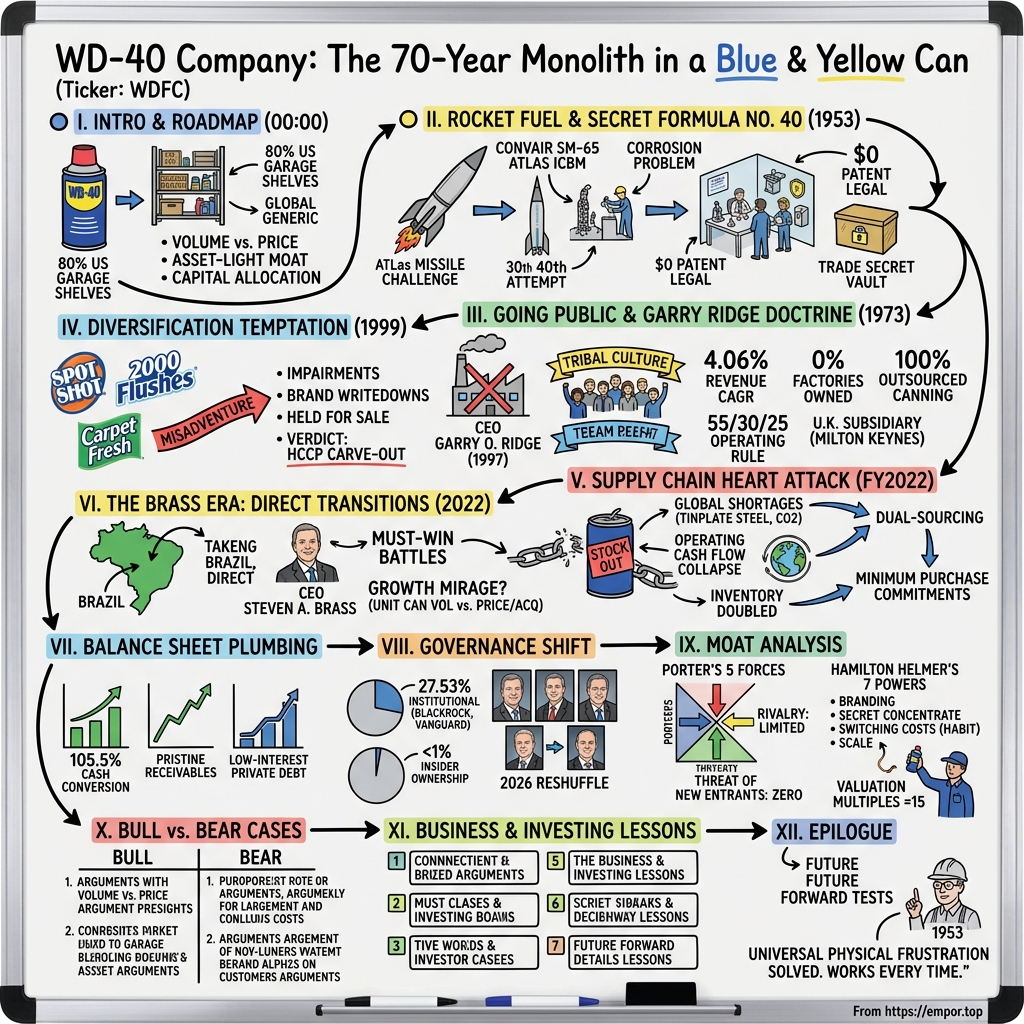
WD-40 Company: The 70-Year Monolith in a Blue and Yellow Can
I. Introduction & Episode Roadmap (00:00–00:15)
Open almost any garage door in America and look at the shelf above the workbench. Between the coffee can of loose screws and the half-used roll of duct tape, there is usually a blue-and-yellow aerosol with a red cap. Nobody remembers buying it. Nobody remembers when it showed up. It is just there, the way salt is in a kitchen.
That can is the entire company, or very nearly. WD-40 Company sold about $620 million worth of products in the fiscal year that ended August 31, 2025, and roughly 95% of that came from maintenance products built around one formula and its close cousins1. The flagship Multi-Use Product alone brought in about $478 million, more than three of every four dollars the company booked1. The company says its products are sold in more than 176 countries10.
Now hold that next to a few other facts. WD-40 does not own the plants that fill its cans. Third-party contract packagers on several continents do that work1. Capital spending in fiscal 2025 was about $4.5 million, less than 1% of revenue, and research and development cost about $8.7 million, around 1.4% of sales1. In early October 2026 the shares traded at roughly 30 times reported trailing earnings, a price usually reserved for consumer brands with pricing power, not for a solvent-and-propellant blend sold in hardware aisles12.
That is the puzzle this story tries to solve. How does a product invented in 1953, never patented, and made in someone else's factory earn a valuation that looks more like a premium household brand than an industrial supplier?
Three questions run through the episode.
The first is about growth. For most of its modern history WD-40 grew at a steady low-single-digit pace. Since Steven Brass became CEO in September 2022, reported revenue has grown faster, and the nine months to May 31, 2026 were up about 12% from a year earlier2. Is that a real change in how many cans the world uses, or mostly the arithmetic of price increases and of buying out distributors and booking their sales as its own?
The second is about the asset-light model. Owning no canning plants gives WD-40 enormous returns on capital in normal years. But in fiscal 2022, when global supply chains seized, the same model turned operating cash flow into almost nothing4. Is outsourcing a moat, or a hidden fault line?
The third is about stewardship. The directors and executive officers together own less than 1% of the company6. A new CFO joined in September 2026, the outgoing CFO moved to run the Americas, and the company is selling off the last of its household cleaning brands78. Will a team of salaried stewards keep the discipline that made the can so profitable, or reach for acquisitions to keep the growth story alive?
The road runs from a San Diego lab working on a missile problem, through Garry Ridge's twenty-five years as CEO, through a long and mostly unhappy detour into toilet-bowl cleaners and carpet sprays, into the supply-chain shock of 2022, and finally to the Brass era and the financial engine that sits under it all. It starts with the formula that never got a patent.
 Subscribe on LinkedIn
II. Rocket Fuel, Rags, and Secret Formula No. 40 (1953–1969) (00:15–00:35)
San Diego, 1953. A three-person outfit called Rocket Chemical Company was working in a small lab on a problem for the aerospace industry: how to keep moisture off metal surfaces so they would not corrode10. The company's own telling of the story is that the team got there on the fortieth attempt, and named the result exactly what it was: Water Displacement, 40th formula10.
The customer story behind it gives the product its first meaning. Convair, the aircraft maker building the Atlas missile, used the formula to protect the missile's outer skin from rust and corrosion10. A rocket that sits outside in coastal air waiting for a launch has the same enemy as a boat trailer or a garden gate: water getting where it does not belong.
The lunchbox leak
The legend that WD-40 tells about itself is the important part. Workers, the company says, found the product so useful that they started sneaking cans out of the plant to use at home10. Whether every detail of the folklore is literal, the business lesson is real: the product found its consumer market from the bottom up, through people who used it at work and wanted it in their garages. Nobody needed to be taught what it was for. They figured out squeaky hinges, stuck bolts and damp ignition wires on their own.
That origin matters for the economics seventy years later. A product that customers discover for themselves, and then find a thousand uses for, does not need an expensive explanation on the shelf. It needs to be present, recognizable and reliable.
The patent that was never filed
The most consequential decision in the company's history is something it never did. The formula was never patented. Instead, the company has kept it as a trade secret for decades10.
The logic is simple once laid out. A patent is a trade: the inventor publishes exactly how the invention works, and in return the government grants a temporary monopoly. When the clock runs out, anyone can copy it from the public record. A trade secret makes no such bargain. It lasts as long as the secret holds.
For WD-40 that bet has held in a very specific way. The secrecy never stopped competitors from making penetrating oils and water-displacing sprays; there are plenty on any store shelf. What it did was prevent anyone from selling "the same thing" with a credible claim. Competitors can sell something similar. They cannot sell WD-40.
That distinction is the first test of the investment case, and history passes it, though with a narrower meaning than the myth suggests. The secret formula is not what protects pricing; plenty of rivals sell sprays that perform well. What protects pricing is the combination of secrecy, a name that became the generic word for the category, and decades of users who trust that the can will behave the way it did last time. The formula is the anchor. The habit is the moat.
From trunk to retail
In 1958 the product went on sale to consumers in aerosol cans, and the company later took the name of its only real product, becoming WD-40 Company in 196910. Renaming a corporation after a single product is a statement of focus. It also turned out to be a statement of risk, because a company whose name is its product has nowhere to hide if the product stumbles.
For investors, the founding era leaves one durable point: WD-40's edge was never technology in the patentable sense. It was a product people adopted on their own and a name that became the category. The next question was whether that kind of edge could be scaled without spending heavily on factories, and the answer would come from a public listing and a CEO from Australia.
III. Going Public and the Garry Ridge Doctrine (1973–2010) (00:35–00:58)
WD-40 went public in 197310. It arrived on the market as a small San Diego company with one product, steady cash flow and no need for heavy factories. The decades that followed were spent learning what kind of company it actually was.
The Australian with a tribe
The man who answered that question most completely was Garry O. Ridge, an Australian who had run the company's business in his home region before rising to become CEO in 199710. Ridge held the job for twenty-five years, until Steven Brass took over on September 1, 20224.
Ridge became something of a management celebrity for his ideas about culture. He described WD-40's people as a "tribe," talked about "learning moments" rather than mistakes, and built a company that management repeatedly described as values-driven[^11]. To a skeptical investor this can sound like corporate wallpaper. The test is whether it changed behavior. On the evidence, the most important cultural idea was not a slogan at all. It was a discipline about what the company would not do.
The factory WD-40 never built
The company's annual report lays out the operating structure plainly. WD-40 makes concentrate, the secret part, at its own and third-party facilities, and then hands it to contract packagers who blend it with other ingredients, fill the cans and ship finished goods1. In fiscal 2025 those packagers were spread across the United States, Mexico, Brazil, Argentina, Colombia, the U.K., Italy, Poland, Australia, China, the Middle East, South Korea and India1.
Think of it like a restaurant that keeps its secret sauce recipe in-house but lets licensed kitchens around the world make the dishes. The brand owner controls the part that matters and leaves the expensive, hazardous and capital-hungry work to specialists. Aerosol filling lines, tinplate inventories and safety liabilities sit on someone else's balance sheet.
The payoff shows up in the numbers. Over the twelve years from fiscal 2014 through fiscal 2025, WD-40 spent about $118 million on capital expenditures in total, against roughly $740 million in cumulative net income143. That is a company that has to reinvest only a sliver of its profits to keep running. The rest is available for dividends, buybacks and, as the story will show, occasional mistakes.
Growing in the slow lane
The cost of this model is speed. From fiscal 2010 to fiscal 2022, the last year of Ridge's tenure, revenue grew from about $322 million to about $519 million, an annual growth rate of roughly 4%34. That is the base rate that matters for everything that follows: over a long stretch that included a global financial crisis aftermath, a commodity cycle and a pandemic, the company grew a little faster than inflation and population.
Ridge's management team expressed its financial goals through a simple framework that management called 55/30/25: a 55% gross margin, cost of doing business near 30% of sales, and an EBITDA margin around 25%[^11]. It works as a compass rather than a promise. Gross margin is what the company keeps after paying packagers and raw materials; cost of doing business is everything spent to sell and run the company; whatever is left is the cash engine. The framework tells investors what management considers a healthy year, which also makes it a yardstick to hold them to.
Going abroad through a U.K. door
The international expansion ran through a U.K. subsidiary, WD-40 Company Limited, which became the hub for Europe, India, the Middle East and Africa1. Rather than building plants abroad, the company typically started with third-party distributors and, where markets grew large enough, moved to running its own sales operations. By fiscal 2025, the EIMEA region employed about 40% of the company's 714 people, more than the Americas1.
That headcount figure is telling in a different way. A company selling in well over a hundred countries with a little over 700 employees is not a manufacturer. It is a brand and distribution business with a chemistry kitchen attached.
For investors, the Ridge doctrine left WD-40 with a clean idea of what it was: a marketer of a near-category-defining product that rents its factories. The open question was whether that playbook could work for anything other than the blue-and-yellow can. The company spent twenty years finding out, mostly in the cleaning aisle.
IV. The Diversification Temptation: The Homecare Misadventure (1999–2021) (00:58–01:18)
Picture a WD-40 sales representative at the turn of the millennium walking into a supermarket buyer's office. In the briefcase are not just maintenance sprays but carpet stain removers and toilet cleaners: Spot Shot, 2000 Flushes, Carpet Fresh, 10011. The pitch is logical on paper. WD-40 already knew how to outsource production, manage brands and work with retailers. Why not run that playbook in more aisles?
The case for buying
The pressure behind the acquisitions was easy to understand. A company whose name is a single product invites a permanent question from investors: what happens if that one product stops growing? Buying mature cleaning brands offered a quick answer. They came with existing revenue, existing retailer relationships and supply chains that could be handed to contract manufacturers in the same way as the core can.
The company grouped these into a category it calls homecare and cleaning products, or HCCP1.
Why the aisle fought back
The trouble was that the grocery cleaning aisle is a completely different battlefield from the hardware aisle. In hardware and industrial channels, WD-40 is the category name; a buyer who does not stock it gets complaints. In the cleaning aisle, WD-40 had no such pull. Its brands competed for shelf space against the largest consumer goods companies in the world, which set the terms on promotions, coupons and slotting fees.
The habit that protects WD-40's pricing in the garage simply does not exist for a toilet-bowl tablet. Nobody walks into a supermarket insisting on a particular carpet freshener the way a mechanic insists on a particular penetrating spray.
The verdict in the numbers
By fiscal 2025, the entire homecare and cleaning portfolio produced about $29 million in sales, roughly 4.7% of the company's revenue1. After two decades of ownership, the brands that were supposed to diversify the company had shrunk to a rounding error. Management moved to sell them, and the company has been classifying the remaining brands as held for sale and exiting them in stages12.
This is the most important piece of disconfirming evidence for anyone who believes WD-40's management can create value by buying brands. The company tried exactly that, over a long period, with the same operating model that works so well for the core product, and it did not work. The core brand's power turned out to be specific to its channel and its use case.
That history narrows any claim about capital allocation discipline. The modern team deserves credit for recognizing the mistake and exiting. But the record shows that WD-40's management, under a celebrated CEO, did once spend capital on adjacent brands that faded. Any future acquisition outside the core maintenance category should be judged against that record, not against the company's reputation.
The lesson of the cleaning aisle was that the brand did not travel. The lesson of the next chapter was nastier: even the core business, in a bad enough year, could not escape the physics of a broken supply chain.
V. The Supply Chain Heart Attack: When Working Capital Broke (FY2022–FY2023) (01:18–01:38)
The asset-light model has a quiet assumption buried in it: somebody else will always be able to get the cans, the steel, the solvents and the propellant. In 2021 and 2022, that assumption broke.
Across the world, packagers ran into shortages and price spikes in the materials an aerosol needs. The brand owner who does not own the filling lines discovers it still owns the problem. If cans do not reach retail shelves, the empty hook is WD-40's, not the packager's.
The cash that disappeared
The fiscal 2022 numbers tell the story with brutal clarity. WD-40 reported net income of about $67 million that year, but cash flow from operations fell to about $2.6 million4. Nearly every dollar of profit was swallowed by working capital. The main culprit was inventory, which climbed from about $56 million to about $104 million in a single year as the company bought and stored materials and finished goods to keep products flowing4.
Put simply, WD-40 turned profit into cans sitting in warehouses rather than cash in the bank. For a company that ordinarily converts its earnings into cash at better than one-for-one, this was the equivalent of a heart attack: the system kept running, but blood stopped reaching the extremities.
At the same time, input-cost inflation squeezed the gross margin well below the 55% target, as the company paid more for petroleum-based ingredients and cans before it could pass those costs on through pricing4[^11].
Myth vs reality: "asset-light means risk-light"
The myth is that renting factories means renting away risk. The reality from 2022 is that outsourcing shifts the form of the risk rather than removing it. WD-40 did not have to repair a plant or write off equipment. Instead, it absorbed the shock through its balance sheet, by financing a much larger pile of inventory and accepting thinner margins until price increases caught up. The company's own risk disclosures acknowledge that it depends on contract packagers and suppliers, and that disruption to them can hurt its ability to deliver products1.
The whip-saw back
Fiscal 2023 showed the other side. As supply chains loosened and inventory was worked down, operating cash flow rebounded to about $98 million, roughly 1.5 times net income4. The working capital that had been trapped in 2022 was released. Over the twelve years through fiscal 2025, cumulative cash from operations ended up slightly above cumulative net income143, which means the 2022 collapse was a timing problem, not a permanent loss.
The demand side passed its own test. During and after the disruption, WD-40 raised prices, and customers kept buying. That is direct evidence of pricing power in the core product: a company without it would have lost volume or margin permanently when it passed through cost increases.
What changed afterwards
WD-40 does not run its supply chain on long-term take-or-pay contracts. At the end of fiscal 2025, its contractual minimum purchase commitments with packagers totaled only about $17 million, with ordering done on forecasts of two to six months1. That light commitment cuts both ways: it keeps the company flexible and avoids paying for idle capacity, but it also means WD-40 is not guaranteed priority when capacity becomes scarce.
The verdict on the outsourcing model is that it survives the test in a narrower form. It is a superb model for returns on capital in normal years, and it held up through the worst supply shock in decades without permanent damage. But it is not a fortress. The next spike in tinplate, solvent or propellant prices will show up first in gross margin and inventory, and investors should expect the cash flow to wobble again when it happens. The measure to watch is gross margin resilience during the next input-cost surge.
The recovery also came with a changing of the guard. The CEO who walked the company out of the supply shock was not Garry Ridge, but his longtime lieutenant.
VI. The Brass Era: Direct Transitions and the Growth Mirage (2022–2026) (01:38–02:00)
On September 1, 2022, Steven A. Brass became president and CEO of WD-40 Company4. He was not an outsider brought in to shake things up. He had spent years inside the business, including as president and chief operating officer, and was widely seen as Ridge's chosen successor6. That made the transition smooth, and it also meant the new CEO's ideas grew from the same roots as the old one's.
The strategy, in management's words
Brass organized his strategy around what management calls "Must-Win Battles": pushing the core product into more geographies, growing the premium WD-40 Specialist line, expanding premium delivery systems such as Smart Straw and EZ-Reach, and moving more markets from third-party distributors to the company's own sales operations[^11]1. Each of these is plausible. The question is what the numbers show so far.
Growth, and where it came from
The headline is that growth sped up. From fiscal 2022 to fiscal 2025, revenue grew from about $519 million to about $620 million, roughly 6% a year, against the 4% pace of the Ridge years41. Then in the first nine months of fiscal 2026, net sales rose about 12% to roughly $511 million, and operating income grew even faster, by close to 19%, to about $90 million2.
Those numbers are real. The harder question is what is driving them, and three forces are tangled together.
The first is price. The company pushed through several rounds of price increases from 2022 onward to recover cost inflation45. Price increases lift revenue without requiring a single extra can to be sold.
The second is distribution insourcing. When WD-40 replaces a third-party distributor with its own operation, as it did in Brazil by acquiring its distributor there in 2024[^12]5, the accounting changes. Before, WD-40 booked revenue at the lower price it charged the distributor. After, it books revenue at the higher price it charges retailers. The same can sold to the same store now shows up as more revenue. That is not fake growth, because WD-40 also captures the distributor's margin, but it is not new demand either.
The third is currency. With most of its sales outside the United States, a weaker dollar flatters reported growth and a stronger dollar hides it1.
Underneath those three is the number that matters most: how many more cans people are actually buying. WD-40 discusses volume and price qualitatively in its filings, but it does not publish a clean global unit-volume figure stripped of price, currency and distribution changes. Until it does, the honest verdict is that the acceleration is partly genuine and partly mechanical, and the split is not disclosed.
That calls for a calibrated conclusion rather than a cheer or a dismissal. The historical record supports a company that grows around 4% to 5% a year organically. The current 12% pace is far above that base rate, and the company's own explanation leans on pricing and geographic transitions that, by their nature, do not repeat forever. The claim that WD-40 has entered a new era of structurally faster volume growth is unproven. The claim that it is executing well on pricing and on capturing distributor margins is supported.
The cost of going direct
Running more of its own sales operations has a cost, and it shows up in headcount. Employees rose from 522 in fiscal 2020 to 714 in fiscal 2025, an increase of more than a third31. Direct operations bring more control and more margin per can, but also more salaries, offices and management complexity in markets like Latin America where currencies and economies can turn quickly.
Specialist: the brand extension that seems to work
One part of the strategy does show a genuine proof point. WD-40 Specialist, a line of more technical products such as degreasers, contact cleaners and silicone sprays, reached about $82 million of sales in fiscal 2025, about 13% of the total1. Unlike the cleaning brands, Specialist sells to the same customers in the same aisles under the same name. That is the critical difference: it extends the brand along the path where the brand has power, rather than into an aisle where it has none.
Pay and the scoreboard
Brass's total compensation for fiscal 2025 was about $4.3 million, most of it in stock awards, up from about $2.5 million in fiscal 20236. The bonus portion was modest, about $220,000, which suggests the annual incentive plan did not pay out generously for fiscal 2025's results6. For a company with this profile, pay at this level is unremarkable. Shareholders seem to agree: the say-on-pay vote at the December 2025 annual meeting passed with about 98% approval9.
So the Brass era has delivered faster reported growth, better margins than the trough and a credible brand extension. What it has not yet delivered is proof that more people, in more places, are using more cans. To judge how much of that matters, it helps to look under the floorboards at the financial plumbing.
VII. The Plumbing: Balance Sheet, Cash Conversion, and Hidden Assets (02:00–02:20)
Every investor who has been burned by a beautiful income statement learns to ask the same question: does the cash show up? At WD-40, it mostly does.
Profit into cash
Over the twelve fiscal years from 2014 to 2025, the company reported about $740 million in cumulative net income and generated about $781 million in cash from operations, a conversion rate of roughly 105%143. After subtracting capital spending, free cash flow came to about $662 million, close to nine-tenths of net income143. Over a long stretch, almost all of what WD-40 calls profit has been real money.
The one recent wrinkle is seasonal. In the first nine months of fiscal 2026, operating cash flow was about $55 million against net income of about $68 million, largely because receivables grew by about $29 million as sales rose2. That is what a growing business that sells on credit looks like mid-year, not a sign of distress, but it is worth watching whether full-year conversion returns to normal.
Who owes WD-40 money
Trade receivables stood at about $121 million at the end of fiscal 2025, against an allowance for credit losses of only about $1.2 million1. Revenue is recognized when goods ship or are delivered, so there are no unbilled receivables or long-dated contract assets to second-guess1. The auditor, PricewaterhouseCoopers, issued a clean opinion; its critical audit matter centered on revenue recognition for product sales across many locations, which is standard for a company with this structure1. In plain terms, WD-40 sells to large, creditworthy retailers and distributors and gets paid.
The tax gift that should not be capitalized
Fiscal 2025 reported net income was about $91 million, or $6.69 per diluted share1. But about $11.9 million of that came from a one-time tax benefit: a reserve the company had held against its foreign "transition tax" under the 2017 U.S. tax reform was released when the statute of limitations expired1. No cash came in; a liability simply went away.
Strip that out and normalized earnings were closer to $79 million, or around $5.85 a share. That is the number to use in any valuation conversation, because the tax release will not recur. The difference matters: it raises the effective earnings multiple at today's share price by several turns.
The debt nobody worries about
WD-40 carries some debt, but almost as a convenience. At the end of fiscal 2025, funded debt was about $87 million1. Most of it was fixed-rate private notes placed with Prudential's investment arm, PGIM, at rates between 2.50% and 3.39%, with maturities stretching from 2027 to 2032, and about $21 million drawn in euros under a $125 million Bank of America revolving facility running to April 20291. Against about $58 million of cash, net debt was under $30 million1.
Those notes were locked in when interest rates were low, which in today's environment is a small but real gift. Covenants cap leverage at 3.5 times EBITDA and require interest coverage of at least 3 times1. WD-40 sits at well under 1 time leverage and covers its interest many times over. The company has no public credit rating, and it does not need one; this is a balance sheet that could carry much more debt but has chosen not to.
Currency: the unhedged exposure
With most revenue earned outside the United States, in currencies including sterling, the euro, the Australian dollar, the Brazilian real and the Chinese yuan, WD-40 is a quiet currency bet1. The company uses short-term forward contracts at its U.K. subsidiary to cover specific transaction exposures, but it does not hedge the translation of overseas profits into dollars1. A strong dollar trims reported earnings; a weak one inflates them. Investors comparing growth rates across years should mentally adjust for this.
Governance plumbing
The company reported no related-party transactions requiring disclosure, and it bans executives and directors from hedging or pledging their shares6. There are no legal proceedings the company considers likely to cause material losses1. This is about as clean as plumbing gets.
The conclusion is unambiguous. WD-40's earnings are high quality, its cash conversion is excellent over time, and its balance sheet is conservative. The real risks lie not in the accounts but in the people deciding what to do with all that cash.
VIII. Governance Shift: Insider Ownership and the 2026 Executive Reshuffle (02:20–02:35)
In June 2026, WD-40 filed a short notice with the SEC that reshaped its leadership8. Sara Hyzer, the CFO who had managed the company's finances through the Brass era, would move into an operating role as Division President for the Americas. A new principal accounting officer, Nicholas Giordano, was appointed, effective June 29, 20268. Then in early September came the second shoe: Keith Stauffer, a finance executive from outside the company, joined as vice president of global finance on September 7, 2026, and is set to become CFO on November 2, 2026, the same day Hyzer takes over the Americas7.
Reading the reshuffle
There are two ways to read this, and the evidence does not yet settle between them.
The generous reading is that this is succession planning. Moving a CFO into running the company's largest region gives her operating experience and broadens the bench of potential future leaders. Bringing in an outside CFO with consumer-goods experience adds fresh eyes.
The skeptical reading is that every leadership change at a single-product company carries execution risk, and that new finance leaders sometimes arrive with new ideas about "unlocking value," which can mean bolder acquisitions. Stauffer's package included a base salary of $525,000, a cash sign-on bonus of $543,000 to cover obligations to his former employer, and about $1.7 million in initial equity awards7. Paying to recruit a strong outsider is normal. What matters is what he does with the checkbook.
Skin in the game
That question becomes sharper when you look at ownership. As of the 2025 proxy, all directors and executive officers together owned fewer than 106,000 shares, well under 1% of the company6. Brass himself held about 38,000 shares, around 0.3%6. At today's share price, that stake is worth several million dollars, meaningful personally but small relative to the company.
Meanwhile, the two largest shareholders were index-fund giants. BlackRock held about 15.5% and Vanguard about 12%, together more than a quarter of the company6. These are passive owners who vote, but they do not run activist campaigns over strategy.
That combination, low insider ownership and passive large shareholders, is not unusual for a mature U.S. company. But it matters here because the company generates far more cash than it needs. The decisions about what to do with that cash are made by professional managers who are paid well but own very little.
What the record says about capital allocation
The record is mixed in a useful way. The cleaning-brand acquisitions were a failure that took two decades to unwind. Since then, recent deployments have been small and close to the core, like buying out distributors. Under a $50 million buyback program approved in June 2023, the company repurchased shares worth about $12 million in fiscal 2025 and about $23 million in the first nine months of fiscal 202612. Dividends absorbed about $46 million in fiscal 2025, and the quarterly payout rose to $0.88 a share12. The diluted share count drifted down only slowly, from about 13.6 million to 13.5 million over three years12, which means the buybacks have mostly offset stock compensation rather than meaningfully shrinking the share count.
There is no sign of a reckless pivot. But there is also no structural safeguard against one. The board is overwhelmingly independent, and shareholders backed the incumbents overwhelmingly at the December 2025 meeting96. That is evidence of satisfaction, not of how the board would respond to a large, tempting acquisition.
The tension heading into fiscal 2027 is plain: a company with a cash machine, a new CFO, and owners who largely do not interfere. To understand how much room for error that cash machine provides, the next step is to examine the moat directly.
IX. Analysis: Moat Durability, Porter's 5 Forces, and Hamilton Helmer's 7 Powers (02:35–02:55)
A maintenance technician walks down the aisle of an industrial supply store. On the shelf: a store-brand penetrating oil for noticeably less, a technical competitor's spray, and the blue-and-yellow can. The job is to free a seized fitting on a machine that costs more than the technician's car. The technician grabs the WD-40.
That choice, repeated millions of times, is the moat. The question is what exactly drives it, and how durable each piece is.
Hamilton Helmer's 7 Powers
Branding. This is the main source of WD-40's power. The name functions as the category itself in much of the world. Buyers ask for "WD-40" when they mean "something to free this up." That habit lets the company charge more than private labels and raise prices during inflation without losing its customers, which the 2022 to 2024 price increases tested and confirmed45. The limit is just as clear: the brand's power stops at the edge of the maintenance category, as the cleaning-aisle experience proved.
Cornered resource. The secret formula is often cited as a cornered resource. In practice it is less important than the folklore suggests. Competitors can make products that work well. What they cannot make is a product with seventy years of trust behind it. The formula protects the brand's authenticity more than its function.
Switching costs. Formally, they are near zero; anyone can buy another can. But the economics of risk create a behavioral switching cost. A can costs a few dollars; the equipment it protects can cost thousands. Saving a dollar on an unknown product is a poor trade when failure means a stripped bolt or a ruined part.
Scale economies. WD-40 has meaningful scale in distribution and advertising relative to most competitors in its niche. Its presence in well over 100 countries means that a global retailer or industrial distributor finds it easy to carry WD-40 everywhere. That makes it a default listing for retailers, though it is scale in distribution rather than in manufacturing, since production is outsourced.
The other powers, network effects, counter-positioning and process power, do not meaningfully apply.
Porter's Five Forces
Buyers. Big-box retailers have real bargaining power over shelf space and promotions, but no single customer accounted for 10% of sales in recent years1. That spread makes WD-40 less exposed to any one retailer than many consumer brands. Retailers need the product because customers expect to find it.
Suppliers. Contract packagers and raw material suppliers have bargaining power, especially in shortages, as 2022 showed. WD-40 mitigates this by spreading production across packagers in many countries1, but it remains a price taker on petroleum-based ingredients and tinplate.
Substitutes. For moisture displacement and light lubrication, substitutes exist only in the form of other chemical products. Technology does not make rust disappear. That makes the business largely immune to software disruption, though environmental regulations on solvents and aerosols remain a slow-moving factor the company must manage.
New entrants. Making a spray lubricant is easy; becoming the category name is nearly impossible. Private labels and competitors have existed for decades without displacing the core product.
Rivalry. Competitors such as CRC Industries and Blaster occupy specialized niches and sell into the same channels. Their presence caps how far WD-40 can push prices, but there is no sign that they are displacing the multi-use can.
What the market is paying for
At roughly $203 a share in early October 2026, WD-40 was valued at about $2.7 billion in equity value12. That works out to about 30 times reported fiscal 2025 earnings, or roughly 35 times normalized earnings after removing the one-time tax benefit1. Over the past five years, the stock has often traded at even higher multiples.
Against peers, that is a premium. Diversified industrial and coatings companies tend to trade at lower earnings multiples, while premium household-brand companies trade at multiples closer to WD-40's. The market is valuing WD-40 as a consumer brand with defensive characteristics, not as an industrial chemical supplier.
What does that price assume? At around 35 times normalized earnings, investors are effectively betting that WD-40 can sustain growth comfortably above its long-term 4% to 5% base rate, keep margins near current levels and avoid major mistakes. The moat supports durability. It does not, by itself, support acceleration.
The verdict on the moat is that it is real, narrow and deep. The brand protects pricing and position within its category with remarkable consistency. It does not extend beyond that category, and it does not protect against input-cost shocks. Those boundaries frame the bull and bear arguments.
X. Bull vs. Bear Case & What to Watch (02:55–03:10)
Every quarter, analysts on the earnings call try to answer the same question in different words: how much of the growth will last? The bull and bear cases are, in the end, two answers to that question.
The bull case
Geographic runway. Usage per person in many emerging markets remains far below North American levels. Every market converted from a third-party distributor to a direct operation captures distributor margins and gives WD-40 more control over pricing and promotion. If the company can replicate its direct model in more markets, it can grow faster than its historical base rate for years.
Premium delivery systems. Smart Straw and EZ-Reach cans command higher prices than the basic aerosol. Moving customers toward these formats raises revenue per can without requiring more customers.
Specialist expansion. WD-40 Specialist has reached about 13% of sales1 and extends the brand along a path where it has demonstrated power. If it continues to grow faster than the core product, it diversifies revenue without the channel mismatch that doomed the cleaning brands.
Defensive demand. In downturns, households and businesses tend to maintain equipment rather than replace it. That makes the core product less cyclical than many industrial or consumer goods.
The bear case
Multiple compression. The stock's valuation already assumes faster growth than the company's long history supports. If growth slows back toward 4% to 5% as price increases are lapped and distributor transitions are completed, the multiple could compress toward that of slower-growth peers. In that scenario, even solid operating results could produce disappointing shareholder returns.
Input-cost shocks. WD-40 is exposed to petroleum-based ingredients, propellants and tinplate. A sharp spike could compress margins and once again absorb cash into inventory, as in fiscal 2022.
Retailer pressure and private labels. Consolidated retailers can push for promotional spending or give more shelf space to store brands. WD-40's brand protects it, but not completely.
Capital allocation drift. With low insider ownership, a new CFO and the cleaning brands nearly gone, management may be tempted to pursue larger acquisitions to keep growth high. The company's own history with cleaning brands shows the risk.
The calibrated verdict
The business is an exceptionally durable cash machine with a narrow but deep moat. The current valuation, however, leaves little margin for error. The history neither confirms nor rejects the idea that WD-40 has entered a structurally faster growth phase; it leaves that claim unproven. The burden of proof sits with the volume numbers.
The three numbers that matter
1. Underlying volume growth. Strip out price, currency and distributor transitions, and how many more cans is the world buying? The latest reported figure, 12% revenue growth in the nine months to May 20262, blends all of these together. The company does not publish a clean unit-volume number, which is itself a gap investors should press on.
2. Gross margin against the 55% target. This is the purest measure of pricing power against input costs. Margins have recovered from the 2022 trough, and the direction has been upward toward the 55% benchmark1[^11]. Any reversal would be an early warning sign.
3. WD-40 Specialist growth. At about $82 million in fiscal 2025 sales1, Specialist is the clearest test of whether the brand can expand beyond the core can without repeating the cleaning-brand mistake.
These three numbers will tell investors whether WD-40 is becoming a faster-growing company or simply a very good slow-growing one with a temporarily generous scorecard.
XI. Playbook: Business & Investing Lessons (03:10–03:25)
1. "Keep the secret, skip the patent."
In 1953, a tiny San Diego company made a decision by omission: it did not patent its formula. A patent would have published the recipe and expired. The secret, instead, became part of the brand's identity, and the brand became the category. The lesson for founders is that durable advantage often comes not from legal protection but from becoming the thing customers ask for by name. The lesson for investors is subtler: the formula is a story, but the habit is the moat. Price the habit.
2. "Rent the factory, own the shelf."
WD-40 built a global business without owning the plants that fill its cans. It turned almost all of its earnings into cash over a dozen years and spent a sliver on capital equipment. The lesson is that in many consumer businesses, the profit lives in the brand and distribution, not in the machinery. But the corollary matters as much: when you rent the factory, you still own the shortage.
3. "A brand is a passport, not a visa to every country."
Twenty years of carpet sprays and toilet cleaners proved that a brand powerful in the hardware aisle can be powerless in the grocery aisle. The lesson for any company with a dominant product is to extend along the path of existing customer trust, as Specialist does, rather than into adjacent aisles where the brand means nothing.
4. "Asset-light is not shock-proof."
In fiscal 2022, WD-40 earned profits and generated almost no cash. Its partners could not get materials, and the brand owner absorbed the hit through inventory and margins. The lesson for investors is to stress-test asset-light businesses not in normal years but in the year when the supply chain breaks.
XII. Epilogue (03:25–03:35)
Tonight WD-40 Company stands at an unusual point. Its core product is as dominant as ever. Its finances are pristine. Its growth is running well above its historical pace. And its leadership is in transition.
On November 2, 2026, Keith Stauffer will formally become CFO and Sara Hyzer will take over the Americas7. Shortly after, the company will publish its fiscal 2026 annual report, covering the year that ended August 31. That report will be the first major test of the Brass-era growth story. If underlying volume continues to grow once price increases and distributor transitions are accounted for, the case for a structurally faster WD-40 strengthens. If growth slows sharply as those effects fade, the market will have to reconsider what it is paying for.
The next test is capital allocation. The $50 million buyback program was set to run through August 31, 20261. Whether the board renews or expands it, and whether the new CFO's first budget leans toward buybacks, dividends, small tuck-ins or something bigger, will reveal how the new team thinks about the cash machine it controls.
The last test is closure. As the remaining cleaning brands are sold, WD-40 becomes what it arguably always should have been: a pure maintenance company. That simplifies the story. It also removes the last distraction, leaving the company's growth entirely dependent on the blue-and-yellow can and its close relatives.
The tension that remains is the same one that has always defined WD-40: an extraordinary business at a price that assumes it will become a little more extraordinary still.
XIII. Outro (03:35–03:40)
Go back to 1953. A small team in San Diego, a missile that needed protection from rust, and a fortieth attempt that finally worked. The missile program moved on. The company that built it is long gone. But the formula from that lab is still sold around the world, in the same blue-and-yellow can, under the same name.
WD-40 is a reminder that some of the most durable businesses are built not on complexity but on simplicity: a product that solves a universal annoyance, works the same way every time and becomes so familiar that its name replaces the category. The secret was never really the formula. The secret was becoming the thing people reach for without thinking.
References
-
WD-40 Company Form 10-K for Fiscal Year Ended August 31, 2025 — U.S. Securities and Exchange Commission, 2025-10-27 ↩↩↩↩↩↩↩↩↩↩↩↩↩↩↩↩↩↩↩↩↩↩↩↩↩↩↩↩↩↩↩↩↩↩↩↩↩↩↩↩↩↩↩↩↩↩↩
-
WD-40 Company Form 10-Q for the Period Ended May 31, 2026 — U.S. Securities and Exchange Commission, 2026-07-09 ↩↩↩↩↩↩↩↩↩↩
-
WD-40 Company Form 10-K for Fiscal Year Ended August 31, 2020 — U.S. Securities and Exchange Commission, 2020-10-21 ↩↩↩↩↩↩
-
WD-40 Company Form 10-K for Fiscal Year Ended August 31, 2023 — U.S. Securities and Exchange Commission, 2023-10-23 ↩↩↩↩↩↩↩↩↩↩↩↩↩↩↩
-
WD-40 Company Form 10-K for Fiscal Year Ended August 31, 2024 — U.S. Securities and Exchange Commission, 2024-10-21 ↩↩↩
-
WD-40 Company DEF 14A Definitive Proxy Statement — U.S. Securities and Exchange Commission, 2025-10-31 ↩↩↩↩↩↩↩↩↩
-
WD-40 Company Current Report on Form 8-K (Executive Leadership Appointments) — U.S. Securities and Exchange Commission, 2026-09-03 ↩↩↩↩
-
WD-40 Company Current Report on Form 8-K (Executive Leadership Transitions) — U.S. Securities and Exchange Commission, 2026-06-04 ↩↩↩
-
WD-40 Company Current Report on Form 8-K (Annual Meeting Voting Results) — U.S. Securities and Exchange Commission, 2025-12-16 ↩↩
-
WD-40 Company Investor Relations Portal — WD-40 Company, 2026-10-03 ↩↩↩↩↩↩↩↩↩
 LinkedIn
 WhatsApp
 Reddit
 Hacker News
 Email
Email Kindle
 RSS Feed
 Spotify
 Apple Podcasts
 Amazon Music
 Audible
 YouTube