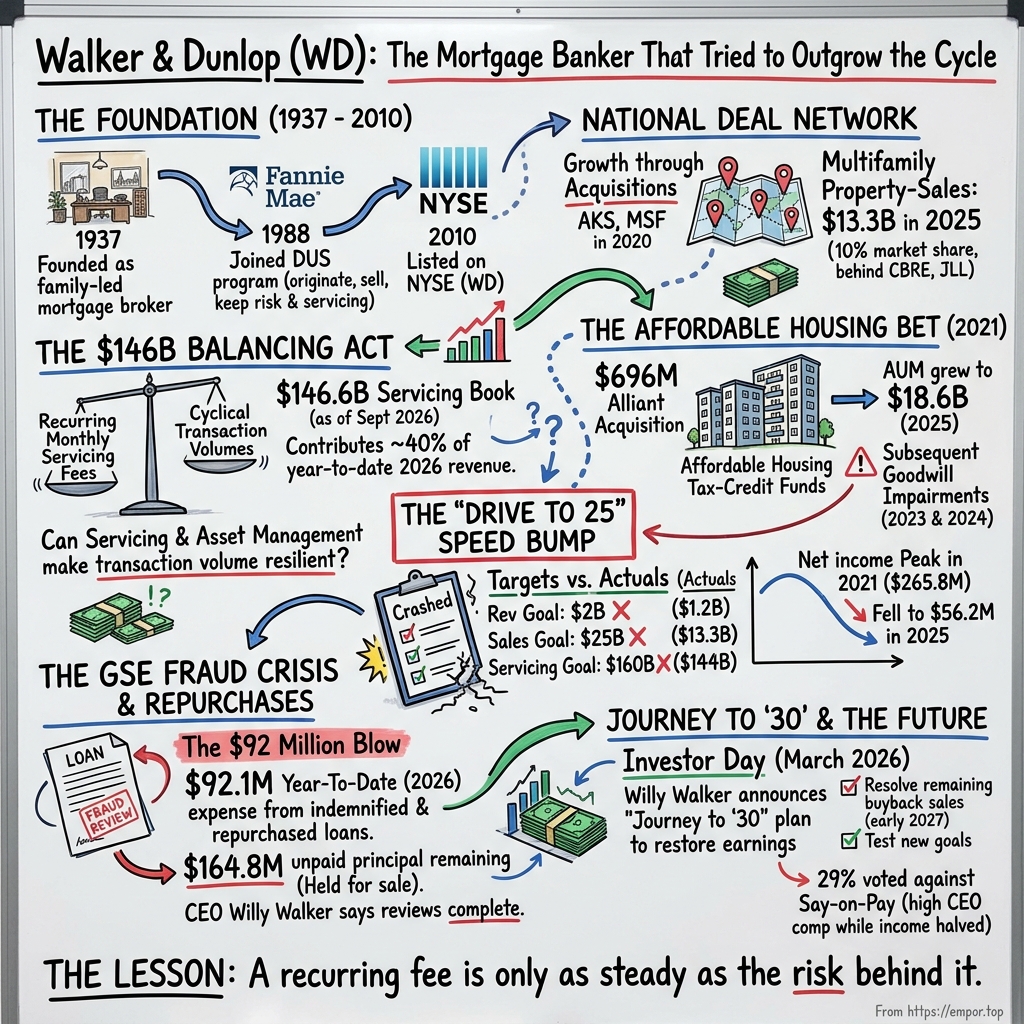
Walker & Dunlop: The Mortgage Banker That Tried to Outgrow the Cycle
The $92 Million Cost of a Loan Nobody Expected to Buy Back
On the morning of November 5, 2026, Willy Walker had a sentence he had waited more than a year to say. Fannie Mae, he told investors, had "completed their fraud review of Walker & Dunlop," just as Freddie Mac had done a quarter earlier, and the company did "not expect any further buybacks or indemnifications related to these investigations going forward."1 For a lender whose whole business rests on the trust of two government-sponsored housing giants, this was the line that mattered most. Management said the investigations were over.
The numbers that came with that sentence told a harder story. Walker & Dunlop had swung to a third-quarter net loss of $37.3 million, or $1.15 a share, on revenue that fell 12% from a year earlier.1 To end the episode quickly, the company had taken the loans it had been forced to buy back from the agencies, together with a handful of non-performing notes, reclassified them as "held for sale," and marked them down to what a buyer in a distressed market might pay. It planned to be rid of them "by early 2027."1 Across the first nine months of 2026, the net cost of loans it had indemnified or repurchased reached $92.1 million.2 Over the same nine months, the whole company earned $17.7 million, against $93.6 million in the same stretch of 2025.2
Hold those two figures side by side. A single cluster of bad loans, most of them traced to fraudulent borrowers and one banking team that is no longer at the firm, cost roughly five times what the entire enterprise managed to keep as profit in three quarters. That is the strange arithmetic at the heart of Walker & Dunlop, and it is why this story is worth telling in full.
Walker & Dunlop is not a bank, and it does not want to be judged like one. It is a commercial real estate finance and services company that originates apartment and commercial mortgages, mostly under the programs of Fannie Mae, Freddie Mac and the Department of Housing and Urban Development, sells those loans on, and then keeps the right to service them for years.3 Around that core it has built a brokerage arm that sells apartment buildings, an appraisal business, a research boutique, an investment-banking practice and a large manager of affordable-housing tax-credit funds.3 For more than a decade, the pitch to shareholders has been that this mix turns a cyclical deal-making business into something steadier, a platform with a growing river of recurring fees running underneath the lumpy transaction income.
The opening scene of November 2026 puts that pitch on trial, and it raises three questions this story will follow to the end. The first is the simplest to ask and the hardest to answer: has Walker & Dunlop become a steadier finance-and-services platform, or does the transaction cycle still set its earnings? Servicing fees kept arriving through the first nine months of 2026, yet profits still collapsed, so the ballast exists but plainly has limits.
The second question is about the loans themselves. Did the agency investigations close a legacy episode, as management says, or did they expose a weakness in how the company originated and monitored loans that could show up again in another form? The company's own leaders have offered both answers at different moments, which makes the record of what they said, and when, part of the evidence.
The third question runs through the company's ambitions. Over the past six years Walker & Dunlop bought teams and businesses, launched a five-year plan with eye-catching targets, and spent heavily to broaden what it sells. Did that growth create durable earnings, or did it leave the company with an expensive set of promises to keep, to the agencies, to affordable-housing partners and to shareholders who were told the platform would be far larger and far more profitable by now?
To answer any of them, it helps to go back to where the company's position actually comes from: a small Washington mortgage brokerage that found its way inside the machinery of American apartment finance.
 Subscribe on LinkedIn
A 1937 Broker Finds Its Way Into the Agency System
Walker & Dunlop's own account of its origins is brief: the company "was founded in 1937 and has been under three generations of Walker family leadership."4 In the depths of the Depression, a mortgage broker in Washington, D.C., was a modest thing, a matchmaker between property owners who needed money and the insurance companies and banks that had it. For half a century, that is more or less what the firm remained.
The turn came in 1988. That year, Walker & Dunlop "became one of the first Fannie Mae DUS lenders."4 DUS stands for Delegated Underwriting and Servicing, and it is worth slowing down on, because almost everything that follows in this story, the good and the painful, flows from it.
Think of Fannie Mae as a very large wholesaler of mortgage money. It does not want to send its own staff to inspect every apartment complex in Phoenix or Charlotte, so it licenses a small group of private lenders to do that work on its behalf. Those lenders find the borrower, underwrite the loan to Fannie's standards, close it, and then deliver it to Fannie, which packages it into securities sold to investors around the world. The lender gets paid an origination fee up front and, crucially, keeps the job of servicing the loan for its life, collecting a slice of the interest every month. The "delegated" part is the privilege: the lender can commit Fannie's money without Fannie re-underwriting each loan. The price of that privilege is that the lender shares in the losses if a loan goes bad, typically absorbing a meaningful portion of any credit loss.3 Fannie, in other words, does not just trust its DUS lenders. It makes them keep some skin in the game.
That bargain made Walker & Dunlop something more than a broker. It became a licensed participant in one of the most important financing channels in the American economy, because Fannie Mae and Freddie Mac together finance a large share of the country's apartment buildings. Freddie Mac runs a similar program, branded Optigo, and HUD insures loans through its own approved lenders. Walker & Dunlop sits inside all three.3
The person who would turn that position into a national company arrived from a long way outside real estate. William M. Walker, universally known as Willy, studied government at St. Lawrence University and earned an MBA at Harvard.4 His early career reads like an adventure résumé. From August 1995 to October 1996 he was general manager of ALTA, a regional airline in Argentina. He then worked as a consultant at Newbridge Latin America on private-equity deals in aviation, water and apparel, before spending 1998 to 2003 at TeleTech, a business-process outsourcing company, where he rose to run its European and Latin American divisions.4 He had joined the board of the family firm in February 2000, became its chief operating officer in September 2003, its president in January 2005 and its chief executive in January 2007.4 His father, Mallory Walker, had chaired the company before him.4
That background shaped the way Walker would run the firm. He came to the family business as an operator who had managed airlines and call centers across continents, not as a career mortgage banker, and he would bring a taste for big public goals, heavy marketing and acquisitions that most of his staid competitors lacked.
He also took over at the worst possible moment. Months after he became chief executive, the global financial crisis began to tear through commercial real estate. Most lenders retreated. Walker & Dunlop went shopping. In January 2009, it acquired the Column business, an affiliate of Credit Suisse, bringing a $5.0 billion servicing portfolio and Column's Fannie Mae, Freddie Mac and HUD operations.4 It was a counter-cyclical bet that only works when the agencies keep lending through a panic, and they did, because government-backed apartment finance was one of the few channels still open in 2009.
By late 2010 the company was ready to go public. Its prospectus proposed selling 10 million shares in a range of $14 to $16 each, two-thirds of them new shares from the company and one-third from Mallory Walker and Taylor Walker.4 The stock began trading on the New York Stock Exchange on December 15, 2010, under the ticker WD.3 At the end of that first month, the entire company was worth about $221 million.5
The timing was awkward in a different way. Fannie Mae and Freddie Mac had been placed into federal conservatorship in 2008, and Washington spent the following years arguing about whether to shrink, reform or replace them. An investor buying Walker & Dunlop in 2010 was buying a company whose most important customers were wards of the state, with futures set by Congress and their regulator rather than by any market. That dependence has never gone away.
Here, then, is the enduring asset. It is not a brand that consumers recognize or a patent. It is a position inside the plumbing: agency licenses, decades of underwriting experience, a servicing book that throws off fees, and relationships with the owners of thousands of apartment buildings. That position matters enormously, but it does not, by itself, prove pricing power. The agencies set the program rules, and other licensed lenders hold the same keys. It is also worth marking the boundary of the story. Walker & Dunlop is a Maryland holding company whose business runs mainly through Walker & Dunlop, LLC and its subsidiaries, and no parent company or private-equity sponsor sits above it.3 The economics in this story are the listed company's own.
The question that Willy Walker set out to answer after the IPO was whether a firm with one superb desk, agency lending, could turn itself into a national deal network that touched every part of an apartment owner's life.
From One Loan Desk to a National Deal Network
Picture an apartment owner in 2015 who wants to sell a 300-unit complex outside Dallas. She hires a brokerage firm to find a buyer. The buyer needs a mortgage, so he calls a lender. The lender needs an appraisal, so it orders one. If the building is affordable housing, someone needs to raise tax-credit equity. In the old world, each of those calls went to a different firm, and each firm earned one fee.
Willy Walker's strategy for the decade after the IPO was to make all of those calls ring at Walker & Dunlop. If the company sold the building, it would have the first chance to finance it. If it financed the building, it would service the loan for years and have the first chance to refinance or sell it again. The idea is simple to say and hard to execute, because each of those businesses is a crowded market with its own specialists.
So the company built and bought. It hired teams of debt brokers who place loans with life insurers, banks and debt funds rather than the agencies. It built a property-sales business. It started an appraisal operation, branded Apprise, and a research and investment-banking practice.3 It bought smaller firms to add teams in particular cities; in January 2020, for example, it announced the acquisition of AKS Capital Partners, a New York City capital-markets advisory firm.6 Those purchases are best understood as ways to acquire people and relationships quickly. Their purchase prices were generally not disclosed, and the company does not report their returns, so there is no way to say from the outside whether any single one created value.
What the outside world could see was scale. In 2025, Walker & Dunlop arranged about $13.3 billion of property sales and roughly $41.5 billion of debt financing, for total transaction volume of nearly $55 billion, up more than a third from 2024.3 Management said the company held about a 10.2% share of multifamily property sales, which made it the fourth-largest multifamily broker in the country according to the trade publication Real Estate Alert.7 More telling for the strategy, it financed 42% of the apartment buildings it sold for the buyer.7 That number is the cross-selling thesis in a single figure: in four of every ten sales, the firm earned a brokerage fee and then a financing fee, and usually a stream of servicing fees after that.
The core desk kept winning too. In 2025, Walker & Dunlop was the largest Fannie Mae DUS lender by loan deliveries for the seventh consecutive year, the third-largest Freddie Mac lender after growing its Freddie volume 58%, and the fifth-largest lender to HUD.73 Its combined share of Fannie and Freddie lending rose to 11.2% from 10.7%.3 Management described the firm as the second-largest originator of agency loans in the country.7
Now play the war game from the other side. Fourth place in property sales means three firms are bigger, and they are formidable: CBRE, JLL and Newmark are global real estate services companies with balance sheets, brands and client lists that dwarf Walker & Dunlop's. In lending, the field includes Wells Fargo, PNC Real Estate, Berkadia, Northmarq, Eastdil Secured and Marcus & Millichap, among others.3 Walker & Dunlop's own annual report described the competitive landscape as fragmented and warned that larger competitors could have stronger brand recognition, deeper capital and lower-cost funding.3 On the Q4 2025 call, Walker himself showed investors a chart plotting the company against "some of the world's largest and most successful real estate finance and services firms," and placed it below them on capital-markets capability, which is the very axis the next plan aims to climb.7
Two further facts keep the network story honest. First, the agency share is a share of a market whose size is set partly by policy: Fannie Mae and Freddie Mac operate under annual lending caps set by their regulator, so a lender can win a bigger slice of a pie that someone else decides how to bake.3 Second, the agency business is concentrated in a way the network story tends to skip. A single customer accounted for 36.9% of Walker & Dunlop's consolidated revenue in 2025, up from 34.8% in 2023, and that revenue was reported through both main segments.3 The company does not name that customer. The obvious candidates are the agencies the company sells loans to and services loans for, but the filing stops short of saying which, and so should anyone else. Whoever it is, more than a third of revenue depends on one counterparty's continued willingness to do business on current terms.
The verdict on the network is therefore positive but bounded. The evidence supports a meaningful national position, with real proof that selling and financing reinforce each other. It does not support the idea of a protected franchise. Brokers can leave and take relationships with them, rivals can poach whole teams, and the largest single source of revenue belongs to a buyer with enormous bargaining power. A deal network is valuable because it keeps deals flowing, and that makes it hostage to whether deals flow at all. Which is why the company has spent so much effort telling investors about the part of its business that does not depend on the next deal: the servicing book.
What a $146 Billion Servicing Book Can—and Can't—Protect
Somewhere in America, on the first of every month, an apartment owner's payment leaves a bank account. It might be for a garden-style complex in suburban Atlanta that Walker & Dunlop financed six years ago. The loan closed long ago, the origination fee was booked long ago, and the broker who arranged it may have moved on. But a small piece of that payment still lands at Walker & Dunlop, because the company is the loan's servicer.
Servicing sounds like back-office work, and in a sense it is. The servicer collects the borrower's monthly payment and passes it to the investors who own the loan. It administers the escrow accounts that hold money for property taxes and insurance. It inspects the property, reviews the owner's financial statements, watches for trouble, and handles the conversation when a borrower wants to modify, assume or pay off the loan. For that work, it keeps a small annual fee, quoted in basis points, or hundredths of a percentage point, on the loan's outstanding balance.
At Walker & Dunlop, that fee averaged about 0.23% a year across a servicing portfolio of $146.6 billion at the end of September 2026, and the average loan had nearly seven years left to run.2 Do the rough multiplication and the portfolio throws off something on the order of $340 million a year in servicing fees before costs, money that arrives month after month whether or not a single new deal closes. The servicer also earns interest on the escrow balances it holds for borrowers, a stream that rises and falls with short-term interest rates.3 On the Q3 2026 call, management said servicing cash flows accounted for about 40% of year-to-date revenue.8
That is the case for resilience, and it is real. The servicing book grew from $144.0 billion at the end of 2025 to $146.6 billion nine months later.32 Every loan the company originates for the agencies feeds it, and because those loans run for years, the book behaves more like a slowly filling reservoir than a monthly sales number.
There is an accounting wrinkle that matters for anyone reading the income statement. When Walker & Dunlop sells an agency loan and keeps the servicing, it records the expected value of those future fees as a gain on day one, booking an asset called a mortgage servicing right, and then amortizes that asset over the life of the loan. So a busy origination year front-loads servicing value into revenue, while the amortization drags on later years. In 2025, depreciation and amortization, most of it servicing-right amortization, came to $238.7 million.3 This is one reason the cash-flow statement is a poor guide to earnings quality here: operating cash flow was negative $664.3 million in 2025, largely because the company was funding loans it planned to sell through warehouse lines. It had been positive $129.4 million in 2024.3 For a loan intermediary, cash swings with the size of the pipeline, not with profitability.
The composition of the book also shows how tightly it is bound to the agencies. Of the $144.0 billion serviced at the end of 2025, about $72.7 billion were Fannie Mae loans and about $42.6 billion were Freddie Mac loans, so roughly four of every five dollars in the reservoir sit inside the two government-sponsored enterprises' programs.3 That is a source of stability, because agency loans are long-dated and the agencies rarely move servicing away from a lender in good standing. It is also a source of dependence, since the agencies set the servicing fee structures and the terms under which the lender keeps its rights.
The escrow income deserves its own caution. When short-term rates were high, the cash that borrowers park with the servicer for taxes and insurance earned a handsome return, and that income flattered the servicing segment's results. As rates came down, that tailwind faded. In February 2026, the chief financial officer said he expected only minor reductions in short-term rates that year, which would "slow the declines in escrow related earnings."7 Declines, in other words, were already underway. Part of what looked like recurring servicing income in 2023 and 2024 was really a rate-driven windfall, and it is shrinking just as the company needs every steady dollar it can find.
So how much ballast does the reservoir really provide? The segment reporting answers that more precisely than the 40% claim. The company splits itself into Capital Markets, which houses origination, brokerage, property sales, appraisal and investment banking; Servicing & Asset Management, which houses the servicing book, the affordable-housing fund business and principal lending; and Corporate.3 In 2025, Capital Markets produced $89.8 million of net income, up 35% as deals returned.3 Servicing & Asset Management produced $566.6 million of revenue, down 4%, and $85.1 million of net income, down 46%.3
That last figure is the surprise. The supposedly steady segment was the one whose profit halved in 2025, because it was where the repurchase losses and the write-downs on affordable-housing assets landed.37 The servicing fee itself is a dependable stream. The segment that owns it also owns the credit risk on the loans being serviced and the assets the company decided to exit, and those proved anything but steady.
The quarter that opened this story makes the same point from the other direction. In Q3 2026, the servicing portfolio was 5% larger than a year earlier, yet total revenue fell 12%.1 Agency originations dropped sharply as borrowers shifted toward brokered loans placed with banks, insurers and debt funds; brokered volume rose 58%, but brokered loans do not usually come with the long servicing tail and day-one servicing value of an agency loan.18 Property sales fell 25%.8 A bigger servicing book could not offset a shift in what kind of deals were getting done.
Is there a moat around this business? The honest answer is a narrow one. Delegated authority from the agencies, decades of servicing expertise and constant contact with borrowers do help Walker & Dunlop win repeat business. A borrower whose loan it services is a natural refinancing and sales prospect, which is exactly why the company finances so many of the buildings it sells. Against that, the agencies write the rules and set the fee economics, the borrower can take a refinancing elsewhere when the loan matures, and the biggest single customer supplies more than a third of revenue. Those are not the conditions under which a company sets its own prices.
Technology deserves a sentence, not a sermon. Walker & Dunlop has invested in appraisal software and data tools and describes developing and acquiring commercial real estate technology.3 Some of that may speed up appraisals and cut costs. But the company does not quantify a technology-driven revenue stream, and one of its technology bets ended in a write-down: in 2024 it recorded a $33.0 million goodwill impairment tied to GeoPhy, a data and technology business inside Capital Markets.3 There is no evidence yet that software has created switching costs for its customers.
So the verdict on servicing is a narrowed version of the bull case. The servicing book is a genuine recurring revenue base, large and still growing, and it gives the company a cushion that a pure broker lacks. But the company does not publish an audited recurring-revenue share or a servicing margin through a full cycle, and the 2025 and 2026 results show that the segment around the fee can lose money fast. The single most useful number to watch is not the size of the book but whether servicing and asset-management profit holds up when transactions do not. For Willy Walker, the answer to that puzzle in 2021 seemed obvious: buy a second recurring-fee engine, and buy a big one.
The $696 Million Bet on Affordable Housing
On August 30, 2021, at the top of the most frenzied real estate market in a generation, Walker & Dunlop announced the largest acquisition in its history. It would buy Alliant Capital, a Los Angeles-area firm that most of its own shareholders had never heard of, for a total enterprise value of $696 million.9
Alliant was a specialist. Founded in 1997 and based in Woodland Hills, California, with 131 employees, it was the sixth-largest syndicator of Low-Income Housing Tax Credits in the country and had been involved in more than 100,000 affordable apartment units.9 Its founder and chief executive, Shawn Horwitz, and the rest of its senior team agreed to stay.9
The tax-credit business needs a short explanation, because it is unlike anything else Walker & Dunlop did. The federal government encourages the construction of affordable housing by awarding developers tax credits, which developers cannot always use themselves. So syndicators like Alliant raise money from banks and corporations that want the credits, pool it into funds, and invest that equity into affordable-housing projects. The investors get tax benefits for roughly a decade or more, and the syndicator earns fees for managing the funds, usually a percentage of invested assets, over the 10 to 15 years those funds typically last.3 It is about as close to an annuity as real estate finance gets.
The strategic logic was clean. Walker & Dunlop already financed affordable apartments. With Alliant, it could raise the equity, arrange the debt, sell the buildings and manage the funds, all inside one firm. Willy Walker said the deal "dramatically accelerates" three of the company's five-year goals, including total revenue of $2 billion and assets under management of more than $10 billion.9 Alliant arrived with about $14 billion of affordable assets under management, which, combined with Walker & Dunlop's own roughly $2 billion, would take the company "far surpassing" that target in one stroke.9
The price was structured to share risk with the sellers. Walker & Dunlop agreed to pay $351 million in cash, assume Alliant's $155 million securitized debt facility, issue $90 million of its own stock, and pay up to $100 million more as an earn-out structured as a participation in future cash flows over four years.9 In return, management projected that Alliant would add $90 million to $100 million of revenue and about $60 million of adjusted EBITDA in 2022.9 On those numbers, the company paid roughly 11.6 times the first year's forecast adjusted earnings before interest, taxes, depreciation and amortization. Whether that was cheap or dear is impossible to say with confidence, because comparable tax-credit syndicator deals rarely disclose their prices. What can be tested is what happened next.
The headline metric soared. Assets under management, about $2 billion at Walker & Dunlop before the deal, reached $18.6 billion by the end of 2025 and $19.2 billion by September 2026.931 Measured by size, the bet delivered exactly what was promised.
Measured by profit, the record is murkier, and the company's disclosures make it hard to isolate. Walker & Dunlop does not report Alliant's earnings as a standalone line, so its contribution cannot be traced cleanly against that $60 million forecast. A few clues do exist. In 2024, the company cut the estimated fair value of its contingent consideration, the earn-out-style payments owed to sellers of acquired businesses, by $50.3 million, citing "challenging market conditions related to one of our reporting units," and by another $8.2 million in 2025.3 A falling earn-out liability means an acquired business is expected to hit fewer of its targets. The company does not name the unit, and Alliant was not the only acquisition with contingent payments, so the reduction cannot be pinned on Alliant. But it is a reminder that some of the businesses bought during the boom have earned less than their sellers expected.
The second clue sits on the balance sheet, and it shows how much capital the affordable-housing business consumes. Tax-credit syndication is not purely a fee business. To win deals and keep projects moving, the company's affordable-equity subsidiaries made pre-development and working-capital loans to affordable-housing project partners. Those loans reached $193.4 million at the end of 2025, up from $137.0 million a year earlier, and earned $12.5 million of interest in 2025.3 At year-end, the company also had $219.9 million of commitments to fund tax-credit equity.3 And in the fourth quarter of 2025, management took an impairment charge on affordable assets held in the Walker & Dunlop Affordable Equity platform and decided to sell them, after evaluating "the costs of operating these assets and their long-term returns."7
Read together, those facts narrow the case for Alliant without overturning it. The deal built a large, long-lived fee base, and the funds' 10-to-15-year horizon makes those fees more durable than anything in Capital Markets. But the business that came with it ties up more of the company's own balance sheet than a pure asset manager would, and in 2025 part of that balance sheet had to be written down. A bigger asset base is not the same as a better return, and the company has never published the return it earned on the $696 million.
There was a parallel shift elsewhere in the lending business that points the same way. For years Walker & Dunlop had made short-term "bridge" loans on its own balance sheet through an Interim Loan Program. Over time it moved that activity toward third-party funds it manages, and by the end of 2025 no loans remained in the program.3 That is a sensible de-risking move, and it is also an admission that holding credit risk directly was not where the company wanted to put its capital.
Alliant was meant to be the crown jewel of a five-year plan. In December 2020, eight months before the deal, Walker & Dunlop had stood in front of investors and promised a far bigger company by 2025. When 2025 arrived, the plan itself became the test.
The Targets That Became a Credibility Test
On December 10, 2020, at a virtual investor day, Willy Walker unveiled "The Drive to '25."10 It was a bold document, in keeping with his style. By the end of 2025, Walker & Dunlop would arrange more than $65 billion a year of debt financing, sell more than $25 billion of property a year, service a portfolio of more than $160 billion and manage more than $10 billion of assets. The financial goals were even more striking: total revenue of $1.7 billion to $2.0 billion, diluted earnings per share of $13 to $15, adjusted EBITDA of $525 million to $575 million, and operating margins of 32% to 35%.10
For context, those targets were set when the company was riding a pandemic-era refinancing wave and interest rates were near zero. Net income would peak the following year at $265.8 million.3
Five years later, the scorecard came in. Revenue for 2025 was $1.234 billion, well short of the low end of the range.3 Property sales were $13.3 billion, about half the target. Debt financing was about $41.5 billion against $65 billion. The servicing portfolio ended at $144.0 billion against $160 billion.3 Diluted earnings per share were $1.64, a small fraction of a goal that started at $13.3 Only one major target was beaten decisively: assets under management, at $18.6 billion against a goal of $10 billion, thanks almost entirely to Alliant.310
How did management explain the gap? On the Q4 2025 earnings call in February 2026, Walker addressed it in two sentences. "We did not achieve The Drive to '25," he said, "due in large part to interest rate spikes and challenging market conditions from 2022 to 2025." Then, in the next breath: "Yet we begin 2026 with the Journey to '30, another bold plan that has everyone at Walker & Dunlop excited."7
The explanation is partly fair. The Federal Reserve's rate increases starting in 2022 froze commercial real estate transactions across the industry, and no five-year plan written in 2020 anticipated them. But it is also incomplete, because not every miss can be laid at the feet of the Fed. Transaction volume rebounded 37% in 2025, yet net income fell by almost half that same year, from $108.2 million to $56.2 million.3 Revenue grew 9%.3 Something other than rates was eating the earnings.
Look at the longer record and the pattern becomes clear. In 2015, Walker & Dunlop earned $82.1 million on revenue of $468.2 million.11 By 2025, revenue was more than two and a half times larger, and net income was about a third lower.3 The company had built a bigger platform without building a more profitable one. Some of that reflects the cycle, since 2015 was a strong year. But much of it reflects choices: headcount reached 1,466 people at the end of 2025, personnel expense rose 16% that year, and the losses on repurchased loans and impairments on affordable assets and acquired businesses kept recurring.3
The losses are worth listing in sequence, because each was explained at the time as a one-off. In 2024 came the GeoPhy impairment and a cut to contingent consideration tied to an acquired unit.3 In 2025 came the first wave of indemnified and repurchased loan expenses, plus the affordable-asset impairment.37 In 2026 came the larger repurchase charges that opened this story. Taken individually, each charge has a story. Taken together, they amount to a recurring cost of the strategy the company chose.
Then there is guidance within 2026 itself, which is the cleanest test of forecasting discipline. In February 2026, chief financial officer Greg Florkowski guided to diluted earnings per share of $3.50 to $4.00 for the year, adjusted EBITDA of $300 million to $325 million, and adjusted core earnings per share of $4.50 to $5.00.7 By August, he was telling investors that the core business was "on a path to finish toward the lower end of our original guidance."12 By November, the GAAP guidance had collapsed to a range of a ten-cent loss to a thirty-cent profit per share, adjusted EBITDA to $260 million to $280 million, and adjusted core earnings to $4.00 to $4.50.8 The revised core guidance implied a modest miss against the original forecast; the revised GAAP range implied a miss of more than 90%.
To management's credit, it has been specific about some things. It broke out the repurchase costs in new income-statement lines, sized the expected carry costs on the assets it planned to sell, and quantified a cost-reduction program.78 It has not explained, in any detail an outsider can test, why the scale targets of 2020 were so far from the outcome beyond the rate shock, or what the company learned about target-setting from the experience.
The verdict is a mixed record that narrows the claim of reliable execution. Drive to '25 produced a much larger asset-management business and a platform with more products, and it was not a failure in every dimension. But it missed most of its scale targets and nearly all of its profit targets, and the explanation offered focused on the market rather than on the company's own choices. The credibility of the next plan therefore depends on clear, reportable milestones and on a willingness to explain misses in detail. And nothing tested that willingness more than the episode that unfolded while the old plan was ending: the loans the agencies sent back.
When the GSE Promise Came Back as a Loss
The fraud, when it was uncovered, was not elaborate. According to Walker & Dunlop's account, a borrower had been submitting false documents to the company and to Freddie Mac in a series of "fraudulent flip transactions," buying properties and refinancing them at inflated values on the strength of fabricated paperwork.7 In 2025, Freddie Mac asked Walker & Dunlop to investigate a portfolio of those loans totaling about $100 million.7
The company hired outside counsel. On the Q4 2025 call, Willy Walker laid out what the investigation found, and it is worth hearing both halves of his conclusion. The first half was exculpatory: "not a single employee at Walker & Dunlop had knowledge of, or participated in, the borrower's fraudulent flip transactions." The second half was not: "a Walker & Dunlop banking team had not adhered to our loan origination policies and procedures. This team is no longer at Walker & Dunlop."7
That distinction matters more than it may first appear. Fraud by a borrower is a risk every lender runs. A team that does not follow the firm's own underwriting rules is a control failure, and controls are precisely what Fannie Mae and Freddie Mac are paying a delegated lender to provide. The whole DUS bargain, described back in the 1988 story, rests on the agencies trusting their lenders to do the checking so the agencies do not have to.
Under the agency agreements, Walker & Dunlop makes representations about the borrower and property. If those prove false, the agency can demand a buyback or indemnification. On Fannie Mae loans, the lender also shares in credit losses even when nothing was misrepresented. A defaulted loan with clean paperwork costs the lender its share. A defaulted loan with fraudulent paperwork can cost it the whole thing.
Once the problem team was identified, Walker & Dunlop went back through roughly 266 loans that team had originated, at its own initiative and expense, and found another portfolio of about $34 million where the borrower appeared to have misrepresented financial information.7 In January 2026, it presented its findings to Freddie Mac and offered to indemnify the agency against losses on the combined $134 million, which produced $29 million of loan-loss expense in the fourth quarter of 2025.7
In that same February call, chief financial officer Greg Florkowski put the episode in proportion. Since 2024, the company had indemnified or repurchased $222 million of loans from the agencies, about 19 basis points of the $115 billion it had outstanding with them, and its cumulative losses were $51 million, or 4 basis points.7 Steve Delaney of Citizens Capital Markets asked the question every investor was thinking: could the market now view these problems as being "in the rear-view mirror"? Walker's answer was careful. "The challenge is that you don't know what you don't know," he said. The incidents were, he believed, "isolated" both to one origination team and to one period, but "you can never say we're done because of the size and scale of what we do."7
It was the right instinct, because the episode was not done. Fannie Mae opened its own review. By August 2026, Freddie Mac's loan-level review was complete, and Florkowski told investors that "we have not identified similar issues elsewhere in our portfolio," attributing about 95% of losses to date to a small group of fraudulent sponsors and the banking team that had left.12 Fannie's review was "almost complete." The second quarter had already absorbed $23 million of charges and operating costs, and Florkowski guided to a further $12 million to $16 million of credit-related charges in the third quarter.12
The third quarter did bring a charge in that neighborhood: $8 million to finalize the Fannie Mae loss-sharing modification, below the range.8 But it brought something much larger as well. Management decided to stop waiting for better prices. It reclassified the repurchased loans, together with some non-performing notes, as held for sale, and marked them to what Florkowski described as valuations "on the distressed side of the market."8 That produced an additional $49 million of valuation adjustments, alongside about $7 million of ongoing holding costs.8 Hence the quarterly loss, and hence the $92.1 million nine-month total that opened this story.2
At the end of September, $164.8 million of unpaid principal remained in repurchased or indemnified loans, carrying $81.5 million of cumulative valuation adjustments and impairments.2 In other words, the company had already written those loans down to roughly half their face value, a carrying value of about $83 million.1 About a third of that value was under a letter of intent from a buyer, and marketing of the rest had just begun. Walker expected most sales by year-end and the remainder early in 2027, and said that variances from the new marks should be "modest."8
How big is this, really? Against the $146.6 billion servicing book, the remaining problem loans are a rounding error, about a tenth of one percent. Against the company's earnings, they are enormous: the nine-month charge was more than five times the company's nine-month profit. Both framings are true, and the second one is what shareholders actually experienced.
There is also a much larger number that needs careful handling. At September 30, 2026, Walker & Dunlop's at-risk Fannie Mae servicing portfolio was $70.3 billion, and its maximum quantifiable contingent exposure under the risk-sharing agreements was $14.5 billion.2 That figure is a contractual ceiling, what the company could owe if every at-risk loan defaulted and lost everything, not a forecast of anything. The more realistic indicators are the allowance the company has set aside for risk-sharing obligations, $63.2 million, and the defaults it is carrying: 17 loans totaling $255.0 million.2 Those are the numbers that will show whether the broader book is as healthy as management says.
So is this a contained legacy event, or a sign of lasting underwriting and counterparty risk? Management's case for containment is reasonable as far as it goes. Both agencies finished their reviews, the company expects no further related claims, the responsible team is gone, and the assets have been marked aggressively enough that the remaining downside should be limited.18
The case against complete comfort rests on the path. In February, the company described the losses as isolated and its credit portfolio as one it felt "extremely good" about.7 In August, it guided to a defined further charge.12 In November, it booked several times that amount, because the strategy for the assets changed from patient workout to fast exit. None of that contradicts the claim that the fraud was isolated. All of it shows how hard it was to forecast the cost. On the third-quarter call, the only description of control changes was Walker's brief reference to "better systems, better controls, and a tighter team," with no detail on what changed in underwriting, how origination teams are now monitored, or whether compensation incentives were altered.8
The verdict is that an important source of uncertainty has closed, and the remaining uncertainty is smaller and dated. Two events will settle it: the actual sale proceeds on the held-for-sale loans, and the absence of any new agency repurchase claims over the coming years. Until then, the claim that this was a one-time legacy problem is plausible but unproven, and the larger lesson about control of origination teams is one the company has acknowledged more in principle than in detail. Which brings the story to the man who has had to deliver all of these messages, and who is now asking investors to trust him with another five years.
Willy Walker's Next Five Years
On March 10, 2026, a few weeks after admitting that Drive to '25 had not been achieved, Willy Walker stood in front of investors in New York and unveiled the successor, "The Journey to '30."13 The new targets for 2030 were $115 billion of total transaction volume, more than $2 billion of total revenue, diluted earnings per share of $8 to $10, and adjusted EBITDA of $400 million to $500 million.13
Set those beside the old plan. The revenue goal is roughly where the 2020 plan's upper bound was, now pushed out five more years. The earnings-per-share goal is lower than the old one, but still roughly five times what the company earned in 2025. Transaction volume would need to roughly double from 2025's level. Walker described the plan on the February call as "another bold plan," and the strategy is to push the company "up the y axis, deeper into commercial real estate capital markets" by adding talent, diversifying services and investing in businesses.7 It is, in substance, the same playbook: grow the platform, then let the platform's scale produce the earnings.
Walker himself is the constant. He has been chief executive since 2007, through the company's major acquisitions, market cycles and the agency reviews.414 He is a visible, energetic, relentlessly promotional leader, and the company's public profile owes a great deal to him. His ownership is material: he held about 1.04 million shares, or about 3% of the company, in the 2026 proxy, worth roughly $40 million at the November 2026 share price.1415 Directors and executive officers as a group held about 4%, and the largest outside holder, BlackRock, reported about 15%.14
The governance flashpoint of 2026 was his pay. Walker's reported total compensation rose from $4.82 million in 2023 to $15.50 million in 2025, while net income fell from about $108 million in each of the first two years to $56.2 million in the third.14 Most of the 2025 jump came from a one-time "CEO Value Creation Award" with a grant-date fair value of $8.17 million, which pays only if the stock clears both absolute and relative shareholder-return hurdles through August 2028.14 Grant-date value is an accounting estimate of what the award might be worth, not money paid; if the stock does not perform, the award can be worth nothing.
Shareholders were not persuaded. The proxy adviser ISS recommended voting against the say-on-pay proposal because of the award, and the company filed additional materials to argue its case.16 At the May 2026 annual meeting, the proposal passed, but with 7.5 million votes against and 18.3 million for, roughly 29% opposition.17 For context, say-on-pay proposals at most large American companies routinely pass with well over 90% support, so close to a third voting against is a meaningful signal of discontent. The directors who drew the most opposition in the same vote were Donna Wells and Ellen Levy.17
The pay design has a defensible logic: a large award that pays only for multi-year shareholder returns ties the chief executive's fortune to the stock rather than to adjusted metrics. Its weakness is timing. It was granted in a year when earnings halved and the repurchase problem was surfacing, and since then the share price has fallen by more than 40% over twelve months.15 An award conditioned on shareholder returns looks very different when shareholders are nursing losses.
Capital allocation shows a company trying to have it both ways. Walker & Dunlop has raised its dividend every year since initiating it in 2018, returned more than half a billion dollars to shareholders over that period, and set the quarterly dividend at $0.68 per share in 2026.71 In February 2026, the board authorized up to $75 million of share repurchases; the company bought about 283,000 shares in the first quarter at an average of $47.13, then bought none in the second or third quarters as the losses mounted, leaving $61.7 million unused.21 In March 2025, it refinanced its corporate debt into a $450 million secured term loan maturing in 2032, a $50 million revolving credit line and $400 million of unsecured notes due 2033 carrying a 6.625% coupon.183 The rating agencies place the unsecured notes in sub-investment-grade territory, at BB from S&P and Ba2 from Moody's.19
The balance sheet needs a translation for anyone used to industrial companies. At the end of 2025, Walker & Dunlop owed $829.2 million of corporate notes, the real leverage, and $1.42 billion of warehouse borrowings.3 Warehouse lines are short-term facilities from banks that fund loans between closing and sale to the agencies; they are repaid within weeks when the agency buys the loan, so they should not be mistaken for ordinary debt. They do, however, require annual renewal and come with covenants on net worth, liquidity and servicing-portfolio size.3
Liquidity is where the agency relationship bites again. As a DUS lender, the company must hold a minimum amount of operational liquidity: at September 30, 2026, it had $153.7 million against a required minimum of $72.6 million, and it must fund another $91.5 million of restricted liquidity for the DUS program over the next 48 months, assuming the portfolio does not change.2 The cushion is adequate, but it is not idle cash. It competes with dividends, buybacks, affordable-housing commitments and the cost of exiting repurchased loans.
In the third quarter, the company said it had begun a reduction in force and negotiated retirements that it expected to improve annual operating income by about $20 million, with a charge of $3 million to $4 million in the fourth quarter and the full benefit in the second half of 2027.8 That is the first concrete sign that management accepts the platform grew faster than its earnings. It is also a quiet revision of the growth story, since a plan that requires doubling volume will eventually require more people.
Has this management team owned its controllable mistakes? Partly. It took accountability for the origination failures, removed the team responsible, quantified the costs as they arose and moved to sell the bad assets. It has said far less about why a larger company produced lower profits, and its explanation for the missed Drive to '25 targets centered on interest rates. Journey to '30 will be measured on the same yardsticks: earnings per share, transaction volume and revenue. The test for Walker is whether, by 2030, those numbers come with a higher return on the capital the company already has, rather than another horizon. That raises the broader question of what this company's story teaches anyone building or investing in a financial platform.
Business & Investing Lessons
Walker & Dunlop's lessons come straight from its own record.
The first lesson begins with the monthly payment that arrives long after the loan has closed. For years, that stream was the company's answer to every question about cyclicality, and it still is a fine stream. But the same delegated authority that earns the servicing fee also makes the lender responsible for what went into the loan, and in 2025 and 2026 the segment that housed the steady fees was the one whose profits collapsed. In agency lending, the servicing fee and the credit risk are the same contract. A recurring fee is only as steady as the relationship and the risk behind it. For founders building recurring-revenue businesses on top of someone else's balance sheet, the lesson is to price the obligation, not just the annuity. For investors, it is to ask what can be clawed back before calling any revenue recurring.
The second lesson lives in the Drive to '25 scorecard. The company beat its assets-under-management goal by more than 80%, largely by writing one $696 million check for Alliant, and missed almost every target that depended on earning more from what it already had. Size was easy to buy; profit was not. A bigger platform is not the same as a better return. The useful discipline for any acquirer, and for anyone judging one, is to publish and track the return on each deal rather than the scale it adds. Walker & Dunlop has never published the return on Alliant, and that silence is itself information.
The third lesson concerns the most important fact in the annual report that almost nobody discusses: a single customer generated 36.9% of revenue in 2025, a share that has crept upward for three years.3 The company does not name that customer, and everyone can guess its identity without the filing confirming it. The fraud reviews showed what that concentration means in practice. Two counterparties were able to open investigations, request repurchases and set the timetable for one of the most consequential episodes in the company's recent history. When your biggest customer is unnamed, concentration is still a fact, and the customer still sets the terms.
The fourth lesson comes from the guidance path of 2026. A February range of $3.50 to $4.00 per share became, by November, a range that included a loss.78 Much of the gap came from a single decision to sell the repurchased loans quickly rather than nurse them. That decision may well prove correct, since distressed assets rarely improve with time. But it shows that, in a credit business, the most important assumption in guidance is often not volume or margin but how the company chooses to resolve problem assets. A lender's guidance is only as good as its last mark.
Analysis & Bear vs. Bull Case
Here is the puzzle investors face in late 2026. Even as transaction volume rebounded in 2025, net income still fell 48%.3 In 2026, the servicing book grew again, the agency market share climbed, and the company still posted a loss in its third quarter. The market's verdict is stark: at $38.30 a share in mid-November 2026, Walker & Dunlop was worth about $1.32 billion, down roughly 43% over a year and about where it stood at the end of 2018.155 At the end of 2021, the market valued it at about $4.8 billion.5
The bull case starts with position. Its agency lending position strengthened in 2025.37 In 2026 that share kept climbing, to 13.7% year to date by the third quarter, up about 290 basis points.1 Market share gains in the middle of a fraud investigation suggest that borrowers and the agencies themselves kept doing business with the firm. Add a servicing book that keeps growing, an asset-management business with long-lived funds, and a cross-selling engine that turns property sales into financing, and the bull sees a franchise temporarily hidden behind write-downs.
The bear case starts with the decade-long gap between revenue growth and earnings.113 More than a third of revenue comes from one counterparty with the power to set terms and claw back losses. The company competes with banks and global real estate firms that have more capital and stronger brands. Its contingent credit exposure is large, even if mostly theoretical. And its management has a track record of missed operating targets and repeatedly revised guidance.
The forces that shape the profit pool
Michael Porter's five forces help explain why both views can be true. Buyer power is high on two fronts. Borrowers can shop a refinancing among dozens of agency and non-agency lenders, which caps origination fees. The agencies, the most important buyers of Walker & Dunlop's loans, set the program rules, servicing fee structures and loss-sharing terms, and, as 2026 showed, decide when loans come back. Supplier power runs through capital: warehouse banks provide funding that must be renewed every year, and the agencies' annual lending caps determine how much product exists to sell. The threat of substitutes is real and cyclical; when agency pricing is less attractive, borrowers turn to banks, insurers and debt funds, as the 58% jump in brokered volume in Q3 2026 showed.1 Rivalry is intense among a fragmented field of brokers and lenders. The threat of new entrants into DUS lending is the one force that favors incumbents, because the agencies license a limited number of lenders and do not hand out delegated authority lightly.
Hamilton Helmer's seven powers point the same way. Walker & Dunlop's strongest claim is to a cornered resource: its DUS license and its long relationship with Fannie Mae. But a resource shared with a couple of dozen other licensed lenders, and governed by a counterparty with full bargaining power, is only partly cornered. There is a modest scale economy in servicing, where a larger book spreads fixed systems and staff over more loans, and a modest switching cost, because borrowers whose loans are serviced by the firm are natural refinancing prospects. Network effects are weak; the cross-selling between sales and financing is a scope advantage, not a network in which each new user makes the service better for the others. Brand power exists in the industry, helped by Walker's relentless public presence, but it does not appear to command a fee premium. Counter-positioning and process power, the remaining powers, have little evidence behind them.
The honest conclusion is a modest moat. Delivery rankings and servicing scale are evidence of position, not proof of durable retention, pricing power or superior returns through a full cycle. Returns tell the story. The company's 2025 net income of $56.2 million amounted to a return of only about 3% on shareholders' equity of roughly $1.7 billion, and the trailing twelve months to September 2026 showed a loss.315
An activist, or simply a skeptical long-term holder, would press three points. First, why keep raising the dividend, now costing about $2.72 a share a year, and buying back stock earlier in 2026, when earnings were falling below the dividend and liquidity must also support warehouse funding, DUS reserve requirements, affordable-housing commitments and the exit from repurchased loans?12 The company paused buybacks after the first quarter, which suggests it heard the question. Second, why does a firm earning a few percent on equity need a platform of more than a dozen product lines, and which of them actually earn their cost of capital? The company does not report returns by business line. Third, why did the board approve a one-time chief executive award in the year earnings halved, and what changed in origination incentives after the repurchase losses?
The risk radar is shorter than for many companies, and it is dominated by four factors. Interest rates drive both transaction volume and escrow earnings. Multifamily transaction activity determines how much product exists. Agency policy, including lending caps and any future change to Fannie and Freddie's conservatorship, could reshape the core business overnight. And execution, particularly on underwriting controls and cost discipline, determines how much of the revenue reaches shareholders. Artificial intelligence and technology belong on the list mainly as a possible source of efficiency in appraisal and underwriting; the company does not quantify AI-related revenue or exposure, and nothing in its disclosures suggests that technology is either a threat or a decisive advantage today.
On valuation, the market price says more than any forecast. At the November 2026 price, the shares traded at about 0.77 times book value of roughly $49.63 a share, with a dividend yield of about 7.1% and no meaningful trailing price-to-earnings ratio because of the twelve-month loss.15 A price below book for a company whose largest asset is a servicing book and goodwill from acquisitions implies that investors doubt the book value fully reflects future earning power, or expect more write-downs. The stock has traded at much higher values in the past, as the 2021 market value shows, but a disciplined comparison of its multiples against its own history and against peers such as other agency lenders and real estate services firms is needed before concluding anything about whether the shares are cheap or expensive.
The three numbers that matter
Three measures will tell investors more than any others. The first is net income, or diluted earnings per share, after repurchase costs, the cleanest test of whether the platform makes money for shareholders; it was $1.64 a share in 2025 and the company's own guidance for 2026 is now between a small loss and 30 cents.38 The direction is down. The second is servicing and asset-management profit relative to the whole, the test of whether the reservoir really stabilizes earnings; servicing accounted for about 40% of revenue in 2026, but the segment's profit fell almost by half in 2025.83 The third is agency market share alongside total transaction volume, the test of whether the franchise is gaining ground; share rose to 13.7% in 2026 while total transaction volume fell 11% in the third quarter.1 That is where the story stands. The next chapter will be written in a handful of moments over the coming months.
Epilogue
Tonight, in mid-November 2026, Walker & Dunlop is a company in between. Behind it is a five-year plan it did not achieve and a fraud episode its agency partners have declared finished. Ahead of it is a new five-year plan and a pile of marked-down loans looking for buyers. The share price sits below book value, the dividend has just been declared again at $0.68 a share, payable on December 4, and the workforce is smaller than it was in the summer.18
The first moment that will decide the next chapter is the sale of the held-for-sale loans. About a third of their carrying value was under a letter of intent at the start of November, and management expects most of the rest to sell by the end of the year and the remainder early in 2027.8 If the sales close near the new marks, the company will have drawn a hard line under the episode, recovered capital it can redeploy, and earned some credibility for the decision to exit fast. If the bids come in well below the marks, it will be the fourth quarter in a row in which the cost of the problem exceeded what was forecast, and the market will be right to discount future assurances accordingly.
The second moment arrives in early February 2027, on the year-end earnings call, when the chief financial officer had promised the first look at 2027.8 This will be the first full-year guidance issued with the investigations closed and the cost program underway, and the first since Journey to '30 was launched. Investors will want to see whether the company sets a range it can actually hit, and whether it reports progress toward Journey to '30 in a way that can be checked year by year.13 Keeping the old Drive to '25 scorecard beside the new promises is the fairest way to judge them.
The third set of moments is slower and less dramatic, and it may matter most. The servicing book needs to keep growing, but the more telling sign will be whether servicing and asset-management profit, not just the unpaid balance, holds up when transactions are slow. The affordable-housing business needs to collect its project-partner loans and deploy its tax-credit commitments without another round of impairments.3 And the broader agency portfolio, including the defaults and allowance reported at the end of September, needs to behave the way management says it will.2
Each outcome maps onto the questions that opened this story. If the repurchased loans sell cleanly and no new agency claims arise, the second question, whether the fraud was a closed legacy episode, will be largely answered in the company's favor. If servicing profit stabilizes through the next downturn in deal volume, the first question, whether the platform has outgrown the cycle, will have its first real evidence. And if Journey to '30 delivers rising earnings per share rather than just rising volume, the third question, whether growth created durable earnings, will finally have a better answer than the last five years provided. Until then, the company remains what it has been for a decade: a skilled originator with a valuable servicing book, still waiting to prove that the combination earns more than the parts.
Outro
Back to that first-of-the-month payment from an apartment owner in Atlanta. It will arrive again in December, and again in January, and Walker & Dunlop will keep its slice, as it has on thousands of loans across nearly nine decades and on a book now approaching $147 billion.2 That steady drip is the reason the company exists in its current form.
But the payment comes with a promise attached, made the day the loan was delivered to Fannie Mae or Freddie Mac: that the borrower was who they claimed to be, that the numbers were real, and that if either proved false, the lender would make it right. In 2026, making it right cost Walker & Dunlop $92.1 million in nine months.2 That is the company's particular bargain with the cycle. One part of the business earns a fee every month for years. Another part can be pulled back, at any time, into the risk of the original loan. Walker & Dunlop sells access and continuity in American apartment finance, and it does that well. Turning that position into steadier earnings for its shareholders is still the promise it has to keep.
References
-
Walker & Dunlop Reports Third Quarter 2026 Financial Results — Walker & Dunlop, 2026-11-05 ↩↩↩↩↩↩↩↩↩↩↩↩↩↩↩
-
Walker & Dunlop, Inc. Form 10-Q for the quarter ended September 30, 2026 — SEC, 2026-11-05 ↩↩↩↩↩↩↩↩↩↩↩↩↩↩
-
Walker & Dunlop, Inc. Form 10-K for 2025 — SEC, 2026-02-26 ↩↩↩↩↩↩↩↩↩↩↩↩↩↩↩↩↩↩↩↩↩↩↩↩↩↩↩↩↩↩↩↩↩↩↩↩↩↩↩↩↩↩↩↩↩↩↩↩↩↩↩↩↩
-
Walker & Dunlop, Inc. Form S-1/A, Amendment No. 5 — SEC, 2010-12-08 ↩↩↩↩↩↩↩↩↩
-
Walker & Dunlop (WD) Market Capitalization History — StockAnalysis, 2026-11-15 ↩↩↩
-
Walker & Dunlop Acquires AKS Capital Partners — Walker & Dunlop, 2020-01-31 ↩
-
Walker & Dunlop Q4 2025 Earnings Call Transcript — Walker & Dunlop, 2026-02 ↩↩↩↩↩↩↩↩↩↩↩↩↩↩↩↩↩↩↩↩↩↩↩↩
-
Walker & Dunlop Q3 2026 Earnings Call Transcript — Equibles, 2026-11-05 ↩↩↩↩↩↩↩↩↩↩↩↩↩↩↩↩↩↩
-
Walker & Dunlop to Acquire Alliant Capital and Affiliates — Walker & Dunlop, 2021-08-30 ↩↩↩↩↩↩↩↩
-
Walker & Dunlop Unveils its Drive to '25 Strategy — Walker & Dunlop, 2020-12-10 ↩↩↩
-
Walker & Dunlop, Inc. Form 10-K for 2015 — SEC, 2016-02-26 ↩↩
-
Walker & Dunlop Q2 2026 Earnings Call Transcript — Equibles, 2026-08-06 ↩↩↩↩
-
Walker & Dunlop Investor Day Unveils Journey to '30 — Walker & Dunlop, 2026-03-10 ↩↩↩
-
Walker & Dunlop, Inc. 2026 Proxy Statement — SEC, 2026-04-01 ↩↩↩↩↩
-
Walker & Dunlop (WD) Statistics and Valuation — StockAnalysis, 2026-11-15 ↩↩↩↩↩
-
Walker & Dunlop, Inc. Additional Proxy Soliciting Materials — SEC, 2026 ↩
-
Walker & Dunlop, Inc. Annual Meeting Voting Results, Form 8-K — SEC, 2026-05-20 ↩↩
-
Walker & Dunlop, Inc. Form 8-K on Debt Transactions — SEC, 2025-03-03 ↩
-
Walker & Dunlop Ratings — Walker & Dunlop Investor Relations ↩
 LinkedIn
 WhatsApp
 Reddit
 Hacker News
 Email
 Kindle
 RSS Feed
 Spotify
 Apple Podcasts
 Amazon Music
 Audible
 YouTube