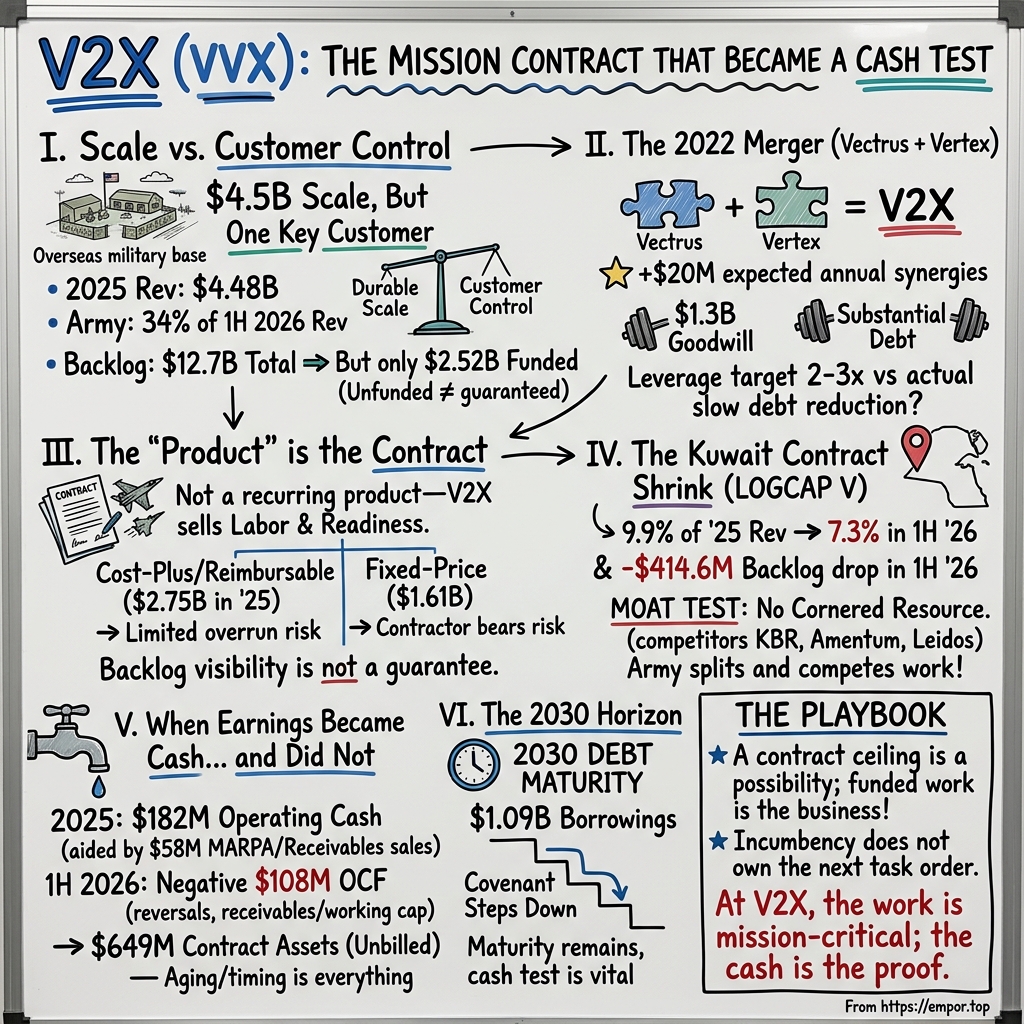
V2X: The Mission Contract That Became a Cash Test
I. A $4.5 Billion Company With One Customer in the Room
It is the middle of the night at a military installation somewhere in the Middle East. The generators hum, the dining facility is being cleaned for breakfast, a work order for a broken air-conditioning unit moves from one inbox to another, and a crew of contractors checks the perimeter systems that keep the base secure. None of these people wear a uniform with a rank on it.
They wear the badge of a contractor, and their job is to make sure that the soldiers who do wear rank never have to think about whether the lights will come on, the water will run or the runway will be clear. That is the business V2X is in. It calls the work mission support. A plainer description is that it rents the United States military a trained, cleared, deployable workforce and the management system to run it.
Several thousand miles away, in an office in Northern Virginia, the decisions that keep that crew employed are being made by people who never set foot on the base. A contracting officer decides whether to exercise next year's option. A program office decides whether the base still needs the same headcount now that the deployment has changed shape. A budget analyst waits to see whether Congress will pass a full-year appropriation or another stopgap. And on the other side of the table, a small group of investors watches the same decisions from a different angle, because for them the night shift on that base is not a mission. It is a revenue line that can shrink.
That tension sits at the heart of V2X, Inc., the NYSE-listed company that trades under the ticker VVX. On paper it is a substantial business. It generated about $4.48 billion of revenue in 2025 and employed roughly 16,200 people at the end of that year.1 By July 2026 it reported a total backlog of about $12.7 billion, almost three years of revenue lined up behind the current year.2 Those are the numbers of a company that looks durable.
But scale in government services is a different thing from scale in most industries. A software company with $4.5 billion of revenue has thousands of customers, each making their own decision. V2X has, in effect, one customer in the room: the U.S. government, buying through the Army, the Navy, the Air Force, the Marines and a handful of allied militaries and agencies. The Army alone accounted for about a third of V2X's revenue in the first half of 2026.2
The company reports a single operating segment, which means investors see one consolidated profit engine rather than separate results for its aircraft maintenance, training ranges, base operations and electronic systems.1 There is no diversified portfolio of independent businesses hiding behind the headline. There is one company, selling one kind of thing, mostly to one buyer.
That buyer has unusual powers. It decides which work is funded and which is merely authorized. It decides whether to renew, compete or cut. It can break a big contract into smaller pieces and hand them to different vendors. It can, in the middle of a contract, decide that a base needs fewer people. And V2X's own filings say plainly that contracts commonly begin with a short base period followed by annual options that the government is not obliged to exercise.1
So the $12.7 billion backlog figure needs to be read with care. Only about $2.5 billion of it was funded at July 2026, meaning money had actually been obligated by Congress and the customer; the other $10.2 billion was unfunded, a list of possibilities that depended on future budgets and future decisions.2 Put another way, about four-fifths of the backlog is a forecast the customer is free to revise.
So the questions that matter about V2X are not the ones a quick glance at the revenue line would suggest. Three of them run through this story. The first is whether the July 2022 merger of Vectrus and Vertex, the deal that created V2X, produced a stronger competitor or just a bigger one with more debt.
The second is whether new contract wins can replace a shrinking piece of work in Kuwait that was, until recently, the company's largest single contract. And the third, the one that decides what all the rest is worth to a shareholder, is whether the profit V2X reports turns into cash, and whether that cash actually pays down the more than $1 billion of borrowings the company still carries.2
The measure that ties all three together is unglamorous. It is the rate at which funded backlog turns into recognized revenue, and then the rate at which that revenue turns into collected cash. Watch those two conversions as the Kuwait work falls away and you will know more about V2X than any award announcement can tell you. To see why the company carries the debt and the shape it does, the story has to go back four years, to the deal that changed its size almost overnight.
 Subscribe on LinkedIn
II. The Merger That Changed the Scale Overnight
On March 7, 2022, two government-services companies that most investors had never thought about together announced that they would become one.3 Vectrus, a Colorado Springs-based base-operations and logistics contractor, would merge with The Vertex Company, an aviation maintenance and training business majority-owned by the private-equity firm American Industrial Partners. The structure told you a lot about who was buying whom. It was an all-stock deal, but Vertex's shareholders would end up with about 62% of the combined company, and Vectrus's shareholders with about 38%.3 The listed shell was Vectrus. The bigger business, and the bigger owner, came from Vertex.
The pitch was about range. Vectrus had grown up running bases: the facilities, the logistics, the security, the communications networks that keep an installation working. Its predecessor had been a division of ITT and then Exelis, and it became a stand-alone public company when Exelis spun it off in 2014.4 That gave Vectrus a public record, but it was a narrow one. Revenue went from about $1.18 billion in 2015 to about $1.78 billion in 2021, respectable growth for a services contractor, but built on a handful of large overseas contracts.45
Vertex brought something different: aircraft maintenance and modification, flight training support, and supply-chain work for military aviation fleets. Put the two together, management argued, and you had a company that could bid on integrated packages of work across the life cycle of a military platform, from keeping the base running to keeping the aircraft flying to training the people who fly them.
The numbers on the announcement slide were designed to impress. On a pro forma basis, the combined company had about $3.4 billion of 2021 revenue and roughly $283 million of adjusted EBITDA, including $20 million of expected annual cost savings, along with a combined backlog of about $11.3 billion.3 The synergy target was modest by the standards of corporate mergers, under 1% of combined revenue, which made it more believable.
Chuck Prow, Vectrus's chief executive, would run the combined company, and the board would be split between six Vectrus directors and five appointed by the Vertex side.3 AIP received board designation rights that would shrink as its ownership fell, along with a standstill and a six-month lockup before registration rights kicked in.3 In other words, the private-equity owner of Vertex would become a large public shareholder with a clear path to selling out over time.
What did Vectrus actually pay? The announcement did not state an enterprise value, but it implied one: roughly $2.1 billion for Vertex, which the company described as about 9.5 times Vertex's 2021 adjusted EBITDA after counting the $20 million of synergies and about $160 million of present value from Vertex's tax attributes.3 That is a carefully constructed number. Strip out the synergies and the tax benefits and the multiple on Vertex's own stand-alone earnings would have been higher.
Was it a good price? There is no clean benchmark, because few government-services businesses change hands publicly and no two have the same mix of contracts, so 9.5 times proves neither a bargain nor an overpayment. And a multiple tells you what you paid, not what you got. The test of the merger is what the acquired business earned afterwards, and what it did to the balance sheet.
The deal closed on July 5, 2022, and the combined company took the name V2X.6 The first financial report showed the scale arriving immediately. Revenue jumped to about $2.89 billion in 2022, of which roughly $908 million came from the newly acquired Vertex business in the half-year after closing.6 Headcount nearly doubled, to about 15,400 full-time employees at year-end, plus about 6,500 subcontract workers.6 Here is the first lesson the record teaches: that 2022 jump was purchased growth. Anyone who draws a straight line from Vectrus's $1.18 billion in 2015 to V2X's $4.48 billion in 2025 and calls it a decade of compounding is measuring the merger, not the business.
The balance sheet tells the other half of the story. The consideration V2X transferred for Vertex was valued at about $634 million in stock at closing, but V2X also took on Vertex's debt structure. The merger plan said Vertex's capital structure would stay in place and Vectrus's own debt would be refinanced into an upsized version of it.3 At the end of 2022, V2X carried first-lien debt of about $1.18 billion and a second-lien facility, for total debt of about $1.34 billion.6
Goodwill on the balance sheet rose from about $322 million to about $1.65 billion, an increase of roughly $1.3 billion, and that goodwill made up just over half of the company's total assets.6 Goodwill is the accountant's word for the part of the purchase price that cannot be pinned to any specific asset; it is a bet on future earnings. V2X recorded a net loss of about $14 million in 2022, weighed down by amortization of the acquired intangibles and merger costs.6
So what did shareholders actually receive? They received a company more than twice as large, with broader capabilities and a bigger list of contracts to bid on. They also received a leveraged balance sheet in which more than half the assets were an accounting estimate of future profit. Management set a long-term leverage target of two to three times net debt to EBITDA at the time of the announcement.3
It also promised the $20 million of cost savings by 2024.3 Savings of that size are the easiest part of a merger to measure, and the least important part of this one. The harder questions are whether the combined company wins more work than the two companies would have alone, and whether it throws off enough cash to retire the debt the deal created.
The early answer on debt is that the company has made progress, but slowly. Total borrowings fell from about $1.34 billion at the end of 2022 to about $1.09 billion by July 2026, a reduction of roughly a quarter of a billion dollars over three and a half years.62 The second-lien loan was repaid in early 2023 using a new $750 million credit agreement, which simplified the structure.6
That is real deleveraging, but at that pace the bulk of the merger debt is still on the balance sheet as its 2030 maturities approach. Whether that pace accelerates depends on the thing the merger did not change: the nature of what V2X sells. And what V2X sells is not a product. It is a contract.
III. The Contract Is the Product
Picture a hangar at a military air base in the American South. A trainer aircraft has come in for scheduled maintenance. A V2X mechanic opens an access panel, checks a component against a work order, logs the hours, and signs off. The aircraft belongs to the Air Force. The hangar belongs to the Air Force. The tools may belong to the Air Force. What V2X provides is the mechanic, the supervisor, the parts-ordering process, the quality system, the security clearances and the promise that the aircraft will be ready on time. And every hour the mechanic works, every part ordered, every dollar of overhead allocated, flows into a billing system governed by a contract that the government wrote.
That is the deepest truth about V2X's economics. The contract is the product. The company does not have a factory, a patent portfolio that drives pricing, or a brand that consumers pay a premium for. It has contracts, and each contract sets the terms on which it is paid. Understanding V2X means understanding three kinds of contract, because each one puts risk in a different place.
The biggest category is cost-plus or cost-reimbursable work, which brought in about $2.75 billion in 2025, a little over 60% of revenue.1 Under this arrangement the government reimburses the contractor's allowable costs and adds a fee, sometimes fixed and sometimes tied to performance. Think of it as a builder who is paid for materials and labor plus an agreed margin. The good news for the contractor is that if costs rise, the customer generally absorbs them. The bad news is that the margin is thin by design, the customer audits the costs, and the contractor cannot earn outsized profits by being clever. The government is buying capacity at a regulated markup.
The second category is firm-fixed-price work, about $1.61 billion of 2025 revenue, roughly 36%.1 Here the contractor agrees to deliver a defined scope for a set price. If V2X runs the work more efficiently than it bid, it keeps the difference. If labor costs rise, a subcontractor fails or the job turns out harder than expected, V2X eats the overrun. Fixed-price work is where a well-run contractor can earn better margins and where a poorly estimated one can lose money.
The third and smallest category in 2025 was time-and-materials work, about $126 million, in which the customer pays agreed hourly rates plus materials.1 That category exploded in 2026, rising nearly fivefold in the first half to about $261 million, because of a burst of discrete national-security mission support, a story that comes back when the question turns to whether V2X's recent growth will last.2
So who holds the leverage in these arrangements? Mostly the customer. V2X's own description of its contracts is sobering for anyone who thinks of backlog as locked-in revenue. Contracts commonly have an initial period of a year or less, followed by annual options, and the government is not obliged to exercise those options.1
Most contracts let the government terminate for convenience, in which case the contractor can recover some or all of its incurred costs and fees, but not the profit it would have earned on the work it never got to do.1 And many of the biggest vehicles are indefinite-delivery, indefinite-quantity contracts, known as IDIQs, under which several companies hold a license to compete for task orders as the government issues them.
An analogy helps here. Imagine a city that signs a ten-year agreement with three plumbing firms. The agreement says the city might spend up to $10 billion on plumbing over the decade. But it does not promise any one firm a single job. Each time a pipe bursts, the city asks the three firms to bid, picks one, and pays for that job. If the city's budget is cut, it fixes fewer pipes. The $10 billion is a ceiling, not a commitment. Much of what gets reported as "contract value" in government services works exactly like this.
That is why the gap between V2X's total and funded backlog matters so much. At July 2026, total backlog was about $12.7 billion, but funded backlog was about $2.52 billion.2 Funded backlog is money that has actually been appropriated and obligated to V2X's contracts. Against revenue guidance of nearly $5 billion for 2026, that funded figure covers about six months of work.7
Management told analysts on the second-quarter call that about 98% of its full-year 2026 revenue was already in backlog, which is a statement about visibility for the rest of this year, not about 2028.7 The other $10.2 billion of backlog depends on option exercises, future task orders and future appropriations. It is a reasonable estimate of what the customer might buy. It is not a promise.
There is a bright side to this model, and it is worth stating clearly. V2X does not need much capital to grow. Capital spending averaged about 0.4% of revenue over the past three years, falling from about $25 million in 2023 to about $12 million in each of 2024 and 2025.17 That is extraordinarily low by industrial standards; a manufacturer of comparable size might spend ten times as much just maintaining its plants.
Because the government often owns the facilities and equipment, V2X's main investment is in people: recruiting them, clearing them, training them and moving them to where the work is. The workforce grew from about 8,100 before the merger to about 15,400 after it and about 16,200 at the end of 2025, which means almost all of the growth in people came from the acquisition, with modest net hiring since.561
What V2X does not report is a research and development line. Neither the 2025 annual report nor the 2026 quarterly filings break out R&D spending as a separate item.12 That matters because management increasingly talks about technology, about AI platforms and electronic systems and engineering-led production work.
On the second-quarter call, management described three AI platforms running across the company's enterprise IT and said that more than $8 billion of new bids incorporated V2X's AI solutions.7 Those are bids, not wins, and V2X has not said how much revenue or profit the technology produces. Until it does, the company is best understood for what its financial statements show: a labor-intensive services business with low capital needs and no disclosed R&D engine.
One more point about the single segment, because it is easy to misread. V2X reports one operating segment, but that is a reporting choice, not evidence that every contract earns the same return.1 A cost-plus base-operations task order in the Gulf, a fixed-price aircraft modification program and a time-and-materials surge of national-security support almost certainly earn very different margins. The company does not show them separately, so investors cannot see which parts of the portfolio are subsidizing which. When margins move, they have to infer the reason from management's commentary rather than from the numbers.
Put all of this together and a picture forms. V2X's product is execution against contracts whose price, duration and scope are set mostly by the buyer. Cost-reimbursable work protects V2X from cost overruns but caps its upside; fixed-price work offers more upside but more risk. The backlog is a map of what the customer might buy, and the funded part of it is a much smaller island of certainty.
The model can be sticky, because an incumbent that performs well is often the safest choice for a contracting officer under pressure. But stickiness only lasts as long as the customer chooses to keep buying from the same vendor in the same quantity. The clearest test of how sticky V2X's work really is comes from the place where the company built its reputation: Kuwait.
IV. The Kuwait Contract That Shows Who Holds the Leverage
For more than a decade, Kuwait was where Vectrus made its name. The country hosts a dense cluster of U.S. Army installations that serve as the logistics hub for American forces in the Gulf, and somebody has to run them: the power plants, the dining halls, the fuel points, the vehicle maintenance yards, the gates. For years that somebody was Vectrus, under a contract called Kuwait Base Operations and Security Support Services, known by its unlovely acronym, K-BOSSS.
It was the company's crown jewel. Through the first nine months of 2016, K-BOSSS alone produced about $323 million of revenue, roughly 36% of everything Vectrus earned.8 Together with two other contracts in the region, it accounted for about 65% of the company's 2016 revenue.8 Vectrus was not so much a diversified contractor as a Kuwait contractor with some other work attached.
Then, on September 29, 2016, Vectrus announced that it had lost.8 The successor contract, worth up to about $827 million over five and a half years, went to a joint venture of KBR and Triple Canopy.9 The market's verdict was instant: Vectrus shares fell 45% the next day.9
In the same month, Vectrus also learned it had not won the recompetition for its Army Prepositioned Stocks contracts in Kuwait and Qatar, known as APS-5, its second-largest piece of work at about 15% of revenue, which went to AECOM.89 Imagine being the management team of a company whose two largest contracts, together about half of revenue, had just been awarded to competitors. There is no product to discount, no new market to pivot into. There is only the protest process.
Vectrus filed a post-award protest with the Government Accountability Office on October 11, 2016, and other losing bidders protested too.8 On November 7, the Army announced it would take corrective action, amending the solicitation and asking the original bidders for revised proposals.8 Vectrus had bought itself a second chance. The APS-5 protest went the other way: GAO denied it in December 2016, and the work rolled off in early 2017.89
Then, in March 2017, the Army called off the K-BOSSS solicitation altogether, citing a change in mission requirements, and handed Vectrus a one-year contract modification worth about $522 million to keep running the Kuwait bases, with options stretching into 2019.9 Vectrus did not win the recompete. The recompete simply disappeared, and the incumbent kept the work while the customer decided what it wanted next. When that decision arrived, it came in a different shape entirely.
That shape was LOGCAP V, the fifth generation of the Army's Logistics Civil Augmentation Program. In April 2019 the Army awarded the program, with a potential ceiling of $82 billion over its life, to four companies.10 KBR won the Northern and European Commands plus Afghanistan, with initial task orders of almost $1.9 billion. Vectrus won the Pacific and Central Commands, with initial task orders of about $1.4 billion.
Fluor took Africa and a joint venture of PAE and Parsons took Southern Command, while DynCorp, a LOGCAP IV incumbent, was shut out entirely.10 Crucially, the Kuwait base-support work that had been K-BOSSS was folded into LOGCAP V as a task order, and Vectrus, which had bid as the incumbent on work that by then made up about 40% of its revenue, kept it.10 A Moody's analyst at the time called Vectrus and KBR the big winners, because they had been named to the most desirable, high-volume regions.10
Even that victory did not end the fight. Fluor and the PAE-Parsons venture, both of whom had won contracts of their own, protested the Army's task-order decisions for KBR and Vectrus, including the Central Command order that covered Kuwait, while AECOM protested its exclusion.11 GAO dismissed those protests in August 2019 because the same issues were already before the Court of Federal Claims, where DynCorp had taken its own challenge.11 Vectrus held on.
But consider what the episode reveals about how this market works. Vectrus's operating history in Kuwait was long and, by its own account, good. It still lost the recompete in 2016. It held on to the work only through a protest, a corrective action, a cancelled solicitation, a restructuring of the entire procurement into a multi-vendor program and another round of protests from rivals. Incumbency earned Vectrus a seat at the table. It did not give Vectrus the table.
This is the strongest evidence in V2X's own record against the idea that its incumbent position is a moat in the sense investors usually mean. The customer controls the architecture of competition. The Army designed LOGCAP V with one award per regional command plus Afghanistan, so that several vendors would each own a region rather than one company owning the whole market.10 It can, and does, re-compete work. And it can reduce the scope of a task order whenever its own needs change, which is exactly what has happened in 2026.
The Kuwait task order's share of V2X's revenue fell from about 12% in 2023 to about 10% in 2025.1 In the first half of 2026, it fell to about 7%, about $182 million, down from about $229 million a year earlier.2 Then, in May 2026, the Army reduced the scope of the Kuwait task order and extended the revised scope only to December 31, 2026, a decision that cut V2X's backlog by about $415 million.2
On the second-quarter call, management said it expected Kuwait to contribute only $20 million to $30 million of revenue in the second half of 2026, down from about $180 million in the first half.7 That is a decline of roughly $150 million in six months from a single program, and it is already in the company's guidance.
Why is the Army cutting back? The filings do not give the operational reasons, and it would be speculation to supply them. What matters for an investor is the mechanism, which is simple: the customer decided it needed less, and the contract let it buy less. There was no recompete to lose, no protest to file. The work just shrank.
How does V2X compare with the companies it competes against for this kind of work? It is a mid-sized player in a field of giants. Amentum, enlarged by its combination with Jacobs' government-services businesses, reported about $14.4 billion of revenue in its fiscal 2025.12 Leidos reported about $17.2 billion for 2025.13 KBR, the company that beat Vectrus in 2016, remains a major LOGCAP holder.10 V2X's roughly $4.5 billion makes it about a third the size of Amentum and about a quarter the size of Leidos.
Those company-wide figures include very different businesses, from nuclear-site cleanup to health IT, so they are not market shares. But they make the competitive position clear. V2X is not the scale leader. It competes against larger primes on big vehicles, against specialists on niche work, and against small businesses that benefit from government set-asides designed to direct some contracts away from large firms.
So what exactly is V2X's edge? The honest answer is execution and access. It has cleared personnel, a global footprint, a long performance record in difficult places and the institutional knowledge of how to run military installations and aviation fleets. Those things help it win. A contracting officer choosing between an incumbent with a clean record and a newcomer with a lower price has a real reason to prefer the incumbent, because a failed transition on a military base is a career-ending event.
But those advantages are not a cornered resource. Competitors such as KBR and Amentum have the same kinds of cleared workforces and the same kinds of performance records, and the Army has shown, in 2016 and again in 2019, that it will restructure procurements to keep several suppliers in play.
The historical record therefore narrows the moat claim rather than rejecting it. V2X has a defensible ability to win and hold work when it performs and when the customer's needs stay stable. It does not have the power to stop the customer from splitting, re-competing or shrinking the work. What would confirm a stronger version of the claim? A run of successful recompetes on its largest programs, funded task orders that replace Kuwait, and stable margins on the new work.
What would falsify it? Losing a major recompete, or replacing Kuwait only with lower-margin work. Management told analysts on the second-quarter call that V2X is in a "recompete holiday," with a smaller share of the portfolio up for renewal in the near term, which frees resources for new bids.7 That is helpful for the next year or two. It also means the real test of incumbency has been postponed, not passed.
The Kuwait run-off turns this competitive question into a financial one. If V2X is going to replace roughly $150 million of half-year revenue with new work, that work has to be won, funded, performed and paid for. And that last step, getting paid, turns out to be the part of the V2X story that deserves the closest look.
V. When Earnings Became Cash—and When They Did Not
Every quarter, a set of V2X invoices goes out to Army, Navy and Air Force paying offices, and to the prime contractors for whom V2X works as a subcontractor. Some get paid in a few weeks. Some wait for a contract modification, or a funding release, or a dispute over a cost to be resolved. In the meantime, V2X has already paid its mechanics and base workers, because people expect their wages every two weeks whether or not a government paying office has cleared an invoice. That gap between doing the work and collecting for it is the hidden engine of a services contractor's finances. It is why a company can report a profit and still burn cash.
V2X's 2025 numbers looked, at first glance, like the opposite problem. The company earned about $78 million of net income and generated about $182 million of cash from operations, more than twice its reported profit.1 A skeptic's first instinct when cash runs far ahead of earnings is to ask where the extra came from. In V2X's case there are three clear answers.
The first is depreciation and amortization, about $140 million in 2025.1 Most of that was amortization of the intangible assets created by the 2022 merger, the customer relationships and contracts that accountants valued at the time of the deal. Amortization reduces reported profit, but it is not a cash cost; the money was spent, in stock, back in 2022. So it is entirely normal for V2X's operating cash flow to exceed net income by a wide margin, and that part of the gap is genuine.
The second answer pulls the other way. Working capital consumed about $70 million of cash in 2025, as receivables and other operating items grew.1 A business that is growing usually ties up more cash in receivables, so this is not alarming on its own.
The third answer is the one that needs a second reading. In 2025, V2X brought in about $58 million of net cash from selling receivables under a facility it calls MARPA, short for Master Accounts Receivable Purchase Agreement.1 The mechanics are straightforward. Instead of waiting for the government to pay an invoice, V2X sells the invoice to a bank, MUFG, and gets most of the cash right away.
The facility allowed up to $400 million of sales.2 The bank collects from the government later. V2X pays a discount for the privilege, about $11 million in 2025, which shows up in other expense.1 It is a little like a homeowner taking a cash advance against next month's paycheck: perfectly legal, often sensible, but it means this month's bank balance looks better than the underlying income alone would justify.
Why does this matter? Because cash from receivables sales is not the same as cash from operations getting better. If V2X increases the amount it sells, reported operating cash rises, even if nothing has changed in the business. If it reduces the amount it sells, reported operating cash falls.
So the question for an investor is not just how much cash V2X generated, but how much it would have generated without changing its use of the facility. Strip the $58 million of MARPA proceeds out of 2025 operating cash flow, take off about $12 million of capital spending, and V2X's underlying free cash flow was roughly $110 million, still higher than net income but far less impressive than the headline.1
Then came the reversal. In the first half of 2026, V2X's operating cash flow was negative: the company used about $108 million.2 The biggest single reason was a net outflow of about $143 million from receivables-sale activity, as the balance sold under MARPA shrank, together with about $85 million of working-capital use.2 By July 2026, the outstanding balance sold to MUFG was about $134 million.2 Cash and restricted cash fell from about $369 million at the end of 2025 to about $214 million in July.2
So which period tells the truth? Neither, on its own. 2025 was flattered by bringing cash forward. The first half of 2026 was penalized by giving some of it back. Management's own preferred measure, adjusted operating cash flow, which strips out the MARPA effect, showed about $50 million generated in the first half, a $110 million improvement on the year before.7 That is a more reasonable picture of the underlying trend.
It is also a measure the company defines for itself, which is why it is worth checking against the plain numbers. Doing the arithmetic directly, adding the $143 million MARPA outflow back to the $108 million use gives about $35 million of operating cash before receivables-sale timing, in the same neighborhood as management's figure and well below what a half-year of $45 million net income plus amortization would suggest if collections were running smoothly.27
The honest verdict on V2X's cash generation is that it is real but lumpy, and that the lumpiness is partly self-inflicted. The company can, within limits, choose when its operating cash shows up by deciding how much to sell to the bank. That choice is legitimate. It makes the reported number less informative.
What about the receivables themselves? Here the quality looks decent but incompletely documented. As of July 2026, billed receivables were about $155 million and unbilled receivables and contract assets, work performed but not yet invoiced, were about $649 million.2 The unbilled figure is the one to watch. It is roughly four times the size of the billed figure, and it represents revenue V2X has recognized on its income statement but cannot yet bill, usually because the contract's billing milestones or the customer's paperwork have not caught up.
V2X says that substantially all billed balances are due from the U.S. government, directly or through prime contractors, and that most of the contract assets on its books at the end of 2025 had been billed during 2026.1 Days sales outstanding, a rough measure of how long it takes to collect, was about 57 days at the end of 2025 and 56 days in the second quarter of 2026, which suggests stability rather than deterioration.12 Credit risk on a U.S. government receivable is about as low as credit risk gets. The risk is timing, not default.
What V2X does not publish is an ageing schedule showing how long balances have been outstanding, or a breakdown of write-offs and specific allowances for disputed amounts.12 So an investor can see that the pile of unbilled work is large and stable relative to revenue, but cannot see whether any part of it is stuck.
One small item belongs here, in proportion. Greenland's tax authorities drew about $4.3 million on a V2X letter of credit over prior-year tax claims, and V2X booked the amount as a receivable because management believes recovery is reasonably likely; the company is appealing.2 Against $649 million of contract assets, it is a rounding error. Its relevance is as a reminder that running operations in many jurisdictions brings tax disputes that occasionally turn into cash out the door before they are resolved.
Where does the cash need to go? There are three main claims on it. Interest is the largest: V2X recorded about $17 million of interest expense in the second quarter of 2026 alone.7 Capital spending is small, as the low-capex model implies. And debt reduction is the priority management keeps naming.
With guided adjusted operating cash flow of $160 million to $180 million for 2026, the arithmetic for paying down a billion dollars of debt is clear: at that pace, even if every dollar after capex went to the lenders, it would take more than five years to retire it, which is longer than the time left before the 2030 maturities.7 That does not mean V2X cannot refinance; most companies do. It means the company's ability to choose its own path depends on growing EBITDA as well as on cash generation, so that leverage falls by both routes.
The cash story ends with a question the company's disclosures cannot yet answer. Without a full cycle of collections through the current program transition, and without a receivables ageing, nobody outside the company can be sure that 2026's cash recovers as management expects. The answer will come in the next few quarters. In the meantime, the revenue line is sending a more optimistic signal, and it deserves an equally careful reading.
VI. Can New Awards Replace the Work That Is Leaving?
On August 3, 2026, V2X reported second-quarter results that, at the top line, looked like a growth company's. Revenue rose about 17% from a year earlier, to about $1.26 billion.27 First-half revenue was up about 20%, to about $2.51 billion.2 Management raised its full-year guidance to $4.875 billion to $5.025 billion of revenue, and lifted its targets for adjusted EBITDA and adjusted earnings per share.7
At the midpoint, that implied revenue growth of about 10% for the year.7 For a company that had grown just 3.7% in 2025, that was a sharp acceleration.1 On the same call, management told analysts that Kuwait would shrink to almost nothing in the second half. Both things were true at once. The question is how.
Start with the long record, set out on a consistent timeline. Vectrus grew from about $1.18 billion of revenue in 2015 to about $1.78 billion in 2021, an average of roughly 7% a year, mostly organic.45 The leap to about $2.89 billion in 2022 was the merger.6 Once both businesses were in the numbers for a full year, revenue went from about $3.96 billion in 2023 to about $4.48 billion in 2025, about 6% a year on average, but with growth slowing from roughly 9% in 2024 to 3.7% in 2025.1 That is the base rate: a solid mid-single-digit grower whose momentum was fading before 2026's spike.
So what changed in 2026? Three things, and they are not equally durable.
The biggest was a discrete surge of national-security mission support. In the second quarter alone it contributed about $102 million of revenue, and management said it accounted for about $200 million of first-half revenue, mostly billed on a time-and-materials basis, which explains why that contract category ballooned.27 On the call, CFO Shawn Mural described the work as running at a much higher operational tempo than the year before and called it the largest driver of growth.7
Management expects about $180 million more from this activity in the second half, and said demand signals point to the work continuing through 2026 and into early 2027.7 The word "discrete" is the company's own, and it is the right word. This is surge work tied to a specific mission at a specific time. It is real revenue, and it shows that V2X can mobilize quickly when the customer needs it. But it is not, by its nature, a recurring program.
The second driver was program ramp-ups in global training and aerospace, which the company cited alongside the national-security work.2 One example is the T-6 trainer aircraft maintenance program, which contributed about $40 million in the first half, with about $100 million expected in the second.7 These are multiyear programs and look more durable, though their ramps are already in the guidance.
The third factor runs the other way: Kuwait. The roughly $150 million half-on-half decline in Kuwait revenue is about the same size as the expected second-half contribution from discrete mission work. Put those two side by side and a picture emerges. In the second half of 2026, V2X's revenue is being held up, in large part, by temporary surge work that roughly offsets the decline of its former largest contract.
One analyst on the call, RBC's Ken Herbert, calculated that the guidance implied only about 3% growth in the second half.7 Management did not dispute that framing. Growth of 20% in the first half and about 3% in the second is not the profile of a company on a new growth trajectory. It is the profile of a company riding a surge while a big program runs off.
That makes award momentum the central question, and here management had news to share. On the call, Wensinger described roughly $1 billion of recent awards, most of them booked after the quarter closed: a multiyear production contract for carriage equipment on the strategic bomber fleet, moving from development to full-rate production; enhanced training for unmanned aircraft maintainers and operators; a five-year recompete win for the Air Force's C-12 aircraft fleet; support for Marine Corps assets; and electronic security work for a Middle Eastern foreign military customer.7
Management said these awards carry margins accretive to the existing portfolio.7 It also said, when pressed by a BTIG analyst, that the margin effect would build only gradually as legacy backlog ran off, since the awards are multiyear, about five years, with modest annual impact.7
Those awards need to be placed in the hierarchy that governs this business. A contract ceiling is the most the customer might ever spend. An award gives V2X the right to perform. A task order specifies work. Funding obligates the money. And revenue is recognized only as work is done. At each step, value can leak. Second-quarter bookings were only about $600 million, a quarterly book-to-bill of 0.5 times, meaning V2X booked about half as much new work as it billed during the quarter.7
Management pointed to a trailing twelve-month book-to-bill of 1.4 times and guided to 1.3 to 1.5 times for the full year, which would mean backlog growing faster than revenue.7 Funded backlog did rise about 10% from the prior quarter to about $2.52 billion, and funded orders in the first half reached about $2.7 billion, up about $540 million from a year earlier.27 Those are encouraging signs. They are also measurements of the stage just before revenue, not of revenue itself.
And then there are margins, where the second-quarter numbers deserve more attention than they received. Revenue rose about 17%, but operating income rose less than 2%, and operating margin fell from about 4.9% to about 4.3%.2 For the first half, operating margin slipped from about 4.2% to about 3.9%.2 Part of the explanation is mix: time-and-materials surge work and cost-reimbursable ramps typically carry lower margins than mature fixed-price work. Part is the fading of a helpful accounting tailwind.
Cumulative catch-up adjustments, the revisions contractors make when they update their estimates of a contract's total cost and profit, added about $20 million to revenue in the first half of 2025 but only about $5 million in the first half of 2026.2 The 2025 improvement in operating income had also benefited from lower integration costs as the merger work wound down.1 Adjusted EBITDA margin, the company's preferred measure, held at about 7%.7 But on the GAAP numbers, V2X was earning less on each dollar of new revenue than on the old ones.
Management's explanation for its guidance was clear and specific, which is to its credit. When Citi's analyst asked where the upside in guidance came from, Mural walked through Kuwait, national-security support, T-6, the Balad base in Iraq and the WTRS training range program one by one.7 When Truist asked what drives higher margins on new awards, Wensinger pointed to differentiation, including AI, past performance and readiness rates, rather than contract type.7 The answers were concrete about this year. They were less concrete about the question that matters most: what happens in 2027, when the surge work may fade, Kuwait will be almost gone and the new awards will be ramping at modest margins?
The verdict on growth is that V2X has real post-merger growth and real award momentum, but the 2026 surge is not evidence of a new growth trajectory. The base rate is mid-single digits. The present run rate is inflated by discrete activity and partly offset by Kuwait's run-off. The test is whether funded new work replaces both the Kuwait revenue and, eventually, the surge revenue, at margins at least as good as the work it replaces. That test will be run by the management team that took over in 2024, and its incentives deserve a close look.
VII. The New CEO, the Old Debt and the Incentives to Pay It Down
In May 2024, V2X announced that its chief executive was leaving. Chuck Prow, the Vectrus veteran who had negotiated the Vertex merger and led the combined company through its first two years, stepped down, and Jeremy Wensinger took over as president and chief executive on June 17, 2024.14 The press release described a board-led succession.
The accompanying filing used a starker word: Prow was "separated," and he received severance consistent with a qualifying termination without cause following the merger, along with accelerated vesting of some equity because he met the age and service requirements for retirement.14 Companies rarely explain these transitions in full, and V2X did not. What the record shows is that the board chose to change leaders two years after the defining deal, at a moment when the merger's integration was largely complete but its financial promise, especially on leverage, was still a long way from fulfilled.
Wensinger arrived with a résumé built almost entirely inside the industry V2X competes in. He was 60 when appointed, with a finance degree from Bowling Green State University and an MBA from the University of South Florida.14 He had spent years at Harris Corporation, run Cobham's defense systems business, served as chief operating officer of Global Technical Systems and, tellingly, led the National Security Solutions business at PAE Government Services, one of the companies that competed against Vectrus for LOGCAP work.14
Most recently he had been chief operating officer of Peraton, a large national-security contractor, since 2017.14 This is the profile of an operator rather than a dealmaker: someone who has spent a career inside the machinery of government contracting, running programs and winning recompetes. That is a reasonable fit for a company whose central challenge is execution and cash conversion. It is also a short record at V2X itself. Wensinger has been in the job for about two and a half years, which means any judgment about his performance is a judgment about a small sample.
What has that sample shown? The company's financial results improved under his leadership, though it is hard to separate his contribution from the natural fading of merger costs. V2X went from a net loss of about $23 million in 2023 to net income of about $35 million in 2024 and about $78 million in 2025.115 The company raised its 2026 guidance.
The company repriced its main term loan. Management has set out a concrete leverage target of about two times or below by the end of 2026 and a cash-conversion target of at least 100% of adjusted net income over time.7 Those are measurable promises, which is more than many management teams offer. Whether they are met is the scorecard to watch.
How is Wensinger paid? His total 2025 compensation was about $8.0 million, up from about $5.9 million in 2024, which was only a partial year in the role.15 The 2025 package included about $5.0 million of stock awards, about $1.5 million of annual incentive pay and a $400,000 cash payment that his offer letter had promised as a replacement for compensation he forfeited by leaving his prior employer.1514
His offer letter set a base salary of $1 million and an annual incentive target of 125% of salary, along with a long-term incentive target of $4.25 million split evenly between time-vesting and performance-vesting shares, and a special one-time grant of 20,000 performance shares tied to stock-price and relative-return goals through the end of 2025.14 The incentive plans reference measures including adjusted EBITDA, bookings, days sales outstanding, relative total shareholder return and adjusted earnings per share.15
Two things about that design deserve a skeptical second look. The first is that most of the operating metrics are adjusted measures, defined by the company. Adjusted EBITDA and adjusted EPS strip out amortization and certain other costs, which is reasonable in a business carrying large merger intangibles, but it also means management is paid on numbers it has some discretion over.
The second is days sales outstanding. DSO is a sensible thing to reward in a business where cash conversion is the central test. But a company with a receivables-sale facility can, in principle, lower its DSO simply by selling more receivables to the bank. The proxy summary does not say whether the DSO metric adjusts for MARPA activity, and an activist investor would want to know.
Then there is ownership. As of March 2026, Wensinger beneficially owned 29,066 shares, including about 10,500 he had the right to acquire within 60 days, and held 61,083 unvested restricted stock units.15 At the October 23, 2026 closing price of about $74, his beneficially owned stake was worth a little over $2 million, roughly a quarter of one year's total pay.1615 The unvested units are worth more, about $4.5 million, but they are a promise of future shares conditional on staying, not money he has put at risk.
This is not unusual for a hired chief executive two years into the role, and the proxy states that no director or named executive has pledged shares.15 But it means Wensinger's personal wealth is tied more to his ongoing pay than to the long-term value of the shares he owns. Compared with net income of about $78 million in 2025, his $8 million package was equal to about a tenth of the company's annual profit, a reminder of how thin the profit pool is in a business that turns $4.5 billion of revenue into well under $100 million of net income.115
Shareholders did not object. At the May 2026 annual meeting, the say-on-pay proposal received about 27.65 million votes in favor and about 240,000 against, roughly 99% support among votes cast for or against.17 That is a strong result, but it is a vote of confidence at a moment when the shares had recovered and the sponsor overhang was lifting, not proof that the pay design is right. The board itself shrank from ten to nine members when director Steve Waechter was not renominated under the board's age policy, and every director other than the chief executive was classified as independent; Mary Howell serves as non-executive chairman.1517
The legacy of the private-equity era is now mostly closed. At the merger, V2X entered a management-services agreement with American Industrial Partners under which it would reimburse AIP's reasonable, documented out-of-pocket expenses for advisory services, with no management or transaction fees.15 V2X did not request or receive any services under the agreement during 2025, and the agreement and related shareholder rights ended that year.15 The amount of expenses reimbursed in earlier years is not disclosed, but the structure was benign by private-equity standards, and it is now history.
So is the sponsor overhang. During 2025, the merger-era significant holders cut their combined ownership from about 45% to about 16%.1 In May 2026, Vertex Aerospace Holdco sold its remaining roughly 2 million shares, about 6.4% of the company, in a registered offering from which V2X received no proceeds.18 An AIP affiliate still held about 375,000 shares, about 1.2%, at the proxy date.15 For years, the knowledge that a large owner wanted to sell had hung over the stock. That weight is now largely gone.
The governance record also carries a few accounting and legal items that need to be weighed in proportion. RSM, the company's auditor, issued clean opinions on the 2025 financial statements and on internal control over financial reporting, and the company reported that previously identified weaknesses in IT access controls had been remediated in the fourth quarter of 2025.1 That remediation matters: an access-control weakness in a company that bills the government through complex cost systems is not trivial, and its resolution removes a reason for concern.
V2X had about $14.4 million accrued at the end of 2025 for legal proceedings and contract matters, including incomplete government audits of incurred costs, up from about $13.1 million a year earlier, and management does not expect these to have a material adverse effect.1 Against roughly $4.5 billion of revenue, that accrual is small. The Greenland tax draw is smaller still.
Capital allocation under the current team is still mostly a story about what it has not yet done. The defining deployment of capital in V2X's history was the 2022 merger, made by the previous chief executive. Since then, the company has focused on integration, debt reduction and refinancing. On the second-quarter call, management said it was looking at acquisitions in areas such as platform modernization, counter-drone systems, electronic warfare and integrated air and missile defense, and described a disciplined approach and a healthy pipeline.7
That is worth flagging. A company that has not yet reached its own leverage target, carrying debt from a large merger, is talking about further acquisitions. That is not wrong in itself, but it raises the bar for discipline. The cleanest evidence of management quality from here will be whether debt falls as promised before any new deal adds to it.
The sponsor is gone, but the debt the sponsor's deal created is not. And that debt has a date attached to it.
VIII. The 2030 Maturity Behind the Backlog
On May 29, 2026, V2X closed a repricing of its first-lien term loan, about $869 million of debt.19 Repricing is the corporate equivalent of a homeowner refinancing a mortgage when rates fall or when their credit improves: same house, same loan, lower rate. The new loan charged the benchmark SOFR rate plus 2.0 percentage points, and the minimum interest-rate floor on SOFR was cut from 0.75% to zero.19
The company said it could cut the margin by another quarter of a percentage point if it achieved specified corporate credit ratings of Ba3 with a stable outlook from Moody's and BB with a stable outlook from S&P.19 CFO Shawn Mural said the transaction immediately lowered the company's borrowing costs.19 It was a good piece of treasury work. It also left the most important feature of the debt unchanged: its maturity date.
Lay out the structure in plain terms. As of July 2026, V2X owed about $1.09 billion in total.2 The largest piece was the first-lien term loan, carried at about $866 million, with an effective interest rate of about 6.18%, a small quarterly amortization of about $2.2 million and about $829 million due in a single payment in December 2030.2 The second piece was a term loan of about $220 million under a separate 2023 credit agreement, carrying an effective rate of about 5.82%, with about $183 million due in March 2030.2
The original second-lien loan had already been repaid.6 The company also had a revolving credit facility with no borrowings drawn and about $485 million of availability.2 So V2X has roughly a billion dollars due within nine months in 2030, a liquidity cushion of about half that size in the revolver, and about $214 million of cash, part of it held overseas.2
Banks protect themselves with covenants, and V2X's are not tight today. The credit agreements require net leverage, debt minus cash divided by a bank-defined measure of EBITDA, to stay at or below 4.75 times through the end of 2026, with step-downs after that, and interest coverage of at least 2 times.2 The company reported that it was in compliance.2 A rough calculation shows why there is headroom.
As of July 2026, net debt was about $870 million. The company guided 2026 adjusted EBITDA to about $355 million at the midpoint.7 That puts net leverage at roughly 2.5 times on management's own earnings measure, well inside the covenant and close to the top of the two-to-three-times range promised at the merger. That is close to management's stated year-end target.7
Why does a step-down in the covenant matter if the company is already well inside it? Because the headroom depends on three moving parts: EBITDA, cash and interest. If Kuwait's decline and the eventual fading of surge work reduce EBITDA, leverage rises even if debt stays flat. If working capital absorbs cash, as it did in the first half of 2026, net debt rises even if the business is healthy.
And if interest rates stay high, more cash goes to lenders rather than to paying down principal. The covenant is not the danger. The danger is that the cushion narrows quietly during a program transition, at exactly the moment the company needs flexibility to bid on and ramp new work.
The credit agencies are part of this story, but carefully. V2X has not published an agency rationale, and the conditions in its repricing announcement describe what the company would need to achieve, not what an agency has concluded.19 On the second-quarter call, management said Moody's had recently revised its outlook on the company to positive.7 That is a meaningful signal from an independent party, though an outlook is a direction, not an upgrade. The practical point for shareholders is that every notch of improvement saves interest and every notch of deterioration costs it.
A few secondary risks belong here, in scale. V2X operates in many countries, but most of its transactions are in U.S. dollars, and its own filings describe foreign-currency operating gains and losses as historically insignificant.1 The derivatives it uses are interest-rate swaps designed to fix part of the cost of its floating-rate loans, not a currency-hedging program.12 Currency is not where this story will turn.
The debt is where it will turn. The verdict is straightforward. The 2026 repricing bought interest relief, the covenant has room, and the company has made steady if unspectacular progress in reducing borrowings since the merger. But none of that removes the refinancing risk concentrated in 2030. The cleaner test is whether free cash flow, measured after separating out MARPA timing, actually reduces debt over the next few years, so that V2X goes into its 2030 refinancing as a company with leverage near two times and a steady cash record, rather than as a contractor in the middle of another program reset. That is the operating test the market is now pricing.
IX. Analysis & Bear vs. Bull Case
On October 23, 2026, V2X shares closed at $74.09.16 Over the previous year they had traded between about $51 and about $94, a wide range for a company whose customer is the U.S. Department of Defense.16 At that price, the market valued V2X's equity at about $2.3 billion.16 Add the roughly $1.09 billion of borrowings and subtract the $214 million of cash reported in July, and the enterprise value, the price of the whole business including its debt, comes to about $3.2 billion.216
Against management's 2026 adjusted EBITDA guidance midpoint of about $355 million, that is roughly 9 times.7 Against the midpoint of adjusted EPS guidance, about $6.10, the shares trade at about 12 times, while on trailing GAAP earnings, which carry the full weight of merger amortization, the multiple is about 25 times.716
What does that price assume? It is a modest multiple, the kind the market gives to a leveraged services contractor rather than to a compounder. It does not price V2X as a defense-technology growth story. It prices a business that will earn mid-single-digit margins, grow at something like its base rate, and gradually reduce its debt. The interesting question is whether the evidence supports more, or less, than that.
Who really holds the power
The most useful way to test V2X's competitive position is to run it through two frameworks investors use to think about durable advantage. The first, Michael Porter's five forces, asks who holds the bargaining power in an industry. The second, Hamilton Helmer's seven powers, asks whether a company has a structural reason to earn returns above its cost of capital for a long time.
Start with Porter, and with the force that dominates everything: buyer power. It is overwhelming. The Kuwait run-off and K-BOSSS loss show how much control the customer has over V2X's work. Supplier power is moderate: V2X's key input is skilled, cleared labor, and labor markets for cleared aviation mechanics and base-operations specialists can be tight, but on cost-reimbursable contracts much of the wage inflation passes through to the customer.
The threat of new entrants is low at the top of the market, because security clearances, past-performance records and the ability to deploy thousands of people overseas take years to build, but it is real at the edges, where small-business set-asides deliberately channel work to new firms. The threat of substitutes comes from two directions: the military bringing work back in-house, and, more speculatively, technology reducing the labor content of maintenance and logistics. Rivalry is intense: V2X competes against Amentum, KBR, Leidos and others, most of which are larger, and recompetes are frequent. Put together, the five forces describe an industry where the customer captures most of the value and contractors earn thin, stable margins in exchange for low capital needs. V2X's own operating margin of around 4% fits that picture exactly.2
Now the seven powers. Scale economies help a little, because overhead can be spread across more contracts, but V2X is smaller than its largest rivals; Amentum earned an adjusted EBITDA margin of about 7.7% in fiscal 2025, close to V2X's roughly 7% on the same adjusted basis, and Leidos, with a much heavier technology mix, about 14%.12137 Scale has not translated into a margin advantage for V2X. Network economies do not apply. Counter-positioning does not apply; V2X's business model is the same as its competitors'. Switching costs are the strongest candidate: changing the contractor on a military base or an aviation fleet is disruptive and risky, which favors the incumbent.
But the Kuwait and LOGCAP histories show switching is painful, not prohibitive. Brand, in this industry, means past-performance ratings, and V2X has a solid record, but so do its peers. A cornered resource would be something only V2X has, and the record shows nothing of the kind: its clearances, facilities access and know-how are shared by competitors. Process power, the accumulated operating know-how that lets a company do things better and cheaper than rivals, is the most plausible long-term advantage, and management points to readiness rates and past performance as differentiators.7 But process power should show up as superior margins or win rates, and V2X does not disclose win rates. Its margins are in line with peers', not above them.
The moat verdict is therefore narrower than the company's own description of itself. V2X has a real but modest edge built on execution, incumbency and cleared, deployable people. That edge earns it the right to compete and often to win. It does not protect it from a customer that multi-sources, re-competes and cuts.
The KPI that would reveal a stronger moat is not disclosed directly, but its proxies are: recompete win rates on major programs, funded-backlog growth and margins on new awards. If V2X wins its upcoming recompetes and margins rise as management says they will, the edge is bigger than the evidence currently shows. If it loses a major program or replaces Kuwait at lower margins, the edge is smaller.
What about AI? The company has not disclosed revenue or profit from AI, and AI-related bids are not wins.7 For now, AI belongs in V2X's story as a feature of how it bids and runs its own operations, not as a growth business. It is also, in principle, a two-sided risk: technology that improves maintenance prediction could make V2X more valuable to its customers, or could reduce the labor hours the customer needs to buy.
Two ways the next five years can go
The bull case begins with demand. The U.S. and its allies are spending more on readiness: keeping aircraft flying, bases operating and forces trained. V2X's recent awards, including the bomber carriage production contract, the C-12 fleet recompete and the unmanned-aircraft training work, show it can win across aviation, training and production.7 The surge of national-security mission work showed it can mobilize quickly.
Its capital needs are tiny, its sponsor overhang is gone, its interest costs are falling and its leverage is near the top of its target range. If V2X converts its funded backlog at a steady pace, holds margins through the Kuwait transition and uses the cash to reduce debt toward two times, the equity can benefit twice: from earnings growth and from more of the enterprise value accruing to shareholders as debt falls. At around 9 times EBITDA, the market is not paying for much of that.
The bear case is simpler and needs fewer things to go wrong. Low capital intensity does not mean low risk; it means the risk sits in labor, execution and contracts. Roughly a third of revenue comes from fixed-price work, where V2X absorbs overruns.1 Contract assets of about $649 million are revenue already recognized but not yet billed.2 Reported cash flow depends partly on how much V2X sells to its bank.
Margins slipped on a GAAP basis in 2026 as revenue surged. The 2026 surge work will fade at some point. And the debt is concentrated in 2030. In the bear case, a large program contraction like Kuwait arrives without a replacement, collections slow during the transition, and V2X enters its refinancing with leverage rising instead of falling. Nothing exotic needs to happen. The customer simply has to buy less, the way it already has.
So why might V2X win from here? Because it does work that matters, in places few companies can operate, for a customer that is spending more on readiness, and because its portfolio is broader than Vectrus ever was. Why might it not? Because the customer can move the work, and because the company's cash conversion has yet to prove itself through the current program transition.
Three numbers will tell investors which story is unfolding. The first is funded backlog and how fast it converts to revenue; it stood at about $2.52 billion in July 2026, up about 10% from the prior quarter.27 The second is operating cash flow after stripping out MARPA activity; it was about $35 million to $50 million in the first half of 2026 depending on the measure, against full-year guidance of $160 million to $180 million on the company's adjusted basis.27
The third is net debt relative to EBITDA, roughly 2.5 times on guided adjusted EBITDA at mid-2026, against management's target of about two times by year-end.7 The multiple on the shares is only a snapshot of what the market currently believes. Those three numbers are the evidence that will change it.
X. Playbook: Business & Investing Lessons
Go back to the spring of 2022, to the slide that announced the merger. It showed about $3.4 billion of combined revenue, $11.3 billion of backlog and $20 million of synergies.3 It was a confident slide, and the revenue did arrive.
But the moments that actually revealed what kind of business V2X had become came later and were far less photogenic: a $1.3 billion jump in goodwill, a May 2026 scope cut in Kuwait that erased about $415 million of backlog in a single contract action, and a half-year in which operating cash went out the door instead of in.62 V2X's story offers a handful of lessons that belong to this company, and to anyone buying scale in a business where the customer can move the work.
The first lesson is about backlog. At V2X, about four-fifths of the backlog was unfunded at July 2026, and the largest reduction of the year came not from a lost competition but from the customer deciding to buy less.2 For any company selling to governments, the headline backlog number is a measure of possibility, not of commitment, and the funded number is the one that pays wages. A contract ceiling is a possibility; funded work is the business.
The second lesson is about mergers in services. The Vertex deal delivered exactly what its announcement promised in revenue and roughly what it promised in cost savings, and yet the investment case still turns on something the slide did not promise: how fast the combined company could pay down the debt it inherited. In a business with thin margins and a powerful customer, scale widens the bid set but does not raise the price. Judge a services merger by the debt it retires, not by the revenue it adds.
The third lesson is about moats. Vectrus ran the Kuwait bases for years, lost the recompete in 2016, watched its shares lose nearly half their value in a day, survived through a protest and a cancelled solicitation, won the work back inside a multi-vendor program, and then saw that same work shrink by customer decision a decade later.9102 No amount of performance history prevented any of those turns. Incumbency earns a hearing; it does not own the next task order.
The fourth lesson is about cash. V2X's 2025 operating cash flow looked superb until the receivables-sale facility was subtracted, and its first-half 2026 cash flow looked alarming until the same facility was added back.12 Both readings were technically correct, and neither was complete. When a company can choose when its cash arrives, the reported figure becomes partly a financing decision. When receivables become a financing decision, cash flow needs a second reading.
The fifth lesson is about management credibility, and it is still being written. Wensinger's team has given unusually specific numbers: Kuwait at $20 million to $30 million in the second half, surge work at about $180 million, a leverage target of about two times, cash conversion of at least 100% of adjusted net income.7 That specificity is valuable precisely because it can be checked. In a business where the customer controls the work, the only thing management fully controls is the accuracy of what it tells investors. At V2X, credibility will be built one quarter at a time, by numbers that land where management said they would.
XI. Epilogue
As of late October 2026, V2X stands at a hinge. Its shares sit in the middle of their recent range. Its guidance calls for 2026 revenue of $4.875 billion to $5.025 billion, a record by a wide margin.7 Its funded backlog stands at about $2.52 billion, its sponsor has sold out and its main loan has been repriced.21819 And yet the three questions that hung over the company at the start of this story remain open, because the evidence that will answer them has not yet arrived.
The first piece of that evidence is close. V2X is scheduled to report third-quarter 2026 results and hold its earnings call on November 2, 2026.20 That call will be the first look at a quarter in which the Kuwait decline began to bite in earnest. Investors will want to see how much of the quarter's revenue came from recurring programs and how much from discrete mission work, whether the roughly $1 billion of awards announced over the summer has turned into bookings and funded backlog, and whether management's margin explanation, that the second half benefits from productivity and contract actions, shows up in the numbers.7
A quarter in which revenue holds, margins improve and the surge work is clearly bridging to new programs would support the idea that V2X is growing through its transition. A quarter in which revenue holds only because of surge work, while margins slip and bookings lag, would point the other way.
The second piece of evidence will come at year-end. The revised Kuwait scope was extended only to December 31, 2026.2 What the Army decides about the work after that date, and how much of V2X's LOGCAP backlog survives, will reveal whether the run-off is a step down to a smaller program or the end of an era. At the same time, the full-year book-to-bill, which management has guided to 1.3 to 1.5 times, will show whether new awards are refilling the backlog faster than revenue drains it.7
The third piece of evidence is cash. Management's adjusted operating cash flow guidance of $160 million to $180 million for 2026 implies a much stronger second half than first.7 If V2X delivers it, and if the MARPA balance and contract assets do not swell to make it happen, the company will have shown that its first-half cash outflow was timing, not trouble. If it falls short, or delivers it only by selling more receivables, the question of cash durability will grow louder.
And behind all of it sits 2030. The leverage target of about two times by the end of 2026 is the near-term milestone; the refinancing of roughly a billion dollars due in 2030 is the long-term one.27 Meeting the specified ratings from Moody's and S&P would cut V2X's interest costs further and signal that the credit markets believe the deleveraging story.19 A stalled deleveraging, or a debt-funded acquisition before the target is reached, would signal the opposite.
None of these outcomes is certain, and the customer controls more of them than the company does. That is the tension V2X has always lived with, and it remains unresolved tonight. The work is essential. Whether it is a durable source of returns for shareholders depends on whether the funded work arrives, whether the cash follows it, and whether the debt falls before the bill comes due.
XII. Outro
Somewhere tonight, a V2X crew is keeping a base running. The lights are on, the aircraft are on the line, the perimeter is quiet. None of the people doing that work will be thinking about funded backlog or MARPA balances or the 2030 maturity. They will be thinking about the next shift.
But in a billing system somewhere in Virginia, tonight’s work is joining the queue of contract assets waiting to become cash.2 That is the quiet journey at the center of V2X: from a mission to a contract, from a contract to a receivable, and from a receivable, eventually, to a dollar that can pay down a loan. The company built its scale by buying more of the first step. Its value will be decided by how reliably it completes the last one. At V2X, the work is mission-critical; the cash is the proof.
References
-
2025 Form 10-K — V2X, Inc., 2026 ↩↩↩↩↩↩↩↩↩↩↩↩↩↩↩↩↩↩↩↩↩↩↩↩↩↩↩↩↩↩↩↩↩↩
-
Q2 2026 Form 10-Q — V2X, Inc., 2026 ↩↩↩↩↩↩↩↩↩↩↩↩↩↩↩↩↩↩↩↩↩↩↩↩↩↩↩↩↩↩↩↩↩↩↩↩↩↩↩↩↩↩↩↩↩↩↩↩↩
-
Vectrus and Vertex to Combine, Creating a Global Leader in Mission Essential Solutions — Vectrus, 2022-03-07 ↩↩↩↩↩↩↩↩↩↩
-
Q2 2026 Earnings Call Transcript — Stock Analysis, 2026-08-03 ↩↩↩↩↩↩↩↩↩↩↩↩↩↩↩↩↩↩↩↩↩↩↩↩↩↩↩↩↩↩↩↩↩↩↩↩↩↩↩↩↩↩↩↩↩↩↩
-
Vectrus Gets $521.6M Contract Extension — Washington Technology, 2017-03-24 ↩↩↩↩↩↩
-
Army's $82B LOGCAP V Awards Reset Defense Services Landscape — Washington Technology, 2019-04-15 ↩↩↩↩↩↩↩
-
Decision on LOGCAP V Protests, B-417506.2 et al. — U.S. Government Accountability Office, 2019-08-07 ↩↩
-
Amentum Reports Fourth Quarter and Fiscal Year 2025 Results, Exhibit 99.1 — Amentum Holdings, 2025-11-24 ↩↩
-
Leidos Posts Strong Fourth Quarter and Fiscal Year 2025 Results — Leidos via Seeking Alpha, 2026-02-17 ↩↩
-
Form 8-K, Executive Leadership Transition — V2X, Inc., 2024-05-13 ↩↩↩↩↩↩↩
-
2026 Definitive Proxy Statement — V2X, Inc., 2026-05-07 ↩↩↩↩↩↩↩↩↩↩↩↩
-
V2X, Inc. (VVX) Stock Price and Overview — Stock Analysis, 2026-10-23 ↩↩↩↩↩↩
-
2026 Annual Meeting Results, Form 8-K — V2X, Inc., 2026-05-07 ↩↩
-
Prospectus Supplement, Form 424B5 — V2X, Inc., 2026-05-11 ↩↩
-
V2X to Generate Interest Expense Savings Through Successful Term Loan Repricing — V2X, Inc., 2026-06-03 ↩↩↩↩↩↩↩
-
V2X Investor Relations, Q3 2026 Earnings Call Event — V2X, Inc., accessed 2026-10-24 ↩
 LinkedIn
 WhatsApp
 Reddit
 Hacker News
 Email
 Kindle
 RSS Feed
 Spotify
 Apple Podcasts
 Amazon Music
 Audible
 YouTube