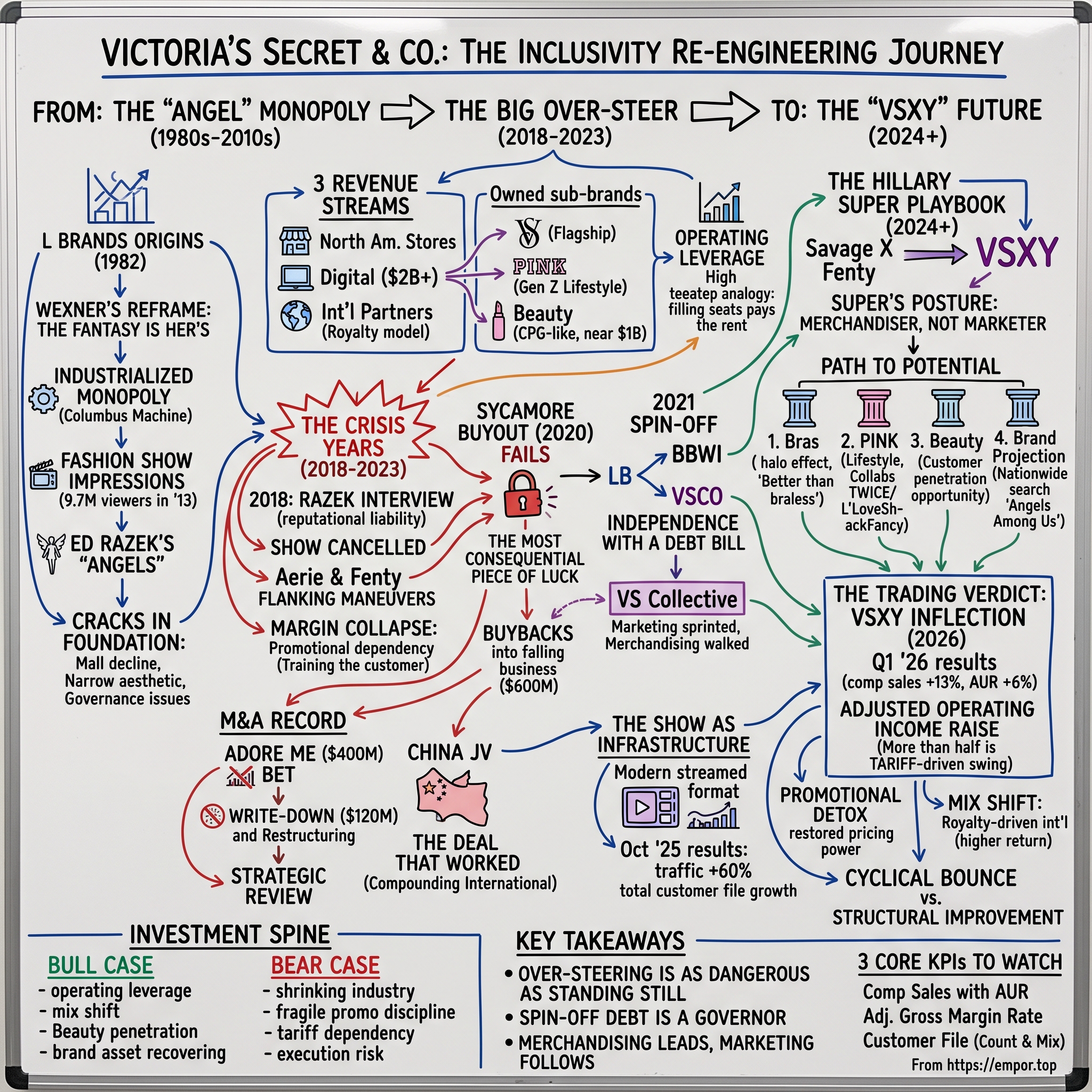
Victoria's Secret & Company: Re-Engineering Sexy in the Age of Inclusivity
I. Introduction & Episode Roadmap (12 Mins)
On the morning of June 2, 2026, the New York Stock Exchange opened with a small piece of housekeeping: the ticker "VSCO" disappeared and "VSXY" took its place. The company framed the swap as a statement of confidence — a signal, in its own words, of "clarity in who it is, what it stands for, and how it shows up for customers."1 Ticker changes are usually corporate theater. This one landed on the same morning the company reported first-quarter results that sent the stock up roughly 50%.2 Suddenly the theater looked like timing.
The numbers behind that move were, for this company, almost disorienting. Net sales rose 15% to $1.56 billion, comparable sales rose 13%, and the company swung from a small loss a year earlier to $48 million of net income.3 Management then raised full-year guidance by an enormous margin — lifting the adjusted operating income outlook from a range of $430–460 million to $550–580 million.3 By late July 2026 the shares changed hands around $83, against a fifty-day average near $50, giving Victoria's Secret & Company a market capitalization of roughly $6.6 billion.4
Rewind three months and the mood was the opposite. On March 5, 2026, the company closed out a fiscal year with record fourth-quarter revenue — and simultaneously disclosed a roughly $120 million impairment against assets from its largest-ever acquisition, plus a strategic review of a business it had bought only three years earlier.56 The stock fell hard, and within weeks a plaintiffs' firm had announced an investigation into whether the company or its officers had engaged in securities fraud.7 Two quarters, two verdicts. That whiplash is the Victoria's Secret story.
The central puzzle. Victoria's Secret remains the largest specialty intimates retailer in North America by a wide margin, with roughly 1,420 stores worldwide at the close of fiscal 2025 and $6.553 billion of annual revenue.5 But scale in retail is not the same as advantage. This is a brand that in 2013 drew 9.7 million television viewers to a lingerie runway show, and by 2018 drew 3.3 million before cancelling it entirely.8 It is a company whose operating income fell from $870 million in fiscal 2021 to $246 million in fiscal 2023 — a collapse of more than 70% in two years, on revenue that fell less than 10%.9 That gap between a modest revenue decline and a catastrophic profit decline is the single most important fact about the business, and it tells you exactly where the damage was: not in customer count first, but in the price the customer would pay.
The dilemma an investor has to resolve. Can a cultural institution built for the mall-anchored, catalog-fed America of the 1980s survive being culturally rejected, then over-correct into a marketing posture its own core customer did not recognize, and finally locate a commercially viable middle ground — all while carrying spin-off debt, absorbing tariffs, and fending off two activist investors at once? As of mid-2026 the operating evidence says the middle ground is being found. Four consecutive quarters of positive comparable sales, gross margin expanding on less promotion rather than more, and a customer file that has resumed growing are real, measurable things, not slogans.1011 The open question is whether they are a cyclical bounce off a very low base, aided by an unusually favorable tariff swing, or the beginning of a structurally better business.
What the company actually is in 2026. Strip away the mythology and Victoria's Secret & Company is three revenue streams stitched to one brand system. There is a North American store fleet, which remains the largest single line. There is a digital business that runs at roughly two billion dollars a year and functions as both a sales channel and the brand's primary customer-acquisition surface. And there is an international operation that increasingly earns royalties from partners rather than operating profits from owned stores.5 Sitting across all three are the sub-brands — the flagship Victoria's Secret line, the younger PINK label, and a Beauty business built on fragrance and body care that behaves less like apparel and more like a consumer packaged goods franchise.
That structure matters because the three streams have completely different economics. Owned stores carry high fixed occupancy and enormous operating leverage. Digital carries no rent but heavy fulfillment, return, and paid-acquisition costs. Partner-operated international carries almost no cost at all — the partner takes the inventory risk and the lease, and Victoria's Secret collects a royalty on the brand. When the company opens 84 net partner doors and closes 16 of its own in a single year, as it did in fiscal 2025, the reported revenue growth understates the improvement in return on capital.5 That is a quiet, structural shift and it deserves more attention than it usually gets.
The roadmap. This story runs in ten movements. First, the Leslie Wexner engine — how a $1 million bargain purchase became a mall-and-catalog monopoly with the fattest margins in specialty apparel. Second, the cultural collapse, the Jeffrey Epstein shadow over the founder, and the private-equity buyout that COVID-19 blew apart. Third, the 2021 separation from L Brands and the debt stack that came with it. Fourth, the "VS Collective" era, when marketing sprinted ahead of merchandising. Fifth, the M&A record: a $400 million bet on a digital-native brand, and a quieter, cleverer deal that turned China from a cash drain into a partnership. Sixth, the arrival of Hillary Super and the "Path to Potential" playbook, plus a hard look at incentives, disclosure, and what the company actually reports. Seventh, a war-game of the competitive set through Hamilton Helmer's 7 Powers and Porter's Five Forces. Eighth, what management says on calls versus what analysts press them on, the activist stress test, and the live risk radar. Ninth, the bull and bear spine and the small number of metrics that actually matter. Tenth, the transferable lessons.
Start where every retail empire starts: with someone who had the right idea and the wrong customer.
 Subscribe on LinkedIn
II. The L Brands Origins: The Wexner Monopoly & The Angel Engine (22 Mins)
In June 1977, a Stanford MBA named Roy Raymond opened a small shop in the Stanford Shopping Center in Palo Alto with about $80,000 of capital, half of it borrowed.12 The premise was personal and, at the time, genuinely novel: Raymond had found buying lingerie for his wife in a department store humiliating — fluorescent lights, racks of utilitarian nylon, saleswomen who looked at him with pity. So he built the opposite. Dark wood panelling, Victorian-print wallpaper, velvet, silk-framed displays. He named it after the Victorian era to borrow its aura of respectability and repression. The store was designed, deliberately, for men.
It worked, in the way that clever ideas often work at small scale and fail at large scale. Raymond's shop grossed about $500,000 in year one, enough to fund a mail-order catalog and a handful of additional stores.12 By 1982 the business had five stores, a forty-page catalog, and roughly $6 million in sales — and was heading toward insolvency.12 The reason was structural. Men buy lingerie a few times a year, on occasions. Women buy bras because their bras wear out. Raymond had built a boutique for the low-frequency, high-emotion purchase and starved himself of the repeat traffic that funds a chain.
The Wexner insight. Leslie Wexner, who had founded The Limited in Columbus, Ohio in 1963, bought the company for a reported $1 million in 1982.12 The purchase price is the least interesting number in this story. What mattered was Wexner's single reframe: the shopper is the woman, and the fantasy is hers, not her husband's. Everything downstream — the lighting, the assortment, the catalog photography, the store's placement in the mall — flowed from that correction. Wexner kept the Victorian conceit and the sensuality and simply pointed them at the person who would come back every eight weeks.
The Columbus Machine
Wexner then did the thing that made him one of the great American merchants: he industrialized it. Victoria's Secret was folded into a portfolio that at various points included Limited Stores, Express, and Bath & Body Works, all run out of a Columbus campus with shared sourcing, logistics, and real-estate muscle. By the early 1990s the chain had expanded to hundreds of mall doors and had become the largest lingerie retailer in the United States.12 The catalog, meanwhile, functioned as something close to a proprietary media channel — decades before "direct-to-consumer" was a phrase, Victoria's Secret was mailing a branded magazine into tens of millions of American homes and converting it into store traffic.
It is worth pausing on how unusual that Columbus operation was for its era. Most American specialty retailers of the 1980s and 1990s were merchandising organizations that outsourced everything else. Wexner built the opposite: a vertically coordinated system in which product development, sourcing relationships, distribution, and real estate negotiation all sat under one roof and served multiple banners at once. When a landlord wanted a Bath & Body Works in a new mall, that landlord was also negotiating about Victoria's Secret and Express. The portfolio bought leverage that no single-banner competitor could match — better locations, better terms, and better renewal economics. For twenty years, this was arguably the most underrated asset in the entire enterprise.
The catalog deserves its own footnote in the history of direct commerce. Long before "owned audience" entered the marketing vocabulary, Victoria's Secret was mailing a glossy, aspirational publication into tens of millions of homes several times a year. It did three jobs simultaneously: it sold product directly at high margin with no store cost, it functioned as a mass-media brand vehicle that competitors had to buy advertising to match, and it drove foot traffic into the mall stores. When e-commerce eventually arrived, the company already understood the mechanics of remote selling — sizing, returns, fulfillment — better than almost any apparel retailer in America. That the company nonetheless lost digital ground in the 2010s is one of the genuine puzzles of this story, and the answer has more to do with product and brand than with technology.
The Angel Machine
The Angel machine. The cultural apparatus that most people remember was largely the work of Ed Razek, the longtime chief marketing officer who ran brand and creative for Wexner. Razek's product was not lingerie; it was the fantasy wrapper around lingerie. He built the "Angels" — a rotating cast of contracted supermodels who became household names — and in 2001 turned the internal sales meeting spectacle into a network television broadcast. At its commercial peak the Victoria's Secret Fashion Show pulled 9.7 million viewers in 2013 and 6.7 million as late as 2016.8 Consider what that meant economically: a lingerie company was producing an annual prime-time entertainment special that people voluntarily watched, delivering brand impressions at a cost per thousand that no competitor could approach. That is the closest thing intimates retail has ever had to owned distribution of attention.
There is a second, less obvious function the show performed: it disciplined the merchandising calendar. An annual televised event forced the organization to have a product story ready, a campaign built, and an inventory position staged around a fixed date. Cultural institutions inside companies often work this way — they impose rhythm. When the show was cancelled in 2019, the company lost not only the impressions but the internal metronome that had organized its year. The 2024 revival was, among other things, an attempt to restart that clock.
The Engine Room
Why the economics were so good. Bras are, in manufacturing terms, absurdly complex garments — dozens of components, engineered cups, graded sizing, and fit tolerances measured in millimeters. That complexity is a barrier. A T-shirt can be sourced by anyone; a bra program that must deliver consistent fit across hundreds of size-and-style combinations requires long supplier relationships and accumulated technical know-how. Layer on a brand that let the company sell an engineered product at a fashion price, and gross margins in the intimates category ran far above ordinary apparel. The offsetting cost was fixed: large mall boxes with high occupancy expense. That combination — high gross margin, high fixed cost — produces enormous operating leverage in both directions. It is why the business earned $870 million of operating income in a good year and $246 million two years later.9 Nothing about that swing required customers to disappear. It only required them to stop paying full price while the rent kept coming due.
A simple way to hold this in mind: think of the business as a theater with expensive seats. Filling the theater at full ticket price is enormously profitable because the building costs the same either way. Discounting the tickets to fill the same seats destroys the model, because the rent on the theater does not fall. Everything that happened to Victoria's Secret between 2016 and 2023 is a version of that sentence.
Cracks in the Foundation
The seeds. Three of them were planted during the good years. First, the store fleet was optimized for a world where American consumers went to malls on Saturdays; e-commerce arrived and the fixed-cost base did not shrink with the traffic. Second, the aesthetic was singular and non-negotiable. The company sold one idea of desirability, defined narrowly, at a moment when the culture was beginning to widen. Third, and most damaging in hindsight, was governance. Wexner's decades-long financial entanglement with Jeffrey Epstein — who for years held sweeping authority over the founder's personal finances — became a public liability, and Wexner ultimately stepped aside as chief executive of L Brands in 2020 amid the fallout and reporting on the internal culture at the company's headquarters.13 For an investor, the lesson is not moral tidiness. It is that a brand whose entire equity rests on how women feel about it cannot afford a leadership scandal about how women were treated.
The bill for all three came due at once.
III. The Crisis Years: Cultural Rejection & The Broken Sycamore Deal (18 Mins)
The moment the machine broke can be dated precisely. In November 2018, hours before that year's runway show taped at Pier 94 in Manhattan, Vogue published an interview in which Razek was asked why the show did not cast transgender or plus-size models. His answer — that the show was "a fantasy," a "42-minute entertainment special," and that such models did not fit it — used outdated language and read as a flat rejection of the direction the culture was moving.14 He apologized within a day.14 It did not matter. The remark crystallized what critics had been saying for years and handed every competitor a marketing brief written by the market leader itself.
That December's broadcast drew 3.3 million viewers, the smallest audience in the show's history.8 In November 2019, L Brands confirmed the show would not return, with management framing the decision as an effort to "evolve the marketing of Victoria's Secret."[^15] The euphemism was doing heavy lifting. What actually happened was that the company's most valuable owned media asset had become a reputational liability, and management chose to switch it off rather than fix it.
The flanking maneuver. While Victoria's Secret was defending a fortress, competitors were taking the ground around it. American Eagle Outfitters' Aerie built an entire brand on un-retouched imagery and inclusive sizing, and over the following years grew into a genuine multi-billion-dollar intimates business — Coresight Research has tracked the head-to-head share shift between the two as one of the defining stories of the U.S. women's underwear market.15 Rihanna's Savage X Fenty attacked from the other flank, keeping the sensuality but detonating the narrow casting. Digitally native brands like ThirdLove and Parade went after fit and comfort with a fraction of the fixed cost.
Note what none of these challengers had: a manufacturing edge. They did not out-engineer Victoria's Secret on bra construction. They out-positioned it. In Helmer's language, this was counter-positioning in its purest form — the incumbent could see exactly what was happening and could not respond quickly, because responding meant repudiating the imagery that had made it famous and that still drove a large share of its sales.
The Anatomy of a Margin Collapse
How the damage showed up in the P&L. The mechanism was promotion. As full-price conversion fell, the company reached for discounts to move units — multi-pack panty offers, sitewide markdowns, semi-annual sale events that stretched longer each year. That kept revenue from falling off a cliff and destroyed the margin structure underneath it. This is the single most important thing to understand about specialty retail economics: revenue held flat with discounts is not the same business as revenue held flat at full price, because gross margin dollars — not sales — pay the rent. The company was still large. It was no longer profitable in the way it had been.
Discounting in apparel is also self-reinforcing in a way that is easy to underestimate. Once a customer learns that a semi-annual sale is coming, she waits for it. Waiting shifts the demand curve, which builds inventory in the interim, which forces deeper markdowns to clear the inventory, which teaches the customer to wait longer next time. Retailers call it training the customer, and it is close to irreversible without a deliberate, multi-season program of holding price and accepting lower unit volume in the short run. Understanding this loop is essential to evaluating what management is attempting today — because the "promotional detox" now driving the margin recovery is precisely the painful, slow unwinding of a habit the company spent five years teaching.
An $1.1 Billion Price Tag on an Icon
The buyout that wasn't. In February 2020, L Brands agreed to sell a 55% controlling stake in Victoria's Secret to the private equity firm Sycamore Partners for $525 million, a transaction that valued the whole business at roughly $1.1 billion.16 For context, this was a company that had generated billions in annual revenue for decades. The price was an admission of how far the franchise had fallen and how little the market believed in a turnaround.
Then the pandemic arrived. Stores closed. Rent went unpaid. In April 2020 Sycamore sued to terminate the agreement, arguing that L Brands' handling of the shutdown — closures, furloughs, unpaid rent — constituted a breach; L Brands countersued, and on May 4, 2020 the two sides agreed to walk away.16 No break fee changed hands in a way that resolved the strategic problem: L Brands still owned a business it had publicly tried to sell at a distressed price and could no longer sell at all.
Why the collapse mattered more than the deal would have. Had Sycamore closed, Victoria's Secret would have gone into a leveraged private structure, majority-controlled by a firm known for aggressive retail restructurings, with public investors owning a minority stub. Instead, the failure forced L Brands into the alternative: separate the business, distribute it to shareholders, and let it stand on its own with a public currency, a public board, and public accountability. Every subsequent chapter of this story — the activist campaigns, the proxy fight, the CEO change, the ability to raise guidance publicly and be believed — exists because that deal died. A broken transaction turned out to be the most consequential piece of good luck in the company's modern history.
The separation was next, and it came with a bill attached.
IV. The 2021 Spin-Off & The "VS Collective" Over-Steer (25 Mins)
L Brands announced the breakup on May 11, 2021: two independent public companies, one built around Bath & Body Works, the other around Victoria's Secret.[^18] The logic was clean and, for once in corporate strategy, honest. Bath & Body Works was a high-return, low-capital, small-format business compounding nicely. Victoria's Secret was a large-format turnaround. Bolted together, they attracted no natural shareholder base — growth investors hated the drag, value investors hated paying for the growth. Split apart, each could be priced on its own facts.
The separation completed on August 2, 2021, with L Brands shareholders receiving one share of Victoria's Secret & Co. for every three L Brands shares, and the new company began trading on the NYSE the following day.1718
The Bill for Independence
The capital structure at birth. This is where the spin-off got expensive. To fund a cash payment to the parent, Victoria's Secret raised debt before it ever traded: an upsized $600 million offering of 4.625% senior notes due July 2029, alongside a $400 million senior secured term loan B maturing August 2028 and a $750 million asset-based revolving credit facility.19 Out of those proceeds it paid approximately $976 million to L Brands on the day of separation.20
Read that sequence carefully, because it is the standard spin-off mechanic and it is rarely spelled out plainly. The parent did not fund the child. The child borrowed roughly a billion dollars and handed the cash to the parent as the price of its freedom. In a business with high fixed occupancy costs, a fashion-cyclical top line, and a brand in the middle of a cultural crisis, that is a meaningful constraint. Every dollar of interest was a dollar unavailable for product development, store remodels, or marketing. To be fair, the terms were good — 4.625% fixed money for eight years, secured in mid-2021 when credit markets were about as generous as they have ever been. Management did not create the leverage, but it inherited a clock.
There is a further wrinkle that shaped the early trading. Spin-offs are notorious for indiscriminate selling in their first months, because index funds and mandate-constrained holders receive shares in a company they never chose to own and dispose of them mechanically. Victoria's Secret arrived into public markets in the summer of 2021 with pandemic-inflated results behind it — stimulus-fueled consumer spending, suppressed promotions because inventory was scarce, and a cost base temporarily lightened by closures. Fiscal 2021 delivered $870 million of operating income, the best year the standalone entity has ever reported.9 Anyone anchoring on that figure as the normalized earnings power of the business was anchoring on a distortion. The subsequent three years of decline were partly a return to reality and only partly a brand failure — a distinction that matters when judging the management that ran into it.
Marketing Sprinted, Merchandising Walked
The over-correction. Martin Waters, a Limited veteran who had run the international business, took over as chief executive of the new company. Even before the separation closed, in June 2021, the company announced it was retiring the Angels and replacing them with the "VS Collective" — a roster of accomplished women including the footballer Megan Rapinoe, the actor and producer Priyanka Chopra Jonas, and the model Valentina Sampaio, positioned as partners and advisors rather than mannequins.21
As a corrective act, this was rational. The old imagery was indefensible and commercially spent. As a merchandising strategy, it had a hole in the middle: the company changed who it talked about far faster than it changed what it sold. Advertising promised a reinvented brand; the store still largely held the old assortment. Customers who had left over the imagery found little new product reason to return, and customers who had stayed for the imagery found the new marketing alienating. By late 2023 the Financial Times was reporting on a company openly trying to find its way back to "sexy" after the inclusive rebrand had failed to arrest the decline.22
The financials confirm the diagnosis. Revenue fell from $6.785 billion in fiscal 2021 to $6.344 billion in fiscal 2022 and $6.182 billion in fiscal 2023, then flattened at $6.230 billion in fiscal 2024.9 A 9% top-line decline over three years is disappointing but survivable. Operating income over the same stretch collapsed from $870 million to $246 million before recovering to $310 million.9 Margin, not volume, was the casualty — precisely the signature of a brand losing pricing power and buying its way to flat sales with promotions.
It is worth being precise about why this failed rather than simply calling it a misstep. Consumer brands operate on two clocks. The marketing clock moves in weeks — a campaign can be conceived, shot, and live inside a quarter. The merchandising clock moves in twelve to eighteen months, because fabric must be developed, fit must be tested across a size grade, factories must be booked, and inventory must be manufactured and shipped. A leadership team that changes the marketing without simultaneously commissioning the product runs a guaranteed gap of at least a year in which the advertising promises something the store cannot deliver. Victoria's Secret ran that gap for closer to three years. The customer, quite reasonably, concluded that the change was cosmetic.
Buying Back Stock into a Falling Business
The capital allocation record, which deserves scrutiny. The newly independent company came out of the gate buying its own stock aggressively. It completed a $250 million accelerated share repurchase in February 2022, retiring 4.4 million shares at an average price of $56.39, and immediately authorized another $250 million program, of which $214 million had been deployed at an average of $41.91 by the third quarter of that year.23 A further $125 million accelerated repurchase was announced in January 2023.[^26]
Judged with hindsight — an unfair standard, but the only one available — this was capital deployed near the top. Roughly $600 million went into buybacks at average prices in the $40s and $50s during a period when the operating business was deteriorating and the stock would later trade far lower. The more useful critique is not that management failed to predict the share price. It is about sequencing. A company one year removed from a leveraged separation, watching its operating margin halve, chose to return capital at scale rather than deleverage or fund the product and marketing reset that was self-evidently required. Management was buying stock while the thesis underneath the stock was breaking. That is a judgment call an investor is entitled to weigh when assessing how this board thinks about capital.
There is a fair counterpoint. The buyback shrank the share count meaningfully, and every share retired at $56 or $42 is a share not participating in the recovery that eventually came. Shareholders who held through the whole cycle own more of the company today because of it. But the counterpoint only works because the turnaround happened. It was not, in 2022, a decision supported by the operating evidence.
By late 2022, with the brand narrative unresolved and the core business shrinking, management reached for a different lever: acquisitions.
V. M&A & Capital Deployment: The Adore Me Bet & China Joint Venture (22 Mins)
There is a familiar move in the playbook of a legacy retailer under pressure. When the core business is losing relevance with younger consumers and the internal capability to fix it is uncertain, buy the capability. On November 1, 2022, Victoria's Secret announced it would acquire Adore Me — a New York-based, digitally native intimates brand with roughly a decade of history, strength in extended sizing, and a subscription-and-home-try-on model — for $400 million, with performance-based earnouts on top.24 The deal closed in December 2022.6
Buying the Capability
What the company was actually buying. Three things, in descending order of the stated logic. First, technology and operating know-how: Adore Me had built a home try-on program and a subscription engine, meaning software that predicted what a customer would keep, managed returns economics, and converted a one-time buyer into a recurring relationship. In plain terms, it is the difference between a store that waits for you to come back and a service that ships you a box and learns from what you send back. Second, size inclusivity built into the supply chain rather than bolted on — Adore Me's assortment was designed around extended sizing from inception, which is a merchandising and manufacturing discipline, not a marketing decision. Third, talent: a younger, digital-first operating team dropped into a company whose institutional muscle memory was mall retail.
How to think about the price. At $400 million upfront for a business with revenue reported in the low hundreds of millions, the headline multiple was not obviously excessive against the private-market comparables of the era, when venture-funded intimates brands were being valued at multiples of sales that made a strategic buyer look disciplined. The problem was not the multiple. It was that the acquisition was funded by a balance sheet already carrying spin-off debt, in a rising-rate environment, by a company whose core operating margin was in free fall. The opportunity cost was real.
There is also a structural reason acquisitions of this type frequently disappoint, and it is worth stating in plain language. A digitally native brand's advantage usually lives in its cost structure and its culture — no stores, no legacy processes, a small team that ships changes weekly. Bolt it onto a $6 billion retailer with a distribution network, a merchandising calendar, and a compliance function, and the acquired company inherits the parent's overhead while losing the speed that made it interesting. The acquirer typically wants both the capability and the independence, and gets neither. Nothing about that dynamic is unique to Victoria's Secret; it is the default outcome, which is precisely why the burden of proof on such deals should be high at the moment of announcement rather than three years later.
The Write-Down
What happened next. The integration did not deliver what was advertised. In the fourth quarter of fiscal 2025 — three years after closing — the company recognized a pre-tax impairment charge of approximately $120 million ($90 million after tax) against Adore Me assets, concluding after separating the businesses' assets that Adore Me's estimated undiscounted future cash flows had fallen below carrying value and that the fair values of its definite-lived intangibles and property and equipment were minimal.6 A further $36 million pre-tax restructuring charge followed from consolidating fulfillment, including exiting a Mexican distribution center.6 The company also initiated a strategic review of DailyLook, an online personal styling service that had come along with the Adore Me transaction, describing it as a non-core asset.5 And in the spring of 2026 it ended Adore Me's Elite subscription box program outright, effective April 1, converting members to a loyalty construct.25
Add it up honestly: the company paid $400 million plus earnout consideration for a business, wrote down roughly $120 million of it, shut down the subscription mechanic that was one of the three stated reasons for buying it, and put a piece of the acquired portfolio up for strategic review. On the fourth-quarter call, chief financial and operating officer Scott Sekella said the company continues to "assess the Adore Me business and explore opportunities to optimize it."6 That is the language of a deal being managed for damage limitation, not compounding.
For readers less familiar with the accounting: an impairment test asks whether the undiscounted cash a business is expected to generate still exceeds what it is carried at on the balance sheet. When it does not, the asset is written down to fair value and the difference runs through the income statement as a charge. It is a judgment, and judgments involve assumptions — which is exactly why a write-down of this size, disclosed alongside a strategic review of a related asset, draws legal attention. The charge is non-cash, but it is not meaningless: it is management formally conceding that the future cash flows it once underwrote are not coming.
Is there a defense? Partially. Impairment is a non-cash accounting judgment about carrying value, not a statement that the asset produced nothing. Some of what Adore Me brought — digital talent, size-inclusive product discipline, fit technology — plausibly shows up inside the core Victoria's Secret business rather than in Adore Me's own P&L, where it would never be separately measurable. The company does not disclose that contribution, so the claim can be neither verified nor falsified from outside. What can be verified is the write-down. An investor should treat the Adore Me chapter as the clearest available evidence on this board's M&A judgment, and weight it accordingly when management proposes future deals.
The Deal That Worked
The China deal, which was the better piece of work. In January 2022, Victoria's Secret announced a joint venture for its China business with 維珍妮 Regina Miracle International, the Hong Kong-listed manufacturer that was already one of its principal intimate apparel suppliers. Regina Miracle took a 49% stake for $45 million in cash, with the partner taking on local product design, sourcing, and logistics responsibility.[^29]
This was a quieter transaction and a smarter one. Directly operating retail in China is capital-hungry, culturally specific, and unforgiving of foreign brands that misjudge local taste — and Victoria's Secret had been burning cash there. Converting the operation into a joint venture with the company that already made the product achieved three things at once: it brought in cash instead of consuming it, it aligned the manufacturer's incentives with local sell-through rather than just order volume, and it handed design and merchandising decisions to a partner with genuine ground-level knowledge. In supply-chain terms, it turned a vendor relationship into a shared-ownership relationship — the manufacturer now had equity exposure to whether Chinese consumers actually liked the product it was building.
The evidence suggests it worked. International, which includes the China joint venture alongside partner-operated franchise markets, grew 27.3% in fiscal 2025 to $967.4 million, and accelerated to 44.9% growth in the first quarter of fiscal 2026.53 On the third-quarter fiscal 2025 call, management attributed a large share of the international momentum to exceptional Chinese digital performance.10 That is a materially better outcome than the alternative of grinding out company-operated stores in a market the company did not understand.
The scorecard on capital deployment since the spin is therefore mixed and specific: roughly $600 million of buybacks executed into a deteriorating operating story, a $400 million acquisition substantially written down, and a $45 million divestiture-into-partnership that appears to be compounding. Which is the better guide to what comes next depends entirely on who is making the decisions — and by mid-2024, that was about to change.
VI. Current Management, Governance & The Hillary Super Playbook (28 Mins)
On August 14, 2024, the company disclosed that Martin Waters was out and that Hillary Super would become chief executive officer.2627 The board did not dress it up as a retirement. Waters had presided over three years in which revenue went sideways in the low $6 billion range and profitability never recovered to anything close to spin-off levels.
The choice of successor was the message. Super arrived directly from the chief executive role at Savage X Fenty — the Rihanna-backed brand that had spent five years taking cultural territory from Victoria's Secret by doing sensuality inclusively rather than abandoning it.26 Before that she had run Anthropologie Group and held senior merchandising roles across American Eagle and Gap. Her background is merchant, not marketer: assortment architecture, speed-to-market, and the unglamorous discipline of deciding what actually hangs on the rack.
Hiring the operator of your most effective antagonist is a specific kind of admission. It says the board had concluded the problem was not messaging but product — that the previous era had spent four years arguing about who should be in the campaign while insufficiently changing what was in the store. That diagnosis is, on the available evidence, the correct one.
Super's operating style, as it reads through public materials, is unusually blunt for a chief executive of a legacy brand. She has been willing to describe the previous era's approach as having chased approval rather than customers, and to say plainly that the company's job is to sell product people want rather than to win an argument about what people should want. That posture carries risk — it invites the accusation of retreating from inclusivity — and the company has been careful to hold both ideas at once: broader casting and broader sizing, but unambiguous glamour.
Path to Potential
The playbook. Super's strategy, branded "Path to Potential," organizes around four pillars that are refreshingly concrete for a turnaround framework: reassert authority in bras, recommit to PINK, fuel Beauty, and evolve brand projection.11 The through-line is that Victoria's Secret should be unapologetically glamorous again — but glamour offered to a much wider set of bodies and moods than the 1990s version, and backed by product that fits.
Bras are the load-bearing pillar. Management narrowed the range to a defined set of top frames and rebuilt them, launching products like a flexible-fit style marketed with the tagline "Better than braless."10 The strategic reason bras matter more than their revenue share is halo: on the first-quarter fiscal 2026 call Super put it directly — "When we win in bras, we create a halo across the entire VS brand" — with panties and sleep growing in the mid-teens alongside a low-double-digit bra performance.11 A customer who trusts the fit comes back for everything else. A customer who doesn't buys her bra elsewhere and never sees the rest of the assortment.
PINK is the second pillar and the most strategically important one for the next decade, because it is the brand's entry point. A retailer that cannot acquire an eighteen-year-old has no thirty-year-old customer in 2038. Management repositioned PINK explicitly as a digitally led lifestyle brand for the 18-to-24 cohort, leaned into fashion-led assortments, and used cultural collaborations to generate reach — a partnership with the LoveShackFancy label drove what management described as the highest five minutes of digital volume in company history, and a collaboration with the K-pop group TWICE generated over two billion impressions.1011 More instructive than either number: PINK intimates returned to growth for the first time in years, which Super called a genuine trend shift and a key learning.10 The reason it matters is that PINK had drifted into loungewear and away from the category where the parent brand has actual manufacturing advantage.
The fourth pillar, brand projection, is where the company has been most inventive. Beyond the runway, it ran a nationwide search for new brand ambassadors called Angels Among Us, which management said drew over 100,000 applications.11 Read cynically, that is a casting call dressed as a campaign. Read commercially, it is a customer-acquisition funnel that costs a fraction of paid media and produces participants who are, by definition, already emotionally invested in the brand.
The Show as Infrastructure
Creative and the return of the show. In April 2025, the company appointed Adam Selman — designer for Beyoncé, Lady Gaga and Rihanna, and for two years the chief design officer at Savage X Fenty — as its first creative director, a role that had not previously existed in that form.28 The show itself had already returned in October 2024, rebuilt for a different distribution world: not a network broadcast bought by advertisers, but a streamed and socially native event designed to convert attention into traffic.29
The October 2025 edition produced numbers management put on the record: 61 million streaming views, up 60% year over year; nearly 9 million new social followers; 51 billion total media impressions; site traffic up 60% on show day with 15% more new-customer conversion.10 Treat vanity metrics like impressions with appropriate skepticism — they are cheap to generate and easy to inflate. The number that matters is the last one, because it links the spectacle to a paying customer. Management reported that the total customer file grew in the third quarter of fiscal 2025 for the first time that year, skewing younger and converting at higher average unit retail.10 That is the difference between a marketing event and a marketing asset. The 2026 show has been announced for Los Angeles — the brand's first show there since 2007 — with Gigi Hadid confirmed and open casting calls held across four cities between April and June.30
Reading the Recovery
The financial arc, and what it does and doesn't prove. Fiscal 2025 closed with net sales of $6.553 billion, up 5%, comparable sales up 5%, and adjusted operating income of $403 million — achieved while absorbing roughly $85 million of tariff pressure.5 Reported operating income actually fell to $271 million because of the Adore Me impairment and restructuring, which is why the March 2026 print read as a disappointment despite record fourth-quarter revenue of $2.270 billion.56
The quality of the margin recovery is what makes it interesting. In the third quarter of fiscal 2025, adjusted gross margin expanded 170 basis points to 36.5%, driven by pulling back promotions and selling more at regular price, with average unit retail up 3% — and up 6% excluding low-margin panties.10 In the first quarter of fiscal 2026, adjusted gross margin reached 37.6%, a 240 basis point improvement, despite roughly $14 million of incremental net tariff cost.11 Sekella has been careful not to declare victory, describing the promotional reduction as "early to mid-inning" and a "multi-year journey."10
This is the single most important operating fact in the current story. A retailer growing comps while reducing discounts is demonstrating restored pricing power. A retailer growing comps by increasing discounts is renting demand. The first quarter of fiscal 2026 delivered 13% comparable sales growth and a large gross margin expansion simultaneously.311 Whatever else is uncertain, that combination is not consistent with a brand in terminal decline.
A single detail from the first-quarter call captures how far the operating discipline has come. Management reported growth in February for the first time in eight years — driven by a stronger Valentine's Day assortment, a campaign anchored on Hailey Bieber, and more surgical media spending around key gifting days.11 Valentine's Day is, for an intimates retailer, the closest thing to a controlled experiment: fixed date, known demand, high intent. Losing it for eight consecutive years was an indictment of execution. Winning it back says the merchandising and marketing clocks have finally been synchronized.
What the Company Does Not Tell You
Where the reporting is thin. Victoria's Secret reports by channel, not by brand. Fiscal 2025 broke out North America stores at $3,544.5 million (up 3.4%), Direct at $2,041.5 million (flat), and International at $967.4 million.5 In the first quarter of fiscal 2026, those lines were $802.8 million (up 11.3%), $469.4 million (up 8.4%), and $287.4 million (up 44.9%).3 What the company does not separately disclose is a full profit-and-loss for PINK, for Beauty, or for Adore Me. Investors learn from calls that Beauty is a "near-$1 billion North American business" with only about 40% customer penetration, and that PINK delivered double-digit growth in recent quarters — but those are management characterizations on a call, not audited segment disclosure.1011 For a business whose bull case leans heavily on Beauty as a high-margin profit engine and PINK as the Gen Z entry point, that opacity is a legitimate governance criticism.
The store fleet stood at 1,420 worldwide at fiscal year-end: 790 company-operated, 65 in the China joint venture, 562 partner-operated, and 3 Adore Me locations, with 33 net additions in the year.5 The mix tells its own story. Company-operated doors declined by 16 while partner-operated doors grew by 84.5 The company is shrinking the capital-intensive part of its footprint and expanding the royalty-driven part — a structurally higher-return trade, provided the brand stays strong enough that partners want to keep opening.
The real-estate strategy underneath that store count is a slow, capital-consuming answer to a structural problem. Legacy Victoria's Secret boxes were sized for an era when a mall anchor needed presence; the newer formats are smaller, brighter, and designed around the bra-fitting experience rather than around theatrical display. Downsizing a lease is not a decision a retailer makes unilaterally — it happens at renewal, which means the fleet transitions over years, not quarters, and capital expenditure guided at roughly 3% of sales places a real ceiling on the pace.11 Investors should treat store productivity improvements from remodels as a slow compounding effect rather than a step change.
A related second-layer observation: the growth in partner-operated doors is the closest thing this company has to a franchising model, and franchising is the highest-return way for a brand to monetize itself. But it is also the most dependent on brand health. Partners open stores when the brand pulls traffic and stop when it does not. The 84 net partner additions in fiscal 2025 are therefore not just a revenue item — they are an independent, third-party vote on whether the turnaround is real, cast by people spending their own capital.5
Pay, Alignment and the Guidance Habit
Incentives. The fiscal 2026 proxy shows a compensation design that is conventional but reasonably tightly wired to outcomes. Super's target bonus sits at 175% of base salary; performance share units make up 60% of the annual long-term incentive, measured over three years against internal operating income goals — including stretch targets — and relative total shareholder return; payouts are capped at 200% for long-term incentives and 215% for the short-term plan.31 The short-term plan for senior executives uses operating income and net sales, plus a supplemental scorecard covering strategic change leadership and navigating trade policy.32 A useful historical data point on rigor: the 2022 performance share cycle paid out at 39.2%, reflecting below-threshold three-year operating income and a 39th-percentile relative TSR result.31 Plans that actually pay below target when performance is poor are worth more than plans with elegant metrics that always pay.
Sekella, who joined as chief financial and operating officer on January 29, 2025, arrived into the middle of the turnaround and the tariff shock simultaneously.32 His public track record is short, but the pattern so far has been to guide conservatively and beat — the first quarter of fiscal 2026 came in at $80 million of adjusted operating income against guidance of $32–42 million, a beat large enough to raise its own questions about how the initial range was set.3 Sandbagging is a mild sin compared with the alternative, but a range that misses by a factor of two is not a range that helps investors model the business.
The strategy is working on the numbers management chooses to show. The harder question is how durable it is against the competitive set that took the territory in the first place.
VII. Competitive Landscape & Structural Analysis (Helmer & Porter) (20 Mins)
Picture the American intimates aisle as a battlefield map. In 2015, Victoria's Secret held the center, the high ground, and the supply lines. By 2023 it still held the center, but every ridge overlooking it belonged to somebody else.
The Map
The challengers, and what each actually took. Skims, founded in 2019 by Kim Kardashian and Jens Grede, raised $225 million at a $5 billion valuation in November 2025, led by Goldman Sachs Alternatives, and said it was on track to exceed $1 billion in net sales that year.33 The strategic point is not the valuation — private marks are opinions — but the growth rate and the positioning. Skims sells neutrality: skin-tone basics, shapewear, and loungewear presented as body-agnostic infrastructure rather than fantasy. It monetizes celebrity attention at close to zero paid-media cost. That combination gave it Gen Z and Millennial mindshare that Victoria's Secret had to buy back.
Aerie attacked the same demographic from the opposite direction — un-retouched imagery, inclusive sizing, and a teen-to-young-adult customer acquired inside American Eagle's existing mall footprint, growing into a business of roughly $2 billion in revenue.15 Savage X Fenty took the edgier, fashion-forward segment with strong direct-to-consumer subscription mechanics. And beneath all of them sit the mass retailers — Target's Auden, Walmart's private labels, Amazon's endless shelf — which have quietly commoditized the basic bra and panty at price points no specialty retailer can profitably match.
The mass channel deserves more respect than it usually gets in this discussion. Target, Walmart and Amazon do not compete for the emotional purchase; they compete for the replenishment purchase, which is most of the units in the category. Their advantage is that intimates is a small, high-frequency, high-margin add-on inside a basket someone was going to fill anyway — the customer acquisition cost is effectively zero. Every basic bra bought on a grocery run is a unit that never enters a specialty store. This is the quiet, permanent tax on the bottom of the market, and it is the reason Victoria's Secret's strategic answer has to be premiumization rather than price competition.
Victoria's Secret still leads the category. On the third-quarter fiscal 2025 call, management said the intimates business returned to mid-single-digit growth and that the company gained more than one point of U.S. share in a declining category.10 Two caveats belong on that claim: the company does not publish the methodology or the third-party data source behind it, and gaining share in a shrinking category is a lower-quality win than gaining share in a growing one. Third-party estimates generally place Victoria's Secret's U.S. intimates share near the high teens to low twenties — well ahead of Aerie's roughly 11% — but the precision of any such figure depends entirely on how the category is drawn.15
Seven Powers, Applied Honestly
Brand. This is the contested power. Victoria's Secret has near-universal aided awareness in the United States — almost nobody needs the brand explained. But awareness is not preference, and for roughly seven years the brand converted awareness into avoidance among under-30 consumers. What is genuinely new in 2025–2026 is evidence that the direction has reversed: growth in the customer file, new customers skewing 18–34, and — the most telling data point — new customers arriving at higher average unit retail, meaning they are coming for product and brand rather than for a discount.1011 On the first-quarter fiscal 2026 call, management reported that customer growth was strongest at both ends of the income spectrum, among households earning under $50,000 and over $200,000.11 Broad-based acquisition is harder to fake than a single cohort's response to one campaign. Brand power here should be described as rebuilding with early evidence, not restored.
Scale economies. This is the strongest and least discussed power. Bra manufacturing at Victoria's Secret's volume, across the full grade of sizes, with fit consistency maintained over years, is genuinely hard to replicate. It shows up as cost per unit, as vendor priority, and as the ability to run a top-ten-frame architecture that a $1 billion brand cannot support. It does not, however, protect against a competitor who wins on taste rather than cost.
Counter-positioning. For most of the last decade this power ran against the company: challengers adopted a business model — inclusive, digital-first, lower fixed cost — that the incumbent could not adopt without cannibalizing its identity and its store base. That dynamic has weakened, because Victoria's Secret has now largely matched the product attributes (wire-free, seamless, extended sizing) without ceding the glamour positioning. But matching is not counter-positioning. The company is currently competing on execution, which is a fair fight and not a moat.
Cornered resource. Weak. Model exclusivity meant something when a handful of contracts could dominate fashion media. In a world of creator-led attention, no roster is scarce. The nearest thing to a cornered resource today is the fashion show itself, which is one of the few owned cultural events in the category — and, notably, an asset the company voluntarily switched off for four years, which tells you it is a choice rather than a structural lock.
Switching costs, network economies, process power. Effectively absent, absent, and partial respectively. Fit familiarity creates mild stickiness — a woman who knows her size in a given frame has a small reason to repurchase — but nothing like a contractual or data lock-in. Process power exists in sourcing and fit engineering but is imitable over time by a well-funded rival.
Porter's Five Forces
Buyer power: high. Switching costs are near zero, price transparency online is total, and the category is discretionary. This is why promotional discipline is so fragile and why any competitor's aggressive discount cycle immediately pressures everyone.
Threat of new entrants: high for digital brands, low for scaled retail. Launching an intimates brand on Shopify with a creator partner is cheap. Building 790 company-operated stores, a bra engineering capability, and a billion-dollar fragrance business is not. The practical consequence is a steady drip of small share losses at the margin rather than a single existential challenger — death by a thousand DTC launches, unless the incumbent keeps giving them a reason.
Supplier power: moderate, and structurally improved. Concentration of manufacturing in Vietnam, Sri Lanka, Indonesia and China is a genuine exposure, but the equity relationship with Regina Miracle converts the most important of those relationships from arm's-length into partnership.
Substitutes: real and rising. Athleisure sports bras, bralettes, and simply going without have all eaten into structured bra demand. The category is not growing.
Rivalry: intense and asymmetric. Victoria's Secret competes with venture-funded brands that do not need to earn a return on capital next year, and with mass retailers that treat intimates as a traffic driver. Neither is optimizing for the same objective function.
The structural verdict is uncomfortable for anyone hoping for a wide moat: this is a strong operating position in a difficult industry, not a fortress. The returns will come from execution — which puts enormous weight on what management says, what analysts test, and what the risks could break.
VIII. Earnings Call Deep-Dive, Activist Stress Test & Risk Radar (15 Mins)
Listen to a Victoria's Secret earnings call in 2026 and you notice that analysts are no longer asking whether the turnaround is real. They are asking whether it is durable, and they are asking it through one specific lens: promotion.
What Gets Asked, and What Gets Answered
What analysts actually press on. On the first-quarter fiscal 2026 call, JPMorgan's Matthew Boss opened by asking how traffic could accelerate while the company was pulling back on discounts — the exact tension at the heart of the story.11 Management's answer was about content resonance, media mix optimization, and a 50% increase in app downloads. Super went further, indicating confidence in returning to "gross margins again in the 40s" absent tariff headwinds.11 That is a specific, falsifiable claim, and it belongs on any investor's checklist for the next four quarters.
Jefferies' Corey Tarlow probed the barbell customer acquisition pattern; Super's answer was that lower-income customers were "likely choosing not to spend in other places in order to spend with us" while affluent customers were choosing on brand positioning and fashion.11 Barclays asked about GLP-1 weight-loss drugs — a genuinely material question for a business built on sizing — and management characterized the impact as minimal, roughly 3% or less in size shifts among existing customers.11 Guggenheim's Simeon Siegel pressed on whether newly acquired customers stick and on the average unit retail outlook, drawing an acknowledgment that the fourth quarter would be harder because the holiday season is inherently more promotional.11 Goldman Sachs asked about marketing reinvestment, and Sekella quantified roughly 30% flow-through on incremental revenue.11
Two observations about the tone. First, management answers are unusually specific for a turnaround — percentages, timeframes, named mechanisms — which is easier to hold them to later. Second, the narrative has been consistent across at least three consecutive calls: same four pillars, same promotional-detox framing, same "multi-year journey" caveat first used in the third quarter of fiscal 2025 and repeated since.1011 Consistency is not proof of correctness, but narrative that mutates quarter to quarter is a reliable warning sign, and this one has not.
The credibility gap that remains is the earlier era's target-setting. Management previously articulated long-term revenue ambitions well above where the business actually landed, and those were quietly recalibrated rather than explained. The current team inherited that record and has so far chosen the opposite posture — conservative guidance, repeated beats. That is a better pattern, but it has only been running for about six quarters.
Two answers in particular deserve flagging as things to verify rather than accept. Telsey Advisory's Dana Telsey asked about the Sport category, and Super acknowledged the segment is saturated while asserting that "sports bras are ours to own" — a claim about a category dominated by athletic brands with far deeper technical and endorsement resources, offered without supporting data.11 And on the Middle East, where a meaningful slice of the partner-operated fleet sits, Sekella noted the exposure is royalty-based and therefore largely insulated from direct operational risk.11 That is true as far as it goes, but royalties depend on partners staying solvent and continuing to open stores; a franchise model transfers operating risk, it does not eliminate demand risk.
The Activist Stress Test
The activist stress test — which stopped being hypothetical. By mid-2025, Victoria's Secret was facing two activist campaigns simultaneously.
BBRC International, controlled by the Australian retail investor Brett Blundy, began building a position in March 2025 and reached roughly 13% of the shares outstanding.34 The board responded on May 20, 2025 by adopting a limited-duration shareholder rights plan — a poison pill — triggering at 15% for active holders and 20% for passive ones, with BBRC grandfathered at its existing stake.3536 Adopting a pill against a holder who has already accumulated 13% is a defensive act that shareholders are entitled to question; it protects the board's process, and it also protects the board.
Separately, Barington Capital Group, holding more than 1%, argued publicly that the company had destroyed more than $2.4 billion of shareholder value since the spin-off, called for replacing a majority or all of the board, and questioned whether Super had sufficient public-company experience to lead the turnaround.3738 Barington's substantive recommendations were the standard activist playbook applied competently: concentrate on the core brand, accelerate digital and international growth, and eliminate distracting initiatives.37 Given what subsequently happened to Adore Me, the "distracting initiatives" critique aged well.
The fight escalated into genuinely unusual territory. The company alleged in filings that Blundy's primary motivation over four years had been obtaining a board seat for himself; that his candidacy raised "reputational, legal, conflict of interest and governance risks," including hiring decisions at portfolio companies involving executives with histories of serious allegations; and that a senior BBRC employee had visited at least 17 Victoria's Secret stores in 2024, obtaining confidential sales information by misrepresenting an affiliation with the retailer.3940 The company also identified Blundy's competing intimates brand, Léays, as a potential antitrust obstacle to appointing him.39 BBRC countered that the company was mischaracterizing ordinary due diligence and kept its focus on removing board chair Donna James.39 Director Mariam Naficy declined to stand for re-election.39
Shareholders resolved it on June 11, 2026. All nine directors were re-elected; James received more than 99% of votes cast excluding BBRC's shares, and over 83% including them.41 The company had campaigned on performance, pointing to total shareholder return of 152% since Super's appointment announcement, a 283% increase in the median analyst price target over the same span, and board refreshment including three independent directors added since 2022 and a stated search for technology and artificial intelligence capability.40
The honest read: activists lost the vote, but the pressure was not wasted. The presence of two credible campaigns almost certainly sharpened the focus on the core brand and hastened the Adore Me cleanup. What an activist would still challenge today is disclosure — the absence of brand-level profitability for PINK and Beauty — and the resumption of buybacks, with $100 million spent in the first quarter of fiscal 2026 at an average of $45.27 per share while roughly $986 million of long-term debt remained outstanding.1142 Given the stock's subsequent move, that particular purchase looks well-timed; the principle is still worth arguing about.
One more piece of the activist playbook that has not been executed and probably should be debated openly: separating or otherwise monetizing Beauty. A near-billion-dollar fragrance and body-care business with structurally higher margins, lower capital intensity, and different seasonality than apparel is exactly the kind of asset that trades at a different multiple on its own. The counter-argument is that Beauty's distribution runs through the same stores and the same customer file, so separating it would break the cross-sell that management has explicitly identified as its largest near-term opportunity — with only about 40% of the customer base currently buying it.10 Both arguments are legitimate. What is not legitimate is the current state of affairs, where investors cannot evaluate the trade-off because the segment's profitability is not disclosed.
The Risk Radar
The risk radar, mechanism by mechanism.
Tariffs. This is the largest live financial variable. Fiscal 2025 absorbed roughly $85 million of tariff pressure.5 The first quarter of fiscal 2026 benefited from a $14 million favorable swing as rates fell from 20% to 10%, but the full-year plan assumes a return to 20% after July 2026, with gross tariff headwinds of approximately $75 million partly offset by mitigation.11 Critically, of the $120 million guidance raise, management attributed $65 million to tariff favorability and only $55 million to underlying business strength.11 Slightly more than half of the good news, in other words, came from trade policy rather than from the customer. Any investor treating the raise as pure operating momentum is misreading it.
Cybersecurity. On May 24, 2025 the company detected a security incident in its information technology systems, took corporate systems and the U.S. e-commerce site offline on May 26, and restored the website on May 29.4344 The disruption was severe enough to force postponement of the quarterly earnings release, and management later quantified roughly $20 million of negative impact on Direct sales.543 For a business generating roughly $2 billion annually through digital channels, a multi-day outage is a direct revenue event, not an IT footnote.
Balance sheet and refinancing. As of May 2, 2026 the company carried a $378 million term loan maturing August 2028, $597 million of the 2029 notes, $15 million drawn on the revolver, and $986 million of long-term debt net of current portion, against $207 million of cash and $685 million of remaining revolver availability.42 The revolver's maturity was extended in May 2025 to five years from that amendment, removing the near-term wall.45 Against guided adjusted operating income of $550–580 million, the funded leverage is modest. The larger obligation is off the funded-debt line: operating lease liabilities of roughly $1.86 billion.42 Leases are the real leverage in mall retail, and they do not reprice when traffic falls.
Supply chain concentration. Manufacturing sits heavily in Vietnam, Sri Lanka, Indonesia and China. That concentration is what makes tariff policy an earnings variable rather than a footnote, and it is not quickly fixable — moving a bra program to a new country means re-qualifying factories on fit tolerances that took years to establish. Management's stated mitigation levers are vendor cost negotiation, sourcing diversification, selective price increases, and shifting freight from air to ocean.10 Those are sensible and incremental; none of them is a structural answer.
Mall exposure and legal overhang. The company's North American fleet remains concentrated in enclosed malls, and the remodel-and-downsize program is a multi-year, capital-consuming answer to a structural traffic problem. Separately, the Pomerantz law firm announced in April 2026 that it was investigating whether the company or its officers engaged in securities fraud, following the fourth-quarter disclosure of the impairment and the DailyLook review.7 Investigation announcements of this kind are routine after a sharp price drop and frequently go nowhere; it belongs on the radar as an overhang, not a conclusion.
With the risks mapped, the two competing cases can be stated plainly.
IX. The Investment Story Spine: Bull vs. Bear Case & Core KPIs (10 Mins)
Why this wins from here.
The bull case does not rest on nostalgia. It rests on a specific, observable mechanism: operating leverage running in the right direction for the first time since the separation. Recall the structure — high gross margin, high fixed occupancy cost. When comparable sales rise 13% while gross margin expands 240 basis points, the incremental dollars fall to the bottom line with unusual force.311 That is exactly what fiscal 2026 guidance encodes: revenue up roughly 7–9% to $7.03–7.13 billion producing adjusted operating income of $550–580 million, versus $403 million the prior year.35 Management has said double-digit operating margin is "within our sights," and on the third-quarter fiscal 2025 call framed it as achievable "over the next couple of years."1110 For a business that has run in the mid-single digits since 2022, that would be a genuine re-rating of earnings power.
The second leg is the mix shift. International grew 27% in fiscal 2025 and 45% in the most recent quarter, and it is increasingly royalty-driven through partner-operated doors — a structurally higher-return, lower-capital model than owning stores.53 The third is Beauty, which management describes as a near-$1 billion North American business with only about 40% of the customer base penetrated, anchored by a fragrance franchise that has held the top position in the U.S. market.10 Fragrance is the highest-margin, lowest-capital-intensity product in this portfolio and is far less fashion-cyclical than apparel — a genuine profit floor. The fourth is that the brand asset appears to be recovering rather than merely stabilizing, with acquisition broadening across income cohorts and new customers arriving at higher price points.11
Capital-wise, free cash flow reached $312 million in fiscal 2025, the highest since fiscal 2021, and capital expenditure is guided at roughly 3% of sales — a light burden for a specialty retailer mid-remodel.911
Why this breaks.
The bear case starts with the industry, not the company. The U.S. intimates category is not growing; management itself described gaining share in a declining market.10 Share gains in a shrinking pie eventually run out of room, and Skims is compounding at a rate that implies it will keep taking mindshare regardless of what happens in Columbus.33 Buyer power is absolute and switching costs are nil.
The second bear leg is that promotional discipline is the whole margin story, and promotional discipline is reversible in a single bad season. Sekella's own "early to mid-inning" framing is a candid acknowledgment that the detox is unfinished.10 The fourth quarter is structurally the most promotional period of the year, and management has already flagged that average unit retail gains will be harder to hold then.11 One weak holiday, one inventory build, and the discount reflex returns.
Third, the guidance raise was more than half tariff-driven.11 If trade policy reverses, a meaningful portion of the 2026 earnings improvement evaporates without any change in customer behavior.
Fourth, the capital allocation record is genuinely mixed — roughly $600 million of buybacks executed as the business deteriorated, followed by a large acquisition substantially written down. The current team is not the team that made those decisions, but the board largely is.
Fifth, the base is flattering. Comparisons through fiscal 2025 and into fiscal 2026 run against a period that included a multi-day e-commerce outage and a brand at its weakest.43 Some of the reported growth is recovery, not gain. The test comes when the comparisons get hard.
And sixth, valuation itself has become a risk. A stock that has roughly tripled from its lows over twelve months no longer carries the deep-value cushion that made the setup asymmetric in the first place.4 The turnaround thesis is now partly in the price; execution errors will be punished rather than absorbed.
Myth vs. Reality
Myth versus reality. Three consensus beliefs deserve correcting. Myth: the inclusivity pivot destroyed the brand. Reality: the pivot was directionally necessary; the failure was that marketing changed years before merchandising did, leaving a store full of old product behind new advertising. Myth: the spin-off left the company crippled by debt. Reality: roughly a billion dollars of fixed-rate debt raised at 4.625% is not the constraint — the $1.86 billion of lease obligations and the fixed occupancy base are the real leverage.1942 Myth: Adore Me brought Victoria's Secret its digital capability. Reality: the acquisition was substantially written down and its signature subscription mechanic was discontinued; whatever capability transferred is undisclosed and unmeasurable from outside.625
A fourth belief worth testing is that Hillary Super's arrival explains the turnaround. The company itself leans on this framing, citing total shareholder return measured from the day her appointment was announced.40 Measuring performance from a stock's low point is a rhetorical choice, not an analytical one. A fairer statement is that the recovery coincides with three things arriving at once: new leadership with a merchant's instincts, a product cycle that was always going to reset after years of underinvestment, and a base of comparison so depressed that improvement was arithmetically easy. Disentangling them is not currently possible from outside the company. The next four quarters, run against genuinely harder comparisons, will do more to separate leadership from luck than any amount of proxy-statement arithmetic.
The Metrics That Matter
The metrics that actually matter. Three, and only three.
Comparable sales growth paired with average unit retail. Neither number means anything alone. Comps up with AUR up means the brand has regained pricing power. Comps up with AUR down means the company bought the growth. This pairing is the single cleanest test of whether the promotional detox is holding.
Adjusted gross margin rate. This is where discount discipline, tariffs, and occupancy leverage all collide. Management has publicly pointed toward a return to the 40s absent tariff pressure.11 That is a stated benchmark against which quarterly progress can be tracked directly.
The customer file — count and mix. Retail turnarounds die when the existing customer buys more for a while and no new customers arrive. Growth in total active customers, and specifically in the 18–34 cohort, is the leading indicator that sits upstream of everything else.1011
Notably absent from that list: net debt to EBITDA. At current funded leverage and with the revolver maturity extended, the balance sheet is not the binding constraint it appeared to be at the spin. Watching it is prudent; leading with it would be fighting the last war.
X. Epilogue & Key Takeaways (5 Mins)
In October 2026, the Victoria's Secret runway will return to Los Angeles for the first time since 2007, with Gigi Hadid confirmed and thousands of open-casting hopefuls having auditioned across four cities.30 The staging is the point: the company is not recreating 2013, and it is not apologizing for 2013 either. It is trying to do the harder thing — hold the glamour that made the brand famous while widening who gets to stand inside it.
Whether that works commercially is still being tested. But the corporate history behind it has already produced three lessons that outlast this particular ticker.
Over-steering is as dangerous as standing still. Victoria's Secret spent four years marketing to a customer who was not buying while alienating the customer who was. The company was right that the culture had moved and wrong about what to do next. In consumer businesses, the correction to a positioning error is almost never the opposite positioning; it is a repositioning that keeps the source of desire and removes the source of offense. The instinct to publicly repudiate your own history is a communications decision. The customer is making a merchandising decision.
Spin-off debt is a governor on the engine. The company borrowed roughly a billion dollars to pay its former parent for the privilege of independence, then spent its first eighteen months returning capital to shareholders rather than reinvesting in product and brand. That sequencing — leverage in, cash out, turnaround later — narrowed the option set at exactly the moment options were most valuable. Anyone underwriting a spin-off should read the separation-related debt not as a balance sheet line but as a constraint on strategic patience.
Merchandising leads; marketing follows. This is the through-line of the entire story. A fashion show can generate 51 billion impressions and a 60% spike in site traffic, but if the bra does not fit, the customer does not come back.10 The evidence that Victoria's Secret is actually recovering is not the show or the campaign — it is the mundane fact that customers have been paying more per unit, four quarters running, with less discounting.1011 Attention is rentable. Fit is not.
And one closing caution that the numbers themselves insist on: more than half of this year's guidance raise came from a favorable turn in tariff policy, not from the customer.11 The turnaround is real, measurable, and — for now — partly on loan from Washington.
References
-
Victoria's Secret & Co. to Change Ticker Symbol to VSXY, Marking the Next Chapter in the Company's Evolution — GlobeNewswire, 2026-05-21 ↩
-
Wall Street Sits Up As Victoria's Secret Delivers Soaring Quarter — Forbes, 2026-06-03 ↩
-
Victoria's Secret & Co. Reports First Quarter 2026 Results — Yahoo Finance / Company Press Release, 2026-06-02 ↩↩↩↩↩↩↩↩↩
-
Victoria's Secret & Co. (VSXY) Stock Quote — Financial Modeling Prep market data, 2026-07-24 ↩↩
-
Victoria's Secret & Co. Reports 2025 Fourth Quarter and Full Year Results — GlobeNewswire, 2026-03-05 ↩↩↩↩↩↩↩↩↩↩↩↩↩↩↩↩
-
Adore Me weighs on Victoria's Secret operating income — Retail Dive, 2026-03 ↩↩↩↩↩↩↩
-
INVESTOR ALERT: Pomerantz Law Firm Investigates Claims On Behalf of Investors of Victoria's Secret & Co. — GlobeNewswire, 2026-04-14 ↩↩
-
Why the Victoria's Secret Fashion Show Was Canceled — Variety, 2019-11-21 ↩↩↩
-
Victoria's Secret & Co. (VSXY) Financials — StockAnalysis.com ↩↩↩↩↩↩
-
Earnings call transcript: Victoria's Secret Q3 2025 beats expectations — Investing.com, 2025-12 ↩↩↩↩↩↩↩↩↩↩↩↩↩↩↩↩↩↩↩↩↩↩
-
Full Transcript: Victoria's Secret Q1 2026 Earnings Call — Benzinga, 2026-06-02 ↩↩↩↩↩↩↩↩↩↩↩↩↩↩↩↩↩↩↩↩↩↩↩↩↩↩↩↩↩↩↩↩↩↩
-
Victoria's Secret founding: Roy Raymond had a great idea, but Les Wexner was the one to see it through — Slate, 2013-10 ↩↩↩↩↩
-
Les Wexner Steps Down as L Brands CEO After Epstein Ties — Wall Street Journal, 2020-02-20 ↩
-
Victoria's Secret Backlash: Ed Razek's Comments About Trans and Plus-Size Models Spark Outrage — The Hollywood Reporter, 2018-11 ↩↩
-
Head-to-Head in the US Women's Underwear Market: Aerie vs. Victoria's Secret — Coresight Research ↩↩↩
-
L Brands, Sycamore Call Off $525 Million Victoria's Secret Deal — Reuters, 2020-05-04 ↩↩
-
Victoria's Secret Split From Bath & Body Works Completed — Bloomberg, 2021-08-03 ↩
-
Victoria's Secret & Co. Investor Relations — Official Portal ↩
-
L Brands Announces Pricing of Upsized $600 Million Offering of 4.625% Senior Notes Due 2029 and $400 Million Term Loan Credit Facility by Its Spin-Off Subsidiary, Victoria's Secret & Co. — GlobeNewswire, 2021-06-30 ↩↩
-
Victoria's Secret & Co. Form 10-Q for the quarter ended July 31, 2021 — SEC EDGAR ↩
-
Victoria's Secret Scraps Angels for Female Athletes and Activists — Wall Street Journal, 2021-06-16 ↩
-
Victoria's Secret Tries to Find Its Sexy Again After Inclusive Rebrand Falters — Financial Times, 2023-11-03 ↩
-
Victoria's Secret & Co. Reports Fourth Quarter Earnings Per Share Above Guidance and Provides Initial 2022 Guidance — GlobeNewswire, 2022-03-02 ↩
-
Victoria's Secret to Buy Digital Intimates Brand Adore Me for $400 Million — Reuters, 2022-11-01 ↩
-
Elite Subscription Box Program Ended On April 1st, 2026 — Adore Me Help Center, 2026 ↩↩
-
Victoria's Secret Names Savage X Fenty's Hillary Super as CEO — Reuters, 2024-08-14 ↩↩
-
Victoria's Secret Form 8-K: Executive Leadership Transition Announcement — SEC EDGAR, 2024-08-14 ↩
-
The fantastical effort to put 'fashion' back in the Victoria's Secret fashion show — Fast Company, 2025 ↩
-
Victoria's Secret Brings Back the Fashion Show with a Modern Spin — Retail Dive, 2024-05-16 ↩
-
Victoria's Secret Fashion Show Is Moving: Everything to Know Before the 2026 Runway Event — Marie Claire, 2026-07 ↩↩
-
Victoria's Secret & Co. Definitive Proxy Statement (DEF 14A) filing summary — StockTitan, 2026 ↩↩
-
Victoria's Secret & Co. SEC Filings (Form 10-K / 10-Q / DEF 14A) — SEC EDGAR Database ↩↩
-
Skims hits $5 billion valuation after funding round led by Goldman — CNBC, 2025-11-12 ↩↩
-
Victoria's Secret Draws a Line: Inside the Battle with BBRC — The Fashion Law, 2025 ↩
-
Victoria's Secret Adopts Poison Pill to Thwart Investor BBRC — Bloomberg, 2025-05-20 ↩
-
Victoria's Secret & Co. Adopts Limited-Duration Shareholder Rights Plan — Victoria's Secret & Co., 2025-05 ↩
-
How activist Barington Capital can collaborate with Victoria's Secret to improve shareholder value — CNBC, 2025-06-21 ↩↩
-
Victoria's Secret Faces Fresh Activist Fight From Barington Capital — The Business of Fashion, 2025 ↩
-
Victoria's Secret unveils allegations against activist investor, loses board director — Retail Dive, 2026-05 ↩↩↩↩
-
Victoria's Secret & Co. Files Supplement to Definitive Proxy Statement and Sends Letter to Shareholders Highlighting Outperformance — GlobeNewswire, 2026-05-11 ↩↩↩
-
Hillary Super powers Victoria's Secret to a record turnaround — FashionUnited, 2026-06-13 ↩
-
Victoria's Secret & Co. Form 10-Q for the quarter ended May 2, 2026 — filing summary via StockTitan, 2026-06 ↩↩↩↩
-
Victoria's Secret & Co. Provides First Quarter 2025 Preliminary Results and Update on Security Incident Involving Information Technology Systems — Victoria's Secret & Co., 2025-06 ↩↩↩
-
Victoria's Secret shuts down website in response to security incident — Cybersecurity Dive, 2025-05-28 ↩
-
Victoria's Secret & Co. Form 10-Q filed June 12, 2025 — Victoria's Secret & Co. investor materials ↩
 LinkedIn
 WhatsApp
 Reddit
 Hacker News
 Email
Email Kindle
 RSS Feed
 Spotify
 Apple Podcasts
 Amazon Music
 Audible
 YouTube