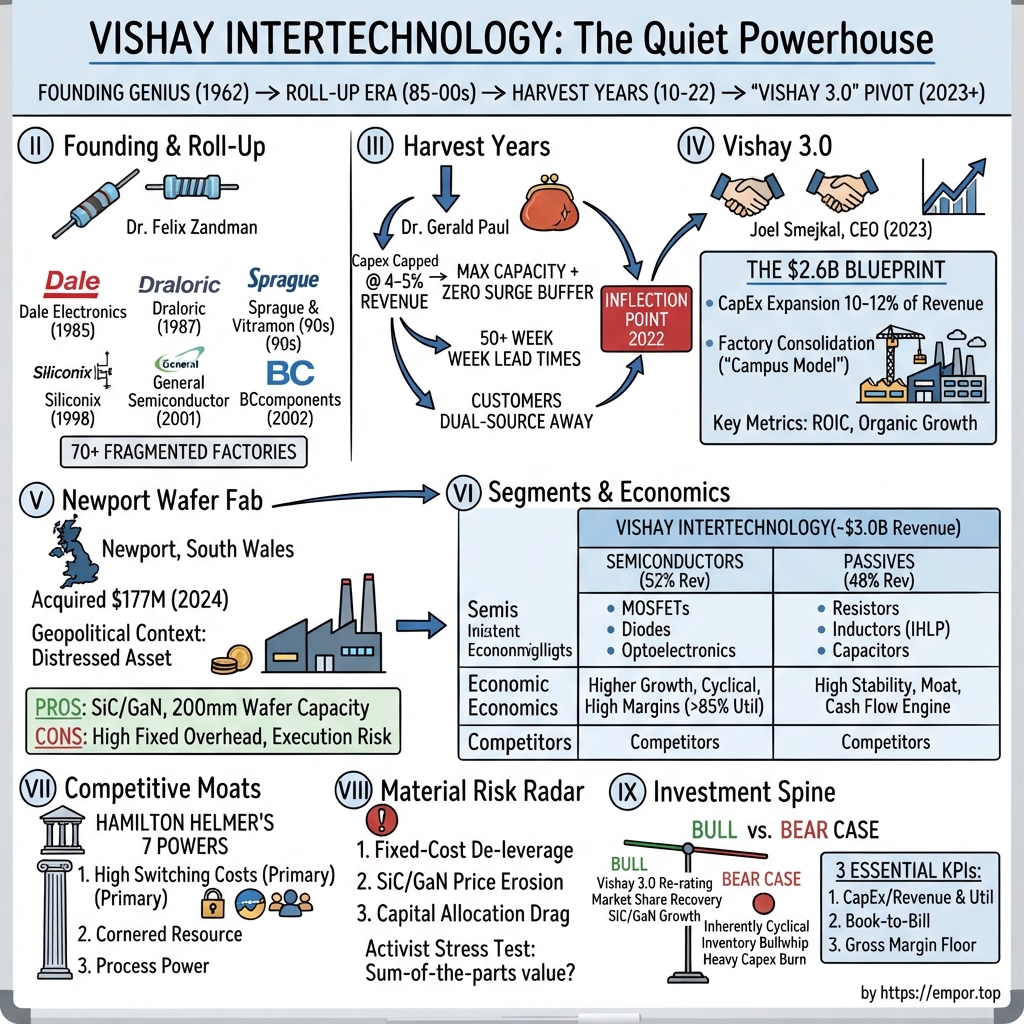
Vishay Intertechnology: The Quiet Powerhouse Behind the Physical Grid
I. Introduction & Episode Roadmap
Open up almost anything that converts electricity into work — an electric vehicle's onboard charger, a solar inverter humming on a warehouse roof, a factory robot's motor controller, an implanted defibrillator, or an AI server rack drawing more power than a suburban home — and soldered onto the circuit board is a constellation of components few outside the industry can name. Little black rectangles that resist current. Coils of wire wound around ferrite that smooth it. Slabs of silicon that switch it on and off tens of thousands of times per second.
Nobody writes magazine profiles about resistors. Yet strip them out, and the physical grid of the modern economy stops.
Vishay Intertechnology manufactures them all, in bewildering variety. The company generates roughly $3 billion a year selling passive components (resistors, inductors, capacitors) and discrete semiconductors (MOSFETs, diodes, optoelectronics) into virtually every corner of the electrified economy.1 Management notes that in a typical power application, Vishay parts can populate more than 80% of the components on the board.2 That is not a claim of technological supremacy. It is a claim about breadth — and breadth, in this industry, represents its own strategic asset.
For most of the past fifteen years, public markets treated Vishay accordingly: as a cyclical, low-multiple hardware business that harvested cash and repurchased stock. As of mid-August 2026, that description no longer fits.
The core tension
The central puzzle lies in how Vishay arrived here. Built by a Holocaust survivor through a debt-financed roll-up of orphaned component businesses, Vishay spent two decades assembling the broadest catalog in Western electronics manufacturing. Then, for roughly a decade under his successor, the company was run for cash: holding down capital expenditures, harvesting free cash flow, and clearing the balance sheet. It was a defensible strategy, and for a period, an effective one.
In hindsight, it was also a gradual surrender of market position. When the global electrification boom arrived, Vishay's factories lacked the capacity to capitalize on it.
Since January 2023, Joel Smejkal, a thirty-year company insider, has sought to reverse that position — directing billions into capacity expansion, acquiring a distressed British wafer fab following a geopolitical standoff, and, in the summer of 2026, selling $862.5 million in new stock to accelerate the effort.3 Management calls this restructuring "Vishay 3.0."
For investors, the core question is not whether the strategic narrative is compelling, but whether execution supports it. The recent evidence presents a dual picture. Vishay posted net losses in both fiscal 2024 and fiscal 2025.1 Yet over the past three quarters, order growth has accelerated significantly, yielding a second-quarter 2026 book-to-bill ratio of 1.32 and an order backlog of $1.9 billion, up 18% in a single quarter.2 Both data points are accurate, and the gap between current financial losses and expanding backlogs defines the investment case.
The roadmap
The episode traces this corporate arc: Felix Zandman's founding focus on precision measurement and the roll-up that followed; the harvest decade and the capacity constraints it created; the executive transition and management's promises versus actual delivery; the Newport wafer fab acquisition as a stress test of capital allocation under geopolitical pressure; the segment-level economics distinguishing high-margin proprietary parts from commoditized components; the strength of Vishay's competitive moat; the primary risks to the thesis; and the key operational metrics that will determine whether Vishay 3.0 marks a genuine transformation or an expensive detour.
The narrative begins with a man hiding under a floor.
 Subscribe on LinkedIn
II. Founding Genius & The Roll-Up Era (1962–2000s)
For seventeen months during the Second World War, a young Polish Jew named Felix Zandman lay concealed in a pit beneath the floorboards of a Christian family's home. To keep from losing his mind, he asked his uncle — hidden alongside him — to teach him mathematics. Geometry, algebra, and calculus were worked through in darkness and whispers. Zandman survived. Most of his family did not.4
He emerged, moved to France, earned a doctorate, and became a physicist focused on a specific engineering problem: how to visualize stress inside a solid object. His solution was PhotoStress — a coating that, when viewed through polarized light, renders internal strain inside a bridge or an aircraft wing as visible bands of color. It was an elegant application of applied physics that established his early career.
In 1962, he founded a company to commercialize the technology, naming it Vishay after the Lithuanian village where his family had lived and where his relatives had been murdered during the Holocaust.5 That origin shaped a durable corporate culture. Zandman built Vishay around technical precision, permanence, and an insistence on operational self-reliance.
From measurement to resistance
The company's commercial breakthrough came from an adjacent challenge. Measuring structural strain accurately requires a resistor whose value does not drift with temperature or time; otherwise, the sensor measures its own instrument. Zandman developed Bulk Metal Foil resistor technology, photo-etching a thin alloy foil into a pattern designed so thermal expansion counteracted temperature-induced resistance changes. The result was among the most stable resistors ever manufactured. Over his career, Zandman accumulated more than 70 patents.5
While Bulk Metal Foil resistors created a profitable, defensible niche in military and aerospace applications, they remained a specialized market. The scale of modern Vishay grew out of a distinct commercial insight Zandman reached two decades later.
The insight: engineers hate purchase orders
By the mid-1980s, Zandman recognized an operational friction that component manufacturers had largely overlooked. Design engineers at industrial and automotive manufacturers do not want to act as procurement specialists. A single circuit board can require 400 discrete components sourced from 20 vendors, each requiring separate qualification paperwork, lead times, quality audits, and failure analysis. Every extra supplier adds administrative overhead and creates another potential point of failure for a production line.
If one supplier could provide most of that bill of materials at automotive quality through a single relationship and unified documentation, it would earn a structural preference that transcended the technical merits of any individual component.
Vishay subsequently embarked on an aggressive, debt-financed acquisition strategy.
The rollout progressed rapidly. Acquiring Dale Electronics in 1985 and Germany's Draloric in 1987 established leadership in wirewound and metal film resistors. Acquisitions of Sprague and Vitramon in the early 1990s added tantalum and ceramic capacitors, including high-reliability grades for mission-critical applications.
The company changed its scope in 1998 by acquiring controlling interest in Siliconix, securing a major position in power MOSFETs — active semiconductor devices that switch current rather than passive components that shape it. Passives and semiconductors operate under different financial dynamics: semiconductors generate higher gross margins when fabrication facilities run at high utilization, but create steep operating leverage when demand drops. In a single transaction, Vishay attached a cyclical, high-margin semiconductor business to a steady, lower-margin passive base, creating a tension between the two segments that would define its financial results for decades.
The acquisition of General Semiconductor in 2001 expanded the rectifier and protection-diode product lines. In 2002, Vishay acquired BCcomponents — the former passive components division of Philips — adding European manufacturing scale and rounding out its broad-line catalog. By the end of this expansion phase, Vishay could offer customers a comprehensive component portfolio.
Zandman's acquisition strategy followed two consistent principles. First, he targeted corporate orphans — divested divisions that were no longer strategic to their parent conglomerates. These assets were acquired at attractive valuations alongside established customer relationships that would have taken decades to build organically. Second, he bought during industry downturns when seller motivation was high and valuations reflected cyclical troughs. This disciplined approach to opportunistic buying foreshadowed the company's Newport wafer fab acquisition two decades later.
This strategy established a Western supplier capable of providing a single point of contact across both passive and active components. While Asian competitors focused deeply on specific component categories and U.S. semiconductor producers avoided passive components, Vishay built a combined portfolio that peers could not match without replicating decades of acquisitions.
What the roll-up actually bought — and what it cost
The roll-up strategy delivered clear strategic advantages while creating long-term operational challenges.
On the positive side, it created an unmatched product catalog in Western markets and secured tens of thousands of component design-wins on customer circuit boards. In the electronic components sector, a design-win functions much like an annuity. Once a specific Vishay component is qualified inside an automotive braking module, replacing it requires re-testing the entire module, incurring significant engineering costs and regulatory paperwork to save fractions of a cent. Consequently, high switching costs are driven primarily by customer qualification requirements rather than proprietary technology alone.
However, this growth came at the expense of operational integration. Each transaction added isolated factories, distinct processes, and regional management teams scattered across dozens of small, single-product plants. Vishay accumulated a fragmented footprint that duplicated fixed costs and prevented the realization of full scale economies on the factory floor.
Management continues to address these structural legacy issues. On the second-quarter 2026 earnings call, when questioned about pathways to margin expansion, Chief Executive Joel Smejkal cited footprint optimization as a key remaining lever, noting, "we got a lot of factories," while outlining restructuring initiatives planned for 2027 and 2028.2
Zandman served as Chief Executive Officer until 2005, when he handed executive leadership to long-time executive Dr. Gerald Paul while remaining Executive Chairman and Chief Technical Officer. Zandman died on June 4, 2011, at age 83.5 He left behind a comprehensive product catalog, but the company's subsequent allocation of the cash flows generated by that catalog would determine its modern trajectory.
III. The Harvest Years & The Capacity Trap (2010–2022)
When Dr. Gerald Paul took over executive leadership, he inherited an extensive catalog, a fragmented global plant footprint, and a balance sheet carrying the residue of two decades of debt-financed acquisitions. His strategy shifted Vishay's focus from aggressive expansion to operational discipline and cash generation.
Under Paul's direction, Vishay tightly controlled operating costs, paid down debt, and restricted capital expenditures to a modest fraction of revenue. The business consistently generated free cash flow, returning capital to shareholders through dividends and share repurchases. Measured by conventional metrics — debt reduction, cash generation, and balance sheet strength during cyclical downturns — the harvest strategy initially succeeded.
That capital-allocation philosophy was codified in corporate policy: a formal commitment to return at least 70% of free cash flow to stockholders.6 While this policy rewarded investors with steady returns, it treated Vishay as a mature cash generator rather than a growth business requiring ongoing reinvestment.
The bill comes due
The market environment shifted dramatically in the late 2010s and early 2020s. Demand surged for Vishay's core components as global electrification accelerated. Electric vehicles require far more power semiconductors and passive components than traditional internal combustion vehicles to support battery management, onboard chargers, traction inverters, and higher-voltage systems. At the same time, demand expanded across solar and wind inverters, industrial grid infrastructure, 5G base stations, and automated manufacturing systems. The central challenge for component suppliers swung quickly from demand creation to supply capacity.
Having constrained capital expenditures for over a decade, Vishay lacked the manufacturing capacity to meet this sudden surge.
The resulting strategic setback unfolded gradually. Delivery lead times stretched to a year or longer for key parts. In response, major Tier 1 automotive and industrial customers qualified secondary suppliers to keep their assembly lines running. Program by program, incremental order volume shifted to competitors that had invested in expanding capacity ahead of demand.
Joel Smejkal later offered a candid assessment of the prior operating model. Addressing investors during the first-quarter 2026 earnings call, he observed that at a similar point in a typical cycle, "much of Vishay 2.0 capacity would have been sold out on allocation and with lead times longer than 1 year," adding that because fulfillment took too long, "Vishay missed repeat opportunities, and we were no longer a reliable supplier to the customers."7 Smejkal's acknowledgment underscored how prolonged capital discipline had compromised customer relationships and market position.
The financial illusion
This dynamic illustrates a common pitfall in capital-intensive manufacturing: underinvestment often flatters financial metrics in the short term. Suppressing capital expenditure temporarily boosts free cash flow, while lower depreciation expenses support reported profit margins. Return on invested capital can appear to improve simply because the net asset base is shrinking. Traditional value screens may flag such a company as attractive even as its underlying competitive position degrades, because lost design-wins do not show up immediately on financial statements.
Vishay's financial performance under the harvest strategy peaked in 2022, generating approximately $3.5 billion in revenue and $428.8 million in net income, or $2.98 per diluted share.1 While these figures reflected strong cyclical demand during widespread industry component shortages, they also masked the structural capacity constraints building within the business.
The capital constraint affected Vishay's two main segments unevenly. Passive component manufacturing can often be expanded incrementally by adding assembly equipment or factory shifts. By contrast, semiconductor fabrication requires massive, upfront capital investments in specialized facilities that take years to construct and qualify. Applying a tight, uniform capital cap across the company disproportionately starved the semiconductor business of necessary investment, creating an acute capacity deficit in power discrete components.
By 2022, Vishay's board of directors — chaired by Marc Zandman, son of the founder — recognized that prioritizing cash harvest was limiting both market share and equity valuation. Reversing course required an expensive, multi-year investment program: committing heavy capital expenditure through cyclical downturns, accepting depressed near-term earnings and negative free cash flow, and building capacity ahead of an eventual demand recovery.
The board committed to this strategic transition. In January 2023, it appointed Joel Smejkal, a thirty-year company veteran, as chief executive officer to lead the expansion strategy known as Vishay 3.0.
IV. The "Vishay 3.0" Pivot & Management Deep Dive
Joel Smejkal's first earnings call as chief executive officer was not a triumphal affair. Taking leadership in January 2023 just as the market began a sharp cyclical downturn, his initial presentation framed less of a new strategy than a candid assessment of corporate character.
A year later, on the February 2024 call, he articulated the required organizational change in terms that read as a critique of the operational model he had spent his career executing. The goal, Smejkal stated, was to move "from a cash flow managed business to a P&L driven company, from a company that fulfills customer orders to one that anticipates customer needs."6
That distinction highlighted a fundamental shift in capital allocation. A cash-flow-managed enterprise prioritizes capital extraction, whereas a profit-and-loss-driven business prioritizes revenue expansion. Vishay had spent a decade optimizing the former at the expense of the latter.
Who he is, and why it matters
Smejkal is a company veteran with over thirty years in Vishay's operational and sales organizations prior to assuming the chief executive role. For investors, insider leadership carries dual implications: long-serving executives possess deep institutional knowledge to navigate entrenched corporate structures, yet they may also be reluctant to challenge historical practices.
Evidence from Smejkal's tenure suggests a willingness to confront past shortcomings directly. His public communications have been notably specific regarding operational failures. On the second-quarter 2026 earnings call, he stated that "historically, Vishay underserved or didn't serve high-margin customers during market upcycles," describing the restructuring effort as regaining accounts "where we had the print position but didn't have the capacity to fulfill orders."2 In short, Vishay had secured design positions on customer circuit boards but lacked the manufacturing capacity to deliver product.
The financial leadership underwent a parallel transition. Lori Lipcaman, chief financial officer during the harvest era, was succeeded by David McConnell in 2024.8 McConnell established a more detailed disclosure style on quarterly calls, explicitly detailing the basis-point margin drag from the Newport wafer fab and clarifying operational reporting metrics for analysts.9
Marc Zandman continues as executive chairman, chief business development officer, and president of Vishay Israel—a combination of roles that warrants ongoing scrutiny regarding corporate governance and board oversight.
The blueprint
At its inaugural Investor Day at the New York Stock Exchange on April 2, 2024, management outlined the Vishay 3.0 plan.6 Key operational commitments included:
Increased capital intensity. Vishay committed to approximately $2.6 billion in capital expenditures from 2023 through 2028, representing a major departure from the constrained spending of the previous decade.10 Capital expenditure reached 8.9% of revenue in 2025, with management guiding to $400 million to $440 million in 2026 capex, with over half allocated to a primary expansion project.9
A 300-millimeter wafer fab in Germany. That project centers on a 300-millimeter silicon wafer facility in Itzehoe. Larger wafer diameters significantly increase die yield per production run, reducing unit manufacturing costs across sellable devices—a standard semiconductor manufacturing efficiency Vishay historically lacked. As of the second-quarter 2026 earnings update, equipment assembly was complete, installation was targeted for completion in the third quarter, engineering wafer trials were scheduled for late 2026, and non-automotive commercial production remained projected for mid-2027.2
Manufacturing consolidation. Moving away from isolated single-product facilities, Vishay began consolidating operations into multi-line production campuses. Key developments in La Laguna and Juárez, Mexico, aim to lower direct labor costs while providing North American customers with nearshore, tariff-insulated supply lines.9
Expanded distribution channels. Management identified inventory availability at distributors as a primary commercial priority. By accelerating product qualifications—adding more than 10,000 stock-keeping units through subcontractor initiatives over two years—Vishay sought to prevent customers from selecting alternative suppliers during design phases.9
Testing the promises against the record
With Vishay 3.0 underway for over three years, management's execution record displays both strategic consistency and operational delays.
Strategic continuity: Management has maintained a consistent narrative across quarterly updates from late 2023 through mid-2026. The eight strategic pillars, capacity-expansion priority, and customer-engagement framework have remained steady without shifting core objectives.
Schedule slipping: Timeline execution has lagged initial targets. The financial metrics proposed at the 2024 Investor Day for 2028 depended on a broader market recovery that developed slower than projected. Addressing analysts in May 2026, Smejkal acknowledged the delay, pointing to extended channel inventory digestion through early 2025 and new international trade tariffs, while reaffirming long-term targets: "the target of revenue is still there. Gross margin, yes, still there. The timing of it is delayed a little bit."7 Capital deployment also trailed initial plans: 2025 capex came in at $273 million against a $300 million to $350 million guidance range due to deferred equipment deliveries for the German fab.9 This mirrored 2023, when capital outlays reached $329 million against a planned $385 million.6
This pattern demonstrates that while management has adhered to its strategic roadmap, operational and market factors have repeatedly extended project completion dates.
Executive compensation alignment: Smejkal's total reported compensation rose to approximately $10.3 million for fiscal 2025, up from $5.5 million in 2024 and $4.8 million in 2023, driven primarily by an $8.2 million stock award.8 Fiscal 2025 marked a period in which Vishay generated a net loss of roughly $9 million on $3.07 billion in revenue.1 Although multi-year equity grants are structured to incentivize long-term performance rather than single-year profitability, a sharp increase in executive remuneration during a loss-making fiscal year highlights a potential misalignment between compensation structures and near-term operating performance.
The operational discipline of Vishay 3.0 faced an immediate test in Wales.
V. M&A Stress Test: The Newport Wafer Fab Deal ($177M, 2024)
In the industrial sprawl of South Wales sits a 28-acre semiconductor site that spent the better part of a decade as a political football.
The Newport fab is the United Kingdom's largest semiconductor manufacturing facility. In 2021, it was acquired by Nexperia — a Dutch-headquartered chipmaker owned by the Chinese group Wingtech Technology (闻泰科技). The purchase landed in the middle of a hardening Western consensus against Chinese ownership of strategic technology assets, leading the UK government in 2022 to order Nexperia to divest most of its stake on national security grounds.
That order created a rare situation: a forced seller of an operational, automotive-certified semiconductor fabrication plant.
The deal
Vishay stepped in. The transaction was announced in late 2023 and completed on March 6, 2024, for approximately $177 million in cash, funded from cash on hand.11 The purchase secured an automotive-certified 200-millimeter wafer fab with the capacity to produce more than 30,000 wafers per month across 28 acres, staffed by roughly 500 employees and carrying an established history of supplying automotive and industrial customers.11
In late 2024, Vishay committed a further £51 million to the site — supported by a £5 million Welsh Government grant — as the initial phase of a planned £1 billion investment intended to add more than 400 jobs by 2030.12
Was it a good price?
On a capacity-per-dollar basis, the economics were compelling; on a cash-flow-per-dollar metric, the asset required two years to achieve operational neutrality.
The capacity math was straightforward. Building a new 200-millimeter fab from scratch costs anywhere from several hundred million to over a billion dollars and requires years of development before generating initial revenue. Vishay paid $177 million for an operating, fully qualified, staffed facility. On a replacement-cost basis, this represented a substantial discount driven by a government-mandated sale rather than asset impairment.
The transaction illustrates a broader principle: geopolitical dislocation can produce forced sellers of physical infrastructure, allowing strategic buyers to acquire operational assets well below replacement value.
However, a manufacturing facility becomes a bargain only when its production lines are running at volume.
The overhead problem
Semiconductor fabs carry high fixed overhead. Cleanrooms, specialized equipment, utility infrastructure, and technical personnel consume capital regardless of wafer throughput. Owning an underutilized fab converts potential capacity into a persistent margin drag until production volume scales.
Vishay acquired Newport at the onset of an inventory destocking cycle across automotive and industrial end markets. In the fourth quarter of 2025 — nearly two years after closing — the Newport facility was still reducing Vishay's consolidated gross margin by approximately 130 basis points and compressing the MOSFET segment's gross margin by roughly 600 basis points, an improvement from a 720-basis-point drag in the third quarter.9 Management guided that margin drag down to between 50 and 75 basis points for the first quarter of 2026, projecting gross-profit neutrality upon exit.9 Vishay met that milestone: Chief Financial Officer David McConnell confirmed on the May 2026 earnings call that the company "exited the quarter with Newport at gross profit neutral."7
While the immediate margin drag has dissipated, the duration of the transition highlights the operational friction of customer qualification.
The qualification grind
Acquiring an automotive-certified fab does not guarantee immediate customer adoption. Tier 1 automotive suppliers must conduct site audits, after which each vehicle program must approve process change notifications for components sourced from the facility. This approval cycle is sequential and structurally slow.
Two and a half years post-closing, qualification remains in progress. On the second-quarter 2026 earnings call, Chief Executive Officer Joel Smejkal reported that nine of ten customer audits had been completed, with "a couple more to go," adding that securing customer program-level approvals "has taken a little time."2 He noted that management expects additional program approvals monthly through the end of 2026.
The site also fulfills a broader network role: migrating automotive component programs to Newport frees up production capacity at the 200-millimeter fab in Itzehoe, Germany, which can then be redirected toward faster-growing, higher-margin demand.2 Newport functions both as a standalone production facility and as a capacity release valve for the broader manufacturing network.
The verdict, provisionally
Vishay acquired a scarce manufacturing asset at a defensible price, then absorbed two years of margin drag to integrate and populate its production capacity during a period marked by consecutive annual net losses. The low purchase price was offset by the operational friction of the ramp-up. Evaluating the long-term value of the transaction requires monitoring the MOSFET segment's gross margin — where Newport's financial results are consolidated — rather than focusing strictly on the initial purchase price.7
This operational integration leads to a core question regarding segment economics: what do Vishay's individual product divisions actually earn, and which segment drives the company's baseline profitability?
VI. Segment Breakdown & Core Business Economics
A persistent assumption about Vishay — repeated often enough to become received wisdom — is that it is fundamentally a semiconductor producer with a passive components attachment. In fiscal 2025, the numbers showed otherwise.
Vishay reports six product segments. Ranked by fiscal 2025 revenue, they are: Resistors at $759.3 million, MOSFETs at $630.5 million, Diodes at $592.8 million, Capacitors at $505.6 million, Inductors at $364.4 million, and Optoelectronic Components at $216.6 million.13
Grouping these segments inverts the conventional narrative. The three passive divisions — resistors, capacitors, and inductors — generated roughly $1.63 billion, or about 53% of total revenue. The three semiconductor segments generated roughly $1.44 billion, or about 47%.13 By revenue, Vishay is primarily a passives manufacturer operating a substantial discrete semiconductor business alongside it.
This distinction is critical because the two operational halves display fundamentally different financial behaviors.
The passives half: slow, sticky, unglamorous
Passive components do not perform computation; they manage electric current. A resistor limits current flow, a capacitor stores charge and smooths voltage fluctuations, and an inductor resists sudden shifts in current, making it essential for power conversion.
If semiconductors function as valves that open and close, passive components act as the surrounding pipes, tanks, and regulators. While plumbing rarely receives top billing, electronic systems cannot function without it.
Economically, passives provide operational stability. Manufacturing volumes are vast, unit prices are frequently fractions of a cent, and cyclical swings are far less volatile than in silicon fabrication. Vishay holds its strongest market positions in specialized components rather than commodity parts: Dale-branded precision and power resistors, the IHLP power inductor family, tantalum and polymer capacitors, and high-reliability components for military and medical applications where stringent qualification standards limit competition.
The competitive landscape includes formidable international peers: Murata Manufacturing, TDK Corporation, Yageo Corporation, Kyocera AVX, and Littelfuse. In high-volume commodity passives — particularly standard multilayer ceramic capacitors (MLCCs) — Vishay is not the low-cost producer. When asked on the second-quarter 2026 earnings call about MLCC exposure, Chief Executive Officer Joel Smejkal noted that Vishay's ceramic offerings are "more specialized," concentrated in military and medical markets, and that the company captures compute orders primarily when competitors experience extended lead times.2 This positioning reflects a tactical supplier filling capacity gaps rather than a market leader setting prices.
Currently, Vishay's main area of momentum in passives is polymer tantalum capacitors, a chemistry increasingly adopted for artificial intelligence power delivery. Management reports strong demand and extended competitor lead times, prompting capacity expansion at existing facilities alongside a new production line in La Laguna, Mexico.2
The semiconductor half: high-beta silicon
The discrete semiconductor segments provide Vishay's primary operating leverage. Power MOSFETs and rectifier diodes serve as the electronic switches and directional valves in power systems. When fabrication facilities run near full capacity, incremental sales drop through at high gross margins because fixed costs are already absorbed. When factory utilization drops, that operational leverage operates in reverse, compressing gross margins rapidly.
Understanding what these devices do is central to evaluating the demand driving artificial intelligence and electric vehicles. A power MOSFET acts as a solid-state switch. Applying a minor control voltage allows large currents to pass; removing the voltage stops the current. Power electronics systems operate by switching these devices tens or hundreds of thousands of times per second, while passive components smooth the resulting pulsed current into steady voltage outputs. This process enables data centers to convert high-voltage grid power down to processor-level requirements, and electric vehicles to convert battery power for motor propulsion.
Each switching cycle dissipates a small fraction of energy as heat. Repeated hundreds of thousands of times per second across thousands of power stages, minor efficiency losses aggregate into megawatts of waste power and heavy cooling requirements. Consequently, switching efficiency is paramount, driving interest in wide-bandgap materials like silicon carbide and gallium nitride, which switch faster and tolerate higher voltages than silicon while wasting less energy per cycle. However, wide-bandgap materials carry higher production costs, leaving traditional silicon as the dominant choice for most sockets. As a result, Vishay's volume MOSFET and diode business remains its primary commercial engine, with wide-bandgap technology representing a future option rather than the current earnings baseline.
In discrete semiconductors, Vishay competes with STMicroelectronics, onsemi, Infineon Technologies, ROHM Co., Ltd., and — in automotive discretes — Nexperia, the former owner of the Newport fab, from which Vishay has been gaining market share.7
What the margin history actually shows
Vishay's recent financial results illustrate how fixed-cost leverage operates across different points in the industrial cycle.
In fiscal 2023, Vishay generated $3.40 billion in revenue and $974.5 million in gross profit — a 28.6% gross margin — resulting in net income of $323.8 million.1 By fiscal 2025, annual revenue fell by 10% to $3.07 billion. Over the same period, gross profit dropped by 39% to $594.9 million, pushing the gross margin below 20% and resulting in a net loss.1
This steep profit decline was driven by two compounding factors. First, lower factory utilization spread fixed manufacturing costs over fewer units. Second, Vishay was simultaneously adding depreciation expenses from its Vishay 3.0 expansion program while absorbing fixed overhead from the newly acquired Newport fab. Consolidated depreciation and amortization rose from $184.4 million in 2023 to $224.7 million in 2025.1 In effect, the business absorbed the financial drag of building future capacity during a cyclical trough in demand.
This dynamic was a direct consequence of the capital commitments under Vishay 3.0, providing short-term evidence for critics who viewed the aggressive investment strategy as value-destructive during the two-year cyclical downturn.
The inflection, and what it proves
Operating performance began to shift in early 2026 as volume recovery reversed the direction of operating leverage.
First-quarter 2026 revenue reached $839 million with a 21.0% gross margin, exceeding management guidance and rising 17% year over year.7 Second-quarter adjusted revenue rose to $919 million with an adjusted gross margin of 22.6% — up 9.5% sequentially and 21% year over year — driven by an 18% increase in unit volume and a 2% rise in average selling prices.2 Adjusted operating margin expanded from 1.4% in the second quarter of 2025 to 5.8% in the second quarter of 2026, while adjusted earnings per share recovered from a loss of $0.07 to a profit of $0.19.2 Consequently, management guided third-quarter 2026 revenue to between $945 million and $975 million with a gross margin of 24.0%, advancing its 24% gross margin timeline ahead of schedule.2
From an analytical standpoint, the structure of the second-quarter expansion is notable: top-line growth was driven primarily by an 18% year-over-year increase in unit volume rather than price increases.2 Price-driven revenue expansion during a supply crunch often reflects temporary scarcity rents that evaporate as industry capacity normalizes. By contrast, volume growth alongside expanding customer accounts supports the premise that Vishay is recapturing lost market share. While broader industry demand recovery benefits all component makers, this volume-led trend aligns with management's capacity-expansion thesis rather than a temporary pricing surge.
How Vishay wins, and how it loses
Wins: Catalog breadth combined with customer qualification. When an engineer designing an AI power system or an EV charger can source MOSFETs, diodes, current-sense resistors, power inductors, and polymer capacitors from a single qualified supplier, the reduction in procurement friction is significant. Furthermore, the engineering and regulatory costs of re-qualifying alternative parts create substantial switching barriers. Management has monetized this breadth through reference designs — pre-validated circuit blueprints composed entirely of Vishay parts that effectively lock in the complete bill of materials.9
Loses: Commodity scale and a structurally lower margin ceiling relative to tier-one peers. Vishay's target for 2028 is a 30% gross margin.10 Leading passive competitors like Murata and TDK have historically generated margins well above that level. Consequently, Vishay's long-term financial target represents a level that its most profitable competitors view as a baseline.
This leads to the central strategic question: does this operational model create a durable competitive moat?
VII. Competitive Moats: Helmer 7 Powers & Porter's 5 Forces
Every component manufacturer claims customer stickiness, but inertia is often mistaken for a competitive moat. Evaluating Vishay’s advantages against established economic frameworks reveals a nuanced picture: while certain moats are genuine and resilient, others remain unproven or non-existent.
Applying Hamilton Helmer's 7 Powers
Switching costs — the primary advantage. High switching costs represent Vishay’s most defensible competitive power. The advantage stems not from superior basic components, but from stringent qualification standards. In automotive (AEC-Q101 and AEC-Q200 specifications), aerospace and defense (MIL-spec), and implantable medical devices, replacing a qualified component requires a re-validation process that can take quarters or years. A design engineer considering a swap to save fractions of a cent per unit faces substantial risks in engineering overhead, test cycles, and regulatory compliance.
Empirical evidence demonstrates that this lock-in is functional rather than theoretical. Chief Executive Officer Joel Smejkal frequently highlighted instances "where we had the print position but didn't have the capacity to fulfill orders," confirming that design wins persisted through years of supply shortfalls.2 Rather than redesigning Vishay out of circuit boards, customers qualified secondary sources to meet immediate demand while maintaining Vishay's print positions. This customer behavior provides stronger validation of switching costs than executive claims alone, as the lock-in held even when buyers had compelling operational reasons to substitute.
However, switching costs primarily protect the existing installed base rather than guaranteeing new design wins. They buy time rather than permanent immunity, and Vishay’s capacity constraints forced the company to invest heavily to defend those positions.
Cornered resource — narrow but real. Proprietary technologies such as Bulk Metal Foil and Z-Foil resistors, alongside the IHLP power inductor product line, provide genuine technical differentiation. However, these represent high-value, niche franchises that generate limited volume across a $3 billion revenue base. While they anchor the premium tier of the catalog, the bulk of Vishay's product portfolio operates under standard market dynamics.
Process power — unproven at expanded scale. Decades of proprietary manufacturing techniques in tantalum, thin-film deposition, and high-reliability assembly provide technical expertise that competitors cannot easily replicate. Yet process power can be disrupted when a manufacturer consolidates facilities, delegates volume to subcontractors, and builds new fabrication sites. Vishay is qualifying production at foundries in South Korea and China, expanding subcontractor relationships, and constructing a 300-millimeter wafer fab utilizing a wafer size the company has not previously operated.2 Transferring proprietary process knowledge across these new operations remains an ongoing execution risk.
Scale economies — a key vulnerability. Relative to tier-one global peers, Vishay lacks scale economies. Management's transition to multi-line manufacturing campuses and the construction of the 300-millimeter wafer facility are explicitly designed to address this deficit, though material cost benefits are unlikely to materialize before 2027 or 2028.
Absent powers: Vishay possesses no network effects, counter-positioning, or brand power. Competitors can replicate its broad-catalog strategy, and design engineers select components based on technical datasheets rather than brand recognition.
Porter's Five Forces, honestly scored
Buyer power — structurally high. Tier 1 automotive suppliers and major industrial original equipment manufacturers exercise significant buyer power, typically negotiating annual contracts that mandate regular price reductions. Corporate disclosures highlight this dynamic: entering 2024, management reported agreeing to low single-digit annual price reductions in exchange for higher volume share.6 By early 2026, leadership noted that annual price declines were significantly below historical averages. Deviating from past industry practice, Vishay implemented targeted price increases starting in the fourth quarter of 2025 to offset rising raw material and logistics costs, covering approximately one-third of active part numbers by mid-2026.2 While supply constraints temporarily shift pricing leverage toward component suppliers, historical patterns suggest that buyer power reasserts itself as market supply normalizes.
Threat of substitutes — minimal. Electrical power circuits fundamentally require components to manage resistance, capacitance, inductance, and switching functions. Fundamental physics offers no direct substitutes for these roles. However, while low substitution risk protects the overall component market, it does not protect Vishay specifically. The combination of low substitution threat and intense rivalry is characteristic of an essential yet highly competitive industry.
Competitive rivalry — intense and bifurcated. Pricing competition is severe in standard commodity passives, where large Asian manufacturers set market prices. Competition is more disciplined in high-voltage industrial, military-specification, and medical components, where rigorous qualification barriers limit the field of suppliers. Vishay’s margin trajectory relies on shifting product mix toward these specialized segments—a strategy management labels "channel management and product mix management," which focuses manufacturing capacity on higher-margin accounts.2
Supplier power — moderate and increasing. Price volatility in raw materials—including tantalum, copper, silver, and specialty alloys—remained a persistent headwind through 2025 and 2026, partially offsetting earnings gains from higher shipment volumes.2 Because component makers must buy these input materials on global commodity markets, supplier power exerts ongoing pressure on input costs.
Threat of new entrants — asymmetric. Barriers to establishing a broad-line component manufacturer in Western markets are high. However, state-subsidized expansion by Chinese manufacturers in passive components and wide-bandgap semiconductors represents a growing long-term competitive threat to global incumbents.
The synthesis
Vishay’s primary competitive advantage rests on switching costs within its existing installed base, supported by niche technical franchises. The company is committing $2.6 billion in capital expenditures to build the scale economies it currently lacks.10 Vishay’s competitive moat remains real but bounded, making the expansion program an effort to widen its structural advantages before legacy design positions erode.
Ultimately, a competitive moat that requires billions of dollars in capital investment to maintain is economically distinct from one that sustains itself organically. That requirement defines the core challenge facing Vishay's long-term investment case.
VIII. Material Risk Radar & Skeptic's Stress Test
Every corporate transformation story sounds convincing during the quarter orders inflect. The analytical task is to identify what must go wrong for the plan to falter — and Vishay presents several credible vulnerabilities.
Risk 1: The leverage that giveth also taketh away
Having established the fixed-cost mechanism in the segment analysis, the forward-looking exposure is distinct: Vishay's fixed cost base is now permanently larger than it was before the Vishay 3.0 transition. Full-year 2026 depreciation guidance sits at approximately $215 million, even though the 300-millimeter German wafer fab has not yet begun depreciating meaningfully.2
When the next industry downcycle arrives — as component cycles invariably do — Vishay will face it with a materially heavier cost structure than the one that produced sub-20% gross margins in 2025. Management contends that campus consolidation and footprint restructuring will lower the breakeven point. Yet by executive accounts, that restructuring does not begin until 2027.2 Consequently, new manufacturing capacity arrives well before the planned cost savings materialize — creating a tangible operational exposure rather than a hypothetical risk.
Risk 2: Chinese capacity in wide-bandgap and commodity passives
Vishay is investing heavily to compete in silicon carbide and gallium nitride — wide-bandgap materials that switch faster and handle higher voltages than standard silicon, making them critical for 800-volt electric vehicle architectures and high-density power supplies. The company released second-generation 750-volt planar silicon carbide MOSFETs in early 2026, launched its first third-generation 1,200-volt trench device shortly before, and began retooling Newport as an eight-inch silicon carbide fab.7
The strategic risk centers on timing. Vishay is entering as a late arrival in a market where Chinese suppliers have aggressively expanded silicon carbide substrate and device capacity. If that low-cost capacity floods the market before Vishay fully ramps production, the company will be building into a price-compressed environment, depressing returns on its wide-bandgap investments. Chief Executive Officer Joel Smejkal acknowledged as recently as early 2026 that "we were not a player in silicon carbide on EV yet."9 Entering semiconductor markets late carries substantial capital penalties.
A similar dynamic threatens commodity passives, where state-subsidized expansion by Chinese and Taiwanese manufacturers continues to expand industry supply.
Risk 3: Capital allocation drag and the equity raise
This area represents the sharpest near-term analytical concern, driven directly by deliberate management choices.
Vishay guided to negative free cash flow for 2026, repeating its 2025 performance, as a result of its intensive capital expenditure program.2 Meanwhile, the corporate policy of returning at least 70% of free cash flow to stockholders has effectively been reduced to maintaining a $13.6 million quarterly dividend.9 Share repurchases have halted entirely, with zero buybacks recorded in the fourth quarter of 2025 or the first two quarters of 2026.2
Then, in June 2026, Vishay issued new equity. The offering priced on June 29 at $50.00 per share — selling 15 million shares, expanded via the underwriters' option to 17.25 million, raising gross proceeds of approximately $862.5 million and net proceeds of roughly $830 million.3 Management stated the capital would accelerate growth initiatives, repay the revolving credit facility, fund research and development, and reignite "a disciplined, value-accretive M&A process."2
That sequence warrants careful examination. A company that spent over a decade prioritizing capital return suspended share repurchases, generated negative free cash flow, and expanded its outstanding share count by roughly 12% within three years. Management defends the equity offering by stating it allows Vishay to invest "across semis and passive technologies in parallel rather than sequentially."2 Issuing equity at a strong valuation to fund a verified demand inflection represents a defensible strategic decision — certainly preferable to returning to historical underinvestment.
However, subsequent market performance has been unfavorable. The stock closed at $35.07 in mid-August 2026, compared with a 52-week trading range of $11.77 to $69.47 and a 50-day moving average of $46.31.14 Investors who participated in the June offering at $50.00 face a substantial unrealized loss. While this markdown does not invalidate the capital raise, it demonstrates that public markets have erased much of the initial optimism, illustrating the stock's pronounced volatility.
An additional complexity involves Vishay's convertible debt structure: the share count used to calculate earnings per share fluctuates with the stock price, prompting management to direct investors to a dedicated supplementary schedule for financial modeling.2
Risk 4: Is the order book real?
A second-quarter 2026 book-to-bill ratio of 1.32 and an order backlog extending to 6.1 months represent strong operational demand — yet in electronic components, these exact metrics can also signal widespread double-ordering.2 Customers fearing component shortages frequently place duplicate orders across multiple vendors, canceling excess commitments once supply stabilizes. Vishay experienced this precise pattern in 2023, when its book-to-bill ratio dropped to 0.75 and distributor channels required eighteen months to digest surplus inventory.6
When questioned directly about this risk, management provided specific, verifiable indicators. Smejkal cited three key metrics: point-of-sale consumption growing 20.5% year over year, distributor inventory declining from 20 weeks to 18 weeks rather than building up, and no evidence of double-ordering across industry contacts.2 The economic logic is sound: if order backlogs were driven by phantom demand, channel inventory would be rising rather than shrinking.
Nevertheless, executive commentary acknowledged the underlying uncertainty, with Smejkal noting, "we're early in this upcycle," and adding, "we're going to watch it every quarter."2 Until shipment volumes translate into sustained end-market deployment, double-ordering risks remain unquantified.
The activist stress test: is Vishay worth more in pieces?
A familiar activist thesis suggests that Vishay comprises two distinct businesses with different capital requirements, cyclical behaviors, and investor bases. Separating the high-leverage semiconductor division from the steady passive components business could theoretically unlock value by eliminating the conglomerate discount applied to the combined entity. Corporate precedent exists within the family history: Vishay spun off Vishay Precision Group in 2010.
However, the structural case against a breakup is more compelling than in typical corporate conglomerates. Vishay's core value proposition relies heavily on its integrated breadth. The ability to supply 80% of a customer's power circuit board through a single vendor relationship, unified documentation, and pre-validated reference designs would be eliminated by a corporate split. Chief Executive Officer Joel Smejkal explicitly credited "the attractiveness of our hybrid component business model" for recent market share gains, citing customer demand for single-source procurement across full bills of materials.2 Furthermore, splitting the company would duplicate administrative overhead across an already fragmented factory footprint.
The more effective governance critique targets voting control, not operational structure. Vishay maintains a dual-class equity structure in which Class B shares carry ten votes per share. Through a family trust, Marc Zandman, Ruta Zandman, and Ziv Shoshani held shared control of approximately 35% of total voting power as of December 31, 2023.15 Marc Zandman simultaneously serves as executive chairman, chief business development officer, and president of Vishay Israel, earning total compensation of approximately $4.9 million for fiscal 2025 — a loss-making year in which the chief executive officer's compensation nearly doubled.8
While family stewardship provided the long-term perspective necessary to fund a major capital expansion, the structure concentrates voting power away from economic ownership. An executive chairman holding operational titles while compensation rises through loss-making periods creates significant corporate governance friction, limiting public shareholders' ability to enforce accountability if strategic execution falters.
The overhangs to keep on file
Two additional operational items warrant monitoring. First, tax complexity: Vishay's effective tax rate has proven volatile at low profitability levels, reaching 33.7% in the second quarter of 2026 with management guiding to 35% to 40% for the third quarter due to U.S. taxation of foreign earnings and cash repatriation.2 Management expects tax rates to normalize as pre-tax income expands; until then, operating gains convert to net income inefficiently. Second, accounting adjustments: second-quarter 2026 results included a $30 million tariff refund recorded as a reduction of both revenue and cost of sales, which was passed through to customers in the second half of the year — explaining why management reports adjusted revenue figures.2 Although fully disclosed and earnings-neutral, the entry causes headline GAAP revenue to temporarily understate the operational run rate.
IX. The Investment Story Spine: Bull vs. Bear & Key KPIs
Strip away the corporate narrative, and two distinct, evidence-based interpretations of Vishay emerge in August 2026. Both rely on the same underlying facts.
The bull case: a re-rating earned by capacity
The bull case contends that Vishay spent three years and roughly $900 million expanding manufacturing capacity through an industry downturn — chief executive officer Joel Smejkal's explicit framing on the second-quarter 2026 call — leaving it as the only Western broad-line component supplier equipped with immediate room to fulfill expanding demand.2
The mechanism is practical rather than theoretical. Electronic component buyers in 2026 are prioritizing assurance of supply over incremental price discounts as delivery lead times stretch industry-wide. Management reports customers placing orders out beyond 52 weeks to secure production slots for artificial intelligence hardware, automotive clients sharing 12-to-18-month forecasts, and customers explicitly requesting Western manufacturing locations across recent earnings calls.2 Vishay's fragmented global footprint, historically an operational drag, functions as a competitive asset for buyers factoring geopolitical risk into supply chains.
This demand extends across multiple end markets. In the second quarter of 2026, industrial revenue rose 30.1% year over year, driven by smart grid, AI power delivery, and high-voltage DC infrastructure. Aerospace and defense revenue grew 15.4% on funded missile and radar programs, healthcare expanded 14.7%, automotive rose 10.1%, and the combined telecom, computing, and consumer segment surged 28.4%.2 Expansion occurred across every major end market, sales channel, and geographic region.
If factories operate at high utilization, operating leverage works in reverse — illustrated by adjusted operating margin expanding from 1.4% to 5.8% in a single year.2 Management's 2028 target of a 30% gross margin remains intact, supported by scale efficiencies from the 300-millimeter wafer fab, bringing subcontractor assembly in-house, and initiating footprint consolidation in 2027.2
The balance sheet reinforces this thesis. Vishay closed the second quarter of 2026 with $1.3 billion in cash and short-term investments against approximately $1.1 billion in total debt — shifting to a modest net cash position from roughly $622 million in net debt a quarter earlier.16 This financial flexibility provides capital management can direct toward targeted acquisitions.
The bear case: a cyclical business wearing a growth costume
The bear case does not dispute the operational data, but questions its long-term durability.
First, historical patterns present a sobering baseline. Vishay has repeatedly experienced similar cyclical swings. Past component upcycles produced record backlogs, optimistic management commentary regarding structural demand shifts, and temporary pricing power. The 2021–2022 upcycle generated peak diluted earnings of $2.98 per share, followed by two consecutive years of net losses.1 Historical evidence does not indicate Vishay has eliminated cyclical volatility; it merely confirms the business currently benefits from an upward swing.
Second, the path to structural profitability remains steep. Even with accelerated guidance, the third-quarter 2026 gross margin target sits at 24.0%.2 Reaching the 30% goal by 2028 requires the German wafer fab to execute on schedule, footprint restructuring to deliver projected cost savings, favorable product mix to hold, raw material costs to remain stable, and pricing gains to survive market normalization. Achieving that target requires five operational variables to succeed sequentially, whereas past execution shows strategic direction holding while operational timelines slip.
Third, capital deployment remains heavy. Free cash flow is guided negative for full-year 2026. While chief financial officer David McConnell indicated capital intensity will decline from 10% to 11% of revenue, he declined to provide a specific 2027 projection, noting that absolute capital outlays may remain elevated.2
Fourth, market pricing reflects much of this operational recovery. The stock's 52-week trading range of $11.77 to $69.47 highlights how investor sentiment shifted from severe pessimism to euphoria before partially retracing.14 At $35.07 in mid-August 2026, the equity no longer trades at trough valuations, embedding an operational turnaround into the current share price.
In short, the bear case argues that investors are paying a growth multiple for a business whose 2028 gross margin target aligns with baseline profitability at premier competitors, inside an industry where the preceding two cycles concluded in net losses.
The three KPIs that actually matter
Evaluating Vishay's forward execution requires monitoring three core operating metrics.
1. Gross margin progression against corporate milestones. Gross margin serves as the central metric, aggregating factory utilization, product mix, pricing power, Newport integration, footprint restructuring, and raw material costs. Management established verifiable targets: 24.0% guided for the third quarter of 2026, and 30% by 2028.2 If gross margin stalls in the mid-20% range while revenue expands, capacity growth is generating volume without expanding unit profitability — signaling that Vishay acquired market share without securing margin expansion.
2. Book-to-bill ratio cross-referenced against distributor inventory and point-of-sale consumption. Standalone book-to-bill figures can mislead if customers engage in double-ordering. Evaluating order health requires checking three metrics simultaneously: the second-quarter 2026 book-to-bill ratio of 1.32, distributor inventory levels at 18 weeks and falling, and point-of-sale growth of 20.5% year over year.2 If book-to-bill remains above 1.0 while distributor inventory rises and point-of-sale growth decelerates, the order backlog reflects phantom demand ahead of a cyclical correction.
3. Capital intensity normalization and free cash flow conversion. Capital expenditures represented 10.5% of revenue on a trailing twelve-month basis in the second quarter of 2026, down from 11.3%.2 Management projected this figure will normalize toward 5% to 6% as major projects reach completion.9 Long-term value creation depends on capital intensity declining on schedule and free cash flow returning to positive territory. Capital expenditure that fails to normalize represents an ongoing cost of maintaining market position rather than an investment in growth.
X. Epilogue & Playbook Lessons
Certain companies reveal more about industrial strategy than their more famous peers. Vishay Intertechnology is one of them: too unglamorous to command headline attention, too essential to disappear, and carrying a sixty-four-year operating record long enough to demonstrate how shifting capital strategies alter a manufacturing franchise over decades.
Three key lessons emerge from its history.
Harvesting capital carries a delayed invoice. The Gerald Paul era was not incompetent; it was disciplined and executed cleanly against its stated goals. Management controlled operating expenses, retired debt, and returned cash to shareholders. Traditional financial metrics improved. Yet behind those reported numbers, the company's capacity to serve growth quietly eroded—a deficit invisible on financial statements until major customers began qualifying secondary suppliers.
This dynamic illustrates a central hazard in capital-intensive manufacturing: underinvestment flatters short-term financial performance. Suppressing capital expenditure inflates free cash flow, while a shrinking asset base temporarily boosts return on capital. Prolonged capital discipline mimics operational efficiency until a demand surge reveals severe capacity constraints. For capital allocators in industrial manufacturing, the relevant metric is not reported free cash flow alone, but cash generation net of the reinvestment required to maintain market position.
Catalog breadth forms a moat built on qualification friction rather than technical supremacy. Vishay's primary competitive advantage stems less from proprietary component technology than from regulatory and engineering hurdles. In safety-critical automotive, industrial, and defense applications, replacing a qualified part incurs qualification costs and testing delays that far exceed the price of the component. Consequently, Vishay retained many of its design positions on customer circuit boards even through extended lead times and shipment delays.
In fragmented markets serving regulated end uses, suppliers that minimize a customer's administrative and procurement burdens can capture durable economic relationships. However, qualification moats primarily protect existing installed bases. They do not automatically secure new design wins. Relying on customer switching costs without reinvesting in production capacity risks stranding a supplier on legacy programs while competitors capture incremental growth on next-generation platforms.
Geopolitical friction creates forced sellers of strategic infrastructure. Operational semiconductor fabrication facilities rarely trade at steep discounts to replacement value unless regulatory intervention mandates a sale. Vishay acquired the Newport wafer fab for $177 million after a UK national security order required Nexperia to divest its majority stake. Regulatory interventions can create rare acquisition opportunities, allowing strategic buyers to secure capital-intensive assets below replacement cost because the discount reflects the seller's regulatory constraints rather than structural asset impairment.
However, acquiring discounted manufacturing capacity carries ongoing operational costs. A fixed-cost asset generates true capital efficiency only when production lines operate at high utilization. The $177 million purchase price represented an initial outlay; two and a half years later, customer qualification audits and program approvals remain in progress, creating margin drag until production volume scales.
Closing reflections
In August 2026, Vishay Intertechnology stands at a pivotal point in its strategic transition. Order backlogs have expanded, gross margins have begun to recover, and net proceeds from an $830 million equity offering have strengthened the balance sheet. Yet the 300-millimeter German wafer fab—the cornerstone of the company's $2.6 billion capital expenditure plan—has not yet commenced commercial wafer production.
Whether the Vishay 3.0 restructuring achieves a permanent corporate re-rating or represents an expensive expansion into a cyclical top will not be determined by current upcycle momentum. The evaluation rests on profitability during the next downturn: whether manufacturing consolidation and footprint restructuring successfully lower fixed-cost breakeven levels, or whether the company entered the next cyclical contraction burdened by higher depreciation expenses and expanded factory overhead.
Global electrification trends remain structurally favorable. Artificial intelligence data centers, electric vehicles, renewable energy grids, and defense systems continuously require discrete components that manage, store, and switch electrical current. Vishay's broad catalog secures its role across those supply chains.
Sustaining consistent profitability alongside that operational role has proven far more difficult. Sixty-four years after Felix Zandman founded a specialized sensor company named for a lost Baltic village, converting indispensable component breadth into durable, long-term shareholder value remains the central test for Vishay Intertechnology.
References
-
Vishay Intertechnology, Inc. Annual Report on Form 10-K, FY2025 and prior years (CIK 0000103730) — U.S. Securities and Exchange Commission ↩↩↩↩↩↩↩↩
-
Vishay (VSH) Q2 2026 Earnings Call Transcript — The Motley Fool, 2026-08-05 ↩↩↩↩↩↩↩↩↩↩↩↩↩↩↩↩↩↩↩↩↩↩↩↩↩↩↩↩↩↩↩↩↩↩↩↩↩↩↩↩↩
-
Vishay Intertechnology Announces Pricing of Public Offering of Common Stock — GlobeNewswire, 2026-06-30 ↩↩
-
The Eulogizer: Industrialist Felix Zandman and IAI founder Al Schwimmer — Jewish Telegraphic Agency, 2011-06-14 ↩
-
Felix Zandman, founder of Vishay, dead at 83 — EE Times, 2011-06-06 ↩↩↩
-
Vishay Intertechnology (VSH) Q4 2023 Earnings Call Transcript — The Motley Fool, 2024-02-07 ↩↩↩↩↩↩
-
Vishay Intertechnology First Quarter 2026 Earnings Conference Call — Vishay Intertechnology, Inc., 2026-05-13 ↩↩↩↩↩↩↩
-
Vishay Intertechnology, Inc. Executive Compensation Disclosures, Form DEF 14A — U.S. Securities and Exchange Commission ↩↩↩
-
Vishay Intertechnology Fourth Quarter and Full Year 2025 Earnings Conference Call — Vishay Intertechnology, Inc., 2026-02-04 ↩↩↩↩↩↩↩↩↩↩↩
-
Vishay Intertechnology Investor Day 2024 — Vishay Intertechnology, Inc., 2024-04-02 ↩↩↩
-
Vishay Intertechnology Acquires Nexperia's Newport Wafer Fab for $177 Million — Vishay Intertechnology, Inc., 2024-03-06 ↩↩
-
£51 million Newport investment latest chapter in Wales' compound semiconductor success story — Welsh Government, 2024-11-27 ↩
-
Vishay Intertechnology, Inc. Reportable Segment Revenue Disclosures, FY2022–FY2025 — U.S. Securities and Exchange Commission ↩↩
-
Vishay Intertechnology (VSH:US) Stock & Company Overview — Bloomberg ↩↩
-
Vishay Intertechnology, Inc. Definitive Proxy Statement (Form DEF 14A) — U.S. Securities and Exchange Commission, 2013 ↩
-
Vishay Intertechnology, Inc. Quarterly Balance Sheet Data, Q2 2026 (Form 10-Q) — U.S. Securities and Exchange Commission, 2026-08-05 ↩
 LinkedIn
 WhatsApp
 Reddit
 Hacker News
 Email
Email Kindle
 RSS Feed
 Spotify
 Apple Podcasts
 Amazon Music
 Audible
 YouTube