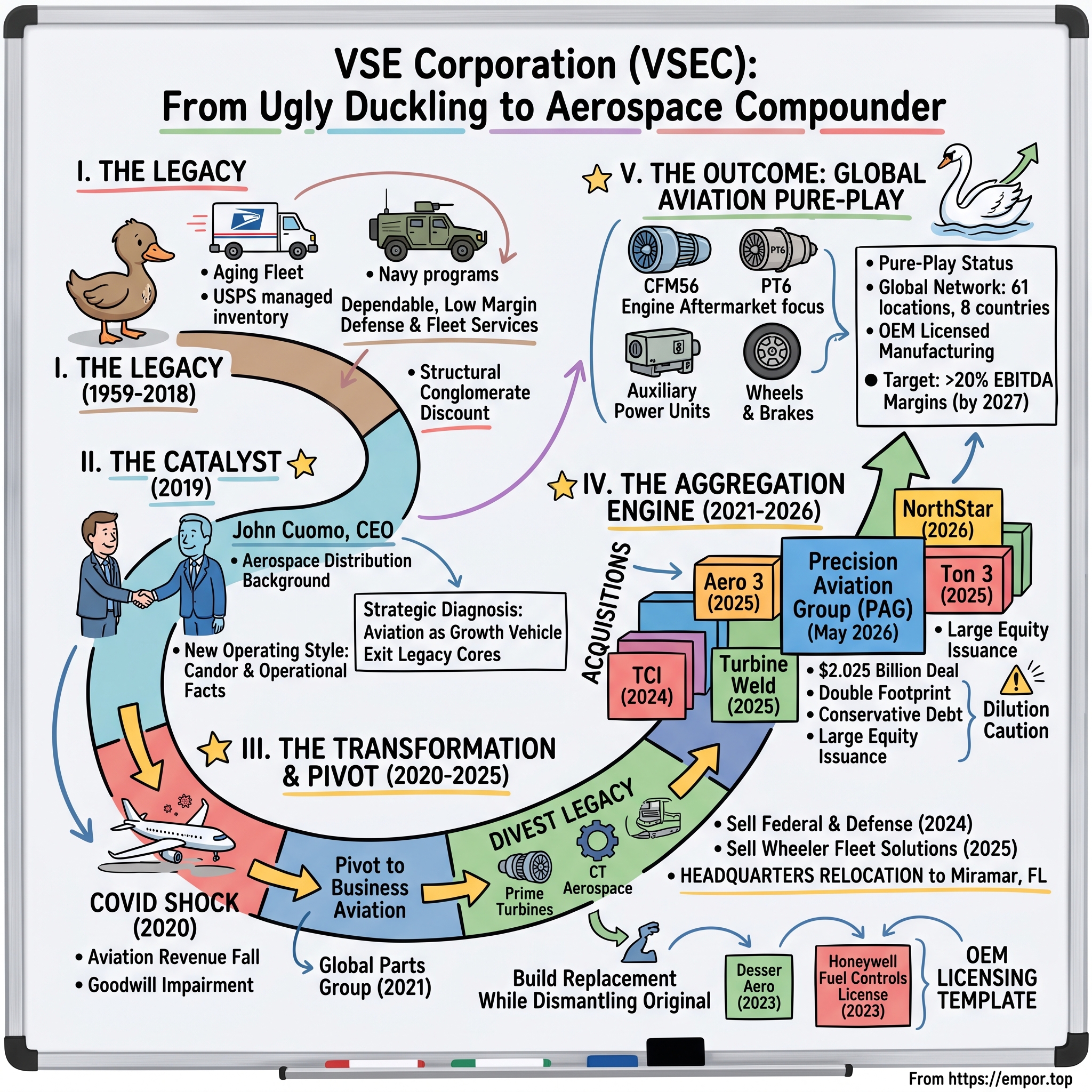
VSE Corporation: The Industrial Ugly Duckling's Ascent to Aerospace Compounder
I. Introduction & Episode Roadmap [00:00 - 08:00 | 8 Mins]
On the morning of May 6, 2026, John Cuomo dialed into a conference call to discuss VSE Corporation's first-quarter results and addressed the largest acquisition in the company's 67-year history. Asked when the combined business might reach 20% EBITDA margins, he laughed and deflected: "Ask me that next quarter." He then offered a punchline: "We've owned the business for, I think, 25 hours."21
The business in question was Precision Aviation Group, acquired for roughly $2.025 billion — a deal VSE had closed the previous day, involving a purchase price larger than VSE's entire market capitalization three years earlier.4
That exchange illustrates VSE's strategic pivot. The company spent six decades operating as a federal services contractor in Alexandria, Virginia — incorporated in Delaware in 1959, performing engineering work for the U.S. Navy, refurbishing military vehicles, and running a managed-inventory program supplying replacement parts to United States Postal Service delivery trucks.1 As recently as 2019, aviation was the smallest of its three operating segments, generating $224.5 million out of $752.6 million in total revenue.2 Today, VSE has divested its non-core operations to become a pure-play global aviation aftermarket distributor and repair company, valued by the market at roughly $5.5 billion.6
 Subscribe on LinkedIn
The Hooks and the Headline Thesis
Portfolio transformations of this magnitude are rare in public markets because they are difficult to execute cleanly. The standard failure mode is familiar: management announces a pivot, sells mature cash-generating operations at a discount, buys growth assets at high multiples, dilutes shareholders to finance the deals, and leaves investors with higher leverage and narrative promises rather than bottom-line earnings.
VSE has avoided that trap so far. In 2025, revenue rose 41.5% year over year to $1.112 billion, generating $182.9 million in adjusted EBITDA.20 Performance accelerated into 2026: first-quarter revenue grew 26.8% to $324.6 million, backed by 15% organic expansion and an adjusted EBITDA margin of 17.1%.5 On the surface, these figures show operational momentum rather than a troubled transition.
However, a complete evaluation requires looking at what this expansion cost shareholders. In 2019, VSE generated $37.0 million in net income spread across roughly 11.0 million diluted shares.2 By 2025, GAAP net income had grown to $53.5 million, but the weighted diluted share count had expanded to roughly 21.2 million.20 Following the February 2026 equity raise and stock issued to Precision Aviation Group's seller, the share count stands near 28 million.6 Total earnings have increased, but so has the volume of claims on those earnings—diluting per-share growth faster than the top-line headlines suggest. Whether the market's expanded valuation multiple fully justifies that share dilution is the central question this analysis examines.
The Strategic Transformation Mystery
Two core puzzles animate this corporate transformation.
First, how does a company divest its historical core business without destabilizing the broader enterprise? VSE's initial attempt was public and fraught. An agreement announced in May 2023 to divest its Federal & Defense segment to Bernhard Capital Partners was terminated in September 2023 when required approvals failed to materialize.910 Management subsequently sold off the segment's assets in pieces, securing a total payout far below the headline figure initially advertised.12 That stumble offers a clearer view of the company's execution risk than the cleaner transaction milestones that followed.
Second, how does a company expand overall margins while acquiring targets that initially drag those margins down? VSE has repeatedly acquired businesses operating at or below its own margin profile and attempted to expand them. CEO John Cuomo pointed to Kellstrom Aerospace as a prime example, claiming its margins expanded "from 11% margins to about 17%" within fourteen months of ownership.21 That assertion serves as a testable benchmark for VSE's operational integration capabilities, standing as one of the primary arguments for the optimistic thesis.
Narrative Arc
The narrative unfolds in five movements: the legacy years, when VSE operated as a steady but unremarkable government contractor with an embryonic aviation option inside it; the 2019 catalyst, when a distribution executive from KLX and Boeing arrived with a distinct operational thesis; the divestiture sequence, complicated by a pandemic that threatened the precise market VSE was betting on; the aggregation engine, a series of acquisitions culminating in Precision Aviation Group; and finally, the stress test—evaluating what protects the business, what remains management rhetoric, and what could break the investment thesis.
Understanding why this transformation was worth attempting requires examining what VSE originally was—and why the market long ignored it.
II. The Legacy Core: Decades as a Defense & Fleet Services Conglomerate (1959–2018) [08:00 - 18:00 | 10 Mins]
Consider the business VSE operated for most of its history. A Postal Service depot in the Midwest orders a brake assembly for a Grumman LLV delivery truck built in the 1980s. In a nearby warehouse, VSE holds that part, having contracted to run the managed-inventory program that kept those vehicles on the road. The margins were thin, but the volume was predictable. The primary customer was the federal government—an entity that does not go out of business, but periodically shifts its spending priorities.
That was legacy VSE: dependable, unglamorous, and structurally constrained by low-margin defense and fleet services.
Cold War Roots
VSE was incorporated in Delaware in 1959, founded by engineers focused on value engineering—systematically stripping costs out of complex systems without degrading function.1 Its core customers were the U.S. Department of Defense and adjacent federal agencies, which contracted VSE for engineering and technical services across large, mission-critical fleets of ships, vehicles, and aircraft.
For decades, this provided a reliable but low-growth business model. Federal services contracting follows a distinct economic structure: contractors bid on multi-year programs, staff them, and earn a modest markup over costs. Scale and operational excellence offer incremental advantages, but financial results depend primarily on winning program recompetes—contracts that come up for renewal on government schedules.
By 2019, the last full year before VSE began its strategic transformation, the Federal Services Group remained the largest of its three operating segments. It generated $313.6 million in revenue and $18.1 million in operating income—an operating margin of just 5.8%. Revenue dropped 7% year over year, driven by reduced demand for services under a U.S. Navy program.2 Shrinking revenue paired with a sub-6% margin reflected a business model devoid of meaningful operating leverage.
The Fleet Pillar and the Postal Service Problem
The second pillar of legacy VSE was Wheeler Fleet Solutions, a medium- and heavy-duty truck parts distributor. Here, the conventional narrative requires nuance.
Myth: VSE's legacy segments were uniformly low-margin drags on corporate performance.
Reality: In 2019, the Supply Chain Management Group housing Wheeler generated $214.5 million in revenue and $29.8 million in operating income—a 13.9% operating margin. That was nearly two and a half times the margin of the federal business and well above the Aviation Group's 8.0% margin that same year.2 Measured strictly by profitability, the legacy fleet operation was the best business VSE owned as management prepared to exit it.
The underlying challenge was not current profitability, but customer concentration and long-term terminal value. VSE's risk disclosures explicitly noted that the Postal Service managed-inventory program "constitutes a material portion of our revenues and profits," while warning that the Postal Service had launched a fleet replacement program for next-generation delivery vehicles. The timing of new vehicle deployment and the phase-out of the old fleet "could potentially have a significant impact on our future revenues and profits."1
In plain terms, VSE's most profitable legacy segment relied on servicing aging delivery trucks that the customer was preparing to replace. Wheeler's high margins were driven in part by the scarcity and sourcing complexity of parts for decades-old vehicles—a business model tied to a declining asset base rather than an enduring competitive advantage. Management moved to address this vulnerability before it eroded earnings; in early 2020, Chief Executive Officer John Cuomo noted that the group had begun expanding beyond the Postal Service program, delivering nearly 20% growth in non-USPS revenue in 2019.2
The Structural Flaws
Three primary friction points kept legacy VSE stagnating.
Working capital intensity without pricing power. Distributing parts to government fleets requires holding inventory against unpredictable draw-down schedules. The distributor finances the inventory, while the customer dictates the purchase timing. Consequently, financial returns depend on turning inventory faster than the cost of capital erodes its value.
An earned conglomerate discount. VSE functioned as three disparate entities—federal engineering services, commercial truck parts distribution, and a nascent aerospace repair business—sharing corporate overhead but little else. The operations offered no cross-selling opportunities, shared technology, or common customer base. Investors seeking defense services exposure could back pure-play defense contractors, while those pursuing aerospace aftermarket returns could buy focused peers like HEICO, leaving VSE's hybrid structure largely unrewarded by the market.
Capital allocation inertia. Top-line revenue moved from $760.1 million in 2017 to $697.2 million in 2018, before reaching $752.6 million in 2019. Diluted earnings per share followed a similar plateau, registering $3.60, $3.21, and $3.35 across those three years. VSE generated steady cash and paid regular dividends, but persistently reinvested capital into units with mediocre or structurally constrained economics.
The smallest segment presented a clear operational contrast. In 2019, VSE's Aviation Group expanded revenue by 54.4% to $224.5 million and increased operating income by 61.6% to $17.9 million—supported partly by the January 2019 acquisition of 1st Choice Aerospace, alongside organic growth exceeding 11%.2 A unit expanding at double digits within a flat broader portfolio signaled a strategic path forward that required new leadership to unlock.
III. The Catalyst & The Playbook: Enter John Cuomo (2019) [18:00 - 30:00 | 12 Mins]
On March 18, 2019, VSE announced that Maurice "Mo" Gauthier, chief executive officer since April 2008, would be succeeded by 43-year-old aerospace distribution executive John Cuomo, effective April 15.3 Board chair Calvin Koonce offered customary remarks highlighting Cuomo's track record of growth and operational excellence, while Cuomo's public statement followed standard executive transition templates.
The significance of the appointment lay not in the corporate press release, but in the specific industry background of the executive VSE had selected.
The Man From the Other Side of the Table
Cuomo had spent his career almost entirely in aerospace parts distribution—the segment that then constituted VSE's smallest operating unit. From 2000 to 2014, he held escalating executive roles at B/E Aerospace, including Vice President and General Manager as well as Senior Vice President of Global Sales, Marketing, and Business Development. Beginning in December 2014, he served as Group President and General Manager at KLX Aerospace Solutions, the consumables distribution business spun off from B/E Aerospace. When Boeing acquired KLX's Aerospace Solutions Group in October 2018, Cuomo became Vice President and General Manager of Boeing Distribution Services.3
He holds a Bachelor of Science in international business, a Juris Doctor from the University of Miami, and a Master of Business Administration from the University of Florida.3 That legal education was directly relevant to his operational background. The commercial foundation of aerospace distribution is fundamentally contractual: exclusive territorial rights, life-of-program authorizations, and license agreements that transfer intellectual property from original equipment manufacturers to distributors. Cuomo spent nearly two decades negotiating those documents from the distributor's side of the table.
He arrived at VSE roughly six months after Boeing absorbed his previous employer. Having observed how an OEM integration unfolds from the inside, Cuomo understood the strategic openings created by market consolidation—specifically, which supplier and customer relationships major corporate acquirers tend to leave orphaned.
The Operating Style, Read From the Transcripts
Transcripts of earnings calls over several years reveal consistent patterns in Cuomo's executive communication style.
He routinely addresses negative developments early and acknowledges operational uncertainty rather than papering over potential risks. Asked whether he would accelerate a public margin target after a strong quarter, he declined, noting: "you buy these businesses, you do all this work and all the diligence and then you have to see it play in reality and really the devil is in the detail as you start to operate the business."21 Asked about a capability at a newly acquired business he had not examined closely during transaction review, he acknowledged it directly—"candidly, I did not spend a lot of time with those businesses during diligence"—and committed to providing an answer on the subsequent call.21
Cuomo also explicitly delineates the limits of his analysis. Offering a perspective on whether elevated fuel prices might drive alternative-parts adoption, he qualified his view: "this is an opinion. It may be different."21 When an analyst noted that free cash flow was omitted from a slide listing 2026 corporate priorities, Cuomo acknowledged the oversight directly: "by the way, it should be. So that was on my part."21
Candor alone does not guarantee operational success, as articulate executives can still misallocate capital. However, a management team that systematically distinguishes verified operational facts from optimistic expectations provides a clearer baseline for investment analysis, allowing disclosures to be scored against subsequent financial results. That tracking exercise forms the basis for evaluating VSE's ongoing strategy.
The Strategic Diagnosis
The strategic landscape facing new leadership was clear. VSE owned a growing aerospace aftermarket business trapped inside a corporate structure that could neither adequately capitalize it nor command a pure-play valuation multiple. The federal services segment absorbed management focus while yielding sub-6% margins, and the fleet distribution business generated steady cash flow while confronting a customer vehicle transition beyond its control.
The aviation unit, by contrast, operated in a market with distinct structural economics—heavily regulated, consolidated among original equipment manufacturers on the supply side, fragmented among service providers, and driven by flight hours rather than government budget appropriations.
"Focus, Scale, Capitalize"
The blueprint executed over the subsequent seven years rested on four pillars.
Pillar one: complete portfolio simplification. Rather than settling for a partial exit or a carve-out with a retained stake, management concluded that public markets would never grant a hybrid conglomerate the valuation multiple awarded to a pure-play business. The company committed to exiting Federal & Defense and Fleet entirely. When announcing the initial divestiture in May 2023, Cuomo framed the move explicitly: the sale "transforms VSE's portfolio by simplifying our operations and focusing our resources on high-growth, high-margin business opportunities."9
Pillar two: reallocate capital to aviation. Capital liberated from legacy operations was earmarked exclusively for redeployment into aftermarket distribution and MRO services.
Pillar three: establish OEM exclusivity. This pillar represents VSE's primary differentiator from generic parts brokers.
When an aerospace original equipment manufacturer—such as Honeywell, Pratt & Whitney, or Collins—designs and certifies a component, that part requires operational support for thirty or forty years across thousands of active aircraft. Managing a mature, low-volume product line can distract an OEM whose engineering resources are focused on next-generation engine platforms. Consequently, OEMs frequently license aftermarket rights, granting a partner the exclusive right to manufacture, distribute, and repair specific product lines, often for the life of the program.
For the distributor, exclusive rights transform a commodity reselling operation into an annuity-like revenue stream. Instead of competing on price against rival parts brokers, the distributor operates as the sole authorized channel. Cuomo described the growth runway bluntly, noting that Tier 1 OEMs were still "managing somewhere between 75% and 80% of the aftermarket on their own," rendering the core opportunity a structural outsourcing trend rather than a market-share fight against competing distributors.21 While that framing reflects management's strategic pitch, it aligns with the contractual partnerships Honeywell, Pratt & Whitney Canada, and others have awarded VSE since 2023.
Pillar four: cultural and geographic alignment. On November 21, 2024, VSE announced the relocation of its corporate headquarters to 3361 Enterprise Way in Miramar, Florida, co-locating with its aviation segment headquarters and MRO center of excellence. Supported by roughly $3.5 million in tenant improvements, the plan called for adding 110 employees over five years on top of an existing South Florida base of about 250.15 Corporate headquarters relocations are often symbolic, but this move was substantive: it physically separated executive leadership from the Washington Beltway ecosystem that had defined VSE for six and a half decades.
Management Credibility: The Alignment Question
Any thorough evaluation must account for the underlying incentive structure driving these strategic decisions. A chief executive officer who transforms a $750 million government contractor into a $1.8 billion aviation company is compensated on a vastly different scale than one who simply manages a legacy government contractor efficiently. That dynamic is not a critique; it is a structural feature of corporate transformations that investors must weigh when management presents its strategy as the obvious path forward.
The critical test is behavioral: did management set clear targets and achieve them, communicate operational setbacks candidly, and maintain narrative consistency across years of public filings and earnings calls? On the historical record, the answer is largely yes—with one significant exception in 2023 that leadership addressed with notable transparency.
That exception marks the beginning of VSE's divestiture sequence.
IV. Portfolio Simplification: Divesting Legacy Cores & Navigating the Aviation Pivot (2019–2025) [30:00 - 45:00 | 15 Mins]
Cuomo had been in the job for eleven months when global aviation stopped.
The COVID Shock
The financial impact of the 2020 pandemic was immediate. VSE's Aviation segment revenue fell 26.5% to $165.1 million as reduced airline passenger traffic severely curtailed commercial maintenance, repair, and overhaul activity. Total corporate revenue declined 12.1% to $661.7 million, pushing the company from $37.0 million in net income the prior year to a net loss of $5.2 million. VSE recorded $33.7 million in goodwill and intangible asset impairments during the year, concentrated primarily within the aviation reporting unit.7
The impairment highlighted the initial vulnerability of the transformation: eighteen months after leadership identified aviation as the company's primary growth vehicle, market conditions forced a writedown of its carrying value.
Management responded by reducing costs to match demand, divesting non-core assets such as Prime Turbines and CT Aerospace, and raising roughly $52 million in net proceeds through a follow-on equity offering. By year-end 2020, the company maintained $175.5 million in cash and available capacity under its $350 million revolving credit facility.7 Cuomo framed VSE as emerging from the downturn as "a leaner, more competitive business" positioned for growth through new business development and bolt-on acquisitions.7
A major strategic test followed in July 2021. With commercial aviation still deeply impaired, VSE acquired Global Parts Group for approximately $38 million in cash—an integrated distribution and MRO provider based in Augusta, Kansas, that generated roughly $65 million in 2020 revenue and served more than 3,000 business and general aviation customers across over 100 aircraft platforms.8
The transaction carried two primary strategic implications. First, acquiring aviation assets during an industry downturn allowed VSE to expand at attractive valuations. Second, it represented a deliberate pivot toward business and general aviation, a market with structural dynamics distinct from commercial airlines. Cuomo outlined the logic behind the shift, noting that business and general aviation grows organically at a somewhat slower pace but permits deeper content penetration platform by platform and holds up better when macroeconomic conditions wobble.21 That operational thesis was subsequently tested as market conditions normalized.
Executing the Divestitures: The Part That Went Wrong
On May 1, 2023, VSE announced the sale of its Federal & Defense segment to Bernhard Capital Partners for up to $100 million—$50 million in upfront cash and up to $50 million in milestone-contingent earn-outs—with closing scheduled between late 2023 and early 2024.9
On September 27, 2023, VSE announced that the transaction had been terminated. The parties mutually ended the agreement because necessary approvals and closing conditions were not expected to materialize within a reasonable timeframe, for reasons VSE stated were unrelated to either company. John Cuomo's statement was unusually direct: "Our decision to terminate the agreement did not come lightly, but we believe it provides a favorable opportunity for our team members and shareholders to move more quickly and effectively toward the sale of this business."10
The final realization fell well short of those earlier targets. On February 29, 2024, VSE announced it had completed the Federal & Defense divestiture through two separate transactions with distinct buyers for total cash consideration of $44.0 million, which included $10.0 million in estimated net working capital adjustments.12
Compared to the $100 million headline figure announced nine months earlier—or even the $50 million in upfront cash Bernhard Capital Partners had originally agreed to pay—VSE realized substantially less. A segment that generated over $300 million in annual revenue in 2019 was ultimately sold for less than a single quarter of its historical top-line contribution.
What this says about the business, not the sellers: federal services contracts are not property in the same sense as an exclusive distribution authorization. They represent revocable relationships with a single counterparty, subject to government novation approvals, and their value to an acquirer is strictly bounded by how easily the government can put those contracts up for recompete. VSE's difficulty in monetizing its defense business offers concrete evidence that the segment lacked durable economics—a reality that retroactively validated the strategic decision to exit, while simultaneously demonstrating that the assets were worth far less than management first advertised.
Building the Replacement While Dismantling the Original
What made the 2023–2024 transition difficult to execute was that VSE was simultaneously unwinding roughly two-thirds of its historical revenue base while building the operational infrastructure to replace it. Divestitures consume significant legal, financial, and management bandwidth—and executing them alongside new operational stand-ups increases execution risk.
In 2024, the operational build-out proceeded across three main initiatives. VSE opened a 45,000-square-foot distribution center in Hamburg, Germany, initially supporting Pratt & Whitney Canada's regional operations across Europe, the Middle East, and Africa before expanding into tires, tubes, and batteries. The company also launched an OEM-licensed avionics repair program and established manufacturing capabilities following its acquisition of Honeywell's fuel controls line. Management stated that the fuel controls program exceeded expectations and contributed meaningfully to 2024 margins, with full transition of OEM manufacturing capabilities planned for 2025.1
The Hamburg facility highlights the physical requirements of aerospace distribution. Exclusive distribution rights are territorial, meaning that serving an OEM's regional customer base requires a localized footprint—including warehouse capacity, inventory, customs clearance, and local personnel. Establishing that facility represented the capital deployment required to convert contractual distribution authorizations into realized revenue.
By the end of 2024, VSE operated 33 facilities across 6 countries—15 repair facilities and 17 distribution facilities—with roughly 1,400 employees.1 That operational base laid the foundation for further expansion, preceding the May 2026 transaction that nearly doubled the company's footprint.
Wheeler: The Cleaner Exit
The divestiture of the Fleet segment proceeded far more smoothly than the federal defense exit. Announced alongside its 2024 full-year financial results, VSE agreed to sell Wheeler Fleet Solutions to One Equity Partners, closing the transaction on April 1, 2025, for up to $230 million — comprising $140 million in cash at closing, a $25 million seller note, and up to $65 million in contingent earn-outs.1617
The deal structure warrants scrutiny. Of the $230 million headline figure, only $140 million represented guaranteed cash at closing. By accepting a $25 million seller note, VSE essentially financed a portion of its own buyout, while the $65 million earn-out meant that more than a quarter of the advertised purchase price remained contingent on the buyer's future operational performance. In corporate divestitures, headline consideration often functions as a promotional figure, whereas cash realized at closing measures actual transaction value.
Upon closing, Chief Executive Officer John Cuomo stated that the sale "marks the completion of VSE's strategic transformation into a pure-play aviation aftermarket parts and services provider."17 That assessment was accurate: as of April 2025, six years after Cuomo took charge, VSE had shed its legacy operational legs to function as a single-industry enterprise.
What Wall Street Was Told, and Whether It Held Up
The primary communication challenge across 2023 and 2024 was persuading investors to focus on earnings quality while VSE intentionally contracted its top-line revenue through divestitures. Management responded by issuing ambitious guidance for the remaining aviation operations and then meeting or exceeding those targets.
The 2024 performance provided initial validation. Aviation revenue reached $786.3 million, up 44.5%, while adjusted EBITDA climbed 47.1% to $128.5 million.16 The segment was expanding fast enough to offset lost legacy revenue while operating at higher margins. For 2025, management projected Aviation revenue growth of 35% to 40% and an adjusted EBITDA margin between 15.5% and 16.5%, explicitly noting that recent acquisitions would temporarily dilute profitability.16
The full-year 2025 results surpassed those projections. Aviation revenue grew 41% to $1.1 billion, Aviation adjusted EBITDA increased 48% to $195 million, and Aviation adjusted EBITDA margin reached 17.6%—above the top end of the guided range.20 Operating margin expanded 80 basis points year over year despite the margin dilution management had anticipated.
Exceeding guidance on both top-line revenue and operating margins during a year marked by a major segment divestiture and multiple acquisitions provided a meaningful test of management credibility. While beating internal forecasts does not guarantee long-term strategic success, it demonstrates that leadership forecasted its business with reasonable discipline—a critical factor as the company prepared to integrate a $2.025 billion acquisition.
V. Strategic M&A & Capital Deployment: Benchmarking the Roll-Up Strategy (2021–2026) [45:00 - 60:00 | 15 Mins]
Consider the strategic puzzle VSE confronted. The company operated as a sub-scale distributor backed by a solid balance sheet and a highly valued stock. Its industry contained hundreds of family-owned repair shops and regional distributors—most founded in the 1980s and 1990s, managed by owners approaching retirement, and too small to command individual market power. The task was assembling these fragmented operations into an enterprise with meaningful scale.
The arithmetic of a roll-up strategy is deceptively simple and inherently risky. When a company acquires targets at 8 to 12 times EBITDA while its own equity trades at a materially higher valuation multiple, every transaction appears accretive on paper. The danger is that this financial arithmetic works even when underlying operations stall—accretion is a mathematical property of multiple arbitrage, not proof of operational value creation. The critical factor distinguishing an enduring compounder from a serial acquirer running on a financial treadmill is whether the acquired operations genuinely improve under new ownership.
The Screen
VSE's acquisition criteria, inferred from its transaction history rather than marketing statements, focus on a few distinct characteristics: proprietary or exclusive intellectual property—such as repair licenses, Designated Engineering Representative approvals, and OEM authorizations—engine or engine-accessory exposure, and customer overlap that enables cross-selling between distribution and maintenance, repair, and overhaul operations.
Chief Executive Officer John Cuomo has maintained that VSE does not intend to become a primary equipment manufacturer. Discussing whether the company might take on more complex OEM-licensed product lines, he established two gating criteria: VSE must manage a complex supply chain without acting as the physical manufacturer, and the majority of revenue must come from the aftermarket rather than new-equipment builds. "Our organization and our design is obviously built around aftermarket," Cuomo noted.21 That boundary establishes a clear operating constraint—one that provides investors with a concrete benchmark to monitor in future acquisitions.
The Chronology
Global Parts Group (July 2021, ~$38 million). The business and general aviation expansion mentioned previously.8
Desser Aerospace (2023). Added wheel and brake distribution and repair capabilities, with the U.S. distribution operations integrated by the third quarter of 2024.1620
The Honeywell fuel controls license (October 2023, $105 million). This transaction established the template for VSE's license-driven strategy. Under an asset purchase and license agreement with Honeywell, VSE acquired a perpetual license granting exclusive rights to manufacture, sell, distribute, and repair more than 340 unique fuel control systems. The portfolio supported over 20,000 in-service aircraft across 120-plus platforms in business, general aviation, and rotorcraft markets, including Rolls-Royce and Pratt & Whitney Canada PT6 variants. The $105 million purchase price included $12 million in existing inventory. Upon signing, management raised its 2023 Aviation guidance and projected $7 million in incremental EBITDA for 2024, rising to $14 million in 2025.11
Rather than acquiring physical facilities or a labor force, VSE bought an exclusive contractual position—the permanent, sole right to service and supply a defined set of parts. In business strategy terms, this creates a defensible asset within the aftermarket supply chain. By early 2026, Cuomo reported that the agreement had generated organic opportunities beyond its original scope, noting that VSE was supporting additional fuel pumps and repair capabilities, while describing the license as a major contributor to both margin expansion and organic growth.21
Turbine Controls, Inc. (closed April 24, 2024, ~$120 million). VSE acquired this Connecticut- and Florida-based provider of repair and overhaul services for complex engine components and airframe accessories for $110 million in cash and $10 million in VSE stock. The purchase of this privately held company reflected VSE's strategy of targeting founder-owned businesses with specialized technical capabilities.1213
Kellstrom Aerospace (announced October 15, 2024, ~$200 million). Marked VSE's largest acquisition to that date, comprising approximately $185 million in cash and $15 million in stock. Kellstrom operated as a commercial aerospace engine aftermarket specialist supporting over 30 original equipment manufacturers and roughly 800 customers across 75 countries, generating about $175 million in trailing twelve-month revenue with roughly half originating outside North America. VSE projected approximately $4 million in cost synergies and a path to 15%-plus EBITDA margins for Kellstrom, funded through an equity offering and credit facility borrowings, with pro forma net leverage expected below 3.5 times EBITDA.14
The integration of Kellstrom provides concrete evidence of VSE's post-acquisition execution. In early 2026, fourteen months after closing in December 2024, Cuomo reported that Kellstrom's operating margins had expanded from 11% at acquisition to roughly 17%—reaching or exceeding VSE's overall corporate margin profile—and that integration results were running well ahead of internal expectations.21 Expanding margins on an acquired unit whose initial profitability lagged the parent company demonstrates genuine operational integration rather than simple financial arbitrage.
Turbine Weld (May 2025) and Aero 3 (December 2025). These bolt-on acquisitions expanded specialized capabilities in engine component repair and welding, as well as global wheel-and-brake distribution and repair, with Aero 3 building directly upon the previously acquired Desser platform.20 VSE completed the operational integration of Turbine Weld by the first quarter of 2026.21
NorthStar Technologies (April 1, 2026). While financially modest—Chief Financial Officer Adam Cohn described it as contributing "a few million" dollars in annual revenue—the acquisition served a distinct strategic purpose. Cuomo explained that VSE purchased NorthStar to satisfy a specific OEM partner requiring logistics support, in-house repair capacity, and teardown capabilities for engines coming off lease.21 The transaction illustrates VSE's practice of acquiring targeted capabilities directly in response to partner requests.
The Big One: Precision Aviation Group
On January 29, 2026, VSE agreed to acquire Precision Aviation Group (PAG) from private equity firm GenNx360 Capital Partners, which had owned the business since 2018. Founded in 1996 and headquartered in Atlanta with more than 1,000 employees, PAG brought substantial scale to VSE's footprint, generating approximately $615 million in expected 2025 adjusted revenue with adjusted EBITDA margins exceeding 20%.1820
The transaction valued PAG at approximately $2.025 billion upfront, comprising $1.75 billion in cash and roughly $275 million in VSE equity rolled over by GenNx360 under registration rights and a staggered lock-up agreement. The deal structure also included up to $125 million in contingent earn-outs payable in cash or stock at VSE's discretion, tied to PAG's 2026 adjusted EBITDA performance. VSE disclosed an implied valuation multiple of roughly 13.5 times expected 2025 adjusted EBITDA, factoring in more than $15 million in identified Phase 1 annualized synergies. Perella Weinberg acted as financial advisor to VSE, with Jones Day serving as legal counsel.18
Evaluating the transaction reveals three critical financial dynamics.
The multiple reflected a premium valuation. At 13.5 times post-synergy EBITDA, VSE paid a full price for an aftermarket services asset—materially higher than the multiples paid for Kellstrom Aerospace or Turbine Controls. From an optimistic perspective, PAG's 20%-plus EBITDA margins immediately expanded VSE's overall corporate margin profile. From a cautious perspective, VSE paid a high strategic price to achieve scale, while the $125 million earn-out allowed the seller to capture additional upside if the business exceeds performance targets.
The financing relied heavily on equity instruments. On February 3, 2026, VSE priced two concurrent upsized capital offerings: approximately 3.99 million common shares at $188.00 per share to raise roughly $750 million, alongside 8.0 million tangible equity units with an aggregate stated value of $400 million. The units carried a 5.75% annual coupon, a February 1, 2029 maturity, and a settlement range between 0.2171 and 0.2660 shares per unit based on a threshold appreciation price of $230.31—representing a 22.5% premium. Combined net proceeds totaled approximately $1.11 billion, expanding to $1.28 billion if underwriters fully exercised their options.19
Issuing nearly four million common shares at $188 leveraged VSE's expanded equity valuation to fund growth. The tangible equity units provided additional flexibility: a mandatory convertible hybrid that credit rating agencies treat partially as equity, allowing VSE to defer immediate share issuance in exchange for a 5.75% coupon and eventual share conversion. While this structure buffered short-term earnings per share, it ultimately deferred equity dilution rather than eliminating it.
Debt leverage was structured conservatively. As of March 31, 2026, VSE held approximately $1.24 billion in cash—primarily offering proceeds awaiting transaction closing—against $366.3 million in total debt.5 On May 5, 2026, the company closed a $900 million Term Loan B maturing in 2033 and expanded its revolving credit facility to $500 million, replacing its previous Term Loan A facility. Chief Financial Officer Adam Cohn noted that the new facility was priced at SOFR plus 200 basis points with step-downs, compared to SOFR plus 175 basis points on the lower-leveraged prior facility—a modest rate premium exchanged for extended maturities and greater covenant flexibility.21 Following the deal close, management guided pro forma adjusted net leverage below 3.0 times EBITDA, with a projected path below 2.5 times by year-end 2026.5
The Capital Allocation Record, Assessed
Over seven years, VSE has issued equity repeatedly—in 2020 for pandemic survival, in 2024 for Kellstrom Aerospace, and in 2026 for Precision Aviation Group—while also using stock as partial consideration in the acquisitions of Turbine Controls, Kellstrom, and Precision Aviation Group. Management has kept debt leverage within its stated target bands, allowing net leverage to fall to 1.1 times EBITDA at the end of 2025 before the Precision Aviation Group transaction pushed it back toward 3.0 times.205
The operational pattern has remained consistent: management expands the balance sheet for acquisitions, relies primarily on EBITDA growth rather than debt paydown to lower leverage, and issues equity when the company's valuation multiple is high. While execution has matched management's public commitments at each step, this strategy continuously expands the volume of claims on future earnings.
The unresolved question is whether the acquired assets can generate enough long-term value to justify that ongoing share dilution and leverage. Answering that depends on the fundamental economics of the industry underneath.
VI. Deep Dive: Aviation Aftermarket Dynamics, Moats, & Economic Engine [60:00 - 75:00 | 15 Mins]
To understand why the aviation aftermarket offers such durable underlying economics, consider an aircraft that refuses to retire.
A Boeing 737 built in 2003 with CFM56 engines was expected to be retired by now—replaced by a 737 MAX ordered years ago that remains undelivered amid OEM production delays. Instead, it stays in service. Every flight hour consumes useful life on its engines, wheels and brakes, hydraulic actuators, and auxiliary power unit. Every component carries a certified life limit, and when that limit is reached, the part must be repaired or replaced by a facility approved by regulatory authorities for that specific task.
Airlines have no operational discretion. An aircraft cannot fly on an uncertified component, and generic substitutes do not exist. Maintenance is non-negotiable—and the authorized service provider is guaranteed to be paid.
A Plain-English Guide to What VSE Actually Fixes
Understanding the physical machinery helps clarify VSE's underlying business, as industry jargon often obscures a straightforward operational model.
Engines and engine accessories. A jet engine consists of thousands of components, and the parts that wear out most predictably are the accessories bolted around the core—fuel controls that meter fuel flow to the combustor, fuel pumps that deliver it, gearboxes that drive accessories, and mechanical actuators. Operating under continuous heat and vibration, these precision devices require maintenance on regulator-mandated schedules. VSE's Honeywell fuel controls license and its Pratt & Whitney Canada fuel pump agreement both sit within this category.1120 The engine platforms driving the highest volume for VSE are mature industry workhorses: the CFM56 powering older Boeing 737s and Airbus A320s, and the Pratt & Whitney PT6 turboprop family powering business turboprops and utility aircraft.
Auxiliary power units. An auxiliary power unit is a small turbine located in the aircraft tail that supplies electrical power and air conditioning on the ground, along with backup engine-start capability in flight. Running continuously during turnarounds, it wears accordingly and represents a distinct turbine aftermarket. VSE's globally exclusive, life-of-program auxiliary power unit components agreement covers more than 2,500 unique parts across more than 15 aircraft platforms.21
Wheels, brakes, and airframe components. Every aircraft landing consumes brake wear-material, stresses wheel structures, and subjects hydraulic actuators to seal wear. This represents high-frequency, recurring maintenance—a position VSE built through its acquisitions of Desser Aerospace and Aero 3.20
What "DER repair" and "PMA" mean. A Designated Engineering Representative approval allows a repair station to perform a component repair not detailed in the original equipment manufacturer's manual—such as re-machining a part the manual instructs operators to scrap. Separately, a Parts Manufacturer Approval grants authorization to produce a replacement part without owning the original design. Both represent regulator-granted rights that create technical barriers to entry. Chief Executive Officer John Cuomo noted that Precision Aviation Group's strength lies primarily in DER repairs, while VSE brought stronger reverse-engineering capabilities to the combined enterprise.21
The common thread across these operations is regulatory necessity: each business exists because aviation authorities require specific maintenance to be completed by approved providers on mandatory schedules.
The Structural Tailwind
On the February 2026 earnings call, Chief Executive Officer John Cuomo detailed the operational drivers underpinning the sector. Aircraft retirements, he noted, "remain an important watch item, but they are anticipated to stay below historical averages for the next several years"—a trend driven by undersupply of new aircraft, sustained utilization of legacy fleets, the durability of mature engine platforms, MRO capacity constraints, extended material lead times, and oil prices that support the economics of keeping older aircraft flying.21
The relationship between fuel prices and fleet retention cuts both ways. Elevated fuel costs typically accelerate the retirement of older, less efficient aircraft, presenting a potential drag on an aftermarket distributor focused on mature fleets. Management contends that VSE possesses a partial hedge against that dynamic, as accelerated retirements drive teardown and component harvesting work across its repair stations. When asked about lag effects from higher crude prices, Cuomo noted: "if you want to play kind of downside scenarios and think through retirements accelerate a bit, that does cause an element of teardowns and such as acceleration happens, which creates additional demand inside of our shops."21
While real, that hedge is inherently asymmetric. Teardown revenue yields lower margins and represents a single, finite event per airframe, whereas an active aircraft generates recurring maintenance demand over decades. Consequently, teardown activity serves as a temporary shock absorber rather than a permanent offset to fleet retirements.
Across the business and general aviation portfolio, management points to a different demand profile. Historical demand in this segment has shown lower sensitivity to fuel price fluctuations, supported by long-term wealth creation and the expansion of fractional ownership and charter flight models.21 Cuomo highlighted VSE's concentration in high-utilization "workhorse" platforms—including PT6-powered turboprops, Citations, Learjets, King Airs, and Pilatus aircraft—rather than ultra-long-range jets that fly fewer hours. He argued that when economic conditions tighten, flight departments sometimes downsize into these core turboprop and light-jet platforms.21
Whether that operational thesis holds through a severe business aviation contraction remains untested under current leadership, as the last major industry downturn occurred between 2008 and 2010.
The Two Engines: Distribution and Repair
VSE now operates as a single reporting segment, but its business rests on two distinct revenue channels with fundamentally different underlying economics.
Distribution involves purchasing parts from original equipment manufacturers—frequently under exclusive authorizations—warehousing them, and shipping them to airlines, repair stations, and corporate flight departments. This channel generates high top-line revenue at moderate gross margins per unit, but it is inherently capital-intensive because distributors must purchase and carry inventory prior to sale. Consequently, financial returns depend heavily on inventory turnover rates and the exclusivity of the underlying distribution rights.
MRO focuses on component maintenance, repair, and overhaul. Technicians at FAA Part 145–certified repair stations diagnose, repair, and certify unserviceable components before returning them to service. While revenue per unit is lower than in distribution, profit margins are higher. Here, the primary operational bottleneck is skilled labor rather than working capital. CEO John Cuomo has highlighted this constraint, noting that in engine-related repair shops, "the market is very receptive, and if we can bring the labor in, we can utilize that labor pretty much immediately. But it's still a tight labor market."21
This operational split explains VSE's working capital dynamics. In the first quarter of 2026, VSE reported negative $62.3 million in operating cash flow and consumed $68.7 million in free cash flow.5 Management attributed this cash burn to two non-recurring outlays: an initial inventory build of roughly $45 million for a new auxiliary power unit distribution program announced the prior quarter, alongside the purchase of CFM56 engines for an airline asset management program.2021 CFO Adam Cohn characterized these investments as "two kind of one-offs, nonrepeatable."21
Investors should monitor these capital demands closely rather than taking management assurances at face value. Expanding exclusive distribution programs structurally depresses cash generation during initial ramp periods, as inventory builds precede sales collections. In full-year 2025, VSE generated $6 million in free cash flow on $183 million in adjusted EBITDA—a modest conversion rate that demonstrates how inventory accumulation absorbs operating cash.20 While Cohn stated that a growing MRO mix should improve cash conversion over time,21 whether that shift delivers durable cash generation remains a key performance indicator to track rather than a guaranteed outcome.
How VSE Actually Wins Business
Combining distribution and repair capabilities creates VSE's primary operational differentiator. A pure-play parts distributor sells a component and completes the transaction, while a standalone repair station simply services incoming units. By integrating both models across shared platform lines, VSE can offer airlines a consolidated service pairing new parts, exchange units, and component repair under a single contract and schedule.
The CFM56 asset management program that Chief Executive Officer John Cuomo described in May 2026 illustrates this integrated strategy in practice. When a major U.S. airline sought to exit a fleet of engines, VSE purchased them directly to tear them down, overhaul key components in its own shops, and monetize the resulting parts—capturing distribution, repair, and asset-sale margins within a single transaction.21 Cuomo noted that this structure was more capital-intensive than VSE's preferred approach, where the company attempts to manage assets on an "asset-light, where we're not buying the asset" basis by helping customers monetize used material on a fee-for-service model.21
Ultimately, this transaction demonstrates VSE's willingness to deploy its balance sheet to win a key customer relationship. Whether that commitment represents disciplined capital allocation to anchor high-margin maintenance work or the start of a drift toward a lower-margin used-serviceable-material trading model remains a key trend for investors to monitor.
The Competitive Set
VSE competes across several distinct categories within the aerospace aftermarket, making broad industry comparisons misleading without granular context.
TransDigm operates on a fundamentally different model: a proprietary-parts supplier holding sole-source positions and pricing power that VSE neither possesses nor claims.
HEICO functions as a structurally adversarial alternative to original equipment manufacturers, producing FAA-approved Parts Manufacturer Approval (PMA) replacement components that compete directly with OEM parts on price.
AAR Corp represents VSE's most direct peer: an independent aviation services provider that combines parts distribution, component repair, and integrated maintenance solutions at a comparable scale.
Boeing Distribution Services—Cuomo's former employer—alongside StandardAero, Duncan Aviation, and internal OEM repair networks round out the broader competitive field.
VSE positions itself as the operational inverse of HEICO. Rather than developing competing PMA parts, VSE acts as an authorized distribution and repair channel for OEMs. When asked in May 2026 whether elevated fuel prices might accelerate airline adoption of PMA and used material, Cuomo offered a measured assessment, stating that PMA and Designated Engineering Representative (DER) repair adoption is "driven more by supply chain than by cost," that individual component savings rarely alter overall airline economics, and that engineering and supply chain constraints remain the primary adoption drivers.21 Cuomo also disclosed that VSE maintains internal reverse-engineering and DER capabilities, confirming that its alignment with OEMs represents a deliberate commercial strategy rather than a technical limitation.21
That strategic choice defines both the strength and the natural boundaries of VSE's competitive moat.
VII. Competitive Analysis & Strategic Frameworks [75:00 - 87:00 | 12 Mins]
Strategic frameworks are most useful when they demand explicit validation of underlying assumptions. Applied to VSE, they reveal a mixed competitive profile: a few genuine structural strengths, several moderate advantages, and at least one claimed differentiator that fails to withstand closer scrutiny.
Hamilton Helmer's 7 Powers, Tested
Cornered Resource — Strong, and the core of the case. Helmer's definition requires preferential access to a coveted asset that independently enhances value. Exclusive, life-of-program OEM distribution and license agreements meet that test directly. The Honeywell fuel controls license is perpetual and exclusive across 340-plus part numbers.11 The Pratt & Whitney Canada APU agreement covers more than 2,500 unique aftermarket parts across more than 15 commercial, regional, and business aviation platforms on a globally exclusive, life-of-program basis.21 Competitors cannot replicate these agreements simply by deploying capital; the rights are legally locked into exclusive channels.
The limitation is that these resources were allocated by third parties, creating customer concentration. Disclosure in VSE's Form 10-K indicates that a group of affiliated customers represents 20% of revenue—a point raised on the May 2026 call suggesting RTX, given the Pratt & Whitney Canada and Collins relationships.21 Chief Executive Officer John Cuomo did not confirm the customer's identity, but described RTX as "an important partner" comprising "really four separate companies or five separate companies."21 Management's response to concentration risk relies on the argument that the concentrated counterparty is internally fragmented—a partial mitigant, but not a full refutation.
Process Power — Moderate and improving. FAA and EASA repair station certifications, DER repair approvals, and accumulated technician expertise represent real entry barriers, but they stem from regulatory compliance and operating duration rather than proprietary secrets. Every established competitor possesses them. Where VSE has shown a more distinct capability is in post-acquisition margin expansion, as demonstrated by the Kellstrom integration. Replicating that performance across TCI, Turbine Weld, Aero 3, and Precision Aviation Group would demonstrate genuine process power; achieving it once remains a single, albeit promising, data point.
Counter-Positioning — Real but fragile. VSE's decision to avoid competing directly with original equipment manufacturers represents a deliberate business-model choice that incumbents like HEICO cannot easily replicate without undermining their own PMA margins. However, counter-positioning requires that incumbent competitors cannot copy the model without self-inflicted harm. Nothing structurally prevents other independents from choosing OEM alignment; indeed, AAR and Boeing Distribution both operate authorized-channel models. VSE's advantage rests on relationship depth and execution rather than structural asymmetry.
Scale Economies — Emerging, not yet established. Following the Precision Aviation Group acquisition, VSE operates 61 locations across eight countries, including 48 repair facilities and 11 distribution centers.4 While this footprint provides scale relative to independent repair shops, it remains modest alongside Boeing Distribution or internal OEM networks. The practical benefits of VSE's scale include procurement leverage, internalizing previously outsourced repair work, and network density that reduces turnaround times—the primary sources management identified for Precision Aviation Group synergies.21
Switching Costs — Moderate. Under exclusive licensing agreements, switching costs are absolute because customers lack alternative authorized suppliers. Outside exclusive contracts, switching costs depend primarily on inventory availability and turnaround times. In an industry where a grounded aircraft imposes steep financial penalties, speed creates customer stickiness, though it falls short of a permanent operational lock-in.
Network Economies and Branding — Essentially absent. No structural mechanism renders VSE's platform more valuable to one customer simply because another customer uses it, nor do aftermarket buyers pay a premium for the VSE brand name. Management makes no claim to the contrary.
Porter's Five Forces
Supplier power: high, and the single most important risk. Original equipment manufacturers represent VSE's core suppliers as well as the source of its most defensible assets. An OEM that elects not to renew an exclusive distribution authorization can instantly eliminate a revenue stream VSE cannot replicate. While VSE mitigates this exposure by integrating deeply into manufacturer supply chains, the underlying commercial relationship remains asymmetric—leaving the distributor permanently vulnerable to OEM strategy shifts.
Buyer power: moderate. Airlines and fleet operators possess significant commercial sophistication, but part availability and turnaround times typically outweigh unit pricing when an aircraft is grounded. Chief Executive Officer John Cuomo has acknowledged that market pricing is normalizing following a period of aggressive expansion, characterizing recent top-line gains as roughly "50-50 price and volume" while anticipating price moderation ahead.21 Interpreting VSE's double-digit growth strictly as volume expansion misreads the dynamics driving recent performance.
Threat of new entrants: low. Regulatory certification timelines, substantial working capital requirements, and contractually locked exclusive rights make de novo market entry impractical. The primary competitive threat stems not from emerging startups, but from well-capitalized incumbent peers with larger balance sheets.
Threat of substitutes: low for the part, higher for the channel. Regulatory mandates prevent operators from substituting non-certified components, rendering product-level substitution negligible. However, channel substitution represents a persistent structural threat: original equipment manufacturers can always choose to insource aftermarket distribution and repair operations previously awarded to third parties. The fact that OEMs continue to directly manage 75% to 80% of the total aftermarket represents both VSE's primary outsourcing opportunity and proof that insourcing remains the industry default.
Rivalry: moderate and intensifying. Industry consolidation is concentrating market power among a smaller group of scaled independent providers. While VSE eliminated a major independent rival by acquiring Precision Aviation Group, competing service providers continue to chase the same aging-fleet maintenance tailwinds and scarce technical labor across the aftermarket ecosystem.
War-Gaming the Threats
Static frameworks describe current conditions; a more rigorous exercise involves war-gaming how counterparties and competitors might exploit VSE's operational vulnerabilities.
An OEM seeking to reclaim its aftermarket. An original equipment manufacturer rarely cancels an existing contract outright, as sudden termination risks operational disruption and customer litigation. A more effective strategy involves allowing current agreements to run their course while declining to expand their scope, building internal capacity for next-generation platforms so that no revenue remains to renew once legacy fleets retire. VSE's counter-strategy relies on embedding itself across multiple programs with a single partner—a dynamic Chief Executive Officer John Cuomo highlighted when noting that an auxiliary power unit program on a regional jet, an engine program on a light business jet, and a gearbox program on a Gulfstream function as distinct businesses within a single OEM relationship.21 Diversification within a single manufacturing partner provides a real, if incomplete, operational hedge.
A larger independent competitor. The most effective point of attack lies in talent acquisition rather than price competition. Skilled engine maintenance technicians represent the primary capacity constraint across the aviation aftermarket, an operational bottleneck VSE leadership has publicly acknowledged on multiple occasions.21 Poaching senior technicians from key repair stations inflicts far greater competitive damage than undercutting service pricing.
An activist short seller. A skeptical short thesis would target the gap between adjusted and GAAP financial results, VSE's modest cash conversion record, and the risk that the aging-fleet supercycle represents a temporary demand pull-forward rather than an enduring structural shift. When Boeing and Airbus eventually restore aircraft production to full rate, deferred fleet retirements could arrive in a sudden wave—leaving a business built on extending legacy airframes facing an operational air pocket rather than a gradual demand taper. While management's engine teardown business provides a partial buffer, the timing of fleet retirements remains uncertain and the fundamental exposure persists.
What would falsify the optimistic thesis fastest. Three specific operational indicators would challenge the bullish narrative: organic revenue growth decelerating below the mid-single-digit market average, adjusted EBITDA margins flattening below 18% while acquisition activity continues, or the non-renewal of a material OEM authorization requiring public disclosure. While none of these conditions has materialized as of mid-2026, each represents a clear, trackable signal for investors.
The Honest Synthesis
VSE's competitive position rests primarily on contractual exclusivity, secondarily on demonstrated operational improvements across acquired assets, and only marginally on economies of scale. The exclusivity is genuine, but ultimately rented from concentrated counterparties. The operational execution is documented, but across a relatively brief track record. Framing VSE as a HEICO-style structural moat overstates its defensibility, while dismissing it as a levered roll-up understates its operational progress.
That tension shifts the analysis to the financial record, and to evaluating where management's execution matches its public commitments.
VIII. Management Credibility, Financials, & Stress-Testing Bull vs. Bear [87:00 - 97:00 | 10 Mins]
Read VSE's earnings call transcripts from 2024 through 2026 in sequence and a consistent pattern emerges: management has typically set conservative financial targets, disclosed operational friction before it surfaced in reported results, and responded to analyst questions with specific operational details rather than generic deflections.
The Guidance Audit
The clearer test of management communication lies in how leadership framed expected cash drains before they occurred. A primary example is the auxiliary power unit inventory build. On the February 2026 earnings call—a full quarter before the cash outflow appeared—Chief Financial Officer Adam Cohn informed investors that the new program would require approximately $45 million in initial inventory, dampening both first-quarter and full-year free cash flow. Chief Executive Officer John Cuomo added that management disclosed the outlay explicitly so analysts "weren't surprised by the inventory build."2021 Consequently, when first-quarter free cash flow arrived at negative $68.7 million, the market had already modeled the deficit.5
Similarly, during the February 2026 call, management explicitly advised investors not to expect 20% EBITDA margins in 2026, setting expectations for the "back end of the year '27" instead.21 Three months later, with Precision Aviation Group closed and the margin trajectory mathematically higher, Cuomo still declined to pull that timeline forward, noting, "I'm not 100% ready to commit to that at this point."21 While management teams driving promotional narratives often accelerate targets when financial metrics improve, VSE maintained its original guidance discipline.
However, the credibility ledger also contains notable debits. The initially announced sale of the Federal & Defense segment to Bernhard Capital carried a $100 million headline value, but VSE ultimately realized just $44 million through piecemeal sales to different buyers.912 Similarly, the Wheeler Fleet Solutions transaction was advertised at "up to $230 million," though guaranteed cash at closing totaled only $140 million.17 While neither disclosure was misleading—both transaction structures were fully reported in regulatory filings—both examples demonstrate how initial divestiture headlines can overstate immediate cash realization.
The Numbers That Matter Now
In the first quarter of 2026, VSE generated $324.6 million in revenue, up 26.8% year over year, supported by approximately 15% organic growth—with distribution revenue rising 26% and repair services expanding 28%. Adjusted EBITDA reached $55.4 million, yielding a 17.1% margin—an expansion of roughly 130 basis points—while adjusted earnings per share reached $1.17.5 Underlying these top-line metrics is a notable shift in revenue mix: engine-related aftermarket activity now accounts for more than half of total revenue.21
Full-year 2026 guidance, updated to incorporate Precision Aviation Group, projects top-line growth between 57% and 61% and an adjusted EBITDA margin ranging from 18.1% to 18.5%. Management emphasized that this revised outlook reflects strictly the contribution of Precision Aviation Group, maintaining "no change in expectations for the underlying business."5
Translating those projections into absolute terms underscores the market's current expectations. Applying that growth rate to 2025's $1.112 billion in revenue yields approximately $1.75 billion to $1.79 billion for 2026, while the guided margin range implies adjusted EBITDA between $316 million and $331 million. Against a market capitalization near $5.5 billion and roughly $900 million in term debt following its deleveraging path, VSE trades at a high-teens multiple of guided current-year EBITDA.5621 That valuation reflects a demanding expectation for execution that remains ahead, given that Precision Aviation Group closed in May 2026 and management has framed integration synergies primarily as 2027 events.21
The Bear Case
Integration and leverage risk, stacked. VSE is attempting to integrate Precision Aviation Group, Aero 3, Turbine Weld, and NorthStar while finalizing the Kellstrom integration—all simultaneously, while balance sheet leverage has climbed from 1.1 times net debt at year-end 2025 to nearly 3.0 times EBITDA on a pro forma basis.205 Under management's own operational timeline, 2026 is designated for insourcing and cross-selling, pushing major cost synergies into 2027.21 Consequently, the more difficult half of the value-creation thesis remains a year away.
The dilution arithmetic. The most overlooked vulnerability in the bull case is share issuance. VSE's share count stands at roughly two and a half times its 2019 level.26 While GAAP net income of $53.5 million in 2025 represented a 45% increase over the $37.0 million generated in 2019, those profits were spread across roughly double the weighted diluted share count.202 Potential share issuance looms further ahead: tangible equity units mandatory convertible into shares by 2029, alongside a potential $125 million Precision Aviation Group earn-out that VSE can settle in stock.1918 To date, per-share value creation has relied heavily on market multiple expansion rather than pure net income growth per share—and valuation multiples represent the one variable executive leadership cannot control.
Free cash flow conversion remains unproven. VSE converted $183 million in adjusted EBITDA into just $6 million in free cash flow in 2025, followed by negative $68.7 million in free cash flow in the first quarter of 2026.205 While management offered clear operational rationale for both figures—specifically upfront inventory builds and engine purchases—a long-term compounding thesis requires earnings to convert reliably into cash at scale. That conversion has yet to materialize consistently.
OEM concentration and renewal risk. A single group of affiliated customers represents 20% of total revenue, underlying a business model where the most defensible assets are exclusive contracts granted by a narrow set of manufacturing counterparties.21
An activist's audit list. A skeptical investor would challenge several operational assumptions: whether buying CFM56 engines directly signals a departure from management's stated asset-light strategy; whether rapid serial acquisitions obscure true underlying organic growth; whether pushing major synergies into 2027 affords leadership a period of unchecked optimism; and whether an enterprise that completed over seven acquisitions in five years possesses the internal control infrastructure to seamlessly absorb a business expanding corporate revenue by 50%. Chief Financial Officer Adam Cohn's reference to behind-the-scenes internal controls and treasury integration at Precision Aviation Group explains the operational focus, but reflects effort rather than verified financial outcomes.21
Labor constraints. Chief Executive Officer John Cuomo has repeatedly highlighted the availability of skilled engine technicians as a primary constraint on growth.21 Unstaffed shop capacity cannot generate maintenance revenue, regardless of underlying market demand.
The Bull Case
The tailwind is structural, not cyclical. Proponents argue that OEM aircraft delivery delays continue to keep legacy airframes in service, life-extending the exact engines and components VSE maintains. Through mid-2026, management held financial guidance despite elevated fuel prices and geopolitical friction, reporting consistent customer demand, a strong April, and stable forward engine bookings.21 That assertion will face an immediate test when the company reports second-quarter 2026 financial results on August 5.
Organic growth is running ahead of the market. Management estimates its addressable aftermarket segments grow at mid-to-high single-digit annual rates and originally targeted high-single to low-double-digit organic growth for VSE. In the first quarter of 2026, organic expansion reached 15%, exceeding both broader market growth rates and internal targets as new OEM programs ramped and the company captured market share.205
Margin expansion has been demonstrated, not merely promised. Chief Financial Officer Adam Cohn stated that acquisitions are not strictly required for margin expansion, estimating that insourcing repair work, capturing operating leverage on organic growth, and optimizing supply chains deliver roughly 50 basis points of annual margin expansion on their own.21 Results from 2025 support that claim: the Aviation segment expanded operating margins by 80 basis points despite absorbing initial dilution from newly acquired businesses.20
The proprietary content mix is rising. Securing exclusive distribution licenses and OEM-licensed manufacturing programs shifts revenue toward higher-margin, harder-to-displace service lines. Management's long-term goal of reaching 20%-plus consolidated EBITDA margins depends primarily on this structural mix shift rather than simple cost reduction.4
The Three KPIs That Matter
Evaluating VSE's trajectory ultimately reduces to three key performance indicators worth tracking every quarter.
1. Organic revenue growth, excluding acquisitions. This metric provides the cleanest test of whether VSE is gaining market share or simply purchasing top-line revenue. Management guides to high-single- to low-double-digit organic growth against underlying markets it estimates grow at mid-to-high single-digit rates. Sustained organic expansion below market growth would challenge the company's core competitive positioning, regardless of headline revenue performance.
2. Adjusted EBITDA margin, tracked against the 20%-plus target. Management has committed to exceeding 20% and has publicly declined to accelerate that timeline beyond late 2027.21 Margin expansion determines whether the acquisition strategy succeeds by genuinely improving acquired operations or reveals itself as financial arithmetic.
3. Free cash flow conversion and adjusted net leverage. These two metrics reflect the same fundamental question: whether the business generates durable, retainable cash. Management has guided to net leverage below 2.5 times EBITDA by year-end 2026 while projecting cash generation to improve as working capital intensity falls.5 Both targets are specific, time-bound, and verifiable.
IX. Playbook & Key Takeaways for Investors and Operators [97:00 - 103:00 | 6 Mins]
Strip away the specifics and VSE offers four transferable lessons—each accompanied by a caveat that celebratory versions of this transformation tend to omit.
Lesson 1: Portfolio Pruning Unlocks Value, But the Pruning Itself Is Rarely Lucrative
VSE's transformation succeeded because it redefined what the enterprise was, not because selling its legacy divisions generated a capital windfall. The federal business yielded just $44 million in total cash against a $100 million headline figure originally advertised.912 Similarly, the fleet business realized $140 million in cash at closing despite an "up to $230 million" transaction announcement.17
Instead, real value emerged from three distinct operational dynamics: management attention redirected entirely toward the high-margin aviation market, a balance sheet freed from competing capital demands, and an expanded valuation multiple from public markets that could finally evaluate a pure-play business. For operators, the strategic lesson is that divestitures should be justified by operational focus and capital reallocation, not anticipated transaction proceeds. For investors, the takeaway is to discount headline transaction figures down to guaranteed cash at closing—and to recognize that a difficult sales process often signals underlying weaknesses in the asset itself.
Lesson 2: Domain Expertise Compresses the Learning Curve
Hiring an executive with deep industry background to run a distribution business sounds straightforward, yet corporate boards frequently select generalists instead. VSE's board recruited leadership with nearly two decades of experience on the commercial side of aerospace parts distribution—the precise market housed within VSE's smallest operating segment at the time—who arrived six months after Boeing acquired his former employer, bringing direct insight into supplier relationships disrupted by that consolidation.3
That background translated directly into transaction execution. Complex agreements—such as the Honeywell fuel controls license, the Pratt & Whitney Canada auxiliary power unit agreement, and the fuel pump asset purchase—reflect a granular understanding of OEM pain points and contract structures.1120 According to Chief Executive Officer John Cuomo, both 2026 program awards resulted from management proactively demonstrating to manufacturing partners where VSE could absorb operational complexity—one secured through a competitive bidding process and the other through direct negotiation.21 Specialized domain knowledge allowed leadership to convert industry relationships into long-term contracted revenue.
The caveat is that deep domain experience fosters high conviction alongside operational insight. While specialized expertise increases the likelihood of identifying attractive assets, it can also lead management to overestimate execution capacity or tolerate higher transaction multiples as the enterprise scales.
Lesson 3: Choose Your Relationship to the Incumbent Deliberately
The aerospace aftermarket offers two viable strategies for independent operators: compete directly with original equipment manufacturers by producing approved alternative parts, as HEICO does, or serve as an OEM's outsourced channel, as VSE does.
Both models can succeed, but they demand fundamentally different organizational capabilities and trade-offs. HEICO's approach requires deep engineering expertise and a willingness to navigate adversarial relationships with manufacturers. VSE's strategy relies on relationship capital and an acceptance that an operator's most defensible assets are contractually granted rather than owned outright.
The strategic insight for operators is that serving as an outsourced channel offers a distinct structural advantage when manufacturing incumbents face severe capacity constraints. As original equipment manufacturers direct capital and engineering resources toward next-generation engine platforms—such as the CFM LEAP and Pratt & Whitney GTF—maintaining legacy program support becomes an operational burden they prefer to delegate. VSE positioned itself to absorb that operational complexity. Chief Executive Officer John Cuomo framed the ideal transaction around this dynamic: helping the OEM extend the operational life of aging aircraft in a way that delivers clear value to the end user.21
The caveat mirrors the advantage: contractually rented moats can ultimately be repossessed.
Lesson 4: Use an Elevated Currency Deliberately, and Count the Dilution Honestly
VSE issued nearly four million common shares at $188 per share alongside $400 million in tangible equity units to fund the Precision Aviation Group acquisition, preserving a manageable leverage profile on its largest transaction.19 This equity-heavy structure contrasts with the heavily debt-financed roll-ups that become vulnerable when interest rates rise or credit markets tighten.
However, structured balance-sheet management does not eliminate the underlying math of share dilution. An enterprise that finances growth through equity must earn a return on acquired assets higher than the cost of the newly issued shares on a per-share basis. Between 2019 and early 2026, VSE's share count roughly doubled while GAAP net income rose 45%.2206 Although the company is substantially larger and better positioned operationally, whether a 2019 shareholder is proportionally better off depends heavily on whether the market's elevated valuation multiple endures—and valuation multiples represent the one variable executive leadership cannot control.
The broader lesson for investors is clear: evaluate acquisitive companies on per-share metrics and post-acquisition operational performance rather than headline revenue growth or mechanical, multiple-arbitrage accretion.
X. Epilogue & What to Watch Next [103:00 - 105:00 | 2 Mins]
As of August 2026, VSE Corporation has achieved the corporate structure it set out to build: a pure-play global aviation aftermarket provider operating 61 locations across eight countries, with 48 repair facilities and 11 distribution centers serving commercial, business and general aviation, rotorcraft, OEM, and defense customers.4 Corporate headquarters now sits in Miramar, Florida, co-located with its primary repair operations rather than a thousand miles away.15 The federal contracting business that defined the enterprise for six decades is gone. So is the truck parts operation.
The transformation is complete. The thesis is not yet proven.
What to Watch
Second-quarter financial results, scheduled for release after market close on August 5, 2026, with the conference call set for the following morning. This will provide the first reporting period incorporating Precision Aviation Group's financial contribution, as well as an initial test of whether end-market demand remained resilient through a quarter marked by elevated fuel prices.
Precision Aviation Group synergy realization relative to management's published timeline. Operational execution calls for cross-selling and in-sourcing repair work throughout 2026, with cost synergies targeted for 2027 against more than $15 million in identified Phase 1 synergies.1821
Progress toward balance-sheet deleveraging. Investors will be tracking whether pro forma net leverage trends toward management's target of below 2.5 times EBITDA by year-end, alongside whether free cash flow inflects positively in the second half of 2026 as leadership projected.5
New OEM authorization wins. Each exclusive, life-of-program agreement adds contractually protected revenue. Chief Executive Officer John Cuomo has characterized the broader sector as being in the "early to mid-innings" of OEM aftermarket outsourcing.21 That thesis underpins the long-term investment case, making every subsequent program award a critical metric of progress.
The investor day planned for late 2026. Chief Executive Officer John Cuomo has promised a granular review of organic growth within acquired operations during this event.21 The presentation will offer an opportunity to evaluate management's assertion that acquired businesses have achieved organic revenue growth exceeding 20% post-acquisition.
Sixty-seven years after a group of engineers incorporated a value engineering firm in Delaware, the company they founded retains almost no operational overlap with its original form—except, perhaps, for its underlying premise: that extending the useful life of complex, capital-intensive machinery built by others remains a durable business.
References
-
VSE Corporation 2024 Annual Report and Form 10-K — VSE Corporation, 2025 ↩↩↩↩↩
-
VSE Corporation Announces Fourth Quarter and Full-Year 2019 Results — VSE Corporation IR, 2020-02-27 ↩↩↩↩↩↩↩↩↩
-
John Cuomo Appointed CEO and President of VSE Corporation — VSE Corporation IR, 2019-03-18 ↩↩↩↩
-
VSE Corporation Completes Acquisition of Precision Aviation Group — VSE Corporation IR, 2026-05-05 ↩↩↩↩
-
VSE Corporation Announces First Quarter 2026 Results — VSE Corporation IR, 2026-05-05 ↩↩↩↩↩↩↩↩↩↩↩↩↩↩
-
VSE Corporation Announces Fourth Quarter and Full-Year 2020 Results — VSE Corporation IR, 2021-03-04 ↩↩↩
-
VSE Corporation Acquires Global Parts Group, Inc. — VSE Corporation IR, 2021-07-26 ↩↩
-
VSE Corporation Announces Strategic Repositioning of Business and Sale of Federal and Defense Segment to Bernhard Capital Partners — VSE Corporation IR, 2023-05-01 ↩↩↩↩↩
-
VSE Corporation Announces Mutual Agreement to Terminate the Sale of the VSE Federal and Defense Segment to Bernhard Capital Partners — VSE Corporation IR, 2023-09-27 ↩↩
-
VSE Announces License Agreement with Honeywell and Increases 2023 Aviation Segment Guidance — VSE Corporation IR, 2023-10-04 ↩↩↩↩
-
VSE Corporation Announces Strategic Actions to Expand Aviation Aftermarket and Enhance Growth and Profitability — VSE Corporation IR, 2024-02-29 ↩↩↩↩↩
-
VSE Corporation Completes Turbine Controls, Inc. Acquisition — VSE Corporation IR, 2024-04-24 ↩
-
VSE Corporation Announces Acquisition of Kellstrom Aerospace — VSE Corporation IR, 2024-10-15 ↩
-
VSE Corporation Announces Relocation of Corporate Headquarters to Miramar, Florida — VSE Corporation IR, 2024-11-21 ↩↩
-
VSE Corporation Announces Fourth Quarter and Full Year 2024 Results — VSE Corporation IR, 2025-02-26 ↩↩↩↩
-
VSE Corporation Completes Sale of Fleet Segment — VSE Corporation IR, 2025-04-01 ↩↩↩↩
-
VSE Corporation Agrees to Acquire Precision Aviation Group in Transformational Aviation Aftermarket Transaction — VSE Corporation IR, 2026-01-29 ↩↩↩↩
-
VSE Corporation Prices Upsized Public Offerings of Common Stock and Tangible Equity Units — VSE Corporation IR, 2026-02-03 ↩↩↩
-
VSE Corporation Announces Fourth Quarter and Full Year 2025 Results — VSE Corporation IR, 2026-02-26 ↩↩↩↩↩↩↩↩↩↩↩↩↩↩↩↩↩↩↩
-
VSE Corporation (VSEC) Earnings Call Transcripts — Seeking Alpha ↩↩↩↩↩↩↩↩↩↩↩↩↩↩↩↩↩↩↩↩↩↩↩↩↩↩↩↩↩↩↩↩↩↩↩↩↩↩↩↩↩↩↩↩↩↩↩↩↩↩↩↩↩
 LinkedIn
 WhatsApp
 Reddit
 Hacker News
 Email
Email Kindle
 RSS Feed
 Spotify
 Apple Podcasts
 Amazon Music
 Audible
 YouTube