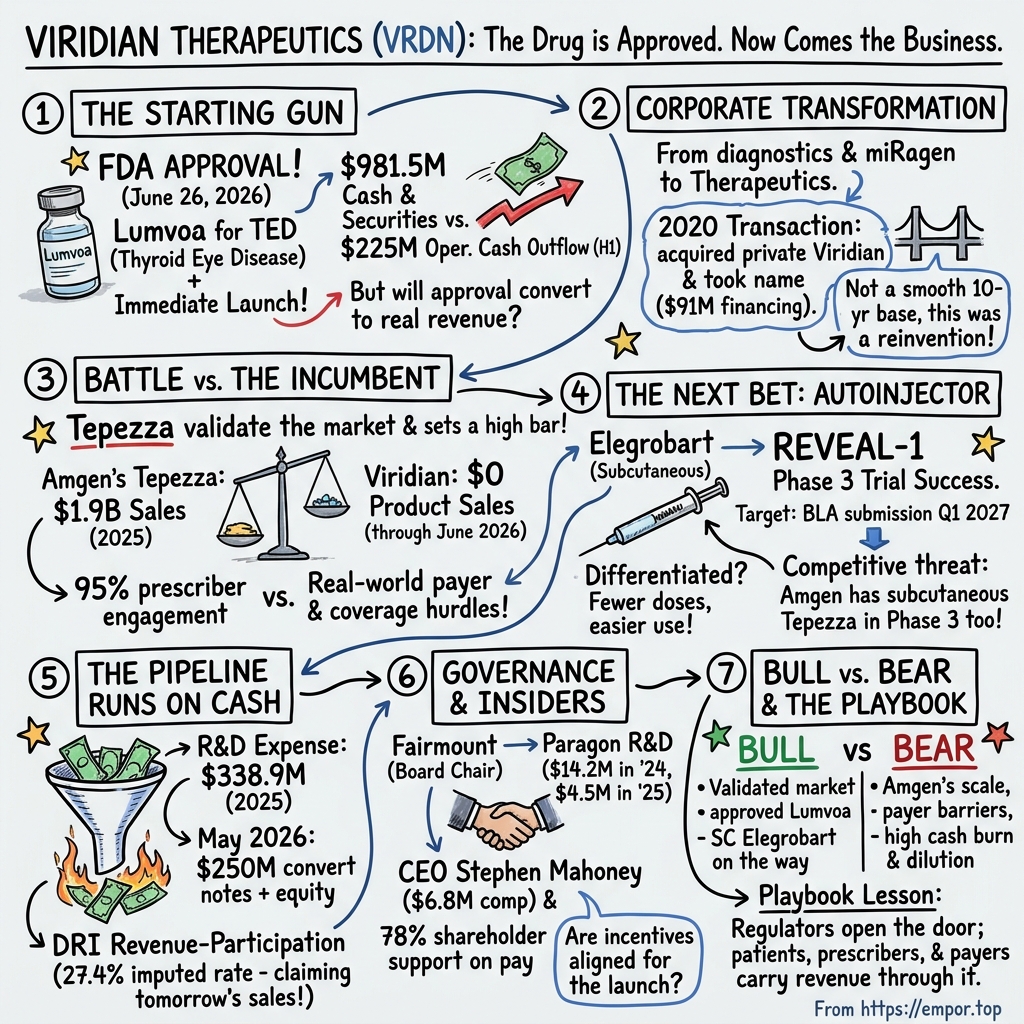
Viridian Therapeutics: The Drug Is Approved. Now Comes the Business.
I. The Approval Was the Starting Gun
On Friday, June 26, 2026, a company in Waltham, Massachusetts, that had never sold a single dose of anything learned that the U.S. Food and Drug Administration had approved its first medicine. The drug was Lumvoa, the brand name for an antibody called veligrotug, and it was cleared for thyroid eye disease, a condition in which the immune system attacks the tissue behind the eyes and pushes them forward in their sockets.1 Viridian Therapeutics did not wait for the weekend to pass. Its announcement said that physicians could prescribe the drug the next day, and that a patient support program called ViridianCares was already standing by to help patients, doctors and infusion centres work out insurance.1
Biotech has a particular kind of approval-day euphoria. For years the company's value has rested on a probability, a guess at whether a molecule will survive the trials and the regulator. Then, in a single letter, the probability collapses into a fact. Steve Mahoney, Viridian's president and chief executive, captured the mood in his statement: Lumvoa was the company's "first FDA-approved medicine and our first commercial product," and the commercial and medical teams had "been preparing for this moment for a long time."1
But an approval is a permission, not a sale. On June 30, four days after the FDA's letter, Viridian closed its second quarter having booked no product-sales revenue at all.2 The only revenue it reported for the quarter was about $284,000 from licensing and a related-party collaboration, a rounding error for a company whose quarterly net loss was $127 million.3 The first Lumvoa doses were given to patients in July.3 So the company that investors are trying to understand in late October 2026 is a strange hybrid: a commercial business on paper, a development-stage business in its income statement, and a launch whose first real numbers have not yet been published.
What makes the story worth telling is the size of the prize and the size of the bill. The market Lumvoa entered is not a speculative one. Amgen's Tepezza, until June the only established FDA-approved drug for thyroid eye disease, generated about $1.9 billion of sales in 2025.4 That is proof that patients exist, doctors prescribe and insurers pay. On the other side of the ledger, Viridian burned through $225 million of operating cash in the first half of 2026 alone.2 It ended June with $981.5 million in cash and marketable securities, a large pile built from repeated trips to the capital markets.3 The arithmetic is the plot. If the company keeps spending at its first-half pace, that pile is roughly two years of fuel, though the rate will not stay fixed, because a sales force costs more than a clinical trial in some quarters and less in others, and revenue should begin offsetting some of it.
Three questions carry the rest of this story. The first is whether Viridian can take share from Tepezza, a drug owned by one of the largest biotechnology companies in the world. The second is whether its pipeline, led by a second thyroid eye disease antibody called elegrobart that is designed to be injected at home, can change the terms of competition rather than simply add another option. The third is whether the balance sheet can carry the company to self-sufficiency without another round of costly financing or dilution that leaves today's shareholders owning a thinner slice of whatever business emerges.
Management's own answer to the third question is unambiguous. Viridian says its existing cash, together with expected revenue from Lumvoa and, if approved, elegrobart, will fund its current plans "through profitability."3 That is a claim, not a result, and the rest of this story treats it that way.
The clock matters too. As of October 24, 2026, Viridian has scheduled its third-quarter results for the morning of Wednesday, November 4, with a conference call at 8:00 a.m. Eastern.5 That report will be the first to include a full quarter of Lumvoa on the market. Everything before it, including the encouraging early indicators the company has shared, is prologue. The approval was the starting gun. To understand who is running this race, and with what kind of legs, the story has to go back to a company that looked nothing like this one.
 Subscribe on LinkedIn
II. The Company Changed Before the Drug Did
The legal entity that trades on NASDAQ as VRDN began life as a diagnostics company. Signal Genetics, based in Southern California, went public in 2014 to sell genomic tests, raising about $8.5 million in gross proceeds in an IPO small enough to be a footnote in that year's biotech boom.6 Its business was laboratory testing, a world of reimbursement codes and sample volumes that has almost nothing in common with the antibody company of today.
The diagnostics story did not last. In February 2017 Signal Genetics merged with miRagen Therapeutics, a private Colorado company developing medicines based on microRNA, the tiny strands of genetic material that regulate how genes are expressed.7 The deal was a classic reverse merger: the private company effectively took over the listed shell, gaining a stock-market listing without running its own IPO, and it came with a concurrent $40.7 million equity financing.8 The listed issuer now carried the miRagen name and a portfolio of microRNA programs. Diagnostics was gone.
Then, in the autumn of 2020, the shell changed hands again in substance if not in law. On October 27, 2020, miRagen closed its acquisition of a private company called Viridian Therapeutics.9 The listed company adopted the Viridian name, moved its centre of gravity to Waltham, Massachusetts, and began trading under the VRDN ticker.9 The deal was accompanied by roughly $91 million of preferred-stock financing.9 The miRagen microRNA programs were not the future; what the new owners wanted was a handful of antibodies aimed at thyroid eye disease.
The most important asset arrived through a licence. Just two weeks before the merger closed, on October 12, 2020, private Viridian had signed an exclusive worldwide licence with ImmunoGen for an antibody against a receptor called IGF-1R, for uses outside cancer.9 That antibody, then called VRDN-001, would become veligrotug and eventually Lumvoa. The licence terms, as the company first disclosed them, included up to $48 million of development milestones, up to $95 million of commercial milestones and royalties in the mid-single digits on net sales.9 It is worth remembering that detail, because it is the first of several claims that other parties hold on Lumvoa's future revenue.
There is a temptation, when writing about a company with a decade-old listing, to tell a smooth decade of growth. Viridian does not have one. The diagnostics business and the miRagen pipeline are not the operating base anyone is underwriting today; they are the corporate equivalent of a previous tenant's furniture. The relevant history starts in late 2020, and it is the history of a development-stage company that spent capital to reach an approval. For the same reason, there is no honest way to judge the 2020 transaction with a conventional acquisition benchmark. Nobody bought a business with sales, so there is no price-to-sales or earnings multiple to compare with industry deals. The $91 million was capital formation, a stake in a bet, and the only meaningful return test is the one now underway: whether that bet turns into approvals, sales and per-share value after all the dilution that followed.
The years between the merger and the approval were not calm in the executive suite. The chief executive's chair changed hands several times between 2021 and 2023.10 The final change came on October 30, 2023, when Viridian announced that Scott Myers had departed and that Steve Mahoney would become president and chief executive.11 The same announcement carried a roughly $185 million private placement led by Fairmount Funds and unveiled a new set of preclinical programs targeting a different immune mechanism, known as FcRn.11 The package was a reset: a new leader, new money, and a signal that the company intended to be more than a single-disease shop.
The terms of that placement are a small window into how the company would be financed for the next three years. Investors bought about 8.8 million common shares at $12.38 each and a block of Series B preferred stock that converts into roughly 6.2 million more common shares, subject to limits on how much any one holder can own.11 Preferred shares with conversion caps are a familiar tool for specialist funds that want a large economic stake without crossing ownership thresholds that trigger extra reporting or control rules. At the time, the company said the money would extend its cash runway into 2026.11 It did reach 2026, but not on that money alone: as the story of the next three years shows, it took several more raises to get there. A runway forecast in biotech is a statement about current plans, and plans in this company have expanded every time the science advanced.
Mahoney was not a laboratory scientist. He trained as a lawyer, with a JD and an MBA from Boston College, and had worked as a business and transactional attorney at Genzyme, the rare-disease pioneer that taught a generation of Boston biotech executives how to sell expensive medicines to small patient populations.11 He went on to be chief commercial officer at Synageva BioPharma, president and chief operating officer at Kiniksa Pharmaceuticals, and finally president, chief financial officer and chief operating officer at Magenta Therapeutics.11 That résumé reads like a deliberate choice. A board that hires a commercial and financing operator to run a company with drugs in late-stage trials is signalling what it thinks the next problem will be: not discovery, but launching and funding.
Fairmount's role needs a precise description, because it is easy to get wrong. Fairmount is a large investor, not a parent company. It beneficially owns more than 5% of Viridian, and its founding partner, Tomas Kiselak, chairs the board as an independent director.10 Viridian's financial statements report only Viridian and its own subsidiaries; there is no group whose results should be added to it.12 Fairmount's influence is real, and it will matter later in this story when the conversation turns to related-party contracts, but it is the influence of a concentrated shareholder with a board seat, not the control of an owner.
So the company that reached the FDA in 2026 had been reinvented twice in six years, had burned through several chief executives, and had placed its central bet on a disease where a competitor had already shown what success could look like. That competitor is where the commercial story really begins.
III. Tepezza Proved There Was a Market. It Also Set the Bar.
In January 2020, nine months before miRagen bought private Viridian, the FDA approved the first drug ever cleared for thyroid eye disease. It was Tepezza, developed by Horizon Therapeutics, and it came to market ahead of its review deadline with priority review and breakthrough therapy designation.13 Patients receive it once every three weeks for a total of eight infusions.13 In its two pivotal studies, most treated patients saw their bulging eyes recede by more than two millimetres, against a small minority on placebo.13
The precise figures set the bar every follower would have to clear. Across two studies with 170 patients in total, 71% and 83% of Tepezza patients achieved a proptosis reduction of more than two millimetres, against 20% and 10% on placebo.13 Response rates that lopsided are rare in autoimmune medicine, and they did two things at once. They told doctors that, for the first time, a drug could reverse the bulging that patients found most disfiguring rather than merely calm the inflammation. And they told every would-be competitor that matching Tepezza on efficacy would be the price of entry, not a point of differentiation. Any challenger would have to win on something else: breadth of label, length of course, convenience, safety or price.
To see why that mattered, it helps to understand the disease. Thyroid eye disease is an autoimmune condition, usually linked to Graves' disease, in which inflammation and tissue remodelling around and behind the eyes cause the eyes to protrude, a sign called proptosis, along with double vision, pain and, in severe cases, threats to sight.1 For years the options were steroids, radiation and surgery. Tepezza works by blocking IGF-1R, a receptor on the cells behind the eye that drives the swelling. Think of the receptor as a doorbell that, when pressed, tells those cells to multiply and swell; the antibody sits on the button. Viridian's veligrotug blocks the same receptor, which makes Lumvoa a follower in the most literal sense: a second key cut for the same lock.
Tepezza became a centrepiece of Horizon, and in October 2023 Amgen completed its acquisition of Horizon for about $27.8 billion, or $116.50 a share in cash.14 In 2025, under Amgen's ownership, Tepezza sales grew 3%.4 The growth rate is the more revealing part of that number. Three percent is not the trajectory of a drug still discovering its market; it suggests that Tepezza has reached a plateau, which is either an opportunity for a challenger who can unlock untreated patients or a sign that the market has a natural ceiling at roughly this size.
A finite course, not a subscription
Before weighing the competition, the revenue model needs to be clear, because it differs from what many investors picture when they hear "blockbuster." Lumvoa is not a pill a patient takes for life. It is a finite course: five intravenous infusions, one every three weeks, over 12 weeks.1 A patient is diagnosed, referred to a specialist, approved by an insurer, scheduled at an infusion centre, and then either completes the course or stops. Each new patient is a new sale; there is no recurring stream from the same person unless they relapse and are retreated.
That shape has consequences. Revenue depends on a pipeline of new patients moving through a sequence of gates, so it behaves more like a funnel than a subscription. Viridian does not disclose a price per dose or per course, so the revenue per patient is not yet public.2 The business is relatively insulated from ordinary economic cycles, because people do not skip treatment for bulging, painful eyes when consumer spending slows. But it is highly exposed to clinical reputation, to safety signals, to the willingness of insurers to pay and to the efficiency of the launch team.
The market, at the moment of Lumvoa's approval, was unusually concentrated. Tepezza was the only established FDA-approved treatment in the United States; anything else doctors used, including steroids, was older or off-label.15 For a challenger, a one-player market cuts both ways. There is no crowd to fight through, and the incumbent's success has already educated doctors, created referral pathways and taught insurers what the drug class is worth. But the incumbent also owns those relationships, and in this case the incumbent is Amgen, a company with a commercial organisation and a balance sheet many times larger than Viridian's.
What Viridian says will win
Viridian's pitch rests on three differences. The first is breadth. Lumvoa's label covers thyroid eye disease "regardless of thyroid eye disease activity or duration," and the company describes it as the first approved TED treatment whose labelling includes data for both active and chronic disease.1 Active disease is the inflamed early phase; chronic disease is the later phase in which the inflammation has burned out but the damage, such as protruding eyes, remains. Tepezza's label was supported mainly by active-disease data.15 The second is speed and convenience: a 12-week course of five infusions versus Tepezza's eight-infusion schedule, with reductions in proptosis observed as early as three weeks.1 The third is double vision. Viridian says Lumvoa is the first approved TED product to show a statistically significant effect on both diplopia response and complete resolution of diplopia in active and chronic disease.1
Those are meaningful clinical arguments. They are also, for now, arguments rather than outcomes. There is no head-to-head trial comparing Lumvoa with Tepezza, so neither relative efficacy nor relative safety can be concluded.15 And the safety profile is a class profile. Lumvoa's label warns of hearing impairment that may be permanent, hyperglycaemia in about 12% of trial patients, infusion reactions in about 9% and a risk of worsening inflammatory bowel disease.1 Hearing loss is the class's best-known problem, and a doctor weighing two IGF-1R drugs will not see an obvious safety escape hatch in either.
So the claim worth testing is narrower than "Lumvoa is better." It is that a shorter course and a broader label will persuade enough doctors, and enough insurers, to make Lumvoa the default for a meaningful share of new patients. That is a claim about behaviour, and behaviour shows up in prescriptions, patient starts and net sales, none of which have been published yet.
What Viridian has published is reach. By July 31, its field sales team had engaged 95% of the roughly 2,000 core prescribing physicians it targets, and the company described early feedback as "strong and positive," adding that patient enrollment forms indicated "broad and strong physician demand."3 The number is impressive as a measure of sales-force execution: in five weeks, the team got in front of nearly every doctor that matters. But engagement is an activity metric. It measures how many doctors heard the pitch, not how many wrote a prescription, how many of those prescriptions were approved by insurers, or how many patients finished all five infusions. It is the equivalent of a restaurant reporting how many people looked at the menu.
Insurers are the gate that turns interest into revenue. Specialty biologics like Lumvoa typically require prior authorisation, and insurers set coverage policies that decide which patients qualify and with what paperwork. In August, Viridian said only that market access efforts to gain payer coverage were "on track."3 That is reassuring language and a long way from a disclosed coverage rate. It also hints at the bargaining dynamic. Insurers that have paid for Tepezza for six years now have a second drug in the same class, which gives them leverage to demand rebates, require step therapy or favour one product on their formularies. A second entrant into a one-drug market is often welcomed by payers precisely because it creates price competition.
The incumbent is not standing still. On April 6, 2026, two and a half months before Lumvoa's approval, Amgen reported positive topline results from a Phase 3 trial of a subcutaneous version of Tepezza, delivered by an on-body injector.16 At 24 weeks, about 77% of patients on the subcutaneous drug were proptosis responders, compared with about 20% on placebo, and Amgen said the formulation provided efficacy comparable to the intravenous version.16 The regimen is not trivial: an injection every two weeks, twelve in total.16 But it removes the infusion chair, and the infusion chair is precisely the burden that Viridian's convenience pitch is built around.
The design of Amgen's trial says as much about its intentions as the result does. It enrolled patients who already had hearing impairment at baseline, a group doctors worry about most with this drug class, and the most common side effects it reported, including muscle spasms, tinnitus and ear discomfort, were in line with the intravenous product.16 Amgen also said that a separate post-approval study of intravenous Tepezza that the FDA had required was complete, with data headed to regulators.16 Put together, that is the behaviour of an incumbent defending a franchise on several fronts at once: shoring up the evidence for the existing product while building the next one. A company that paid $27.8 billion for Horizon has every reason to protect what it bought, and the means to do it.
That leaves Lumvoa's opening narrower than the approval-day headlines implied. Tepezza proved the market, and its flat growth suggests room for a challenger with a different profile. Yet the challenger is selling against a scaled incumbent that is also redesigning its own product around convenience. If convenience is going to be Viridian's lasting edge, it will have to come from somewhere other than Lumvoa's five infusions. That is the job Viridian has given its second drug.
IV. One Infusion Drug, Then a Bet on the Autoinjector
On March 30, 2026, three months before the Lumvoa decision, Viridian reported that REVEAL-1, a Phase 3 trial of elegrobart in active thyroid eye disease, had produced positive topline results.17 By August, the company reported that the companion trial, REVEAL-2 in chronic disease, was positive as well.3 At week 24 in both studies, elegrobart dosed every four weeks and every eight weeks produced what Viridian called "rapid and robust" reductions in proptosis, and the four-week regimen also showed meaningful benefits for double vision; the drug was generally well tolerated, with safety consistent with the anti-IGF-1R class.3
Elegrobart is the same idea as Lumvoa, blocking IGF-1R, reengineered for a different delivery. It is an antibody with an extended half-life, meaning it lingers in the body longer, so it can be given less often and in a smaller volume. The company's ambition is a low-volume autoinjector that patients could use at home, much like an EpiPen or a diabetes pen.3 If it works as designed, a patient's whole course could be as few as three doses, according to the company.18 Viridian describes it as potentially the first subcutaneous autoinjector for TED.3
The analogy for why this matters is the difference between going to a dentist and brushing your teeth. Intravenous infusion means a scheduled appointment at a clinic or infusion centre, an hour or more in a chair and a nurse to supervise. A home autoinjector means a few seconds in a kitchen. For the patient it removes travel and time off work; for the healthcare system it frees infusion capacity; for the doctor it may make it easier to treat chronic patients who are less motivated to sit through infusions for a condition that is no longer flaring. If the chronic market is where Tepezza's growth has stalled, convenience is a plausible key to it.
Viridian plans to submit a biologics licence application for elegrobart in the first quarter of 2027.3 It also expects that its existing commercial and medical affairs teams will support an elegrobart launch "with limited incremental investment."3 That second claim is strategically important, because it is the heart of the company's two-product logic. The doctors who prescribe Lumvoa are the same doctors who would prescribe elegrobart. If the sales force, patient support program and payer relationships built for Lumvoa can be reused, the second product's economics would be markedly better than the first's.
Trial success is not a moat
Here the story needs a careful separation. Positive Phase 3 data and a planned BLA are real milestones; they materially raise the odds that elegrobart reaches the market. But they are not approval, and approval is not uptake. Nor is "first subcutaneous autoinjector" the same as "only subcutaneous option." Amgen's on-body injector for Tepezza, reported positive in April, is already in the race.16 Amgen has not disclosed a filing timetable for it in that release, but it has the data, the commercial footprint and the cash to move quickly.16
So the competitive question becomes specific. Elegrobart's case for winning is not merely that it is subcutaneous. It is that it might need fewer doses than Tepezza's twelve-injection regimen, delivered by a small autoinjector rather than a wearable device, with data in chronic as well as active disease. Each of those points is testable. Fewer administrations and easier delivery will matter only if doctors and patients actually prefer them strongly enough to switch from a familiar brand. Efficacy and tolerability will need to hold up in full data and, eventually, in real-world use. Payer terms will decide whether a convenience premium can be charged or whether insurers treat the two subcutaneous options as interchangeable. And the launch team will need to turn those features into patient starts against a rival that can match its message doctor for doctor.
There is a historical test worth running here, and its result is honest rather than flattering. The investor case for elegrobart implicitly assumes that Viridian can convert clinical milestones into commercial products. A long-run record would either support that or undercut it. But Viridian's therapeutics history is barely six years long, and Lumvoa is its first commercial launch. There is no string of past launches that flopped, and no string that succeeded. The microRNA programs of the miRagen era belonged to a different business with different science, and they are not fair evidence about a thyroid eye disease franchise. The conclusion is that Viridian's ability to commercialise is unproven, not confirmed. The first evidence on that question arrives with Lumvoa's sales, and it will colour how much weight elegrobart deserves.
The rest of the pipeline deserves to be seen at its actual scale. Viridian is developing two FcRn inhibitors, a class of drugs that lower the antibodies driving many autoimmune diseases. VRDN-008, designed with an extended half-life, is in a Phase 1 trial in healthy volunteers with data expected in the second half of 2026; in a single head-to-head monkey study, it showed a longer half-life and more sustained antibody reduction than efgartigimod, the leading drug in the class.3 VRDN-006 showed class-consistent antibody reductions in its own healthy-volunteer study, and the company plans to share development plans in 2026.3 Separately, Viridian is preparing to file an investigational new drug application for a long-acting antibody against TSHR, the thyroid receptor at the root of Graves' disease, in the fourth quarter of 2026.3
These are real options, and the FcRn market is large. But they are early-stage programs whose primary evidence comes from healthy volunteers and animals. Most such programs never become products. Weighting them alongside an approved drug and a late-stage follow-on would be a mistake; they are a reason Viridian keeps spending on research, not a reason to assume future revenue.
Which brings the story to the cost of all that ambition. A company running a commercial launch, preparing a second BLA and advancing three early programs at once is a company writing large cheques every quarter, long before anyone knows which bets will pay. How it has paid for that, and what it has promised in return, is the next chapter.
V. The Pipeline Runs on Cash—and on New Capital
In late May 2026, with the Lumvoa decision a month away, Viridian went to the markets again. It sold $250 million of convertible senior notes and, alongside them, a concurrent offering of common stock, for combined gross proceeds of $394 million.319 On May 27, it used part of the money to repay and terminate its loan from Hercules Capital, paying $55.1 million.2 Then it waited for the FDA.
The timing was a choice with a clear logic. Raising money before an approval is cheaper in one sense, because it removes the risk of being forced to raise after a disappointment, and more expensive in another, because a successful approval would usually have lifted the share price and let the company sell fewer shares for the same dollars. Management chose certainty. By the end of June, cash and marketable securities had climbed to $981.5 million, from $762.2 million three months earlier.3
The May raise was not an isolated event; it was the second half of a two-step plan. In October 2025, the same month Viridian submitted the veligrotug BLA, it assembled a package of equity, royalty and credit that it said secured access to up to $889 million of potential capital.20 That headline number was a sum of possibilities rather than cash: it counted the full potential of the DRI agreement and the Hercules facility, much of which depended on milestones or on the company choosing to draw. The cash effect was still dramatic. Cash and short-term investments of about $491 million at September 30, 2025 had become roughly $888 million by October 31, a month later.20 Then, seven months after that, the company raised again. Two financings in eight months, bracketing an FDA decision, show how management thinks about risk: it would rather hold too much cash on approval day than too little.
To understand why a company with nearly a billion dollars keeps raising money, look at the engine it is feeding. Research and development expense was $238 million in 2024 and rose to $339 million in 2025, as the THRIVE and REVEAL programs ran their large Phase 3 trials.12 In the first half of 2026, R&D eased to $149 million, below the $164 million of the same period a year earlier, because the big trials were finishing.2 All of it is expensed as incurred, so there is no hidden asset of capitalised development costs on the balance sheet; what was spent is gone from the accounts.12
As research spending began to plateau, the commercial bill arrived. Headcount rose from 94 at the end of 2023 to 143 a year later and 252 at the end of 2025.12 Selling, general and administrative expense in the second quarter of 2026 was $55 million, nearly triple the $20 million of a year earlier, driven by people and the build-out of commercial infrastructure for Lumvoa.3 First-half SG&A reached about $94 million.2 This is what a biotech looks like in the transition: research costs are coming down from their peak just as a sales force, market-access teams and a patient support program go on the payroll. The company is being built, not harvested.
The accounting loss is not the same as cash burn, and the difference is worth decomposing. In 2025, Viridian reported a net loss of $342.6 million but an operating cash outflow of $276.4 million.12 About $44 million of the gap came from share-based compensation and other non-cash charges, which reduce profit without consuming cash.12 Another $23 million came from working capital, chiefly the timing of payments to vendors, clinical trial sites and manufacturers.12 Neither is a sign of hidden profitability. Stock compensation is a real cost borne by shareholders through dilution, and payables have to be paid eventually.
The first half of 2026 tells the same story with less cushion. A net loss of $232 million turned into an operating cash outflow of $225 million.2 Non-cash compensation and interest helped narrow the gap, but a $6.3 million gain on the fair value of a derivative tied to the DRI agreement, which flattered the income statement without generating cash, pushed the other way.2 The headline is simple: the business consumes cash at a pace of more than $100 million a quarter, and launch conversion is the only thing that changes that.
Interest income has helped at the margin. Viridian earned $16.4 million of interest in the first half of 2026 on a portfolio of money-market funds, Treasuries and corporate paper, partly offset by $11.8 million of interest expense.2 Other income, net, was about $21 million in 2025.12 That is real money, but it is treasury income on a cash pile that exists because shareholders and lenders supplied it. It extends the runway slightly; it does not change the operating economics.
Four kinds of money, four kinds of claims
The financing structure is now layered, and each layer makes a different claim on the future business.
The simplest is the convertible notes. The $250 million of 1.75% notes are unsecured and due in May 2032, with an effective interest rate of 2.32% once issuance costs are included.2 The coupon is cheap because investors also bought the right to convert into shares if the stock rises. So the notes are a bet with two outcomes. If Lumvoa succeeds and the share price climbs, the notes are likely to become equity, diluting holders. If the business disappoints, Viridian will owe $250 million in cash in 2032. Either way, the low coupon is not free money.
The Hercules loan, by contrast, is gone. In October 2025, Viridian had amended that facility to provide access to up to $300 million and drew $50 million at closing.20 Repaying it in May removed a lender, its maturity schedule and its covenants from the picture.2
The most expensive layer is the one with the friendliest name. In October 2025, Viridian signed what it called a royalty financing with DRI Healthcare, worth up to $300 million: $55 million upfront and up to $115 million of near-term milestones linked to the elegrobart trial results and to U.S. approval of veligrotug, in exchange for tiered royalties on U.S. net sales of both TED drugs.20 In plain terms, Viridian sold a slice of its future sales in exchange for cash today. Because Viridian keeps the obligation to pay DRI out of revenue it has not yet earned, the accounting treats the arrangement as debt rather than income.
How expensive is that debt? At June 30, the DRI liability carried a net value of $113.6 million and an imputed annual interest rate of 27.4%.2 Imputed means it is the rate that makes the expected royalty payments equal to the money received; it moves as forecasts change. But a rate in the high twenties is roughly twelve times the effective cost of the convertible notes. The reason for the gap is risk. DRI took on uncertainty about whether and how much Lumvoa would sell, and it priced that uncertainty accordingly. If Lumvoa sells well, DRI's return is high; if it sells poorly, DRI's return falls. For Viridian's shareholders, the agreement converts some of the upside of a successful launch into a payment to a financier.
The approval itself triggered one of those milestones. At June 30, Viridian recorded $75 million due from DRI following the FDA decision, and the company reported receiving it in July.2 That is worth noticing for a reason beyond the money: it was the largest receivable on the balance sheet, but it was not a trade customer paying late. It was a financier honouring an approval-linked payment, collected within weeks. Viridian does not disclose trade receivables or an aging schedule in its 2025 annual report or second-quarter filing, because until then there had been no product sales to collect.2 The third-quarter filing will provide a new receivables record for Lumvoa, and the days it takes specialty distributors and pharmacies to pay will become a number to watch.
Add the ImmunoGen licence from the 2020 deal, with its royalties and milestones, and the shape becomes clear.9 Lumvoa's revenue does not belong solely to Viridian's shareholders. A licensor and a royalty financier both sit between the gross sale and the residual profit.
Paying for the bet, one round at a time
The capital history connects all of this to shareholder returns. The October 2023 private placement raised about $185 million, partly in preferred shares that convert into common stock subject to ownership limits.11 A January 2024 common-stock offering raised $150 million, a September 2024 deal added common and Series B preferred shares, an October 2025 offering raised $289 million gross, and the company used at-the-market sales along the way.12 Then came May 2026. Counting only the deals with disclosed totals, Viridian raised more than $1 billion of equity and convertible capital between late 2023 and mid-2026. By June 30, the company had about 125.3 million shares outstanding on an as-converted basis, including about 12.1 million shares issuable on conversion of preferred stock.3
That pattern is not unusual for a company taking two late-stage antibodies through Phase 3. Biotech development is a business in which equity is the raw material. But it rebuts any idea that Viridian has been self-funding or capital-light. Each round bought progress at the cost of a smaller slice per share, and the convertible notes and preferred stock carry further dilution inside them.
Viridian has not made an acquisition that produced a mature operating business, so there is no record of prior deals to benchmark against industry M&A returns, and no history of write-downs either. The capital-allocation test is therefore forward-looking: whether the $1 billion-plus deployed since 2023 converts into durable product revenue, and whether the May 2026 money proves to be the last large raise before cash flow turns. Management has said it will be. The quarterly cash outflow, set beside quarterly sales, will say whether that promise is holding.
A company spending and financing at this scale invites a second question, about who is making the decisions and whose interests they serve. In Viridian's case, the answer runs through one investor.
VI. Fairmount's Connections Make the Contract Notes Matter
Fairmount is the kind of investor biotech executives court. It is concentrated, patient and hands-on, and in Viridian it has been present at every turning point that matters: it led the placement that accompanied Mahoney's arrival.11 Its founding partner, Tomas Kiselak, chairs the board.10 In its 2026 Schedule 13D amendment, Fairmount reported beneficial ownership of about 17.2 million shares on an as-converted basis, including preferred shares subject to conversion limits.21 Against the company's as-converted share count, that is on the order of a seventh of the company.
The rest of the register has been changing as the company matured. In June 2026, T. Rowe Price Associates reported holding about 5.75 million shares, or 5.2%, in a passive Schedule 13G filing.22 The arrival of a large long-only manager is a typical marker of a biotech moving from specialist-fund ownership toward a broader institutional base, the kind of holder that buys commercial-stage stories rather than binary trial readouts. The 2026 proxy still cited an older Fidelity filing from January 2024, so that line is a historical snapshot rather than a current holding.10 With repeated issuance and preferred conversions, ownership percentages have shifted from year to year, and Viridian does not publish a consistent multi-year breakdown of its shareholder base.
Concentrated ownership by an engaged specialist is often good for a biotech. It provides an anchor investor in difficult financings and a board that understands drug development. But Fairmount's reach extends beyond Viridian. It has interests in Zenas BioPharma, which licensed Viridian's IGF-1R antibodies for Greater China, and in Paragon Therapeutics, which has supplied research and development services to Viridian.1210 That creates a web of relationships in which one investor sits on several sides of transactions that move money among its portfolio companies. None of that makes Viridian a Fairmount subsidiary. It makes the contract footnotes worth reading.
Following the money to Paragon and Zenas
Start with the revenue side, because a question about related-party concentration usually starts there. In 2025, Viridian's revenue was $70.8 million, of which $70 million was a single non-refundable upfront payment from キッセイ薬品工業 Kissei Pharmaceutical for rights to the TED drugs in Japan.12 Collaboration revenue from Zenas and 再鼎医药 Zai Lab, both related parties in the company's disclosures, was $0.8 million.12 So related-party revenue was not driving reported sales; a one-time licence was. The Kissei deal also comes with up to $315 million of potential milestones and tiered royalties in the twenties to mid-thirties percent on licensed-product sales in Japan, though Kissei may terminate for convenience under specified notice terms.12 That is valuable optionality, not a recurring base.
The cost side is where scrutiny belongs. Viridian recorded Paragon-related R&D costs of $12 million in 2023 and $14.2 million in 2024, before the spend fell to $4.5 million in 2025 and $1.5 million in the first half of 2026.122 At June 30, $0.5 million was unpaid.2 The decline is the relevant fact: whatever Paragon provided, Viridian is buying much less of it as its programs mature. The audit committee reviews related-person transactions under a written policy.10 What the filings do not provide is the thing an outside investor most wants, an independent benchmark showing that Paragon's prices matched what an unrelated supplier would have charged. Viridian discloses who is connected and how much was paid, but it does not show whether the deal was fair.
That is not evidence of wrongdoing. It is a gap in disclosure that matters because of the structure. When the same investor has interests on both sides of a contract, the burden of showing arm's-length pricing is higher, and in Viridian's case that burden has been met with process, not with comparables.
Pay, bonuses and a 78% vote
Mahoney's compensation follows the lumpy pattern common to biotech chief executives. His reported pay was $12.5 million in 2023, the year he joined and received his initial awards; $1.1 million in 2024; and $6.8 million in 2025, most of it in equity.10 The 2025 figure included a $630,000 cash incentive.10 The board paid annual bonuses at 150% of target for 2025, after concluding that the company had met all of its goals and stretch criteria.10 Seth Harmon, who became chief financial officer on January 1, 2025, received $2.6 million.10
On their own terms, the 2025 goals were plausibly met: the BLA was filed in October 2025, the DRI and equity financings closed, and the elegrobart program advanced toward its readouts.20 But maximum bonuses for a year of milestones put a sharp point on the question this story keeps asking. Those were clinical, regulatory and financing goals. The goals that will determine whether shareholders earn a return, sales and cash flow, start now. A board that paid out at 150% for milestones will face a more revealing test when it sets and scores goals for a commercial year.
Shareholders have already signalled some unease. At the June 2025 annual meeting, about 78% of votes cast supported the company's 2024 executive pay program.23 That is a passing grade, but below the roughly 80% level at which many governance specialists begin to treat a say-on-pay result as a warning. The 2026 proxy reported that result, and at the 2026 annual meeting director nominees were elected and the proposals passed.1024 Six of seven directors were identified as independent.10 The pay vote is a real check on investor confidence; it does not by itself establish poor execution.
The auditor's signals are cleaner than the pay vote. KPMG gave the 2025 financial statements an unqualified opinion and found internal control over financial reporting effective.12 Its one critical audit matter, the area it judged hardest, was the valuation of the embedded derivative in the DRI agreement, a $20 million liability at year-end 2025 valued using a model that depends on unobservable assumptions about projected cash flows, the probability of a change of control and the discount rate.12 That is a significant estimate, and its movements will flow through the income statement as Lumvoa's prospects change, but it is an estimate to track, not a qualification.
The rest of the accounting picture is quiet. Viridian says it is not party to any legal proceeding it believes would materially harm the business.122 It discloses no material tax demands or recognised uncertain tax positions for 2023 through 2025.12 Foreign-exchange disclosure is limited: the second-quarter filing shows only a $6,000 currency translation adjustment for the first half of 2026, with no broader sensitivity analysis or hedging schedule.2 As the Kissei and Zenas royalties grow, Japanese and Chinese sales will create currency exposure, but today it is small. Quiet disclosures are not proof of zero exposure. They are, for now, a sign that the material risks lie elsewhere.
Taken together, the governance record does not indict management. It raises two pointed questions, about the pricing of related-party contracts and about whether incentives pay for milestones or for outcomes, and it hands the final judgment to the launch. Which is exactly where the investment case has to be argued.
VII. The Bull Case Has a Drug; the Bear Case Has a Clock
Picture the war room from both sides. In Waltham, a company with one approved product, a few hundred employees and a launch barely four months old. In Thousand Oaks, Amgen, owner of a $1.9 billion drug, with a subcutaneous version already through Phase 3 and a commercial organisation that has called on the same ophthalmologists and endocrinologists for years. Every argument about Viridian's future is, at bottom, an argument about whether the smaller army has a weapon the larger one cannot copy, and whether it can keep paying its soldiers long enough to use it.
Same lock, two keys
Start with the structure of the market, using Michael Porter's five forces. The threat of new entrants is low: developing an IGF-1R antibody, running two Phase 3 trials and securing an FDA label takes years and hundreds of millions of dollars, as Viridian's own spending shows. Those barriers protect Viridian from a flood of new competitors. But barriers to entry are not the same as barriers to substitution. Doctors can choose between Lumvoa and Tepezza patient by patient, and soon possibly among intravenous and subcutaneous versions of both. Rivalry, in other words, is concentrated but intense: two capable players fighting for the same prescribers.
Buyer power is the force that matters most and the one least visible today. The ultimate buyers are insurers and pharmacy benefit managers, and a second entrant hands them the leverage to extract rebates or impose step therapy. Viridian's 2025 customer concentration, with Kissei accounting for nearly all revenue, is a one-time licence quirk, not evidence about the product business.12 The relevant evidence for Lumvoa will be coverage policies, the time it takes a prescription to become an infusion, and net price realisation once rebates are paid, none of which is yet disclosed. Supplier power is real but hard to measure: Viridian outsources manufacturing and clinical work and does not disclose supplier concentration.12 Substitutes include steroids and surgery, which are cheaper but less effective, and, longer term, entirely different mechanisms, including the TSHR approach Viridian itself is pursuing.
Hamilton Helmer's seven powers framework sharpens the question of durable advantage. Viridian does not have scale economies; Amgen does. It has no network effects, which do not apply to a medicine. Switching costs are low for new patients, because a finite course means each patient is a fresh decision, though they may be modest for prescribers who have learned one drug's paperwork and infusion logistics. Brand is still forming. Viridian has no cornered resource in the sense of exclusive access to the IGF-1R mechanism, because Amgen has the same target. What it does have is a form of counter-positioning and process power in the making. Its label covers active and chronic disease, it has a shorter course, and it has a late-stage subcutaneous follow-on that its sales force could launch into the same offices. If elegrobart's convenience is real and arrives first, Viridian could own the "fewest doses" position that Amgen, protecting a large intravenous franchise, might be slower to embrace.
But the record weakens that counter-positioning claim. Amgen has not been slow. It ran a Phase 3 trial of a subcutaneous Tepezza and reported positive results before Lumvoa was even approved.16 That is the clearest disconfirming evidence in the story: the incumbent has shown it will copy the convenience. So the moat claim narrows. Viridian does not yet have a durable advantage; it has a set of plausible differentiators, each of which can be matched or neutralised. The KPI that would confirm a real edge is Lumvoa's share of new patient starts, particularly in chronic disease, sustained after Amgen's response. Until that number exists, the moat is a hypothesis.
The bull case is coherent and grounded in facts. The FDA approved Lumvoa with a label covering both active and chronic disease, a first for the class.1 The market is proven: Tepezza's sales show that doctors will prescribe and insurers will pay for IGF-1R therapy at scale.4 Tepezza's slowing growth hints that many patients, particularly chronic ones, are not being treated, which is where a broader label and shorter course could find room. Elegrobart's two positive Phase 3 trials and a planned BLA in early 2027 give Viridian a credible second act aimed squarely at convenience.3 And the balance sheet, with nearly $1 billion in cash and securities, means the company can launch without a gun to its head.3 There is a quieter piece of upside too. Outside the United States, Viridian has handed regional rights to partners rather than building its own teams: Kissei in Japan, with up to $315 million of potential milestones and royalties that rise as high as the mid-thirties percent of sales, and Zenas in Greater China.12 If the drugs succeed abroad, those royalties arrive without a matching sales-force bill, the kind of revenue that falls almost straight to the bottom line.
The bear case is equally coherent. Amgen's subcutaneous Tepezza undercuts the most distinctive part of Viridian's long-term story. Payer access is still developing, and "on track" is not a coverage rate. The only commercial metric Viridian has published, 95% physician engagement, measures sales calls, not sales. And the cost of the launch is high: first-half operating cash outflow of $225 million, a business that has raised capital repeatedly to keep going, and a DRI agreement whose 27.4% imputed rate and royalty claims mean that some of the reward for a successful launch goes to a financier rather than to shareholders.2
Run the balance-sheet claim through its own falsification test. Management says existing cash plus expected revenue will fund the company through profitability.3 The record does not reject that claim, but it narrows it. Viridian has never yet funded itself from operations; every year of its therapeutics history has ended in a loss, and each year from 2023 through 2026 brought at least one significant new raise.1112 The May 2026 raise came even though the company already held more than $750 million.3 The claim is therefore intact but unproven, and it rests entirely on the revenue ramp. The figure that would falsify it is easy to name: if quarterly operating cash outflow does not begin to fall within the next several quarters as Lumvoa sales arrive, another raise becomes likely, and the per-share math of the story changes.
Imagine, for a moment, the skeptical long-short investor or activist who studies all of this and decides to push. Their letter would not attack the science; the FDA has already ruled on that. It would attack the shape of the company. Why, it would ask, is a business with one drug in launch and one awaiting filing also funding two FcRn programs and a TSHR antibody, each of which will need years of spending before any return, at the very moment cash burn matters most? Why did the company sell a slice of its U.S. sales at an implied cost in the high twenties a few months before it could raise convertible debt at little more than 2%? Why does the board, chaired by the founding partner of its largest shareholder, not publish pricing comparisons for contracts with a company in which that same shareholder has interests? And why did bonuses pay out at the maximum for a year whose achievements were milestones rather than sales?
Management has answers to some of these questions. The pipeline is the company's stated strategy to become a multi-product autoimmune business rather than a single-franchise bet.3 The DRI agreement was signed before approval, when risk was highest and other capital was costlier, and it was designed, the company said, to fully fund the launches of both TED drugs.20 But an activist would note that each answer is a claim about the future, and that the evidence to judge them, especially whether the early pipeline is worth its cost, will not arrive for years. Capital allocation in a company like this is tested not at the moment of decision but at the moment of payoff, and none of the payoffs have arrived yet.
On technology risk, artificial intelligence is not the immediate threat. AI may speed antibody discovery for future competitors, but it does not replace clinical trials, FDA approval or a patient receiving a biologic. The operational risks that matter more are prosaic: continuity of outsourced biologic manufacturing, regulatory execution on the elegrobart filing, payer decisions and the daily grind of a launch.
Valuation cannot settle the debate either. While Viridian is losing money, price-to-earnings multiples are meaningless, and there is no stable revenue base for a price-to-sales comparison with its own history. The market's price today is a bet on the size and timing of revenue that has not yet been reported, discounted for the claims of DRI, ImmunoGen and convertible holders. Anyone pricing the company is pricing a forecast.
What would settle it
The debate reduces to a small number of measures. The first is quarterly Lumvoa net sales, ideally alongside patient starts, which together show whether physician interest is converting into completed courses. The second is operating cash outflow, set beside R&D and SG&A, which shows whether the launch is closing the gap or widening it; the latest reading is $225 million for the first half of 2026, with research spending falling and selling costs rising.2 The third is elegrobart's progress toward a BLA in the first quarter of 2027, set against Amgen's subcutaneous timetable. Everything else is commentary.
For anyone following management's narrative, four recordings are worth comparing: the March 30 REVEAL-1 call, for the clinical claims about elegrobart; the June 29 approval webcast, for how management positioned Lumvoa; the second-quarter call in August, for launch and financing tone; and the company's September investor-conference appearance, for how management handled questions about conversion and subcutaneous competition.117325 The test is consistency: whether the language about "demand" shifts toward numbers, and whether management names a measure of success before the results arrive rather than after.
The real divide in the Viridian debate is not between optimists and pessimists. It is between telling investors that a drug can work and showing them that the business can earn from it. The first has been done. The second is just beginning.
VIII. Playbook: Business & Investing Lessons
Every company teaches lessons, but Viridian's are unusually sharp because its story is compressed. In six years it went from a recycled listing to an approved drug, and in the space of a few months it had to become a commercial company while still running three research programs and managing a stack of financial claims. The lessons below belong to this company, though they apply to every biotech that crosses the same line.
The first lesson is from approval day. The FDA approved a broad label, yet by June 30 the company had still reported no product sales.12 A regulator can open the door; only patients, prescribers and payers can carry revenue through it. For founders, the lesson is that a launch is a different company from the one that ran the trials, with different skills, costs and failure modes. For investors, it is that the approval-day share price reflects a probability of commercial success, not the success itself.
The second lesson is from the DRI agreement. It claimed a slice of future U.S. sales, priced at a 27.4% imputed rate.202 Cash raised against tomorrow's sales is still a claim on tomorrow's business. Non-dilutive is not the same as costless; it simply moves the cost from the share count to the revenue line, where it is easier to overlook.
The third lesson is from elegrobart. Viridian's home autoinjector thesis faced an incumbent that had already reported positive Phase 3 data for its own subcutaneous version.316 A more convenient molecule is a product thesis until patients adopt it, and an incumbent can copy the convenience. The investor's question about any "next-generation" product should not be whether it is better, but whether the leader can reach the same place, and how long it would take.
The fourth lesson is from the Paragon relationship. Viridian disclosed its connection to Paragon and the decline in related-party R&D costs.122 Viridian's filings did not supply a benchmark price. Disclosure tells investors who is connected; a pricing benchmark tells them whether the deal is fair. In founder-and-investor ecosystems where the same fund seeds several companies that trade with each other, transparency about relationships is the minimum, not the standard.
The final lesson is about discipline. Viridian announced a run of milestones in 2025 and 2026, including clinical, regulatory, financing and launch progress.320 Each was real. None of them was a sale. The operational habit that matters now is to judge the company by patient starts, net sales, cash burn and financing terms, not by the number of milestones announced. A biotech that keeps winning milestones while its cash pile shrinks is succeeding at science and still has to prove it can run a business.
IX. Epilogue
Tonight, on October 24, 2026, Viridian is a company between reports. Its last full set of numbers describes a quarter in which it had a drug approved and no sales; its next set, due before the market opens on November 4, will describe its first full quarter as a commercial business.5 Somewhere in the weeks since the August update, infusion centres across the United States have been administering Lumvoa, prior-authorisation forms have been approved or denied, and patients have started or stopped their five-infusion courses. None of that is public yet.
The first thing to watch on November 4 is not the sales figure itself, which will be small for any drug a few months into launch, but what sits around it. Viridian has so far reported physician reach. The test of the launch is whether the company now reports patient starts, completed courses or a coverage rate, and whether the language moves from "on track" and "strong early momentum" to numbers that can be checked against the next quarter's. A company confident in its demand usually shows it in the metrics it chooses to disclose. One that keeps reporting activity rather than outcomes leaves investors to infer the gap.
The second is cash. The commercial build-out has pushed selling costs up sharply while research costs fall.3 The third quarter will show whether the total burn is flattening as the big trials wind down, or rising as the launch absorbs more people and marketing. It will also be the first quarter in which DRI's royalty begins to bite on actual sales, a small amount now but a direct deduction from each dollar of Lumvoa revenue as long as the agreement runs.20
The third is the race for the home injection. Viridian has promised an elegrobart BLA in the first quarter of 2027.3 Amgen has the data for its own subcutaneous Tepezza and has said it will present full results at a medical meeting.16 Whichever company files first, and whichever label lands with fewer doses and a simpler device, will shape how the next decade of this market looks.
Before the year is out, the smaller bets will also have their moments. Viridian has said that healthy-volunteer data for VRDN-008, its long-acting FcRn inhibitor, will arrive in the second half of 2026, that it will share a development plan for VRDN-006 during the year, and that it will file to begin human trials of its TSHR antibody in the fourth quarter.3 Those events will generate headlines, and some of them may move the share price. They deserve a different kind of attention from the launch. Good FcRn data would strengthen the argument that Viridian can become more than a thyroid eye disease company; it would also make the case for spending on the early pipeline even as the launch absorbs cash. Disappointing data would sharpen the activist's question about focus. Either way, the early programs are years from revenue, and the November report on Lumvoa will say more about the company's next two years than any healthy-volunteer study.
Then there are outcomes, each with a clear meaning. A strong first quarter with disclosed patient numbers and falling cash burn would support management's "through profitability" claim and suggest that Lumvoa's broader label is finding patients Tepezza has not reached. A soft quarter with vague metrics would not doom the drug, because launches in specialty markets often start slowly while insurers write policies, but it would shorten the distance between today and the next capital raise. A quarter of strong demand alongside high costs would leave the most interesting question open: whether the business can earn more than it spends once a royalty financier and a licensor have taken their share.
None of that will be settled in November. Durable demand, defensible differentiation and enough capital to reach profitability without worsening per-share economics are questions measured in years. What November can do is show whether the story is moving in the right direction, and whether the company is willing to let investors see the evidence.
X. Outro
Go back to that Friday in June. The FDA approved Lumvoa, and Viridian said doctors could prescribe it the next day.1 The first patients received doses in July.3 Those two moments, a permission and a first treatment, mark the line every biotech dreams of crossing and few cross on their own.
But crossing the line is not the same as finishing the race. A drug can be approved in a day; a durable business takes patients, payers, execution and time, and in Viridian's case it also takes enough capital to outlast a far larger rival that is redesigning its own product as fast as Viridian is. The company has done the hard part of science. It has not yet done the hard part of business.
Viridian has the green light. Now it has to make the medicine move.
References
-
Viridian Therapeutics Announces U.S. FDA Approval and Launch of Lumvoa (veligrotug-vvze) for the Treatment of Thyroid Eye Disease — Viridian Therapeutics, 2026-06-26 ↩↩↩↩↩↩↩↩↩↩↩↩↩
-
Form 10-Q for the quarter ended June 30, 2026 — Viridian Therapeutics, 2026-08-06 ↩↩↩↩↩↩↩↩↩↩↩↩↩↩↩↩↩↩↩↩↩↩↩
-
Viridian Therapeutics Highlights Recent Business Progress and Reports Second Quarter 2026 Financial Results — Viridian Therapeutics, 2026-08-06 ↩↩↩↩↩↩↩↩↩↩↩↩↩↩↩↩↩↩↩↩↩↩↩↩↩↩↩↩↩↩↩
-
Form 10-K for 2025, including Tepezza sales — Amgen, 2026 ↩↩↩
-
Viridian Therapeutics to Report Third Quarter 2026 Financial Results — BiopharmaWatch, 2026-10-20 ↩↩
-
Form 8-K recording the merger with miRagen Therapeutics — Signal Genetics, 2017-02-13 ↩
-
miRagen Therapeutics Completes Merger with Signal Genetics and Concurrent $40.7 Million Equity Financing — Viridian Therapeutics (formerly miRagen), 2017-02-13 ↩
-
Form 10-K for 2021, including the 2020 acquisition disclosure — Viridian Therapeutics, 2022-02-24 ↩↩↩↩↩↩
-
2026 Proxy Statement — Viridian Therapeutics, 2026-04-17 ↩↩↩↩↩↩↩↩↩↩↩↩
-
Viridian Therapeutics Appoints New Chief Executive Officer, Unveils Next Generation FcRn Inhibitor Programs and Announces $185 Million Private Placement, Form 8-K Exhibit 99.1 — Viridian Therapeutics, 2023-10-30 ↩↩↩↩↩↩↩↩↩
-
Form 10-K for 2025 — Viridian Therapeutics, 2026-02-26 ↩↩↩↩↩↩↩↩↩↩↩↩↩↩↩↩↩↩↩↩↩↩↩
-
FDA approves first treatment for thyroid eye disease — Eyewire News, 2020-01-21 ↩↩↩↩
-
Amgen Completes Acquisition of Horizon Therapeutics plc — BioSpace, 2023-10-06 ↩
-
Lumvoa gains US FDA approval for thyroid eye disease with class-first broad label — Ophthalmology Times, 2026-06 ↩↩↩
-
Amgen Announces Positive Topline Phase 3 Results for Subcutaneous TEPEZZA in Adults Living With Moderate to Severe Active Thyroid Eye Disease — Amgen, 2026-04-06 ↩↩↩↩↩↩↩↩↩↩
-
Viridian Therapeutics Announces Positive Topline Results from Elegrobart Phase 3 Clinical Trial in Active Thyroid Eye Disease — Viridian Therapeutics, 2026-03-30 ↩↩
-
Corporate presentation, May 2026 — Viridian Therapeutics, 2026 ↩
-
Prospectus supplement, Form 424B5 — Viridian Therapeutics, 2026-05 ↩
-
Viridian Therapeutics Reports Third Quarter 2025 Financial Results and Highlights Recent Progress — BioSpace, 2025-11-05 ↩↩↩↩↩↩↩↩↩
-
2025 annual meeting voting results, Form 8-K — Viridian Therapeutics, 2025-06-24 ↩
-
2026 annual meeting voting results, Form 8-K — Viridian Therapeutics, 2026-06-03 ↩
-
Investor relations overview and events — Viridian Therapeutics ↩
 LinkedIn
 WhatsApp
 Reddit
 Hacker News
 Email
 Kindle
 RSS Feed
 Spotify
 Apple Podcasts
 Amazon Music
 Audible
 YouTube