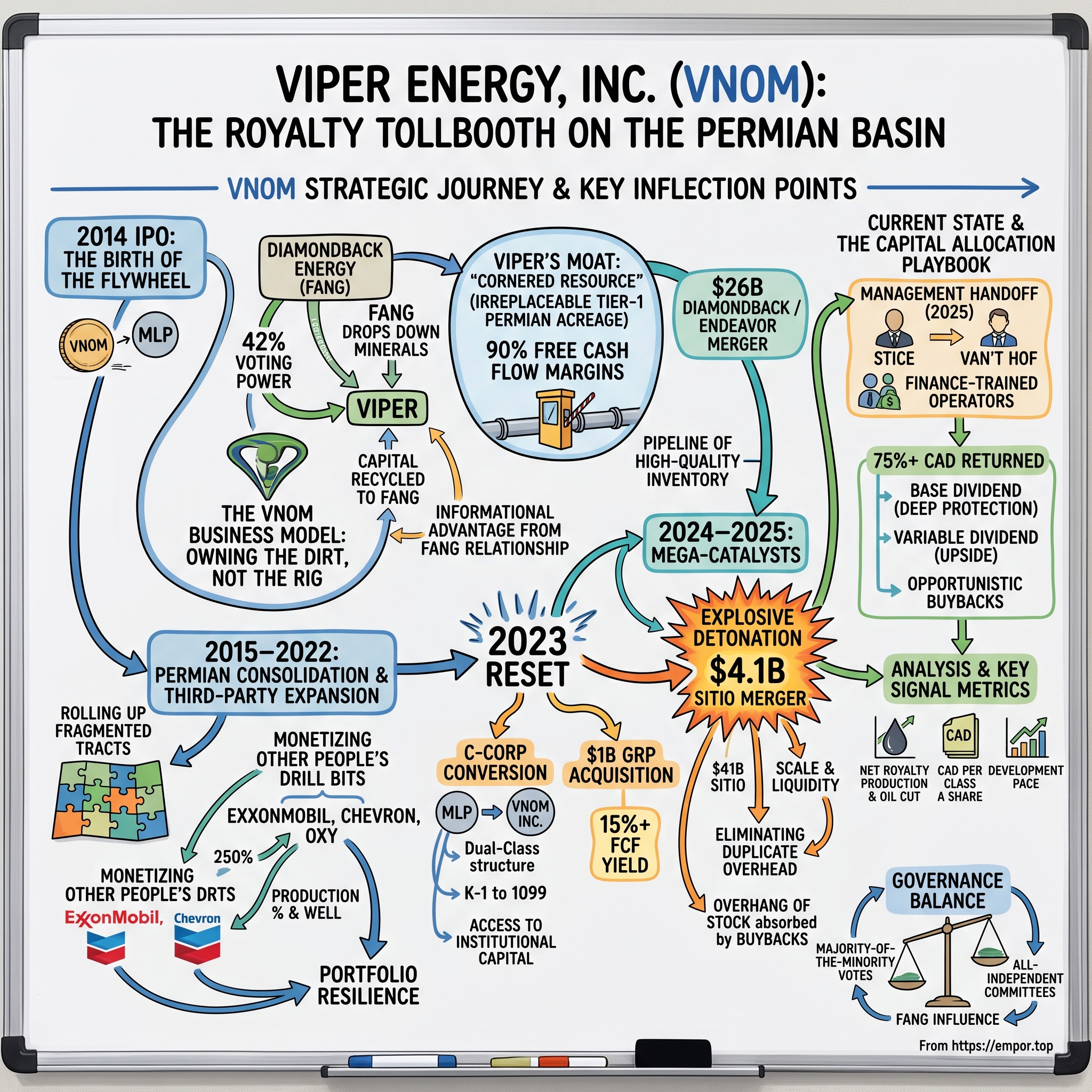
Viper Energy, Inc.: The Royalty Tollbooth on the Permian Basin
I. Introduction & Episode Roadmap
Somewhere under the flat, sun-bleached scrubland of West Texas, at two o'clock on an ordinary afternoon, a drill bit two miles below the surface pushes into a seam of Permian crude that has been waiting there for roughly 250 million years. On the surface, the machinery of extraction is deafening and expensive: rigs the height of office buildings, fleets of diesel trucks hauling water and sand, frac spreads that burn through millions of dollars in a matter of days, crews working around the clock. Someone spent a fortune to make that barrel come out of the ground. And the moment it does, a small slice of its value — before a single expense is deducted, before the operator recovers a dollar of its costs — flows to a company that never showed up to the job site. That company owns the dirt. Or, more precisely, it owns the minerals under the dirt, and the right to a royalty on everything that comes up.
That is the business of Viper Energy, Inc., which trades on NASDAQ under the ticker VNOM. It is one of the largest mineral and royalty owners in the United States, and by the summer of 2026 it carried a market capitalization of roughly $16 billion.[^16] Its assets are not rigs or refineries or pipelines. They are the subsurface mineral rights beneath tens of thousands of acres of the Permian Basin — the most productive oil field in the Western Hemisphere — plus a scattering of interests in other American shale plays. Viper collects a royalty on the oil and gas that others produce from that acreage. It funds no drilling. It runs no wells. It carries essentially no operating cost against the top line. In the language of business models, it is about as close to a pure toll on production as the energy industry offers.
There is a second, stranger fact about Viper that makes it more than a simple royalty vehicle: it is not really independent. Viper is a majority-controlled subsidiary of Diamondback Energy (NASDAQ: FANG), one of the premier pure-play Permian producers, which owned roughly 42% of Viper's voting power at the end of 2025.8 Diamondback created Viper. Diamondback operates a meaningful share of the wells that pay Viper its royalties. And Diamondback sits on both sides of the transactions in which it periodically sells — "drops down" — mineral packages into Viper. The relationship is symbiotic and, depending on your seat, either a structural advantage or a permanent conflict of interest waiting to be tested.
This is the tension that runs through the whole Viper story. On one side sits an unusually clean cash-flow machine: a business that in the first quarter of 2026 converted its royalty revenue into roughly $204 million of cash available for distribution and handed 90% of it back to shareholders in the same quarter.6 On the other side sits a governance structure in which the controlling parent is also the counterparty, the operator, and the architect of the company's growth.
This episode traces how that machine was built and stress-tests whether it holds up. We will walk through the economics of owning minerals versus operating rigs; the 2014 birth of Viper as the first mineral royalty partnership sponsored by an active driller; the long grind of rolling up fragmented Permian mineral tracts; the 2023 conversion from a partnership into a corporation; the mega-catalysts of Diamondback's $26 billion Endeavor merger and Viper's own $4.1 billion acquisition of Sitio Royalties; the leadership handoff from Travis Stice to Kaes Van't Hof; and the capital-allocation playbook that turns a royalty check into a dividend. Along the way we will keep asking the two questions that matter for a long-term owner: why does this business win from here, and what would break the case?
 Subscribe on LinkedIn
II. The Economics of Oil Royalty: Owning the Dirt vs. Operating the Rig
To understand why a royalty owner can be so profitable, start with a peculiarity of American law that most of the world does not share. In the United States, a private landowner can own not just the surface of a property but the minerals beneath it — the oil, the gas, the rock — and, crucially, can sever the two. You can sell your ranch and keep the minerals. You can sell the minerals and keep the ranch. Over a century of West Texas and New Mexico land dealing, ranching, inheritance, and speculation, surface and mineral ownership were split, resplit, and scattered across families, trusts, and estates until the map of who owns what beneath the Permian became a fantastically complicated patchwork. That fragmentation is the raw material of the royalty business.
When an oil company wants to drill, it must first lease the mineral rights from whoever holds them. In exchange, the mineral owner keeps a royalty — historically a one-eighth (12.5%) fraction of production value, though modern Permian leases often run to one-fifth or one-quarter. That royalty is paid on gross revenue, off the top, free of the costs of getting the oil out of the ground. The operator carries everything: the drilling, the completion, the pumping, the water disposal, the eventual plugging and abandonment. The mineral owner carries nothing but the wait.
This is where the industry's favorite unit of measurement, the net royalty acre (NRA), comes in. A gross acre of land tells you nothing useful on its own, because your economic slice depends on both how much of the minerals under that acre you own and what royalty fraction the lease carries. The NRA normalizes all of that. Viper's own filings define it plainly: net royalty acres equal net mineral acres multiplied by the average lease royalty interest.8 An acre where you own 100% of the minerals under a 25% lease is worth twice as much, in NRA terms, as the same acre under a 12.5% lease. It is the royalty world's equivalent of square footage adjusted for location — the number that lets you compare one messy patchwork position against another.
And not all acres are created equal, a point the outline rightly insists on. Two NRAs can carry wildly different value depending on the rock beneath them: the thickness of the oil-bearing zone, the number of stacked productive intervals ("stacked pay," where the Permian's genius lies — several oil layers piled vertically so an operator can drill the same acreage many times), the oiliness of the production versus lower-value gas, and, not least, the competence of whoever is drilling. A world-class operator wringing more oil out of each well makes every royalty acre beneath it worth more. Viper's management makes exactly this argument when it stresses that a large share of its acreage sits under Diamondback and other top-tier operators.
Now put the two business models side by side, because the contrast is the entire thesis. An exploration-and-production operator — Diamondback, ExxonMobil, Chevron, Occidental — lives and dies by capital. It spends billions a year drilling. It is exposed to steel prices, diesel prices, frac-sand shortages, rig availability, labor costs, water-disposal fees, and the brutal arithmetic of decline curves that force it to keep spending just to hold production flat. In a downturn, its costs are sticky while its revenue collapses, and capital gets destroyed. Viper, by contrast, told investors in its 2025 annual report that its interests "provide us with cash flows without the requirement to fund drilling and completion costs or lease operating expenses."8 When oil prices fall, the operator's margins get crushed by fixed costs; Viper's margin, being almost pure, compresses far more gently. That asymmetry is the whole point. It is why, on the first-quarter 2026 call, president Austen Gilfillian could describe the model as running "90% free cash flow margins."11
Analysts who reach for frameworks will recognize a few of Hamilton Helmer's 7 Powers here. The clearest is Cornered Resource: Tier-1 Permian acreage in the geological sweet spots of the Midland and Delaware Basins is irreplaceable — nobody is manufacturing more of it, and the best rock was spoken for long ago. A subtler advantage is informational. Because Viper is co-located with, and partly staffed by, its operator-parent Diamondback, it can see drilling schedules, completion timing, and well performance on its own acreage with a clarity outsiders lack — a form of scale-and-information edge rather than a textbook Helmer power. We will return to whether that edge is as durable as it sounds, because the same closeness that grants visibility is also the source of Viper's central governance problem. But first, the origin story — and it begins not with Viper at all, but with a young Permian driller that needed cash.
III. The Origins: Diamondback's Masterstroke & The 2014 IPO
Rewind to 2012, 2013, 2014. The American shale revolution was in full, feverish swing, and nowhere more so than the Permian Basin, where horizontal drilling and hydraulic fracturing were unlocking oil that vertical wells had left stranded for decades. It was a land rush. Exploration companies were paying dizzying prices per acre and then burning through cash to drill it, because in shale you cannot bank the resource by simply owning it — you have to keep drilling to prove it and to keep production from declining. The constant, gnawing problem for every ambitious young E&P was the same: capital. There was never enough of it, and every dollar raised by selling stock diluted existing owners, while every dollar borrowed added risk to a business already leveraged to a volatile commodity.
Diamondback Energy, itself only recently public, was one of these hungry drillers, run by a plain-spoken engineer named Travis Stice. And Diamondback's leadership noticed something clever. When Diamondback bought Permian acreage, it typically acquired not just the right to drill but, in many cases, the underlying minerals themselves. Those minerals were an asset sitting quietly on the balance sheet, generating royalty income but not obviously worth anything in the stock market's eyes so long as they were buried inside an E&P. What if you could separate them out — carve the mineral interests into a dedicated, publicly traded vehicle whose only job was to collect royalties? Public investors, hungry for yield and drawn to a business with no drilling risk, might pay a premium multiple for that pure royalty stream. Diamondback could sell or contribute minerals into it, harvest the proceeds, and recycle the capital straight back into its drill bit — non-dilutive funding, in effect conjured from an asset it already owned.
In June 2014, that idea went public. Viper Energy Partners LP priced its initial public offering at $26.00 per common unit, selling five million units and beginning to trade on the NASDAQ Global Select Market under the ticker VNOM on June 18, 2014.7 The offering was modest — roughly $130 million in size, with the public initially owning units representing only about a 7% limited-partner interest; Diamondback retained the rest and took the proceeds.7 Viper came public not as a corporation but as a master limited partnership, a tax structure then beloved in the energy sector for passing income through to unitholders without corporate-level tax. It was widely regarded as the first mineral-and-royalty MLP sponsored by an active, operating E&P — a structural innovation, even if the "first" superlative is more industry lore than something you will find stamped on a filing.
The elegance of the arrangement was the drop-down mechanism, and it is worth pausing on because it defines the company to this day. Diamondback would go out and buy acreage, retain operational control and the right to drill, and then periodically sell — drop down — the associated mineral interests into Viper. Viper got two things it could not easily manufacture on its own: instant, high-quality inventory, and the assurance that the operator drilling its acreage was a disciplined, low-cost driller with every incentive to develop it. Diamondback got a captive, permanently hungry buyer for its minerals and a source of capital that did not dilute Diamondback shareholders. Each entity fed the other. The flywheel, at least on paper, was self-reinforcing: Diamondback drills, Viper collects, Diamondback drops down more minerals, Viper pays Diamondback, Diamondback drills more.
For a sophisticated investor, the elegance should also raise an eyebrow, and this is the thread to hold onto through the rest of the story. A captive buyer that is majority-owned by the seller is a wonderful arrangement — for the seller. The entire edifice of independent fairness opinions, special committees, and minority-shareholder protections that Viper would later build exists precisely because the drop-down model, left unchecked, invites the parent to sell its worst rock at its best price. Whether Viper's safeguards are real or ceremonial is a question we will stress-test directly. But in 2014, with oil above $100 and the Permian on fire, nobody was asking. The problem was simpler and more pressing: Diamondback alone could not feed Viper fast enough to make it big.
IV. The Permian Consolidation Rush & Third-Party Expansion (2015–2022)
Here is the constraint that shaped Viper's entire middle chapter. A royalty company that depends solely on its parent's drop-downs is hostage to the parent's pace. Diamondback could only buy and develop so much acreage so fast, and a mineral vehicle that grew only as quickly as one operator's appetite would never reach the scale that institutional investors — the index funds, the long-only mandates, the pensions — require before they will touch a stock. To matter, Viper had to become a buyer in its own right, out in the open market, competing for minerals against every other aggregator in Texas.
That meant getting its hands dirty in one of the least glamorous businesses in American energy: mineral title work. Picture the actual labor involved. Somewhere in the county records of Howard or Midland or Reagan County sits the deed history of a ranch that was subdivided among four children in 1955, two of whom moved to California, one of whom died intestate, and one of whom sold half her interest to a neighbor in 1978. To buy the minerals under that ranch, a land team has to trace every one of those threads, verify who owns what fraction today, and negotiate with heirs scattered across the country who may not even know they own a royalty interest. Multiply that by thousands of tracts, some as small as a handful of acres, and you begin to see why aggregating a large, contiguous mineral position is genuinely hard — and why, once assembled, it is hard for anyone else to replicate. The moat here is not glamorous; it is the accumulated, painstaking work of consolidation.
Viper spent these years building exactly that machine, and it expanded across both halves of the Permian. The two basins have distinct personalities, and the distinction matters to a royalty owner. The Midland Basin, on the eastern side, is the more mature, more predictable half: a high oil cut, well-understood geology, and orderly decline curves, anchored in legacy counties like Howard, Midland, and Upton. The Delaware Basin, to the west and spilling into New Mexico, is deeper, higher-pressure, and geologically messier, with towering initial production rates and thick stacks of pay — the Wolfcamp and Bone Spring intervals — across counties like Reeves, Loving, Eddy, and Lea. Midland offers reliability; Delaware offers punch, along with more gas and more variability. Owning both gives a royalty portfolio a measure of diversification within the same overall play.
The strategic breakthrough of this period was learning to monetize other people's drill bits. A royalty owner does not care who drills its acreage — it cares only that someone good does. As Viper aggregated positions, it found itself collecting royalties not just from Diamondback but from the biggest names in the basin: ExxonMobil, Chevron, Occidental, Pioneer, and others, all deploying their own capital, their own rigs, and their own crews on land beneath which Viper held the minerals. Every well one of those majors completed on Viper acreage generated a royalty check that cost Viper nothing to earn. By the first quarter of 2026, the breadth of that exposure was stark: management reported that operators across its acreage had turned more than 650 gross horizontal wells to production in a single quarter, of which Diamondback drilled 114 — meaning the large majority of Viper's new production came from third parties it did not control.11 The average royalty interest told the same story of scale-through-breadth: roughly 2.3% across the portfolio, with Diamondback-operated wells carrying a fatter interest and the long tail of third-party wells a thinner one.11
What this diversification bought Viper was resilience against the very dependence that defined its birth. A royalty stream fed by a dozen of the best-capitalized operators on earth is sturdier than one fed by a single parent, however good that parent is. But breadth alone was not enough to unlock the largest pools of capital, because a structural problem sat at the very top of the company — the partnership form itself. Solving that would require Viper to reinvent what kind of entity it was.
V. Structural Evolution: The C-Corp Conversion & The GRP Transaction (2023)
For all its cash-generating elegance, Viper spent its first nine years wearing a straitjacket it had been born into: the master limited partnership. The MLP structure is tax-efficient — income passes through untaxed at the entity level — but it comes at a steep cost in the modern market. MLPs issue a Schedule K-1 tax form instead of the familiar 1099, a paperwork headache that many investors and, more importantly, many institutions simply refuse to deal with. A large swath of index funds and long-only mandates are prohibited or discouraged from holding partnerships. And the market has historically slapped a valuation discount on the whole MLP category. For a company that had spent a decade proving it could aggregate minerals at scale, the partnership wrapper had become the single largest cap on its investor base.
So in 2023, Viper made the pivot. It announced in July its intent to convert from a Delaware limited partnership into a Delaware corporation, and on November 13, 2023, Viper Energy Partners LP formally became Viper Energy, Inc.8 The ticker stayed VNOM, but almost everything about the wrapper changed. The new corporation adopted a dual-class structure — Class A shares held by public investors and Class B shares tied to Diamondback's controlling interest — in an "Up-C" arrangement common to sponsor-controlled companies. The prize was access: eligibility for index inclusion, a clean 1099, and the vast pool of long-only institutional capital that had been fenced off from a partnership.8 The conversion did not change a single barrel of oil under Viper's acreage. What it changed was who was allowed to buy the stock — and in equity markets, the size of your eligible buyer base is itself a form of value.
Structure was only half of 2023's story; the other half was a large acquisition that showed Viper flexing its independent buying muscle. In September 2023, Viper announced a deal to acquire mineral and royalty interests from affiliates of Warwick Capital Partners and GRP Energy Capital, paying roughly $750 million in cash plus about 9.02 million Viper units — a transaction widely pegged at over $1 billion all-in.4 It is worth correcting a common piece of confusion here: this was a Permian-focused minerals deal, bringing roughly 7,300 net royalty acres, the bulk of them in the Midland and Delaware Basins, along with production of about 7,000 barrels of oil equivalent per day.4 It had nothing to do with the Haynesville gas play — a different transaction entirely — and, notably, Viper did not frame the deal around an EBITDA multiple at all. Instead, it told investors the assets offered greater than a 15% unlevered free-cash-flow yield on 2024 estimates at then-current strip prices.4
That choice of yardstick is itself revealing about how a royalty business thinks. An E&P buying assets talks in reserve multiples and finding-and-development costs. Viper talks in free-cash-flow yield, because for a company with no drilling costs, the relevant question is brutally simple: how much cash will this acreage throw off relative to what I paid, and how fast? A 15%-plus unlevered yield means the acreage pays for itself, in cash, in well under a decade even before accounting for future development — and every well drilled after that is upside the seller was not fully crediting. The GRP deal was, in effect, a demonstration that Viper could source, underwrite, and finance a billion-dollar acquisition on its own terms, funding it in a way that kept leverage comfortably low rather than stretching the balance sheet.
Taken together, the two moves of 2023 reset the board. The C-Corp conversion widened the pool of investors who could own Viper; the GRP acquisition proved Viper could grow without waiting on Diamondback. A skeptic would note that neither move resolved the underlying governance question — Diamondback still controlled the company — but both made Viper a bigger, more liquid, more institutionally palatable vehicle. And in early 2024, that newly upgraded vehicle was about to be handed the two largest catalysts in its history, both originating from the same source: its parent.
VI. The Mega-Catalysts: Endeavor Dropdowns & The $4.1B Sitio Merger (2024–2025)
On February 12, 2024, the Permian Basin's competitive map was redrawn in a single announcement. Diamondback Energy said it would combine with Endeavor Energy Resources, the largest privately held operator in the basin, in a cash-and-stock transaction valued at approximately $26 billion including Endeavor's net debt.312 The consideration was roughly 117.3 million Diamondback shares plus about $8 billion in cash, leaving legacy Diamondback holders with about 60.5% of the combined company and Endeavor's owners with the rest.3 Diamondback projected annual synergies of around $550 million.3 Overnight, Diamondback vaulted into the front rank of Permian pure-plays, with a vastly larger drilling footprint and decades of inventory.
The reason this mattered for Viper is a matter of plumbing. Endeavor was not just rigs and wells; it was also an enormous package of mineral interests sitting underneath the acreage Diamondback was now absorbing. Under the drop-down model, those minerals became natural candidates to be sold down into Viper over time — a multi-year pipeline of high-quality, largely Diamondback-operated inventory with a built-in, disciplined developer. Two important caveats belong here. First, Diamondback's merger announcement itself said nothing about Viper drop-downs; the "pipeline" framing is analytical interpretation and later company commentary, not a promise embedded in the deal. Second, the pipeline is only as good as the price Viper pays for it — which is exactly where the conflict-of-interest question bites. Still, the mechanism began to operate: on May 1, 2025, Viper acquired the 1979 Royalties entities from Endeavor, adding roughly 24,446 net royalty acres in the Permian, 69% of which were operated by Diamondback.8 That transaction, tellingly, was routed through the safeguards — approved by Viper's all-independent audit committee and by a majority of stockholders other than Diamondback.8
If the Endeavor ripple was the slow-burn catalyst, the acquisition of Sitio Royalties was the detonation. On June 3, 2025, Viper announced it would acquire Sitio Royalties in an all-equity transaction valued at approximately $4.1 billion including Sitio's net debt of roughly $1.1 billion.113 The mechanics were a fixed exchange ratio of 0.4855 Viper shares per Sitio share, implying about $19.41 per Sitio share based on the prior day's close.1 This was not a bolt-on; it was the combination of two of the largest publicly traded mineral companies in North America. When the deal closed on August 19, 2025, Sitio brought roughly 25,300 net royalty acres in the Permian plus about 9,000 more across the DJ, Eagle Ford, and Williston basins — some 34,300 NRA in total.2
The strategic logic Viper offered was threefold, and it is worth weighing each claim against the evidence rather than taking it at face value. First, accretion: management projected the deal would be roughly 8–10% accretive to cash available for distribution per Class A share, and simultaneously raised the base dividend by 10% to signal confidence.1 Accretion on a per-share cash metric is the right test for a royalty roll-up, and raising the dividend alongside the deal put management's money where its mouth was. Second, synergies: Viper guided to more than $50 million in annual savings, chiefly from eliminating Sitio's duplicate corporate overhead — a credible number for a business whose costs are almost entirely G&A rather than operations.1 Third, scale and liquidity: by absorbing its largest public peer, Viper positioned itself as the dominant institutional vehicle in a fragmented asset class, outbidding standalone mineral peers like Kimbell Royalty Partners and Black Stone Minerals on the currency of size.
There was, however, a catch that surfaced almost immediately and that a careful investor should note. Because Sitio was bought with Viper stock, its former holders — including funds with no mandate to own a mineral company long-term — became Viper shareholders. On the third-quarter 2025 call, KeyBanc's Tim Rezvan pressed management on exactly this overhang: roughly four "unnatural holders" sitting on about 13% of the shares, a block that could weigh on the stock until it cleared.9 Management's answer was to lean into buybacks, repurchasing over $90 million of stock in the quarter partly to absorb that supply.9 It was a revealing exchange: the same all-equity structure that made the deal cheap to finance also planted a temporary seller in the shareholder base, and management's willingness to name and address it directly is the kind of behavior worth tracking. The scale was now undeniable. The question turning into 2025 and 2026 was whether the people running this enlarged machine — and the parent standing behind them — could be trusted to run it for all shareholders.
VII. Current Management, Governance & The Parent-Subsidiary Dynamic
On February 20, 2025, Viper announced a leadership handoff that had been telegraphed for months but still marked the end of an era. Travis D. Stice, the engineer who had built both Diamondback and Viper, stepped aside as chief executive, and Kaes Van't Hof — then president, and previously the chief financial officer who had architected much of the capital-allocation and M&A strategy across both companies — took the CEO role, effective immediately.5 Austen Gilfillian, who had run the mineral business day to day, was promoted from vice president to president.5 Stice retained a board seat, keeping the founding sensibility in the room without holding the wheel.
The choice of Van't Hof is itself a statement about what Viper is. He is not a wildcatter or a geologist; he is a capital-allocator, a finance-trained operator whose fingerprints are on the drop-downs, the C-Corp conversion, the Sitio deal, and the return-of-capital framework. Putting a balance-sheet mind in the top job at a business whose entire value proposition is converting royalty cash into per-share returns is coherent — this is a company that competes on financial discipline, not on drilling prowess. The same coherence, of course, underlines how tightly Viper and Diamondback are entwined: Van't Hof and Stice both sit on Viper's board and are bound to Diamondback through a services-and-secondment agreement under which Diamondback supplies personnel.8 Viper does not have an entirely separate management culture; it has, in significant part, Diamondback's.
That entanglement is the heart of the governance question, and it deserves to be posed as a skeptical investor would. Diamondback controlled roughly 42% of Viper's voting power at the end of 2025 and sits on both sides of every drop-down — it is the seller of the minerals, the operator of many of the wells, and, through its board seats, an influence on the buyer.8 The sharp version of the worry: is Diamondback using Viper as a captive dumping ground, selling second-tier acreage into its subsidiary at rich prices to raise cash for parent-level needs, at the expense of Viper's minority public shareholders? The incentive to do so plainly exists. The question is whether the safeguards are strong enough to neutralize it.
On paper, the safeguards are real and, importantly, they leave a paper trail. The 2025 Endeavor drop-down was approved both by an audit committee composed entirely of independent directors and by a majority vote of stockholders other than Diamondback — a "majority of the minority" mechanism that gives public holders an actual veto.8 Related-party leases run through a conflicts committee of the board, and Viper's filings disclose the approval mechanics in detail.8 These are not nothing. A majority-of-the-minority vote is one of the stronger tools in the governance toolkit, and the fact that Viper routes drop-downs through it — rather than simply having the controlling parent impose them — is evidence that the structure is designed to be defensible rather than merely convenient.
But a careful reader should hold two things in tension. Process safeguards constrain the worst abuses; they do not guarantee that every drop-down is priced as keenly as an arm's-length deal with a stranger would be, and independent directors nominated within a controlled-company structure are not wholly independent of the ecosystem that appoints them. The honest verdict is that the governance is better than the skeptic's caricature and weaker than a fully independent company's. The single most useful discipline is empirical: because Viper discloses its acquisitions and its well activity, outside investors can, over time, compare the performance of dropped-down acreage against third-party purchases. If parent drop-downs consistently underperform, the market will see it in the production data. That ongoing, verifiable comparison — not the fairness opinions — is what keeps the structure honest. And what the structure ultimately exists to protect is the cash it hands back to shareholders, which is where the real discipline of this business shows up.
VIII. Capital Allocation Playbook & Financial Engineering
Ask what Viper is actually for, and the answer is not "growth" in the way a technology company means it. Viper exists to convert a stream of royalty cash into per-share returns with as little leakage as possible, and the mechanism it uses to do so is a deliberately engineered capital-return framework. The commitment, stated repeatedly across its 2025 and 2026 earnings calls, is to return at least 75% of cash available for distribution to shareholders — and in practice the company has consistently run well above that floor.11 In the third quarter of 2025 it returned about 85% of CAD; in the fourth quarter and again in the first quarter of 2026, roughly 90%.9106
The architecture has three layers, each with a different job. The first is the base dividend — the promise-you-can-count-on layer. Its defining feature is how deeply it is protected: after a 15% increase approved with the fourth-quarter 2025 results, management described the base dividend as representing roughly half of estimated 2026 free cash flow at $50 WTI and as fully covered even below $30 WTI.10 That is the number that matters most for anyone relying on the payout, because it tells you how far oil has to fall before the floor cracks — and $30 WTI is a genuinely severe, recession-grade oil price. The base dividend is engineered to survive a downturn that would force many E&Ps to slash their own.
The second layer is the variable dividend — the share-the-upside layer. When oil is high and cash is abundant, the bulk of the excess flows out to shareholders as a variable distribution on top of the base. This is what makes Viper's total yield swing with the commodity: in a strong quarter, base plus variable can represent a mid-single-digit annualized yield or better.9 The third layer is opportunistic buybacks, which management has explicitly ranked as the third priority, behind the base and variable dividends — a lever pulled when the stock looks cheap relative to the value of the underlying minerals, and, as in 2025, when there is a specific overhang of stock to absorb.911 The ordering matters: it tells you management would rather pay a reliable, rising dividend than chase its own share price, and treats buybacks as a value tool rather than a headline-management tool.
Underpinning all of this is the margin profile that makes the whole thing possible. With no drilling capital and minimal operating cost, Viper's business converts the overwhelming majority of revenue into cash — the roughly 90% free-cash-flow margin its president cited.11 That is what lets the company simultaneously pay a growing dividend, buy back stock, fund acquisitions, and reduce debt; when nearly every revenue dollar is available, you are not forced to choose. The final discipline is the balance sheet. Management has anchored on a net-debt target it frames as roughly $1.5 billion, and after using about $610 million in proceeds from selling non-Permian assets to repay its term loan and revolver, it carried pro forma net debt of roughly $1.6 billion — a little over one turn of EBITDA — heading through 2026.96 Notably, Van't Hof has been careful to describe that $1.5 billion not as a rigid ceiling but as "a capitalization mix designed to evolve with the continued growth of the business" — a phrase worth flagging, because it gives management room to lever up for the next deal.11 Once the balance sheet sits at target, management has said it intends to return close to 100% of cash available for distribution.10 Whether that discipline holds when the next multibillion-dollar acquisition beckons is precisely the kind of promise a long-term owner should keep score on.
IX. Analysis, Risk Radar & Bull vs. Bear Case
Strip away the narrative and a mineral-royalty company comes down to a handful of numbers that actually move the value, and the discipline for an investor is to watch those and ignore the noise. For Viper, three metrics carry most of the signal.
The first is net royalty production and its oil cut — how many barrels-equivalent per day flow through Viper's royalties, and what fraction is crude rather than lower-value gas and natural gas liquids. Volume tells you whether the acreage is being developed; oil cut tells you the quality of each barrel-equivalent, because oil sells for far more than Permian gas, which periodically trades at brutal discounts at the Waha hub. In the first quarter of 2026, Viper produced about 130,700 boe/d, of which roughly 65,000 barrels were oil — an oil cut of just under 50%.6 Management has flagged that the cut has drifted from the mid-50s toward the low-50s-and-below as Delaware and Sitio gas-heavier acreage entered the mix, a trend worth watching because it quietly dilutes revenue per barrel-equivalent.10
The second is cash available for distribution per Class A share — the ultimate scorecard, because it captures not just how much cash the business generates but how much reaches each share after all the deal-making and share issuance. A royalty roll-up that grows total cash while issuing so much stock that per-share cash stagnates has accomplished nothing for its owners. Viper generated about $1.05 of CAD per Class A share in the first quarter of 2026.6 This is the number against which every acquisition should ultimately be judged: did it raise per-share cash, or merely total size?
The third is development pace on Viper's acreage — the rig and well activity, split between Diamondback and third parties. Because Viper cannot make its own wells appear, its organic growth is entirely a function of how fast operators drill its minerals. The 650-plus gross wells turned to production in the first quarter of 2026, with Diamondback contributing 114, is the leading indicator of next year's royalty stream.11 When that count falls, Viper's growth stalls a few months later, with a lag but with near-certainty.
The risk radar follows directly from the model's virtues. The same absence of hedging and operating cost that makes Viper a clean bet on production makes it a naked bet on price: Viper is largely unhedged, so a sustained slide in WTI crude or Waha gas flows almost undiluted into its cash flow and its variable dividend. Second is the capital-discipline risk — if operators, including a consolidating Permian dominated by fewer, more disciplined players, choose to slow drilling in a low-price world, Viper's organic growth simply stops, because it has no lever to force activity. Third is the governance and related-party risk examined above, which never fully disappears in a controlled company. And fourth, more subtly, is the risk embedded in Viper's own strategy: a serial acquirer that has told investors its debt target is "dynamic" could, in a moment of ambition, lever up for a deal that looks accretive on a spreadsheet at strip prices and painful at $50 oil.
Now war-game the competitive position through the frameworks. On Porter's Five Forces, Viper's picture is genuinely favorable on several axes. The threat of new entrants is low: the best Permian minerals are already owned, and assembling a comparable position from scratch would take years of title work — a real barrier. Supplier power is nearly irrelevant, because Viper has almost no suppliers; it buys no steel, sand, or diesel. Buyer power is muted, since oil is a globally priced commodity Viper simply collects a royalty on. The genuine pressures are two: rivalry, in the form of competition to acquire minerals from peers like Kimbell Royalty Partners and Black Stone Minerals and from Diamondback's other outlets, which can bid up acquisition prices; and substitutes, in the existential, long-horizon sense that the ultimate substitute for oil royalties is the energy transition away from oil itself. On Helmer's 7 Powers, the strongest claim is Cornered Resource — irreplaceable Tier-1 acreage — supplemented by the informational and scale advantages of the Diamondback relationship. What Viper conspicuously does not have is a network effect, switching costs, or a brand that lets it charge more; its edge is the quality of what it owns and the discipline with which it allocates capital, not a structural lock on customers.
So, the bull case. Viper is the closest thing the oil patch offers to a pure toll on the lowest-cost major oil basin in the world, with roughly 90% cash margins, a dividend engineered to survive $30 oil, a multi-year organic drop-down pipeline seeded by the Endeavor combination, and, post-Sitio, the scale and liquidity to be the institutional mineral vehicle — with potential index-inclusion upside as the free float and trading volume grow. If the Permian keeps producing and operators keep drilling, Viper compounds cash per share with almost no capital risk.
And the bear case, which deserves equal airtime. Sustained oil below roughly $60 would compress the variable dividend and, if it persisted, slow the drilling that feeds organic growth; a consolidated Permian with fewer, more capital-disciplined operators could structurally reduce the pace of development on Viper's acreage; Waha gas discounting erodes the value of an increasingly gas-heavier production mix; and the parent relationship caps Viper's true independence, leaving minority holders perpetually reliant on safeguards they must trust rather than control. The honest synthesis is that Viper is a high-quality asset with a genuinely advantaged model and an unavoidable dependence on two things it does not control — the price of oil and the conduct of its parent. Both the moat and the vulnerability are real, and neither cancels the other.
X. Epilogue & Playbook Lessons
Step back from the quarterly detail and Viper's twelve-year arc offers a few durable lessons that outlast any single oil-price cycle.
The first is about where you sit in the revenue stack. Viper's entire advantage flows from occupying the top of it — collecting a royalty off gross revenue, before any cost is deducted, rather than earning a margin after a mountain of capital and operating expense. In a capital-intensive, cyclical, inflation-exposed industry, the party that gets paid first and spends nothing is structurally advantaged in exactly the moments when everyone else is bleeding. That is why a royalty owner's margins hold up in a downturn that guts the operators drilling its wells. It is a lesson that generalizes far beyond oil: in any value chain, the position that captures revenue without carrying the cost of production is a powerful place to stand — if you can get there.
The second is about the sponsor flywheel, and it cuts both ways. Viper's alignment with a dominant, low-cost operator gave it something rare: a built-in developer with every incentive to drill its acreage, plus informational visibility into that development years ahead of the market. That is a genuine structural edge. But the same relationship is the source of the company's central unresolved tension — a controlling parent that sits on both sides of the table. The lesson is not that sponsor relationships are good or bad, but that they are a package deal: the advantage and the conflict are the same fact viewed from two angles, and an investor has to underwrite both.
The third is about M&A discipline in a fragmented asset class. Viper's history — the patient title work of the 2010s, the GRP acquisition, the Endeavor drop-downs, the Sitio merger — is a case study in rolling up a scattered, illiquid asset base into something with administrative scale and capital-cost advantages. Consolidation in fragmented markets creates real value by eliminating duplicate overhead and building the size that unlocks cheaper capital and a broader investor base. But it only works if each deal raises cash per share rather than merely total size — which is why the discipline of measuring accretion, not empire, is the thread that separates value-creating roll-ups from value-destroying ones.
Which returns us, finally, to the two questions we started with. Why does Viper win from here? Because it owns irreplaceable rock in the best oil basin in the world, runs it at margins almost no other business model can match, and hands the cash back to shareholders through a framework built to endure a severe downturn. What could break the case? A durable collapse in oil prices it cannot hedge away, a Permian that slows its drilling, a gas mix that keeps creeping heavier, or a parent that one day prices a drop-down for itself rather than for Viper's minority owners. The machine is elegant, and the cash is real. The discipline for anyone who owns it is to keep watching the three numbers that matter, and to never stop asking whether the tollbooth is being run for everyone who holds the ticket — or only for the company that built the road.
References
-
Viper Energy, Inc. to Acquire Sitio Royalties Corp. in All-Equity Transaction; Increases Base Dividend — GlobeNewswire, 2025-06-03 ↩↩↩↩
-
Viper Energy, Inc. Has Completed Its Acquisition of Sitio Royalties Corp. In All-Equity Transaction — GlobeNewswire, 2025-08-19 ↩
-
Diamondback Energy, Inc. and Endeavor Energy Resources, L.P. to Merge to Create a Premier Permian Independent Oil and Gas Company — GlobeNewswire, 2024-02-12 ↩↩↩
-
Viper Energy Partners LP, a Subsidiary of Diamondback Energy, Inc. Announces Acquisition — GlobeNewswire, 2023-09-05 ↩↩↩
-
Viper Energy, Inc. Announces Leadership Transition Plan and Additional Updates to Executive Team — GlobeNewswire, 2025-02-20 ↩↩
-
Viper Energy, Inc. Reports First Quarter 2026 Financial and Operating Results — GlobeNewswire, 2026-05-04 ↩↩↩↩↩
-
Viper Energy Partners LP Prices Initial Public Offering at $26.00 Per Common Unit — GlobeNewswire, 2014-06-18 ↩↩
-
Viper Energy, Inc. Form 10-K for fiscal year ended December 31, 2025 — U.S. Securities and Exchange Commission, 2026 ↩↩↩↩↩↩↩↩↩↩↩
-
Viper Energy, Inc. (VNOM) Q3 2025 Earnings Call Transcript — Seeking Alpha, 2025-11-04 ↩↩↩↩↩↩
-
Viper Energy (VNOM) Q4 2025 Earnings Call Transcript — The Motley Fool, 2026-02-24 ↩↩↩↩
-
Viper Energy (VNOM) Q1 2026 Earnings Call Transcript — The Motley Fool, 2026-05-05 ↩↩↩↩↩↩↩↩
-
Diamondback Energy to buy Endeavor in $26 billion Permian deal — Reuters, 2024-02-12 ↩
-
Viper Energy to acquire Sitio Royalties in $4.1 billion deal — Reuters, 2025-06-03 ↩
 LinkedIn
 WhatsApp
 Reddit
 Hacker News
 Email
Email Kindle
 RSS Feed
 Spotify
 Apple Podcasts
 Amazon Music
 Audible
 YouTube