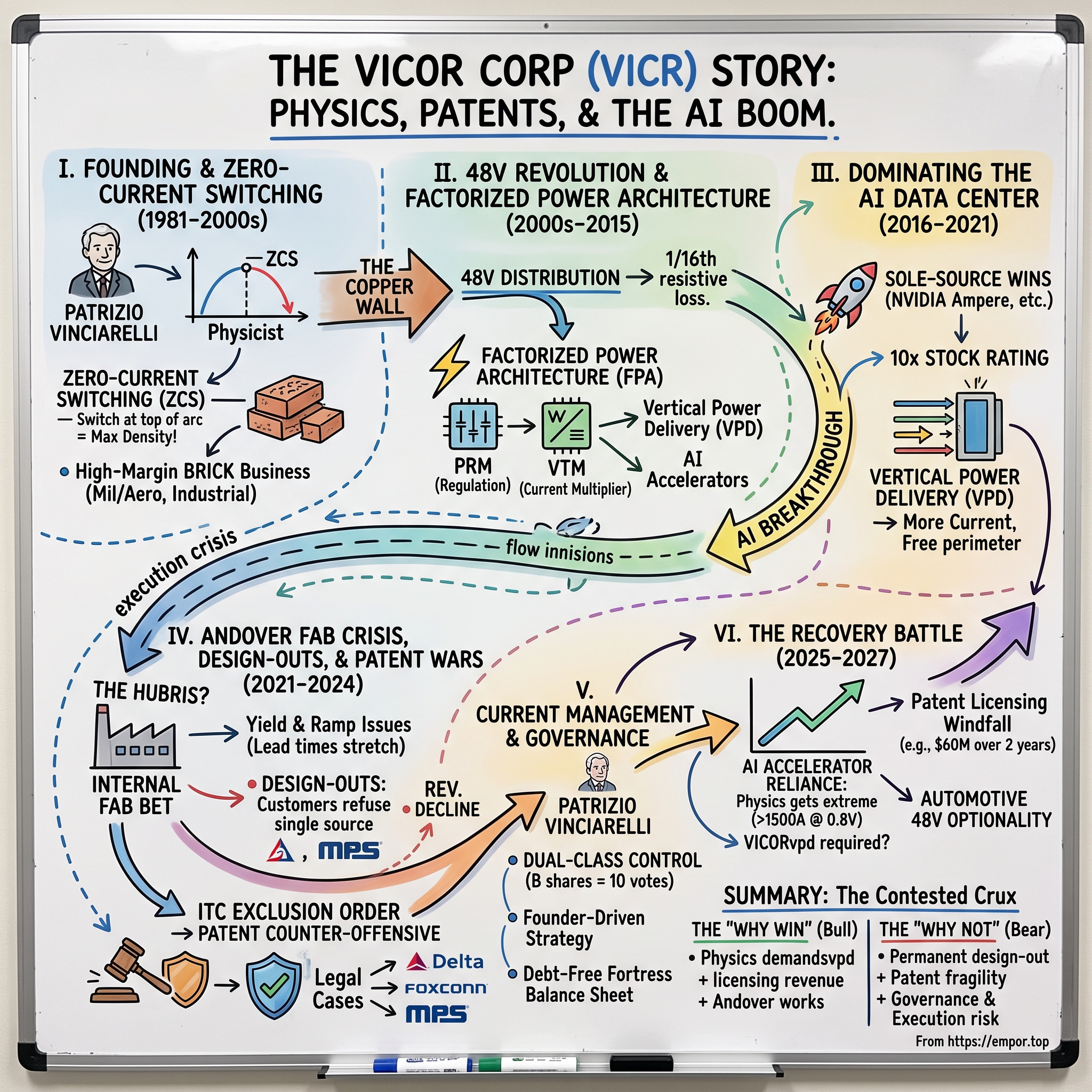
Vicor Corporation: The Physics, Patent Wars, and Powering the AI Boom
I. Introduction & Episode Roadmap
Picture the beating heart of a modern artificial-intelligence supercomputer: a silicon die the size of a postage stamp, packed with tens of billions of transistors, that needs to be fed more than a thousand amperes of electrical current at less than one volt. To put that in human terms, a thousand amps is roughly what an electric-arc welder draws, except here it must be delivered not into a steel beam but into a fragile chip, cleanly, instantly, and without cooking the circuit board it sits on. This is the physical bottleneck at the center of the AI boom, and it is where a small, stubborn engineering company from Andover, Massachusetts made itself briefly indispensable and then nearly irrelevant.
The problem is deceptively simple and utterly unforgiving. Electrical power is voltage multiplied by current. As AI accelerators from Nvidia, Google, and a growing roster of custom-silicon designers have grown hungrier, their core voltage has fallen toward and below one volt while their power draw has climbed past a kilowatt. When you must deliver a kilowatt at under a volt, current explodes into the thousands of amps, and current is the enemy. Resistive loss in copper scales with the square of current, the famous $I^2R$ term, so doubling the current quadruples the wasted heat. Beyond a certain point you simply cannot push that much current across a printed circuit board without the copper traces glowing.
Enter Vicor Corporation, traded as VICR on the NASDAQ Global Select Market. Vicor is not a household name, but for a stretch of the late 2010s it was one of the purest "picks-and-shovels" plays on AI compute, an engineering-driven power-density pioneer whose proprietary 48-volt Factorized Power Architecture and "Converter housed in Package" building blocks let designers step 48 volts down to sub-one-volt right next to the processor, slashing the current that has to travel across the board. For a while, that physics made Vicor the sole-source power supply on some of the most advanced accelerators on earth.1
The narrative arc that follows is a genuine business drama. It runs from a 1981 startup founded by a theoretical particle physicist who had grown bored of CERN and Princeton, to an AI-era darling whose stock rose more than tenfold; through a self-inflicted manufacturing crisis when the company bet everything on building the world's first automated, panel-based power-module foundry in Massachusetts; to a bruising round of design losses as customers refused to depend on a single stumbling supplier; and finally to an IP counter-offensive in which Vicor turned its patent portfolio into a legal battering ram against Monolithic Power Systems, 台達電子 Delta Electronics, and the Taiwanese contract manufacturers 鴻海精密 Foxconn, Quanta, and Wistron.
The core investment question is unresolved and genuinely two-sided. Can an uncompromising, founder-controlled engineering shop rebuild its manufacturing execution and convert its patents into durable, high-margin royalties fast enough to reclaim the AI power-delivery market it helped invent? Or will multi-phase silicon competitors, backed by lower cost and the willingness to be second-sourced, simply route around Vicor's proprietary architecture? By mid-2026 the company was posting record backlog and licensing checks even as skeptics called the whole story a value trap. To understand how a firm can be both at once, you have to start with the physicist who refused to compromise.
 Subscribe on LinkedIn
II. Physics, Power Density, & Founding Context (1981–2000)
Patrizio Vinciarelli did not set out to build a power-electronics company. He set out to understand the universe. Born in Italy, he spent the first decade of his professional life after graduation doing fundamental research in particle physics, moving between CERN, the great particle-collider complex outside Geneva; Stanford on the American West Coast; and the Institute for Advanced Study in Princeton, the same rarefied think tank that had housed Einstein.3 It is worth dwelling on how strange a launchpad this is for a manufacturer of DC-DC converters. Vinciarelli was a theorist, trained to reason from first principles about symmetry and energy, and he had, by his own account, never worked a day inside a company before he founded one.
What pushed him out of physics was impatience. He grew frustrated with the field's glacial pace, the sense that a career could pass while a single question inched toward an answer. Power conversion, by contrast, was a field where the incumbents were, in his estimation, primitive. In 1981 he founded Vicor to attack it.3 The insight he brought was the physicist's habit of asking not "how do others build this?" but "what does the physics actually permit?"
The zero-current switching revolution
To appreciate what Vinciarelli did, you need a plain-language picture of what a power converter is. Every electronic system runs on a different voltage than the wall or the battery supplies, so a converter chops the incoming power into rapid pulses, runs them through a transformer and filter, and reassembles them at the target voltage. The faster you chop, the smaller the magnetic components can be, because a transformer handling high-frequency energy can be physically tiny. So the whole game of power density is: switch faster.
The problem, circa 1980, was that switching faster wasted more energy. Conventional pulse-width-modulation converters turned their transistors on and off while current was still flowing through them, and each hard switch dissipated a burst of heat. Crank the frequency up and the losses piled up until the device melted. Vinciarelli's answer was zero-current switching, or ZCS, and later zero-voltage switching: topologies that time the switch to occur at the exact instant current (or voltage) naturally crosses zero, so the transistor flips when there is nothing to dissipate.4 The analogy is a person jumping off a moving swing. Jump at the bottom of the arc, at maximum speed, and you get hurt. Jump at the top, at the instant of zero velocity, and you step off gracefully. ZCS let Vicor switch at megahertz frequencies that competitors could not touch, shrink the magnetics dramatically, and achieve power densities that stunned the industry. The first product, shipped in 1984, delivered 25 watts per cubic inch, roughly twenty times denser than the alternatives of the day.3
Building the high-margin industrial base
Vicor packaged this physics into standardized "bricks," the full brick, half brick, and quarter brick, rugged modules that engineers in aerospace, defense, industrial automation, telecommunications, and medical equipment could drop into a design and trust. These were not commodity parts. They commanded premium prices because they solved a hard problem in a small space, and they served customers for whom reliability mattered more than pennies. That customer base gave Vicor an enviable financial personality early: gross margins durably above 50 percent, no long-term debt, and R&D funded entirely from its own cash flow.
Vinciarelli took the company public on NASDAQ in 1990, but he engineered the listing so that going public changed almost nothing about who was in charge.3 From the start the capital-allocation philosophy was austere and idiosyncratic: no acquisitions, no leverage, everything reinvested into proprietary tooling and internal manufacturing. It is the behavior of a man who trusts his own physics far more than he trusts the market's judgment about it, a trait that would prove to be both Vicor's greatest asset and its most dangerous blind spot. The brick business threw off the cash. The question that would consume the next two decades was what to build with it, and the answer began with a wall made of copper.
III. The 48V Revolution & Factorized Power Architecture (2000–2015)
Every technology company has a moment when a physical constant quietly rewrites its business plan. For Vicor, that constant was the resistance of copper, and the moment arrived as data centers began to scale.
The copper wall
For decades, computer boards distributed power at 12 volts. That was fine when a processor sipped a few dozen watts. But as server racks pushed toward thousands of watts, the arithmetic of 12-volt distribution turned brutal. Power equals voltage times current, so at a fixed power, lowering voltage raises current, and it is current that copper punishes. The heat wasted in a wire rises with the square of the current: the $I^2R$ term again. Delivering thousands of watts at 12 volts meant hundreds of amps coursing through thick, expensive copper busbars, with a meaningful fraction of the electricity simply vanishing into heat before it ever reached the chip.
The escape was elegant and, once you see it, obvious. Raise the distribution voltage from 12 volts to 48 volts, and to move the same power you need one-quarter the current. Because loss scales with current squared, one-quarter the current means one-sixteenth the resistive loss. A factor of sixteen is not an optimization; it is a different universe. Forty-eight volts also happened to sit just under the 60-volt threshold that regulators treat as "safe to touch," making it the highest practical distribution voltage for commercial gear. The physics all but demanded a shift to 48 volts. The hard part was the last step: how do you get from 48 volts down to the sub-one-volt a processor actually eats, right at the chip, without giving all the savings back?
Inventing Factorized Power Architecture
Vinciarelli's answer, developed and patented through the 2000s, was to stop thinking of power conversion as a single monolithic step and instead to factor it into two specialized jobs, a strategy Vicor branded Factorized Power Architecture. The idea borrows from the way a physicist factors an equation: split a hard problem into simpler pieces that can each be optimized independently.
The first piece was regulation, handled by a Pre-Regulator Module, or PRM, which produces a clean, controlled intermediate voltage and can sit anywhere convenient on the board. The second piece was transformation, handled by a Voltage Transformation Module, or VTM, a fixed-ratio device Vicor called a Sine Amplitude Converter. The VTM does one thing with extreme efficiency: it steps voltage down by a fixed factor and multiplies current up by the same factor, acting as a "current multiplier." Because it has a fixed job and no regulation loop to worry about, it can be made tiny and placed in the last inch, or last fraction of an inch, right beside the processor.
Here is why that placement is the whole ballgame. The 48-volt, low-current power can travel the long distance across the board cheaply, and only in the final short hop does it get converted to the monstrous low-voltage current, so the punishing $I^2R$ losses are confined to a distance measured in millimeters rather than centimeters. Vicor had turned the copper wall into a copper doorway.
Counter-positioning against multi-phase silicon
The incumbents in point-of-load power, analog-chip specialists like Monolithic Power Systems, Renesas, and Infineon, took a different road. They used multi-phase pulse-width-modulation controllers driving a dozen or two dozen bulky inductors and capacitors clustered in a ring around the processor. It works, it is cheap, and every hardware engineer knows how to design with it. But it eats board real estate, and it hits a wall of its own as current climbs, because you can only cram so many inductors around a chip's perimeter.
Vicor's pitch was that its modules delivered power densities the multi-phase crowd could not approach while freeing the crowded perimeter around the chip. That is a classic counter-positioning move in the language of strategy: offering something the incumbent structurally cannot copy without abandoning the business model that makes it money. But counter-positioning cuts both ways, and the incumbents had a counter-pitch of their own, cheaper, easier to design in, and available from many suppliers at once. That tension, superior physics versus commercial convenience, is the spine of everything that follows, and it snapped into sharp relief the moment AI accelerators arrived.
IV. The AI GPU Breakthrough: Dominating the Data Center (2016–2021)
For most of its life, Vicor was a quietly profitable niche engineering firm that Wall Street barely covered. Then the machines learned to learn, and the machines were hungry.
The Nvidia moment and the supercomputer surge
As Nvidia's data-center GPUs marched from the Volta generation to the Ampere A100, their appetite crossed a threshold that made conventional power delivery untenable. These processors demanded hundreds of amps, then many hundreds, at sub-one-volt cores, precisely the regime where confining resistive loss to the last millimeter stops being a nice-to-have and becomes a survival requirement. Vicor's 48-volt direct-to-processor modules, and its high-current point-of-load "current multiplier" parts, were suddenly the elegant solution to an urgent problem, and the company won sole-source design positions on flagship AI accelerator boards.
The market noticed. Vicor's stock, long a sleepy small-cap, ran up more than tenfold from its mid-decade levels as investors reframed it from an obscure module vendor into an indispensable enabler of the AI build-out. This is the point in the story where it is worth pausing on what "sole-source" really means, because it is simultaneously the bull case and the seed of the coming disaster. Sole-source is glorious while it lasts: pricing power, guaranteed volume, a captive design. It is also, for a customer building the most strategically important hardware on the planet, a single point of failure they will tolerate exactly until they have an alternative.
Vertical Power Delivery
Even as it rode that wave, Vicor pushed the physics one step further with Vertical Power Delivery. In the traditional layout, the current-multiplier module sits beside the processor and power flows laterally across the board into the chip's edge. Vicor's insight was to mount the module directly underneath the processor die, on the back side of the printed circuit board, so power flows vertically up through the shortest possible path into the silicon.
The payoff is twofold and large. First, shortening the power path cuts the resistance of the power-delivery network dramatically, by up to 95 percent in Vicor's telling, which means less wasted energy and a cleaner, steadier voltage at the die. Second, and just as valuable, moving power delivery underneath the chip frees the entire perimeter around the processor for the high-speed input/output and the High Bandwidth Memory stacks that AI chips crave. Real estate next to an AI die is some of the most contested territory in electronics; Vicor was offering to vacate it entirely. On the company's more recent calls, management has framed second-generation vertical power delivery as the crux of its comeback, claiming current densities of three amps per square millimeter in 2026 rising toward five by early 2027, against competitors it characterizes as "barely above one amp per square millimeter."2 Those are management's figures, and the competitive gap they imply should be treated as a claim to be tested, not a settled fact, but the architectural logic behind vertical delivery is real and widely acknowledged.
From bricks to Advanced Products
Financially, the AI surge showed up as a shift in the mix. Vicor began disaggregating its revenue into two buckets: legacy Brick Products and the ChiP-based "Advanced Products" that carried the new architecture. Advanced Products became the growth engine and the margin story, and total revenue climbed to a then-record of roughly $359 million in 2021.5 The narrative could not have been cleaner: superior physics, sole-source wins, a stock rerating, and a customer list that read like the who's-who of AI.
And then Vicor made a decision that would test whether great physics can survive contact with a factory floor. It resolved to build that factory itself.
V. The Andover Fab Yield Crisis, Design-Outs, & The MPS Legal War (2021–2024)
There is a particular kind of hubris that afflicts brilliant engineers, and it is not stupidity. It is the conviction that because you can design something better than anyone else, you can also build it better than anyone else, at scale, on time. Vicor caught that fever, and it cost the company the very AI wins it had earned.
The vertically integrated bet
Rather than outsource the manufacture of its ChiP modules to the Asian assembly-and-test houses that the rest of the industry relies on, Vicor decided to build a proprietary, highly automated, panel-based fabrication facility at its Andover, Massachusetts campus, a plant conceived to eventually support more than a billion dollars of annual revenue.3 The strategic logic was defensible on paper. Owning a unique, panel-based process, packaging many modules simultaneously on a large panel much as a semiconductor fab processes a wafer, would bake the manufacturing know-how into trade secrets that a generic contract manufacturer could never replicate. It was an attempt to convert an IP moat into a process moat.
When the moat became a bottleneck
The trouble with building the world's first version of something is that there is no one to copy and no yield curve to inherit. Vicor's proprietary plating, slicing, and automated-handling steps proved fiendishly hard to integrate and ramp. Through 2022 and 2023, exactly when AI demand was going vertical, the fab became a constraint rather than an enabler. Lead times stretched, the company had to allocate scarce supply among customers, and delivery dates slipped. A supplier that cannot ship when its single largest market is exploding is not merely leaving money on the table; it is handing its customers a reason to find someone else.
The design-out
They did. Hyperscalers and Nvidia build their most important products on the assumption of supply security, and no procurement organization on earth will bless a single, capacity-constrained, sole-source supplier for a flagship platform if a credible alternative exists. As Vicor stumbled, that alternative materialized. Monolithic Power Systems, 台達電子 Delta Electronics, Infineon, and Renesas stepped in with multi-phase discrete solutions and 48-volt lateral modules that were cheaper, multi-sourced, and, crucially, deliverable. Vicor lost primary-volume positions on the highest-profile AI platforms of the era.
The financial signature of that loss is visible in the top line, though it is easy to misread. Total company revenue slid from about $405 million in 2023 to roughly $359 million in 2024, a painful reversal for a company that had been selling an AI-growth story.5 Within that, the high-margin Advanced Products line, which had run well over $240 million at its 2022 peak, fell to around $197 million in 2024 before beginning to recover.5 The point is not the precise decimals; it is what the shape reveals. Vicor's own execution, not a collapse in demand for its physics, had knocked it off the design wins. That is a very different diagnosis from "the technology failed," and it frames the entire recovery debate: fixable operational stumble, or a permanent loss of trust?
The patent counter-offensive
Locked out of the volume it believed its inventions had unlocked, Vicor reached for the other weapon in its arsenal: the courtroom. If competitors were going to supply 48-volt power to AI systems, Vicor's position was that many of them were doing so with technology Vicor had patented, and they should either license it or be barred from the U.S. market.
The campaign escalated at the U.S. International Trade Commission, a venue prized by patent holders because it can block infringing imports outright rather than merely award damages. On February 13, 2025, the ITC issued a final determination that certain power modules and the computing systems containing them infringed two Vicor patents, and it imposed a Limited Exclusion Order barring their importation, along with cease-and-desist orders naming Delta Electronics (Americas), Quanta Computer, and the 鴻海精密 Foxconn affiliates FII USA and Ingrasys.4 The ruling was not a clean sweep, the ITC also found that two Foxconn affiliates held a license to one patent through purchase-order language, a finding Vicor said it would appeal to the Federal Circuit, but it established that Vicor's claims had teeth.4
Vicor then widened the front. In January 2026 it filed fresh infringement suits in the U.S. District Court for the Western District of Texas, asserting a newly issued patent covering a "power distribution architecture with series-connected bus converter" against Monolithic Power Systems, Delta, Wistron, and Luxshare.6 The strategy is unmistakable: make it legally and commercially painful to build 48-volt AI power without Vicor, and convert that pain into licensing revenue. Whether that gambit pays off depends on courts, appeals, and the durability of the patents themselves, and it hands enormous influence to the man who controls every one of those decisions.
VI. Current Management, Governance & Capital Allocation: The Vinciarelli Control
To understand Vicor's governance, imagine a company where the founder can lose every outside shareholder vote and still win. That is not a metaphor at Vicor; it is the charter.
Founder control by design
Vicor carries a dual-class structure in which Vinciarelli holds the Class B common stock, and each Class B share carries ten votes to a Class A share's one.5 Because Vinciarelli beneficially owns effectively all of the Class B, he commands a supermajority of the total voting power despite owning a much smaller slice of the economics. The practical consequence is total insulation. There is no activist campaign, no proxy fight, no hostile bid, and no boardroom coup that can force a change of strategy, a sale of the company, or a pivot to outsourced manufacturing. Vinciarelli established the structure precisely to guarantee that continuity.
This is the central governance fact of the whole story, and it deserves a neutral reading rather than a cheer or a jeer. Founder control of this kind is genuinely double-edged. On the upside, it let Vinciarelli make enormous, decades-long bets, on 48 volts, on Factorized Power Architecture, on vertical power delivery, long before the market rewarded them, without being second-guessed by quarterly-minded investors. Much of Vicor's technological lead exists because one person could keep pointing the company at the physics. On the downside, the same structure removes the external check that might have forced a course correction when the Andover fab faltered or when customers begged for a second source. When the founder is also the visionary, the CEO, the chairman, and the controlling shareholder, there is no institutional mechanism to tell him he is wrong.
Management credibility, tested against the record
An independent investor judges management not by its slides but by its behavior over time, and Vicor's record is mixed in instructive ways. The strengths are real: a genuinely differentiated technology portfolio built on well over a hundred patents, a debt-free balance sheet, and a refusal to chase growth through dilutive acquisitions. This is not a management team that has ever papered over a weak business with financial engineering.
The weaknesses are equally real and worth naming plainly. Vicor has a documented history of over-promising and under-delivering on the Andover ramp, with fab-readiness and yield timelines that slipped repeatedly. The explanation for the revenue softness also evolved uncomfortably across successive earnings calls, attributed at various points to post-pandemic lead-time normalization, then to fab integration difficulties, then to competitors' alleged patent infringement. Each explanation may hold a piece of the truth, but a narrative that keeps relocating the cause of the same problem is exactly what a skeptical investor is trained to flag. And the founder's philosophical resistance to the industry-standard practice of multi-sourcing, ethically principled though he frames it, is the very stance that made customers nervous enough to design Vicor out. On the Q2 2026 call, Vinciarelli's framing of the licensing campaign, "if they're using our technology, the only ethical, legal thing to do is to pay for it by way of a license," was vintage: morally certain, and betting the recovery on that certainty being enforceable.2
Capital allocation
The capital-allocation story is one of consistency to the point of dogma. Vicor has essentially no meaningful M&A history; it grows through internal R&D and proprietary tooling, full stop. It funds its capital expenditure, including the Andover plant and the second fab it is now planning, from its own cash rather than debt, and it ended June 2026 with roughly $454 million of cash and no financial leverage to speak of.1 For a company betting on a capital-intensive manufacturing comeback, that fortress balance sheet is a genuine and underrated asset: it can fund years of fab investment through a downturn without touching the capital markets. The open question is whether pouring that cash into a second self-built foundry repeats the Andover lesson or finally scales the process moat. That hinges on the economics of the two product families the cash is meant to serve.
VII. Segment Economics & Emerging Growth Drivers
Strip away the drama and Vicor is, at its core, two businesses wearing one ticker, and they behave very differently.
The two engines
Vicor reports as a single segment but splits its revenue into Advanced Products and Brick Products, and the distinction matters enormously for how an investor should think about the company. Advanced Products are the ChiP-based modules, the PRMs, VTMs, and current multipliers, aimed at AI data centers, high-performance computing, 48-volt automotive, and advanced robotics. This is the high-growth, high-margin, high-volatility engine; it is what surged in the AI boom, cratered during the design-outs, and is now rebounding. Brick Products are the legacy DC-DC converters serving aerospace, defense, industrial, and telecom, the original business, lower growth but steady, sticky, and cash-generative, a classic cash cow that funds the swings elsewhere.
The 2025 numbers make the recovery concrete. Advanced Products revenue climbed to roughly $249 million from about $197 million the year before, while Brick Products held roughly flat near $159 million, lifting total revenue back to about $408 million.5 Read plainly, that tells you the AI-facing business is regrowing off its trough while the legacy base provides ballast. The Q2 2026 quarter reinforced the pattern: revenue jumped nearly 27 percent sequentially to $143.4 million, and the sequential lift was driven by roughly a 45 percent surge in advanced-products shipments alongside a large new licensing payment.1 For a company written off as a design-out casualty, re-accelerating advanced-products volume is the single most important sign that the physics still sells.
The automotive optionality
Beyond the data center sits a second, slower-burning opportunity that most Vicor bulls treat as free optionality: automotive. The auto industry is beginning a long migration from the century-old 12-volt electrical system toward 48-volt architectures, a shift given a high-profile push when Tesla adopted a 48-volt standard for the Cybertruck and openly encouraged the rest of the industry to follow. A 48-volt vehicle backbone needs exactly the kind of compact, bidirectional 48-volt-to-12-volt conversion, via non-isolated bus converters and related modules, that Vicor has spent decades perfecting.[^11]
The reason this could matter is diversification. A meaningful automotive 48-volt franchise would give Vicor a large, multi-year end market whose cycles have nothing to do with hyperscaler capex, softening the boom-bust volatility that defines the AI business. The reason to stay skeptical is that automotive design cycles are long, qualification is grueling, and the 48-volt transition has been "about to happen" for years without becoming a large revenue line. It is real optionality, not a current growth driver, and an honest analysis treats it as a call option that may or may not come into the money. What decides whether any of this compounds into durable value is the competitive structure of the market, which is worth war-gaming directly.
VIII. Competitive Strategy: Hamilton Helmer 7 Powers & Porter's 5 Forces
Peel back the engineering romance and ask the cold question an investor must ask: what, exactly, protects Vicor's profits from being competed away? Two frameworks, Hamilton Helmer's 7 Powers and Michael Porter's Five Forces, help stress-test the answer, and the honest verdict is that Vicor's moat is real but narrower and more contested than the bulls suggest.
Hamilton Helmer's 7 Powers Analysis
Cornered Resource (patents and IP) is Vicor's strongest power. The portfolio of well over a hundred patents covering Factorized Power Architecture, the Sine Amplitude Converter, series-connected bus converters, and ChiP packaging is the crown jewel, and it is the asset the company is now actively monetizing through litigation.6 But a cornered resource is only as strong as its enforceability, and that is precisely what the ITC and district-court battles are testing in real time. A cornered resource being adjudicated in court is a moat whose depth is not yet measured.
Process Power is the intended prize of the Andover gamble: manufacturing know-how so specific to Vicor's panel-based process that no substrate vendor can replicate it. The catch is that process power is only a power once the process actually works at yield and scale. Through the crisis years, Andover looked less like process power and more like a process liability; by mid-2026 management said the plant was approaching full utilization, which is necessary evidence that the moat is forming, but not yet proof.2
Counter-Positioning against multi-phase silicon is genuine, as described earlier, but it is a two-way street. Vicor counter-positions on density; the incumbents counter-position right back on unit cost, ease of board integration, and multi-sourcing. Whether density or convenience wins depends entirely on how extreme the power demands become.
Scale Economies is where Vicor is weak, and the analysis should not soften this. Against Taiwanese contract manufacturers like Delta and Foxconn, or high-volume silicon vendors like Monolithic Power, Vicor is small and its self-built capacity is a fraction of what those rivals command. Manufacturing scale is the incumbents' power, not Vicor's.
Switching Costs are the most interesting because they are asymmetric in time. Once a Vicor module is integrated into a custom accelerator's package and validated, ripping it out is expensive, which gives Vicor real stickiness after a design win. But before the design is frozen, switching cost is essentially zero, and Nvidia's move to alternatives on later platforms proved it. Vicor's switching-cost power exists, but only on the far side of a design win it must first earn.
Porter's 5 Forces Analysis
Bargaining power of buyers is extremely high, and it is the force that has hurt Vicor most. Hyperscalers, Microsoft, Google, Meta, and Amazon, and GPU vendors like Nvidia dictate design requirements, insist on dual-sourcing as a condition of doing business, and will drop a single-source supplier the instant it stumbles on yield. This is not a market where a supplier tells the customer how it will be.
Threat of substitutes is high. For any workload that does not truly require Vicor's extreme density, multi-phase discrete power stages from Monolithic Power, Renesas, and Infineon remain a perfectly viable, cheaper, multi-sourced alternative, which is precisely why analysts at outlets like SemiAnalysis frame this as an open competitive fight rather than a Vicor walkover.7
Rivalry is intense, spanning both price and design, against Monolithic Power (MPWR), Delta, and Infineon, several of whom Vicor is simultaneously suing, which tells you something about how the competition is being waged.
Bargaining power of suppliers is low, a rare point of comfort: the MOSFETs, substrates, and copper Vicor buys are commodity inputs available from many sources.
Threat of new entrants is low, thanks to the technological barrier, capital intensity, and patent thicket around 48-volt-to-sub-one-volt current multiplication, the one force working clearly in Vicor's favor.
Netted out, the war-game verdict is that Vicor holds a strong-but-narrow position: a real IP-and-density moat surrounded by powerful buyers, credible substitutes, and better-scaled rivals. That is exactly the kind of position that can produce either a spectacular recovery or a slow bleed, which is why the bull and bear cases both sound so plausible.
IX. Investment Story Spine, Bear vs. Bull Stress Test & Key KPIs
Every contested stock has a spine, a single crux on which the whole thesis pivots. For Vicor the crux is this: does the physics of next-generation AI chips become so extreme that Vicor's architecture stops being optional and becomes mandatory, before competitors and customers make the design-out permanent?
The "Why Win" / Bull Case
The bull case rests first on physics running in Vicor's favor. Next-generation AI accelerators built on 2- and 3-nanometer processes are projected to demand well over 1,500 and toward 2,000 amps at core voltages below 0.8 volts. The bull argument is that at those extremes, lateral multi-phase silicon simply runs out of perimeter and copper, and vertical power delivery directly beneath the die stops being one option among several and becomes the only physically workable one. If that thesis is right, Vicor's second-generation vertical power delivery is not competing for the socket; it is the socket. Management's claimed density lead, three amps per square millimeter today against rivals near one, is the quantitative expression of this hope, and its recent engagement with hyperscalers and OEMs on integrated voltage regulators is the early evidence.2
The second leg is manufacturing normalization. If Andover reaches stable, automated yields and the planned second fab, which management says is needed to reach a long-term $2.5 billion revenue ambition at 70 percent gross margins, comes on cleanly, gross margins can expand meaningfully from here as fixed costs spread over more volume.2 The third leg is the patent campaign converting into a high-margin royalty stream. Vicor's Q2 2026 already showed what that looks like: a new licensing arrangement management valued at roughly $60 million over two years, with about $15 million recognized in the quarter, helped push total revenue and royalty income sharply higher and lifted gross margin to 58 percent.12 Licensing dollars carry almost no cost, so even modest, durable royalties would reshape the earnings profile.
The "Why Not" / Bear Case
The bear case is not that Vicor's technology is bad; it is that being right on physics is not the same as winning the market, and Vicor has already proved it can lose from a winning position. The first bear pillar is permanent design-out: MPS, Delta, and Renesas keep improving multi-chip modules and alternative 48-volt topologies that are "good enough" for most workloads at 30 to 50 percent lower cost with guaranteed multi-sourcing, so Vicor is confined to a shrinking sliver of only the most extreme sockets. The most pointed public expression of this view, a short thesis arguing that "AI chip mania accelerates Vicor's competitive demise," contends that the very AI boom bulls cite is drawing in better-resourced competitors faster than Vicor can defend.8
The second pillar is legal fragility. The entire royalty-windfall thesis assumes the patents survive. Inter Partes Review proceedings or district-court trials could invalidate key claims, and the ITC has already shown it will rule against Vicor on specific points, such as the Foxconn license finding.4 A moat made of patents evaporates the day a court says the patents are invalid. The third pillar is key-person and governance risk: Vinciarelli, the source of the vision and the holder of absolute control, is in his late seventies, and Vicor has disclosed no clear technical-succession plan, so a firm whose entire strategy runs through one mind carries a discontinuity risk no diversified board could accept. The fourth pillar is simply execution: if Andover yields wobble again or the second fab repeats the first fab's ramp problems, manufacturing overhead stays elevated and margins stay depressed regardless of how good the physics is.
The intellectually honest position holds both cases at once. The bull case requires you to believe Vicor executes on manufacturing and enforces its patents; the bear case requires only that Vicor keeps doing what it has recently done, stumble on the factory floor and win in the market slower than rivals adapt. Which is unfolding is knowable, if you watch the right things.
Top 3 KPIs to Track
An investor does not need to model every line; three metrics carry most of the signal. First, Andover fab utilization and yield, because it is the master key to Advanced Products gross margin and the proof-or-disproof of the process-power thesis; management's claim that the plant is nearing full utilization is the number to verify quarter by quarter. Second, Advanced Products revenue growth, the cleanest read on whether AI, HPC, and automotive design wins are actually converting into shipments rather than press releases; the near-45-percent sequential jump in Q2 2026 is the kind of data point that either continues or doesn't.1 Third, litigation and licensing milestones, the ITC rulings, appeals, and signed license agreements that determine whether Vicor's IP becomes defensible cash or merely expensive litigation; management has pointed to a second ITC decision expected in 2027 as the next catalyst.2 Track those three and you are tracking the actual thesis, not the noise.
X. Epilogue & Playbook Lessons
Step back from the quarter-to-quarter and Vicor becomes a case study, one of the cleaner ones in public markets, in the gap between being right and winning.
The first playbook lesson is the danger of single-sourcing in modern supply chains. Vicor had the better physics, the sole-source wins, and the AI tailwind, and it still lost primary volume, because superior technology means nothing to a hyperscaler if you cannot guarantee supply and refuse to be second-sourced. In an era when the buyers are among the most powerful companies on earth and they have institutionalized dual-sourcing as a rule of survival, a supplier's manufacturing reliability and its willingness to share the socket can matter more than its raw performance. Vicor learned that lesson the expensive way.
The second lesson is the double-edged sword of vertical integration. Building a proprietary foundry was a legitimate bid to convert an IP moat into a process moat that no contract manufacturer could copy, and if Andover ultimately runs at yield, that bet may still look prescient. But vertical integration front-loads the risk: the same plant that is supposed to be a long-term structural advantage became, in the short term, the bottleneck that cost Vicor its best customers at the worst possible moment. Owning your manufacturing means owning your manufacturing problems, precisely when you can least afford them.
The third lesson is founder control as both protection and blind spot. Vinciarelli's absolute grip let Vicor make visionary, unpopular, decades-long bets that a conventionally governed company would never have sustained, and much of the technology moat exists because of it. That same grip removed every external mechanism that might have forced a pragmatic pivot, on multi-sourcing, on outsourcing, on succession, when pragmatism was exactly what the moment demanded. Dual-class control is not good or bad in the abstract; it amplifies whatever the founder is, and Vinciarelli is both a genuine visionary and, by the evidence, a leader reluctant to bend to commercial reality.
Vicor in mid-2026 sits in a genuinely suspenseful place. Its backlog had swelled to $380 million, up 145 percent year-over-year, its cash pile had grown to more than $450 million, and its licensing checks had begun to arrive, all signs that the physics still sells and the legal strategy has bite.1 Yet the same company remains a narrow, contested, founder-dependent bet whose recovery hinges on executing the very thing, manufacturing at scale, it has historically executed worst. It remains one of the purest physics-driven engineering companies in public markets, a firm whose technology is hard to dispute on paper, now fighting its decisive battle not in the lab but in the courtroom and on the factory floor, to win back the AI revolution it helped ignite.
XI. Outro & Links
For long-term investors, the Vicor story distills to a short list of things worth holding in mind. This is a founder-controlled engineering company with a genuine, IP-backed density advantage in AI power delivery, a fortress balance sheet, and a recovering high-margin product line, set against powerful customers, credible cheaper substitutes, better-scaled rivals, a manufacturing track record that has disappointed, and a governance structure that concentrates both the vision and the risk in one aging founder. The bull and bear cases are unusually symmetric, and the outcome is unusually knowable if one watches fab yields, Advanced Products growth, and the arc of the patent litigation rather than the rhetoric around them.
The primary sources that matter most for continued diligence are Vicor's own investor materials and filings, its quarterly results and the accompanying earnings calls, its 10-K risk factors and segment disclosures, and the public dockets of its ITC and district-court cases, read alongside independent competitive analysis of the AI power-delivery market. Those documents, more than any narrative, will reveal whether Vicor's physics finally converts into durable, defensible profits.
References
-
Vicor Corporation Reports Results for the Second Quarter Ended June 30, 2026 — GlobeNewswire, 2026-07-21 ↩↩↩↩↩↩
-
Vicor (VICR) Q2 2026 Earnings Call Transcript — The Motley Fool, 2026-07-21 ↩↩↩↩↩↩↩
-
Patrizio Vinciarelli creates Vicor to solve power conversion challenge — Vicor Technical Library ↩↩↩↩↩
-
ITC bars importation of power modules and unlicensed computing systems that infringe Vicor patents — GlobeNewswire, 2025-02-14 ↩↩↩↩
-
Vicor Corporation SEC Filings (10-K annual reports, segment and revenue disclosures) — SEC EDGAR ↩↩↩↩↩
-
Vicor Corp v. Monolithic Power Systems and related defendants (patent infringement dockets) — Justia Dockets ↩↩
-
AI Power Delivery Architecture and Competition Analysis — SemiAnalysis ↩
-
Vicor Short Thesis: AI Chip Mania Accelerates Vicor's Competitive Demise — The Razor's Edge ↩
 LinkedIn
 WhatsApp
 Reddit
 Hacker News
 Email
Email Kindle
 RSS Feed
 Spotify
 Apple Podcasts
 Amazon Music
 Audible
 YouTube