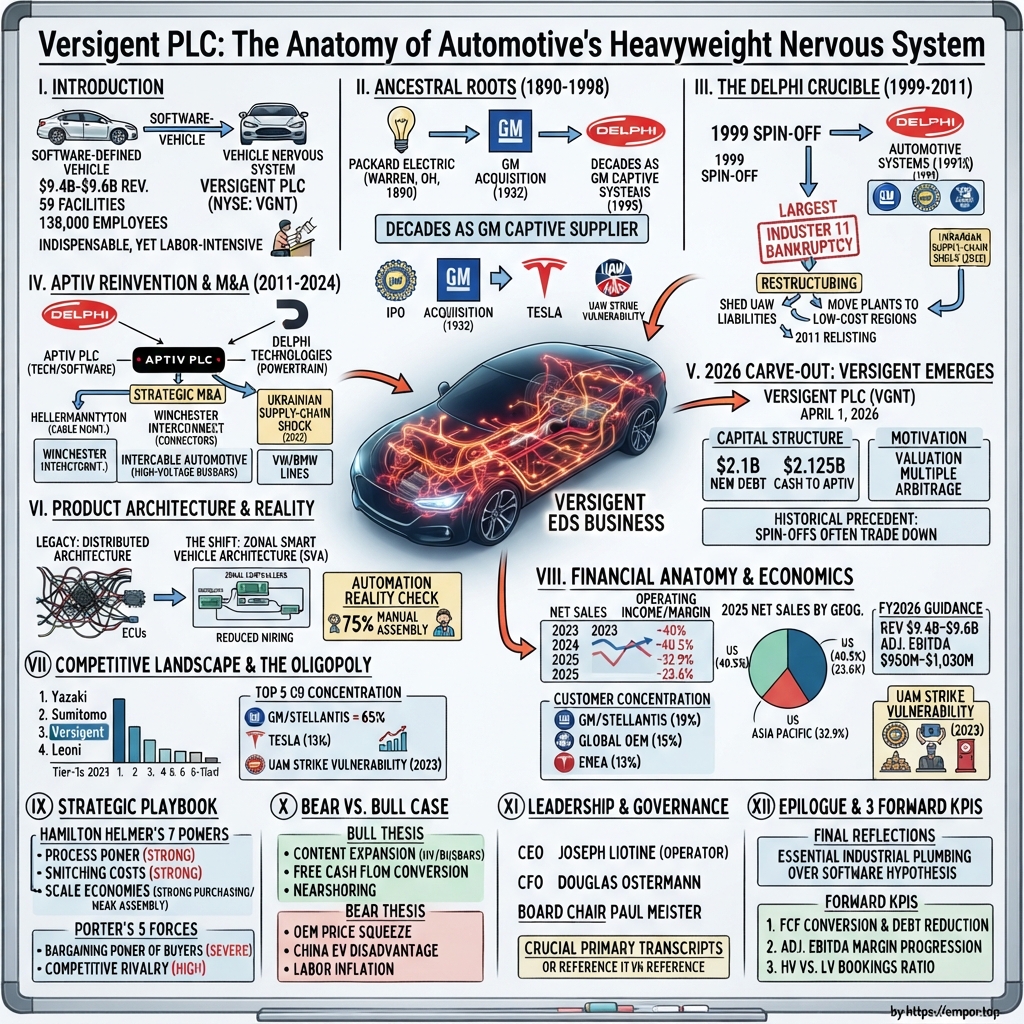
Versigent PLC: The Anatomy of Automotive's Heavyweight Nervous System
I. Episode Roadmap & The Car's Central Nervous System [00:00:00 – 00:15:00]
Step onto the floor of an automotive wiring harness plant in Ciudad Juárez or Kénitra, and the immediate impression is not noise, but stillness. There are no six-axis robotic arms executing choreographed routines, no stamping presses concussing the air every four seconds, and no showers of weld spatter. Instead, rows of vertical layout boards—each the size of a garage door and printed with a full-scale schematic of a vehicle’s electrical architecture—fill the plant. Standing at each board, an operator takes wire from a bin, routes it along designated paths, clips it into fixtures, wraps it in tape, and passes the assembly down the line. Thousands of individual wires, hundreds of crimped terminals, and dozens of plastic connectors come together into a single, branching harness. Weighing more than a small child, this dense, orange-and-black physical network is folded, bagged, and shipped to an assembly plant, where automation remains equally scarce: human workers must still feed the harness through the body-in-white by hand.
This manufacturing reality defines Versigent PLC, which began trading on the New York Stock Exchange under the ticker VGNT on April 1, 2026. The company launched with 138,000 employees, operations across more than 25 countries, engineering centers on four continents, and 2025 revenue of roughly $8.8 billion.1 It represents one of the largest workforces attached to any newly listed company in recent American market history—and the vast majority of those workers do not sit behind a screen.
Management's core commercial pitch is straightforward: while modern vehicles are marketed as software-defined computers on wheels—complete with over-the-air updates, driver-assistance features, 800-volt fast charging, and sprawling digital cockpits—software cannot route power or transmit raw physical signals on its own. That physical layer requires copper wire, aluminum busbars, power distribution centers, connectors, and terminals. Regardless of how centralized a vehicle's compute architecture becomes, physical conduits must deliver current from high-voltage battery packs to drive units and seat motors, while shielding data moving from cameras to domain controllers through a vibrating, thermally stressed steel chassis built to endure a decade of Michigan winters and Arizona summers. According to company disclosures, Versigent’s components power roughly one in six passenger vehicles in production globally today.1
Beyond its scale, the company sits at the center of an enduring manufacturing paradox. A wiring harness is among the heaviest and most expensive subsystems in a modern automobile, rivaled only by the powertrain or battery pack and the structural body itself. Yet it remains among the least automated components in global manufacturing. Wire is limp and flexible; it lacks a fixed geometry, offers no uniform grip surface for robotic end-effectors, and varies with every vehicle trim, option package, and regional regulatory configuration. As a result, despite a quarter-century of industry automation initiatives, harness assembly remains dependent on manual labor in low-cost manufacturing regions.
That operational reality led Aptiv PLC to conclude it no longer wanted to own the business.
The inflection point. On January 22, 2025, Aptiv announced plans to separate its Electrical Distribution Systems segment into an independent, publicly traded entity through a tax-free spin-off, targeting completion by the end of the first quarter of 2026.2 The transaction closed fourteen months later. Aptiv shareholders of record as of March 17, 2026 received one Versigent ordinary share for every three Aptiv shares held, and regular-way trading commenced on April 1.3 Before the distribution, Versigent raised approximately $2.1 billion in new debt—consisting of a $500 million term loan and $1.6 billion in senior unsecured notes—and, according to its quarterly filings, paid a cash dividend of $1,894 million to its former parent during the first half of 2026.45
That sequence establishes the financial foundation of the spin-off: a business unit that had never carried standalone debt took on significant leverage, with the borrowed cash flowing directly to its former parent rather than being retained on Versigent's balance sheet. Whether this capital structure represents an acceptable cost of independence or an onerous toll extracted during the carve-out is an assessment the market will determine across multiple operating cycles rather than a few quarters.
Investors face a clear analytical dilemma. Is Versigent a low-multiple, capital-constrained industrial carve-out—the labor-intensive legacy operations shed so a parent company could pursue higher-multiple software valuations—or is it an indispensable, cash-generative supplier anchored at a physical manufacturing chokepoint that vehicle electrification makes more valuable? Both interpretations stem from the same set of facts, indicating that the ultimate outcome depends far more on operational execution than on corporate structure alone.
Where this story goes. The narrative begins with 136 years of industrial lineage—tracing the Packard brothers in Warren, Ohio, through decades as a captive General Motors division, into Delphi's consolidation and subsequent bankruptcy—a history that illustrates the structural vulnerabilities inherent to this business model. The focus then turns to the past decade: Aptiv’s corporate repositioning, three key acquisitions that reveal how management allocates capital, the supply chain disruptions following the war in Ukraine that exposed the product's systemic fragility, and the execution of the spin-off itself.
The analysis then investigates the physical and economic mechanics: how modern harnesses are engineered, why the transition to zonal electrical architectures introduces both margin opportunities and volume risks, why the four-firm global oligopoly is more heavily dominated by Japanese suppliers than Western investors typically realize, and what the initial two quarters of standalone public filings reveal about operating margins, copper pass-through mechanisms, and management's forecasting discipline. Every core thesis is evaluated against disclosed operational data rather than executive projections, given the sector's long record of ambitious promises tempered by physical manufacturing limits.
The underlying operating economics are demanding. The business has historically delivered GAAP operating margins in the mid-single digits, absorbs fluctuations in raw copper prices before passing them along on a lag, and negotiates pricing annually against concentrated, highly sophisticated global automakers. While viable, it is an industry where profitability shifts by tens of basis points, and where the primary operating expense remains human labor in regions experiencing steady wage growth.
That is the operating environment Versigent inherited. Understanding why it is shaped this way requires returning to an incandescent lamp factory in Warren, Ohio.
 Subscribe on LinkedIn
II. Ancestral Roots: From Packard Electric to General Motors Captive (1890–1998) [00:15:00 – 00:35:00]
In 1890, two brothers in Warren, Ohio—James Ward Packard and William Doud Packard—established a two-story plant to manufacture incandescent light bulbs.6 Arriving eleven years after Thomas Edison demonstrated a practical incandescent lamp, amid the broader rush to electrify American industry, the Packards were pursuing the same path as hundreds of mechanical tinkerers across the country: chasing the newly emerging power grid.
Bulbs, however, proved to be the wrong product. The enduring commercial opportunity lay in the conduits that carried current to them. In 1901, the brothers added a cable and wire business, and the logic of that pivot outlasted every other decision they made.6 Wire manufacturing was unglamorous, but the product was universal. Every electrical system required it, and the infant automotive industry soon demanded extraordinary quantities engineered for operating conditions residential wiring never encountered: engine heat, continuous vibration, motor oil, road salt, and constant mechanical flexing.
The Packards also built automobiles. That car business was sold and relocated to Detroit in 1902, becoming the Packard Motor Car Company, while the electrical operations remained in Warren.6 The split created a notable historical irony: the storied luxury automaker carrying the family name fell into insolvency and disappeared in the 1950s, while the unheralded wiring business left behind in Ohio continues to ship product 125 years later—now operating under a new corporate banner on the New York Stock Exchange.
The General Motors decades. In 1932, during the depths of the Great Depression, General Motors acquired Packard Electric.6 The transaction fit Alfred Sloan's overarching operational playbook: vertical integration as a strategic hedge. As automobiles grew electrically complex, wiring harnesses became a critical assembly bottleneck, and GM refused to remain vulnerable to outside suppliers for components that could halt a production line.
What followed were roughly six decades inside the GM corporate umbrella, shaping the business in ways that still influence Versigent's cost structure and manufacturing culture today. As a captive supplier, Packard Electric standardized the architecture of the modern automotive wiring harness: multi-pin connectors, modular fuse blocks, and color-coded circuits. By the 1980s, it had become the automotive industry's leading producer of wire harnesses and related electrical components.6 Its sprawling Warren complex grew into one of the era's largest American manufacturing campuses.
Yet captive status created two opposing structural realities. On one side, guaranteed vehicle volumes fostered genuine manufacturing scale and engineering depth. On the other, captive demand eliminated the discipline of competitive bidding, while embedding a union labor cost structure calibrated to GM's peak postwar profit margins rather than the economics of global component manufacturing. That cost burden remained manageable as long as GM controlled nearly half of the domestic automotive market; it became an acute liability once import competition eroded that domestic dominance.
Delphi. In 1995, GM consolidated its internal component divisions—combining Packard Electric with Delco, Saginaw, Harrison Radiator, Inland Fisher Guide, and several others—into Delphi Automotive Systems, rebranding the Warren operation Delphi Packard Electric Systems.67 The stated strategy was to run component manufacturing as an independent commercial enterprise rather than an internal cost center, allowing it to pursue contracts with rival automakers and adapt to competitive market pricing.
While the commercial rationale was sound, execution collided directly with the legacy labor agreements and pension obligations GM had accumulated over six decades. Corporate leadership could rename the division and assign it an independent profit-and-loss statement, but redrawing an organizational chart could not renegotiate the retiree healthcare and pension liabilities owed to tens of thousands of workers.
For long-term investors, the critical takeaway from this era is not industrial nostalgia. It is that automotive wiring has always been an operating-scale and labor-management business rather than an intellectual-property franchise. Packard's durable competitive advantage was never a defensible patent; it was physical proximity to a dominant anchor customer, accumulated process engineering, and deeply embedded customer relationships. While tangible, those operational advantages remain tethered to the health of the primary customer. When that customer loses market share, supplier margins erode in tandem. That dynamic forms the structural thread running from 1932 to the late 1990s—and explains why the next chapter in the lineage ended in federal bankruptcy court.
III. The Delphi Crucible: Spin-Off, Mega-Bankruptcy, & Hedge Fund Rebirth (1999–2011) [00:35:00 – 00:58:00]
In 1999, General Motors spun Delphi off to its shareholders. The transaction briefly appeared to be a triumph: Delphi debuted as the largest automotive supplier in the world by revenue, a $28-billion-plus enterprise with components in nearly every vehicle sold in North America.
The underlying vulnerability lay in the labor contracts Delphi inherited. The company entered the public markets bound by collective bargaining agreements designed for a captive GM division—featuring rigid job-security rules, generous benefits, and defined-benefit pension obligations calibrated for an automaker with domestic pricing power. Delphi's competitors—primarily non-union transplant suppliers building greenfield plants across the American South and Mexico—carried none of these legacy commitments. Delphi was forced to compete for contracts against rivals whose fully loaded labor costs were a fraction of its own, in a product category where assembly labor is the primary variable expense. That cost disparity created a structural deficit that unraveled over the following six years.
October 2005. Delphi filed for Chapter 11 protection in the Southern District of New York, listing $17.1 billion in assets—at the time the largest bankruptcy in the history of the American auto industry and among the largest industrial filings the country had seen.[^8] The proximate causes were structural: rising raw material prices, GM's accelerating loss of North American market share, and an inflexible domestic cost base that could not adjust to declining production volumes.
The restructuring evolved into a four-year standoff, serving as an instructive case study in the company's operating lineage.
Unfunded retirement liabilities formed the core dispute. Delphi's defined-benefit pension plans were terminated in 2009, with responsibility for paying benefits transferring to the Pension Benefit Guaranty Corporation, the federal insurer.8 The transfer triggered years of litigation and congressional inquiries regarding the disparate treatment of union and salaried retirees, underscoring the risk of accumulating fixed obligations that a manufacturing business cannot support through an industry downturn.
As the proceedings dragged on, distressed-debt investors stepped in. Delphi emerged from Chapter 11 in 2009 with hedge funds—Silver Point Capital and Elliott Management prominent among them—controlling the reorganized equity.[^8] The pre-petition equity was extinguished. The new controlling shareholders executed a sweeping operational overhaul: closing or selling unprofitable facilities, shuttering uncompetitive product lines, and shifting manufacturing footprints aggressively to low-cost locations across Mexico, Eastern Europe, and China. The business was reconstituted as Delphi Automotive PLC, incorporated in Jersey and tax-domiciled in the United Kingdom.
The 2011 relisting. In November 2011, Delphi Automotive returned to the New York Stock Exchange. The offering priced at $22 per share, at the low end of the marketed range, raising roughly $530 million and valuing the company at approximately $7.5 billion.9 Notably, the proceeds flowed entirely to selling shareholders rather than into company operations, functioning as a liquidity event for the restructuring funds rather than a growth-capital raise. The PBGC's own equity stake had been redeemed for $594 million in March 2011, prior to the public offering.8
Delphi's subsequent operating performance was strong. Shedding its pension liabilities, closing legacy domestic facilities, and relocating production to lower-cost labor markets allowed the company to expand margins and compound shareholder value, establishing Delphi as a prominent case study in automotive supplier turnarounds over the following decade.
Evaluating that track record requires careful analytical distinction. One interpretation suggests that this corporate lineage possesses an exceptional ability to manage lean, globally distributed manufacturing—a capability that remains relevant to Versigent today. A more measured interpretation acknowledges that the outsized returns generated between 2011 and 2017 were largely engineered through the bankruptcy process itself. A Chapter 11 reorganization that cancels legacy equity, shifts roughly $6 billion in pension liabilities to a federal backstop, and abrogates legacy labor contracts represents a one-time structural reset rather than an ongoing operational capability. That process cannot be replicated.
This distinction bears directly on how investors evaluate Versigent's operational roadmap. The cost structure Versigent inherited at its 2026 spin-off is already the post-restructuring footprint; there are no lingering legacy liabilities to discharge through financial engineering. Future margin gains must be generated on factory floors, through component purchasing leverage, and via architecture mix shifts rather than in court.
That operational reality set the stage for how the reorganized business navigated its next corporate transformation.
IV. The Aptiv Reinvention & The Great M&A Roll-Up (2011–2024) [00:58:00 – 01:22:00]
By 2017, Delphi's leadership had reached a conclusion that has since become a familiar playbook across industrial capital markets: equity investors were unwilling to assign a premium technology multiple to a business that still manufactured engine valves and fuel injectors.
The company's portfolio spanned two fundamentally distinct investment theses. On one side stood powertrain—fuel injection, ignition, and valvetrain systems—an operational base whose terminal value faced growing skepticism as automotive electrification accelerated. On the other sat active safety, vehicle connectivity, and electrical architecture—the sensory electronics and physical routing systems essential to software-defined vehicles. Held together under one corporate umbrella, the combined enterprise traded at the valuation multiple of its slowest-growing, least-favored business unit.
The bifurcation. On September 27, 2017, Delphi Automotive announced the names of the two independent publicly traded companies that would emerge from separating its Powertrain Systems segment: the remaining business would become Aptiv PLC, and the spun entity would be named Delphi Technologies PLC.10 The board approved the transaction on November 13, 2017, with the distribution taking effect on December 4 and Aptiv commencing regular-way trading under the ticker APTV the following day.1110
The subsequent trajectory of the spun-off powertrain business provides a cautionary precedent for corporate carve-outs. Delphi Technologies struggled to establish durable standalone equity value. On January 28, 2020, BorgWarner agreed to acquire the company in an all-stock transaction initially valued at approximately $3.3 billion.12 By the time the transaction closed later that year, the consideration delivered by BorgWarner had contracted to roughly $2.4 billion, comprising approximately $1.5 billion in equity and the assumption and repayment of roughly $900 million of Delphi Technologies debt.12
That transaction represents the closest corporate parallel to Versigent's 2026 separation. When this management lineage previously carved out a business facing structural headwinds and burdened it with leverage, the spun entity failed to re-rate; instead, it was acquired at a diminished valuation within three years. While a single corporate action does not guarantee a future outcome—and Versigent's electrical architecture business does not face the terminal decline of internal combustion—the precedent complicates the standard thesis that pure-play focus automatically unlocks equity value, particularly when executed by the same corporate architects.
Three acquisitions, three lessons. Aptiv's capital allocation between 2015 and 2022 illustrates how leadership attempted to reposition the electrical architecture business before ultimately spinning it off.
HellermannTyton, December 2015. Delphi completed the acquisition of HellermannTyton Group PLC in a transaction valued at £1.07 billion on a cash-and-debt-free basis, following an offer of £4.80 per share the previous July.13 The investment thesis centered on content adjacency: HellermannTyton manufactured cable ties, clips, routing hardware, protective conduit, and identification systems—the specialized fasteners that secure a wiring harness to a vehicle's body-in-white. By bundling fastening hardware directly with the wiring assembly, a supplier can capture more dollar content per vehicle at higher gross margins than raw copper and PVC insulation alone.
The underlying industrial logic was defensible, marking management's first concerted attempt to escape harness commoditization by packaging an integrated mechanical-electrical system rather than selling loose wire. Leadership guided to roughly 15 cents of adjusted EPS accretion beginning in 2016, excluding integration expenses.13 From public filings, however, verifying whether the business recovered the multiple paid remains difficult: Aptiv never broke out HellermannTyton as a standalone reporting segment, nor did it disclose incremental content-per-vehicle metrics attributable to the product line. That reporting opacity highlights an enduring analytical challenge for investors: when an acquired business is absorbed into an existing operating division without dedicated disclosure, the market loses the ability to evaluate whether the capital outlay generated an attractive return.
Winchester Interconnect, 2018. On July 10, 2018, Aptiv agreed to acquire Winchester Interconnect from an affiliate of Snow Phipps Group for $650 million, closing the transaction on October 24.1415 Winchester specialized in custom-engineered interconnects for harsh environments across aerospace and defense, semiconductor manufacturing equipment, industrial automation, and medical devices, generating roughly $250 million in revenue at the time of the deal.14 The commercial rationale was cyclical diversification: adding non-automotive revenue streams that do not track passenger vehicle build cycles, while monetizing Aptiv's connector engineering in adjacent industrial markets.
At roughly 2.6 times revenue for an asset insulated from automotive volume swings, the purchase price was reasonable for cyclical protection. Yet relative to Aptiv's total revenue base, Winchester represented only a few percentage points of sales—never large enough to materially dampen the consolidated business's cyclical exposure. Its enduring significance lies instead as an operational template: Versigent's leadership today identifies commercial vehicles, agricultural machinery, and stationary energy storage as accounting for roughly 10% of revenue and representing a primary near-term growth vector.16 That strategy directly replicates the Winchester blueprint.
Intercable Automotive Solutions, 2022. On September 13, 2022, Aptiv agreed to acquire an 85% equity interest in Intercable Automotive Solutions for €595 million, with the founding Mutschlechner family retaining the remaining 15%.17 Operating from Bruneck, Italy, Intercable brought specialized manufacturing expertise spanning seven generations of high-voltage busbar engineering, solid-state electrical centers, and battery cell interconnect systems, generating roughly €250 million in estimated 2022 sales.17
Strategically, Intercable was the most consequential of the three transactions—and, in hindsight, the most vulnerable to cyclical timing. Busbars are heavy, rigid conductive metal bars that route high current within battery packs and power electronics, replacing flexible cabling with structural metal conduits. They represent the high-voltage content unlocked by vehicle electrification that traditional harness assemblers do not inherently control. Acquiring an established European specialist offered an accelerated route to securing proprietary manufacturing capability rather than developing it internally.
However, the transaction closed just as European battery-electric vehicle production began decelerating. The steep ramp in high-voltage component demand required to justify the premium valuation proved slower and smaller than the 2022 underwriting model assumed. Versigent's second-quarter 2026 financial results reflected those headwinds, with European revenue declining 6% year over year and adjusted net sales contracting 11%, driven by broader European production softness and platform roll-offs.16 To align capacity with subdued volumes, Versigent recorded approximately $46 million in restructuring charges during the first half of 2026, primarily associated with European facility closures.5 Whatever proprietary advantages Intercable's technology confers over the long term, the acquisition has thus far coincided with an operational contraction across its primary geographic market.
The Ukraine shock. In early 2022, the systemic fragility of the global automotive wiring harness network was laid bare. Western Ukraine had developed into a major production corridor for European vehicle assembly, and the onset of the war forced immediate plant closures. Volkswagen, BMW, and Porsche quickly curtailed assembly operations across Europe due to missing wire harnesses; Porsche halted output at its Leipzig facility, and the harness deficit briefly superseded the global semiconductor shortage as Volkswagen's most pressing supply chain bottleneck.18
Aptiv managed the immediate operational crisis effectively. According to reporting by Reuters, the company had spent several months prior to the outbreak of hostilities relocating high-volume production lines out of its two Ukrainian facilities into existing manufacturing plants in Poland, Romania, and Serbia.18 That proactive transfer demonstrated operational risk management executed under real-world geopolitical uncertainty.
Yet the broader episode highlighted the structural vulnerabilities of the product category itself. A wiring harness cannot be cost-effectively air-freighted at volume; it cannot be swiftly re-sourced to an alternate vendor because each assembly is engineered to the precise physical geometry and electrical topology of a specific vehicle platform; and it cannot be easily automated out of its low-cost labor footprint. Within global automotive supply chains, the harness is simultaneously indispensable and geographically rigid. The 2022 disruption underscored that manufacturing concentration in low-cost jurisdictions is not an incidental risk to be engineered away, but a permanent structural feature of the business model.
By 2024, Aptiv's corporate leadership had concluded that the capital intensity, labor footprint, and operational friction of housing an electrical distribution business alongside high-margin software assets were no longer tenable. How management structured and executed that separation is the focus of the next chapter.
V. The 2026 Carve-Out: Why Versigent Was Spun Off [01:22:00 – 01:45:00]
The argument Aptiv presented to its shareholders in January 2025 echoed the rationale Delphi had offered in 2017: two distinct businesses, two separate investment profiles, and a single blended valuation multiple that penalized both.
When Aptiv announced its plan on January 22, 2025 to separate the Electrical Distribution Systems segment into an independent public company—structured to be tax-free for both Swiss and U.S. federal income tax purposes and targeted to close by March 31, 2026—it disclosed the unit's standalone economics.2 For 2024, the segment generated approximately $8.3 billion in revenue, $0.4 billion in GAAP operating income, and $0.8 billion in adjusted EBITDA.2 Aptiv's shares rose on the news.
In its registration statement, management cited five standard rationales: sharper strategic focus, greater flexibility in capital deployment and acquisitions, independent capital structures with direct market access, distinct investment profiles for shareholders, and equity incentives aligned with each company's operational performance.4 While standard across corporate carve-outs over the past three decades, these boilerplate justifications offer limited analytical insight into the transaction's true mechanics.
The financial architecture. What was far from routine was the balance-sheet engineering, which establishes the financial parameters governing Versigent's initial years as an independent operator.
Versigent entered public trading carrying approximately $2.1 billion in funded debt: a $500 million Term Loan A facility, arranged alongside an $850 million revolving credit facility in November 2025, and $1.6 billion in senior unsecured notes issued in March 2026, split evenly between $800 million at 6.125% due in 2031 and $800 million at 6.375% due in 2034.5 Under the credit agreement, the company must maintain a total leverage ratio of no more than 4.25 to 1.00 across its first four operating quarters.5 Little of that capital remained on the balance sheet: Versigent's first-half 2026 filing recorded a cash dividend of $1,894 million paid directly to Aptiv.5
In operational terms, the newly created entity raised debt yielding more than 6% and transferred nearly all the proceeds to its former parent, allowing Aptiv to de-lever while leaving Versigent responsible for the liabilities. The resulting interest burden is substantial: quarterly interest expense rose from $1 million in the second quarter of 2025, when the unit relied on corporate treasury funding, to $36 million in the second quarter of 2026.19 On an annualized basis, that represents roughly $140 million in pre-tax cash flow diverted to debt service—a cash outflow the business previously never carried.
That structural shift explains why comparing historical carve-out earnings directly to standalone results can be misleading. In 2025, on a carve-out basis, the Electrical Distribution Systems segment reported net income of $528 million on $8,818 million in net sales and $534 million in operating income.4 In contrast, Versigent's initial full-year 2026 guidance projected GAAP net income between $315 million and $375 million.20 The same underlying industrial operation generated a substantially lower projected net profit because carve-out accounting apportioned overhead and corporate expenses under corporate assumptions that have been superseded by actual interest obligations, dedicated corporate overhead, and a standalone tax profile. Treating historical carve-out net income as an ongoing earnings baseline overstates underlying profitability by roughly one-third.
The multiple-arbitrage argument, tested. The strategic rationale behind the transaction is clear. Aptiv's continuing operations—focused on active safety, digital cockpits, and software-defined vehicle platforms—are comparatively asset-light next to a 138,000-employee manufacturing enterprise where copper and labor drive the cost base. Bound together, the combined company traded closer to an industrial supplier multiple than a technology valuation. Separating them was designed to allow each business to re-rate independently.
Historically, however, automotive supplier spin-offs have frequently faced post-separation difficulties. General Motors' spin-off of Delphi in 1999 resulted in Chapter 11 six years later; Ford's separation of Visteon in 2000 followed a similar trajectory; and Delphi Technologies, carved out of Delphi Automotive in 2017, was acquired by BorgWarner in 2020 at a valuation well below initial expectations.12 The commercial pattern is familiar: institutional investors holding the parent for its growth profile often sell the cyclical spin-off, creating technical selling pressure divorced from immediate operating fundamentals, while the new entity absorbs duplicative corporate administrative overhead it had never previously managed alone.
Initial operating results, however, provided an early counterweight to that pattern. In its first full standalone quarter, Versigent exceeded Wall Street expectations, posting second-quarter 2026 adjusted diluted earnings per share of $1.92 against a consensus forecast of approximately $1.50, on revenue of $2.44 billion compared to the $2.30 billion projected.16 The stock rallied following the earnings release, defying the immediate margin erosion typical of recent supplier carve-outs.
Evaluating the spin-off's long-term success requires a longer horizon. The thesis that pure-play independence unlocks shareholder value remains unproven. Five months of trading offers little definitive evidence on whether a cyclical, low-margin supplier can sustain higher valuation multiples. A conclusive verdict will depend on operating execution rather than short-term market reactions: maintaining adjusted EBITDA margins above the approximately 10% rate implied by annual guidance, reducing net leverage well below its initial level of roughly 1.7 times, and delivering free cash flow toward the upper end of management's guided range. Those are verifiable operational milestones; multiple expansion is the byproduct of execution, not a substitute for it.
A final governance detail complicates the narrative of complete independence: Aptiv retains a presence in the boardroom. Kevin P. Clark, Aptiv's chairman and chief executive officer, holds a seat on Versigent's board of directors.21 While management describes this presence as necessary for operational continuity during a multi-year transition involving shared facilities, joint customer accounts, and transitional service agreements, it also means the architect of the leverage transaction that benefited Aptiv maintains a direct voice in Versigent's oversight. For investors monitoring corporate governance, the duration of that board tenure will serve as a key test of genuine operational autonomy.
VI. Product Architecture & Industrial Reality: The Anatomy of a Harness [01:45:00 – 02:08:00]
Strip the interior out of an automobile, and the exposed electrical layout resembles anatomy far more than machinery. A central trunk of bundled wire runs the length of the vehicle. Branches split off at the firewall, the door pillars, the seat rails, and the tailgate. Each branch terminates in a precision-engineered plastic connector designed to mate in only one orientation and resist vibrating loose over a decade of road use. The entire assembly must be manufactured flat on a layout board, folded for shipping, and manually unfolded inside a steel chassis by an assembly worker reaching through an open window aperture.
Low voltage. The traditional harness operates at 12 volts, increasingly supplemented by 48-volt subsystems. Its role is twofold: delivering electrical power to hundreds of distributed loads—such as window motors, seat heaters, exterior lighting, power mirrors, and infotainment displays—and transmitting data between control units across automotive networks like CAN and LIN. This represents the high-volume core of the business. Dollar content scales directly with vehicle complexity, which is why a fully optioned luxury sedan carries several times the electrical content of an entry-level compact.
High voltage. Electrification introduced an entirely different engineering discipline. Systems operating between 400 and 800 volts or higher, carrying hundreds of amperes during high-power DC fast charging, require heavily shielded cabling—the bright orange jacketing visible beneath an electric vehicle's hood is an internationally mandated safety color, not a styling flourish. They also require aluminum and copper busbars, battery disconnect units, charging inlets rated for 350-kilowatt throughput, and pyrotechnic safety switches engineered to physically sever circuits within milliseconds during a collision.
The underlying unit economics differ fundamentally. High-voltage architectures involve fewer discrete components at significantly higher unit values, protected by substantial engineering barriers surrounding thermal dissipation, electromagnetic interference, and functional safety. This is the capability set Versigent acquired through Intercable, and it represents the primary structural argument for why fleet electrification expands the company's addressable market rather than diminishes it.
Power distribution and solid-state switching. Between low-voltage wiring and high-voltage conduits sits the electrical power distribution center—historically an electromechanical junction box housing fuses and relays, but increasingly an intelligent semiconductor assembly. Transitioning from mechanical relays to solid-state switches represents more than an incremental upgrade. A traditional fuse is a single-use, sacrificial component; a solid-state switch can be electronically commanded, monitored, reset, and diagnosed remotely over the vehicle's network. It converts a passive junction into an addressable digital node, commanding higher unit pricing and drawing the supplier closer to the vehicle's software layer.
The zonal shift. The broader architectural transition underway across the automotive industry involves a structural reorganization of vehicle computing and power delivery. Historically, automotive electrical architectures expanded without centralized planning: every time automakers introduced a new feature, engineers installed a dedicated electronic control unit and routed wiring back to power sources and vehicle sensors. Across three decades of feature accumulation, that decentralized design produced vehicles carrying miles of cabling weighing tens of kilograms, connected to dozens of disparate control units with significant wiring redundancy.
Zonal architecture applies systematic planning to that sprawl. Rather than routing individual circuits back to central points, automakers place localized domain controllers in distinct quadrants—or zones—of the vehicle. Nearby peripheral devices connect to their local zone controller across short physical runs, while the zone controllers link to centralized vehicle compute servers via high-speed data and power backbones. The architectural shift resembles moving from an obsolete telecommunications grid where every telephone required a dedicated copper line to a central exchange to a modern network routed through localized neighborhood switches.
For automakers, the engineering benefits are substantial: reduced wiring mass, lower vehicle weight, less raw copper consumption, simplified packaging, and—crucially for suppliers—simpler wiring harnesses that are theoretically easier to handle during manufacturing.
The commercialization test. Evaluating that transition requires testing a specific thesis promoted across the automotive supplier sector: that the combination of zonal architecture and manufacturing automation will expand harness assemblers' operating margins into double digits.
The historical record provides substantial counter-evidence, particularly regarding automation. Automated harness assembly has been prototyped, showcased, and promised for more than two decades, yet it has never achieved commercial scale across high-volume production. The bottleneck is physical rather than financial: electrical wire is flexible, limp, and lacks a rigid grasping geometry, while every vehicle trim package and regional option creates a unique physical harness configuration. Industrial robotics excel at executing repetitive motions on rigid components presented in uniform orientations; a manual harness board presents the inverse of that operating environment. That technical barrier explains why the world's leading harness manufacturers, despite decades of relentless cost competition and access to advanced capital equipment, still rely on human labor on factory floors. Versigent's own 138,000-person workforce supporting $8.8 billion in revenue reflects that enduring physical constraint.1
A second-order tension also emerges within the zonal thesis. Reducing the total length of wire per vehicle directly reduces raw copper and harness content per vehicle. If an assembler's revenue is tied to the physical volume of wiring installed in each chassis, an architecture that eliminates wire represents a structural headwind unless the supplier captures the high-value electronics that replace it: zone controllers, solid-state power distribution centers, and high-voltage busbar systems. That capture is far from guaranteed. Zone controllers are sophisticated electronic compute modules—and electronics is precisely the higher-margin business that Aptiv retained in the spin-off.
The evidence points to a more measured conclusion: while the zonal transition is underway, its near-term financial impact should be viewed conservatively. Architectural reorganization creates a mix shift toward higher-margin high-voltage conduits and intelligent power distribution hardware that can lift margins incrementally over time. What the operational data does not support is a sudden expansion in operating margin driven by automating away manual labor. The primary metric that will distinguish meaningful technological capture from volume erosion is the composition of Versigent's new business awards—specifically the ratio of high-voltage and power distribution content relative to replacement low-voltage harness contracts.
Winning those awards, however, requires competing against an entrenched global oligopoly that has dominated automotive electrical distribution for decades.
VII. Competitive Landscape & The Global Wiring Oligopoly [02:08:00 – 02:30:00]
A conventional Western framing often describes the wiring sector as four global players, with Versigent among them, dividing the world's vehicle platforms. That framing obscures a competitive structure that is considerably more lopsided—and considerably less favorable to the American-listed supplier.
The global automotive wiring harness market was valued at roughly $48.7 billion in 2023 and is projected to reach about $59.5 billion by 2030, representing a compound annual growth rate under 3%.22 That modest growth rate establishes the central commercial reality: this is not an expanding market that allows participants to outgrow operational missteps. In an industry expanding at low single digits, market share gains and content-per-vehicle expansion represent the only viable growth levers.
The Japanese core. Yazaki Corporation and Sumitomo Electric Industries—operating through Sumitomo Wiring Systems—together command a global market share exceeding 50%.22 Adding Furukawa Electric and Fujikura brings the collective share of Japanese harness suppliers to more than 60% of the worldwide market.22 South Korean suppliers, led by Kyungshin and Yura, account for roughly another 15%.22 European and American manufacturers, principally Leoni and Versigent, compete for the remaining quarter of global industry volume.
Yazaki represents a distinct competitive anomaly: a massive, privately held Japanese enterprise governed by long-term family stewardship and supported by an expansive global manufacturing footprint. Free from quarterly earnings scrutiny, it remains structurally integrated into Toyota's supplier keiretsu and the broader Japanese automaker ecosystem.23 Sumitomo Electric provides a different structural advantage: deep, vertically integrated materials science expertise spanning copper and aluminum metallurgy, optical fiber, and specialized conductor alloys, which proves increasingly decisive as automakers pursue aluminum substitution to shave weight from chassis wiring.24
This dynamic creates an enduring competitive asymmetry for Versigent. The company competes for multi-year platform contracts against a private rival unconstrained by public cost-of-capital targets and against a diversified industrial conglomerate where wiring harnesses are insulated by unrelated business divisions. Neither competitor operates under equivalent pressure to demonstrate sequential margin expansion each quarter. In a procurement environment where contracts are awarded through aggressive platform bidding, that asymmetry imposes a tangible competitive headwind.
Leoni, and what happened to it. The cautionary precedent for European harness manufacturing occurred recently enough to offer direct lessons. Following years of persistent operating losses, Germany's Leoni AG initiated formal financial restructuring under Germany's StaRUG framework in 2023. Lenders absorbed haircuts totaling approximately €708 million—eliminating roughly half the company's financial liabilities—while an investment vehicle controlled by Austrian industrialist Stefan Pierer injected €150 million in fresh capital to assume 100% of the reorganized equity. The restructuring court confirmed the plan on June 21, 2023, and the takeover closed on August 18, 2023, wiping out pre-existing shareholders and delisting the company from the Frankfurt Stock Exchange.25
Leoni marked the second major Western harness manufacturer to extinguish its equity within two decades, following Delphi's bankruptcy in 2005. While two corporate reorganizations do not establish an iron law, they demonstrate a recurring pattern: high financial leverage, rigid European production footprints, and relentless contractual price-reduction demands from automakers have repeatedly eliminated the margin for error for Western public suppliers.
The aftermath of Leoni's restructuring proved even more consequential for global competition. In September 2024, Chinese electronics contract manufacturer Luxshare Precision—prominently known as a primary assembler of Apple consumer hardware—agreed to acquire a majority interest in Leoni's Wiring Systems Division along with 100% of its automotive cable business, completing the transaction in July 2025.26 Luxshare assumed control of a premier European harness supplier employing roughly 95,000 workers with annual sales near €5 billion, explicitly articulating plans to integrate harness fabrication with advanced electronics and vehicle software across the broader electrical architecture value chain.26
This transaction represents a significant competitive escalation. The industry's baseline cost floor is now set in part by a Chinese contract manufacturing giant known for rapid scaling and deep vertical integration, operating directly within Europe and executing the exact harness-plus-electronics convergence that underpins Versigent's zonal architecture thesis. If the premier commercial prize in automotive architecture is packaging zone controllers and power distribution systems alongside traditional wiring, Versigent is far from the only supplier pursuing that strategy.
Beyond integrated harness assemblers, specialized connector manufacturers such as TE Connectivity and Amphenol, alongside Lear Corporation's E-Systems division, compete aggressively for adjacent electronic content. These well-capitalized competitors possess specialized engineering capabilities and routinely deliver structurally higher operating margins than labor-intensive harness assembly yields.
Customer concentration. The other side of Versigent's operating environment is defined by extreme customer concentration. The company's ten largest customers generated approximately 83% of net sales in the second quarter of 2026 and 81% across the first half of the year.5 Its three largest individual buyers accounted for 20%, 18%, and 14% of second-quarter revenue, respectively.5 Across 2025, the five largest customers generated approximately 65% of net sales, drawn from a global portfolio of more than 50 automakers across 30 countries that includes nine of the world's ten largest automotive groups.4
While regulatory disclosures do not identify these buyers by name, the financial reality is evident: roughly one out of every five dollars of Versigent's revenue depends on the production schedules, labor relations, and platform decisions of a single purchasing department.
That exposure creates clear operational vulnerabilities. A prolonged labor stoppage at an anchor automaker eliminates volume that cannot be recovered retroactively, because harnesses are engineered and manufactured in strict sequence to assembly-line schedules. A vehicle unbuilt during a shutdown represents permanently forfeited production. Similarly, losing a single high-volume vehicle platform during a scheduled redesign cycle removes an established multi-year revenue stream in a single procurement review. Furthermore, any automaker that aggressively streamlines its vehicle architecture—shifting to 48-volt subsystems, running data over power lines, or consolidating distributed modules into centralized computers—directly compresses wiring content per vehicle unless the supplier captures the replacement electronics.
Versigent maintains one fundamental commercial defense: wiring harnesses are geometrically unique to a vehicle's body-in-white. Once a supplier is awarded a platform for a typical five-to-seven-year production cycle, an automaker cannot practically replace the vendor mid-cycle without incurring massive tooling expenses, lengthy regulatory re-homologation, and destructive crash testing. That operational lock-in provides dependable multi-year revenue visibility once awarded. Yet that protection remains inherently cyclical, expiring with every platform redesign—at which point the intense global price competition resumes in full.
The financial consequences of navigating these structural pressures are directly reflected in the company's operating figures.
VIII. Financial Anatomy & Segment Economics [02:30:00 – 02:52:00]
The three-year carve-out financial record offers an unvarnished view of how the business performs across an operating cycle, stripped of corporate separation noise.
Versigent reported net sales of $8,832 million in 2023, $8,309 million in 2024, and $8,818 million in 2025.4 Over that three-year span, top-line revenue effectively ended where it began. The 2024 contraction of roughly 6% reflected platform roll-offs and a broader deceleration in global electric vehicle adoption, while the 2025 rebound of approximately 6% restored baseline volumes. Versigent is not a high-growth technology enterprise housed in an industrial wrapper; its top line fundamentally tracks global vehicle build rates and content-per-vehicle trends, and global automotive production has remained largely stagnant.
Operating income followed that trajectory with pronounced operational leverage: $587 million in 2023, $457 million in 2024, and $534 million in 2025, generating GAAP operating margins of roughly 6.6%, 5.5%, and 6.1%.4 On an adjusted basis, operating income totaled $672 million, $576 million, and $670 million over the same period.4 The underlying sensitivity is striking: a 6% decline in revenue translated into a 22% drop in GAAP operating profit. That operating leverage illustrates the central vulnerability of a capital-intensive, low-margin component manufacturer when production volumes soften.
In 2025, adjusted EBITDA reached $893 million.1 Against $8,818 million in net sales, that generated an adjusted EBITDA margin of 10.1%—establishing the primary financial baseline against which management's standalone margin expansion claims must be evaluated.
Regional shape. Versigent organizes operations across four geographic regions: North America, Europe/Middle East/Africa (EMEA), Asia Pacific, and South America, with North America and Asia Pacific generating the vast majority of volume and South America remaining immaterial. While the company has not published a granular dollar breakdown by geography in its standalone filings, disclosures provide clear directional trends. In the first quarter of 2026, top-line growth was supported by volume gains in North America and Asia Pacific that outpaced underlying automotive production, indicating market share and content expansion in those territories.20 Europe, by contrast, contracted sharply, with second-quarter EMEA revenue falling 6% and adjusted net sales declining 11% amid regional production softness.16
Within Asia Pacific, the dynamics in China have evolved rapidly. During the second-quarter earnings call, management disclosed that more than 35% of the company's Chinese production is now exported to international markets, up from 25% in the first quarter.16 That represents a swift reorientation within a single quarter. It indicates that Versigent's Chinese manufacturing base is increasingly utilized to supply global export demand rather than domestic Chinese vehicle platforms—a shift that optimizes plant capacity and labor-cost arbitrage, but also highlights the market share compression Western automakers have experienced inside China.
The standalone quarters. Versigent reported its first quarter of 2026 on a carve-out basis, as it operated as an Aptiv division through the end of March. Revenue reached $2,212 million, up 9% on a reported basis, but approximately 3% after adjusting for foreign exchange fluctuations and commodity pass-throughs.20 Adjusted EBITDA landed at $203 million, representing a 9.2% margin—a decline from 9.8% in the prior-year period—which management attributed to commodity cost inflation and currency friction.20 Free cash flow was negative $30 million, weighed down by $26 million in separation-related costs and $66 million in capital expenditures.20
The second quarter of 2026, reported on August 4, marked Versigent's first full operating period as an independent public company, and results improved significantly. Net sales reached $2,444 million, reflecting 10.8% reported year-over-year growth and adjusted organic growth of approximately 5%.19 Net income totaled $118 million, yielding diluted earnings per share of $1.64 and adjusted diluted earnings per share of $1.92.19 Adjusted EBITDA increased roughly 25% to $272 million, lifting the adjusted EBITDA margin 120 basis points to 11.1% from 9.9% in the prior-year period.19 Operating income rose to $199 million, while free cash flow rebounded to $107 million, supported by disciplined capital expenditures of $51 million.19
Dissecting that second-quarter margin expansion reveals three distinct drivers with sharply differing degrees of durability.
First, raw copper dynamics. During the earnings call, the chief financial officer noted that roughly three-quarters of Versigent's copper exposure is covered by contractual escalation agreements, which incorporate a three-to-four-month lag between movements in market prices and customer billing adjustments.16 As copper prices surged roughly 15% early in the year, that contractual delay generated approximately $46 million in margin headwind during the first quarter, which narrowed to a $9 million headwind in the second quarter as price indexation caught up.16 Approximately 90 basis points of second-quarter margin pressure still reflected commodity timing.16 Consequently, a substantial portion of the sequential margin recovery was mechanical rather than structural, and that relief remains vulnerable to future commodity spikes.
Second, trade policy adjustments. Second-quarter results benefited from roughly $7 million in tariff refunds under the International Emergency Economic Powers Act (IEEPA), which contributed approximately 30 basis points to operating margin.16 That reimbursement represents a non-recurring regulatory recovery rather than ongoing operational profitability.
Third, structural factory execution. Management attributed underlying operational gains to procurement savings, material productivity, value engineering, manufacturing efficiencies, and footprint optimization, describing these efforts as a combination of established practices and newly launched standalone programs with cost-extraction potential through 2027.16 During the quarter, the company launched 39 large-scale vehicle programs globally—its highest single-quarter total—while sustaining on-time delivery and product quality metrics above 99%, and secured more than $2.8 billion in lifetime new business awards.16
Adjusting for the unwinding copper indexation lag and the one-time tariff refund demonstrates that while operational performance was solid, core recurring margin expansion was considerably more modest than the headline 120 basis points implied.
Guidance, and what the revision reveals. Following the strong second quarter, Versigent raised its full-year 2026 net sales guidance to between $9,400 million and $9,600 million, up from its initial target of $9,100 million to $9,400 million, while holding adjusted EBITDA guidance unchanged at $950 million to $1,030 million and free cash flow at $200 million to $300 million.1920
That divergence between an expanded revenue outlook and static profit guidance is instructive. Management addressed the dynamic transparently: the chief financial officer explained that the $300 million top-line increase stemmed entirely from macroeconomic factors—specifically higher commodity pass-through revenues from elevated copper prices and the translation impact of a stronger Chinese renminbi against the dollar—carrying no incremental margin contribution.16 In contract manufacturing, pass-through revenue carries virtually zero operating profit. Lifting sales targets while holding EBITDA expectations flat accurately reflects that accounting reality, demonstrating commendable forecasting discipline during the company's initial months on the public markets.
The balance sheet. At the close of the second quarter, Versigent carried $153 million in short-term debt and $2,071 million in long-term debt against $554 million in cash and cash equivalents and $5,359 million in total assets, providing total available liquidity of approximately $1.4 billion.1916 Net debt of approximately $1.67 billion against the midpoint of full-year adjusted EBITDA guidance represents a net leverage ratio near 1.7 times. While comfortably below the credit facility's maximum covenant ceiling of 4.25 times, that debt load remains a material consideration for an enterprise operating at mid-single-digit GAAP operating margins and displaying 22% operating profit sensitivity to modest top-line contractions.
Capital return. In August, the board declared an inaugural quarterly dividend of $0.13 per share, payable September 18, 2026 to shareholders of record as of September 4.19 Based on approximately 72 million diluted shares implied by second-quarter results, the dividend represents an annual cash commitment of roughly $37 million. The conservative payout aligns with the capital allocation framework established alongside the first-quarter release, when the board authorized both the ongoing dividend policy and a $250 million share repurchase program.20 Looking further ahead, management has guided to cumulative free cash flow of approximately $1 billion across the 2026 to 2028 period, supported by annual capital expenditures budgeted at roughly 3% of net sales.16
Setting a baseline dividend that remains well covered even during trough cash flow periods provides an appropriate financial cushion for a newly leveraged cyclical manufacturer. The true test of that capital return framework, however, will arrive when the automotive cycle inevitably turns downward.
IX. Strategic Playbook: 7 Powers & Porter's 5 Forces [02:52:00 – 03:12:00]
Strategic frameworks prove useful here precisely because they distinguish genuine structural moats from mere descriptions of manufacturing scale.
Applying Hamilton Helmer's 7 Powers.
Process Power—present, but narrower than it appears. Versigent manufactures an expansive catalog of distinct harness configurations to automotive quality standards across a globally distributed footprint, reporting above 99% quality and on-time delivery through its highest-ever launch quarter.16 That execution is demanding. Coordinating tens of thousands of active part numbers, sequencing delivery directly to automaker build schedules, and maintaining single-digit parts-per-million defect rates across a largely manual workforce represents an organizational capability refined over decades.
The limitation is that Yazaki, Sumitomo, and Leoni execute the exact same disciplines. In Helmer's framework, process power requires a proprietary operational advantage that rivals cannot duplicate even after observing it in practice. In wiring harness manufacturing, every major incumbent possesses comparable capabilities. It functions as an effective barrier against prospective new entrants, but yields no excess returns against established peers.
Switching Costs—strong within a cycle, absent between cycles. This dynamic represents the most critical, and most frequently mischaracterized, potential power in the analysis. Because a harness is engineered to the precise physical contours of a vehicle's body-in-white, and because mid-cycle modifications trigger tooling redesigns, software re-validation, and crash recertification, an automaker cannot practically replace a supplier during an active model run. That physical lock-in secures predictable multi-year revenue for the life of the platform.
Yet that protection dissolves entirely at vehicle redesign. During platform rebidding, an incumbent's advantage rests on institutional familiarity and established relationships rather than contractual exclusivity. An offer priced even one percentage point above market risks losing a five-to-seven-year production award to a rival. The accurate characterization is not permanent switching costs, but switching costs with a scheduled expiration date recurring every five to seven years—an asset profile carrying fundamentally different economic value.
Scale Economies—strong upstream, weak downstream. Scale confers clear benefits in raw material procurement: Versigent purchases copper cathode, specialty polymers, stamped terminals, and semiconductors at volumes few global peers can match, creating meaningful purchasing advantages where materials dominate the bill of materials. However, plant-level manufacturing scale economies remain constrained. Because assembly labor represents the primary variable cost, doubling plant output requires roughly doubling the headcount on the floor. This labor intensity explains why harness operating margins do not scale toward electronics margins, regardless of an assembler's global footprint.
Cornered Resource—largely absent. In its separation disclosures, Versigent identified approximately 700 patents and protective rights alongside roughly 8,000 scientists, engineers, and technicians.4 While this intellectual property and engineering bench are substantial—and Intercable's high-voltage busbar patents provide differentiated content—the core low-voltage harness remains a build-to-print assembly dictated by customer engineering specifications. The business controls no exclusive raw material sources, specialized tooling monopolies, or unreplicable physical assets.
Network Economies and Counter-Positioning—absent. No automaker derives incremental utility from another customer contracting with Versigent. Similarly, counter-positioning requires pioneering an unorthodox business model that incumbents cannot adopt without cannibalizing their core operations; Versigent operates directly within the industry's established incumbent model.
Helmer's framework yields a clear diagnosis: Versigent commands substantial barriers to entry and a robust, recurring, yet cyclical form of customer lock-in, but possesses no durable pricing power. That structural reality aligns with the historical financial record—GAAP operating margins hovering in the mid-single digits across diverse volume environments, precisely what an industrial model with high entry barriers but negligible pricing leverage dictates.
Porter's Five Forces, stress-tested.
Buyer power—severe, and the defining industry force. Global automakers represent some of the most concentrated, sophisticated procurement operations in industrial manufacturing. They are few in number, negotiate with immense leverage, and routinely mandate contractual annual price-down productivity givebacks of two to three percent as a condition of doing business. Consequently, suppliers cannot fully retain factory productivity gains; a portion of that operational improvement is promised to the buyer before it is achieved. This structural dynamic forms the primary ceiling on harness margins.
Supplier power—moderate to high, but partially neutralized. Copper is a liquid, globally traded commodity with fragmented extraction, and its price volatility is largely passed through to automakers under indexation contracts. Semiconductor supply presents a different challenge: the component base for solid-state power distribution is concentrated among a handful of global chipmakers with considerable pricing leverage. As vehicle electrical centers transition from passive electromechanical relays to active silicon switches, Versigent's exposure to this concentrated supplier base increases.
Threat of new entrants—negligible. The barriers to establishing a competitive automotive harness operation are formidable. A prospective entrant requires an expansive global manufacturing footprint, stringent automaker quality audits, significant working capital to carry copper inventory under standard payment terms, and local logistics infrastructure adjacent to assembly plants across three continents.
Threat of substitutes—low in concept, but material within the product. While conducting electrical current through physical conductors faces no external replacement, technological substitution occurs within the harness itself. Centralized computing and zonal controllers eliminate physical circuits; high-strength aluminum alloys replace copper conductors; and transmitting signals over power lines removes dedicated data cables. Each architectural refinement reduces physical wire content per chassis. This technological substitution inside the vehicle represents the primary content risk confronting suppliers.
Rivalry—intense and structurally persistent. With four major global manufacturing groups, an overall market expanding at less than 3% annually, and contract allocation determined through competitive platform bidding, aggressive price discipline characterizes every vehicle redesign.
The strategic takeaway for investors is straightforward: Versigent operates in an industry structured to constrain profitability rather than protect it. High barriers to entry insulate the sector from outside disruption, while intense buyer power continuously compresses margins. In this environment, structural tailwinds will not lift returns on their own; operational execution—plant floor productivity, footprint optimization, procurement discipline, and favorable product mix—remains the sole lever determining whether management creates shareholder value.
X. Bear vs. Bull Case & The Falsification Crucible [03:12:00 – 03:32:00]
Every serious investment case here ultimately reduces to a single question: does vehicle electrification add enough content per unit to overcome an industry structure engineered to compete supplier margins away?
The bull case, in three arguments.
Content expansion. A battery-electric or plug-in hybrid vehicle carries substantially more electrical distribution content than a comparable internal combustion model: high-voltage shielded cabling, solid-state power centers, busbars, battery interconnect systems, charging inlets, and pyrotechnic disconnect units—none of which are required in a conventional combustion chassis. If the global vehicle fleet electrifies over the coming decade, addressable content per vehicle expands even if aggregate vehicle build rates remain stagnant. This represents the strongest pillar of the long thesis because it is rooted in engineering reality rather than corporate promotion: the physics of distributing 800 volts requires specialized physical hardware that mechanical powertrains never needed.
Cash generation. The business converts operating earnings to cash reliably because it is not capital-intensive by traditional manufacturing standards. Capital expenditures are budgeted at roughly 3% of net sales, supporting management's target of approximately $1 billion in cumulative free cash flow from 2026 through 2028.16 Delivering on that cash trajectory against roughly $1.67 billion of net debt provides the balance sheet flexibility to fund steady deleveraging, comfortably cover the quarterly dividend, and preserve strategic optionality across an industry downturn.
Regionalization. The company's "in-region, for-region" manufacturing footprint—utilizing Mexico for North America, Morocco and Eastern Europe for the European Union, and China for wider Asia—was originally configured to optimize logistics and labor costs, but it functions effectively as an operational buffer against rising tariff regimes. Management has addressed trade policy with notable discipline, declining to make hasty reshoring commitments during the second-quarter earnings call while noting that manufacturing footprint decisions depend on labor availability, logistics infrastructure, and just-in-time sequencing requirements that demand rigorous evaluation before committing capital.16 That operational restraint is far more reassuring to long-term investors than rhetorical commitments to domestic reshoring.
The bear case, in three arguments.
The price-down and copper vice. Automaker contracts systematically mandate annual price reductions of two to three percent, while copper costs flow through contractual escalators with a multi-month lag that absorbs working capital and distorts quarterly operating margins in both directions. The company's own disclosures quantify the vulnerability: roughly one-quarter of copper exposure lacks indexation protection, while three-quarters is subject to pass-through delays that generated roughly 90 basis points of margin pressure during a second quarter that management otherwise characterized as strong.16
China. While Versigent's Asia Pacific operations have historically served as an earnings engine, the changing composition of that revenue warrants caution. More than 35% of Chinese production is now exported to international markets.16 Western-affiliated component suppliers are expanding exports from China primarily because domestic Chinese passenger vehicle demand is increasingly captured by domestic automotive champions—including BYD, Geely, and Xiaomi—that rely on localized, domestic wiring supply networks. Versigent's market penetration with those local Chinese automakers remains undisclosed. An export-focused Chinese manufacturing footprint provides a tangible labor-cost advantage, but it carries heightened geopolitical and tariff risks and cannot be equated with winning market share inside the world's largest automotive market.
Labor inflation. Cost of sales accounts for roughly 88% of revenue, and its primary variable component is direct labor across Mexico, Morocco, Eastern Europe, and China. Minimum wage mandates in Mexico have risen sharply in recent years, while Eastern European manufacturing wages continue to converge toward Western European standards. A business operating at GAAP operating margins near 6% with its cost structure centered in low-cost manufacturing corridors is structurally exposed to the wage inflation those developing economies are experiencing. This cost pressure is particularly difficult to counter through operational restructuring alone, because relocating production plants yields diminishing returns as fewer viable low-cost industrial regions remain.
The falsification crucible. Testing the core investment arguments requires evaluating each against the strongest disconfirming evidence available in the company's operating record.
Claim: the competitive moat is customer stickiness. The commercial mechanism that tests this claim is platform rebidding at vehicle redesign. The historical record indicates that wiring contracts are highly sticky during a five-to-seven-year production cycle, but intensely contestable between cycles—a dynamic confirmed by the industry's aggressive platform procurement reviews. Verdict: the claim survives, but only in a narrowed form. Versigent possesses dependable multi-year revenue visibility across an active vehicle platform, not an enduring competitive moat. The operational metric that confirms or refutes this narrowed thesis is the multi-year booking run rate relative to maturing contracts; booking awards consistently above replacement volume demonstrates that the company is winning competitive redesigns rather than merely harvesting inherited contracts. While securing $2.8 billion in new lifetime awards in a single quarter is constructive, management appropriately urged caution, noting that quarterly bookings fluctuate with customer production schedules and volume adjustments.16
Claim: management will expand operating margins through operational excellence. The disconfirming test is the long-term margin record of the automotive harness sector, which reflects cyclical stability rather than structural expansion. Versigent's three-year carve-out adjusted operating margins—approximately 7.6% in 2023, 6.9% in 2024, and 7.6% in 2025—display a flat historical baseline with a cyclical dip rather than an upward trajectory.4 While the second quarter of 2026 demonstrated meaningful operational improvement, a significant portion of that margin rebound stemmed from temporary factors: the mechanical reversal of the copper pass-through lag and a one-time tariff refund rather than permanent factory efficiencies. Verdict: unproven, with the burden of proof remaining on management. Delivering full-year 2026 adjusted EBITDA near the upper bound of the guided $950 million to $1,030 million range, followed by a 2027 exit margin sustained durably above the 10% historical baseline, would provide verifiable evidence of structural progress. Anything less suggests the sector's historical margin ceiling remains intact.
Claim: capital allocation has been disciplined. Scrutinizing this claim is essential, as the phrase appears routinely across corporate filings. The capital allocation track record across this management lineage is decidedly mixed. HellermannTyton represented a logical product adjacency acquired at a premium valuation whose standalone financial returns were never separately reported. Winchester Interconnect was sensibly priced and strategically sound, but too small relative to total revenue to insulate the business from automotive cyclicality. Intercable secured valuable high-voltage busbar technology, but the transaction closed just before a severe European electric vehicle slowdown that necessitated facility consolidations and roughly $46 million in restructuring charges during the first half of 2026.5 Furthermore, the carve-out itself required the newly formed company to absorb roughly $2.1 billion in debt while sending $1,894 million directly to its former parent.5 Verdict: the characterization of disciplined capital allocation is not supported strongly enough to accept without qualification. The strategic direction has been sensible—securing high-voltage intellectual property, expanding into adjacent fastening hardware, and seeking non-automotive industrial revenue—while deal pricing and market timing have mirrored typical industrial cycles. That represents an ordinary manufacturing track record rather than an exceptional one.
Claim: corporate separation unlocks equity value. As evaluated in the carve-out analysis, the corporate precedent established by Delphi Technologies in 2017 offers a cautionary parallel, whereas Versigent's initial standalone trading resilience and earnings beat have resisted that historical pattern. Verdict: genuinely open.
The activist lens. A skeptical institutional investor assessing Versigent's public profile would focus on four specific vulnerabilities. First, the capital structure engineered at separation, which transferred substantial cash proceeds to Aptiv shareholders while leaving Versigent responsible for debt service, overseen by a board that includes Aptiv's chief executive. Second, the discrepancy between historical carve-out net income and standalone net income guidance, which makes backward-looking valuation comparisons appear deceptively favorable. Third, the lack of granular regional and customer-level financial breakdowns, which impedes independent evaluation of customer concentration risks. Finally, the heavy reliance on non-GAAP metrics, underscored by management's decision not to provide a quantitative reconciliation between forward-looking adjusted EBITDA and GAAP net income, citing the unpredictability of reconciling items.19 While standard legal practice across industrial suppliers, that non-reconciliation means investors must underwrite the company's financial progress against a performance metric defined and adjusted by management itself.
XI. Management, Governance, & Primary Transcripts [03:32:00 – 03:48:00]
The most telling detail about Versigent's leadership is what it is not. The chief executive of a company positioning itself at the center of vehicle electrification is not a software architect or an automotive technologist. He is an appliance and small-engine manufacturing operator.
Joseph T. Liotine spent nearly two decades in senior operating roles at Whirlpool Corporation, rising to President and Chief Operating Officer, before becoming chief executive of Briggs & Stratton in 2023.27 He joined Aptiv in April 2024 as President of Signal and Power Solutions, subsequently served as Executive Vice President and President of Electrical Distribution Systems, and was named chief executive of the spin-off.2721
That trajectory reflects the board's perspective on the company's core challenge. Whirlpool is a business of high-volume, low-margin, globally distributed manufacturing where competitive advantage is won through plant productivity, supply chain optimization, and purchasing leverage—an operational problem directly analogous to harness manufacturing, transposed from home appliances to wire. Briggs & Stratton represents a turnaround property in a mature industrial category. Neither background points to an executive hired to reinvent the vehicle; both suggest an operator appointed to enforce plant floor discipline and extract costs.
For a business operating under severe margin constraints, that operational orientation fits the economic terrain. If corporate structure and industry dynamics cannot generate margin expansion on their own, execution remains the sole variable. Appointing a manufacturing operator rather than a technology visionary aligns with that reality, though evaluating the appointment rests on an evidence base just two quarters long.
Liotine's language reinforces that focus. During the second-quarter earnings call, he credited "the unique value we create for our customers, the agility of our global team, and a firm commitment to disciplined execution."16 The emphasis remained on customers, agility, and factory execution rather than architectural revolutions or software platforms. That thematic consistency across the spin-off launch, the first-quarter filing, and the second-quarter conference call provides an encouraging early signal: the corporate narrative has remained stable between the initial roadshow and standalone operations.
Douglas R. Ostermann serves as chief financial officer, and his handling of the guidance revision provides an instructive behavioral test. Rather than allowing a $300 million top-line increase to be interpreted as commercial acceleration, Ostermann stated that the revision "solely reflects macro-driven factors, including higher copper-related pass-throughs and a stronger Chinese renminbi relative to the U.S. dollar compared with our previous guidance assumptions."16 He also disclosed the contractual copper coverage ratio, pass-through lag windows, and quarter-by-quarter margin headwind figures with specificity.16
That transparent disclosure reflects commendable forecasting discipline. Openly clarifying that commodity pass-throughs add zero incremental margin establishes credible baseline expectations with public markets.
Capital allocation disclosures reflect a similar consistency. Alongside its first-quarter report in May, the board authorized a $250 million share repurchase program and outlined a dividend framework contemplating roughly $0.13 per share quarterly.20 In August, the board formally declared an inaugural dividend of exactly $0.13.19 Ostermann noted that the action was "fully aligned with the dividend policy framework we previously outlined."16 Fulfilling capital return commitments on the stated timeline offers a tangible foundation for managerial credibility.
Governance. The board is chaired by Paul Meister as independent non-executive chair, with Liotine and Kevin P. Clark as directors, alongside Brad Cerepak chairing the audit committee, Amy Alving chairing compensation and human resources, Armando Tamez, and Eric Kueppers.2821 The roster combines automotive manufacturing expertise—Tamez's experience in Mexican automotive production directly aligns with Versigent's primary labor footprint—with technical and financial oversight.
That roster brings the governance dynamic surrounding Clark back into focus. While common in corporate carve-outs to preserve operational continuity across shared facilities and transitional service agreements, Clark's dual role means the executive who executed the spin-off's debt transfer retains a direct oversight voice at the newly leveraged entity. For investors monitoring corporate governance, the duration of that board tenure will serve as a key test of genuine operational autonomy.
Where to look for the live version of the story. Three primary sources carry the greatest analytical weight. Aptiv's separation announcement and regulatory filings detail the strategic carve-out rationale and debt allocation mechanics.229 Versigent's inaugural first-quarter report outlines the standalone guidance framework, carve-out accounting reconciliations, and capital return policy.20 Finally, the second-quarter conference call captures where analysts probed deepest: Evercore's Chris McNally questioned second-half visibility given the guidance range and vehicle production headwinds, TD Cowen's Itay Michaeli examined the 2027 growth bridge, and several analysts pressed management on the rising export share of Chinese plant production.16 Management maintained a 3% to 4% growth framework for 2027 grounded in content-per-vehicle expansion and market share gains rather than underlying vehicle production growth—a clear, verifiable operational target.16
Notably, leadership also maintained distance from speculative industrial adjacencies. Disclosures characterized utility-scale battery storage and humanoid robotics as early-stage opportunities excluded from 2028 guidance, while framing commercial vehicles and agricultural equipment—currently accounting for roughly 10% of sales—as the primary nearer-term diversification path.16 Excluding speculative end markets from multi-year projections rather than inflating the total addressable market reinforces management's pragmatic operational stance.
XII. Epilogue & 3 Forward KPIs to Watch [03:48:00 – 03:56:00]
Industrial manufacturing repeatedly produces a familiar archetype: an enterprise that is physically indispensable, operationally unglamorous, and structurally constrained from earning the financial returns its systemic importance would suggest. Versigent fits squarely within that lineage. A modern automobile cannot function without the physical conduits the company manufactures, yet global automakers systematically extract annual contractual price reductions, while the wage bill supporting 138,000 employees continues to rise across developing manufacturing corridors.
An industrial lineage spanning 136 years—from an Ohio incandescent lamp workshop through captive General Motors ownership, consolidation into Delphi, bankruptcy, hedge fund ownership, a 2011 relisting, and two subsequent corporate separations—demonstrates that the physical product is non-negotiable. No automotive restructuring has ever concluded that vehicles require less wiring. Indispensability, however, does not guarantee durable equity value. Twice in two decades, at Delphi in 2005 and at Leoni in 2023, public equity in a leading Western harness supplier was wiped out entirely.
What differs today is the starting operational baseline. Versigent entered public trading without legacy defined-benefit pension liabilities or rigid domestic labor contracts, with an established manufacturing footprint situated directly in low-cost labor corridors, and with high-voltage component capabilities that did not exist during earlier restructurings. Conversely, the company also launched carrying more than $2 billion in funded debt, an annual interest burden near $140 million, and dedicated corporate overhead that makes post-separation net income appear materially lower than historical carve-out figures. Neither condition guarantees success or failure on its own.
Ultimately, corporate structure alone will neither insulate nor impair the business; future valuation multiples will be earned on factory floors and in customer purchasing reviews. Three forward operating indicators will track whether management's execution is succeeding.
1. Adjusted EBITDA margin progression. Versigent established a 2025 baseline adjusted EBITDA margin of 10.1%. While second-quarter 2026 results reached 11.1%, roughly 90 basis points of that performance reflected lingering commodity pass-through timing friction, while approximately 30 basis points stemmed from a non-recurring tariff reimbursement. Whether core operating margins—adjusted for commodity indexation lags and temporary regulatory windfalls—can be durably sustained above the 10% historical baseline and advance toward the low-11% range represents the primary test of operational execution. Historically, that is also the threshold where automotive supplier turnarounds have most frequently faltered.
2. The high-voltage share of new business awards. Bookings serve as the leading indicator of multi-year revenue quality. The critical metric is not the headline dollar figure of lifetime awards, but their product composition: specifically, the proportion representing high-voltage electrification hardware, busbars, battery interconnect assemblies, and solid-state power distribution systems relative to replacement low-voltage harness contracts. High-voltage components expand dollar content per vehicle and command structurally higher gross margins, whereas traditional low-voltage harness awards merely defend baseline volume against architectural streamlining. If Versigent is successfully capturing the content shifts driven by vehicle electrification and zonal redesigns, award composition will reflect that transition well before it registers on the income statement.
3. Net debt reduction and free cash flow conversion. Versigent debuted with approximately $1.67 billion in net debt, representing a net leverage ratio near 1.7 times supported by senior unsecured notes carrying coupon rates above 6%. Management's capital roadmap targets full-year 2026 free cash flow between $200 million and $300 million and approximately $1 billion cumulatively through 2028. Delivering free cash flow toward the upper half of that guided range while steadily lowering net debt would confirm that the business generates sufficient cash to de-lever comfortably while funding its regular dividend. Conversely, free cash flow tracking near the lower bound during periods of stable vehicle production would indicate that customer price-down concessions, copper working capital absorption, and standalone corporate overhead are eroding underlying cash generation.
For investors tracking Versigent's initial years as an independent public operator, those three operational benchmarks will prove decisive. The broader debates surrounding the pace of vehicle electrification, zonal architecture adoption, and Japanese competitor keiretsu dynamics will ultimately resolve into whether these core metrics advance or deteriorate over the coming operating cycles.
References
-
Versigent Launches as New Publicly Traded Company — Versigent Investor Relations, 2026-04-01 ↩↩↩↩
-
Aptiv Announces Intention to Separate Its Electrical Distribution Systems Business — Aptiv Investor Relations, 2025-01-22 ↩↩↩↩
-
Aptiv Board of Directors Approves Spin-Off of Versigent — Aptiv Investor Relations, 2026 ↩
-
Versigent PLC Form 10-12B/A Registration Statement, Information Statement Exhibit 99.1 — SEC EDGAR, 2026-03-06 ↩↩↩↩↩↩↩↩↩
-
Versigent PLC Form 10-Q for the Quarterly Period Ended June 30, 2026 — SEC EDGAR, 2026-08-04 ↩↩↩↩↩↩↩↩↩
-
Packard Electric Co. / Packard Electric Division, General Motors Corp. — VintageMachinery.org Manufacturers Index ↩↩↩↩↩↩
-
History of Delphi Packard Electric Systems' Dana Street complex in Warren — Vindy Archives, 2003-11-12 ↩
-
Delphi Corporation: Pension Plans and Bankruptcy — Congressional Research Service, Report R42076 ↩↩
-
Delphi Automotive valued at around $7 bln in IPO — Proactive Investors, 2011 ↩
-
Delphi Automotive Announces Post Spin-Off Names — Aptiv Investor Relations, 2017-09-27 ↩↩
-
Delphi Board of Directors Approves Delphi Technologies Spin-off — PR Newswire, 2017-11-13 ↩
-
BorgWarner to Acquire Delphi Technologies in All-Stock Transaction to Strengthen Propulsion Systems Leadership — BorgWarner, 2020-01-28 ↩↩↩
-
Delphi acquires HellermannTyton — Business Wire, 2015-12-18 ↩↩
-
Aptiv to Acquire Winchester Interconnect — Aptiv Newsroom, 2018-07-10 ↩↩
-
Aptiv Completes Acquisition of Winchester Interconnect — PR Newswire, 2018-10-24 ↩
-
Earnings call transcript: Versigent tops Q2 2026 forecasts, shares jump 8% — Investing.com, 2026-08-04 ↩↩↩↩↩↩↩↩↩↩↩↩↩↩↩↩↩↩↩↩↩↩↩↩↩↩↩
-
Aptiv Signs Definitive Agreement to Acquire Industry-Leading Provider of High-Voltage Busbars and Interconnect Solutions — Aptiv Investor Relations, 2022-09-13 ↩↩
-
Ukraine invasion hampers wire harness supplies for carmakers — Reuters via MarketScreener, 2022-03-02 ↩↩
-
Versigent Reports Second Quarter 2026 Results, Form 8-K Exhibit 99.1 — SEC EDGAR, 2026-08-04 ↩↩↩↩↩↩↩↩↩↩
-
Versigent Reports First Quarter 2026 Results — Versigent PLC / Business Wire, 2026-05-05 ↩↩↩↩↩↩↩↩↩
-
Aptiv Announces Leadership Appointments and Company Name for New Independent Electrical Distribution Systems Company — Aptiv Investor Relations ↩↩↩
-
Automotive Wiring Harness Market — Top Companies and Market Share Insights — MarketsandMarkets ↩↩↩↩
-
Yazaki Corporation Corporate Profile & Global Wire Harness Operations — Yazaki Group, 2025 ↩
-
Sumitomo Electric Industries Automotive Business & Wiring Systems — Sumitomo Electric Global, 2025 ↩
-
Clifford Chance advises Stefan Pierer on the successful takeover of LEONI AG through a StaRUG process — Clifford Chance, 2023-08 ↩
-
Luxshare-ICT secures majority ownership of Leoni, after its successful turnaround — LEONI, 2025 ↩↩
-
Briggs & Stratton Appoints Joseph T. Liotine as Chief Executive Officer — PR Newswire, 2023 ↩↩
-
Versigent PLC: Shareholders, Board Members, Managers and Company Profile — MarketScreener ↩
-
Aptiv PLC Form 10-K for the Fiscal Year Ended December 31, 2025 — SEC EDGAR, 2026 ↩
 LinkedIn
 WhatsApp
 Reddit
 Hacker News
 Email
Email Kindle
 RSS Feed
 Spotify
 Apple Podcasts
 Amazon Music
 Audible
 YouTube