Vertex, Inc.: The Tax Engine Inside the World’s Commerce
I. A Record Quarter, a $46 Million Loss
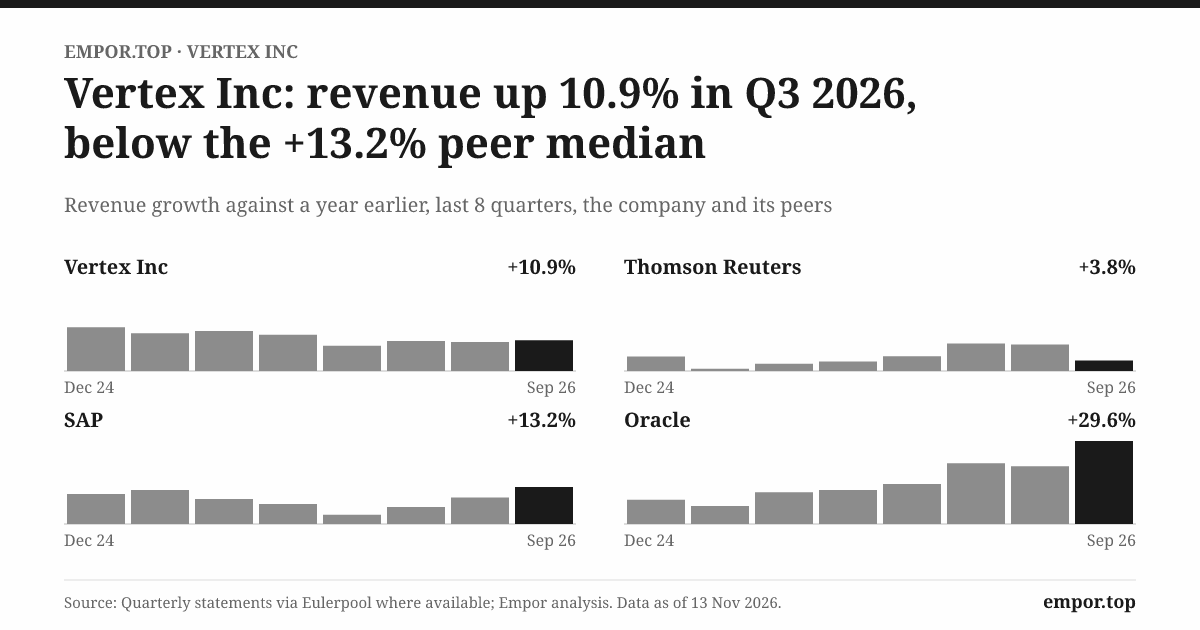
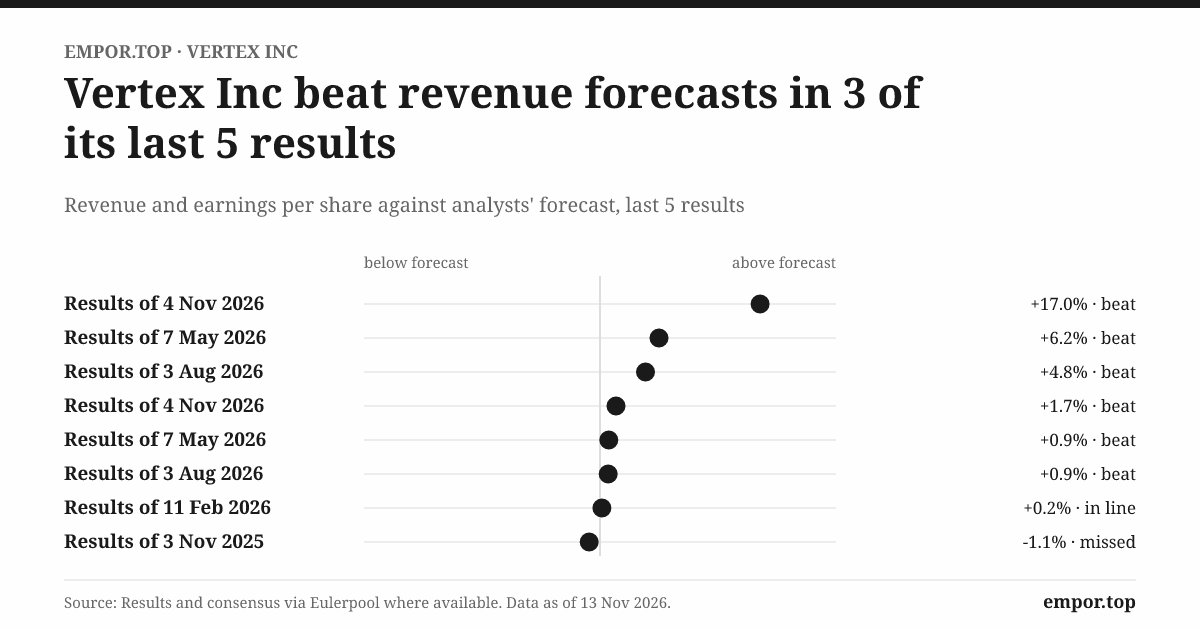
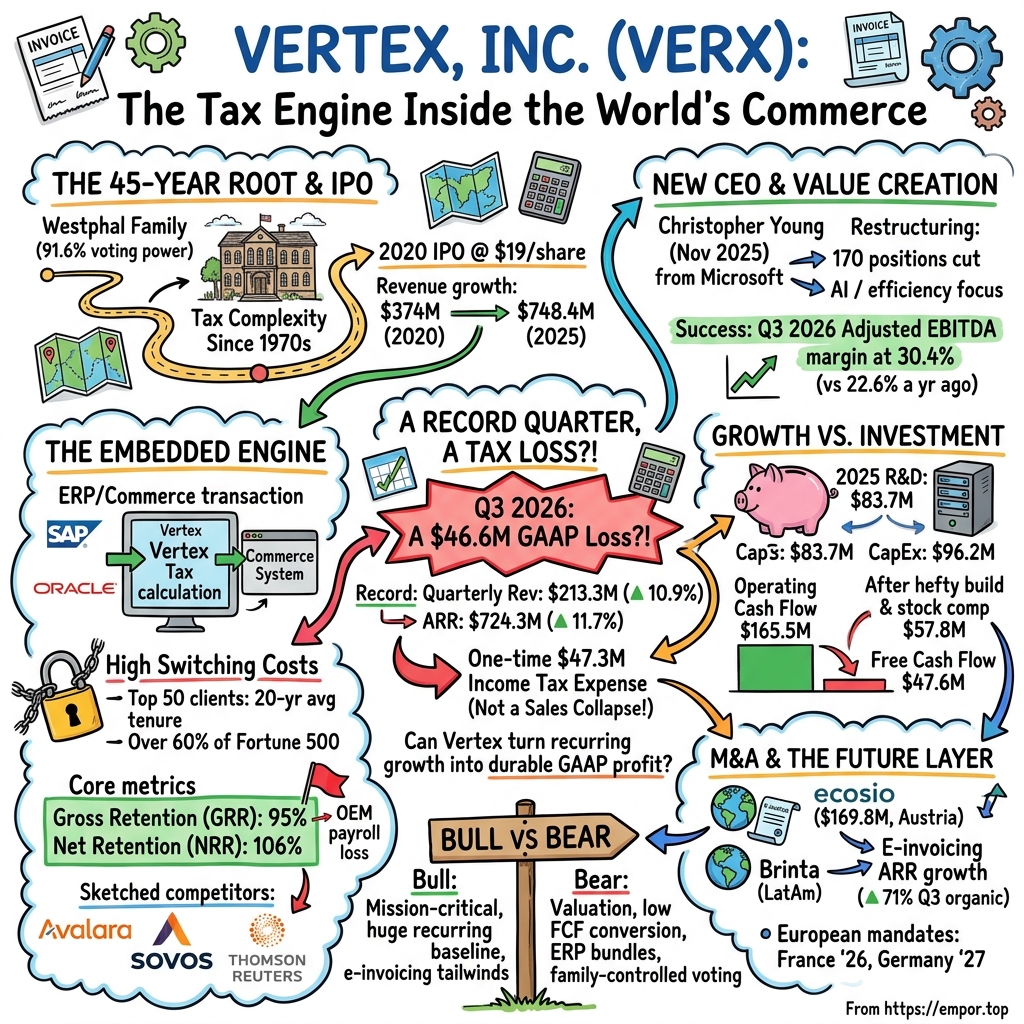
On the first Thursday of November 2026, a software company in suburban Pennsylvania put out the best sales quarter in its history and, in the same release, reported that it had lost $46.6 million.1 Both numbers were true. Vertex, Inc. had booked $213.3 million of revenue in the three months to September, up 10.9% from a year earlier, and its cloud revenue had grown by about a fifth.1[^2] Annual recurring revenue, the company's measure of the software subscriptions it would collect over the next year if nothing changed, reached $724.3 million, up 11.7%.[^2] By the ordinary signals a software investor watches, the quarter was a good one. And yet the bottom line was a deep red.
The explanation sat a few lines further down. Vertex's operating income for the quarter was almost exactly zero, about $300,000 on more than $200 million of sales, and then an income tax expense of $47.3 million landed on top of it.1 Most of that charge was accounting rather than cash: the company had to reassess whether it could use deferred tax assets, the bookkeeping credits a business carries for future tax deductions, and when a company cannot show enough confidence in future taxable profit, accounting rules require it to set aside a valuation allowance against them.1 It is an odd kind of loss. Nothing broke in the business that quarter. No customer walked away en masse, no product failed, no price war erupted. What the charge did reveal is something more uncomfortable: a company that has been selling tax software for almost half a century still runs close enough to GAAP break-even that its accountants had to question whether profits would arrive soon enough to use those credits.
That is the puzzle at the centre of this story. Vertex sells the software that calculates sales tax, value-added tax and other indirect taxes inside the billing systems of some of the largest companies in the world. It is the kind of product nobody notices until it is wrong. Its customers renew at high rates, its revenue has grown steadily for years, and its cloud business is accelerating. Yet across the eight years from 2018 to 2025, the company's cumulative net result was a loss of roughly $121 million, even as its operating activities threw off about $800 million of cash.23 Somewhere between the invoice and the income statement, a lot of value gets spent, capitalised, issued as stock or simply never reaches shareholders.
So the episode asks three questions. The first is whether Vertex's software is genuinely hard to replace, or whether customers simply dislike the risk of switching a system that touches every sale. The second is whether e-invoicing, the fast-growing business of transmitting and validating invoices for governments that now demand to see them in real time, is a real new profit engine or simply a promising line that is too young to judge. The third is about the man who has been running the company for barely a year. Christopher Young arrived from Microsoft in November 2025 with a mandate to sharpen the business, and by the third quarter of 2026 the company's adjusted EBITDA margin had jumped to 30.4% from 22.6% a year earlier.4[^2] Can he raise margins without starving the product that customers trust?
Before going further, the boundary of the story needs drawing. Vertex, Inc. is itself the listed operating company, trading on the Nasdaq Global Market under the ticker VERX, and its filings consolidate the whole business.2 There is no parent company siphoning off the economics, no private-equity sponsor whose interests sit above the minority shareholder. There is, however, a family. The Westphals, whose patriarch started the company in 1978, still control the overwhelming majority of the votes, and that fact will shadow every question about pay, capital allocation and accountability in the chapters that follow.
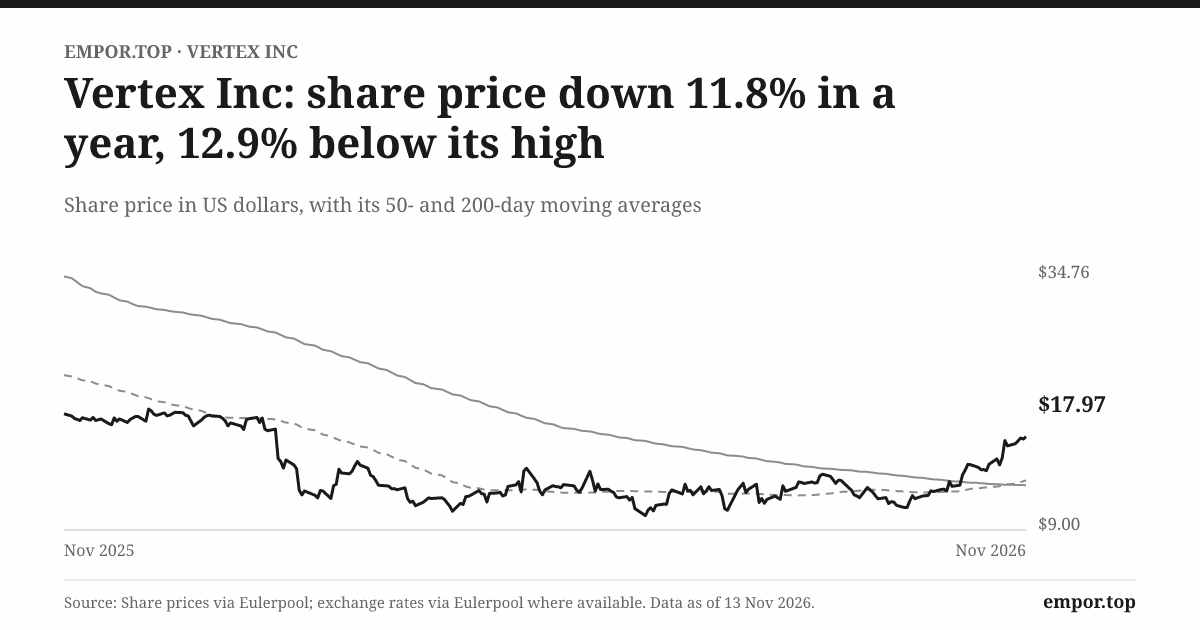
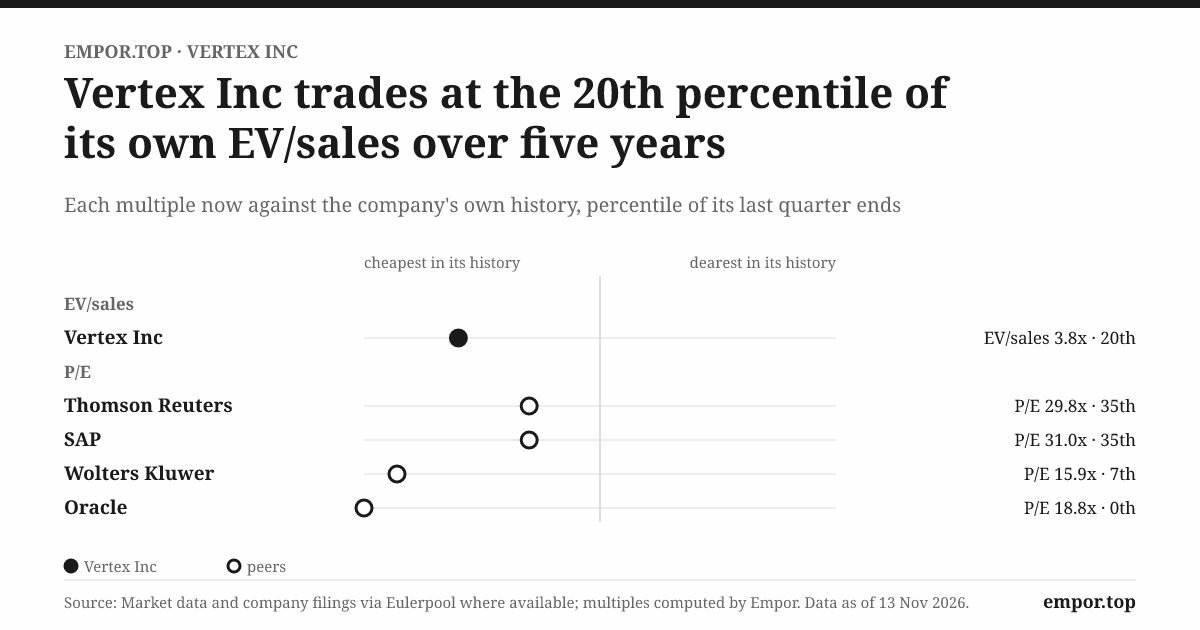
There is also a valuation puzzle to flag at the start, because some of the headline multiples are misleading on their face. On November 13, 2026, Vertex's shares closed at about $18, giving the company a market value of roughly $2.9 billion, about 3.6 times its trailing sales.[^6] Some data services showed a price-to-earnings ratio of more than 450 times. That figure measures the twelve months to June 2026, a window in which a few cents of profit happened to accumulate; over the twelve months to September, earnings per share were negative, at minus 29 cents.1 A multiple of 458 times nothing much is not an earnings anchor. It is a reminder that, for Vertex, the earnings line has been too thin and too noisy to price the company on. The market is paying for something else: the durability of recurring revenue, and the hope that margins will eventually show up where they count.
That hope has had a bumpy ride. Over the five years to November 2026, the stock suffered a peak-to-trough fall of more than 80%, and even in the latest year it traded between about $10 and about $21.[^6] Investors have repeatedly re-priced the same question: how much is an embedded, mission-critical tax engine worth if it rarely produces GAAP profit? To answer it, the story has to go back to a dining room table in Berwyn, Pennsylvania, and to a problem that has only grown more complicated since.
 Subscribe on LinkedIn
II. Forty-Five Years of Tax Rules, One Embedded Engine
Picture a multinational closing a single sale. A distributor in Ohio orders industrial equipment from a manufacturer whose headquarters is in Germany, whose warehouse is in Kentucky and whose billing runs through an SAP system administered from Dublin. The price is set in a commerce platform. Before the invoice can go out, someone has to answer a deceptively simple question: how much tax applies to this sale? The answer depends on where the goods ship from and to, what exactly they are, whether the buyer holds an exemption certificate, which of thousands of state, county, city and special-district rates apply that day, and whether any of those rules changed last week. Get it wrong and the company either overcharges a customer or underpays a government, and governments are not forgiving creditors. Vertex's business is answering that question, automatically, millions of times, and then helping the company prove later that it answered correctly.
The company began with a far smaller version of the problem. Rainer "Ray" Westphal had been laid off from a consulting job in 1969, at the age of 34, with a wife and three children to support.5 He later worked on a lease accounting system that included a corporate tax-rate table, and as another layoff loomed, he and his wife Antoinette bet that the rate table met a need corporations could not easily fill themselves.5 He started Vertex in 1978 with one employee and a second mortgage, running it from a dining room table in Berwyn.5 In the late 1980s, the company says, he pioneered corporate tax software and built what it now describes as a recurring, subscription-like revenue model, decades before the word software-as-a-service existed.5 He led the business for twenty years.5
That recurring model is the most important inheritance from those early years. Tax rules never stop changing, so a customer who buys tax-calculation software also needs a stream of updates to the underlying rules, which the industry calls tax content. A rate table that is a month out of date is not merely stale; it is a liability. That created a business where the product was not a one-time sale but a relationship, renewed every year, in which the vendor's research team kept the customer's systems current with the world's legislators. The founder's children inherited that model and the company with it. The family still controls the votes, and two Westphal siblings, Amanda Westphal Radcliffe and Stefanie Westphal Thompson, sit on the board.[^8]
Vertex grew into a fixture of large-enterprise finance departments, and its software became one of the standard tax engines that plug into enterprise resource planning systems, the vast software suites from SAP, Oracle and others that run a company's orders, books and supply chain. The company tells investors that more than 60% of the Fortune 500 are customers.[^9] For most of its life, it did this quietly and privately.
Then, in July 2020, in the middle of a pandemic that was pushing every company's software budget toward the cloud, Vertex went public. The initial public offering priced at $19 a share, and the stock began trading on Nasdaq at the end of that month.[^10][^11] The listing changed several things at once. It gave the company public currency for acquisitions and stock compensation, and it subjected management to quarterly scrutiny and Securities and Exchange Commission disclosure. It also produced a strange first-year income statement. In 2020, Vertex reported an operating loss of about $105 million on $374 million of revenue, overwhelmingly because of a one-time surge in stock-based compensation tied to the listing, and the company also paid out about $146 million to its pre-IPO owners that year as it shed its private-company structure.3 It was the first sign of a pattern that has run through the public years: the cash business and the reported earnings often tell different stories.
What the IPO did not change was control. Vertex created two classes of stock. The public bought Class A shares; the family kept Class B shares carrying ten times the votes. At the measurement date in the 2026 proxy statement, the controlling family group held all of the Class B shares and 91.6% of the combined voting power.[^8] Public shareholders own a large share of the economics but have almost no say over the board. The family has been gradually converting Class B shares into Class A, a few million at a time, which slowly dilutes its economic stake without loosening its grip on the votes in any way that matters.2
The IPO prospectus is useful now as a time capsule. In it, Vertex pitched itself as the beneficiary of three trends: indirect tax was becoming more complex, companies were moving finance systems to the cloud, and global commerce meant more businesses facing more jurisdictions.[^10] Those claims set a baseline that can be tested against what happened next.
On growth, the record broadly bears the pitch out. Revenue nearly doubled, from $374 million in 2020 to $748.4 million in 2025, a compound rate of almost 15% a year.32 That is good, durable growth for a company of its age. But the trend inside that period matters as much as the endpoints. Growth ran in the mid-teens through 2024, at about 16%, and then eased to 12.3% in 2025 and to roughly 10% to 11% in each quarter of 2026.21 The company did not stall, but it decelerated meaningfully just as it changed CEOs.
On profitability, the record is less flattering. In the five full years after its listing, Vertex never produced a material GAAP operating profit. It hovered within a few percentage points of zero, sometimes slightly above, often slightly below.2 The prospectus promised a large market and recurring revenue. It did not promise, and the company has not yet delivered, a business that converts that recurring revenue into reported earnings.
This is where the history matters for the investment case, and also where it stops being useful. Forty-five years of relationships with large enterprises is a real asset. Customers that have run Vertex inside their billing systems for decades are not going to rip it out on a whim. But age and customer logos are not a moat by themselves. Plenty of old software companies with famous customers have been displaced by a bundled feature in a bigger platform or by a cheaper, faster rival. The evidence that would show Vertex's history translating into a durable advantage is not in its founding story; it is in whether customers stay, whether they spend more each year, and whether they keep choosing Vertex when a vendor review puts the contract on the table. To judge that, the first step is to understand exactly what customers are buying.
III. The Tax Calculation That Has to Be Right
Imagine a mid-sized state legislature changes how it taxes digital downloads, effective the first of next month. For a consumer, nothing happens; the price at checkout simply changes. For a company selling software, music or digital services across the United States, the change ripples through every system that touches a transaction: the e-commerce storefront, the subscription billing platform, the ERP that books revenue, the procurement system that buys services from other vendors. Each of those systems has to apply the new rule at the moment of sale, and each has to record the result in a way that will later reconcile with the tax return the company files to that state. A tax department of a dozen people cannot track thousands of jurisdictions by hand. This is what Vertex sells: the right answer at the point of transaction, and the paper trail afterwards.
The product has two halves. The first is tax determination, the engine that sits inside a customer's transaction systems, receives the details of a sale or purchase and returns the correct tax. The second is compliance: collecting the results of all those calculations, preparing returns, reconciling what was charged with what is owed and handling the records that auditors will ask for. Around both sits the tax content, the constantly updated library of rates, rules and product classifications that makes the engine accurate. And around all of that sit the integrations, the connectors that let Vertex plug into SAP, Oracle, Salesforce, Adobe Commerce and dozens of other platforms where transactions actually happen.2
The economics follow from that design. In 2025, Vertex generated $748.4 million of revenue, and $639.7 million of it, or about 85%, came from software subscriptions.2 The remaining $108.7 million came from services, mostly implementation and advisory work that helps customers install and configure the software.2 Services matter strategically, because a well-implemented tax engine is one a customer is unlikely to remove, but they are lower-margin work and are not where the business makes its money.
Within subscriptions, there are two delivery models, and the shift between them is the most important operating trend of the last five years. On-premise software, which Vertex records as software licences, runs on servers the customer controls. Cloud subscriptions run on infrastructure Vertex operates. In 2025, cloud revenue was $352.9 million, up 27.9%, while licence revenue was $286.7 million.2 Cloud was already the larger half, about 55% of software subscriptions, and it is growing much faster. In the third quarter of 2026, cloud revenue grew by roughly 20%.1
It is tempting to treat the cloud as a new business displacing an old one. That would overstate it. Many of the cloud dollars come from existing customers moving the same tax engine from their own servers to Vertex's, often as they move their ERP to the cloud. The customer, the use case and the tax content are largely the same. What changes is who runs the infrastructure, and usually the size of the bill, because a cloud contract bundles hosting and operations into the price. So the cloud transition is better read as a change in delivery and in recurring mix than as a separate engine of demand. It raises the revenue per customer, but it also loads Vertex with the cost of running data centres and cloud infrastructure, which is a theme that comes back when the story turns to cash.
The billing mechanics explain why investors watch annual recurring revenue so closely. Vertex generally invoices subscription customers annually, at the start of each contract year, with payment terms of 30 to 60 days, and then recognises the revenue evenly over the term.2 A customer that signs in January pays most of the year's fee by March, but the income statement records it month by month. That is why the company's cash flow is lumpy across quarters and why deferred revenue, cash collected but not yet earned, is a large liability on its balance sheet. Annual recurring revenue, in turn, takes the monthly recurring software subscription revenue at the end of a period, including discounts, and multiplies it by twelve.2 It measures the subscription engine only. It excludes services and any one-time items, so ARR of $724.3 million and trailing revenue of roughly $800 million are not measuring the same thing, and neither is a measure of profit.
Why would a company pay a specialist instead of using the tax functions built into its ERP or doing the work internally? The honest answer is that many companies do the latter, especially smaller ones with simpler footprints. The case for a specialist rests on complexity. A business selling in a handful of states can live with a basic rate table. A multinational selling thousands of products across dozens of countries, through several commerce systems, cannot. For that customer, the cost of a wrong calculation, in audit assessments, penalties, customer refunds and management time, is much larger than the cost of the software. Vertex's pitch is that a single engine shared across every system produces one consistent answer, while each system's native tax functions produce slightly different answers that the tax team then has to reconcile.
That pitch has competition on every side. Avalara, the other large American specialist, focused historically on mid-market and e-commerce customers and has been moving upmarket; it was taken private by Vista Equity Partners at $93.50 a share in October 2022, which means its financials are no longer public in the same way.6 Sovos and Thomson Reuters, through its ONESOURCE tax software, compete for global corporate tax and compliance work.2 And the ERP vendors themselves, SAP and Oracle above all, offer tax capabilities within their own platforms.2 None of these rivals reports revenue that can be lined up cleanly against Vertex's, and no public series establishes market share in enterprise indirect tax, so any claim that Vertex is winning or losing share should be treated with suspicion.
Distribution adds a further twist. Vertex reaches many customers through the ecosystems of the platforms it integrates with, and through systems integrators and consulting firms that implement those platforms.2 That is an efficient way to reach large enterprises, because the tax engine gets specified when the ERP project is designed. But it also means the platforms hold a key to the door. When SAP or Oracle decides what its customers see by default during a migration, it shapes the competitive field. When a partner decides to embed a different vendor's tax engine in its own product, that customer channel can close quickly, as Vertex discovered in 2026 with a payroll partner.
Then there is regulation, the force that keeps the whole category busy. Governments change tax rules constantly, and increasingly they want to see invoices themselves, digitally and close to real time. Every new rule creates work for providers like Vertex: research, content updates, new integrations, new filing formats. That is a powerful source of demand. But a mandate is not a contract. A French or German rule that companies must exchange e-invoices through approved channels creates a market; it does not tell the customer which vendor to buy from. The question of whether Vertex wins that work is a question of product, price and relationships, and it is the same question that decides whether the core business has a moat.
That remains the test.
IV. The Moat Has to Survive a Vendor Review
Every few years, a large company puts its software contracts through a vendor review. Procurement asks the tax department whether there is a cheaper option. The ERP team, in the middle of a migration to the cloud, asks whether the new platform's built-in tax function would do. A consultant shows up with a slide comparing three vendors. This is the moment a moat either exists or doesn't. In 2026, Vertex lived through both outcomes. Most large customers, facing that choice, kept Vertex and often added more products or moved to its cloud. And one partner, a provider of payroll tax software that had embedded Vertex in its own offering, chose a different vendor.4
Start with what the retention numbers say. At September 30, 2026, Vertex's gross revenue retention was 95%, and its net revenue retention was 106%, down from 107% a year earlier.[^2] These two numbers measure different things, and the gap between them is the story. Gross retention asks: of the subscription revenue we had from existing customers a year ago, how much did we keep, ignoring any upsell? At 95%, Vertex lost about five cents of every dollar to customers who left or cut back. Net retention adds back what existing customers spent on top, through price increases, extra products, more transactions or moves to the cloud. At 106%, the existing customer base, taken as a whole, spent about 6% more than a year earlier.
That is a healthy profile for an enterprise software company, and it is consistent with genuine switching costs. A 95% gross retention rate in a product category with credible alternatives means that customers, when given the opportunity to leave, overwhelmingly stay. The company also tells investors that its top 50 subscription customers have been with it for an average of about 20 years.[^9] No single customer accounted for more than 10% of revenue in 2023, 2024 or 2025, nor in the first nine months of 2026.21 The customer base is broad, long-tenured and sticky.
But a moat argument should be tested, not admired. Net retention of 106% is only modestly above 100%. Enterprise software companies that genuinely dominate a workflow often expand existing customers at 110% or more for years. Vertex's expansion is real but measured; a single point of change in net retention is a meaningful share of the expansion engine. And gross retention of 95% is not 99%. Each year, customers representing about one dollar in twenty of subscription revenue leave or shrink.
The payroll episode shows what that churn can look like. On the third-quarter call, management disclosed that it had lost an original-equipment-manufacturer customer in payroll tax, a partner that had built Vertex's payroll tax calculations into its own product, and said it expected the loss to reduce both gross and net retention by roughly one percentage point in the fourth quarter.4 The revenue effect, management estimated, would be about $1 million.4 That sounds small, and in revenue terms it is. But it says something about the channel. When a partner embeds a vendor's engine inside its own product, the partner, not the end customer, owns the decision, and partners can change suppliers in one stroke. The loss is not evidence that the core indirect-tax determination business is deteriorating; it was in payroll, an adjacent line, and it was a single relationship. It is evidence that the switching costs are lower when Vertex sits behind someone else's product rather than inside the customer's own systems. The retention reading for the fourth quarter will show whether management's framing of a discrete, one-point event holds.
The way to think about the moat is through the customer's decision. Large enterprises have real buying power. They run formal procurement processes, can compare several specialist vendors and can threaten to use the tax function inside their ERP. So buyer power is meaningful. What tempers it is operational risk. Replacing a tax engine means re-testing every transaction type, re-mapping product codes to tax categories, re-validating exemption handling, re-integrating with every commerce and billing system and then running parallel systems while the tax department confirms the new one matches the old. It means doing that work in a function where an error becomes an audit finding. Few chief financial officers want to own that project unless the savings are large or the incumbent has failed them.
That is what the evidence supports as Vertex's advantage: switching costs grounded in integration work, embedded tax logic, recurring content updates and decades of accumulated configuration. It is not a network effect. One more Vertex customer does not make the software more valuable to the others in any way the filings demonstrate, and calling it a network effect would overstate it. Nor is it proof of unassailable pricing power. If Vertex could raise prices freely, net retention would likely run higher than 106%, and its gross margins and operating margins would show it.
There is also a counterweight in what the company does not disclose. It does not publish how much its top five or top ten customers represent, nor how much revenue flows through partner channels like the one it just lost.2 Without that breakdown, outside investors cannot size the risk of the next channel loss.
So where does this leave the "why win, why not" spine of the story? Vertex wins when complexity is the deciding factor: global companies with many systems, many jurisdictions and a low tolerance for error, where a single engine integrated everywhere is worth paying for. In those accounts, the 20-year tenure figure is the most persuasive evidence in the case. Vertex loses when a buyer decides that a bundled ERP tax function is good enough, when a partner moves its embedded engine to a rival, or when a competitor offers a better price or a more modern product during a cloud migration that forces a re-implementation anyway. That last risk is the subtle one. The cloud migration is a growth driver for Vertex, but it is also the one moment in a customer's life when switching costs temporarily fall, because the customer is re-implementing everything anyway.
The verdict on the moat is therefore a narrowed one. The evidence leaves the switching-cost advantage intact: 95% gross retention and two decades of tenure among the largest customers are hard to explain otherwise. It narrows any claim of pricing power or dominance, because expansion is only modest and the company has just lost a partner. The figures that will confirm or falsify it are gross retention holding at about 95% after the payroll loss, and net retention returning toward 107% rather than drifting toward 100%. Switching costs keep customers. Whether they also make shareholders rich depends on what it costs to serve those customers, and that is where the cloud bill comes due.
V. Cloud Growth Meets the Cost of Building It
Walk through a Vertex data centre bill, metaphorically speaking, and the shape of the problem appears. When a customer ran Vertex's engine on its own servers, the customer paid for the hardware, the electricity and the staff who kept it running. When that same customer moves to Vertex's cloud, all of those costs move to Vertex. The customer pays a bigger subscription, which is why cloud revenue grew nearly 28% in 2025, but Vertex now has to build and operate the infrastructure, monitor it around the clock, secure it and keep it fast enough that a tax calculation never slows down a checkout.2 At the same time, it has to keep investing in the product itself, in tax content, in new integrations and in the artificial-intelligence features that every enterprise software vendor now feels obliged to ship. Growth and investment arrive together. The question for investors is how much is left over.
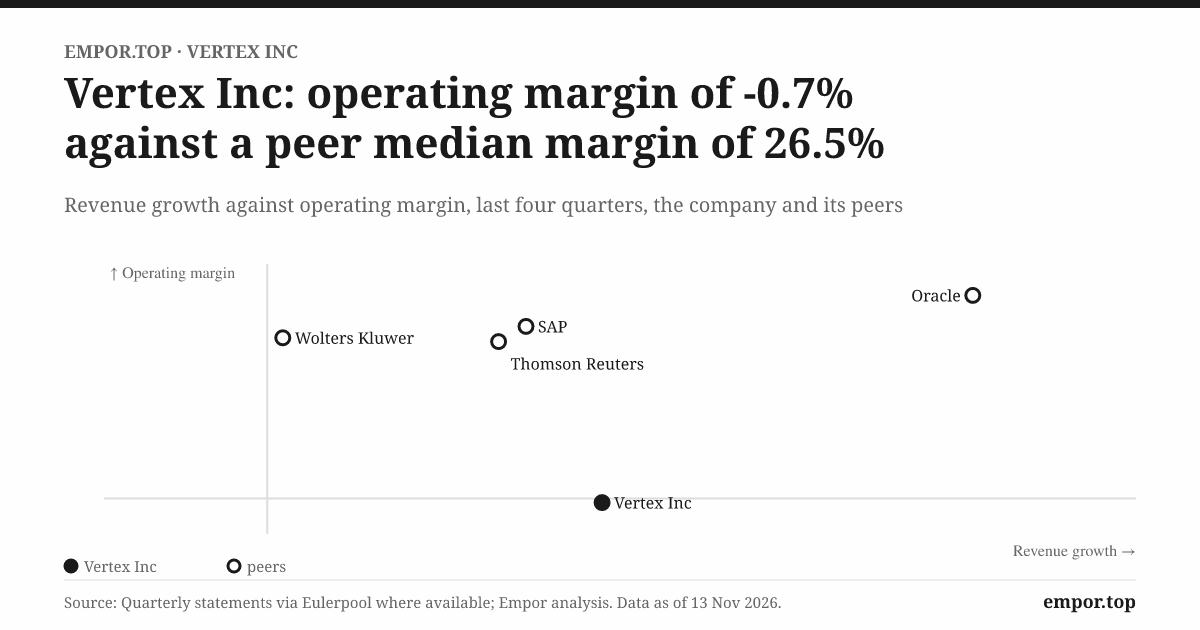
Start with the reported income statement. Vertex has spent its public life hovering around break-even on a GAAP operating basis. In 2025, its operating income was $2.3 million on $748.4 million of revenue, a margin of about 0.3%.2 Some data services show a small operating loss for that year, around minus 1%, because they classify certain items differently, but the company's own audited statements report a thin profit, and the company's figure is the one to use.2 Either way, the conclusion is the same: after paying for its people, its infrastructure, its research and its sales force, and after recognising stock compensation as an expense, Vertex keeps almost nothing at the operating line.
Why is that, for a company with 85% of revenue in subscriptions and 95% gross retention? The cost lines tell most of the story. Research and development rose from $66.7 million, or 10% of revenue, in 2024 to $83.7 million, or 11.2%, in 2025.2 That is the visible portion of product investment. Much of the rest is less visible, because software companies can capitalise some of the cost of building software and cloud infrastructure, putting it on the balance sheet and depreciating it over several years rather than expensing it at once. Vertex's additions to property and equipment, which include that capitalised software and infrastructure, rose from $65.8 million in 2024 to $96.2 million in 2025, nearly 13% of revenue.2 For a company that sells software and owns no factories, that is a striking level of capital spending. It is closer to the capital intensity of a telecom operator than to the image of an asset-light software vendor.
Then there is stock-based compensation. Vertex recorded $57.8 million of it in 2025, almost 8% of revenue.2 Stock compensation is non-cash in the period, so it does not show up in operating cash flow, but it is a real cost to shareholders, because the shares issued to employees dilute everyone else's claim on the business. A company that pays a large slice of its people in stock and then calls the resulting cash flow "free" is telling only half of the story.
This explains how a business can report losses and still generate cash. In 2025, Vertex produced $165.5 million of operating cash flow.2 That figure starts with a small net income and then adds back the non-cash charges: $96.9 million of depreciation and amortisation, $57.8 million of stock compensation and a few smaller items.2 It also reflects the timing of working capital. Because customers prepay annual subscriptions, Vertex collects cash before it earns revenue, which flatters operating cash flow whenever bookings grow. In 2025, rising receivables, $19 million more owed by customers at year-end, worked the other way, while in 2026 collections improved and net receivables fell by $28.4 million in the first nine months.2[^13] Working capital can help or hurt in any given year; over a long period, it largely washes out.
The cumulative record is where the real story sits. Over the eight years from 2018 to 2025, Vertex's operating cash flow totalled about $801 million, against cumulative net losses of about $121 million.23 That looks like a classic cash-rich software story, the kind where GAAP accounting obscures a money machine. But subtract capital spending, and free cash flow over those eight years totalled about $239 million, or roughly 30 cents of every operating-cash dollar.23 And about $146 million of that went out as distributions to the pre-IPO owners in 2020.3 Year by year, the pattern is even more sobering. Free cash flow was about $6 million in both 2023 and 2024, as the cloud build-out consumed nearly all of the operating cash, before rebounding to $47.6 million in 2025.2 For a company valued at almost $3 billion, $47.6 million of free cash flow is a yield of under 2%, and that is before treating stock compensation as a cost.
So the honest reading of Vertex's cash generation is a narrowed one. The cash is real. The business does throw off money from customers who prepay for software they need. But operating cash flow substantially overstates what remains for owners, because a large part of it is reinvested in infrastructure and capitalised software that the cloud business requires, and because a further part of the cost of running the company is paid in shares.
The $47.3 million third-quarter tax charge did not consume cash when recorded.1 A valuation allowance is typically recorded when recent history includes cumulative losses, and here it reflects the company's assessment of its confidence in future taxable profit. The charge can reverse if profits materialise, which would then flatter future earnings. Investors reading future quarters should watch for that reversal and strip it out, just as they should strip out this charge now.
Two other items make reported earnings noisier still. In 2025, Vertex booked $10.3 million of legal expense tied to a lawsuit it filed in 2022 against a competitor, alleging unfair competition, interference with contracts and misappropriation of trade secrets; the outcome remains uncertain and the company has not recognised any potential recovery.2 And acquisitions have brought earn-outs, contingent payments to sellers if acquired businesses hit targets, whose estimated value the company must re-measure each period, so swings in those estimates flow through the income statement. In 2025, the re-measurement produced a $16.8 million non-cash adjustment.2 Each of these items has a story. Together they mean that reported operating income at Vertex is a figure that has to be decomposed before it can be judged.
The balance sheet is sound for now. At the end of 2025, Vertex held $314 million of cash and had $345 million of 0.750% convertible senior notes outstanding, due in May 2029, with no borrowing drawn under its credit line.2 The convertible notes were cheap money raised in 2024, but they are not free: if the shares rise far enough, holders can convert into equity, and the conversion window broadens from November 2028.2 There is also the matter of acquisition obligations. At the end of 2025, Vertex carried about $86.6 million of expected cash earn-out payments, most due within three years.2 Neither the notes nor the earn-outs threaten the company today. Both are reminders that the cash on the balance sheet is not wholly unclaimed.
The verdict, then, is that cash generation is real but heavily committed. The forward test is concrete. Investors should watch free cash flow after property, equipment and capitalised software, alongside stock compensation as a share of revenue. If free cash flow climbs as the cloud build-out matures and stock compensation falls as a share of sales, the long-promised conversion of recurring revenue into owner earnings is happening. If capital spending keeps rising with revenue and stock compensation stays near 8%, the business is running hard to stand still. And in the middle of that build-out, Vertex chose to spend a significant sum on something else entirely: a European company that moves invoices between businesses.
VI. ecosio: Paying Five Times Revenue for the Next Compliance Layer
In September 2024, Vertex completed the purchase of ecosio, a company headquartered in Vienna that specialises in e-invoicing and electronic data interchange, the plumbing that lets businesses exchange orders, invoices and other documents directly between their systems.7 On its face, it was an odd fit. Vertex calculates tax; ecosio moves documents. But the strategic logic was clear enough, and it rested on a bet about where governments were heading.
For most of the history of indirect tax, governments learned about a company's sales after the fact, through periodic returns. Increasingly, they want to see the invoices themselves, in a standard digital format, as they are issued. Several Latin American countries moved early, and France and Germany later scheduled phased business-to-business e-invoicing mandates, with more countries heading the same way.2[^15] In that world, the invoice and the tax become one object. A company has to calculate the tax correctly, then format the invoice to the government's specification, transmit it through an approved channel, sometimes wait for clearance, and reconcile the result. Vertex's bet was that a vendor that already owned the tax calculation could own more of that chain if it also controlled the exchange of the invoice.
Vertex disclosed that the initial cash payment for ecosio was about $69 million, roughly five times the business's revenue run rate at the time.7 That is the number the company led with, and it is the number most investors remember. But it is not the full price. The 2025 annual report records total purchase consideration of about $169.8 million, including the fair value of earn-outs tied to revenue targets that the sellers could receive if ecosio grew fast enough.2 In effect, Vertex paid roughly $69 million upfront and agreed to pay considerably more if the business performed. Measured against total consideration, the price was well above five times revenue.
Was that a good deal? The honest answer is that nobody outside the company can yet say. Five times revenue is not, on its own, a return analysis. A buyer could pay five times revenue for a business with 40% margins and do very well, or pay the same multiple for a business that loses money and never recover it. Vertex has not disclosed ecosio's standalone margins or profitability, and there is no clean peer set of privately acquired European e-invoicing providers against which to judge the multiple. The earn-out structure does, at least, align part of the price with outcomes: if ecosio misses its targets, Vertex pays less. But that cuts both ways. If ecosio succeeds, the effective price rises, and the success has to be large enough to justify it.
Management's claim is that it is. On the third-quarter 2026 call, the company said ecosio and Brinta, a second, smaller acquisition, were outperforming the assumptions made when the deals were struck.4 Vertex's growth figures support part of that claim. Organic e-invoicing ARR, which excludes acquisitions in their first year, grew 66% in the first quarter of 2026, 52% in the second and 71% in the third.[^15] Those are very fast rates. But they start from a small base, and the company does not disclose e-invoicing ARR in absolute dollars with enough precision for outsiders to know how much it contributes to the overall $724 million.
Brinta deserves a brief word of its own, because it signals the direction of travel. In March 2026, Vertex paid $22.1 million for Brinta, a Latin American provider of tax and e-invoicing software.8 Latin America was one of the earliest regions to adopt mandatory e-invoicing, and its rules are notoriously complex, so a local provider brings both content and credibility. But Brinta is a bolt-on, not a new segment, and Vertex has not disclosed its revenue base, so there is no way to calculate the multiple it paid. Including Brinta, Vertex's reported e-invoicing ARR growth in the third quarter of 2026 was 100%; without it, 71%.[^15] The gap between those numbers is a reminder that headline growth rates for small, acquisitive lines of business can flatter organic performance.
There is an important distinction here between readiness and commercialisation. Vertex has been eager to point out its technical and regulatory credentials in e-invoicing: certified access points, partnerships with platforms, readiness for France's and Germany's mandates.[^15] Those matter, because a vendor that is not certified cannot compete. But certification is not revenue, and partnerships are not profit. The e-invoicing business is growing fast. What it has not yet shown is mature margins, long-term retention or a contribution to profit large enough to change the company's overall economics. Those are the figures that would turn a strategic fit into a proven investment.
The acquisitions also sit within a broader picture of how Vertex spends its capital. In October 2025, the board authorised a $150 million share repurchase programme, and the company bought back about $10 million of stock in the fourth quarter of 2025.2 An authorisation is a permission, not a purchase, and the gap between the two matters. Over the same period, Vertex was funding the cloud build-out, paying earn-outs on past deals, having closed Brinta and investing in AI features. A company that buys back a modest amount of stock while issuing tens of millions of dollars of stock compensation each year is, at best, offsetting dilution rather than shrinking the share count meaningfully.
So ecosio is a plausible strategic step whose economics remain unproven. The record so far narrows the claim rather than rejecting it: the acquired businesses are growing quickly and management says they are ahead of plan, but the full price was much higher than the headline multiple and no disclosure yet allows an outsider to compute a return. The evidence that would settle the question is acquisition-level revenue and margin progress, ideally disclosed by the company, and the size of the earn-out payments themselves. Bigger earn-outs mean ecosio hit its targets. They also mean Vertex paid more. Weighing those two outcomes is the job of the man who inherited the deal, and who arrived with a mandate to make the whole company more profitable.
VII. The New CEO’s First Year Becomes a Margin Test
In October 2025, Vertex announced that David DeStefano, who had run the company since 2016 and taken it through its listing, would retire as chief executive, and that Christopher Young would succeed him in November.9 DeStefano would stay on as chair of the board.9 The choice of successor said a good deal about what the board, and the family behind it, wanted. Young came from Microsoft, where he had been an executive vice president overseeing business development, strategy and ventures, and before that he had been chief executive of McAfee, the cybersecurity company, and held senior roles at Intel.9 He was a large-company operator steeped in enterprise software, security and the partnership deals that decide how products reach big customers. He was not a tax person. He was hired to make a long-lived specialist company run like a modern software business.
His pay package made the point in dollar terms. Young's employment agreement provided a base salary, a target annual cash bonus equal to 100% of salary and a one-time grant of restricted stock worth $25 million.[^18] In the 2026 proxy statement, his 2025 total compensation was reported at $25.6 million, almost entirely that equity award, plus a $500,000 bonus.[^8] For comparison, DeStefano's total compensation in 2025 was about $10.3 million, and the chief financial officer, John Schwab, received about $3.7 million.[^8] A one-time hiring award is not the same as a recurring pay level, and the proxy presents it as exceptional. But a $25 million grant to lead a company that had never produced meaningful GAAP operating profit, worth more than 3% of its annual revenue, is a large bet on a single person. It is fair for minority shareholders to treat alignment as something to be tested rather than assumed.
Young moved quickly. In April 2026, Vertex announced what it called a Value Creation Plan, which included a reduction of about 170 positions and significant cuts to third-party spending, while the company said it would redirect investment toward AI and growth.[^13] At the end of 2025, Vertex had employed more than 2,100 full-time staff, so the cut was roughly 8% of the workforce.2 It was a course correction with an explicit cost: severance charges in 2026, and the risk that fewer people would mean slower product work or thinner customer support in a business whose moat depends on getting details right.
The early financial results showed the leverage the plan was designed to produce. In the third quarter of 2026, adjusted EBITDA margin reached 30.4%, compared with 22.6% a year earlier.[^2] Management said the plan had brought forward a margin level it had previously targeted for later years.4 That is a large change in a single year, and it came while revenue grew about 11%, which means costs grew much more slowly than sales.
But the measure matters. Adjusted EBITDA excludes stock compensation, depreciation and amortisation, restructuring charges, acquisition-related items and taxes. For Vertex, those exclusions are not trivia. Depreciation and amortisation are the expense side of the heavy capital spending on cloud infrastructure and capitalised software. Stock compensation is a large, recurring cost to shareholders. GAAP operating income in the same quarter that showed a 30% adjusted EBITDA margin was essentially zero.1 Some of that gap was restructuring charges that should fade. Much of it is structural and will not. The adjusted figure shows that the cost plan is working at the level of cash operating expenses. It does not yet show that the company has become profitable on the measures that include every cost.
The arc of management's narrative across the year is itself revealing. In the second quarter, the tone was cautious. On that call, management reduced its expectation for 2026 cloud revenue growth to about 18%, explaining that customer migrations from on-premise to cloud were taking longer than expected.10 That was an honest disclosure, and also a meaningful one: cloud migration was the engine of the growth story, and its slowing was the clearest sign that the company's top line was maturing. By the third quarter, the tone had brightened. Results came in ahead of expectations, management raised its full-year guidance for both revenue and adjusted EBITDA, and the emphasis on the call shifted to e-invoicing.4[^2] The shift is not inconsistent. Cloud growth slowed, cost cuts landed, and e-invoicing accelerated. But the spotlight moved from the business that was decelerating to the business that was accelerating, which is something investors should notice when they compare calls across a year.
Credit is due on the payroll partner. When management disclosed the lost OEM relationship, it quantified the expected retention effect, about one point on both gross and net retention, and the revenue effect, about $1 million, and described it as discrete rather than a sign of broader weakness.4 That is a specific answer rather than an evasive one, and it gives investors a precise test. If fourth-quarter retention drops by about a point and then stabilises, management's explanation will have been accurate. If retention keeps sliding, the explanation was incomplete.
Governance sets the boundaries of any judgment about management. With the controlling family group holding 91.6% of the votes, Vertex is a controlled company under Nasdaq rules and can rely on exemptions from some board-independence requirements.2[^8] When shareholders voted at the June 2026 annual meeting, the family's block alone was large enough to decide any ordinary proposal on the ballot.11[^8] Public Class A shareholders can sell their shares or voice concerns, but they cannot change the board, the CEO's pay or the company's strategy. There is a case that this structure has benefits: the family has kept the company independent for nearly half a century, and long-term owners can tolerate investment cycles that quarterly investors would punish. There is also an obvious cost. The people who decided to hand Young $25 million in stock are not the people whose shares are diluted by it.
The way to judge Young, then, is through behaviour over time. Does the company hit the guidance it sets? Does adjusted margin progress show up in GAAP operating income and free cash flow, rather than only in adjusted figures? Do restructuring savings coexist with stable gross retention and continued customer growth, or does the moat erode quietly as the cost base shrinks? A year in, Young has moved fast and shown operating leverage. It is too early to call the improvement durable. And the part of the plan that is supposed to turn cost savings into growth rests on two words that every enterprise software company now uses: e-invoicing and AI.
VIII. The Mandate Wave, the AI Pitch, and the Risk of Mistaking Demand for a Moat
On the first of September 2026, France's business-to-business e-invoicing mandate went live in its first phase, requiring companies to be able to receive electronic invoices through approved platforms and the largest companies to start issuing them.[^15] Germany's requirement for most companies to issue structured e-invoices is scheduled to start phasing in from January 2027.[^15] For tax technology vendors, these dates are the equivalent of a product launch they did not have to organise. Thousands of companies that had never thought about invoice formats suddenly needed a provider. Vertex, with ecosio's European network and its own tax engine, wanted to be that provider, and in its third-quarter presentations it described itself as an AI-enabled compliance platform.[^2][^15]
The mechanism is worth spelling out, because it explains both the opportunity and its limits. Under a clearance or reporting model, a company cannot simply email a PDF invoice. It has to produce the invoice in a structured digital format, validate it against government rules, send it through an approved channel and, in some countries, wait for the tax authority to confirm it. The government sees the transaction almost immediately and can match the seller's and buyer's records. That creates real work: implementation projects, connections to each country's systems, ongoing compliance updates. And because the requirement repeats with every invoice, it creates a recurring need, which is exactly the shape of business Vertex has always liked.
The growth numbers reflect that demand. In the third quarter of 2026, Vertex's e-invoicing ARR grew 100% from a year earlier, or 71% organically, excluding Brinta.[^15] But scale matters more than the growth rate. Total company ARR grew 11.7%.[^2] If e-invoicing were a large share of the total, it would be pulling the overall growth rate up much more. That it is not tells investors that e-invoicing is still a small layer of the business, an emerging extension of the core rather than a replacement for it. Vertex's international revenue, which is where most e-invoicing mandates bite, was about 12% of revenue in the first nine months of 2026, up from about 10% in 2025.[^13]2
On the call, Young was asked whether the pace could last. His answer was careful: he said e-invoicing should continue to grow significantly faster than Vertex overall, but cautioned that investors should not expect the current growth rate every quarter.4 That is a sensible framing, and it is also a useful marker. Organic growth has already varied widely, and the mandate timetable is lumpy. Growth will come in bursts around go-live dates, followed by slower periods as the newly compliant customers settle in.
The AI claims need the same separation of capability from revenue. Vertex has said that AI is making its engineers faster and has introduced AI-driven features, such as Smart Categorisation, which uses machine learning to map product descriptions to tax categories, a tedious job that tax teams and implementation consultants have long done by hand.[^13]4 Those are plausible productivity gains. They may help the company implement customers faster, lower its cost of tax content and make its product more attractive. But Vertex has not disclosed material standalone AI revenue. The investment is real; the separately monetised return is not yet visible. AI also cuts the other way. If AI makes tax mapping and rule interpretation easier, it could lower the barriers for new entrants and for ERP vendors building their own tax functions. A moat built partly on accumulated expertise is exposed when that expertise becomes cheaper to reproduce.
The risks attached to this growth vector are specific to the business. ERP vendors can bundle e-invoicing and tax features into their platforms, and some already offer them. Failed integrations or incorrect calculations can create liability for Vertex and damage the trust that underpins its retention rates. Cyber incidents are a particular danger for a company that processes the transactional data of thousands of large enterprises and now exchanges their invoices with governments. And each new country mandate creates its own implementation costs and dependence on that country's rules, which can change or be delayed.2 A scheduled go-live date is a political commitment, and governments can and do move them, which is why a mandate calendar is not the same thing as a revenue forecast.
The skeptical-investor test is simple. If Vertex's advantage is something more than a rising compliance burden that every vendor benefits from, the evidence will show up in a few places. Retention will hold or improve as customers add e-invoicing to tax determination. Existing customers will expand, lifting net retention. E-invoicing will become a disclosed, recurring line of meaningful size, rather than a growth rate on an undisclosed base. And margins will hold or improve as the new business scales, rather than being diluted by expensive country-by-country implementation work.
Today, e-invoicing looks like a plausible future growth vector, because it is growing much faster than the core and attaches to the same compliance workflow. Its durability and profit contribution remain unproven, and AI is a capability rather than a revenue line. A regulation can deliver customers to the market. It cannot decide that they will buy from Vertex. That leaves the investment case resting on a combination of evidence and hope, and it is time to weigh them.
IX. Analysis & Bear vs. Bull Case
On Friday, November 13, 2026, two investors could look at the same Vertex share price, a little under $18, and see two different companies.[^6] One sees sticky recurring growth, rising margins and a fast-growing e-invoicing line, all for about 3.6 times sales.[^2][^6] The other sees a company that has not produced meaningful GAAP operating profit in its public life, that reinvests most of its operating cash flow, that pays heavily in stock, that just lost a partner channel and that is controlled by a family that public shareholders cannot outvote. Both are describing real facts. The investment case depends on which set of facts the future rewards.
Start with what the market is paying. At a market value of about $2.9 billion and an enterprise value of about $3.0 billion, Vertex trades at roughly 3.8 times trailing sales and about 55 times trailing EBITDA, with a free cash flow yield of about 2%.[^6] Those are not the multiples of a cheap company, nor of a wildly expensive one by software standards. They imply that investors expect the business to keep growing at around 10% a year and, more importantly, to convert a far larger share of its revenue into profit and free cash flow than it has so far. A 2% free cash flow yield on a company growing 11% only works if free cash flow grows much faster than revenue for years. That is the margin thesis, and it is the bet embedded in the price.
The bull case begins with operating proof rather than slogans. Vertex's customer base remains sticky, and cloud and e-invoicing are growing. ARR rose from $671 million at the end of 2025 to $724 million by September 2026.1[^21][^2] The new CEO has also shown that the cost base can flex: the adjusted EBITDA margin jump came while revenue still grew double digits. In the bull's version, 2026 is the year Vertex stopped running for growth at any cost and started running for profitable growth, and the market has not yet priced in the full effect.
The bear case works through mechanisms rather than mood. First, ERP bundling: as customers move to cloud versions of SAP and Oracle, the platform vendors have every incentive to offer tax functions that are good enough for many buyers, and the cloud migration itself is the moment when a customer is most open to switching. Second, procurement power: large enterprises can and do negotiate hard, which helps explain why net retention sits at 106% rather than well above it. Third, slowing expansion: net retention slipped a point in the year to September 2026, and management expects it to slip another point after the payroll OEM loss.4[^2] Fourth, the cost of staying current: tax content, cloud infrastructure and integrations require continuous investment, which is why capital spending reached about 13% of revenue in 2025 and free cash flow was negligible in 2023 and 2024.2 In the bear's version, the 30% adjusted margin is a measure that excludes the costs that matter most, and the GAAP line will remain close to zero because the business structurally needs to reinvest what it earns.
Porter's five forces give the competitive picture a quick frame without re-running the moat argument. Rivalry is meaningful: Avalara, Sovos, Thomson Reuters and the ERP vendors all compete for enterprise tax work. Buyer power varies with size; the largest customers can extract discounts, while mid-sized companies have less leverage and fewer alternatives willing to handle global complexity. Substitutes are real, in the form of ERP-native tax tools and, for simpler businesses, internal processes. Supplier power is moderate but not trivial; Vertex depends on cloud infrastructure providers and on implementation partners and platforms that influence which tax engine a customer chooses. And the threat of new entrants is tempered by the cost of building and maintaining global tax content, though AI could lower that barrier over time. Regulation sits across all five forces: it raises demand for every provider, but it does not select the winner.
Hamilton Helmer's 7 Powers framework, which asks what structural advantage lets a company earn persistent returns above its cost of capital, sharpens the point. Switching costs are the power with the strongest evidence, in 95% gross retention and 20-year tenure among top customers. Process integration, the accumulated configuration inside customer systems, reinforces it. Scale economies in tax content may help, because a vendor that maintains rules for thousands of jurisdictions spreads that cost across many customers, but Vertex's thin margins suggest this advantage has not yet translated into superior profitability. Network effects, brand power that commands a premium price, counter-positioning, a cornered resource and a durable cost advantage are not established by the evidence. A company with one well-evidenced power is a defensible business. It is not necessarily a high-return one, and Vertex's returns on equity and invested capital have been negative or near zero for most of its public life.2
Capital allocation deserves its own stress test, because a skeptical activist would start there. The ecosio deal's full consideration was more than twice its upfront cash payment once earn-outs were valued.72 Brinta's revenue multiple is not disclosed.8 The company has authorised $150 million of buybacks but executed only a fraction, while issuing tens of millions of dollars of stock compensation each year.2 It carries $345 million of convertible notes that could become equity.2 It spent millions on a lawsuit against a competitor whose outcome is uncertain.2 None of these decisions is indefensible on its own. But the combination means that per-share value creation, rather than company-level revenue growth, is the right measure, and the company does not yet provide acquisition-level revenue and margin data that would let outsiders judge whether its deals are working. Until it does, claims of value creation from acquisitions should be treated as management's view rather than established fact.
The audit trail itself is clean. The auditor gave unqualified opinions on both the 2025 financial statements and the company's internal controls over financial reporting.[^22] There is no restatement or going-concern doubt in the record. The accounting complexity lies elsewhere: in the judgments around capitalised software, earn-out valuations and the deferred-tax valuation allowance that produced the third-quarter loss. Those are legitimate judgments, but they are the places where reported earnings can move without the business changing.
The family's control is the final trade-off. It has real virtues. A controlling family that has owned a business since 1978 can take a long view, tolerate a multi-year cloud investment cycle and resist the temptation to sell to a private-equity buyer at the first decent offer. It also has real costs. Outside shareholders cannot influence pay decisions like Young's $25 million award, cannot force a different capital allocation policy and cannot replace the board. With 91.6% of the votes held by one group, there is no market for corporate control at Vertex unless the family chooses one.[^8] For some investors, that is a reason to own the shares; for others, a reason to demand a discount.
Strip it down, and three measures will tell investors most of what they need to know. The first is net revenue retention, currently 106% and drifting down, which shows whether the recurring engine is expanding; if the moat is real, it should stabilise after the payroll loss and recover. The second is GAAP operating margin, close to zero in 2025 and in the third quarter of 2026, which shows whether adjusted improvements translate into earnings that include every cost. The third is free cash flow after capitalised software and infrastructure spending, $47.6 million in 2025, which shows what owners actually receive.2 The bull case requires all three to improve together. The bear case needs only one to stall.
X. Playbook: Business & Investing Lessons
Go back to the invoice. Before a company can close its books, before a CFO can sign a quarterly report, before a government receives its share, a calculation passes quietly through Vertex's engine. Most of the people involved never see it. That invisibility is the source of Vertex's strength, and also the source of the puzzle that makes it so hard to value. A few lessons travel well beyond this company.
The first comes from that embedded tax engine and its two-decade customer relationships. The long tenure of Vertex's largest customers is its most convincing evidence of switching costs. Software that sits deep inside a mission-critical workflow accumulates configuration, testing, institutional memory and fear of failure, and those things are worth more than any feature list. The lesson is that the software customers notice least may be the software they hesitate most to replace. For investors, it means looking past product reviews and asking how much work, risk and audit exposure a customer would take on to leave.
The second comes from the cloud transition and its capital bill. Vertex's cloud build-out nearly erased free cash flow for two years. Recurring revenue is often treated as an end in itself, as if a subscription automatically meant a profit. Vertex shows otherwise. Recurring revenue is a starting point; the margin and cash left after serving it decide the economics. Founders who move customers from licences to subscriptions should plan for the years when they pay for the servers before the margins arrive. Investors should value the subscription only after subtracting what it costs to deliver.
The third comes from ecosio, whose full price rose well above the headline multiple once earn-outs were valued. The strategic logic was that if invoices and taxes converge, owning both is valuable. But logic is not a return. A strategic fit can widen the product, but only the acquired revenue and return can prove the price was right. The test for any acquirer is whether it will disclose the acquired business's revenue and margins clearly enough that shareholders can judge the deal, rather than asking them to trust a narrative.
The fourth comes from the $25 million stock award that welcomed Christopher Young. Equity-heavy pay is meant to align a leader with shareholders, and in principle it does. But alignment is a design, not an outcome, and at Vertex the design was approved by a family that controls the votes. Alignment is a promise written in shares; performance is the record that settles it. Investors in controlled companies should judge pay by what it delivers over the vesting period: GAAP earnings, free cash flow per share and retention, not by the size of the grant or the reasoning in the proxy.
The fifth comes from France's September 2026 go-live and the German deadline that follows. Regulation creates demand on a schedule that vendors do not control, and it creates it for every vendor at once. It cannot choose the vendor or guarantee the profit. The companies that win mandate waves are the ones whose products, partnerships and prices are better when the deadline arrives, not the ones with the loudest press releases about the rules.
XI. Epilogue
Tonight, Vertex stands at an interesting moment. It has a new CEO with a year of decisions behind him, a cost structure that has just been reshaped, a fast-growing e-invoicing line and a core tax engine that customers rarely abandon. It also has a GAAP income statement that remains close to zero, a third-quarter loss caused by a tax charge that reflects its own uncertainty about future profits, and a freshly disclosed partner loss. The coming months will put several of those tensions to the test.
The first test arrives with the fourth-quarter results early in 2027. Management has guided to revenue of $215 million to $217 million and adjusted EBITDA of $58 million to $60 million.[^2] It also expects gross and net retention each to fall by about one percentage point because of the payroll OEM loss.4 If retention drops by roughly that amount and then stabilises in 2027, management's account of a discrete event will have been accurate, and the switching-cost thesis will survive intact. If retention falls by more, or keeps falling, the market will have to consider whether the loss was the first sign of a wider weakness in partner channels or in the core.
The second test is the German mandate in January 2027. France's go-live in September 2026 drove a burst of e-invoicing demand; Germany's will show whether Vertex can win a second major European market at scale.[^15] The company says e-invoicing should keep growing much faster than the overall business, while warning that the pace will vary.4 Investors will want to see e-invoicing disclosed in enough detail, in dollars rather than growth rates, and with acquired-business contribution separated, to judge whether ecosio's earn-outs are being paid on organic success.
The third test is the conversion of adjusted margins into GAAP and cash. Severance and restructuring charges from the Value Creation Plan should fade through 2027. If they do, GAAP operating margin should rise toward the adjusted figures, at least partially. If GAAP operating income remains close to zero after restructuring costs subside, the gap between the two measures is structural rather than temporary. Alongside that, investors should watch capital spending and stock compensation as a share of revenue, and free cash flow after both.
The fourth test is governance. The next proxy statement, in the spring of 2027, will disclose Young's realised compensation for his first full year, the family group's updated voting power and any changes to the board. A rising GAAP profit line alongside a disciplined pay disclosure would strengthen the case that the family's control serves outside shareholders. Large awards alongside a flat GAAP line would weaken it.
Each of these tests maps onto the questions that opened the story. Is the tax engine hard to replace? Retention will say. Is e-invoicing a new engine? Disclosure and growth will say. Can the new CEO raise margins without weakening the product? The GAAP line and the retention figures will say together. The tension that remains is the same one that showed up in the November quarter: revenue that keeps reaching new highs, and profit that has not yet followed.
XII. Outro
Somewhere tonight, an invoice is being issued. A distributor in Ohio, a manufacturer in Germany, a retailer in Brazil. Before it leaves the system, a tax engine decides what the government is owed, formats the result and records it for the auditors. If the answer is right, nobody notices. If it is wrong, everybody does.
That is what makes Vertex unlike a conventional software story. It sells confidence in the rules that govern commerce, and customers have paid for that confidence for decades with remarkable loyalty. The tax engine is buried inside the transaction, quiet and indispensable. The investment case is exposed in every quarter's margins and cash. Vertex has proved that its customers depend on it. It still has to prove that its shareholders can depend on it.
References
-
2025 Form 10-K — Vertex, Inc., 2026-02-24 ↩↩↩↩↩↩↩↩↩↩↩↩↩↩↩↩↩↩↩↩↩↩↩↩↩↩↩↩↩↩↩↩↩↩↩↩↩↩↩↩↩↩↩↩↩↩↩↩
-
Q3 2026 Earnings Call Transcript — The Motley Fool, 2026-11-05 ↩↩↩↩↩↩↩↩↩↩↩↩↩
-
Remembering Rainer “Ray” Westphal — Vertex, Inc., 2023-08-16 ↩↩↩↩↩
-
Vista Equity Partners Completes Acquisition of Avalara — Vista Equity Partners, 2022-10-19 ↩
-
Vertex Completes Acquisition of ecosio — Vertex, Inc., 2024-09-04 ↩↩↩
-
Q2 2026 Form 10-Q, Brinta Acquisition — Vertex, Inc., 2026-08-04 ↩↩
-
Vertex Announces CEO Retirement and Succession Plan — Vertex, Inc., 2025-10-21 ↩↩↩
-
Q2 2026 Earnings Call Transcript — Investing.com, 2026-08-03 ↩
-
2026 Annual Meeting Voting Results, Form 8-K — Vertex, Inc., 2026-06-11 ↩
 LinkedIn
 WhatsApp
 Reddit
 Hacker News
 Email
 Kindle
 RSS Feed
 Spotify
 Apple Podcasts
 Amazon Music
 Audible
 YouTube