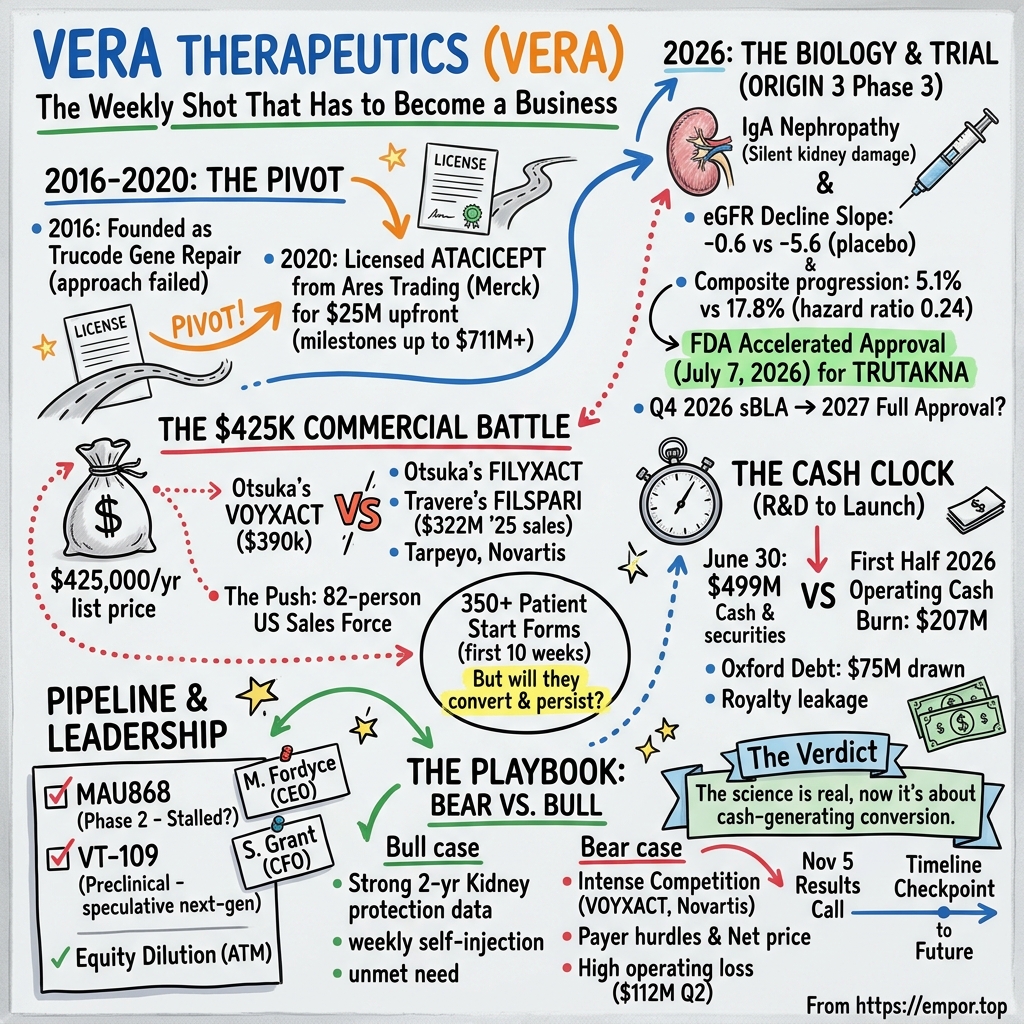
Vera Therapeutics: The Weekly Shot That Has to Become a Business
I. The Approval Was Real. The Business Was Still a Question.
On July 7, 2026, a small company in Brisbane, California, got the letter every drug developer spends its life waiting for. The U.S. Food and Drug Administration granted accelerated approval to TRUTAKNA, the brand name for atacicept, to reduce proteinuria in adults with primary IgA nephropathy who are at risk of their disease getting worse.1 For Vera Therapeutics, a decade of clinical trials, licence payments and stock offerings had been compressed into a single regulatory sentence. The company that had only ever spent money now had something to sell.
The celebration came with an uncomfortable fact attached. Through the end of June, Vera had not booked a single dollar of product revenue, and in the second quarter alone its operating loss reached about $112 million.2 Approval had arrived a week after the quarter closed, so the business that investors were now being asked to value existed mostly as a plan: a weekly autoinjector, a newly hired sales force, a price list, and a promise that patients and insurers would follow.
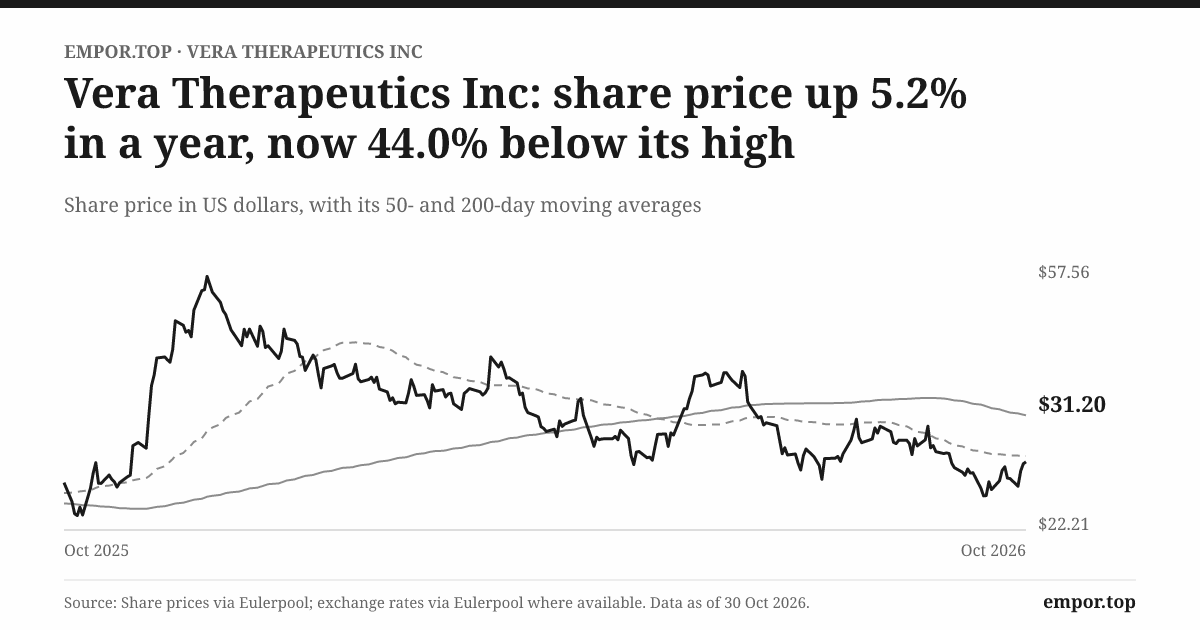
By October 30, 2026, the market had put a number on that promise. Vera's shares closed at $31.20, giving the company a market value of about $2.2 billion.3 That is a substantial price for a business with no sales history. It is also a sobering one for anyone who bought near the 52-week high of about $55.67, because the stock is trading roughly 44% below that peak even after the approval it had been waiting for.3 The market is not doubting that the drug worked. It is asking a harder question about what the drug will earn.
The cushion behind the company was real. At June 30, Vera held about $499 million in cash and marketable securities.2 But that cushion was shrinking fast, down from about $715 million six months earlier, and the launch had only just begun.24 The first commercial clue came in September, when management said that in roughly ten weeks on the market, more than 350 patient start forms had come in from doctors' offices.5 A start form is the paperwork that begins a patient's journey to treatment: it signals intent, not a paid prescription, and certainly not a patient who stays on therapy for years.
That distinction is the whole story of where Vera stands tonight. The science question that consumed the company for six years has largely been answered, and answered well. In September, Vera reported that patients on atacicept in its pivotal trial had kidney function that barely declined over two years, while patients on placebo lost it at a steady clip.6 The commercial question is only beginning. Can TRUTAKNA win patients from doctors who already have several therapies to choose from? Will insurers pay a $425,000 annual list price without squeezing it hard through rebates and restrictions?7 And will launch cash arrive before Vera has to go back to shareholders, or lenders, for more?
Three tests sit inside that question, and they will run through every section of this story. The first is adoption: whether start forms turn into paid, persistent treatment. The second is differentiation: whether a strong placebo-controlled trial can hold up in a market where competitors have also produced strong trials. The third is time: whether the money in the bank lasts long enough for the first two tests to come back positive.
What makes the moment unusual is who is taking the tests. Many small biotechs that reach approval do so with a large partner waiting to sell the drug, or sell themselves before launch to a company that already employs thousands of representatives. Vera did neither. It kept the worldwide rights, built its own U.S. commercial team and chose to launch alone.87 That choice keeps all of the upside, minus the licensor's royalty, inside the company. It also keeps all of the execution risk there, at a moment when the competitors across the table are some of the largest drug companies in the world.
There is a temptation, with any newly approved biotech, to treat the rest of the pipeline as a second act already in rehearsal. Vera has other programmes, including an antiviral called MAU868 and a preclinical successor to atacicept called VT-109.8 Neither generates revenue, and neither is close to it. Atacicept is the business today. Everything else is an option whose value depends on whether the first product pays for the company's ambitions.
The next major test was already on the calendar. Vera scheduled its third-quarter results webcast for November 5, 2026, the first financial report that will include sales after launch.[^9] Until then, investors have a regulatory decision, a set of excellent trial results, a ten-week paperwork count, and a burn rate. To understand why that mix is both promising and fragile, the story has to go back to a company that, a decade ago, was trying to do something entirely different.
 Subscribe on LinkedIn
II. The Company Changed Its Mind Before It Found Its Drug
In 2016, a physician named Marshall Fordyce incorporated a company in Delaware. It was not called Vera. It was called TruCode Gene Repair, and as the name suggests, its founding idea had nothing to do with kidneys or immune signals.9 It was a bet on repairing genes, one of the most ambitious and capital-hungry corners of biotechnology.
Fordyce was not a typical first-time founder. He had trained as a physician, earned his undergraduate degree at Harvard and his medical degree at Harvard Medical School, served as senior chief resident at NYU's Bellevue Hospital, completed an infectious-diseases fellowship at Columbia University and a translational research fellowship at Rockefeller University.10 He then spent more than five years at Gilead Sciences, where he led development of the tenofovir alafenamide programme, the chemistry behind a generation of HIV and hepatitis B medicines that earned Gilead a fortune.10 Before founding Vera, he was an entrepreneur in residence at the venture firm Kleiner Perkins.10
That background shaped the company in two ways. From Gilead, Fordyce knew what it looks like when a well-chosen molecule, developed methodically through large trials, turns into a franchise. From the venture world, he knew that a small company with no parent behind it lives or dies on whether each experiment earns the next round of funding. Vera had no pharmaceutical parent to lend it a pipeline, a sales force or a balance sheet. It was independent and small, and every year it had to persuade new investors that it deserved to exist.
The first idea did not survive that test. Vera's own account of its history is unusually blunt: in 2020 and 2021, the company "discovered the science behind our initial therapeutic approach did not advance as intended" and undertook a strategic pivot.11 That sentence covers what, inside a startup, is usually a period of real fear. The original thesis had failed. The money raised to pursue it had to be redirected, or returned, or lost. In the years before the pivot, the company was spending relatively modest sums, with a net loss of about $11 million in 2019, but by 2020 the loss had jumped to about $53 million as the new direction took shape.9
The new direction came from Germany. In October 2020, Vera licensed atacicept from Ares Trading, an affiliate of the German group Merck KGaA.8 This was not a fresh discovery. Atacicept had a long clinical history inside Merck KGaA and its partners, who had tested it in other autoimmune diseases before setting it aside. To a large pharmaceutical company, a molecule that has not found its best use is a line item in a portfolio review. To a small company with a failed founding thesis, it can be the whole future.
It is worth being precise about what Vera acquired, because the deal type shapes everything that followed. Vera did not buy a drug company, and it did not take on a business with revenue, employees or factories. It took a licence: the exclusive worldwide right to develop and sell a specific molecule, in exchange for upfront money, milestone payments and a share of future sales.8 Vera took responsibility for developing atacicept in IgA nephropathy and other immune-mediated diseases, which meant that every trial, every manufacturing batch and every regulatory filing would be Vera's to fund.
The price of entry was $25 million paid to Ares when the asset transferred in 2020.8 The longer bill was much larger on paper. Vera's 2022 annual report disclosed potential regulatory milestones of up to $176.5 million and commercial milestones of up to $515 million, plus tiered royalties on net sales.12 Some of that bill has already come due: Vera paid $15 million when it filed its marketing application in January 2026 and became obligated for another $20 million upon approval in July.2 Royalties run from the low double digits to the mid-teens as a percentage of covered net sales.8
Was it a good deal? The honest answer is that no clean yardstick exists. A licence for a drug with no sales has no revenue multiple, no earnings multiple and no cash flow against which to compare its price. The $691.5 million of headline milestone ceilings sounds enormous, but milestones are contingent by design: Ares only receives the big commercial payments if TRUTAKNA becomes a big commercial product, in which case Vera would be able to afford them. The royalty is the more enduring cost, because it shaves a slice off every dollar of sales for as long as the drug sells.
The better test is whether the asset advanced, and on that measure the licence has already earned its upfront fee many times over in strategic terms. Atacicept went from a shelved compound to an approved medicine in less than six years under Vera's stewardship.1 The economic test, whether sales after royalties can support the launch and the pipeline, has not been run yet. That is the right way to frame the "overpaid?" question: the bet on the science paid off; the bet on the economics is still being placed.
The pivot also changed what investors were funding. When Vera went public in May 2021, pricing its IPO at $11 a share and raising about $48 million net, its prospectus no longer described a gene-repair company.912 It described a clinical-stage biotech built around atacicept and a single big hypothesis: that blocking two immune signals could change the course of a kidney disease that slowly destroys the organs of young adults. Whether that hypothesis was true would take the next six years to find out.
The structure of the company at listing carried a few fingerprints of that venture-backed childhood. Vera came to market with two classes of common stock: voting Class A shares and non-voting Class B shares, a device that lets large healthcare funds hold economic exposure above certain ownership thresholds without taking voting control.8 By the end of 2025, no Class B shares remained outstanding, and every share carried one vote.8 No controlling shareholder emerged from the venture era. The largest disclosed holder in the 2026 proxy was Avoro Capital Advisors, a concentrated biotech investor, with about 5.6 million shares, roughly 8% of the company.13 Vera is, in other words, owned by the specialist funds that financed it, and those funds tend to judge management on a single question: did the next dataset justify the last raise?
For the first two years as a public company, that question hung over every quarter. The phase 2b ORIGIN trial had to deliver enough to justify the far larger phase 3, and the market was not patient. In 2023, Vera sold about 16.4 million shares at $7 each, less than two-thirds of its IPO price, to keep the programme funded.128 Investors who bought that offering were betting that the mechanism worked. Those who sold to them were betting it might not. The rest of this story is about which side was right.
III. A Kidney-Disease Mechanism Had to Prove More Than a Lab Result
Picture a patient in their thirties who goes to the doctor for something routine and leaves with an unexpected lab result: blood and protein in the urine. There is no pain. Nothing feels wrong. A biopsy shows IgA nephropathy, and a nephrologist explains that the disease often progresses silently for years, gradually reducing the kidneys' ability to filter blood, until for a significant share of patients it ends in dialysis or a transplant.
The mechanism behind that slow damage starts in the immune system. In IgA nephropathy, the body produces an abnormal form of an antibody called IgA. Other antibodies then recognise that abnormal IgA as foreign and bind to it, forming clumps called immune complexes. Those clumps lodge in the kidney's filters, the glomeruli, where they trigger inflammation and scarring. The analogy that clinicians often reach for is a kitchen sieve slowly clogging and tearing: first some protein leaks through where it should not, and over time the sieve stops working.
Atacicept attacks that process upstream. It is a fusion protein, an engineered molecule that combines a piece of a receptor called TACI with the stem of an antibody, so that it circulates in the blood and soaks up two signalling molecules called BAFF and APRIL.14 Both signals help B cells, the immune cells that make antibodies, survive, mature and produce. Mop them up, and the theory says the body should make less of the abnormal IgA and the antibodies that attack it. Fewer immune complexes should mean less damage to the filters.
The difference between targeting one signal and two is the scientific heart of Vera's pitch. APRIL appears to be especially important for the plasma cells that churn out IgA; BAFF supports a broader range of B cells at earlier stages of their development. Block only APRIL, the argument goes, and some of the antibody-making machinery keeps running on BAFF. Block both, and the supply is cut more completely. It is an elegant argument. It is also exactly the kind of claim that only a direct comparison between drugs could settle, and no such comparison exists.
That theory was plausible biology, and plausible biology is cheap. Medicine is littered with mechanisms that made perfect sense on a whiteboard and did nothing for patients. What mattered was whether atacicept could move clinical measures that regulators and doctors trusted, and eventually whether it could preserve kidney function itself.
The evidence arrived in stages. Vera's earlier phase 2b work, the ORIGIN programme, gave it enough confidence to launch a pivotal phase 3 trial, ORIGIN 3, which enrolled 428 adults with IgA nephropathy and randomised them to a weekly injection of atacicept or placebo.156 The first hurdle was proteinuria, the amount of protein leaking into urine, which regulators accept as a "surrogate" endpoint, an early marker reasonably likely to predict longer-term kidney outcomes. At 36 weeks, patients on atacicept had about a 46% reduction in proteinuria from baseline, or about 42% after adjusting for the placebo group.5
That interim result was the basis for the accelerated approval in July. The distinction is important. Accelerated approval is the FDA's way of letting a drug reach patients sooner on the strength of a surrogate, on the condition that the company later confirms real clinical benefit.1 For a disease that unfolds over a decade, it is a pragmatic bargain. It also leaves an open door: if the confirmatory evidence disappoints, the approval can be narrowed or withdrawn.
Vera did not have to wait long to walk through that door. On September 15, 2026, it announced the final 104-week efficacy analysis of ORIGIN 3.6[^17] The headline measure was the eGFR slope, which tracks how quickly a patient's estimated glomerular filtration rate, the kidneys' cleaning capacity, falls each year. On atacicept, kidney function fell by about 0.6 mL/min/1.73m² per year. On placebo, it fell by about 5.6.6 In plain English, treated patients' kidneys were holding nearly steady over two years, while untreated patients were losing ground at a pace that, compounded over a decade, takes many of them toward dialysis.
A rough sense of scale helps. A healthy young adult has an eGFR around 90 to 120; dialysis typically becomes necessary somewhere below 15. A patient who starts treatment with moderately reduced function and loses five or six points a year can run out of kidney function within a decade or so. A patient who loses less than one point a year may never get there. That is why nephrologists care so much more about the slope than about any single lab value, and why the two-year result mattered more to Vera's future than the approval itself.
The second measure was harder still. The trial counted composite kidney-progression events: a sustained 30% or greater drop in kidney function, kidney failure requiring dialysis or transplant, or death. Over the follow-up, 11 patients on atacicept had such an event, about 5.1% of the treated group, compared with 38 patients on placebo, about 17.8%.6 The hazard ratio of 0.24 means the risk of a progression event was about 76% lower on treatment.65 Those are not lab results. They are kidneys that kept working.
In October, the New England Journal of Medicine published the final analysis, timed with the American Society of Nephrology's Kidney Week meeting.16 Publication in that journal does not make a result more true, but it does mean the methods, the statistics and the handling of missing data passed through one of the most demanding peer-review processes in medicine. For nephrologists who would never read an 8-K, it is the version of the evidence that changes practice.
The trial had real boundaries, and they matter for how much weight the results can carry. ORIGIN 3 was designed, funded and run by Vera.15 It compared atacicept with placebo on top of standard supportive care, not with any other approved IgA nephropathy drug, so it says nothing directly about whether TRUTAKNA is better than its rivals. The FDA's own review documents, posted at approval, included kidney-function data through 72 weeks; in June, Vera had aligned with the agency on the plan for the final analysis.177 That alignment matters because changes to an analysis plan late in a trial are exactly what sceptical reviewers scrutinise.
Safety looked manageable. In the label, infections occurred in 32% of treated patients versus 28% on placebo, and injection-site reactions in 19% versus 2%, while the company reported no serious, severe or opportunistic infections and no cases of dangerously low antibody levels in the trial.214 For a drug that dampens part of the immune system, that is the profile doctors want to see. It is also a profile built on two years of trial follow-up; longer real-world use will be the ultimate test.
The regulatory path is now about converting accelerated approval into full approval. Management said it planned to submit a supplemental marketing application in the fourth quarter of 2026, targeting full approval around mid-2027.5 Full approval would remove the surrogate caveat from the label and let Vera promote kidney-function preservation, a more persuasive claim to doctors than protein in urine. The company also said it intended to file in Europe and Japan, and that data in a second disease, membranous nephropathy, were expected by year-end.5
The verdict on the science is clear, hedged once: ORIGIN 3's final results materially strengthened the case beyond a surrogate, because kidney function and hard progression events both moved in the right direction, by large margins, in a randomised trial. What the data cannot do is choose the drug for a doctor who has five other options on the shelf. A weekly injection with strong evidence is one candidate among several, and the next chapter is about what happens when the trial leaves the journal and enters the clinic.
IV. At $425,000 a Year, the Trial Moves to the Clinic
In the weeks after approval, 82 sales representatives fanned out across the United States.7 Vera's commercial chief, Matt Skelton, described a team in which roughly nine in ten had rare-disease experience and close to nine in ten had sold to nephrologists before.7 Their target list was not enormous: of roughly 11,000 nephrologists in the country, Vera planned to call on about 6,000.7 Their product was a single box: a 150 mg autoinjector, used at home once a week.14 And their price was $425,000 a year at list.18
That price says a lot about how Vera sees itself. It sits above the $390,000 wholesale acquisition cost of 大塚製薬 Otsuka Pharmaceutical's VOYXACT, the APRIL-blocking antibody that won accelerated approval in November 2025 and reached the market first.1819 Pricing above an incumbent is a statement of confidence: Vera is telling payers that dual BAFF and APRIL inhibition, two years of kidney-function data and a broad label justify a premium. It is also a bet that the premium can survive the negotiating table, which in American drug pricing is where list prices go to be discounted.
The product itself is a mixed proposition. A weekly self-injection is convenient compared with infusions in a clinic, and the injection itself takes seconds. But VOYXACT is dosed once every four weeks, and several other options are pills.19 For a patient who will be on therapy for years, four injections a month versus one is not a trivial difference. Vera is running a dose-ranging study of a monthly regimen that management said was designed to finish next year, an implicit acknowledgment that dosing frequency could matter competitively.7
Timing compounds the challenge. VOYXACT reached the market about eight months before TRUTAKNA, which gave Otsuka's sales force most of a year to meet nephrologists, secure early payer policies and enrol patients in its support programmes before Vera's representatives arrived.191 Analysts at William Blair described TRUTAKNA's label as generally competitive with VOYXACT's but noted Otsuka's "distinct first-to-market advantages," while a Jefferies analyst called Vera's evidence "the most robust dataset."18 Both can be true at once. In specialty pharmaceuticals, the better dataset often wins eventually, but the first mover sets the reference point every payer uses when the second arrives.
A crowded field with no proven winner
The field TRUTAKNA entered looks nothing like the one Vera faced when it licensed atacicept in 2020. Back then, doctors had little beyond blood-pressure drugs and steroids. By 2026, they had a menu. Tarpeyo, owned by 旭化成 Asahi Kasei after its acquisition of Calliditas, is a targeted-release steroid designed to act in the gut, where much of the abnormal IgA is made.20 FILSPARI, from Travere Therapeutics, is a pill that blocks two hormone receptors involved in kidney damage.20 Novartis has two more approved options, Fabhalta and Vanrafia, working through different pathways.20 VOYXACT targets APRIL alone. Behind them, AstraZeneca, Roche with Ionis, Vertex, Biogen, 武田薬品 Takeda and others have programmes in development.20
Scale tilts the board. Vera is a company worth about $2.2 billion with no sales history.3 Novartis, Otsuka and AstraZeneca are global groups with commercial organisations that dwarf Vera's 82 representatives. They can bundle relationships, absorb payer concessions across portfolios and fund long-term outcomes studies without asking shareholders for money.
FILSPARI is the useful reference point for what is possible. Travere reported $322 million in U.S. net sales of the drug in 2025, which shows that a branded IgA nephropathy drug from a mid-sized company can build a real franchise.21 It is not a forecast for Vera. FILSPARI is an oral pill with a different mechanism, a different price, a different safety-monitoring burden and a head start of several years. It proves the patients and the prescribers exist; it does not prove they will choose a weekly injection at a premium price.
Treat the competition as a war game, and the forces line up in a recognisable way. Rivalry is intensifying, not easing: several approved mechanisms now compete for the same patients and a growing phase 3 pipeline is behind them. The buyers come in two layers. Nephrologists decide what to prescribe, but payers decide whether it is covered and at what net price, and in a category with multiple options, payers have leverage. Switching costs are low at the start of treatment, since a newly diagnosed patient has no history with any drug. And suppliers matter more than usual: Vera relies on contract manufacturers and a single supply chain for each product, so a manufacturing disruption would reach patients directly.28 Complex biologics manufacturing can slow new entrants, but it does not stop the giants already in the field.
Management's strongest arguments are real. TRUTAKNA is, in Vera's framing, the only approved drug that blocks both BAFF and APRIL.7 It has two-year kidney-function data and a hard-outcome result. Its label covers adults at risk of progression without the narrower restrictions some rivals carry, and it can be self-administered at home.14 Fordyce framed the competitive difference as "an APRIL-only mechanism as opposed to dual BAFF/APRIL," and the company has 12 years of U.S. biologics exclusivity and patents extending to 2042.5
Each of those arguments has a limit. "First and only" in a mechanism is a marketing line until it shows up in outcomes that doctors can compare. No head-to-head trial exists between TRUTAKNA and VOYXACT, and the two drugs' pivotal trials used different populations and designs. When Otsuka presented its final VISIONARY results in October, it reported an eGFR treatment effect of about 4.5 mL/min/1.73m² per year and composite kidney events in just 1 of 259 treated patients versus 28 of 251 on placebo.19 Vera, at the Morgan Stanley conference, compared its own two-year slope difference of about 5.0 with Otsuka's 4.5.5 Cross-trial comparisons like that are exactly what regulators and statisticians warn against, and in this case both sides have strong numbers. The clinical evidence makes TRUTAKNA a credible choice. It does not make it the obvious one.
What ten weeks can and cannot tell you
The early launch numbers arrived in September, during back-to-back investor conferences. At Cantor Fitzgerald's healthcare conference on September 10, analysts pressed on starts, payers and capacity. Management said drug reached the distribution channel about three weeks after approval, that more than 70% of patients so far were commercially insured, and that in the tenth week of launch there had been "no meaningful pushback from payers."7 Five days later at Morgan Stanley, Fordyce repeated the 350-form figure.5
Those numbers deserve a careful reading. A start form is the opening move in a process that runs through benefits verification, prior authorisation and specialty pharmacy dispensing before a patient receives a first paid dose. During the Cantor discussion, a conversion benchmark of 65% to 70% was cited for VOYXACT's start forms, and Otsuka had reported about 180 start forms at five weeks into its own launch.7 If similar conversion held for Vera, the 350 forms would translate to a couple of hundred patients on paid drug, a meaningful start but a long way from a franchise. Management also acknowledged that the ten-week trajectory was not linear, which is common in launches as backlogs of motivated patients clear and growth settles into a steadier pace.7
There is a deeper point about the "no pushback" comment. Early in a launch, payers often have not yet completed formal reviews, and many initial claims are handled through medical-exception processes or bridge programmes. Vera's patient support offers commercially insured patients the chance to pay as little as $0 out of pocket.2 That helps patients start, but it also means the company absorbs some of the cost. The gap between a $425,000 list price and what Vera actually keeps after rebates, co-pay assistance and free goods, the "gross-to-net" discount, has not been disclosed and will only begin to emerge in the financial reports.
The insurance mix carries its own message. More than 70% of early patients were commercially insured, which fits a disease that often strikes people in their twenties to forties, before Medicare eligibility.7 Commercial plans tend to be faster to approve specialty drugs for working-age patients, but they also rely heavily on prior authorisation and step therapy, which can require a patient to try a cheaper drug first. Early approvals for motivated patients with severe disease are the easy part of any launch. The harder cohort comes later: patients with milder disease, doctors who are comfortable with what they already prescribe, and plans that have negotiated preferred positions with a competitor.
Management has also sketched a very large prize. At Morgan Stanley, Fordyce described roughly 160,000 U.S. patients and a market "in the $10 billion-$20 billion range."5 Otsuka and Novartis have cited even larger patient estimates.7 A figure of that size is a statement about opportunity, not a near-term sales forecast. For it to have economic meaning, patients have to be diagnosed, judged eligible, prescribed, covered and kept on therapy, and each of those filters takes a large bite. The history of rare-disease launches is full of markets that were enormous on a slide and modest on an income statement.
The verdict is that Vera has a credible clinical and positioning case, but no demonstrated commercial moat yet. Three readings will decide whether the premium price sticks: net product sales and the net price behind them, the share of start forms that become paid patients who stay on treatment, and the breadth of payer coverage as formal policies replace launch-phase exceptions. None of those was public on October 30. All of them cost money to chase, and that is where the clock comes in.
V. The Launch Begins With a Clock on the Cash
Follow the money from the lab to the sales call, and a pattern emerges. In 2024, Vera spent about $126 million on research and development. In 2025, that rose to about $215 million, driven by manufacturing, clinical trials, commercial preparation and a doubling of R&D staff costs to about $62 million.8 General and administrative spending rose even faster, to about $100 million, as the company hired the people needed to sell a drug.8 The result was a 2025 net loss of about $300 million, roughly double the year before and three times the loss of 2023.8
The shape of the spending shifted again in 2026. In the second quarter, Vera spent about $60 million on R&D and about $52 million on general and administrative costs.4 For most of its life, research had dwarfed everything else. Now the cost of running a commercial company was nearly as large as the cost of running trials. That is what a launch looks like on an income statement: the salesforce, the market-access team, the patient-support hub and the distribution contracts all start costing money months before revenue arrives.
Step back further and the trajectory is striking. In the middle of 2023, Vera's quarterly operating loss was about $22 million. By the first quarter of 2026 it had reached about $125 million, before easing to about $112 million in the second quarter.82 The cost base grew more than fivefold in under three years, which is the natural consequence of running a large phase 3 trial, building a manufacturing supply chain and hiring a commercial organisation all at once. It also sets the bar that revenue now has to clear.
A simple worked relationship shows how high that bar is. If Vera's quarterly operating spending stayed near its second-quarter level, the company would spend roughly $450 million a year. Every dollar of net sales would first lose a low-double-digit to mid-teen slice to Ares, plus the cost of making the drug, before it could cover any of that spending.8 On those assumptions, TRUTAKNA would need something on the order of half a billion dollars a year in net sales just for the company to stop burning cash, and more if commercial spending keeps rising, as it usually does in the first years of a launch. That is a larger figure than FILSPARI's entire 2025 U.S. sales.21 Break-even is not a near-term event; it is a multi-year destination.
On the cash side, the first half of 2026 consumed about $207 million in operating cash, against a net loss of about $231 million.2 The roughly $24 million gap is not a sign of hidden profitability. Most of it came from non-cash charges, principally stock-based compensation, which reduces reported profit without leaving the bank account, and from timing differences in payables and accrued bills.2 Licence milestone payments to Ares, like the $15 million paid on the BLA filing, can also appear in investing cash flows rather than operating ones, which flatters the operating line slightly.2
The longer view tells the same story. Across the seven years from 2019 through 2025, Vera reported about $731 million of cumulative net losses and about $601 million of operating cash outflows.89 The $130 million difference is mostly the same combination of stock compensation and timing. Stock compensation alone was about $38 million in 2025.8 It is a real cost to shareholders, paid in dilution rather than cash, and it is one reason the cash burn understates the full economic cost of running the company.
Between December and June, the balance fell by about $216 million.2 It is tempting to divide one number by the other and announce a runway: at that pace, roughly a year of cash. That arithmetic would mislead. Launch revenue will begin to offset spending, trial costs will rise or fall as programmes start and finish, and the company has additional borrowing capacity that could extend the timeline. The useful framing is not "how many months are left" but "how much revenue must arrive, how fast, to change the slope."
The cash is not idle. At June, Vera's marketable securities were mainly U.S. government, agency and corporate debt, about $408 million of it due within a year.2 Interest on that pile produced about $24.5 million of income in 2025, a useful offset but not a business model.8 As the pile shrinks, so does the interest income that helped narrow the loss.
The lender, the licensor and the missing denominator
Debt entered the picture in a more serious way in June 2025, when Vera refinanced its existing facility with Oxford Finance.22 At June 30, 2026, $75 million was drawn, with up to $425 million more potentially available.24 That headline capacity sounds like a war chest, but it is not cash in the bank. The additional tranches come with conditions tied to milestones and other terms, and the loan is secured by substantially all of Vera's assets except its intellectual property, which is subject to a negative pledge, meaning Vera has promised not to pledge it to anyone else.82
The price of that money is meaningful. The loan floats at the greater of one-month Term SOFR or 3.75%, plus 4.95%, which means its interest rate can never fall below about 8.7%.8 The facility also restricts additional debt, liens and acquisitions, and includes a loan-coverage test that does not apply while Vera's market capitalisation stays at or above $1.25 billion.8 At $2.2 billion on October 30, Vera is above that line, but the stock's 64% peak-to-trough fall at one point in the past five years is a reminder that market value is not a fixed quantity.3 Vera's auditor, KPMG, flagged the accounting for the 2025 refinancing as a critical audit matter, a signal of complexity rather than a problem, and gave an unqualified opinion.8
Then there is the licensor's share. The approval milestone arrived just as the launch began, and Ares takes a royalty from the first dollar of covered net sales.28 Put a rough number on it. For every $100 of net sales, something like $10 to $15 leaves for Germany before Vera pays for manufacturing, salespeople or new trials. That is a structural tax on the margin of the company's only product, and it is one reason a drug that looks lucrative at list price may look more ordinary at the operating-profit line.
Valuation screens struggle with all of this. Standard data services show Vera's enterprise value at about $1.8 billion and an EV-to-sales multiple of 0.0x.3 That figure is not a bargain signal; it is a division by zero dressed up as a ratio, because the company had no meaningful product sales in the reported periods. The price-to-book multiple of about 5.4x tells you more: investors are paying more than five times the company's net assets, which are mostly cash, for the expected value of a product that has barely begun to sell.3 The first post-launch quarter will finally give the market a sales figure to divide by.
The verdict on liquidity is that it is substantial but being consumed quickly, and the debt adds flexibility at a price rather than a guarantee. The next capital decision is not a question of whether Vera has cash today. It is a question of how much launch revenue, trial spending and pipeline ambition that cash has to fund before management decides to raise again. And to judge how management is likely to answer that question, it helps to look at what the company did the last times it had a choice about where to put money.
VI. One Asset Won Approval. The Rest of the Pipeline Has to Earn Its Place.
In December 2021, seven months after its IPO, Vera made its second asset deal. It bought MAU868, an antibody against BK virus, from Amplyx Pharmaceuticals, a company that Pfizer had acquired.23 BK virus is a common infection that most people carry harmlessly, but in kidney-transplant patients, whose immune systems are deliberately suppressed to protect the new organ, it can reawaken and damage the transplant. There is no approved antiviral for it. To a company building a kidney-focused business, it looked like a natural adjacency: same doctors, same hospitals, an unmet need.
The price was small. Vera paid $5 million upfront and assumed a $2 million contingent obligation, recording the purchase at about $7 million, with further milestones and royalties possible if the drug succeeded.238 A phase 2 study was already underway when Vera took over.23 This was a cheap option on a second product, the kind of bet that a disciplined small company can make without endangering its main programme.
The option has not paid off yet. Vera reported antiviral activity in phase 2, but after receiving feedback from the FDA, the company says it is evaluating development options rather than launching a next trial.8 Nearly five years after the purchase, the programme has a technical signal and no defined path to approval. That is not a disaster, given the modest cost, but it is the relevant piece of evidence when management talks about building a broader company. The one pipeline bet that was not atacicept has stalled at the next-step decision.
The second option is newer and closer to home. In January 2025, Vera licensed VT-109 from Stanford University, paying a $750,000 upfront fee for global rights to what it describes as a next-generation fusion protein that also targets BAFF and APRIL.24 VT-109 is preclinical, meaning it has not yet been tested in humans. Its strategic logic is lifecycle management: if it can be dosed less often or perform better, it could one day protect Vera's position when atacicept faces competition or patent expiry. But preclinical molecules fail far more often than they succeed, and VT-109 carries future milestones of its own. Today it deserves only speculative value.
Neither of these deals can be benchmarked like a corporate acquisition. There were no revenues to apply a multiple to and no comparable cash flows to value, so the question of whether Vera overpaid has no tidy answer. The more useful measure is what happened next. On that measure, the record is split: atacicept went from licence to approval, while MAU868 has not advanced. One out of two clinical-stage bets converted, and the one that converted is the one that consumed almost all of the company's money and attention. That is evidence of focus, not yet evidence of a pipeline engine.
The people carrying the next phase
Marshall Fordyce has led Vera since founding it in 2016, through the failed first thesis, the pivot, the IPO and the approval.10 That continuity is unusual in small biotech, where founders are often replaced by "commercial" CEOs when a company nears launch. Fordyce owned about 1.8 million shares at the 2026 proxy record date, roughly 2.5% of the company, which gives him a stake worth on the order of $55 million at the October 30 price.133 His incentives are tied to the share price, for better and worse.
Around him, the job has shifted from scientists to operators. CFO Sean Grant now carries the financing burden, and commercial chief Matt Skelton the launch.137 Chief Medical Officer Robert Brenner led the clinical story at the September conferences.7 One change came at a delicate moment: in August 2026, Vera named Nancy Boman as Chief Regulatory Officer, succeeding William Turner, just weeks after accelerated approval and ahead of the supplemental filing for full approval.4 The proxy shows turnover across named executive roles between 2023 and 2025, but no change at the top.13
Pay followed the milestones. Fordyce's reported compensation was about $7 million in 2025, up from about $5.65 million in 2024 and about $3.2 million in 2023.13 Most of the 2025 figure, about $5.8 million, was the accounting value of stock and option awards, which is not cash paid and will be worth more or less depending on the share price. His cash incentive was $554,400, paid at 140% of target against the board's corporate goals.13 Shareholders approved the company's say-on-pay proposal with about 97% support, and the 2026 annual meeting approved the director and compensation proposals.1325 There is no visible shareholder revolt over pay.
A skeptical investor would note two things about that picture. The first is that compensation rose as losses tripled, which is normal in biotech, where goals are milestones rather than profits, but it means pay has been rewarded for spending money well rather than for making it. The second is the share count. After the IPO, Vera returned to the equity market again and again: about 5.7 million shares at $15 in 2022, about 16.4 million at $7 in 2023, about 9.3 million at $31 in February 2024, about 8.2 million at $42 late in 2024, and about 7.1 million at $42.50 in December 2025.128 In total, nearly 47 million new shares were sold after the IPO.
That dilution shows up plainly in per-share numbers. The weighted-average share count rose from about 28 million in 2022 to about 72 million in the second quarter of 2026, roughly two and a half times as many shares in under four years.122 The 2023 raise at $7 a share was the most expensive in ownership terms, because it sold a large slice of the company at a low price. The most recent two raises were done above $42, which means investors in them were sitting on losses at $31.20.3 In August 2025 Vera also put in place a $200 million at-the-market programme, which lets it sell shares directly into the market whenever conditions suit, without the fanfare of a marketed offering.8 The company is not obligated to use it, but its existence is a standing reminder that equity is part of the financing model.
The governance file is otherwise quiet. KPMG's 2025 audit opinion was unqualified, and internal controls were reported effective.8 Vera says it is not party to material legal proceedings.82 The one related-party arrangement on file is small: a contract with IntegriChain, a market-access and government-pricing software company chaired by a Vera board member, with expected fees of up to $0.3 million, of which about $0.1 million was expensed in the first half of 2026.2 Against more than $230 million of half-year operating expenses, it is not material to the operating story.
The verdict on management is that the record supports execution on one lead asset, and that is a genuine achievement: taking a shelved molecule through a pivotal trial and an FDA approval is the hardest thing a small biotech does. It does not yet support a "platform" story. The original approach failed, MAU868 has not advanced, VT-109 is preclinical, and the company's growth has been financed by repeated dilution. Whether management can run a profitable launch, a different discipline from running a good trial, is the question the next year answers. Which brings the story to what it has already taught.
VII. Playbook: Business & Investing Lessons
Every company story eventually becomes a set of lessons, and Vera's are sharper than most because the company has just crossed the most important line in its industry. It spent a decade on the risk side of drug development, and in July it stepped onto the commercial side. The habits that got it across are not automatically the habits it needs from here.
The first lesson comes from Vera's pivot after the company said its founding thesis had failed.11 Plenty of companies say they pivot; fewer say plainly why. What made Vera's turn work was not the act of changing direction but the choice of what to change toward: a molecule with years of human safety data behind it, a disease with a validated surrogate endpoint, and a regulatory path that could produce an answer within a few years. Each step could earn the next dollar. Founders who treat a pivot as a fresh start often bet on another long-shot; Vera bet on something that could be tested quickly and cheaply relative to its prize. A pivot is only disciplined when the next experiment earns the next dollar.
The second lesson sits in the gap between July and September, when Vera's final trial data strengthened its clinical case beyond the surrogate used for accelerated approval.16 Investors often treat accelerated approval as the finish line; it is really a provisional permit. Confirmatory evidence determines how far that permit stays open. For investors in other biotechs, the lesson generalises: price the confirmatory evidence, not the approval letter. A surrogate can open the door; patient outcomes decide how far it stays open.
The third lesson is being written right now. Vera's early start-form count made a good headline.5 But start forms are leads, the way a pipeline of prospects is for a software company or footfall is for a retailer. The revenue lives further down the funnel: insurance approval, first shipment, refills, and months and years of adherence. A company can generate a lot of paperwork and still disappoint if conversion is slow, discounts are steep or patients stop. A launch metric is a lead, not a business.
The fourth lesson belongs to Vera's other pipeline options, which have yet to establish a second source of value.824 A collection of options looks like a portfolio on a slide, but a portfolio only reduces risk when more than one asset can actually generate value. Until a second programme reaches late-stage proof, Vera's diversification is mostly in its presentation, not its economics. A pipeline is not a portfolio until more than one asset moves.
The fifth lesson is the one the next twelve months will grade. Vera entered the launch with substantial cash, conditional borrowing capacity and a royalty burden.28 Money can fund a salesforce, a patient-support hub and an outcomes study. It cannot make a nephrologist choose a weekly injection over a monthly one, or make a payer cover it at list price. Cash buys time; it does not buy adoption.
VIII. Analysis & Bear vs. Bull Case
In late October 2026, at the American Society of Nephrology's Kidney Week, the two most closely watched new IgA nephropathy drugs both presented long-term results, each published in the New England Journal of Medicine.1619 Vera showed its two-year ORIGIN 3 data. Otsuka showed its final VISIONARY data for VOYXACT, including a composite kidney-outcome event rate of 0.4% on treatment against 11.2% on placebo.19 Two companies, two strong datasets, one patient population. Vera was days away from reporting its first full commercial quarter.
That scene captures the central difficulty of judging Vera. Its clinical case is about as strong as a newly approved drug can have. Its commercial case is about as unproven as a newly approved drug can be. The market's price, about $2.2 billion, 44% below the 52-week high, sits uneasily between the two.3
The bull case starts with the evidence. A two-year eGFR slope of about minus 0.6 against minus 5.6 on placebo, and a 76% reduction in progression risk, is the kind of data that changes practice guidelines.65 The label covers a broad adult population at risk of progression, the drug is self-administered at home, and the safety profile in the trial was benign.142 The mechanism is genuinely different: TRUTAKNA is the only approved drug that blocks both BAFF and APRIL, and a nephrologist who believes that dual action matters biologically has a reason to prefer it.7
The demand signals also exist. More than 350 start forms in ten weeks compared favourably with the roughly 180 Otsuka reported after five weeks of its own launch, though the comparison covers different time spans and market conditions.57 FILSPARI's $322 million of U.S. sales in 2025 shows that a mid-sized company can build a meaningful IgA nephropathy franchise in a few years.21 If the full-approval filing succeeds in 2027, Vera will be able to promote kidney-function preservation directly. And the company has twelve years of U.S. biologics exclusivity and patents running to 2042, which, if the drug succeeds, gives it a long runway to earn back its investment.5
The bear case starts in the same place, with the evidence, and asks what it does not show. ORIGIN 3 was a placebo-controlled trial. VOYXACT's VISIONARY results were also excellent, with an eGFR treatment effect of about 4.5 mL/min/1.73m² per year and a once-every-four-weeks dosing schedule.19 When two drugs both preserve kidney function well, the difference that doctors and patients feel day to day may be the number of injections and the size of the bill, and on both counts Vera is not the more convenient or the cheaper option.1819
The FILSPARI comparison is also less comforting than it looks. FILSPARI is a pill, with a different mechanism, a head start of several years and its own commercial infrastructure; it proves the patients exist, not that Vera will capture them.21 Vera has no market-share data, no net-sales trend and no persistence record. Its 82-person salesforce is competing against Novartis, Otsuka and, in time, AstraZeneca and Roche, companies that can outspend it on every front.720
Then there is the money. The first half of 2026 consumed about $207 million in operating cash; the additional $425 million of Oxford debt is conditional; and the company's history since 2022 is a steady sequence of equity raises.248 Royalties of low double digits to mid-teens on net sales permanently reduce the margin.8 A bear does not need TRUTAKNA to fail. It only needs the drug to succeed slowly, at a deeper discount than expected, while the cash runs down.
An activist-minded skeptic would add a few pointed questions. Why price above an entrenched competitor that doses four times less often, rather than at parity, if the goal at payers is parity? Why keep MAU868 on the books after FDA feedback, rather than shutting it down or out-licensing it to conserve cash? How much of the stock-based compensation, which ran at about $38 million in 2025, is being earned for milestones that the shareholders' own capital paid to achieve?8 And with a $200 million at-the-market programme in place and the shares below the price of the last two offerings, how will management weigh dilution against the debt's 8.7% minimum rate when it next needs money?83 None of these is a scandal. Each is a question about whether a company built to win approvals will become a company built to earn returns.
The timing of the last raise sharpens the point. In December 2025, before approval and before the final data, Vera sold about 7.1 million shares at $42.50.8 In hindsight, that was a well-judged raise: the company locked in capital at a price well above where the shares traded ten months later, and it was that money which carried the balance sheet into the launch. But it also shows the pattern a skeptic worries about. Vera has raised equity when the window was open rather than when the business needed it most, which is prudent for the company and dilutive for anyone holding through the sequence. With the shares now near $31, the next window may not be as generous.3
Two quieter risks belong on the radar. The first is supply: a single supply chain for each product and reliance on outside manufacturers mean that a quality problem at one site could interrupt shipments to patients who are supposed to inject every week.82 The second is regulatory: accelerated approval remains provisional until the confirmatory filing succeeds, and while the final ORIGIN 3 data make that outcome likely, it is not complete until the FDA acts.15
Where the power really lies
Hamilton Helmer's framework of seven powers asks what lets a business earn returns above its cost of capital over time. Running Vera through it is clarifying, because most of the powers are absent or unproven. Scale economies favour the giants, not Vera. Network effects do not exist in prescription drugs. Switching costs are low for new patients and only modest for existing ones; a patient doing well on a drug tends to stay on it, but Vera has no cohort yet to prove that. Brand, in the consumer sense, barely applies, although physician trust in a dataset can act like one. Process power, the kind of operational know-how competitors cannot copy, has not yet been tested on the commercial side.
That leaves two powers that matter. The first is a cornered resource: the exclusive licence to atacicept and the intellectual property around it, protected by biologics exclusivity and patents into the 2040s.58 That is real, but it protects the molecule, not the market; competitors do not need atacicept to treat IgA nephropathy. The second is counter-positioning, the idea that a newcomer's model is one incumbents cannot copy without hurting themselves. That barely applies here, because the incumbents are themselves launching new mechanisms. In Porter's terms, rivalry is intensifying, payers hold meaningful buying power, substitutes are plentiful, suppliers are concentrated, and new entrants keep arriving from well-funded pipelines.208
Put plainly, Vera's moat today is evidence plus exclusivity, and evidence is a moat that competitors can also dig. The claim that TRUTAKNA is a differentiated, premium product is intact but unproven; the history of the category, in which each new mechanism has produced strong trial data, narrows it to a smaller version: TRUTAKNA is a credible contender that will have to win share drug by drug and payer by payer. What would confirm the stronger version is a sustained net price close to list, a rising share of new patients, and persistence that matches or beats rivals. What would falsify it is deep discounting to win formulary access, or start forms that plateau as the early backlog clears.
What management said when pressed
The live version of the story came out at the September conferences. In prepared remarks, management emphasised the clinical data, the label and the early start forms. Under questioning, the answers were more textured. Asked about payers, Skelton said that in the tenth week there had been no meaningful pushback, and Fordyce described the payer goal as "parity," not preference.75 Asked about competition, Skelton said the company did not spend much time on competitive detailing, which can be read either as confidence or as a sales force focused on its own message.7 Asked about pacing, management acknowledged the launch trajectory was not linear.7 Those are honest answers. They are also answers that leave the key commercial facts, conversion, net price and persistence, for later disclosure.
There is one more thing the valuation screens get wrong. The price-to-book multiple of about 5.4x reflects expectations against a business with no mature revenue base, and the 0.0x EV-to-sales figure is uninterpretable.3 There are no own-history sales or earnings multiples to compare against, and peers at different stages are not comparable on these figures alone. What the market price appears to assume, at an enterprise value of about $1.8 billion, is that TRUTAKNA becomes a several-hundred-million-dollar product within a few years, without proving that it will.3
Three readings will settle the argument, and none needs a forecast. The first is net product sales and the net price behind them, which stood at zero through June and gets its first reading on November 5. The second is the conversion of start forms into patients on paid, ongoing therapy, for which the only public figure is more than 350 forms in ten weeks. The third is quarterly operating cash use and the liquidity it leaves, which ran at about $207 million in the first half of 2026, faster than the roughly $241 million used in all of 2025.28 If the first two rise while the third flattens, the bull case gains ground. If the third keeps climbing while the first two disappoint, the bear case writes itself.
IX. Epilogue
On the evening of October 30, 2026, Vera stands at an unusual point in its life. The clinical uncertainty that defined it for six years has largely resolved in its favour. The commercial uncertainty that will define the next six has only just begun to resolve at all. And the first real scorecard is less than a week away.
That scorecard arrives November 5, when Vera is scheduled to report third-quarter results.[^9] The headline number will be product sales, and it will be small: the second-quarter filing anticipated only limited third-quarter revenue, with the drug reaching the channel shortly after approval.27 The more revealing figures will sit behind the headline: how many start forms became paid patients, how much of the list price survived rebates and assistance, and how fast operating spending grew as the launch ran its first full quarter. If paid patients track closely to start forms and discounts look modest, the launch will look like a franchise in its first innings. If conversion lags and the gross-to-net gap is wide, the market will start pricing a slower, cheaper product.
The regulatory clock runs in parallel. Vera still plans to submit its supplemental application in the fourth quarter of 2026, aiming for a decision around mid-2027.54 A clean, on-time filing would test whether the new regulatory leadership, installed in August, can execute as smoothly as the team that won the accelerated approval.4 The company also expects PIONEER results by year-end, alongside membranous-nephropathy data.45
Imagine the two endings of the next eighteen months. In the first, the November report shows paid patients building steadily, net price holds within a reasonable distance of list, the full-approval filing goes in on schedule and Europe and Japan follow; by the end of 2027, TRUTAKNA has a real revenue line, the burn is narrowing, and the question shifts to how large the franchise can get. In the second, conversion stalls once the early backlog clears, payers push Vera toward deeper rebates to secure parity with VOYXACT, commercial costs keep climbing, and by late 2027 the company is back in the equity market at a price well below its last offerings. Both endings are consistent with everything known tonight. That is precisely why the next few reports matter so much.
Across the first full commercial year, the questions narrow to a handful. Do patients stay on a weekly injection when a monthly option exists? Does the net price hold as payers formalise policies? How large does the royalty bill become, and how fast do commercial costs grow? And will management expand pipeline spending before TRUTAKNA's economics are visible, or wait for the drug to pay its own way first? Each further Oxford drawdown or sale of shares through the at-the-market programme will be a signal of how the company is answering the cash question.
The international question will also start to take shape. Management said it planned to file in Europe in the near term and in Japan.5 Vera has not said whether it will build its own commercial presence abroad or partner with a larger company. Either path has a price. Going alone would add another layer of commercial spending before U.S. economics are proven; partnering would share the upside, but could bring an upfront payment that eases the cash question. How management chooses will reveal how it weighs independence against dilution.
None of those readings will arrive as a verdict. A single quarter can show momentum or hesitation, but launches of specialty drugs are measured over years, and early quarters are distorted by backlogs, stocking and the initial rush of motivated patients. The next report is a scorecard, not a judgement. The tension that remains is simple to state and hard to resolve: Vera has proved that its drug works, and it now has to prove that the business built around the drug works too.
X. Outro
At the end of July 2026, about three weeks after the FDA said yes, the first boxes of TRUTAKNA reached the distribution channel on their way from contract manufacturers to patients' homes.7 Inside each was a weekly autoinjector. A few seconds against the skin, once a week, is the whole patient-facing product. Behind it sit a failed gene-repair thesis, a licence from a German conglomerate, a 428-patient trial, a royalty that will travel back to Ares with every sale, an 82-person sales force and a cash balance that fell by about $216 million in six months.672
The FDA's approval answered the question that hung over Vera for a decade: could a small, independent company take a shelved molecule across the finish line? The answer was yes. The next act asks a different question, one that no trial can settle. Vera's identity will not be decided by what the drug does in a kidney. It will be decided by whether patients keep injecting it, payers keep covering it, and the cash lasts long enough for both to become a habit.
References
-
FDA Approval of TRUTAKNA, Form 8-K — Vera Therapeutics, 2026-07-07 ↩↩↩↩↩↩
-
Q2 2026 Form 10-Q — Vera Therapeutics, SEC, 2026-08-10 ↩↩↩↩↩↩↩↩↩↩↩↩↩↩↩↩↩↩↩↩↩↩↩↩↩↩
-
Investor Relations and Stock Information — Vera Therapeutics, 2026-10-30 ↩↩↩↩↩↩↩↩↩↩↩↩↩
-
Q2 2026 Business Update and Financial Results — Vera Therapeutics, 2026-08-10 ↩↩↩↩↩↩↩↩
-
Morgan Stanley 24th Annual Global Healthcare Conference Transcript — Stock Analysis, 2026-09-15 ↩↩↩↩↩↩↩↩↩↩↩↩↩↩↩↩↩↩↩
-
ORIGIN 3 Final Efficacy Analysis, Form 8-K — Vera Therapeutics, SEC, 2026-09-15 ↩↩↩↩↩↩↩↩↩
-
12th Annual Cantor Fitzgerald Global Healthcare Conference Transcript — Stock Analysis, 2026-09-10 ↩↩↩↩↩↩↩↩↩↩↩↩↩↩↩↩↩↩↩↩↩↩↩↩
-
2025 Form 10-K — Vera Therapeutics, SEC, 2026-02-26 ↩↩↩↩↩↩↩↩↩↩↩↩↩↩↩↩↩↩↩↩↩↩↩↩↩↩↩↩↩↩↩↩↩↩↩↩↩↩↩↩
-
Our Leadership and Board of Directors — Vera Therapeutics ↩↩↩↩
-
2026 Definitive Proxy Statement — Vera Therapeutics, SEC, 2026-04-09 ↩↩↩↩↩↩↩
-
TRUTAKNA Prescribing Information — U.S. Food and Drug Administration, 2026-07 ↩↩↩↩↩
-
ORIGIN 3 Final Efficacy Analysis — New England Journal of Medicine, 2026-10-22 ↩↩
-
TRUTAKNA FDA Integrated Review — U.S. Food and Drug Administration, 2026 ↩
-
Vera Therapeutics Wins FDA Nod for Closely Watched Kidney Disease Drug — BioPharma Dive, 2026-07-07 ↩↩↩↩
-
Otsuka Presents Final Phase 3 VISIONARY Results for VOYXACT — Otsuka, 2026-10-22 ↩↩↩↩↩↩↩↩
-
Vera's Dual-Target Atacicept Wins FDA Approval for IgAN — Fierce Pharma, 2026-07-07 ↩↩↩↩↩↩
-
Travere Therapeutics Reports Fourth Quarter and Full Year 2025 Financial Results — Travere Therapeutics, 2026 ↩↩↩↩
-
Vera Therapeutics Announces Refinancing of Existing Oxford Debt — Vera Therapeutics, 2025-06-03 ↩
-
Form 8-K: MAU868 Asset Purchase — Vera Therapeutics, SEC, 2021-12-17 ↩↩↩
-
Vera Therapeutics Acquires Global Rights to Novel Next-Generation BAFF/APRIL Inhibitor VT-109 — Vera Therapeutics, 2025-01-13 ↩↩
-
2026 Annual Meeting Results — Vera Therapeutics, 2026-05-26 ↩
 LinkedIn
 WhatsApp
 Reddit
 Hacker News
 Email
 Kindle
 RSS Feed
 Spotify
 Apple Podcasts
 Amazon Music
 Audible
 YouTube