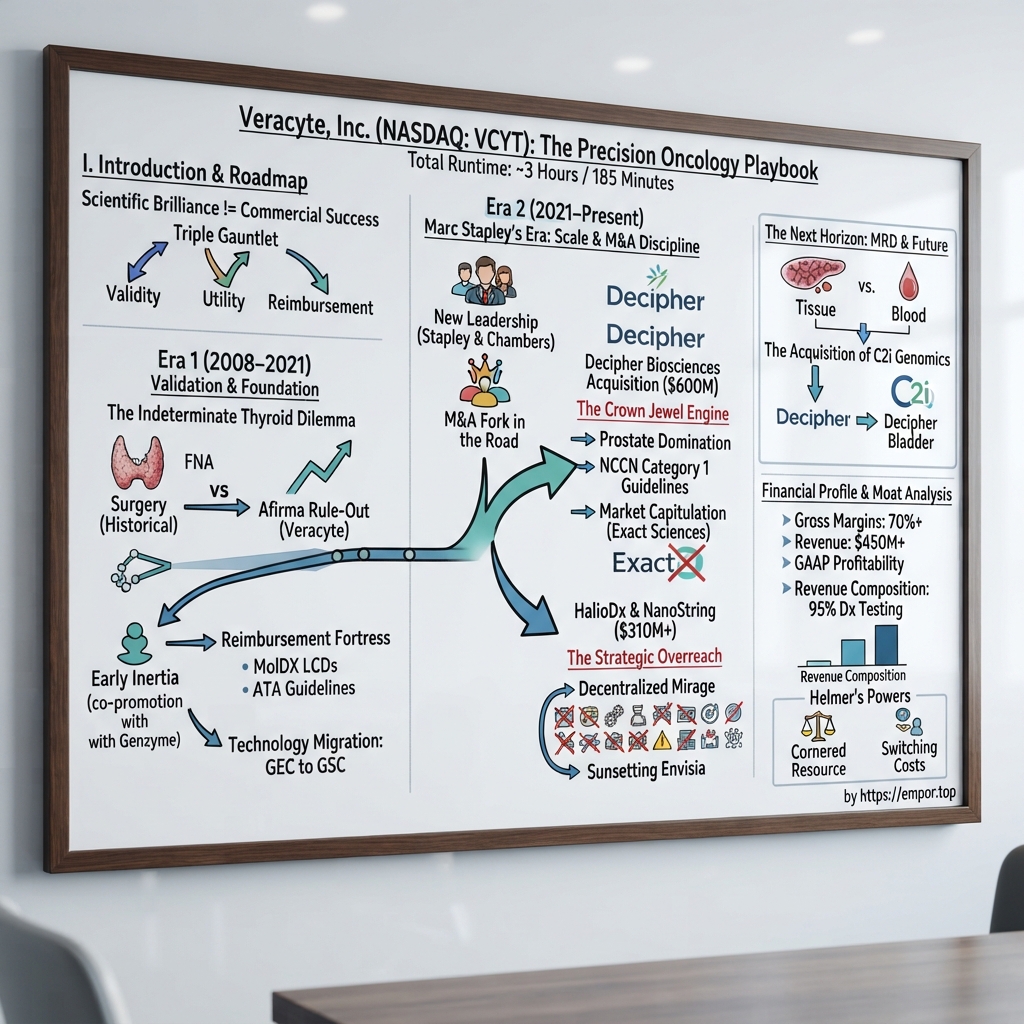
Veracyte, Inc. (NASDAQ: VCYT): The Precision Oncology Playbook
I. Introduction & Episode Roadmap (00:00 – 00:15)
The scene: a pathology bench, and a decision nobody wants to make
Picture a cytopathologist in 2009, hunched over a glass slide holding a smear of cells drawn from a lump in someone's neck. The cells are not obviously benign, nor are they clearly malignant. They sit in diagnostic limbo — and under the clinical conventions of the era, that gray zone led to a single outcome: surgery. Surgeons routinely excised half the thyroid, and often the entire organ, simply to send the tissue to surgical pathology and reach a definitive diagnosis. Roughly three-quarters of the time, the nodule proved benign, leaving the patient with a surgical scar and, in many cases, a lifetime reliance on daily thyroid hormone replacement.
That unresolved slide became the commercial foundation for a company that, seventeen years later, reported $517 million of revenue, $66 million of GAAP net income, and $136 million of operating cash flow.1 Veracyte did not reach those milestones merely by advancing molecular biology. It succeeded by solving the commercial barrier that routinely derails diagnostic companies: securing broad, reliable payer reimbursement.
The core paradox of diagnostic genomics
The molecular diagnostics industry is fraught with failure because laboratory science is often the most straightforward hurdle. A commercial diagnostic assay must clear three sequential gates. First is analytical validity: can the assay measure its target accurately and reproducibly, even from a degraded clinical sample? Second is clinical validity: does that measurement correlate consistently with the underlying disease? Then comes the gate that exhausts early-stage capital: clinical utility and reimbursement. Does the result meaningfully change clinical practice, and will Medicare and commercial insurers pay an established price that covers operating costs?
That third gate is where diagnostic balance sheets break down. An assay developer can publish promising data in the New England Journal of Medicine and still deplete its cash reserves waiting for coverage determinations. Veracyte’s structural breakthrough was establishing a repeatable framework to clear that final gate: channel all testing through its own central laboratories certified under the Clinical Laboratory Improvement Amendments (CLIA) — specialized, federally audited facilities where reagents, equipment, and protocols are rigorously validated — gather real-world outcomes data from routine clinical volume, convert those findings into peer-reviewed clinical evidence, and translate that evidence into guideline inclusion and binding payer contracts. In 2025, that commercial engine converted 169,714 reported patient tests into $493 million of testing revenue, generating a non-GAAP gross margin above 75% and an adjusted EBITDA margin of 27.6%.12
The two strategic eras — and why the second one is being tested right now
Veracyte's corporate trajectory divides into two distinct operational eras. The first belonged to co-founder Bonnie Anderson, who led the business from its 2008 rebranding through June 2021. That chapter centered on clinical validation, protracted reimbursement negotiations in thyroid testing, and an expansive hypothesis that the Afirma diagnostic playbook could be systematically replicated across multiple organ systems.[^3]
The second era belongs to chief executive Marc Stapley and chief financial officer Rebecca Chambers, both former Illumina executives who took the helm in 2021 and introduced a stricter operating framework — narrowing the pipeline, prioritizing unit economics, and executing against defined profitability targets rather than broad scientific mandates.[^3][^4] The pair inherited two corporate acquisitions completed within six months of each other in 2021. The first, Decipher Biosciences, became the primary driver of top-line expansion. The second, HalioDx, underwent progressive asset write-downs until its French operating entity entered judicial restructuring in Marseille in 2025.1
What this episode actually argues
The prevailing investment consensus on Veracyte holds that clinical practice guidelines and Medicare coverage establish an unbreachable competitive moat — one more durable than patents, because rival developers cannot litigate their way into National Comprehensive Cancer Network (NCCN) recommendations. Yet that view overlooks a critical dynamic that defines the company's operating environment in 2026.
Clinical guidelines do not function as a passive moat; they act as an assertive counterparty. In late 2025, the NCCN removed its recommendation for molecular testing during active surveillance of low-risk prostate cancer. Following that change, Veracyte's Decipher volume growth, which had exceeded 20% year-over-year for sixteen consecutive quarters, slowed to 17% in the second quarter of 2026.3 Management subsequently lowered its internal Decipher volume projection for the full year by roughly 1,000 tests, a reduction isolated entirely to the low-risk segment.3 In that same guideline revision, an artificial-intelligence tool that evaluates standard stained pathology slides received an NCCN recommendation, marking the first software-only diagnostic of its kind endorsed for localized prostate cancer.4
These developments raise concrete operational questions. Does guideline inclusion provide a permanent protective barrier, or does it leave diagnostic providers vulnerable to committee discretion? Did Illumina-trained management sustainably optimize capital allocation, or did the firm benefit primarily from a single high-performing transaction? And can a company whose bottom line depends almost entirely on two tests in two anatomic sites successfully challenge entrenched incumbents in breast cancer and blood-based monitoring?
The investigation starts with a fine-needle biopsy, an indeterminate thyroid nodule, and a persistent commercial problem.
 Subscribe on LinkedIn
II. Founding Origins: The Indeterminate Thyroid Dilemma (2008–2011) (00:15 – 00:32)
The bottleneck: 650,000 needles a year and no good answer
Every year in the United States, roughly 650,000 people undergo fine-needle aspiration biopsy for a suspicious thyroid nodule.1 The procedure itself is straightforward—a thin needle, a few seconds, and a smear of cellular material on a glass slide. The diagnostic interpretation is not.
Most aspirates come back clearly benign, while a small minority show unambiguous malignancy. But a stubborn portion falls directly in the middle: cells that look atypical enough to concern a pathologist, but not abnormal enough to confirm cancer. Under the Bethesda System—the standardized reporting framework pathologists use for thyroid cytology—these results fall into categories III and IV, the indeterminate tiers.
To make that gray zone concrete: a Bethesda category III result denotes "atypia of undetermined significance," while category IV designates "follicular neoplasm." In both instances, the pathologist must document that the cells appear abnormal, yet standard light microscopy cannot resolve whether the lesion is malignant. Differentiating a benign follicular adenoma from a follicular carcinoma depends primarily on whether tumor cells have invaded the fibrous capsule surrounding the nodule—a structural boundary impossible to evaluate on a cytological smear, because needle aspiration disrupts the tissue architecture. The diagnostic blind spot stemmed not from pathologist error, but from the physical limits of the sample itself.
For decades, the standard of care resolved that ambiguity with a scalpel: patients with indeterminate findings were routinely referred for diagnostic surgery. And here is the number that defined the entire commercial opportunity: historically, when those nodules were removed and examined under surgical pathology, 70% to 80% of them proved benign.1 Tens of thousands of Americans each year had part or all of a functioning endocrine organ excised to answer a question that surgical pathology mostly answered "no" to. A total thyroidectomy requires lifelong levothyroxine therapy, and every neck operation carries clinical risks, including permanent damage to the recurrent laryngeal nerve and parathyroid glands. The procedure was, in the most literal sense, an expensive, irreversible diagnostic test performed with a scalpel.
The founding team and the counterintuitive bet
The corporate shell that became Veracyte was incorporated in Delaware as Calderome, Inc. in 2006, operating as an incubator project funded by Kleiner Perkins Caufield & Byers, TPG Biotech, and Versant Ventures, before being renamed Veracyte in 2008.5 Bonnie Anderson, a commercial operator rather than a bench scientist, co-founded the company and served as chief executive and chairman until June 2021.[^3]
Anderson's insight was grounded less in biology than in decision theory. Historically, almost every cancer diagnostic has been engineered to find disease—maximizing clinical confidence that a positive result indicates cancer. Anderson built the opposite instrument. Afirma was designed as a rule-out test: a genomic classifier calibrated so that when it calls an indeterminate nodule benign, the treating physician can trust that assessment enough to cancel surgery. In statistical terms, the test was optimized for negative predictive value rather than positive predictive value.
The clinical arithmetic of that choice was unforgiving. Because roughly three-quarters of indeterminate nodules are benign, an uncalibrated test that simply labeled every sample benign would boast high apparent accuracy while missing lethal malignancies. The classifier had to be tuned so that false negatives were exceptionally rare, which inevitably meant accepting a modest false-positive rate: a meaningful number of benign nodules would still be flagged as suspicious and referred to surgery. Afirma did not eliminate unnecessary operations entirely; it curtailed them under a rigorously quantified and published error profile. Commercial adoption depended on convincing endocrinologists that this residual risk was low enough to safely alter patient management.
That dynamic created a powerful economic distinction. A rule-in test merely provides supplemental detail for a surgical decision the clinician was already inclined to make. A rule-out test averts a surgical procedure, establishing an immediate economic rationale for health insurers and a compelling proposition for patients: a multianalyte molecular test costing several thousand dollars substituted for an inpatient operating room procedure and lifelong hormone replacement therapy.
Building the classifier — and publishing it
The original Afirma Gene Expression Classifier read messenger RNA—the working transcripts cells produce when expressing genes—across a 167-gene signature measured on microarray technology. Rather than evaluating the shape of cells under a microscope, the assay measured which molecular pathways the cells were actively transcribing, matching that expression pattern against a reference database of thousands of nodules with verified surgical outcomes.
The definitive clinical validation arrived in August 2012, when a prospective, multicenter, double-blinded validation study of the classifier in cytologically indeterminate thyroid nodules was published in the New England Journal of Medicine.6 For a young diagnostic firm with roughly $11.6 million of revenue that year, an NEJM paper was the single most valuable asset on the balance sheet—and it was not on the balance sheet at all.7
The falsification: publication is not adoption
Here is where the founding-era narrative transitions from scientific milestone to commercial case study. The implicit assumption in many diagnostic business models is that superior published evidence naturally unlocks rapid clinical adoption. Veracyte's early operating history proved otherwise.
Endocrinologists did not immediately trade surgical certainty for an algorithmic probability. Community physicians had spent entire careers operating under protocols mandating surgery for indeterminate nodules, and the legal and clinical downside of a missed cancer fell squarely on the treating physician rather than a laboratory classifier. To build commercial momentum, Veracyte executed an expensive distribution strategy: in January 2012, it signed a global co-promotion agreement with Genzyme, the Sanofi subsidiary whose endocrinology sales representatives already called on target physicians. Veracyte received a $10.0 million upfront fee, and in exchange agreed to pay Genzyme a co-promotion fee equal to a percentage of Afirma cash receipts—40% initially, stepping down to 32% in March 2014.8
To establish the clinical habit, the company surrendered roughly two-fifths of its cash collections to an external commercial sales force. That arrangement was not a structural moat; it was rented distribution at a punitive price to compensate for the absence of an internal sales channel. The episode established a structural principle that persisted across Veracyte's expansion: in molecular diagnostics, peer-reviewed evidence is a necessary prerequisite, but insufficient on its own. Converting published data into recurring revenue demands a physician-by-physician behavioral change campaign—and funding that effort requires substantial operational capital.
For a young diagnostic firm absorbing heavy commercialization costs, securing that capital required broader financial support. In October 2013, the answer was the public market.
III. Going Public & Building the Reimbursement Fortress (2012–2019) (00:32 – 00:52)
A modest debut
On October 30, 2013, Veracyte priced 5,000,000 shares at $13.00 per share—the low end of its marketed range—raising $65 million gross and roughly $58 million net, with the offering closing on November 4.9 It was a modest public debut for a company dependent on a single commercial assay, surrendering a substantial share of cash receipts to an external sales partner, and facing persistent market skepticism over whether a single-test specialty laboratory could build a sustainable enterprise.
For most of the subsequent six years, that skepticism appeared well founded. While annual revenue expanded from $21.9 million in 2013 to $120.4 million in 2019, Veracyte incurred net losses in every single year, accumulating hundreds of millions of dollars in red ink.7 Over that same span, the company's share count roughly doubled as management issued equity to fund commercialization. That protracted cash burn reflected the baseline economic reality of molecular diagnostics, where the time required to secure coverage determinations routinely strains early-stage balance sheets.
The reimbursement engine, explained in plain English
Behind those persistent operating deficits, however, Veracyte was assembling the most durable operational asset in the diagnostic industry: a comprehensive payer reimbursement network.
In the United States, diagnostic reimbursement follows two distinct tracks. Medicare reimburses under a clinical laboratory fee schedule administered by regional administrative contractors. For molecular and genomic testing, the primary gatekeeper is the MolDX program, overseen by Medicare contractor Palmetto GBA, which issues local coverage determinations that establish whether an assay demonstrates sufficient clinical utility to justify payment. Commercial health plans follow with their own internal coverage policies, and their medical directors rely heavily on practice guidelines published by professional specialty bodies such as the American Thyroid Association and the NCCN.[^12]
The reimbursement sequence is slow and strictly sequential: publish clinical evidence, secure codification from guideline panels, and leverage those endorsements to negotiate in-network contracted rates with private health insurers. The lag between initial peer-reviewed publication and widespread coverage routinely spans five years or more. That timeline explains why well-capitalized diagnostic developers frequently exhaust their reserves—and why surviving companies establish a commercial position that competitors cannot easily displace.
By the end of 2025, that prolonged effort had established Afirma coverage across commercial and government health plans representing more than 275 million covered lives.1
The central role of clinical guidelines stems from the administrative structure of private health insurance. Commercial medical policy committees rarely possess the bandwidth or specialized expertise to evaluate primary genomic literature, and they have little incentive to do so. An insurer that unilaterally designates an assay experimental after a recognized specialty society has endorsed it faces administrative appeals, state regulatory inquiries, and potential litigation. In practice, health plans outsource that scientific judgment to guideline panels. When the American Thyroid Association codified molecular testing in its management guidelines for thyroid nodules in 2015, the biological performance of Afirma remained identical. What changed was the administrative defensibility of an insurance denial.[^12] Positive coverage determinations unlock negotiated contracted rates, which in turn drive higher cash collection percentages. That dynamic illustrates why a diagnostic provider's most critical personnel often work outside the laboratory, in medical affairs and market access. Yet that hard-won coverage also creates acute revenue exposure: Medicare accounted for 33% of Veracyte's total revenue in 2025, while UnitedHealthcare generated 14%—meaning two payers together represented 47% of the top line.1 That payer concentration serves simultaneously as a formidable barrier to entry and a structural vulnerability.
The technology migration that reset the competitive line
In July 2017, Veracyte launched the Afirma Genomic Sequencing Classifier, replacing microarray technology with RNA sequencing and machine learning.10 The primary commercial significance of the transition was not analytical novelty, but diagnostic yield.
Two clinical metrics illustrate the shift. The benign call rate—the proportion of indeterminate nodules the classifier can definitively clear for clinical surveillance rather than surgical resection—increased from roughly 44% under the legacy classifier to approximately 64% under the Genomic Sequencing Classifier (GSC).10 Furthermore, specificity in Hürthle cell neoplasms, a challenging diagnostic subtype that the original microarray frequently flagged as suspicious, improved from about 12% to about 59%.10
That analytical improvement fundamentally altered the clinical proposition for ordering physicians. Under the first-generation assay, an endocrinologist submitting an indeterminate sample faced roughly a coin-flip chance of receiving an actionable result that averted surgery. Under the GSC, nearly two-thirds of evaluated patients received a definitive benign assessment that safely bypassed the operating room. The assay shifted from an occasional clinical adjunct to an essential triage mechanism. By expanding the volume of avoided surgeries without increasing the unit price, Veracyte increased the economic value delivered to health systems.
That assay optimization has continued into the current operating era. In the fourth quarter of 2025, Veracyte completed the transition of all Afirma testing to a second-generation transcriptome workflow, which lowered laboratory processing costs and improved diagnostic rescue on samples with low RNA yield. Management reported that an improving "no result rate" contributed roughly 400 basis points to Afirma volume growth in the first quarter of 2026, though Chief Financial Officer Rebecca Chambers cautioned analysts that this operational yield benefit was "about as good as it's going to get."11 The disclosure established clear limits on further internal yield gains.
Competitive anatomy in thyroid
Veracyte's stated competition in thyroid includes Interpace Diagnostics Group and ThyroSeq, marketed by Sonic Healthcare.1 The competing platforms reflect contrasting technical philosophies: ThyroSeq evaluates DNA and RNA alterations to both rule in malignancy and rule out benign disease, whereas Afirma relies primarily on gene expression signatures to rule out cancer. Both approaches demonstrate clinical validity; the primary competitive differentiation lies in commercial execution and workflow integration rather than raw analytical capability.
At the end of 2025, management estimated Afirma's share of the indeterminate thyroid testing market at approximately 38%.12 While Afirma remains the market leader, that figure tempers the common industry assumption of total commercial dominance. Afirma testing volume grew 11% in 2025 and roughly 10% in the second quarter of 2026—a steady trajectory for a mature diagnostic franchise, but noticeably slower than the broader company average.12
In operational terms, Afirma functions as a mature, high-margin, defensible commercial annuity generating modest growth. Its market position is insulated by dense payer contracts, established clinical ordering routines, and specialized collection-kit logistics that make switching an administrative nuisance rather than an active clinical choice. By 2021, Afirma was no longer the primary driver of corporate revenue acceleration, but its reliable cash generation funded the strategic expansion that followed—including a series of diversification bets that largely failed to replicate its commercial model.
IV. The Pipeline Mirage & Strategic Overreach (2015–2020) (00:52 – 01:10)
The seductive hypothesis
Once a diagnostic developer proves that a rule-out genomic test can avert surgery, the strategic temptation is obvious: replicate the playbook in another organ system. Nearly every anatomic site has its own version of an indeterminate nodule, and nearly every surgical subspecialty performs diagnostic resections that yield mostly benign tissue.
Veracyte targeted the lungs. Percepta, launched in 2015, relied on the biological concept of a "field of injury"—the observation that smoking-related exposure leaves molecular alterations throughout the respiratory tract. By brushing cytologically normal cells from the mainstem bronchus during a routine bronchoscopy, the classifier evaluated whether a suspicious, peripheral lung nodule was malignant. Envisia, which followed, used a whole-transcriptome signature derived from transbronchial biopsies to identify the usual interstitial pneumonia pattern characteristic of idiopathic pulmonary fibrosis (IPF), aiming to spare patients an invasive surgical lung biopsy.
The biological hypotheses were sound. The commercial execution was not.
Why pulmonology broke
Three structural headwinds undermined these products, none of which could be resolved with additional clinical data.
First, clinical workflow. Afirma integrated seamlessly into fine-needle aspiration biopsies that endocrinologists were already performing as routine practice. By contrast, the pulmonology assays required interventional pulmonologists to alter their bronchoscopy protocols or take supplemental tissue samples solely to collect genomic material. Asking proceduralists to adapt established clinical routines to accommodate an external laboratory's test proved far more difficult than requesting an aliquot from an existing procedure.
Second, and more decisive, clinical decision impact. In idiopathic pulmonary fibrosis, available therapeutics such as nintedanib and pirfenidone slow disease progression rather than reverse lung damage, and both carry notable tolerability burdens. Many pulmonologists initiated medical therapy based on clinical history and high-resolution computed tomography without requiring genomic confirmation. An assay that merely validates an existing clinical judgment does not generate sustainable diagnostic order volume. A central principle of diagnostic commercialization emerged from this shortfall: biological elegance that fails to alter clinical management rarely translates into recurring revenue, regardless of peer-reviewed validation.
Third, channel economics. Maintaining a specialized commercial sales force to detail community pulmonology practices entailed operating costs comparable to endocrinology field teams, but generated only a fraction of the revenue per clinical account.
Veracyte never disclosed segment-level profitability for its pulmonology franchise, meaning the frequently cited industry estimate of $25 million to $35 million in annual pulmonary-related cash burn cannot be independently verified from public filings. What regulatory disclosures confirm is directionally consistent: when management reduced commercial sales support for Envisia in 2024, selling and marketing expense declined sufficiently that the following year's 5% expense increase was partly offset by that reduction—reflecting a product line whose wind-down produced a visible, though not transformative, operating benefit.1
The hardware detour: nCounter
In December 2019, Veracyte pursued a different strategic avenue. The company paid NanoString Technologies $40 million in cash and $10 million in Veracyte common stock, plus up to $10 million in contingent milestone payments tied to commercial launches, to acquire exclusive global diagnostic rights to the nCounter platform—a benchtop digital profiling system capable of running targeted gene-expression panels without requiring a centralized high-throughput sequencing facility.[^16] The transaction also included Prosigna, an in vitro diagnostic breast cancer recurrence assay based on the PAM50 gene signature.
The strategic rationale was to bypass the geographic constraints of a single centralized laboratory. Under the domestic CLIA laboratory model, international patient specimens had to be shipped across borders to Veracyte's testing facilities in California. Under a decentralized in vitro diagnostic framework, pathology departments in Europe or Asia could purchase standardized reagent kits and run assays locally on hospital instrumentation. While decentralized testing significantly reduces revenue realized per patient test compared to centralized laboratory billing, it dramatically expands geographic reach and lowers the marginal cost to serve.
In practical terms, the acquisition delivered three components: an instrument diagnostic license, an unproven international distribution strategy, and a breast cancer assay that Veracyte would not meaningfully commercialize in the United States for another six and a half years.
Weighing the pipeline record
Evaluated in its entirety, the founder-era diversification effort yielded an unambiguous commercial verdict. Percepta and Envisia both achieved technical validation, and Envisia secured Medicare coverage, but neither attained commercial scale. Veracyte curtailed commercial sales support for Envisia in 2024 as part of an explicit portfolio reprioritization, and the assay was subsequently paused.1 Meanwhile, the Percepta nasal swab program—engineered to assess lung cancer risk through a non-invasive nasal brush—completed enrollment in its NIGHTINGALE clinical trial in 2025. In February 2026, Stapley told Wall Street analysts that the product had been moved out of the company's three-to-five-year operational plan and into its "5- to 10-year plan," deferring commercial contribution pending extended clinical follow-up, peer-reviewed publication, and subsequent coverage negotiations.12
The operational record ultimately disproved the thesis that the Afirma commercial playbook could be universally applied across organ systems. Over roughly a decade, Veracyte channeled considerable capital into three diversification initiatives—lung nodule triage, pulmonary fibrosis subtyping, and decentralized international instrument distribution—without establishing a single durable profit engine from them. The narrower, defensible conclusion was that the model works primarily when an assay directly cancels or redirects an expensive, invasive procedure within a clinical workflow that physicians are already performing. That refined thesis would find validation in the company's next major transaction, and it continues to frame its ongoing initiatives in breast cancer and minimal residual disease monitoring.
That strategic pivot set the stage for 2021—the year executive leadership changed hands, and Veracyte deployed roughly $1 billion in capital across two acquisitions completed within six months.
V. The Inflection Year: New Leadership and The M&A Fork in the Road (2021) (01:10 – 01:32)
Two press releases, one morning
On June 1, 2021, Veracyte announced it had agreed to terms to acquire HalioDx, a French immuno-oncology diagnostics company, for approximately €260 million.13 Quoted in the press release was Bonnie Anderson, described as executive chairwoman. Also quoted, in his first official day in the chief executive's chair, was Marc Stapley, who called HalioDx "a strategic investment that we believe will position the company to unlock its growth potential."13
That timing complicates the conventional narrative that new leadership merely inherited and cleaned up a founder-era misstep. While the strategic groundwork was laid under Anderson, Stapley publicly endorsed the HalioDx transaction on the day it was announced.
The people
Stapley's appointment was announced in May 2021, effective June 1, with Anderson transitioning to executive chair.[^3] His background was rooted in the financial architecture of the genomic sequencing era rather than the underlying laboratory biology: chief financial officer of Illumina from January 2012 to January 2017, then chief administrative officer, and subsequently executive vice president through January 2019, followed by two years as chief executive of the consumer genomics company Helix.[^3] Rebecca Chambers joined as chief financial officer in July 2021, arriving from the CFO role at Outset Medical after previously leading investor relations and financial planning at Illumina.[^4]
The arrival of Illumina alumni shifted the corporate vocabulary. Where founder-era Veracyte emphasized biology and unmet clinical need, post-2021 leadership framed strategic priorities around adjusted EBITDA margin targets, market penetration rates, and return on invested capital. On the fourth-quarter 2025 earnings call, Stapley articulated that operating philosophy directly: "a well-run business in this diagnostics industry should be able to get to 25% and sustainably remain there."12 Whether that orientation reflected durable operational discipline or simply a change in corporate messaging is best evaluated against subsequent performance—and 2021 presented two immediate test cases.
Test case one: Decipher
On February 3, 2021, Veracyte announced the acquisition of Decipher Biosciences, a San Diego developer whose 22-marker RNA classifiers evaluated the aggressiveness of prostate and bladder cancers. Total consideration was $600 million—comprising $250 million in cash and up to $350 million in stock issued at a fixed price of $54.30 per share, with Veracyte retaining an option to substitute cash for stock.14
The transaction carried a demanding valuation. Decipher had generated approximately $39 million to $40 million of revenue in 2020, up from $16.5 million in 2019, on clinical test volume of 15,500 to 16,500 tests.14 That implied a multiple of roughly fifteen times trailing revenue for an unintegrated laboratory—more than double the roughly six-and-a-half times sales multiple that Exact Sciences paid for Genomic Health in 2019.
Two structural aspects of the transaction warrant scrutiny. First, corporate governance: Dr. Tina Nova, Decipher's president and chief executive, had served on Veracyte's board of directors since 2015. While standard conflict-of-interest protections were observed—Nova resigned from Veracyte's board before signing, recused herself from Veracyte's deliberations, and an independent special committee of Decipher's board approved the merger14—the company's single most consequential acquisition nevertheless involved an asset led by a sitting board member.
Second, equity financing. On February 4, 2021—the day after announcing the transaction—Veracyte priced an underwritten public offering of 7,432,433 shares at $74.00 per share, raising approximately $550 million gross after upsizing from an initially planned $400 million.15 In capital allocation terms, the Decipher purchase was largely funded by issuing stock near the zenith of the 2021 diagnostic market rally. With Veracyte shares closing at $42.53 on September 4, 2026,16 investors who funded that transaction through the equity offering remained down roughly 40% five and a half years later, even as the acquired asset met high operational expectations. The outcome highlights a fundamental investing principle: strong asset selection does not insulate equity returns from the valuation multiple paid at entry.
Test case two: HalioDx
The strategic rationale for HalioDx was vertical integration in pursuit of decentralized diagnostic testing. HalioDx operated CLIA laboratories in France and the United States alongside an in vitro diagnostic manufacturing facility in Marseille. Veracyte intended to transfer the manufacturing of nCounter test kits—then produced by NanoString—into that French facility, accelerating the expansion of its European testing menu.13 The transaction also added Immunoscore, an immune-profiling assay for colorectal cancer, and a biopharmaceutical services division. Total consideration was approximately €147 million in cash and up to approximately €113 million in stock, with a cash-substitution option.1317
The 2021 scorecard
Within six months, a company that had never generated an annual operating profit committed roughly $900 million across two transactions, supported by the largest equity offering in its corporate history. On the 2021 statement of cash flows, that strategy resulted in $736.8 million in acquisition spending against $593.8 million in net proceeds from stock issuance, accompanied by an operating cash outflow of $31.6 million.7
One of those investments formed the commercial core of the company today. The other initiated a multi-year progression of asset write-downs that ended in commercial court proceedings in France. Before analyzing that operational restructuring, it is essential to examine how Decipher transformed Veracyte's financial trajectory—and where that franchise is now encountering growth resistance.
VI. The Crown Jewel Engine: Decipher Prostate & Urologic Domination (2021–Present) (01:32 – 01:52)
The clinical problem: too much treatment and too little, at the same time
Roughly 334,000 American men are diagnosed with prostate cancer each year.1 Clinically, the disease presents a persistent dilemma of biological heterogeneity. A substantial portion of localized tumors are indolent and will never progress to threaten a patient's life, while an aggressive minority will metastasize and prove fatal. Overtreating indolent disease exposes patients to surgical complications, urinary incontinence, and erectile dysfunction without extending life. Conversely, undertreating high-risk disease carries lethal consequences.
Standard clinical risk stratification has historically relied on prostate-specific antigen (PSA) blood levels, physical tumor staging, and the Gleason grading system determined by a pathologist under a light microscope. These measures are anatomical proxies rather than direct reads on tumor biology, and they frequently misclassify risk. Decipher evaluates tumor behavior at the molecular level: a 22-marker RNA signature analyzed via machine learning to estimate the individual probability of clinical metastasis. In clinical practice, Gleason grading evaluates what the tumor looks like; Decipher evaluates what the tumor is doing.
The evidence fortress — what it actually consists of
Decipher established its leading position in urologic oncology not because it was the sole genomic prostate assay on the market, but because its clinical validation was built within prospective cooperative-group randomized trials where tissue specimens were banked under controlled protocols and patients were tracked for a decade or more.
That clinical architecture established a competitive barrier that is structurally difficult for late entrants to replicate. As Stapley observed to Wall Street analysts in May 2026, "most of these studies you have to have started that long ago in order to read out in this particular disease state, which creates quite a competitive moat."11 Because prostate cancer progresses slowly, generating comparable long-term outcome data requires cohorts monitored over ten to fifteen years—an investment horizon that cannot be compressed with additional capital alone.
By the end of 2025, the franchise was supported by more than 100 publications on clinical utility and validity, alongside approximately 100 additional studies leveraging the research-use-only Decipher Genomic Resource Information Database (GRID).12 Veracyte's regulatory filings state that Decipher Prostate holds Simon Level IB evidence and inclusion in the 2026 NCCN prostate cancer guidelines, distinguishing it as the only gene-expression test to do so.1 That distinction is clinically specific: Simon Level IB denotes prospective-retrospective validation using archived specimens from completed randomized trials, distinct from the broader "Category 1 preferred" phrasing occasionally cited in secondary market commentary.
Clinical trial enrollment has continued to expand the evidence base. Four Phase III trials evaluating Decipher's utility in treatment intensification and de-intensification completed enrollment, including the roughly 2,000-patient GUIDANCE study, which concluded ahead of schedule in the first quarter of 2026.11 These trials are commercially consequential because they transition Decipher from a prognostic tool—estimating baseline metastatic risk—to a predictive diagnostic that indicates which patients will respond to specific therapeutic regimens. Predictive claims typically secure stronger guideline language and more favorable payer reimbursement.
The distinction between prognostic and predictive data drives the long-term commercial trajectory of the franchise. A prognostic test identifies an aggressive tumor, informing clinical vigilance; a predictive test identifies whether a tumor will respond to an intervention, such as adding androgen deprivation therapy, directly altering prescribing decisions. Payers reimburse diagnostic interventions that direct drug utilization more reliably than those that merely quantify risk. Veracyte has systematically pursued that predictive profile: the ENZAMET study, presented at the American Society of Clinical Oncology meeting in mid-2026, assessed Decipher's ability to identify metastatic patients who derive survival benefit from triplet therapy.112 Management has also identified three supplemental genomic signatures—PORTOS, PTEN, and PAM50—derived from GRID database research, intending to incorporate them into clinical reports as optional insights for men with high-risk and recurrent disease.12 Because these signatures run on the laboratory's existing whole-transcriptome sequencing workflow, adding them entails virtually no incremental processing expense, allowing Veracyte to expand the clinical scope of each run without expanding its laboratory cost structure.
Competitive capitulation, and its limits
A tangible indication of Decipher's commercial entrenchment came from a major competitor's divestiture. In August 2022, Exact Sciences sold its Oncotype DX Genomic Prostate Score business to MDxHealth for consideration of up to $100 million, of which $25 million was cash and $5 million was settled in 691,171 American Depositary Shares.[^22][^23] Exact Sciences, despite its substantial commercial infrastructure and diagnostic balance sheet, determined that defending a third-place prostate assay offered lower risk-adjusted returns than allocating capital toward Cologuard and Oncotype DX Breast.
Myriad Genetics continues to market Prolaris, and MDxHealth pairs the acquired GPS test with its existing urology portfolio.1 Chambers characterized the field in February 2026 as a three-player market, noting that share occasionally shifted between the two smaller competitors without materially affecting Veracyte.12
The engine's economics — and the moment it stalled
The commercial scale Decipher achieved following the 2021 acquisition significantly reshaped Veracyte's income statement. Decipher delivered approximately 102,000 tests in 2025, growing 27% year over year, and the franchise generated $91.9 million of revenue in the second quarter of 2026 compared to Afirma's $51.2 million—accounting for roughly 63% of total testing revenue.12 Blended testing average selling price stood near $2,986 in the first quarter of 2026, up 6% year over year including prior-period collections, or roughly $2,900 excluding them.11 That realized price reflects stable, contracted payer rates and sits meaningfully below the $3,000 to $3,500 estimates frequently cited in external commentary.
The franchise's growth trajectory, however, encountered resistance in mid-2026. Decipher had generated year-over-year volume growth above 20% for fifteen consecutive quarters through the end of 2025.12 In the second quarter of 2026, volume growth moderated to 17%—its first sub-20% print in sixteen quarters—and management lowered its internal full-year Decipher volume projection by roughly 1,000 tests.23
Stapley attributed the deceleration to an NCCN guideline revision finalized in late 2025, explaining that "for every test, whether molecular or AI-based, for active surveillance, it was taken out of guidelines."3 The entire volume reduction was concentrated in the low-risk segment—the exact patient cohort management had highlighted throughout 2025 and early 2026 as a primary expansion channel, pointing to more than 80,000 low-risk patients tested since commercial launch alongside encouraging active-surveillance registry data.11
This development highlights the central vulnerability in Veracyte's investment narrative. The long-term adoption thesis relies on Decipher being roughly one-third penetrated, leaving two-thirds of eligible prostate cancer patients untested.12 The counterargument demonstrates that the guideline panel responsible for enabling market penetration can unilaterally curtail an addressable indication, independent of underlying assay validity or competitive pressure. Management's response affirmed that structural dynamic while disputing its ultimate financial severity: the company emphasized that all competing assays faced identical exclusions, and confirmed it is assembling prospective and retrospective trial data to support guideline reinstatement, with initial study readouts anticipated as early as 2027.3
That divergence reframes the nature of Veracyte's competitive position. Decipher's extensive clinical literature and guideline codification establish a durable barrier against commercial competitors, but leave the franchise fully exposed to guideline committee discretion. The critical operational metric for investors is whether volume expansion across intermediate-risk, high-risk, biochemical-recurrence, and metastatic disease—where management reported volume growth near 30% in early 2026—can sustain overall Decipher growth near 20% while the low-risk active-surveillance segment remains a single-digit grower.113
VII. The Reckoning & Pruning: The Envisia Sunset and HalioDx Write-Down (2022–2024) (01:52 – 02:10)
The scene: a commercial court in Marseille
On July 16, 2025, the Marseille Commercial Court approved the divestiture of the contract manufacturing operations of Veracyte SAS—the French subsidiary formerly known as HalioDx—to Helio Diagnostics SAS, effective August 1. The court placed the remaining assets under a judicial administrator pending the appointment of a liquidator.1 Following that ruling, Veracyte ceased consolidating the subsidiary and recognized a $6.7 million non-cash loss on deconsolidation.1
Four years after committing roughly a quarter of a billion euros to acquire a French manufacturing base, the company exited the asset through a local insolvency proceeding. That resolution forms the unvarnished conclusion to Veracyte's European manufacturing expansion before examining the accounting and operational details behind it.
Correcting the record on the write-downs
The commonly circulated version of this episode—hundreds of millions of dollars in goodwill impairments across 2022 and 2023—is contradicted by regulatory disclosures. Veracyte recorded no goodwill impairment in 2023, 2024, or 2025, and reported goodwill stood at $767.2 million at the end of 2025.1 Because the company operates as a single operating segment and single reporting unit for goodwill evaluation, the substantial cash flows and enterprise value of the Decipher franchise mathematically shield the carrying value of the HalioDx purchase price from a goodwill write-down.1 While that accounting treatment conforms to US GAAP, it also reflects an artifact of reporting-unit aggregation rather than evidence that the acquisition delivered on its original targets.
What management wrote down instead were finite-lived intangibles and long-lived physical assets across three successive waves:
In 2023, asset impairments totaled $68.3 million.1 Of that figure, $32.0 million related to HalioDx developed technology, customer relationships, and customer backlog, triggered by biopharmaceutical spending reductions and client cancellations that sharply lowered management's revenue projections. The remainder related to the nCounter license, written down alongside a decision to adopt a multi-platform in vitro diagnostic distribution model—revaluing the exclusive instrument rights acquired in 2019 after concluding the company could not anchor its decentralized future to a single hardware platform.1
In 2024, Veracyte recognized an additional $3.4 million in impairments, comprising $2.7 million against HalioDx intangibles and $0.6 million associated with exiting the C2i Genomics facility in Watertown, Massachusetts.1
In 2025, the company recorded another $20.5 million in asset impairments tied directly to the Veracyte SAS judicial proceedings, primarily writing down lease right-of-use assets, manufacturing property and equipment, and certain research tax credits.1
Why the decentralised dream failed
Three structural pressures converged to derail the decentralized testing strategy. First, the European Union's In Vitro Diagnostic Regulation replaced the prior self-certification CE-mark regime with rigorous clinical evidence requirements and notified-body conformity reviews, significantly extending the regulatory timeline for commercial test kits. Second, European single-payer health systems showed little willingness to reimburse genomic tests at American price points. Third, the contract biopharmaceutical services business Veracyte acquired generated erratic, low-margin revenue that diluted consolidated gross margins rather than expanding them—a drag reflected in the decline of biopharmaceutical and other revenue costs from $15.3 million in 2023 to $7.6 million in 2025 as the operation wound down.1
By early 2026, Chambers was guiding Wall Street to less than $1 million in biopharma revenue for the full year, explaining that "with shutting down the French entity, that was where the vast majority of the biopharma revenue came from."12 The commercial retreat from the acquired European services business was complete.
Envisia: correcting the timeline
The frequently repeated claim that Veracyte announced the termination of Envisia commercialization in October 2023 is likewise contradicted by corporate filings. In the third quarter of 2023, the reported impairment was tied to the nCounter platform and the shift to a multi-platform distribution strategy. The commercial withdrawal from Envisia occurred later and far more quietly: public disclosures detailed restructuring costs associated with portfolio reprioritization that included "the reduction of Envisia sales support in 2024," after which the assay was paused.1
The chronological distinction provides insight into executive decision-making. This was not an immediate, decisive restructuring announced on an investor stage, but an incremental, eighteen-month operational retreat disclosed primarily within expense-line footnotes. While the capital reallocation ultimately addressed an unprofitable franchise, the corporate communication around the withdrawal remained understated.
Weighing the capital allocation record
Evaluating the leadership team's capital allocation record requires weighing two conflicting sets of facts.
The case for management discipline is supported by clear financial results. Executive leadership restructured operating expenses, curtailed investment in unprofitable non-core programs, and exited the loss-making French manufacturing entity rather than committing further capital to defend it. That discipline contributed to a marked financial turnaround: Veracyte transitioned from a $74.4 million net loss in 2023 to net income of $24.1 million in 2024 and $66.4 million in 2025, while cash flow from operations expanded from $44.2 million to $75.1 million and then to $136.3 million over that three-year span.71
The counter-evidence, however, qualifies that narrative. This leadership team endorsed the HalioDx transaction on its announcement day, wrote down its intangible assets across consecutive years, and ultimately dissolved the operating unit through French judicial restructuring. Similarly, management acquired minimal residual disease developer C2i Genomics for total consideration of up to $100.2 million, which included $17.2 million in contingent milestone payments—of which only $5.0 million was earned in 2024 and $0.7 million in 2025, with the remaining milestones expiring unachieved on January 1, 2026.1 Because roughly two-thirds of that contingent earnout went unearned, Veracyte recorded a $15.3 million non-cash gain from revaluing the liability downward—a non-operational adjustment that lifted reported 2025 GAAP net income while confirming that the acquired technology had failed to hit its developmental benchmarks.1
A balanced assessment supports a specific conclusion. Stapley and Chambers have demonstrated discipline in operating the core diagnostic testing engine and in terminating underperforming legacy commitments. Yet the transaction record does not demonstrate superior foresight in asset acquisition: two of the three acquisitions completed during or immediately preceding their tenure underperformed relative to their initial deal terms. Testing whether that pattern represents structural capital misallocation or prudent pruning depends on whether the acquired minimal residual disease platform can successfully translate technical feasibility into guideline-backed, reimbursed clinical volume at commercial scale.
VIII. The Next Horizon: Liquid Biopsy, C2i Genomics, and MRD (2024–Present) (02:10 – 02:26)
A different kind of question
Every diagnostic platform Veracyte commercialized through 2023 was a solid tissue assay: a clinician collects cells or a surgical tissue block, the laboratory profiles RNA expression, and the result guides a single clinical decision at diagnosis.
Minimal residual disease (MRD) testing addresses a fundamentally different clinical question on a recurring basis: following surgery or radiation, does residual cancer persist below the detection limit of conventional radiographic scans? The methodology detects circulating tumor DNA (ctDNA)—trace genetic fragments shed by malignant cells into the bloodstream at minute concentrations. If standard imaging searches for a building, an MRD assay searches for microscopic dust shed by that structure suspended across a reservoir.
The commercial incentive for molecular diagnostics developers is substantial. An initial cancer diagnosis generates a single tissue test, whereas longitudinal MRD surveillance creates the potential for quarterly blood draws spanning multiple years—converting an episodic testing transaction into recurring, subscription-like volume.
The acquisition
On January 8, 2024, Veracyte announced the acquisition of C2i Genomics, completing the transaction on February 5.18 Recorded purchase consideration totaled $100.2 million, comprising roughly 2.7 million common shares valued at $73.3 million, $0.8 million of replacement options, and $17.2 million of contingent consideration.1
The technological differentiator of C2i's platform centers on whole-genome sequencing. Conventional tumor-informed MRD assays typically sequence a patient's primary tumor, synthesize a customized multiplex gene panel targeting that individual's specific somatic mutations, and subsequently track those bespoke markers in longitudinal plasma draws. By contrast, C2i's methodology performs whole-genome sequencing across the primary tumor, germline DNA, and cell-free plasma DNA, deploying machine-learning pattern recognition across the entire genome rather than manufacturing patient-specific physical panels. Eliminating custom panel synthesis is designed to compress laboratory turnaround times, lower marginal manufacturing complexity at scale, and yield an expansive genomic dataset for each patient—generating the bioinformatic raw material intended to fuel a clinical evidence repository akin to Decipher's database.
The commercial strategy — deliberately narrow
Rather than competing directly in colorectal cancer, where Natera's Signatera assay holds an entrenched lead in published clinical evidence and reimbursement coverage, Veracyte focused initially on muscle-invasive bladder cancer (MIBC). That selection leveraged existing commercial infrastructure: Decipher's urology sales force already calls on the treating urologists and urologic oncologists who manage these cases, with management estimating that roughly 70% of eligible bladder cancer patients are treated within that existing commercial channel.12 The serviceable target market is intentionally narrow: Chief Commercial Officer John Leite estimated the initial population at approximately 20,000 patients annually, subject to serial repeat testing throughout each episode of care.12
Management also paired that market entry with an explicit operational policy: the company would not initiate commercial sales until established payer reimbursement was secured. "We have a standing policy that we would only pursue tests commercially once they're reimbursed," Leite told Wall Street analysts in February 2026, characterizing the posture as "prudence, not conservatism."12
What actually happened in 2026
The company adhered to that reimbursement discipline. In June 2026, Veracyte commercially launched TrueMRD for muscle-invasive bladder cancer following Medicare coverage determination—marking the first Medicare coverage decision for its whole-genome sequencing platform.2 Management indicated that initial MolDX pricing was established "around $2,500" at the low end.3 Reflecting an incremental commercial rollout, neither TrueMRD nor Prosigna revenue was incorporated into full-year 2026 financial guidance; management directed internal operational metrics toward physician ordering workflows and laboratory turnaround performance rather than immediate top-line contribution, projecting meaningful revenue impact beginning in 2027.123
Concurrently, Veracyte launched Prosigna as a laboratory-developed test (LDT) following the presentation of the OPTIMA trial at the American Society of Clinical Oncology meeting, where the study met its primary endpoint by providing prospective evidence that more than two-thirds of clinically high-risk breast cancer patients could safely omit adjuvant chemotherapy.2
The commercial expansion into breast oncology, however, marks a structural departure from Veracyte's historical playbook. As Stapley observed to analysts in May 2026, every prior commercial assay required Veracyte to educate clinicians on why molecular diagnostics were warranted in that clinical setting; with Prosigna, by contrast, the breast cancer testing market is mature and heavily penetrated, meaning commercial success depends on demonstrating superior clinical evidence to displace established platforms.11 This represents a direct share-capture campaign against deeply entrenched, guideline-codified incumbents such as Exact Sciences' Oncotype DX—a competitive dynamic Veracyte has not previously navigated. Management points to concrete clinical differentiators, highlighting prospective validation in premenopausal women and in patients with extensive nodal involvement, noting that OPTIMA enrolled patients with up to nine positive lymph nodes compared to the three-node ceiling of the established comparator.312 Yet when analysts questioned what market share Prosigna might capture over a three-to-five-year horizon, Chambers declined to provide an estimate.3 That reticence underscores early operational realities: the commercial push currently relies on a single prospective trial readout and a dedicated field team expanding from roughly ten sales representatives to fifteen in 2026.3 Furthermore, Medicare reimbursement for the Prosigna LDT was not yet in place as of the second-quarter call, which is why its revenue sits outside financial guidance.3
The skeptical read, grounded in this company's own record
Regulatory clearance and coverage determinations do not guarantee commercial viability—an operational lesson Veracyte has repeatedly absorbed. Envisia secured Medicare coverage alongside peer-reviewed validation yet failed to achieve commercial scale. The nCounter diagnostic license offered exclusive global rights but was subsequently impaired. Similarly, the C2i acquisition structure included developmental earnout milestones that the acquired business largely failed to achieve, leaving two-thirds of the contingent consideration unearned.1
Evaluating TrueMRD against that baseline requires balancing two distinct operational dynamics. On one hand, its commercial position is structurally sounder than the company's prior pulmonology initiatives: TrueMRD is sold directly through an established urology sales channel, and it informs an actionable clinical decision—determining whether a post-cystectomy bladder cancer patient harbors occult residual disease—where the standard alternative is surveillance imaging. On the other hand, the initial target population is limited to roughly 20,000 patients, the preliminary Medicare price of approximately $2,500 sits below Veracyte's blended testing average selling price, and Natera maintains the incumbent market position in bladder cancer MRD under Veracyte's own regulatory filings.1
In commercial terms, TrueMRD currently represents a functional operational milestone rather than an immediate revenue engine. Transforming that technical feasibility into a substantial profit stream remains unproven, dependent on verifiable catalysts: securing private commercial payer coverage beyond Medicare, expanding into subsequent clinical indications with contracted reimbursement in place, and integrating MRD volume directly into annual financial guidance. Until those milestones materialize, Veracyte's financial performance remains anchored where it has stood since 2021: on two established franchises, in two anatomic sites, dependent on a concentrated payer structure.
IX. Management Credibility, Financial Profile, & Capital Allocation (02:26 – 02:42)
Judging management by behaviour over time
The most practical test of an executive leadership team is not what it promises, but how it executes when commitments come due. Veracyte offers several clear operational benchmarks.
Start with the profitability target. Stapley and Chambers publicly committed to achieving a 25% adjusted EBITDA margin. They reached 27.6% in 2025—more than a year ahead of the operating plan they had set out.12 They subsequently guided 2026 margins back down to approximately 25%, explaining that two product launches warranted incremental investment and that leadership wanted the operational flexibility "to invest faster to go faster."12 By the second quarter of 2026, they had raised that margin floor back above 26% while lifting full-year revenue guidance to between $590 million and $596 million.2
That sequence—exceeding targets, deliberately reinvesting, and then raising expectations again—reflects an executive team managing to a long-term operating model rather than to a single quarterly print. It also signals strong revenue visibility, an operational advantage supported by predictable cash collections from Medicare and commercial insurers.
A more telling observation emerges from executive compensation disclosures. For 2025, the board set an executive target for total testing revenue of $495 million. Actual testing revenue came in at $493 million—99.6% of target, and a miss.19 Adjusted EBITDA margin, targeted at 22.0%, came in at 27.6%. Because of that margin outperformance, the blended executive bonus funded at 118%.19
An investor should weigh two realities here. The incentive plan worked as designed: it balanced top-line growth against operating profitability, allowing margin outperformance to carry the final payout. Yet it also meant executive leadership was paid above target in a year the business narrowly missed the primary growth metric that the compensation committee itself described as "the best indicator of our growth and successful execution."19 While standard practice under formulaic incentive structures, this divergence illustrates where corporate incentives actually bite—a notable distinction as the Decipher franchise encountered its first growth deceleration in 2026.
Shareholders have voiced little objection to that structure. Say-on-pay advisory votes registered 91.7% support in 2022, 97.0% in 2023, 95.2% in 2024, and 97.3% in 2025, reflecting rising dissent-free approval, with no meaningful governance revolt on record over that period.19
Ownership and alignment — smaller than commonly claimed
Insider equity alignment remains modest compared to assumptions in secondary market commentary. All directors and executive officers as a group—fourteen individuals—beneficially owned 1,252,197 shares, representing 1.6% of the 79,791,856 shares outstanding as of March 31, 2026.19 Stapley personally held 494,513 shares including exercisable options; Chambers held 207,389.19
The shareholder register is anchored by index funds and large institutional asset managers rather than dedicated healthcare specialists: BlackRock held 15.0%, Artisan Partners at 7.8%, FMR at 7.1% and State Street at 5.3%.19 Artisan's position represents the notable exception, serving as the only concentrated, active manager among the top four institutional holders.
Financial anatomy
By 2026, Veracyte's operating model had become exceptionally streamlined for a molecular diagnostics provider. Clinical testing generates virtually the entire top line—accounting for $145.7 million of the $150.3 million in second-quarter revenue, with product revenue contributing $3.9 million and biopharma services now negligible following the French exit.2
Gross margins have expanded decisively. GAAP gross margin reached 72% and non-GAAP gross margin reached 75% in the second quarter of 2026, compared to a baseline in the mid-60s before the transcriptome transition.2 The operational drivers are concrete: the second-generation workflow lowered laboratory cost per test, lower no-result rates converted previously discarded specimens into billable results, and fixed laboratory overhead was distributed across an expanding volume base at three CLIA sites in South San Francisco, San Diego and Austin.111
The balance sheet carries no traditional funded debt—total borrowings consist of roughly $40 million in finance lease obligations—against $299.5 million in cash and cash equivalents and $185.7 million in short-term investments at mid-2026, with $81.0 million of operating cash generated in the first half.2 Free cash flow in 2025 was $126.6 million against $136.3 million of operating cash flow, on capital expenditure of under $10 million.7 Operating as a capital-efficient laboratory network, the company has not returned to public equity markets for growth capital since the February 2021 offering—with the qualification that it issued approximately 2.7 million shares to acquire C2i Genomics in 2024, and that stock-based compensation ran $43.6 million in 2025, a real ongoing cost to holders even where it does not consume cash.1
The activist's question
What structural vulnerabilities would a skeptical investor press? Three primary issues stand out. First, balance sheet carrying value: $767.2 million in goodwill remains on the balance sheet without standalone impairment testing, protected by single-reporting-unit treatment. Second, customer concentration: 47% of revenue flows from two payers, and one of them, Medicare, sets prices under PAMA with Afirma's CPT code subject to annual reporting as an Advanced Diagnostic Laboratory Test.1 Third, and most immediately, portfolio dependence: after a decade of expansion attempts, the company's core profit pool is narrower in 2026 than it was in 2021, anchored almost entirely by two commercial assays.
That narrowness is what the strategic and valuation frameworks in the next section directly measure.
X. The Playbook: Strategy Frameworks & Moat Analysis (02:42 – 03:00)
Seven Powers, applied honestly
Cornered resource — strong, and genuinely rare. The banked tumor samples from cooperative-group randomized trials, accompanied by a decade or more of protocol-controlled follow-up, cannot be recreated on any commercially viable timeline. A competitor entering in 2026 with unlimited capital cannot purchase 2011 patient enrollment. This represents the single most durable asset within the enterprise. Its limitation is biological and clinical: it confers an unbreachable advantage in prostate cancer specifically, but does not transfer to breast oncology or minimal residual disease, where Veracyte operates as a challenger.
Switching costs — moderate, and frequently overstated. The operational friction lies in clinical workflow: collection kits stocked in physician offices, diagnostic order sets pre-configured in electronic health record systems like Epic, pathology reports formatted for multidisciplinary tumor board review, and clinicians who have internalized the decision rules of a specific genomic score. That friction is meaningful, but it is overcome through months of dedicated detailing rather than years of contractual lock-in. Crucially, the growth moderation in low-risk prostate cancer in 2026 did not stem from a competitor surmounting those switching costs; it resulted from a guideline committee excising the indication entirely. Switching costs provided no defensive buffer because no clinician switched—they simply stopped ordering.
Scale economies — substantial and compounding. Centralized clinical laboratory infrastructure carries heavy fixed costs: high-throughput sequencing instruments, automated liquid handling, specialized personnel, and validated quality systems. Spreading incremental test volume across that fixed base is what expanded gross margins into the mid-70% range. This operational leverage is genuine and durable, serving as the primary mechanical engine behind the recent profitability turnaround.
Process power — moderate. Extracting diagnostic-quality RNA from a fine-needle aspirate or an archival formalin-fixed, paraffin-embedded tissue block is an operational craft honed over fifteen years. The second-generation transcriptome's demonstrated capacity to salvage low-yield clinical specimens provides direct evidence of proprietary laboratory know-how translating into realized revenue.
Network effects — largely absent. Processing an additional Decipher sample does not intrinsically enhance the diagnostic value of the next test in real time. A slow, asynchronous analog exists through the research-use Decipher GRID repository, which mines banked genomic profiles to validate supplemental signatures—such as PORTOS, PTEN, and PAM50—that management intends to integrate back into commercial clinical reports.12 However, that feedback loop operates across multi-year research and publication cycles rather than delivering dynamic, immediate network benefits.
Porter's five forces, with the 2026 evidence attached
Buyer power: acute, and freshly demonstrated. Two healthcare payers account for nearly half of consolidated revenue, and the NCCN—an entity that does not even disburse reimbursements—curtailed an entire growth segment through a single guideline revision. That sequence provides the clearest possible demonstration of buyer-side leverage in the molecular diagnostics industry.
Supplier power: low, but constrained by single-source chokepoints. Core sequencing reagents and consumables are broadly commoditized. However, regulatory disclosures highlight critical sole-source dependencies, including Bruker Spatial Biology for nCounter and Prosigna components following Bruker's acquisition of NanoString assets, alongside a single vendor for specialized thyroid cytopathology review.1 Unmitigated single points of failure across a laboratory supply chain represent tangible operational vulnerabilities even when underlying commodity inputs remain inexpensive.
Threat of substitutes: rising, and the defining development of 2026. Digital pathology artificial intelligence analyzes the standard stained histology slide a laboratory already possesses—consuming no additional tissue, requiring no specimen transit, and offering potentially lower marginal cost. ArteraAI announced that its prostate algorithm became the first artificial-intelligence risk-stratification tool incorporated for localized prostate cancer within NCCN clinical practice guidelines.4 Management's formal response, articulated by Stapley, maintains that molecular profiling and digital pathology "measure different parts of the biology" and function as complementary clinical tools rather than direct substitutes, adding that treating physicians remain wary of discordant AI readouts.311 Veracyte has reinforced that stance with empirical research, scanning more than 350,000 historical pathology slides to evaluate multimodal concordance.11 While that analytical initiative reflects a disciplined defense rather than passive dismissal, the claim remains unproven in commercial practice. An incumbent asserting that an emerging technology is complementary reflects standard defensive messaging whether that assertion ultimately holds true or not.
Threat of new entrants: low. Navigating the sequential gauntlet of analytical validation, prospective clinical utility studies, guideline inclusion, and contracted payer reimbursement requires substantial capital and years of execution. Veracyte's own protracted operating history illustrates the height of that barrier.
Rivalry: moderate. Competition remains concentrated within both core clinical markets, with overt pricing degradation largely absent. Commercial leadership's observation that "pricing alone" does not govern a physician's diagnostic selection aligns with stable realized average selling prices across the testing menu.11
Myth versus reality
Myth: Veracyte holds a monopoly in thyroid molecular testing. Reality: Management estimated Afirma's domestic market share at approximately 38% at the close of 2025.12 The assay maintains clear market leadership, but falls well short of total commercial dominance.
Myth: Guideline inclusion serves as a permanent competitive fortress. Reality: Practice guidelines undergo annual committee review, and revisions cut in both directions—as demonstrated by the late-2025 removal of the active-surveillance prostate indication.3
Myth: Current executive leadership is an established, programmatic acquirer. Reality: The post-2021 transaction record consists of one exceptionally accretive acquisition in Decipher, one operational unit liquidated through French insolvency proceedings, and a third transaction whose contingent earnout milestones largely lapsed unachieved.1
Myth: Veracyte absorbed hundreds of millions of dollars in goodwill impairments on HalioDx. Reality: The company recorded zero goodwill impairment in 2023, 2024, or 2025; balance-sheet write-downs were confined to finite-lived intangibles and physical assets, totaling $68.3 million, $3.4 million, and $20.5 million across those respective years.1
The bear case
Guideline vulnerability represents the primary, empirically verified headwind: an independent NCCN revision eliminated an active growth segment without any intervening competitive disruption. Payer pricing pressure stands as the secondary exposure, with Protecting Access to Medicare Act (PAMA) statutory mechanics indexing Medicare rates to weighted-median private payer collections, governed by a data-reporting cadence updated in the 2026 Consolidated Appropriations Act.1 Third is technological substitution from algorithmic digital pathology, now codified within clinical guidelines. Fourth is simultaneous commercial execution risk across two expansion markets where Veracyte operates as a challenger—introducing Prosigna against an entrenched breast oncology incumbent, and scaling TrueMRD against Natera's dominant market position in minimal residual disease. Fifth is the structural risk that C2i's whole-genome approach replicates its historical pattern: an analytically sophisticated platform that struggles to convert into scaled, profitable clinical volume.
The bull case
Approximately two-thirds of newly diagnosed American prostate cancer patients remain untested by Decipher, while prospective treatment intensification and de-intensification trials reading out from 2027 onward could significantly expand the assay's addressable clinical indications rather than restrict them.11 Operating leverage is an established financial reality rather than a speculative model: centralized laboratory scale and the second-generation transcriptome have structurally elevated gross margins above 70%. In breast oncology, Prosigna enters the domestic market backed by Level 1A prospective evidence from the OPTIMA study and clinically differentiated claims in premenopausal patients and extensive nodal disease, targeting an established clinical category that requires zero clinician education regarding the utility of molecular testing.3 Finally, an unencumbered balance sheet—carrying zero funded debt and nearly half a billion dollars in cash, equivalents, and short-term investments—provides executive leadership the capital flexibility to finance multi-year clinical trial programs without diluting public shareholders.
The strategic synthesis resolves into a clear operational profile: a commercial enterprise anchored by one exceptional oncology engine, a steady diagnostic annuity, demonstrated manufacturing operating leverage, and structural vulnerability to external guideline committees beyond its control. The bull and bear theses are not fundamentally contradictory; they describe the identical operating engine exposed to differing degrees of regulatory and guideline cooperation.
XI. Epilogue & Core Investing Lessons (03:00 – 03:15)
The scene, seventeen years later
Return to that pathology bench. The slide is still ambiguous—molecular testing did not abolish the gray zone, but built an exit from it. In 2025 alone, Veracyte returned results to nearly 170,000 patients, and management noted the company was on track to test its one millionth patient during 2026.121 That is the operational deliverable: tens of thousands of individuals who avoided unnecessary surgery or radiation, or received timely intervention when disease proved aggressive.
Whether that clinical contribution translates into durable shareholder value is a separate question, and the answer has never depended primarily on laboratory biology.
The three things to watch
First, Decipher volume growth, decomposed by risk category. This remains the primary operating metric for the business. Headline Decipher volume growth fell below 20% in the second quarter of 2026 for the first time in sixteen quarters, triggered by the NCCN's removal of the low-risk active-surveillance indication.23 The critical test going forward is whether volume expansion across intermediate-risk, high-risk, biochemical-recurrence, and metastatic disease is strong enough to sustain broader franchise momentum while low-risk orders stagnate. If it is, the guideline revision was an isolated recalibration; if it is not, the underlying thesis surrounding the franchise's runway requires reassessment.
Second, non-GAAP testing gross margin. The gross margin expansion achieved in 2025 and early 2026 stemmed from a concrete operational program: the migration to the second-generation transcriptome workflow and lower specimen failure rates. The question is whether that profitability holds as two early-stage tests—one of them carrying an initial Medicare rate below the company's blended average selling price—enter the laboratory mix at subscale volumes. Sustaining gross margins above 70% throughout this rollout would confirm that the cost-structure improvement is structural rather than a temporary artifact of favorable volume mix.
Third, free cash flow conversion without recourse to equity. Veracyte generated $126.6 million of free cash flow in 2025 while funding two commercial launches.7 If expanding those platforms or defending market share requires renewed shareholder dilution or leveraged debt, the self-funding investment profile breaks.
That dashboard provides the critical baseline—rather than adjusted EBITDA margin, which management has demonstrated it can achieve and then deliberately spend against, or aggregate test volume, which masks the divergence between a decelerating franchise and a mature annuity.
The enduring lessons
Utility beats elegance, every time. Afirma succeeded commercially because it directly averted an invasive neck surgery. Decipher expanded because it alters whether an oncologist prescribes radiation and androgen deprivation therapy. Envisia languished despite analytical validity and Medicare reimbursement because pulmonologists frequently managed patients the same way with or without the genomic result. The nasal swab program, despite its non-invasive biological appeal, was deferred into a five-to-ten-year horizon.12 A diagnostic assay that does not redirect clinical management remains a research tool with an administrative billing code.
The scarce asset is time, not technology. Decipher's competitive barrier was financed by clinical trial investigators who banked patient tissue in randomized cooperative studies more than a decade before commercialization. No deployment of capital in 2026 can purchase clinical follow-up initiated in 2011. In diagnostics where an economic moat is longitudinal, the decisive question is when the trial clock started.
Discipline in exit is not the same as discipline in entry. The operating record under Stapley and Chambers demonstrates consistent execution in curtailing unprofitable legacy programs—the French manufacturing restructuring, the Envisia sales wind-down, and the refusal to commercialize TrueMRD prior to established reimbursement. It does not yet establish comparable foresight in capital deployment. Two of the three corporate transactions completed during or immediately preceding this leadership team's tenure underperformed against their initial transaction terms, and the equity issued to finance the Decipher acquisition was priced at $74.00 per share against a September 2026 market price of $42.53.1516
And the guideline lesson, which Veracyte demonstrates more clearly than almost any peer. Guideline codification and coverage determinations resemble permanent fortifications because they require years of capital and clinical evidence to breach. They function more accurately as institutional leases. They are issued by third-party committees operating on independent review cycles and evidence thresholds, and they can be amended without warning and without any competitive entrant taking market share. A company whose commercial runway relies on those endorsements is not permanently insulated by them, but operating with their permission—and the rent comes due each time clinical practice guidelines are revised.
Veracyte in 2026 presents a profitable, cash-generative, debt-free enterprise anchored by one exceptionally performing urology engine and a defensible endocrine annuity, directed by an executive team that has demonstrated strong operational capability while still establishing its asset-allocation record. The company navigated a regulatory and commercial gauntlet that eliminated many of its early peers. What remains to be tested is whether that commercial infrastructure can scale a second durable oncology franchise—or whether its primary guideline counterparty will continue to renew the lease.
References
-
Veracyte, Inc. Form 10-K for the Fiscal Year Ended December 31, 2025 — U.S. Securities and Exchange Commission, 2026-02-26 ↩↩↩↩↩↩↩↩↩↩↩↩↩↩↩↩↩↩↩↩↩↩↩↩↩↩↩↩↩↩↩↩↩↩↩↩↩↩↩
-
Veracyte Announces Second Quarter 2026 Financial Results — Veracyte, Inc. / GlobeNewswire, 2026-07-30 ↩↩↩↩↩↩↩↩↩↩↩↩
-
Earnings call transcript: Veracyte beats Q2 2026 estimates but shares fall after hours — Investing.com, 2026-07-30 ↩↩↩↩↩↩↩↩↩↩↩↩↩↩↩↩
-
ArteraAI Prostate Test — Information for Clinicians — ArteraAI ↩↩
-
Preoperative Diagnosis of Benign Thyroid Nodules with Indeterminate Cytology — The New England Journal of Medicine, 2012-08-23 ↩
-
Veracyte, Inc. Company Profile and Market Data (VCYT.OQ) — Reuters ↩↩↩↩↩↩
-
Genzyme and Veracyte Announce Global Co-Promotion Agreement to Deliver Personalized Solution for Thyroid Patients — Veracyte, Inc., 2012-01 ↩
-
Veracyte, Inc. Announces Pricing of Initial Public Offering — Veracyte, Inc., 2013-10-30 ↩
-
Veracyte Announces Pivotal Clinical Validation Data for Next-Generation Afirma Test to Help More Patients Avoid Unnecessary Surgery in Thyroid Cancer Diagnosis — Veracyte, Inc. / PR Newswire, 2017-05 ↩↩↩
-
Veracyte, Inc. (NASDAQ:VCYT) Q1 2026 Earnings Call Transcript — Insider Monkey, 2026-05-06 ↩↩↩↩↩↩↩↩↩↩↩↩↩
-
Veracyte (VCYT) Q4 2025 Earnings Call Transcript — The Motley Fool, 2026-02-25 ↩↩↩↩↩↩↩↩↩↩↩↩↩↩↩↩↩↩↩↩
-
Veracyte to Acquire HalioDx, Positioning for Global Cancer Diagnostics Growth (Form 8-K, Exhibit 99.1) — U.S. Securities and Exchange Commission, 2021-06-01 ↩↩↩↩
-
Veracyte To Acquire Decipher Biosciences (Form 8-K, Exhibit 99.1) — U.S. Securities and Exchange Commission, 2021-02-03 ↩↩↩
-
Veracyte Announces Pricing of Upsized Public Offering of 7,432,433 Shares of Common Stock (Form 8-K, Exhibit 99.1) — U.S. Securities and Exchange Commission, 2021-02-04 ↩↩
-
Veracyte, Inc. (VCYT) Share Price and Market Capitalisation — Reuters ↩↩
-
Veracyte, Inc. Form 8-K: Securities Purchase and Contribution Agreement for the Acquisition of HalioDx SAS — U.S. Securities and Exchange Commission, 2021-07-13 ↩
-
Veracyte Completes Acquisition of C2i Genomics to Expand Diagnostic Platform into Minimal Residual Disease — Veracyte, Inc., 2024-02-06 ↩
-
Veracyte, Inc. Definitive Proxy Statement on Schedule 14A — U.S. Securities and Exchange Commission, 2026-04-22 ↩↩↩↩↩↩↩
 LinkedIn
 WhatsApp
 Reddit
 Hacker News
 Email
Email Kindle
 RSS Feed
 Spotify
 Apple Podcasts
 Amazon Music
 Audible
 YouTube