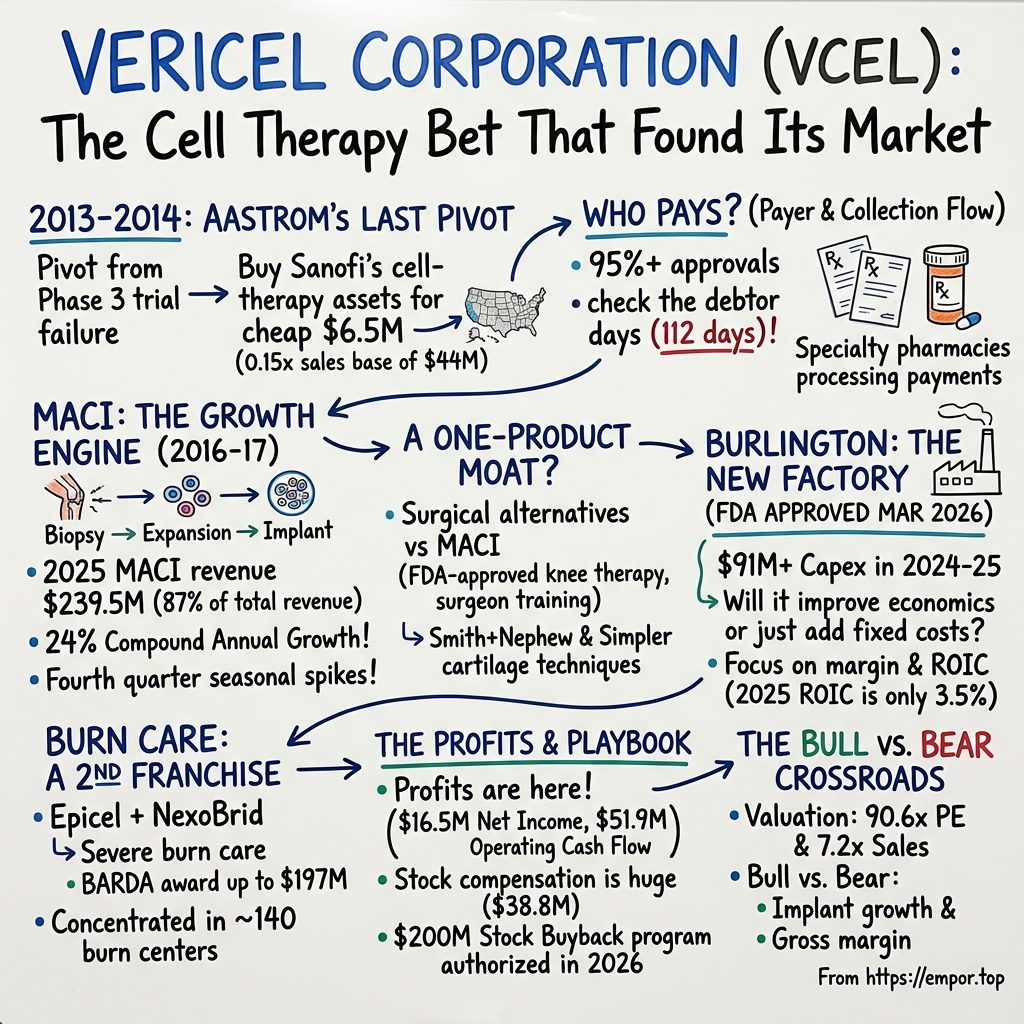
Vericel Corporation: The Cell Therapy Bet That Found Its Market
I. The Factory, the Knee and the $200 Million Question
On July 30, 2026, Vericel did two things that few young biotech companies ever get to do in the same afternoon. It raised its full-year revenue guidance to between $330 million and $340 million, and its board authorized the company to buy back up to $200 million of its own stock, which management called its first share repurchase program.1 The company sat on about $227 million of cash and investments and owed no bank debt.1 Four months earlier, the U.S. Food and Drug Administration had approved commercial manufacturing of MACI, Vericel's knee-cartilage cell therapy, at a new facility in Burlington, Massachusetts.2 For a company whose history ran through abandoned trials, restructurings and more than a decade of losses, it looked like the moment the story turned from survival to compounding.
The product behind that confidence is unusual. A surgeon takes a tiny piece of healthy cartilage from a patient's knee, sends it to Vericel, and some weeks later receives the patient's own cells grown onto a membrane, ready to be implanted into the damaged joint. In 2025 that product, MACI, brought in $239.5 million, about 87% of the company's $276.3 million of total revenue.3 The rest came from a burn-care business built around Epicel, a skin replacement grown from a patient's own cells, and NexoBrid, an enzyme treatment that clears dead tissue from severe burns.3 Three marketed products, then, but one of them carries almost the whole company.
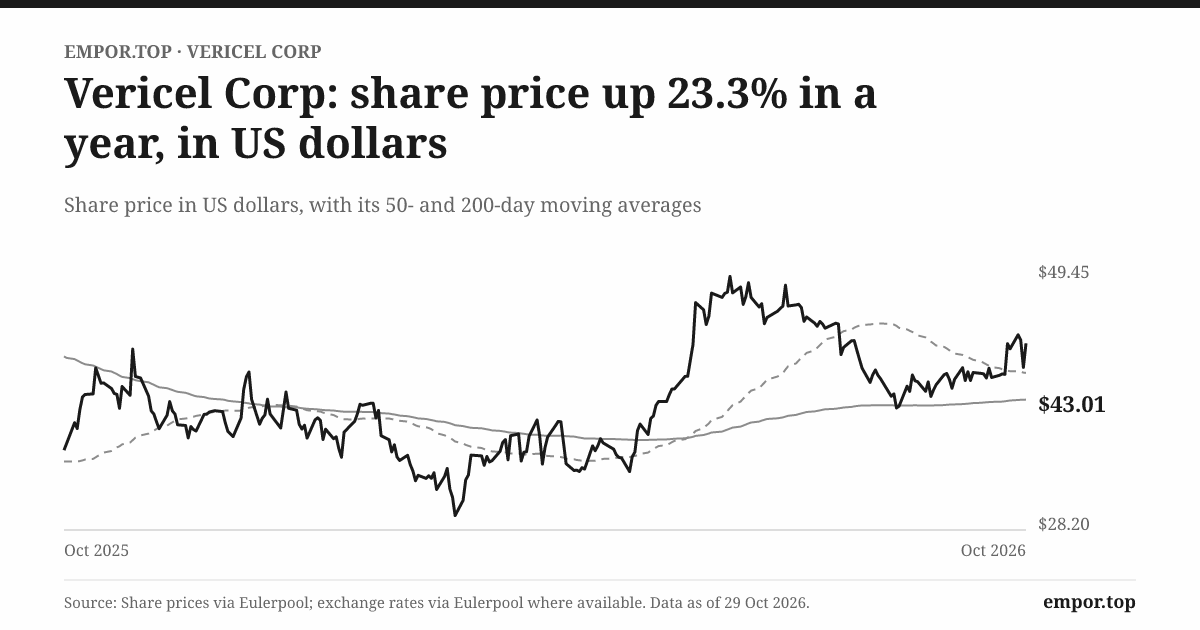
The stock market has noticed. On October 29, 2026, Vericel's shares traded at about $43, which valued the company at roughly $2.2 billion, or about 90 times its trailing earnings and a little over 7 times its sales. That is a price for a growth company with a long runway, not for a business that has only just learned to make money. And that is where the tension sits. In 2025 Vericel kept about four cents of operating profit from every dollar of sales, and its return on the capital invested in the business was in the low single digits.3 The new factory, which absorbed most of the heavy capital spending in 2024 and 2025, has only begun to run commercial batches. The buyback authorization arrived before that factory had shown what it could earn.
So the questions that frame this story are simple to state and hard to answer. Can MACI keep growing at something like 20% a year as it becomes almost the entire business? Can Burlington turn a fixed cost into a margin advantage rather than a burden? And can a management team that has spent thirteen years turning a struggling research company into a commercial one now turn optionality, such as an ankle indication, a British launch and a government stockpile contract, into actual sales?
Vericel is not a typical biotech, because it sells products today and does not depend on a single trial readout. Nor is it a typical medical-device company, because its product is alive, made one patient at a time, and paid for only after an insurer agrees. It has no controlling shareholder; its largest holders are index giants such as BlackRock, with about 15%, and Vanguard and State Street behind it.4 The best way to understand what that combination is worth is to go back to the moment when the company that became Vericel had almost nothing left to sell.
The verdict, before the evidence: MACI has made Vericel a genuinely growing commercial business. Two profitable years and a newly approved factory, however, are not yet proof of durable returns, and the rest of this story is about the gap between those two statements.
 Subscribe on LinkedIn
II. Aastrom's Last Pivot Became Vericel's First Asset
In March 2013, in Ann Arbor, Michigan, a company called Aastrom Biosciences announced that it would stop enrolling patients and end its Phase 3 trial in critical limb ischemia, a condition in which blocked arteries starve the legs of blood and often lead to amputation.5 The trial, called REVIVE, had been designed to enroll 594 patients at about 80 U.S. sites.6
Aastrom had built its identity around a cell therapy called ixmyelocel-T, made by expanding cells from a patient's own bone marrow, and REVIVE was meant to be the pivotal proof. Instead, the company said the program would not find a partner quickly enough to support the pace of enrollment, and it shifted its remaining hopes to a smaller Phase 2b study in dilated cardiomyopathy, a weakened-heart condition.5 It also announced a restructuring that would cut staff and operating expenses by about half.5 The stock fell 38% on the news.7
The man who signed that announcement was Dominick Colangelo, Aastrom's new president and chief executive.5 He was not a lab scientist turned founder. He had spent nearly a decade at Eli Lilly, including as director of strategy and business development for Lilly's diabetes products and as founding managing director of Lilly Ventures, the drugmaker's venture-capital arm.4 That background matters to everything that follows. A venture investor learns to ask which bets deserve more money and which should be cut, and a strategy executive learns that a scientific asset is worth only what a commercial organization can make of it. Colangelo's first big act was to cut, and his second would be to buy.
Aastrom at that point was a classic research-stage cell therapy company: plenty of science, a long list of trials, and no product revenue. Funding it meant selling more shares. In February 2014 it registered up to $15 million of stock for possible sale to a single investor, Lincoln Park Capital, under a purchase agreement, the kind of financing that small companies use when the conventional equity markets are hard to tap.8 Whatever Aastrom's science was worth, the company needed something that could pay its bills.
That something came from Sanofi. In April 2014, Aastrom agreed to buy Sanofi's cell therapy and regenerative medicine business for $6.5 million, with $4 million in cash at closing and $2.5 million as a promissory note.9 Sanofi had inherited the unit in 2011 when it bought Genzyme, and to a pharmaceutical giant it was a rounding error.10 To Aastrom it was transformative: worldwide rights to three marketed products, Carticel and MACI for knee cartilage and Epicel for burns, along with manufacturing and production centers in the United States and Denmark.10 The deal closed on May 30, 2014, and it also brought Aastrom more than 250 patents and patent applications.11 Those three products had generated $44 million of revenue in 2013.9
Put the price beside that revenue and the deal looks almost absurd: Aastrom paid about 0.15 times one year's sales for an operating business with an FDA-approved factory in Cambridge, Massachusetts. Markets rarely give away revenue that cheaply, and the reasons this one came cheap are part of the lesson. The products were not equal. Carticel, a first-generation cartilage therapy, generated most of the money but was ageing. MACI, the newer version that grew the patient's cells on a membrane rather than injecting them under a patch, had been approved in Europe in 2013 but not in the United States.12
Epicel was a niche burn product sold under a humanitarian device exemption, a special FDA pathway for treatments of very rare conditions.3 A $44 million sales base made up of a declining product, an unapproved one in the biggest market and a tiny specialty item is not the same as $44 million of healthy, growing revenue. So the low multiple is best read as the price a large company accepts for a business it no longer wants, not as a benchmark for what such assets are worth.
The portfolio also needed pruning immediately. Within weeks of closing, Aastrom decided to stop manufacturing MACI in Denmark and temporarily cease selling it in Europe, and it eliminated about 80 positions, roughly 30% of its workforce.11 In November 2014, European regulators suspended MACI's marketing authorization because there was no longer an authorized manufacturing site for it; the authorization lapsed for good in 2018 when Vericel's Danish subsidiary chose not to renew it.12 The European franchise that had come with the deal simply disappeared. That same November, Aastrom renamed itself Vericel Corporation, moved its headquarters to Cambridge, and began trading under the ticker VCEL.13
What, then, had $6.5 million really bought? Not a mature business, but a starting position: a working factory, a commercial team that knew orthopedic surgeons and burn centers, and a cartilage product that, if the FDA approved it, could replace the ageing one. Carticel did exactly what a cash bridge should do and then disappeared. Once MACI was approved in the United States, Vericel removed Carticel from the market at the end of the second quarter of 2017.14 The cheap acquisition did not create the value on its own. The value came from what management built on top of one of the three assets, while another was retired and the European half of the third was given up.
The first year's numbers show how lopsided the inheritance was. In 2014, Vericel reported about $28.8 million of revenue, covering only the seven months after the deal closed, and about $22.3 million of it came from Carticel, the product it would soon retire.15 Epicel contributed about $6 million. The company lost almost $20 million.15 More than three-quarters of the new commercial business, in other words, rested on a product whose own successor was waiting for approval.
Could this small, partly inherited base become a repeatable commercial business, or was it just another detour for a company that had already changed direction several times? The answer would depend almost entirely on one product.
III. MACI Replaced the Pipeline With a Product
On December 13, 2016, the FDA approved MACI in the United States, and on January 31, 2017, Vericel shipped and implanted the first one.14 For a company descended from a research shop that had spent years trying to prove that cells could fix legs and hearts, this was a different kind of milestone. It was not a trial result. It was a product with a price, a reimbursement path and a factory behind it, and it is the moment the company's story stopped being about its pipeline.
The best way to understand MACI is to follow a single knee. Picture a 30-year-old recreational athlete with a painful hole in the smooth cartilage that lines the end of the thigh bone or the back of the kneecap. Cartilage has almost no blood supply, so it barely heals on its own. The traditional fix, microfracture, involves poking small holes in the bone beneath the defect so that marrow seeps up and forms a scar-like fibrocartilage. That patch is cheap and quick, but it is not the same tissue. MACI tries to do better by replacing like with like.
During an initial arthroscopy, often one the surgeon is doing anyway to diagnose the injury, the surgeon snips a small biopsy of healthy cartilage from a part of the knee that does not bear weight and sends it to Vericel in a biopsy kit.3 In Vericel's cleanroom, technicians release the cartilage cells, called chondrocytes, multiply them by the millions, and seed them onto a resorbable collagen membrane made from pig tissue. The finished implant goes back to the hospital, where the surgeon trims it to the shape of the defect and fixes it in place. Over the following months, the cells are intended to fill the gap with tissue resembling the patient's own cartilage.3
That two-step journey defines the business. Between the biopsy and the implant sit manufacturing, scheduling and, crucially, an insurer's prior authorization. A biopsy is therefore a leading indicator, a promise of a possible future implant, and management watches how many biopsies turn into implants, a ratio it calls the conversion rate.16 It also means revenue is not recurring in the way software revenue is. A patient with one damaged knee will typically need one implant. Growth comes from more surgeons choosing MACI and from each surgeon using it for more of their patients. Repeat business, in other words, comes from the surgeon, not from the patient.
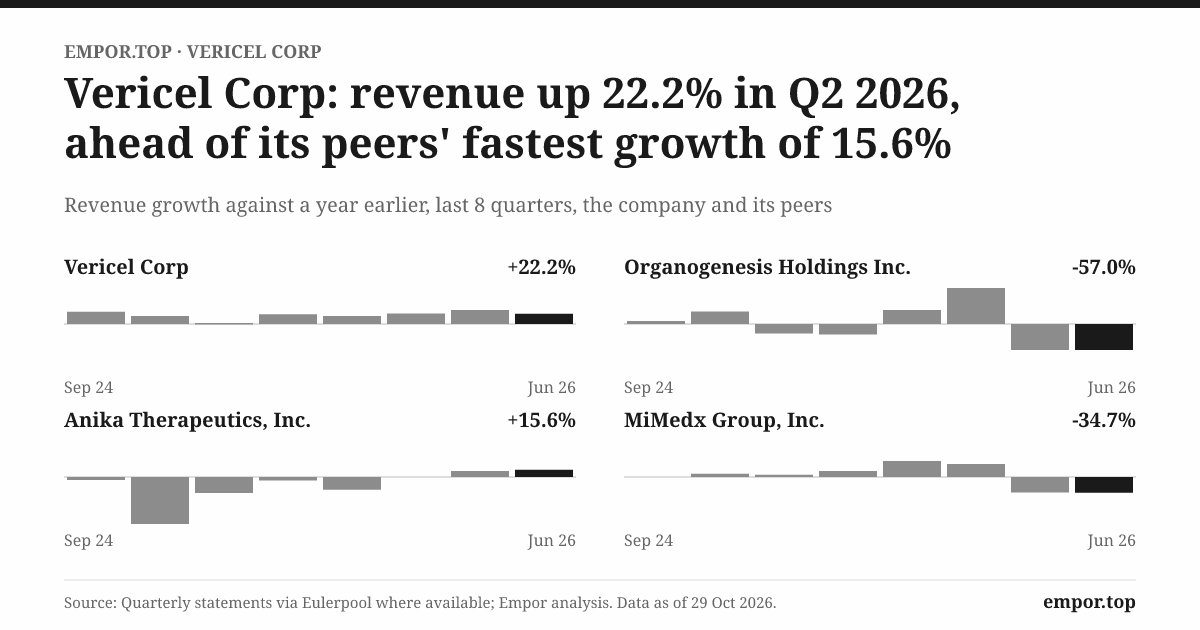
The numbers show how well that model has worked. Vericel says MACI's revenue has compounded at about 24% a year since the 2017 launch, and it grew by 20% or more in each of the last three years.16 By 2025, MACI revenue had reached $239.5 million, up 21%, and the company's total revenue had grown from about $28 million in 2014 to $276 million.153 Vericel said more than 20,000 American patients had been treated with MACI by the end of 2025.16 Over the decade from 2015 to 2025, total revenue compounded at a little over 18% a year.
The profits took much longer. Vericel lost money in every year from 2014 to 2023 except 2020, and it reported net income of $10.4 million in 2024 and $16.5 million in 2025.3 That is the first important caveat in the story: the revenue record is about a decade long, while the profit record is about two years long. Investors who look at the 24% compounding and assume the business has always been an earnings machine are reading a much longer history into a much shorter one.
MACI also follows the calendar of the American insurance system. Over the last five years, about a third of its annual volume has typically landed in the fourth quarter, while the first quarter has been the weakest, at about a fifth.3 The reason is deductibles. Patients who have already met their annual out-of-pocket maximum by autumn rush to schedule elective surgery before the counter resets in January.
So Vericel tends to report losses in the first half of the year and large profits in the fourth quarter. In the fourth quarter of 2025, for example, MACI brought in $84.1 million and gross margin reached 79%, the highest in the company's history.16 Yet in the first half of 2026, a period in which revenue grew 26%, the company still reported a small net loss of about $4 million.1 Neither period on its own describes the business. Only the full year does.
That seasonality also explains the moment that tested investors' faith in 2025. In May 2025, Vericel reported first-quarter MACI revenue of $46.3 million, up 15% from a year earlier, or about 17% after adjusting for one fewer selling day.17 That was slower than the 20% that investors had grown used to, and Epicel had a weak quarter as well.
Management's explanation on the call was specific rather than vague: MACI was in line with internal expectations; the new arthroscopic version, MACI Arthro, had just launched in earnest in the first quarter; and because biopsies typically take four to six months to convert into implants, the boost from newly trained surgeons would show up only in the second half.17 Colangelo pointed to the 2017 launch as precedent, when a surge in biopsies preceded implant growth of 54% the following year.17 The company reaffirmed revenue growth guidance of 20% to 23% for the year.18
The record since then is mixed, and it is worth being exact about it. MACI did accelerate. Second-quarter 2025 MACI revenue grew 21%, though it came in slightly below management's own quarterly guidance, a shortfall that an analyst called out directly on the call and that the chief financial officer, Joe Mara, attributed partly to implants slipping from June into July.19 By the fourth quarter, MACI was growing 23%, and in the first half of 2026 it grew 22%, including 23% in the second quarter, to $65.5 million.1
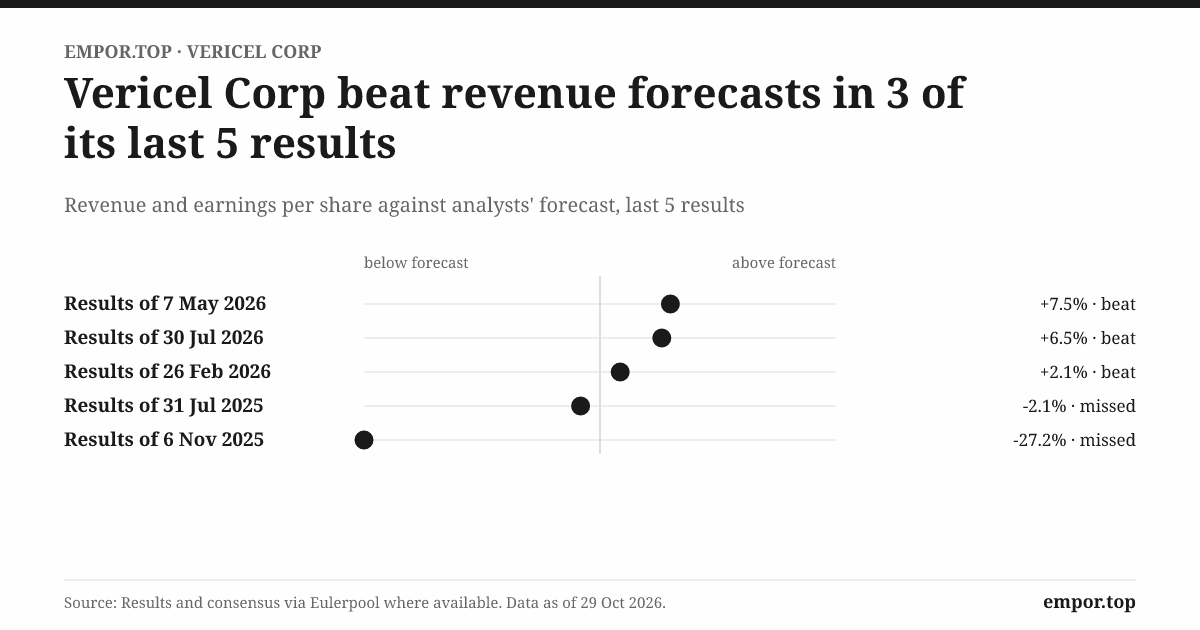
In other words, the biopsy-to-implant thesis management laid out in May 2025 broadly played out. But the company as a whole finished 2025 with revenue growth of 16.5%, well below the 20% to 23% it had reaffirmed in May, because burn care disappointed and guidance was reset along the way.318 The lesson for anyone weighing management's word is that the MACI-specific explanations have generally held up, while total-company guidance has been less reliable.
The newer delivery option deserves its proportion. MACI Arthro, approved by the FDA in August 2024, lets surgeons place the implant through small arthroscopic incisions rather than opening the knee.3 Vericel says it trained about 1,000 surgeons on the technique within roughly eighteen months, that those surgeons now account for more than half of implants, and that the small femoral-condyle defects the instruments were designed for became one of the fastest-growing segments.20 Those are management's metrics, and they are encouraging, but the company does not publish MACI implant volumes or Arthro's share of revenue. Early surgeon case series suggesting less pain and faster recovery were accepted for publication in 2026, but they are not randomized trial data.20 Arthro widens the pool of surgeons and patients. It has not yet proven that the underlying market is larger than Vericel already assumed.
The knee itself explains why the arthroscopic version matters. Vericel estimates its target population at about 60,000 patients a year and divides it by where the damage sits. Defects on the back of the kneecap, the patella, have been MACI's largest and fastest-growing segment, even though no patella patients were enrolled in the original approval trial.20 Smaller defects of two to four square centimeters on the femoral condyles, the rounded ends of the thigh bone, make up about 20,000 of the 60,000, and historically MACI reached only a small share of them, because opening the knee for a modest defect was a hard sell.17
In the second quarter of 2025, treatment of those small condyle defects grew 40% from a year earlier.19 Surgeons also began using Arthro in the trochlea, the groove behind the kneecap, a segment of about 10,000 patients a year that accounted for nearly a fifth of Arthro implants by mid-2025.19 The commercial logic is simple: a less invasive operation lowers the threshold at which a surgeon recommends MACI, and a lower threshold reaches patients who would otherwise have had microfracture.
Management has also leaned on a playbook it has used before. The company expanded its MACI sales force every year from 2017 through 2020 and, Colangelo said, grew rep productivity through each expansion.17 In the second half of 2025, it added roughly 25 sales territories, taking the MACI sales force from 76 territories to about 100, and had the new reps shadow existing ones through the fourth-quarter peak before moving into their own territories in January 2026.19 The early returns were good: Vericel reported record first-quarter biopsies and implants in 2026 and 22% MACI growth, well above the first-quarter growth rates of recent years.20 A larger sales force is a fixed cost, though, about $10 million a year on management's estimate, and it will pay off only if each rep's productivity recovers to its earlier level.16
There is one more ingredient in MACI's growth that the company is candid about but that rarely makes the headline: price. On the second-quarter 2025 call, Colangelo said payers and hospital administrators expect mid-to-high single-digit annual price increases for a biologic like MACI, and that Vericel has taken them.19 When an analyst asked in February 2026 whether price had driven too much of the growth, Mara said pricing "has been and will remain part of our growth algorithm," while describing the second-half 2025 step-up as volume-driven.16 Vericel does not split its growth between price and volume, but simple arithmetic is revealing: if price rises by mid-to-high single digits a year, then roughly a third of a 21% revenue increase comes from price, and volume growth is closer to the low-to-mid teens than to the headline figure. That is still healthy, but it means the long-run growth rate depends on insurers continuing to accept those increases. Which raises the question that sits underneath every MACI sale: who actually pays?
IV. Who Actually Pays for a Cartilage Repair?
Imagine the implant is ready. The patient's cells have grown on schedule, the surgeon has booked the operating room, and the box is on its way. But the hospital does not simply send Vericel a check. Most MACI implants are sold through two specialty pharmacies, Orsini and AllCare, which handle distribution and billing, or directly to hospitals.321 The pharmacies collect from the patient's insurer, yet under its distribution agreements Vericel itself assumes the credit and collection risk of those third-party payers.3 In plain terms, the middleman does the paperwork, but if an insurer pays less than expected or a patient cannot cover their share, the loss is Vericel's.
That structure makes the payer relationship the real gatekeeper of the business. Here, the evidence is strong. Vericel says a large majority of the biggest U.S. commercial insurers have formal medical policies covering MACI, and that prior-authorization approval rates for commercial patients stayed above 95% in 2025.316 Colangelo described that combination of approval rates and annual price increases as "a pretty unique position to be in, in the med tech space."19 He is probably right about the rarity. Many medical-device companies spend years fighting for coverage. MACI got its coverage over a long period, helped by published evidence, including studies showing it worked for kneecap defects that were not part of its original trial, which led insurers such as UnitedHealthcare to add those cases to their policies.20
Approval, however, is not the same as cash. Most MACI orders are due within 30 to 90 days.3 At the end of 2025, Vericel carried $84.6 million of net receivables, about 112 days of revenue, compared with 107 days back in 2014.3 That looks high for a company whose customers should pay within three months, but year-end distorts it, because the receivables balance is measured right after the huge fourth quarter. By June 2026, receivables had fallen to $75.7 million as those December implants were collected.21 The direction of collections, in other words, is normal for a seasonal business.
The more interesting number is buried in the revenue recognition note. Vericel's allowance for doubtful accounts, the classic bad-debt reserve, is trivial: $13,000 at the end of 2025 and $23,000 at mid-2026.321 But that is not where the real uncertainty sits. When Vericel books a MACI sale, it estimates up front how much of the billed amount will never be collected because of payer denials, partial payments or patient balances, and it reduces revenue by that amount.
That reserve for uncollectible consideration stood at $8.4 million at the end of 2025 and $9.8 million in June 2026.321 The company's auditor singled the estimate out as a critical audit matter, and Vericel says that a half-point change in the estimated collection rate would have moved 2025 revenue by about $0.7 million.3 That is small relative to $276 million in sales, but it is a judgment, made with historical collection data, and it is the place where reported revenue and eventual cash could drift apart if payer behavior changed.
What Vericel does not publish is just as telling. It gives no aging schedule showing how long receivables have been outstanding and no breakdown of collections by payer. It also does not name its largest customer. One unnamed customer accounted for 13% of 2025 revenue and 11% of receivables, up from 11% and 10% a year earlier.3 Given the distribution model, that customer is very likely one of the specialty pharmacies, which means the concentration is about a billing channel rather than a single hospital. But the company does not say so, and an investor can only infer it.
Here is the mechanism worth remembering. Fast growth in a product that is billed after surgery and collected weeks or months later consumes cash. In 2025, Vericel's working capital absorbed about $22 million, mostly because receivables grew with sales.3 That is not a red flag in itself; it is what growth looks like in a reimbursement business. It does mean that each extra dollar of MACI revenue arrives as cash only after a lag, and that the company's reported profits will run ahead of its cash in years when growth accelerates.
One more pressure point sits outside the company's control: the health of the insured patient population and the elective-surgery market. In May 2026, an analyst asked whether softer orthopedic procedure volumes and the expiration of enhanced Affordable Care Act subsidies, which could leave some patients uninsured or underinsured, were showing up in MACI demand.20 Colangelo said the company had seen no slowdown, pointing to a strong December and double-digit biopsy and implant growth in the first quarter, and Mara said the guidance assumed none.20 That is a fair answer for now. But because MACI is elective surgery for younger, commercially insured patients, any tightening of coverage or rise in out-of-pocket costs would show up first in the number of patients willing to go ahead with a second operation.
The verdict on the payment chain is reassuring but conditional. Coverage is broad, approval rates are high and collections have behaved normally through the seasonal cycle. The risk is not today's collections. It is that the whole model depends on insurers continuing to accept a high-priced, annually repriced therapy for a condition that has cheaper alternatives. That brings us to the operating room, where the alternatives are chosen.
V. A One-Product Lead Is Not the Same as a Locked Market
Step inside the operating room. An orthopedic surgeon looks through an arthroscope at a cartilage defect on the end of a young patient's thigh bone, about the size of a postage stamp. The surgeon has options. Microfracture can be done in the same procedure, today, at modest cost. An osteochondral graft, a plug of bone and cartilage taken from elsewhere in the patient's knee or from a donor, can fill the hole in one surgery. Minced-cartilage and scaffold products, such as Arthrex's BioCartilage, can augment microfracture. For older patients with early arthritis, Smith+Nephew sells Agili-C, a coral-based implant it acquired with CartiHeal.320 Or the surgeon can take a biopsy, wait several weeks for Vericel to grow the cells, secure insurance approval, and bring the patient back for a second operation. MACI is only one choice among several, and it is the most complex of them.
That framing corrects a common shortcut. Vericel likes to describe MACI as the clear market leader in cartilage repair, and in its own class it stands alone: it is the only FDA-approved product in the United States that grows a patient's own cartilage cells on a scaffold for knee repair.20 But being the only product of its kind is not the same as being the only treatment for the condition. The company's own estimate of its market makes the point.
Of roughly 750,000 knee cartilage procedures in the United States each year, Vericel estimates about 315,000 fit MACI's label, about 125,000 are clinically appropriate, and about 60,000 are likely to secure insurance authorization.3 More than 20,000 patients have been treated with MACI since 2017 in total, so at today's volume the product is still reaching only a fraction of even its narrowest addressable group in a given year. That is the bullish reading. The bearish reading is that most knee cartilage defects are still treated with something else, and the funnel narrows at every step because of clinical judgment and cost.
How big is MACI against its competitors? Here, the comparisons need care. Smith+Nephew is a global medical-technology company with billions of dollars of sales; Arthrex is a large private company. Their corporate revenue says nothing about their share of this narrow market, and Vericel does not publish a market-share series, retention data or a price comparison against alternatives. What can be said is that the competitive landscape has been stable for years.
When an analyst asked in May 2026 how Vericel was preparing for Agili-C's expected improvement in reimbursement, Colangelo argued that the two products serve different patients: Agili-C mainly for older arthritic knees, as a bridge to replacement, and MACI for young, active patients with clean cartilage injuries.20 He noted that Agili-C is contraindicated for kneecap defects, MACI's largest and fastest-growing segment, and that a surgeon would not core out more than a centimeter of healthy bone to treat a clean cartilage injury.20 That argument is plausible and backed by the label, but it comes from the company with the most to lose, and the reimbursement change for Agili-C has not yet taken effect. It is a claim to test in 2027, not a settled fact.
So what kind of advantage does MACI actually have? Three things support it. The first is the regulatory barrier. Any rival living-cell cartilage product would need its own biologics license, years of randomized trials and a validated cell factory. The second is manufacturing know-how. Growing a patient's cells reliably, at scale, under FDA rules, with a chain of custody that never mixes up two patients, is a hard operational skill that took decades to build and that Vericel inherited from Genzyme and has refined since. The third is surgeon learning. Thousands of surgeons know how to take a biopsy, how to handle the membrane and how to get approval for the procedure, and each of them is a channel that a newcomer would have to build from scratch.
Against those advantages stand real limits. Payers, not surgeons, hold the purse, and they decide whether a patient qualifies. Surgeons can always choose a simpler procedure. The intellectual property is not permanent either: Vericel says its MACI-related patents have expired or will expire between late 2027 and early 2043, and Epicel has no issued patents at all.3 The strongest protection is the combination of regulatory approval and manufacturing difficulty, not a patent wall.
The company's own history offers the sharpest test of any moat claim. Carticel, too, was once the only FDA-approved cell-based cartilage product in America. It did not become a durable growth engine; it was the declining product that made the Sanofi business cheap, and it was taken off the market within months of its successor's approval.14 A skeptic could fairly say that first-generation dominance in cell therapy is temporary, and that MACI's lead depends on nobody building a simpler product.
Vericel itself is a reminder that the threat may come from the incumbent's own successor rather than from a rival: if a one-step, off-the-shelf product ever matched MACI's results, the two-step model would be exposed. When asked about that possibility, Colangelo said Vericel has developed a donor-derived cell line of its own but that no one is anywhere near clinical development of such a product, and that even "one-step" cartilage repair usually involves a diagnostic arthroscopy and an insurance approval first.20
Weighed together, the evidence narrows the moat claim rather than rejecting it. MACI has a real, bounded advantage: it is the only product of its kind, protected by regulation, manufacturing skill and surgeon habit, with an unusually strong payer position. It does not have a locked market, because it competes for patients against cheaper techniques and depends on payers continuing to approve it. The claim would weaken visibly if any of four things appeared: slowing price realization, rising payer restrictions or denials, a slowdown in surgeon adoption, or a competitor such as Agili-C taking meaningful share of young patients. None has appeared yet. But all of MACI's advantages assume something else that is easy to overlook: that Vericel can keep making the product, in volume, without interruption. That is where the new factory comes in.
VI. Burlington: Can the New Factory Earn Its Keep?
On March 4, 2026, Vericel announced that the FDA had approved commercial manufacturing of MACI there, clearing the company to begin production in the second quarter.2 It was the end of a long build. Vericel had signed the lease for the roughly 126,000-square-foot building in January 2022, and for most of the time since, it had been paying for a factory it could not yet use for commercial products.3 Until approval, MACI and Epicel were still made in the older Cambridge plant that came with the Sanofi deal.3
To see why the facility matters, look at the cash. Vericel spent about $20 million on property and equipment in 2023, then $64 million in 2024 and $27 million in 2025, most of it on the Burlington build-out.3 That 2024 spending equalled more than a quarter of the year's revenue, an extraordinary level for a company of this size. Over the full period from 2014 to 2025, Vericel's free cash flow, after subtracting capital spending from operating cash flow, came to a cumulative negative $18 million. The company that looks like a cash generator today spent a decade consuming cash, and the factory was the last and largest bill.
The strategic case for Burlington is straightforward. MACI demand has been growing about 20% a year, and a cell factory cannot be expanded overnight. Without new capacity, growth would eventually collide with the limits of the Cambridge cleanrooms. Burlington also allows the company to produce MACI for markets outside the United States, which management says it could not do from the existing site.20 And it is where Vericel's headquarters now sits, consolidating operations in one modern building.
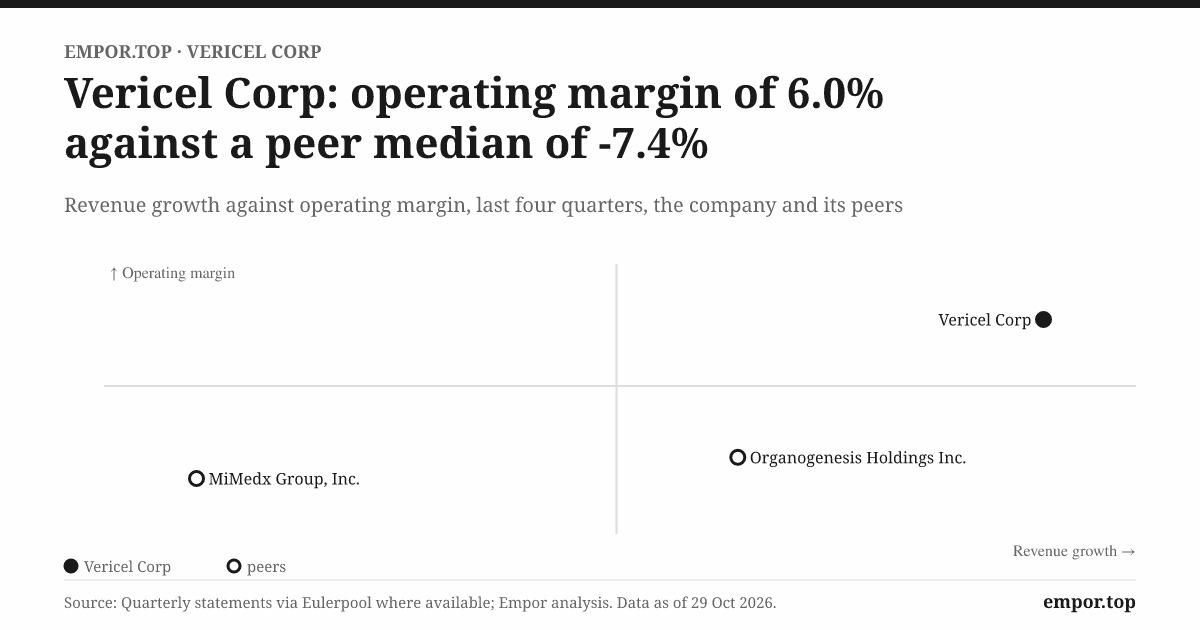
The financial case is less settled, and here the numbers deserve attention. Vericel's gross margin, what remains after the direct cost of making the products, was about 74% in 2025.3 That is a healthy figure, and it improved by about two points from 2024. But gross margin is measured before the cost of selling, research and administration, and in 2025 those costs ate up almost all of it. Operating margin was about 4%, and the return on invested capital was about 3.5%.3 A business can have a 74% gross margin and still earn a meager return on the money tied up in it if it spends heavily on sales forces, trials and factories. That is Vericel today.
Management's argument is that fixed-cost leverage will change the picture. A cell factory carries large fixed costs, including the building, the cleanrooms, quality control and skilled staff, and those costs do not rise one-for-one with volume. As more implants run through the same facility, each one should carry a smaller share of the overhead. Mara said the company expected gross margin to reach the high 70s by the end of the decade, and adjusted EBITDA margin, a measure that excludes stock compensation, depreciation and interest, to reach the high 30s by 2029.1719 Management points to the peak-volume fourth quarter of 2025 as an illustration of what scale can do.16
The structure of Vericel's costs explains why management is so confident about that leverage. Because its factories are in the United States and most of its manufacturing cost is labor and overhead rather than imported materials, Mara said in May 2025 that tariffs would have very little effect on the business.17 The same feature, though, means costs are sticky. Operating expenses rose through 2025 mainly because of more employees and the costs of the new facility, including depreciation and the work of transferring MACI's manufacturing process to it.17
Headcount grew from about 314 at the end of 2023 to 398 at the end of 2025, while revenue grew about 40% over the same two years.223 For 2026, management guided to about $220 million of operating expenses, spread evenly through the year, with the bigger sales force and the ankle trial as the main additions.16 In a business with a seasonal revenue pattern and flat quarterly costs, that is why the first half of the year looks thin and the fourth quarter looks spectacular.
The same logic runs in reverse, and that is the risk. In 2026, Vericel is operating two facilities at once while it shifts production, and it guided to a full-year gross margin of about 75%, only modestly above 2025, explicitly citing the added costs of the Burlington facility.16 In the first quarter of 2026, gross margin was 72%; in the second quarter it was 73%, slightly below the 74% of a year earlier.201 The full-year guidance was reaffirmed in July, not raised.1 So far, the new capacity has added cost without yet adding visible margin, which is exactly what a skeptic would expect during a transition. The company does not disclose the factory's utilization rate, the timetable for moving all MACI production out of Cambridge, or when the older lease might be released. Those are the three facts that would show whether Burlington is a lever or a weight.
International expansion is the other promise attached to the factory, and it should be held at arm's length. Vericel said in February 2026 that it planned a staged approach, starting with the United Kingdom, where MACI had once been sold, where about a dozen centers of excellence treat cartilage injuries, and where an expedited approval route exists.16 In July 2026, the company said it had submitted a marketing authorization application to the U.K. regulator, the MHRA.1 If approved, a launch could come in 2027.20 The United Kingdom is a small market and Vericel has no revenue outside the United States today.3 The European history from 2014 is a reminder that overseas cell-therapy businesses depend on manufacturing authorization as much as on demand. A British launch would be a useful proof point, not a material revenue line, for some time.
The verdict on Burlington is that it was strategically necessary and financially unproven. It removes a future capacity ceiling and opens a door abroad. Until it runs at meaningful utilization, and the older plant's costs fall away, it is a fixed cost waiting for volume. The factory makes knees. The other half of Vericel makes skin, and that business has a very different rhythm.
VII. Burn Care Is a Second Franchise in the Making
A patient arrives at a burn center with burns over half of their body. In the first days, surgeons must remove the dead, charred tissue, called eschar, before anything can heal, and they must find a way to cover enormous wounds when the patient has little healthy skin left to graft. Vericel sells products for both moments. NexoBrid is a gel made from pineapple-derived enzymes that dissolves eschar in hours, sparing healthy tissue that a surgical knife might remove.3 Epicel is grown from a postage-stamp-sized biopsy of the patient's own skin, multiplied in the lab into sheets of new skin that can cover large areas.3 It is approved for patients with deep burns over at least 30% of their body.3
The market for those products is small and concentrated. There are only about 140 burn centers in the United States, and only a fraction of them regularly treat the most severe, large-surface-area burns that Epicel addresses.3 Demand also depends on tragedy, and on whether a gravely injured patient survives long enough to be treated. Epicel is sold directly to hospitals and burn centers under contracted rates, while NexoBrid is sold through specialty distributors.3 Vericel does not own NexoBrid; it licenses the North American rights from the Israeli company MediWound, which is the product's exclusive supplier.3 The FDA approved NexoBrid for adults in December 2022, and Vericel added a pediatric indication in 2024.3
For several years, burn care was the part of Vericel that rarely made the headlines, and in 2025 it went backwards. Epicel revenue fell from $36.6 million in 2024 to $32.1 million, while NexoBrid grew to $4.7 million, leaving total burn-care revenue at about $37 million, down from about $40 million.3 Management attributed much of the weakness to cancelled cases: patients whose biopsies arrived at Vericel but who were too sick, or died, before their grafts could be used.17 Faced with repeated misses, management changed how it guided. In July 2025, Mara told analysts the company would switch to a run-rate guide of about $10 million per quarter instead of forecasting from the biopsies in hand, adding: "this is not where we want our guidance to be."19 It was an honest admission that the business could not be predicted quarter to quarter.
The rebound in 2026 has been striking, though the starting point flatters it. First-quarter burn-care revenue rose more than 90% to $12 million, against a weak quarter a year earlier, and second-quarter revenue rose 22% to $12 million, including record NexoBrid sales of $1.5 million.201 Colangelo credited better commercial execution in converting biopsies into grafts.20 The sales team of 17 territories now promotes both products, and NexoBrid has helped reopen burn centers that had stopped using Epicel.16 Of roughly 90 target accounts, more than 70 had ordered NexoBrid by early 2026.16 These are real improvements. But NexoBrid's revenue is still only a few million dollars a year, three years after its launch, and the shift from surgical to enzymatic debridement is a slow change in medical practice.
Then came the government. On April 2, 2026, Vericel announced that the Biomedical Advanced Research and Development Authority, or BARDA, the federal agency that buys medical countermeasures for emergencies, had awarded it a ten-year contract valued at up to $197 million for NexoBrid.23 The headline number needs translating. Only the base period, $35 million, is committed. About $10 million of that covers the first twelve months, including an initial purchase of NexoBrid for the Strategic National Stockpile, a vendor-managed inventory system and early development work on a potential indication for blast injuries.23 The rest of the $197 million consists of options BARDA may or may not exercise: more stockpile purchases, further blast-trauma trials, a potential U.S. manufacturing facility and a room-temperature version of the product.23
Colangelo said about two-thirds of the contract's value would flow to Vericel in some form, as revenue or as offsets to costs it would otherwise bear.20 Management expected $5 million to $6 million of procurement revenue in the second half of 2026, beginning in the third quarter, with the remainder of the initial purchase early in 2027.20 For scale, Colangelo noted that when BARDA previously stockpiled NexoBrid through MediWound, the order was about 16,500 units, while Vericel's initial procurement is roughly 3,000 units, with a possible ramp-up of another 5,000.20 The upside depends on whether the government wants to rebuild a stockpile closer to its earlier size. The award was also delayed by the federal government shutdown before it was signed, a reminder that procurement revenue follows Washington's budget calendar, not a burn center's.20
The BARDA contract is therefore best understood as a pathway, not a windfall. It validates NexoBrid's clinical value, adds a few million dollars of revenue a year in its early stages, and funds development work Vericel might not otherwise afford. It also deepens the company's dependence on MediWound, which makes the product and is developing the room-temperature formulation.
A similar dependency sits under MACI: a company called Matricel exclusively supplies the collagen membrane on which every MACI implant is grown, under an agreement that runs through 2030 with an option to extend, and Vericel has committed to minimum purchases of roughly €12.5 million over its eight-year term.3 Vericel keeps substantial safety stock of both the membrane and NexoBrid, and it said in 2025 that tariffs would have negligible effect.17 But a quality problem at either supplier would hit products that together account for nearly all of the company's revenue, and Vericel does not disclose a qualified second source for either.
Burn care, then, is material but secondary. Management's raised 2026 guidance of $46 million to $50 million for the franchise, including the BARDA revenue, would make it roughly one-seventh of the company.1 It now has momentum after a difficult year, but its economics will remain dominated by MACI. The question that follows is whether the profits generated by that combined business are as solid as they look.
VIII. The Profits Arrived; So Did the Stock Awards
Open Vericel's 2025 cash-flow statement and you find something that looks like a magic trick. The company reported net income of $16.5 million, yet it generated $51.9 million of cash from operations.3 The difference came mostly from one line: $38.8 million of stock-based compensation, a non-cash expense added back to profit, along with about $11.5 million of depreciation and amortization and about $5 million of lease amortization, partly offset by the $22 million that growing receivables absorbed.3 The same pattern runs across the company's whole public history. From 2014 through 2025, Vericel reported cumulative net losses of about $86 million and cumulative operating cash flow of about $131 million.
The paradox has a simple explanation. When a company pays its employees partly in shares and options, the accounting rules record an expense, but no cash leaves the building. The cost is real, but it is paid by shareholders rather than by the company's bank account, because each new share issued to an employee dilutes everyone else's claim on future earnings. Vericel's share count tells that story in miniature: it had about 50.8 million shares outstanding in February 2026 and about 51.2 million by late July, an increase of almost 1% in five months.321 At $38.8 million, stock compensation in 2025 was more than twice the company's net income and roughly 14% of revenue.3
This matters most when reading the profit measure management prefers. Vericel guides to adjusted EBITDA, which excludes stock compensation, depreciation, interest and tax. On that basis, the company earned a 26% margin in 2025 and expects about 27% in 2026.161 On a GAAP basis, operating margin was about 4%.3 Almost all of the gap between the two is stock compensation and depreciation of the facilities, both of which are real economic costs: one paid by shareholders, the other by past capital spending. An investor who values the company on adjusted EBITDA is effectively treating employee pay and the new factory as free.
There is a second prop under reported earnings. Vericel earned $7.0 million of interest income in 2025 on its cash and investment portfolio, about 40% of its $17.4 million pretax profit.3 The portfolio, about $227 million at June 2026, is mostly corporate notes, with smaller holdings of commercial paper and U.S. government agency bonds.21 That income is genuine, but it is a return on cash raised and accumulated over years, not a return on making cartilage implants. Strip it out, and 2025 operating profit was about $11 million on $276 million of sales.3 The underlying business made a profit; it just made a small one.
Now put the free-cash picture together. In 2025, operating cash flow of about $52 million, minus stock compensation of about $39 million, minus capital spending of about $27 million, leaves a negative number. That year was distorted by the tail end of the factory build, and the first half of 2026 looked much better: $32.6 million of operating cash flow and only $3.2 million of capital spending.1 The question for 2026 and beyond is whether operating cash flow, after an honest charge for stock compensation and the capital spending needed to sustain the business, settles at a level that justifies the company's valuation. It has not yet had a full year to show it.
That is the backdrop for the $200 million buyback. The authorization has no expiration date, and the company reported no purchases under it through the end of the second quarter.21 At roughly 9% of Vericel's market value and close to its entire cash pile, it is large. A buyback can make sense for a company that generates more cash than it can reinvest at high returns, and it can partly offset the dilution from stock awards. But Vericel is still investing in a new factory ramp, a Phase 3 ankle trial, a larger sales force and a possible British launch. An authorization is permission, not a commitment, and the useful test will be how much stock management actually buys, at what prices, and whether it does so while also funding those projects. Until then, the buyback signals confidence more than it changes the economics.
The people running the program deserve a closer look. Colangelo has led the company since 2013, through the restructuring, the Sanofi deal, the MACI launch and the factory build.4 Joe Mara, a former finance and investor-relations executive at Biogen, became chief financial officer in January 2021.4 There has been no recent turnover at the top, and six of the seven directors are independent.4 In 2025, Colangelo's reported compensation was about $11.2 million, of which about $9.4 million came as stock and option awards, plus an $860,000 cash bonus paid at 100% of target.4
That total equals roughly two-thirds of the company's net income for the year, and it has risen quickly, from about $7.1 million in 2023 and $10.2 million in 2024.4 The 2025 bonus plan's revenue goal was at least $288.2 million; the company delivered $276.3 million, yet the compensation committee scored the plan's goals at 100% overall, and the chief executive's bonus paid out at target.4 The equity awards are mostly stock options and time-vesting restricted shares, with no performance-share program tied to returns on capital.4 Executive officers and directors together held about 7.6% of the company on the proxy's beneficial-ownership basis, which includes options and shares vesting soon.4 The company prohibits insiders from pledging or hedging their stock.4
Shareholders have started to push back, modestly. At the April 2026 annual meeting, the advisory vote on executive pay passed with about 36.4 million votes for and 9.7 million against, roughly 79% support, down from more than 90% the year before.244 Director Heidi Hagen received about 7.8 million withheld votes, the most of any nominee.24 Neither result threatens anyone's position. But a drop of more than ten points in pay support is a signal that some institutional holders are looking at the same mismatch described here: generous equity awards and a target-level bonus against a missed revenue goal, in a company whose GAAP profits are small.
The balance sheet, at least, is clean. Vericel had no bank borrowings at the end of 2025 or in June 2026, and it has an undrawn $150 million secured revolving credit facility.321 The roughly $98 million that some data services label "borrowings" is mostly lease obligations, chiefly for the Burlington and Cambridge facilities.321 Those leases are real long-term commitments, but they are not drawn bank debt, and there is no refinancing pressure. The company faced no material litigation, and its auditor, PwC, issued an unqualified opinion on the 2025 statements and internal controls.321 Financing risk is low. The open question is not whether Vericel can survive. It is whether its returns can justify what the market is paying.
IX. Analysis & Bear vs. Bull Case
At $43 a share, Vericel trades about 11% below its 52-week high of roughly $48, and well above its 52-week low of about $29. Its price-to-earnings ratio of about 90 looks much lower than its five-year median of about 270, but that comparison is almost meaningless: the median spans years of losses and tiny profits, when any positive earnings produced an enormous multiple. The more useful frame is what the price implies. At about 7 times sales and an earnings yield of about 1%, the market is assuming that Vericel's revenue keeps compounding near the high teens and that margins expand dramatically from today's 4% operating level. The decade-long revenue record supports the first half of that assumption. The past two years of profit are all the evidence there is for the second half.
The case for compounding
The bull case starts with MACI's record. It has grown at 20% or more for three straight years, and at about 23% in the most recent quarter.161 Unusually for a medical product, it combines growing volume with annual price increases and payer approval rates above 95%.1619 MACI Arthro broadens the pool of surgeons and the types of defects treated. The enlarged sales force is in its territories, and management says it expects rep productivity to return to 2025 levels as early as 2027.16
Burlington removes a capacity ceiling. The ankle indication, now in a Phase 3 trial called MASCOT that randomizes about 300 patients against bone-marrow stimulation over two years, could open a market management sizes at more than $1 billion.1916 And operating leverage is real: in the fourth quarter of 2025, when volume peaked, gross margin reached 79% and adjusted EBITDA margin 40%.16 If the whole year eventually looks more like that quarter, today's earnings multiple would compress quickly.
What could break it
The bear case begins with concentration. MACI's growth depends on a funnel with several gates: surgeon choice, patient eligibility, payer authorization and collection estimates. A change at any gate, such as a large insurer tightening its policy or a cheaper alternative gaining clinical evidence, would hit nearly the whole company. Price is part of the growth, and price is the lever most exposed to payer resistance.
The second mechanism is cost. A cell factory is a fixed-cost machine, and Vericel has just built a large one while still running the old one. Supplier concentration adds fragility, with sole sources for both MACI and NexoBrid. And the company's history shows a long gap between product milestones and revenue. MACI was approved in Europe in 2013 and has earned nothing there since 2014.12 NexoBrid was approved in late 2022 and still sells only a few million dollars a year.3 The BARDA contract's full $197 million is mostly options.23 A skeptical investor would apply that conversion record to the ankle, the United Kingdom and the stockpile.
Peers offer only descriptive comparisons. MiMedx, a wound-care and placental-tissue company, trades at about 1.9 times sales with no meaningful trailing P/E, and Organogenesis, which sells regenerative wound and surgical products, has trailing losses.2526 Both have different products and payer exposure, so they do not set a fair value for Vericel. They do show that the market pays Vericel a large premium for its growth and its payer position in a sector that rarely earns such multiples.
A structured look at the industry sharpens the picture. Among Michael Porter's five forces, the threat of direct new entrants is low, because a rival cell-based cartilage product would need a biologics license, randomized trials and a validated factory. The threat of substitutes is high, because microfracture, grafts and scaffolds are always available to the surgeon. Buyer power is substantial, held mainly by insurers, who authorize every case, and by surgeons, who choose the procedure; the specialty-pharmacy channel adds some concentration, with one customer at 13% of revenue. Supplier power is meaningful, because Matricel and MediWound are each sole sources. Rivalry within MACI's exact class is minimal, but rivalry for the patient is real.
Hamilton Helmer's seven powers framework points to the same conclusion. Vericel has something close to a cornered resource in its FDA approval and manufacturing know-how, though Carticel's eclipse shows that such a position can fade when a better product appears. It has modest switching costs, in that surgeons trained on MACI and comfortable with its reimbursement are reluctant to change, but nothing prevents a surgeon from choosing a different procedure for the next patient. Scale economies are emerging in manufacturing, but they remain a prospect rather than a demonstrated fact. There are no network effects, no brand power in the consumer sense and no counter-positioning that incumbents cannot copy. The moat is real but narrow: a regulatory and process advantage in a specific niche, defended by habit and payer relationships.
Three indicators matter more than all the others. The first is MACI revenue growth, the best public proxy for implant growth, which the company does not disclose numerically; it stood at 23% in the second quarter of 2026, up from 15% in the first quarter of 2025.117 The second is gross margin as Burlington ramps, which was 73% in the second quarter of 2026, slightly lower than a year earlier, against a full-year 2025 level of about 74%.13 The third is operating cash flow after stock compensation and capital spending, which was negative in 2025 because of the factory build and has improved in 2026 as capital spending fell sharply.31
Management's credibility, tested over time, is mixed but improving. It explained the soft start to 2025 in specific terms and the MACI acceleration it predicted did arrive. But it reaffirmed 20% to 23% total revenue growth in May 2025 and delivered 16.5%.183 It missed its own MACI guidance in the second quarter of 2025. It switched burn care to a run-rate guide after repeated misses. Since then, it has guided more conservatively and beaten its numbers in early 2026, raising revenue guidance twice.201 The ankle trial and the factory have so far run on the timetables management set: the trial started in the fourth quarter of 2025, as promised, and the factory was approved in time for second-quarter production.162
The balance sheet adds resilience but not cheapness. With no bank debt and more than $200 million of cash and investments, Vericel faces little financing risk. That reduces the chance of a dilutive equity raise, which was the company's lifeline in its Aastrom years. It does not make the stock inexpensive. The investment case rests on a credible growth mechanism in MACI, but the valuation assumes growth and margin progress that the company has shown for only a couple of years, and its returns on capital remain low.
X. Playbook: Business & Investing Lessons
Every company has moments that compress its whole philosophy into one decision. For Vericel, it was the spring of 2013 into the spring of 2014: a research company stopped a Phase 3 trial, halved its costs, and then used a few million dollars to buy products that patients and hospitals were already paying for. The lessons that follow come from that pivot and from what was built on it.
The first lesson is that a therapy is not a business until the patient, the payer, the surgeon and the factory all say yes. Vericel's commercial success depended on the whole biopsy-to-implant chain, including insurer approval rates that the company says exceeded 95% of cases.16 Remove any one of those links and the science is worth little. For founders in cell and gene therapy, the implication is uncomfortable: the hardest problems after approval are often logistics, reimbursement and training rather than biology.
The second lesson is that the cheap deal was the beginning, not the moat. Paying about 0.15 times sales for Sanofi's unit looks like genius in hindsight, but Sanofi was not foolish. The business it sold was mostly a declining first-generation product and a European franchise that was soon shut down.1112 The value came from the decision to bet the company on MACI's U.S. approval and to retire Carticel as soon as the replacement was ready.14 Investors who admire a bargain acquisition should ask what had to be built afterwards, because that is where the returns came from.
The third lesson is that cash flow can flatter a young profit story. Vericel's cash-flow history shows why stock awards and factory spending must be counted as costs. The shareholders paid the difference in dilution, and the factory then took what was left. The founder's version of the lesson is that equity is the most expensive currency a growing company can spend. The investor's version is shorter: count the stock awards as wages, count the factory as a cost, and only then decide whether the business generates cash.
The fourth lesson is that capacity earns its keep only when the line is running. Burlington cost about $90 million over two years.3 It gives Vericel room to grow and a route to the United Kingdom, but an approved factory running beside an old one is, for a while, two sets of costs and one set of customers. Vericel's thin return on capital is the price of building ahead of demand. The lesson for any manufacturer of specialized products is that new capacity is an option on demand, and options can expire worthless.
There is a fifth lesson underneath the other four: in a business that depends on a payer's approval, price is both the engine and the fuse. The company says it has raised MACI's price by mid-to-high single digits a year without losing approvals.19 That is a privilege few medical companies enjoy, and it is also the part of the growth algorithm most exposed to a single insurer's policy change.
XI. Epilogue
Tonight, Vericel sits at a hinge. The Burlington factory has been making commercial MACI since the second quarter. Management has raised its 2026 revenue guidance twice, to between $330 million and $340 million, and MACI grew 23% in the second quarter while burn care grew 22%.1 The buyback authorization is in place, with no purchases reported through June.21 On the calendar ahead are the third-quarter results, the seasonal surge of the fourth quarter, and the full-year report early in 2027 that will show, for the first time, a complete year of the new factory and the larger sales force.
The first thing to watch is MACI growth alongside the expanded sales force. In May, management framed the rest of 2026 as high-teens MACI growth and said it did not want to assume any acceleration; in July it nudged MACI guidance up again, to between $284 million and $290 million.201 If MACI continues to grow above 20% through the fourth quarter, the case that the larger sales force and Arthro have lifted the growth rate will strengthen. If growth slips toward the mid-teens as the sales-force additions are lapped, the story becomes one of a maturing product with high fixed costs. The fourth quarter, with about a third of the year's volume, will carry most of the verdict.
The second is the factory. Watch gross margin through the fourth quarter and into 2027, when the company should begin to show whether the transfer from Cambridge is complete and whether the cost of running two sites is falling away. Management has a stated target of high-70s gross margin by the end of the decade.19 A full-year 2026 margin near the guided 75% would be consistent with that path; anything lower would suggest that Burlington is still absorbing more than it gives. Capital spending, which dropped to a few million dollars a quarter in 2026, should remain low if the build is truly finished.1
The third is burn care and the government. The company had expected the first BARDA deliveries to begin in the third quarter of 2026, and the larger question is whether BARDA exercises the options that would expand the stockpile and fund new indications.20 Each exercised option would turn a headline number into funded work. Meanwhile, NexoBrid must keep broadening its use in burn centers for the franchise to grow beyond its Epicel base.
The fourth is cash. Watch operating cash flow after working-capital swings, after stock compensation and after the capital spending needed to sustain the business. That figure, more than adjusted EBITDA, will show whether Vericel's profits are becoming durable. It will also show whether the $200 million buyback authorization is a sign of excess cash or a statement of confidence ahead of it.
The tension remains. Vericel has found its market, but it has not yet shown the returns that its valuation assumes. Over the next few quarters, the company has to show that MACI's growth, Burlington's margins and real cash flow can all arrive at the same time.
XII. Outro
Go back to the biopsy. A sliver of cartilage leaves an operating room in a small kit, travels to a factory in Massachusetts, is multiplied into millions of living cells on a membrane from a single outside supplier, and returns weeks later to the same patient, after an insurer has agreed to pay for it. Nothing about that journey is standardized in the way a pill or a screw is. Every implant is made for one person, and the whole chain has to work every time.
That coordination is Vericel's edge, built up over a decade from a product line a pharmaceutical giant sold for about the price of a modest office building. One product now supplies roughly seven-eighths of the revenue. The new factory and the payer pathway will decide how far it can travel. Vericel has shown that living cells can become a growing business. It has not yet shown that they can become a high-return one.
References
-
Vericel Reports Second Quarter 2026 Financial Results, Form 8-K Exhibit 99.1 — SEC, 2026-07-30 ↩↩↩↩↩↩↩↩↩↩↩↩↩↩↩↩↩↩↩
-
Vericel Announces FDA Approval of New State-of-the-Art Advanced Therapy Manufacturing Facility — BioSpace (GlobeNewswire), 2026-03-04 ↩↩↩
-
Vericel Corporation 2025 Form 10-K — SEC, 2026-02-26 ↩↩↩↩↩↩↩↩↩↩↩↩↩↩↩↩↩↩↩↩↩↩↩↩↩↩↩↩↩↩↩↩↩↩↩↩↩↩↩↩↩↩↩↩↩↩↩↩↩↩↩↩↩↩↩
-
Vericel Corporation 2026 Proxy Statement — SEC, 2026-03-19 ↩↩↩↩↩↩↩↩↩↩↩↩
-
Aastrom Biosciences Announces Strategic Change in Research and Development Programs — SEC, 2013-03-27 ↩↩↩↩
-
Aastrom Phase III REVIVE trial in critical limb ischemia — Clinical Trials Arena, 2012-03-01 ↩
-
Aastrom changes course, stock drops 38% — Citeline, 2013-03-28 ↩
-
Aastrom Biosciences Form S-1 — Vericel Investor Relations, 2014-02-10 ↩
-
Aastrom Bioscience acquires Sanofi's Cell Therapy and Regenerative Medicine business for $6.5 million — Medthority, 2014-04-21 ↩↩
-
Sanofi Sells Cell Therapy and Regenerative Medicine Business to Aastrom Biosciences — DCAT Value Chain Insights, 2014-04 ↩↩
-
Aastrom Biosciences Form 10-Q for the quarter ended June 30, 2014 — SEC, 2014 ↩↩↩
-
MACI: European public assessment report — European Medicines Agency ↩↩↩↩
-
Aastrom Biosciences Changes Name to Vericel Corporation, Form 8-K Exhibit 99.1 — SEC, 2014-11-24 ↩
-
Vericel Form 10-Q note on business and MACI approval, quarter ended September 30, 2018 — SEC, 2018 ↩↩↩↩
-
Vericel Reports Fourth-Quarter and Year-End 2014 Financial Results — BioSpace (GlobeNewswire), 2015-03-23 ↩↩↩
-
Vericel (VCEL) Q4 2025 Earnings Call Transcript — The Motley Fool, 2026-02-26 ↩↩↩↩↩↩↩↩↩↩↩↩↩↩↩↩↩↩↩↩↩
-
Vericel Corporation (NASDAQ:VCEL) Q1 2025 Earnings Call Transcript — Insider Monkey, 2025-05-09 ↩↩↩↩↩↩↩↩↩↩↩
-
Vericel Reports First Quarter 2025 Financial Results, Form 8-K Exhibit 99.1 — SEC, 2025-05-08 ↩↩↩
-
Vericel Corporation (NASDAQ:VCEL) Q2 2025 Earnings Call Transcript — Insider Monkey, 2025-08-01 ↩↩↩↩↩↩↩↩↩↩↩↩
-
Vericel Corporation (NASDAQ:VCEL) Q1 2026 Earnings Call Transcript — Insider Monkey, 2026-05-09 ↩↩↩↩↩↩↩↩↩↩↩↩↩↩↩↩↩↩↩↩↩↩↩↩
-
Vericel Corporation Second Quarter 2026 Form 10-Q — SEC, 2026-07-30 ↩↩↩↩↩↩↩↩↩↩↩
-
MediWound Reports BARDA Contract Award to Vericel for NexoBrid Valued at up to $197 Million — BioSpace, 2026-04-02 ↩↩↩↩
-
Vericel 2026 Annual Meeting Voting Results, Form 8-K — SEC, 2026-05-01 ↩↩
 LinkedIn
 WhatsApp
 Reddit
 Hacker News
 Email
 Kindle
 RSS Feed
 Spotify
 Apple Podcasts
 Amazon Music
 Audible
 YouTube