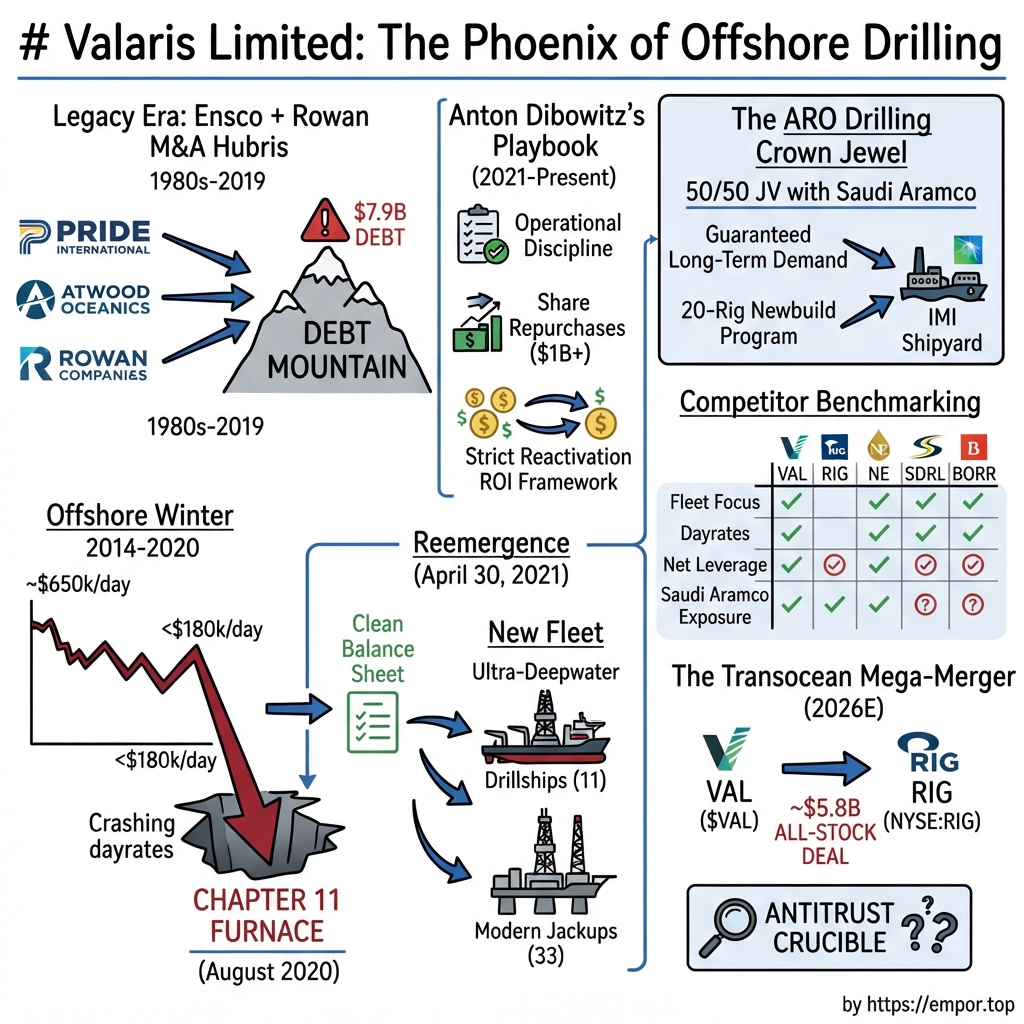
Valaris Limited: The Phoenix of Offshore Drilling
I. Introduction & Episode Roadmap
On February 9, 2026, the offshore drilling industry received the news it had been quietly rehearsing for a decade. Transocean Ltd. announced an all-stock acquisition of Valaris Limited valued at roughly $5.8 billion. The transaction creates an offshore giant operating 73 rigs — including 33 ultra-deepwater drillships, nine semisubmersibles, and 31 jackups — with an enterprise value near $17 billion and a combined contract backlog of about $10 billion.1 Valaris shareholders were offered 15.235 Transocean shares for each share held, leaving them with roughly 47% of the combined entity.1
The contrast was hard to miss. Less than six years earlier, on August 19, 2020, this same company entered the U.S. Bankruptcy Court for the Southern District of Texas carrying one of the largest debt loads in oilfield services history and asked to be taken apart.4 Existing equity was cancelled, and bondholders took the keys. When the entity emerged on April 30, 2021 — with roughly $7.1 billion of debt eliminated and $520 million of fresh capital injected — it was, in a literal legal sense, a different creature wearing the same name.[^5]
That mechanism is the central story: how a business lacking product differentiation, pricing power over its end market, and cost flexibility managed to destroy an entire generation of shareholder capital, rebuild under new ownership and management to generate cash for stock buybacks, and ultimately agree to sell itself altogether.
Valaris (NYSE: VAL) serves as a clean case study in how commodity cycles interact with balance sheets. The core lesson is unglamorous and old: in a business where revenue can fall 70% in eighteen months while costs remain rigid, fixed debt is not leverage — it is a countdown timer. Three consecutive acquisitions financed near the top of the cycle set that timer, and a pandemic finished it.
Yet the post-bankruptcy narrative is more complex than a simple recovery arc suggests, because Valaris is not the invincible cash machine that story implies. As of mid-2026, the company carries about $1.09 billion of long-term debt against $541 million of cash, its floater fleet is running at 62% active utilization, and adjusted EBITDA in the second quarter dropped to roughly $97 million from $163 million in the same period a year earlier.23 Dayrates are high, but utilization is not — two simultaneous facts that define the current operating reality.
A crucial distributional reality also reframes what "recovery" means. Shareholders who owned the company through its decade of expansion — financing acquisitions, absorbing dilution, and trusting strategic rationales — received essentially nothing. Distressed-bond investors who stepped in during 2020 acquired the entire enterprise. Every subsequent gain, including any premium from the Transocean transaction, has accrued to that second group. When commentators describe Valaris as a turnaround success, the key question remains: a turnaround for whom?
The analysis unfolds across several key stages. First, the underlying physics: what an offshore drilling contractor actually sells, and why a rig's economics behave like an option rather than a traditional business. Next, the legacy: Ensco's and Rowan's long histories, alongside the 2011–2019 acquisition sequence that built the fleet and debt simultaneously. Then, the crash and Chapter 11 restructuring. Following that, the reemergence under CEO Anton Dibowitz and an evaluation of whether stated capital discipline is real or merely convenient. Then, the operating segments and the ARO Drilling joint venture with Saudi Aramco (أرامكو السعودية) — the most distinctive yet opaque asset on the balance sheet. Finally, the competitive structure of the post-consolidation industry, the pending Transocean transaction and its antitrust hurdles, a stress test of bull and bear cases through Porter and Helmer, and the core metrics that reveal actual operational performance.
One framing note guides the analysis throughout. Valaris cannot be understood through its own narrative, which changed three times in fifteen years with equal conviction. It must be evaluated through its mandatory regulatory disclosures — segment tables, active utilization rates, and contingency notes. Where corporate narrative and official filings conflict, the filings win.
Start with the steel.
 Subscribe on LinkedIn
II. The Physics of Offshore Drilling & Rig Economics
Consider a vessel roughly the length of two football fields, holding position over a fixed point on the seabed 8,000 feet below using dynamic positioning and six azimuth thrusters firing continuously against wind and current. It never anchors. It drills a hole the width of a dinner plate through two miles of water and another four miles of rock, navigating pressure regimes capable of crushing a submarine, operating for months at a time while 200 people live aboard.
That is a seventh-generation drillship. Valaris does not own the hydrocarbon reserves, nor does it take exploration risk; it rents the machine and crew by the day.
The business model is a rental agreement with a performance clause. A customer — such as Shell, BP, TotalEnergies, Equinor, Petrobras, or a national oil company — signs a drilling contract specifying a dayrate, a firm term, and optional extensions. Valaris earns that dayrate for every day the rig remains available and operational. If equipment fails and drilling halts, the rig drops to a reduced rate or earns nothing until repaired. Consequently, the industry's primary operational benchmark is revenue efficiency: the percentage of the contracted dayrate actually collected. Valaris reported 98% revenue efficiency in the second quarter of 2026, meaning roughly two cents of every contracted dollar were lost to downtime.2 For a fleet generating more than $2 billion annualized, each percentage point represents millions of dollars in revenue, placing the metric at the top of corporate disclosures.
The two fleets behave completely differently. Floaters — drillships and semisubmersibles — operate in deep and ultra-deepwater. Jackups are self-elevating platforms with three steel legs anchored on the seabed in shallow water, typically under 400 feet. The economics diverge sharply, as reflected in segment disclosures.
In the second quarter of 2026, the floater segment generated $279.0 million of revenue (excluding reimbursables) against $167.9 million of contract drilling expense, yielding $111.6 million in segment adjusted EBITDA — a margin of roughly 40%.23 Average daily revenue on floaters reached $451,000, climbing from $436,000 in the previous quarter and $381,000 during the first half of 2025.3 Meanwhile, the jackup segment generated $183.4 million in revenue and $40.6 million in EBITDA — a 22% margin — with average daily revenue of $134,000, remaining essentially flat year over year.23
The operating leverage becomes clear when breaking down the numbers. With 11 active floaters operating over a 91-day quarter at 62% active utilization, approximately 620 revenue-generating rig-days produced that $279 million. Yet operating expenses spanned all 1,001 available rig-days in the period, implying a baseline running cost of roughly $168,000 per day for each active floater regardless of whether it earned revenue.3 That dynamic captures the sector's core risk: a floater generating $451,000 per day yields substantial cash flow, but an idle floater continues to consume six figures daily.
The physical origins of these vessels shape industry supply, which remains concentrated across a few major global shipbuilders. The ultra-deepwater fleet in service today was overwhelmingly constructed in East Asian shipyards — primarily South Korean conglomerates 삼성중공업 Samsung Heavy Industries, 한화오션 Hanwha Ocean (formerly 대우조선해양 DSME), and HD현대중공업 HD Hyundai Heavy Industries — alongside Singaporean and Chinese facilities. Industry rig-tracking data confirms a timeline central to the sector's structural overhang: nearly every rig remaining under construction was ordered during the 2010–2014 offshore expansion, with only a handful commissioned after the 2015 oil market downturn.19
An entire generation of global offshore drilling capacity was ordered within a four-year speculative boom — often commissioned directly by shipyards or financial investors rather than drillers holding firm customer contracts. According to industry records, a majority of uncontracted newbuilds were situated in Chinese yards, which held nearly half of the global newbuild fleet.19 This shadow inventory remains a persistent factor in offshore supply dynamics: a backlog of near-complete vessels requiring no ongoing holding costs from drilling contractors, ready for completion if market dayrates justify the capital expenditure.
The commercial structure of a drilling contract is as critical as the headline dayrate. A standard agreement specifies a firm term — ranging from a single well to several years — along with priced extension options, mobilization fees to relocate and customize the rig for the customer's well program, and occasionally demobilization fees. Because mobilization payments are collected upfront but recognized as revenue over the contract's duration, Valaris carried $117.5 million in current and $74.0 million in noncurrent contract liabilities on its balance sheet — representing cash collected for services not yet rendered.3 Consequently, cash flows precede reported revenue when a contract commences and trail it upon completion, meaning reliance solely on the income statement can obscure underlying cash dynamics.
This introduces the industry's most consequential operational choice: managing uncontracted rigs. Drillers face three choices, forming a ladder of increasing irreversibility.
Warm stacking maintains a skeleton crew, power, and active certifications, allowing mobilization within weeks. While expensive — incurring substantial operating expenses without offsetting revenue — it preserves immediate operational readiness. On its third-quarter 2025 earnings call, management stated it would warm-stack the semisubmersibles MS-1 and DPS-1 in Malaysia after their contracts expired while evaluating new opportunities.11 DPS-1 secured no subsequent work, and Valaris sold the rig for recycling in the second quarter of 2026.3
Cold stacking involves discharging the crew, powering down equipment, and placing the rig in long-term preservation. Holding costs drop significantly, but operational optionality is severely curtailed.
Reactivation represents a major capital commitment. Returning a cold-stacked drillship to service requires recertifying blowout preventers, risers, thrusters, and drilling equipment, recruiting specialized offshore crews amid tight labor markets, and passing rigorous customer inspections. The process typically costs tens of millions of dollars and requires nearly a year of work before generating revenue. While Valaris has not disclosed a formal capital hurdle rate for reactivations, corporate filings show that as of June 30, 2026, its fleet comprised 14 floaters and 23 jackups, of which 11 floaters and 17 jackups were active.3 The remaining idle units have remained uncontracted.
A fourth condition exists that receives less public emphasis: vessels constructed and delivered that have never entered commercial service. Valaris owns two such drillships, illustrating the structural risks of speculative fleet expansion — a topic examined in detail following the history of the company's asset accumulation.
This structural asymmetry defines the offshore sector. Rig supply responds slowly to price signals in either direction: building a drillship requires more than three years, and reactivating a preserved vessel requires substantial capital and lead time. Meanwhile, drilling demand responds to oil price fluctuations with a six- to twenty-four-month lag as exploration companies evaluate long-cycle capital expenditure plans. Consequently, the market fluctuates between acute capacity shortages and prolonged oversupply, with rare windows of equilibrium.
Understanding these economic physics provides the context for evaluating the strategic decisions of prior management.
III. The Legacy Era: Ensco, Rowan, & The Great Consolidation Trap
In 1975, an oilman named John R. Blocker — a Texas A&M graduate who had worked Gulf of Mexico rigs before starting a South Texas drilling business with his father — founded Blocker Energy Corporation.6 The Arab oil embargo had ignited a domestic exploration boom, and oil majors were divesting their in-house drilling arms. Recognizing that he could not outmaneuver hundreds of small domestic competitors, Blocker took the company international. By the early 1980s, Blocker Energy operated 54 rigs across eight countries and ranked as the world's fifteenth-largest drilling contractor.6
Then oil prices collapsed, and so did Blocker. In late 1982, to avoid bankruptcy, the company surrendered 64% of its equity to banks in exchange for $240 million of debt forgiveness.6 By 1983, its active fleet had shriveled to six rigs. That sharp retrenchment captured the defining pattern of the enterprise: thirty-eight years before Valaris filed for Chapter 11, its corporate ancestor was nearly destroyed by leverage during a commodity downturn.
The rescue came from Richard Rainwater, the Stanford-educated investor who built the Bass family fortune and possessed an appetite for buying distressed hard assets. His BEC Ventures took control in December 1986.6 Carl F. Thorne replaced Blocker as CEO in May 1987, and the company was renamed Energy Service Company — Ensco — before becoming ENSCO International in 1992.6 The Rainwater-era playbook was straightforward: run lean, keep debt low, and buy rigs when asset values crash. Ensco acquired Penrod Holding's 19 rigs in 1993 and Dual Drilling's 15 in 1996, becoming a major offshore contractor almost entirely through countercyclical purchases.6
The other half of the lineage was older and distinct. Rowan Companies was founded in Texas in 1923 and spent nearly a century as an engineering-focused house devoted to a single challenge: making jackups survive weather that would kill a normal one.[^11] Its harsh-environment "Gorilla" class jackups were built for the North Sea, and that engineering reputation was the primary reason Saudi Aramco eventually selected Rowan — rather than a larger competitor — as its partner in a joint venture examined later in this story.
The contrast between the two corporate origins explains what the merged company became. Ensco's strength was capital allocation: buy cheap, control overhead, and sell high. Rowan's strength was specialized engineering: build rigs that operate where others cannot and command a rate premium. Merging the two created a contractor with the world's largest fleet by rig count, but one that struggled to maintain either discipline in its purest form.
Then came the empire-building. Between 2011 and 2019, Ensco executed three acquisitions in eight years, each looking very different in hindsight than on announcement day.
On February 7, 2011, Ensco agreed to acquire Pride International for $41.60 per share — $15.60 in cash plus 0.4778 Ensco shares — valuing the transaction at roughly $7.3 billion and requiring about $2.8 billion of cash to Pride shareholders.5 The combined company controlled 74 rigs, including 21 deepwater units, and carried roughly $10 billion of revenue backlog.5 CEO Dan Rabun called it "an ideal strategic fit, as our rig types, markets, customers and expertise complement each other with minimal overlap," while management guided to long-term debt of roughly 30% of total capital and expected to retain an investment-grade rating.5
The strategic logic appeared sound at the time. Pride brought deepwater positions in Brazil and West Africa that Ensco lacked, while Brent crude traded above $100 per barrel. But that logic relied on market consensus. Industry participants assumed a structural shortage of deepwater rigs, prompting shipyards to accept orders for dozens of speculative newbuild drillships scheduled for delivery between 2013 and 2016. Ensco paid peak-cycle prices for deepwater exposure just as a massive global supply wave was being underwritten.
The Pride transaction also marked a fundamental cultural reversal. Ensco's historical identity under Rainwater was a low-debt jackup specialist buying assets out of distress. Pride transformed it into a leveraged deepwater contractor buying assets in euphoria. The acquisition did not merely add debt; it inverted the conservative operating philosophy that had guided the business for two decades.
The second acquisition was smaller but similarly mis-timed. On May 30, 2017, Ensco agreed to acquire Atwood Oceanics for about $839 million.7 By then, the downturn was three years old and asset values had collapsed. Buying high-specification floaters near a cyclical trough matched Ensco's traditional countercyclical model, but the market had not reached bottom. Dayrates continued falling for two more years, while Atwood's capital commitments added obligations to a balance sheet already absorbing Pride's debt.
Among the assets inherited from Atwood were two drillships ordered from a South Korean shipyard in 2012, originally scheduled for 2015 delivery and repeatedly deferred as the market slid.20 Those hulls sat unfinished for more than a decade, remaining a persistent obligation for future management teams.
The third move was the largest. On October 8, 2018, Ensco agreed to merge with Rowan in a transaction valuing the combined entity at roughly $12 billion, creating the world's largest offshore drilling fleet by rig count.8 Rowan shareholders received 2.750 shares each. The transaction closed in April 2019, and the combined entity was renamed Valaris plc that July, with management targeting $165 million of annual expense synergies.9
The financial stress surfaced immediately. In its first full quarter as Valaris, the company reported second-quarter 2019 revenue of $584 million against $500 million of contract drilling expenses and $158 million of depreciation — producing an operating loss before a dollar of interest.9 In that same quarter, it repurchased $952 million aggregate principal of its own senior notes at an average discount of 24%.9 While management framed the buybacks as opportunistic deleveraging, the steep discount reflected a credit market that had already concluded Valaris could not service its debt at prevailing dayrates.
So did management overpay? Each transaction was defensible on its own terms but destructive in sequence. Pride was bought at peak valuations for deepwater exposure that a shipyard boom soon oversupplied. Atwood was a bottom-fishing trade executed two years before the market bottomed. Rowan merged two weakened contractors, adding scale and the Saudi Aramco joint venture without reducing the fixed debt service claims on a shrinking revenue base. The cumulative result was a company entering 2020 with a massive fleet, broad geographic reach, and a capital structure calibrated to $100 oil in a market that could no longer support it.
IV. The Crash & The Chapter 11 Furnace
The offshore winter did not begin with the pandemic. It began in late 2014, driven by two reinforcing market forces.
The first was the rise of U.S. shale. Developing a deepwater project requires a final investment decision years before first production, billions of dollars in committed capital, and confidence in long-term oil prices. A shale well requires a few million dollars and produces within months. When capital allocators at major oil companies compared a 15-year deepwater commitment against a portfolio of short shale cycles, the short-cycle option won repeatedly. Deepwater required long-term conviction, while shale required only immediate cash flow flexibility.
The second force was the global newbuild wave. Drillships ordered during the 2010–2014 boom delivered into a market that no longer needed them, creating a structural oversupply just as exploration spending plummeted.
By 2018, dayrates that had topped $600,000 at the cycle's peak hovered near operating breakeven. Contractors kept rigs working at near-zero margins because an idle rig continued to burn cash, driving the entire industry into self-inflicted unprofitability.
The underlying economics underscored the structural fragility of pure commodity service businesses. A drillship generating mid-six-figure dayrates in 2013 paid back a substantial portion of its construction cost within a few contract cycles. Four years later, that same vessel struggled to cover crew salaries and routine maintenance. Because a driller has no control over market clearing prices, asset profitability is a function of broader supply and demand rather than intrinsic asset quality. In 2018, operational skill could not compensate for excessive leverage; only contractors with manageable fixed debt obligations survived without court protection.
In March 2020, the COVID-19 pandemic erased roughly a third of global oil demand in weeks. Crude prices collapsed, operators declared force majeure, and drilling programs were deferred or cancelled. For a contractor earning revenue one rig-day at a time while carrying fixed debt service, cash flow disappeared.
On August 19, 2020, Valaris filed for Chapter 11 protection in the Southern District of Texas.4 It did so with a pre-negotiated Restructuring Support Agreement backed by approximately half its noteholders, plus a Backstop Commitment Agreement and $500 million of debtor-in-possession financing.4 This was a controlled restructuring, negotiated in advance with the creditors who would assume ownership.
The architecture of the plan reshaped the company's financial foundation. Pre-petition revolving credit facility claims and unsecured notes were equitized into common shares. A backstopped rights offering provided $500 million in new secured notes. Trade claims were paid in full in cash to maintain supply chains and offshore operations, while existing equity was effectively cancelled, receiving only warrants in certain circumstances.4
This redistribution defined the outcome of the cycle. Common equity holders who had financed a decade of fleet expansion received out-of-the-money warrants, while distressed-bond investors acquired control of the enterprise.
The bankruptcy court confirmed the plan on March 3, 2021, and Valaris emerged on April 30, 2021, having eliminated roughly $7.1 billion of debt and taken in $520 million of new capital through the issuance of new secured notes.[^5] It reincorporated in Bermuda as Valaris Limited and relisted on the NYSE.
Two structural consequences of the Chapter 11 reorganization proved crucial for the post-emergence business. The first was fresh-start accounting. Upon emergence, Valaris wrote its entire fleet down to fair market value. This is why a company operating 44 rigs carried property and equipment of just $2.83 billion at cost as of June 30, 2026 — a fraction of what those assets cost to build.3 Lower asset values reduced annual depreciation expenses, boosting reported net income relative to un-restructured peers while lowering the asset base used to calculate return on invested capital.
The second consequence was the shift in ownership. Valaris emerged with a shareholder register dominated by credit funds and distressed-debt investors who had purchased bonds at significant discounts. This investor base prioritized capital return over long-term fleet growth, directly shaping post-emergence strategy, share buyback programs, and eventual openness to an M&A exit.
By mid-2021, with debt eliminated and a fresh balance sheet established, the immediate strategic question was leadership.
V. The Reemergence & Anton Dibowitz's Playbook
Anton Dibowitz took over as interim president and CEO on September 3, 2021, and was confirmed in the permanent role on December 8, 2021.10 On paper, he presents an atypical background for a contract driller: a certified public accountant with an MBA and a Master of Professional Accounting from the University of Texas at Austin, who began his career in tax and process reengineering at Transocean and Ernst & Young before moving into commercial roles.10
The most instructive entry on his résumé is one a promotional write-up might gloss over. Dibowitz served as CEO of Seadrill Ltd. from July 2017 to October 2020 — running another major offshore contractor through its own extended restructuring saga.10 He arrived at Valaris having observed firsthand how excessive leverage can dismantle an operating business when a commodity cycle turns. Whether that background produced genuine discipline or merely fluency in its vocabulary remains an empirical question testable against the post-emergence record.
Board Chair Elizabeth Leykum framed the appointment in terms of continuity, noting that Dibowitz had "done a tremendous job leading Valaris over the past three months," while Dibowitz pointed to more than $2.1 billion of backlog added year to date.10 From day one, management prioritized contracted backlog over fleet size or market share.
The macro environment subsequently delivered a genuine upcycle. The energy security shock following Russia's invasion of Ukraine, years of upstream underinvestment, and project maturation across the Guyana, Brazilian pre-salt, Namibian, and West African basins combined to revive deepwater demand. Crucially, the cost benchmark had also reset: Valaris cited Rystad Energy estimates showing that roughly 65% of expected deepwater activity over the next five years is associated with projects breaking even below $50 per barrel, and roughly 80% below $60.3 Deepwater was no longer the high-cost marginal option.
Floater pricing responded, though not in a straight line. Valaris's average daily floater revenue rose from $381,000 across the first half of 2025 to $451,000 in the second quarter of 2026.3 On the October 30, 2025 earnings call, Dibowitz characterized the market as having found a floor, telling analysts that dayrates for high-specification ships had "largely troughed in the high 300s, low to mid-400 range."12 That statement reflected a measured assessment — an acknowledgment that leading-edge pricing had softened into that band rather than rising into it.
On capital allocation, corporate actions proved more revealing than earnings call rhetoric. Three distinct patterns defined the strategy.
First, the company sold older rigs rather than reactivating them. Valaris sold the 27-year-old jackup VALARIS 247 for $108 million in the third quarter of 2025 — a price driven by the scarcity of working jackups — while disposing of VALARIS 102 and 145 during the same period.123 It sold VALARIS 104 and 109 in June and July 2026 for combined proceeds of about $74 million, and scrapped the semisubmersible DPS-1.23 Consequently, the fleet contracted from 49 rigs at the end of June 2025 to 44 a year later.3 For an enterprise whose predecessors grew through aggressive consolidation, deliberate downsizing marked a clear departure from historical habit.
Second, preserved floaters remained on the sidelines. Despite floater pricing climbing by more than a third during the recovery, Valaris did not reactivate its cold-stacked drillships. Chief Financial Officer Chris Weber told analysts the company maintained a minimum operating cash requirement of roughly $200 million, against $676 million on hand at the end of the third quarter of 2025.12 The liquidity existed, yet management chose not to commit it to speculative reactivations.
However, this discipline had one prominent exception, standing as the defining capital decision of the Dibowitz era. On December 21, 2023, Valaris exercised its options and acquired the two drillships originally ordered by Atwood Oceanics, taking delivery of VALARIS DS-13 and DS-14 for an aggregate purchase price of approximately $337 million.20 Dibowitz described the transaction as expanding the drillship fleet to 13 units and reinforcing its position as one of the most technically capable in the sector.20 The company subsequently guided to roughly $355 million in additional fourth-quarter capital expenditures covering the purchase and mobilization preparation, plus about $35 million more in 2024 for mobilization costs.20
Valaris then sailed both drillships from South Korea to Las Palmas, Spain, where they were stacked to await customer contracts.20 Nearly three years later, both units remained stacked and uncontracted.
This deployment presents two contrasting interpretations. The favorable view: Valaris acquired two brand-new, high-specification drillships at roughly $170 million apiece — a fraction of newbuild costs — with no obligation to incur reactivation capital until a customer pays for it. That represented a low-cost, long-dated call option on deepwater demand. The critical view: over $370 million in purchase and mobilization capital sat idle for nearly three years, generating zero revenue, incurring stack and preservation costs, and consuming capital that could have retired roughly a tenth of the outstanding share count. Although Dibowitz stated at the time that the company anticipated strong customer interest,20 that interest failed to convert into a contract.
Capital discipline in offshore drilling is rarely absolute. Valaris declined costly reactivations on legacy floaters while writing a nine-figure check for two uncontracted newbuilds. Both decisions were articulated in the language of discipline, but only one generated productive returns.
Executive incentive disclosures offer limited clarity on strategic alignment. Corporate communications emphasized operational metrics — revenue efficiency, safety performance, backlog growth — over fleet expansion, and executive compensation framework reflected in proxy materials tracked that emphasis.1012 However, the specific weightings governing 2026 executive pay across operational and return-on-capital targets cannot be verified from interim financial filings. Furthermore, the pending acquisition by Transocean introduces change-of-control provisions that naturally alter executive incentives during merger negotiations.
Third, direct capital returns to shareholders were episodic rather than programmatic. The board authorized a share repurchase program of up to $600 million.3 Valaris repurchased $75 million of stock at an average price of about $49 per share during the third quarter of 2025, with Dibowitz stressing that returns should be "driven by operational delivery" rather than funded by asset sales.12 However, the company executed zero repurchases during the first half of 2025 or 2026, leaving roughly $175 million of authorization unused as of June 30, 2026 — an authorization frozen by restrictions in the Transocean business combination agreement.3
The resulting scorecard is nuanced. Valaris avoided repeating the debt-fueled asset accumulation that bankrupted Ensco between 2011 and 2019. Yet it also did not return capital aggressively enough to compound per-share value significantly before agreeing to sell the company. Total shares outstanding decreased from about 71 million in mid-2025 to roughly 70 million in mid-2026 — a reduction of under 3%.3 In practice, post-emergence discipline resembled patient waiting for an industry buyer.
What Valaris did possess, which none of its peers could replicate, was a structural position inside the world's largest shallow-water drilling market.
VI. Segment Deep-Dive & The ARO Drilling Saudi Moat
In the shallow waters of the Arabian Gulf, a few dozen kilometres off the Saudi coast, sit some of the most reliably profitable drilling assets in the world. The water is warm and calm. The reservoirs are enormous and well understood. The wells are shallow by modern standards. And the customer has been drilling them continuously for seventy years and intends to keep doing so for another fifty. It is, in almost every respect, the opposite of the deepwater frontier that dominates the industry's imagination — and for one company, it is the closest thing to an annuity that offshore drilling produces.
The most valuable thing Rowan brought to the 2019 merger was not a rig. It was a contract.
On November 21, 2016, Rowan and Saudi Aramco agreed to form a 50/50 joint venture to own, manage and operate offshore drilling units in Saudi Arabia. The entity — Saudi Aramco Rowan Offshore Drilling Company, or ARO — was formed in May 2017 and commenced operations that October 17.[^11] Rowan contributed three jackups, including the previously idle J.P. Bussell; Aramco contributed two; each partner then received roughly $88 million of excess cash back.[^11] ARO simultaneously assumed management of Rowan's seven remaining jackups already working in the Kingdom.[^11]
The structural commitment attached to the venture was extraordinary: ARO agreed to purchase twenty newbuild jackup rigs, to be constructed by a Saudi Aramco manufacturing partnership, with deliveries expected between 2021 and 2030 — and each newbuild carrying a sixteen-year drilling commitment.[^11] In an industry where a three-year contract is considered long-dated, sixteen years is a different asset class entirely.
How the money actually flows is the part most summaries get wrong, so it is worth being precise. Valaris earns from ARO through three distinct channels, and they sit in three different places in the financial statements.
The first is equity income. Because ARO is 50/50 and unconsolidated, none of its revenue appears in Valaris's top line. Only Valaris's share of ARO's net income, adjusted for fresh-start basis differences, flows through as "equity in earnings of ARO" — $10.6 million in the second quarter of 2026.3 ARO itself generated $126.9 million of revenue, $44.7 million of adjusted EBITDA and $14.8 million of net income in that quarter, operating nine owned jackups at an average daily revenue of $113,000 and 77% utilization.23
The second is bareboat charter revenue. Valaris leases seven of its own jackups to ARO, which then bears substantially all operating costs.3 Valaris collects a lease payment and takes essentially no operational cost exposure. This is the "Other" segment, and it produced $17.9 million of total operating revenue from lease agreements in the second quarter.3 It is genuinely capital-light — but it is also small relative to the narrative weight typically assigned to it.
The third is interest. During 2017 and 2018, Valaris contributed assets to ARO in exchange for ten-year shareholder notes receivable bearing SOFR plus 2.10%, carried at $357.2 million as of June 30, 2026 against an equity investment in ARO of just $139.2 million.3 In other words, more than two-thirds of Valaris's ARO-related balance sheet exposure sits in a loan to its own joint venture, not in equity ownership of it.
Now the obligations, which receive far less attention than the benefits. The shareholder agreement specifies that ARO shall purchase twenty newbuild jackups. Two — Kingdom 1 and Kingdom 2 — were delivered and commenced operations in 2023 and 2024. ARO ordered Kingdom 3 in October 2024 and Kingdom 4 in November 2025, each at a purchase price of approximately $300 million, funding a 25% down payment from cash on hand with the balance due on delivery.3 If ARO cannot fund the program from operations or third-party financing, each partner may be required to make capital contributions of up to $1.25 billion, reduced as newbuilds deliver; following Kingdom 2, Valaris's remaining commitment stood at $1.1 billion.3
Hold that against a company with $541 million of cash. The ARO joint venture is simultaneously Valaris's most durable demand source and its largest undrawn contingent liability. Four rigs ordered in nine years against a twenty-rig commitment also tells you the program is running well behind its original 2021–2030 delivery arc — which is, in fairness, the reason the contingent funding call has not arrived.
The suspension episode tested the whole arrangement. Beginning in 2024, Saudi Aramco cut offshore capital spending and began suspending jackup contracts. On April 4, 2024, Valaris disclosed that ARO had received a suspension notice for VALARIS 143 for up to twelve months, on a contract that had been scheduled to run to December 2024, with ARO retaining the right to terminate the drilling contract entirely.18 Further suspensions followed across the Saudi jackup market.
What happened next is the actual test of whether ARO is a moat. Valaris and ARO did not receive a bailout; they negotiated a sequence of short-term bareboat charter extensions and, over time, redeployed capacity. By mid-2026, ARO's nine owned rigs were running at 77% utilization and the leased fleet at 78%, versus 86% and 100% respectively a year earlier.3 The relationship survived. The economics were impaired. Both statements are true, and the correct conclusion is narrower than "guaranteed demand": ARO gives Valaris privileged access to Aramco's offshore program, not immunity from Aramco's capital budget.
The region added a second, uglier cost in 2026. Ongoing Middle East conflicts reduced Valaris's operating income by approximately $30.0 million in the second quarter and $38.0 million in the first half — roughly $11.0 million of that in the quarter from war-risk insurance premiums on regional jackups, and about $14.0 million from project delays on VALARIS 250 and VALARIS 116 while they sat in regional shipyards.3 Management expects the drag to moderate as VALARIS 250 resumed its bareboat charter in July and VALARIS 116 was expected back in the third quarter, while noting explicitly that escalation — including disruption to the Strait of Hormuz — could make the impact "significantly higher."3
The non-Saudi jackup business deserves its own accounting, because it is where the fleet's most differentiated engineering sits and where the outline's "stable workhorse" framing holds up best. Valaris's harsh-environment jackups work the North Sea — the market that Rowan spent decades building rigs for, where winter weather, water depth and regulatory standards eliminate most of the world's jackup fleet from contention. That capability is genuinely scarce, and the pricing reflects it. In the second quarter of 2026 the company added more than $160 million of North Sea jackup backlog, extending contract coverage through 2027.2 Across the wider fleet, jackups were the steadier of the two segments in 2026: active utilization of 90% against the floaters' 62%, at an average daily revenue that has not moved in a year.3
That combination — stable volume, static price — is the signature of a mature, competitive market rather than a scarce one. It is a good business. It is not a business with pricing power, and investors should not confuse the two. The floater fleet is where operating leverage lives; the jackup fleet is where the cash flow floor lives. A company that owns both is structurally less volatile and structurally less explosive than a pure-play at either end.
Geographically the picture is more concentrated than the "global fleet" language suggests. As of June 30, 2026, Valaris had four floaters and five jackups in the Middle East and Africa alongside the seven rigs leased to ARO; four floaters and eleven jackups in Europe; five floaters and three jackups across North and South America; and just one floater and three jackups in Asia and the Pacific Rim.3 Europe and the Middle East together account for the clear majority of the fleet — a useful corrective to the assumption that this is primarily a Gulf of Mexico story.
Set against the floater business, the picture that emerges is a company with two engines running at different speeds: a deepwater fleet with excellent pricing and mediocre utilization, and a shallow-water franchise with dependable utilization, flat pricing, and geopolitical exposure that is currently costing real money.
Which raises the obvious question: how does that compare to everyone else?
VII. Competitor Benchmarking & Industry Structure
In 2014, more than a dozen credible contractors competed for a deepwater drilling contract. By 2023, a supermajor planning a multi-year campaign in the Gulf of Mexico or offshore Guyana was effectively choosing among three. That compression did not happen through competitive victory; it occurred through the bankruptcy courts.
For most of its history, offshore drilling illustrated how structural fragmentation destroys capital: dozens of contractors offering undifferentiated assets faced a customer base comprising some of the world's most sophisticated procurement organizations. When demand fell, each contractor's rational response was to slash prices to cover immediate cash operating costs, ensuring that few operators earned their cost of capital over a full commodity cycle.
The 2020–2022 bankruptcy wave altered that structural dynamic. Valaris, Noble, Seadrill, Diamond Offshore, and Pacific Drilling all restructured under court protection before the survivors consolidated. Noble completed its business combination with Maersk Drilling on October 3, 2022, creating an entity with more than $4 billion in backlog and a stated commitment to maintaining a conservative balance sheet with low leverage and high liquidity — a deal that required divesting five jackups to Shelf Drilling for $375 million as a regulatory remedy.16 Meanwhile, Seadrill emerged from restructuring as a dedicated floater operator.
These transactions left the top three contractors in control of the overwhelming majority of global high-specification floating capacity. That market concentration serves as the foundation of the post-2021 bull thesis for the offshore sector.
The peer set differs along distinct operational lines. Transocean operates as a pure-play ultra-deepwater driller, maintaining the highest-specification floater fleet and largest floater backlog alongside the heaviest legacy debt load among major peers — a function of past acquisitions and a decision not to restructure during the downturn. Noble sits closest to Valaris strategically, pairing high-specification floaters with premium jackups while adhering to a conservative balance sheet and a formal shareholder return framework. Seadrill remains floater-weighted with high operational sensitivity to drillship dayrates. Borr Drilling operates exclusively in premium jackups with no floater exposure, while Shelf Drilling occupies the lower-specification, lower-cost segment of the jackup market, competing primarily on operating costs rather than rig capability.
The Noble–Maersk combination offers a specific blueprint for evaluating future sector consolidation because it required explicit regulatory intervention. Noble divested five jackups to Shelf Drilling for $375 million to secure antitrust clearance while targeting at least $125 million in annual cost synergies within two years.16 That transaction provides the template for the pending Transocean–Valaris deal, carrying two distinct implications: it demonstrates that major offshore drilling combinations can win approval through asset remedies, while confirming that competition authorities have already established that consolidation in the sector can diminish competition enough to require structural intervention.
Evaluating competitive positions requires looking beyond headline fleet counts, as asset capabilities vary widely within standard industry classifications. A nominal drillship range spans older sixth-generation units built around 2009 to modern seventh-generation vessels equipped with dual-activity systems that command pricing premiums on complex wells. Rig comparisons are most informative when evaluating backlog per active rig, realized dayrates across equivalent specifications, and contracted coverage twelve to twenty-four months forward. Across backlog per active rig and realized dayrates, the top three contractors have converged, with publicly reported leading-edge drillship rates for Transocean, Noble, Seadrill, and Valaris clustering in a narrow band — reflecting disciplined supply in a market of close asset substitutes.
Within this competitive landscape, Valaris stands out for its balanced fleet structure and its joint venture position in ARO Drilling. No other public contractor maintains a 50/50 structural partnership with Saudi Aramco, providing a clear competitive distinction, albeit one that represents preferred commercial access rather than an absolute demand guarantee.
On leverage, the popular characterization deserves correction. Valaris is frequently described by market commentators as effectively debt-free, but official disclosures present a more nuanced balance sheet. As of June 30, 2026, the company held $1.0876 billion in long-term debt against $541.2 million in cash, leaving net debt at approximately $546 million.3 Measured against 2025 adjusted EBITDA of roughly $625 million, leverage stood below one turn — a modest level for the sector.12 However, when evaluated against first-half 2026 adjusted EBITDA of about $163 million, which translates to an annualized run rate near $325 million, net debt climbs closer to 1.7 times earnings.2 While neither ratio indicates immediate distress, describing Valaris as debt-free relies on peak-cycle earnings rather than trough cash flows.
One structural difference deserves emphasis because it will matter to the merged entity. Valaris and Noble operate balanced fleets containing both floaters and jackups, whereas Transocean and Seadrill focus almost exclusively on floaters. Jackups generate lower dayrates and operating margins, causing balanced contractors to lag pure-play floater operators during deepwater expansions — a dynamic that drew investor criticism toward Valaris in 2024 and 2025. However, jackup contracts feature shorter durations, broader customer bases, and less dependence on multi-billion-dollar deepwater project sanctions, providing revenue stability when deepwater demand softens. Second-quarter 2026 results illustrated this balancing effect, as active jackup utilization held near 90% while floater utilization dropped to 62%.3 Fleet diversification can appear advantageous or burdensome depending on the cycle phase, and the pending Transocean transaction will shift the combined asset base decisively toward ultra-deepwater exposure.
On competitive rivalry, the discipline is real but conditional. Major contractors have publicly committed to avoiding speculative reactivations of cold-stacked rigs without customer contracts, and market behavior has aligned with those statements — helping sustain floater dayrates around $400,000 even as utilization rates declined. Yet this restraint relies on shared financial incentives rather than formal agreements, enduring only while contractor balance sheets remain sound. The downturn between 2015 and 2019 demonstrated how rapidly pricing breaks down toward cash operating costs when individual debt burdens force contractors to prioritize utilization over rate discipline.
The proposed combination of Transocean and Valaris represents an effort to embed supply discipline structurally within a consolidated market leader. Regulators have already taken notice.
VIII. The Transocean Mega-Merger & Antitrust Crucible
A distinct historical symmetry underscores the buyer's identity. Transocean is where Anton Dibowitz began his career in tax and process reengineering more than two decades ago.10 It is also the one large floater contractor that avoided Chapter 11 restructuring during the downturn, carrying its debt load through the market collapse rather than surrendering equity to bondholders. Valaris underwent bankruptcy and wiped out equity to preserve fleet economics; Transocean carried high leverage to preserve existing equity. In February 2026, those two strategic paths converged.
Under the business combination agreement signed on February 9, 2026, Transocean agreed to acquire all outstanding Valaris common shares in exchange for 15.235 Transocean shares per share, valuing Valaris equity at approximately $5.8 billion and the combined enterprise at roughly $17 billion, leaving Transocean shareholders with about 53% and Valaris shareholders with about 47% of the combined entity on a fully diluted basis.13 Outstanding Valaris warrants — issued to former creditors and restructured equity participants — will be assumed by Transocean and remain exercisable.3 The transaction is structured as a court-approved scheme of arrangement under Bermuda law.3
The strategic rationale rests on scale and cost reduction: a combined fleet of 73 rigs, approximately $10 billion in aggregated backlog, and more than $200 million in annual cost synergies identified through the consolidation of shore bases, supply chains, and administrative overhead, expanding upon Transocean's existing efficiency initiatives.1 Transocean President and CEO Keelan Adamson described the combination as creating an attractive investment vehicle differentiated by technical fleet capabilities and operational execution, while Dibowitz framed it as establishing an industry leader for shareholders, customers, and employees.1
For Valaris shareholders, an all-stock transaction at a fixed exchange ratio changes the investment exposure. Investors are not being cashed out for liquidity; they are exchanging equity in one cyclical balance sheet for a proportional claim on a larger, more floater-heavy, and more leveraged contractor. The long-term return profile depends entirely on the trajectory of ultra-deepwater dayrates and Transocean's capacity to service its debt load through future cyclical downturns.
The regulatory review process has proved more complex than initial timeline projections. Both companies submitted Hart-Scott-Rodino notifications to the Federal Trade Commission and the DOJ Antitrust Division on March 2, 2026. Transocean withdrew and refiled its filing on April 1 and April 3, respectively — a procedural mechanism used to reset the standard waiting period and grant regulators additional evaluation time short of a formal challenge.14 The refiling did not avert regulatory escalation. On May 4, 2026, both contractors received a Second Request for additional information from the DOJ.1415
Under U.S. merger control, most non-problematic transactions clear following the initial 30-day waiting period. A Second Request is issued in a small fraction of reviewed deals, signaling that enforcement authorities have identified a substantive theory of potential market power that requires deeper investigation. In this instance, antitrust scrutiny centers on combining the two largest owners of seventh-generation drillships in a sector characterized by a concentrated customer base of major oil companies and long lead times for new rig supply.
The parties committed to the DOJ not to certify substantial compliance with the Second Request before July 31, 2026, and — barring an earlier termination of the statutory waiting period — not to close the transaction until 60 days after both companies certify compliance.14 The merger also required national security review from the Committee on Foreign Investment in the United States. Following a joint filing on April 21, CFIUS formally accepted the notice on May 14 and granted clearance on June 29, 2026.14 Beyond domestic reviews, the transaction remains subject to several foreign regulatory approvals.15
The CFIUS determination cleared a notable hurdle. Merging a Bermuda-incorporated firm into a Swiss parent presents limited security concerns on the surface, but the combined entity will control a substantial portion of high-specification floaters in the U.S. Gulf of Mexico while maintaining a major joint venture with a foreign state oil producer. CFIUS approval within six weeks indicates that national security considerations were straightforward, whereas antitrust analysis by the DOJ has required extended review.
As of its July 1, 2026 disclosure, management maintained expectations for completion in the second half of 2026.14 In its second-quarter report released on August 5, Valaris clarified that the combination remained on track to close in the fourth quarter of 2026.2
For current equity holders, the position effectively functions as two linked dependencies: underlying offshore drilling fundamentals and a regulatory approval process governed by antitrust review. Because the exchange ratio is fixed, the merger execution risk cannot be unbundled from fundamental industry performance.
The pending transaction has also altered corporate disclosure practices. Following the merger announcement, Valaris suspended quarterly earnings conference calls and discontinued forward-looking financial guidance.2 The company held its final live analyst call on October 30, 2025. Consequently, public questioning regarding dayrate trends, contract white space, reactivation economics, and Saudi jackup utilization has been absent for three consecutive quarters. While communications silence is standard legal procedure during pending combinations, it reduces available investor transparency at a time when evaluating execution is critical. Market participants must rely exclusively on regulatory filings.
Despite corporate silence, commercial operations continued securing new contracts. Contract backlog reached approximately $4.9 billion in May 2026 — its highest point in nearly a decade — driven by more than $500 million in new awards.13 Among those commitments, Valaris entered a deepwater drilling partnership with Halliburton and Petronas offshore Suriname, expanding exposure in an active South American exploration basin.17 By August 5, 2026, total backlog stood at $4.585 billion, comprising $3.016 billion in floaters, $1.133 billion in jackups, and $435.5 million in leased and managed units.2
That sequential backlog decline — from nearly $4.9 billion to under $4.6 billion across a single quarter — provides a clear operational signal. Total backlog contracts when revenue burn outpaces new contract additions. Independent of merger timing, the underlying business in mid-2026 has been consuming existing contract coverage faster than new drilling commitments have replaced it.
IX. Hamilton Helmer's 7 Powers & Porter's 5 Forces Analysis
Strategic frameworks are most useful when they force analysts to say no. Applied honestly to offshore drilling, most frameworks return a negative result — which is itself the primary finding.
Scale Economies — moderate, not high. The intuitive case holds that spreading shore bases, spare-parts pools, crew training, and safety systems across 44 rigs lowers unit costs compared to a single-rig operator. That holds true at the low end of the market. However, evidence for a scale advantage among major contractors remains thin. Valaris's own disclosures show onshore support costs held outside operating segments precisely because they do not scale cleanly with rig count.3 The practical test is unforgiving: does Valaris earn structurally higher margins than Noble or Seadrill on comparable assets in comparable markets? Nothing in the public record supports that claim. What scale actually buys is the capacity to bid multi-rig packages and absorb individual rig downtime — a real operational benefit, but closer to a table-stakes requirement among top-tier operators than a durable competitive edge.
Cornered Resource — the strongest claim, with two caveats. The 50/50 ARO Drilling joint venture represents a genuinely non-replicable asset: Saudi Aramco is not forming a second joint venture, and the 16-year contract structure attached to the newbuild program is unavailable anywhere else in the sector.[^11] The first caveat is that, as the 2024–2025 contract suspensions demonstrated, this resource confers commercial access rather than guaranteed revenue. The second caveat is that it comes bundled with a contingent funding obligation of up to $1.1 billion.3 A cornered resource that can call capital from its owner during a downturn differs fundamentally from one that simply generates cash distributions.
The secondary cornered-resource argument — that seventh-generation drillships are finite assets requiring years and immense capital to replicate — is valid but shared. It is a feature of the asset class, not a proprietary advantage of Valaris. Every major contractor controls a portion of that high-specification fleet.
Switching Costs — low to moderate, and often overstated. Changing contractors mid-campaign requires requalifying equipment, revalidating safety protocols, and rebuilding crew familiarity, leading operators to exhibit stickiness when a rig performs reliably — as management highlighted when discussing contract extension talks for DS-7 and DS-9 in Angola.12 Nevertheless, drilling contracts are finite and rebid, rigs are mobile across ocean basins, and a major operator will relocate a drilling program to a competitor's vessel for a materially lower rate. Switching costs slow customer movement, but they do not prevent it.
Counter-Positioning and Process Power — absent. No competitor is precluded from copying the business model, and no proprietary operating process delivers a sustained cost advantage. Delivering 98% revenue efficiency reflects strong operational execution, but peers report similar figures during favorable quarters.
Network Effects and Branding — absent. A rig does not gain value because another customer utilized it, nor do oil majors pay premium rates for corporate branding.
Counter-Power — present and cyclical. Post-restructuring supply consolidation has blunted the buyer power that supermajors wielded from 2015 to 2020. This is evidenced by floater dayrates holding above $400,000 through a period of declining active utilization — a combination that historically would have triggered price discounting.3 However, this counter-power stems from market cycles and temporary contractor restraint rather than immutable market structure.
Evaluating Porter's Five Forces illustrates how these competitive dynamics interlock.
Threat of new entrants: very low. Building a new drillship requires approximately three years, several hundred million dollars, and capital markets willing to fund speculative construction. That financing environment has been absent since 2014 due to the industry's bankruptcy history. This barrier constitutes the sector's most durable protection.
Bargaining power of buyers: moderate and rising during oil price weakness. The customer base is concentrated, sophisticated, and patient. Management disclosed early-stage cost-reduction discussions with Petrobras on its third-quarter 2025 earnings call — demonstrating that major deepwater customers reopen commercial terms when market conditions soften.12
Bargaining power of suppliers: moderate to high, and rising. This force is often underweighted in offshore sector analysis. Drilling contractors do not manufacture their critical equipment. Blowout preventer stacks, riser systems, top drives, and drilling control packages are produced by a small oligopoly of original equipment manufacturers — primarily National Oilwell Varco and SLB's Cameron division. Once a vessel is constructed around a vendor's package, spare parts and recertification services are effectively sole-sourced for the asset's lifespan. Competitive tenders do not exist for proprietary blowout preventer components when a rig is under contract at $450,000 per day and operational downtime creates immediate revenue losses.
Labor represents the second supplier constraint, and following years of industry downsizing, it remains binding. Experienced deepwater crews exited the sector between 2015 and 2021, and many did not return. Shipyard capacity for special periodic surveys provides a third bottleneck — as Valaris experienced when VALARIS 250 and 116 spent longer in regional shipyards than anticipated.3 Management explicitly highlighted rising operating costs, tariff exposures, and currency fluctuations, noting that contractual escalation provisions cannot guarantee full recovery of inflation from customers.3 This disclosure acknowledges that cost increases cannot always be passed through, creating a mechanism where strong dayrates can still result in compressed operating margins.
Threat of substitutes: low in the near term, structural over the long term. U.S. shale serves as the immediate substitute for exploration capital and has already absorbed significant market share. The long-term substitute is the broader energy transition, though deepwater drilling retains a competitive case: offshore projects offer large resource volumes at low breakeven costs and lower carbon intensity per barrel than many onshore alternatives.3
Competitive rivalry: currently restrained, structurally high. While contractor discipline currently supports dayrates, underlying competitive rivalry remains intense whenever market demand contracts.
The strategic synthesis presents a nuanced picture for the investment case. Valaris holds one genuine, non-replicable asset in ARO Drilling (which carries contingent capital obligations), shares industry-wide entry barriers with its peer group, and relies on advantages that are cyclical rather than structural. The framework evidence indicates Valaris cannot consistently out-earn its major peers across a full cycle based solely on competitive moat. Its primary structural advantage lies in balance sheet resilience designed to out-survive competitors through cyclical downturns — a capability that has historically proved decisive in offshore drilling.
X. Analysis: Bull vs. Bear Case & Activist Stress Test
Strip away the narrative, and the investment case for Valaris rests on four load-bearing claims. Each deserves to be tested against the empirical record rather than accepted on faith.
Claim one: the fleet is modern and high-specification, and therefore captures premium pricing. The evidence supports this. Floater average daily revenue reached $451,000 in the second quarter of 2026 compared to $381,000 across the first half of 2025 — an 18% improvement in realized pricing during a period when floater utilization actually fell.3 Customers are paying up for premium capability. What would falsify it: a sustained shift in the mix of awarded contracts toward lower-specification work, or leading-edge fixtures printing below $400,000 without an offsetting gain in utilization.
Claim two: the balance sheet insulates the business from commodity swings. Partially supported. Net debt of roughly $546 million against a fleet with meaningful liquidation value is manageable, and $111.4 million in letters of credit and surety bonds is modest.3 But that insulation is thinner than the "clean balance sheet" shorthand implies, particularly when measured against trough earnings, and it excludes the ARO funding contingency entirely. What would falsify it: a simultaneous downturn in floater pricing and a capital call from ARO's newbuild program.
Claim three: ARO provides cash flow insulation. Weakly supported, and this is where the consensus narrative diverges furthest from disclosed numbers. Bareboat charter revenue of $17.9 million in the second quarter of 2026 and equity earnings of $10.6 million together represent a small fraction of consolidated results.3 ARO matters strategically far more than it contributes to the current income statement. What would falsify it: nothing needs to; the disclosures already do.
Claim four: free cash flow generation enables meaningful shareholder returns or merger upside. Contested. The company generated $237 million in adjusted free cash flow in the third quarter of 2025 — a robust figure.12 But 2026 has told a different story: adjusted EBITDA came in at $66.7 million in the first quarter and $96.5 million in the second, while capital expenditures reached $101 million and $106 million in those same periods.2 On those figures, the business was not self-funding its capital program in the first half of 2026 even before working capital adjustments. Consequently, cash balances fell from $599.4 million at year-end 2025 to $541.2 million as of June 30, 2026.3
The bear case, then, is straightforward. Deepwater project sanctioning slows if Brent crude settles persistently below $60 per barrel, causing operators to defer long-cycle investments just as they did after 2014. Cold-stacked reactivations, if attempted, run over budget — a process with a historically poor track record. Saudi Aramco extends or widens its rig suspensions. Middle East conflicts escalate rather than moderate, taking war-risk insurance premiums and shipyard delay costs above the $38 million already absorbed in the first half of 2026.3 And the DOJ blocks or extracts significant divestitures from the Transocean combination, collapsing the merger spread and returning Valaris to standalone status in a softening market.
Now consider the activist stress test — the specific arguments a skeptical investor would put in a shareholder letter.
On capital allocation: the board authorized $600 million in share repurchase capacity and used roughly $425 million, leaving $175 million unspent while the stock traded through a period management itself described as a cyclical trough.312 An activist would ask why a company insisting it would not deploy capital into speculative rig reactivations also declined to deploy it into its own equity — and would note that the answer arrived in February 2026 in the form of a merger agreement that froze the buyback program entirely.
On the idle newbuilds: the sharpest single question an activist would raise is why a company that refused to reactivate cold-stacked rigs on speculation chose to spend $337 million plus mobilization expenses on two drillships with no contract, no customer, and no announced deployment schedule — and then held them, uncontracted, for nearly three years.20 Management's implicit rationale is that acquiring a finished hull cheaply differs from committing reactivation capital to an older unit, which is analytically sound: the purchase preserved optionality rather than consuming it. But optionality carries holding costs, and three years is long enough for the market to have offered a contract if demand were as strong as stated at purchase. The absence of a contract is telling data.
On the sale itself: is a fixed-exchange-ratio, all-stock transaction near a utilization trough the optimal trade? Valaris shareholders are exchanging a lightly levered, balanced fleet for a 47% stake in a more levered, floater-concentrated entity. The deal includes no cash component and no price collar. If ultra-deepwater pricing inflects upward from here, Valaris shareholders capture only a proportional share of upside they were already positioned to enjoy on a standalone basis. The counterargument — that $200 million in annual synergies and a stronger market position outweigh standalone optionality — is plausible but unproven. It is also worth recalling that the last time this corporate lineage promised merger synergies, in 2019, the company filed for Chapter 11 bankruptcy sixteen months later.84
On disclosure: eliminating earnings conference calls and forward guidance for the duration of the merger review — now stretching across three consecutive quarters — is the governance issue with the most practical bite.2 While legal and standard, it leaves analysts unable to question management on the record about reactivation economics for idle drillships or how ARO's funding obligations would be handled under stress.
On accounting judgment: the balance sheet carries $1,345.3 million in deferred tax assets — roughly a quarter of total assets of $5,448.4 million.3 Recognizing deferred tax assets of that magnitude requires management to assume that future taxable income will be sufficient to absorb them. The company demonstrated the fragility of such assumptions by establishing a $168.8 million valuation allowance in 2025 in connection with retiring semisubmersibles.3 A skeptic would note that this represents the single largest management estimate on the balance sheet and that its realization depends on the same cyclical earnings the rest of the thesis relies upon. Relatedly, the effective tax rate excluding discrete items rose to 21.7% in the first half of 2026 from 15.2% a year earlier — creating a tangible cash headwind.3
On sunk transaction costs: the $25.0 million in merger and integration expenses incurred during the first half of 2026 — including $11.4 million in the second quarter alone — represents capital spent on a transaction that has not closed and remains subject to regulatory review.3
So what is the honest verdict on management credibility? Positive, with an asterisk. Anton Dibowitz's team stated it would not chase uncontracted growth, and it maintained that position — the active fleet shrank in every year of the upcycle. Management noted that dayrates had troughed rather than asserting they were surging, a framing that proved more accurate than promotional peer commentary.12 It disclosed Middle East geopolitical impacts with specificity and quantified them by cause rather than masking them in general overhead.3 These reflect the operating practices of an executive team expecting rigorous scrutiny.
The asterisk is that this capital discipline was never truly tested. Management was never forced to choose between funding an expensive reactivation or forfeiting a major contract, because market demand never tightened enough to require that trade-off. A strategy that resembles restraint may simply reflect an environment that offered little temptation.
XI. Playbook & Key Investing Lessons
A hundred and three years separate the founding of Rowan Companies from the day antitrust regulators asked Transocean and Valaris to explain their proposed combination. Across that span, the offshore drilling sector has yielded a remarkably concise set of transferable lessons—cleanly illustrated because commodity businesses strip away the variables that obscure corporate histories elsewhere. There is no consumer brand to debate, no proprietary software to credit, and no network effect to invoke. What remains is capital allocation and the cycle.
One: in a cyclical business, fixed debt is a countdown timer. This is the lesson the enterprise learned twice—as Blocker Energy in 1982, surrendering 64% of its equity to banks, and as Valaris in 2020, turning over 100% of the enterprise to bondholders.64 The underlying mechanism is identical in both cases: revenue in contract drilling can drop 70% in eighteen months because it reflects two collapsing variables simultaneously—dayrate and utilization. Meanwhile, interest obligations remain fixed. Equity serves as the residual buffer, and residuals go to zero first. The fundamental error was not any individual acquisition; it was financing volatile cash flows with inflexible debt claims.
The practical corollary for investors is a stress test applicable across cyclical sectors: measure net debt not against trailing peak EBITDA, but against an estimate of trough EBITDA during the weakest phase of a downturn. A leverage ratio that appears manageable at one turn of earnings near a market top routinely expands to five turns at the bottom, and that trough ratio determines whether equity survives. Nearly every balance-sheet failure in commodity industries stems from calculating leverage against an unsustainable earnings peak.
Two: Chapter 11 restructuring functions as a competitive weapon, though the reported advantages are partly optical. Emerging with $7.1 billion less debt eliminated substantial interest expense. Simultaneously, fresh-start accounting reset the asset base to fair market value, permanently lowering annual depreciation charges and shrinking the invested-capital denominator used to calculate returns on capital.[^5]3 The cash flow advantage is structural, while the reported return improvement is largely accounting-driven. Comparing a restructured driller to an un-restructured peer requires evaluating EBITDA less maintenance capital expenditure rather than reported net income, preventing write-downs from masking underlying operational performance.
A second-order commercial effect also reshapes market dynamics. A newly restructured driller can bid for work at dayrates that would be unviable for a heavily levered competitor because it carries no fixed debt service requirements to reach cash breakeven. In a fragmented market, this dynamic depresses industry-wide pricing. In a consolidated market, it allows the restructured firm to capture market share from solvent rivals. Transocean's choice to acquire Valaris rather than compete against its reset balance sheet reflects this structural competitive pressure.
Three: asset quality outweighs nominal fleet count, and downsizing can represent high-return capital allocation. Valaris sold a 27-year-old jackup for $108 million and scrapped an idle semisubmersible during the same period.123 A rig lacking long-term commercial viability is not a productive asset; it is an ongoing holding cost attached to a low-probability option. While predecessor management spent a decade acquiring fleet scale, post-emergence executives spent five years rationalizing assets—yielding superior per-share outcomes for equity holders.
In asset-heavy cyclical industries, capital markets frequently price the physical fleet differently from the public enterprise. Consequently, management's highest-value role often involves arbitrage between private secondhand asset values and public market valuations—selling individual vessels into tight regional markets at prices higher than public equity multiples imply. This unglamorous asset pruning has generated more tangible equity value over recent cycles than large-scale corporate consolidation.
Four: strategic joint ventures can secure commercial demand, but contingent terms dictate real risk. The ARO partnership provides Valaris with privileged access to Saudi Aramco's offshore drilling program under multi-year contract structures.[^11] However, the arrangement includes a contingent funding commitment of up to $1.1 billion and exposed the contractor to contract suspensions when the host producer trimmed capital spending.318 When a contract driller partners with a national oil company, the host operator's capital budget dictates operational cadence. Access to customer demand does not guarantee immunity from capital budget cuts.
Evaluating joint-venture moats requires inspecting three specific governance provisions in regulatory filings: control over capital deployment decisions, funding liabilities assigned to the partner, and rights triggered by a change of control. For Valaris, disclosed terms qualify the strength of the moat. ARO remains a valuable commercial asset, but its cash generation depends directly on counterparty policy rather than sole management control.
Five: market cycles dictate the revenue ceiling, while management capital discipline sets the floor. An offshore contractor's top-line revenue depends on external factors beyond executive control: crude oil prices, deepwater project approvals, and global rig supply. Management controls only whether the balance sheet survives cyclical downturns intact. Strategy between 2011 and 2019 created a financial structure incapable of enduring a market crash, whereas decisions between 2021 and 2026 prioritized balance-sheet preservation over debt-fueled expansion. Neither executive team controlled market dayrates, but capital discipline dictated whether equity survived the cycle.
XII. The 3 KPIs That Matter Most & Epilogue
Offshore drilling generates a vast volume of disclosed data — fleet status reports listing every rig, contract, dayrate, and expiration date, alongside quarterly utilization by segment, backlog by asset class, revenue efficiency, and rig-day counts. While public disclosures make it one of the most transparent sectors in the market, that transparency can obscure underlying performance: most reported numbers are secondary consequences rather than primary drivers.
For investors evaluating the business, three core operational metrics dictate performance.
One: floater average daily revenue paired with active floater utilization. These figures must be evaluated together to avoid misinterpreting cyclical momentum. Valaris reported floater average daily revenue of $451,000 in the second quarter of 2026 alongside active floater utilization of 62%, down from 80% a year earlier.3 Rising dayrates paired with falling utilization indicate that customers are paying premium rates for scarce, high-specification capacity even as aggregate demand contracts. Conversely, rising rates alongside expanding utilization would signal a true cyclical upswing, whereas falling rates and falling utilization would mark a breakdown in contractor pricing discipline. Only the dual metric reveals which market dynamic is underway.
Because average daily revenue is a portfolio metric that blends multi-year legacy contracts with recent fixtures, it lags spot market pricing in both directions. During an upcycle, the reported average understates leading-edge contract rates; during a downturn, it overstates current market clearing prices. Consequently, individual contract announcements — with disclosed durations and terms — serve as the leading operational indicator, while reported average daily revenue provides lagging confirmation.
Two: revenue efficiency. Registering at 98% in each of the first two quarters of 2026, revenue efficiency serves as the primary gauge of operational execution.2 The metric sits largely within management's control, converts directly into top-line cash flow, and degrades rapidly when maintenance is deferred or offshore crews are overextended. A sustained decline below the mid-90% range would indicate that operational cost control has compromised rig reliability.
Unlike traditional profit margins, revenue efficiency isolates operational uptime from market pricing. A weak financial quarter can stem from depressed dayrates — an external market factor — or from unplanned rig downtime, an internal execution failure. Isolating revenue efficiency separates market exposure from operating performance. It is also the metric most vulnerable to quiet erosion during merger integration, when administrative attention shifts and maintenance choices are deferred to a buyer's operating budget.
Three: net backlog change — new contract awards minus revenue burn. Contract backlog fell from approximately $4.9 billion in May 2026 to $4.585 billion by August 5, 2026.132 Sustained over time, a shrinking backlog indicates that the company is burning through existing contract coverage faster than it is securing new commitments, regardless of headline dayrates. Backlog represents the sole forward-looking metric in contract drilling backed by binding customer commitments rather than management forecasts. With quarterly earnings calls and financial guidance suspended during merger review, tracking backlog replenishment has become the primary tool for evaluating ongoing commercial momentum.
However, total backlog numbers aggregate contracts of vastly different economic quality. A three-year ultra-deepwater contract at leading-edge rates adds total backlog dollars alongside a six-month jackup extension at marginal dayrates. Contract composition — duration, pricing, and asset class — dictates true revenue quality, making detailed segment breakdowns more revealing than aggregate totals.
Quarterly free cash flow conversion is intentionally omitted from these primary indicators despite its frequent emphasis in financial commentaries. Because customer mobilization payments are collected upfront while rig customization expenditures are heavily front-loaded, quarterly cash conversion fluctuates sharply due to payment timing rather than core business health. The metric provides meaningful analytical signal across multi-year cycles, but offers limited diagnostic value on a quarter-to-quarter basis.
Epilogue. As of August 2026, Valaris operates in a transitional state. The proposed Transocean combination awaits Department of Justice clearance, following national security approval from CFIUS and pending foreign regulatory reviews.1415 With quarterly conference calls suspended, public visibility remains restricted to mandatory filings. The operational picture shows floaters securing elevated dayrates on reduced active days, jackups running steadily while absorbing higher regional insurance costs in the Middle East, and the joint venture with Saudi Aramco operating below its 2023 peak.
Two distinct narrative conclusions remain plausible. One presents a story of financial reconstruction: an enterprise that eliminated billions in legacy debt through Chapter 11, restored operational discipline, and agreed to combine with the sector's largest operator. The other presents a cautionary outcome: a contractor committing to an all-stock transaction at a fixed exchange ratio near a cyclical utilization trough. Which path materializes will depend on factors beyond executive control — including regulatory determinations, deepwater project approvals, and geopolitical stability across the Middle East.
What remains clear is the core structural lesson. A company constructed through debt-funded acquisitions was dismantled by the market collapse it failed to anticipate, then restructured by creditors who prioritized balance-sheet durability over fleet size. Whether the post-emergence entity represents a lasting operational success or a transitional asset sale, its central takeaway endures: in capital-intensive commodity industries where revenues depend on physical capacity and prices are governed by global cycles, the balance sheet is not merely a financing tool — it is the strategy.
References
-
Transocean to Acquire Valaris — Valaris Limited, 2026-02-09 ↩↩↩↩↩
-
Valaris Reports Second Quarter 2026 Results — Valaris Limited, 2026-08-05 ↩↩↩↩↩↩↩↩↩↩↩↩↩↩↩
-
Valaris Limited Form 10-Q for the quarterly period ended June 30, 2026 — US Securities and Exchange Commission, 2026-08-05 ↩↩↩↩↩↩↩↩↩↩↩↩↩↩↩↩↩↩↩↩↩↩↩↩↩↩↩↩↩↩↩↩↩↩↩↩↩↩↩↩↩↩↩↩↩↩↩↩↩↩↩↩↩↩↩
-
Offshore Drilling Giant Valaris Files for Chapter 11 Bankruptcy — Reuters, 2020-08-19 ↩↩↩↩↩↩
-
Ensco plc to Acquire Pride International, Inc. — Ensco plc, 2011-02-07 ↩↩↩
-
History of ENSCO International Incorporated — FundingUniverse / International Directory of Company Histories ↩↩↩↩↩↩↩
-
Ensco to Buy Atwood Oceanics for About $839 Million — Reuters, 2017-05-30 ↩
-
Ensco to Buy Rowan Companies in $12 Billion Offshore Drilling Deal — Reuters, 2018-10-08 ↩↩
-
Valaris plc Reports Second Quarter 2019 Results — US Securities and Exchange Commission (Form 8-K Exhibit 99.1), 2019-08-01 ↩↩↩
-
Valaris Appoints Anton Dibowitz President and Chief Executive Officer — Valaris Limited, 2021-12-08 ↩↩↩↩↩↩
-
Earnings Call Transcript: Valaris Q3 2025 Highlights Strong Contract Wins — Investing.com, 2025-10-30 ↩
-
Valaris (VAL) Q3 2025 Earnings Call Transcript — The Motley Fool, 2025-10-30 ↩↩↩↩↩↩↩↩↩↩↩↩
-
Valaris Secures New Rig Contracts and Extensions as Backlog Reaches $4.9 Billion — Offshore Energy, 2026-05-08 ↩↩
-
Valaris Limited Form 8-K: CFIUS Approval and DOJ Second Request — US Securities and Exchange Commission, 2026-07-01 ↩↩↩↩↩↩
-
US FTC and DOJ Issue Second Request for Transocean-Valaris Merger — Offshore Energy, 2026-05-14 ↩↩↩
-
Noble and Maersk Drilling Close Business Combination, Creating a New and Dynamic Leader in Offshore Drilling — Noble Corporation, 2022-10-03 ↩↩
-
Valaris, Halliburton and Petronas Collaborate on Suriname Deepwater Drilling — Hart Energy, 2026-07-15 ↩
-
Valaris Announces Contract Suspension for Jackup VALARIS 143 — Valaris Limited, 2024-04-04 ↩↩
-
Esgian Rig Services: Upcycle in Rig Demand Creates Lean Inventory in Shipyards — Offshore Magazine ↩↩
-
Valaris Takes Delivery of Newbuild Drillships VALARIS DS-13 and DS-14 — Valaris Limited, 2023-12-21 ↩↩↩↩↩↩↩
 LinkedIn
 WhatsApp
 Reddit
 Hacker News
 Email
Email Kindle
 RSS Feed
 Spotify
 Apple Podcasts
 Amazon Music
 Audible
 YouTube