Marriott Vacations Worldwide Corporation: The Timeshare Empire in the Credit Crucible
I. Introduction & Episode Roadmap
Picture a lobby in Orlando on a bright morning. A family checks in at a resort with a famous hotel name over the door, and before the room keys are handed over somebody offers them a deal: a stack of loyalty points, perhaps some discounted park tickets, in exchange for ninety minutes of their vacation. The family says yes. Most families do. Ninety minutes later some of them are signing a promissory note for a five-figure purchase of vacation ownership, with a modest down payment and the balance financed at double-digit interest by the very company that just served them coffee.
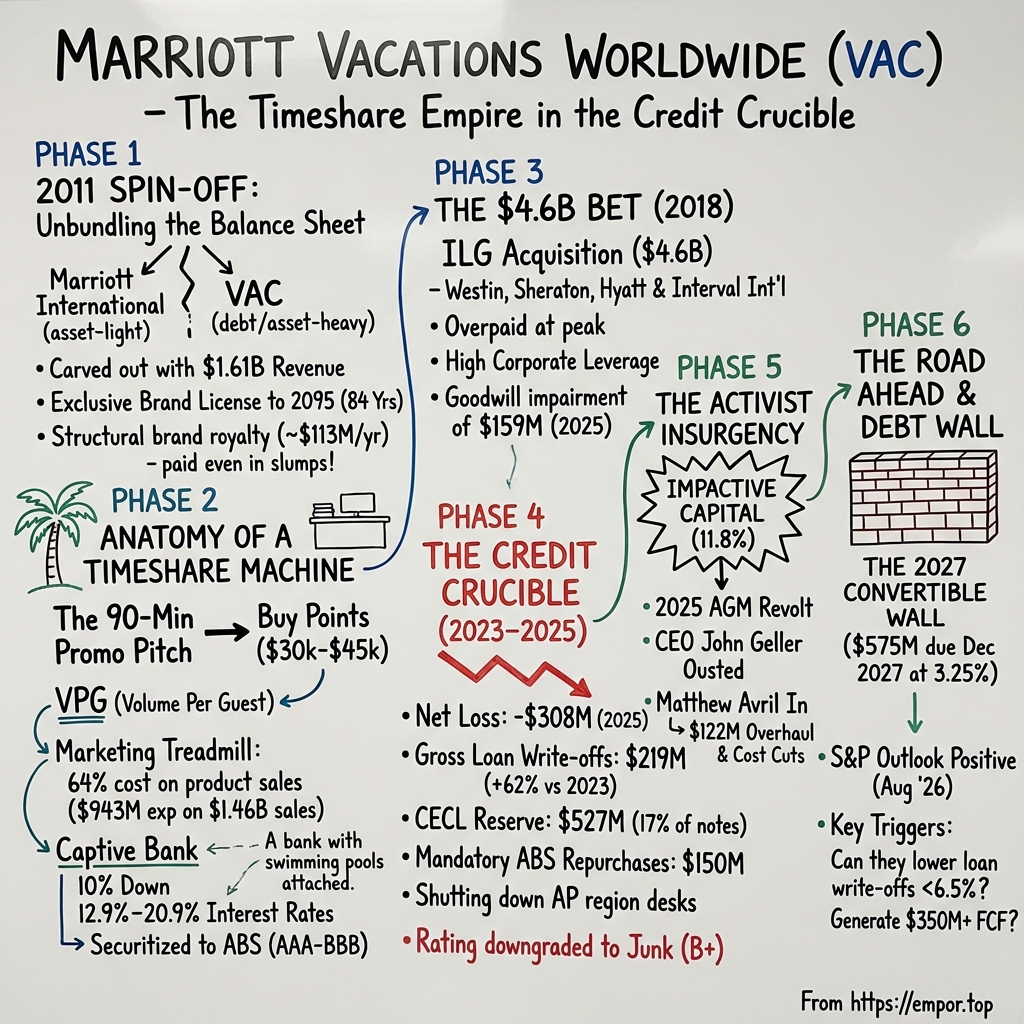
That transaction is the heartbeat of Marriott Vacations Worldwide, the New York Stock Exchange company that trades as VAC. In 2025 it reported about $5.0 billion of revenue across resorts carrying the Marriott, Westin, Sheraton and Hyatt names, roughly three times what it booked when Marriott International set it free in 2011.12 And yet the same year ended with a net loss of about $308 million, a credit downgrade by S&P Global Ratings deeper into speculative grade at B+, and a chief executive shown the door after an activist hedge fund had taken a seat in the boardroom.134
How does a company with some of the most desirable brands in travel end up there? The answer starts with a misunderstanding about what VAC actually is. It looks like a hotel company. It is really four businesses wearing a hotel company's uniform. It is a real estate developer that builds or buys resort villas and sells them in slices. It is a consumer lender that finances a large share of those slices and then packages the loans into bonds. It is a property manager that runs the resorts on behalf of the owners' associations and collects fees for doing so. And through Interval International, it is an exchange network that lets owners of thousands of unrelated timeshares trade their weeks.1 The marquee logo sits on top. Underneath is a balance sheet that behaves more like a specialty finance company than an innkeeper.
Four questions run through this story, and each of them is still open on October 28, 2026.
The first is about credit. Between 2023 and 2025, VAC's annual write-offs of bad timeshare loans rose by more than 60%, and the company had to buy defaulted loans back out of its securitization trusts year after year.1 Has that wave crested, or has the lending business become permanently less profitable than investors believed?
The second is about cash. VAC spends a remarkable share of every sales dollar simply finding and closing customers, it pays fixed royalties to its brand owners whatever the sales climate, and in 2025 its operating cash flow shrank to almost nothing.1 The new leadership launched a modernization and cost program. Will it restore real cash conversion, or are the costs of selling a product people rarely seek out simply part of the furniture?
The third is about the biggest decision VAC ever made: the roughly $4.6 billion purchase of ILG in 2018.5 That deal brought the Westin, Sheraton and Hyatt timeshare businesses and the Interval International exchange. Seven years later, VAC's auditor flagged the value of the exchange business as a critical audit matter and the company wrote down another $159 million of goodwill.1 Did the deal create value, and can anyone still rescue the piece that is shrinking?
The fourth is about the calendar. On December 15, 2027, $575 million of convertible notes come due, carrying a coupon of just 3.25% that a B+ borrower will not see again in today's market.1 Shareholders already showed they would vote against dilution. How does VAC pay the bill?
The road to those questions runs through five chapters. It begins with the Marriott family deciding, in 2011, that their timeshare business belonged on somebody else's balance sheet. It continues through the consolidation race that saw VAC swallow ILG. It opens up the cash engine to show why profits and cash so rarely agree. It walks through the credit shock of 2023 to 2025. And it ends in the boardroom, where Impactive Capital helped turn a slow-motion disappointment into a change of command.64
A note on posture before the story starts. VAC's managers, past and present, have plenty to say about recovery, and some of the early 2026 evidence is genuinely encouraging. The task here is to weigh those claims against what the company's own record shows, and to be plain about where the record supports management and where it does not.
 Subscribe on LinkedIn
II. The 2011 Spin-Off: Unbundling Bill Marriott’s Balance Sheet
On November 21, 2011, Marriott International announced that it had completed the spin-off of its timeshare business, distributing shares of a new company, Marriott Vacations Worldwide, to its own stockholders.2 J.W. "Bill" Marriott Jr., the son of the company's founder and still its chief executive at that point, had overseen the timeshare business since Marriott bought its way into the industry in 1984.7 Now he was handing it to the public markets, with Arne Sorenson, his chosen successor, in the wings.
It is tempting to read the spin-off as a liberation story: a fast-growing division finally freed from a corporate parent that did not understand it. The record supports a less romantic reading. The deal was at least as much about what Marriott International wanted to get rid of as about what VAC was being given.
Consider the problem from Bethesda. By the late 2000s, Marriott had become a company that mostly did not own hotels. It signed management contracts and franchise agreements, collected fees, and let other people's capital buy the buildings. Investors paid generous multiples for that kind of fee stream because it needs little capital and is relatively steady. The timeshare unit was the opposite. It tied up money in half-built resorts and unsold villas, it carried a large book of consumer loans, and its earnings swung hard with the economy. The financial crisis had just demonstrated that last point with brutal clarity, when timeshare buyers vanished and lending markets froze. Keeping that business inside the parent dragged down the whole company's valuation and blurred the asset-light story Marriott wanted to tell.
So the split was drawn with care. Marriott International kept the hotel brands, the management and franchise contracts, and the loyalty program that later became Marriott Bonvoy. VAC took the resorts, the sales galleries, the inventory, the owner relationships and the receivables, which is to say the capital, the cyclicality and the credit risk.7 At birth it had about $1.61 billion of revenue.78
What VAC did not take was ownership of the name on its front door. Instead, it signed a license to use the Marriott brand for vacation ownership that runs to 2095, a term of more than eighty years.1 For a timeshare developer, that license is close to everything. The brand lowers the cost of persuading a stranger to sit through a sales presentation, gives buyers confidence that the villa will be well run, and connects the product to the hotel loyalty program that feeds VAC its prospects.
The price of that license is the part of the bargain that deserves more attention than it usually gets. VAC pays its brand owners royalties that combine fixed annual amounts, adjusted for inflation, with variable fees tied to sales.1 After the ILG deal brought Hyatt into the family, those payments to Marriott and Hyatt together ran to about $117 million in 2023, $114 million in 2024 and $113 million in 2025, roughly 2% of total revenue and close to 8% of vacation ownership product sales.19
The striking thing about those three numbers is how little they moved. Across a period when VAC's profits went from comfortably positive to a large loss, the royalty bill barely budged.1 That is what a largely fixed license fee does. In good years it looks like a modest tax on a valuable brand. In bad years it behaves like rent on a store whose customers have stopped coming. An independent developer facing a sales slump can cut its marketing and branding spend. VAC can cut its marketing, but it cannot negotiate down the fee for the right to say "Marriott."
There is one more twist in the ownership story that is easy to miss. The Marriott family did not walk away entirely. JWM Family Enterprises, the family's investment vehicle, still held about 5.8% of VAC's stock as of the 2026 proxy, making it one of the company's larger holders.10 The family kept the hotel company and a slice of the timeshare company, while letting public shareholders carry most of the cyclical risk.
The first decade under Stephen P. Weisz, the longtime Marriott executive who ran VAC from the spin-off until the end of 2022, was mostly a quiet success.1 Weisz and his team pushed the business away from the old model, in which a buyer owned a particular week at a particular resort, the classic "Week 28 in Maui," toward points. In a points system the buyer owns an interest in a trust that holds many resorts, receives an annual allotment of points, and spends them on whatever location and season they like. Points are easier to sell because they are flexible, and easier for the developer to manage because inventory can be added to the trust as needed rather than built resort by resort and sold out in fixed slices.
The approach worked well enough that revenue kept rising, and the company's loan securitizations kept earning strong ratings from the agencies that grade them.1 Over the long run the data also show something less flattering: in its first years as an independent company, VAC was a $1.7 billion to $1.8 billion revenue business that grew in single digits a year.18 It needed something bigger to change its scale.
So the verdict on the spin-off is a split one. For Marriott International, it was a clean win: the parent shed a capital-hungry, credit-sensitive business, kept the brand and collected a royalty stream that does not depend on how many villas sell. For VAC, it created a company with an enviable brand and a long runway, but one handcuffed to a fixed cost that does not flex down. That asymmetry, where one side holds the brand and the other holds the balance sheet, sits under everything that follows. And in 2018 VAC decided the way to outgrow it was to buy a rival with brands of its own.
III. The $4.6 Billion Bet: Swallowing ILG and the Trap of Consolidation
On April 30, 2018, VAC announced it would buy ILG, the company formerly known as Interval Leisure Group, in a cash-and-stock transaction valued at around $4.6 billion including debt; the deal closed on September 1, 2018.5 It was the biggest move in VAC's history, and it more than doubled the size of the company overnight.
To understand why VAC wanted ILG so badly, it helps to understand what ILG had become. For decades ILG's core was Interval International, an exchange network. A family that owned a week at an independent resort in, say, the Smoky Mountains could deposit that week with Interval and swap it for a week somewhere else, paying a membership fee and a transaction fee for the privilege. Interval was the second-largest network of its kind, behind RCI.1 Then, in 2016, ILG bought Vistana, the timeshare business that had belonged to Starwood Hotels, which brought with it the Westin and Sheraton vacation clubs. ILG also held the licenses to develop and sell Hyatt-branded vacation ownership.1
That made ILG the prize in an industry going through a land grab. The big hotel companies had decided, one by one, that they did not want timeshares on their own books. Wyndham separated its hotels from its timeshare arm, which became Travel + Leisure Co. Hilton spun off Hilton Grand Vacations, which later bought Diamond Resorts and Bluegreen Vacations to bulk up.11 The result was a small group of branded timeshare giants competing for the same luxury beachfront and the same pool of travelers who could afford a five-figure purchase. Scale mattered in that race, because a bigger company could spread its sales technology, its marketing machine and its securitization program over more volume.
VAC's pitch to its investors was about exactly that. Combining Marriott, Westin, Sheraton and Hyatt inventory would give owners more places to go, give the sales force more to sell, and create savings from merging two corporate headquarters. Interval, meanwhile, would add a stream of recurring, high-margin fees that did not depend on selling another villa.
In one sense the bet paid off. Revenue jumped from about $3.0 billion in 2018 to about $4.3 billion in 2019, and after the pandemic interruption it climbed to about $5.0 billion by 2024.18 VAC had become one of the largest vacation ownership businesses in the world, with the Hyatt license to 2093.1 It added another piece in April 2021, paying roughly $430 million for Welk Resorts to extend the Hyatt brand along the West Coast.1
But size is not the same as value, and the balance sheet shows what the deal cost. Before ILG, VAC carried a bit over $1 billion of debt against about $1 billion of shareholders' equity. After the deal, borrowings rose to around $3.8 billion, and they have kept climbing to about $5.8 billion by the end of 2025, while equity has drifted down to about $2.0 billion.18 Some of that debt is the non-recourse securitization borrowing that naturally grows with the loan book, which the story returns to later. But a large part is ordinary corporate debt, and it is that corporate leverage that later put VAC on the wrong side of the rating agencies.
The more pointed test of the ILG thesis is what happened to the asset that was supposed to supply recurring fee income. Interval International, by the company's own reporting, has been shrinking. Revenue from customers outside VAC's own system fell from about $262 million in 2023 to about $213 million in 2025, a drop of nearly a fifth in two years. Over the same period the segment's adjusted EBITDA, its profit before interest, tax and non-cash charges, fell from about $130 million to about $91 million, a decline of about 30%.1
Why? The exchange model was built for an era when owners held fixed weeks and needed a middleman to trade them. The industry's own move to points systems, which VAC itself championed, lets owners swap within a developer's own network without paying an outside exchange. Meanwhile the pool of independent resorts that feed Interval is ageing. In plain terms, the dominant developers have been internalizing the trading that Interval used to broker, and VAC is one of those developers.
The accounting caught up in 2025. When a company buys another for more than the value of its identifiable assets, the excess sits on the balance sheet as goodwill, and each year auditors test whether the business is still worth what was paid. In its report on the 2025 accounts, Ernst & Young named the valuation of goodwill a critical audit matter, its formal way of telling shareholders that a judgment was especially subjective and especially significant. VAC took a $159 million impairment on the exchange and third-party management reporting unit, citing a sustained decline in operating performance, which brings the cumulative write-downs on that unit to about $232 million.1 The goodwill charge was part of a larger pile: in total, VAC booked about $577 million of asset and goodwill impairments in 2025.1
It is worth being precise about what a write-down does and does not mean. The cash for ILG was spent in 2018, and the impairment does not take money out of VAC's bank account in 2025. What it does is admit, in the company's own books, that part of what it paid will not come back. It also says something about forecasting. Management's earlier projections for the exchange business supported a goodwill balance that the 2025 results could not.
Weigh the evidence and the ILG verdict comes out narrower than either side usually admits. The thesis that ILG would give VAC scale and brands is intact: Westin, Sheraton and Hyatt are now core parts of the system, and VAC would be a much smaller company without them. The thesis that Interval would be a growing annuity of fee income has been rejected by VAC's own numbers. And the thesis that the deal created value for VAC's shareholders is, at best, unproven. Shareholders' equity has shrunk from about $3.5 billion just after the deal to about $2.0 billion, the corporate debt it introduced is the reason the company's credit rating is now B+, and the most "recurring" piece of the purchase is the one being written down.
Still, a skeptic should not stop at the goodwill line, because the place where VAC actually makes or loses money is not the exchange. It is a much stranger machine that sits behind the sales gallery doors.
IV. The Secret Machine: Anatomy of a Vacation Ownership Cash Engine
Go back to the Orlando lobby, and follow the family into the preview center. The setting is designed to sell a feeling: a model villa with a balcony, a pool glinting below, a sales executive who knows exactly how many points it takes to bring three generations to Maui for a week. The family came for the free points and theme park tickets. The company spent real money to get them in the room, and it will spend a lot more paying the commission if they buy.
To see how that room connects to a $5 billion income statement, it helps to take VAC's 2025 revenue apart. There were five pieces.1
The largest, at about $1.7 billion, was something called cost reimbursements. It is the least interesting line economically and the most misleading optically. VAC manages resorts on behalf of the owners' associations, the homeowners' groups that technically own the common property. When VAC pays the housekeepers, the pool maintenance crews and the front desk staff, the associations reimburse it, and accounting rules require VAC to book those reimbursements as revenue and the matching costs as expense. The margin on that $1.7 billion is essentially zero.1 Strip it out and VAC is really a business of about $3.3 billion of revenue, not $5 billion, which matters every time someone quotes its price-to-sales ratio.
The second piece, about $1.5 billion, was the sale of vacation ownership products, the actual timeshare sales.1 This is the transactional engine and the most cyclical line, because it depends on how many people tour, how many of them buy and how much they spend.
The third, about $860 million, was management and exchange fees: what VAC earns for running the resorts on behalf of roughly 700,000 owner families, plus the club dues and Interval's exchange fees.1 This is the closest thing VAC has to an annuity. Owners pay maintenance fees whether or not they travel, and the management contracts with the associations run for years and generally renew.
The fourth, about $650 million, was rental revenue: renting out villas that are unsold or that owners have handed back for a season, often through Marriott's own booking channels.1
The fifth, about $360 million, was financing revenue: the interest on VAC's book of loans to timeshare buyers.1 It is the smallest line, and yet it is the one that will dominate the next chapter of this story.
Now look at what it costs to make that second line happen. VAC's marketing and sales expense in 2025 was about $943 million, up from about $823 million two years earlier. Set against $1.46 billion of product sales, that is roughly 64 cents of selling cost for every dollar of timeshares sold.1 For comparison, a typical consumer brand might spend a tenth to a fifth of revenue on marketing. VAC spends more than half.
The industry has a reason for this, and it is not mere extravagance. Almost nobody wakes up wanting to buy a timeshare. The product has to be put in front of people at the moment they are enjoying a vacation, explained at length, and closed in person, and every step of that funnel costs money: the free stays and loyalty points that bring families in, the staff who run the tours, the commissions that reward the closers. The key industry metric captures this. It is called volume per guest, or VPG, and it measures how much in sales each tour generates on average, combining how often tours close with how large each purchase is. When VPG falls, the fixed costs of running the tour machine eat the margin almost immediately.
What that cost ratio tells an investor is simple and uncomfortable. The product does not sell itself, and there is little sign that brand strength has lowered the price of selling it. Over the two years to 2025, marketing and sales spending rose by about 15% while total revenue grew by only about 6%.1 If the brand moat were widening, the funnel should be getting cheaper to run, not more expensive.
So where does the profit come from? Part of it comes from the margin left after the product is sold, which depends heavily on the accounting for what each villa cost to build, a judgment Ernst & Young also flagged as a critical audit matter because it relies on assumptions about future prices.1 A larger and steadier part comes from the management fees. And part comes from the loans.
That brings up the puzzle every VAC analyst eventually trips over. In 2025 VAC reported a net loss of about $308 million but generated about $28 million of operating cash flow. In 2024 it reported about $218 million of net income and about $205 million of operating cash. Over the twelve years from 2014 to 2025, cumulative operating cash flow of about $2.8 billion was more than two and a half times cumulative net income.18 On the surface that looks like a company whose cash routinely outruns its profit. Look closer and the picture is subtler.
The trick is where the loans sit. When VAC lends a buyer money to purchase a timeshare, that loan is treated as part of operating activity, so new lending shows up as a cash outflow in operating cash flow. When buyers make their monthly payments, that comes back as an inflow. In 2025, VAC originated about $1.03 billion of new loans and collected about $679 million of principal, a net operating drain of about $351 million.1 But VAC funds most of those loans by bundling them into asset-backed securities, and that borrowing is recorded in a different section of the cash flow statement entirely, under financing. In 2025 VAC raised about $1.40 billion from securitizations and repaid about $1.39 billion.1
The analogy is a bakery that counts the flour it buys as operating cost but books the bank loan it used to buy the flour somewhere else. When VAC grows its loan book, reported operating cash flow looks starved. When lending slows, it looks flush. Neither number on its own is the true cash generation of the business.
Read the 2025 gap through that lens and it decomposes cleanly. The large impairments, about $577 million, were non-cash and so explain why the loss was so much worse than the cash. The provision for future loan losses, about $222 million, was also a non-cash charge. Pulling the other way were the $351 million net loan origination drain, about $113 million spent on inventory and development, and a deferred tax benefit of about $103 million.1 The headline loss overstates the economic damage. But the near-zero operating cash flow is not purely an artifact either. It reflects a business that was originating loans faster than it was being repaid, and setting aside more for bad ones.
Here is the line that the cash flow statement makes hard to ignore. In 2025 VAC paid about $110 million in dividends and spent another $61 million buying back stock, while its operating cash flow after capital spending was slightly negative.18 For one year, that is a timing question. As a habit, it would be a balance sheet question.
The verdict on the machine, then, is more specific than "timeshares are a great business" or "timeshares are a bad business." VAC's reported revenue is inflated by $1.7 billion of pass-through. Its sales engine consumes nearly two-thirds of what it sells. Its most dependable profit comes from managing what it has already sold. And a meaningful slice of its economics depends on lending money to people on vacation, at interest rates the next section explains, which works beautifully right up until those people stop paying.
V. The Subprime Vacation: Underwriting, FICO Gaps, and the $219M Write-Off Wave
Imagine the credit committee meeting at the close of 2025. On the table is a book of about $3.1 billion of loans to people who bought vacation ownership.1 The headline statistics were not alarming at first glance. Most of the borrowers were domestic customers with good credit scores, and most of them were paying on time. Then came the slides about the parts of the book that were not paying, and about the trusts where VAC had to step in and buy back loans that had gone bad.
Start with how the lending business is supposed to work, because it is a genuinely elegant machine when it runs well. A buyer puts down a portion of the price, usually around a tenth, and finances the rest with VAC over about ten years. The weighted average interest rate on VAC's book was about 12.9%, with some loans as high as 20.9%.1 VAC then pools thousands of those loans into a trust and sells bonds backed by the payments. Because the bonds are structured in layers, with the top layers paid first, the senior slices earn ratings as high as AAA from Fitch even though the underlying borrowers are ordinary consumers.12 Those bonds pay investors far less than the 12.9% the buyers pay VAC. The difference, after losses, is VAC's profit.
The analogy is a small bank that lends to its own customers at credit-card-like rates and funds itself at something closer to mortgage rates. It is a very good business as long as the loans perform as modelled. The problem is that every assumption in that sentence is about consumer behavior.
Between 2023 and 2025 the assumptions started to slip. VAC's allowance for credit losses, the reserve it holds against expected defaults across the life of the loans, rose from about $362 million at the end of 2022 to about $527 million at the end of 2025. By then the reserve equalled about 17% of the gross loan book, up from about 15% at the end of 2023.1 Put differently, VAC's own accountants now expect roughly one dollar in six of its timeshare loans not to come back.
Reserves are estimates. Write-offs are the actual bodies. Annual gross write-offs, loans VAC gave up on, climbed from about $135 million in 2023 to about $199 million in 2024 and about $219 million in 2025, an increase of more than 60% in two years.1 Divided by the average loan book, the 2025 figure works out to a charge-off rate of a little over 7%. At year-end, about $279 million of loans, roughly 9% of the book, were past due, and about $156 million were more than 120 days behind.1
Who stopped paying? VAC discloses the credit scores of its borrowers, and the breakdown is revealing. About 61% of the book was owed by borrowers with FICO scores of 700 or above, about 24% by borrowers between 600 and 699, and 2% by borrowers below 600. The remaining 13.7%, about $415 million, carried no score at all.1 Most of those no-score borrowers are international buyers, for whom no U.S. credit history exists, and VAC itself identified them as the group where defaults spiked.1
There is a second fault line inside the customer base. Roughly 70% of VAC's sales come from existing owners buying more points, and they tend to be reliable borrowers because they already know and use the product. The other 30% or so come from first-time buyers, and that group is where the higher default rates sit.1 The pressure on a sales force to grow, in other words, runs directly into the riskiest part of the funnel. A sales desk that needs new names pushes harder on first-timers and on international visitors, and the loan book quietly takes on the consequences one or two years later.
That is the most plausible explanation for what happened. In the post-pandemic travel boom, when resorts were full and tour flow was strong, VAC sold aggressively into channels it had not stress-tested through a downturn. The Asia Pacific business is the clearest example. The company said it shut down underperforming sales operations there in the fourth quarter of 2025, part of the restructuring that accompanied the leadership change, because buyers recruited there were defaulting at elevated rates.1[^13] Closing the desks admits the problem but does nothing about the loans already written. Those stay on the book until they are paid off or charged off.
The structure of the securitizations was supposed to protect the company from all this. The bonds are non-recourse, meaning the investors who buy them can look only to the loans in the trust, not to VAC's corporate assets, if borrowers default. In theory, if the loans in a trust go bad, the bondholders take the loss.
In practice VAC behaves differently, and the reasons are commercial rather than legal. The trust agreements allow VAC to repurchase or substitute defaulted loans, and VAC has done so heavily: about $105 million of defaulted notes bought back in 2023, about $151 million in 2024 and about $150 million in 2025.1 Keeping the trusts clean keeps their performance metrics within the triggers that protect bondholders and keeps the ratings on future deals strong. A developer whose trusts started tripping performance triggers would find that the next securitization costs more, or does not get done at all. So the non-recourse label is real in a courtroom and partly fictional on a cash flow statement. When borrowers stop paying, VAC's corporate cash steps in.
There is a fair counterpoint, and the bulls are right to raise it. A defaulted timeshare loan is not like a defaulted credit card. When a buyer stops paying, VAC gets the vacation ownership interest back and can sell it again, often to a new buyer, at a product cost far below the original price. Some of the economic loss on a write-off is therefore recovered through future sales of the same inventory. That mechanism is why the industry has historically been able to live with default rates that would horrify a mortgage lender. But it does not make defaults free. Recycled inventory still has to be marketed and sold through the same expensive sales funnel, and a rising flow of repossessions can depress pricing.
One more front in this war deserves a mention, because it shapes the default numbers. A cottage industry of so-called timeshare exit companies markets itself to unhappy owners, and some of these firms advise clients to stop paying their loans and maintenance fees as a negotiating tactic. VAC has spent heavily fighting them, recording about $17 million of litigation charges in 2025, after about $23 million in 2024 and $13 million in 2023, much of it directed at deceptive exit schemes and consumer arbitration.1 That is a small number against the size of the loan book, but it is a signal: some fraction of VAC's credit problem is not about borrowers' ability to pay, but about third parties persuading them they do not have to.
So has the default wave peaked? The evidence for the optimists is real but thin. The annual provision for loan losses fell to about $222 million in 2025 from about $279 million in 2024, suggesting management believes it has caught up with the problem, and the worst channels have been closed.1 The evidence against is larger: write-offs set a new record in 2025, buybacks from the trusts stayed near $150 million, and the no-score slice of the book remains sizable.1 On the record so far, the claim that credit has normalized is unproven. The figure that will settle it is the gross charge-off rate in the 2026 annual report. If it falls back toward the low-to-mid single digits, the underwriting repair will have worked. If it stays above 7%, the 12.9% loans are not earning the spread the business model assumes.
A deteriorating loan book, a shrinking exchange business, a stagnant sales line and a loss-making year would test any management team. At VAC, they set off something the company had never experienced: a shareholder who decided to come inside.
VI. The Impactive Insurgency: An Activist Crashes the Boardroom
On November 10, 2025, VAC's board asked its chief executive to leave. John E. Geller Jr. resigned that day at the board's request, and with him went Brian Miller, the president of the vacation ownership business, and James Hunter, the general counsel.410 In his place the board installed Matthew E. Avril, a veteran of the industry who was already sitting on VAC's board, as interim chief executive.4 The same announcement unveiled a business transformation program and the retreat from Asia Pacific.[^13] It was the most abrupt change of command in the company's fourteen years of independence, and it did not come out of nowhere.
Geller was, in many ways, the logical heir. He had spent years as VAC's chief financial officer before taking over as chief executive in January 2023, succeeding Weisz.1 He knew the securitization machine and the balance sheet better than anyone. He also took the job at precisely the wrong moment. The post-pandemic surge in travel was cresting, tour flow and sales productivity were softening, and on August 8, 2023, wildfires devastated Lahaina on Maui, close to some of VAC's most profitable Hawaiian resorts.1 The wildfire disrupted operations for months; by 2025 the company was still collecting insurance recoveries for the interruption, about $15 million that year.1
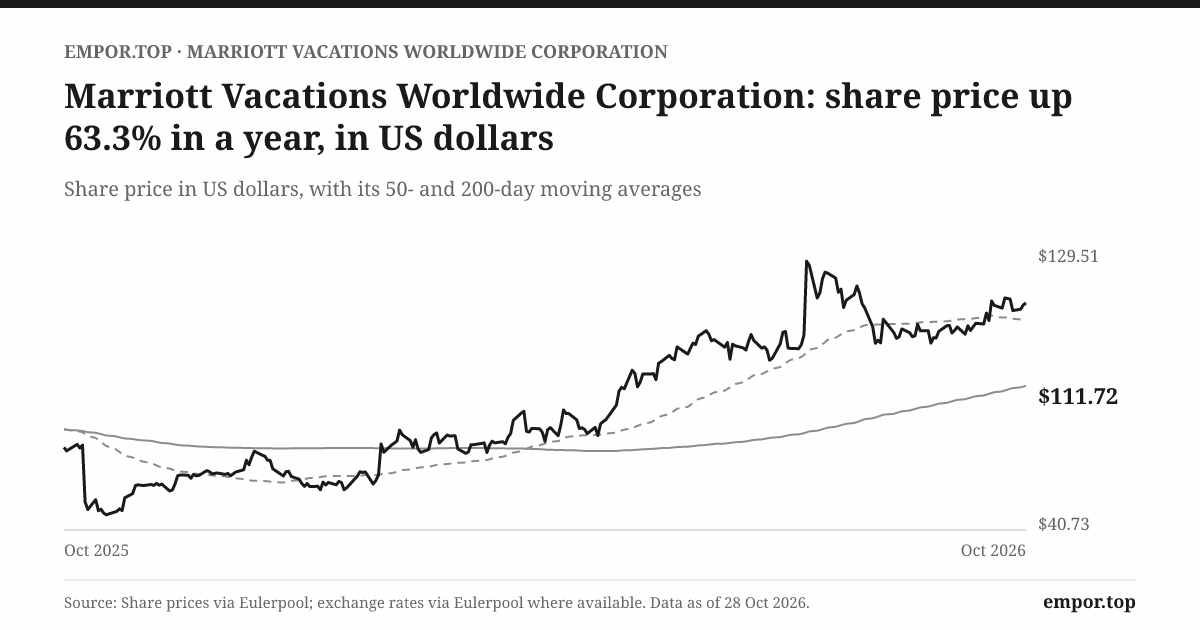
The numbers under Geller tell the story his critics told. Revenue grew at only about 2.6% a year between 2022 and 2025, against a historical pace closer to 9%.1 Net income fell from about $391 million in 2022 to about $254 million in 2023, about $218 million in 2024, and then the large loss of 2025.1 The share price, which had peaked in the post-pandemic rally, suffered a peak-to-trough fall of about 74% over five years, and within the last twelve months it touched about $45.1
Into that slide stepped Impactive Capital, the New York investment firm run by Lauren Taylor Wolfe and Christian Asmar.13 Impactive's style is unusual among activists. It runs a concentrated portfolio of a handful of companies, and it likes to describe its approach as constructive engagement rather than public warfare. At VAC, it built a stake of about 4.05 million shares, roughly 11.8% of the company, making it nearly as large a holder as BlackRock.1310
The governance landscape it found was striking. Excluding Impactive's own holdings, all of VAC's directors and executive officers together owned less than about 1.3% of the company's stock.10 The people running and overseeing VAC had, in aggregate, very little personal capital at stake in its fortunes. That is not unusual for a large public company. But it meant there was no meaningful insider block to counterbalance an outside owner holding nearly a twelfth of the shares, plus a few large index funds that typically vote with whichever argument seems most credible.
The signal from the wider shareholder base came at the annual meeting on May 13, 2025. Geller was re-elected, but about 1.91 million shares were withheld from his election.14 It is worth being careful about how big that was. It was a visible protest, but a minority one, far from the kind of majority rebuke that topples a chief executive by itself. What mattered more was what came next. On May 27, two weeks later, VAC signed a support agreement with Impactive and appointed Asmar to the board.6 A settlement like that is how most activist campaigns end now: the company avoids a proxy fight, and the activist gets a seat at the table and a voice in the strategy.
Six months after Asmar joined, Geller was gone. The company has not published a detailed account of the board's deliberations, so anyone who claims to know exactly who pushed for what is guessing. But the sequence is clear: an activist with a large stake joined in May, the business deteriorated through the summer, S&P downgraded the credit in November, and the chief executive left at the board's request the same month.643
The pay that accompanied that exit became its own controversy. Geller's total reported compensation rose from about $5.4 million in 2023 to about $7.4 million in 2024, and then to about $14.3 million in 2025, the year the company lost money.10 Of the 2025 figure, about $6.5 million came from separation payments, including about $5.1 million of cash severance equal to two years of salary plus bonus, and a prorated bonus of about $1.3 million.10 Those payments followed the terms of his existing arrangements rather than being a fresh gift from the board, and a company that dismisses its chief executive usually has to pay something. But the optics were brutal, and they fed a broader suspicion that VAC's pay architecture rewarded tenure more than results.
That suspicion showed up again a year later. At the May 15, 2026 annual meeting, shareholders were asked to approve 2.5 million more shares for the equity incentive plan. The plan passed, but about 7.83 million shares voted against it and about 17.44 million voted for, meaning about 31% of the votes cast opposed the request.15 For a routine compensation proposal, that is a loud dissent, and it is the clearest sign yet that a large part of VAC's investor base is unwilling to finance its turnaround by issuing new stock.
Matthew Avril is a telling choice to lead that turnaround. He has spent most of his career in the hospitality and vacation ownership business, and he has run Diamond Resorts, a large timeshare company that Hilton Grand Vacations later absorbed.10 He had also sat on VAC's own board, so he arrived knowing the company's numbers. The board removed the interim tag on February 16, 2026, making him permanent chief executive; his reported compensation for 2025, mostly for his weeks as interim chief and his board service, was about $4.0 million.10 Jason Marino stayed on as chief financial officer.10
The Avril playbook, so far, has been a classic retrenchment. Headcount fell from about 22,300 at the end of 2024 to about 21,100 at the end of 2025, a cut of about 5%.1 Spending on property, plant and equipment was held to about $57 million in 2025, half the level of 2023.1 The company sold non-core assets, including a hotel in Cancun.1 And it launched what it calls its strategic business operations program, an overhaul of corporate overhead and the sales organization on which it has spent about $122 million in advisory and transition costs.1[^13]
That last figure deserves scrutiny. Restructuring programs are easy to announce and expensive to run, and the savings usually arrive later than the costs. Management has framed the program as the path to restored margins, but by the end of 2025 shareholders had seen the bill, not the benefit. There is also a subtle tension in the capital spending story. While equipment capital spending was cut, VAC spent about $140 million in 2025 buying and developing property that will become future timeshare inventory, up from about $10 million in 2024.1 Whether that is disciplined restocking ahead of a sales recovery or a quiet return to the old habit of spending ahead of demand will only become clear when those villas are sold.
So what does the activist's arrival change for an investor? It changes accountability more than it changes the business. A board that has already fired one chief executive for missing the mark will be quicker to judge the next one. It also aligns the board's loudest voice with per-share value rather than with size or prestige. But Impactive does not control VAC, and an activist with a large stake has its own timetable. The real test of the new regime is not the personnel changes, which are done, but what it does about the balance sheet, which is where the clock is ticking loudest.
VII. The 2027 Convertible Wall: Refinancing in a Junk-Rated World
In August 2026, analysts at S&P Global Ratings sat down with VAC's second-quarter numbers and liked what they saw. Contract sales, the industry's measure of timeshare sales signed before accounting adjustments, had risen about 22% from a year earlier. The agency affirmed its B+ rating and moved the outlook from negative to positive, a signal that an upgrade was possible if the recovery held.3 It was the first good news from the rating agencies in a long time, and it came with a warning attached, because S&P's projection that leverage would fall depended on VAC actually delivering it.
To understand why credit matters so much here, it helps to see VAC's debt as two separate silos that behave very differently.
The first silo is the securitized debt, about $2.15 billion at the end of 2025.1 It is the bonds issued by the bankruptcy-remote trusts that hold timeshare loans, and it is repaid from borrowers' monthly payments. It is rated by agencies such as Fitch on the quality of the loans, with senior slices at AAA and junior slices down to BBB-, investment grade throughout.12 Because this debt is matched to specific loans and largely self-liquidating, it grows and shrinks with the loan book, and most analysts treat it as part of the operating business rather than as corporate leverage. VAC's repurchases of defaulted loans are the reason that treatment deserves a caveat, but the logic broadly holds.
The second silo is the corporate debt, and it is what determines the B+ rating. At the end of 2025 it totaled about $3.53 billion.1 It included a term loan of about $780 million due in 2031, senior unsecured notes due in 2028, 2029 and 2033, two issues of convertible notes, and finance lease obligations, with nothing drawn on an $800 million revolving credit line.1
Convertible notes are the piece of this structure that deserves a moment of explanation. A convertible is a bond that the holder can swap for shares if the stock price rises above a set level. Because investors get that upside option, they accept a much lower interest rate than on an ordinary bond. VAC issued them when its stock was high and money was cheap. The first batch, about $575 million, carried no coupon at all and came due in January 2026. The second, also about $575 million, pays 3.25% and matures on December 15, 2027, with a conversion price of about $187.91 a share.1
The 2026 notes were the first test, and VAC passed it. In the third quarter of 2025, it sold about $575 million of new senior unsecured notes due in 2033, and in January 2026 it used that cash to repay the zero-coupon convertibles at par, without issuing a single new share.111 Corporate debt fell to about $3.1 billion by the middle of 2026.11 This is a fact that should temper the most alarmist reading of VAC's balance sheet: in a difficult year, with its credit rating sliding, the company still found buyers for long-dated unsecured debt.
But notice what the swap cost. VAC replaced debt that paid nothing with debt that pays a market coupon for a speculative-grade borrower. The 2027 convertibles are the second, and harder, version of the same exercise. With the stock at about $112 in late October 2026, well below the $187.91 conversion price, holders have no reason to convert, so VAC will almost certainly have to repay the $575 million in cash or refinance it.1 If the replacement debt carries a rate somewhere around 7.5% to 8.5%, the rough range for a B+ issuer, the extra interest relative to the 3.25% coupon works out to about $25 million to $30 million a year before tax. That is not an existential number for a company with several hundred million dollars of adjusted EBITDA. It is, however, a recurring cost, and it lands on shareholders at exactly the moment the turnaround needs every dollar.
The rating agencies spell out the stakes. When S&P cut VAC from BB- to B+ in November 2025, it pointed to weaker sales productivity, rising loan delinquencies and leverage that had climbed to roughly 7.5 to 8 times its measure of earnings.3 The August revision to a positive outlook rested on a forecast that leverage would fall toward 5.5 times by the end of 2026 and toward 4.5 times in 2027.3 S&P rates VAC's secured bank debt at BB and its unsecured notes at B, reflecting where each layer sits in the queue.3 The bank lenders, meanwhile, hold their own guardrail: a first-lien net leverage covenant of 4.75 times under the credit agreement, with which VAC has reported compliance.1
The company has more room than its headlines suggest. The revolving credit line is undrawn and has been extended to March 2030.1 The 2028 and 2029 notes are smaller than the convertibles. And S&P's positive outlook, if it turns into an upgrade, would lower the cost of whatever VAC issues next. But the margin for error is thin. A fresh wave of loan defaults would hit earnings and cash at the same time, push leverage back up and make the 2027 refinancing more expensive precisely when it has to be done.
There is also the cash pile, which looks larger than it is. VAC ended 2025 with about $733 million of cash, but about $327 million of that was restricted, held in reserve accounts for the securitizations or on behalf of the owners' associations, and cannot be used to pay corporate debt.1 By the middle of 2026, after the convertible repayment, unrestricted cash was closer to $211 million.11 So the 2027 notes will be paid with money VAC either earns between now and then or borrows.
For investors, the refinancing is not a cliff so much as a toll. VAC has shown it can cross this kind of bridge; the January 2026 repayment proved that. The question is how much the toll costs, and that depends almost entirely on whether the credit book and the sales funnel keep improving. Which raises the deeper question that underlies all of these numbers: what, exactly, protects this business from competitors and substitutes in the first place?
VIII. Strategic Moat Analysis: 7 Powers & Porter’s Five Forces
Picture a family planning a vacation to the desert. They could buy into a small independent timeshare in Branson, Missouri, with a modest price tag and a modest brand. They could listen to a pitch from Travel + Leisure, the former Wyndham timeshare arm, in Orlando. Or they could tour a Marriott Vacation Club villa in Palm Desert, where the presentation reminds them that their purchase connects to Marriott Bonvoy, a loyalty program with more than 200 million members.1 For a family that already collects Marriott points, the third option has a gravitational pull the others cannot match. That pull is the core of whatever moat VAC has, and the strategist Hamilton Helmer's framework of seven "powers" is a useful way to measure it.
The strongest power is what Helmer calls a cornered resource: an asset a company controls on preferential terms that competitors cannot easily copy. VAC's cornered resource is its long-term licenses to use the Marriott and Hyatt brands, together with integration into Marriott Bonvoy and World of Hyatt.1 No competitor can sell Marriott-branded timeshares. The licenses give VAC access to a pool of affluent, travel-loving prospects who already trust the brand, which is one of the most expensive things in the timeshare business to acquire.
But a cornered resource that you rent is a weaker thing than one you own. VAC does not hold the intellectual property, Marriott and Hyatt control the brand standards and loyalty program rules, and the royalty is fixed in the way the spin-off chapter described.1 If Marriott ever changed how Bonvoy points could be earned or redeemed through VAC, or tightened brand standards in ways that raised VAC's costs, VAC's funnel would suffer and it would have little leverage to push back. The power is real, but the landlord holds the keys.
The second power is switching costs, and here VAC's position is strong in a way that cuts both ways. Once an owner has paid tens of thousands of dollars for points and committed to annual maintenance fees that can run into the thousands of dollars, leaving is hard. The resale market for timeshares is notoriously illiquid, often valuing interests at a fraction of their original price.1 That lock-in underpins the management fee stream, the steadiest part of VAC's revenue. It is also the source of the industry's reputational problem, the anger that the exit companies exploit, and the reason the most loyal customers can turn into the most motivated defaulters when finances tighten.
The third power, network economies, is where the ILG story bites. Interval's exchange network was a classic network business: more resorts made it more valuable to members, and more members made it more valuable to resorts. That network still exists and still produces an adjusted EBITDA margin of about 43%.1 But it is shrinking as developers like VAC route owners through their own points systems instead.1 It is a power in managed decline.
Scale economies, the fourth power, are modest but real. A company of VAC's size can afford centralized reservation technology, a national sales and marketing machine, and a regular securitization program that lowers its cost of funding consumer loans compared with a small independent developer.12 But the larger rivals have the same advantages, so scale is a defense against the minnows rather than a weapon against peers.
Branding, the fifth power, is VAC's most visible strength and largely borrowed. Consumers attach Marriott's and Hyatt's reputations for consistency and service to VAC's villas. The marketing-cost ratio remains high, which is the honest test of how much that reputation is worth in practice.1 A brand that truly pulled customers in would make the selling cheaper.
The last two powers are largely absent. There is no counter-positioning: VAC is the incumbent, and the newer models that threaten it, short-term rentals on Airbnb and Vrbo, luxury travel subscriptions, plain hotel bookings with loyalty points, compete precisely by asking for no long-term commitment. And there is no distinctive process power: the preview-center sales presentation is standard across the industry, and VAC's version, however polished, is not something rivals cannot replicate.
Michael Porter's five forces sharpen the same picture from the industry's side. The threat of new entrants is low, because building luxury resorts takes capital, timeshare sales are tightly regulated, and almost no newcomer can rent a brand of Marriott's stature. The bargaining power of suppliers, in VAC's case its brand licensors, is very high: the whole model depends on two hotel companies whose interests overlap with VAC's but are not identical.1
Buyer power has an unusual shape. Before the sale it is enormous: prospects have complete discretion, and VAC has to spend close to a billion dollars a year in marketing and sales to persuade enough of them.1 After the sale, it collapses: owners are bound by their deeds, their loans and their association dues, and they have very little leverage over the fees they pay. That is the dual personality at the heart of the business: expensive to win, sticky once won.
The threat of substitutes is high and rising, especially among younger travelers who value flexibility and dislike long-term obligations. And rivalry is that of a tight oligopoly: VAC, Travel + Leisure and Hilton Grand Vacations compete for the same beachfront land, the same families on vacation and the same tour flow, and since Hilton Grand Vacations absorbed Diamond Resorts and Bluegreen Vacations, it has become a heavyweight competitor with brands and scale of its own.11
Weigh all of that and the conclusion is narrower than the brand halo suggests. VAC's moat is real but concentrated in two places, the rented licenses and the switching costs of existing owners. It protects the management fee stream well. It protects the sales engine much less, because the expense of persuading new buyers has not fallen, and it does nothing at all to protect the lending book from a weaker consumer. Those are the pieces of evidence any investor has to carry into the lessons this story teaches.
IX. The Playbook: Durable Business & Investing Lessons
The first lesson begins in Bethesda in 2011, when Marriott International handed the timeshare business to its shareholders but kept the name, the loyalty program and a royalty that runs to 2095.21 In 2025, a year VAC lost more than $300 million, it still paid its brand owners more than $110 million.1 The broader lesson for anyone looking at a spin-off is to follow the brand and the balance sheet separately, because they rarely travel together. When a capital-light parent spins off a capital-heavy child, the parent usually keeps the asset that earns money in every weather and the child gets the asset that needs money in every weather. The line to remember: in a branded spin-off, whoever keeps the logo keeps the leverage.
The second lesson comes from the credit committee's year-end slides. VAC wrote off more than $200 million of timeshare loans in 2025 and bought another $150 million of defaulted loans back from trusts that were supposed to be non-recourse.1 The temptation is to treat that as a temporary blemish on a hospitality company. It is better understood as the normal behavior of the lender that sits inside every timeshare developer. A company that lends to vacationers at about 13% is running a consumer finance book with swimming pools attached, and it should be analyzed with a banker's skepticism about who borrows, at what score, and what happens when they stop paying.
The third lesson is written in the preview center. VAC spent roughly $943 million on marketing and sales to generate roughly $1.46 billion of product sales in 2025.1 When a business must spend nearly two-thirds of what it sells on finding and persuading customers, the selling cost is not overhead; it is the product. The wider lesson for founders and investors is to measure a brand's strength by how cheaply it converts strangers into customers, not by how famous it is. A product that has to be sold rather than bought spends its margin in the funnel.
The fourth lesson belongs to the boardroom in November 2025. A chief executive whose company lost money that year received about $14.3 million in reported pay, including severance, while an activist sat on the board and the stock had fallen to a fraction of its peak.104 Six months later, almost a third of shareholders voted against more stock for the equity plan.15 Activists rarely need to invent a campaign when a company makes the gap between pay and performance visible. When compensation rises as earnings fall, shareholders eventually stop sending polite letters and start sending directors.
The fifth lesson comes from the ILG deal and the write-down of the exchange business seven years later.51 The most expensive assumption in a merger is often the one that seems safest: that a recurring fee stream will keep recurring. Interval's fees were recurring only as long as owners needed an outside exchange, and VAC's own points strategy helped make that need disappear. Buy an annuity from an industry you are changing, and you may be the one who ends it.
X. Analysis & Bear vs. Bull Case
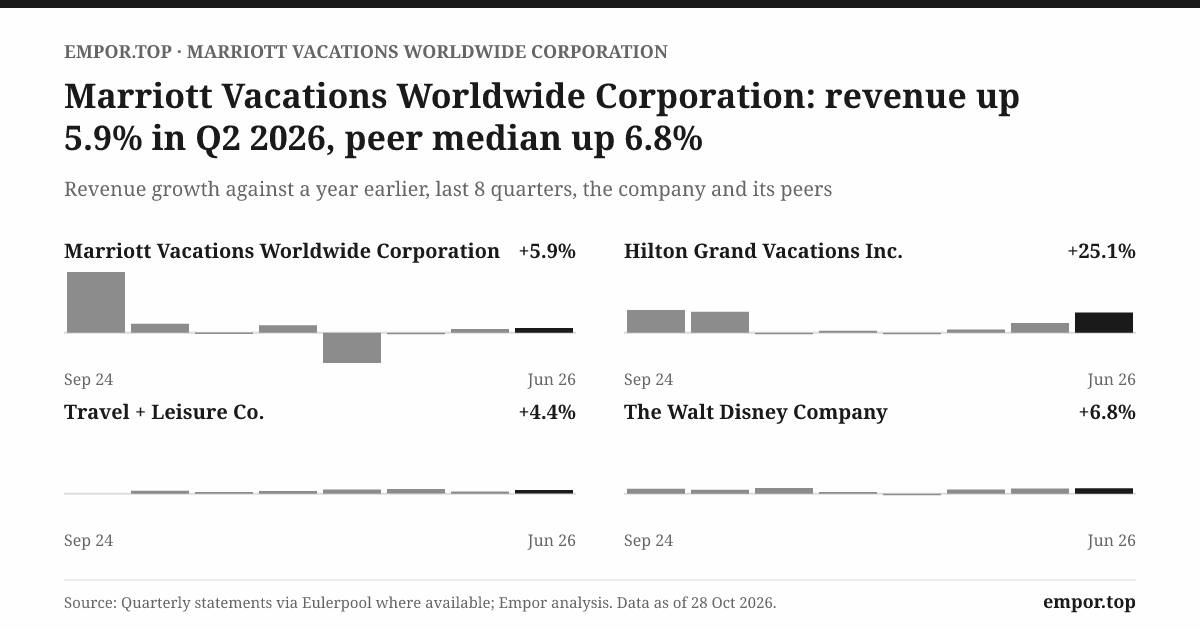
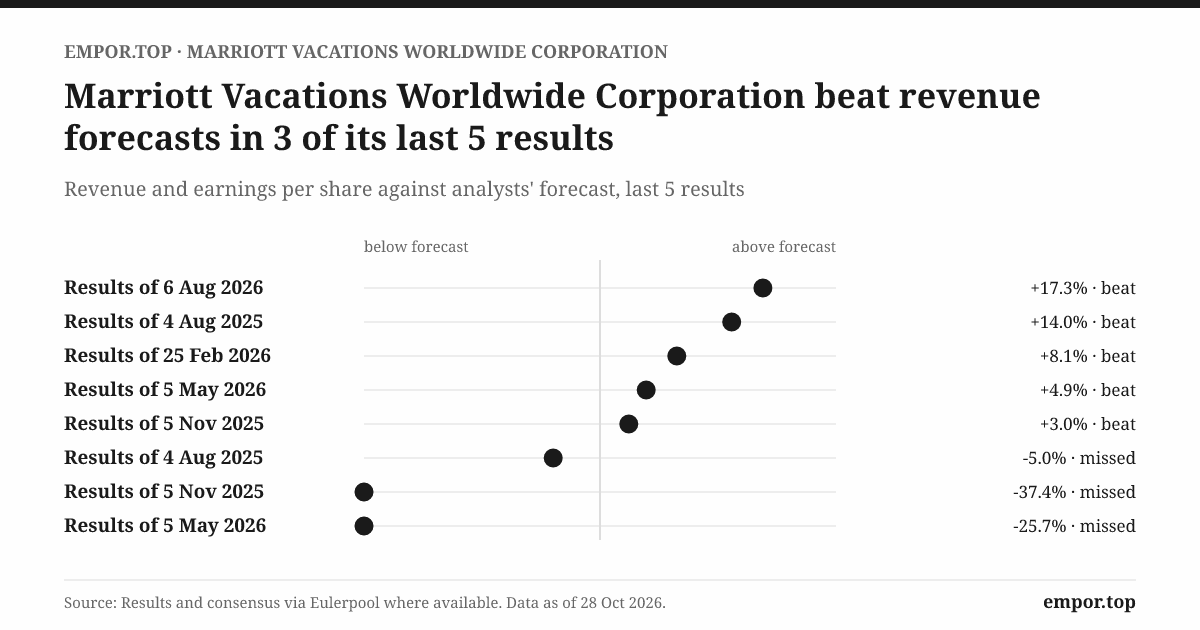
In August 2026, VAC reported a second quarter that would have looked like a turning point on almost any other stock. Contract sales continued to rise, revenue was up about 6%, and quarterly net income of about $77 million was up about 12%.113 Yet when the trading desks debated the stock afterward, the arguments were less about the quarter than about the things the quarter could not yet answer: whether loan losses were really falling, and how the company would pay off its convertibles.
Start with what the market is paying. On October 28, 2026, VAC's shares closed around $112, giving the company a stock market value of roughly $3.8 billion, based on about 34.4 million shares outstanding.11 That is more than double the low of about $45 touched within the past year, a reminder of how violently sentiment has swung.
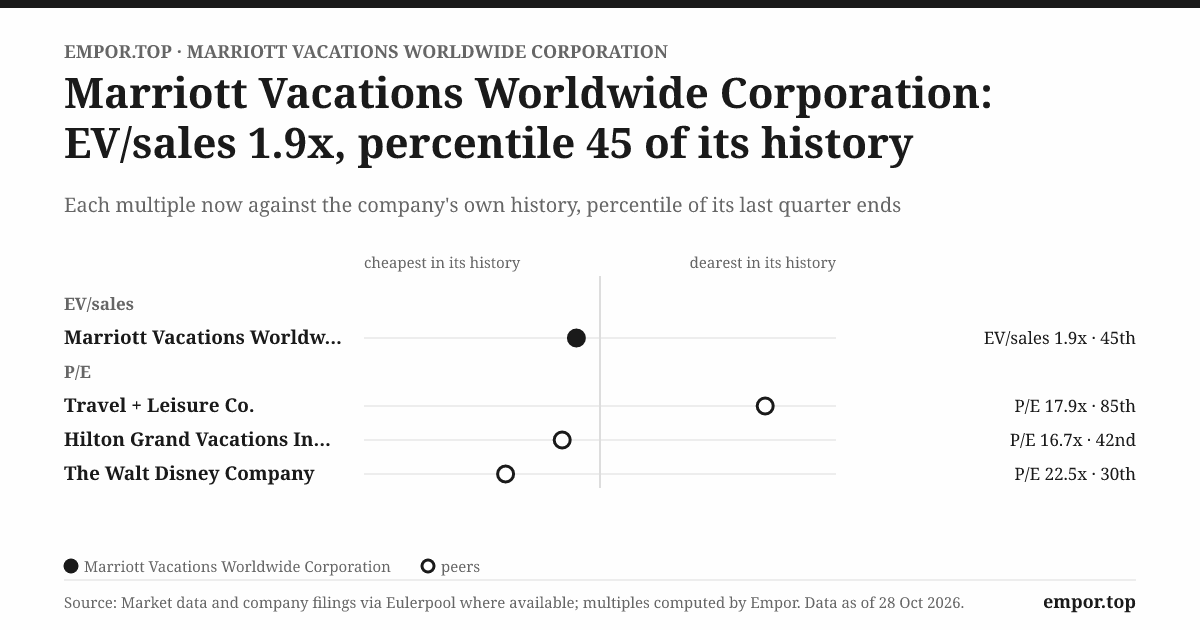
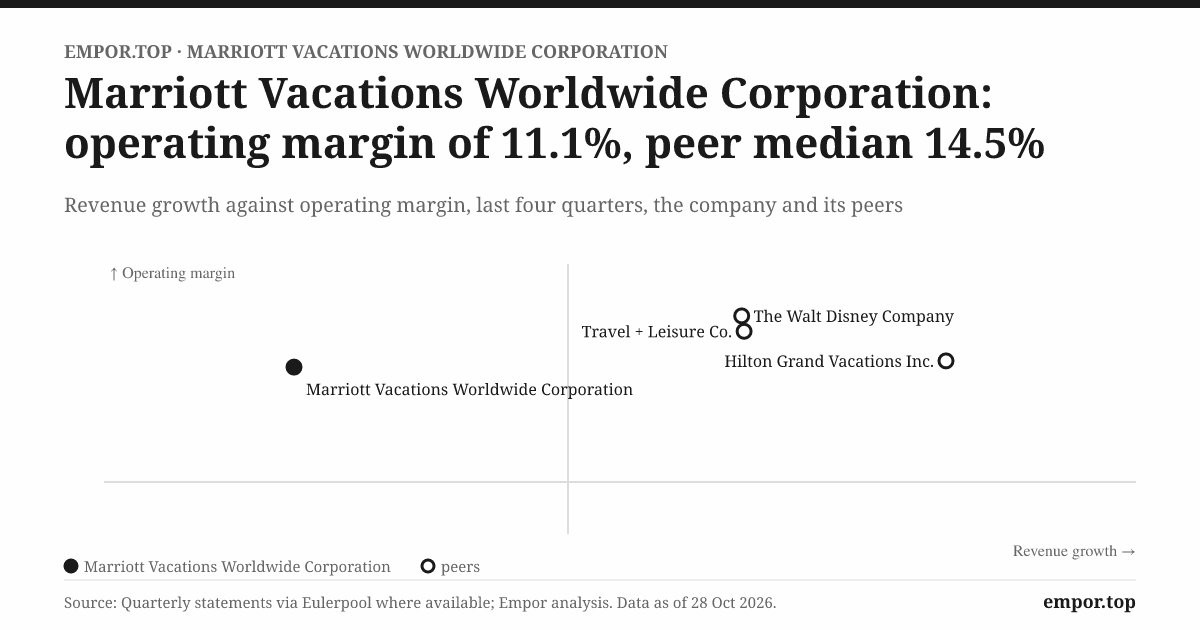
Valuation multiples for a timeshare company are notoriously easy to misread, because of the securitized debt. If that debt is counted as corporate borrowing, VAC's enterprise value comes out at roughly $9 billion, and the stock looks expensive relative to its earnings. But that debt is serviced from the loans it finances, and VAC's own adjusted EBITDA already deducts the interest on it, so adding it to enterprise value double-counts. The cleaner measure adds only the roughly $3.1 billion of corporate debt and subtracts unrestricted cash, giving an enterprise value of about $6.7 billion.11 Against 2025 adjusted EBITDA of about $751 million, that is about nine times, a figure that would look undemanding for a stable business and reasonable for a cyclical one.1 On reported earnings, the picture is muddier: trailing earnings per share are negative because of the 2025 impairments, and the price-to-earnings ratio quoted on the latest twelve months of positive earnings, about 13, sits almost exactly on its five-year median.1 Peers such as Travel + Leisure and Hilton Grand Vacations trade in a broadly similar range on comparable measures, with Travel + Leisure often credited with lower leverage and better cash conversion.11 The market, in other words, is not pricing VAC as a broken company. It is pricing it as an ordinary timeshare company that has not yet proved its recovery.
Three numbers will decide whether that judgment is too pessimistic or too generous.
The first is the gross charge-off rate on the loan book. In 2025 it was a little over 7%, after a two-year climb.1 A move back toward the 5% to 6% range VAC historically lived with would show that the underwriting repair worked; a reading stuck above 7% would mean the lending spread is permanently narrower than the business model assumes.
The second is operating cash flow. In 2025 it was only about $28 million, after about $205 million in 2024 and about $232 million in 2023.1 Because new loan originations drain operating cash flow, the number must be read alongside originations, but a full-year 2026 figure well above the 2023 level, somewhere north of $350 million, would be the clearest sign that the business is converting its earnings into cash again. A figure below $200 million would suggest marketing and financing costs are absorbing the improvement.
The third is volume per guest, the sales productivity of each tour. It is the number that tells whether that $943 million of marketing is buying more or less than it used to.1 The 22% jump in second-quarter contract sales suggests improvement; a full year of rising VPG would confirm it.
The bear case begins with credit. If the economy softens, the families who stretch to buy a timeshare are among the first to stop paying, and VAC would face higher provisions, more buybacks from its trusts and fresh pressure on its rating. Interval would keep shrinking as owners bypass outside exchanges. The 2027 refinancing would add ongoing interest expense. And the activist-led cost program, with about $122 million in costs, might deliver less than promised, as restructuring programs often do.1 Bears would also point out, with some justice, that VAC's 2025 shareholder payouts exceeded free cash flow, and that a company with a B+ rating and a maturity wall should be husbanding cash.18
The bull case is the mirror image. The worst of the credit wave may already be in the reserves: the 2025 provision was lower than 2024's, and the riskiest channels have been closed.1 Contract sales are rising again. The cost program, the Asia Pacific exit and lower capital spending could lift margins. If leverage falls as S&P expects, an upgrade toward BB- would lower borrowing costs just as the 2027 notes need refinancing.3 And the share count has already fallen sharply, from about 45.5 million in 2021 to about 34.4 million by mid-2026, with about $322 million of buyback authorization remaining through the end of 2026.111 For a company with a stable management-fee base, a shrinking share count can compound per-share earnings quickly once profits stabilize.
What both cases share is that the outcome depends less on brand than on credit and capital discipline. The moat protects the fee stream but not the lending book. So an investor's view of VAC is really a view on two things: the American and international vacationing consumer's ability to keep paying a 13% loan, and the new board's willingness to put debt repayment ahead of shareholder payouts until the convertibles are behind it. The 2026 numbers so far favor the bulls on sales and leave the credit question genuinely open.
XI. Epilogue
Tonight, VAC is a company in the middle of its recovery, not at the end of it. Its chief executive has been in the permanent job for eight months. An activist sits on its board. Its stock has recovered from last year's lows but remains far below its post-pandemic peak.101 Its rating agency has hinted at an upgrade, and its creditors are waiting to see whether the hint comes true.3
The next few months will settle much of what is still open. The first moment will come when VAC reports its full-year 2026 results, expected early in 2027. Two numbers in that filing will tell most of the story: the charge-off rate on the loan book and operating cash flow. If charge-offs fall meaningfully and operating cash flow tops about $350 million, the first two central questions, about credit and about cash, will tilt firmly toward the turnaround. If charge-offs stay elevated and cash stays thin, the case for VAC as a durable cash generator will weaken, whatever the sales growth.
The second moment is the plan for the December 2027 convertibles. VAC can repay them from cash it earns, refinance them with new senior notes as it did with the 2026 convertibles, or attempt an exchange. Each choice signals something different. A cash payoff would show the business has recovered its earning power. A new note would show capital markets still trust it, at a price. An exchange or any hint of equity issuance would collide with the May vote against more shares.15
The third moment is the fate of Interval International. After the goodwill write-down, the board faces a choice between investing to stabilize the exchange business and deciding whether someone else should own it. Neither path has been announced. The evidence of the past two years suggests that waiting is the most expensive option.
Behind all three sits the question that has followed VAC since 2011. It owns one of the best brand licenses in hospitality, but its fortunes are set by things no license controls: the credit scores of vacationing families, the price of borrowing in the bond market, and the discipline of the people in its boardroom.
XII. Outro
Return, one last time, to the preview center in Orlando. The villa is spotless, the pool is blue, the presentation has run long and the coffee has gone cold. At the closing table a family signs a ten-year note at about 13% interest for the right to come back, in one form or another, for the rest of their lives.
That signature contains the whole company, from the borrowed brand to the recurring fees. Its next chapter depends on whether those families keep paying.
References
-
Form 10-K for the Fiscal Year Ended December 31, 2025 — U.S. Securities and Exchange Commission, 2026-03-02 ↩↩↩↩↩↩↩↩↩↩↩↩↩↩↩↩↩↩↩↩↩↩↩↩↩↩↩↩↩↩↩↩↩↩↩↩↩↩↩↩↩↩↩↩↩↩↩↩↩↩↩↩↩↩↩↩↩↩↩↩↩↩↩↩↩↩↩↩↩↩↩↩↩↩↩↩↩↩↩↩↩↩↩↩↩↩↩↩↩↩↩↩↩↩
-
Marriott International Completes Spin-Off of Timeshare Business — Marriott International Investor Relations, 2011-11-21 ↩↩↩
-
Marriott Vacations Worldwide Corp. Outlook Revised To Positive On Strong Operating Performance — S&P Global Ratings, 2026-08-14 ↩↩↩↩↩↩↩↩↩
-
Form 8-K: Executive Departure and CEO Succession Announcement — U.S. Securities and Exchange Commission, 2025-11-12 ↩↩↩↩↩↩
-
Form 8-K: Completion of Acquisition of ILG, Inc. — U.S. Securities and Exchange Commission, 2018-09-04 ↩↩↩
-
Form 8-K: Entry into Support Agreement with Impactive Capital — U.S. Securities and Exchange Commission, 2025-05-28 ↩↩↩
-
Form 10-12B: Initial Registration of Marriott Vacations Worldwide Corporation Spin-Off — U.S. Securities and Exchange Commission, 2011-10-28 ↩↩↩
-
SEC EDGAR Company Facts XBRL CIK 0001524358 — U.S. Securities and Exchange Commission, 2026-10-03 ↩↩↩↩↩↩↩
-
Form 10-K for the Fiscal Year Ended December 31, 2024 — U.S. Securities and Exchange Commission, 2025-02-28 ↩
-
Definitive Proxy Statement on Schedule 14A — U.S. Securities and Exchange Commission, 2026-03-26 ↩↩↩↩↩↩↩↩↩↩↩
-
Form 10-Q for the Quarterly Period Ended June 30, 2026 — U.S. Securities and Exchange Commission, 2026-08-06 ↩↩↩↩↩↩↩↩↩↩
-
Fitch Ratings Affirms MVW Owner Trust Notes at 'AAA_sf' / 'BBB-_sf' — Fitch Ratings, 2026-06-15 ↩↩↩
-
Impactive Capital Discloses 11.8% Stake and Seeks Value Creation at Marriott Vacations Worldwide — Schedule 13D, U.S. Securities and Exchange Commission, 2025-05-19 ↩↩
-
Form 8-K: Voting Results of the 2025 Annual Meeting of Stockholders — U.S. Securities and Exchange Commission, 2025-05-14 ↩
-
Form 8-K: Voting Results of the 2026 Annual Meeting of Stockholders — U.S. Securities and Exchange Commission, 2026-05-18 ↩↩↩
 LinkedIn
 WhatsApp
 Reddit
 Hacker News
 Email
 Kindle
 RSS Feed
 Spotify
 Apple Podcasts
 Amazon Music
 Audible
 YouTube