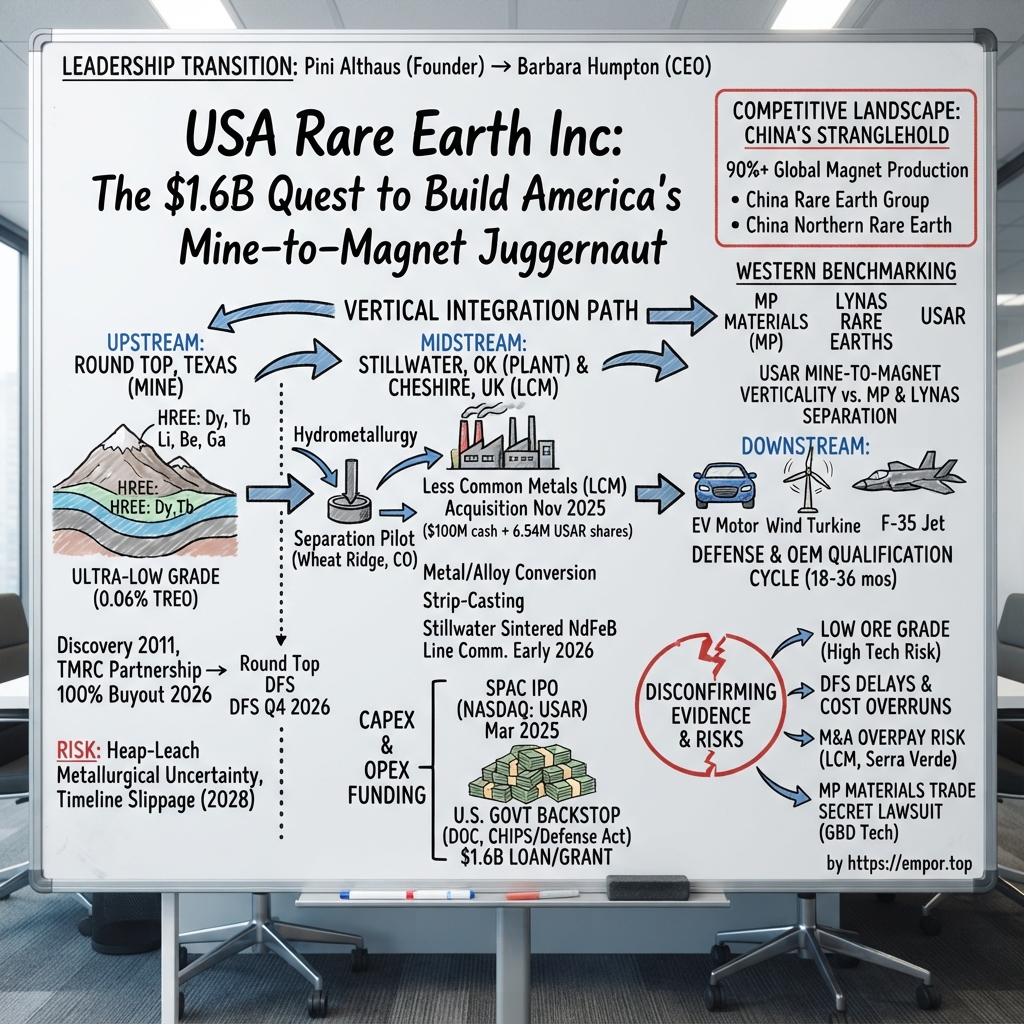
USA Rare Earth Inc: The $1.6B Quest to Build America's Mine-to-Magnet Juggernaut
I. Introduction & Episode Roadmap [00:00 - 07:00]
On a June morning in 2026, inside a leased industrial building in Wheat Ridge, Colorado — a Denver suburb better known for garden centers than for chemistry — a set of solvent-extraction circuits began operating for the first time.1 Inside those circuits, a milky slurry moved through banks of mixer-settlers, each stage nudging one rare earth element a fraction of a step away from its nearly identical chemical neighbors. A month later, the plant produced its first commercial-grade dysprosium oxide and neodymium-praseodymium oxide, made not from Texas ore but from grinding dust swept off the floor of the company's own magnet plant in Oklahoma.2
It was a genuine technical achievement. In revenue terms, however, it generated nothing.
That gap — between what USA Rare Earth has demonstrated technically and what it has sold commercially — is the central story. The company closed the second quarter of 2026 with $1.53 billion in cash, a market capitalization near $4.4 billion, definitive agreements with the U.S. Department of Commerce for access to up to $1.6 billion in support, and quarterly revenue of $5.8 million — every dollar of it generated by a British alloy maker it bought in November 2025.12 Its own magnet plant had produced no revenue. Its own mine had produced no ore. Its balance sheet was exceptionally liquid, but its income statement showed a gross loss.1
The pitch. USA Rare Earth began life as a junior mining partnership with a claim on a mineralized deposit in West Texas. Seven years later, it is a Nasdaq-listed, Washington-backed industrial roll-up attempting something no Western company has done: own every link in the supply chain that turns rock into a finished permanent magnet. That model spans mining at Round Top in Hudspeth County, Texas; separation chemistry at Wheat Ridge, Colorado; metal-making and alloy strip-casting at Less Common Metals in Cheshire, England; sintered neodymium-iron-boron magnet production at a converted 310,000-square-foot plant in Stillwater, Oklahoma;11 and, pending closing, an operating ionic-clay mine in Goiás, Brazil.
The core thesis. Market and geopolitical attention centers on a single number: China controls roughly 90% of global rare earth separation and processing capacity and about 93% of global magnet manufacturing, according to CSIS analysis of the 2025 export-control regime.3 Beijing demonstrated what that dominance means in practice when Announcement No. 61 of 2025 extended export licensing to magnets containing as little as 0.1% Chinese-origin heavy rare earths, as well as products made using Chinese process technology.3 For a Western defense prime or a European automaker, that arrangement shifts a supply chain into a regulatory permission slip.
Into that vacuum stepped a company whose primary domestic upstream asset is, by grade, one of the leanest rare earth deposits ever proposed for commercial development.
The questions this episode tests. First: can a company built on junior-mining promises cross into commercial manufacturing execution — and what does its record of promises versus delivery say about the odds? Second: how does a capital deployment sequence featuring a SPAC listing, a $100 million cash acquisition, a $73.9 million all-stock buyout, and a roughly $2.83 billion share-funded merger compare with the path taken by MP Materials, which anchored itself on an already-producing high-grade mine, or with Lynas Rare Earths, which spent fifteen years learning that separation plants present harder operational challenges than mines?1 Third: what happens when sovereign industrial policy — the willingness of a government to write checks and take equity — collides with low-grade ore metallurgy, trade-secret litigation, and a share count that grew from roughly 93 million to 230 million in twelve months?1
That last figure is easily lost in the noise. Between the second quarter of 2025 and the second quarter of 2026, USA Rare Earth's weighted-average share count rose from about 92.8 million to about 230.1 million.1 The Serra Verde transaction, if it closes, adds roughly another 126.8 million.1 The stock, meanwhile, traded between $11.45 and $43.98 over the past year and sat near $18 in late August 2026 — meaning shareholders who bought the story at its most enthusiastic have seen substantial value evaporate even as the company's asset base expanded dramatically.26
That is the core tension: a company acquiring strategic assets at high speed using a currency whose market value is repeatedly re-priced. To understand whether that trade makes sense, one must first understand how the global market reached this position.
 Subscribe on LinkedIn
II. The Geopolitical & Industry Backdrop: The Critical Minerals Bottleneck [07:00 - 18:00]
Picture a purchasing manager at a European tier-one auto supplier in the winter of 2025. She has a contract to deliver traction motors. Each motor needs magnets. Each magnet needs a few grams of dysprosium, without which the magnet loses its grip at engine-bay temperatures. Her magnet supplier calls to say the export licence has not come through. Not denied — just not through. Chinese magnet exports fell by roughly three-quarters in the two months after the new controls took effect, and prices for rare-earth-based products made outside China ran up to six times Chinese domestic levels.7
That is the market USA Rare Earth is selling into. Not a market defined by price. A market defined by whether the material shows up at all. Barbara Humpton put it plainly on the company's second-quarter 2026 call: "availability, or lack thereof, is what governs the rare earth industry now."5
The stranglehold, and where it actually sits
The common misconception is that China's advantage is geological. It is not, or at least not primarily. China holds a large share of global mined supply, but the United States, Australia, Brazil, Vietnam and Myanmar all host substantial deposits.6 The chokepoint sits downstream, and it is worth walking through the steps slowly, because the entire investment case turns on which step a company actually controls.
Step one is mining: dig rock, crush it, concentrate it. Difficult but ordinary; the world knows how to do this.
Step two is separation. Rare earths are chemically almost indistinguishable from one another — seventeen siblings that behave nearly identically in solution. Pulling them apart requires hundreds of sequential extraction stages using organic solvents, each one shifting the mix a little. It is slow, chemically messy, capital-hungry, and environmentally fraught. This is where China built its lead, and where roughly 90% of world capacity now sits.3
Step three is metal-making: reducing the separated oxide into metal. Step four is alloying — melting that metal with iron and boron and pouring it onto a chilled spinning wheel to freeze the alloy into thin ribbons with the right crystal structure, a technique called strip casting.
Step five is magnet-making proper: milling the alloy into powder finer than flour, aligning that powder in a magnetic field, pressing it, sintering it in a furnace, then machining, coating and magnetising the block.
Mining, in other words, is the easy fifth of the problem. The state-consolidated Chinese champions — 中国稀土集团 China Rare Earth Group in the south, 北方稀土 China Northern Rare Earth in Inner Mongolia — dominate not because of what is in their ground but because of the four steps that follow, built over three decades with patient state capital and environmental tolerance the West did not extend to its own producers.
Why dysprosium and terbium are the whole argument
A standard neodymium-iron-boron magnet is astonishingly powerful and rather fragile in one specific way: heat. Warm it enough and the magnetic domains lose their alignment. Adding a few percent of dysprosium or terbium — the "heavy" rare earths — raises that threshold dramatically.
Which means Dy and Tb are exactly the elements you need for the applications that matter most: EV traction motors that run hot, direct-drive wind turbine generators, and defence systems. CSIS lists the F-35, Virginia- and Columbia-class submarines, Tomahawk missiles, radar systems, Predator drones and Joint Direct Attack Munitions among the platforms dependent on rare earth magnets.3 It also happens that heavy rare earths are far scarcer than light ones, and that China's control of heavy separation is even tighter than its control of light. When Beijing wrote its 2025 controls, it aimed them squarely at this vulnerability.3
Every serious Western player is now racing at the same target. The differences are in what they start with.
The competitive field
MP Materials owns Mountain Pass in California, a bastnäsite orebody rich enough that its mineralised zone is described in whole percentage points of total rare earth oxide.10 MP spent years shipping concentrate to China for separation before building its own separation and, latterly, magnet capability. In July 2025 it struck a partnership with the U.S. Department of Defense that reset the sector's expectations: a $400 million convertible preferred investment making the department MP's largest shareholder on a converted basis, a ten-year price floor of $110 per kilogram on NdPr, a commitment to purchase 100% of the output of a planned second magnet plant, a $1 billion construction financing commitment from JPMorgan and Goldman Sachs, and a $150 million loan for heavy separation at Mountain Pass.8 MP's advantage is simple and profound: it already had a producing, high-grade mine and a cash-generating business before the money arrived.
Lynas Rare Earths mines Mt Weld in Western Australia, whose 2024 ore reserve stood at 32.0 million tonnes at 6.4% TREO, and separates in Malaysia.9 Lynas is the proof that this is survivable outside China — and also the cautionary tale, having spent well over a decade and several near-death financing experiences to get there.
Around them sits a fragmented specialist layer: 盛和资源 Shenghe Resources, whose influence over global concentrate flows is considerable; Neo Performance Materials; Solvay, which has moved to restart European separation capacity; and a handful of small magnet makers. This layer matters more than its size suggests, because it is where Western supply chains are actually being stitched together deal by deal rather than built end-to-end. USA Rare Earth itself sits inside that web: in 2025 it established a relationship with Solvay to supply rare earth metals to Permag LLC, and signed an agreement to supply metals and alloys from its British subsidiary to Solvay and to Arnold Magnetic Technologies, a Compass Diversified subsidiary, for advanced permanent magnet production — later expanded into a mutual, non-exclusive sales and distribution arrangement under which each company can offer the other's products.17
That last detail is worth pausing on, because it complicates the tidy "vertically integrated champion" narrative. In practice, the emerging Western rare earth industry behaves less like a set of competing integrated pipelines and more like a mutual-aid society: everyone buys from everyone, because nobody yet has enough of anything. Which means the competitive question for any single participant is not merely "can you build the chain?" but "when the shortage eases, which links will still command a margin?"
How the West lost it, and why that history rhymes
The reason none of this existed in 2020 is not that America never had it. Mountain Pass supplied much of the world for decades before Chinese production and a collapse in prices ended its first corporate incarnation, and the Hitachi magnet line in North Carolina — the equipment that now sits in Oklahoma — was shut in 2015.15 The West did not lose rare earths through incompetence. It lost them because, in a free market, the low-cost producer wins, and China was willing to absorb the environmental and capital costs that Western shareholders would not.
Nothing about that arithmetic has changed. What has changed is that governments have decided the arithmetic is the wrong objective function. That is the entire basis of the current investment cycle, and it is worth naming plainly: this is not a market opportunity that emerged from customer demand. It is a market opportunity that emerged from policy. Policy-created markets can be extremely durable — defence procurement has sustained industries for generations — but they are a different animal from organic demand, and they should be underwritten differently.
The forces that shape returns here
Two of Porter's forces are already unambiguous, and both cut against new Western entrants.
Rivalry and supplier power are extreme in a way that is not really about competition at all. Chinese state enterprises operate with state-subsidised capital and, historically, a demonstrated willingness to let prices fall to levels that make Western projects uneconomic. This is the structural reason Western governments have moved to price floors rather than grants alone: without a floor, Beijing can simply wait.
Buyer power is high and underappreciated. Tier-one automotive OEMs and defence primes do not buy magnets the way you buy steel. They qualify a supplier — sampling, dimensional and magnetic testing, life testing, sometimes vehicle-level validation — over cycles that run 18 to 36 months. That is a barrier protecting incumbents, but for a new entrant it is a long, unpaid runway. And once qualified, the buyer holds the whip on price, because it now knows exactly what your cost structure looks like.
Which is where a company with an ultra-lean orebody, a converted 1984 warehouse and a British alloy shop decided to enter.
III. Origins & Upstream Foundation: Round Top & Early Management (2011–2023) [18:00 - 30:00]
Drive west out of Van Horn, Texas, on Interstate 10, and the landscape flattens into creosote scrub. Just past the town of Sierra Blanca — population under six hundred, best known regionally for having once received New York City's sewage sludge by rail — a low rhyolite dome rises off the desert floor. It is not much to look at. It is called Round Top, and it has been teasing geologists for the better part of eighty years.
The deposit was first identified as a potential mineral source in the mid-twentieth century.11 Cyprus Minerals ran an internal feasibility study on it in 1988 — for beryllium, not rare earths — and walked away.11 What kept bringing geologists back was the mineralogy. Round Top's rare earths sit largely in yttrofluorite, a simple mineral that dissolves readily in dilute acid, and the deposit is unusually rich in heavy rare earths: dysprosium, terbium, and yttrium. It also carries lithium, beryllium, gallium, and hafnium as potential co-products.12
The catch is the fundamental number that governs everything else. Round Top's historical resource estimates put its grade at roughly 639 parts per million rare earth oxide — or about 0.064%.13 By comparison, Mt Weld's reserve grade is 6.4% total rare earth oxide.9 That is a hundredfold difference. Mountain Pass ore is measured in whole percentage points.10 To produce a single tonne of rare earth oxide at Round Top, an operator must move, crush, and chemically process roughly one hundred times more rock than at Mt Weld.
The bullish counterargument has long been that grade is the wrong metric: the rock is soft, near-surface, uniformly mineralised, and amenable to heap leaching — spraying dilute sulphuric acid over a pile of crushed ore and collecting what drains out. Under that logic, the cost per tonne moved stays low while co-products absorb part of the burden. That argument is not without technical logic. It is also, as of today, unproven at commercial scale for heavy rare earths anywhere in the Western world.
From TMRC to USA Rare Earth
Texas Mineral Resources Corp., a small Sierra Blanca-focused explorer, acquired the lease over Round Top and between 2010 and 2019 completed the preliminary groundwork: surface sampling, aeromagnetic and gravity surveys, stream sediment analysis, and drilling.11 It produced preliminary economic assessments in 2012, an updated resource model in 2013, and a further PEA in 2019 alongside its new partner.11
That partner was USA Rare Earth, formed in 2019 around founder Pini Althaus and a group of private backers including Cove Capital and founding investor Mordechai Gutnick, who served on the operating company's board of managers across most of the private era.11 The deal followed a standard junior-mining earn-in structure: USA Rare Earth would fund development milestones to earn a majority economic interest — reported at the time as an 80% stake — leaving TMRC with a carried minority interest and a claim on the upside.12
The land position itself is unusual and stands out as one of the project's key advantages. Round Top sits on Texas state land leased from the General Land Office under two mineral leases covering roughly 860 and 90 acres — 950 acres in total — with the later of the two running to October 2030 unless extended.11 Around that core, the company assembled roughly 2,037 acres of mine processing land outright and holds a purchase option over a further 5,670 acres, of which 950 are authorised for mining and the remainder planned for leach fields, plant sites, and mine development, along with easements for roads, a fresh-water pipeline, and a 24-kV power line.11 For a heap-leach operation, which requires expansive flat land rather than deep pit volume, that footprint is well suited. Moreover, dealing with a single state landlord rather than navigating federal permitting presents a clear administrative advantage over projects on federal land. The primary constraint at Round Top has never been land or permitting. It is chemistry and cost.
The company's early corporate history also includes legal friction. In July 2022, Ramco Asset Management and affiliates filed a Delaware Chancery Court complaint against the operating company, Gutnick entities, and Althaus. The court dismissed all claims except a breach-of-contract and good-faith claim against the operating company, and in July 2025 the matter was settled with the issuance of 159,000 shares and a $150,000 payment, expressly without admission of liability.11 Though small in financial terms, the lawsuit highlights the governance dynamics of the pre-listing entity.
Historical falsification: is Round Top a generational anchor?
The claim. Round Top is a century-long domestic anchor deposit for heavy rare earths — the resource that ends American reliance on China for dysprosium and terbium.
Disconfirming evidence one: there is no current resource estimate at all. This fact directly challenges the narrative, and it comes directly from the company's own prospectus. Neither the 2012 PEA, nor the 2013 PEA, nor the 2019 PEA was prepared in compliance with Item 1300 of Regulation S-K, and none constitutes a current resource estimate for the company under that regulatory standard. Furthermore, the company explicitly stated that it "is not relying on the 2019 PEA for the purpose of reporting mineral resources," does not currently intend to update it, and "does not make any representation that any historical estimate is a current mineral resource estimate for the Round Top Project."11 The Round Top Project is formally described in the 2026 second-quarter filing as being "at the exploration stage," with construction not commenced.1
As a result, the widely cited tonnage and grade figures are historical estimates that the company itself declines to endorse. That does not mean the mineralisation is absent; it means the commercial economics remain formally unquantified until a feasibility study is completed.
Disconfirming evidence two: the extraction route is the primary hurdle, and a competitor is contesting it in court. MP Materials, in litigation filed in May 2026 that is examined later in this series, has publicly contested USA Rare Earth's operational narrative.25 The underlying engineering question stands regardless of the lawsuit's outcome: heap-leach hydrometallurgy paired with heavy rare earth separation has not been commercialised at scale in the West. The Wheat Ridge demonstration facility exists specifically to address this technical uncertainty by testing three flowsheets in parallel — Round Top ore, third-party mixed rare earth carbonate, and swarf recycling — with the findings intended to support the definitive feasibility study.2
Disconfirming evidence three: the timeline record. Here the gap between projections and execution is clearest. The Stillwater magnet facility was announced in 2022 with production promised by 2023; more than three years later, in April 2026, local reporting found the plant still incomplete, with full capacity not expected until late 2026 or 2027.14 In January 2025, upon producing its first batch of sintered magnets, management targeted Round Top mine production for 2025 or 2026.15 By late 2025, that target had moved to "late 2028" — a change management described as a two-year acceleration because the internal timeline had previously slipped to 2030.17 While both statements reflect shifting internal planning, the original public commitments remain the baseline against which execution is judged.
The verdict. The historical record does not disprove that Round Top holds a large, heavy-rare-earth-enriched deposit — the geology is well documented and extensively sampled. It does, however, sharply challenge the premise that Round Top represents a near-term domestic supply solution. Based on current disclosures, Round Top is best understood as a long-dated, capital-intensive option on an unproven commercial metallurgical process, managed by a company whose upstream timeline has slipped by roughly five years since 2019. The decisive test will be the Round Top Definitive Feasibility Study, which management stated in August 2026 it expects to complete in the fourth quarter of 2026 and publish in the first quarter of 2027, detailing confirmed recovery rates and projected operating costs per kilogram.2
That reality raises a fundamental question: if the mine remains a 2028 project at the earliest, what specific operational foundation has the company been assembling in the interim?
IV. Midstream & Downstream Expansion: The Assembly of "Mine-to-Magnet" (2020–2026) [30:00 - 45:00]
In 2015, Hitachi Metals shut its rare earth magnet plant in North Carolina — at the time essentially the last sintered NdFeB capability of consequence in the United States. The presses, jet mills, and sintering furnaces all went quiet. Five years later, a company with no mine, no revenue, and no factory bought that equipment, trucked it to Oklahoma, and installed it in a 310,000-square-foot industrial building that had been standing on a 40-acre parcel outside Stillwater since 1984.1115
That acquisition illustrates the company's core strategy: USA Rare Earth spent six years assembling the discarded components of a Western supply chain that previous owners had abandoned.
Stillwater: the downstream bet
The Stillwater plant — internally designated as the Innovations Lab — produced its first batch of sintered permanent magnets in January 2025, using the ex-Hitachi line.15 At that point, the company was buying feedstock from third parties including Australian Strategic Materials and American Resources Corporation.15 Phase 1a was commissioned in March 2026, which management said would let it begin fulfilling customer orders in the second quarter, ramping to a 600 metric tonne per annum run rate by the fourth quarter of 2026, with Phase 1b taking capacity to 1,200 tonnes in the first quarter of 2027.17 The building as configured can eventually hold about 4,800 tonnes of nameplate capacity.15
However, operational progress has not yet translated into commercial sales. As of the second quarter of 2026, SEC filings confirmed that USA Rare Earth had "not begun generating revenue from sintered neodymium-iron-boron permanent magnets."1 Revenue was not merely depressed; it was zero. Management expects the first magnet sales by the end of 2026.5 Meanwhile, a local investigation in April 2026 flagged the distance between the company's public language — "commissioned," "taking orders" — and its SEC filings, which described the facility as under development and not yet selling commercially.14 Both descriptions were defensible; the gap between them highlights the distinction between internal qualification runs and commercial execution.
Stillwater also received public support beyond the federal package: roughly $1.2 million from the State of Oklahoma and up to $7 million from the City of Stillwater through tax increment financing.14 Small money, but it establishes a pattern — this is a company whose capital structure is unusually entangled with the public sector at every level.
Wheat Ridge: the chemistry lab that matters more than it looks
If Stillwater is the factory, Wheat Ridge is the science. The Colorado facility runs the separation chemistry — the step where China's real advantage lives. Its swarf recycling work offers a clear economic rationale: magnet manufacturing generates grinding waste, that waste is already fully separated high-value material, and recovering it turns an operational cost centre into feedstock. Management has said swarf could eventually supply up to 30% of its magnetic rare earth oxide needs.2
That recycling effort offers a practical, near-term offset to raw material constraints without requiring a mine. For now, however, Wheat Ridge remains a pilot demonstration facility producing qualification samples rather than a full-scale commercial separation business.
Less Common Metals: the linchpin
The company's most strategic operational move occurred not in Texas or Oklahoma, but in Cheshire, England.
Less Common Metals, founded in 1992, is one of very few producers outside China capable of making both light and heavy rare earth permanent magnet metals and alloys at scale, working from both mined and recycled oxide feedstock.16 USA Rare Earth agreed in September 2025 to buy it for $100 million in cash plus 6.74 million shares, cleared the UK's National Security and Investment Act review, and closed the transaction on 18 November 2025.161
Why it mattered: Less Common Metals filled the exact midstream gap — oxide to metal to strip-cast alloy — that would otherwise have left Stillwater dependent on Chinese or Japanese alloy suppliers. It also immediately provided USA Rare Earth with its first commercial revenue stream.
Financial results quickly revealed the commercial challenges of operating a standalone midstream processor. Every dollar of the company's $11.5 million of first-half 2026 revenue came from LCM.1 In the first quarter of 2026, LCM ran a gross margin of 1.9%. In the second quarter it swung to a gross loss of $1.6 million — a negative 27.2% margin — which management attributed to raw material costs that rose substantially quarter-on-quarter and were only partly offset by selling price increases, compounded by inventory adjustments.1
This margin compression exposes a structural vulnerability. Less Common Metals occupies a scarce and essential operational link, yet during a quarter when rare earth oxide prices spiked — precisely the environment the entire investment thesis anticipates — it lost money on every unit it sold. Operating as a converter in the middle of a squeezed supply chain is not the same as having pricing power. Until USA Rare Earth owns its own oxide feedstock, LCM is structurally short the raw material it needs and long a customer base that resists price pass-through in real time. That is a mechanism, not a one-off, and it is the clearest single argument for the company's aggressive upstream acquisitions.
Operating guidance shifted alongside those financial pressures. In its full-year 2025 release of March 2026, the company listed as a 2026 objective: "Reach 3,000 MTPA of run-rate metal making and alloy capacity at LCM in Q4 2026."17 In the second-quarter release of August 2026, that specific target was replaced with a commitment to "evaluate metal making and alloy capacity at LCM to optimize for customer demand."2 A hard number became a soft verb, without explanation. That is exactly the kind of guidance drift a long-term investor should log.
Consolidating feedstock: TMRC and Serra Verde
To address that upstream feedstock exposure, USA Rare Earth executed two major transactions.
The first was tidy housekeeping. In March 2026 the company agreed to acquire Texas Mineral Resources in an all-stock deal, exchanging 3,823,328 USAR shares for 100% of TMRC and thereby consolidating full economic ownership of Round Top; the deal closed on 7 August 2026 at a value of approximately $73.9 million based on that day's share price.1 Buying out a carried minority partner in a pre-development asset for roughly $74 million of paper is not obviously cheap for an orebody with no current resource estimate — but the governance simplification is real, and the currency was the company's own stock at elevated levels.
The second transaction represented a far larger commitment. On 19 April 2026 USA Rare Earth signed a definitive agreement to acquire SVRE Holdings, parent of Serra Verde Group, for approximately $2.83 billion — $300 million in cash and 126.8 million shares.1 Serra Verde operates the Pela Ema mine in Goiás, Brazil: the first commercially operating ionic clay rare earth deposit in the Western world, in production since 2024 after more than $1.1 billion of investment, and the only mine outside Asia supplying all four magnetic rare earths at scale.19
Ionic clays are the geological opposite of Round Top's problem. The rare earths sit loosely adsorbed onto clay particles and can be washed off with a mild salt solution — no crushing, no acid heap, no hundred-to-one strip ratio. Serra Verde is projected to reach roughly 6,400 tonnes of TREO annually at Phase 1 completion by the end of 2027, with a possible Phase 2 doubling, and carries a 15-year offtake agreement covering 100% of Phase 1 neodymium, praseodymium, dysprosium and terbium with a U.S. government-backed special purpose vehicle including contractual price floors.191 In August 2026 that SPV's capitalisation was completed at an upsized $1.55 billion, including $750 million from the Department of War and a $500 million senior secured revolver from a tier-one bank, alongside a U.S. government forward purchase commitment of at least $300 million of rare earth products over five years with take-or-pay provisions and floor prices.24
Historical falsification: is this disciplined capital allocation?
The claim. Management is executing a synergistic, disciplined capital allocation strategy that fills the West's supply chain gaps.
Disconfirming evidence. Three things cut against the word "disciplined."
First, sequencing. The company has bought a British alloy maker, agreed to buy a Brazilian mine, taken a 13.6% stake in French processor Carester SAS for approximately $45.7 million, and announced a second U.S. magnet and metals plant at Blacksburg, South Carolina targeting 6,400 tonnes of magnets and 5,000 tonnes of alloy with commissioning beginning in 2028 — all before its own mine has produced a gram of ore or its own magnet plant has recognised a dollar of revenue.12 Four countries, four regulatory regimes, four industrial cultures, one management team, zero operating history at scale.
Second, currency. Roughly 90% of the Serra Verde consideration is stock.1 Paying in equity is rational when equity is expensive and the asset is scarce — but it is a bet, not a discipline, and the market's verdict has been unenthusiastic. The stock fell about 5% on the day the upsized SPV capitalisation was announced, and closed at $17.99 on 28 August 2026 against a 52-week high of $43.98.26
Third, the record on converting technical milestones into revenue is, so far, thin. First magnets in January 2025; commissioning in March 2026; first magnet sales expected by the end of 2026 — a gap of roughly two years between the technical first and the commercial first, in a business where OEM qualification cycles then run 18 to 36 months on top.15175
The verdict. The history does not reject the strategic logic — Serra Verde genuinely solves the feedstock problem that LCM's negative gross margin exposed, and buying an operating mine with a price-floored government offtake is a materially better risk than developing Round Top. It does reject the framing of "disciplined." This is a leveraged, equity-funded land grab executed on a compressed timetable during a window of extraordinary political support. That can work. It is not caution. The KPI that will settle it is whether the combined company converts Serra Verde's projected $550–650 million annualised run-rate EBITDA by the end of 2027 into actual reported segment cash flow — because that projection, made by the seller's own shareholder in April 2026, is the load-bearing assumption under the entire $2.83 billion price.19
To fund all of this, the company needed a currency and a sponsor. It found both in 2025 and 2026, in ways that are themselves part of the story.
V. Going Public & Capital Deployment: The SPAC Era & Sovereign Subsidies [45:00 - 56:00]
By early 2025, the special purpose acquisition company boom had largely run its course. Blank-check mergers had become a financing route of last resort, frequently marked by de-rated valuations and high shareholder redemptions. That background makes USA Rare Earth's public market debut notable.
Inflection Point Acquisition Corp. II — sponsored by Michael Blitzer, co-founder of Kingstown Capital — completed its business combination with USA Rare Earth on March 13, 2025, following stockholder approval three days earlier, with trading commencing on the Nasdaq under the symbols USAR and USARW on March 14.4 The private investment in public equity was modest for that period, upsized by $8 million to bring affiliate and pre-funded investor participation to roughly $50 million.4 The company thus entered public markets with a converted warehouse in Oklahoma, an exploration-stage deposit in Texas, and, by the end of 2025, $359.9 million in cash with no significant debt.17
Then the geopolitical environment shifted, dramatically altering the company's cost of capital.
The $1.6 billion — and what it actually cost
On January 26, 2026, the company announced a letter of intent with the U.S. government for access to up to $1.6 billion in support under the Department of Commerce's CHIPS Program. Concurrently — as a structural condition of the federal agreement — the business raised $1.5 billion in private capital through a common stock PIPE that closed on January 28, issuing 69.8 million shares for gross proceeds of $1.50 billion and net proceeds of $1.45 billion.117 In less than a week, a company holding $360 million in cash transformed its balance sheet into one carrying roughly $1.75 billion.17
Definitive agreements followed on June 3, 2026, comprising a Direct Funding Agreement of $277.0 million and a Loan Guarantee Agreement of $1.30 billion.1 Examining those figures closely reveals how the headline conceals the actual financial structure: of the total package, only $277 million represents direct federal grant funding. The remaining $1.3 billion is senior secured loan capacity — debt that the company must borrow, service, and repay as disbursements are released against specific operational milestones. As disclosed in the second-quarter 2026 Form 10-Q, no disbursements or advances had been received as of June 30, 2026, with initial funding remaining subject to milestone approval.1
That federal arrangement carried a steep price tag. As conditions precedent, USA Rare Earth issued the Department of Commerce 16,132,790 shares of common stock, valued at $451.4 million, alongside a warrant covering 17,600,584 shares at a $17.17 exercise price, initially valued at $430.9 million.1 Beyond the accounting complexity, the company issued financial instruments it valued at roughly $882 million in exchange for a $277 million direct grant and the right to incur up to $1.3 billion in debt. The warrant obligation alone added a $430.9 million balance-sheet liability requiring quarterly remeasurement, introducing substantial non-cash volatility into reported earnings.1 For example, the second quarter's net loss attributable to shareholders of $10.3 million was reduced by a $22.4 million non-cash gain on financial instruments; excluding that adjustment, the operational net loss stood at $33.5 million.2
This dynamic underscores the true nature of the government backstop. Far from an unencumbered subsidy, it operates as a highly structured, milestone-conditioned, equity-priced financing through which Washington secured a major position in the corporate capital structure.
A smaller line item in the same SEC filings highlights the company's current financial reality: during the first half of 2026, USA Rare Earth recorded $26.4 million in interest and dividend income on its cash reserves, compared to $11.5 million in total product revenue.1 Generating more than double its commercial revenue from cash yields reflects a corporate balance sheet that remains far more productive than its manufacturing facilities. It also highlights a ticking clock, as treasury income will decline as capital is deployed, making any operational delay a trade of liquid reserves for unproven industrial operations.
Alongside the primary federal package, the company assembled a network of smaller public support programs: a Texas Semiconductor Innovation Fund grant of up to $14.2 million for Round Top, disbursed strictly on a cost-reimbursement basis through December 2028; selection for up to $19.3 million in Department of Energy funding toward a proposed $50.5 million pilot separation project; and prospective French state incentives, debt guarantees, and equity investment for a planned facility in Lacq projected to require over €175 million in capital and create 300 jobs by 2030.12 Individually modest, these awards collectively demonstrate a strategy focused on securing public funding — establishing a specialized capital-raising capability that doubles as a core structural dependency.
The governance stress test
Public scrutiny quickly followed the announcement. On March 20, 2026, Representative Zoe Lofgren, ranking member of the House Committee on Science, Space, and Technology, sent a ten-page letter to the Department of Commerce alleging that the agreement was structured to provide Commerce Secretary Howard Lutnick with troubling leverage over a commercial enterprise while benefiting his family's financial firm.21 Her inquiry highlighted three core issues: that the structure allowed the government to retain an equity position between 8% and 16% even if funding was not ultimately disbursed, that full capital access was tied to a private raise led by Cantor Fitzgerald, and that statutory CHIPS Act provisions did not explicitly authorize equity acquisition in private companies.21 Neither USA Rare Earth nor the Department of Commerce issued formal public comments regarding the letter at the time.21
While the Congressional letter alleged no corporate misconduct by USA Rare Earth, it highlighted a significant strategic vulnerability: the company's reported financial strength relies in part on a federal structure subject to administrative and legal challenges. Political leadership shifts and statutory authorities can face litigation, creating regulatory risks that operational execution alone cannot insulate.
Corporate governance concerns also emerged during the Texas Mineral Resources acquisition. Following the distribution of joint proxy materials on June 29, 2026, both entities received shareholder lawsuits and demand letters alleging disclosure deficiencies.18 Although management maintained that filings met all securities standards, the companies issued supplemental disclosures containing prospective financial projections for Round Top, while explicitly noting that the data was highly uncertain and unreviewed by USA Rare Earth.18 While disclosure litigation frequently accompanies public acquisitions, the caveat underscored the unverified nature of Round Top's long-term economics. TMRC shareholders subsequently approved the merger on July 28, 2026, recording over 50 million votes in favor against approximately 551,000 opposed.18
Historical falsification: does federal funding secure the balance sheet?
The claim. Federal financial backing ensures balance-sheet stability and insulates shareholders from capital distress.
Disconfirming evidence. In its second-quarter 2026 Form 10-Q, management noted that available liquidity would support planned operations for at least twelve months, while explicitly cautioning in the same filing that long-term capital needs for Round Top, Stillwater, Blacksburg, and Lacq "are expected to exceed our current resources, and we will require additional capital."1 Operating activities consumed $75.3 million in cash during the first half of 2026, alongside $108.4 million spent on capital investments and equipment deposits, while second-quarter operating expenditures totaled $44.7 million — including $9.9 million in consulting fees and $6.1 million in legal costs connected to acquisitions and federal funding agreements.1
Furthermore, equity dilution has already occurred. The company's weighted-average share count more than doubled year-over-year prior to factoring in the approximately 126.8 million shares slated for the Serra Verde merger, the 16.1 million shares issued to the government, or the 17.6 million government warrants.1 Total shares outstanding reached approximately 244.7 million by late August 2026.26
The verdict. The assertion that federal backing eliminates balance-sheet risk is unsupported by disclosures. Government participation functioned as a direct driver of equity dilution, given that both the private PIPE and federal equity warrants served as prerequisites for funding. What the capital structure provides is operational runway: holding $1.53 billion in cash affords management time to demonstrate Round Top's processing economics, expand production at Stillwater, and integrate Serra Verde without immediate solvency pressures.1 Nevertheless, liquidity is distinct from execution. The critical indicator to monitor is whether initial CHIPS Act disbursements are released on schedule against contractual milestones, as operational delays could imperil milestone approvals.
Securing capital, however, addresses only part of the equation. The more complex challenge lies in the execution capabilities of the leadership team overseeing deployment.
VI. Management Credibility & Current Leadership: The Barbara Humpton Era [56:00 - 67:00]
On the second-quarter 2026 earnings call in August, Barbara Humpton delivered a line that functions as the company's entire thesis in twenty words: "A mine without processing is a stranded asset. Processing without metal and alloy-making capability is a science project."5
She then mentioned, almost in passing, that it would be her last quarterly call.5
From promoter to industrialist, and out again
USA Rare Earth has now had four chief executives in seven years, and the sequence tells you what the company thought it needed at each stage.
Pini Althaus, the founder, ran it from 2019 through 2023 — the junior-mining era, when the job was to secure the asset, tell the story and raise money against it.11 Joshua Ballard took it through the SPAC listing and the first magnet batch.1522
Then, on 29 September 2025, the company announced that Barbara Humpton would become CEO effective 1 October, with Ballard staying on as an adviser through the end of that month.22 Humpton's résumé was the point. She spent fourteen years at Siemens, more than seven of them as president and CEO of Siemens USA, running electrification, automation and digitalisation businesses at industrial scale; before that she was president and CEO of Siemens Government Technologies, and earlier a vice president at Booz Allen Hamilton and at Lockheed Martin.22 She sits on the board of the Federal Reserve Bank of Richmond.22 Michael Blitzer, the SPAC sponsor turned chairman, framed the hire around exactly the two things the company needed: "critical infrastructure, technology and strategic national defense."22
The signal was unmistakable. A company that had been selling a deposit hired someone who had spent a career selling to and building for the U.S. government. Within four months of her start date, the letter of intent with Commerce and the $1.5 billion PIPE were both announced.
And then, on 19 July 2026, the board announced she would retire as CEO and director effective 1 October 2026 — a tenure of exactly one year.23 The 8-K states her retirement "was not due to any disagreement with the Company or any matter relating to the Company's operations, policies or practices," and provides for the vesting of 219,329 restricted stock units and a pro-rated 2026 bonus of $500,000.23
Her successor is Thrasyvoulos "Thras" Moraitis, 63, CEO of Serra Verde Group since January 2023 — which is to say, the chief executive of the company USA Rare Earth is buying.23 Before Serra Verde he co-founded X2 Resources and sat on the executive committee of Xstrata under Sir Mick Davis, responsible for strategic development, post-acquisition integration, external affairs and investor relations, through to the 2013 sale to Glencore.23 Davis himself is expected to join the USA Rare Earth board on closing, and Blitzer moves to executive chairman.1
How should an investor read a CEO transition after twelve months? Two honest readings coexist. The generous one: the company is becoming, in substance, a mining company with an operating asset, and mining operators run mining companies. Moraitis and Davis bring the Xstrata playbook — serial acquisition, aggressive integration, operational leverage — which is arguably the correct skill set for what USA Rare Earth has become. The less generous one: the acquirer's board handed the top job to the seller's management within three months of signing, the incumbent CEO departed after a single year, and the company's identity shifted from "American magnet manufacturer" to "global rare earths group" without any explicit strategic reset being announced to shareholders. The 10-Q even carries a risk factor noting that failure of the Serra Verde acquisition to close "could result in leadership uncertainty and may require the Board to identify an alternative CEO successor."1 The company's chief executive is, at the time of writing, contingent on a transaction closing.
Incentives, and what they are pointed at
Executive alignment at USA Rare Earth is worth examining because the company's milestones are unusually explicit. Humpton's retirement terms provide for the vesting of 219,329 restricted stock units scheduled to vest on the separation date and a pro-rated 2026 bonus of $500,000 "based on the level of performance achieved," conditional on a release of claims, continued employment and compliance with non-disparagement, non-solicitation and cooperation provisions.23 Stock-based compensation across the group rose by $9.4 million in the first half of 2026 as headcount expanded.1
The more consequential alignment mechanism is not in any compensation table. It is the $17.17 exercise price on the government's 17.6 million warrants.1 That strike sits below where the stock traded through most of 2026 and materially below the January PIPE price, which means the U.S. taxpayer participates in upside from a low base while the company's obligations run in the opposite direction — milestones to hit, loans to draw and repay. Management's incentives are therefore pointed at a specific and narrow set of outcomes: satisfy federal milestones, deliver the feasibility study, ramp Stillwater, close Serra Verde. Those are the right things to be pointed at. They are also, notably, all inputs. None of them is profit.
Testing narrative consistency
Set the March 2026 full-year release next to the August 2026 quarterly release and two things stand out.
The disappearing LCM tonnage target, discussed earlier, is one. The other concerns Round Top's studies. In March, the plan was clear and staged: publish a Preliminary Feasibility Study by the end of the third quarter of 2026, initiate the Definitive Feasibility Study in the fourth quarter, publish it in the first quarter of 2027.17 By August, the outlook section said the DFS would be completed in the fourth quarter of 2026 and published in the first quarter of 2027 — with the PFS no longer mentioned as a 2026 deliverable at all.2 Meanwhile the same filing's liquidity discussion still described the company as "funding the ongoing Preliminary Feasibility Study" and "advancing toward a Definitive Feasibility Study."1
That is not a scandal. It may reflect a decision to fold the PFS into the DFS. But it was not explained, and an intermediate study quietly vanishing from a company's outlook while the final study's completion date pulls forward is precisely the sort of thing that deserves an analyst question. To management's credit, the underlying disclosure in the filings has been unusually candid — the exploration-stage language, the refusal to stand behind the 2019 PEA, the explicit statement that long-term capital needs exceed current resources. The promotional gap sits between the filings and the press releases, not inside the filings.
CFO Rob Steele — William Robert Steele Jr., appointed in March 2025 after a career that included a managing directorship at Bank of America Securities and a stint as global CFO of robotics software firm Mujin — offered the more assertive framing on the August call: the team "said what we would do, and then we went out and did it and more."51 Against a Stillwater plant that was promised for 2023 and had not sold a magnet by mid-2026, that is a claim investors should weigh against the record rather than accept.14
The MP Materials lawsuit, and what it says about the IP moat
On 22 May 2026, MP Materials Corp., MP Magnetics LLC and MP Mine Operations LLC filed suit in the Business Court of Texas, Eighth Division, against USA Rare Earth, its Director of Magnet Operations Kevin Elkins, and FOM Technologies Inc.1 The claims: misappropriation of trade secrets under the Texas Uniform Trade Secrets Act, breach of contract, tortious interference and unjust enrichment. The relief sought includes temporary and permanent injunctions against further use and possession of the allegedly protected technology, plus damages of at least $5 million, exemplary damages and fees.125
The technology at issue is grain boundary diffusion — and it is worth explaining, because it is not incidental. A sintered magnet is a compacted mass of microscopic crystal grains. Heat resistance depends mostly on what happens at the edges of those grains. GBD is the trick of painting heavy rare earth onto the magnet's surface and heat-treating it so the dysprosium or terbium migrates along grain boundaries to exactly where it is needed, instead of being blended throughout. The result: the same heat resistance using dramatically less of the scarcest, most China-controlled material. In a world of export controls, GBD is close to the most economically valuable process knowledge in the industry.
MP alleges Elkins was hired in July 2022 as a senior engineer in Fort Worth, signed confidentiality agreements, worked directly on MP's GBD programme, submitted an invention disclosure in June 2023 describing proprietary formulations, left in 2024 and joined USA Rare Earth in 2025, subsequently sharing formulations that were passed to a third-party firm.25 USA Rare Earth disputes the allegations and has said it intends to defend vigorously, characterising the suit as without merit and filed for an improper purpose.1 Industry commentary has noted the genuine legal question: GBD as a general technique has been discussed and refined across the industry for many years, and the case turns on whether MP's specific formulations and process parameters are protectable trade secrets or industry knowledge.25
The claim being tested. USA Rare Earth possesses proprietary, competitive magnet manufacturing technology, including dysprosium-saving GBD.
Disconfirming evidence. The claim's provenance is now contested in open court by the only other U.S. company with commercial magnet ambitions at scale, and the relief sought includes injunctive relief against use and possession — which, if granted even in part, would bear directly on the advanced magnet grades Stillwater needs to serve automotive and defence customers. Note also the shape of the allegation: it describes capability arriving via hiring rather than via internal development, which if substantiated would say something about how much of the downstream "process power" is organically the company's.
The verdict. The evidence is insufficient to reject or confirm the technology claim on the merits — that is what the litigation is for, and nothing here should be read as a prediction of outcome. What the evidence does establish is that the claim is unproven and encumbered. A capability that is the subject of an injunction request is not yet a moat; it is a legal position. The falsifying events are concrete: a ruling on injunctive relief, and separately, the first OEM qualification of a Stillwater high-temperature magnet grade. Until then, the honest description of USA Rare Earth's downstream advantage is that it has restarted a capability the U.S. had lost, using equipment the U.S. had discarded, with process knowledge whose ownership a competitor disputes.
Which sets up the harder analytical question: strip away the politics and the litigation, and what kind of business is actually being built here?
VII. Playbook & Strategic Powers Analysis (7 Powers & 5 Forces) [67:00 - 77:00]
There is a classic war-gaming exercise worth running on any vertically integrated ambition: imagine being the incumbent with thirty years of process experience, state-backed capital, and a government willing to weaponise export licences. How do you respond to a $4 billion American challenger? You do not compete on quality. You wait and let price do the work, because your challenger must construct four separate businesses simultaneously while none is yet profitable.
That is the frame for assessing what USA Rare Earth actually owns.
Hamilton Helmer's 7 Powers, applied honestly
Cornered Resource — weak upstream, potentially real via policy. A cornered resource is preferential access to a coveted asset on attractive terms. Round Top does not qualify today: an exploration-stage deposit with no Item 1300 resource estimate and an unproven flowsheet is an option, not a corner.111 Serra Verde is a much stronger candidate — an operating ionic clay mine producing all four magnetic rare earths outside Asia, with a 15-year price-floored offtake, is genuinely hard to replicate.19 But note where the value sits: the offtake is with a U.S. government-backed vehicle, which means the "cornered resource" is substantially a policy asset. Policy assets are powerful, but they are also revocable.
The more durable version of the argument runs through the demand side. Under U.S. content rules, defense primes will increasingly require magnets with documented non-Chinese provenance. That creates a pool of buyers who cannot simply choose the lowest-cost supplier. It is a genuine advantage, with one critical caveat: when a company's protected customer base consists of the U.S. government and its contractors, that customer holds immense bargaining power. It can qualify a second vendor, change specifications, restructure a program, or demand price concessions. MP Materials already holds a ten-year, 100% offtake arrangement for its planned second magnet facility.8 Washington is deliberately building more than one domestic champion.
Process Power — moderate, and located in Cheshire, not Oklahoma. Less Common Metals' decades of alloy and metal-making experience represents the group's most defensible operational capability. Its April 2026 first commercial pour of 99% to 99.5% purity yttrium metal placed it among a very small number of producers outside China.2 That is process power in the classical sense: knowledge accumulated over time that a competitor cannot easily buy off the shelf. But it is bounded. LCM's negative second-quarter gross margin demonstrated that this capability does not currently confer pricing power over its input costs, while its cross-border position leaves it exposed to tariff and trade-policy shifts.1
Scale Economies — unrealised, and further away than the roadmap suggests. Magnet sintering is a high-fixed-cost business where unit economics depend heavily on plant utilization and yield. At a 600-tonne annual run rate, USA Rare Earth remains a boutique operator. The combined Stillwater and Blacksburg ambition of roughly 10,000 tonnes of annual magnet capacity by around 2030 would represent competitive scale — matching the capacity MP Materials expects to reach with its own second facility on a similar timeline.28 Two Western entrants attempting to reach 10,000 tonnes each at roughly the same moment, into a market where Western demand is real but finite, creates an operational supply curve worth analyzing carefully.
Switching Costs — the sleeper strength. This is the strategic power the company highlights least, yet may benefit from most. Once an automotive or industrial customer qualifies a magnet supplier through an 18-to-36-month validation cycle, switching suppliers requires repeating that entire process. Qualification is slow, costly, and operationally risky, making every qualified customer sticky. The company reported successful onsite vendor qualification visits from semiconductor, industrial motor, heavy equipment, and aerospace customers, alongside a growing backlog of prototype and production purchase orders.17 Prototype orders are not multi-year production contracts, but this validation pipeline represents the primary mechanism for building a durable commercial business.
Counter-Positioning, Branding, Network Economies — not applicable. Incumbents face no structural barrier preventing them from copying this model; branding carries minimal weight in a specification-driven industrial market; and magnet manufacturing features no network effects.
Porter's five forces, in this specific market
Threat of new entrants: low, which cuts both ways. Capital intensity, complex permitting, difficult separation chemistry, and multi-year customer qualification cycles keep newcomers out. They also make USA Rare Earth's own expansion slow and expensive.
Buyer power: high. As noted, customers exercise significant leverage through rigid technical specifications, benchmark pricing, and a concentrated pool of government-linked buyers.
Supplier power: currently high, representing an acute vulnerability. Until Round Top or Serra Verde supplies consistent feedstock, the company remains dependent on third-party oxide and metal. Its own risk disclosures state explicitly that until it satisfies its own feedstock needs, "if ever," the business remains subject to the availability of oxide and metal feedstock in quantities and at prices that permit commercial operation.1 Those two words — "if ever" — serve as management's own explicit qualification of its central promise.
Threat of substitutes: moderate to high, and rising. Several automakers are developing rare-earth-reduced or rare-earth-free motor architectures, including externally excited synchronous and induction designs. Substitution sacrifices some performance and efficiency, meaning it will not replace heavy rare earths at the top end. However, the high price environment required to justify USA Rare Earth's project economics is the same force driving research into alternative technologies.
Rivalry: intense, and asymmetric. Against MP Materials, USA Rare Earth lags in upstream cash generation and holds no operational lead in domestic revenue-producing manufacturing. Against Lynas, it lacks comparable commercial separation experience. Against Chinese state champions, it lags in scale, cost structure, and technical history — leaving provenance as the sole axis where Western buyers and governments pay a premium.
Two durable lessons
The vertical integration dilemma. Mining is a high-beta, capital-intensive, geologically uncertain business. Precision magnet manufacturing is a tight-margin, yield-sensitive, qualification-driven business. They fail for entirely different reasons on entirely different timelines. Integrating them does not average their operational risks — it multiplies them, because a bottleneck at any step strands capital across the entire chain. Lynas required over a decade to integrate just two of these steps successfully. USA Rare Earth is attempting to integrate five steps across three continents simultaneously.
Sovereign industrial policy as a capital bridge, not a destination. Government backing can fund capital expenditure and, through price floors, temporarily buffer producers from commodity price swings. What it cannot do indefinitely is substitute for underlying cost competitiveness. Every price floor is a policy choice subject to political shifts. Representative Lofgren's inquiry serves as a reminder that current funding arrangements already face political scrutiny.21 The ultimate test is not whether Washington will finance the initial buildout, but whether a USA Rare Earth magnet can compete on price in commercial markets without ongoing government price supports.
VIII. Investor Story Spine: Bull vs. Bear Case & Key KPIs [77:00 - 86:00]
Myth versus reality
Before weighing the bull and bear cases, three common assumptions about USA Rare Earth warrant scrutiny against official disclosures.
Myth: "The U.S. government is investing $1.6 billion in USA Rare Earth." Reality: the definitive agreements provide $277 million in direct funding and $1.30 billion in senior secured loan capacity, disbursed against operational milestones, with no funds drawn as of June 30, 2026 — and the company issued government shares and warrants valued at roughly $882 million as conditions precedent.1
Myth: "USA Rare Earth is producing rare earth magnets commercially." Reality: while the Stillwater plant has been commissioned and has produced sample magnets, the company had recognized no revenue from sintered NdFeB magnets as of the second quarter of 2026 and expects initial commercial magnet sales by year-end.15 All reported product revenue has originated from the British alloy maker acquired in November 2025.1
Myth: "Round Top is America's answer for heavy rare earths." Reality: company SEC filings classify Round Top as an exploration-stage project with construction not yet commenced,1 lacking an Item 1300-compliant mineral resource estimate and carrying an explicit statement that management does not rely on the historical 2019 assessment.11 The primary asset capable of supplying heavy rare earths in the near term is located in Brazil, not Texas.
None of these realities invalidates the strategic vision, but together they reframe what investors are underwriting.
Why USAR wins
The bull case does not hinge on Round Top, which makes the thesis more resilient than surface descriptions suggest.
A comprehensive asset portfolio. Should the Serra Verde transaction close, USA Rare Earth will control an operating mine supplying all four magnetic rare earths outside Asia,19 a demonstration-scale separation facility in Colorado,2 the only major ex-China alloy maker of both light and heavy rare earths in England, a commissioned magnet plant in Oklahoma, and a strategic stake in French separation firm Carester, providing access to specialized processing and recycling intellectual property.1 No rival Western enterprise commands a comparable end-to-end footprint.
Strategic heavy rare earth positioning. MP Materials operates Mountain Pass, a predominantly light rare earth deposit where heavy rare earth separation remains under development alongside a $150 million Department of Defense loan.8 Conversely, Serra Verde's ionic clay mineralization yields dysprosium and terbium naturally. Because Western industrial vulnerability centers on heavy rare earths — as reflected in China's 2025 export licensing controls — USA Rare Earth sits directly at the primary supply bottleneck.3
Substantial liquidity and capital access. The balance sheet holds approximately $1.53 billion in cash, complemented by $277 million in direct federal grants, $1.30 billion in loan capacity, a $14.2 million grant from the Texas Semiconductor Innovation Fund,1 selection for up to $19.3 million from the U.S. Department of Energy, and prospective state incentives for the proposed Lacq facility in France.2 For an industrial roll-up, near-term solvency risk is largely insulated.
Contractual price protections. Management highlighted the Serra Verde offtake structure — featuring guaranteed price floors for neodymium-praseodymium as well as dysprosium and terbium — as a major strategic milestone.20 Structurally, contractual price floors insulate commodity revenue against predatory pricing, bringing predictable cash flows to an otherwise volatile market.
Customer stockpiling behavior. Former CEO Barbara Humpton noted that automotive tier-one suppliers were instructed by original equipment manufacturers to maintain up to twelve months of permanent magnet and metal inventory.20 Customer inventory accumulation signals intense corporate concern over supply continuity.
Why USAR fails or underperforms
Unfavorable feasibility findings at Round Top. Should the definitive feasibility study scheduled for the fourth quarter of 2026 reveal uncompetitive extraction costs or lower-than-projected metallurgical recoveries, the asset providing the company's namesake and political backing would revert to a speculative option.2
Equity currency depreciation and debt risks. USA Rare Earth relies heavily on its common stock to fund acquisitions. With shares declining from a 52-week peak of $43.98 to approximately $18 in late August 2026,26 future transactions risk severe shareholder dilution. Further equity depreciation may force reliance on CHIPS Act loan facilities, which SEC filings note carry restrictive debt covenants.1 Furthermore, acquiring Serra Verde entails assuming its existing Development Finance Corporation obligations, which the company explicitly categorizes as substantial debt bound by restrictive covenants.1
Legal threats to high-margin products. If MP Materials secures injunctive relief restricting grain boundary diffusion technology, Stillwater could be blocked from producing premium high-temperature magnet grades during critical customer qualification windows.1
Market price manipulation by incumbents. While price floors insulate Serra Verde's mined output, commercial margins at Stillwater and Less Common Metals remain fully exposed to broader market price drops if dominant Chinese producers lower global benchmark prices.
Severe organizational integration complexity. Over the next eighteen months, executive management must integrate a Brazilian mining operation, transition to a new chief executive, scale magnet output to 1,200 metric tonnes, execute pilot separation flowsheets, deliver a feasibility study, advance a new South Carolina facility, expand British metal operations, establish a French joint venture, fight trade-secret litigation, and fulfill federal grant milestones. Second-quarter operating expenses of $44.7 million — up $26.4 million year-over-year due largely to legal and advisory expenditures — reflect the immediate financial cost of managing this multi-front expansion.1
Skeptical market framing. Summarized critical perspectives characterize the business as a pre-revenue magnet maker that issued extensive equity across multiple corporate transactions within eighteen months, generates revenue exclusively from an alloy subsidiary suffering negative gross margins, relies on an exploration-stage domestic asset lacking a current resource estimate, faces executive turnover after one year, holds a federal support package composed primarily of debt capacity, and trades on valuation multiples derived from private seller projections. While management offers operational rebuttals, navigating these dual perspectives remains central to evaluating the equity.
The three KPIs that matter
Evaluating the business requires tracking three key empirical metrics:
1. Stillwater commercial magnet revenue and customer qualification. Beyond nameplate capacity, performance depends on physical tonnage produced, delivered, and recognized as commercial revenue, alongside customer transitions from prototype sampling to multi-year supply contracts. Management targets a 600-tonne annualized run rate by the fourth quarter of 2026 and initial commercial magnet sales by year-end.25 Revenue recognition serves as the definitive boundary separating technical demonstration from commercial execution.
2. Round Top Definitive Feasibility Study results. Targeted for completion in the fourth quarter of 2026 and publication in the first quarter of 2027,2 this technical report must demonstrate economic recovery rates and unit operating costs for dysprosium and terbium. The study's engineering metrics will determine whether heap-leach processing of low-grade ore represents a commercially viable operation or a long-dated strategic reserve.
3. Alloy gross margins and internal feedstock integration. Less Common Metals' margin swing from a positive 1.9% to a negative 27.2% gross margin highlights the operational risks of operating without captive oxide supplies.1 Stabilizing gross margins as Serra Verde and Wheat Ridge supply feedstock will demonstrate whether vertical integration delivers economic efficiency or merely operational complexity.
IX. Epilogue & Outlook [86:00 - 90:00]
There is a version of this story that ends as a classic business school case study, and the ultimate verdict remains balanced on an edge.
In one scenario, the company recognized earlier than its peers that the West's rare earth vulnerability lay not in the ground, but in the four downstream processing steps that follow mining. Moving rapidly while the political window was open, it leveraged government funding for assets private capital would not back, secured an operating Brazilian mine with a price floor to resolve its feedstock deficit, and turned discarded equipment in Oklahoma into the foundation of a domestic magnet industry. By the early 2030s, it operates as a profitable, contracted, and strategically indispensable supplier, rendering the equity dilution of 2025 and 2026 the acceptable cost of a successful asset aggregation.
In the alternative scenario, the political window narrows before manufacturing operations reach scale. A feasibility study on a high-strip-ratio deposit returns unviable unit economics. A Texas court restricts the technology the magnet plant relies on for high-margin grades. Chinese benchmark prices adjust to render price floors burdensome and unsubsidized commercial sales uncompetitive. Ultimately, a company that raised capital on the promise of vertical integration finds that managing five complex industrial operations simultaneously leaves it vulnerable to failure at whichever link breaks first.
What remains clear is that USA Rare Earth has become an industry test case. Its Wheat Ridge circuits, Cheshire furnaces, and Sierra Blanca drill rigs represent a collective experiment in whether a market economy can rebuild in five years an industrial supply chain that a state-directed economy spent three decades constructing—and whether it can accomplish that on a public balance sheet without permanent sovereign support.
The empirical record shows a company that has assembled a significant asset base but has yet to demonstrate it can operate those assets profitably. Regulatory filings frame this reality far more directly than promotional announcements: exploration-stage classification, no reliance on historical resource estimates, zero commercial magnet revenue, long-term capital requirements exceeding current resources, and feedstock availability described as uncertain "if ever."1 These disclosures describe an enterprise that has purchased the opportunity to execute, at a price shareholders have already paid through substantial dilution.
The coming quarters will provide definitive empirical markers: the publication of a definitive feasibility study, the initial recognition of commercial magnet revenue, the first disbursement of federal loan funds, a leadership transition to a new chief executive, and the formal financial consolidation of an operating Brazilian mine. Seldom does an industrial investment thesis present so many decisive operational catalysts within such a narrow timeframe.
References
-
USA Rare Earth, Inc. Quarterly Report (Form 10-Q) for the quarter ended June 30, 2026 — U.S. Securities and Exchange Commission, 2026-08-10 ↩↩↩↩↩↩↩↩↩↩↩↩↩↩↩↩↩↩↩↩↩↩↩↩↩↩↩↩↩↩↩↩↩↩↩↩↩↩↩↩↩↩↩↩↩↩↩↩↩↩↩↩
-
USA Rare Earth Reports Second Quarter 2026 Financial Results (Form 8-K, Exhibit 99.1) — U.S. Securities and Exchange Commission, 2026-08-10 ↩↩↩↩↩↩↩↩↩↩↩↩↩↩↩↩↩
-
China's New Rare Earth and Magnet Restrictions Threaten U.S. Defense Supply Chains — Center for Strategic and International Studies ↩↩↩↩↩↩
-
Inflection Point Acquisition Corp. II Completes Business Combination with USA Rare Earth, LLC — Conyers, 2025 ↩↩
-
Earnings call transcript: USA Rare Earth Q2 2026 revenue miss sparks selloff — Investing.com, 2026-08-11 ↩↩↩↩↩↩↩↩
-
Mineral Commodity Summaries 2024: Rare Earths — U.S. Geological Survey, 2024-01-31 ↩
-
With new export controls on critical minerals, supply concentration risks become reality — International Energy Agency ↩
-
MP Materials Announces Transformational Public-Private Partnership with the Department of Defense to Accelerate U.S. Rare Earth Magnet Independence — MP Materials, 2025-07-10 ↩↩↩↩
-
USA Rare Earth, Inc. Prospectus (Form 424B3) — U.S. Securities and Exchange Commission, 2026 ↩↩↩↩↩↩↩↩↩↩↩↩↩↩
-
A mountain near Sierra Blanca, Texas, is a gold mine of rare metals. Will anyone mine it? — El Paso Matters, 2024-05-13 ↩↩
-
Round Top Rare Earth and Critical Minerals Project — NS Energy ↩
-
Stillwater rare earth plant years behind schedule as questions grow over production — KOKH FOX 25, 2026 ↩↩↩↩
-
USA Rare Earth produces first batch of magnets at Oklahoma plant — Oklahoma Manufacturing Alliance, 2025-01-17 ↩↩↩↩↩↩↩↩
-
USA Rare Earth Gains UK Approval for $100M Acquisition of Less Common Metals — Investing News Network, 2025 ↩↩
-
USA Rare Earth Reports Fourth Quarter and Full-Year 2025 Financial Results (Form 8-K, Exhibit 99.1) — U.S. Securities and Exchange Commission, 2026-03-30 ↩↩↩↩↩↩↩↩↩↩
-
Texas Mineral Resources Faces Lawsuits Over Merger Disclosures — TipRanks, 2026 ↩↩↩
-
Serra Verde Group Announces Definitive Agreement to be Acquired by USA Rare Earth for ~$2.8 Billion, Creating the Global Rare Earth Leader — Denham Capital, 2026-04-20 ↩↩↩↩↩
-
USA Rare Earth (USAR) Q1 2026 Earnings Call Transcript — The Motley Fool, 2026-05-14 ↩↩
-
US House Democrat blasts Commerce's 'highly concerning' $1.6 billion USA Rare Earth deal — Reuters via Investing.com, 2026-03-20 ↩↩↩↩
-
Long-Serving Siemens Executive Barbara Humpton Joins USA Rare Earth as CEO — GovConWire, 2025-09-29 ↩↩↩↩↩
-
USA Rare Earth, Inc. Current Report (Form 8-K) — CEO Transition — U.S. Securities and Exchange Commission, 2026-07-19 ↩↩↩↩↩
-
USA Rare Earth secures $1.55B funding for Serra Verde deal — Investing.com, 2026-08-24 ↩
-
MP Materials and USA Rare Earth Clash in Texas Trade Secrets Lawsuit as Race for U.S. Rare Earth Magnet Supply Chain Intensifies — InvestorNews, 2026 ↩↩↩↩
-
USA Rare Earth (USAR) Stock Price & Overview — StockAnalysis.com, 2026-08-28 ↩↩↩↩
 LinkedIn
 WhatsApp
 Reddit
 Hacker News
 Email
Email Kindle
 RSS Feed
 Spotify
 Apple Podcasts
 Amazon Music
 Audible
 YouTube