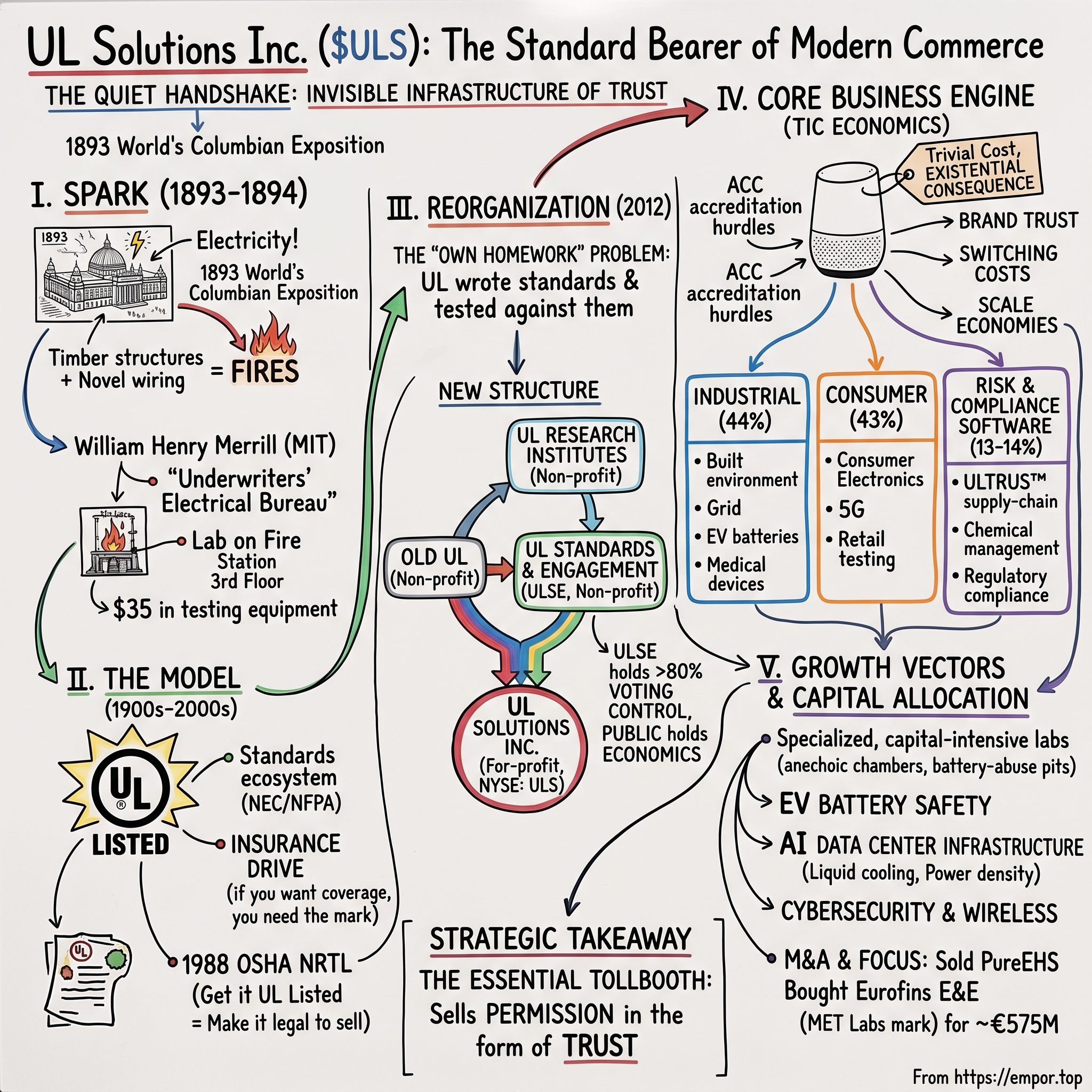
UL Solutions Inc.: The Standard Bearer of Modern Commerce
I. Introduction & Episode Roadmap
Pick up almost any electrical thing in a North American home — the phone charger on the nightstand, the microwave, the power strip behind the television, the breaker panel in the basement — and turn it over. Somewhere on the housing, molded into the plastic or stamped into the metal, you will very likely find a small circle with two letters inside: UL. Most people have looked at that mark ten thousand times and never once thought about it. That is precisely the point. The circled "UL" is one of the most successful pieces of infrastructure ever built, and its success is measured by its invisibility. It is the quiet handshake that lets a retailer stock a product, an insurer write a policy, and a building inspector sign off on an occupancy permit — all without anyone in the chain having personally verified that the thing won't catch fire.
Behind that mark sits UL Solutions Inc., which trades on the New York Stock Exchange under the ticker ULS.13 It is a roughly $3 billion revenue company operating in the global Testing, Inspection, and Certification industry — TIC, in the trade — and in fiscal 2025 it generated $3.05 billion of revenue at an adjusted EBITDA margin of 25.9%.8 Those are the economics of a business that sells trust: high recurring demand, strong cash conversion, and a customer that treats the fee as a rounding error against the cost of getting a product to market.
Here is the paradox that makes the story worth telling. This is a 130-year-old institution that was born out of literal fire panic at the 1893 Chicago World's Fair, spent more than a century as a non-stock, non-profit safety bureau, and then, in April 2024, sold shares to the public for the first time in a $946 million initial public offering.1 Yet even now, as a listed company, it is controlled by its non-profit parent. Public shareholders own the economics; a non-profit owns the votes. Understanding how that arrangement came to be — and whether it is a feature or a flaw — is the through-line of everything that follows.
A few themes will recur. The first is the regulatory tollbooth: testing typically costs a manufacturer a trivial fraction of what it spends developing a product, but a failed certification can stop a global launch cold. The second is structural transformation — the 2012 decision to separate the writing of safety standards from the commercial act of testing against them, and the 2024 decision to tap public markets. The third is the set of growth vectors pulling the company forward: electric-vehicle battery safety, clean-energy grid compliance, the ULTRUS™ software portfolio, and the validation of the dense, power-hungry hardware inside AI data centers. And the fourth is governance and capital allocation — how a company run under a non-profit controlling stockholder competes against a set of hard-charging European TIC conglomerates. Let's start where the fire started.
 Subscribe on LinkedIn
II. The Spark: William Henry Merrill & The Birth of the UL Mark (1894–2010)
Chicago in the summer of 1893 was a city showing off. The World's Columbian Exposition sprawled across more than 600 acres on the lakefront, and its centerpiece was electricity. Thomas Edison and George Westinghouse had turned the fairgrounds into a palace of light, with tens of thousands of incandescent bulbs blazing after dark in a way most Americans had never seen. But the buildings holding all that novel wiring were, by and large, timber-framed temporary structures. Sparks flew, insulation smoldered, and fires broke out with unnerving regularity. To the insurance underwriters who would be on the hook for the losses, the fair was less a marvel than a slow-motion actuarial nightmare.
Into that anxiety walked a young electrical engineer named William Henry Merrill, a graduate of the Massachusetts Institute of Technology, dispatched to investigate the electrical hazards. What Merrill saw convinced him that electricity was not going away, that it would only spread into every home and factory in the country, and that somebody needed to stand between the enthusiasm of inventors and the ignorance of everyone else. In 1894 he founded the Underwriters' Electrical Bureau, opening a laboratory on the third floor of a Chicago fire patrol station with, by legend, about $35 worth of testing equipment. The first test report was issued on March 24, 1894, on a sample of non-combustible insulation.
From that modest bench, Merrill built something closer to the safety architecture of industrial America than a mere lab. The organization — which became Underwriters Laboratories — worked hand in glove with the emerging codes that would govern how the country wired itself, most importantly the National Electrical Code and the standards ecosystem that grew up around the National Fire Protection Association. The genius of the model was that UL never had to force anyone to use it. Insurance companies did the forcing for it: if you wanted commercial property coverage, your building and its equipment needed to carry the mark. Demand for safety was manufactured not by a regulator but by the people writing the checks when things burned down.
The regulatory capstone came much later. In 1988, the U.S. Occupational Safety and Health Administration created the Nationally Recognized Testing Laboratory program, a formal accreditation scheme for the labs that certify workplace equipment as safe.2 UL was a charter member, and NRTL status hard-wired its certifications into federal workplace-safety enforcement. A manufacturer could, in theory, use any accredited NRTL. In practice, for vast categories of electrical product sold in the United States, "get it UL Listed" became shorthand for "make it legal to sell."
And yet the institution carried a structural weakness inside its own virtue. For over a century UL operated as a non-stock, non-profit membership organization. That form was the source of its credibility — it had no shareholders to please, no incentive to cut a corner for a paying customer — but it was also a financial straitjacket. A non-profit cannot issue equity. It cannot easily raise a war chest for acquisitions. And while UL sat in Chicago guarding the North American electrical market, a very different kind of competitor was consolidating across the Atlantic: publicly traded European TIC giants with real balance sheets and global ambitions. By the 2000s, the mismatch between UL's mission and its capital structure had become impossible to ignore. Something had to give.
III. The Great Reorganization & For-Profit Carve-Out (2012–2022)
There was also a conflict hiding in plain sight, and by the early 2010s it had become awkward enough to demand a fix. UL wrote safety standards. UL also charged manufacturers to test their products against those same standards. To an outsider, that looked uncomfortably like a company grading its own homework — writing the exam and then selling the tutoring. As UL pushed to expand commercially and internationally, that dual role risked undermining the very neutrality that made the mark worth anything.
The 2012 reorganization was the first move to resolve it. The organization began separating the two functions: the standards-development activity stayed inside the non-profit world, while the commercial product-testing business was carved into a separate for-profit subsidiary that would eventually become UL LLC. The logic was that a standard means more when the body writing it is visibly independent from the body profiting off the testing — even if, in this case, they shared a common ultimate parent.
By 2022 this had matured into a clean tripartite architecture that is essential to understanding the public company today. There are three distinct entities. UL Research Institutes is a non-profit that conducts fundamental research into emerging safety hazards — the chemistry of toxic exposures, the physics of lithium-ion thermal runaway.5 UL Standards & Engagement, known as ULSE, is a non-profit that develops and publishes the safety standards themselves and does the public-policy engagement work.4 And UL Solutions Inc. is the for-profit commercial entity that runs the testing, inspection, certification, software, and advisory businesses. Crucially, ULSE holds the controlling stake in UL Solutions — the standards writer sits atop the testing company as its owner, which is either an elegant alignment of mission and money or a governance knot, depending on your vantage point.3
With a for-profit vehicle finally in place, capital allocation could shift from defense to offense. For most of its history UL's spending had been about maintaining the domestic electrical franchise. Now the strategy pivoted toward building specialized, capital-intensive testing infrastructure for the technologies coming down the pike: anechoic chambers for electromagnetic-compatibility testing, battery-abuse pits for deliberately driving cells into failure, high-voltage labs for renewable-energy equipment. This is not commodity testing you can run out of a strip-mall office. It is physical plant that takes years and tens of millions of dollars to build, and that becomes a barrier to anyone thinking of competing.
The M&A followed the same logic. UL expanded into renewable-energy consulting and testing through the acquisition of AWS Truepower, moved deeper into environmental and materials science through businesses such as Method, and picked up specialized testing assets to fill capability gaps. The discipline management has described — and which investors should hold it to — is to benchmark bolt-on deals against the valuations European TIC peers pay, roughly the low-double-digit to mid-teens multiples of EBITDA that trade hands in this industry, and to avoid overpaying for generic commodity testing while paying up selectively for proprietary software or scarce clean-energy testing infrastructure. Whether that discipline holds under the pressure of being a public company with a growth story to feed is one of the open questions of the story. To judge it, you first have to understand how the underlying industry actually makes money.
IV. Core Business Engine: TIC Industry Economics & Segment Deep Dive
Imagine you run a consumer-electronics brand and you have designed a beautiful new smart speaker. You have spent millions on industrial design, chip sourcing, software, and marketing. Now you need to sell it in the United States, the European Union, Japan, and a dozen other markets — each with its own electrical-safety rules, its own radio-frequency emission limits, its own plug shapes and voltage tolerances. You cannot ship a single unit until an accredited third party certifies that the speaker won't electrocute anyone, catch fire, or jam the neighbor's Wi-Fi. That certification, relative to your total bill of materials and development budget, costs almost nothing. But without it, your entire investment is stranded on the factory floor. That asymmetry — trivial cost, existential consequence — is the beating heart of the TIC industry.
Globally, TIC is a fragmented market worth well over $200 billion when you include the in-house testing that companies and governments do themselves. The independent, third-party slice is smaller but still enormous, and no single player dominates it. The recognizable global leaders together hold only around a quarter of the market; the rest is a long tail of regional and specialist labs. The scaled competitors are mostly European: SGS S.A. of Switzerland, the largest, with roughly $7.5 billion in revenue and deep strength in trade, agriculture, and oil and gas; Bureau Veritas of France at roughly $6.5 billion, strong in marine, offshore, and buildings and infrastructure; Intertek Group of the UK at roughly $4.2 billion, strong in consumer goods, softlines, and fuels; Eurofins Scientific of Luxembourg, the bioanalytical and environmental leader; and the German engine of DEKRA, TÜV SÜD, and TÜV Rheinland, which own automotive and European industrial testing. Against this field, UL Solutions' distinctiveness is not scale — it is smaller than SGS or Bureau Veritas — but positional: an almost unrivaled grip on North American electrical safety, building products, appliances, and industrial automation, the categories where the UL mark is closest to a legal prerequisite.
The company reports through three segments, and the current names matter because the labels have evolved. Industrial, the largest at about 44% of 2025 revenue, covers the built environment, industrial automation, energy and grid infrastructure, EV battery systems, engineered materials, and medical devices.8 This is the highest-growth engine, riding directly on grid electrification, factory automation, and the energy transition. In the first quarter of 2026, Industrial revenue rose 10.3% to $375 million and its adjusted EBITDA margin reached a remarkable 32.8%, up 280 basis points year over year — a level of profitability that tells you how much pricing power sits behind mandatory certification of high-stakes equipment.9
Consumer, at roughly 43% of revenue, is the classic franchise: consumer electronics, household appliances, retail testing, electromagnetic compatibility, and wireless and 5G certification.8 It is high-volume and sticky, tied to the launch cadence of hardware brands, but it is also the segment most exposed to the cyclicality of consumer-hardware demand. In the first quarter of 2026 Consumer grew a more pedestrian 4.6% in total and just 3.0% organically — a reminder that when phones and appliances slow, so does this line.9
The third segment, now reported as Risk & Compliance Software and historically described as Software and Advisory, is the smallest at roughly 13% to 14% of revenue but strategically the most interesting. It houses the ULTRUS™ software portfolio — subscription tools for supply-chain transparency, chemical management, and regulatory compliance. Its role is to convert a transactional testing relationship into a recurring software one, deepening the hooks into a manufacturer's workflow. In the first quarter of 2026 its adjusted EBITDA rose 26.7% to $19 million as margin jumped 460 basis points to 29.2% — evidence that, freed of some lower-margin baggage, the software franchise can be genuinely profitable.9
Put the pieces together and the unit economics explain the durability. The testing fee is a negligible fraction of a manufacturer's total product cost, but an uncertified product faces customs seizure, retailer rejection, and open-ended liability exposure. Because certification requirements are baked into building codes and retailer mandates rather than negotiated deal by deal, UL Solutions carries structural pricing power — the ability to raise prices through an inflationary cycle without losing volume, because the customer has no real alternative to being certified. The question for the next decade is where that engine finds its next gear.
V. Hidden & Future Growth Vectors: Software & Next-Gen Technologies
For most of its life, UL was a hardware story — a company of laboratories, ovens, and abuse chambers. The most consequential strategic bet of the modern era is that its future is partly made of code. The ULTRUS™ portfolio is management's attempt to sit not just at the end of a product's development cycle, testing the finished good, but throughout it — helping a manufacturer manage restricted-substance lists, trace materials through a supply chain, and keep pace with a thickening web of ESG and chemical-safety regulation.6 The economic weight is still modest, roughly 14% of enterprise revenue, and the honest way to frame it is as an optionality layer sitting atop the core testing business rather than a second engine of equal size.
What makes the software story credible, rather than merely aspirational, is that management has been willing to cut as well as build. In a move that told investors something real about capital discipline, UL Solutions sold its Employee Health and Safety software business to an affiliate of the private-equity firm Peak Rock Capital, a transaction that closed on April 2, 2026; the buyer relaunched the assets under the brand PureEHS.10 The rationale management offered was focus: EHS software served workplace-safety managers and had little to do with certifying hardware, whereas the ULTRUS tools that survived the cut plug directly into the product-compliance workflows that surround UL's testing business. Selling a non-core asset to sharpen the portfolio is the kind of behavior a skeptical investor should reward — provided the proceeds are redeployed well, a point we return to shortly.
Where does the durable growth actually come from? Three vectors stand out, and it is worth being precise about which are proven and which are bets. The most tangible is EV battery and energy-storage safety. A lithium-ion cell that overheats can enter "thermal runaway," a self-feeding chemical fire that is extraordinarily hard to extinguish — the reason a single scooter battery can burn down an apartment. Testing high-voltage battery architectures for this failure mode requires exactly the kind of purpose-built destruction facilities UL has been investing in, and demand is real and growing as electrification spreads from cars into grid-scale storage. This is strategic to the core, not speculative.
The second is AI data-center infrastructure. The server racks now being installed to train and run large AI models pack unprecedented power density into small volumes, which forces exotic engineering: liquid cooling running inches from live electronics, power-delivery systems pushing far more current than legacy racks, and electromagnetic interference that has to be contained so thousands of components don't corrupt one another. Every one of those problems is a safety-and-compliance problem, and every one is a potential testing mandate. This is the most exciting story management can tell right now, and also the least proven — real optionality, but optionality that has yet to show up as a disclosed, sized revenue line. The third vector, cybersecurity and wireless testing for connected devices, follows the same logic as regulators in the U.S. and Europe begin treating the security of an internet-connected gadget as a safety attribute in its own right. Whether these bets pay off will be decided not by the technology alone but by the people allocating capital toward them.
VI. Current Management, Strategy, & Corporate Governance
When Jennifer F. Scanlon took the top job in 2019, she arrived as an operator, not a lifer.8 She had spent years running USG Corporation — the maker of Sheetrock wallboard — through a cyclical building-products business and a takeover by Germany's Knauf, which is about as clean a résumé as exists for someone whose job would be to turn a century-old non-profit laboratory into a public company. Under her leadership UL Solutions modernized its operations, pushed the software integration, and, most visibly, carried the organization through its NYSE listing. Alongside her, Chief Financial Officer Ryan D. Robinson has been the steward of the financial narrative that investors actually underwrite: margin expansion, working-capital discipline, and the integration of bolt-on deals.11 Robinson signaled his own conviction at the listing by buying roughly $2 million of Class A stock at the IPO price — a small gesture, but the kind of skin-in-the-game investors notice.11
The IPO itself was an unusual piece of financial engineering worth dwelling on. On April 11, 2024, UL Solutions priced its offering at $28.00 per share, the top of its marketed range, and shares began trading on the NYSE the following day.1[^2] The deal was upsized from an initial 28 million shares to 33.8 million, raising about $946 million, and with the underwriters' option exercised the total offering reached roughly $1.08 billion — the largest U.S. listing of its kind at the time.1112 But here is the crucial structural detail: this was a secondary offering. The selling shareholder was the parent, ULSE, monetizing a portion of its stake. Not a dollar of primary capital flowed into UL Solutions itself. The company got a public currency — a listed stock it could use for acquisitions and employee compensation — without diluting existing owners with new shares, while its non-profit parent got liquidity.
That structure carries straight into the governance arrangement, which is where a skeptical investor should linger. UL Solutions has two classes of stock. The public holds Class A shares, one vote each. ULSE holds 100% of the Class B shares and, through them, north of 80% of the total voting power.3 In plain terms: public shareholders own a meaningful slice of the economics but have almost no ability to determine the outcome of a vote. The board is effectively appointable by the parent. Management can point to alignment — the non-profit's mission is safety, and safety is the product — but alignment of mission is not the same as alignment of financial interest. A public Class A holder who wanted the company to, say, lever up and return more cash, or replace directors, has no mechanism to force it.
There are subtler conflicts to watch. The UL mark itself — the brand at the center of everything — is bound up with the non-profit side of the house, which raises perennial questions about royalty, license, and trademark arrangements between the for-profit company and its non-profit parent and affiliates. Any related-party economics that flow from ULS to ULSE are, in effect, money moving from public shareholders' company to an entity they do not control. None of this is hidden; it is disclosed. But disclosure is not the same as protection, and the governance discount that some investors apply to ULS is a rational response to a structure where the controlling owner's incentives and the minority's incentives could, someday, diverge. To assess whether that discount is warranted, it helps to war-game the competitive position formally.
VII. Strategic Frameworks: 7 Powers & Porter's 5 Forces Analysis
Strip away the history and the segments, and the investment question reduces to one thing: how durable is the advantage? Hamilton Helmer's 7 Powers framework is a useful scalpel, and UL Solutions lights up several of its powers at once — though not all of them, and it is worth being honest about which.
Start with branding. The circled UL mark is one of the few genuine trust brands in industrial commerce; for North American retailers, inspectors, and consumers it functions as a synonym for "safe to plug in." That brand took a century of accident-free credibility to build and could not be replicated with any amount of marketing spend, which is exactly what makes it a power rather than a logo. Closer to the true source of the moat is what Helmer would call a cornered resource — UL's accreditation under the OSHA NRTL program and, more importantly, the direct reference to UL standards inside thousands of NFPA, ANSI, and international codes.2 When a municipal building code names a UL standard by number, the company has effectively been written into law. A competitor cannot simply offer a cheaper equivalent, because the code does not ask for an equivalent; it asks for that standard.
Switching costs compound the effect. Once a manufacturer designs a product and its component list around UL-certified specifications, changing certification providers is not a procurement decision — it is a re-engineering and re-filing project, with fresh testing, fresh documentation, and fresh regulatory exposure. The software layer deepens this further, because a compliance workflow embedded in a customer's supply-chain systems is stickier still. And scale economies show up in the physical plant: a full-scale fire-simulation tower or an EMC anechoic chamber costs a fortune to build and only pays off when spread across a global client base, which a subscale entrant cannot assemble. The powers UL does not obviously possess are network effects and process power in the software sense — worth noting so the moat isn't overstated.
Porter's Five Forces tells the same story from the outside in. The threat of new entrants is extremely low: the accreditation hurdles, the decades of brand trust, and the capital intensity of the labs together form a wall few would attempt to climb. The bargaining power of buyers is low to moderate — an individual manufacturer cannot bypass the certification that its own retailers and building inspectors demand, though the largest global OEMs do have some leverage on price for high-volume, repeatable testing. The bargaining power of suppliers — the makers of specialized lab equipment — is low and fragmented. The threat of substitutes is low, because even where an alternative standard technically exists, local building codes and retailer mandates block the substitution. And competitive rivalry is best described as rational rather than brutal: the global TIC market behaves like an oligopoly carved up by geography and vertical, where the big players mostly compete on the edges rather than in ruinous price wars. The forces point one direction. The interesting arguments are about the exceptions — which is where the bull and bear cases collide.
VIII. Skeptical Investor & Activist Stress Test: Bull vs. Bear Case
Imagine an activist investor building a position in ULS and drafting the letter to the board. What would they attack? The first and most obvious target is governance. With the parent controlling more than 80% of the vote, the classic activist toolkit — proxy fights, board nominations, forcing a capital return — is essentially disarmed.3 An activist cannot win a vote it is structurally guaranteed to lose. The governance discount is real, and the honest bear observation is that public shareholders here are minority passengers in a vehicle steered by a non-profit whose ultimate loyalties are to a safety mission, not to the ULS share price.
The second line of attack is the quality of the growth. Is margin expansion coming from genuine operating leverage — pricing power and volume — or is it being manufactured through cost synergies on acquisitions and the flattering optics of selling lower-margin businesses like EHS? The bull's answer is that the evidence leans toward the former: adjusted EBITDA margin expanded 300 basis points in fiscal 2025 to 25.9%, and the first quarter of 2026 saw a further 320-basis-point jump to 26.0%, gains too broad and too fast to be explained by mix cleanup alone.89 The bear's rejoinder is that a company simultaneously divesting EHS and acquiring the Eurofins electrical-and-electronics business is reshaping its own numerator and denominator in ways that make clean like-for-like comparison genuinely hard, and that investors should demand organic clarity.
This is why a disciplined observer should ignore the noise and track a very small number of key performance indicators. Three matter most. The first is organic revenue growth — the truest read on underlying demand and pricing power, stripped of the distortions of M&A; management has guided 2026 to mid-single-digit organic growth, and the first quarter delivered 5.7%.9 The second is adjusted EBITDA margin, where the company has walked its stated target up from the mid-20s toward roughly 27.0% for full-year 2026 — a promise investors can check against results every quarter.9 The third is free-cash-flow conversion and returns on invested capital: in fiscal 2025 the company converted operating cash flow of $600 million into $403 million of free cash flow after $197 million of capital expenditure, a signal that the growth is genuinely cash-generative rather than a capex sinkhole.14 These are the dials to watch; the reader should track them, not take management's characterization on faith.
The risk radar is specific, not generic. The most immediate is cyclicality in the Consumer segment: a slowdown in consumer-electronics and appliance manufacturing directly slows a line that is more than 40% of revenue. The second is capital intensity — the very next-generation labs that create the moat (battery destruction pits, high-power AI-server test bays) also consume cash, and if demand for that capacity disappoints, the returns on that capex compress. The third is geopolitical and trade friction, which can scramble the cross-border certification flows on which a global TIC business depends.
Stack it up and the debate is clean. The bull case: regulated safety mandates create an annuity-like revenue stream with structural pricing power; the secular tailwinds of EV batteries, grid storage, and AI hardware are real and durable; and continued portfolio pruning pushes margins toward and past 27%. The bear case: the absence of public voting control caps governance flexibility and justifies a permanent discount; the Consumer cycle can suppress organic growth for extended stretches; and well-capitalized European competitors contest UL's every step outside its North American fortress. Both cases are legitimate. The tiebreaker is what management actually says and does when the microphone is live.
IX. Conference Call Forensics & What Management is Saying Now
Earnings calls are where a management team's narrative gets stress-tested in real time, and UL Solutions' post-IPO calls have settled into a recognizable rhythm. In the prepared remarks, management leads with margin. On the fourth-quarter and full-year 2025 call in February 2026, the headline was a full-year adjusted EBITDA of $792 million, up 20.7%, with margin of 25.9% expanding 300 basis points, adjusted net income of $423 million up 17.2%, and adjusted diluted EPS of $1.99.8 The board underscored its confidence by raising the quarterly dividend 11.5% to $0.145 per share — a modest but tangible commitment to returning cash even as the company invests for growth.8
Then the analysts pushed, and the pushback is where the real information lives. Wall Street's recurring lines of questioning have been consistent: the sustainability of software-segment margins, the split between organic volume and price increases, and the pace of M&A integration. On the first-quarter 2026 call in early May, management fielded exactly these and delivered a result that gave them room to answer confidently — revenue of $758 million, up 7.5% with 5.7% organic growth, and adjusted EBITDA of $197 million at a 26.0% margin, an EPS of $0.50 that ran well ahead of consensus expectations near $0.34.9 More telling than the beat was the reaction: management raised full-year adjusted EBITDA margin guidance to approximately 27.0%.9 Raising a margin target one year into public life, against a Consumer segment that was visibly decelerating to 3% organic growth, is a statement of confidence in the Industrial and software mix — and a target investors can now hold them to.
The portfolio moves have dominated the strategic Q&A. Management has framed the EHS divestiture and the Eurofins acquisition as two sides of one coin: shed software that does not serve hardware compliance, and buy testing capacity that does. On April 13, 2026, UL Solutions announced a definitive agreement to acquire the electrical-and-electronics business of Eurofins Scientific, including the MET Labs certification mark, for an enterprise value of roughly €575 million, or about $670 million.7 The acquired business was expected to generate around $200 million of revenue in 2026, and management said it would fund the deal from cash and its revolving credit facility, with roughly 30% of the price sourced from the EHS sale proceeds — a neat closing of the loop between the divestiture and the purchase, and closing was expected in the fourth quarter of 2026 subject to regulatory approvals.710 The skeptical read is that buying a competitor's electrical-and-electronics testing business is a bet on scale in the exact category where UL is already strong; the constructive read is that it consolidates a rational oligopoly and adds EMC and wireless capacity precisely where the AI-hardware and connected-device demand is heading.
For investors who want to do the primary-source work themselves, the essential documents are the Form S-1 registration statement and IPO roadshow materials from spring 2024, the sequence of post-IPO earnings calls from the second quarter of 2024 through the full-year 2025 and first-quarter 2026 results, and the capital-allocation Q&A surrounding the Eurofins transaction.3[^16] Read together, they show a management team that has, so far, set targets and then met or raised them — the single most valuable habit a newly public company can demonstrate, and the one most worth watching for the first sign of slippage.
X. Epilogue & Strategic Takeaways
The arc is almost too neat to be true. A young engineer sets up a $35 workbench on the third floor of a Chicago fire station in 1894, worried that the wondrous new electricity on display at the World's Fair is going to burn the country down. A hundred and thirty years later, that workbench has become a New York-listed enterprise generating more than $3 billion in annual revenue, its mark stamped on billions of products, its standards written into the building codes of the world.813
The enduring lesson is about a particular kind of business model — the essential tollbooth. UL Solutions does not make the products, does not own the factories, does not carry the inventory. It sells permission, in the form of trust, at a price that is negligible to the customer and impossible for the customer to refuse. That is a rare and beautiful economic position, and it is why the company can post mid-20s EBITDA margins and convert profits into cash while competitors twice its size grind through commodity testing.
But the story does not resolve into a simple verdict, and it should not. The same non-profit heritage that gives the UL mark its unimpeachable credibility also produced a governance structure in which public shareholders own the upside and control almost none of the votes. The same secular tailwinds — batteries, grids, AI hardware — that promise durable growth also demand heavy, front-loaded capital and remain, in the case of AI, largely unproven as a disclosed revenue line. The bet a public investor makes in ULS is that a mission-driven parent and a profit-seeking minority can want the same things for a very long time, and that the tollbooth keeps collecting as the roads it sits on shift from copper wire to lithium cells to liquid-cooled silicon. The history says the franchise is real. The next decade will say whether the structure built around it was the right one.
References
-
UL Solutions Raises $946 Million in US IPO Priced at Top of Range — Reuters, 2024-04-11 ↩↩
-
Nationally Recognized Testing Laboratory (NRTL) Program Overview — U.S. Occupational Safety and Health Administration, 2024-01-01 ↩↩
-
SEC EDGAR Form S-1/A Registration Statement — UL Solutions Inc., 2024-04-02 ↩↩↩↩
-
UL Standards & Engagement Official Website — ULSE, 2024-01-01 ↩
-
UL Research Institutes Official Website — UL Research Institutes, 2024-01-01 ↩
-
ULTRUS Software Portfolio Solution Overview — UL Solutions Inc., 2024-05-15 ↩
-
UL Solutions Inc. Broadens Portfolio with Agreement to Acquire Eurofins Scientific's Electrical & Electronics Business — UL Solutions Inc., 2026-04-13 ↩↩
-
UL Solutions Inc. Reports Strong Fourth Quarter and Full-Year 2025 Results — UL Solutions Inc., 2026-02-19 ↩↩↩↩↩↩↩↩
-
UL Solutions (ULS) Q1 2026 Earnings Call Transcript — The Motley Fool, 2026-05-05 ↩↩↩↩↩↩↩↩
-
Peak Rock Capital Affiliate Completes Acquisition of the Employee Health and Safety Software Business of UL Solutions — PR Newswire, 2026-04-02 ↩↩
-
UL Solutions Announces Pricing of Upsized Initial Public Offering — UL Solutions Inc., 2024-04-11 ↩↩↩
-
UL Solutions Raises $946 Million in Year's Largest US Tech IPO — Bloomberg, 2024-04-11 ↩
-
UL Solutions Inc. Stock Market Profile and Quote ($ULS) — Wall Street Journal, 2024-04-12 ↩↩
-
UL Solutions Inc. Form ARS Annual Report FY2025 — SEC EDGAR, 2026-04-01 ↩
 LinkedIn
 WhatsApp
 Reddit
 Hacker News
 Email
Email Kindle
 RSS Feed
 Spotify
 Apple Podcasts
 Amazon Music
 Audible
 YouTube