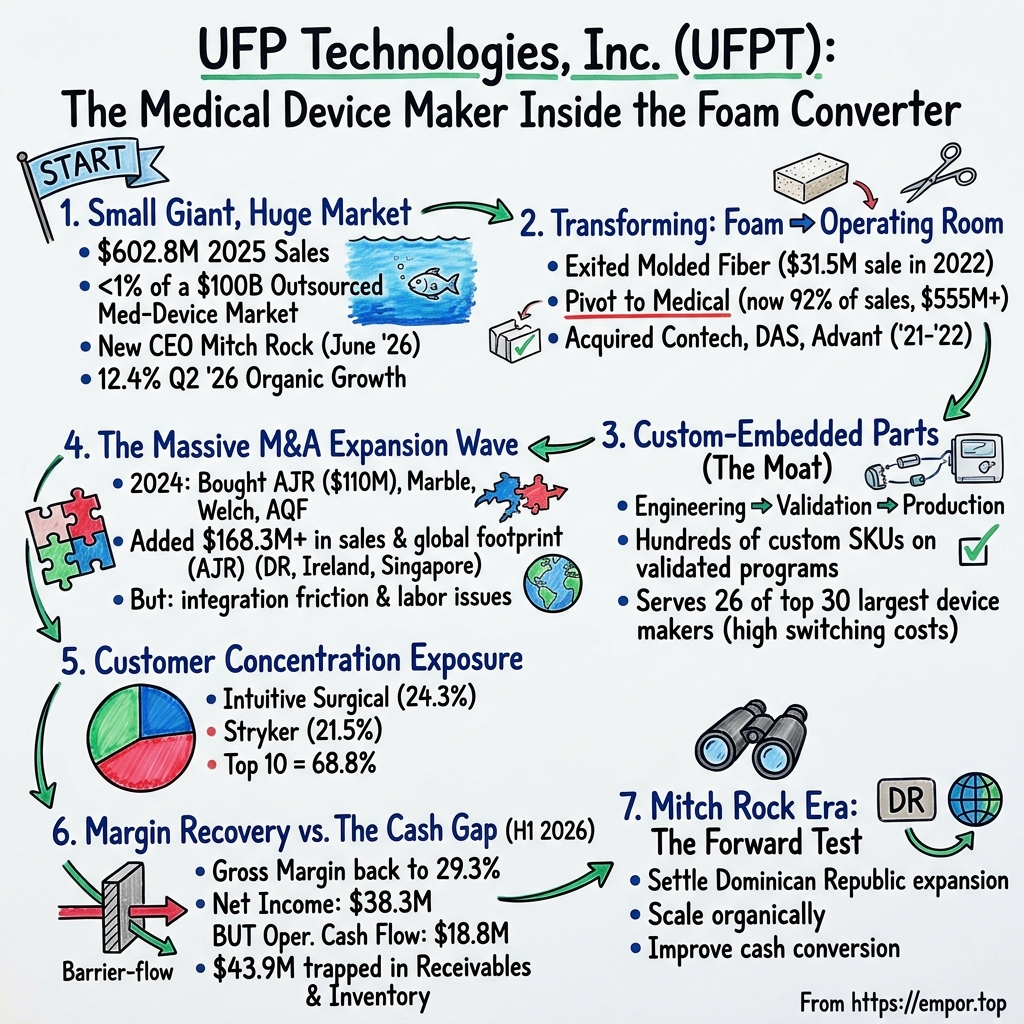
UFP Technologies, Inc.: The Medical Device Maker Inside the Foam Converter
I. A $600 Million Supplier With a $100 Billion Market in Sight
On August 3, 2026, Mitch Rock sat down for his first earnings call as chief executive of a company he had joined thirty-five years earlier as a salesman for its molded-fiber packaging division.12 Two months into the top job, he had a good quarter to report. Sales at UFP Technologies rose about 15% to $174 million, and the number that mattered more, growth that did not come from buying somebody else's revenue, came in at 12.4%.1 That was a startling figure for a company whose organic growth for the whole of 2025 had been 1.5%, and whose first quarter of 2026 had come in essentially flat.34
The timing gave the call a particular charge. Rock's predecessor, Jeff Bailly, had run the company for more than three decades and had spent the last five years turning it from a regional foam and plastics converter into a contract manufacturer for the world's largest medical-device makers.2 That transformation had been built in large part through acquisitions, and acquisitions are wonderful at making a company bigger and terrible at proving it is getting better. A 12.4% organic quarter was the first clean piece of evidence in a while that the business underneath the deals could grow on its own.
Consider how far the company had travelled. In 2021, UFP reported $206.3 million of sales.5 Four years later, the figure was nearly three times as large, a point management made itself when it closed the books on 2025.6 Few industrial companies triple in four years without either a technological breakthrough or a checkbook, and UFP did not have a breakthrough. It had a strategy, a willing lender and a list of targets. The result was a much larger company whose underlying growth rate had become genuinely hard to see.
The company Rock inherited is not small, but it is small relative to what it chases. UFP reported $602.8 million of sales in 2025.3 Its latest investor presentation frames the opportunity as a roughly $100 billion outsourced medical-device market growing around 10% a year, a figure it borrows from an industry ranking rather than measuring itself.7 Do the arithmetic and UFP's medical revenue is about half of one percent of that pool. On paper, that is the kind of runway long-term investors dream about: a capable supplier in a fragmented market, with almost all of the field still ahead of it.
Paper is generous, though. A $100 billion "market" for outsourced manufacturing is not a single prize waiting to be claimed; it is thousands of separate programs, each owned by a device company that decides who builds what, for how long and at what price. UFP does not compete for "the market." It competes, one validated program at a time, for the right to make a specific drape, pouch, pad or packaging tray for a specific customer. The relevant question is not how big the ocean is but how good the boat is at catching fish.
What the boat looks like today is a medical company with a small industrial tail. Medical sales were $555.3 million in 2025, about 92% of the total, while the older Advanced Components business, which sells engineered foam and specialty parts into automotive, aerospace and industrial customers, brought in $47.5 million and shrank by more than a tenth.3 The tail is not where the story lives. It is a reminder of where the company came from and how decisively it has left.
The stakes, then, come down to one question asked three ways. Is UFP's growth engine now its customer programs, its acquisitions, or some blend of the two? Can it keep its margins as it scales into larger customers and new factories? And does the growth turn into cash, or does it get swallowed by inventory and receivables on the way to the bank?
Those three questions give the story its tests. The first is organic growth: the sales the company would have had without the businesses it bought, which is the only honest measure of whether its customers want more of what it makes. The second is customer concentration, because a supplier whose two biggest customers account for nearly half its revenue lives partly on decisions made in other companies' boardrooms. The third is cash conversion: whether the profit on the income statement shows up, in time, in the bank account.
Rock's own framing of the quarter was measured. He described it as solid execution across the platform and continued progress on the long-term strategy, and in the same breath acknowledged that investments in the Dominican Republic were weighing on margins in U.S. operations.1 It was the voice of an operator rather than a promoter, which is a reasonable first impression. But tone is not evidence, and the evidence was mixed.
On that August call, all three tests were moving at once. Organic growth had jumped. Growth outside the biggest customers had outpaced growth inside them. And yet the first half of the year had produced barely half as much operating cash as net income.8 A good quarter, in other words, but not a verdict. To understand which reading of UFP is closer to the truth, the story has to go back to the moment the company decided what it wanted to be.
 Subscribe on LinkedIn
II. The Foam Converter Moves Into the Operating Room
In the summer of 2022, UFP sold a business that, by most measures, was perfectly fine. Molded Fiber Technology made packaging from pressed pulp, the gray egg-carton material that cradles electronics and consumer goods, and it had brought in about $21 million of revenue the year before.5 On July 26, 2022, UFP sold it, along with its Iowa real estate, to CKF USA for about $31.5 million, booking a gain of roughly $15.7 million because the assets had been carried at about half the sale price.5 The proceeds went to paying down the revolving credit line the company had just used to buy its way into medical devices, and to the tax bill on the gain.5
There was a certain poetry to it. Molded fiber was where Mitch Rock had started his career in 1991.2 Selling it was not a rejection of a bad business; it was a statement about attention. Every hour of management time and every dollar of capital spent on pulp packaging was an hour and a dollar not spent on what UFP now believed was the better game.
To see why that choice mattered, it helps to know what UFP had been for most of its life. The company traces its roots to 1963 and spent decades as an engineered-materials shop out of Massachusetts, cutting, laminating, molding and thermoforming foams, plastics and composites into custom shapes for whoever needed them.9 Its customers spanned automotive, aerospace and defense, consumer, electronics and industrial markets, with medicine as one niche among many.10 Over the years it accumulated a long list of materials it knew how to work with and machines that could shape them. That was the real asset: not a product, but a library of manufacturing know-how for flexible, soft, hard-to-handle materials.
Medical-device makers had always been among its customers. A foam that cushions an orthopedic implant inside a sterile tray, or a polyurethane pad that wicks fluid from a wound, is not so different from a foam insert that protects a camera in transit. What is different is everything around it: the clean rooms, the sterile-barrier testing, the documentation trail that lets a device maker prove to regulators that every part was made the same way, every time. Medical work pays better precisely because it is harder to do and harder to switch.
Bailly, who had joined the company in 1988 and become chief executive in 1995, pushed UFP steadily toward that harder, better-paying work.2 By the start of the decade, the company had concluded that the medical opportunity was large enough to bet the company on. The turning point came in a rapid burst of acquisitions between October 2021 and March 2022, when UFP bought Advant Medical, DAS Medical and Contech Medical for nearly $100 million combined.11 Those deals added clean-room capacity, final device assembly, and manufacturing in lower-cost locations, and they pulled UFP closer to the surgical-robotics programs that came to define its customer list.
It is worth pausing on what the business looked like just before that burst. In 2021, UFP's medical sales grew about 10%, but organic medical growth was only about 5%; the rest came from Contech, bought in October, and DAS Medical, bought just before Christmas.10 The same year, the company noted new manufacturing facilities in the Dominican Republic and in Tijuana, Mexico.10 Those two details foreshadow the entire next chapter. Organic growth on its own was modest, and the company was beginning to move labor-intensive work to places where labor cost less.
Why does geography matter so much in this business? Because many of UFP's medical products, drapes, slings, pouches, assembled kits, are not made by giant automated machines. They are cut, welded, sewn, folded and packed by people working in clean rooms. In that kind of factory, the wage bill is a large share of the cost of each unit, and moving a program from Massachusetts or Illinois to the Dominican Republic can change its economics more than any engineering improvement. The device makers know this too, which is why a supplier with validated low-cost capacity close to the United States becomes more attractive to them.
The effect on the reported numbers was dramatic. Net sales jumped about 72% in 2022 to $353.8 million, and medical sales more than doubled, rising 116%.5 That is the headline most people remember, and it is the kind of figure that makes a strategic pivot look visionary in hindsight.
The record, read carefully, tells a more modest story. Of that medical surge, acquired companies contributed about $121.9 million.5 Medical organic growth was a healthy 24%, but the company itself attributed it to three forces that had little to do with strategic positioning: a rebound in surgical procedures after the pandemic, one customer restocking its inventory, and price increases passed through to offset higher input costs.5 Procedure recovery fades, restocking is a one-time event, and inflation pass-through is not real volume growth. None of that diminishes 2022 as a year. It does mean that 2022 cannot, on its own, prove that the focus on medical created a repeatable organic engine.
There was also a sting in the deal accounting. DAS Medical and Contech carried earn-outs, payments to the sellers if the businesses hit targets after closing. Those businesses did well enough that UFP had to raise its estimate of what it would owe, which in 2022 produced a remeasurement charge of about $9.8 million.5 In one sense, this was good news dressed as an expense: the acquired companies were outperforming the assumptions baked into the price. In another, it was a reminder that the true cost of an acquisition is not always known on the day it closes.
So the Molded Fiber sale is best understood as a clean, well-executed capital-allocation decision inside a story that was still mostly being written by acquisitions. UFP had sharpened its focus and paid down debt with the proceeds. What it had not yet shown was that the sharper focus would compound on its own. The next chapter raised the stakes considerably, with four acquisitions in 2024 alone and more in 2025. Before following that buying spree, though, it is worth understanding what exactly UFP was buying more of, and why a device maker would hand it a program in the first place.
III. A Custom Part Becomes Part of a Validated Program
Picture a surgical robot, the kind with articulated arms that a surgeon controls from a console across the room. The robot itself is an expensive capital machine that will be used for years. But every time it operates on a patient, its arms must be covered in sterile plastic drapes that are thrown away afterward. Those drapes have to fit precisely, flex without tearing, allow the instruments to move freely and maintain a sterile barrier through hours of surgery. They are, in a sense, a disposable skin for a machine that cannot be sterilized between every case.
UFP makes those drapes, along with a long catalog of other single-use, single-patient items: wound-care components, infection-prevention products, sterile packaging for orthopedic implants, components for cardiac implants, coils that dispense catheters, and products used in biopharmaceutical manufacturing.3 The company now describes itself as a contract development and manufacturing organization, a mouthful that simply means it helps customers design a product and then makes it for them under the customer's brand.3
Some of those products sound obscure until their purpose becomes clear. Negative-pressure wound therapy, for instance, uses a sealed foam dressing attached to a small pump that gently draws fluid out of a wound to speed healing; the foam has to be porous in exactly the right way, safe against open tissue and consistent from batch to batch. IV port cleaners are tiny caps soaked in disinfectant that nurses snap onto catheter connectors to prevent bloodstream infections.
Sterile packaging for an orthopedic implant is a molded tray and lid that must keep a titanium knee sterile through shipping, storage and the moment a nurse peels it open in the operating room. UFP's catalog of applications, as it described them in 2024, reads like a tour of the hospital: robotic surgery drapes, catheter and guidewire packaging, surgical site preparation, ports for minimally invasive surgery and hospital beds.9
Behind the catalog sits the physical plant. By August 2024, UFP said it had 39 clean rooms and controlled environments, about 1.3 million square feet of manufacturing space and more than 100 people in its engineering group.9 Those figures do not prove a moat, but they do describe something a small regional converter cannot easily match: the ability to take a product from concept to validated production in multiple countries, with the quality systems large device makers require.
How a part becomes a program is the heart of the business. A device maker arrives with a need: a new robotic instrument, a redesigned wound dressing, a safer way to lift a patient from a bed. UFP's engineers work alongside the customer's team to choose materials, shape the design, and figure out how it can be manufactured reliably at volume. The customer then runs the part through its own testing and regulatory process, and the manufacturing process is validated, which means documented and tested so that the device maker can show regulators that every unit will match the one they approved. Only then does production begin, often for years.
The money follows that sequence, but not evenly. In 2025, UFP earned $591.4 million from products, against just $4.5 million from tooling and machinery and $6.9 million from engineering services.3 In other words, almost all of the revenue comes from making things once a program is running. The design work is the door, not the house. It is better thought of as an investment in winning the right to manufacture than as a business in itself. That makes UFP look less like a software company with subscriptions and more like a supplier riding the production volumes of its customers' products.
Why, then, would a customer keep UFP on a program once it has been designed? The answer is validation. Once a device maker has proven to regulators that a drape or package made by a specific process in a specific facility performs as specified, changing suppliers is not as simple as sending a purchase order elsewhere. The new supplier would need to replicate the process, and the device maker would need to re-validate it, with the time, testing and regulatory paperwork that entails. Think of it like changing the foundation under a house that is already built: possible, but nobody does it casually.
The company leans heavily on that logic. Its investor materials talk about early design-in and high switching costs as core differentiators.7 By August 2024, UFP said its customers included 25 of the 30 largest medical-device manufacturers in the world.9 Those are real signs of an embedded supplier.
But the claim deserves a stress test, because "switching costs" is one of the most overused phrases in investing. The strongest evidence would be a retention rate, a count of programs renewed versus lost, or proof of sole-source status. UFP publishes none of those. Its filings do not disclose typical contract lengths, minimum purchase commitments or the share of revenue that recurs under multiyear agreements.3 What they do disclose cuts the other way: customers can reduce or cancel orders, and volumes rise and fall with product launches, procedure rates and the customer's own production schedules.3 Switching friction protects UFP against being replaced on an existing program; it does not protect it against a customer simply buying less.
There is also the question of pricing. A supplier with genuine leverage raises prices faster than its costs. UFP's record shows it can pass through cost increases, as it did in 2022 and again in 2025 when it passed tariffs through to customers.512 That is valuable, but it is not the same as pricing power. Passing through costs keeps margins steady; it does not widen them.
The rise of artificial intelligence sharpens the point rather than undermining it. Much of what investors fear AI will commoditize is digital: code, design files, documentation. UFP's value lies in physical manufacturing, quality systems and medical validation, none of which can be downloaded. AI may well make UFP's own engineers faster, and it may make it easier for competitors to design products too, but the company has not quantified either effect. For now, the validated factory remains the barrier.
What about the competition? UFP says its main rivals are smaller, independent regional converters, local shops that cut and form materials for nearby customers.3 At the other end of the spectrum are much larger contract manufacturers. Integer Holdings, one of the biggest names in medical-device outsourcing, reported about $1.85 billion of sales in 2025, roughly three times UFP's size, though Integer focuses on cardiac, vascular and neuromodulation components rather than the soft, flexible materials that are UFP's specialty.13 UFP occupies a middle position: larger and more capable than the regional shops, much smaller than the giants, and specialized in a material niche that neither fully covers.
The verdict on the moat, at this stage, is that it is plausible but not proven. The mechanism is real: validated processes create friction, and serving most of the largest device makers is a meaningful credential. But without retention, win rates or price data, the best available evidence is indirect. The cleanest test is whether organic growth holds up across many customers over many periods, and whether margins stay steady as volumes rise. That test became much harder to read once UFP started buying companies at scale.
IV. Four Deals, One Bigger Bet on Medical Manufacturing
On July 1, 2024, UFP closed the largest acquisition in its history. For $110 million in cash, funded almost entirely by a new term loan, it bought AJR Enterprises, a contract manufacturer based in St. Charles, Illinois, with a factory in Santiago, in the Dominican Republic.14 AJR made single-use devices for safe patient handling: the slings, sheets and transfer systems that let nurses move patients without injuring them or themselves. It was not glamorous, but it was big, with about $75 million of sales in the twelve months before the deal.14
The same 8-K contained a detail that matters more than its placement suggested. Nearly all of AJR's sales came from a single major customer in the safe-patient-handling market.14 UFP was not just buying capacity; it was buying a relationship.
The terms show how seriously UFP treated that relationship. The sellers agreed not to compete with UFP for seven years, and $4 million of the price was held in escrow against future claims.14 The purchase was financed with about $115 million of a new secured term loan, which meant UFP was, for the first time in its modern history, carrying meaningful debt to fund a single bet.14 At roughly 700 employees, AJR was also a large workforce for UFP to absorb in one step.9
AJR was the centerpiece of a remarkable eight weeks. On June 24, 2024, UFP bought Marble Medical, a 25-person converter of 3M healthcare adhesives in Tallahassee, Florida, that brought expertise in medical tapes and stick-to-skin products.9 On July 15, it bought Welch Fluorocarbon of Dover, New Hampshire, an 83-person maker of thin thermoformed films used in implantable devices such as pacemakers and defibrillators.915 And on August 23, it added AQF Medical, a foam and thermoplastic-polyurethane specialist in Navan, Ireland, with a joint-venture facility in Singapore, for about €43 million.911 All told, the company spent about $197.5 million in cash on acquisitions in 2024.3
Each deal had a clear logic. AJR brought low-cost Dominican Republic capacity and a foothold in patient handling. Marble added adhesive expertise. Welch added a specialty material that took UFP closer to implantable devices, where margins tend to be higher. AQF gave UFP a European manufacturing base and an entry point to Asian customers. It is a coherent story of collecting capabilities, which is precisely what management said it was doing.9
The harder question is whether UFP paid sensible prices. Here, the evidence is thinner than the story. AJR cost about 1.5 times its trailing sales, and UFP put the multiple at about 6.5 times AJR's 2023 adjusted EBITDA.14 For a contract manufacturer with a single dominant customer, that is not an extravagant price; on paper, it looks reasonable. Welch was a different matter: UFP paid $34.6 million, or about 11.5 times adjusted EBITDA, plus up to $6 million more if the business hit profit targets over the next three years.15
When the AQF deal was announced, KeyBanc analysts described its price as slightly above UFP's historical average but reasonable.11 The company did not disclose EBITDA multiples for Marble or AQF, and private-company deal data for close comparables is not public. So no honest conclusion can be drawn about whether the portfolio was bought cheaply or expensively in aggregate.
What can be tested is what happened afterward. And the most telling evidence comes not from the biggest deal but from the most expensive one. Welch missed its profit targets for both 2024 and 2025, and by the end of 2025 UFP did not consider it probable that Welch would hit its 2026 target either.3 The earn-out, once valued at about $0.8 million, was written down to zero.3
That is a small number in UFP's accounts, and a missed earn-out does not mean the deal was a failure. But it is direct evidence that the business UFP paid the highest multiple for has underperformed the expectations set when it was bought. It is the kind of detail that rarely makes a presentation slide and should temper any claim that the acquisition program is uniformly disciplined.
The structure of the Welch deal also says something useful about how UFP buys. By tying up to $6 million of the price to future profits, the company shifted some risk back to the sellers: if Welch underperformed, UFP would pay less, and that is exactly what happened.153 Marble carried a similar, smaller earn-out linked to sales targets.3 Earn-outs are a sensible tool for buying small private businesses whose future is uncertain. They are also an admission, written into the contract, that the buyer was not sure what it was getting. In Welch's case, the doubt proved warranted.
AQF added a different kind of complexity. Its Singapore operation was a joint venture, which UFP accounts for as an equity-method investment valued at about $6.9 million at the end of 2025.3 That means UFP records its share of the venture's profits but does not consolidate its sales, so a piece of the Asian growth story sits outside the revenue line investors watch. It is small, but it is another reason UFP's reported numbers are a slightly imperfect window into the businesses it now owns.
AJR's story was more dramatic. In 2025, its Illinois plant was hit by a labor crisis. Employment-eligibility checks through E-Verify led to more than half of the direct labor workforce turning over, which cut output, left more than $8 million of orders unfilled and reduced earnings per share by $0.28 in the third quarter alone.12 Across the year, the inefficiencies added more than $6.3 million of labor costs.3 Management said July 2025 was the low point.12 By the fourth quarter, the excess cost had fallen to $1.2 million from $3.0 million in the third quarter, and by the second quarter of 2026, management said the AJR backlog had been cleared and the St. Charles facility was fully staffed.616
That recovery is real, and management deserves credit for explaining the problem in concrete terms, with dollar figures and a timeline. But the episode exposes a vulnerability in the acquisition model: a business bought largely for its customer relationship and its low-cost footprint turned out to depend on a workforce that could not be retained. Due diligence evaluates revenue and EBITDA; it is much harder to diligence how many workers will pass eligibility checks a year later.
The buying did not stop. In 2025, UFP bought AJR Specialty Products and AJR Custom Foam Products for about $2.8 million, Universal Plastics & Engineering for about $7.5 million and Techno Plastics Industries for about $4.5 million.3 These were small tuck-ins, and management said the latter two were immediately accretive.12 By the end of 2025, UFP had completed seven acquisitions in two years, and management said it was still hunting.6 On the second-quarter 2026 call, it described a pipeline of five to ten targets, each generating $5 million to $30 million of EBITDA, while promising to remain disciplined on valuation.16
The scale of the program's contribution is the essential fact. Acquired businesses contributed about $168.3 million of UFP's 2025 sales, up from $73.1 million the year before.3 That is more than a quarter of the company's revenue. The 19.5% headline growth for 2025 was almost entirely bought; the organic piece was just 1.5%.3
That is the crux of the investment debate. The acquisitions broadened UFP's capabilities and footprint, and in aggregate they appear to have been bought at defensible prices. But they also produced integration costs, a failed earn-out and a labor crisis, and they make it harder to see how well the underlying business is growing. The validation of the strategy is not a bigger revenue base; it is acquired businesses that subsequently grow, earn stable margins and generate returns that justify their prices. AJR's price looks reasonable, but its value depends on something even more important than the labor issue: the customer it came with.
V. The Customer Concentration Hidden Inside the Growth Story
In the third quarter of 2025, UFP revealed that it was negotiating to extend and expand a contract with its largest customer, Intuitive Surgical, a deal management described as worth roughly $500 million.12 Intuitive makes the da Vinci surgical robot, and UFP makes the drapes that cover its arms. By the fourth-quarter call in February 2026, the extension had been signed: at least two more years, materially higher volumes and an additional program.6 Management declined to quantify the volumes.6
On the surface, this was a triumph. A larger, longer contract with a customer that dominates its field is exactly what a supplier wants. But it also illustrated the central tension in UFP's story. The single most important commercial event of the year was a decision made by someone else.
The numbers make the exposure plain. Intuitive Surgical accounted for 24.3% of UFP's 2025 sales, and Stryker for 21.5%.3 Together, two customers represented nearly half the company's revenue. The top ten customers accounted for 68.8%, up from 59.3% two years earlier.3 Concentration, in other words, has been rising, not falling, during the period when UFP has been diversifying its capabilities.
Look more closely and the shape shifts in an interesting way. Intuitive's share actually fell, from 29.2% in 2024 to 24.3% in 2025, while Stryker's rose sharply, from 15.4% to 21.5%.3 The timing coincides with the first full year of AJR, whose sales came almost entirely from a single safe-patient-handling customer, and Stryker is a major name in patient-handling equipment.14 UFP does not identify AJR's customer, so the link is an inference rather than a fact. But if it holds, the acquisition that was meant to broaden UFP's base also deepened its dependence on a second giant. Diversifying capabilities and diversifying customers are not the same thing.
The balance sheet tells the same story from another angle. At the end of 2025, one customer accounted for 32.1% of UFP's gross receivables.3 That is not a sign of trouble; large device makers pay their bills. But it does mean that a third of the money UFP is owed at any moment depends on one company's payment schedule.
There is a counterpoint, and it arrived in the second quarter of 2026. Sales to the top five customers grew 14.7%, while the rest of the MedTech business grew 19.7%.1 Growth was coming from cardiovascular, infection control, orthopedics and surfaces and support, while the robotic surgery market was flat to down for the year, as management had predicted.16 If the rest of the book can keep outgrowing the giants, concentration will dilute naturally over time.
The robotic-surgery business shows how even the largest relationship can produce lumpy numbers. In the third quarter of 2025, UFP's robotic-surgery revenue grew about 5%, while management said growth with Intuitive itself was closer to 8%; the gap reflected a one-year accounting effect from moving pouch production to the Dominican Republic.12 On the same call, management said two new robotic programs were launching and would contribute at least $10 million in 2026, with more after that.12 In other words, the relationship with the largest customer is not static. It is a series of programs, each with its own launch curve, transfer timing and pricing, and UFP's results move as those programs start, ramp and relocate.
One quarter, however, is not a trend, and the counterpoint has to be weighed against its own context. The top five customers still accounted for 61% of sales in the first half of 2026.16 And the first quarter of the year had shown almost no organic growth at all.4 UFP's chief financial officer, Ron Lataille, was candid on the August call: he expected organic growth to return to the company's long-term range of 6% to 9%, and did not expect a repeat of the double-digit pace as comparisons got tougher.16 That is an admirable piece of guidance discipline. It also means the company itself is telling investors not to extrapolate the quarter that made the headlines.
What about the bargaining power of these customers? Large device companies are sophisticated buyers. They can negotiate hard on price, split volume among multiple suppliers, insource production or move programs elsewhere when contracts come up for renewal. On the third-quarter 2025 call, management said the expanded Intuitive volumes would require a new building and capital investment, possibly shared with the customer.12 When a customer helps pay for your factory, it is a sign of commitment. It is also a sign of who sets the terms.
Comparing how management has handled the hardest questions over three calls is revealing. On the third-quarter 2025 call, analysts pressed on AJR's labor problems, and management responded with specific figures and a timeline.12 On the fourth-quarter call, asked to quantify the higher Intuitive volumes or the backlog, management declined.6
By the second quarter of 2026, the AJR backlog had been cleared, as promised, but the Dominican Republic program transfers were running behind: two of three had moved, and the third was delayed, with benefits taking longer than expected.16 The pattern is of a management team that is concrete about problems once they have happened and more guarded about the size of future opportunities. That is not unusual. It does mean investors have to wait for results rather than rely on forecasts.
The verdict on concentration is that UFP's relationships appear deep, but its revenue is not broad. The extended Intuitive contract reduces the near-term risk of losing the largest customer, while the second quarter's growth outside the top five is encouraging. But the company remains highly exposed to the procurement decisions of a few giants. The measures to watch are simple: the largest customers' share of sales and receivables, and whether the rest of MedTech keeps growing faster. And if those customers are going to keep buying more, UFP has to build more, which brings the story to the place where growth meets cash.
VI. The Margin Recovery Has to Reach the Cash Account
In the first half of 2026, UFP earned $38.3 million of net income.1 In the same six months, its operations generated just $18.8 million of cash.8 For a company that had spent the previous two years producing more cash than profit, it was a sharp reversal, and one that deserves a careful explanation rather than either alarm or dismissal.
Start with the longer pattern, because it is reassuring. In 2025, operating cash flow was $91.9 million against $68.3 million of net income, and in 2024 it was $66.6 million against $59.0 million.3 That is what a healthy manufacturer with significant depreciation and amortization should look like: non-cash charges from all those acquisitions inflate the gap between accounting profit and cash in the right direction. The exception was 2023, when operating cash flow of $41.3 million fell short of $44.9 million of net income.3 So the history shows cash conversion that is generally strong, but not guaranteed every year.
Then came 2026. In the first half, rising receivables consumed $30.5 million of cash, and inventory absorbed another $13.4 million.8 Put simply, UFP shipped more products than its customers had paid for yet, and it built up stock ahead of the volumes it expected. Together, those two items consumed nearly $44 million, which more than accounts for the gap between profit and cash.
Is that a warning sign? It depends on why it happened. Net trade receivables rose from $83.8 million at the end of 2025 to $113.2 million by June 2026.38 Part of that is simply the arithmetic of growth: second-quarter sales were the highest in UFP's history, and sales made in May and June are naturally still owed at the end of June. Part of it may be timing around program launches.
What the company does not publish is an aging schedule showing how much of the balance is overdue, so it is impossible to say from the outside whether any customer is paying more slowly.8 The allowance for doubtful accounts rose from $895,000 to about $1.16 million, a modest increase relative to the balance.38 In 2025, the company recorded just $31,000 of bad-debt expense.3 There is no evidence of collection trouble; there is simply a lot more money owed.
The second quarter on its own looked better than the half-year total. Operating cash flow was about $15.6 million in the quarter, against capital spending of just $1.2 million, and leverage ended the quarter below one times EBITDA.16 But cash on hand fell from $20.3 million at the end of 2025 to $9.0 million by June, as UFP used what it had to pay down borrowings rather than build a cushion.38 That is a defensible choice for a company with a revolving credit line, but it leaves little room if working capital keeps swelling while the next acquisition beckons.
Inventory follows a similar logic. A company ramping two new robotic surgery programs, moving production to the Dominican Republic and preparing for higher volumes under a renewed contract needs materials on hand before it ships. The risk is not that the inventory is bad. It is that working capital becomes a permanent tax on growth, which would mean that each extra dollar of sales requires more cash than the company had previously needed.
Margins sit underneath all this. UFP's gross margin, the share of each sales dollar left after the direct costs of making the product, fell to 28.3% in 2025 from 29.1% the year before.3 The decline was almost entirely explained by the AJR labor problem; management estimated that without it, the margin would have been 29.3%.3 By the second quarter of 2026, gross margin had recovered to 29.3%, with AJR back to full staffing.116 That is the recovery management had promised, delivered.
Why was a labor shortage at one plant so expensive? Management's own estimate offers the answer. It said the unfilled AJR orders carried a contribution margin of roughly 30% to 35%, meaning that each lost dollar of sales took a third of a dollar of profit with it, while the plant still paid for training, overtime and replacement workers.12
The Dominican Republic also shows up in a less obvious place: the tax line. UFP's effective tax rate fell to 17.2% in 2025 from 19.2% the year before, which management attributed to more pre-tax income being earned in the Dominican Republic.36 Every program that moves there potentially improves both the cost of making it and the tax paid on its profit. That is a genuine economic incentive behind the transfers, and it raises the stakes of getting them done on time.
But a new pressure emerged as the old one faded. Rock acknowledged that UFP's investments in the Dominican Republic were creating near-term margin pressure in U.S. operations, as production moved but the savings arrived more slowly than expected.116 When a program moves from a U.S. plant to a lower-cost site, the U.S. plant loses volume and its fixed costs have to be spread over fewer units, while the new site has not yet reached full efficiency.
Only two of the three planned program transfers had been completed by the second quarter, the company said.16 Meanwhile, selling, general and administrative costs rose to 11.7% of sales on an adjusted basis, driven by new leadership hires and CEO-transition costs, and Lataille called that level the "new normal" until mid-2027.16 And petroleum-based raw materials were getting more expensive because of oil-price volatility linked to the conflict in Iran, which management expected to pass through to customers.16
How much is UFP reinvesting to support the growth? Capital spending was $12.9 million in 2025, about 2% of sales, which is modest for a manufacturer and suggests much of the expansion has come through acquired factories and leased buildings rather than heavy new construction.3 The company had planned to take possession of a sixth building in the Dominican Republic in April 2026 to expand robotic-surgery capacity.6
Research and development, mostly engineering time, fell to about $8.6 million, or 1.4% of sales, from about 2.1% the year before.3 Headcount, meanwhile, grew from about 3,100 full-time employees at the start of 2024 to more than 4,800 at the start of 2026, with temporary workers rising to 503.317 The decline in R&D as a share of sales deserves monitoring, because design-in is the front door to future programs.
The conclusion is that the first-half cash gap is explained mainly by working capital built during a growth spurt, and is not by itself evidence of poor-quality sales. Gross margin has recovered as promised. But the next margin story, the Dominican Republic transfers, is running behind, and cash conversion is the measure that will reveal whether growth is affordable. Receivables and inventory need to grow in line with sales, not faster. Those questions now belong to a new chief executive.
VII. A New CEO Inherits the Acquisition Machine
On June 4, 2026, at UFP's annual meeting, Jeff Bailly retired as chief executive after 31 years in the role, and Mitch Rock took over.2 Bailly is staying on as executive chairman for one year.2 The handoff had been planned for months, reinforced by Rock's appointment as company president in February 2024.182 In corporate terms, it was about as smooth as a succession gets.
The two men represent different chapters of the same career. Bailly ran divisions and operations before becoming chief executive, and chairman in 2006.2 He oversaw the long transformation from foam converter to medical manufacturer and the acquisition spree that defined the last five years. Rock rose through sales and marketing, becoming a vice president in 2002, senior vice president in 2014 and president of UFP MedTech in 2021.2
When Bailly named him president, he called Rock a key strategic advisor with strong customer and vendor relationships, someone well known and well respected throughout the industry.18 Rock is, by background, a salesman and relationship builder, a fitting profile for a business that lives on customer programs. Ron Lataille, the finance chief since 1997, remained in place.2
Bailly's final quarter as chief executive was a reminder of what Rock was inheriting. In the first quarter of 2026, sales rose about 4%, but organic growth was essentially flat, and Bailly attributed slower earnings growth partly to softer results at AJR.4 That same winter, the company had detected a ransomware attack on February 14; management said data had been taken and then destroyed, and production continued under contingency plans.6 Rock took over a company that had just weathered a labor crisis and a cyber incident, with a renewed largest-customer contract and a set of new factories still ramping.
Rock's pay package is substantial but not lavish for a company of UFP's size: a $700,000 base salary, a target annual bonus of up to 100% of salary and a one-time grant of restricted stock worth $650,000.19
Bailly's pay is more complicated. His total compensation reached about $7.65 million in 2025, up from $5.28 million in 2024 and $4.93 million in 2023.220 Most of the 2025 figure, about $5.4 million, came from stock awards.2 Over the same period, net income rose from $44.9 million to $68.3 million.3 Pay rose by roughly 55% while profit rose by roughly 52%, so the direction is aligned.
But the scale deserves scrutiny: Bailly's 2025 package equaled more than a tenth of the company's net income. The bonus was tied to adjusted operating income, which came in at about $97.8 million against a $93.7 million target, a measure that rewards growth whether it is bought or built.2 An activist might reasonably ask whether a company so dependent on acquisitions should pay its executives on a metric that acquisitions can inflate, rather than on organic growth or return on invested capital.
Shareholders did not object strongly. At the June 2026 meeting, say-on-pay passed with about 5.97 million votes for and 664,037 against.21 Six of seven directors are independent.2 Directors and executives collectively held about 4.6% of the shares, with Bailly alone holding 2.2%.2 That is a meaningful stake, enough to align insiders with outside shareholders, but far from controlling. The large holders are institutions: BlackRock with about 14%, Wasatch Advisors with about 10%, Vanguard with about 7%.2
There is one related-party arrangement worth noting. In 2025, the company paid $216,292 in salary and benefits to Bailly's brother for a corporate estimating role, about 0.04% of sales.2 It is immaterial in size and described as ordinary employment rather than a fee to an outside entity. The company does not give a pricing comparison, but nothing about the arrangement suggests value is leaking out of the business.
The more important test of management is behavioral: what it has said compared with what happened. Back in 2022, the DAS and Contech earn-out remeasurement suggested acquired businesses were beating their initial assumptions.5 Since then, the record has been mixed. AJR's labor problem was serious, but management explained it in specifics and resolved it on roughly the timeline it gave. Welch's missed earn-out was another setback.3
Organic growth fell far short of the company's long-term range.3 The Dominican Republic transfers also lagged in mid-2026.16 The company's own investor presentation targets 12% to 18% blended annual growth and a 28% to 31% gross margin over three to five years.7 Margins sit inside that range. Organic growth, the part management controls most directly, has not consistently delivered its share.
The balance sheet gives Rock room. Borrowings fell from $135.5 million at the end of 2025 to $117.3 million by June 2026, and the company remained in compliance with its covenants.38 Leverage was under one times EBITDA.16 But the debt is variable-rate, at a weighted average of about 5%, and secured, with most of it maturing in 2029.8
UFP pays no dividend and has not bought back stock in recent years, so nearly all free cash goes to debt reduction and acquisitions.3 With five to ten targets in the pipeline, the next large deal is likely to come under Rock's watch, and the first real measure of his discipline will be whether he pays for it with cash the business has generated or with debt the business has not yet earned.
The verdict on the transition is that it preserves continuity, which is both its strength and its limit. Rock knows the customers and the strategy because he helped build them. That makes a sharp break unlikely. It also means the decisive evidence will not be his background but his results: organic growth, cash conversion and acquisition returns over the next several years. To weigh those results, it helps to set the bull and bear cases side by side.
VIII. Analysis & Bear vs. Bull Case
Two investors can look at the same second quarter of 2026 and see two different companies. The first sees 12.4% organic growth, a record quarter, recovering margins and growth outside the biggest customers. The second sees a single strong quarter after a year of 1.5% organic growth, a first half that produced barely half as much cash as profit, two customers accounting for nearly half the revenue and a factory transfer program running late. Both are describing the same facts. The question is which facts will matter most over the next five years.
Start with the industry's structure, using Michael Porter's five forces. Buyer power is the dominant force, and it is strong. UFP's top ten customers account for more than two-thirds of sales, and they are among the most sophisticated procurement organizations in the world. Rivalry is fragmented: UFP faces many small regional converters below it and much larger diversified manufacturers above it, such as Integer.313
Supplier power is meaningful in a narrow way, because UFP relies on a limited number of suppliers for certain cross-linked foams, technical polyurethane foams and thermoplastic urethane.3 The threat of new entrants is moderated by clean rooms, ISO certifications and validated processes; UFP operates 19 ISO 13485-certified sites and 13 FDA-registered locations.3 And the threat of substitutes is low in the near term, because a surgical robot still needs a drape and a patient still needs a sling, but customers always retain the option to insource or redesign.
Hamilton Helmer's seven powers framework sharpens the question of whether UFP has a durable advantage. Of the seven, only two plausibly apply. The first is switching costs, the friction of re-validating a program with a new supplier. This is the core of UFP's moat claim, and the mechanism is real. But its strength is unproven, because the company publishes no retention rates, sole-source percentages or price-realization data, and customers can still cut volumes without switching.
The second is a modest form of scale economies: a global footprint with low-cost plants in the Dominican Republic, Mexico and Costa Rica lets UFP offer customers something the regional converters cannot. That advantage is real but replicable by any well-capitalized competitor. UFP's investor materials also cite exclusive access to certain specialty materials, which could amount to a cornered resource, but the company does not disclose how much revenue depends on those materials.9 There is no network effect, no brand that patients recognize and no counter-positioning against incumbents.
A peer comparison helps calibrate what "good" looks like. Integer, the much larger outsourcing specialist, grew its sales about 8% in 2025, with organic growth of about 6.4%.13 UFP's reported growth that year was more than twice as fast, but its organic growth, at 1.5%, was a quarter of Integer's.3 The two companies serve different niches, and one year is a narrow window. Still, the comparison captures the heart of the debate: UFP looks like a faster grower only when acquisitions are counted. A company whose moat produces superior organic growth should, over time, beat a larger and more diversified peer on that measure. In 2025, UFP did not.
The bull case, then, runs like this. UFP is a focused, mid-sized supplier embedded early in the design of single-use medical products, with a broad material library, a growing low-cost footprint and relationships with most of the world's largest device makers. Its end markets, especially robotic surgery, are growing faster than medical devices as a whole, and its own investor deck cites growth rates of about 13% to 17% a year for robotic-assisted surgery.7 New robotic programs that launched in late 2025 are expected to contribute an eight-figure sum in 2027.16 If UFP can win more programs from customers outside its top five, the second quarter's 19.7% growth in the rest of MedTech could become the norm rather than the exception, and concentration would fall naturally.
The bear case is just as coherent. Two customers account for nearly half of sales, and the largest of them renewed on terms it negotiated, with volumes management would not quantify and a factory expansion it may help fund. Organic growth was weak in 2025 and the first quarter of 2026, with the business relying on acquisitions to grow. The acquisition program has produced a labor crisis at its largest deal and a written-off earn-out at its most expensive one. The Dominican Republic transfers that are supposed to lift margins are behind schedule. And growth is consuming cash rather than generating it, at least for now.
An activist looking at UFP would focus on three areas. The first is incentive design: executive pay tied to adjusted operating income rewards acquisitions as much as organic growth, so tying a portion to organic growth or return on invested capital would sharpen accountability. The second is disclosure: a company that sells the idea of switching costs could publish program retention or renewal data to prove it. The third is capital allocation: with a pipeline of five to ten deals, investors would want to see that past acquisitions are earning returns that justify their prices before the next large check is written.
How has history treated the bull case's central claims? The claim that UFP is a sticky supplier survives, narrowed to a smaller version: switching friction protects existing programs, but it has not protected UFP against flat volumes, as 2025 showed. The claim that acquisitions are disciplined is also narrowed: AJR's price was reasonable, Welch underperformed, and the integration costs were real. The claim that focus on medical produces superior organic growth remains unproven. The 24% medical organic growth of 2022 came from procedure recovery, restocking and pricing, and 2025's organic growth was weak. The second quarter of 2026 is the first strong data point in a while, and management itself has guided to a return to 6% to 9%.16
The risks are concrete rather than abstract. Customers can reduce or cancel orders.3 Program concentration means one decision can move results. Labor availability and program transfers have already caused disruption. A small number of suppliers provide critical foams and thermoplastic urethane.3 The debt is variable-rate and secured.8 About 16% of sales go to customers outside the U.S., and operations in the Dominican Republic, Ireland, Costa Rica and Mexico expose results to currency swings; translation gains and losses have moved equity by several million dollars a year in both directions.3
In February 2026, UFP detected a ransomware attack in which data was taken; management said production continued under contingency plans and it did not expect a material financial impact.6 That makes cybersecurity an operational risk rather than a demonstrated financial loss. The company also reports one employee claim, which management does not expect to have a material effect.3 Grant Thornton, UFP's auditor since 2005, issued clean opinions on both the financial statements and internal controls, with no critical audit matters.3
Three measures will tell investors more than any narrative. The first is organic sales growth, which was 1.5% for 2025, 0.4% in the first quarter of 2026 and 12.4% in the second.341 The second is the largest customers' share of sales and receivables, with the top ten at 68.8% of 2025 sales, up from 59.3% two years earlier.3 The third is cash conversion: operating cash flow relative to net income, which fell from about 135% in 2025 to less than half in the first half of 2026, as receivables and inventory grew faster than sales.38
And how does the market price all this? In August 2024, as the acquisition wave was cresting, UFP's market value was about $2.4 billion, against pro forma annual revenue of about $565 million, which works out to more than four times sales.9 By June 2026, after the company had grown revenue past $600 million and earned $68.3 million in 2025, its market value had fallen to about $1.7 billion, or under three times sales and about 25 times trailing earnings.73 The share count barely changed, so the decline was entirely a reassessment of what each share was worth.
The market, in other words, had grown noticeably more skeptical even as the company grew larger. That skepticism appears to price in exactly the doubts the bear case raises: weak organic growth, concentration and integration risk. If the second quarter marks the start of a durable organic recovery, that skepticism would be tested; if it proves an outlier, the market's caution would look justified. Comparing that valuation with peers such as Integer requires current market data, but the internal comparison is telling enough: investors now pay considerably less for each dollar of UFP's sales than they did at the height of the buying spree.
IX. Playbook: Business & Investing Lessons
The first lesson begins with a pulp packaging plant in Iowa. Selling Molded Fiber was a choice about where to spend attention. Four years later, UFP's organic growth record is still mixed. Focus is a capital-allocation choice, and it only earns its keep when the business you keep grows on its own.
The second lesson lives inside a sterile drape on a surgical robot. UFP's validated programs are valuable, but 2025 showed that switching costs cannot make customers order more. For anyone building a supplier business, switching costs protect your seat at the table; they do not decide how much food is served.
The third lesson comes from St. Charles and Dover, where labor disruption and a missed earn-out showed how acquisition economics can change after closing. Buying capability is the opening move; integration is where the price gets paid. For investors, the price on announcement day is an estimate. The real price emerges two years later, in the margin, the labor bill and the earn-out ledger.
The fourth lesson is written in UFP's first-half 2026 cash-flow statement: profit outpaced operating cash as receivables and inventory grew. Growth is not free; it must be financed, and the bill arrives in receivables and inventory before it arrives in profit. Profit describes the period; cash tells you what growth demanded.
The fifth lesson is about who sets the terms. UFP's expanded contract with its largest customer showed the value of a deep partnership and the influence a customer can gain when it helps fund a factory. A supplier that grows with its giants should measure success not just by how much more they buy, but by how much less it needs them.
X. Epilogue
On the evening of October 24, 2026, UFP Technologies stands at an uncomfortable midpoint. Its new chief executive has been in place for less than five months. The quarter that made his first earnings call a success is now three months old, and the third-quarter results, the first full quarter of his tenure, will be the next piece of evidence. A sixth building in the Dominican Republic is meant to house more robotic-surgery work. One delayed program transfer is still underway. And a pipeline of acquisition targets sits on the table, waiting for a decision.
The next few quarters will decide which story is true. The first test is organic growth. Lataille has already told investors to expect a return to a 6% to 9% range rather than repeat double-digit quarters.16 If UFP lands in that range consistently, the company will have shown that its base business can grow at a respectable clip without the help of acquisitions. If it slips back toward the low single digits, the second quarter will look like a burst of catch-up demand rather than a new trajectory.
The second test is the factory map: whether the delayed Dominican Republic transfers can lift margins without new disruption.
The third test is cash: whether first-half working-capital pressure eases before the next acquisition.8 If second-half collections catch up and inventory stabilizes, the first-half gap will look like a timing quirk of a record quarter. If working capital keeps rising faster than sales, the company will be funding its growth with cash it does not have, which would make the next acquisition harder to justify.
Several dates are already on the calendar. Management expects the robotic programs to add to revenue in 2027.16 Overhead should begin to ease around mid-2027, according to Lataille.16 And Bailly's year as executive chairman ends in June 2027, at which point Rock will run the company without his predecessor in the room.2 By then, investors should be able to judge whether the robotic programs ramped as promised, whether overhead fell back as a share of sales, and whether the new chief executive's first acquisition, if there is one, was bought at a price the business could afford.
What would change the verdict? Sustained organic growth combined with strong cash conversion would support the claim that UFP has built a scalable platform, one that wins programs, keeps them and turns them into cash. Another round of acquisition-led growth with weak conversion would leave that claim unproven, and the market's skepticism vindicated.
The tension at the heart of the company remains unresolved. UFP has embedded itself in important customer programs, but the customer controls the order, and UFP must fund the capacity to fill it. Every new building is a bet that the customer will keep buying. Every renewal is a reminder of how much depends on that customer's decision.
XI. Outro
Somewhere tonight, in an operating room, a surgeon will sit at a console and guide a robot's arms through an incision. Very likely, the drape on those arms will have been made by a company that started out cutting foam in Massachusetts in 1963.
That invisibility is UFP's opportunity and its vulnerability in one. Medicine now accounts for more than 90% of its sales, and customers find its validated products hard to replace. But ten customers decide how many units to order and account for about two-thirds of revenue. UFP's next chapter turns on a single question: can a component become indispensable when the customer still owns the design and the order?
References
-
Q2 2026 Earnings Release — UFP Technologies / SEC, 2026-08-03 ↩↩↩↩↩↩↩↩
-
2026 Proxy Statement — UFP Technologies / SEC, 2026-04-30 ↩↩↩↩↩↩↩↩↩↩↩↩↩↩↩↩↩↩
-
2025 Form 10-K — UFP Technologies / SEC, 2026-02-27 ↩↩↩↩↩↩↩↩↩↩↩↩↩↩↩↩↩↩↩↩↩↩↩↩↩↩↩↩↩↩↩↩↩↩↩↩↩↩↩↩↩↩↩↩↩↩↩↩↩↩↩↩↩
-
Q1 2026 Earnings Results — UFP Technologies / SEC, 2026-05-04 ↩↩↩↩
-
2022 Form 10-K — UFP Technologies / SEC, 2023-03-01 ↩↩↩↩↩↩↩↩↩↩
-
Q4 2025 Earnings Call Transcript — The Motley Fool, 2026-02-25 ↩↩↩↩↩↩↩↩↩↩
-
June 2026 Investor Presentation — UFP Technologies / SEC ↩↩↩↩↩
-
Q2 2026 Form 10-Q — UFP Technologies / SEC, 2026-08-06 ↩↩↩↩↩↩↩↩↩↩↩↩
-
August 2024 Investor Presentation — UFP Technologies ↩↩↩↩↩↩↩↩↩↩↩
-
UFP to Buy AQF Medical, Extending Deal Spree — MedTech Dive, 2024-08-27 ↩↩↩
-
Q3 2025 Earnings Call Transcript — The Motley Fool, 2025-11-27 ↩↩↩↩↩↩↩↩↩↩
-
Integer Holdings Corporation Reports Results for Fourth Quarter and Full Year 2025 — Integer Holdings, 2026-02-19 ↩↩↩
-
AJR Acquisition, Form 8-K — UFP Technologies / SEC, 2024-07-01 ↩↩↩↩↩↩↩
-
Welch Fluorocarbon Acquisition, Form 8-K — UFP Technologies / SEC, 2024-07-16 ↩↩↩
-
Q2 2026 Earnings Call Transcript — The Motley Fool, 2026-08-10 ↩↩↩↩↩↩↩↩↩↩↩↩↩↩↩↩↩↩↩
-
UFP Technologies Names Mitchell Rock President, Exhibit 99.1 — UFP Technologies / SEC, 2024-02-07 ↩↩
-
CEO Employment Terms, Form 8-K — UFP Technologies / SEC, 2026-02-13 ↩
-
Annual Meeting Voting Results, Form 8-K — UFP Technologies / SEC, 2026-06-10 ↩
 LinkedIn
 WhatsApp
 Reddit
 Hacker News
 Email
 Kindle
 RSS Feed
 Spotify
 Apple Podcasts
 Amazon Music
 Audible
 YouTube