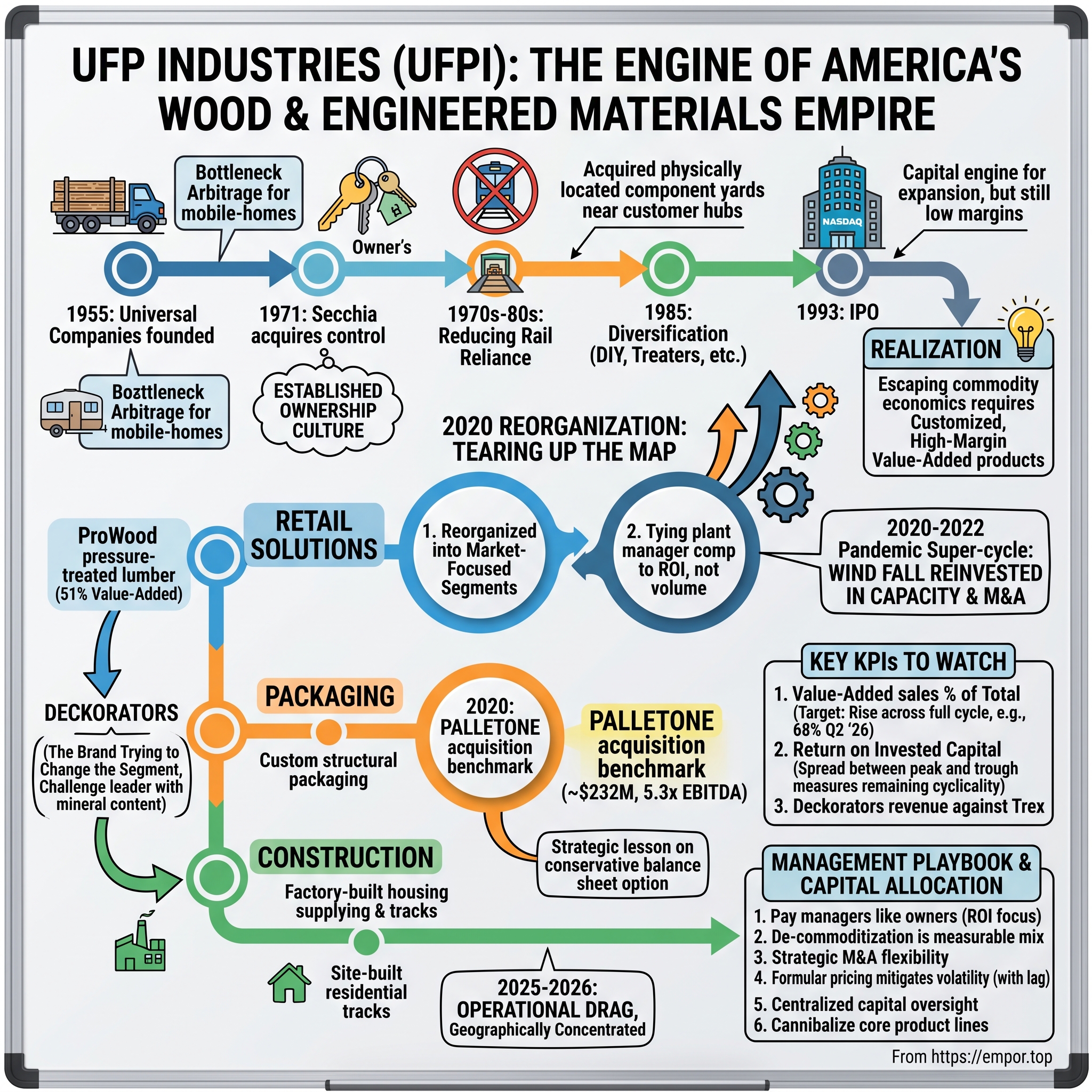
UFP Industries: The Engine of America's Wood & Engineered Materials Empire
I. Introduction & Episode Roadmap (10 min)
A $6 billion industrial operation in plain sight
Walk into a Home Depot on a Saturday in April and look at the stacks of green-tinged, pressure-treated two-by-sixes near the garden center. Someone grew that tree, someone sawed it, and someone treated it with copper preservative, kiln-dried it, banded it, trucked it, and merchandised it onto that rack in the proper lengths for a homeowner building a 12-by-16 deck. That unglamorous middle operation is a substantial business. In 2025, it generated $6.32 billion in revenue, and the company running the largest version of it in North America is headquartered not in Atlanta or Dallas, but in Grand Rapids, Michigan.1
UFP Industries operates 201 facilities across seven countries, including 178 in the United States. Management describes the company as the largest softwood lumber converter in North America, processing roughly 6% of the continent's lumber supply.2 It supplies home improvement retailers such as The Home Depot and Lowe's, factory-built housing producers like Clayton Homes, concrete contractors pouring parking structures, and industrial manufacturers requiring heavy wooden crates to ship equipment such as turbine blades.
The core paradox
Here is the paradox at the center of the company. Dimensional lumber is a pure commodity: graded, indexed, futures-traded, and indifferent to the vendor selling it. Between 2020 and 2022, the Random Lengths framing lumber composite surged from roughly $350 per thousand board feet to a May 2021 record of $1,514—with futures trading above $1,700—before plummeting approximately 75% to roughly $366 by mid-2024.[^3]3 Most business models built on top of such volatile price swings function less as stable enterprises and more as leveraged bets on commodity charts.
Yet UFP compounded capital through that volatility. Over the five years ending in 2025, management reported an average annual EBITDA growth rate of roughly 13%, along with about 170 basis points of adjusted EBITDA margin expansion compared to 2019, while maintaining an average annual return on invested capital near 24%.45 Such performance metrics are typical of specialized manufacturing rather than commodity lumber processing.
The thesis—and how to test it
Management frames UFP's trajectory as a structural de-commoditization. The executive argument contends that reorganizing into three market-facing segments in 2020, tying plant manager compensation to return on capital rather than volume, and acquiring assets like PalletOne disciplined the business, transforming a pass-through commodity operation into a durable earnings engine.
The empirical record presents a nuanced picture. Value-added products expanded to 68% of sales in the second quarter of 2026, up from 41% in 2011.2 Conversely, cyclical pressures remain evident: for the trailing twelve months through mid-2026, the adjusted EBITDA margin stood at 8.2% against a long-term target of 12.5%, while trailing return on invested capital declined to roughly 11% in the quarter ending March 2026—still exceeding the cost of capital, but well below the 24% peak.26 Diluted earnings per share decreased from $6.77 in 2024 to $5.00 in 2025, and the stock traded in a range of roughly $78 to $118 over the preceding year against a market capitalization near $4.9 billion.17
The critical question is not whether UFP operates efficiently; operational metrics demonstrate that it does. The question is whether its de-commoditization represents a permanent structural shift that survives full industry cycles, or whether the company remains a well-run cyclical operator experiencing a housing downturn while promoting a growth narrative supported by cost reductions.
Roadmap
The analysis begins in Grand Rapids in 1955 with a lumber salesman riding a mobile-home building surge, moves to the 2020 corporate restructuring that renamed the company and reorganized its management structure, and then evaluates the three operating segments: Retail Solutions and its Deckorators composite-decking line; Packaging and the PalletOne acquisition, which serves as a case study in UFP's M&A approach; and Construction, the segment that has acted as an operational drag on recent results. From there, the evaluation covers the incentive compensation structure that management cites as a competitive barrier, a strategic assessment using Helmer's Seven Powers and Porter's Five Forces, the short and activist thesis, and the key financial metrics that will determine long-term performance.
The narrative starts with an executive who was not the company's founder.
 Subscribe on LinkedIn
II. History in Brief: From Trailer Parks to NASDAQ Listing (1955–1990s) (12 min)
Correcting the origin myth
A quick historical correction is necessary before tracing the company's expansion, because one detail gets repeated often enough to matter. UFP is frequently described as having been founded by Peter F. Secchia. It was not. Universal Companies, Inc. was established in 1955 to distribute lumber to the postwar mobile-home manufacturing industry, with William F. Grant as its major stockholder and—in the early years—its sole salesperson.8 Secchia arrived in 1962, straight out of Michigan State University, working as a salesman before rising to vice president. In 1971, with the company generating $12 million in sales, he purchased a controlling interest.8
The distinction matters because the culture UFP now highlights as its moat reflects Secchia's legacy rather than Grant's. Grant built a distribution business, whereas Secchia constructed an ownership model—later installing an employee stock ownership plan that put roughly 18% of the company's equity in employee hands by 1994.8 The company's present narrative regarding entrepreneurial plant managers and profit-center accountability traces directly to that operational philosophy: incentivizing plant leadership to think like owners in an industry where thin margins leave little room for disinterest.
Solving a supply-chain problem nobody else wanted
The early business operated as a bottleneck arbitrage. On one side sat large, capital-intensive sawmills in the Pacific Northwest and the Southern pine belt that required full railcar shipments on predictable schedules. On the other side sat hundreds of undercapitalized trailer manufacturers across the Midwest requiring specific lumber lengths, specific grades, and rapid delivery. Universal filled that void by absorbing inventory, breaking bulk, extending credit, and managing the timing mismatches.
Universal then made a structural shift that shaped the next half century: it reduced its reliance on rail infrastructure. Starting around 1970, the company began purchasing its own component yards rather than relying on rail distribution.8 That move marked the transition from a traditional middleman to an owner of physical processing assets located near customer hubs—laying the foundation for the geographic-density model management emphasizes today. Its first outright acquisition followed in 1973 with the purchase of Lumber Specialties of Granger, Indiana.8
In its early decades, concentration risk remained substantial. Manufactured housing represented roughly 90% of revenue in the late 1970s.8 That left Universal heavily exposed to a single end market driven by consumer credit and sensitive to interest rate fluctuations, where customer insolvencies were common during cyclical downturns. By 1985, the company reduced manufactured housing concentration to about 35% by expanding into do-it-yourself retail and other markets.8 Diversification at UFP did not originate as an abstract strategic initiative; it was an imperative for survival.
Going public, and the limits of what public money can fix
Universal went public in November 1993, selling 5.2 million shares at $7 per share and raising roughly $33.4 million, which was deployed to pay down bank debt and integrate the acquisition of Chesapeake Wood Treating.8 Secchia, who had served as the United States Ambassador to Italy following his 1989 appointment by President George H. W. Bush, returned as chairman that same year.8
The initial public offering functioned effectively as a capital engine for expansion. Sales expanded from $867.7 million in 1996 through $1 billion in 1997 to $1.64 billion by 2002.8 However, access to public capital did not fundamentally resolve the underlying economics of the business. Throughout its first four decades, UFP generated substantial revenue expansion without driving proportional margin expansion or high returns on capital per dollar sold. Distributing and lightly processing commodity lumber offered narrow tolls on large working capital requirements. When lumber prices contracted, gross profit margins contracted alongside them, revealing that past gains were often driven by temporary inventory appreciation rather than structural pricing power.
The realization
The inflection point for the company came with the recognition that escaping commodity economics required adding customized, high-margin value—creating products and services that command a specification premium and are difficult for customers to easily replace. Preservative treatment offered an initial baseline. Engineering custom roof trusses to a builder's exact floor plans proved more defensible. Developing proprietary composite decking that end consumers request by brand name established true product differentiation.
That transition unfolded over two decades, requiring executive leadership shifts, navigating severe cyclical downturns, and ultimately restructuring an organizational framework that had been in place since 1983.
III. The Great De-Commoditization & The 2020 Reorganization (25 min)
The bottom
Start with a single figure, because it illustrates the company's vulnerability at the nadir of the last major housing collapse. In fiscal 2011, UFP generated $1.82 billion in revenue but only $12.0 million in operating income, resulting in net income of $4.5 million and earnings per share of about eight cents.9
For a business generating nearly $2 billion in top-line sales, an operating margin of roughly seven-tenths of one percent reflected severe structural distress rather than a routine cyclical trough. The downturn in U.S. homebuilding had reduced residential construction to generational lows. Meanwhile, UFP's corporate framework—organized geographically into Atlantic, Midwest, Northeast, Southeast, and Southwest divisions under a structure dating back to 1983—inhibited internal alignment: plants in Texas and Ohio serving the same national buyer operated independently, often competing against each other for lumber inventory and customer contracts.8
Matthew J. Missad assumed the CEO role in July 2011, at the bottom of that downturn.10 A lawyer by training and a long-time UFP executive, Missad inherited an enterprise with revenue down 20% from its 2006 peak and net earnings near zero. His strategy over the subsequent decade focused on altering the product mix before attempting a broader organizational overhaul.
Changing the mix (2000s–2010s)
The shift was incremental and execution-focused. Rather than reselling green lumber directly into the market, UFP routed more volume through preservative treating operations. Instead of shipping loose dimensional boards to job sites for manual cutting, facilities engineered pre-assembled roof trusses, floor systems, and wall panels. In industrial markets, plants fabricated customized shipping crates to customer engineering specifications rather than selling bulk lumber to third-party crate builders. Concurrently, the company acquired small regional component manufacturers, integrating them into its national purchasing grid.
Each adjustment represented a modest step up the value chain. Collectively, however, these changes expanded value-added products from 41% of total sales in 2011 to 68% by the second quarter of 2026.2 This shift in sales composition remains a central metric for evaluating whether UFP has established durable pricing power.
The operational rationale became visible during the 2008–2009 financial crisis. In 2009, when U.S. housing starts dropped to postwar lows, UFP's revenue contracted to $1.67 billion, yet the company remained profitable, generating $24.3 million in net income.9 Pure-play residential construction suppliers lacked that resilience. Demand across industrial packaging and do-it-yourself retail channels follows manufacturing activity and home repair-and-remodel spending, which do not track housing starts in lockstep. This diversification did not shield UFP from revenue contraction, but it preserved solvency through severe housing downturns.
The 2019–2020 restructuring: tearing up the map
On August 12, 2019, UFP announced a strategic reorganization, transitioning from geographical divisions to market-focused operating segments effective January 1, 2020.[^12] The traditional regional structure was dismantled in favor of three distinct units—UFP Retail, UFP Construction, and UFP Industrial (later renamed Packaging)—each generating over $1 billion in annual revenue at launch.[^12] On April 22, 2020, shareholders approved renaming the enterprise from Universal Forest Products, Inc. to UFP Industries, Inc.[^13]
Removing "Forest Products" from the name signaled a shift in marketing, but the structural realignment dictated operational strategy. Under the prior geographical setup, national retailers like The Home Depot negotiated central agreements, yet UFP's regional divisions maintained separate pricing schedules, service standards, and local profit incentives. The market-facing structure established unified account management, channel-specific product development, and capital allocation governed by end-market return profiles rather than regional executive influence.
Simultaneously, UFP maintained operational decentralization beneath the segment level. The organization preserved a network of discrete business units and profit centers, assigning facility-level accountability to individual general managers.[^12] This structure aimed to combine national coordination across customer accounts with local managerial ownership at the plant level. While recent performance in 2025 and 2026 indicates ongoing capacity consolidation and business unit exits, the overarching framework aligned administrative oversight with end-market economics.
The pandemic super-cycle: a stress test disguised as a windfall
When commodity lumber markets experienced unprecedented volatility during the pandemic, framing composite prices climbed from pre-pandemic baselines to a record $1,514 per thousand board feet in May 2021 before precipitously declining.[^3]3 For an enterprise processing massive softwood volumes, this rapid price escalation created significant operational opportunities alongside inventory risk.
UFP's revenue expanded from $5.15 billion in 2020 to $8.64 billion in 2021, peaking at $9.63 billion in 2022, while operating income rose from $346 million to $738 million and reached $950 million over the same period.9 Peak performance yielded a 9.9% operating margin—a level historically unachievable in commodity lumber processing.
Management attributed this margin expansion to index-linked pricing structures, where customer contracts adjusted against published lumber benchmarks with an operational lag. High inventory turnover mitigated the risk of holding high-cost inventory during market downturns, shielding the firm from severe inventory write-downs when prices normalized.
Evaluating the super-cycle requires distinguishing temporary commodity tailwinds from structural de-commoditization. Much of the 2021–2022 profit surge resulted from favorable price lags that expand dollar margins during inflationary spikes. The market-facing structure allowed UFP to capture a substantial cash influx, which executive leadership reinvested into Deckorators manufacturing capacity, strategic acquisitions, and share repurchases. The true test of structural de-commoditization depends on earnings stability across subsequent downturns, as reflected in the mixed financial results observed through 2025 and 2026.
IV. Segment Deep Dive #1: UFP Retail Solutions & The Deckorators Brand (30 min)
The shelf war
Every spring, in roughly February, a decision gets made in a merchandising office that determines the next twelve months for several billion dollars of building-products revenue. A big-box buyer decides which decking brands get bay space, at which price points, in which regions. Get the slot, and the manufacturer's plant runs full. Lose it, and a production line sits idle through the only season that matters.
UFP Retail Solutions lives inside that annual negotiation. It is the company's largest segment at roughly $2.4 billion of annual revenue, with about 74% of sales going through big-box channels and 26% through one- and two-step distribution.2 In fiscal 2025 the segment did $2.43 billion, down 6.3%, at an adjusted EBITDA margin of 6.8% — the lowest of the three segments.1
That margin tells you what the segment mostly is. Retail Solutions is only 51% value-added and 49% commodity — the least differentiated mix in the company.2 The bulk of it, roughly $2.0 billion, is the ProWood group: pressure-treated lumber, decking, fence and building materials.2 ProWood is a very good version of a business with limited pricing power. The customer is enormous, the product is substitutable, and the primary competitive weapons are cost position and delivery reliability.
The brand that is trying to change the segment
Which brings us to Deckorators, the most interesting $328 million inside UFP.2
Composite decking is worth explaining plainly, because the technology differences drive the economics. Traditional composite deck boards are made by mixing wood flour with plastic — usually recycled polyethylene — and extruding the result. They are heavier than wood, they don't rot, and they cost more. Their weaknesses are thermal movement (they expand and contract meaningfully with temperature, which constrains how they can be installed), heat retention on a summer afternoon, and moisture absorption through the wood fiber.
Deckorators' proprietary alternative, marketed as Surestone, replaces much of the wood fiber with mineral content. The practical claims are a better strength-to-weight ratio, dramatically less thermal movement, and enough water resistance that the boards can be fully submerged — which opens applications like docks and pool surrounds that conventional composites handle poorly. If you have ever seen a composite deck where the installer had to leave visible gaps at the board ends to allow for summer expansion, you understand why "it doesn't move" is a real selling point to a contractor.
The numbers behind the story
Management has been unusually specific about Deckorators' size, which is helpful. On the fourth-quarter 2025 call, CFO Mike Cole broke it down: about $165 million of decking sales for the year, of which roughly $90 million was mineral-based Surestone and about $75 million traditional wood-plastic composite; another $80 million in railing, for $245 million in decking and railing combined; plus roughly $70 million in fence and deck accessories to reach the business unit total.6
The growth rates have been genuinely strong. In the fourth quarter of 2025, Surestone sales grew 44% and wood-plastic composite 35%.6 In the second quarter of 2026, total decking sales climbed 59%, with Surestone up 37% and wood-plastic composite up 85%.11 The company entered the third quarter with roughly $30 million of ordered-but-unshipped decking backlog.11
Here is the analytically important part, and it cuts against a simple bull reading. For most of 2025, Deckorators was not demand-constrained. It was capacity-constrained. Schwartz said it directly: "we were really limited in 2025 from a capacity standpoint," and sales "would have been better."6 Cole added something more consequential for margins: "we experienced very little margin lift because the capacity wasn't fully optimized."6
In other words, the 40%–60% growth rates of the past several quarters reflect a company finally being able to make what it had already sold. That is a good problem, but it is a different problem from winning share on the merits, and it means the growth rate will decelerate mechanically once the backlog clears.
The capacity build-out is substantial. Surestone capacity is going from roughly $100 million to $350 million with the Selma, Alabama expansion and the new Buffalo plant, whose first truck shipped in mid-April 2026.612 Management has guided to $100 million of incremental Deckorators decking and railing growth in 2026 and has stated an ambition to double composite decking market share over five years.612
The MoistureShield trade: buying capacity instead of building it
On April 6, 2026, UFP purchased the net operating assets of MoistureShield's decking business from Oldcastle APG — a manufacturing plant in Springdale, Arkansas, plus inventory, brands and the proprietary CoolDeck technology, reported at roughly $55 million.1219 The plant roughly doubles UFP's wood-plastic composite capacity from about $100 million to about $200 million by 2027, and CoolDeck reduces heat transfer by up to 35% — a property management intends to apply across the Deckorators line, including Surestone boards.12
Schwartz's explanation of the logic on the first-quarter call was refreshingly unstrategic: "We needed additional capacity. We've been challenged there. We needed a secondary plant. And so we had budgeted, it was reflected in the CapEx expectation for another plant. That eliminated that need."12 The company bought a running factory instead of building one, and cut its capital expenditure guidance by roughly $50 million as a direct result.12
That is the ROI compensation system operating at the corporate level. Two paths to the same capacity, one cheaper and faster, with a working product line and a set of distributor relationships attached. Management has said it will run the MoistureShield brand through 2026 and begin folding it under the Deckorators umbrella in 2027.12 The risk is the ordinary one for a challenger brand buying a competitor's assets: absorbing a second manufacturing culture and a second distributor network while simultaneously ramping two new Surestone lines is a lot of operational change to run through one business unit in eighteen months.
The competitive reality check
Now the war-game. Trex reported full-year 2025 net sales up 2.0% to roughly $1.2 billion, with net income of $190 million, down from $238 million in 2024.13 AZEK, owner of TimberTech, ceased to be an independent public company when James Hardie completed its approximately $8.4 billion acquisition on July 1, 2025.14
Read those two facts together and the picture sharpens. Deckorators at roughly $328 million is a distant third in a category where the leader is roughly four times its size and the number two now sits inside a global exterior-products platform with far deeper marketing resources. UFP is the challenger.
Challengers in branded consumer categories win in one of two ways: superior product economics, or superior distribution. UFP is attempting both. On product, Surestone is a genuine technical differentiator rather than a marketing claim — the submersion and thermal-stability properties are physically real. On distribution, UFP's argument is that it already ships product to every big-box distribution center in America every week, and can carry decking on trucks that were going there anyway.
But the cost of the attempt is visible in the P&L. UFP has been spending $30 million a year on Deckorators advertising, and when an analyst asked on the fourth-quarter call whether that would step down, Schwartz was explicit that it would not: "we do not expect to step that down anytime soon," eventually converting to a percentage-of-sales model.6 In fiscal 2025, Deckorators advertising rose $20 million year over year, partially offsetting $35 million of targeted SG&A reductions.6 The brand-building is being funded out of the cost-out program.
The rest of the segment, and what it says about discipline
Two other things happened in Retail worth noting because they cut in opposite directions.
UFP Edge — premium siding, trim and pattern boards, roughly $93 million of annual sales — was restructured hard.2 Volume fell 57% in the fourth quarter of 2025 and 20% in the first quarter of 2026 as the company closed facilities and narrowed the portfolio to products that could meet profitability targets by the end of 2026.612 That is management doing the unglamorous thing: shrinking a business unit rather than defending it. It is evidence for capital discipline.
Second, UFP deliberately exited certain low-margin commodity sales in ProWood beginning in the second quarter of 2025, which mechanically depressed reported volumes for a year.12 ProWood units fell 13% in the fourth quarter of 2025, of which management attributed roughly 8 percentage points to the absence of prior-year storm-related demand.6
By the second quarter of 2026, Retail sales rose 4% to $819 million with 1% organic unit growth, and segment adjusted EBITDA margin held up better than the rest of the company, easing only from 8.1% to 7.8%.112 For investors, the read is that the deliberate margin-over-volume trade is working at the segment level, but the segment's profitability still depends far more on ProWood's cost position than on Deckorators' brand — and will for years, because $2.0 billion of commodity-adjacent revenue does not get outrun by a $328 million brand growing $100 million a year.
V. Segment Deep Dive #2: UFP Packaging & The $232M PalletOne M&A Benchmark (25 min)
The most boring $6 billion market in America
No customer buys a shipping pallet out of brand preference. A pallet simply stands between a forklift and the warehouse floor, required only to be durable, economical, and delivered on schedule. It is a product without brand equity or consumer pull, operating within a distribution radius constrained by the logistics cost of transporting low-value wood and empty volume. These economics explain why the industry remains highly fragmented: thousands of small regional manufacturers and recyclers operate locally, with almost none achieving national scale.
UFP Packaging operates as a $1.6 billion segment.2 It divides into structural packaging at roughly $1.0 billion—encompassing wood, steel, foam, and corrugated solutions, alongside crates, skids, and engineered box systems—PalletOne at approximately $524 million, and protective packaging solutions at about $86 million.2 In fiscal 2025, the segment generated $1.60 billion in revenue, down 2.0%, at an 8.5% adjusted EBITDA margin, making it UFP's most profitable operating unit that year.1
With value-added products accounting for 76% of sales, Packaging is considerably more differentiated than Retail Solutions—a distinction overlooked by observers who equate industrial timber packaging with pure commodities.2 The differentiation rests on specialized engineering: designing custom packaging that protects high-value goods through complex supply chains at minimal material cost, then fabricating those solutions across a network of plants situated near customer facilities.
The PalletOne deal, and why it is the best benchmark in UFP's history
On December 10, 2020, UFP announced that its industrial subsidiary would acquire 100% of the equity of PalletOne, Inc. for approximately $232 million on a cash-free, debt-free basis, plus $18 million for PalletOne's recent capital expenditures.[^18] The transaction closed on December 28, 2020.15
The acquisition valuation merits scrutiny. PalletOne's trailing twelve-month sales and adjusted EBITDA through October 2020 stood at $672 million and $44 million, respectively, up from $525 million and $37 million in 2019.[^18] Against the $232 million equity purchase price, the transaction valued PalletOne at roughly 5.3 times trailing EBITDA.
That valuation was notably low for the prevailing market environment. In late 2020—amid liquid capital markets and active private equity competition, where industrial packaging assets routinely commanded high single-digit to low double-digit EBITDA multiples—UFP acquired the leading U.S. manufacturer of new pallets at just over five times cash flow. Based in Bartow, Florida, PalletOne added 17 manufacturing facilities across the Southern and Eastern United States, custom bin and crate production, and its Sunbelt Forest Products subsidiary, which operated five pressure-treating facilities in the Southeast.[^18]
Three factors explain the discounted purchase price. First, broader financial markets viewed pallet manufacturing as a low-multiple, low-growth commodity business rather than a scalable platform. Second, PalletOne was selling during a pandemic-era freight boom, prompting prospective buyers to discount trailing earnings as unsustainable. Third, UFP offered strategic certainty: a conservative, cash-rich balance sheet capable of closing quickly without financing contingencies.
The transaction offers a clear strategic lesson: maintaining a conservative balance sheet is not merely a defensive measure; it functions as an option to acquire quality assets when risk-averse sellers prioritize transaction certainty.
Did it work?
Evaluating the acquisition requires looking beyond the attractive 5.3-times entry multiple.
The strategic rationale held up operationally: the transaction established UFP as the largest wooden pallet manufacturer in North America while integrating regional treating capacity and logistics networks. Furthermore, the overall segment maintained a resilient margin profile through a challenging industrial cycle.
However, PalletOne itself emerged as an operational weak spot within the portfolio. Unit volume contracted 4% in the fourth quarter of 2025 and 7% in the first quarter of 2026, with Chief Financial Officer Mike Cole attributing a $7 million year-over-year decline in segment adjusted EBITDA to lower PalletOne volumes and higher input costs, compounded by unabsorbed overhead at greenfield protective-packaging sites.12 By the second quarter of 2026, the segment's adjusted EBITDA margin compressed from 9.1% to 6.1%—the sharpest margin contraction across UFP's three operating divisions.2
Top-line expansion provided a partial counterweight: Packaging sales rose 7% to $458 million in the second quarter of 2026, supported by an 8% increase in structural packaging volumes from new customer wins and an overall segment unit gain of 8% year over year.112 Notably, structural packaging's 1% volume increase in the fourth quarter of 2025 marked its first positive year-over-year comparison since 2021, signaling an inflection point following a three-year industrial destocking cycle.6
The empirical verdict on PalletOne remains nuanced. While the purchase price was advantageous and the strategic rationale sound, the acquired operations have underperformed relative to the broader segment as market-wide excess capacity weighs on pricing.2 Disciplined deal execution secures entry value, but long-term returns remain dependent on broader industrial demand cycles outside management's control.
Industry structure and where the real competition sits
The competitive landscape in industrial packaging features a distinct structural split. On one side stands Brambles, operating the CHEP pooled-pallet network—a rental model where pallets are tracked, repaired, and recirculated rather than sold. Pooling competes with single-use white-wood pallets on total cost of ownership rather than unit purchase price, operating under fundamentally different capital dynamics.
On the other side lies a fragmented long tail: thousands of localized manufacturers and recyclers operating one or two facilities within a restricted trucking radius, frequently led by owners nearing retirement. This fragmented landscape represents UFP's primary consolidation opportunity. Management highlighted this potential directly, with executive leadership describing packaging as "extremely fragmented and a place that we can make a real difference."6 The acquisition of Berry Pallets in April 2026 exemplified this approach: a regional Upper Midwest manufacturer acquired to densify network coverage.12
Why this segment earns its place in the portfolio
The strategic case for maintaining the Packaging segment within a building-products enterprise centers on cash-flow diversification. Demand for pallets, crates, and protective packaging correlates with industrial production, manufacturing utilization, and freight volumes rather than mortgage rates or homebuilding starts. During periods when UFP's residential construction businesses face extended cyclical downturns, deriving roughly one-quarter of revenue from independent macroeconomic drivers stabilizes enterprise cash flows.
However, portfolio diversification provides incomplete protection when macroeconomic cycles synchronize. In 2025 and 2026, industrial manufacturing and residential housing experienced concurrent weakness. Diversification mitigates isolated sector shocks, but it cannot insulate the enterprise from a broad economic slowdown.
This structural reality leads directly to the operating segment that has produced the largest drag on recent performance.
VI. Segment Deep Dive #3: UFP Construction & Factory-Built Dominance (25 min)
The math problem on the job site
A framing crew of five, working in Texas summer heat, will take days to cut and stand the roof of a house from stick lumber. A truss plant will build the same roof structure in a climate-controlled building on an automated table with a jig, ship it flat on a trailer, and have a crane set it in an afternoon. The plant does not need a skilled carpenter for every cut. It needs one designer and a machine.
That substitution—factory labor for job-site labor—is the core long-term thesis for UFP Construction. It is also, at present, a thesis running directly into a wall of unaffordable mortgages.
In fiscal 2025, the segment generated $2.00 billion in revenue, down 5.2%, at an adjusted EBITDA margin of 7.9%.1 It represents UFP's most differentiated division by product mix, with value-added products accounting for 82% of sales, as virtually no volume is sold as raw lumber.2 The segment comprises four operating units: factory-built at roughly $800 million, site-built residential and light commercial at approximately $658 million, commercial and architectural interiors at about $276 million, and concrete forming at roughly $194 million.2
The problem child: Site-Built
Site-built residential operations have served as the primary operational drag on corporate performance over the past two years.
Site-built unit volume contracted 17% in the fourth quarter of 2025 and 14% in the first quarter of 2026; segment adjusted EBITDA fell $12 million year over year in that first quarter, with Chief Financial Officer Mike Cole citing site-built as the primary driver of a nearly $19 million gross-profit decline.612 Cole provided a candid explanation for why UFP underperformed the broader market: "Our regional footprint and product mix, both negatively impacted results as we are more heavily weighted to single-family housing and have a strong footprint in Texas and Colorado, which have seen more significant declines in demand."6
That explanation is specific, identifies structural exposure rather than weather conditions, and provides a clear operational framework. It also acknowledges that the business is not merely cyclical, but geographically concentrated in the regions experiencing the sharpest demand retrenchment during this cycle.
The competitive dynamic proved more challenging than volume declines alone. When pressed by an analyst on whether pricing was stabilizing, Chief Executive Will Schwartz stated that site-built was "the hardest part of the business for us today," noting that rising fuel and lumber costs were difficult to pass through and adding that "it continues to be a very pressured market for us on the margin side."12 Competitors with underutilized truss capacity discounted prices to maintain factory throughput, while homebuilders actively negotiated down component quotes to manage inventory.
UFP responded by shifting from individual component sales to integrated systems. In February 2026, the site-built unit launched Frame Forward Systems, consolidating previously separate product lines into a unified solution-selling platform that management reported leveraging to secure contracts with new national builders.6 The strategic rationale—bundling design, component engineering, and delivery schedules so builders purchase predictable construction timelines rather than isolated truss prices—is logically coherent. However, the initiative remains in its early stages, supported primarily by management assertions rather than segmented financial reporting.
The steadier businesses, and one myth to retire
Underneath the site-built downturn, three business units have held up more consistently.
Factory-built operations—supplying components for HUD-code manufactured housing, modular structures, and recreational vehicle and cargo-trailer manufacturers—have served as the segment's primary operational ballast.16 The unit posted low single-digit volume growth in the fourth quarter of 2025; although unit volume declined 7% in the first quarter of 2026, the reduction largely reflected UFP's deliberate exit from low-margin commodity sales, with mix improvements supporting profitability.612 Schwartz framed factory-built housing as an essential response to housing affordability, highlighting efforts to align manufactured homes visually with site-built designs through additions like the Endurable drop-down deck featuring Deckorators decking.6
Concurrently, commercial interiors and concrete forming each delivered mid-teens unit growth in the first quarter of 2026, representing the highest growth rates across the entire enterprise that quarter.12 Concrete forming represents a specialized niche: selling engineered plywood forming panels and shoring systems to structural concrete contractors, aligning with non-residential and infrastructure activity rather than single-family housing while increasingly bundling services to address job-site labor shortages.12
A persistent narrative in market commentary asserts that UFP controls more than 50% of the market supplying HUD-code manufactured-home builders. However, UFP does not disclose a quantified market-share figure for factory-built housing, and corporate disclosures consistently describe the company as "a leading supplier" rather than citing a specific position.16 Analytical rigor requires treating claims of majority market dominance as unverified. Disclosed figures confirm that factory-built generates roughly $800 million in annual revenue across a market UFP has supplied for decades, with management expecting to capture additional market share through new product introductions and cross-selling.212
The secular trend, tested
The broader investment thesis for off-site construction posits that persistent shortages of skilled job-site labor will structurally drive demand toward prefabricated component manufacturing. While labor constraints represent a documented long-term industry trend, current operational data tests that thesis. If prefabrication were capturing market share rapidly enough to offset broader market headwinds, UFP's site-built volume trends would outpace overall housing starts. Instead, site-built volumes have underperformed overall housing starts, falling by double digits over several consecutive quarters—a performance gap management attributes to unfavorable regional mix and builder inventory management.612 The secular transition toward off-site fabrication remains plausible, but its financial impact is currently obscured by a deep cyclical downturn in residential construction.
Results from the second quarter of 2026 provided the first indication of an operational floor: Construction segment sales contracted 4% to $523 million, but organic unit volume expanded 1% as multifamily construction trends improved.112 However, segment adjusted EBITDA margin slipped further, declining from 8.2% to 6.8%.2 Volume stabilization preceding price recovery represents the typical sequence exiting a construction trough, making the duration of margin recovery the primary variable for investor returns.
VII. The Management Playbook & Capital Allocation Engine (20 min)
A handoff planned in public
On August 27, 2024, UFP announced that Matthew Missad would move to executive chairman and that William "Will" Schwartz would become chief executive officer, effective December 29, 2024 — the first day of the new fiscal year.10 Missad agreed to stay on as executive chairman through 2026 to support the transition.10
Succession is where good industrial companies most often break, so the details matter. Missad's record is the reason the transition was watched closely: over more than thirteen years as CEO he took revenue from $1.8 billion in 2011 to $7.2 billion in 2023, restructured the company from geography to market segments, and presided over a stock price increase the company put at more than 1,500%.10 He is also the architect of the value-added pivot, which means the strategy Schwartz inherited is Missad's strategy, and the executive chairman evaluating its execution is the person who designed it. That is a governance arrangement with obvious benefits and one obvious risk: it makes a genuine strategic change of course harder to initiate from the CEO's chair.
Schwartz is an internal product in the most literal sense. He joined UFP in 1998 as a sales trainee and worked through account manager, sales manager, regional sales director, and executive vice president before being named president of UFP Retail Solutions — the largest segment — in 2023.10 Before that he had led restructuring work and improvements in transportation and purchasing.10 Missad's description of him was operational rather than visionary: someone "who makes the businesses and people he manages better."10
That background is worth holding onto, because Schwartz's first eighteen months as CEO have been almost entirely an operations job: a $60 million cost-out program, exiting underperforming business units, consolidating capacity, and absorbing a transportation cost shock. Michael R. Cole, the CFO, simultaneously took on the title of President of Corporate Services, consolidating the back office under finance.10 And in April 2026, Patrick Benton was moved from president of the Construction segment into a newly created role of Executive Vice President of Operations Integration — explicitly to accelerate the path from acquisition close to earnings contribution.12
Read that last move carefully. Creating a dedicated integration executive is a signal that management expects M&A volume to rise. It is also a tacit acknowledgment that prior integrations have taken longer than they should.
The core mechanism: paying managers like owners
The most-cited element of UFP's culture is its bonus plan, and it deserves precise description because it is frequently described loosely.
Under the Performance Bonus Plan, a fixed percentage of pre-bonus operating profit is contributed to bonus pools based on the pre-bonus return on investment of each business unit — plant, region and division — plus a separate corporate pool.17 ROI is calculated as the business unit's pre-bonus operating profit less income taxes, divided by average investment. And "average investment" is defined as the average of inventory, plus accounts receivable, plus net property, plant and equipment, plus intangibles, less accounts payable.17
That definition is the whole game. Because receivables and inventory sit in the denominator, a plant manager who takes a large low-margin order that ties up working capital for ninety days is punishing their own bonus. Because net PP&E and intangibles sit in the denominator, a manager who lobbies for a new machine has to earn a return on it. And because the pool is funded from pre-bonus operating profit, the manager's upside is uncapped if they can generate profit on a small asset base.
The behavioral consequences are visible in the disclosures, which is the test of whether a compensation system is real or decorative. UFP exited low-margin commodity sales in ProWood and factory-built, accepting reported volume declines to protect margin.12 It restructured Edge rather than defending its revenue.6 It closed the Bonner facility.2 Those are the actions of an organization that does not treat revenue as an end in itself.
There is a cost to it, too, and investors should see both sides. A decentralized profit-center culture accumulates business units. Over time you end up with greenfields that never reached target profitability — Cole flagged exactly this as remaining upside, noting "we still have some greenfields that take time to get to the level where you want them" and "a few operations that are kind of performing to expectations."6 A system that rewards local entrepreneurship generates a portfolio that periodically requires central pruning. UFP is in the pruning phase now.
One more nuance worth noting: bonus expense is itself a swing factor in reported results, running an estimated 17%–18% of pre-bonus operating profit in 2026.12 In the fourth quarter of 2025, an over-accrual in the prior year's first three quarters made the year-over-year bonus comparison $14 million worse, obscuring underlying progress.6 The plan is genuinely aligning, but it also injects accounting noise that requires investors to look at adjusted figures — always a place to keep one's guard up.
Capital allocation: the actual record
Here the behavior is more informative than the framework.
In fiscal 2025, UFP generated $546 million of operating cash flow and $451 million of free cash flow — off only 5% from 2024 despite a 29% decline in net earnings, which is what a working-capital release in a deflating commodity looks like.6 It spent $106 million on maintenance capital expenditure and $164 million on growth capital, coming in below its $275–$300 million target because it postponed capacity additions in weak end markets.6 It paid $82 million in dividends and repurchased $443 million of stock — roughly 7% of shares outstanding — at an average price just over $98.6
It ended the year with $914 million in surplus cash, no borrowings, and $2.2 billion of total liquidity.6
Two observations, one favorable and one uncomfortable.
The favorable one: not spending capital in weak markets is genuine discipline. Most industrial managements spend the capex budget because it is the budget. UFP cut it twice — from $300–$325 million originally planned for 2026, to $250–$275 million after the MoistureShield deal removed the need for a greenfield, to $175–$200 million by the second quarter as the company shifted toward acquisitions.61211 That is capital being reallocated to whichever route to capacity is cheaper, which is exactly what the ROI system should produce.
The uncomfortable one: the 2025 buyback was executed at an average price just over $98 in a year when the stock subsequently traded down to roughly $78, and year-to-date 2026 repurchases through the second quarter totaled $142 million at an average of $84.95.611 Management explicitly frames opportunistic repurchase as buying "below intrinsic value."12 Deploying $443 million — nearly the entire year's free cash flow — into buybacks near the top of the recent range, and then having less to deploy at lower prices, is a fair criticism. It is not egregious; it is the ordinary difficulty of timing one's own stock. But it should temper any assumption that UFP's capital allocation is infallible.
The stated framework going forward: organic growth first, then M&A ahead of greenfield expansion, dividends growing in line with long-term free cash flow — the March 2026 quarterly dividend went to $0.36, a 3% year-over-year increase and the thirteenth consecutive annual increase — and buybacks primarily to offset stock-compensation dilution, with opportunistic additions.12 The long-term targets are 7%–10% compound annual unit sales growth including M&A, a 12.5% adjusted EBITDA margin, returns above 15% on new investments, and a conservative capital structure around 1.5 times EBITDA of capacity.24 A $100 million five-year venture fund has been added for higher-margin adjacencies.4
Against a current 8.2% adjusted EBITDA margin, that 12.5% target implies more than 400 basis points of expansion.2 It is not a forecast, and management does not present it as one. Investors should treat it as a statement of ambition whose credibility will be judged by the trajectory, not the destination.
VIII. Hamilton Helmer's 7 Powers & Porter's 5 Forces Analysis (15 min)
War-gaming the moat
Strip away the narrative and ask the mercenary question: if a competitor had unlimited capital, what could they not replicate about UFP?
Scale economies and geographic density — the strongest power. Wood products have terrible value-to-weight ratios. A truckload of treated lumber is worth a few thousand dollars, and the freight to move it several hundred miles can eat the entire margin. This physical reality converts UFP's network of 201 facilities into something closer to a cornered resource than a simple scale advantage.2 A new entrant cannot serve a national big-box account from three plants; the freight economics forbid it. Combine that density with UFP's position as the largest softwood lumber converter in North America, processing roughly 6% of continental supply, and the result is mill-level purchasing scale that a regional competitor cannot match.2
The 2026 transportation shock serves, perversely, as evidence for this power rather than against it. When spot flatbed rates rose roughly 30% excluding fuel — inflation Chief Executive Will Schwartz described as "more rapid and severe than we experienced during COVID" — UFP absorbed roughly $27 million, or 1.6 percentage points of net sales, in a single quarter.11 That margin hit was painful, but a competitor lacking geographic density and contracted freight arrangements would have absorbed proportionally more. UFP was able to pass costs through via surcharges and repricing because, as Schwartz noted, "we're not the only ones in that game with the cost out of our control."12
Process power and the compensation culture — high, and hard to copy. The preceding analysis described the underlying mechanics of UFP's incentive system. The reason this structure functions as a strategic power rather than a mere administrative policy is that a centralized distributor cannot easily bolt it on. Implementing plant-level ROI compensation requires plant-level profit-and-loss statements, plant-level balance sheets, rigorous allocation methodologies for shared assets, and an organizational willingness to support local managers who turn down low-margin orders that corporate sales wants booked. Competitors built on matrix organization models and centralized procurement would have to dismantle their operating structure to adopt it.
Switching costs — medium, and asymmetric by segment. In Construction, switching costs are substantial: a roof truss package engineered to a builder's specific floor plans, with drawings and delivery sequencing embedded in the master construction schedule, is costly to re-source mid-project. In Packaging, switching costs are moderate and rising as UFP designs proprietary hardware — such as the U-Loc 200 nailgun-free crate fastener patented in December 2025, which embeds UFP directly into customer assembly lines.6 In Retail, switching costs remain near zero for ProWood commodity items and are only beginning to form for Deckorators, where consumer brand pull creates the barrier.
Counter-positioning — weak, and overstates the operational reality. PalletOne's combined manufacturing and recycling footprint represents a solid operating network, but it does not constitute a business model that incumbents are structurally disincentivized to follow. Recyclers already recycle, and manufacturers already manufacture. Network scale is the primary differentiator, not counter-positioning.
Branding — nascent. Deckorators is the only credible candidate, operating as a $328 million challenger brand that spends $30 million annually on advertising to build consumer awareness against a market leader four times its size.26 Describing branding as an established power today would be premature; treating it as a strategic call option is a more accurate assessment.
Porter's five forces, applied honestly
Threat of new entrants: low, but driven by network scale rather than capital. Building an automated truss plant or a composite extrusion line requires significant capital, and wood-treating operations carry environmental compliance obligations. However, the true barrier to entry is the physical network. A single plant can be built by any funded competitor; replicating a network of two hundred facilities is far more difficult.
Bargaining power of suppliers: medium. The sawmill industry is consolidated among a handful of major producers. However, framing lumber is exchange-referenced and index-priced, which constrains the bilateral leverage any single mill can exert. Furthermore, UFP's sheer purchasing volume makes it a favored customer. The primary supplier risk in 2026 has originated in logistics rather than raw lumber — freight capacity, not timber fiber, compressed operating margins.11
Bargaining power of buyers: high, representing the primary structural constraint. Big-box home improvement retailers are sophisticated, concentrated buyers capable of exacting price concessions. Homebuilders during a housing slowdown negotiate even more aggressively. Schwartz's description of the site-built market — characterized by compressed margins and an inability to pass along rising fuel and lumber costs — illustrates buyer power in real time.12 UFP's counterweight is national coverage and delivery reliability, which provides operational value but does not yield true pricing power.
Threat of substitutes: medium and rising. Structural substitutes include steel studs, engineered wood alternatives, plastic pallets, pooling networks, and — most directly — composite decking replacing pressure-treated wood. UFP's decision to expand Deckorators represents a direct effort to compete with its own ProWood pressure-treated lumber business. That cannibalization is the necessary response to a substitution trend, even if it creates internal friction given that ProWood generates roughly eight times the revenue of Deckorators.
Competitive rivalry: high. UFP faces intense competition across all three divisions: against Builders FirstSource, Boise Cascade, 84 Lumber, and hundreds of independent truss plants in site-built components; against Trex and TimberTech in composite decking; and against thousands of regional lumber yards and pallet recyclers in industrial packaging. Excess capacity during a cyclical downturn exacerbates this rivalry, as market-wide capacity overhang continues to pressure pricing across packaging and industrial channels.2
The synthesis
UFP's competitive moat is real but narrower than executive presentations suggest. It is fundamentally a cost-and-density advantage amplified by a disciplined ownership culture — the type of operational moat that yields returns consistently above the cost of capital and produces substantial cash windfalls during commodity spikes, but not the type that confers pricing power in a market downturn. The empirical proof rests in recent performance: a well-capitalized company navigating a housing contraction while watching its EBITDA margin compress because buyers hold structural leverage and freight inflation remains indifferent to corporate culture.
That margin compression forms the central pillar of the skeptical investment thesis.
IX. Activist / Bear vs. Bull Stress Test & Current Risk Radar (15 min)
The activist's letter, if one were ever written
Imagine an activist fund with a 4% stake writing to the board in late 2026. The argument would write itself, proving uncomfortable precisely because it is grounded in reported facts.
Point one: three companies under a single ticker. A branded consumer outdoor-living business, an industrial packaging manufacturer, and a construction components supplier share a central lumber purchasing desk and little else. The market values them collectively as a single cyclical building-products enterprise at a market capitalization near $4.9 billion.7 Deckorators alone, which grew decking sales 59% year over year on proprietary technology, would likely command higher standalone valuation multiples.11 Shareholders could ask why they should accept a conglomerate discount simply to preserve purchasing overlap.
The counterargument holds weight. Deckorators benefits from distribution synergies—sharing freight and big-box retail relationships established by ProWood—that would evaporate upon a spinoff. Moreover, with $328 million in annual revenue against $30 million in advertising spend, a standalone Deckorators would operate as a sub-scale entity fighting a brand war against a far larger market leader.26 Nevertheless, the governance critique remains valid: management has rarely been forced to defend the quantitative logic of keeping these distinct divisions under one corporate roof.
Point two: an unbridged margin target. Executive leadership has publicly committed to a long-term adjusted EBITDA margin of 12.5%, yet the business currently operates at 8.2%.2 Management outlined a $60 million cost-reduction initiative, capturing $35 million in lower overhead and $7 million in consolidation savings in 2025, while targeting an additional $25 million for 2026.611 These combined cuts bridge approximately 100 basis points of the gap. Reaching the remaining 330 basis points depends on end-market recovery, higher Deckorators mix, and pricing leverage that management acknowledged remains unachievable in today's site-built market. While the target may prove achievable, management has not provided a step-by-step financial bridge that external investors can independently verify.
Point three: capital allocation execution. UFP committed nearly a full year of free cash flow to share repurchases at an average price just over $98, shortly before the stock dropped toward $78.67 A skeptical shareholder would highlight that the board authorized these repurchases while asserting that the stock traded below intrinsic value, raising questions about market timing.
Point four: lingering portfolio drags. The UFP Edge siding line required a severe restructuring that reduced quarterly unit volumes by 57%.6 Meanwhile, several greenfield protective-packaging facilities continue to run below target profitability.12 Critics can point to these drag factors as friction inherent to a decentralized operating framework that permits underperforming units to persist before central intervention occurs.
The bull rebuttal
The optimistic case relies on structural trends rather than heroic assumptions.
First, consider product mix. Value-added sales reached 68% of total revenue in mid-2026, up from 41% in 2011—a fifteen-year operational trend line.2 New product sales expanded 33% year over year in the second quarter of 2026, accounting for 8.4% of total sales against a corporate target of 10% or higher. Penetration varies considerably by division: 11.6% in Packaging, 9.3% in Retail Solutions, and 4.1% in Construction.2111 The lower figure in Construction represents either a structural bottleneck or an unexploited growth runway, depending on an investor's assessment of the Frame Forward Systems rollout.
Second, consider balance-sheet strength. Carrying roughly $1.9 billion in total liquidity and a debt-to-equity ratio of 0.12 during an industry downturn provides strategic flexibility.11 Chief Executive Will Schwartz characterized the current M&A pipeline as the strongest in over five years, citing proactive seller outreach.12 During the first half of 2026, UFP deployed $122 million across the MoistureShield, Berry Pallets, and John Rock transactions.11 Maintaining capital reserves while target valuations soften mirrors the conditions that enabled the PalletOne acquisition in 2020.
Third, look at early operational stabilization. The second quarter of 2026 generated UFP's first positive organic volume growth since late 2022. Net sales reached $1.883 billion, up roughly 3% year over year, while adjusted EBITDA landed at $154.5 million and diluted earnings per share came in at $1.48—down from $1.70 a year prior, but exceeding market consensus estimates of $1.42.1118 Historically, volume recovery precedes margin expansion. Should transportation costs normalize and housing construction stabilize, fixed-cost reductions accomplished over recent quarters provide operational leverage.
Current risk radar
Interest rates and housing activity. Residential construction remains the primary macro vulnerability, directly generating roughly one-third of company revenue.2 Executive commentary across recent earnings calls highlights persistent headwinds: elevated mortgage rates, housing affordability pressures, and cautious builder inventory management.612 These macroeconomic conditions lie entirely outside management's operational control.
Freight and transportation inflation. Inflation in flatbed spot rates exceeding 30% imposed a $27 million cost penalty in the second quarter of 2026, revealing that contract pass-through mechanisms operate with a multi-month lag.11 Management projects freight pressures will moderate as long-term carrier contracts replace spot market exposure.11 Financial recovery depends on whether these savings materialize in upcoming quarterly gross profit metrics.
Industrial demand dynamics. Packaging segment performance mirrors broader industrial production, where industry-wide excess capacity continues to weigh on selling prices.2 Rebound in structural packaging volume offers an encouraging signal, but persistent unit volume contraction at PalletOne demonstrates ongoing end-market softness.
Lumber price index lags. Rapid declines in framing lumber benchmarks temporarily compress gross margin dollars before index-adjusted contract formulas reset. While this lag represents a recurring operational reality rather than a structural flaw, it introduces short-term volatility into reported gross margins.
Executive succession and culture. UFP's operational moat relies on plant-level return-on-investment incentives and entrepreneurial accountability. Behavioral cultures can erode gradually during leadership transitions. While Chief Executive Will Schwartz has maintained financial targets and operating principles consistent with predecessor Matt Missad, validating long-term cultural continuity will require performance across a full economic cycle.
Deckorators capacity expansion. UFP expanded annual composite decking capacity—raising the Surestone manufacturing ceiling to $350 million6 and traditional wood-plastic composite to $200 million12—within an outdoor-living market where the category leader grew sales by only 2.0% in 2025.13 If market share gains decelerate, unabsorbed factory overhead could pressure segment margins, making this expansion UFP's most critical strategic commitment.
X. Earnings Call & Transcript Evidence Guide (8 min)
Reading the tape
For investors analyzing UFP Industries beyond its top-line guidance, quarterly earnings calls provide the clearest signal of operational execution and management transparency.
Consistency of the strategic frame. Across the fourth-quarter 2025, first-quarter 2026, and second-quarter 2026 calls, Chief Executive Will Schwartz reiterated the same four long-term targets: a 12.5% adjusted EBITDA margin, 7% to 10% annual unit growth, return on invested capital above 15%, and a conservative capital structure.612 While repeating targets during a cyclical downturn does not guarantee achievement, maintaining identical metrics provides investors with a consistent benchmark to evaluate management against actual results.
The quality of answers under pressure. The transcript record demonstrates detailed responses during analyst Q&A sessions. When Andrew Carter of Stifel pressed executive leadership on the size and duration of energy pass-through headwinds, Chief Financial Officer Mike Cole quantified the impact directly, stating "it was about a $3 million headwind in March, and it did increase in April," before outlining specific recovery mechanisms through freight surcharges and product repricing.12 Similarly, when Kurt Yinger of D.A. Davidson questioned ProWood volume trends, Schwartz attributed the contraction to prior-year storm comparisons, weather, and the deliberate exit from low-margin product lines rather than offering broad market generalizations.12 Cole reinforced that breakdown on the fourth-quarter 2025 call, noting that prior-year storm demand accounted for roughly 8 of ProWood's 13 percentage points of unit decline.6
Providing quantified, falsifiable details during questioning offers a clearer window into operational realities than scripted executive remarks.
Where the answers get vaguer. Disclosures become less detailed when addressing specific product line profitability, particularly regarding Deckorators. On the fourth-quarter 2025 call, Schwartz cited "tons of opportunity" for margin expansion but declined to provide precise figures, stating "we're not going to get to the point of giving you margin, we don't share margins."6 Protecting proprietary unit economics is a standard competitive practice, but it prevents external verification of a key bullish assumption: that Deckorators generates higher margins at scale than UFP's core building products.
Key Q&A themes for upcoming quarters. Recent transcript exchanges highlight several critical metrics for investors to monitor. Analysts have focused on the fulfillment timeline for Deckorators' $30 million order backlog, the timing of freight cost recoveries, and gross profit per unit. Addressing unit profitability on the second-quarter 2026 call, Cole offered a measured assessment, stating that "once we arrive to the point where demand kind of finds its level and it normalizes, my expectation is that the gross profit per unit would expand."11 The explicit dependence on demand normalization indicates that unit margin expansion remains contingent on broader market recovery rather than internal operational adjustments alone.
Prepared remarks versus Q&A. Across recent calls, management's prepared statements have consistently highlighted new product rollouts, brand growth, and long-term financial targets, whereas the Q&A sessions yield concrete data regarding freight inflation, competitive pricing pressures, and segment volume declines. Comparing the strategic positioning in prepared remarks against the operational details extracted during Q&A provides the balanced context necessary to evaluate UFP's performance through the current industry trough.
XI. Playbook: Business & Investing Lessons (10 min)
1. Include capital in the incentive denominator.
The single most transferable insight from UFP's operational model is that plant managers are not compensated on net or operating profit alone. Management ties incentive compensation to operating profit relative to capital deployed within each business unit—specifically inventory, accounts receivable, net fixed assets, and intangibles, minus accounts payable.17 Common vulnerabilities in decentralized industrial companies, such as empire-building, inventory hoarding, chasing volume at negative incremental margins, and unearned capital expenditure requests, frequently represent logical responses to incentives based solely on profit figures. Placing capital in the denominator makes inefficient resource allocation self-punishing. The operational proof appears when facility leadership deliberately foregoes low-margin orders, accepting lower reported unit volumes to protect return metrics.
2. De-commoditization is a measurable mix ratio, not a strategic slogan.
UFP did not insulate itself from commodity cycles simply by declaring a corporate transformation. It achieved partial insulation by expanding value-added products from 41% to 68% of total sales over fifteen years—advancing incrementally through specialized preservative treating lines, engineered truss facilities, and custom packaging plants.2 The shift relies not on software platforms or regulatory protections, but on chemical treatment, computer-aided component design, and mineral-filled composite extrusion lines. For investors, evaluating de-commoditization requires tracking the trajectory of product mix ratios rather than relying on qualitative strategic assertions.
3. A conservative balance sheet serves as an M&A catalyst, not merely defensive insulation.
The acquisition of PalletOne at roughly 5.3 times trailing EBITDA in December 2020 was enabled by UFP's ability to fund the transaction in cash, close within eighteen days, and offer transaction certainty during a period of acute economic volatility.[^18]15 The favorable purchase valuation was a direct product of balance-sheet liquidity. While maintaining low debt through market cycles is sometimes criticized as capital inefficiency, the strategic payoff materializes when liquidity allows a firm to purchase quality assets at attractive valuations from distressed or risk-averse sellers.
4. Formula pricing mitigates commodity volatility—it does not eliminate lag, where cost pressures emerge.
Index-linked contracts protected UFP through unprecedented volatility in softwood lumber markets. However, pass-through pricing mechanisms created a $27 million single-quarter transportation drag in 2026 when flatbed freight inflation outpaced contractual adjustment schedules.11 Index-based formulas convert outright price risk into timing risk. While timing risk is less severe than unhedged price exposure, rapid cost spikes still temporarily compress margins before contractual resets take effect.
5. Decentralized operations require centralized capital oversight and routine portfolio pruning.
Assigning operational autonomy to local plant managers drives entrepreneurial initiative, but it naturally generates a long tail of underperforming or non-core business units over time. UFP's execution during 2025 and 2026—restructuring the Edge siding line, closing uncompetitive facilities, consolidating plant capacity, and establishing a dedicated operations integration executive—does not represent a breakdown of the decentralized model.612 Rather, periodic restructuring represents an ongoing operational cost of maintaining decentralized governance. Investors analyzing decentralized industrial models should anticipate recurring pruning cycles and evaluate management on its willingness to exit underperforming assets promptly.
6. Cannibalize core product lines before competitors do.
Deckorators was developed to capture market share from pressure-treated lumber—the core category of UFP's $2.0 billion ProWood division.2 Established enterprises frequently hesitate to fund products that compete with their largest legacy profit centers. Supporting a challenger brand against a core business line demonstrates a willingness to adapt to long-term consumer substitution trends rather than defending declining legacy product categories.
XII. Epilogue & Key KPIs to Watch (5 min)
Three numbers, and only three
Everything in this story reduces to a small number of observable quantities. Tracking UFP does not require a complex model; it requires monitoring three specific metrics over time.
1. Value-added sales as a percentage of total revenue. This is the primary operational variable. The metric reached 68% in the second quarter of 2026, up from 41% in 2011, though it varies significantly across divisions—standing at 82% in Construction, 76% in Packaging, and 51% in Retail.2 If this ratio continues to rise across a full cycle, the structural de-commoditization thesis remains credible and the long-term margin target achievable. If the ratio plateaus or reverses when commodity volumes recover, the apparent transformation reflected mix drift during a construction downturn rather than permanent progress. Investors should monitor segment-level breakdowns closely, as a rising consolidated figure driven solely by contraction in Construction would represent a misleading signal.
2. Return on invested capital. Management targets returns exceeding 15% on new capital deployments and reported an annual average near 24% over the five years through 2025.45 Trailing return on invested capital stood at 13.2% for fiscal 2025 and declined to roughly 11% by the quarter ending March 2026.612 The spread between peak performance and trough levels measures the company's remaining cyclicality. The critical test is whether trough returns remain securely above the cost of capital—as they have to date—and whether they recover toward historical averages as demand normalizes. A trough ROIC that ratchets higher with each successive cycle would provide compelling empirical evidence that incentive structures and product mix shifts are achieving management's strategic goals.
3. Deckorators decking and railing revenue against Trex. This comparison provides the clearest competitive benchmark for UFP's consumer expansion. Having established a baseline of roughly $245 million in combined decking and railing sales in 2025, management publicly targeted $100 million in incremental growth for 2026 along with doubling its composite decking market share over five years.6 Because Trex reports quarterly, this metric allows external verification of UFP's progress in building a branded consumer franchise. Investors should also track the $30 million decking backlog: clearing it by year-end as planned indicates successful capacity expansion, whereas persistent backlog signals operational bottlenecks.11
A closing reflection
UFP Industries spent four decades discovering that being indispensable to a supply chain differs fundamentally from capturing durable profits within one, followed by fifteen years systematically reshaping its business model. Its mechanism was operational rather than financial: holding plant managers directly accountable for the working capital on their balance sheets while providing higher-margin, differentiated products to sell.
Whether this model yields a permanent double-digit-margin specialty manufacturer or a disciplined cyclical operator remains an open question that 2026 results alone will not resolve. What the empirical evidence confirms is specific and actionable: UFP has demonstrated a consistent willingness to exit unprofitable revenue, a balance sheet capable of acquiring quality assets during industry troughs, and an executive team that addresses complex challenges with detailed financial metrics rather than vague assertions. Those attributes enable an enterprise to navigate cyclical downturns; whether they compound capital through the next recovery will become clear over the next three years.
References
-
UFP Industries Announces Fourth Quarter 2025 Results — UFP Industries, Inc., 2026-02-24 ↩↩↩↩↩↩↩
-
UFP Industries Q2 2026 slides: organic growth returns amid margin pressure — Investing.com, 2026-07-30 ↩↩↩↩↩↩↩↩↩↩↩↩↩↩↩↩↩↩↩↩↩↩↩↩↩↩↩↩↩↩↩↩↩↩↩↩↩↩
-
Lumber prices are plunging—blame the 'hangover' from the pandemic bubble — Fortune, 2024-06-30 ↩↩
-
UFP Industries Updates Strategy and Long-Term Growth Targets — The Globe and Mail / TipRanks, 2026-05-01 ↩↩↩↩
-
UFP Industries Highlights 2025 Results and Growth Strategy — TipRanks ↩↩
-
UFP Industries (UFPI) Q4 2025 Earnings Call Transcript — AOL, 2026-02-24 ↩↩↩↩↩↩↩↩↩↩↩↩↩↩↩↩↩↩↩↩↩↩↩↩↩↩↩↩↩↩↩↩↩↩↩↩↩↩↩↩↩↩
-
UFP Industries (UFPI) Stock Price & Overview — StockAnalysis.com ↩↩↩
-
Universal Forest Products, Inc. — Company History — Reference for Business ↩↩↩↩↩↩↩↩↩↩↩
-
UFP Industries (UFPI) Revenue and Financial History 2005–2026 — StockAnalysis.com ↩↩↩
-
CEO Matthew Missad to move to Executive Chairman role at UFP Industries; William "Will" Schwartz named CEO — UFP Industries, Inc., 2024-08-27 ↩↩↩↩↩↩↩↩
-
Earnings call transcript: UFP Industries beats Q2 2026 estimates as costs bite — Investing.com, 2026-07-29 ↩↩↩↩↩↩↩↩↩↩↩↩↩↩↩↩↩↩↩↩
-
UFP (UFPI) Q1 2026 Earnings Call Transcript — The Motley Fool, 2026-04-30 ↩↩↩↩↩↩↩↩↩↩↩↩↩↩↩↩↩↩↩↩↩↩↩↩↩↩↩↩↩↩↩↩↩↩
-
Trex Company Reports Fourth Quarter and Full Year 2025 Results — StockTitan ↩↩
-
James Hardie Completes Acquisition of AZEK to Become a Leading Provider of Exterior Home and Outdoor Living Solutions — James Hardie Industries plc, 2025-07-01 ↩
-
UFP Industries closes on purchase of PalletOne — UFP Industries, 2020-12-28 ↩↩
-
UFP Industries, Inc. Form 10-K for fiscal 2023 — U.S. Securities and Exchange Commission, 2024-02-28 ↩↩↩
-
UFP Industries reports Q2 revenue $1.883B, adjusted EBITDA $154.5M, EPS $1.48 — TradingView News, 2026-07-29 ↩
-
UFP Industries Boosts Deckorators Capacity With MoistureShield Deal — The Globe and Mail / TipRanks, 2026-04-06 ↩
 LinkedIn
 WhatsApp
 Reddit
 Hacker News
 Email
Email Kindle
 RSS Feed
 Spotify
 Apple Podcasts
 Amazon Music
 Audible
 YouTube