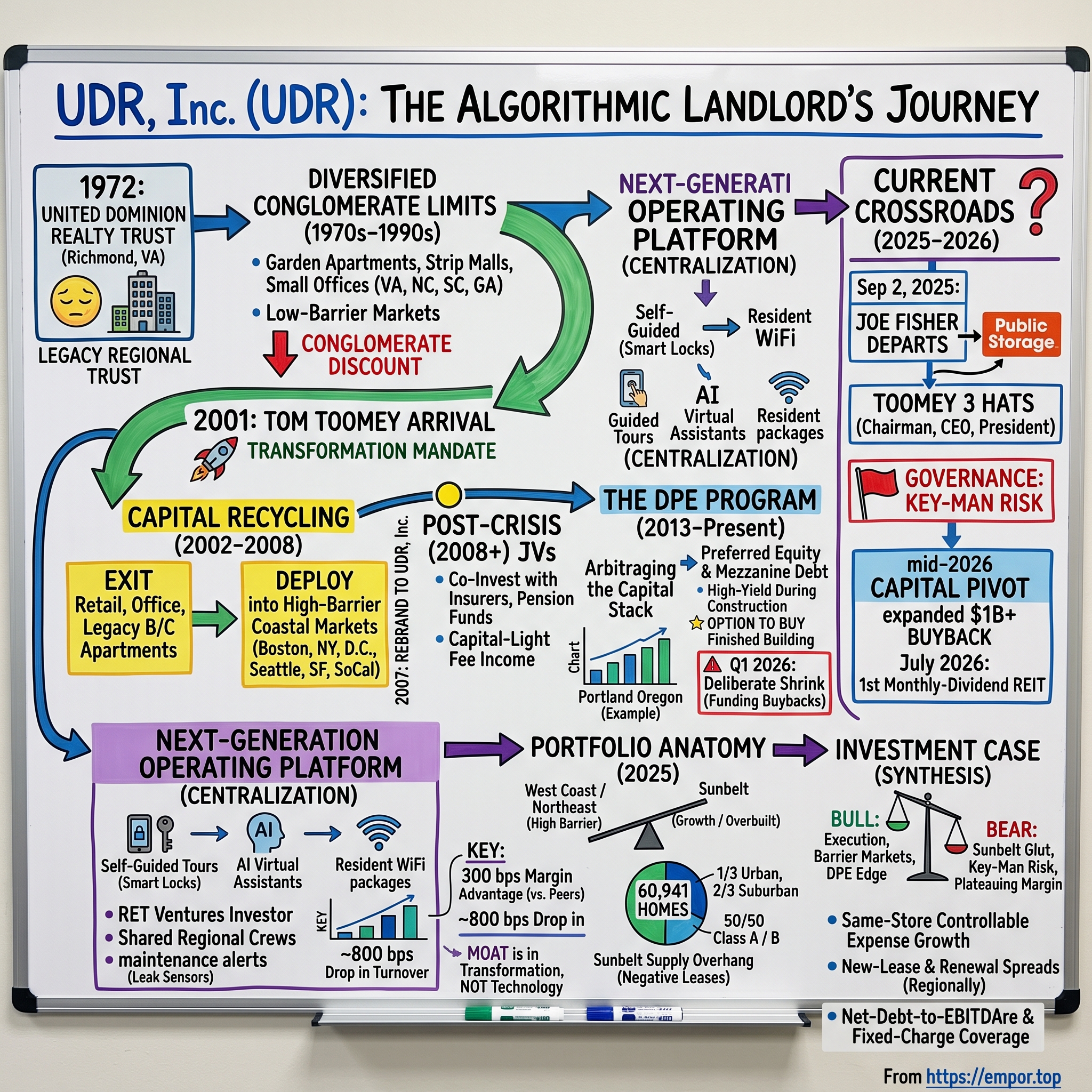
UDR, Inc.: The Algorithmic Landlord
I. Introduction & Episode Roadmap
Picture a leasing office at eight o'clock on a Tuesday night. The lights are off. There is no agent behind the desk, no key rack rattling on the wall, no leasing consultant in a branded polo shirt asking whether you'd like to see the two-bedroom with the courtyard view. And yet, in that same moment, a prospective renter three time zones away is unlocking the front door of a vacant apartment with her phone, walking the unit alone, and signing a lease on her laptop before she reaches her car — while a chatbot answers a maintenance question from another resident, and a single human leasing agent sitting in a regional hub quietly oversees a dozen buildings she has never physically visited.
This is what a modern American apartment company looks like when it decides that the most expensive thing it owns is not its buildings, but its payroll.
UDR, Inc. is a roughly $15 billion enterprise-value, S&P 500 multifamily real estate investment trust that owned or held an interest in 60,941 apartment homes as of the end of 2025.1 To the casual observer it is one of a handful of interchangeable coastal apartment landlords — a name that shows up in a dividend screen next to AvalonBay and Equity Residential. But UDR's real story is stranger and more interesting than its ticker suggests. It is the story of a sleepy regional Virginia trust, born in 1972 with a mismatched grab-bag of older suburban apartments, strip malls, and small offices, that spent two decades methodically dismantling itself and rebuilding into something its founders would barely recognize: the most automated, highest-margin, and — as of July 2026 — the first monthly-dividend-paying operator in residential real estate.4
The through-line of this episode is a single paradigm shift. The traditional apartment business is a high-touch, headcount-heavy service operation: every building its own little fiefdom with its own manager, its own leasing staff, its own maintenance crew. UDR spent the last decade tearing that model apart and replacing it with a centralized, software-driven, "staffless-adjacent" machine — one agent, one call center, one algorithm serving many buildings at once. Whether that is a durable competitive advantage or simply an early-mover head start that peers will eventually copy is the central investment question we'll test throughout.
Why should a long-term investor care about the internal plumbing of an apartment landlord? Because multifamily housing is one of the few genuinely non-discretionary industries in the economy — everyone needs a place to live, in every cycle — and the operators who win are the ones who squeeze the most durable cash flow out of that inelastic demand. In a business where you cannot meaningfully differentiate the product (an apartment is an apartment), the entire competitive game is played on two fields: where you own and how efficiently you run it. UDR is a case study in a company that made deliberate, high-conviction bets on both — bets that are now being tested by a supply cycle, a rate cycle, and a leadership transition all arriving at once. That convergence is exactly what makes 2026 an interesting moment to open up the machine and look inside.
Here's the roadmap. First, the legacy — the John McCann era and the limits of the diversified regional trust. Then the repositioning — Thomas Toomey's arrival in 2001 and the multi-billion-dollar recycling of the portfolio out of cheap suburban Southeast markets and into supply-constrained coastal metros. Then the Developer Capital Program, UDR's clever structured-finance workaround that lets it capture brand-new buildings without swinging a hammer. Then the next-generation operating platform — the centralization and PropTech bet that produced industry-leading margins. And finally the current crossroads: the abrupt 2025 exit of heir-apparent Joe Fisher to Public Storage, the Sunbelt supply glut, and the dramatic mid-2026 pivot to monthly dividends paired with a billion-dollar buyback.
Let's start where every real estate story starts — with a piece of land and a man in Richmond.
 Subscribe on LinkedIn
II. Origins of United Dominion & The Regional Conglomerate Limits (1972–2000)
In 1972, Richmond, Virginia was not where anyone went to reinvent an industry. It was a mid-sized Southern city with cheap land, a slow-moving business establishment, and a real estate market defined by garden-style apartment complexes — two- and three-story walk-ups with surface parking and a leasing office by the pool. Into this modest setting stepped John P. McCann, who founded a small real estate investment trust called United Dominion Realty Trust.
The REIT structure itself was still young — Congress had only created the vehicle in 1960, offering investors a way to own income-producing real estate through a stock-like security that paid out almost all its earnings as dividends and, in exchange, escaped corporate income tax. For a regional operator like McCann's, the appeal was obvious: raise public equity, buy buildings that threw off rent, pass the cash through to shareholders. United Dominion did exactly that, and for its first two decades it did so with a decidedly local, opportunistic flavor.
The founding ethos was proximity. United Dominion bought what was nearby and what was cheap: older garden apartments, community strip malls anchored by a grocery store, and small suburban office buildings scattered across Virginia, the Carolinas, and Georgia. If a deal came across the desk and the numbers penciled, the trust bought it — regardless of whether it fit any coherent portfolio theory. In the parlance of a later era, United Dominion was a diversified regional conglomerate, and in the 1970s and 1980s that diversification felt like prudence. Spread across property types and towns, the thinking went, and no single local downturn could sink you.
To understand why that felt safe, you have to remember what the REIT sector was before the 1990s: a cottage industry. Most REITs were small, externally managed, and financed on a deal-by-deal basis, closer to a collection of syndicated partnerships than a modern operating company. Then came the "REIT revolution" of the early-to-mid 1990s, when a wave of large, self-managed, self-administered companies went public — the UMBRELLA Partnership REIT (UPREIT) structure let private owners contribute buildings tax-efficiently in exchange for operating-partnership units, and suddenly the sector had the scale and the currency to consolidate. Capital that had once been parceled out to dozens of tiny local trusts began flowing to a handful of large specialists. United Dominion had been early to the public markets and grew steadily through this period, rolling up apartments and mixed commercial assets across its Southeastern footprint. But growth by accumulation is not the same as growth by design, and the company was building a bigger version of the wrong thing.
The problem was that the market's definition of prudence changed. By the late 1990s, institutional capital had developed a strong allergy to complexity. The great insight of the modern REIT era was specialization: a fund manager who wanted apartment exposure wanted to buy an apartment company, full stop — not a company that owned apartments and shopping centers and offices, forcing the analyst to underwrite three businesses to value one stock. Diversified REITs were punished with a persistent "conglomerate discount" — their shares traded below the sum of what their individual assets would fetch in a private sale, a gap to net asset value that no amount of steady rent collection seemed to close. The logic was almost mechanical: a dedicated apartment analyst couldn't cover you properly because you weren't a pure apartment story, a dedicated retail analyst couldn't either, and the generalist who covered the whole messy thing applied a discount for the confusion. Legibility, it turned out, was worth real money — and United Dominion didn't have it.
There was a second, more fundamental problem baked into United Dominion's geography. The Southeast markets it called home were, in real estate terms, low-barrier-to-entry: flat, cheap land, permissive zoning, and a ready supply of regional builders happy to throw up another garden complex the moment rents ticked up. That meant every rent increase was an invitation for a competitor to build across the street and undercut you. Rent growth was structurally capped. And because the assets themselves were aging Class-B and Class-C product, the capital expenditures required just to keep them competitive — new roofs, new HVAC, new appliances — kept climbing. United Dominion was running to stand still.
By the turn of the millennium the diagnosis was clear even if the cure was not: the company had the wrong assets in the wrong markets, wrapped in the wrong corporate structure. It would take an outsider — someone with no sentimental attachment to a single Richmond strip mall — to do something about it. That someone arrived in 2001.
III. The Tom Toomey Restoration & The Great Capital Recycling (2001–2012)
Thomas W. Toomey did not come to Richmond to preserve anything. He came to demolish and rebuild.
Toomey arrived in 2001 from the front lines of the apartment industry's most aggressive consolidator. He had served as chief operating officer and chief financial officer at AIMCO — Apartment Investment and Management Company — the Denver-based roll-up machine that spent the 1990s hoovering up apartment complexes across the country, and before that he had done time as a senior executive at Lincoln Property Company, one of the largest private developers and managers in the United States.[^13] Toomey had grown up inside the operational guts of the business: the rent rolls, the turnover math, the brutal arithmetic of a garden apartment that costs more to maintain than it earns. He arrived with a thesis that was less a strategic plan than a demolition permit.
His formative years at AIMCO mattered enormously to how he'd run UDR. AIMCO under Terry Considine was the apartment industry's most notorious acquirer of complicated, hairy, hard-to-underwrite portfolios — the kind of deals that scared off buyers who wanted clean stories. Toomey spent that era learning to see through the mess of a distressed rent roll to the cash flow underneath, to price risk that others wouldn't touch, and to manage the ruthless integration work that follows a roll-up. He also absorbed AIMCO's defining flaw as a cautionary tale: a company that grew so complex, so levered, and so operationally sprawling that the market eventually punished it for exactly the confusion United Dominion was suffering from. Toomey, in other words, arrived in Richmond having watched both the upside of aggressive dealmaking and the downside of complexity for its own sake. His plan for UDR was to keep the deal-making muscle and throw out the complexity — to be aggressive about simplifying. That is an unusual combination, and it defined his entire tenure: a CEO who was simultaneously a relentless trader of assets and a fanatic about narrative clarity.
The manifesto was blunt. United Dominion had to exit retail and commercial entirely — no more strip malls, no more suburban offices. It had to sell tens of thousands of legacy suburban apartment units in those low-barrier Southeast markets where new supply capped every rent increase. And it had to redeploy every dollar of that capital into high-barrier, supply-constrained metros where the physics of new construction worked in the landlord's favor rather than against it. In markets like coastal California, greater Boston, metro Washington, and Seattle, land is scarce, zoning is a multi-year knife fight, and neighborhood opposition to new apartments is a civic sport. In those places, an existing owner enjoys a kind of scarcity moat: when demand rises, competitors can't simply build their way in.
This is the discipline the industry calls capital recycling, and between roughly 2002 and 2008 UDR executed it at scale — selling billions of dollars of legacy assets and plowing the proceeds into premium coastal product across Boston, New York, Washington D.C., Seattle, San Francisco, and Southern California, from Orange County to San Diego. It was, in effect, a years-long act of corporate self-surgery: sell the thing you are, buy the thing you want to become, and hope the market rewards the transformation before the transition costs eat you alive.
Two moments crystallized the new identity. The first was cosmetic but telling: in 2007 the company retired the clunky "United Dominion Realty Trust" and rebranded simply as UDR, Inc. — a clean, initials-only institutional identity that signaled the strip-mall era was over. The second was a genuine stress test. In 2008, global credit markets seized, and a real estate company mid-transformation, still digesting billions in asset sales and purchases, was exactly the sort of business that could have been caught fatally offside.
It wasn't. The defensive posture and early recycling meant UDR entered the crisis with a cleaner balance sheet than it might otherwise have had. And rather than freeze, Toomey went on offense in a capital-efficient way: UDR formed joint ventures with blue-chip institutional partners — insurers and global asset managers among them — to co-invest in high-quality assets when few others had the equity or the nerve. The mechanics mattered. In a joint venture, UDR could put up a minority slice of the equity, bring in a partner for the rest, and still earn management and asset-management fees for running the properties. It was a way to expand the footprint and the fee stream while conserving UDR's own scarce equity and protecting its investment-grade credit rating.
Consider the elegance of the arrangement from UDR's side of the table. A large insurer or pension fund has an ocean of capital and a mandate to own stable, income-producing real estate, but no desire to run leasing offices or dispatch plumbers at midnight. UDR has the opposite problem: deep operating expertise and a hunger for scale, but a limited and expensive supply of its own equity. Pair the two and you get a symbiosis — the partner supplies most of the money, UDR supplies the operating platform and a minority co-investment, and the two split the returns while UDR clips fees off the top for doing what it already knows how to do. It is capital-light growth in its purest form: expanding the assets you manage far faster than you could ever expand the assets you fully own. The downside, which a neutral investor should note, is that fee income and minority stakes are lower-quality, less-permanent earnings than wholly owned rent — partners can sell, mandates can end, and joint ventures add a layer of governance complexity. But in 2008 and 2009, when equity was the scarcest commodity on earth, that trade-off was overwhelmingly worth it, and it seeded relationships and structures UDR would draw on for years.
By the time the dust settled around 2012, the transformation was substantially complete. The strip malls and offices were gone. The bulk of the old low-barrier Southeast apartment book had been sold. In their place sat a portfolio concentrated in exactly the supply-constrained coastal and gateway markets Toomey had targeted a decade earlier, plus a set of institutional partnerships that extended UDR's reach without bloating its balance sheet. The conglomerate had become a pure-play. The discount had narrowed. And a company that had spent ten years selling and buying now had to answer the harder, more permanent question: with the portfolio finally in the right shape, how do you keep getting bigger and better when the whole world knows those coastal markets are the ones worth owning?
Here is the honest, neutral read for an investor. The recycling story is genuinely impressive execution, and it is the foundation of everything UDR became. But it is worth noting what it also was: a bet that coastal, high-barrier markets would deliver superior long-run rent growth to compensate for their higher entry prices and lower going-in yields. That bet has mostly paid off across cycles, but it is not costless — it left UDR structurally exposed to the specific regulatory and demand shocks of a handful of expensive metros, a vulnerability that would resurface after 2020. The transformation solved the conglomerate-discount problem. It did not, and could not, solve the problem of what to do when your chosen markets stop growing. For that, UDR would need a new trick — a way to keep acquiring brand-new, top-tier buildings without paying top-of-market prices or taking on the risk of building them. That trick had a boring name and a clever design.
IV. The Developer Capital Program (DPE): Arbitraging the Capital Stack (2013–Present)
Every apartment REIT faces the same uncomfortable choice, and none of the options is clean.
You can buy stabilized buildings on the open market — but you'll bid against every other institutional buyer, and in a hot market you'll overpay, locking in a low yield the day you close. You can build from the ground up — which offers the fattest returns but hands you the entire nightmare of development: entitlement delays, cost overruns, a local labor strike, a subcontractor bankruptcy, an interest-rate spike halfway through a three-year build. Ground-up development is where apartment fortunes are made and, occasionally, incinerated. Or you can do nothing and watch your portfolio slowly age.
In 2013, UDR designed a fourth door. It launched what it originally called the Developer Capital Program — today folded into its Debt and Preferred Equity, or DPE, book — and the elegance of it is worth slowing down to appreciate.7
Think of the money that funds a new apartment building as a layer cake. At the bottom is senior bank debt, cheap and first in line to be repaid. At the top is common equity — the developer's own money, last in line, taking all the upside and all the downside. In between sits a squishy middle layer: mezzanine debt and preferred equity, which earn a fat contractual yield and sit ahead of the developer's common equity if things go wrong. UDR's insight was to occupy that middle layer for other people's projects. Instead of being the developer, it became the developer's financier.
The economics work like this. A regional builder has a great site and a strong plan but needs to fill a gap in the capital stack. UDR steps in with preferred equity or mezzanine debt and, historically, earns a high-single-digit to low-double-digit yield during the construction and lease-up phase — the riskiest, most capital-starved stretch of a project's life. As of the first quarter of 2026, UDR's DPE book carried a contractual weighted-average return in the high-single digits and a weighted-average remaining term of roughly two and a half years.75 Crucially, UDR structures many of these deals with a right of first look or a pre-negotiated option to buy the finished building.
That option is where the real money hides. Because UDR is already sitting inside the capital stack as the preferred holder, it has an inside track to acquire the completed, stabilized, brand-new Class-A property without ever entering a public bidding war. Over the program's life it has often ended up owning a meaningful share of what it financed — capturing new buildings at prices that management argues are structurally below what it would pay competing against every other REIT on the open market. Since inception in 2013, UDR has invested roughly $1.0 billion across more than 30 transactions with 25-plus development partners.7
A concrete example from the current book shows the mechanism in miniature. Through a single development partner, UDR gained access to two apartment communities in Portland, Oregon — the first a 232-home community it acquired in the spring, with the second acquisition expected to follow — and management flagged that these Portland assets carried the potential for a high-5% stabilized yield.57 Put that number in context: buying a comparable stabilized coastal apartment building on the open market in that vintage might have meant accepting a yield a full percentage point or more lower, because you'd be bidding against everyone. That spread — the difference between the yield UDR captures through its financing relationship and the yield it would pay in open competition — is the entire economic point of the program. It is not glamorous, but a percentage point of extra yield on a new building, compounded across a pipeline, is precisely the kind of quiet edge that separates a good capital allocator from an average one.
There's a risk to name honestly, too. Sitting in the mezzanine and preferred layers feels safe because you're ahead of the developer's common equity — but "ahead of the equity" only protects you if the building is worth more than the senior debt plus your position. In a genuine value collapse, where a project's finished value falls below its total debt, the preferred holder can be impaired right alongside the developer. UDR's response has been to shift the DPE book over time away from higher-risk ground-up development toward recapitalizations of already-cash-flowing assets with current-pay coupons — trading some upside for a much sturdier risk profile.7 That drift is worth watching as a tell about how management reads the cycle.
Then came the part of the story that tested the design under fire. When the Federal Reserve began its aggressive rate-hiking campaign in 2022 and bank lending to developers seized up through 2025, regional builders found themselves in a vise — construction loans maturing, refinancing markets shut, equity partners gone quiet. UDR, sitting on an investment-grade balance sheet and a low cost of capital relative to a squeezed regional developer, could play white knight: provide rescue capital, clip a double-digit coupon, and negotiate favorable terms on the way in. On paper, higher rates are supposed to hurt a REIT. The DPE program is one of the few mechanisms that lets UDR turn a tightening cycle partly to its advantage.
But a neutral investor should hold two facts in tension. The first is that the program is small relative to the whole company — a few hundred million dollars against a portfolio worth tens of billions — so it is a spice, not the main course; it cannot by itself move the earnings needle dramatically. The second is more telling about management's live thinking. On the Q1 2026 earnings call, the CFO signaled that UDR was deliberately shrinking the DPE book, guiding it down toward roughly $300 million by year-end from $354 million, as paydowns came in and management chose to redirect that capital toward buying back its own stock instead.5 In other words, UDR's own capital-allocation math had, at least for the moment, concluded that the best "developer" to fund was itself. Which brings us to the question of what, exactly, made UDR's own operating business worth buying.
V. The Next-Generation Operating Model: Algorithmic Efficiency
For most of the history of the apartment business, the org chart was a law of nature. Every building had its own leasing office. Every leasing office had a property manager, one or two leasing agents, a maintenance supervisor, and a turnover crew. Multiply that by a couple hundred communities and you have an army — an expensive, high-turnover, geographically scattered army whose payroll is the single largest controllable line item in the whole enterprise. For a century, nobody seriously questioned it, because there was no alternative. If a prospect wanted to see an apartment, a human had to unlock the door.
UDR's central bet of the last decade is that this law of nature was actually just a technology constraint — and that the constraint had lifted.
The company approached it less as a customer buying software and more as an insider shaping it. UDR was a founding investor in RET Ventures, a venture capital firm dedicated specifically to "rent tech" — the emerging category of software and hardware built for the real estate rental industry.11 By anchoring a fund aimed squarely at its own industry's toolmakers, UDR bought itself something more valuable than any single product: early, proprietary visibility into which startups were building the tools that would reshape the business, and equity exposure to their success. Among its notable early bets was SmartRent, a smart-home platform for apartments — connected locks, thermostats, and leak sensors that turn a dumb building into an addressable network of devices.
Then it wired those pieces together into an operating system. The old way was the fiefdom model described above. The UDR way is centralization. Working with partners like Funnel — a unified customer-relationship and leasing platform — and maintenance-focused tools, UDR collapsed the property-by-property silos into a small number of regional hubs.[^11] A single centralized leasing agent, instead of manning one building's front desk, now works the top of the funnel across five to ten different communities at once. Self-guided tours, enabled by those smart locks and automated identity verification, let a prospect tour a vacant unit on her own schedule with no employee present. And AI-driven virtual assistants field the round-the-clock deluge of top-of-funnel inquiries — the "is this available," "what's the pet policy," "can I tour Saturday" questions that used to consume a leasing agent's entire day — reportedly handling the large majority of first-touch interactions without a human.8
It helps to think about the economics of the old model to see why this is such a big deal. In a traditional apartment company, staffing is essentially fixed per building regardless of how busy the leasing office is. A 200-unit community needs its leasing team whether it's signing forty leases in a hot spring or four in a dead January. That's an enormous amount of paid human capacity sitting idle on slow days, and it scales linearly — double your buildings, double your onsite staff. Centralization breaks that linearity. When you pool demand across ten communities into one regional team, the peaks and troughs of individual buildings smooth out, and a smaller total headcount can cover the same number of units because it's never all busy at once. The economists' term is that UDR converted a fleet of fixed, per-building labor costs into a shared, variable, pooled resource. That is the same structural move that let call centers replace bank branches and that let cloud computing replace server closets: take a resource everyone provisioned individually for their own peak, and pool it.
The maintenance side follows the same logic. Rather than every building hoarding its own technician and its own turn crew, UDR routes work orders and unit turns — the frantic clean-paint-repair sprint between one tenant moving out and the next moving in — through centralized scheduling that dispatches shared crews where the demand actually is. A leak sensor that pings before a slow drip becomes a flooded unit isn't a gadget; it's a way to catch a five-thousand-dollar repair while it's still a fifty-dollar one, and to do it without a human physically inspecting every apartment every week.
Here is where a neutral analyst has to separate the verified from the advertised. UDR and its partners have promoted a striking figure: a roughly 40% reduction in onsite, property-level headcount as the centralized model rolled out.[^11]8 Take that specific number as a company-associated claim rather than an audited fact — the precise magnitude is hard to independently verify, and the company itself frames the reduction as ongoing rather than a single one-time cut. What is verifiable, and more important, is where the strategy shows up in the financials. UDR has driven its same-store controllable operating margin — the share of rental revenue it keeps after the property-level costs management can actually influence — to roughly 84%, which the company describes as peer-leading, with an advantage of around 300 basis points over the average of its large public competitors.5 Three hundred basis points of margin, sustained across a 60,000-home portfolio, is real money and a genuine outlier. On the customer-experience side, management has pointed to resident turnover falling by roughly 800 basis points since 2023 — about 400 basis points better than the peer average — which matters because every avoided move-out saves the cost of a turn and a stretch of vacancy.5
The layer on top is ancillary revenue. Because UDR buys smart-home hardware and bulk internet access at national scale, it can bundle those into "smart home" packages and community-wide WiFi and charge residents a monthly premium for them — incremental, high-margin dollars on top of base rent. Management characterizes these as meaningful per-unit premiums; treat the exact per-door figures as directional rather than precise.
This is also the right place to puncture a myth. The popular framing — repeated in plenty of breathless PropTech coverage — is that UDR "invented" a technology moat. That is not quite right, and pretending otherwise would be doing management's marketing for it. UDR did not build proprietary software that competitors can't access; it bought and integrated commercially available tools, the same ones its rivals can license tomorrow. What UDR actually did was something less flashy and arguably more valuable: it committed early, absorbed the organizational pain first, and reorganized its entire operating structure around centralization while peers were still running pilots. The moat, to the extent one exists, is in the transformation, not the technology.
So what is the honest investor's takeaway? The centralization platform is the most credible source of durable advantage in the entire UDR story — not because the technology is proprietary, but because reorganizing a company around it is brutally hard. It requires laying off or reskilling a large chunk of your onsite workforce, dismantling the property-manager fiefdoms, absorbing the change-management pain, and integrating a dozen systems. UDR started early and ate that pain first. The open question — and the bear's best line of attack — is whether a three-percentage-point margin lead is a permanent moat or merely a timing advantage that peers slowly close. The evidence cuts both ways: on one hand, every large apartment REIT is now pursuing some flavor of centralization, and the tools are for sale to all of them, which argues the gap should narrow. On the other, UDR has held or extended its margin lead over several years despite that competition, which suggests the head start is stickier than a pure-imitation story would predict — organizational change really is slow, and years of accumulated process refinement are not downloaded overnight. Where the truth settles between those two poles is, more than anything else, what will determine whether UDR earns a premium multiple or drifts back toward the pack. First, let's look at exactly what this machine is running.
VI. Portfolio Anatomy & Segment Economics (2025–2026)
Strip away the technology narrative and the structured-finance cleverness, and UDR is still, at bottom, a collection of buildings in specific places. The character of those places determines almost everything about how the company earns and how it bleeds.
At the end of 2025, UDR owned or held an interest in 60,941 apartment homes.1 The wholly and majority-owned core was roughly 165 communities and about 55,240 completed homes spread across 21 U.S. markets, with the balance held through joint ventures — the fee-earning co-investment structures that trace back to the crisis-era partnerships.1 These are not trophy skyscrapers; they are overwhelmingly mainstream rental communities, and their geographic and quality mix is the whole ballgame.
Start with geography, which UDR thinks of as a barbell. Roughly two-fifths of the portfolio's net operating income comes from the Northeast and Mid-Atlantic — the high-barrier, low-supply, slow-and-steady end of the bar. Roughly a third comes from the West Coast — tech-centric metros with the highest absolute rents in the portfolio but also the greatest sensitivity to both a tech-employment downturn and California's ever-shifting rent-regulation politics. And roughly a quarter sits in the Sunbelt — the high-population-growth, job-magnet markets of the South and Southwest that were the industry's darlings in 2021 and its problem child by 2024.10 The design intent is that these three legs rarely stumble at the same time. When West Coast tech hubs stalled after COVID and downtown San Francisco emptied out, the Sunbelt was still booming and carried the load. When the Sunbelt's construction boom turned into a supply glut in 2024 and 2025, the stable Northeast and the recovering coasts cushioned the blow.
The second axis is where the portfolio quietly diverges from its glossier peers. By location type, UDR skews suburban — a bit under a third of the portfolio is urban, and a bit over two-thirds is suburban. And by asset quality, it is close to evenly split, tilting slightly toward Class-B over Class-A. This is not the profile of a pure luxury-highrise landlord, and that is the point. Class-B suburban apartments — the solidly middle-market product, a notch below brand-new luxury — behave very differently from urban Class-A towers in a downturn. Their residents tend to stay longer, because they have fewer cheaper places to trade down to and moving is a hassle. Their demand is stickier, because it is anchored to everyday affordability rather than discretionary lifestyle. In a recession, the Class-A tenant paying top dollar for amenities is the one most likely to get a roommate, move home, or trade down. The Class-B suburban tenant mostly just renews.
There's a second, subtler reason the Class-B tilt matters, and it goes to the supply argument at the heart of the whole company. New apartment construction is almost always Class-A — developers build the shiniest product they can to justify the rents that pencil against today's land and construction costs. Nobody breaks ground on a brand-new Class-B building. That means the flood of new supply that periodically drowns a market lands most heavily on the Class-A segment, forcing luxury landlords to cut rents and offer concessions — a free month, waived fees — to fill units. The Class-B owner is partially shielded, because the new supply isn't a direct substitute for its product. When the Sunbelt overbuilt in 2024 and 2025, it overbuilt luxury; UDR's suburban Class-B book felt the wash but not the full wave. This is the kind of structural nuance that never shows up in a headline occupancy number but explains a great deal about why UDR's earnings have proven more stable than its market mix alone would suggest. The COVID era made the same point in reverse: when urban cores emptied out in 2020 and 2021 as remote work let people flee dense downtowns, UDR's suburban weighting was a buffer while pure urban-core landlords took the brunt.
The economic engine underneath all of this is simple to name and hard to execute: net operating income margin and funds-from-operations per share. FFO is the REIT world's preferred earnings measure — roughly, net income with real estate depreciation added back, on the logic that a well-maintained building doesn't actually lose value the way an accountant's depreciation schedule pretends. Grow FFO per share and protect NOI margin, and the dividend and the stock take care of themselves. Shrink them, and no amount of narrative saves you.
The "per share" part deserves emphasis, because it is where REITs quietly succeed or fail. A real estate company can always grow its total FFO by issuing shares and buying more buildings — bigger is easy. The discipline is growing FFO per share, which means every acquisition, every development, every dollar of capital raised has to earn more than it dilutes. This is precisely why UDR's mid-2026 pivot toward buying back stock rather than buying buildings is so revealing: when your own shares trade below the value of your buildings, the most accretive per-share move available is to shrink the share count, not grow the asset base. Management's job, stripped to its essence, is a continuous auction — comparing the return on buying an apartment building, funding a developer, or retiring a share, and steering capital to whichever wins that day. The quality of a REIT management team is, more than anything, the quality of its answers to that auction over time.
The 2025 results showed the machine working through a genuinely choppy environment: net income attributable to common stockholders jumped to $372.9 million from $84.8 million a year earlier — though an investor should read that leap carefully, because the bulk of it came from gains on selling assets, higher interest income, and the absence of a prior-year loan reserve rather than a surge in core operations.1 The steadier signal is that same-store assets supplied 95% of total NOI and same-store NOI still grew, driven by higher rents, better rent collection, and lower vacancy — evidence that the underlying rental business kept grinding forward even as the Sunbelt sagged.1 The barbell, in other words, did roughly what it was designed to do. Which makes the timing of a boardroom shock all the more jarring.
VII. The 2025 Executive Shakeup & The July 2026 Capital Pivot
On September 2, 2025, UDR issued a press release that landed with an audible thud across the analyst community. Joseph D. Fisher — President and Chief Investment Officer, the man most investors had penciled in as Tom Toomey's successor — was leaving, effective at the close of business that same day.2
Fisher was not a peripheral figure. He had joined the senior ranks as Chief Financial Officer in 2017, been elevated to President in 2022, and picked up the Chief Investment Officer title in January 2025 — the classic grooming arc of an heir apparent being handed ever-wider authority before the top job.2 For a company that had been run by the same CEO since 2001, Fisher was the succession answer, the reassurance analysts needed that UDR was not a one-man show. And then, with the terse language companies reserve for departures they'd rather not dwell on, he was gone.
The company was careful to call it amicable and to insist it was not the product of any disagreement over strategy, accounting, or operations — the three explanations that keep audit committees up at night.9 The separation terms were disclosed and substantial: an immediate $3 million severance payment plus an additional $3 million payable over the following twelve months — the kind of package that reads less like a firing and more like a negotiated, mutually managed exit.9 Still, "amicable" is what everyone says, and a neutral observer was entitled to wonder why a company would let its designated future leader walk out the door with no named replacement in the wings.
The market got its answer five months later. On February 10, 2026, Public Storage — the giant self-storage REIT — announced it had appointed Fisher as its President and Chief Financial Officer, effective February 16, after a brief stint consulting for the company.3 The heir apparent had not been pushed out; he had been recruited into one of the largest and most prestigious jobs in the entire REIT universe. That reframes the story: less a scandal, more a talent-market reality that even a well-run company cannot always win.
The consequence for UDR, though, was concrete and uncomfortable. With Fisher gone and no seasoned insider ready to slide into the President's chair, the board handed the role back to the man who had never really let go of the company: Tom Toomey now wears three hats — Chairman, CEO, and President — well into his sixties and a quarter-century into running the same company.2 It is a testament to Toomey's stamina and his grip on the institution. It is also, unavoidably, a flashing yellow light on the governance dashboard. A company that concentrates chairman, chief executive, and president in one long-tenured individual, with the succession bench visibly thinned, is a company where key-man risk is not a theoretical footnote. It is the single most legitimate thing an activist or a skeptical long-term holder can point at.
Governance specialists have a name for the setup — a combined chairman-and-CEO with no independent lead balance — and they generally frown on it, because it concentrates the power to set the board's agenda and the power to execute strategy in the same pair of hands. Adding the president's title on top removes even the internal counterweight of a strong number two. To be fair to Toomey, his long tenure is not the tenure of a caretaker; it is the tenure of the person who personally engineered the company's transformation, and his track record of capital allocation across multiple cycles is genuinely strong. Investors have largely extended him the benefit of the doubt because he has earned it. But benefit of the doubt is not a succession plan. The Fisher episode exposed that UDR's answer to "what happens after Toomey" is, for now, "Toomey" — and that is an answer with a shelf life. The right thing for a diligent shareholder to demand is not Toomey's departure but visible evidence of a bench: a clearly empowered chief investment officer, a CFO with room to grow into more, a board that talks openly about the transition rather than hoping the question doesn't come up for a few more years.
And then, as if to change the subject, UDR made two moves in the spring of 2026 that reframed the whole capital-allocation conversation. First, on May 4, 2026, the board authorized expanding the share-repurchase program by 25 million shares — lifting total authorization to roughly 30 million shares, a capacity worth well over $1 billion at prevailing prices.6 This was not a symbolic gesture. UDR had already been buying: about $150 million of stock repurchased in the first quarter of 2026 alone, and roughly $268 million since the prior September, at prices the CFO bluntly described as "75 to 80 cents on the dollar" of the company's estimated private-market value.5 The logic management laid out was clean arbitrage — sell mature, lower-growth buildings at full private-market value, and use the proceeds to buy back your own shares trading at a steep discount to that same private-market value. When a company's stock is worth demonstrably less than its buildings, the highest-returning acquisition on the menu is itself.
The second move broke with a century of industry habit. Starting with the payment scheduled for July 2026, UDR became the first residential REIT to shift from quarterly to monthly dividends — a monthly payment of $0.145 per share, or $1.74 annualized, which at the late-April share price worked out to a yield around 5%.4 On the Q1 2026 call, Toomey framed it as aligning the cadence of distributions with the monthly rhythm of rental income, and leaned on UDR's remarkable streak — 53 consecutive years of dividends totaling nearly $9 billion — to pitch the change as a magnet for family offices, income-focused retail investors, and yield-hungry buyers who value getting paid twelve times a year instead of four.45
Is monthly-versus-quarterly a fundamental value driver? Honestly, no — the arithmetic of an annual payout barely changes, and a skeptic would call it clever marketing dressed as capital-structure innovation. But it is revealing as a signal. It tells you a management team acutely aware that its stock trades at a discount is reaching, on multiple fronts at once — buybacks, dividend cadence, asset sales — for anything that might narrow the gap between where UDR trades and what its real estate is worth. That instinct, and whether it is enough, is exactly what the analytical frameworks are built to interrogate.
VIII. Hamilton Helmer's 7 Powers & Porter's 5 Forces Analysis
Strip a business down to its skeleton and ask the only question that matters for a long-term owner: what, precisely, stops a well-funded competitor from doing exactly what this company does and competing away its returns? Two frameworks help x-ray UDR — Hamilton Helmer's 7 Powers, which catalogs the specific sources of durable advantage, and Michael Porter's classic Five Forces, which maps the structural pressures of the industry itself.
The 7 Powers Analysis
Process Power — the core, and most debatable, moat. Helmer defines process power as an advantage embedded in a company's organization and activities that competitors cannot replicate even if they know exactly what you're doing, because copying requires a long, painful internal transformation. UDR's centralized, PropTech-driven operating model is the best candidate. The tools themselves — Funnel, SmartRent, and their peers — are not proprietary; anyone can license them. What is hard to copy is the reorganization: dismantling property-level fiefdoms, retraining or shedding a large share of onsite staff, rewiring maintenance and leasing workflows, and absorbing years of change-management friction. That difficulty is real, and UDR's roughly 300-basis-point controllable-margin lead is the evidence it has produced something durable.5 But an honest analyst flags the vulnerability: process power built on commercially available software erodes faster than process power built on genuinely secret know-how. This is a head start measured in years, not a fortress measured in decades.
Scale Economies. UDR spreads fixed corporate overhead and centralized software and development costs across a 60,000-home national footprint, so each incremental unit carries a thinner slice of head-office cost. Scale also delivers procurement leverage — bulk pricing on smart-home hardware, internet bandwidth, and utilities, some of which UDR marks up to residents as ancillary revenue. Genuine, but note the ceiling: several peers (MAA, AvalonBay, Equity Residential, Camden) operate at comparable or larger scale, so this is table stakes among the large-caps rather than a UDR-specific edge.
Cornered Resource. The prime, high-barrier real estate itself — irreplaceable parcels in coastal suburban nodes like Orange County and the Boston suburbs, where zoning, land cost, and community opposition make new competing supply nearly impossible. This is the most classically defensible power UDR holds, and it is the direct legacy of Toomey's capital recycling. You cannot build a second Orange County.
Porter's Five Forces Analysis
Threat of New Entrants — low to medium, and geographically split. In the Sunbelt, where land is cheap and zoning permissive, the barrier is low — which is precisely why supply floods in and depresses rents, the exact dynamic hurting that quarter of the portfolio right now. In the coastal markets, the barrier is very high. UDR's exposure is deliberately weighted toward the latter.
Bargaining Power of Buyers — low, but with an asterisk. Individual renters sign individual leases and have essentially no collective bargaining power. Switching is physically real but financially moderate — moving costs, deposits, the hassle of a new commute. UDR's smart-home features and slick digital resident experience are designed to nudge switching costs up and turnover down, and the reported ~800-basis-point drop in turnover suggests it is partly working.5 The asterisk is regulatory: in tenant-friendly jurisdictions, political power substitutes for individual bargaining power, capping the landlord's pricing through rent control.
Bargaining Power of Suppliers — low. Construction trades and utilities have some leverage, but UDR's centralized national purchasing scales it down.
Threat of Substitutes — medium, and rate-dependent. The great substitute for renting is buying a home. When mortgage rates are high — as through the 2022–2025 tightening cycle — the math tilts sharply toward renting, and UDR benefits. When rates fall, the for-sale market pulls demand away. This is a genuine cyclical swing factor UDR does not control.
Intensity of Competitive Rivalry — high. UDR competes for assets, capital, and residents against a deep bench of well-capitalized institutional peers — AvalonBay, Equity Residential, Essex, Mid-America (MAA), and Camden among them. There is no oligopoly here; the apartment sector is fragmented and fiercely contested.
The framework verdict, stated neutrally: UDR's most durable edge is its cornered coastal real estate, its most distinctive edge is its operating platform, and its most overrated edge is the technology itself, which is rented, not owned. The bull and bear cases both live in the gap between those three statements.
IX. Playbook: Business & Investing Lessons
Step back from the ticker and UDR offers a compact set of transferable lessons — the kind of durable operating principles that outlast any single quarter's lease spreads.
Don't settle for the conglomerate discount. The founding-era United Dominion owned apartments, shops, and offices and was punished for the mismatch, trading below the value of its own parts for years. Toomey's answer was not clever financial engineering to explain away the discount but the hard, multi-year, unglamorous work of actually eliminating it — selling everything that didn't fit until the story was clean enough that an institutional investor could underwrite it in a sentence. The lesson for any complex business: markets pay for legibility, and the only reliable cure for a conglomerate discount is to stop being a conglomerate.
Structure out the risk you don't need to take. The Developer Capital Program is a small line item with an outsized teaching value. UDR wanted the returns of ground-up development without the existential risk of actually developing, so it engineered a position in the capital stack — preferred equity and mezzanine debt — that earned a fat yield during the risky phase and handed it an option to buy the finished product at an advantaged price.7 The principle generalizes: you can often capture most of an opportunity's upside by choosing your seat in the capital structure carefully, rather than betting the whole company on being the operator of last resort.
Technology is a margin driver, not a press release. Plenty of companies buy software to look modern. UDR's centralization bet is instructive precisely because it treated technology as a lever on the single largest controllable cost — labor — rather than as a customer-facing gimmick. The proof is not the app; it's the roughly 300-basis-point controllable-margin advantage that shows up in the actual financials.5 When you evaluate any "digital transformation," ask the UDR question: which cost line does it structurally bend, and does the P&L show it?
Align the distribution cycle with the business cycle — but know what it does and doesn't do. Shifting to monthly dividends matches cash out to cash in and courts a stickier, income-focused shareholder base.4 It is a smart piece of investor-relations design. The disciplined lesson, though, is to be honest about magnitude: cadence changes optics and ownership mix, not intrinsic value. The best management teams use such moves as complements to real capital allocation — the buybacks, the asset sales, the margin work — not as substitutes for it.
The connective thread across all four is that UDR's history rewards active stewardship over passive ownership. This was never a company that simply held buildings and waited for the cycle to lift it. Which is also why the risks that matter most are the ones that threaten the stewardship itself.
X. The Investment Case: Skeptic Stress Test & Bull vs. Bear
Every good investment thesis should be able to survive its own cross-examination. Here is UDR's, argued from both sides.
The Skeptic / Activist Stress Test
An activist looking at UDR would go straight for two soft spots.
The first is succession and key-man risk, and it is the most legitimate critique in the entire story. Tom Toomey has run this company since 2001. With Joe Fisher's departure to Public Storage, Toomey has reabsorbed the President role and now holds Chairman, CEO, and President simultaneously, well into his sixties.23 There is no seasoned, publicly identified insider successor. Should Toomey step back suddenly — by choice or otherwise — UDR would face a leadership vacuum at the exact moment stability matters most, and that vacuum is precisely the opening an activist uses to agitate for a sale, a merger, or a break-up. Concentrated leadership plus a thin bench is not a hypothetical governance nitpick; it is a real, present structural weakness, and management has not yet given the market a satisfying answer to it.
The second is the cap-rate versus cost-of-capital squeeze. In a higher-rate world, UDR's own cost of capital has risen, and acquisition yields — cap rates — have not risen as much, because private real estate values have stayed sticky. When the yield you can buy at is barely above (or below) your cost of the capital to buy it, growth-by-acquisition becomes dilutive rather than accretive. That is exactly why UDR has leaned on the DPE program, on capital recycling, and on buying its own stock instead of buying buildings. An activist would fairly ask: if the external growth engine is throttled by math the company doesn't control, what is the long-run growth story beyond financial engineering and margin optimization that eventually plateaus?
The Bear Case
The bear's first exhibit is the Sunbelt supply overhang. That quarter of the portfolio sits in markets that overbuilt through 2023–2025, and the glut was still biting in 2026 — management noted blended lease growth in Sunbelt markets deteriorating from around negative 1.5% in Q1 to negative 2.5% by April.5 Negative new-lease spreads mean UDR is signing tenants at lower rents than the prior lease — a direct drag on same-store growth until the excess supply is absorbed, and the timing of that absorption is not in UDR's hands.
The second exhibit is refinancing pressure. UDR's balance sheet is genuinely clean, with net-debt-to-EBITDAre in the mid-5x range, but "clean" doesn't mean immune. A meaningful slug of older, low-coupon debt was issued in the zero-rate era, and rolling it over at today's rates raises interest expense and quietly erodes FFO per share for years — a persistent headwind rather than a cliff.
The third, and most interesting, is a critique of the crown jewel itself: the impersonal resident experience. The aggressive march toward centralized, self-service, staffless-adjacent operations optimizes cost, but the higher-income Class-A tenant paying a premium may well expect a human at the front desk, a concierge touch, a person who knows their name. Push automation too far and you risk alienating exactly the residents whose rent underwrites the margin — driving churn up and quietly giving back the turnover gains the platform was supposed to deliver. It is the classic tension of any efficiency play: the last increment of cost savings can cost you the customer.
The Bull Case
The bull answers each in turn. On geography, the barbell is the whole point — with roughly three-quarters of NOI outside the Sunbelt, in high-barrier Northeast and recovering West Coast markets, UDR is structurally insulated from the worst of the oversupply and positioned to capture national rent growth once the Sunbelt clears.10 On operations, the efficiency edge is structurally embedded — even in a flat-rent world, UDR can grow NOI by out-controlling peers on expenses, and a 300-basis-point margin lead is a durable, compounding advantage that flat rents can't erase.5 On the rate environment, the bull flips the bear's own argument: high rates play into UDR's hands through the DPE program, letting it fund squeezed developers at double-digit coupons and buy distressed new product cheaply. And on capital allocation, the expanded buyback is accretive by construction — repurchasing stock at 75–80 cents on the dollar of asset value mechanically lifts FFO per share and NAV per share for continuing holders.56
It's worth situating UDR against its peer set explicitly, because "coastal apartment REIT" contains real variety. AvalonBay pairs ownership with a large in-house development machine, taking on the very construction risk UDR deliberately structures around — higher potential returns, higher execution exposure. Equity Residential is the other giant coastal operator, similarly concentrated in high-barrier gateway markets. Essex is the pure West Coast play, effectively a leveraged bet on California and Seattle. Mid-America (MAA) and Camden sit at the opposite end of the barbell, weighted heavily toward the Sunbelt UDR only partly touches. Against that field, UDR's distinctiveness is not its markets — several peers own similar buildings in similar cities — but its operating model and its willingness to grow through structured finance rather than the drill and the crane. That is a genuine differentiation, but it is a differentiation of method, and methods get copied. The peer comparison is where the bull's "structurally embedded efficiency" claim gets its real test: if UDR's controllable-margin lead over this specific group compresses year after year, the moat was a mirage; if it holds, the process-power thesis is vindicated.
The synthesis a neutral investor should hold: UDR is a well-run, structurally advantaged operator trading at a discount to its private-market value, whose two biggest question marks — succession and the durability of its margin lead — are exactly the two things no financial model can fully resolve. The bull case rests on execution and time; the bear case rests on governance and imitation. Notably, both cases agree on the underlying facts and disagree only on their durability, which is usually the sign of a genuinely contested, fairly priced situation rather than an obvious mispricing in either direction.
3 Key KPIs to Track
Cut through everything and three metrics tell you whether the thesis is intact.
Same-store controllable operating expense growth is the single best gauge of whether the Next-Gen platform is still bending costs. If controllable expenses keep growing slower than revenue — and slower than peers — the margin moat is holding. If that gap narrows, the process-power advantage is eroding and the bears are winning.
New-lease and renewal rate spreads, tracked regionally — coastal versus Sunbelt — are the cleanest read on supply absorption and pricing power. Watch for the Sunbelt spread to climb back toward zero and turn positive; that inflection is the signal the supply overhang is clearing.
Net-debt-to-EBITDAre and fixed-charge coverage — leverage in the mid-5x area, coverage around the high-4x range — measure whether the balance sheet retains the flexibility to keep buying stock, funding DPE, and refinancing without strain. Watch these drift, and the capital-allocation flywheel loses its freedom to spin.
XI. Epilogue & Outro
UDR's fifty-plus-year arc is, in the end, a study in refusing to be what you started as. A regional Richmond trust with strip malls and garden apartments had every excuse to stay small, local, and discounted. Instead it recycled its way out of the wrong markets, engineered a seat in the capital stack that let it capture new buildings without building them, and re-wired the century-old mechanics of property management around software and centralized labor — producing, for now, the highest controllable margins in its industry.
None of that guarantees the next chapter. The company enters the back half of 2026 with a Sunbelt supply hangover still working through its rent rolls, a low-coupon debt stack maturing into a higher-rate world, a margin advantage that clever competitors are racing to copy, and — most consequentially — a founder-CEO holding three titles at once with no visible successor. The monthly dividend and the billion-dollar buyback are the moves of a management team convinced its stock is worth more than the market says. Whether they are right is a question the buildings, the lease spreads, and the succession plan will answer over the next several years — not the press releases.
What the UDR story does prove, beyond dispute, is the power of three ideas working together: aggressive asset recycling to earn a clean, legible narrative; structured finance as a disciplined acquisition pipeline; and the structural margin leverage of a genuinely centralized digital operation. The algorithmic landlord built something real. The market's job now is to decide how much of it is a moat, and how much is a head start.
References
-
UDR, Inc. Form 10-K for the year ended December 31, 2025 — U.S. Securities and Exchange Commission ↩↩↩↩↩
-
UDR Announces Departure of Joe Fisher as President and Chief Investment Officer — Business Wire, 2025-09-02 ↩↩↩↩
-
Public Storage Announces Board and Executive Changes (Joseph D. Fisher named President and CFO) — MarketScreener, 2026-02-10 ↩↩
-
UDR, Inc. Commences a Monthly Dividend and Declares Dividends for the Second Quarter of 2026 — Business Wire, 2026-04-28 ↩↩↩↩
-
UDR, Inc. Q1 2026 Earnings Call Transcript — Sahm Capital, 2026-04-30 ↩↩↩↩↩↩↩↩↩↩↩↩↩
-
UDR, Inc. Expands Share Repurchase Program (press release, Form 8-K exhibit) — U.S. Securities and Exchange Commission, 2026-05-04 ↩↩
-
UDR's Centralized Operating Model Drives Onsite Headcount Reductions — Multifamily Dive, 2024-03-12 ↩↩
-
UDR's President, Chief Investment Officer Resigns — Multifamily Dive, 2025-09 ↩↩
-
Property Technology is Re-shaping the Modern Multifamily Real Estate Market — REIT.com (NAREIT), 2025-08-14 ↩
 LinkedIn
 WhatsApp
 Reddit
 Hacker News
 Email
Email Kindle
 RSS Feed
 Spotify
 Apple Podcasts
 Amazon Music
 Audible
 YouTube