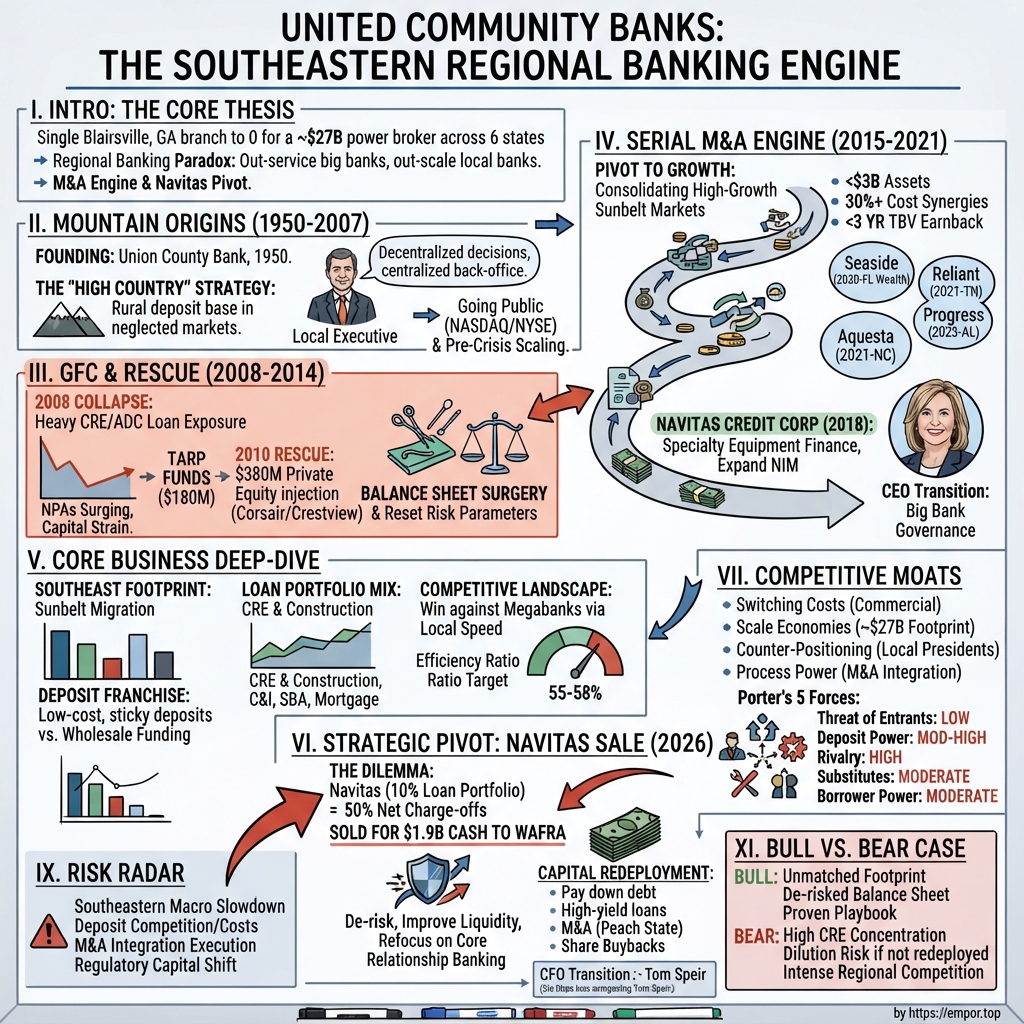
United Community Banks: The Southeastern Regional Banking Engine
I. Introduction & Episode Roadmap
Along Georgia Highway 515 north of Atlanta, suburban sprawl gives way to the Appalachian foothills. Blairsville sits at the end of that corridor in Union County, closer to the North Carolina border than to any major Georgia city. In 1950, Union County Bank opened there to serve a local economy based on cattle, timber, and mountain tourism. Seventy-six years later, the institution issues press releases from Greenville, South Carolina, trades on the New York Stock Exchange, and holds roughly $29.1 billion in assets across six Southeastern states.13
The distance between those two points frames the bank's evolution.
United Community Banks, Inc. — ticker UCB — is not a household name in the manner of a money-center bank.5 It operates without a major credit-card franchise, an investment bank, or a national advertising campaign. Instead, it maintains 189 branches and 11 loan production offices, holding top-10 deposit market share in both Georgia and South Carolina. Its footprint is concentrated in metropolitan areas where population growth over the past five years ran at more than twice the national average.1 Atlanta represents its largest deposit market, accounting for 22.3% of total deposits, followed by Greenville at 8.4%, along with a presence in Miami, Nashville, Raleigh, and Gainesville, Georgia.1 In short, the franchise represents a targeted bet on Southeastern demographic migration.
This positioning illustrates the classic regional banking challenge. A bank of United's scale operates in a competitive middle ground: it must compete on customer service against money-center institutions such as JPMorgan Chase, Bank of America, and Wells Fargo — firms with technology budgets exceeding United's entire market capitalization — while out-scaling $500 million community banks that maintain close client relationships but lack the capacity to underwrite $30 million credit facilities or provide sophisticated treasury-management platforms. Regional banks contend they can combine local decision-making with institutional product depth, a model whose execution requires continuous scrutiny.
Capital allocation forms the spine of United's modern history, anchored by two pivotal transactions eight years apart. In 2018, United acquired national equipment-finance lender Navitas Credit Corp. for $130 million to integrate higher-yielding loans into a low-yield balance sheet.1112 In June 2026, management agreed to sell Navitas to funds managed by Wafra Inc. for $1.9 billion in cash — a transaction designed to remove roughly 10% of the loan book and, by management's accounting, approximately half of the company's net charge-offs.3 Between those deals lies a period marked by a financial-crisis recovery, a private-equity recapitalization, a series of bolt-on acquisitions, and executive choices regarding core asset ownership.
This analysis traces that trajectory. It examines how crisis-era losses reshaped the bank's credit culture; how a post-2015 acquisition strategy expanded its regional footprint; how the deposit base performed through the 2022–2024 monetary tightening cycle and subsequent easing; what the Navitas sale reveals about executive priorities; and key risk factors for investors — including commercial real estate concentration, the reinvestment strategy for $1.9 billion in cash proceeds, and nuances in public disclosures. The study evaluates the franchise using strategic frameworks, including Hamilton Helmer's 7 Powers and Porter's Five Forces, while identifying the key operational metrics that will signal quarter-by-quarter execution.
The story begins with an executive who assumed control of a $42 million mountain bank and led it for 34 years.
 Subscribe on LinkedIn
II. Mountain Origins & The Founder's Blueprint (1950–2007)
Jimmy Tallent arrived at United in 1984. The institution he inherited was a single location with roughly $40 million in assets, serving a rural county whose entire population could fit inside a mid-sized Atlanta office tower.6 By the time he stepped down as chief executive in 2018, United had expanded into a four-state regional bank with $12.3 billion in assets and 151 offices.6 That multi-decade expansion rested on a fundamental insight about commercial bank funding.
The High Country Insight
The insight centered on deposits rather than loans.
During the 1980s and 1990s, Atlanta's major regional banks viewed rural North Georgia and Western North Carolina as structurally unattractive markets. Towns were small, operating branches was costly relative to deposit volume, and growth appeared limited. Yet deposit behavior in these mountain communities proved exceptionally stable. Customers tended to be older, less rate-sensitive, and relationship-oriented. They maintained balances in non-interest-bearing checking accounts, rarely chased yield across state lines, and stayed with their local institution across generations.
For a commercial bank, those sticky deposits are the raw material of a durable franchise. Bank economics depend fundamentally on net interest margin: the difference between the yield earned on assets and the cost of funding them. While most competitive effort in banking focuses on the asset side—competing for borrowers, structuring credit, and discounting rates—asset-side advantages are often temporary in a commoditized market. Enduring differentiation more often stems from the liability side. A bank backed by low-cost, stable deposits can afford to forgo aggressive rate competition on individual loans while still generating superior returns across a full credit cycle.
Tallent focused on accumulating low-cost funding in uncontested rural markets before expanding credit operations. As the North Georgia mountains evolved from agricultural communities into second-home and retirement destinations, and as Atlanta's exurbs expanded northward, United's deposit footprint positioned it in fast-growing corridors. The bank leveraged this funding strength through a steady series of small, rural bank acquisitions. By the mid-2000s, United had grown into a multi-billion-dollar institution with shares trading on Nasdaq under the ticker UCBI.7
The Operating Model: Centralize the Boring, Decentralize the Human
The organizational answer to running a multi-market community bank became United's signature strategy: centralize compliance, technology, credit policy, and back-office operations, while decentralizing customer relationships and local lending decisions to market-level executives with genuine authority.
This dual structure underpins the company's competitive positioning. For commercial borrowers, underwriting decisions depend primarily on approval certainty and speed. A major national bank might process a $4 million credit request for a Gainesville poultry-processing supplier through a centralized credit committee tuned for scale—an efficient process that yields consistent risk management, but one that can be slow and indifferent to decades of local operating history. Conversely, a small community bank may know the borrower intimately but lack the capital strength, treasury management products, or legal lending limits to accommodate the business as it expands.
United's hybrid model aimed to bridge that gap by empowering local market presidents to originate and champion credit decisions within a centralized risk, technology, and regulatory framework. When executed effectively, this approach delivers rapid turnarounds without sacrificing oversight. When executed poorly, however, it risks building a portfolio of correlated regional risks approved by lenders who share tight geographic and personal ties with their borrowers—a vulnerability United's management did not fully appreciate in the 1990s and early 2000s.
That structural flaw became critical during the mid-2000s real estate boom. The fastest-growing lending category in North Georgia was no longer local commercial businesses, but residential land acquisition, development, and construction—funding residential lots, subdivisions, and speculative housing across Atlanta's northern exurbs. Because local market presidents evaluated opportunities independently within the same booming market, many pursued the same asset class. In practice, the decentralized model concentrated United's loan portfolio into a single, highly correlated real estate trade.
For investors, United's early decades left a dual legacy that remains relevant today. The sticky deposit franchise assembled during those years laid the foundation for the bank's enduring funding advantage. At the same time, the permissive credit culture of that era brought the institution to the brink of collapse. Both inheritances shaped the company's trajectory as the 2008 financial crisis arrived.
III. Near-Death Experience: The Great Financial Crisis & Private Equity Rescue (2008–2014)
By the summer of 2010, the financial strain on United reached a critical point. In the second quarter of 2010 alone, the company reported a net operating loss from continuing operations of $59.5 million, or $0.66 per share, which included a $45.3 million non-cash charge from a transaction with Fletcher International to dispose of nonperforming assets.8 The provision for loan losses that quarter reached $61.5 million, pushing the loan loss allowance to 3.57% of total loans—roughly triple the reserve level of a healthy commercial bank.8 Reserving more than three and a half cents against every dollar of loans signaled an institution shifting from routine risk management to capital preservation.
How It Happened
The catalyst stemmed from the concentration risks detailed earlier. Residential construction and land-development loans—financing raw land, entitlements, and uncompleted residential subdivisions across North Georgia—represent one of the most volatile asset classes in community banking. Because these loans generate no cash flow during development, debt service depends entirely on selling finished properties into an active real estate market. When regional housing demand collapsed during the financial crisis, borrowers lacked tenant rents or business revenues to service their debts, leaving the bank holding depreciated real estate collateral.
Georgia became the focal point of U.S. bank failures during that cycle, and United faced severe capital pressure. In December 2008, the company issued $180 million in fixed-rate cumulative preferred stock—180,000 shares paying a 5% dividend for five years and 9% thereafter—to the U.S. Treasury under the Capital Purchase Program, along with a warrant enabling the Treasury to purchase 2,132,701 common shares at $12.66 per share.7 Within two years, United's common stock traded at a small fraction of that strike price.
While Capital Purchase Program funds provided temporary liquidity, credit losses continued to accumulate through 2009 and 2010. By the end of 2010, nonperforming assets reached 4.3% of total assets, prompting heightened regulatory oversight.9
The March 2011 Reset
On March 16, 2011, United executed a comprehensive recapitalization that stabilized the institution while severely diluting existing equity holders.
The bank announced definitive agreements to raise $380 million in a private placement of common stock and mandatorily convertible preferred stock, led by an affiliate of Corsair Capital, LLC alongside other institutional investors.9 The common shares were priced at $1.90 per share, with the preferred stock convertible at the same price.9 Upon closing, Corsair and its limited partners held approximately 22.5% of the pro forma company and secured a seat on United's board of directors.9
To address problem credits directly, United concurrently agreed to sell approximately $293 million of substandard and nonperforming loans in bulk transactions while accelerating the disposition of about $142 million in foreclosed properties.9 In total, the bank slated roughly $435 million in troubled assets for rapid removal from its balance sheet.
The immediate financial impact was substantial. Estimated after-tax charges from the asset sales ranged between $140 million and $155 million.9 On a pro forma basis, tangible book value per share dropped from $4.76 to approximately $2.27—a 52% decline prior to accounting for dilution from the new common shares issued at $1.90.9 However, the recapitalization fundamentally strengthened United's capital ratios: nonperforming assets fell from 4.3% to a pro forma 1.1% of total assets, tangible common equity increased from 6.0% to 8.5% of tangible assets, and the Texas ratio—measuring problem assets against capital and allowance reserves—improved from 44.2 to 11.0.9
"The effective recapitalization of United strengthens our balance sheet, enabling us to address our challenges and to build a much stronger platform for the future," Tallent stated in the transaction announcement, characterizing Corsair as an ideal partner.9 Corsair Chairman Nicholas B. Paumgarten noted that United was "uniquely situated to be a leading community banking organization in the Southeast."9
What Survived, and What It Cost
The 2011 recapitalization functioned as a controlled balance-sheet restructuring. United management chose to recognize substantial asset losses immediately, despite severe dilution to existing shareholders, rather than attempt a multi-year workout of troubled loans during an uncertain housing recovery. Institutions that delayed loss recognition during that period often experienced persistent credit erosion, leading in many cases to regulatory failure.
Two structural consequences of this period remain central to evaluating United's modern operating strategy.
First, the crisis reshaped the bank's risk governance and portfolio boundaries. Having experienced a construction portfolio contraction that erased more than half of tangible book value, executive management established conservative underwriting limits. This institutional memory explains why commercial construction represents a modest portion of total loans in the current portfolio, residential construction accounts for approximately 1%, and regulatory commercial real estate and construction concentration ratios remain well inside supervisory threshold guidance.1
Second, the long-term returns illustrate the structural dynamics of distressed recapitalizations. Following the $1.90 per share recapitalization in 2011, United's tangible book value per share reached $23.31 by June 30, 2026.2 While this represents significant balance-sheet growth from the crisis trough, much of the subsequent equity appreciation accrued to the private equity sponsors and institutional investors who supplied recapitalization capital at distressed valuations. For long-term investors, the bank's subsequent trajectory hinged on whether management could maintain strict credit discipline while executing a broader regional expansion strategy.
IV. The Serial M&A Engine & The Specialty Lending Shift (2015–2021)
Once a bank has finished cleaning up, it faces a question that is more consequential than it looks: what do you do with a repaired balance sheet in a region full of banks that have not repaired theirs?
United's answer, from roughly 2015 onward, was to become a buyer. And the pattern of what it bought — and where — reveals a deliberate strategic migration that took the better part of a decade to complete.
From the Mountains to the Metros
The rural North Georgia deposit base was the company's foundation, but it was never going to be its growth engine. The growth was three hours south and east: Atlanta, Greenville, Charlotte, Nashville, Charleston, Orlando, Miami. The acquisition program was, at its core, a mechanism for converting the equity value of a mountain deposit franchise into a presence in the fastest-growing metropolitan markets in the United States.
The Florida entry came first and was the most transformative. On July 1, 2020 — in the middle of the pandemic, when most bank M&A had frozen — United closed its acquisition of Three Shores Bancorporation, parent of Seaside National Bank & Trust, headquartered in Orlando.10 The deal brought $2.13 billion of assets, $1.43 billion in loans, and $1.80 billion of assumed deposits, along with a fourteen-branch network across key Florida metropolitan markets and, critically, a wealth management platform.10 Seaside was not a rural community bank. It was a commercial lender serving affluent Florida markets, and it gave United a private-banking and advisory capability it had not previously possessed.
A year later the company reinforced that capability by acquiring FinTrust, an investment advisory firm based in Greenville with offices in Anderson, South Carolina, and Athens and Macon, Georgia — a straightforward bolt-on to the advisory services division.10
Tennessee came next. On July 14, 2021, United announced an agreement to acquire Reliant Bancorp, headquartered in Brentwood, a Nashville suburb.10 Reliant operated a twenty-five-branch network concentrated around Nashville, with additional branches in Clarksville and Chattanooga, and reported $3.01 billion of assets, $2.39 billion of loans, and $2.55 billion of deposits.10 It also carried something less obviously strategic: a manufactured housing finance group based in Knoxville.10 That detail is worth remembering — small acquired specialty portfolios have a way of generating outsized problems years later, and this one did, surfacing as a distinct manufactured-housing loss event in 2024 that management still referenced when discussing charge-off trends the following year.15
Charlotte followed on October 1, 2021, with the acquisition of Aquesta Financial Holdings, whose subsidiary Aquesta Bank was based in Cornelius, North Carolina, and operated primarily in the Charlotte metropolitan area.10 Then Alabama: United agreed to buy Progress Financial, the Huntsville-based parent of Progress Bank, in a stock transaction valued at roughly $271 million — an entry into one of the Southeast's densest concentrations of aerospace, defense, and federal research employment.13 Finally, in December 2024, the company announced an agreement to acquire ANB Holdings, parent of American National Bank in Fort Lauderdale, deepening the South Florida position it had opened with Seaside.14
The Discipline Underneath
What makes this program analytically interesting is not the list of deals. It is that management has stated a consistent set of financial hurdles and, on the evidence available, has largely stuck to them.
The core constraint is the tangible book value earnback period. When a bank issues stock to buy another bank at a premium to tangible book value, the acquirer's own tangible book value per share falls immediately — the buyer is paying more than accounting value and diluting existing owners in the process. The earnback period is the number of years of incremental earnings required to restore that lost book value. Chief Risk Officer Rob Edwards articulated the standard on the July 2026 call: "We target a 3-year earn-back on an all-stock basis."4 Chief Executive Lynn Harton has separately described a preference for targets at "10%, probably at the most, 15% or less of our size," on the reasoning that institutions of that scale align better on employee and client experience and can be more meaningfully improved by the acquirer.17
The economics of a well-executed small in-market deal are genuinely attractive, and the most recent transaction illustrates why. In the Peach State acquisition announced in April 2026, United paid roughly $100 million for a bank with approximately $788 million of assets — about 1.9 times tangible book value, but only about six times cost-saved earnings, assuming 40% expense synergies.17 The gap between those two multiples is the entire logic of bank consolidation. You are not buying a growth business; you are buying a deposit base and then removing the duplicate cost structure that sat on top of it. Harton made the capital-allocation comparison unusually explicit on that call: "if I'm evaluating a share repurchase at 11, 12x earnings versus buying a bank at 6, hey, why not buy the bank at 6x earnings."17
That is a defensible framework. It is also one that only works if the cost saves are real, the deposits stay, and the acquirer does not overpay in a competitive auction. On the evidence of United's own commentary, the discipline has held — Edwards conceded that Peach State's pricing "was probably on the high side," which is at least an honest characterization rather than a promotional one.4
The Navitas Detour
Running alongside the geographic program was a different kind of transaction entirely, and it deserves its own treatment because it defined the next eight years.
On January 8, 2018, United announced a definitive agreement to acquire NLFC Holdings Corp. and its subsidiary Navitas Credit Corp., a specialty lender headquartered in Ponte Vedra, Florida, that financed equipment purchases for small and medium-sized businesses nationwide.11 At the time, Navitas held roughly $350 million of loans and leases and serviced more than 17,000 finance contracts for approximately 14,500 business customers.11 The deal closed on February 1, 2018, for $130 million in total consideration — $84.5 million in cash and $45.7 million in stock — bringing $393 million of assets and $350 million of liabilities onto the balance sheet and generating $87.4 million of goodwill.12 Management projected roughly $0.20 of first-full-year earnings per share accretion.11
The strategic rationale was stated plainly in the announcement: combine "United's liquid balance sheet, low cost funding and excess capital with Navitas' proven growth capabilities."11 Translated, it was a yield trade. A community bank with abundant cheap deposits and mediocre asset yields would buy a high-yield lending platform and capture the spread. In a world where the Federal Reserve had held rates near zero for the better part of a decade and net interest margins across the industry had been ground down, this was a rational and widely-copied maneuver.
It also embedded a risk the yield math tends to obscure — a point the story returns to in Section VI, because the resolution took eight years.
The Handoff
The leadership transition arrived in the same period. On April 2, 2018, United announced that Tallent would retire as chief executive effective June 30 and move to executive chairman, with Lynn Harton — then chief executive of the banking subsidiary — taking over the holding company.6
Harton was a deliberate choice of a particular type. He had joined United in 2012 as an operating executive and was elected to the board in February 2015 before being named chief executive of the bank in August 2017.6 His prior career was almost entirely a credit and risk career at institutions considerably larger than United: chief executive of The South Financial Group, chief credit officer at both Regions Financial Corporation and Union Planters Corporation, and, before all of that, a twenty-year stint at BB&T.6
Consider what that résumé means in context. United's board, seven years after a near-failure caused by concentrated credit risk, handed the company to a career chief credit officer. Tallent had been the growth architect and the cultural founder; Harton brought large-bank risk governance into a community-bank structure. The appointment reads less like a routine succession than a statement about which failure mode the board was most determined never to repeat.
Whether that instinct held under pressure is testable — and the test came from the very business Tallent's team had bought three months before Harton was named. First, though, the machine those decisions built deserves examination on its own terms.
V. Core Business Deep-Dive: Economics, Segments, & Competitive Position
Strip a bank down to its mechanics and it is a spread business with a service wrapper. It borrows money from depositors at one price and lends it at a higher one; the difference, expressed against average earning assets, is the net interest margin. Everything else—fee income, expense discipline, credit losses—modifies that core engine.
That makes funding the most informative starting point for evaluating United's balance sheet.
The Engine Room: A Deposit Franchise That Behaved
In the second quarter of 2026, United held $23.7 billion of total deposits against $29.1 billion of assets, with demand deposit accounts—checking balances that pay no interest—comprising 27% of customer deposits.12 The company's cost of deposits was 1.66%, down one basis point from the prior quarter.1
That metric reflects how the franchise navigated the preceding interest-rate cycle.
When the Federal Reserve raised its policy rate aggressively through 2022 and 2023, regional banks faced immediate pressure as depositors sought higher-yielding alternatives such as money-market funds. The industry measures this pricing sensitivity through deposit beta—the percentage of central bank rate adjustments passed through to depositors. A lower beta indicates greater funding stability and pricing power.
Through the easing cycle that followed, United reported a cumulative total deposit beta of 40% as of the fourth quarter of 2025, improving to 39% in the first quarter of 2026—meaning it had captured roughly four-tenths of the Fed's cuts in reduced deposit costs.1517 Chief Financial Officer Jefferson Harralson noted on the January 2026 call that the company was retaining roughly 90% of maturing certificates of deposit, and added a comparison worth taking seriously: "We understand that's much generally higher than where the industry is."15
Two structural factors support the claim of deposit durability. First, United funds its balance sheet almost entirely from core retail and commercial customers, maintaining minimal reliance on brokered deposits or wholesale market borrowings.17 Second, its loan-to-core-deposit ratio excluding Navitas stood at 76% in the second quarter of 2026, compared to a KBW Nasdaq Regional Banking Index peer median of 91%.1 Lending 76 cents of every core deposit dollar provides structural liquidity reserves, whereas institutions operating near 91% must purchase higher-cost marginal funding during tight monetary conditions.
However, management has noted that deposit cost relief is reaching its near-term limit. On the July 2026 call, Harralson acknowledged that market competition had firmed and told an analyst that "our cost of deposits will drift slightly higher in the back half."4 While time deposits were running off at 3.40% as new volume came on at 3.20%, that yield benefit is narrowing, with 30% of the $3.7 billion CD book set to mature within three months at an average rate of 3.09%.1 Concurrently, the cumulative beta on non-maturity interest-bearing deposits had reached 55%.1 The deposit franchise remains a key asset, but it is not immune to competitive repricing.
What the Bank Actually Lends Against
On a pro forma basis excluding the equipment finance business held for sale, United's loan portfolio breaks down to roughly 39% commercial and industrial including owner-occupied commercial real estate, 28% commercial real estate, 17% residential mortgage, 8% home equity, 6% commercial construction, and about 1% each of residential construction and other consumer credit.1
The distinction between owner-occupied and income-producing commercial real estate carries structural significance. When a business borrows against the facility it occupies, credit underwriting depends primarily on operational cash flows, with the real estate serving as secondary collateral. By contrast, debt service on investor commercial real estate relies entirely on tenant lease payments. United classifies owner-occupied CRE within its commercial and industrial category to reflect this cash-flow dependency, an approach reflected in loss allowances: as of the second quarter of 2026, the company reserved 0.66% against owner-occupied CRE and 0.75% against income-producing CRE, compared to 1.70% for general commercial and industrial credit.1
At the regulatory level, United reported commercial construction and total CRE concentration ratios of 43% and 195% of total risk-based capital, respectively.1 The supervisory guidance thresholds that trigger heightened regulatory scrutiny sit at 100% for construction and 300% for total CRE. United operates comfortably inside both parameters—a direct consequence of the underwriting reforms instituted following the 2008 financial crisis.
One notable disclosure limitation remains. United's quarterly investor materials separate CRE by owner-occupied status and allowance coverage but do not publish a granular property-type breakdown covering office, retail, industrial, and multifamily assets. While management indicates conservative overall exposure, the absence of explicit property-level breakdowns leaves investors unable to independently verify specific office market exposure during a period of stress for commercial office valuations.
Loan expansion is concentrated in management's targeted categories. In the second quarter of 2026, home equity lines expanded at an 18% annualized pace and commercial and industrial lending grew at 10%, driving total annualized loan growth of $332 million, or 6.8%—or 6.4% excluding equipment finance.12 That originations mix reflects strategic priority: HELOCs and commercial operating lines establish broader treasury management and deposit relationships, whereas investor real estate loans are predominantly transactional, rate-driven credits.
The Fee Businesses
Noninterest income reached $38.4 million in the second quarter of 2026, accounting for roughly 14% of total revenue ($279.3 million).12 The revenue mix comprises deposit service charges, mortgage banking fees, wealth management receipts, and gains on loan sales.
The Small Business Administration lending platform functions as a key fee-generation engine. In SBA lending, the bank originates loans carrying partial federal guarantees, sells the guaranteed portion into secondary markets at a premium to book immediate gain-on-sale income, and retains ongoing servicing fees. While capital-efficient, the strategy carries operational risk. In the fourth quarter of 2025, United charged off a $4 million owner-occupied SBA loan after identifying an underwriting documentation defect that led management to forgo the government guarantee. Chief Risk Officer Rob Edwards discussed the incident directly on the January 2026 call: "In the last 12 years, that's really the first time we've originated a credit that we decided to not pursue the guarantee," noting that the company completed an after-action review and implemented procedural controls.15 The disclosure highlighted how operational control failures can compromise fee-generating credit programs.
The wealth management division oversees approximately $3.6 billion in assets under management. While modest relative to the core balance sheet, United has been expanding the unit by deploying its Florida private-banking platform across its expanded Southeastern footprint.115 Mortgage banking revenues remain tied to broader real estate activity; in the second quarter of 2026, purchase transactions represented 79% of funded volume, insulating the division from refinance drops but leaving earnings reliant on existing housing sales velocity.1
Operating Economics and the Peer Frame
United's efficiency ratio—noninterest expense as a percentage of revenue—stood at 57.0% on a GAAP basis and 56.7% on an operating basis in the second quarter of 2026, or approximately 55% when adjusting for a non-recurring regulatory settlement.124 Operating return on assets reached 1.22%, while operating return on tangible common equity was 13.0%.2
These metrics place United near the median of its regional peer group rather than at the top. Top-tier Southeastern regional banks consistently generate efficiency ratios in the low 50s and returns on tangible common equity above 15%. United competes directly for commercial accounts and market talent against regional peers including SouthState, Pinnacle Financial Partners, Synovus, Cadence, Renasant, and First Horizon. Pinnacle's rapid expansion via aggressive team lifts serves as a ongoing reminder that recruiting local commercial bankers is a widely shared regional playbook rather than a proprietary advantage.
United's primary balance-sheet distinction lies in its capital positioning and balance-sheet liquidity. The bank reported a Common Equity Tier 1 (CET1) ratio of 13.5%, compared to a KBW Nasdaq Regional Banking Index peer median of 12.2%, alongside a tangible common equity ratio of 9.9% versus the peer median of 8.7%.1 These wider capital cushions reflect a explicit choice to maintain balance-sheet strength over financial leverage—a policy that restrains return on equity during expansionary periods but preserves solvency options during credit downturns.
The financial profile of the franchise remains nuanced. Its low-cost deposit base provides a verifiable funding advantage relative to mid-sized peers. Its geographic coverage in high-growth Southeastern metropolitan areas positions it well demographically, and external benchmarks—including twelve regional customer satisfaction rankings from J.D. Power, most recently in the first quarter of 2026—confirm strong retail service scores.17 However, core profitability metrics remain mid-pack. United has largely funneled its deposit advantage into balance-sheet safety rather than top-tier return metrics.
The decision to divest Navitas represents a explicit attempt to reshape that balance-sheet trade-off.
VI. The Strategic Pivot: The $1.9B Navitas Sale & Capital Realignment (2026)
Here is the number that ended the argument.
Equipment finance represented 10% of United's total loan portfolio. It also accounted for approximately 50% of the company's net charge-offs for the twelve months ended March 31, 2026.3
Once a business is generating half your credit losses on a tenth of your assets, the debate about whether the yield justifies it has largely resolved itself. But it took eight years and a great deal of nuance to get to that clarity, and understanding why is more instructive than the headline.
The Yield That Was Real, and the Loss That Was Too
Navitas was not a bad business. It was a good business that belonged somewhere other than inside a community bank.
The portfolio's yield ran consistently around 9.7% — roughly triple what United earned on securities and materially above what its core commercial book generated.1 The weighted average FICO score across the portfolio sat at 762, which is a prime credit profile by any consumer or small-business standard.1 In 2025, Navitas generated $166 million of gross revenue against $32 million of total noninterest expense, and crossed $1 billion of originations for the first time.115 It was, by ordinary operating measures, working.
The problem was the loss profile. Navitas net charge-offs ran between roughly 1.11% and 1.25% of the portfolio through 2025 and into early 2026 — against bank-only charge-offs that Edwards described as having run between 8 and 13 basis points over the prior decade.14 Equipment finance was losing roughly ten times as much, proportionally, as the rest of the bank.
That is not a scandal; it is how small-ticket equipment finance works. The business lends against forklifts, trucks, construction equipment, and restaurant systems for small businesses across the country. The yields are high because the losses are structurally high, and the model works if pricing exceeds losses across a cycle — which it did. But it introduced two things a community bank does not want. First, volatility: a portfolio whose loss rate can move sharply with small-business conditions injects earnings noise into a franchise whose entire equity story rests on predictability. Second, geographic and relationship disconnection. Navitas' largest state exposures were California at 11%, Texas at 10%, and Florida at 10%.1 United was a Southeastern relationship bank carrying a national credit book in states where it had no branches, no local knowledge, and no deposit relationship with the borrower.
There was also a governance dimension that surfaced in an uncomfortable way. In the second quarter of 2026, United recorded a $4.5 million expense to settle with the California Department of Financial Protection and Innovation to obtain a lender's license for Navitas. Harralson explained the history on the July call: Navitas had held a California license before the acquisition but let it lapse "because we believe it was no longer required to have one under United ownership as a bank subsidiary."4 Roughly 75% of the settlement was not tax deductible.4 It is a small dollar amount against a $29 billion balance sheet, but it is a precise illustration of the operating-complexity cost of running a national non-bank lending platform inside a regional bank charter — fifty state regimes, none of which care about your Georgia charter.
The Decision and the Deal
The timeline of the decision matters, and management disclosed it in a way that raises a fair question.
On the July 2026 call, Harton stated: "When we decided early last year that it was time to sell Navitas and refocus on our core franchise, we spent time developing a playbook and strategy to put the same effort and attention we have paid to integrating merged teammates into hiring new revenue producers."4 Early last year means early 2025. The hiring program began in the third quarter of 2025.1
On June 12, 2026, United announced a definitive agreement to sell the equipment finance business — Navitas Credit Corp. and NLFC Reinsurance Corp. — to funds managed by Wafra Inc., a New York alternative asset manager with roughly $30 billion under management, for $1.9 billion in cash.318 The price reflected a 7% premium to the par value of the loan portfolio.3 United expected a one-time pre-tax benefit of $109 million, 3% accretion to tangible book value per share, and 145 basis points of additional CET1 capital.3 BofA Securities acted as exclusive financial advisor to United, with Squire Patton Boggs as legal counsel; Wafra's financing came from Bank of America and Wells Fargo, with $1.0 billion of additional capacity beyond the purchase.18
Navitas' management team and all employees were expected to remain with the business, with chief executive Mike Bruman continuing to lead it as an independent equipment finance company.18 As of March 31, 2026, Navitas held $1.8 billion of owned receivables and employed more than 200 people across six U.S. locations.18 The buyer's characterization is worth registering, because it is the mirror image of the seller's: Wafra's head of real assets and infrastructure, Edward Tsai, described Navitas as having "distinguished itself in the equipment finance industry by growing successfully through multiple cycles while consistently serving its customers and delivering strong financial performance."19 Both statements can be true. A business can be an attractive standalone platform for an asset manager funding it with institutional capital and a poor fit inside a deposit-funded community bank.
Harton's framing in the announcement was notable for what it conceded: "for the past several quarters, we have had to restrain Navitas' growth to remain within our self-imposed portfolio limits."3 Translated: United had capped the business at 10% of loans, Navitas kept growing faster than that, and the bank was forced to sell loans into the secondary market to stay within its own guardrail. It was a business the owner could not let run.
In the second quarter of 2026, United reclassified approximately $1.9 billion of equipment finance loans to held-for-sale and released the associated $38.5 million allowance for credit losses.12 That release produced a negative provision of $29.8 million and added $0.25 to GAAP earnings per share — which is why the company reported $0.95 of GAAP EPS against $0.71 of operating EPS.42 The allowance ratio fell from 1.15% to 1.04% of loans as a direct consequence.1 Investors reading the headline GAAP number without the reconciliation would have badly misread the quarter, and to management's credit, both the release and the presentation separated the two clearly.
As of this writing, the transaction had not yet been announced as completed; the company expected closing in the third quarter of 2026, subject to customary conditions.3
The Reinvestment Problem
Selling a business earning 9.7% and receiving cash creates an immediate and unavoidable arithmetic problem, and management has been unusually specific about it.
The company's stated near-term plan is to park proceeds in lower-risk securities yielding a weighted average of 4.0% to 4.5% with a target duration under two years.3 Harralson quantified the drag on the July call: on a static basis, selling Navitas and reinvesting at 4.25% "moves our margin down by about 30 basis points."4 His projection was that the third quarter would land somewhere between current levels and down 20 to 25 basis points, with the fourth quarter probably down 20 to 25 basis points, and the underlying margin widening thereafter as back-book repricing and stronger loan growth offset the mix shift.4
That is the honest version of the trade: United is exchanging roughly 30 basis points of near-term margin for a materially lower loss rate and a much larger capital cushion. Whether it proves value-accretive depends entirely on execution over the following two years.
The capital picture is the other half. Pro forma for the sale, CET1 would sit around 14.5%.4 Harralson framed the excess plainly when an analyst pressed on buybacks: "if you think about just getting back to the 13% range, that's about $300 million of excess capital," adding that this would be a board discussion over the coming year and that "you could realistically see capital usage and perhaps and buybacks increase significantly next year."4
Four uses have been articulated: funding organic loan growth, which is accelerating; opportunistic small in-market M&A; share repurchases; and balance-sheet optimization.34 Harton was direct about the ranking, and it was not the answer a buyback-focused investor wanted: "doing some of those for cash is a more effective buyback in a way."4 When D.A. Davidson's Gary Tenner pushed on whether the buyback commitment had softened relative to the June announcement, Harton characterized it as preserving flexibility — and agreed, when Tenner offered the phrase, that "slow playing it a little bit" was a fair description.4
The bridge for the lost Navitas earnings is the hiring program. United added 37 net new revenue producers between the third quarter of 2025 and mid-2026, an expansion of about 17% of its sales force, roughly half of them commercial lenders, with average tenure above twenty years and most recruited from larger banks.1 Chief Banking Officer Rich Bradshaw described the target profile on the July call: bankers with twenty years' experience who had run portfolios above $100 million, expected to reach roughly $30 million of funded volume each, recruited without external recruiters.4 The company's own materials state the objective explicitly: funded volume from recent hires is expected to replace projected Navitas growth in 2027.1
That is a testable claim with a specific deadline, which is the most useful kind. It is also unproven. Lender hiring programs across the industry have a mixed record — the bankers arrive with a cost immediately and the revenue on a lag, and the loans they bring are sometimes the loans their previous employer was happy to lose.
The Handoff at the CFO Desk
The final piece of the pivot is personnel. Harralson — the chief financial officer whose name appeared on the Navitas acquisition release in 2018 and on the divestiture release in 2026 — announced his retirement, and on August 19, 2026, United named Tom Speir as his successor, effective September 8, 2026.21 Speir came from Regions Financial Corporation, where he had held senior roles across investor relations, strategy, corporate development, and treasury.21 Harralson was to remain chief financial officer until the transition and then continue in another capacity through December 31, 2026, to support an orderly handover.21
Speir's background is notable in composition. He is a corporate development and treasury executive, not a controller — which is a reasonable profile for someone whose immediate mandate is deploying $1.9 billion of cash and managing the resulting balance sheet. The company simultaneously added Sean Simpson as chief commercial banking officer and appointed Carl S. Carande to its board.2425 For a bank that closed an acquisition on August 1 and expects to close a $1.9 billion divestiture in the same quarter, that is a substantial amount of senior-level change moving at once.20
Which raises the question the next section takes up directly: what, underneath all this motion, does United actually own that a competitor cannot replicate?
VII. Competitive Moats & Structural Frameworks
Banking is a commodity business selling an undifferentiated product — money — under heavy regulation, with thousands of competitors offering nearly identical terms. Any claim of durable competitive advantage in this industry deserves aggressive interrogation before acceptance.
Run United through Hamilton Helmer's 7 Powers, and the honest answer is that it holds two of them meaningfully, one partially, and several not at all.
Switching Costs: Real, but Only on One Side
The strongest genuine power United possesses applies to commercial relationships, not retail ones.
A retail depositor can move a checking account in an afternoon. A mid-sized commercial client cannot. Consider a regional distributor with $80 million of revenue: its operating account is connected to automated clearing house origination for payroll, positive-pay fraud controls, remote deposit capture at three locations, lockbox processing for receivables, a revolving line of credit tied to a borrowing-base certificate submitted monthly, and interest-rate swaps hedging its term debt. Moving that relationship is not a transaction; it is a project with a legal budget, a treasury workstream, and a real risk that payroll breaks in week three.
This is why commercial deposits are stickier than retail ones and why United's C&I and treasury-management focus is strategically coherent rather than merely fashionable. The company's own management has articulated the mechanism as policy: Bradshaw noted that on the loan side, "we are requiring a depository relationship whenever we do a loan."17 Loans are the wedge; the operating account is the moat.
The limit is that switching costs protect the existing book, not the next dollar. They make United hard to leave. They do not make it easier to win.
Scale Economies: Present, but Bounded — and Management Says So
The conventional argument is that a $29 billion bank spreads regulatory compliance, cybersecurity, core processing, and fraud technology across a base large enough to make those costs bearable, while a $500 million bank cannot.
There is truth in this, and United has demonstrated concrete returns. Harton reported on the April 2026 call that the company's fraud losses had dropped roughly 50% over two years, attributing much of the improvement to artificial intelligence deployed by its technology vendors, alongside chatbot-enabled contact-center capacity gains and higher programming throughput without added headcount.17 Notably, this is scale benefit purchased through vendors rather than built in-house — which is cheaper, but also available to any competitor willing to write the same check.
What makes United's position analytically unusual is that its own chief executive has publicly disputed the scale-in-technology argument. Asked in January 2026 whether anything might change the company's reduced appetite for M&A, Harton said: "the only thing that scale really gets you, it's not technology. We can fund whatever technology we need. In fact, at our size, it's probably easier to implement than it is if you're larger. What scale does get you is a bigger balance sheet, product set, particularly for your commercial clients and then the ability to attract better talent."15 He added, memorably: "would I like to be bigger? Absolutely, but are we big enough? Absolutely."15
That is a chief executive declining to make the empire-building argument available to him — and it reframes the scale power as being about legal lending limit and talent recruitment rather than cost absorption.
Counter-Positioning: Weak as a Power, Real as an Operating Choice
The local-authority model is frequently described as counter-positioning against centralized megabank credit algorithms — the claim being that JPMorgan structurally cannot delegate credit authority to a Gainesville market president without abandoning the standardization its own model depends on.
There is something to this, but it does not meet Helmer's bar. Counter-positioning requires that the incumbent be unable to respond without damaging its existing business. Large banks can and do staff local commercial teams with meaningful discretion. More importantly, United's actual competition for a Southeastern middle-market borrower is not primarily JPMorgan. It is Pinnacle, SouthState, Synovus, and Renasant — regional banks running functionally identical models with functionally identical claims about local decision-making. When every competitor in the relevant set has the same posture, it is a table stake, not a differentiator.
Process Power: The Most Plausible Claim, Now Partially Idle
The strongest case for something proprietary is integration capability. Acquiring a bank and converting its core systems, retaining its deposits, keeping its lenders, and realizing the promised cost saves is genuinely difficult, and failures are common and expensive. United has executed the sequence repeatedly across Florida, Tennessee, North Carolina, Alabama, and Georgia.
Process power is built through years of accumulated organizational learning and is hard to copy quickly. But there is an awkward wrinkle: United has largely stopped exercising it at scale. Harton counted the acquisition universe in January 2026 and found "literally less than 2 handfuls. I mean, less than 10 in our markets that we would be interested in," noting that most were quality institutions expecting a strong 2026 and inclined to wait.15 A capability that is used once every eighteen months on an $800 million target is a capability that may atrophy.
Brand, network effects, cornered resources, and scale-driven pricing power are not meaningfully present. United's J.D. Power recognition is real and repeated, and it plausibly supports both deposit retention and lender recruitment — Bradshaw observed that culture "comes up in every discussion" when hiring senior lenders.15 But bank brand is local, not transferable, and it does not command price.
Porter's Five Forces
Threat of new entrants: low. De novo bank formation requires regulatory chartering, substantial capital, and — the binding constraint — a core deposit base that takes years to build. Fintech lenders and digital banks can enter the asset side but struggle to replicate low-cost sticky funding without either paying up for rate-sensitive money or partnering with a chartered institution.
Bargaining power of depositors: moderate to high, and structurally elevated. The March 2023 regional bank failures permanently changed depositor behavior. Commercial treasurers who had never considered deposit insurance limits now monitor them. United's evidence of retention is above average, but the ceiling on this power is set by the market, not by the bank.
Rivalry: high and intensifying. Bradshaw noted competition had "gotten a little more competitive" over two quarters, though qualified that it was showing up in rate rather than structure — an important distinction, because competing away price is recoverable while competing away covenants and collateral is not.15 By July 2026 he reported that "pricing and structure have both kind of leveled off."4 Rivalry now extends to talent, where United is both aggressor and target.
Threat of substitutes: moderate and rising. Private credit funds and non-bank lenders have taken meaningful share of middle-market lending, competing on speed, structure flexibility, and freedom from bank capital rules. They cannot take the operating account, which is United's defense — but they can take the loan.
Bargaining power of borrowers: moderate. Quality commercial borrowers shop terms and know it. The counterweight is relationship depth and the switching friction already described.
The synthesis is that United's advantages are real but concentrated in one place: a funding franchise that is measurably cheaper and stickier than the peer median, embedded in geography that is demographically favored. That is a genuine edge. It is not an unassailable one, and it does not, on current evidence, translate into peer-leading profitability.
Which makes the question of whether management is allocating capital well the decisive one.
VIII. Governance, Management Credibility, & Earnings Call Transcript Audit
Reading three consecutive United earnings calls in sequence produces a telling pattern. The tone remains consistent, the numbers reconcile transparently, and difficult questions receive direct answers—yet a major strategic shift remained unmentioned until it was already underway.
The Disclosure Question
On January 14, 2026, Chief Executive Lynn Harton opened the fourth-quarter call by describing 2025 as "a great year." He pointed to 11% year-over-year revenue growth, an 18% increase in full-year operating earnings per share from $2.30 to $2.71, and a return on tangible common equity of 13.3%, alongside an 11% gain in tangible book value per share.1516 Full-year net income reached $328 million on pre-tax, pre-provision income of $471 million, compared to $252 million and $374 million, respectively, in 2024.16
During the call, Harton highlighted that Navitas "crossed $1 billion in originations for the first time."15 When analyst Catherine Mealor of KBW asked how management planned to handle the equipment finance portfolio in 2026, Chief Financial Officer Jefferson Harralson framed the response in purely operational terms. He noted that Navitas represented 9.5% of total loans, which management intended to cap at 10%. With originations growing at an 18% annualized pace before asset sales, Harralson concluded that "Navitas selling more loans is the most likely outcome for 2026."15
Yet by Harton's own later account, executive management had already decided to sell the equipment finance business in early 2025—roughly a year before that call.4
There is a practical explanation for this silence. Exploring a transaction is not the same as closing one; without a signed agreement or fixed price, premature public disclosure risks unsettling employees, alienating clients, and weakening negotiating leverage. Factually, Harralson's January statements were accurate: the bank was actively managing portfolio caps through loan sales, standard preparation for a business being readied for market.
Nevertheless, investors listening to that call would reasonably have inferred that equipment finance remained a core, permanent component of United's balance sheet. A similar pattern emerged in M&A strategy. On the same January call, Harton remarked that "M&A opportunities are light. We've kind of built the foundations of the footprint that we want," adding that this environment "really puts buybacks in the crosshairs."15 Just three months later, United announced its Peach State acquisition and, by July, management was discussing active conversations with potential bank targets while reframing share repurchases as a flexible option.417
To his credit, Harton acknowledged the shift directly before analysts pressed the point, noting: "that's probably why my conversation — my comments, maybe the last 2 quarters haven't been as consistent as they should have been because it's just really hard to predict."15 Acknowledging a communications gap is preferable to defending one. The broader takeaway is that while United's management provides transparent reporting on historical performance, their forward-looking guidance requires more cautious evaluation.
Where Analysts Actually Pushed
The question-and-answer exchanges across recent earnings calls highlight the primary operational concerns among institutional investors.
Margin trajectory after the sale. Stephen Scouten of Piper Sandler opened the July call by asking whether United could deliver a seventh consecutive quarter of net interest margin expansion. Harralson addressed the drag directly, outlining the immediate 30-basis-point margin reduction from the Navitas sale alongside offsetting repricing drivers to provide a quantifiable baseline for future quarters.4
Deposit cost direction. Pressed on certificate of deposit repricing, Harralson conceded that overall funding costs would drift slightly higher in the second half of the year.4 Management's willingness to acknowledge near-term cost pressure on a key metric underscores their reporting transparency.
Buyback pacing. Capital deployment prompted the sharpest exchange of the series, with management providing less definitive guidance on the timing and scale of share repurchases.4
Credit normalization. Chief Risk Officer Rob Edwards provided detailed context across calls, reiterating a historical baseline of 8 to 13 basis points for bank-only charge-offs. He walked through specific fourth-quarter 2025 commercial losses, including a $14 million franchise loan that resulted in a $6 million charge-off when the borrower and franchisor failed to reach a workout agreement, while projecting a normalized loss range of 20 to 25 basis points for 2026.15
Tariffs. Asked in January 2026 whether trade tariffs were straining commercial borrowers, Edwards reported no evidence of stress in problem-loan reviews or annual credit evaluations, noting that clients were managing cost pressure through price adjustments or margin absorption.15
Notably, analyst questioning across these calls contained little discussion of commercial office or multifamily real estate exposure. Whether this reflects market confidence in United's underwriting or stems from limited granular property breakdowns in public filings remains unconfirmed.
Incentive Design — Read the Proxy, Not the Press Release
United's executive compensation framework underwent structural revisions for 2025 that offer key insights into management incentives.22
For performance-based equity, the company replaced four-year ratable vesting with a single three-year cliff-vesting period. The performance metrics shifted from return on average assets to an equal 50% weighting between core return on average assets and tangible book value per share growth plus dividends, modified by a relative total shareholder return scale of 75% to 125% against peers.22 The maximum potential payout was raised from 187.5% to 250% of target.22
Weighting tangible book value per share growth alongside dividends creates a strong alignment with long-term capital compounding, discouraging management from boosting short-term earnings through under-reserving. Similarly, evaluating total shareholder return relative to peers isolates executive performance from broader industry trends.
However, changes to the annual cash incentive warrant closer examination. United previously evaluated annual bonuses using two explicit credit metrics—net charge-offs to average loans and nonperforming assets to total assets—each holding a 15% weighting. In 2025, both hard targets were removed in favor of a broad "risk-based modifier." This modifier grants the Talent and Compensation Committee discretion to reduce or eliminate bonus payouts based on capital, liquidity, or credit quality failures.22 Concurrently, the committee introduced a 20% weighting for revenue growth and expanded the customer satisfaction metric to 20%.22
Management contends that discretionary modifiers allow for a more comprehensive evaluation of risk than rigid accounting ratios, backed by the authority to cancel awards entirely for severe risk oversights.
The timing of these adjustments is notable. In the same year management committed to selling the equipment finance unit responsible for half the bank's net charge-offs, hard credit quality metrics were removed from the annual bonus scorecard in favor of committee discretion, revenue growth targets were added, and maximum long-term equity payouts were expanded to 250%. Individually, each modification can be justified; collectively, they tilt executive incentives toward asset growth and managerial discretion precisely as the company prepares to reallocate $1.9 billion in cash proceeds.
At the same time, United's historical capital allocation demonstrates significant discipline. Divesting a profitable, high-yielding platform to reduce portfolio volatility—and accepting near-term margin compression in the process—runs counter to traditional empire-building. That action, alongside the redemption of preferred stock in 2025, the retirement of $100 million in subordinated debt on April 30, 2026, the repurchase of one million shares below $30 in late 2025 and $37 million more in early 2026, and a 4% dividend increase to $0.26 per share in August 2026, reflects a clear commitment to balance-sheet management.1517123
The key test for shareholders is whether that disciplined approach persists as management deploys a substantial surplus of unallocated capital.
IX. Activist / Skeptical Investor Stress Test & Risk Radar
An activist investor building a position and assembling a presentation would focus on a specific set of operational and strategic vulnerabilities.
The Bear's Four Arguments
"This is a serial acquirer that has run out of targets." United's expansion since 2015 relied heavily on mergers and acquisitions. Chief Executive Lynn Harton publicly noted that fewer than ten suitable acquisition targets remain in its core Southeastern markets, with most disinclined to sell.15 Meanwhile, organic loan expansion measured 4.3% for full-year 2025 and an annualized 3.9% in the first quarter of 2026 before accelerating to 6.4% excluding Navitas in the second quarter.4 While management points to its senior lender hiring program to explain that pickup, skeptical investors counter that a single quarter does not establish a trend. A bank facing a diminishing acquisition runway and a shrinking asset base following a major divestiture must demonstrate a sustained organic growth capability it has yet to prove over a full multi-year cycle.
"The commercial real estate portfolio has not been tested by a regional downturn." United's total commercial real estate concentration of 195% of risk-based capital sits comfortably below supervisory threshold guidance, while credit quality indicators remain benign: nonperforming assets stand at 0.52% of loans, past-due loans at 0.11%, and criticized loans—defined as special mention plus substandard accruing—at a two-year low of 2.5%.1 However, these metrics reflect an economy sustained by robust population and job growth across the Southeast. Commercial real estate credit rarely degrades gradually; repricing stress typically materializes when borrowers face maturity refinancing with reduced appraisal values. In a broad Sunbelt economic slowdown, United's primary asset—its geographic concentration across six correlated states—could turn into a source of portfolio contagion. Furthermore, because public filings omit granular property-type breakdowns, external investors cannot independently quantify the bank's commercial office exposure.
"Unrealized securities losses." When interest rates rose sharply in 2022, banks holding long-duration securities purchased at low yields registered substantial unrealized losses. These paper losses reduce tangible common equity through accumulated other comprehensive income (AOCI), creating the structural vulnerability that triggered several regional bank failures in 2023. For United, recent reporting indicates this concern is receding rather than acute: AOCI fluctuations contributed only one cent per share to tangible book value movements in the second quarter of 2026, compared to ninety-five cents from GAAP earnings, while management deliberately shortened securities portfolio duration during 2025 "to improve the durability of our earnings in multiple interest rate scenarios."115 The company's tangible common equity ratio of 9.9% also sits comfortably above peer medians.1 Although this balance-sheet risk appears largely historical today, it could re-emerge if long-term yields shift adverse to an expanded bond portfolio funded by divestiture proceeds—underscoring why management's sub-two-year reinvestment duration target is critical.3
"Earnings dilution during capital redeployment." The most immediate, quantifiable challenge is the yield gap created by the Navitas sale. United receives roughly $1.9 billion in cash, replacing a platform that earned a 9.7% yield with interim securities targeted at 4.0% to 4.5%.31 Former Chief Financial Officer Jefferson Harralson noted that a portion of the proceeds would initially rest in cash earning approximately 3.75% for one to three months before being fully deployed.4 Any delay in redeployment creates a drag on earnings per share. While management plans to offset this dilution through accelerated organic lending from recent hires and enhanced capital returns, the full earnings benefit remains deferred until 2027.
The Risk Radar
Southeastern migration slowdown. United's long-term thesis relies heavily on demographic and business inflows across Georgia, North Carolina, South Carolina, Tennessee, Florida, and Alabama. Internal projections anticipate major markets such as Jacksonville, Orlando, Raleigh, and Charlotte expanding by more than 7% between 2026 and 2031, far outpacing national averages.1 However, key markets—particularly in Florida—face emerging cost pressures, including escalating property insurance premiums and housing affordability declines. A deceleration in regional migration would unlikely trigger immediate credit distress; instead, it would simultaneously dampen loan demand and deposit growth, presenting a more persistent headwind to earnings expansion.
Deposit cost pressure. The primary risk to funding costs stems from regional competitive dynamics rather than central bank policy alone. Ongoing consolidation across Southeastern banking markets forces newly merged institutions to aggressively defend their deposit bases. Defending core accounts amid heightened regional rivalry inevitably pressures funding costs upward, narrowing net interest margins.
Integration and system conversion execution. Following the closing of the Peach State acquisition on August 1, 2026, core IT systems, signage, and operational conversions are scheduled for completion in the first quarter of 2027.20 This two-quarter operating gap—during which the acquired institution functions on legacy platforms—presents execution risks where deposit runoff and service disruptions typically occur. Although United has executed similar rollouts successfully, such as the conversion of American National Bank in Fort Lauderdale during 2025, system integration remains a recurring operational risk with every transaction.15
Regulatory threshold and compliance drift. Banking regulations become progressively more restrictive as institutions cross threshold asset sizes, starting at $10 billion and advancing toward $50 billion and $100 billion. Holding $29.1 billion in assets, United occupies a tier where evolving supervisory standards directly impact operating overhead. While future regulatory adjustments remain uncertain, compliance costs represent a structural expense pressure—a dynamic that underscores the industry's broader incentive to seek additional scale.
Execution risk in replacement lending strategy. United's senior lender hiring program is not simply a routine talent expansion; it serves as the strategic replacement for an equipment finance platform that generated roughly $166 million in annual gross revenue.1 Management has publicly committed to offsetting projected Navitas growth with loan volume from these new hires by 2027, even as hiring expenses immediately hit current run-rate costs.1 If these commercial lenders fail to achieve expected origination targets, the company will incur higher operating expenses without generating the loan revenue required to replace divested earnings.
This stress test highlights an institution defined less by existential flaws than by execution risks. United retains a solid capital foundation and an above-average core deposit franchise, but it now faces the challenge of proving an unproven organic growth engine while prudently deploying $1.9 billion in liquidity.
X. Strategic Playbook & Durable Business Lessons
Three transferable lessons emerge from United's 76-year history, most of them learned expensively.
Lesson One: The Local Autonomy Paradox
Centralize what customers never see; decentralize what they experience.
The full version of this lesson is more demanding than the slogan. United's own history demonstrates that decentralized credit authority without centralized concentration control produces catastrophe—the local market presidents of 2006 were each making individually sensible loans that collectively constituted one enormous bet on North Georgia real estate. The model functions only when the center holds an absolute veto over aggregate risk exposure while surrendering individual lending decisions.
The evidence that United now operates this way is visible in the current portfolio: growth is arriving evenly across geographies rather than concentrating in whichever market is hottest. Chief Banking Officer Rich Bradshaw described production as "spread across all the geographies," with regions "kind of fighting it out each quarter on who's the top."4 Banking history suggests that when a single market suddenly dominates loan growth, that market is usually where the next credit cycle's losses will surface.
Lesson Two: Pruning High-Yield Temptations
The Navitas arc serves as the clearest capital-allocation case study in United's history, offering a lesson that can be uncomfortable for growth-oriented executives: a business can be profitable, expanding, well-managed, and still belong outside the organization.
The temptation with a high-yield business is to evaluate it purely on standalone economics, where Navitas passed easily. The proper evaluation occurs at the portfolio level: what does owning the unit do to earnings volatility, loss distribution, regulatory complexity, and the equity multiple investors assign to the overall franchise? A bank with predictable earnings trades at a premium to one with volatile returns, and a business contributing half of total net charge-offs on a tenth of the loan book acts as a persistent drag on that valuation premium.
The broader insight is clear: when a subsidiary must be capped to prevent it from overwhelming the parent's risk appetite—as United did by limiting Navitas to 10% of total loans and selling excess originations into the secondary market—the ownership structure is already sending a signal. Capacity constraints imposed by a parent company are empirical evidence that the asset belongs in different hands.
Lesson Three: Secular Demographic Alignment
The highest-return decision in United's history may ultimately have been geographic. A banking franchise compounds capital most efficiently when its branch network aligns with a multi-decade demographic corridor, where deposit growth, loan demand, and collateral values expand simultaneously.
The corollary is the trap. Demographic tailwinds can easily be mistaken for managerial skill, masking execution flaws on the way up just as thoroughly as they expose them during a downturn. Every Sunbelt bank looks like a superior operator during a prolonged economic boom. The true test of a franchise lies in what management chose not to fund while competitors were expanding rapidly—a test United failed in 2006, but has navigated far more prudently in the current cycle.
XI. Bull vs. Bear Case & Key Performance Indicators
The Bull Case
The foundation of the bull case rests on a simple premise: United is a heavily capitalized, highly liquid regional bank operating in high-growth Southeastern corridors, positioned to trade a higher-risk earnings stream for balance-sheet safety and strategic flexibility.
Its funding franchise demonstrates measurable strength relative to competitors, highlighted by a loan-to-core-deposit ratio of 76% excluding Navitas—compared to a 91% peer median—alongside declining deposit costs and a 90% certificate-of-deposit retention rate.115 That funding advantage provides operational freedom: a bank that does not depend on expensive market funds can comfortably reject riskier loan pricing without sacrificing balance-sheet stability during economic downturns.
Following the Navitas divestiture, United's credit profile improves structurally. Bank-only net charge-offs averaged between 8 and 13 basis points over the prior decade, and removing the higher-loss equipment finance unit allows reported credit losses to realign with that lower baseline.4 Coupled with a Common Equity Tier 1 ratio moving toward 14.5%, approximately $300 million in identified excess capital, and an established history of shareholder returns, the balance sheet provides capacity for either selective growth or capital distribution.4
Additionally, the company's disciplined M&A framework offers a proven route for expansion, acquiring deposit-rich targets at cost-saved earnings multiples in the mid-single digits.17 That strategy is supported by demographic tailwinds across markets where United's projected 2026-to-2031 population growth exceeds 7%, covering several of its core deposit centers.1
The Bear Case
The bear case counters that United remains a mid-tier return institution whose primary strength is defensive, sacrificing asset yield for balance-sheet safety while relying on an organic growth strategy that has yet to prove itself across a full credit cycle.
Performance metrics underscore this limitation. An operating return on tangible common equity of 13.0% and a return on assets of 1.22% were achieved while benefiting from higher-yielding Navitas originations.2 Forgoing roughly 30 basis points of net interest margin to hold cash and short-duration securities yielding 4.0% to 4.5% will pressure earnings metrics until those proceeds are fully redeployed.34 Excess capital functions as an earnings drag when held in low-yielding cash instruments rather than high-return assets.
Portfolio concentrations also present ongoing questions. The bank's commercial real estate exposure, at 195% of risk-based capital, has been tested primarily during favorable economic conditions, while the lack of property-level breakdowns limits independent assessment of underlying office or retail risks.1 Concurrently, the organic growth replacement plan—adding 37 commercial lenders carrying $1 million in quarterly expense as of mid-2026—remains an unproven initiative with full earnings replacement targeted for 2027.117
Meanwhile, regional competitive pressures remain intense. Peers such as Pinnacle Financial continue aggressive lender recruitment models, while regional rivals SouthState and Synovus compete directly for Southeastern commercial accounts. In this environment, United's deposit advantage serves as a partial buffer against margin compression rather than an absolute shield.
Finally, management's communication pattern—including a year-long gap between deciding to sell Navitas and disclosing the transaction publicly—suggests that forward-looking guidance should be evaluated with appropriate skepticism, even as historical reporting remains transparent.
The Three KPIs That Matter
Evaluating United's trajectory over coming quarters depends primarily on three core metrics.
1. Cost of deposits and cumulative deposit beta. Funding performance represents the core driver of United's relative advantage. The key metrics to monitor are quarterly deposit costs and cumulative beta relative to regional peers. If United's deposit pricing escalates faster than peer averages, the funding advantage that underpins its strategy will narrow. Management indicated that funding costs would drift slightly higher through the second half of 2026, making relative peer performance the decisive test.4
2. Tangible book value per share growth, including dividends. Tangible book value per share plus dividends provides an unadjusted benchmark of equity compounding that cannot be distorted by allowance releases, aligning directly with United's executive incentive structure.22 It also serves as the primary scorecard for the Navitas sale: while the transaction delivered an immediate 3% boost to tangible book value, long-term value creation depends on whether capital redeployment generates higher cumulative returns than the divested business.3
3. Bank-only net charge-offs, excluding equipment finance. With equipment finance removed, reported credit losses should converge toward the historical bank-only range of 8 to 13 basis points.4 Tracking net charge-offs alongside the ratio of special mention and substandard accruing loans—which stood at 2.5% in the second quarter of 2026—will show whether credit discipline persists as management works to deploy surplus liquidity.1
Other operational metrics—acquisition timing, lender hiring velocity, and quarterly margin adjustments—represent supporting execution details. These three core metrics will determine whether United's strategic pivot delivers durable shareholder value.
The bank's evolution from a single mountain office to a $29.1 billion regional franchise has centered on funding stability. Management's sale of Navitas reflects a deliberate choice to prioritize balance-sheet strength over loan yield. Empirical proof of that decision will emerge quarter by quarter in deposit costs, tangible book value growth, and charge-off ratios—the metrics that will ultimately validate or challenge the franchise's trajectory.
References
-
2Q26 Investor Presentation (Form 8-K, Exhibit 99.2) — United Community Banks, Inc. / SEC EDGAR, 2026-07-21 ↩↩↩↩↩↩↩↩↩↩↩↩↩↩↩↩↩↩↩↩↩↩↩↩↩↩↩↩↩↩↩↩↩↩↩↩↩↩↩↩↩
-
United Community Banks, Inc. Reports Second Quarter Earnings (Form 8-K, Exhibit 99.1) — SEC EDGAR, 2026-07-21 ↩↩↩↩↩↩↩↩↩
-
United Community Banks, Inc. Announces Agreement to Sell Equipment Finance Business, Consisting of Navitas Credit Corp. and NLFC Reinsurance Corp., to Funds Managed by Wafra Inc. (Form 8-K, Exhibit 99.1) — SEC EDGAR, 2026-06-12 ↩↩↩↩↩↩↩↩↩↩↩↩↩↩
-
UCB (UCB) Q2 2026 Earnings Call Transcript — The Motley Fool, 2026-07-21 ↩↩↩↩↩↩↩↩↩↩↩↩↩↩↩↩↩↩↩↩↩↩↩↩↩↩↩↩↩↩↩
-
United Community Banks, Inc. Announces Transfer of Listing of Common Stock and Depositary Shares to NYSE (Form 8-K, Exhibit 99.1) — SEC EDGAR, 2024-07-26 ↩
-
United Community Banks, Inc. Announces CEO Succession Plan (Form 8-K, Exhibit 99.1) — SEC EDGAR, 2018-04-02 ↩↩↩↩↩
-
United Community Banks, Inc. Completes Sale of $180 Million in Preferred Shares to U.S. Treasury (Form 8-K, Exhibit 99.1) — SEC EDGAR, 2008-12 ↩↩
-
United Community Banks, Inc. Reports Net Operating Loss for Second Quarter 2010 (Form 8-K, Exhibit 99.1) — SEC EDGAR, 2010-07-23 ↩↩
-
United Community Banks, Inc. Announces $380 Million Capital Raise and Plans to Sell $435 Million of Classified Assets (Form 8-K, Exhibit 99.1) — SEC EDGAR, 2011-03-16 ↩↩↩↩↩↩↩↩↩↩
-
United Community Banks, Inc. Quarterly Report on Form 10-Q for the period ended September 30, 2021 — SEC EDGAR, 2021 ↩↩↩↩↩↩↩
-
United Community Banks, Inc. and NLFC Holdings Corp., the Parent of Navitas Credit Corp., Announce Merger Agreement (Form 8-K, Exhibit 99.1) — SEC EDGAR, 2018-01-08 ↩↩↩↩↩
-
United Community Banks, Inc. Annual Report on Form 10-K for the year ended December 31, 2018 — SEC EDGAR, 2019 ↩↩
-
United Community to acquire Alabama bank for $271 million — American Banker ↩
-
United Community Banks, Inc. and ANB Holdings, Inc., the Parent of American National Bank, Announce Merger Agreement — United Community, 2024-12-03 ↩
-
United Community Banks (UCB) Q4 2025 Earnings Call Transcript — The Motley Fool, 2026-01-15 ↩↩↩↩↩↩↩↩↩↩↩↩↩↩↩↩↩↩↩↩↩↩↩
-
United Community Banks, Inc. Reports Fourth Quarter Earnings (Form 8-K, Exhibit 99.1) — SEC EDGAR, 2026-01-14 ↩↩
-
United Community Banks, Inc. First Quarter 2026 Earnings Call Transcript (Form 425) — SEC EDGAR, 2026-04-21 ↩↩↩↩↩↩↩↩↩↩↩↩
-
Wafra Announces Acquisition of Navitas Credit Corp. — PR Newswire, 2026-06-12 ↩↩↩↩
-
United Community Banks Sells Navitas to Wafra in $1.9bn Deal — Banking Exchange, 2026 ↩
-
United Community Banks, Inc. Announces Completion of Merger With Peach State Bancshares, Inc., The Parent Company Of Peach State Bank & Trust (Form 8-K, Exhibit 99.1) — SEC EDGAR, 2026-08-03 ↩↩
-
United Community Names Tom Speir as New Chief Financial Officer (Form 8-K, Exhibit 99.1) — SEC EDGAR, 2026-08-19 ↩↩↩
-
United Community Banks, Inc. Definitive Proxy Statement (Form DEF 14A) — SEC EDGAR, 2026 ↩↩↩↩↩↩
-
United Community Banks, Inc. Announces Quarterly Cash Dividend on Common Stock — GlobeNewswire, 2026-08-13 ↩
-
United Community Banks, Inc. Appoints Industry Veteran Carl S. Carande to Board of Directors — PR Newswire, 2026-08-03 ↩
-
United Community Names Sean Simpson Chief Commercial Banking Officer — PR Newswire, 2026-08-13 ↩
 LinkedIn
 WhatsApp
 Reddit
 Hacker News
 Email
Email Kindle
 RSS Feed
 Spotify
 Apple Podcasts
 Amazon Music
 Audible
 YouTube