United Bankshares: The 50-Year Dividend King & M&A Engine of Mid-Atlantic Banking
I. Introduction & Episode Roadmap
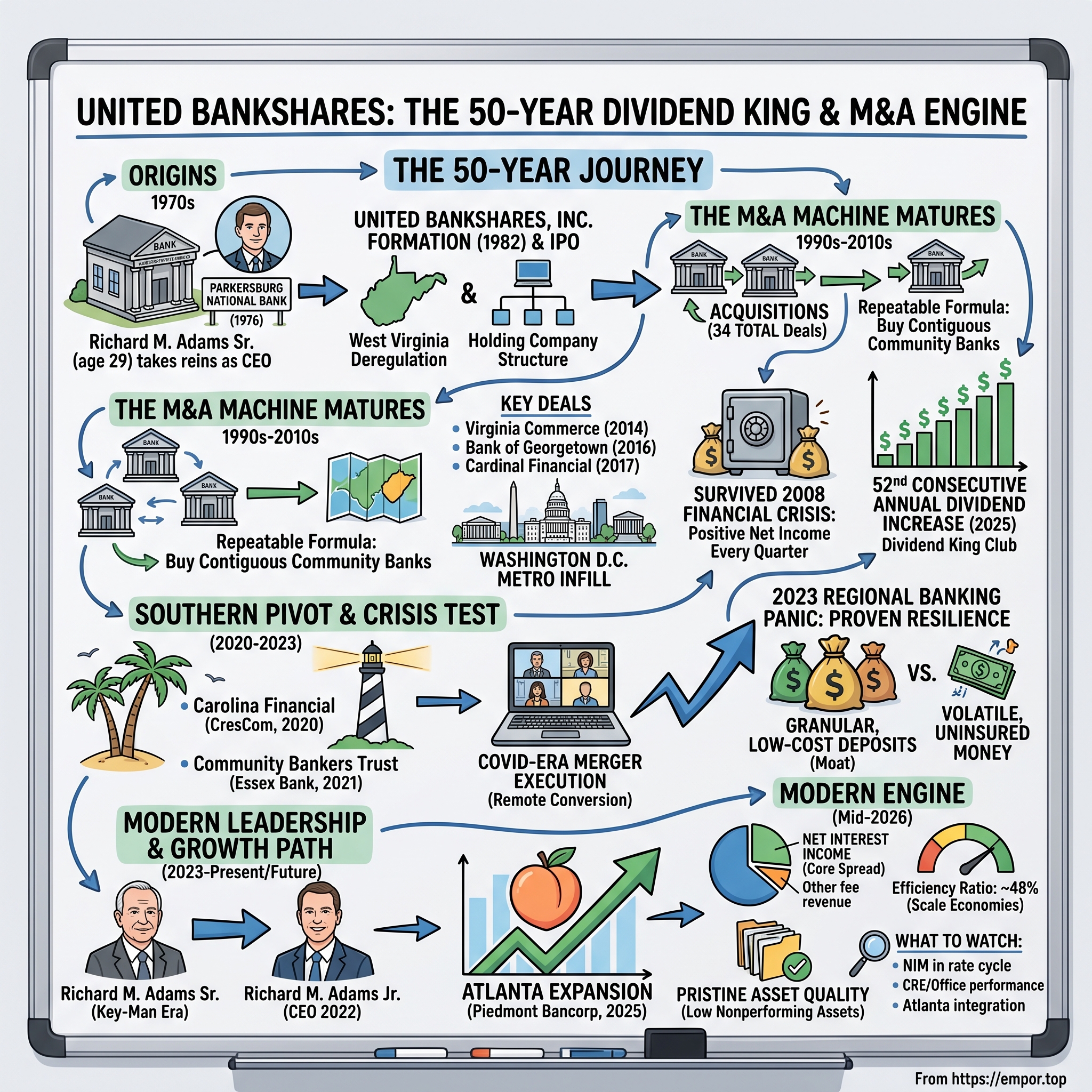
Picture a single-office bank in Parkersburg, West Virginia — a town wedged into the Ohio River valley where the Appalachian foothills flatten out, better known for oil, gas, and DuPont chemical plants than for high finance. In the mid-1970s that bank, Parkersburg National, held roughly $100 million in assets and operated from one location. A 29-year-old named Richard M. Adams was handed the keys as president and chief executive.1 Half a century later, the enterprise he built — United Bankshares, Inc., ticker UBSI on the Nasdaq — carried about $33.7 billion in total assets, roughly 250 banking and mortgage offices, and around 3,000 employees stretched from the coalfields of West Virginia down through the government-contractor corridors of Northern Virginia and into the fast-growing suburbs north of Atlanta.[^2]2
That is a 300-fold expansion of the balance sheet, and it did not happen through some viral fintech app or a single transformational bet. It happened through 34 acquisitions, executed one methodical deal at a time, over four decades.9 United bought community banks the way a patient collector assembles a set — contiguous, well-run, deposit-rich institutions, folded into a common back office and credit culture, again and again and again.
Pause on that number for a moment, because 34 completed bank acquisitions is genuinely extraordinary. Bank mergers are among the most failure-prone transactions in all of corporate finance: cultures clash, star lenders defect to competitors the week the deal closes, promised cost savings evaporate in botched systems conversions, and acquirers routinely overpay at the top of the cycle only to eat the losses at the bottom. The corporate landscape is littered with banks that made one bad acquisition and never recovered. United did it 34 times and is, by every visible measure, stronger for each one. That track record is either the product of a genuinely replicable institutional capability — a machine — or it is the luck of a favorable era dressed up as skill. Deciding which is the central analytical task of this episode, and the honest answer, as we will see, is mostly the former, with an asterisk.
There is a second, quieter distinction that matters just as much to the kind of investor who reads footnotes. In November 2025, United's board declared its 52nd consecutive annual dividend increase, raising the payout to $1.49 per share for the year.3 That streak — begun in the early 1970s, before the fall of Saigon — makes United one of only two major U.S. banking companies to have raised its dividend for at least half a century, and a member of the rarefied "Dividend King" club, companies with 50-plus years of uninterrupted increases.3 The streak survived stagflation, the savings-and-loan collapse, the 2008 financial crisis, the 2020 pandemic, and the 2023 regional-bank panic. In an industry that periodically incinerates shareholder capital, that is close to a miracle of consistency.
This is the story of how that happened, and — because Empor tells the stories of top companies without carrying water for their investor-relations departments — of what could yet break the machine. The narrative has three protagonists and one central puzzle.
The first protagonist is Richard M. Adams Sr., who ran the company for 46 years and engineered one of the most disciplined regional-bank roll-up playbooks in American financial history. The second is his son, Richard M. Adams Jr., who inherited the CEO chair in 2022 — a rare, clean father-to-son succession in a public company — and immediately had to steer through post-pandemic inflation, the March 2023 banking crisis, and an aggressive push into the Southeast.[^14] The third protagonist is not a person at all: it is the deposit base, the granular, low-cost, sticky funding that is the real engine of any bank, and the thing United has spent fifty years accumulating.
The central puzzle is this. Can a conservative, credit-first community bank keep its cheap-deposit advantage and its near-spotless loan book intact while competing against giant super-regionals — Truist, PNC, M&T — and hungry local acquirers across Washington D.C., Richmond, Charleston, and now Atlanta? United's answer, repeated across decades, has been discipline: buy at reasonable prices, strip out redundant costs, keep credit clean, and let compounding do the rest. The bull case says that flywheel still turns. The bear case says the easy Appalachian deposits are behind it, commercial real estate could bite, and integrating banks in Atlanta against Synovus and Truist is a very different game than absorbing a thrift in Wheeling. We will test both.
A word on the analytical posture of this episode before we begin. United's own materials tell a triumphant story — 52 years of dividends, 34 flawless acquisitions, credit that never blinked — and much of that story is verifiably true, which is exactly what makes it dangerous to a lazy analyst. A record that good invites the assumption that it must continue. Our job is the opposite: to separate the parts of United's advantage that are structural and durable from the parts that are cyclical, self-reported, or simply the good luck of having operated in a forgiving environment. A bank that has never had a bad year has also never proven what it does in a genuinely bad one for its book specifically — and banking is an industry where the losses of a decade can arrive in a single quarter. Keep that tension in mind. It is the difference between admiring a company and underwriting it.
Here is the roadmap. We begin on the banks of the Ohio River, in a regulatory world that no longer exists, to understand why a bank like this had to grow by buying other banks in the first place. Then we follow the acquisition machine as it matures through the 1990s and survives 2008; watch it march into the wealth of Washington; make its audacious pandemic-era leap into the Carolinas; hand the wheel from father to son; and finally, we open the hood on the modern $33 billion engine, war-game it against the competition, and lay out the two or three numbers that will tell you, quarter by quarter, whether the fifty-year formula is still working. Let us start where it started.
 Subscribe on LinkedIn
II. Origins in Parkersburg: From $100M Single-Branch to Regional Contender (1900–1980s)
The oldest thread in United's DNA runs back to March 17, 1839, when an institution called the Northwestern Bank of Virginia opened its doors in Parkersburg — decades before West Virginia even existed as a state, carved from Virginia during the Civil War in 1863.1 For most of the next century and a half, banks like this one operated inside a regulatory cage that is almost unimaginable today. West Virginia, like many states, enforced strict "unit banking" and branch-prohibition laws: a bank was largely confined to a single office, forbidden from spreading branches across the countryside the way a retailer opens stores.1 The rules were designed to protect small-town bankers from big-city predators, and their side effect was to freeze the industry into thousands of tiny, undiversified institutions, each rising and falling with its own local economy.
That cage is the essential backdrop to everything that follows. When you cannot grow by opening branches, the only way to get bigger is to buy another bank outright and run it as a subsidiary. Deregulation, when it finally came, would turn that constraint into the foundation of an entire corporate strategy.
The catalyst arrived in the person of Richard M. Adams Sr. In the mid-1970s, at just 29 years old, he was named president and CEO of The Parkersburg National Bank — a single-office community bank with about $100 million in assets.1 For scale, $100 million was a rounding error even then; the giants of the era, the money-center banks of New York and Chicago, were a thousand times larger. Adams was, in effect, a young man running a very small shop in a very small town. What distinguished him was not ambition for its own sake but a clear reading of where the regulatory winds were about to blow.
It is worth dwelling on how unusual it was to hand a $100 million bank to a 29-year-old in 1976. Banking was, and largely remains, a gerontocracy — an industry that prizes gray hair as a proxy for the credit judgment that only comes from having lived through a downturn. Adams got the job young and then kept it for 46 years, which meant that for nearly half a century a single mind held continuous authority over the institution's risk appetite. That is a double-edged inheritance. Continuity of judgment is precisely what let United avoid the fads that periodically destroy banks — the each-generation-forgets rhythm of lending booms and busts. But it also concentrated the entire enterprise's credit philosophy in one person for so long that the market could reasonably wonder whether the discipline was institutional or merely personal. Resolving that question would have to wait until 2022, but the seeds of the doubt were planted the day a twentysomething took the corner office.
In the early 1980s, West Virginia relaxed the legislation that had bottled up bank expansion, permitting multi-bank holding companies to own institutions across the state.1 Adams pounced on the structural opening. Parkersburg National was reorganized into a holding-company format, combined with sister institutions including Union Central National Bank and United National Bank, and in 1982 the parent entity was formally christened United Bankshares, Inc. and taken public on the Nasdaq.12 (The company's own filings date its corporate "formation" to 1982, the moment the acquisition machine had a legal chassis to sit on.)2 The name was a tell: this was to be a company built by uniting many banks under one roof.
From the very beginning, Adams codified an operating philosophy that would prove remarkably durable — and that, more than any single deal, explains the company's longevity. The idea was a deliberate split between the front office and the back office. Local market presidents kept genuine autonomy over customer relationships and lending decisions, so that the bank in each town still felt like a hometown bank run by people who knew the borrowers by name. But underwriting standards, credit committee approvals, information technology, and administrative plumbing were centralized at headquarters. Decentralized sales, centralized risk. It is a design that lets a bank scale its personality while standardizing its discipline — and it is the reason United could eventually digest more than thirty acquisitions without losing its credit culture.
Two other habits took root in these early years. The first was the dividend. United's board began raising its annual payout in the early 1970s and simply never stopped, treating the increase as a sacred commitment rather than a discretionary reward — a signal to shareholders, and to management itself, that the enterprise would be run for durable cash generation over flash.3 Consider the environment that streak had to survive in its infancy: the double-digit inflation and 20% interest rates of the late 1970s and early 1980s, an era that broke the entire savings-and-loan industry and would eventually cost U.S. taxpayers hundreds of billions of dollars to clean up. A small West Virginia bank that kept raising its dividend straight through that carnage was, whether it knew it or not, making a promise it would spend the next four decades keeping.
The second habit was a conservative credit rulebook: a bias toward local, well-collateralized commercial real estate and commercial-and-industrial lending to businesses management could actually see and understand, and a corresponding allergy to national speculative credits chasing yield. The logic here is worth making explicit, because it is the intellectual core of the whole company. A community bank's edge is information — it knows the borrower, the collateral, the local economy, in a way a distant national lender never can. The moment a bank ventures outside that circle of knowledge — buying syndicated loans to companies it has never met, or securitized products it does not fully understand — it surrenders its only real advantage and becomes a price-taker in a game the big players run better. Adams's rule was, in effect, stay inside the circle of competence, decades before that phrase became fashionable. In flush times that discipline looked unglamorous, even timid, as flashier rivals booked bigger loans and bigger fees. In crises, as we will see, it looked like genius.
With the holding-company structure in place and a philosophy set in cement, Adams had built the chassis. What he needed next was an open road — and Washington was about to pave one.
III. The M&A Machine & Mid-Atlantic Footprint Expansion (1990s–2010s)
For a bank that grows by acquisition, the single most important law of the twentieth century was signed in 1994. The Riegle-Neal Interstate Banking and Branching Efficiency Act swept away the last major barriers to banks operating across state lines, unleashing a wave of consolidation that would shrink the number of U.S. banks from more than 12,000 to a fraction of that over the following decades. For a bank the size of United, Riegle-Neal posed a stark, binary question: eat, or be eaten. Stay small and become a tidy acquisition target for a super-regional, or become the consolidator of choice across the Mid-Atlantic.
Adams chose to be the eater — but a fastidious one. Over the 1990s and 2000s, United refined what its own culture came to treat as a repeatable formula, an in-house deal architecture that outsiders might call "the United way." The template targeted high-performing community banks, generally in the range of roughly $500 million to $5 billion in assets, located in markets contiguous to United's existing footprint, with a heavy weighting of cheap, non-interest-bearing deposits — the checking accounts and operating balances that fund a bank almost for free.2 The prize in a bank acquisition, contrary to intuition, is rarely the loans; loans are commodities that anyone can originate. The prize is the deposits, the stable low-cost funding, and the customer relationships that produce them.
The discipline showed up in the numbers management was willing to underwrite. United's deals were benchmarked against demanding standards: cost savings on the order of 30% or more of the target's expense base, achieved by eliminating redundant executives, back-office staff, and duplicate technology; tangible book value "earnback" periods held to a few years, meaning the dilution to United's per-share net worth from paying up for a target had to be recovered reasonably quickly through the acquired earnings; and consideration structured largely in stock, often with a cash component, to protect regulatory capital ratios. The phrase to internalize is earnback discipline: when an acquirer pays more than a target's tangible book value, it dilutes its own book value per share on day one, and the merger only creates value if the added earnings repair that dilution fast enough. United's reputation was for refusing deals where that math did not work — walking away rather than overpaying to feed the machine.
It is worth pausing on why the cost-synergy math is so reliably favorable in bank M&A, because it explains the entire economic logic of consolidation. A community bank's expenses are dominated by fixed overhead that every bank must carry regardless of size: a core processing system, a compliance department, a risk function, a treasury operation, a board, a C-suite, cybersecurity. When United buys a $2 billion bank, it does not need a second core system or a second chief risk officer; it needs the deposits and the lenders. So a large slice of the target's cost base — often a third or more — is pure redundancy that can be eliminated, and every dollar of eliminated cost drops almost straight to the combined company's bottom line. This is the engine of scale economics in banking: the acquirer's existing platform absorbs the target's business at near-zero marginal cost. The catch, and it is a real one, is that this only works if the acquirer actually executes the integration cleanly. A botched systems conversion or a wave of departing lenders can vaporize the promised savings and turn a cheap deal into an expensive mistake. United's edge was never that it discovered this math — everyone in banking knows it — but that it executed on it, repeatedly, without blowing up the customer experience. Reputation as an acquirer compounds: well-run community banks that decide to sell prefer a buyer known for treating employees and customers decently, which gave United access to deals and sometimes to gentler prices.
The ultimate stress test of that conservatism came in 2007–2009. The global financial crisis was, at its core, a credit-quality event — a reckoning for banks that had loaded up on subprime residential mortgages, exotic structured credit, and speculative construction loans during the bubble. Storied regional franchises did not survive it: Wachovia was swallowed by Wells Fargo in a fire sale, National City by PNC, and Washington Mutual became the largest bank failure in American history. United did something almost boring by comparison. It kept lending to the local businesses it understood, avoided the toxic mortgage and structured-credit products that were minting fees elsewhere, and posted positive net income in every quarter of the crisis — a claim very few banks of any size could make.
Why did the credit book hold? Because the discipline described above was not marketing copy; it was a genuine constraint on behavior during the years when abandoning it would have been most tempting. Consider the psychology of the bubble years: from roughly 2004 to 2007, the banks making the biggest subprime and construction-lending bets were also posting the biggest earnings, and their executives were being celebrated for it. A conservative CEO who sat those years out watched rivals grow faster and looked, quarter after quarter, like he was leaving money on the table. It takes genuine conviction — and the insulation of a controlling founder who does not fear being fired for underperforming a bubble — to keep saying no. United refused the predatory growth of the bubble, which meant it entered the downturn with excess capital rather than a hole to fill.
This is the clearest evidence in the whole story that United's conservatism is structural rather than rhetorical: the company was tested precisely when discipline was most costly, and it held. It repaid early federal capital-assistance programs cleanly and emerged from the wreckage with the strategic luxury that almost no one else had: dry powder. There is a general principle here that every serial acquirer eventually learns or dies by — the best time to have capital is when no one else does. Distressed and forced sales during a downturn offer the acquirer with a clean balance sheet the chance to buy franchises at prices that never appear in good times. When your competitors are dead, dying, or diluting their shareholders to survive, the survivor with capital gets to choose the terms of the next decade. United was about to spend that advantage in the single richest metropolitan market in the United States.
IV. Capitalizing on Washington D.C.: The Affluent MSA Fortress (2014–2017)
Every consolidation strategy eventually collides with geography. By the early 2010s, United confronted an uncomfortable truth about its home turf: West Virginia and eastern Ohio are not growth markets. The population is flat to shrinking, the median incomes are modest, and Appalachia's economy leans on legacy industries in secular decline. A bank can be the best-run institution in West Virginia and still find that the pond itself is not getting any bigger. The deposits were sticky and cheap — a genuine asset — but the runway for deploying them profitably was short.
So United did something strategically shrewd: it pointed its cheap Appalachian funding toward the most affluent, most recession-resilient metropolitan area in the country. The Washington, D.C. region — Northern Virginia, suburban Maryland, and the District itself — is anchored by the one client that never goes out of business: the federal government, along with the vast ecosystem of contractors, law firms, trade associations, and nonprofits that orbit it. Federal paychecks and contracts flow through recessions. For a deposit-first bank, that stability is worth a premium.
The strategic term of art for this maneuver is capital reallocation — the deliberate act of taking cash flow generated in one market and deploying it in a better one. It is one of the most underappreciated jobs of a bank's management, and one of the hardest to do well, because it requires the humility to admit that your home market is not where your growth lies. Many community banks never make this leap; they keep reinvesting in a stagnant home geography out of inertia and sentiment until they slowly wither. United's willingness to point West Virginia's cheap deposits at Virginia's rich growth was, in retrospect, one of the most important capital-allocation decisions in its history.
United built its D.C. fortress through three targeted "infill" acquisitions in quick succession. The word infill matters: rather than a single giant leap, United layered adjacent, overlapping franchises on top of one another to build genuine density in a market, because deposit-share density is what creates local pricing power and brand recognition. The first, in 2014, was Virginia Commerce Bancorp, a roughly $1.9 billion-asset franchise that gave United an instant, substantial presence in Northern Virginia's dense economy of government contracting, commercial real estate, and professional services. The second, in 2016, was Bank of Georgetown, a high-margin, privately held boutique commercial bank of roughly $1.2 billion in assets whose clientele skewed toward affluent D.C. professionals and their businesses — precisely the kind of low-cost, relationship-driven deposits United coveted.
The capstone came in April 2017, when United completed its acquisition of Cardinal Financial Corporation, the parent of Tysons Corner-based Cardinal Bank, in an all-stock transaction valued at roughly $912 million.6 Cardinal carried around $4.2 billion in assets and vaulted United into a top-tier deposit-share position in Northern Virginia, standing alongside national giants like Wells Fargo and Bank of America in one of the wealthiest submarkets in America.6 It was, by the standards of United's usual bite-sized deals, a large and transformational bet — and a statement that the sleepy West Virginia acquirer now intended to be a serious force in the capital region.
What did United actually buy with these three deals, beyond branches and balance-sheet heft? It bought a particular kind of deposit relationship. The most valuable commercial banking relationships are the operating accounts — the escrow balances of a title company, the treasury account of a law firm, the payroll and operating funds of a government contractor or a trade association. These deposits are large, they are sticky because they are entangled with a company's day-to-day operations, and crucially they often pay little or no interest. Think about why a law firm's operating account almost never moves: the firm's billing, payroll, escrow, and treasury-management workflows are all wired into that bank, the switching cost in time and operational risk is high, and the interest forgone on a checking balance is trivial next to the hassle of re-plumbing the firm's finances. That entanglement is workflow lock-in, and it is the closest thing a commodity business like banking has to a genuine switching cost. It is worth far more to a bank than a rate-shopping consumer's certificate of deposit, which will flee for an extra quarter-point the day it matures.
United positioned itself as "Washington's community bank," courting the middle-market business customers who felt like afterthoughts at the money-center institutions but were too substantial for a tiny local bank to serve well. This is a genuine strategic wedge: the largest banks are organized to serve either mass-market retail or Fortune 500 treasuries, and the business in between — the $20-million-revenue government contractor, the regional developer, the mid-sized trade association — often gets a call center instead of a banker. United's pitch was a real relationship with a decision-maker who could actually approve a loan, backed by a balance sheet large enough to be credible. The D.C. deposits that pitch produced would prove their worth spectacularly a few years later, when the entire regional banking system briefly caught fire. But before that test came, United would make its boldest geographic leap yet — and it would do so with the world locking down around it.
V. The Southern Pivot & COVID-Era Courage: Acquiring Carolina Financial & Essex Bank (2020–2021)
In November 2019, United announced an agreement to acquire Carolina Financial Corporation, the Charleston, South Carolina-based parent of CresCom Bank, in an all-stock deal then valued at roughly $1.1 billion.7 It was a logical extension of the playbook: push out of the mature Mid-Atlantic into the high-growth coastal Southeast — Charleston, Greenville, Myrtle Beach, Wilmington, and the Raleigh-Durham corridor — markets swelling with retirees, remote workers, and domestic migrants fleeing higher-cost, higher-tax states in the North. Carolina Financial brought roughly $4.4 billion in assets and a foothold in some of the most demographically attractive geography in the country.7
Then the world stopped. Between the announcement and the intended close, COVID-19 arrived, financial markets convulsed in March 2020, and the entire banking industry braced for a wave of pandemic loan losses that, at the time, no one could size. Plenty of acquirers in that spring quietly renegotiated or walked away from pending deals. United did not. It completed the Carolina Financial merger in early May 2020, in the teeth of nationwide lockdowns and maximum uncertainty.7 The exchange ratio was fixed at 1.13 United shares for each Carolina Financial share, and the combination pushed United's total assets to roughly $25 billion.7
Was this courage or recklessness? It is a fair question, and the honest answer is that at the moment of decision, no one — not United, not anyone — knew how bad pandemic credit losses would be. What made the bet defensible rather than reckless was that United was buying deposits and franchise in a structurally attractive region, not a pile of dubious loans, and its capital cushion could absorb a bad scenario. The bet paid off because the feared pandemic loan apocalypse never fully materialized, cushioned by massive federal stimulus; an investor should be careful not to over-credit management for an outcome that partly depended on Washington's checkbook. What management can be credited for is not flinching, and then executing.
Because the courage was one thing; the execution was the more revealing story. Bank mergers live or die on the systems conversion — the moment when the acquired bank's core processing platform, the software backbone that runs every account, loan, and transaction, is migrated onto the acquirer's system. Picture it as performing a heart transplant while the patient keeps working: every customer's balance, every automatic payment, every loan schedule has to move to a new system over a single weekend without anyone losing access to their money on Monday morning. Botch it and customers lose access to their funds, relationships walk out the door, and the promised cost savings evaporate. United pulled off the Carolina integration with its conversion teams working largely remotely, under lockdown conditions that would have been unthinkable to plan for a year earlier. Doing that cleanly, in that environment, was a real-world demonstration that United's integration machinery was robust rather than merely well-marketed — a distinction that matters enormously when the whole investment thesis rests on the repeatability of acquisitions. If the integration playbook is the company's crown jewel, COVID was its stress test, and the playbook passed.
United was not done with the region. In December 2021, it closed its acquisition of Richmond-based Community Bankers Trust Corporation, the parent of Essex Bank, in a stock transaction valued at roughly $303 million, at a fixed exchange ratio of 0.3173 United shares per Community Bankers Trust share.8 Community Bankers Trust carried about $1.7 billion in assets, and its strategic logic was less about entering new territory than about stitching together existing territory: it filled the geographic gaps along the I-95 spine running from Washington through Richmond toward Hampton Roads, connecting United's D.C. fortress to its new Carolina beachhead into something resembling a continuous corridor.8
Across both deals, the familiar cost-synergy arithmetic held. United's edge in these transactions came from the same source every time: it already had a scaled core banking platform, so consolidating an acquired bank's redundant technology contracts and duplicate administrative overhead routinely eliminated a large share of the target's expense base. On the question of whether United overpaid — always the right question to ask a serial acquirer — the deals were struck at price-to-tangible-book multiples in the broad vicinity of 1.4 to 1.7 times, which looked disciplined against the frothier regional-bank M&A multiples of the mid-2010s peak, though "disciplined relative to peers" is not the same as "cheap." The honest read is that United paid full but defensible prices for genuinely franchise-quality deposits, and its record of hitting its own synergy targets is what has historically justified the checks. That record was about to be handed to a new person — because at the top of the house, a fifty-year era was ending.
VI. The 46-Year Handoff: Adams Sr. to Adams Jr. & Modern Leadership (2022–Today)
There is a particular kind of risk that hangs over any company built around a single towering founder, and bank analysts have a blunt name for it: key-man risk. For 46 years, United Bankshares was Richard M. Adams Sr. He had taken the company from $100 million to more than $29 billion in assets, personally shaped its acquisition doctrine, and embodied its conservative credit culture.[^14] The obvious question, whispered for years by investors, was what happens when he steps down — and whether the machine could run without its designer.
The answer came in April 2022, when Adams Sr. transitioned from CEO to executive chairman, and his son, Richard M. Adams Jr., stepped into the chief executive role.[^14] Father-to-son successions in public companies are fraught — the graveyard of family businesses is littered with heirs who inherited a title they had not earned — and skeptical investors were right to scrutinize this one. But Adams Jr. was not a dilettante airlifted into the corner office. He had joined United in 1994, after practicing law at the West Virginia firm Bowles Rice, and had spent nearly three decades climbing through the organization — serving as president of United Bank and president of the holding company, and sitting on the board — before taking the top job.[^14] By the time he became CEO, he had been steeped in the company's credit and M&A disciplines for a working lifetime. This was a groomed successor, not a coronation of convenience.
The transition also spoke to something United's proxy materials have long emphasized: alignment. Insiders and directors have historically held a meaningful slice of the company's stock, the kind of ownership stake that means management eats its own cooking and feels shareholder pain personally.12 United's incentive architecture has tied executive pay to the metrics that actually matter for a conservatively run bank — returns on average assets and equity, the efficiency ratio, nonperforming-asset levels, and dividend coverage — rather than to the revenue-at-any-cost growth targets that have blown up other banks.2 An independent observer should note that alignment and good incentives reduce the odds of reckless behavior but do not guarantee good judgment; they are necessary, not sufficient. Still, relative to the industry, United's governance has been a stabilizer rather than a red flag.
Adams Jr.'s tenure was baptized by fire almost immediately. In March 2023, the collapse of Silicon Valley Bank — followed within days by Signature Bank and, in early May, First Republic — triggered the sharpest crisis of confidence in regional banking since 2008. The mechanism of the panic was specific and instructive. The failed banks shared two fatal traits: a deposit base dangerously concentrated in a small number of very large, uninsured accounts (SVB's clientele of venture-backed tech startups, First Republic's wealthy coastal households), and a securities portfolio stuffed with long-duration bonds bought at rock-bottom yields that had cratered in value as the Federal Reserve jacked up interest rates. When jittery depositors — coordinating in real time over group chats and mobile apps — yanked their uninsured money, the banks had to sell those underwater bonds at a loss to raise cash, crystallizing the very insolvency the depositors feared. A modern, digital-speed bank run.
United was close to the photographic negative of that profile, and the contrast is the entire point. Its deposit base was granular — built from hundreds of thousands of ordinary retail and small-business accounts across West Virginia, Virginia, and the Carolinas, with average balances comfortably within FDIC insurance limits and essentially no concentration in flighty venture or crypto money. Granular deposits are the opposite of a concentrated one: no single depositor can trigger a run, and insured depositors — protected up to $250,000 by the federal guarantee — have no rational reason to flee even in a panic. This is the moat that fifty years of small-town branch banking quietly built. It cannot be replicated quickly; you cannot buy a granular deposit base off the shelf or conjure it with a marketing budget. It accretes one checking account at a time, over decades, in places where a fintech would never bother to compete.
Its securities portfolio, managed under a conservative asset-liability discipline, carried far more manageable duration risk than the peers that had loaded up on long bonds at the top of the market. The mechanism that felled SVB is worth spelling out because it is genuinely counterintuitive: a bank that buys long-dated Treasury bonds — supposedly the safest asset on earth — can still be destroyed by them, because when interest rates rise, the market value of those old low-yielding bonds falls, and a bank forced to sell them early to meet deposit withdrawals crystallizes that paper loss into a real one. Safety of credit is not the same as safety of duration. United had simply not reached for yield by loading up on long paper, so it was never forced into that doom loop.
The independent verdict here should be measured but genuinely positive. United did not survive 2023 through luck or a clever last-minute maneuver; it survived because its balance sheet had been built, deliberately and unglamorously, to be boring in exactly the ways SVB's was exciting. While regional bank stocks cratered indiscriminately across the sector that spring — the market briefly unable to tell the safe banks from the doomed — United's deposits held firm. The 2023 crisis was, in effect, a surprise final exam on fifty years of deposit-gathering philosophy, and the boring, small-town funding that had once looked like a growth constraint revealed itself as the franchise's deepest moat. It also handed Adams Jr. something no succession plan can manufacture: instant credibility, earned in a crisis, in his first year on the job. Which raises the natural next question: what does that franchise actually look like under the hood today?
VII. The Modern Engine: Segment Economics, Credit Discipline, & Atlanta Expansion (2023–2026)
Strip away the fifty years of history and look at United Bankshares as it operates in mid-2026, and you find a roughly $33.7 billion regional bank whose economics are, at heart, gloriously simple.4 The overwhelming majority of its revenue comes from net interest income — the spread a bank earns between what it charges on its roughly $24.6 billion loan book and what it pays for its roughly $27.1 billion in deposits.4 In the first quarter of 2026, United generated about $282.5 million of net interest income and posted a net interest margin of 3.80% — the percentage spread it earns on its interest-earning assets, up 11 basis points from a year earlier as deposit costs eased.45 Net income for the quarter was $124.2 million, or $0.89 per share, on total revenue of about $316.6 million.4
The remainder of the revenue — a minority slice — comes from fee income, and it is worth understanding because it is the part of the bank least dependent on interest rates. United runs a wealth management and trust operation that earns recurring, high-margin fees on billions of dollars of assets under management and administration; a mortgage banking arm that originates residential loans and sells them into the secondary market, a cyclical business that booms when rates fall and refinancing surges and goes quiet when rates rise; and a treasury-management and payments franchise that collects service charges and card interchange from its commercial customers. Each of these deserves a word on quality, because not all fee income is created equal. Wealth and trust fees are the gold standard — recurring, sticky, and lightly capital-consuming, they are the kind of annuity-like revenue that investors pay up for. Mortgage banking is the opposite: genuinely cyclical, feast-or-famine, and correlated to the very rate moves that also swing the core spread business, so it diversifies less than its label suggests. Treasury management sits in between, valuable mainly because it deepens the commercial deposit relationships that are the real prize. None of these is individually enormous, but together they nudge the bank away from pure reliance on the rate cycle — and on the Q1 2026 results, stronger brokerage fee income helped offset softer loan yields and lower purchase-accounting accretion.5
That last phrase — purchase-accounting accretion — deserves a brief, skeptical unpacking, because it is where a serial acquirer's reported earnings can flatter reality. When United buys a bank, it marks the acquired loans to fair value, often at a discount; as those loans are repaid, the discount is "accreted" back into interest income, boosting reported margins and earnings in the quarters after a deal. This is legitimate accounting, but it is a wasting asset: accretion income fades as the acquired book runs off, so a bank that keeps its margins up partly through accretion needs a steady stream of new deals to replace it. An analyst reading United's NIM should mentally separate the core spread from the accretion sugar-high, and United's disclosure that recent results absorbed lower accretion — while the margin still rose year-over-year — is actually a point in the core franchise's favor.5
Then, in January 2025, came deal number 34. United completed its acquisition of Piedmont Bancorp, Inc. — the Atlanta-based parent of The Piedmont Bank — in an all-stock transaction valued at roughly $267 million, at a fixed exchange ratio of 0.300 United shares per Piedmont share.913 Piedmont carried around $2 billion in assets and, critically, its branches sat in exactly the counties an acquirer would want: the affluent, fast-growing northern Atlanta suburbs of Gwinnett, Fulton, and Cobb.913 The deal, which cleared its final Federal Reserve approval in late November 2024, planted United's flag in the Atlanta metropolitan area — one of the highest-growth big-city markets in the United States — and lifted the combined company past $32 billion in assets with a network of more than 240 locations across nine states and Washington, D.C.911 To lead the Georgia push, United retained Piedmont's chairman and CEO, Monty Watson, as its regional president for the state — a textbook application of the decades-old "keep the local team" doctrine.10
But Atlanta is where the bull and bear cases collide most directly, and it is worth being clear-eyed about what United is walking into. Every one of United's prior conquests followed a similar logic: enter a market where its scale, capital, and integration machine gave it an edge over smaller local incumbents. Atlanta breaks that pattern. It is not an under-banked Appalachian town or a fragmented mid-Atlantic suburb; it is one of the most fiercely contested banking markets in the Southeast, home to entrenched regional heavyweights like Synovus, Cadence, Ameris, and Truist — the last of which is itself an Atlanta-adjacent super-regional born from the BB&T–SunTrust merger. United arrives as a newcomer with roughly $2 billion of deposits and a name most Georgians have never heard, competing against banks with decades of local relationships and, in some cases, far larger technology budgets. The "keep the local team" doctrine and Monty Watson's relationships are United's answer to that cold-start problem, and it is a sensible one — but it is a bet on execution in a market where United's historical home-court funding advantage simply does not exist yet. This is the clearest test of whether the playbook is a genuinely portable capability or a product of the forgiving markets in which it was refined.
The operating metrics that United posts today are the real evidence for whether the fifty-year formula still works, and they are genuinely strong. The efficiency ratio — the share of each revenue dollar consumed by operating expense, where lower is better — ran at roughly 48% in early 2026, comfortably better than the 60%-plus that is typical for the regional peer group; a bank that spends 48 cents to earn a dollar simply keeps more of every dollar it makes.5 That gap versus peers is not an accident of one good quarter — it is the accumulated result of decades of stripping redundant cost out of every acquisition, and it is arguably the single cleanest piece of quantitative evidence that the scale-and-integration machine actually works. A persistently low efficiency ratio is hard to fake and harder to sustain; it shows up only when a bank genuinely converts scale into lower unit costs rather than merely getting bigger.
Asset quality remained pristine by any standard, with nonperforming assets a small fraction of the balance sheet — a direct legacy of the credit conservatism baked in during the Adams Sr. era.5 Here a note of analytical caution is warranted: credit quality is a lagging indicator, and it always looks best right before it looks worst. A bank's loan book can appear immaculate for years and then deteriorate rapidly when the economic cycle turns, because problem loans take time to surface. United's clean book today is genuinely reassuring evidence of underwriting discipline, but it is not a guarantee about tomorrow, and the prudent reading treats it as a strong prior rather than a settled fact.
The one metric to watch with the most skeptical eye is the net interest margin as the Federal Reserve's rate cycle turns. The dynamic is a tug-of-war: when the Fed cuts rates, a bank's loan yields tend to reprice downward fairly quickly, while its ability to cut what it pays depositors depends on competitive pressure and customer stickiness. A bank with a genuinely cheap, sticky deposit base — United's whole thesis — should be able to push deposit costs down faster than loan yields fall, protecting or even widening the margin. A bank whose deposits are less loyal than management believes will watch the margin compress from both ends. In other words, the NIM in a cutting cycle is the live, quarter-by-quarter market test of whether the deposit moat is as real as the 2023 crisis suggested. That the margin actually rose 11 basis points year-over-year into early 2026 is an encouraging early data point, but one cycle is not a proof.4 Which is precisely the kind of tension a serious investor should game out — so let us turn to the playbook, and then to the case for and against.
VIII. Playbook: Business & Investing Lessons
Step back from the individual deals and a set of transferable principles emerges — the reusable logic that turned a one-branch bank into a regional franchise, and that any student of capital allocation can learn from.
Lesson one: the infill consolidation algorithm. United's core trick was never mysterious; it was disciplined repetition. Buy a well-managed community bank in a market adjacent to your own, at a price your synergy math can justify. Eliminate 30% to 40% of the redundant overhead — the duplicate executives, the parallel back offices, the overlapping technology contracts — because the acquirer already owns a scaled platform onto which the target can be bolted. Convert the core banking systems inside a year. And, crucially, keep the local lending team, so the bank on Main Street still feels local even though its risk controls now run through corporate headquarters. Do that thirty-four times, in contiguous geography, and you compound a small bank into a large one without ever betting the company on a single transformational gamble. The genius is in the boredom of it.
Lesson two: in banking, deposits are the moat, not assets. This is the single most important idea in the whole story, and it inverts the intuition of most non-bankers. Loans — the assets — are commodities; anyone with capital can make a loan, and in a hot market everyone does, usually at the worst possible time. The durable competitive advantage lives on the other side of the balance sheet, in the deposits: the cheaper and stickier a bank's funding, the more it can earn on any given loan and the better it sleeps when markets seize up. United's granular small-town deposits and its entrenched D.C. commercial operating accounts function as low-cost funding insurance — an advantage that is invisible and unglamorous in calm times and decisive in a panic, exactly as 2023 demonstrated.
Lesson three: dividend discipline as a shareholder-selection mechanism. Fifty-two years of uninterrupted dividend increases does more than reward income investors; it selects for a particular kind of shareholder.3 A multi-decade streak attracts long-term, loyal retail and institutional owners who prize consistency and tend to hold through volatility, which in turn dampens the stock's swings and lowers the company's cost of capital. It also imposes a useful internal discipline: a management team that has publicly staked its credibility on never cutting the dividend will not casually gamble the balance sheet. The streak is both a signal and a constraint.
Lesson four: decentralized sales, centralized risk. The organizational design Adams Sr. set in the 1980s is the connective tissue that makes the other three lessons possible. Local market presidents own the customer relationships and make relationship-based lending calls; corporate headquarters in Charleston, West Virginia, owns the credit committee, the underwriting limits, and the risk appetite. This is how United scaled its warmth without scaling its risk — how it could be thirty-four different hometown banks and one disciplined credit institution at the same time. The lesson generalizes far beyond banking: distribute the judgment that benefits from local knowledge, and centralize the judgment that benefits from consistency and scale.
There is a fifth, meta-lesson that sits beneath the other four, and it is the one most relevant to judging United from here: a repeatable playbook is only as valuable as the environment in which it can be run. Each of these four disciplines was forged in a specific world — falling interest rates, abundant community-bank sellers, benign credit cycles, and home markets where United's scale gave it a decisive edge over local incumbents. The playbook is genuinely excellent, but excellence and portability are not the same thing. The open question is whether a formula optimized for buying sleepy banks in adjacent, under-competitive markets transfers cleanly to winning organic share in crowded, high-growth cities where United has no incumbent advantage. Whether that elegant machine is actually durable from here, in other words, is a question the playbook alone cannot answer. For that we need to war-game the competition.
IX. Analysis: Bear vs. Bull Case, Moat, & Stress Test
To assess United's durability, it helps to run the business through two analytical lenses that investors use to separate real moats from temporary leads: Michael Porter's Five Forces and Hamilton Helmer's Seven Powers.
The competitive structure (Porter). Banking is, in aggregate, a brutal industry: the product (money) is a pure commodity, switching a checking account is easier than it has ever been, and the sector is crowded with rivals ranging from national behemoths to fintech upstarts. The force that most threatens United is rivalry — it competes for deposits and loans against super-regionals with vastly larger technology budgets (Truist, PNC, M&T) and, in its newer Southern markets, against entrenched local players like Synovus and Cadence. The force that most protects it is the power of its own buyers being low: granular retail depositors have little individual bargaining power and, being insured, little incentive to chase a few extra basis points elsewhere. New entry, meanwhile, is throttled by one of the highest regulatory barriers in the economy — you cannot simply start a bank.
Where the real power lives (Helmer). Against Helmer's Seven Powers framework, United can credibly claim three. Scale economies: the rising fixed costs of the modern banking business — cybersecurity, regulatory compliance, core technology, fraud detection — are spread across a $33 billion asset base, an overhead-per-dollar advantage that a $1-to-$5 billion community bank simply cannot match, and which is precisely why those smaller banks keep selling to acquirers like United. Process power: thirty-four integrations and five decades of underwriting have institutionalized an M&A and credit machine that is genuinely hard for a less-experienced acquirer to replicate, and it shows up in the efficiency ratio. Cornered resource, more debatably: the deeply entrenched local relationship-banking teams and government-and-commercial deposit relationships in key Mid-Atlantic submarkets are not easily poached. What United does not have is much of a network economy or branding power in the consumer-tech sense; a depositor in Atlanta has no idea United raised its dividend for 52 years, and does not care.
The activist stress test. A skeptical long/short investor would press hardest on commercial real estate. United is fundamentally a commercial lender, and CRE — especially office — is the epicenter of post-pandemic credit anxiety as hybrid work hollows out demand for downtown towers. Here the disclosure is reassuring but not exculpatory: non-owner-occupied office loans totaled roughly $0.7 billion, or about 2.9% of total loans, in early 2026 — a modest, ring-fenced exposure rather than a concentrated bet.5 Management has consistently characterized its CRE book as conservatively underwritten: low loan-to-value ratios, healthy debt-service coverage, personal guarantees on middle-market properties, and minimal exposure to the non-recourse, speculative, high-rise office deals that generate the scary headlines. An independent analyst should hold two thoughts at once: United's office exposure is genuinely small and its historical credit record genuinely excellent, and CRE losses tend to surface slowly, so the absence of problems so far is not proof of their absence to come. The prudent stance is to watch classified and criticized loan trends quarter by quarter rather than to take the all-clear on faith.
The bull case rests on four pillars, and each is backed by evidence rather than rhetoric. The M&A integration engine is proven and is now scaling into the two best regional-growth markets in the country — the Carolinas and Atlanta. The credit history is pristine across multiple cycles, which is exactly the downside protection that matters most in a recession or a CRE shakeout. The 52-year dividend record, backed by a conservative payout ratio, provides a floor of shareholder loyalty and a signal of financial durability.3 And the operating efficiency — that sub-50% efficiency ratio — means United converts its revenue into profit more effectively than most peers.5
The bear case is equally concrete. Net interest margin, the bank's core profit engine, is vulnerable if deposit competition keeps funding costs sticky while loan yields reprice lower in a Fed-cutting cycle — the margin can compress from both ends. The office and broader CRE exposure in the D.C. metro, while small, is precisely the kind of slow-developing credit risk that could force higher provisioning if remote work permanently impairs urban commercial values. And Atlanta is not Wheeling: integrating Piedmont and winning share in a crowded, fast-growing, hotly contested market against Synovus, Truist, and every other Southeast consolidator is a real execution risk, and United's home-court deposit advantage does not travel with it. There is also the subtler, structural bear point that the outline's own logic implies — United has largely exhausted the cheap, sticky deposits of its Appalachian home base, and every future dollar of growth must be won in more competitive, more expensive markets where its historical funding edge is weaker.
A skeptical investor should also press on governance and capital allocation, not just credit. The father-to-son succession, however well-executed, concentrates a great deal of continuity — and potential influence — in a single family across a half-century, and an activist might reasonably ask whether the board provides genuinely independent challenge to a management culture that has been right for so long that dissent is structurally hard to voice. Being right for fifty years is a wonderful track record and a subtle governance hazard at the same time; institutions that have never been seriously wrong rarely build strong mechanisms for being told they are. On the other hand, the heavy insider ownership that raises that concern also mitigates it, because the family's wealth rides on the same shares as everyone else's.12 There is no smoking gun here — no related-party controversy, no disclosure red flag, no history of overpromising and underdelivering that the record reveals — but "no evidence of a problem" is where diligence should stay alert, not where it should stop looking.
Weighing it all, the three key performance indicators that actually matter for tracking United from here fall out naturally. First, net interest margin and total cost of deposits — the truest real-time read on whether the deposit moat is holding as rates move. Second, nonperforming assets and net charge-offs — the early-warning system for whether the legendary credit discipline is intact, with CRE office the sub-sector to watch. Third, tangible book value per share growth — the ultimate scorecard for whether all this acquiring actually compounds shareholder wealth rather than merely inflating the balance sheet with dilutive deals. Those three numbers, tracked over time, will tell the story better than any narrative. Notice what they share: each one directly tests a specific pillar of the thesis rather than measuring generic "performance." The margin tests the deposit moat, the credit metrics test the underwriting discipline, and tangible book value per share tests whether the acquisition engine actually compounds wealth or merely dilutes it in slow motion. A bull thesis on United is, at bottom, a bet that all three hold; a bear thesis is a bet that at least one cracks. Anyone can watch these without a spreadsheet of forecasts — the point is not to predict the numbers but to notice when the company's own results start contradicting its own story. That is the moment the fifty-year narrative would have to be rewritten. And the narrative's next chapter is genuinely open.
X. Epilogue & What to Watch
The most interesting question hanging over United Bankshares in 2026 is deceptively simple: does the machine keep running, and how far? Richard M. Adams Jr. inherited a company built on the premise that there is always another well-run community bank to buy in an adjacent market. That premise is being tested by arithmetic — the universe of independent community banks shrinks with every deal the industry does — and by geography, as United's expansion frontier moves into the Southeast, where targets are pricier and competition for them is fiercer. Whether deals number 35, 36, and beyond materialize in Florida, Tennessee, or deeper into Georgia, and at prices that clear United's own earnback hurdles, is the open strategic question. The company has the capital and the reputation to keep consolidating; what it cannot control is whether attractive sellers appear at sane prices.
Before leaving the strategic picture, it is worth puncturing one comfortable narrative — the myth that United's 34-for-34 acquisition record proves the machine is infallible. Reality is more nuanced. A perfect deal record can reflect superb execution, and in United's case largely does; but a spotless record can also reflect a market environment that has been unusually forgiving to acquirers — decades of falling interest rates, benign credit, and a steady supply of willing community-bank sellers. Some of United's success is genuine skill, and some is having played a good hand well in a good era. The coming years will feature a less generous backdrop: a thinner pipeline of sellers, pricier targets in growth markets, and rivals who have learned the same consolidation math. The record is real and impressive. It is not a guarantee, and treating it as one is precisely the error a disciplined investor must avoid.
There is a second, quieter transformation to watch: technology. United is, by design and by heritage, a relationship-first, decentralized, human-scale bank — a model with real advantages in trust and stickiness, but also real cost and speed disadvantages against digitally native competitors. The strategic tension is how much of the modern toolkit — digital commercial banking portals, AI-assisted credit underwriting, automated fraud detection — a traditional community bank can absorb without diluting the local relationships that are its whole point. Management frames technology as an efficiency lever, and the renegotiated technology contracts flowing through recent results suggest that discipline is real.5 But the larger question — whether a bank of United's philosophy can keep pace with the digital expectations of the next generation of customers and the next generation of fintech rivals — is unresolved, and worth watching.
There is also a demographic tailwind worth naming, because it may matter more to United's next decade than any single acquisition. The company has spent the past ten years repositioning its capital away from shrinking Appalachian markets and toward the three fastest-migrating regions in the eastern United States: the Washington wealth corridor, the Carolina coast, and now metropolitan Atlanta. If the multi-decade migration of Americans and businesses toward the lower-cost, higher-growth Southeast continues — and the demographic data has pointed that way for years — then United has, deliberately, planted its deposit-gathering franchise in the path of that flow. That is the optimistic frame. The skeptical counter is that everyone else in banking can read the same census data, which is exactly why Atlanta and the Carolinas are so crowded; being in the right geography guarantees exposure to growth, not a disproportionate share of it. Both things are true at once, and holding them together is the essence of judging this company fairly.
Zoom all the way out and United Bankshares is, in the end, a study in the compounding power of the unglamorous: credit conservatism, patient capital, disciplined acquisition, and an almost religious commitment to a rising dividend, sustained across half a century in an industry that reliably rewards those virtues and reliably punishes their absence. It is not a growth story in the venture sense, and anyone looking for one should look elsewhere. It is a durability story — a demonstration that in banking, the boring things done consistently for fifty years can build something formidable. The open question, and the one every long-term investor should keep asking, is whether the next fifty years will reward the same virtues as the last, or whether scale, competition, and technology have quietly changed the game beneath United's feet.
XI. Outro & Key Links
United Bankshares' story is, at its core, the story of a philosophy that outlasted its author — decentralized relationships wrapped around centralized discipline, funded by the cheapest and stickiest deposits its acquirers could find, and dividended out to loyal shareholders year after uninterrupted year. Whether that philosophy proves as powerful in the affluent, contested markets of the modern Southeast as it did in the quiet towns of Appalachia is the wager embedded in every share of UBSI. The source materials below — the company's SEC filings, its merger disclosures, its dividend announcements, and its most recent earnings — are where the ongoing story can be tracked as it is written.
References
-
United Bankshares, Inc. — Form 10-K, Fiscal Year 2025 (U.S. Securities and Exchange Commission) ↩↩↩↩↩
-
52nd Consecutive Year of Dividend Increases for United Bankshares, Inc. — Business Wire, 2025-11-20 ↩↩↩↩↩
-
United Bankshares, Inc. Announces Earnings for the First Quarter of 2026 — Form 8-K, U.S. Securities and Exchange Commission, 2026-04-23 ↩↩↩↩↩
-
First Quarter 2026 Earnings Review — United Bankshares, Inc. (UBSI) Investor Presentation ↩↩↩↩↩↩↩↩
-
United Bankshares, Inc. Completes Merger with Cardinal Financial Corporation — Business Wire, 2017-04-21 ↩↩
-
United Bankshares, Inc. Completes Merger with Carolina Financial Corporation — Business Wire, 2020-05-04 ↩↩↩↩
-
United Bankshares, Inc. Completes Merger with Community Bankers Trust Corporation — Business Wire, 2021-12-03 ↩↩
-
United Bankshares, Inc. Completes Merger with Piedmont Bancorp, Inc. — Business Wire, 2025-01-10 ↩↩↩↩
-
United Bankshares, Inc. to Acquire Piedmont Bancorp, Inc. — Business Wire, 2024-05-10 ↩
-
Order Approving the Acquisition of Piedmont Bancorp, Inc. by United Bankshares, Inc. — Federal Reserve System, 2024-11-29 ↩
-
United Bankshares, Inc. — EDGAR Company Filings (CIK 0000729986), U.S. Securities and Exchange Commission ↩↩
-
United Bankshares finalises Piedmont Bancorp acquisition — Retail Banker International, 2025-01-13 ↩↩
 LinkedIn
 WhatsApp
 Reddit
 Hacker News
 Email
Email Kindle
 RSS Feed
 Spotify
 Apple Podcasts
 Amazon Music
 Audible
 YouTube