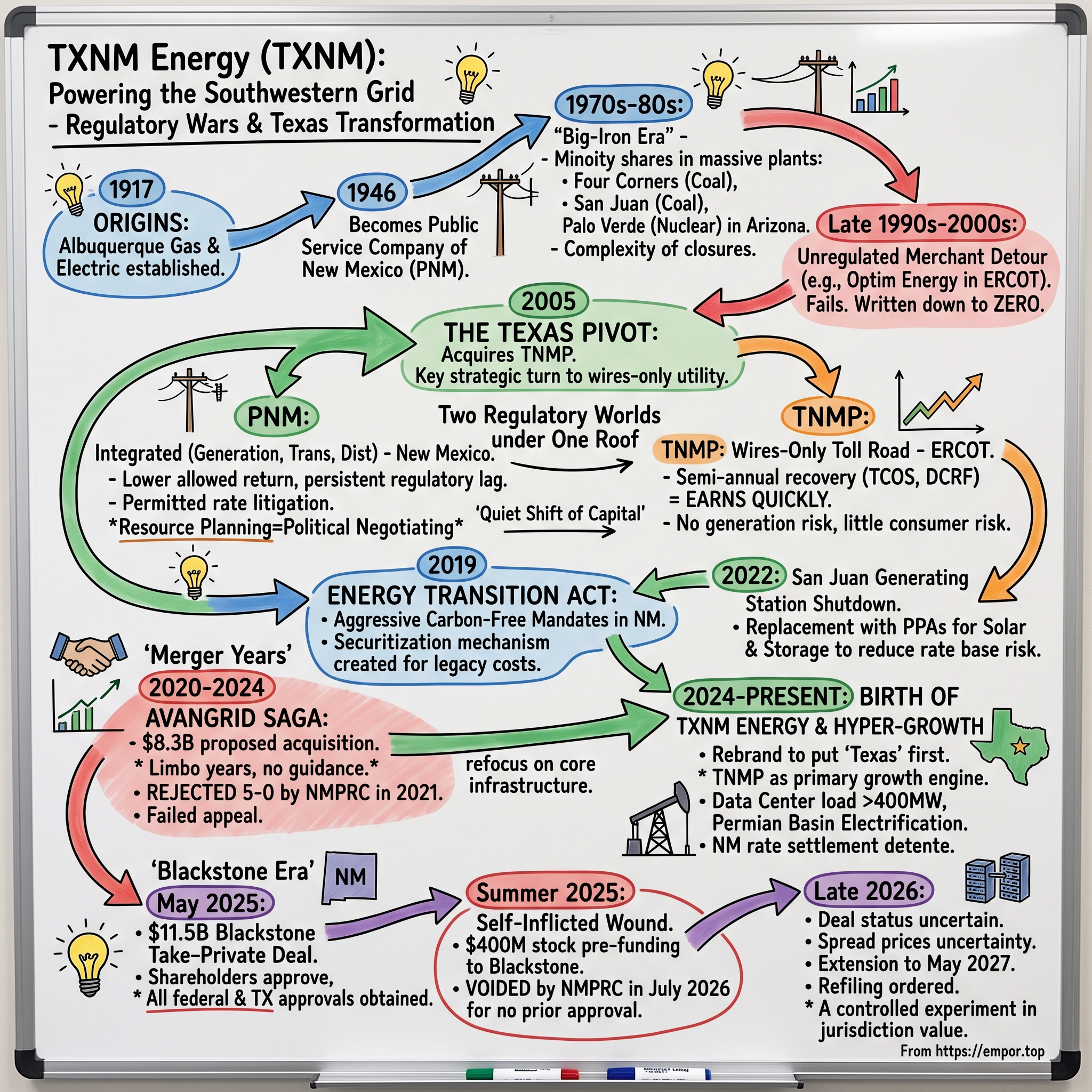
TXNM Energy: Powering the Southwestern Grid, Regulatory Wars, and the Texas Transformation
I. Introduction & Episode Roadmap
On July 2, 2026, three commissioners sat in a hearing room in Santa Fe and did something that private equity firms are not accustomed to hearing. By a 2-1 vote, the New Mexico Public Regulation Commission ordered Blackstone Infrastructure and TXNM Energy to unwind a $400 million stock purchase — 8 million shares, a 7.59% stake — that the two companies had executed in the summer of 2025 while their $11.5 billion merger was still pending before that very commission. The order came with fines: $100,000 against TXNM, $200,000 against Blackstone affiliates. Commissioner Pat O'Connell summarized the reasoning in one sentence that should be tattooed on the wall of every utility M&A war room: "You've got to follow the law or else the regulatory compact doesn't work."1
If that sounds like an unusually feisty thing for a state regulator in a state of 2.1 million people to say to the world's largest alternative asset manager, you haven't been paying attention to New Mexico. This is the second time in six years that a global capital giant has tried to buy the electric utility that lights Albuquerque, and the second time that the commission in Santa Fe has proven to be the hardest gate in the entire approval chain — harder than the Federal Energy Regulatory Commission, harder than the Public Utility Commission of Texas, harder than antitrust review.
That's the hook. But the deeper story is stranger and more instructive.
TXNM Energy, Inc. (NYSE: TXNM) is a holding company that owns two electric utilities with almost nothing in common except a shared corporate parent and a state line. One of them, the Public Service Company of New Mexico — PNM — is a 109-year-old, vertically integrated utility that generates, transmits, and distributes power to roughly 550,000 customers in a politically activist state with a legislated path to zero-carbon electricity.2 The other, Texas-New Mexico Power — TNMP — is a pure "wires" company inside ERCOT serving roughly 260,000 customers across three geographically scattered pockets of Texas: the Permian Basin, the Gulf Coast, and the exurbs north of Dallas-Fort Worth.2 TNMP owns no power plants, takes no fuel risk, and gets to file for capital recovery twice a year without a full rate case.
For most of the last two decades, PNM was the company and TNMP was the sidecar. That relationship has inverted. In 2024, management renamed the holding company to put Texas first — literally, the "TX" precedes the "NM" — and the capital plan now allocates almost exactly half of a $10.2 billion five-year budget to a Texas utility that serves a third as many customers.3
So the questions this story tries to answer are these. Why did Avangrid, backed by Spanish utility giant Iberdrola, spend three years and ultimately walk away from an $8.3 billion acquisition of this company? Why did Blackstone come back four years later and pay a materially higher price for the same asset — and then trip over a New Mexico statute that a first-year utility lawyer should have flagged? What actually changed inside the business between 2020 and 2025 to justify the re-rating? And most importantly for anyone underwriting this as a long-term investment rather than a merger-arbitrage spread: is the Texas growth engine as durable as management says, or is it a cyclical Permian story dressed in regulated clothing?
We'll go in order — origins, the Texas pivot, the coal exit, the failed European merger, the rebrand, the Blackstone deal and its current wreckage — and we'll test the story against what management has actually said on earnings calls over the past three years versus what has actually been delivered.
That last part matters more than usual here. In 2025 this company missed its own guidance by a wide margin and then stopped issuing guidance altogether, citing the pending transaction. It has not hosted a public earnings call since May 9, 2025 — ten days before the Blackstone deal was announced.7 For a story about a company whose entire investment case rests on the credibility of a five-year capital plan, that silence is itself a fact worth analyzing.
A note on what this is not. This is not a merger-arbitrage analysis, and the spread between the market price and the deal price is interesting here mainly as a scoreboard for what sophisticated capital thinks about New Mexico politics. The more durable question is what a long-term owner of this asset — Blackstone's funds, or public shareholders if the deal fails — is actually buying: a growth utility with a regulatory problem, or a regulatory problem with a growth utility attached.
Let's start with what the company actually is, because the two-headed structure explains almost everything that follows.
 Subscribe on LinkedIn
II. The Desert Utility's Dual Identity: PNM, TNMP, and the Southwestern Grid
Picture two control rooms about 400 miles apart.
In the first, in Albuquerque, PNM's system operators are watching a machine with a lot of moving parts: 2,660 megawatts of owned generation capacity, a nuclear interest at Palo Verde in Arizona, a shrinking coal position, a fast-growing fleet of solar and battery resources, and roughly 15,250 miles of transmission and distribution line strung across high desert.2 They worry about fuel costs, plant outages, resource adequacy, and — every few years — about whether the commission in Santa Fe will let them recover what they spent.
In the second, somewhere in Texas, TNMP's operators are watching something far simpler: 9,744 miles of poles, wires, substations, and transformers.2 They do not dispatch generation. They do not hedge gas. They do not own a nuclear plant. In ERCOT's deregulated retail construct, TNMP is a toll road. Electrons flow across its wires; TNMP bills for the passage; competitive retailers handle the customer relationship and the commodity risk. If a power plant blows up in West Texas, that is emphatically someone else's problem.
That structural difference — integrated utility versus pure transmission-and-distribution utility — is the single most important thing to understand about TXNM Energy, because it drives everything from earned returns to political exposure to the multiple the market is willing to pay.
The economics of the split. Consolidated average rate base — the invested capital on which a utility is allowed to earn a regulated return — was forecast at $7.6 billion in 2026, rising to $13.6 billion by 2030.3 Within that, PNM's retail rate base was projected to move from roughly $3.4 billion to $6.2 billion, PNM's FERC-jurisdictional transmission base from about $1.0 billion to $1.3 billion, and TNMP from about $3.3 billion to $6.2 billion.3 Read that last one again. A utility serving a third of the customer count is on track to match the New Mexico utility's regulated asset base by the end of the decade.
Why? Because Texas pays faster. TNMP recovers transmission capital through semi-annual Transmission Cost of Service (TCOS) filings and distribution capital through Distribution Cost Recovery Factor (DCRF) filings — mechanisms designed explicitly to let a utility earn on new investment without waiting for a general rate case. The practical effect is that TNMP went from 2018 to 2026 without filing a base rate case at all, and still earned close to its authorized return the entire time.4 New Mexico, by contrast, uses a future test year and a 13-month rate case clock, which sounds reasonable on paper and in practice means PNM lives in a near-permanent state of rate litigation.
Here's the analytical conclusion, stated plainly: TNMP's value is not primarily that Texas is growing. It's that Texas has engineered away regulatory lag. Growth without recovery mechanisms is a cash drain; growth with them is compounding. That is why a wires-only business in three disconnected Texas pockets became the most valuable thing this company owns.
The mirror image is also true, and management has been unusually candid about it. On the Q4 2023 call, Chair and CEO Pat Vincent-Collawn walked investors through a disclosure most utilities would bury: the share of consolidated rate base sitting in TNMP plus PNM's FERC transmission — the two places with formulaic, fast recovery — had risen from 31% in 2018 to more than half.5 She presented it as diversification. A skeptic would call it something blunter: the company had been quietly shifting capital away from the jurisdiction where it kept losing.
There's a third, less-discussed asset in the structure: PNM's FERC-jurisdictional transmission business, which operates under a formula rate with a 10% authorized return and updates annually. It's small, but it is the most reliably-earning piece of the New Mexico operation, and it grew meaningfully after PNM acquired the Western Spirit transmission line in 2021.5
Why does a formula rate work so much better? Because it removes the adversarial step. Under a formula rate, the utility files an annual update reflecting actual costs and system utilization, and rates adjust mechanically. There is no litigated proceeding in which a commission decides whether the spending was prudent. Management noted on the Q4 2023 call that PNM had been able to offset regulatory lag and earn its 10% authorized FERC return in recent years — a result it has never sustainably achieved on the state-regulated retail side.5 The same company, the same crews, the same wires, two regulators, two very different outcomes. That comparison is the cleanest natural experiment available on how much regulatory design is worth.
Two utilities, two regulatory climates, one balance sheet, one credit rating. To understand how that structure came to exist — and why it took a Texas acquisition to fix a New Mexico problem — we have to go back to a desert town with about 15,000 residents and a brand-new gas works.
III. Origins & Merchant Power Legacy: From Albuquerque Gas & Electric to Regulated Monopoly (1917–2005)
Albuquerque in 1917 was a railroad town on the edge of the American electrical map. The Albuquerque Gas and Electric Company was founded that year to consolidate the small, competing electrification efforts scattered around the Rio Grande valley — a story repeated in a hundred American cities in the same decade, where local gas works and lighting companies merged into single franchises because the physics and the capital intensity of the grid punished fragmentation.6 Management still marks the date; on the Q1 2025 earnings call, Vincent-Collawn opened by wishing PNM a happy 108th birthday before turning to the numbers.7
The company took the name Public Service Company of New Mexico in 1946, and the next four decades were the classic postwar American utility arc: population growth, load growth, and ever-larger generating units built on the assumption that demand would compound forever.
The big-iron era. In the 1970s and 1980s, PNM bought into three enormous generating assets that would define its balance sheet — and its politics — for the next fifty years: the coal-fired San Juan Generating Station in northwestern New Mexico, the Four Corners Power Plant nearby, and the Palo Verde Nuclear Generating Station in Arizona, the largest nuclear facility in the United States. Each was a partnership; PNM took equity slices rather than sole ownership, which spread the capital risk and, as it turned out, made every subsequent decision to retire or exit a multi-party negotiation.
This is worth dwelling on because it explains PNM's later regulatory pain. When a utility owns a minority slice of a coal plant it wants to close, closing it isn't a management decision — it's a treaty negotiation involving co-owners, coal suppliers, transmission counterparties, tribal governments, host communities, and a state commission that will decide, after the fact, how much of the stranded investment ratepayers must absorb.
There's a second inheritance from this era that shapes the company to this day. Palo Verde is not a small commitment. It is a three-unit nuclear station, and any change in the ownership or control of an entity holding a licensed interest in it requires approval from the Nuclear Regulatory Commission. That single fact is why every attempted acquisition of this company — 2020's and 2025's alike — has had a federal nuclear regulator on the approval checklist alongside the antitrust and energy agencies. The 1970s decision to buy into a nuclear plant in another state added a permanent procedural step to any future sale of the enterprise.
The financing of that era also left scars. Utilities that built big in the 1970s and 1980s frequently did so into demand forecasts that never materialized, and PNM's balance sheet spent years digesting capacity it had committed to before the energy-efficiency and industrial-restructuring waves of the 1980s reshaped load growth. The lesson the industry drew — that the regulated model punishes speculative capacity built ahead of demand — is precisely the lesson management would invoke four decades later when explaining why it prefers purchase power agreements over utility-owned generation in New Mexico.
The unregulated detour. In the late 1990s and 2000s, PNM's leadership caught the same fever that swept the entire American utility sector after federal restructuring: the belief that the boring regulated business was a cash cow to be milked in service of a high-return, unregulated merchant power and retail energy business. PNM Resources was created as a holding company in 2000 precisely to enable this.
The signature mistake was Optim Energy. In January 2007, PNM Resources and ECJV Holdings — a wholly owned subsidiary of Cascade Investment, the private investment vehicle associated with Bill Gates — formed Optim Energy as a 50/50 joint venture to build and own merchant generation inside ERCOT.8 The logic was seductive: Texas power prices were volatile, gas was cheap, and a well-timed merchant fleet could clear returns that no regulator would ever grant.
What followed was a textbook demonstration of why merchant generation is not a utility business. The shale gas revolution collapsed ERCOT power prices. Merchant plants that had been underwritten on forward curves became value traps. By December 31, 2010, PNM Resources had written its Optim Energy investment down to zero, recording a pre-tax loss of $188.2 million.9 In September 2011, a restructuring cut PNM's ownership from 50% to 1%, and on January 4, 2012, ECJV exercised an option to buy that final 1% at fair market value — which was determined to be zero.9 Optim Energy itself filed for Chapter 11 two years later.
The company also owned First Choice Power, the competitive retail electricity business that came attached to its Texas acquisition, and exited that too.
So what should an investor take from a fifteen-year-old write-off? Two things. First, the strategic conclusion the company drew was correct and it stuck: PNM Resources became, and has remained, a pure-play regulated utility holding company. There has been no repeat flirtation with unregulated generation, and the discipline has now held for well over a decade — which is a meaningful data point when assessing whether this management team is prone to "diworsification." Second, and less comfortably, the episode establishes that this board has historically been willing to chase scale and adjacent businesses when the market narrative rewarded it. That's context to keep in mind when we get to the merger years.
But the most consequential decision of this era wasn't the one that failed. It was the one Wall Street initially disliked.
IV. The Texas Pivot: Acquiring TNMP & The Pure-Play Regulated Transformation (2005–2018)
The company PNM Resources bought in 2005 had one of the odder corporate histories in American utilities.
Texas-New Mexico Power began life in December 1934 as Community Public Service Co., which commenced operations on January 1, 1935 by taking ownership of all the properties and assets of Texas-Louisiana Power Co.10 It was, for decades, a vertically integrated utility spanning parts of Texas and New Mexico — and, improbably, an ice business, which it did not exit until 1951.10 It renamed itself Texas-New Mexico Power in 1981 and created TNP Enterprises as a holding company in 1984.10
Then Texas deregulated. In 2002, TNMP's Texas operations were restructured into a pure transmission and distribution service provider, with the retail customer relationship handed to competitive providers.10 By 2006 the company had divested its New Mexico operations to a sister company, becoming exclusively Texas-focused.10
The deal. On June 6, 2005, PNM Resources completed the acquisition of TNP Enterprises — including TNMP and the First Choice Power retail business — a little over ten months after announcing it. The aggregate purchase price was $1.221 billion, comprising a net payment to the previous owner of $162.0 million (split between $74.6 million of cash and $87.4 million of stock), assumption of $1.037 billion of TNP debt and preferred stock, and $21.5 million of transaction costs. The stated rationale was straightforward: complement the New Mexico electric operations and expand into Texas retail and wholesale markets.11
At the time, the analytical community was unimpressed. The footprint was messy — three disconnected service pockets rather than a contiguous territory. The retail arm carried commodity risk. And the price wasn't cheap for what looked like a subscale wires business.
Twenty-one years later, it is difficult to identify a better dollar this company has ever deployed. Not because management foresaw the Permian electrification wave or the data center buildout — there is no evidence in the record that anyone did in 2005 — but because the acquisition bought optionality on the single most important structural feature in American utility investing: a jurisdiction that lets you earn on capital quickly. The messy footprint turned out to be a feature, not a bug. Three separate Texas economies — oil and gas in the west, petrochemicals on the Gulf Coast, suburban housing and commercial growth north of the Metroplex — meant the growth was diversified across industries that rarely peak and trough together.
Two regulatory worlds under one roof. From 2005 onward, the holding company had to manage a genuine institutional split personality. TNMP's job was to build wires as fast as the interconnection queue demanded and file for recovery. PNM's job was harder: run a generation fleet through the beginning of the energy transition while a state commission and an increasingly organized environmental advocacy community litigated every decision.
The pressure started early. San Juan Units 2 and 3 were retired in 2017 under an agreement to comply with regional haze regulations — a preview of the much larger closure to come, and an early lesson that in New Mexico, environmental compliance and rate recovery are negotiated simultaneously rather than sequentially.
The Texas side of the house, meanwhile, was learning a different discipline. A wires-only utility inside ERCOT has a narrow job description and a well-defined scoreboard: connect what the queue asks you to connect, keep the lights on through summer peaks, and file for recovery on schedule. The absence of a retail customer relationship — competitive providers own the billing relationship in most of TNMP's territory — means TNMP has almost no consumer-facing brand and correspondingly little consumer-facing political risk. When electricity prices spike in Texas, the anger lands on retailers and generators, not on the company that owns the poles.
It also meant TNMP could go remarkably long between general rate cases. As management acknowledged on the Q3 2024 call, the utility had not filed a base rate case since 2018 and had obtained extensions of the filing requirement twice.21 For a utility growing its asset base at a double-digit rate, going six years without a rate case is only possible where interim recovery mechanisms are doing nearly all the work. That is both the strength of the Texas model and the reason a rate case, when it finally came, would be about rate design and capital structure rather than about catching up on unrecovered investment.
By the end of this period, the underlying shift was visible in the numbers but not yet in the narrative. The company still called itself PNM Resources. Its headquarters, its brand, its regulatory attention, and its political capital were all in New Mexico. But the growth — and increasingly the earnings — were coming from Texas.
Then New Mexico passed a law that made the coming decade far more complicated, and far more interesting.
V. The Green Mandate & Coal Exit: The Energy Transition Act & San Juan Shutdown Drama (2019–2022)
On March 22, 2019, Governor Michelle Lujan Grisham signed Senate Bill 489, the Energy Transition Act, at a ceremony that New Mexico's environmental community had spent years working toward.12 The law set one of the most aggressive decarbonization schedules in the country: at least 50% renewable electricity by 2030, 80% by 2040, and 100% carbon-free electricity by 2045 for investor-owned utilities.12
For most utilities, a mandate like that is a threat. For PNM, it was — at least on paper — a rescue.
The securitization mechanism, explained simply. Here is the problem the ETA was designed to solve. When a utility retires a power plant before the end of its accounting life, there's an unrecovered investment sitting on the books — money spent on an asset that no longer serves customers. Someone has to eat it. Historically, the fight over who eats it is what makes coal retirements so brutal: shareholders want full recovery, consumer advocates want a write-off, and the commission splits the difference in a way that satisfies nobody.
Securitization changes the math. The state authorizes the utility to issue special "energy transition bonds" backed by a dedicated, non-bypassable charge on customer bills. Because the repayment stream is guaranteed by statute, the bonds price at very low interest rates — far below the utility's blended cost of capital.
The utility uses the proceeds to retire the stranded asset from its balance sheet at par. Customers pay off the bonds over time at a cost lower than what they'd have paid in continued rate base returns. Shareholders get made whole. Communities get a slice.
Think of it as refinancing a high-interest mortgage on a house you're about to demolish, with the state co-signing the loan. Everyone's payment goes down.
In practice it was not smooth. Litigation over whether the ETA applied to a retirement already in progress went to the New Mexico Supreme Court, which in January 2022 upheld the securitization structure and cleared the way for approximately $361 million of energy transition bonds tied to San Juan.13 The ETA also directed $40 million in economic support to coal-impacted communities and steered replacement generation toward the affected region.12
The shutdown. The final unit of the San Juan Generating Station went offline on September 30, 2022, retiring roughly 840 megawatts of coal capacity from PNM's system.14 Replacement came primarily through purchased power agreements for solar paired with battery storage, plus some utility-owned storage — a deliberate choice to avoid putting large new generation capital into a rate base that the commission had proven willing to disallow.
There is a human dimension to this that the financial framing tends to erase. San Juan was the economic anchor of a corner of northwestern New Mexico that had few alternatives. The ETA's community provisions — worker severance, job training, economic development funds for coal-impacted regions, and a directive to site replacement generation in those same communities — were not decoration. They were the political price of getting the votes, and they explain why, years later, PNM's 2028 resource filing prioritized a 150-megawatt solar-and-storage facility in the Central Consolidated School District, the same area where San Juan had operated. Management described that siting choice on the Q1 2025 call as "a key priority for stakeholders."7 In New Mexico, resource planning is not purely an engineering exercise.
The aftermath told you a lot about the New Mexico regulatory environment. In 2023, PNM reached a unanimous settlement to provide $115 million in customer rate credits reflecting savings from the ETA bonds — a delayed true-up over money that consumer advocates argued customers had been overcharged during the transition period.
The replacement strategy also reveals something about how management learned to manage regulatory risk. Rather than building large owned generation to replace San Juan, PNM secured the bulk of replacement capacity through renewable and storage purchase agreements.5 A purchase agreement is an operating expense recovered through the fuel clause; owned generation is rate base that a commission can disallow. Management was explicit on the Q4 2023 call that it had "reduced the amount of capital investments into generation resources substantially over the last decade."5 From a shareholder's perspective this is a trade-off, not a win: it lowers disallowance risk while forgoing the rate base that would otherwise drive earnings growth. The company carved out one exception — utility-owned battery storage, where management argued operational control over how a battery is cycled produces genuine system benefits, and where the Inflation Reduction Act's tax credits made utility ownership cost-competitive.5
The pattern of regulatory lag. Across this period, PNM consistently earned below its authorized return in New Mexico. Management's framing on the Q4 2023 call was that the company had been able to offset lag on post-2018 investments "through the energy transition," and that the January 2024 rate decision finally trued up costs so PNM could earn its allowed return going forward.5 The decision set an authorized ROE of 9.26% on a 50% equity layer, and resolved generation-recovery disputes dating back to commission decisions made in 2016.5
Two observations for investors. First, the ETA is genuinely a good template — the securitization blueprint has since been copied in multiple states, and it defused what would otherwise have been a shareholder-versus-ratepayer bloodbath. Second, and more important: the ETA did not fix the underlying relationship between PNM and its regulator. It removed one category of dispute (legacy coal recovery) while the commission continued to contest replacement resources, rate base inclusions, and timing. The gap between authorized and earned returns in New Mexico is the tax this company pays for operating in a state that is ideologically enthusiastic about the energy transition and simultaneously hostile to paying for it through rates.
Which brings us to the moment when management decided the answer might be to sell the whole thing to somebody with a bigger balance sheet.
VI. The Avangrid Saga: An $8.3B European Merger Blocked in Santa Fe (2020–2024)
October 21, 2020. Eight months into a pandemic, with interest rates near zero and every large European utility hunting for regulated U.S. assets, Avangrid and PNM Resources announced that their boards had approved a merger. PNM shareholders would receive $50.30 per share in cash — a 19.3% premium to the 30-day volume-weighted average price as of the prior day — valuing the company at an $8.3 billion enterprise value.15
The strategic logic was clean, and on paper it was excellent. Avangrid, the U.S. subsidiary of Spanish utility giant Iberdrola, ran regulated utilities concentrated in the Northeast and a large renewables development business. Adding PNM would have created a company with ten regulated utilities across six states and made it the third-largest renewables player in the U.S., with operations in 24 states.15 Iberdrola provided a funding commitment letter covering the entire equity requirement — no financing risk.15 New Mexico offered world-class solar and wind resource, and PNM's ETA obligations offered a decade of visible renewable buildout.
The federal approvals went exactly as planned. FERC, the FCC, the Nuclear Regulatory Commission, the Committee on Foreign Investment in the United States, and the Public Utility Commission of Texas all cleared the transaction.
Then the deal arrived in Santa Fe.
The New Mexico wall. The companies did what sophisticated merger parties do: they negotiated a stipulated settlement with intervening parties designed to buy peace. It offered more than $300 million in benefits to New Mexico customers and communities, along with governance safeguards intended to guarantee continued local control of utility operations.16 Hearing examiners reviewed it. And on December 8, 2021, the New Mexico Public Regulation Commission rejected it — unanimously, 5-0, having first voted 4-1 to deny the parties' request for oral argument to address the commission's concerns.1617
The stated grounds were reliability risk, the potential for higher electricity prices, and the possibility of slower renewable development under foreign ownership.18 Circulating in the background — and heavily litigated by intervenors — was Avangrid's service quality record at Central Maine Power, which had become a national cautionary tale about what happens when a distant parent runs a local utility badly.
Consider what that 5-0 vote actually communicated. This was not a commission asking for more concessions. A commission seeking a better deal issues a conditional order. A commission that denies oral argument and then rejects unanimously is telling you it does not want the transaction on any terms it can presently imagine.
Two years of limbo. The parties appealed to the New Mexico Supreme Court and extended the merger agreement — repeatedly. Between the rejection and the end, they filed a notice of appeal, agreed to extensions in 2022 and again in June 2023, and at one point jointly asked the court to remand the matter back to the commission.
Meanwhile the world changed underneath the deal. The Federal Reserve raised rates at the fastest pace in four decades. A $50.30 all-cash price negotiated against a zero-rate discount curve looked very different against a 5% one. Utility equities de-rated broadly. Avangrid had its own capital problems, including a troubled offshore wind portfolio.
The composition of the commission changed too, and in a way that should have been favorable. New Mexico voters approved a constitutional amendment converting the PRC from a five-member elected body to a three-member commission appointed by the governor, with the new structure taking effect at the start of 2023. The theory behind the change was that appointed, professionally screened commissioners would be more technically competent and less politically reactive than an elected board. In practice, the merger appeal was already lodged with the state's highest court by then, and the reconstituted commission never got the chance to rule on the Avangrid transaction on a clean record — a detail worth remembering, because it means the 5-0 rejection and the 2026 stock-sale order were issued by two entirely different commissions with different members and different appointment processes. Whatever institutional hostility exists in Santa Fe, it has survived a full structural reorganization.
For shareholders, the limbo had a specific and compounding cost. Under a pending change of control, a company cannot meaningfully reset its long-term plan: it does not host investor days, does not issue five-year earnings-power guidance, and defers permanent capital structure decisions because the acquirer's balance sheet is supposed to solve them. Vincent-Collawn made the point almost as a joke on the February 2024 call, welcoming back the "highly anticipated return" of the potential earnings power slide.5 It was funny because it was true: public investors had gone roughly three years without the company's own forward view of its earnings.
On January 2, 2024, Avangrid terminated. The company's stated reason was that with the close of 2023 there was "still no clear timing" on resolution of the court review.19 PNM Resources shares fell about 6% on the news; Avangrid's rose about 2.5% — a market verdict on who had been rescued.19 Vincent-Collawn said the company was "greatly disappointed" and would refocus on the infrastructure investments needed to meet future energy needs.19
Post-mortem. Did Avangrid overpay or dodge a bullet? Both readings have support. At $50.30 in late 2020, the price reflected roughly 21x forward earnings — rich versus small-cap utility comparables, but defensible when capital was free and scarcity value for regulated assets was high. Judged against where TXNM shares actually traded in the years that followed, and against the $61.25 Blackstone later agreed to pay, Avangrid did not obviously overpay. What it did do was underwrite 38 months of deal-cost, management distraction, and optionality forgone.
The cost to PNM Resources was arguably higher and less visible. Through the merger years the company issued no long-dated guidance slides, deferred permanent financing decisions, and pushed holding-company term loan maturities out to 2025 and 2026 rather than terming them out — a deliberate choice, and a rational one under a pending change of control, but one that left a $1 billion refinancing problem waiting on the other side.5 S&P had moved the outlook to positive in 2020 on the strength of joining a larger entity; after the break, the outlook returned to stable — back to exactly where it had been before the merger was announced.5
On that first post-termination call, in February 2024, Vincent-Collawn opened with a joke — that the company was "still standing" — and Mizuho's Anthony Crowdell asked the question everyone wanted answered: did the conditions that drove the board to seek a larger platform still exist? Her answer was notable for what it conceded. The board still believed size mattered for accessing cheaper capital, materials, and talent, she said, but any future transaction would be framed against market conditions and — critically — "anybody would need to see a fact pattern from the commission in New Mexico" showing that regulators were changing how they think.5
Fifteen months later, the board decided it had seen enough of a fact pattern. It was wrong.
VII. Rebirth as TXNM Energy & The Texas Hyper-Growth Engine (2024–Present)
Corporate rebrandings are usually noise. This one was a strategy document.
In August 2024, PNM Resources became TXNM Energy, Inc., and the ticker changed from PNM to TXNM.20 Read the name literally: TX before NM. A company headquartered in Albuquerque, whose flagship utility had carried the "PNM" letters since 1946, put Texas first in its own name. Wall Street understood the message immediately, because the underlying numbers had been telling the same story for years.
What was actually happening in Texas. The TNMP disclosures across 2024 and 2025 read less like a utility and more like a growth company. On the Q3 2024 call, management noted TNMP had just set its sixth new system peak of the year, 16% above the prior year's peak, reflecting a 13% annual growth rate since 2020, with interconnection requests running at nearly double 2020 levels.21 Data center load on the system had crossed 400 megawatts.21 By Q1 2025, TNMP had already set a new first-quarter system peak 22% above the prior year, demand-based load was up 9.7%, and data centers had added another 70 megawatts in a single quarter with a further 150 megawatts expected from existing customers before year-end.7 For full-year 2025, the company reported supporting 28% growth in TNMP peak demand.22
Three distinct drivers sit underneath that. The first is Permian Basin electrification — the substitution of grid power for on-site diesel and gas-fired generators at oil and gas production sites. This is not primarily an environmental decision; it is an economics decision, because grid power is cheaper and more reliable than field generation, and because the compression and water-handling loads in modern shale operations have grown large enough to justify high-voltage service. The second is Gulf Coast industrial expansion. The third is data centers, which typically arrive as distribution customers paying demand-based rates and, as they scale, migrate to the transmission customer class, where TNMP recovers through TCOS.21
It is worth being precise about what "data center load" means for a wires utility, because the market often conflates two very different exposures. TNMP does not sell electricity to a data center in the way a vertically integrated utility would; it delivers it. Its revenue from a large customer is a function of the demand charge and the transmission cost allocation, not of energy consumed. That makes the earnings stream less sensitive to whether the customer's servers are busy — but it also means TNMP captures less upside from an AI boom than headlines might suggest. What it captures is the capital: the substations, the transformers, the high-voltage interconnections needed to serve a 100-megawatt campus. In a business where earnings are a function of rate base, that is the right thing to capture.
The Permian Basin Reliability Plan. The most concrete piece of committed growth came from ERCOT's regional planning process.37 Texas legislation required ERCOT to produce a Permian Basin reliability plan, and studies completed for West Texas more than doubled the forecast load for the region compared with studies from just a few years prior.21 In April 2025, the commission formally approved the common projects in that plan; management said TNMP would invest approximately $750 million by 2030 on its share, with certificate applications to be filed in the first quarter of 2026.7
The New Mexico détente. Simultaneously, PNM did something it had not managed in years: it settled. Rather than litigating, management opened discussions with intervening parties before filing the case. On the Q3 2024 call, Don Tarry described it as "a traditional kind of T&D case" with the legacy generation issues behind them.21 An unopposed stipulation was filed in November 2024. Hearings originally scheduled for two and a half weeks lasted two days.7 The NMPRC approved it on May 15, 2025: a $105.0 million revenue requirement increase based on a 9.45% return on equity and a 51% equity capitalization on $3.0 billion of rate base, phased in with half effective July 1, 2025 and the remainder April 1, 2026.23
That outcome is the "fact pattern" Vincent-Collawn had said the board needed to see. It is genuinely better than what came before — a higher authorized ROE, a thicker equity layer, and an unopposed settlement rather than a contested order. It is also worth noting what it was not: it was a rate case settlement, not evidence about how the commission would treat a change of control.
The Texas legislature quietly changed the math too. The 2025 Texas legislative session produced House Bill 5247, a "unified tracker" mechanism that lets qualifying utilities defer costs to the balance sheet and recover them in a single annual filing rather than through separate transmission and distribution proceedings. To qualify, a utility must be investing above roughly 300% of depreciation — a threshold designed to reward companies that are genuinely building. TNMP clears it.7 Vincent-Collawn described the mechanism on the Q1 2025 call as looking and smelling "a lot like the system resiliency recovery mechanism," where essentially everything can be deferred, earned on, and brought into rates with regulatory lag eliminated.7 By the 2025 full-year results, HB 5247 revenues were already cited as a driver of TNMP's earnings.35
This is the mechanism that matters most and gets the least attention. A regulated utility's earnings growth is a function of two things: how much capital it deploys, and how quickly that capital starts earning. Texas has spent three consecutive legislative sessions attacking the second variable — semi-annual DCRF filings, shortened certificate timelines, system resiliency plans, and now a unified tracker. Each incremental reform raises the earnings yield on every dollar TNMP spends. That is a structural tailwind, not a cyclical one, and it is the strongest single argument in the bull case.
The people. Pat Vincent-Collawn joined the company in June 2007 as Utilities President, became President and COO in August 2008, President and CEO in March 2010, and Chair in January 2012.24 Her public style is idiosyncratic in a sector not known for it — she opened earnings calls with themed music and holiday jokes, wished Billy Joel a happy birthday, and after the Avangrid break used Elton John's "I'm Still Standing" as the walk-on. Beneath the levity, her tenure was defined by three hard things: getting the ETA passed and implemented, closing San Juan without a shareholder catastrophe, and spending three years on a merger that failed.
Don Tarry — Joseph D. Tarry formally — is the archetype of the utility insider. He joined in 1996 and worked through Controller, Treasurer, Chief Information Officer, VP of Customer Service, and Senior Vice President and CFO before becoming President and COO.24 On May 14, 2025, the board announced he would succeed Vincent-Collawn as President and CEO effective July 1, 2025, with Vincent-Collawn moving to Executive Chair as part of what the company described as a long-standing succession plan.24 Henry Monroy serves as Senior Vice President and CFO.24 The timing was not lost on observers: the announcement came five days before the Blackstone deal was made public.
Compensation and incentives. The structure is conventional but informative. For 2025, the annual incentive was weighted 60% to earnings per share, 20% to customer satisfaction, and 20% to reliability; long-term performance shares were weighted 40% earnings growth, 40% relative total shareholder return, and 20% FFO-to-debt.22 Vincent-Collawn once claimed on a call that TXNM was likely the only utility with an investment-grade credit rating commitment written into its long-term incentive plan.5 Putting a credit metric in the LTI is a real signal in a business where the temptation is always to lever up into a growing capital plan.
The rebrand, the settlement, the Texas load growth, and the succession all landed within nine months of each other. Then, on May 19, 2025, the board sold the company anyway.
VIII. The Blackstone $11.5B Take-Private & Current Capital Deployment Strategy
The number was $61.25 per share in cash, and the enterprise value was $11.5 billion — a 23.0% premium to TXNM's unaffected 30-day volume-weighted average price as of March 5, 2025, the day before press reports of a possible sale began circulating.2526
Compared with the Avangrid agreement, the price was 21.8% higher in dollar terms and represented a substantially larger enterprise value, despite being struck in a far worse interest rate environment. That delta is the cleanest available measure of what the Texas transformation was worth: roughly four and a half years of TNMP rate base growth and ERCOT load acceleration, minus whatever discount the market applied for New Mexico regulatory risk.
Why infrastructure capital wants this asset. Blackstone Infrastructure is not a merchant power investor. Its interest in TXNM is the same interest that pension funds have in toll roads: long-duration, inflation-linked, regulated cash flows attached to an asset that cannot be replicated.
The specific attraction here is the funding problem. TXNM's own five-year plan, as updated in Q1 2026, called for $10.215 billion of capital investment across 2026–2030 — $4.940 billion at PNM, $4.926 billion at TNMP, and $349 million at corporate.3 A company with a market capitalization in the mid-single-digit billions financing a $10 billion capital program through public equity issuance faces relentless dilution. In 2025 alone, TXNM secured $800 million of equity financing.22
Private infrastructure capital solves that. A sponsor with committed long-dated funds can write equity checks without a shareholder register that punishes each one, and without the reflexive problem that afflicts small-cap utilities in growth mode: the more capital opportunity you disclose, the more equity you must issue, the lower your share price, the more expensive the next issuance becomes.
There is also a less flattering reading of why a sponsor pays a premium for a regulated utility, and it is the one that intervenors raise. Infrastructure funds have finite lives and return targets. A regulated utility's earnings are capped by the allowed return, so a buyer paying a premium to book value must find its excess return somewhere: in growing rate base faster than the seller would have, in financing the business more aggressively, in cutting operating costs, or in an eventual exit at a higher multiple. Consumer advocates argue that in practice this pressure shows up as pressure on rates and on service quality. TXNM and Blackstone argue the opposite — that patient private capital is precisely what allows a small-cap utility to fund a $10 billion program without the quarter-to-quarter constraints of public markets. Both propositions are testable only after the fact, which is exactly the problem a state commission faces when deciding whether to approve.
The commitments package offered to New Mexico was substantial and specific: $175 million in total benefits, including a $105 million residential rate credit over four years worth roughly 3.5% off the average bill, $10 million for the PNM Good Neighbor Fund over ten years, $35 million for economic development and workforce training, and $25 million for clean technology investments at no cost to customers — plus pledges that PNM would remain locally managed, independently operated, headquartered in New Mexico, with its workforce and labor contracts retained and its charitable giving to tribal and pueblo communities preserved.27 The application was filed with the NMPRC on August 25, 2025, and management estimated roughly a one-year approval process while acknowledging that New Mexico statutes specify no deadline for a decision.27
Compare that to the roughly $300 million package Avangrid offered in 2021 and a question arises immediately: is $175 million enough, given that a larger package was rejected 5-0 four years earlier? The companies' answer is that the earlier rejection turned on foreign parent control and service quality history rather than the size of the customer benefit. That may be right. It is also unfalsifiable until the commission rules.
The self-inflicted wound. Everything about the approval process was proceeding well until the companies created a problem that did not need to exist.
In the summer of 2025, Blackstone purchased 8 million newly issued TXNM shares for $400 million — a 7.59% stake, held through an affiliate, Troy TopCo LP.28 The purpose was to pre-fund equity for the capital plan ahead of closing. The companies took the position that the stock purchase was a separate transaction from the pending $11.5 billion acquisition.29
New Mexico's hearing examiners, Jocelyn Barrett and Patrick Schaefer, did not accept the distinction. In a recommended decision issued June 8, 2026, they found that the purchase violated the state law prohibiting acquisition of control of a utility's parent without prior commission approval, and recommended that the companies unwind the transaction, pay $100,000 penalties each for "knowing participation in the unauthorized transaction," and refile the merger application to accurately reflect the current posture of the deal.2930 Commission staff endorsed the recommendation. TXNM shares fell more than 2% on the news.29
On July 2, 2026, the commission adopted it 2-1, with Commissioners Pat O'Connell and Gabriel Aguilera in favor and Greg Nibert opposed, fining TXNM $100,000 and Blackstone affiliates $200,000, and giving the companies 45 days to demonstrate compliance.1 The order cancelled hearings that had been set for mid-August.1 TXNM's public response was that the stock issuance had been "completed in good faith, publicly disclosed well in advance."1
Where things stand as of late July 2026. On July 17, 2026, TXNM and Blackstone extended the merger agreement's termination date to May 31, 2027.25 TXNM entered a $400 million term loan to fund the unwind of the voided stock transaction and said it plans to issue common stock to repay it.25 The joint applicants said they intend to file a compliance report with the NMPRC before the end of July 2026, after which they expect the commission to set a new procedural schedule.25 Expected closing moved from the second half of 2026 to the first half of 2027.25 Tarry said the company remains "committed to our proposed partnership with Blackstone Infrastructure because it is critical to TXNM Energy's long-term ability to provide clean, affordable and reliable power to the customers we serve"; Blackstone's Sean Klimczak framed the extension as a sign of commitment to "work collaboratively with stakeholders."25
Everything else is done: shareholders approved on August 28, 2025; the Public Utility Commission of Texas cleared the deal on February 6, 2026; FERC on February 20, 2026; the FCC and Hart-Scott-Rodino waiting period are satisfied.22536 Only the Nuclear Regulatory Commission and the NMPRC remain.25
Note the asymmetry in that list. Texas — the state that will host roughly half the capital spending, and whose regulator arguably has more at stake in the outcome — approved by unanimous settlement.2 New Mexico, which will host the other half, has not scheduled a hearing. Same transaction, same buyer, same commitments architecture, two completely different institutional responses. Whatever else the Blackstone saga demonstrates, it is a controlled experiment in how much a utility's value depends on the state it happens to sit in.
The activist's read. A skeptical investor would make three points here, and all three are fair. First, this is an unforced governance error of a specific and embarrassing type: two of the most sophisticated counterparties in infrastructure finance structured a pre-closing equity injection in the one jurisdiction that had already killed a merger, and did not obtain pre-approval. Second, it hands the commission's most skeptical members a fitness argument on a platter — intervenor Mariel Nanasi of New Energy Economy immediately argued the decision "raises serious questions about the fitness" of entities acquiring critical infrastructure.29 Third, the remedy is itself dilutive: TXNM must now unwind $400 million of equity, carry a term loan, and re-issue common stock into the public market at a price capped by a merger spread.
The counter-argument deserves a hearing. The companies did publicly disclose the stock issuance in advance, filed it with regulators in August 2025, and had a colorable legal theory that a 7.59% passive stake does not constitute acquisition of control. One of three commissioners agreed with them.1 And the remedy the commission chose — unwind, fine, refile — is notably not a rejection. A commission that intended to kill the transaction had an easier path available: simply deny it. Ordering a refiling that "accurately reflects the current posture of the transaction" is the language of a regulator that intends to rule on the merits, eventually.29
The stock tells the story. TXNM traded around $58 in late July 2026 against a $61.25 deal price — a spread of roughly 5% for a transaction that, on the extended timeline, might not close for another ten months.31 That is not the pricing of a deal the market considers a formality, and it is not the pricing of a deal the market expects to break either. It is the pricing of genuine uncertainty about a decision that rests with three people.
IX. Playbook: Business & Investing Lessons
Strip away the personalities and four transferable lessons remain.
1. Regulatory arbitrage is real, and it is invisible in consolidated earnings. TXNM's consolidated ongoing EPS tells you almost nothing useful, because it blends two businesses with fundamentally different earnings quality. In 2025, PNM delivered $1.35 of ongoing EPS and TNMP delivered $1.42, with corporate and other a drag of $(0.44) — meaning the Texas wires business, serving half as many customers, out-earned the New Mexico integrated utility.35 Utility holding companies must be underwritten segment-by-segment: what is each utility's authorized ROE, what is its actual earned ROE, and what is the mechanism by which capital converts into revenue? A holding company that earns its allowed return in one state and persistently misses it in another is not a "9.5% ROE business." It is two businesses that happen to share a credit rating.
2. Wires beat vertical integration — for reasons that go beyond fuel risk. The obvious advantage of a pure T&D utility is the absence of commodity and generation-performance risk. The subtler and larger advantage is political surface area. An integrated utility must ask its regulator for permission to build power plants, retire power plants, sign purchase agreements, and pass through fuel costs. Each of those is a fight, and each fight is a chance to lose recovery. A wires company asks for permission to build poles. That is a fundamentally less contested request, which is why wires assets trade at premium multiples and attract infrastructure capital that will not touch generation.
3. State commissions hold an absolute veto, and it is not priceable. This is the hardest lesson and the one this company has now demonstrated twice. Every federal approval in the Avangrid deal was obtained. Texas approved. The transaction still died, because a single state commission with no statutory deadline said no. In the Blackstone deal, every approval except two has been obtained, and the timeline has still slipped by roughly a year over a procedural violation. For anyone underwriting utility M&A: the merger spread is not a function of the acquirer's balance sheet or the strategic logic. It is a function of the political disposition of a small number of state commissioners, and that is not something a discounted cash flow model can capture. Deal risk in utilities is not financing risk. It is jurisdiction risk.
4. Securitization is the working blueprint for retiring fossil assets. The ETA's energy transition bond structure did what a decade of contested prudence reviews could not: it converted a shareholder-versus-ratepayer zero-sum fight into a positive-sum refinancing. The mechanism has since been replicated widely. Its limitation is worth stating too — securitization resolves the legacy asset question. It does nothing to resolve the far larger question of who pays for, and who earns on, the replacement resources. In PNM's case, that second fight simply became the new fight.
5. Interim recovery mechanisms are worth more than headline ROE. A superficial comparison of TXNM's two utilities would note that TNMP's 9.65% authorized return is only twenty basis points above PNM's 9.45% and conclude the jurisdictions are similar.3423 They are not remotely similar. Authorized ROE is the return a utility is permitted to earn; the recovery mechanism determines how much of it the utility actually earns and when. A utility with a 9.65% allowed return that starts earning on capital within months of energizing it will out-compound a utility with a 10% allowed return that waits two years and then litigates over prudence. When comparing regulated businesses across states, the mechanism is the variable that matters, and it is buried in the regulatory section of the 10-K rather than on the cover of the investor deck.
There's a sixth, less comfortable lesson embedded in the last two years, and it belongs in the stress test rather than the playbook: a management team that spends three of the last six years under a pending change of control is a management team that has, structurally, been unable to run a normal long-range capital and financing strategy. Which is a good segue into the harder analysis.
X. Strategic Analysis, Powers, & Bull vs. Bear Stress Test
Hamilton Helmer's 7 Powers, applied honestly.
The dominant power here is the one Helmer would classify under cornered resource — though in utilities it's cleaner to call it what it is: a statutory monopoly. PNM and TNMP hold exclusive legal franchises. No competitor may string a distribution wire to a customer in their territories. This is the strongest form of competitive protection that exists in any industry, and it is why utility cash flows are underwritten like bonds.
But — and this is where naive 7 Powers analysis of utilities goes wrong — the statutory monopoly comes with a statutory cap. The same government that grants exclusivity sets the allowed return. So the correct framing is not "does TXNM have a moat?" (obviously yes) but "does TXNM have pricing power?" (unambiguously no). Its returns are administratively determined. All of the analytical action is therefore in a narrow band: how much capital can be deployed into the protected franchise, and how completely can the allowed return be earned on it?
Scale economies exist but are modest and largely internal — spreading fixed transmission infrastructure and overhead across a growing load base. TNMP's operating leverage from 28% peak demand growth is real.22 Switching costs are absolute for distribution service and nonexistent for the commodity in Texas, where retail choice means TNMP has no customer relationship to lose in the first place. There is no meaningful network economy, no branding power, no process power, and no counter-positioning.
Porter's Five Forces, adapted for a regulated grid.
Threat of new entrants: effectively zero. Threat of substitutes: low but non-trivial and rising. Rooftop solar paired with home batteries does not disconnect customers, but it does erode volumetric sales, which matters under rate designs that recover fixed costs through per-kilowatt-hour charges. On the industrial side, large loads with on-site generation are a genuine bypass risk in Texas — though the current direction of travel in the Permian is toward the grid, not away from it. Bargaining power of suppliers: moderate and worse than it was five years ago. High-voltage transformers, breakers, and conductor have multi-year lead times industry-wide. Management flagged roughly a 2% cost impact from tariffs on the Q1 2025 call — modest, but a live input.7 Bargaining power of buyers: this is the decisive force, and it is not the customers. It is the NMPRC and the PUCT, which set allowed returns, approve capital, and — as 2021, 2026, and everything in between demonstrated — decide who may own the asset.
Myth versus reality. Three consensus narratives about this company deserve testing.
Myth: "TXNM is an AI/data-center play." Reality: data centers are a real and growing driver, and they crossed 400 megawatts on TNMP's system in 2024.21 But TNMP's disclosed growth in that period was broader than that — demand-based load from traditional commercial and industrial customers rose 9.7% in a single quarter, and management attributed much of it to businesses growing in areas around where data centers located rather than to the data centers themselves.7 The correct framing is that data centers are one of three drivers, and the utility earns on the wires rather than on the load.
Myth: "The 2025 New Mexico settlement proves the regulatory relationship is fixed." Reality: the settlement was unopposed and constructive, and it is genuine evidence of improvement in rate proceedings. It said nothing about the commission's disposition toward ownership proceedings, and the events of June and July 2026 demonstrated the distinction sharply.
Myth: "The Blackstone deal is essentially done — five of seven approvals are in." Reality: approval counting is misleading because the approvals are not fungible. Every federal approval was obtained in the Avangrid deal too, and it died anyway. The only approval that has ever mattered for this company is the one that has never been granted.
Peer context. The right comparison set is Texas-exposed wires utilities — CenterPoint Energy, Oncor (majority-owned by Sempra), and the T&D operations within AEP Texas — plus small-cap integrated Western utilities. Against that set, TNMP's growth profile is competitive with any of them, and its recovery mechanisms are identical, since they're set by the same commission. What TXNM has that the pure Texas players don't is New Mexico: a second jurisdiction that dilutes the growth rate, adds political risk, and — in fairness — adds a large, statutorily-mandated renewable and transmission buildout that will require capital for two decades.
The bull case.
The core of it is simple. This is a company whose regulated asset base is forecast to nearly double in four years, from $7.6 billion to $13.6 billion, with roughly half of that growth in a jurisdiction that pays as you build.3 The Texas demand signals are not projections; they are metered peaks and interconnection requests, and they have consistently come in at or above plan. The Permian reliability plan represents committed, commission-blessed transmission investment. The ERCOT load story has structural drivers — electrification of oilfield operations, Gulf Coast industrial expansion, and data center demand — that are not obviously cyclical over a five-year horizon.
On the New Mexico side, the 2025 settlement was the most constructive rate outcome in years, and the state has begun legislating in a more investment-friendly direction: site-readiness bills allowing utilities to pre-build infrastructure for large new customers and defer costs, a wildfire task force, and HB 91 giving the commission authority to approve low-income-specific rates.7 PNM completed a 20-year transmission planning study identifying roughly $4 billion of statewide transmission need — a very long runway, most of it outside the current plan.7
And there is the deal. If the Blackstone transaction closes at $61.25, shareholders receive a premium exit. If it does not close, they own a standalone utility with a doubling rate base and no obligation to fund it through public equity at depressed prices — though the second half of that sentence is doing a lot of optimistic work.
The bear case, and it deserves equal weight.
Start with the thing the bull case skips: 2025 was a bad year, and the company stopped explaining it. Guidance for 2025 was set at $2.74 to $2.84 per share and affirmed as recently as the May 2025 call.7 Actual full-year ongoing EPS came in at $2.33 — below the low end by more than forty cents, and below 2024's $2.74.35 GAAP EPS fell from $2.67 to $1.48.35 The company withdrew guidance in the third quarter, stating it was "not affirming previously issued earnings guidance for 2025 and does not plan to issue revised earnings guidance during the pending transaction," and it declined to issue 2026 guidance for the same reason.3235
The stated drivers were real and partly exogenous: mild weather reducing usage at both utilities, higher O&M, higher depreciation and property tax and interest on a growing asset base, and dilution from $950 million of new equity issuance.32 But the pattern deserves naming. A company under a pending take-private has a reduced incentive to explain a miss and a ready-made reason not to. Investors have now gone four consecutive quarters without an earnings call, without guidance, and without the "earnings power" disclosure slide that management once treated as a signature transparency exercise. That is a material degradation in the information available to public shareholders, and it happens to coincide with the period of weakest results.
Second, execution risk on the capital plan. Doubling rate base in four years assumes supply chains deliver, crews are available, and regulators approve. Management's own answer, when Scotiabank's Andrew Weisel asked in 2024 whether there was a ceiling on capital, was revealing: the binding constraint is customer bill impact.21 There is a limit to how much capital you can push into rates before affordability politics turns on you — and New Mexico is a state where affordability politics is already loud.
Third, financing and credit. The company targets FFO-to-debt above 13% at Moody's and 14% at S&P.5 It has leaned repeatedly on hybrid securities — junior subordinated convertibles and other instruments that earn partial equity credit from rating agencies — to fund growth without issuing straight common. That is efficient, and it is also a form of financial engineering that works until agencies revise their equity-credit methodologies. Layer on the new $400 million term loan taken to unwind the voided stock sale, with common equity to be issued to repay it, and the balance sheet has more moving parts than a utility of this size should carry.25
Fourth, deal risk in both directions. If the merger breaks, TXNM returns to public markets carrying a $10 billion capital plan, a damaged relationship with its primary regulator, and an equity story that has been off the air for two years. If it closes, current holders lose the compounding.
Fifth, the physical risks. Wildfire is the one that should worry an equity holder most. Utilities across the American West have discovered that inverse condemnation doctrine and jury verdicts can generate liabilities that dwarf market capitalizations. PNM operates lines across dry, high-desert terrain; TNMP operates across rural Texas, including the wind-exposed plains of the west. New Mexico created a wildfire task force in 2025 and Texas legislators have been working on utility wildfire prevention and liability — pole inspection standards, approval of wildfire mitigation plans — but neither state has yet delivered the kind of statutory liability framework that would let investors size this exposure.7 TNMP's 2025–2027 system resiliency plan commits $545.8 million to hardening, including vegetation management and wildfire mitigation.33 That is genuine risk reduction and it is also rate base, which is a rare instance in this business where the safety investment and the shareholder investment point in the same direction. It is not a solution. ERCOT winter events remain a separate tail risk, though as a wires-only utility TNMP's exposure there is operational rather than commodity — its Hurricane Beryl experience, recovered through a five-year rider, is the template for how storm costs actually flow through.34
Sixth, and most subtly: the load growth that underpins the entire Texas case has a concentration problem hiding inside its apparent diversification. Management correctly points out that the three Texas service pockets have different industrial bases. But two of the three largest demand drivers — Permian oilfield electrification and Gulf Coast petrochemical expansion — are ultimately levered to hydrocarbon economics, and the third, data centers, is levered to a capital expenditure cycle in artificial intelligence that is itself unusually concentrated among a handful of buyers. A sustained oil price collapse would slow Permian electrification; a pause in AI infrastructure spending would slow interconnection requests. Neither would cause TNMP to lose money on assets already in rate base — regulated utilities are protected on the downside in a way merchant businesses are not — but both would flatten the growth rate that justifies the valuation. The wires are safe; the compounding is not.
The honest synthesis: the Texas growth mechanism is well-evidenced and genuinely durable, and it is the reason two different global capital pools have tried to buy this company. The New Mexico relationship is the persistent discount, and the events of June and July 2026 made it worse rather than better.
On management credibility, the record is mixed rather than damning. The positives are real: a decade-plus of no unregulated adventures after the Optim write-off, a credit metric written into the incentive plan, a genuinely improved approach to New Mexico rate cases that produced an unopposed settlement after years of litigation, and a Texas execution record that has consistently delivered the capital and recovery it promised. The negatives are also real: a 2025 guidance miss of more than forty cents against a range affirmed as recently as May of that year, followed by the withdrawal of guidance and the suspension of earnings calls, and a structuring error on the Blackstone equity injection that a company on its second attempt at a New Mexico change-of-control approval should not have made.
Anyone underwriting TXNM is, whether they frame it this way or not, making a judgment about three commissioners in Santa Fe.
XI. Key KPIs & Risk Radar
Strip the model down and three things determine whether this business compounds.
1. TNMP rate base growth versus plan. This is the engine, and it is the only metric where TXNM has something structurally superior to a generic regulated utility. Watch the trajectory from roughly $3.3 billion in 2026 toward the $6.2 billion 2030 target, and watch the leading indicators that feed it — new system peaks, interconnection requests, data center megawatts connected, and progress on certificate filings for the company's roughly $750 million share of the ERCOT Permian Basin reliability projects.37 If interconnection requests and peak demand stop setting records, the entire growth case weakens well before it shows up in rate base.
2. The gap between authorized and earned ROE at PNM. New Mexico authorized 9.45% on a 51% equity layer in the 2025 settlement.23 Texas continues at 9.65% on a 45% equity layer under the settlement TNMP filed in May 2026.34 The number that matters is not the authorized figure — it is the spread between authorized and actually earned at PNM. That spread is the cleanest available proxy for the quality of the New Mexico regulatory relationship, and it is where regulatory lag, disallowances, and O&M inflation all show up. A narrowing gap would be the single most credible evidence that the 2025 settlement marked a genuine regime change rather than a one-off.
3. FFO-to-debt. With capital spending running roughly double depreciation and a large slug of it funded by hybrids, credit metrics are the constraint that binds before anything else. Management's own threshold — above 13% at Moody's, 14% at S&P — is the number to hold them to, and it is embedded in the long-term incentive plan at a 20% weighting.522 If FFO-to-debt drifts below threshold, either the capital plan shrinks or the equity issuance grows. Both outcomes reduce per-share value.
A note on what deliberately did not make this list. Consolidated EPS is not one of the three, even though it is 60% of the annual incentive, because in a regulated utility with a doubling asset base, EPS in any given year is dominated by weather, rate-case timing, and share count — none of which tell you whether the business is compounding. Nor is customer count, which for both utilities grows in low single digits and has almost no relationship to earnings. And nor is the renewable percentage of PNM's generation mix, which is a compliance metric rather than an economic one: hitting 80% carbon-free delivery in 2025 was a real operational achievement and tells you nothing about whether the associated capital earned its allowed return.22
The risk radar, limited to what actually applies.
Regulatory and political risk sits at the top and needs no further elaboration, except to note the specific near-term markers: the compliance report due to the NMPRC by end of July 2026, the commission's re-establishment of a procedural schedule after that, and the outstanding Nuclear Regulatory Commission approval tied to PNM's Palo Verde interest.25
Wildfire and extreme weather liability is the tail risk that could impair the equity rather than merely dent earnings, and it is unquantified by design — no utility can size it in advance. TNMP's $20.5 million rate rider for Hurricane Beryl restoration costs, spread over five years, illustrates the recoverable case; a catastrophic ignition event in New Mexico illustrates the other one.34
Supply chain and interconnection risk is the quiet constraint on the whole plan. Transformer and high-voltage equipment lead times determine whether $10 billion of announced capital becomes $10 billion of rate base on schedule. Tariff exposure of roughly 2% is manageable; multi-year equipment queues are not, because they push revenue recognition to the right without pushing the financing costs with them.
Cost of capital and refinancing risk is elevated by the deal limbo. The company must refinance holding-company debt, fund the $400 million unwind term loan with new equity, and do both while its shares trade in a range set by the merger spread rather than by fundamentals.25
Disclosure risk is unusual enough to name explicitly: no guidance, no earnings calls, and no earnings-power disclosure for the duration of the pending transaction.35 Investors are underwriting the 2026 and 2027 story from 8-Ks and a 10-Q rather than from management's own forward view.
XII. Epilogue & Conclusion
There is something fitting about the fact that a company founded in 1917 to consolidate the gas works and lighting companies of a dusty railroad town is, in 2026, the object of a takeover fight between a global private equity firm and three elected-then-appointed regulators in Santa Fe. The physics of the business have not changed in 109 years: capital in, wires out, a franchise granted by the state, a return set by the state.
What has changed is where the capital wants to go. The story of TXNM Energy over the last two decades is, in the end, the story of one 2005 acquisition that Wall Street thought was messy and that turned out to be the whole company. A scattered collection of Texas wires, bought for roughly $1.2 billion including assumed debt, is now on track to carry a regulated asset base larger than the New Mexico utility whose name the company bore for 78 years.113 Nobody planned that. It happened because Texas built a regulatory machine that converts capital into earnings quickly, and New Mexico built one that converts capital into litigation.
That contrast is the enduring lesson, and it is not a moral one. New Mexico's Energy Transition Act was serious, well-designed legislation that pioneered a financing mechanism now copied across the country. Its commission's willingness to reject a merger 5-0, and to void a $400 million stock purchase over a procedural violation, reflects a genuine view about what a regulatory compact means — a view Commissioner O'Connell stated plainly and that is difficult to argue with on the law. But regulatory rigor and investor returns are different objectives, and where they conflict, the state wins. That is the deal utility shareholders make.
It is also worth noticing what the last six years have done to the company as an institution. Since October 2020, TXNM Energy has spent roughly four and a half of them as an acquisition target. Its CEO transition happened five days before a buyout announcement. Its earnings calls stopped. Its guidance stopped. Its most experienced executives have spent an enormous share of their attention on regulatory dockets about ownership rather than on operations. Whatever the merits of either transaction, that is a real cost, and it is borne by an operating business that in the meantime has to connect a doubling load in West Texas and decarbonize a generation fleet in New Mexico.
For the long-term investor, the question is not whether the Blackstone transaction closes in the first half of 2027, though that will determine the next twelve months of the share price. The question is whether the Permian and Gulf Coast load growth that made this company valuable enough to buy twice is a decade-long structural shift or a five-year commodity cycle wearing a regulated-utility costume — and whether, in the jurisdiction that still holds half the assets and all of the veto power, the détente of 2025 survives the fight of 2026.
Wires in a growth corridor really are close to a royalty on economic activity. Generation transition in a state that legislates the destination but litigates the route is something else entirely. TXNM Energy owns one of each, and for now, it does not get to choose.
References
-
New Mexico regulators order Blackstone, TXNM to unwind $400 million stock sale — Albuquerque Journal, 2026-07-02 ↩↩↩↩↩
-
TXNM Energy Reports First Quarter 2026 Results — PR Newswire, 2026-05-01 ↩↩↩↩↩↩↩
-
TXNM Energy, Inc. Form 10-K for fiscal year 2025 — U.S. Securities and Exchange Commission ↩
-
PNM Resources Q4 2023 Earnings Call Transcript, 2024-02-06 — Seeking Alpha ↩↩↩↩↩↩↩↩↩↩↩↩↩↩↩
-
TXNM Energy Q1 2025 Earnings Call Transcript, 2025-05-09 — Seeking Alpha ↩↩↩↩↩↩↩↩↩↩↩↩↩↩↩
-
PNM Resources, Inc. Form 10-K for fiscal year 2013 — U.S. Securities and Exchange Commission ↩
-
PNM Resources, Inc. Form 10-K for fiscal year 2011 — TXNM Energy ↩↩
-
PNM Resources, Inc. Form 10-K for fiscal year 2005 — U.S. Securities and Exchange Commission ↩↩
-
Governor signs landmark energy legislation, establishing New Mexico as a national leader in renewable transition efforts — Office of the Governor of New Mexico, 2019-03-22 ↩↩↩
-
New Mexico's coal transition law still faces an uncertain timeline — New Mexico In Depth, 2022 ↩
-
PNM Resources, Inc. Form 8-K, San Juan Generating Station retirement — U.S. Securities and Exchange Commission, 2022-09-06 ↩
-
AVANGRID and PNM Resources Announce Merger Plans — Avangrid, 2020-10-21 ↩↩↩
-
New Mexico Public Regulation Commission Rejects Agreement Reached with Parties in PNM / AVANGRID Merger — PR Newswire, 2021-12-08 ↩↩
-
PNM Resources, Inc. Form 10-K for fiscal year 2021 — U.S. Securities and Exchange Commission ↩
-
New Mexico Public Regulation Commission — State of New Mexico ↩
-
Avangrid ends PNM acquisition bid, sees 'no clear timing' to resolve New Mexico PRC's rejection of deal — Utility Dive, 2024-01-02 ↩↩↩
-
PNM Resources Rebrands as TXNM Energy to Reflect Texas Growth — Utility Dive, 2024-08-06 ↩
-
TXNM Energy Q3 2024 Earnings Call Transcript, 2024-11-01 — Seeking Alpha ↩↩↩↩↩↩↩↩
-
TXNM Energy, Inc. Definitive Proxy Statement (DEF 14A), 2026-04-23 — U.S. Securities and Exchange Commission ↩↩↩↩↩↩
-
PNM, TNMP Receive Rate Approvals — PR Newswire, 2025-05-15 ↩↩↩
-
TXNM Energy Announces Executive Leadership Transition of Pat Collawn to Executive Chair, Don Tarry to CEO — PR Newswire, 2025-05-14 ↩↩↩↩
-
TXNM Energy and Blackstone Infrastructure Extend Merger Agreement — PR Newswire, 2026-07-17 ↩↩↩↩↩↩↩↩↩↩↩
-
Blackstone Infrastructure to Acquire TXNM Energy in $11.5B Deal — Utility Dive, 2025-05-20 ↩
-
TXNM Energy and Blackstone Infrastructure Acquisition — PNM ↩↩
-
TXNM Energy Enters Agreement to be Acquired by Blackstone Infrastructure — TXNM Energy ↩
-
PRC hearing examiners recommend reversing $400 million TXNM stock sale to Blackstone — Albuquerque Journal, 2026-06-08 ↩↩↩↩↩
-
Recommended Decision, Case No. 25-00060-UT, Show Cause Proceeding — New Mexico Public Regulation Commission, 2026-06 ↩
-
TXNM Energy Reports Third Quarter 2025 Results — PR Newswire ↩↩
-
TNMP files comprehensive rate settlement with PUCT — StockTitan, 2026-05-29 ↩↩↩↩
-
TXNM Energy Reports 2025 Results, Transaction and Regulatory Updates — PR Newswire ↩↩↩↩↩↩
-
ERCOT Grid Planning and Permian Basin Reliability Study — Electric Reliability Council of Texas ↩
 LinkedIn
 WhatsApp
 Reddit
 Hacker News
 Email
Email Kindle
 RSS Feed
 Spotify
 Apple Podcasts
 Amazon Music
 Audible
 YouTube