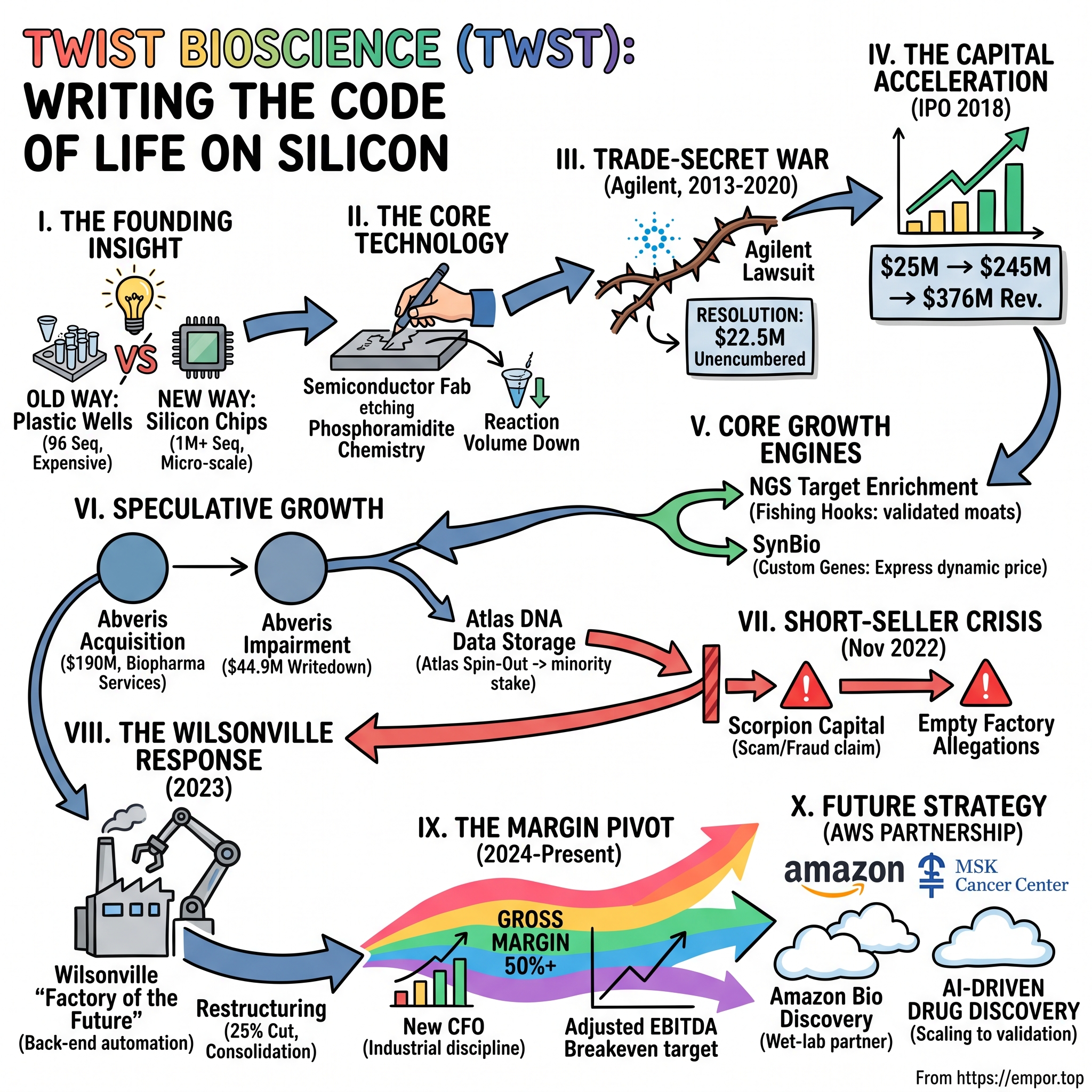
Twist Bioscience: Writing the Code of Life on Silicon
I. Introduction & Episode Roadmap
In April 2026, Amazon Web Services stood up something the life sciences industry had been circling for a decade: an AI drug-discovery service where a researcher describes a biological target in plain language, a fleet of foundation models designs candidate antibodies, and then — this is the part that had never worked — the best designs get physically built and tested in a real laboratory without a human ever picking up a pipette to place the order. AWS named the product Amazon Bio Discovery. It named Twist Bioscience as one of the wet-lab partners that would close the loop.1
The demonstration case was not a toy. Working with Memorial Sloan Kettering Cancer Center, the team ordered roughly 100,000 specific DNA sequences from Twist as a single pooled library, screened them, and advanced the winners into individual synthesis, protein expression, and characterization.2 A hundred thousand distinct sequences, made in parallel, in one order. Twenty years ago, a well-funded academic lab could make a few dozen genes a year.
That is the whole company in one anecdote, and it explains why a business that was left for dead in late 2022 has become one of the more contested stocks in the life-science tools sector. Twist Bioscience's founding insight was almost insultingly simple: everyone in the DNA synthesis industry was making DNA in plastic. Ninety-six little wells in a plastic tray, each holding a drop of expensive reagent, each producing exactly one sequence. Meanwhile, three hours south of Twist's South San Francisco headquarters, an entire industry had spent forty years learning to etch billions of features onto a slab of silicon for pennies. Nobody had seriously tried to run DNA chemistry on that substrate at commercial scale.
Twist did. The company's core claim is that by moving synthesis from plastic wells to micro-wells etched into silicon, it collapsed the reaction volume by orders of magnitude, ran roughly a million reactions in parallel on a chip you could hold between two fingers, and drove the cost of writing a base pair down far enough to change what customers could afford to attempt. Whether that translated into a durable business — as opposed to an impressive piece of engineering that sold DNA at a loss — is the question that has occupied investors since the company listed.
The Scale Inversion
It is worth sitting with the magnitude of the change, because the numbers are easy to read past. A 96-well plate produces 96 sequences. A silicon chip in Twist's platform produces on the order of a million. That is not an improvement; it is a change of kind, roughly four orders of magnitude, and it inverts what a customer can reasonably ask for. Under the plate paradigm, a scientist designed an experiment around the DNA they could afford — a handful of variants, chosen carefully, each one a small bet. Under the chip paradigm, the scientist designs the experiment they actually want and orders the library. The constraint moves from synthesis to screening. Every business Twist has built since is a consequence of that inversion: pooled antibody libraries, custom diagnostic panels with hundreds of thousands of probes, and now AI-generated design sets that no human would have had the patience to specify.
The Investment Puzzle
For most of its public life, the honest answer was "not yet." Twist listed on Nasdaq at $14.00 per share in an October 2018 initial public offering of 5,000,000 shares, at which point it was doing about $25 million of annual revenue with negative gross margin — it cost more to make the DNA than customers paid for it.34 Fiscal 2023 closed with revenue of $245 million and a net loss of $205 million.5 A short seller called it a fraud. The company cut a quarter of its workforce. The stock traded in the twenties as recently as the last twelve months.6
Then the arithmetic turned. Fiscal 2025 revenue reached $376.6 million, up 20%, with gross margin of 50.7% against 42.6% the prior year — an eight-point improvement in a single year, which in a manufacturing business is not a rounding error but a structural event.7 The March 2026 quarter produced $110.7 million of revenue, a thirteenth consecutive quarter of sequential growth, and management raised full-year guidance to $442–447 million while reiterating that the fourth quarter of fiscal 2026 will be the first at adjusted EBITDA breakeven.8 Shares traded around $90 in late July 2026 against a market capitalization near $5.6 billion, versus a fifty-two-week low of $23.30.6 Management told the May 2026 Investor Day audience it sees roughly $1 billion of revenue by fiscal 2031.9
So the investment puzzle is sharper now than it was at the bottom. Twist is no longer a story about whether the technology works — 300,000 physically shipped genes in a single quarter settles that.8 It is a story about three harder questions. Is the margin expansion the product of a genuine cost advantage that compounds, or of a favorable mix shift and a price umbrella that competitors will eventually collapse? Is the current surge in AI-driven drug discovery demand a durable new end market or the 2026 edition of the 2021 biotech bubble that already cost Twist a $44.9 million write-down? And does a company that has never earned an operating profit in its history, now valued at roughly fourteen times forward revenue, have the operating discipline to convert scale into cash?
The story runs in seven movements: the physics that made silicon synthesis possible; the founding and the trade-secret war with Agilent that nearly ended the company before it began; the two engines — gene synthesis and NGS target enrichment — that generate the revenue; the Abveris acquisition and what it revealed about capital allocation; the short-seller siege and the Oregon factory that answered it; the margin pivot under a new CFO; and finally the competitive war-game, where the most interesting threat is not the incumbent Twist set out to disrupt but a new generation of enzymatic chemists doing to Twist what Twist did to Agilent.
Start with the chemistry, because the entire business model is downstream of a physical constraint.
 Subscribe on LinkedIn
II. The Physics & Economics of Synthesizing Life
Picture a 96-well microtiter plate: a rectangle of clear plastic, roughly the size of a paperback, dimpled with eight rows of twelve small cups. It is arguably the most important object in the history of modern biology, and for thirty years it was where synthetic DNA got made. Each well held a few dozen microliters of liquid. Each well produced exactly one DNA sequence. If you wanted a thousand sequences, you needed roughly ten plates, ten times the reagent, and ten times the robot time.
Why Reading Got Cheap and Writing Did Not
To understand why that mattered, you have to understand what "writing DNA" physically is. DNA is a chain of four chemical letters — A, T, C, G — strung in a specific order. Reading that order is called sequencing, and the world got spectacularly good at it: the cost of reading a human genome fell from roughly $100 million to a few hundred dollars over two decades, faster than Moore's Law. Writing the order — actually assembling a novel chain of letters that did not previously exist — advanced far more slowly, and the reason is that the two problems are not symmetric. Reading is a measurement problem, and measurement scales with optics and computation. Writing is a manufacturing problem, and manufacturing scales with chemistry, fluid handling, and yield.
The chemistry in question is called phosphoramidite synthesis, invented in the early 1980s and essentially unchanged since. Think of it as building a chain one link at a time, where each link is added in a four-step cycle: unlock the end of the growing chain, wash in the next chemical letter and let it couple, cap off any chains that failed to couple so they stop growing, then chemically lock the new end. Repeat. Each cycle takes a few minutes and works about 99.5% of the time. That efficiency sounds superb until you compound it: at 99.5% per step, a 200-letter chain comes out roughly 37% intact. This is precisely why synthetic DNA has always been made in short pieces — oligonucleotides, or "oligos," typically under 200 letters — and then stitched together enzymatically into longer genes. The stitching, assembly, cloning, and quality-checking is where most of the labor and most of the cost has always lived.
The Economics of the Plastic Well
The legacy economics followed directly from the plastic. Each well needed enough liquid to submerge the synthesis surface, which meant reagents were consumed by geometry rather than by chemistry. The phosphoramidite monomers themselves are not cheap. Robots had to move plates, aspirate, dispense, and wash. Technicians had to run assembly and quality control on each sequence individually. The result was a business where custom oligos and genes sold at prices in the range of roughly ten to thirty cents per base — economics that made a modest gene affordable and a large-scale library experiment financially unthinkable. Agilent Technologies, Integrated DNA Technologies (later acquired by Danaher), and Thermo Fisher Scientific built profitable franchises selling into exactly this constraint, and they were happy there: low throughput, high price, high margin, sticky customers.
The Substrate Change
Twist's proposition was to attack the geometry rather than the chemistry. Keep phosphoramidite chemistry — it is well-understood, robust, and there is no need to reinvent it — but stop running it in plastic cups. Instead, use semiconductor fabrication techniques to etch microscopic wells into a silicon wafer. The wells are small enough that the reaction volume falls by roughly three orders of magnitude, which means the reagent cost per sequence falls by roughly the same factor. And because the wells are lithographically defined, you can put an enormous number of them on a single chip. Twist's platform description consistently frames this as synthesizing hundreds of thousands of unique sequences in parallel on one device, with the company telling investors it can print on the order of a million oligos per chip.10 On the Q2 fiscal 2026 call, President and COO Patrick Finn described the underlying capability as printing "really high-quality DNA" at a scale that gives Twist "quality, speed and economics of scale."2
Shrinking the reaction, however, creates a problem that plastic did not have. In a large well, a small amount of contamination or a slightly imperfect wash is diluted into insignificance. In a well a thousand times smaller, everything is closer to everything else, and the tolerances on fluid delivery, surface chemistry, and temperature become severe. This is the reason silicon synthesis took a decade to industrialize rather than a year, and it is the reason the accumulated process knowledge is the real asset. A competitor can read Twist's patents. It cannot read the ten years of failed runs that taught the company which surface treatments hold and which wash protocols leave residue.
The analogy that actually holds is the printing press versus the scribe. A scribe copying a manuscript has a cost per page that is essentially constant no matter how many pages you order. A press has an enormous setup cost and then a marginal cost per page approaching the price of ink. Silicon synthesis is a press. The fixed cost of designing the chip, building the deposition and fluidics hardware, and running the fab process is large. The incremental cost of adding one more sequence to a chip that is already running is close to nothing. That is why the business has such violent operating leverage — and why, for its first decade, it looked like a disaster.
The Fulcrum Cuts Both Ways
This is the part investors most often skip. Extreme operating leverage cuts in both directions, and Twist spent years on the wrong side of the fulcrum. In fiscal 2018, the company generated $25.4 million of revenue against $32.2 million of cost of revenue — a negative gross margin, meaning every gene shipped destroyed value.5 The press was built; there was not yet enough volume running through it. By fiscal 2023, gross margin had climbed to roughly 37% on $245 million of revenue.5 By fiscal 2025 it had crossed 50%.7 Management has told investors the incremental drop-through on new revenue should run 75–80% as automation scales.2 That figure is the single most important number in the Twist model, because it is the mathematical expression of the press analogy — and it is a management projection, not yet an audited multi-year fact.
Two caveats deserve flagging before the story moves on. First, Twist has never publicly disclosed its actual cost per base, so the widely repeated claim of a decisive cost advantage over incumbents cannot be verified from filings; what can be verified is the gross margin trajectory and the fact that Twist has been taking share while its academic end market shrinks. Second, the silicon platform is not a fully general solution. Certain DNA sequences — long repeats, hairpin structures, extreme GC content — are genuinely hard to manufacture on any platform, and Twist has been explicit that it declines a small fraction of customer orders for this reason.2 That admission, which the company turned into a growth initiative in 2026, is one of the more honest disclosures in the sector, and it points directly at where the competitive fight is now being waged.
To understand how Twist got the chance to build the press at all, though, you have to go back to a research director at Agilent who spent a decade making oligos in plastic and concluded her employer would never let her stop.
III. Founding Context & The Agilent Trade-Secret War (2013–2020)
Emily Leproust arrived in the United States from France to pursue a doctorate in chemistry at the University of Houston, and joined Agilent Technologies at the start of her career, eventually rising to run research and development for the company's genomics business. Agilent was, at the time, one of the best places on earth to make DNA. It had commercialized inkjet-style oligo synthesis, held deep expertise in array manufacturing, and sold into every serious genomics laboratory. Leproust spent roughly thirteen years there. She also spent thirteen years watching an incumbent behave the way incumbents do.
The Incumbent's Rational Refusal
The strategic problem was not that Agilent lacked the technology. It was that Agilent's DNA business made money selling arrays and reagents into an existing workflow, and a radically cheaper synthesis platform would have cannibalized that business faster than it grew a new one. This is textbook counter-positioning: the incumbent understands the new model perfectly well and rationally declines to adopt it, because the new model destroys more of its existing profit pool than it creates. It is also the single most common reason that talented people leave large companies to start small ones.
Leproust left in 2013 and co-founded Twist Bioscience with two collaborators whose skills mapped precisely onto the gaps in her own. Bill Peck brought the physical chemistry and instrumentation — he became Twist's chief technology officer and has spent the intervening decade on the problem of scaling the chip. Bill Banyai brought semiconductor and optics engineering, the discipline that actually knew how to put a million features onto silicon and get them to behave identically. The founding team was, in effect, a chemist, a machine builder, and a chip person: the exact three-legged stool the problem required, and a combination that no single existing company had assembled.
The composition of that founding team is more analytically interesting than it first appears, because it explains why the opportunity had gone unexploited. Making DNA on silicon required someone who understood phosphoramidite chemistry at the level of a person who had run it commercially for a decade, someone who could design the instrument that delivers picoliter volumes of reagent to a precise location thousands of times per second, and someone who knew how semiconductor fabs actually behave. Those three skill sets essentially never coexist inside one organization, because chemistry companies do not employ chip engineers and chip companies do not employ synthetic chemists. Agilent was one of the few places on earth where the first two overlapped — which is precisely why the founding team came from there, and precisely why Agilent believed the resulting company had taken something.
Capital followed. Twist attracted backing from a roster of specialist deep-tech and life-science investors including ARCH Venture Partners and Illumina, and by the time it filed to go public in 2018 it had built a real, if small, commercial business.4 But it had also acquired something else: a lawsuit designed to kill it.
Bet-the-Company Litigation
In February 2016, Agilent sued Twist and Leproust personally, alleging trade-secret misappropriation and breach of the duty of loyalty — in essence, that Twist's silicon synthesis technology had been developed on Agilent's dime and walked out the door.11 The claim was existential in a way that is easy to underestimate from a distance. Twist at that point had negligible revenue and was entirely dependent on venture capital. Every prospective investor's counsel would have read the complaint. Every prospective large customer — the pharmaceutical companies and diagnostics firms Twist most needed — would have asked whether the supplier they were about to validate into a workflow might be enjoined from selling. And the named defendant was the chief executive, which meant the litigation risk and the key-person risk were the same person.
What happened next is the first real read on management. Twist did not settle quickly, did not pivot away from silicon, and did not slow its commercial build-out. Instead it kept shipping, kept raising, and took the company public in October 2018 with the litigation unresolved and disclosed as a risk factor in the prospectus.3 Revenue roughly doubled from $25.4 million in fiscal 2018 to $54.4 million in fiscal 2019 while the case was live.5 Investors can debate whether that was courage or recklessness; what is not debatable is that customer acquisition did not stall under legal siege, which is meaningful evidence that the product was solving a real problem rather than selling on narrative.
What the Settlement Did Not Say
The case resolved on February 6, 2020, when the parties announced a settlement under which Twist paid Agilent $22.5 million.[^12] Agilent's own announcement characterized the outcome as a resolution of the dispute.12 Trade press reporting at the time framed the settlement as ending the litigation without an admission of liability by Twist.13 The financial statements show the charge landing in fiscal 2020, where a $22.5 million item appears in operating expenses against $90.1 million of revenue.5
The analytical point is not that $22.5 million was cheap — against a company burning roughly $140 million a year at the time, it was real money. The point is what the settlement did not contain. There was no injunction, no field-of-use restriction, no ongoing royalty on the silicon platform, and no forced licensing that would have capped Twist's freedom to operate. For a defendant in a trade-secret case, the difference between "pay and continue unencumbered" and "pay and operate under restrictions" is the difference between a bad quarter and a broken business model. Twist got the former, and it got it three weeks before the world shut down for the pandemic — timing that, in retrospect, cleared the deck just as capital markets opened wider than they ever had for synthetic biology.
There is a subtler lesson here about the credibility of founder-led deep-tech companies. Leproust ran a company for four years under an accusation that she personally had stolen the technology the company was built on. The organizational cost of that is not visible in any filing: the board time, the legal spend, the recruiting conversations that had to start with an explanation. That she emerged with the platform intact and the commercial engine accelerating is the strongest single piece of evidence in her favor as an operator — and it is worth holding onto, because the later chapters of this story include a $44.9 million write-down and a securities fraud settlement that cut the other way.
With the legal overhang gone and money suddenly free, Twist did what almost every company did in 2020 and 2021: it built and it bought. The building part is where the actual business lives.
IV. The Core Growth Engines: SynBio & NGS Target Enrichment
A clinical laboratory in Massachusetts is running a test on a blood sample from a patient who finished chemotherapy eight months ago. The question is whether any cancer cells survived. The answer, if it exists, is present as a few fragments of tumor DNA floating among billions of fragments of ordinary DNA — a signal at roughly one part in ten thousand or worse. Sequencing the entire genome deeply enough to find it would cost thousands of dollars and take days. So the lab does something cleverer: before sequencing, it throws in a custom-designed set of DNA "fishing hooks" — short synthetic sequences, each complementary to a specific stretch of the genome the lab cares about. The hooks grab their targets, everything else gets washed away, and the sequencer reads only the few hundred kilobases that matter.
That is target enrichment, and it is Twist's largest business. The hooks are called probes; a designed set of them is a panel; and the economics are compelling for the customer because sequencing capacity is the expensive input. Enriching first means the sequencer spends its reads where the information is rather than distributing them uniformly across three billion base pairs of mostly irrelevant genome.
The Segment That Is Bigger Than Investors Think
Twist reorganized its reporting in fiscal 2026, folding the old SynBio and Biopharma lines into "DNA Synthesis and Protein Solutions" and renaming NGS as "NGS Applications."7 Under the prior structure, fiscal 2025 broke down as NGS at $208.1 million, SynBio at $145.0 million, and Biopharma at $23.5 million.7 That is worth pausing on, because it corrects a common misreading: NGS was not a supporting act at roughly 45% of the business — it was 55% of it, the largest single engine, and it grew 23% that year. Biopharma, by contrast, was about 6% of revenue, not the 10% that casual descriptions often assume.
The competitive structure of target enrichment is what makes it attractive. Twist competes against Agilent, IDT, Thermo Fisher, and Roche — all larger, all well-capitalized. But the buyer behavior is unusual. When a diagnostics company builds a clinical assay around a specific probe panel, that panel becomes part of a validated workflow. Changing the supplier is not a purchasing decision; it is a revalidation exercise, potentially involving regulatory resubmission, bridging studies, and months of laboratory work, all to save a few percent on a consumable that is a small fraction of the test's cost. The switching cost is not contractual — it is procedural, and procedural switching costs in regulated workflows are among the most durable moats in the tools industry.
There is a second, less-discussed reason target enrichment favors a manufacturer like Twist. A probe panel is not a catalogue item; it is a design. A laboratory building an assay for a specific cancer indication needs probes covering a specific set of genomic regions, tiled at specific densities, balanced so that every region gets read roughly equally rather than some regions dominating the sequencer's attention. Getting that uniformity right is a design and manufacturing problem simultaneously, and it is one where making hundreds of thousands of distinct probe sequences cheaply and in parallel is an enormous practical advantage over making them one at a time. Leproust framed this on the Q2 fiscal 2026 call in terms of where Twist sits in the workflow — between the patient sample and the sequencer — and argued that minimal residual disease testing, which must detect variants at extremely low frequencies, places an unusual premium on exactly that uniformity.2
The claim is plausible and consistent with the customer mix, though the company has not published head-to-head performance data against competing panels that would let an outsider verify it independently. This is a recurring feature of the Twist story that investors should get comfortable with: the company makes specific technical claims about its platform's superiority that are internally consistent, corroborated by customer behavior and margin data, and essentially impossible to verify directly from public sources. The market data is the evidence. The physics is asserted.
The evidence supports this reading, with an important qualification. In the March 2026 quarter, Twist's top ten NGS customers accounted for roughly 39% of NGS revenue, and the company served 627 NGS customers.2 That concentration is a two-sided fact: it confirms the deep, recurring, high-volume relationships that the switching-cost thesis predicts, and it also means a handful of customer decisions move the segment. Twist saw exactly that risk materialize in the December 2025 quarter, when NGS grew only 8% because a single large customer was transitioning an assay from research use into commercial deployment — excluding that account, the segment grew 18%.14 Management disclosed the dynamic clearly and told investors NGS would reaccelerate; it grew 12% in the following quarter and 9% sequentially, and the company guided to a return to 20% growth by the fourth quarter.8 Flagging the headwind in advance and then hitting the reacceleration is the kind of behavior that builds forecasting credibility, and it is a marked improvement on the vaguer explanations of earlier years.
Selling Time: The Express Genes Experiment
The second engine is gene synthesis proper: clonal genes, gene fragments, and pooled oligo libraries sold to researchers who want to build something. Here the constraint on customer behavior was never mainly price — it was time. A researcher who orders a gene and waits two weeks has a two-week clock on every hypothesis. Twist attacked that directly with Express Genes, launched in November 2023 and expanded in January 2024, which cut turnaround to as little as five business days for smaller quantities.[^16]
What makes Express Genes analytically interesting is the pricing mechanism. Rather than setting a fixed premium, Twist priced speed dynamically against available manufacturing capacity — the premium floats with demand and factory utilization. This is airline yield management applied to DNA, and it is only possible because the Oregon factory gave Twist enough automated capacity to sell scarcity rather than ration it. The commercial consequence showed up in the gross margin line: Twist moved from roughly 37% in fiscal 2023 to 42.6% in fiscal 2024 and 50.7% in fiscal 2025, a trajectory that reflects both the mix shift toward premium-priced fast turnaround and the underlying factory automation.57
The Metric That Reframes the Moat
But the more revealing recent development is not price at all. On the Q2 fiscal 2026 call, Finn walked analysts through a metric Twist had never emphasized before: sequence acceptance rate. Three years earlier, Twist accepted about 96% of clonal gene requests and could successfully manufacture about 97.5% of what it accepted. By early 2026, it accepted roughly 97% and manufactured about 98.5%, with broader DNA products running near 99%. The company announced a push toward accepting roughly 99.5% of clonal genes and 99.9% of all DNA products.2
The reason this matters more than a percentage point suggests is a behavioral one Finn named explicitly: when a customer submits a set of sequences and one is rejected, the customer frequently routes the entire order to a competitor. A 3% rejection rate does not cost 3% of revenue; it costs whatever share of full orders those rejections contaminate. Breadth of manufacturable sequence space, not price per base, is emerging as the real competitive battleground — which is a meaningfully different moat from the cost story that has dominated the Twist narrative for a decade, and investors should update accordingly.
Benchmarking the Field
Set against the field, Twist's position is genuinely differentiated but not unassailable. GenScript operates at enormous scale with a heavily manual, labor-intensive model centered in China — an approach that competes hard on price for standard genes but carries geopolitical and supply-chain exposure that regulated Western diagnostics customers increasingly price in; Twist noted China was roughly 1% of its own revenue in the March 2026 quarter, so the exposure runs mostly the other way.2 The legacy instrument makers face the counter-positioning problem already described. The most interesting challengers are the enzymatic synthesis companies — DNA Script, Ansa Biotechnologies, and others — which replace phosphoramidite chemistry with an enzyme that appends bases in water rather than harsh solvents, promising longer strands and fewer failure modes.
The conventional view has been that enzymatic synthesis remains confined to short oligos and benchtop convenience. That view needs revising. In January 2026, Integrated DNA Technologies — the Danaher-owned incumbent that is arguably Twist's most formidable competitor — announced a collaboration to distribute Ansa's Clonal DNA and XL Clonal DNA products, spanning 100 base pairs to 50 kilobases.15 Fifty kilobases is not a short oligo; it is an order of magnitude beyond what Twist routinely quotes for direct synthesis. A large distributor pairing with an enzymatic specialist to attack the long, complex end of the market is precisely the shape a real competitive threat takes, and it is the sharpest counter-evidence to the "enzymatic is niche" consensus.
Which brings the story to the period when Twist had capital, momentum, and a strong temptation to buy its way into adjacent markets.
V. M&A, Capital Allocation, & The Abveris Deal (2021)
By late 2021, the synthetic biology sector was in the grip of a valuation regime that now reads like a historical curiosity. Ginkgo Bioworks had gone public at a valuation in the tens of billions. Berkeley Lights, Absci, and a dozen other platform companies had listed into an environment where a compelling technology narrative and a large stated addressable market were sufficient to command double-digit revenue multiples. Interest rates were near zero. Cash was cheap, equity was expensive in the good sense — meaning it was a strong currency to spend — and boards across the sector were being told, not unreasonably, that the window to build scale would not stay open forever.
Twist's balance sheet reflected the era. The company had raised repeatedly into strength, revenue had grown from $90.1 million in fiscal 2020 to $132.3 million in fiscal 2021, and the losses were being funded without difficulty.5 Management had also identified a strategic gap it genuinely wanted to close. Twist sold synthetic antibody libraries — enormous designed collections of antibody variants that a drug-discovery customer could screen for binders. That is an in vitro approach: everything happens in a dish. The complementary approach, in vivo, immunizes an animal and lets the immune system do the discovery, which finds different and often better candidates. Twist had one half of the toolkit.
The Deal
On November 22, 2021, Twist announced the acquisition of Abveris, a private antibody discovery services company whose DiversimAb platform used hyperimmune mouse models.16 The structure was up to $190 million: roughly $150 million payable at closing in stock plus up to $10 million cash, and up to $40 million in additional shares contingent on Abveris hitting an internal revenue target for calendar 2022.16 Paying primarily in stock at what turned out to be near the sector's peak was, at least, the correct currency choice — Twist spent an asset that was itself richly valued.
The strategic logic was coherent on paper. Combining in vivo and in vitro discovery would let Twist offer customers an end-to-end path from target to validated antibody lead, moving the company up the value chain from selling DNA by the base to selling discovery outcomes with milestone and royalty economics attached. The problem was that the thesis depended on a customer base — early-stage biotech companies funded by venture capital — that was about to have a very difficult three years.
The Write-Down
It did not work as underwritten. Biopharma revenue was approximately $20.3 million in fiscal 2024, and management's own guidance that year projected the line declining roughly 13% year over year.17 Then, in the June 2024 quarter, Twist recorded a $44.9 million impairment of long-lived assets tied to Biopharma.17 On the call, CFO Adam Laponis explained it plainly: the company had revisited its long-term growth forecast for Biopharma and the outlook had shifted from the original view.[^20] The quarter's net loss ballooned to $85.6 million from $40.6 million excluding the charge.17
Strip away the language and this is a company writing down a substantial portion of what it paid for Abveris less than three years after buying it. As a capital allocation retrospective, the verdict is not favorable. Twist bought a services business — human-intensive, project-based, lumpy — at the top of a funding cycle, using the logic that it would combine with a platform asset to create something more than the sum. The combination may yet prove valuable; Biopharma revenue did recover to $23.5 million in fiscal 2025, growing 15%.7 But even after recovery, the line was contributing roughly one dollar in sixteen of company revenue, having consumed up to $190 million of consideration. An activist would put that ratio on the first slide.
The benchmarking question — did Twist overpay? — has a cleaner answer than most retrospectives allow, because the comparison set is unusually well-defined. The 2021 synthetic biology cohort that Abveris was priced against included Ginkgo Bioworks, Absci, and Berkeley Lights, all of which carried revenue multiples that assumed platform economics and durable growth. Within three years, that entire cohort had de-rated violently as the venture funding that supported their customers dried up. Twist paid in stock for a services business whose customers were drawn from precisely that funding pool. In other words, the acquisition was correlated with the acquirer's own cycle risk rather than diversifying against it — Twist bought more exposure to biotech funding at the moment it already had a great deal. The lesson is not that management misjudged Abveris specifically; it is that the deal added no diversification at a price that assumed the cycle would persist.
Two qualifications are fair. First, Twist was hardly alone; the same three years destroyed far more value at Ginkgo, Berkeley Lights, and most of the 2021 synthetic biology cohort, several of which fell 90% or more from their peaks. Being early to write down an underperforming asset is better governance than carrying it at cost and hoping. Second, and more importantly, management's subsequent capital allocation behavior changed materially — which is the thing investors actually need to assess, because past deals are sunk and future deals are not.
Spinning Out Rather Than Writing Off
The clearest evidence is the DNA data storage decision. Twist had spent years and real R&D dollars on the idea of encoding digital information in synthetic DNA — a technology with genuinely spectacular theoretical properties, since DNA is astonishingly dense and stable for millennia, and genuinely distant commercial timelines. Rather than continuing to fund it internally or writing it off, on May 5, 2025 Twist spun the program out as an independent company, Atlas Data Storage, which raised $155 million in seed financing from a syndicate including ARCH Venture Partners, Deerfield Management, Bezos Expeditions, and In-Q-Tel. Varun Mehta, the founder of Nimble Storage, became CEO; co-founder Bill Banyai moved across as CTO. Twist retained a minority stake.18
This was a genuinely elegant piece of capital allocation and deserves credit. Twist removed a long-dated cash-consuming project from its own P&L at precisely the moment it was promising investors a path to breakeven, retained the option value through equity, and let specialist investors fund the risk. The accounting reflected it: fiscal 2025 included a $48.8 million gain on sale of business, and the balance sheet carried $54.3 million of investment in equity securities at year-end where there had been $1.5 million a year earlier.7 Investors should note that this gain flattered the reported net loss — the $77.7 million fiscal 2025 loss would have been meaningfully larger without it — and that management appropriately excluded it from adjusted EBITDA.7
The Invenra transaction in February 2026 shows the same instinct applied to a build-versus-buy decision. Rather than acquiring a bispecific antibody company outright, Twist licensed Invenra's B-Body platform, paying $5 million in cash plus up to 324,558 shares for the license and technology transfer, and issuing up to 307,770 additional shares to two Invenra investors for roughly a 6% preferred stake in Invenra, with a board designation right.19 Twist keeps the service revenue and pays Invenra a royalty on license revenue. That is a fraction of Abveris's cost for access to a fast-growing modality, structured so that Twist's downside is capped and its upside is tied to actual customer demand.
The pattern across Abveris, Atlas, and Invenra is a company that made one expensive mistake at a market top and then materially tightened its structure — smaller checks, more optionality, less balance-sheet risk. That is the honest read. Whether it holds when the next boom arrives is untested; management is currently operating in a rising market with a re-rated stock, which is exactly the condition under which discipline historically erodes.
Before the discipline arrived, though, the market delivered a far more brutal verdict on Twist than any impairment charge.
VI. The Short-Seller Crisis & The Wilsonville "Factory of the Future" (2022–2023)
On November 15, 2022, Scorpion Capital published a research report on Twist Bioscience. Scorpion's house style is not the measured skepticism of a traditional short thesis; it is prosecutorial. The report characterized Twist as a "lab-on-a-chip" scam in the lineage of Theranos and Berkeley Lights, alleged accounting fraud, and stated the firm's belief that the equity would go to zero.[^23] Among the more visceral claims was that Twist's new Oregon manufacturing facility — the plant on which the entire margin thesis rested — was effectively an empty shell.
Twist shares fell roughly 20% that day.[^23] The company issued a same-day response calling the report highly misleading and containing distortions and inaccuracies, and confirmed it would report fiscal 2022 results three days later as scheduled.[^23]
Why the Attack Landed
The timing could not have been worse, and this is what made the attack effective rather than merely loud. Fiscal 2022 had closed with $203.6 million of revenue against a net loss of $217.9 million — the company was losing more money than it made in sales.5 Cash was being consumed at a rate that made the runway a live question. The rate environment had turned violently against long-duration equities. And Twist's central claim — that a silicon platform would deliver structurally superior cost — was, at that moment, unproven at the gross margin line, which sat in the low forties and had gone backwards from the prior year. A skeptic did not need to allege fraud to build a bear case; the financial statements supplied the raw material.
What Twist could not do was argue its way out. A short report alleging that a factory is empty is not refuted by a press release; it is refuted by product coming out of the factory. Which is roughly what happened. On January 26, 2023, Twist announced it had begun shipping commercial product from the Wilsonville, Oregon site — a 110,000 square foot facility outside Portland designed to roughly double manufacturing capacity, with access to an additional 100,000 square feet for future expansion.[^24] The company subsequently opened the site to investors, analysts, and elected officials for tours, and by May 2026 was hosting its full Investor Day in Oregon with a facility walkthrough as the centerpiece.2 Transparency about physical assets is the only credible answer to an emptiness allegation, and Twist eventually gave a great deal of it.
Cutting a Quarter of the Company
But the more consequential response was strategic rather than rhetorical, and it came in May 2023. On May 3, Twist's board approved a restructuring plan cutting approximately 270 employees — roughly 25% of the total workforce — with expected pre-tax charges of $9 to $11 million in severance and related costs.20 The plan eliminated the duplication of synthetic biology production between South San Francisco and Wilsonville, consolidating gene, gene fragment, and most oligo pool manufacturing into Oregon. It also resized the Biopharma team toward revenue-generating partnerships and moderated the investment in DNA data storage.20
What the Oregon facility actually changed is worth being concrete about, because "factory of the future" is marketing language attached to a specific operational fact. Gene synthesis has always had two halves: the front end, where oligos are made on the chip, and the back end, where those oligos are assembled into genes, cloned into bacteria, grown, purified, and sequence-verified. The front end was already automated by the silicon platform. The back end was where the technicians were — and where the cost, the turnaround time, and the variability lived. Wilsonville automated the back end at scale, which is why it simultaneously enabled faster turnaround, lower unit cost, and the elimination of the duplicated South San Francisco lines.
Leproust later described the ongoing work as "automating the automation," noting that a single room at the site had been reconfigured to deliver several times its previous capacity.2 Understanding this structure also explains a limitation: because each new product format needs its own back-end branch, capacity expansion is incremental and continuous rather than a one-time build.
The decision to cut a quarter of the company in the same quarter it reported record revenue is the second real read on this management team, and it deserves a more careful assessment than "they responded well." The charitable reading is that Twist recognized it had been running two factories for one factory's worth of demand, that the Oregon automation had rendered the older lines redundant, and that the discipline to act quickly preserved the balance sheet at a moment when raising equity would have been ruinously dilutive. The less charitable reading is that the company had over-built and over-hired through the boom — the fiscal 2022 loss was not an accident of timing — and that the restructuring corrected an error rather than seizing an opportunity. Both readings are true. Managements that never over-extend do not need 25% reductions in force.
It is also worth separating what the short thesis got right from what it got wrong, because investors who dismiss short reports wholesale learn nothing from them. Scorpion was correct that Twist was consuming cash at an unsustainable rate, that gross margins were far below what the platform narrative implied, and that the company's spending discipline was poor. Those observations were accurate and, notably, Twist's own subsequent actions — a 25% workforce reduction, a factory consolidation, a de-emphasis of data storage, and a Biopharma write-down — conceded every one of them within eighteen months. What the report got wrong was the leap from "this company is badly run financially" to "this company is a fraud and the technology is fake." That distinction is the entire investment case, and it is the distinction the operating data eventually resolved.
What is not in dispute is what the Oregon plant subsequently became. The facility that a short seller called deserted turned into the physical infrastructure for Express Genes — the dynamic-priced rapid turnaround service that required exactly the automated, high-throughput back-end that Wilsonville provided — and therefore into the engine of the margin expansion that followed. The asset the bears used as evidence of fraud became the asset that broke their thesis.
The Legal Epilogue
The legal epilogue arrived in 2026 and is more ambiguous than the operational one. A securities class action filed in the Northern District of California in the wake of the short report — covering investors who bought in a 2020 offering or between December 2018 and November 2022 — reached a settlement in principle for approximately $17.1 million. Twist recorded $7.2 million of litigation settlement costs net of recoveries in the March 2026 quarter, expecting insurance to cover the remainder.8 Laponis told analysts the company viewed it as "a positive resolution allowing management to remain fully focused on execution."2
Investors should resist reading a settlement as vindication in either direction. Companies settle securities class actions for reasons that have little to do with the merits — the cost of discovery, the distraction, the tail risk of a jury. A $17.1 million settlement, largely insured, on a company now valued in the billions is a nuisance resolution, not an admission and not an exoneration. What it does confirm is that the 2022 episode carried a real, if modest, cash cost that persisted for more than three years after the stock price had recovered — a useful reminder that narrative attacks on companies with weak financials impose durable expenses even when the underlying business turns out fine.
By the time that settlement was booked, the company writing the check looked almost nothing like the one Scorpion had targeted.
VII. Modern Management, Incentives, & Financial Pivot (2024–Present)
The most telling detail about Adam Laponis is where he came from. Twist named him chief financial officer in January 2024, recruiting him from a background that included Ecovyst, Carlyle, and Johnson & Johnson — specialty chemicals, private equity, and large-cap pharma.[^26] That is not the résumé of a life-science tools CFO. It is the résumé of someone who has spent a career on industrial cost structures, plant economics, and the discipline of making a manufacturing asset earn its capital. Hiring him was a statement about what Twist thought its problem was: not technology, not demand, but conversion.
The Delivery
The pivot he was hired to execute has been, on the reported numbers, largely delivered. Gross margin moved from roughly 37% in fiscal 2023 through 42.6% in fiscal 2024 to 50.7% in fiscal 2025, with the fourth quarter of fiscal 2025 at 51.3%.57 Adjusted EBITDA loss narrowed from $93.5 million in fiscal 2024 to $46.9 million in fiscal 2025.7 Research and development spending fell from $90.9 million to $80.3 million over the same period while revenue grew 20% — the company got more efficient at innovation, or at least spent less on it.7 Guidance discipline improved markedly: Twist has beaten its own quarterly revenue guidance in each of the recent quarters and raised full-year expectations twice during fiscal 2026, from $425–435 million at the outset to $435–440 million in February and $442–447 million in May.7148
That last sequence is worth dwelling on, because guidance behavior is one of the few objective windows into management character. A team that guides conservatively and raises is telling you something different from a team that guides aggressively and trims. Twist has been doing the former consistently for two years, after a history that included overpromising on Biopharma. When Leproust was asked at the May 2026 call whether the raise reflected a specific segment, she noted the company had "doubled the raise" relative to the quarter's beat and expressed broad-based confidence, while explicitly declining to guide by product line to avoid helping competitors.2 That is a defensible refusal, though it does reduce disclosure quality on exactly the mix questions investors most want answered.
Narrative consistency across calls is the other test, and Twist passes it better than most. The language management used in November 2025 — maintain gross margin above 50%, exit the fourth quarter of fiscal 2026 at adjusted EBITDA breakeven, drive toward sustained profitable growth — is very nearly the same language used in February and again in May, with the specific numeric commitments unchanged and the revenue guidance moving only upward.7148 Compare that to the fiscal 2024 period, when the company was simultaneously guiding to gross margin above 50% by the end of fiscal 2025 and writing down a business it had bought three years earlier.17 The narrative has become tighter and more falsifiable, which is the direction investors want it to move. The caution is that a narrative is easiest to hold steady when results are cooperating; the real test of consistency comes in a quarter that misses.
Emily Leproust remains chief executive and chair, and her equity stake keeps her interests substantially aligned with shareholders. She has been selling shares under a Rule 10b5-1 trading plan adopted May 27, 2025, including sales in May and June 2026 as the stock re-rated.21 Pre-arranged plan sales after a fourfold move are unremarkable and not a governance flag; investors monitoring the situation should watch whether the pace changes materially or whether new plans are adopted at successively higher prices, which would be a different signal. Bill Peck continues as chief technology officer, and Patrick Finn's elevation to President and COO added an operator between the founders and the factory.
Where the Leverage Is Leaking
Now the part that requires more skepticism than the margin story invites.
Operating expenses are growing faster than gross profit dollars in the current cycle. In the March 2026 quarter, selling, general and administrative expense reached $76.1 million against $63.7 million a year earlier — up roughly 19% — while gross margin improved only about 200 basis points and actually moderated sequentially from 52.0% to 51.6%.814 Laponis framed the SG&A growth as "deliberate investment in our commercial organization and digital infrastructure" with "a clear line of sight to return," and pointed to the 55% growth in therapeutics revenue as the justification.2 That is a coherent argument. It is also exactly the argument every growth company makes about opex, and it is falsifiable only in retrospect.
The company's own actions suggest management shares some of the discomfort. In April 2026, Twist reduced 36 positions to reallocate resources, and told investors that combined with other cost initiatives it expects roughly $6 million of sequential operating expense improvement in the fourth quarter.2 Read plainly: the fourth-quarter adjusted EBITDA breakeven target — reiterated at every reporting event since November 2025 — depends materially on a cost action taken in April rather than purely on operating leverage from revenue growth.72 That does not make the target unachievable; it does make it engineered, and investors should judge the milestone on whether it holds in fiscal 2027 rather than on whether it is touched once.
Runway, and a Liability Worth Naming
The cash position deserves similar precision. Twist held $232.4 million in cash and short-term investments at the end of fiscal 2025, roughly $198 million at the end of December 2025, and approximately $172 million at the end of March 2026.7148 The March quarter's sequential decline reflected $17.6 million of operating cash usage, $7.9 million of capital expenditure on manufacturing automation, and $5 million of cash for the Invenra transaction.2 The trajectory is manageable and the burn is shrinking, but the earlier framing of Twist as maintaining a comfortable buffer above $250 million no longer describes the balance sheet. A company approaching breakeven with roughly $172 million of liquidity has enough runway to get there — it does not have enough to absorb a demand shock and a strategic investment cycle simultaneously without returning to the market.
One further balance-sheet item deserves flagging because it is easy to miss: Twist carries a $15 million "liability related to the sale of future revenue," which appeared in fiscal 2025 and persisted through March 2026.78 The company has monetized a future revenue stream in exchange for cash today. That is a legitimate financing technique, not a red flag, but it is a form of non-dilutive leverage that does not appear in a conventional debt calculation, and investors modeling the capital structure should account for it.
Governance and the Question of Alignment
A skeptical investor examining governance would find a mixed but not alarming picture. Leproust holds the roles of chief executive and board chair simultaneously, a combination that concentrates authority and that many institutional investors object to on principle — though it is common in founder-led companies and Twist added Trynka Shineman to the board during fiscal 2025, continuing a pattern of independent director additions.7 The compensation structure ties heavily to revenue growth and gross margin, which is directionally sensible given the company's stage.
But it is worth noting what such a structure does not penalize: it does not directly penalize dilution, and dilution has been substantial. Weighted average shares outstanding rose from roughly 53.9 million in fiscal 2022 to about 59.8 million in fiscal 2025 and 61.7 million by the March 2026 quarter — roughly 14% cumulative dilution over four years, before counting the shares issued for Invenra.578 Shareholders have funded a meaningful share of the operating losses through their own ownership percentage rather than through cash. That is normal for a pre-profit growth company and it is also a real cost that adjusted EBITDA conceals entirely.
Finally, the speculative businesses are now correctly sized, which is itself a management achievement. Biopharma, at roughly 6% of fiscal 2025 revenue, is a real high-margin service line with genuine milestone and royalty optionality — Twist has disclosed clinical progress on antibodies discovered using its libraries — but it is not the story.717 DNA data storage is no longer a Twist cost center at all; it is an equity stake carried at $54.3 million as of September 2025, rising to $68.1 million by March 2026 after the Invenra investment was added to the same line.78 Investors get exposure to a potentially enormous long-dated market without funding its development. That is a materially better structure than the one that existed in 2023, and it is the clearest evidence that the discipline narrative has substance behind it.
The question that remains is whether the underlying competitive position justifies the current valuation, which requires a more formal war-game.
VIII. Hamilton Helmer's 7 Powers & Porter's 5 Forces Analysis
Strategy frameworks are only useful when they force a distinction between advantages a company genuinely holds and advantages its investor deck asserts. Run Twist through Helmer's seven powers with that discipline and the picture is narrower than the bulls describe, but the parts that survive are strong.
The Seven Powers, Honestly Scored
Process Power is the strongest and most defensible claim. Twist has spent more than a decade on the specific integration of semiconductor microfabrication with phosphoramidite flow chemistry, and the evidence that this is hard to copy is not the patent estate — it is the operating data. Manufacturing yield on clonal genes improved from roughly 97.5% to 98.5% over three years, and sequence acceptance from about 96% to 97%, with the company targeting 99.5%.2 Those are the incremental, accumulated process improvements that cannot be bought, licensed, or reverse-engineered from a patent filing; they are learned. The counterpoint is that process power decays if a competitor changes the process rather than matching it, which is precisely the enzymatic threat.
Scale Economies are real and improving, but the mechanism is more specific than "bigger is cheaper." The fixed costs are chip design and fabrication plus the Oregon automation; the variable cost per additional sequence is small. Twist shipped approximately 938,000 genes in fiscal 2025 against roughly 772,000 in fiscal 2024, and about 300,000 in the March 2026 quarter alone against 227,000 a year earlier.78 Volume is compounding on a largely fixed asset base, which is exactly what should drive margin. The qualifier Leproust offered on the Q2 call is important: the front end — the chip where oligos are made — is shared across products, but each new product "flavor" requires added back-end automation, so capacity expansion is not free.2 Scale economies are strong at the chip and weaker downstream.
Counter-Positioning was decisive historically and is fading in importance. The reason Agilent, IDT, and Thermo Fisher did not aggressively adopt silicon synthesis was that doing so would have cannibalized profitable legacy reagent and instrument franchises. That asymmetry gave Twist a decade of relatively unmolested share gain. But the IDT–Ansa arrangement demonstrates that incumbents have found a way to respond without cannibalizing themselves: partner with a next-generation specialist and distribute.15 Counter-positioning protects you from an incumbent's incentives, not from its distribution, and distribution is what IDT is now lending to a competing chemistry.
Switching Costs are high in NGS diagnostics for the procedural reasons already established, moderate in industrial and therapeutics accounts where relationships and integration matter but revalidation does not, and low in academic research where the buyer is genuinely price- and speed-sensitive. The blended picture is a company with a hard core of sticky revenue surrounded by a contestable periphery.
Cornered Resource, Network Effects, and Brand are all weak-to-absent, and honest analysis should say so rather than manufacture them. There is no scarce input Twist controls. There is no mechanism by which one customer's use makes the product better for another. Brand functions as a soft quality signal in high-fidelity gene synthesis — researchers trust that a Twist gene will be correct — but that is reputation, which is earned continuously and lost quickly, not a structural power.
The Five Forces
Turning to Porter, the five forces tell a story about where the profit pool actually sits.
Rivalry is the dominant force and it is intensifying rather than easing. Standard oligos and simple genes are close to commoditized, with GenScript competing on labor-cost arbitrage and the incumbents competing on account relationships. Twist's answer has been to compete on dimensions where rivalry is weaker — speed, sequence breadth, and integrated downstream services — which is strategically correct but also means the company must keep running.
Threat of Substitutes is the force most likely to be underestimated. Enzymatic synthesis is not a hypothetical; a 50-kilobase clonal DNA product distributed through the largest specialist channel in the industry is a commercial product on the market today.15 If enzymatic platforms achieve cost parity at long lengths, the silicon advantage narrows to the massively parallel pooled-library use case — which is valuable and growing, but is a subset of Twist's business rather than all of it.
Threat of New Entrants is genuinely low. The capital intensity, the accumulated process knowledge, and the decade of yield learning constitute a real barrier for anyone starting from zero. The entrants that matter are not new; they are well-funded specialists who started five to ten years ago.
Buyer Power is bifurcated. Regulated diagnostics customers have low switching flexibility but high volume leverage — the top ten NGS accounts at 39% of segment revenue can negotiate.2 Academic buyers have high flexibility and low volume, and Twist has been giving them price concessions: Leproust confirmed on the Q2 call that the company extended a promotion letting academic customers buy Express Genes at standard gene prices, explicitly to take share in a shrinking market.2 That is a rational share-capture decision and simultaneously an admission that pricing power does not extend uniformly across the customer base.
Supplier Power looks low — silicon wafers and phosphoramidite precursors are commodity inputs — with one exception that Twist itself flags in every filing. The company's standing risk-factor language includes "dependence on one supplier for a critical component."8 The component is not identified. A single-source dependency in the manufacturing chain of a company whose entire thesis is manufacturing is a concentration risk investors should hold in mind, even absent evidence of any disruption to date.
Reading the forces together points at where the profit pool actually sits, and it is not where the founding story would suggest. The commodity end of DNA synthesis — standard oligos, simple genes at standard turnaround — is a low-margin knife fight that Twist participates in largely to hold accounts and fill capacity, and where it is currently discounting to defend academic share. The profit sits in two adjacent places: regulated diagnostic panels, where switching costs are procedural and volumes recur with patient testing rather than with research budgets, and complex high-value discovery work, where the customer is buying speed, breadth, and increasingly downstream protein data rather than DNA by the base. Twist's strategic behavior over the past three years — Express Genes, the acceptance-rate push, the Invenra license, the AWS partnership — is entirely consistent with a company migrating deliberately from the first pool toward the second two.
That migration is the correct response to the competitive structure, and it is also what makes the operating expense growth defensible rather than merely excusable, since selling discovery outcomes requires a different and more expensive commercial organization than selling consumables.
The synthesis is this: Twist holds two strong powers — process and scale — anchored in a business where the highest-quality revenue is protected by procedural switching costs, and where the historic protection from incumbent incentives is eroding. That is a good competitive position. It is not an impregnable one, and the current valuation implies a great deal of confidence that the process advantage compounds faster than the substitute threat arrives.
Which sets up the central argument an investor has to resolve.
IX. Investment Story Spine: Bull vs. Bear Stress Test
Why Twist Wins From Here
The bull case does not rest on the silicon story anymore. It rests on four observable mechanisms, and the strongest of them is the one that emerged most recently.
AI-driven discovery has changed the shape of the demand curve. Therapeutics revenue reached $40.8 million in the March 2026 quarter, up 55% year over year — an acceleration from the prior quarter, and the fastest-growing category in the business.2 The mechanism is specific and worth understanding, because it is not simply "AI is hot." When a discovery team designed antibodies by hand, it might test dozens of candidates. When a foundation model generates designs, it produces thousands, and every one of those designs must be physically built and characterized before it means anything.
Leproust described the dynamic on the Q2 call: AI "just increases the number of sequences that people want to look at," and because many customers lack the internal capacity to express and characterize thousands of antibodies, Twist upsells from DNA into protein expression and characterization data.2 Twist is, in effect, selling picks and shovels to a gold rush where the models generate the map — and the more capable the models become, the more physical validation they demand, which is an unusually favorable position to occupy in an AI value chain. Critically, Leproust noted that in 2025 the excitement came from very few accounts, whereas by 2026 "dozens of accounts" were driving the growth, and that customers had shifted from one-time model-building purchases to smaller, more frequent orders as they moved into production cycles.2 Breadth of adoption plus recurring order patterns is the difference between a fad and a market.
Margin expansion has been delivered, not promised. The eight-point gross margin improvement in fiscal 2025 is audited history, and management has guided above 52% for fiscal 2026 with a target of 75–80% incremental drop-through as automation scales.72 If that drop-through holds, the path from breakeven to meaningful profitability is arithmetic rather than aspirational.
The sticky core keeps growing. Diagnostics revenue reached $40.0 million in the March 2026 quarter, up 14% and up 13% sequentially, driven by minimal residual disease and liquid biopsy applications where panel customization and turnaround speed are genuine technical requirements rather than procurement preferences.2 MRD testing moving from clinical adoption into scaled deployment is a secular volume driver that does not depend on biotech funding cycles.
Geographic breadth is improving. EMEA grew 22% and APAC 30% in the March quarter, against 17% in the Americas, with China at roughly 1% of revenue.2 A company diversifying away from a single market while carrying negligible exposure to the most geopolitically fraught one is de-risking, quietly.
What Could Break the Case
The AI demand could be a cycle, and Twist has been here before. The 2021 biotech boom produced exactly this pattern — a new class of well-funded customers buying aggressively — and it ended in a $44.9 million impairment. AI-enabled drug discovery is funded substantially by venture capital and large-tech budgets, both of which are discretionary. Twist disclosed that roughly $25 million of AI-related orders booked in the fourth quarter of fiscal 2025 had almost entirely shipped by the first quarter of fiscal 2026, meaning the revenue is fast-cycling rather than contracted.2 Fast-cycling revenue converts quickly on the way up and disappears quickly on the way down. There is no backlog to cushion a downturn.
Enzymatic synthesis is a live substitution threat with distribution behind it. This is the most underappreciated risk in the story and has been addressed above; the point for the bear case is simply that the threat now has a channel.
The academic and industrial end markets are contracting. Leproust stated directly that the academic market "is basically shrinking right now" under funding pressure.2 Industrial and applied revenue fell to $5.8 million in the March quarter from $7.0 million a year earlier, and global supply partner revenue declined to $11.4 million from $12.0 million, which management attributed to order timing.2 Twist is growing by taking share in shrinking segments while a single hot segment carries the growth rate — a mix that works until the hot segment cools.
Operating leverage is being consumed by operating expenses. The activist framing writes itself: a company with a 51.6% gross margin, a $110.7 million quarter, and a $44.0 million net loss is not a company constrained by unit economics. It is a company spending $95.8 million a quarter on operating expenses excluding cost of revenue.2
Stock-based compensation ran $64.5 million in fiscal 2025 against $376.6 million of revenue, and $18.9 million in the March 2026 quarter alone — roughly 17% of that quarter's revenue, which is why adjusted EBITDA and GAAP net loss diverge so dramatically.78 An investor buying on adjusted EBITDA breakeven should be clear-eyed that GAAP profitability is a separate and much more distant milestone, and that the gap is real economic cost borne by shareholders through dilution.
Concentration in NGS remains a single-decision risk. The December 2025 quarter demonstrated how one customer's assay transition can halve segment growth.14 That will happen again.
Biosecurity regulation is a genuine tail risk that cuts both ways. A company that can manufacture arbitrary DNA sequences on demand is, by definition, a potential vector for synthesizing dangerous genetic material, and the rise of generative protein design tools has sharpened regulators' attention. Twist has positioned itself on the right side of this — it co-authored a peer-reviewed paper in Science on strengthening nucleic acid biosecurity screening against generative design tools, led by Microsoft with the International Gene Synthesis Consortium, and joined the U.S. AI Safety Consortium established under the National Institute of Standards and Technology.717 Being at the table when rules are written usually advantages the incumbent, since compliance costs fall hardest on smaller competitors. But the tail risk is real: a single misuse incident traced to a commercial synthesis provider would invite regulation across the entire industry, and Twist's own filings list additional regulation as a standing risk that could increase costs and delay commercialization.8
Capital intensity does not end at breakeven. Capital expenditure was $7.9 million in the March quarter alone, and each new product format requires incremental back-end automation.2 Next-generation chip development is a continuing cost. Free cash flow positivity sits well beyond adjusted EBITDA breakeven.
The Activist Stress Test
If a concentrated fund built a position and wrote a letter, the argument would not be about the technology. It would be about the distance between a 51.6% gross margin and a $44.0 million quarterly net loss, and it would make four points. First, that a company generating roughly $57 million of quarterly gross profit and spending roughly $96 million on operating expenses excluding cost of revenue has an expense problem, not a revenue problem, and that the April 2026 reduction of 36 positions was too small to be a genuine answer.28 Second, that stock-based compensation running near a sixth of revenue transfers value from shareholders to employees at a scale that a non-GAAP metric is designed to obscure.8 Third, that the Abveris outcome established a pattern of paying up for services businesses at cycle peaks, and that the current environment — a re-rated stock, a hot AI end market, a management team being praised for growth — is exactly when that pattern recurs. Fourth, that the disclosure has moved in the wrong direction: Biopharma is no longer separately reported, and management has explicitly declined to guide by product line, which means investors cannot independently verify the mix shift on which the margin thesis depends.72
The counter-argument is that each of those is a symptom of a company deliberately investing into a demand inflection it did not create and could not have forecast, and that the correct time to judge the discipline is fiscal 2027 — the first full year on the other side of breakeven. Both positions are reasonable. What makes the debate resolvable is that it will be settled by disclosed quarterly data within four quarters rather than by argument.
Myth Versus Reality
Three consensus beliefs deserve correction. Myth: Twist's moat is cost per base. Reality: the company has never disclosed cost per base, is discounting to defend academic share, and its own management now emphasizes sequence acceptance breadth and speed as the competitive edge.2 Myth: Biopharma is a meaningful growth pillar. Reality: it was roughly 6% of fiscal 2025 revenue, was written down by $44.9 million in 2024, and has been folded into a broader segment where its individual performance is no longer separately disclosed.717 Myth: EBITDA breakeven means the company is self-funding. Reality: adjusted EBITDA excludes stock compensation, and the fourth-quarter target depends partly on an April headcount reduction.28
The Three KPIs That Matter
Everything above collapses into three things worth tracking each quarter.
First, gross margin against the 52%-plus commitment, watched sequentially rather than year over year. The sequential dip from 52.0% to 51.6% in the March quarter is the kind of detail that gets lost in annual comparisons but tells you whether the incremental drop-through thesis is holding as the company invests in new formats.148 Management was pressed on exactly this by Wolfe Research on the Q2 call and attributed it to deliberate investment in IgG and characterization capacity.2
Second, therapeutics revenue growth and the breadth of accounts behind it. This is the AI exposure, isolated. Growth rate alone is insufficient — the question is whether the disclosed account base keeps broadening or re-concentrates into a handful of large buyers, because that determines whether this is a market or a moment.
Third, quarterly cash burn and the trajectory of operating expenses relative to gross profit dollars. This is the discipline test. A company that reaches adjusted EBITDA breakeven and then lets operating expenses reaccelerate has not changed; a company that holds the line has.
Deliberately excluded from that list are the metrics that dominate the coverage: total revenue growth, which is well telegraphed by guidance and rarely surprises; the adjusted EBITDA breakeven date itself, which is a single point rather than a trend and has already been engineered; and anything relating to Atlas Data Storage, which is now an equity stake whose value will be set by financing rounds Twist does not control. Three signals, tracked quarterly, resolve the argument. Everything else is commentary.
X. Epilogue & Playbook Lessons
Thirteen years after three people left a large instrument company because it would not build the thing they wanted to build, Twist Bioscience shipped roughly 300,000 genes in a single quarter to some 2,583 customers, and was named as the physical laboratory behind an Amazon drug-discovery product.81 That arc contains at least three lessons that generalize well beyond synthetic biology.
The best cross-industry translations are unglamorous. Twist did not invent new chemistry. Phosphoramidite synthesis in 2026 works essentially the way it worked in 1983. What Twist did was recognize that the chemistry was not the bottleneck — the container was — and then import forty years of accumulated semiconductor manufacturing knowledge to fix the container. The most valuable arbitrage in deep tech is frequently not a scientific breakthrough but a substrate change borrowed from an adjacent industry that solved the same physical problem decades earlier. The corollary is that these translations take far longer to reach profitability than their proponents forecast, because importing a manufacturing paradigm means importing its learning curve too. Twist needed roughly a decade from founding to positive gross margin and will have taken thirteen years to reach adjusted EBITDA breakeven, if the fourth-quarter target holds.
Narrative attacks are answered with physical evidence, and only with physical evidence. When a short seller alleges that a factory is empty, no amount of rebuttal changes the argument's structure — it simply becomes one party's word against another's. What ended the debate was product shipping from Oregon, followed by margin expansion that could not have occurred without the plant running. The generalizable point for investors is that in disputes about operating reality, the resolution comes from the operating data, and the correct posture during the dispute is to identify which specific future disclosure would settle it and then wait for that disclosure.
In Twist's case, the settling metric was gross margin, and it took roughly two years to arrive. An investor who identified that in November 2022 and simply monitored one line item each quarter would have reached the right conclusion well before the market did — and would have done so without needing any private judgment about whether a short seller or a management team was more trustworthy.
The transition from land-grab to discipline has to happen while there is still capital to fund it. Twist made its 25% workforce reduction in May 2023, with a substantial cash balance and no financing pressure — from a position of weakness in the market's eyes but strength on the balance sheet. Companies that wait for the market to force the decision make it with a worse hand: less cash, a lower stock price, and a compressed timeline that forecloses the option of spinning assets out rather than writing them off. The Atlas Data Storage transaction was only available to a company that still had something to spin.
A fourth lesson sits underneath the other three: the moat you start with is rarely the moat you keep. Twist was founded on a cost argument — silicon makes DNA cheaper than plastic — and for a decade that was the whole pitch. By 2026, management's own emphasis had shifted to something else entirely: the breadth of sequences the platform can accept and manufacture, and the speed with which it can deliver them. Cost per base is now a hygiene factor that the company does not even disclose, while acceptance rate is the metric the president chose to walk analysts through in detail. Investors who anchor on a company's founding advantage often miss the moment when the source of its pricing power quietly migrates. In Twist's case, the migration is favorable — breadth and speed are harder to commoditize than cost — but it also means the competitive threat has migrated too, from incumbents who could not adopt silicon to specialists attacking the exact sequence space Twist still declines.
The unresolved question is whether the discipline survives success. Twist enters fiscal 2027 with a re-rated equity, a hot end market, and a management team that has spent three years being rewarded for restraint. The 2021 version of this company had all three of those conditions and responded by paying up to $190 million for a services business it later wrote down. The Invenra structure suggests something has been learned. The next acquisition will say whether it was learned durably.
For a company that spent its formative years defending itself — first against a former employer's claim that its core technology was stolen, then against a short seller's claim that its core asset was a fiction — the most interesting fact about Twist Bioscience in 2026 is how thoroughly the argument has shifted. Nobody now debates whether the silicon platform works. The debate is about how much of the value it creates accrues to Twist rather than to its customers, its employees through equity compensation, or eventually to a competitor running a different chemistry. That is a much better problem to have, and a considerably harder one to solve.
References
-
Twist Bioscience Reports Fiscal Second Quarter 2026 Financial Results (Form 8-K, Exhibit 99.1) — Twist Bioscience / SEC EDGAR, 2026-05-04 ↩↩
-
Earnings call transcript: Twist Bioscience Q2 2026 — Investing.com, 2026-05-04 ↩↩↩↩↩↩↩↩↩↩↩↩↩↩↩↩↩↩↩↩↩↩↩↩↩↩↩↩↩↩↩↩↩↩↩↩
-
Prospectus (Form 424B4), Initial Public Offering of 5,000,000 Shares at $14.00 — Twist Bioscience / SEC EDGAR, 2018-10-31 ↩↩
-
Form S-1 Registration Statement (IPO Prospectus) — Twist Bioscience / SEC EDGAR, 2018-10-03 ↩↩
-
Form 10-K for the Fiscal Year Ended September 30, 2023 — Twist Bioscience / SEC EDGAR, 2023-11-21 ↩↩↩↩↩↩↩↩↩↩
-
Twist Bioscience Corporation Stock Overview & Financials — Reuters ↩↩
-
Twist Bioscience Reports Fiscal Fourth Quarter and Full Year Fiscal 2025 Financial Results (Form 8-K, Exhibit 99.1) — Twist Bioscience / SEC EDGAR, 2025-11-14 ↩↩↩↩↩↩↩↩↩↩↩↩↩↩↩↩↩↩↩↩↩↩↩↩↩↩
-
Twist Bioscience Reports Fiscal Second Quarter 2026 Financial Results — condensed financial statements and guidance — Twist Bioscience / SEC EDGAR, 2026-05-04 ↩↩↩↩↩↩↩↩↩↩↩↩↩↩↩↩↩↩↩↩
-
Canaccord initiates Twist Bioscience stock coverage — Investing.com, 2026 ↩
-
Form 10-K for the Fiscal Year Ended September 30, 2024 — Twist Bioscience / SEC EDGAR, 2024-11-18 ↩
-
Agilent Sues Twist Bioscience Over Alleged Trade Secret Theft — BioPharma Dive, 2016-02-04 ↩
-
Agilent Settles Legal Dispute with Twist Bioscience — Agilent Technologies, 2020-02-06 ↩
-
Agilent and Twist Bioscience Settle $22.5M Trade Secret Dispute — Chemical & Engineering News, 2020-02-07 ↩
-
Twist Bioscience Reports Fiscal First Quarter 2026 Financial Results (Form 8-K, Exhibit 99.1) — Twist Bioscience / SEC EDGAR, 2026-02-02 ↩↩↩↩↩↩↩
-
Integrated DNA Technologies Expands Synthetic Biology Portfolio with Ansa Biotechnologies' Clonal DNA and XL Clonal DNA Products — Ansa Biotechnologies, 2026-01-14 ↩↩↩
-
Twist Bioscience Acquires In Vivo Antibody Discovery Company Abveris — Twist Bioscience IR, 2021-11-22 ↩↩
-
Twist Bioscience Reports Fiscal Third Quarter 2024 Financial Results (Form 8-K, Exhibit 99.1) — Twist Bioscience / SEC EDGAR, 2024-08-02 ↩↩↩↩↩↩↩
-
Twist Bioscience Spins Out DNA Data Storage as Independent Company (Form 8-K, Exhibit 99.2) — Twist Bioscience / SEC EDGAR, 2025-05-05 ↩
-
Current Report on Form 8-K regarding the Invenra license and equity investment — Twist Bioscience / SEC EDGAR, 2026-02-17 ↩
-
Current Report on Form 8-K, Item 2.05 — Costs Associated with Exit or Disposal Activities — Twist Bioscience / SEC EDGAR, 2023-05-05 ↩↩
-
Twist Bioscience CEO Leproust sells $3.2m in company stock — Investing.com, 2026 ↩
 LinkedIn
 WhatsApp
 Reddit
 Hacker News
 Email
Email Kindle
 RSS Feed
 Spotify
 Apple Podcasts
 Amazon Music
 Audible
 YouTube