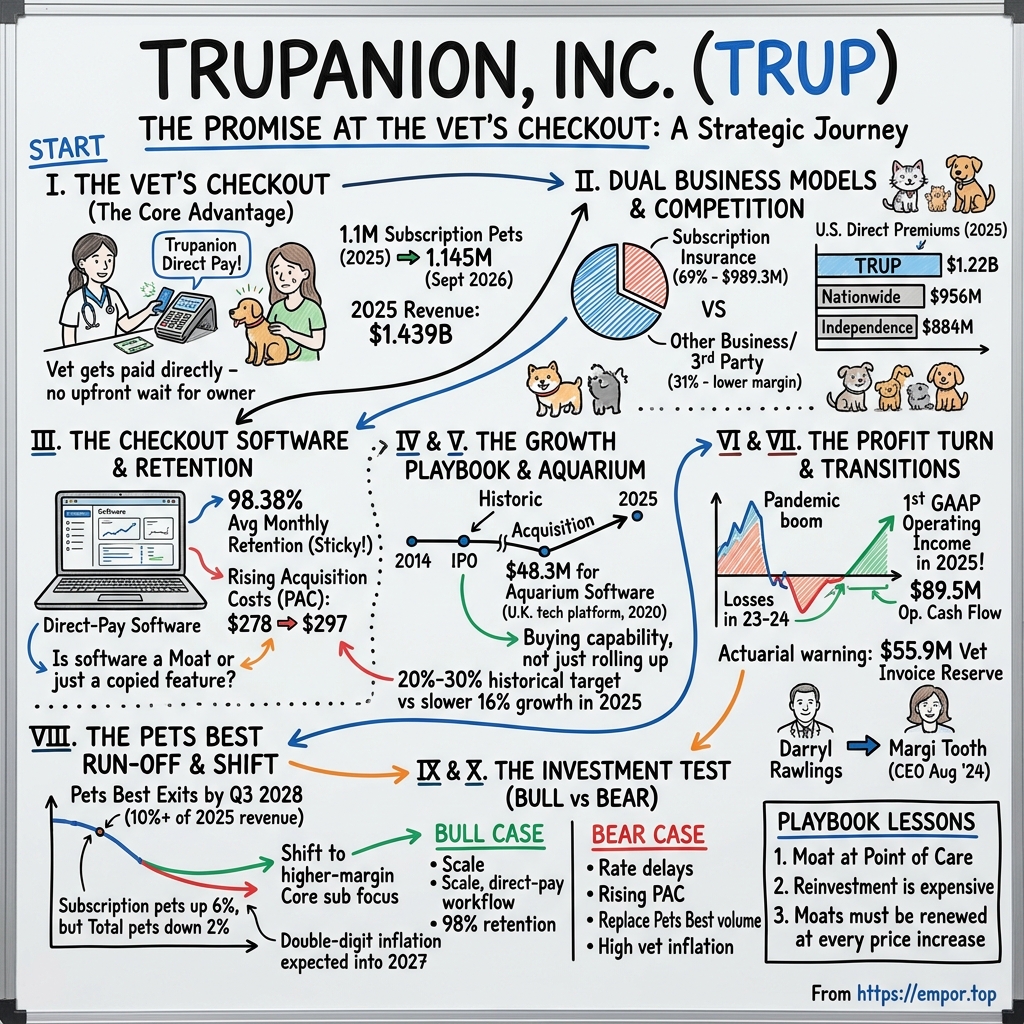
Trupanion, Inc.: The Promise at the Vet's Checkout
I. The Pet Insurer That Pays the Vet
It is late on a weeknight at an animal hospital somewhere in North America. A dog that ate something it should not have is in the back, sedated, and the family that brought it in is standing at the front desk under fluorescent light, looking at an estimate. The number on the page is large enough to change the shape of their month. In most of the pet insurance industry, the arrangement at this moment is the same: the owner pays the full bill tonight, on a credit card if they have the room, then submits a claim, waits, and hopes the reimbursement arrives in the amount they expected. The insurance, if they have it, is a promise about next month.
Trupanion was built around a different promise. When the hospital runs a Trupanion-insured pet through checkout, the vet can send the invoice straight to the insurer and be paid directly, so the owner covers only their share rather than floating the whole bill. The company has described itself as the only provider able to pay the veterinary invoice at the time of checkout, "often in seconds," doing away with what it called "the cumbersome reimbursement model."1 For the family at the front desk, the difference is not abstract. It is the difference between authorizing surgery and asking what the cheaper option would be.
That idea has carried a Seattle-based insurer a very long way. By the end of 2025, Trupanion had about 1.1 million pets enrolled in its core subscription business, and by September 2026 the figure had reached roughly 1.145 million.2 In 2025, total revenue was about $1.44 billion.3 It is the largest underwriter of pet insurance premiums in the United States.4 And for most of its public life, it lost money, or something close to it, while it chased that scale.
That is the tension at the heart of this story. Trupanion has always sold itself as a long-term compounding machine: acquire a pet once, keep it for years, and collect monthly premiums that grow as veterinary medicine grows. The question investors have argued about for a decade is whether that machine produces durable profit, or whether the costs of acquiring pets and paying for their care keep swallowing the revenue it generates. Only recently has the answer begun to tilt. The company moved into operating profit in 2025, after operating losses in 2023 and 2024, and in the first nine months of 2026 it earned about $21 million of net income, up from roughly $14 million a year earlier.32 A short record, but a real one.
To understand Trupanion, it helps to know that it runs two different businesses under one roof. The first, and the one the brand is built on, is the subscription business: pet owners who enroll directly, pay monthly, and stay for years. That is where the direct-pay software, the veterinary relationships and the retention all live. The second is what the company calls its "other business," mostly policies sold by third-party partners under their own brands, for which Trupanion acts as the underwriter.
That second business adds a lot of revenue and very little profit. In the third quarter of 2026, the subscription business turned about $288 million of revenue into roughly $45 million of adjusted operating income, while the other business turned about $118 million of revenue into less than $2 million.2 One is a franchise. The other is closer to a fee for lending out a balance sheet.
That distinction matters now more than ever, because the two businesses have begun to move in opposite directions. In the third quarter of 2026, subscription pets grew 6% from a year earlier. Total enrolled pets, counting the partner business, fell 2%, to about 1.63 million.2 The partner book is shrinking because Trupanion's largest distribution relationship, with Pets Best, is winding down. Subscription revenue grew 14% in the quarter, faster than pets, because prices kept rising to keep up with veterinary costs.25
So the story Trupanion now tells investors is a story about mix: a smaller, cleaner, more profitable company built on its own members, replacing a larger, thinner business it underwrote for someone else. Whether that story holds depends on three things the rest of this piece will test. Can the vet-centered service keep bringing in new pets at a sensible cost? Can retention hold while premiums rise at double-digit rates? And can a company that spent most of its life prioritizing growth over earnings show that its first profits are a beginning rather than a peak? To answer any of that, it helps to start with the bill itself, and with why the bill keeps getting bigger.
 Subscribe on LinkedIn
II. The Bill Arrives Before the Reimbursement
Picture the conversation in the exam room before the front-desk moment. The vet has the X-rays up. There is a plan: imaging, surgery, a night or two in hospital, medication afterward. Then there is the cheaper plan, and the much cheaper plan, and finally the decision nobody wants to name. Veterinary medicine has quietly become something close to human medicine over the past generation, with specialists, MRI machines, oncology and emergency hospitals open all night.
Owners have come to treat their pets like family. But unlike a human patient in most rich countries, a pet arrives with no default payer except the person holding the leash. The rise of corporate and private-equity ownership of veterinary practices has become one popular explanation for why those bills feel so much higher than they used to.6
Pet insurance is a bet that some meaningful share of owners would rather pay a predictable amount every month than face that exam-room choice cold. The bargain is simple to describe. A member pays a recurring premium. In return, the insurer pays a large share of the cost of covered illness and injury. Trupanion prices each policy according to the pet's characteristics, such as species, breed, age and location, and the coverage the owner chooses, bills members monthly, and recognizes the revenue over the term of the contract.3 There is no long contractual lock-in beyond the policy itself: a member can stop paying and leave.3
The economic logic of the product is what Trupanion's management calls a cost-plus model. On the third-quarter 2026 earnings call, CEO Margi Tooth used exactly that phrase.5 The company aims to pay out roughly 70 cents of every subscription revenue dollar in veterinary invoices, a ratio it calls its "value proposition," and in the third quarter of 2026 the figure was 69.7%, against 70.1% a year earlier.5 Think of it as a promise to members that the insurer will not hoard their premiums: if vet bills rise, prices rise with them, and the insurer's own slice, about 30 cents, has to cover acquisition, servicing, overhead and profit.
A worked example makes the promise concrete. In the third quarter of 2026, the average subscription pet brought in about $89 a month, a little over $1,000 a year.2 If the model works as designed, roughly $750 of that goes back out the door to veterinary hospitals, and about $300 is left to pay the territory partners and marketing that won the member, the staff who service the account, the software that pays the invoice, and finally the shareholders. That last slice is thin, which is why every point of payout ratio matters so much. A payout ratio one point above target, sustained across a million pets, removes about $10 million a year from the company's earnings.
That design has a sharp edge. Because the payout ratio is meant to be stable, the company's revenue per pet is effectively chained to the cost of veterinary care. When veterinary inflation runs hot, as it has for the past several years, Trupanion has to raise prices, and every price increase is a moment when a member can decide the policy is no longer worth it. Insurers in most lines live with this tension.
But in pet insurance the customer is unusually exposed: no employer pays part of the premium, no government mandates coverage, and the household budget is the only safety net. Owners' ability and willingness to absorb higher premiums is the ceiling on how fast the insurer can pass through rising costs. And because Trupanion's insurance subsidiaries are regulated by state and provincial authorities, it cannot simply reprice on its own timetable: rate changes need regulatory approval, which can leave pricing trailing behind claims costs for a while.3
In 2025, the subscription business produced about $989 million of Trupanion's roughly $1.44 billion in revenue, close to seven of every ten dollars.3 The other business, about three dollars in ten, consisted mostly of annual policies sold through unaffiliated general agents, which Trupanion underwrites and recognizes evenly over each policy's 12 months.3 Those agent-sourced premiums are structurally lower-margin, because the partner owns the customer relationship and keeps much of the economics. The subscription business is where Trupanion earns a return on its own brand.
Seen from a distance, the market itself is still young. Only a small minority of North American pets are insured, which is why every pet insurer's investor presentation features a slide about "low penetration." That observation is true and also slippery: low penetration can mean a large untapped market, or it can mean that most owners have looked at the price of coverage and decided to self-insure. Both are probably part of the answer.
What is not in doubt is who leads. In 2025, Trupanion wrote about $1.22 billion of U.S. direct premiums, the most of any pet insurer according to AM Best's ranking. Nationwide, the long-time market leader, wrote about $956 million, and the Independence group, which consolidated several fast-growing brands, wrote about $884 million and climbed rapidly to third.4 The ranking captures something worth pausing on. Trupanion leads by a margin of roughly a quarter over its closest rival, not by multiples. And it is worth noticing that "direct premiums written" counts the business Trupanion underwrites for partners as well as its own members. Some of Trupanion's lead is the partner business that is now winding down.
Leadership in a growing, underpenetrated category is not the same as pricing power or durable returns. In insurance, a large premium base can be bought by underpricing risk, and an insurer can grow its way into a bad book. Growth is only valuable if four things stay in balance at once: premiums high enough to cover claims, retention high enough to recover the cost of acquiring each member, acquisition costs low enough to justify that recovery, and regulators willing to approve price changes in time. Trupanion's history is essentially a long experiment in keeping those four plates spinning.
That raises the obvious question. If the product is, at bottom, an insurance policy that pays a share of vet bills, and if Nationwide, Independence and a crowd of others sell something similar, why would a pet owner, or a veterinarian, choose Trupanion at all? The company's answer has always been that the policy was never the whole product. The real product was what happened at the checkout desk.
III. The Checkout Software Was the Bet
The scene that defines Trupanion is not in a boardroom or a trading floor. It is direct pay at checkout, built into a veterinary hospital's own software. When the company announced a partnership with Vetter Software in June 2020, it described an integration that put what it called its patented direct-pay software inside a cloud practice-management system already used by more than 1,300 clinics.1 That is how direct pay spreads: one practice-management system, one hospital, one front desk at a time.
The founding insight goes back further, and it is personal. Darryl Rawlings has told the story of being about 13 or 14 years old in Vancouver when his family's two-year-old dog, Mitzi, suffered a twisted stomach. At a specialty hospital, the vet said she needed surgery quickly. The family could not pay, and they left without her.7 Rawlings went on to build and sell a cigar business, used the proceeds to fund his new idea in 1998, and issued the first policy to his own dog, Monty, in 2000.7 The company was founded in Canada as Vetinsurance Ltd., began doing business as Trupanion in 2007, and enrolled its first U.S. pet in 2008.8
What Rawlings took from that childhood night was not simply that pets should be insured. It was that the reimbursement model fails at the precise moment it matters most: when a family has to pay first and be repaid later, the insurance cannot help a family that cannot pay first. Trupanion's ambition was to make pet coverage feel more like human health insurance, where the provider is paid and the patient is not asked to float the bill.
In an interview in 2017, Rawlings described the business as "an acceptance game," meaning acceptance by veterinarians, and summarized his pricing philosophy with a line about the two things you do not want cheap in life: "sushi and health insurance."7 By the time of the 2014 IPO filing, the company was pitching a new technology called Trupanion Express, "designed to facilitate the direct payment of claims to the veterinarian."8
The vet is the hinge of the strategy. Trupanion built its distribution around veterinary hospitals, with field representatives, called territory partners, cultivating relationships with clinics so that the vet recommends Trupanion when a new puppy comes in. By early 2014, the company said it was receiving referrals from more than 5,000 veterinary practices.8 The logic is attractive: the vet is the most trusted voice in the owner's pet-care life, and a vet who gets paid quickly and without paperwork has a reason to keep recommending the insurer that makes that possible. On the third-quarter 2026 call, Tooth said paying vets directly at checkout is a major reason the number of active hospitals using the company's software has been rising.5
The strongest evidence that the service is valued comes from members' behavior. In the third quarter of 2026, Trupanion's subscription business averaged about 98.4% monthly retention on a trailing 12-month basis, its seventh consecutive quarter of year-over-year improvement.25 Monthly retention numbers sound uniformly high, so they deserve translation. Losing about 1.6% of members each month means that over a year, roughly one member in five leaves. Put differently, the average member stays for something like five years. In a product with no contractual lock-in, sold to households facing steep and repeated price increases, that is a sign of genuine stickiness.
But retention is evidence, not proof of a moat. Trupanion does not publish how much of its loyalty comes from the direct-pay experience versus other forces. Some of it is plain satisfaction with having claims paid. Some is inertia. And some is a structural switching cost common to the whole industry: once a pet develops a chronic condition, a new insurer will usually treat it as pre-existing and exclude it, so an owner who leaves loses coverage for exactly the condition they most need covered. That trap works for Nationwide and Independence as well as for Trupanion. Nor do competitors publish comparable retention figures, so there is no clean way to show that Trupanion's members are stickier than anyone else's.
The competitive test, then, is whether direct pay is a moat or a feature. Nationwide brings a national insurance brand and employer distribution. Independence brings a portfolio of consumer brands and aggressive growth. Any of them could, in principle, build or license point-of-sale payment technology. Trupanion's defense is that its software is patented, that it has spent years integrating into practice-management systems, and that vets are reluctant to learn multiple systems. Those are plausible advantages. They are not yet demonstrated advantages, because the company does not disclose what share of claims are paid at checkout or how many hospitals actively use the software, so outsiders cannot measure how deeply the workflow is embedded.
The second test is cost. Every pet Trupanion enrolls has to be paid for up front, through territory partners, marketing and promotions, and that cost is recovered only over the years a member stays. In the first nine months of 2026, the average pet acquisition cost, which Trupanion calls PAC, was $297, up from $278 a year earlier.2 That rise cuts against the idea that a vet-referral engine scales at a stable cost.
The quarterly path is more nuanced. PAC climbed to about $320 in the fourth quarter of 2025, then fell each quarter to $279 by the third quarter of 2026, below the $290 of a year earlier.2 Finance chief Fawwad Qureshi credited higher conversion of leads into enrolled members.5 Gross additions in the quarter rose about 14% year on year, the strongest increase since 2023, and net new subscription pets were up more than 28%.5
Why does a few dollars of acquisition cost matter so much? Because the entire investment case is a ratio between what a member costs to win and what that member is worth over its life. Here is a rough version using the company's own figures. In the third quarter of 2026, the subscription business earned about $45 million of adjusted operating income, before acquisition costs, across roughly 1.14 million pets.2 That is about $13 a pet each month, or around $160 a year.
With a member staying about five years on average, a pet acquired for about $300 generates something like $800 of pre-acquisition profit over its life, before discounting for time and before the stock compensation the adjusted figure leaves out. On that arithmetic, a well-retained pet pays back its acquisition cost roughly two and a half times over. On the second-quarter call, Tooth said the lifetime value of an enrolled pet had risen 25%.9 The arithmetic is why management has always wanted to spend more on growth. It is also why the arithmetic is fragile: shave a year off the average member's life, or let the payout ratio drift a couple of points, and the multiple compresses quickly.
So the evidence lands in an honest middle. The retention data and the active-hospital trend support a real service advantage at the vet's checkout. The rising nine-month acquisition cost, the absence of peer comparisons and the lack of disclosure on direct-pay usage mean the durability of that advantage is unproven rather than refuted. The question that matters is simple to state: can a vet-centered service bring in pets efficiently enough to justify the years of premiums that follow? For most of the company's public history, management answered that question with an aggressive growth target.
IV. The Growth Machine Promised 20 to 30 Percent
In 2014, when Trupanion filed to go public, it was a specialist insurer with about 182,000 enrolled pets and full-year 2013 revenue of roughly $84 million.8 It had come from a long way back: on the first day of 2010 it had about 31,000 pets.8 The IPO turned a niche Canadian-born insurer into a public growth story, and for the next several years it behaved like one.
Revenue climbed from about $116 million in 2014 to $188 million in 2016.10 By 2018, it had reached about $304 million.11 By 2020, the year of the pandemic, it was about $502 million.311 Subscription enrollment told the same story: from roughly 31,000 pets in 2010 to about 1.1 million at the end of 2025, which the company describes as a 25% compound annual rate.12
The engine behind that run had a few moving parts that fed each other. Geographic reach expanded from Canada into the United States and eventually into parts of continental Europe; by the third quarter of 2026 the subscription base included about 66,000 pets in Europe.5 Veterinary referrals generated leads. High retention meant each cohort of pets kept paying for years.
And management reinvested whatever the existing book produced into acquiring the next cohort. The company's preferred measure of its own performance was not GAAP net income but adjusted operating income, which adds back the cost of acquiring new pets, along with stock compensation and other items. That choice encodes a worldview: acquisition spending is investment, not expense, and should be judged by the return it earns over a pet's life.
The culture behind the engine was unmistakably the founder's. Rawlings talked about "10-year moonshots" and about pricing across roughly 1.2 million categories of pet, breed, age and location, a granularity that he argued let Trupanion charge each member a fair price rather than an average one.7 That data advantage was real and compounding: every claim paid added to the pricing model, and a company that had paid invoices for decades in some regions knew things about the cost of treating a ten-year-old Labrador in a particular city that a newcomer could only estimate. Rawlings was also unusually willing to tell investors to judge him over a decade rather than a quarter, which bought patience in the good years and tested it in the bad ones.
Management made the ambition explicit. On the fourth-quarter 2018 earnings call, the company described a goal of 20% to 30% annual revenue growth, while expanding adjusted operating income and reinvesting in new pets at a targeted internal rate of return of 30% to 40%.11 It was an engineer's version of a growth story: if each pet acquired returns 30% or more on the money spent to win it, then spending as much as possible on acquisition is the rational choice, and GAAP losses are merely an accounting artifact of growing fast.
That 2018 call makes a useful credibility baseline, because the outcome can now be measured. The revenue part largely happened for a while. From about $304 million in 2018 to more than $1 billion by 2023, revenue more than tripled in five years, which works out to growth well inside the target range.113 But two things diverged from the promise.
The first is the rate today. Total revenue growth in 2025 was 16%, below the bottom of the old range.12 Management's 2026 guidance, given on the third-quarter call, pointed to total revenue of about $1.59 billion to $1.60 billion, roughly 11% growth, with subscription revenue up about 14% at the midpoint.5 Some of the slowdown is mechanical, the partner business shrinking as Pets Best winds down. Some is the law of large numbers. Either way, the company of 2026 is not the 20%-to-30% grower of 2018.
The second divergence is more important. The growth engine was supposed to produce expanding profits along the way. Instead, as the next chapters show, Trupanion reported operating losses in 2023 and 2024, years after the call that promised expanding operating income.3 Revenue kept growing, but the economics of the book deteriorated as veterinary inflation outran the company's pricing.
It would be unfair to read this as a single broken promise. Growth did continue for years, and the 30%-to-40% return target applied to the internal economics of acquiring pets, which management could argue were sound even when consolidated earnings were not. But there is a pattern worth naming. Trupanion's growth narrative leaned heavily on non-GAAP measures that excluded acquisition costs, and those measures stayed positive while the company's reported profits did not. Reaching sustainable GAAP profit proved slower and harder than that narrative suggested, because the assumption underneath it, that pricing would keep pace with the cost of care, turned out to be fragile when veterinary inflation accelerated. An investor who took the 2018 framework at face value got the revenue growth and missed the earnings.
That gap between top-line momentum and bottom-line proof shaped what management did next. As the company grew, it began to treat technology itself as part of the core, not just something supplied by partners like Vetter. In the autumn of 2020, it went shopping.
V. Aquarium Cost $48 Million—and Bought a Software Platform
On October 30, 2020, Trupanion closed its acquisition of Aquarium Software Limited, a U.K.-based provider of insurance software.13 It was not the kind of acquisition that makes headlines. Aquarium was a back-office company: its software helps insurers run policy administration, claims and the plumbing of an insurance operation. Trupanion paid about $48.3 million in cash, net of the cash Aquarium held.13
The timing matters. That same month, Trupanion also closed a $200 million equity investment from Aflac, the supplemental insurer, which is the subject of the next chapter. The company was flush, the pandemic had sent pet adoption and pet spending soaring, and management was investing with confidence. Aquarium was the capability purchase that came with that confidence.
The rationale was straightforward. Trupanion's whole proposition rests on software: pricing by pet, processing invoices fast enough to pay vets at checkout, and administering policies across countries and regulators. Buying Aquarium gave the company its own insurance software platform, its developers and its technology, rather than depending entirely on outside vendors. The acquisition note says the pet-space technology and personnel were expected to improve Trupanion's back-end software.13 In principle, this was a buy-the-team-and-the-tools deal that could support new products, new geographies and more automated claims handling.
Measured against Trupanion itself, the price was material but not reckless. At $48 million, it amounted to roughly a tenth of the company's 2020 revenue.133 Of the purchase price, about $31 million was booked as goodwill, the premium paid above identifiable assets, and about $20 million as amortizable intangibles such as developed technology, customer relationships and the trade name, with a weighted average life of about five years.13 Aquarium's results were immaterial to Trupanion's consolidated results.13 In other words, Trupanion bought Aquarium for what it could do, not for the revenue it brought.
What the public record can and cannot settle is worth being precise about. The purchase accounting relied on discounted cash-flow forecasts for revenue growth, margins, customer attrition and discount rates.13 Trupanion did not disclose a revenue multiple for the deal, and it does not report Aquarium as a separate segment with its own revenue or profit. So the filings cannot show that the company overpaid, and they cannot show that the acquisition earned its cost. Anyone who claims certainty in either direction is guessing.
The better test is whether the capability shows up in the core. Here there are some clues. Technology and development expense rose from about $21 million in 2023 to about $38 million in 2025, and the company described 2025 capital spending as primarily software for member experience, claims processing and policy management.123
On the third-quarter 2026 call, Tooth said the share of claims handled through automation had climbed from under 15% in 2020 to over 65%.5 That is a striking change in how the company works. Not all of it can be traced to Aquarium; Trupanion was investing in technology through many channels. But faster, cheaper claims processing is exactly what a software purchase like this was meant to enable, and it supports the checkout promise that gives the brand its identity.
This is the main M&A story in Trupanion's history, and it is not a roll-up. The company has not built itself by buying competitors; its growth has been overwhelmingly organic. That restraint is worth noting, though it should not be overstated. The company has also made smaller bets that are harder to evaluate, including the investment in Baystride, which appears later in a quieter place: as a one-time gain in the 2025 income statement.
And management has funded adjacent ventures such as Landspath, a pet-food initiative that has not yet produced meaningful revenue. The fair verdict on Aquarium is narrower than either a bull or a bear would like: a plausible, modestly sized capability purchase, connected to the core, whose return is visible only indirectly, in claims automation and in the software behind direct pay.
What Aquarium could not do was solve the larger problem. A better back office can make an insurer more efficient. It cannot make an insurer profitable if the price of care is rising faster than the price of coverage. That problem was about to arrive, hidden at first by the biggest boom in pet ownership in a generation.
VI. The Pandemic Boom Hid a Harder Question
In the autumn of 2020, the world was stuck at home, and many people decided it was the right time to get a dog. For a pet insurer, it looked like a gift: a flood of new owners, many of them young, buying puppies and kittens at precisely the age when insurance is cheapest to start. Trupanion's enrollment soared, and its share price followed. In October 2020, Aflac agreed to buy up to about 3.64 million newly issued Trupanion shares at $55 apiece, an investment of about $200 million that would leave it with roughly 9% of the company.1415 Aflac agreed not to sell the shares for three years and to keep its ownership below 10%.14
The deal was partly a capital raise and partly a distribution alliance. Aflac would offer Trupanion's insurance at U.S. worksites through its agents and brokers, and the two companies would explore pet insurance in Japan.15 In return, Trupanion agreed not to develop a competing third-party worksite pet benefit in the United States or Japan.15 Founder Rawlings said the company was "excited to enter the worksite."15 Aflac still held about 8% of the company in April 2026.16
Three things are worth saying about that financing. It strengthened Trupanion's balance sheet at a moment of uncertainty, which was sensible. It diluted existing holders, which is the price of any equity raise. And it was a capital raise, not evidence that the operating model had matured. A large, sophisticated insurer paying $55 a share was a vote of confidence, but it was a vote on the future, and the future proved harder than the price implied. Shares traded at about $35.56 on November 20, 2026, well below the price Aflac paid six years earlier.17
The harder question arrived gradually. Revenue kept rising, from about $502 million in 2020 to more than $1 billion by 2023.3 But Trupanion reported operating losses in 2023 and 2024.3 How does a company double its revenue in three years and lose money doing it?
The answer is in the cost-plus model: veterinary costs rose quickly after the pandemic, and by 2026 management was still describing veterinary inflation as roughly double-digit.9 Claims severity, the average cost of each claim, rose with them. Regulatory approvals and renewal timing can delay price increases, leaving them lagging behind claims costs. For a period, the company was paying 2024 vet bills with prices set on 2022 assumptions. Whenever that happens, claims eat into the 30 cents the model reserves for everything else. At the same time, the company kept spending to acquire new pets, because that was the growth playbook. Higher claims plus sustained acquisition spending meant losses.
It is worth separating cash timing from earnings quality here, because insurance accounting blurs them. Premiums arrive before claims are paid, and reserves for invoices not yet received are estimates. In any given year, growing deferred revenue and rising liabilities can make cash flow look healthier than earnings. Operating cash flow was positive throughout, about $19 million in 2023 and $48 million in 2024.3 But that does not change the underlying verdict: the claims experience and the cost of acquisition determined the economics, and for those two years they produced losses.
It was in the middle of that struggle that the company changed its leader. Darryl Rawlings, who had run Trupanion since issuing that first policy to Monty, retired as chief executive in August 2024.3 He stayed on the board and continued to work with the company on its pet-food initiative under a consulting agreement that paid him $200,000 in 2025, and his father received payments of about C$230,000 as a territory partner; the proxy disclosed both related-party arrangements.16
The successor was Margi Tooth, who had joined Trupanion in 2015 and had led revenue delivery, the part of the business responsible for bringing in and keeping members.12 Where Rawlings was the founder with the origin story and the long-horizon vision, Tooth came to the job as an operator, the executive who had run the growth engine whose economics now needed fixing.
Her first full year as chief executive brought a turn. In 2025, Trupanion reported operating income, its first after two years of operating losses.3 The change came largely from pricing catching up with the cost of care: by the third quarter of 2026, Tooth said on the earnings call that pricing had "caught up for the most part."5 The company also introduced new coinsurance and deductible options, which give members more ways to manage their premiums and, Tooth said, appeared to be helping conversion.5
One profitable year cannot settle whether the economics are durable. Profits arrived after a period of aggressive price increases, and the question is whether those increases were a one-time catch-up or a recurring necessity. Management's own guidance points to the second: Tooth said she expects double-digit veterinary inflation to continue into 2027, and that "our pricing assumes that."5 So the business crossed into GAAP operating profit just as it began changing its growth mix, and the first profits came with complications worth unpacking.
VII. The First Profits Came With a Claims Reserve Attached
The 2025 annual report confirmed the return to operating profit. For a company whose stock had spent years as a battleground between believers in the compounding story and skeptics of its economics, that was a big moment. The skeptics' core argument, that the business would never earn its keep, had been dented. But the details of how 2025 looked so much better show how much of the improvement is repeatable and how much belongs to that year.
Start with cash. Operating cash flow rose from about $19 million in 2023 to $89.5 million in 2025.3 That is a real improvement: nearly five times the 2023 level in two years. Part of it came from better operating results, as pricing caught up with claims. But part came from working-capital timing. In 2025, deferred revenue added about $19 million to operating cash flow, and accounts payable, accrued and other liabilities added about $26 million.3
Those are not fake cash. Deferred revenue grows when premiums are collected ahead of coverage, which is normal for a growing insurer. But they are not pure earnings either, and they can reverse if growth slows or payment timing changes. A plain reading is that cash conversion was strong in 2025 partly because the book was growing and collecting money ahead of service.
Next, the income statement below the operating line. Other income rose from about $8 million in 2023 to about $22 million in 2025.3 About $12 million of it was interest income on the company's cash and investments, which is a recurring feature of an insurer that holds premiums before paying claims, but one that depends on interest rates. Another $7.8 million was a realized gain from exchanging Trupanion's preferred stock in Baystride for intellectual property.3 That gain helped pretax income, but it is not underwriting profit, and it will not repeat. An investor looking at 2025 earnings should mentally set it aside.
Then there is the reserve, the most important accounting judgment in any insurance company. At the end of 2025, Trupanion held a $55.9 million reserve for veterinary invoices: an estimate of what it will owe for care already delivered but not yet invoiced or processed.3 It is the insurer's best guess at bills still in the mail. Because that estimate relies on actuarial models of how claims develop over time, Trupanion's auditor flagged it as a critical audit matter, meaning the area involved especially challenging judgment.3 The auditor still issued clean opinions on the financial statements and internal controls.3
The reserve's history is reassuring so far. The reserve set at the end of 2024 developed favorably by about $2.5 million, which means actual bills came in slightly below the estimate.3 Favorable development is what conservative reserving looks like. But it is a single year, and the direction can change; in the third quarter of 2026, the company reported about $0.6 million of adverse prior-period development in the subscription business, a small amount but a reminder that reserves move both ways.5 Reserve releases can flatter earnings, and reserve strengthening can hurt them, which is why the long-run pattern of development matters more than any single year.
One more balance-sheet line deserves a glance because it connects to the partner business. Receivables were about $302 million at the end of 2025, up from about $274 million a year earlier, against a credit-loss allowance of only about $1.3 million.3 Most of those receivables sit in the other business, where general agents pay monthly on annual policies.3 The tiny allowance suggests collections have been reliable, but Trupanion does not publish an aging table, and with one agent accounting for more than a tenth of revenue, the collection risk is concentrated in a counterparty whose relationship is now ending. A run-off is exactly the period when a partner has the least reason to be generous about payment timing, so the receivable line is worth watching through 2028.
The 2026 results offer partial confirmation that the turn is real. In the first nine months of 2026, net income reached about $21 million, up from about $14 million in the same period a year earlier, and free cash flow reached about $61 million, up from $50 million.2 Operating income for those nine months was about $21 million, roughly three times the year-earlier figure.2 In the third quarter alone, adjusted operating income exceeded $47 million, which Tooth called an all-time high, and free cash flow of about $28.5 million was a record.52 Management guided to full-year 2026 adjusted operating income of $179 million to $182 million, roughly 19% growth at the midpoint.5
Two caveats temper that confirmation. The adjusted figure excludes the cost of acquiring new pets, about $66 million in the first nine months of 2026, along with stock-based compensation of about $27 million.2 Stock compensation is a real cost to shareholders, paid in dilution rather than cash, and acquisition spending is a real cost even if it is an investment. The gap between $130 million of nine-month adjusted operating income and $21 million of GAAP operating income is the cost of those choices.2 Neither number is wrong. But the GAAP number is the one that has only just turned positive, and it is still thin relative to $1.2 billion of nine-month revenue.
The profit is also attached to a shifting base. The subscription book is growing and earning more each quarter. The partner book, which still supplies close to three in ten revenue dollars, is in the middle of a transition that will remove one of the company's largest distribution relationships. So the obvious question is what happens to the company's economics when that relationship ends.
VIII. Pets Best Is Leaving, and Total Enrollment Is Falling
On August 5, 2026, near the end of his prepared remarks on the second-quarter call, Fawwad Qureshi slipped in a sentence that would reshape how investors read the company's numbers: Trupanion had agreed with Pets Best "to conclude our relationship following the third quarter of 2028."9 Three months later, on the third-quarter call, he added detail: the transition was underway, with the existing book of business beginning to move to a new underwriting partner in the fourth quarter of 2026, which he called "a meaningful step towards the ultimate runoff of the business."5
To understand why that matters, it helps to see what Pets Best was to Trupanion. Pets Best sells pet insurance under its own brand; Trupanion underwrote those policies, taking the insurance risk and booking the premiums in its other business segment. In 2025, premiums sourced by general agents accounted for about 30% of Trupanion's total revenue, and one general agent's members alone produced more than 10% of total revenue.3 The company does not name that agent, but the scale of the Pets Best relationship makes the inference natural. This is real distribution concentration, even though the policyholders are individual pet owners.
The economics are the key point. In the third quarter of 2026, the subscription segment supplied about 71% of revenue and the other business about 29%.2 But the margin difference is stark. The other business turned about $118 million of quarterly revenue into roughly $1.6 million of adjusted operating income, a margin of about 1.4%.2 Subscription turned about $288 million into about $45 million, a margin near 16%.2 On a GAAP basis, the other business lost about $1.9 million in the quarter.2 Losing it therefore takes away a lot of revenue and very little profit. If the capital that supported the partner book can be redeployed, or released as dividends from the insurance subsidiaries, the run-off could even help returns.
But the run-off does not come free. The partner business spreads fixed costs, including technology, claims operations and overhead, across a larger book. It contributes to the premium volume behind Trupanion's AM Best ranking. And it masks the core trajectory. Total enrolled pets fell 2% to about 1.63 million in the third quarter of 2026, as Pets Best-related pets ran off, while subscription pets rose 6% to about 1.145 million.2 Investors who watch the headline count will see a shrinking company. Those who watch the subscription count will see a growing one. The truth is that Trupanion is becoming a different company, smaller in pets but potentially better in quality.
The replacement task is concrete. Over the next two years, the company needs subscription growth to replace not the partner book's profit, which is small, but its scale and the operating leverage it provided. That requires sustaining net new subscription pets at a pace well above recent history. The third quarter was encouraging: about 20,500 net new subscription pets, up more than 28% from a year earlier.5 Nearly 50,000 net subscription pets were added in the first nine months of 2026.5
The Q&A on the third-quarter call offered a direct test. Asked about the outlook for veterinary costs, Tooth said, "We are expecting to see continues of double-digit inflation in 2027," adding that "we see nothing to expect that to be easing. Our pricing assumes that."5 She also said she expects the average rate increase for members to ease in 2027, because pricing has largely caught up.5 That combination is the bet in a sentence: costs keep rising at double digits, while member price increases moderate.
If both hold, the payout ratio stays near 70% and retention holds. If costs outrun prices again, the company is back in the 2023 squeeze. Qureshi said the third quarter's price increases were the lowest since 2023, and that gross additions were closing the gap with pricing as a revenue driver.5 That is the shift investors should want to see: growth coming from more pets rather than higher prices.
Capital allocation has also turned. On the second-quarter call, alongside a $44 million dividend from the U.S. insurance subsidiary approved by New York regulators, the board authorized up to $100 million of share repurchases, with no expiration date.9 In the third quarter, the company bought back about 830,000 shares for about $25 million.5 This was new behavior: Trupanion had made no repurchases in 2024 or 2025.3
Debt stood at about $112 million at the end of 2025, on a floating-rate facility with PNC, and about $105 million at the end of the third quarter of 2026, with a further $15 million repaid after the quarter.35 The company's U.S. insurance subsidiary held about $275 million of statutory capital, comfortably above its regulatory action level of about $106 million.3 But statutory rules limit how freely cash can move from the insurance entities to the parent, so not all the cash on the balance sheet is available for buybacks.3
Management's incentives are designed to reward the kind of value creation the buyback implies. Tooth owned about 207,000 shares as of April 2026, roughly half a percent of the company.16 Her 2025 long-term incentive program granted restricted stock units based on growth in a modeled measure of intrinsic value per share, with no long-term awards to named executives if that measure grew 10% or less.16 That design ties pay to per-share growth rather than raw revenue, which is a sensible choice. But a modeled intrinsic value depends on assumptions about retention, payout ratios and lifetime value, which management itself sets. The measure can reward improvements in the model as much as improvements in the business.
The shareholder register helps explain why the board has room to think long-term. No one controls Trupanion. As of April 2026, the largest holders were index and active institutions, BlackRock at about 12%, Capital World Investors at about 9%, Vanguard at about 8%, alongside Aflac at about 8%, Felix Holdings at about 10% and Nielsen Capital Management at about 7%.16 That is a register of patient, concentrated owners rather than a single dominant family or sponsor, which means management answers to institutions that can vote against it but rarely need to.
Shareholders were not troubled. At the June 2026 annual meeting, the say-on-pay vote passed with about 30.4 million votes in favor and about 531,000 against.18 Every director nominee, including Rawlings and Tooth, was elected comfortably.18 Overwhelming approval is a sign of investor comfort, but it does not settle whether the incentive measure rewards durable underwriting results.
Then there is Landspath, the pet-food venture. Tooth said on the third-quarter call that limited trials had begun, with a launch expected around the middle of 2027, and that she expects "very limited revenue" over the next 18 months.5 Qureshi had said earlier in the year that the company did not anticipate any meaningful revenue contribution from it in the current strategic plan.9 It is an option, not a second business, and should be valued as one. Companies that pursue adjacent businesses while their core is in transition run the risk of distraction, and Trupanion's record of turning ventures into revenue is thin.
So the company stands at a crossroads it chose. It is giving up scale for quality. Whether that trade looks wise in 2028 depends on whether the moat around the subscription business is as strong as management believes.
IX. Analysis & Bear vs. Bull Case
The third-quarter 2026 numbers capture the whole debate in a single quarter: subscription pets up, total pets down, revenue per pet up, acquisition cost down for the quarter but up for the year, retention at a multi-year high. Bulls and bears look at the same quarter and see different companies.
The bull case is clean. Trupanion leads U.S. pet insurance premiums.4 Subscription enrollment is still growing, and growing faster: net additions rose more than 28% in the third quarter.5 Retention remains near 98% a month and is improving.2 The direct-pay workflow solves a genuine problem at the moment that matters most. The run-off of the low-margin partner business will leave a higher-quality company. And the stock, at about $1.54 billion of market value on November 20, 2026, traded at roughly one times trailing revenue and about 18 times trailing free cash flow.1917 If subscription growth holds in the low to mid teens and margins expand, the bull argues, that price underestimates the value of a growing book of loyal members.
The bear case is equally clear. Nationwide remains close, and Independence is growing quickly.4 Part of Trupanion's lead comes from the partner business now leaving. Pet acquisition costs were higher year on year for the first nine months of 2026.2
Revenue growth has relied heavily on price increases, and management expects veterinary inflation to stay in double digits.5 The GAAP profit record is less than two years long, and the stock trades at about 58 times trailing earnings, a multiple that assumes much more profit than the company has yet earned.17 The bear's worry is that the company's improved economics are a product of a pricing catch-up rather than a lasting change, and that the next bout of cost inflation will bring back the squeeze.
The industry structure helps judge which story is more plausible. Start with buyers. Pet owners can compare policies online in minutes and cancel at any time, which gives them power before they enroll. But once a pet has a health history, pre-existing-condition exclusions make switching costly, which shifts power back to the insurer. Veterinarians are an important second kind of buyer: they do not pay premiums, but they influence referrals, and Trupanion's workflow gives them a reason to favor it.
Suppliers, in the form of veterinary hospitals that are increasingly consolidated, set the prices of care, and Trupanion has little power over them; it can only pass their costs on. Rivalry is real and well-funded, from Nationwide's brand to Independence's portfolio. The threat of new entrants is moderate: insurance requires capital, regulatory approval and actuarial data, but large insurers and insurtechs have entered repeatedly. Substitutes, mainly self-insurance through savings or credit, are always available and become more attractive with every price increase.
In Hamilton Helmer's framework of durable advantages, Trupanion's claim rests on three powers. The first is switching costs, which are real but industry-wide, because pre-existing-condition exclusions trap members of every insurer. The second is a form of process power in direct pay and claims automation, which is plausible but not proven, because the company does not disclose how many claims are paid at checkout. The third is scale economies in pricing data, built from more than two decades of claims across breeds, ages and regions, which matters but is matched in part by the largest rivals.
Network effects are limited: more hospitals using the software makes Trupanion more attractive to owners in those areas, and more members make the software more useful to hospitals, but the loop is local and modest. Brand is meaningful among veterinarians, less clearly so among consumers. Counter-positioning was once Trupanion's biggest edge, because rivals built on reimbursement could not easily adopt direct pay without rebuilding their operations, but that advantage erodes with time as technology spreads.
The honest verdict is that the moat is credible but narrower than the bull case claims. Trupanion has a real service advantage at the point of care and a real data advantage in pricing. It does not yet have proof that those advantages produce durable, above-average returns through a full cycle of cost inflation. The history narrows the claim: Trupanion has a sticky product and a strong position, but its profitability depends more on pricing discipline than on any structural barrier.
Three numbers will test that verdict. The first is whether subscription pet growth, now about 6% a year, accelerates as gross additions improve.2 The second is whether monthly retention, now about 98.4%, holds as prices rise.2 The third is the payout ratio, now 69.7%, and whether it stays near the 70% target as veterinary inflation continues.5 A company with rising pets, stable retention and a steady payout ratio is compounding. A company with any of those moving the wrong way is not.
A skeptical activist would press on a handful of points, each grounded in the company's own disclosures. The first is stock compensation. In the first nine months of 2026, stock-based compensation was about $27 million, larger than the company's entire GAAP operating income of about $21 million over the same period.2 Equity pay is part of why adjusted profit looks so much healthier than reported profit, and the buyback partly offsets dilution that the compensation creates. The second is related-party flows: payments to the founder's consulting arrangement and to his father as a territory partner are small relative to the company, but they are the kind of ties a governance-minded holder would want reviewed every year.16
The third is focus. With a partner book running off, a new digital product the company says is due to launch, a coinsurance rollout under way and a pet-food venture in trials, management has several initiatives competing for attention and capital at the same moment.5 And the fourth is disclosure. The disclosure gap around direct-pay usage remains, and an investor is entitled to ask why.
Regulation and solvency belong in the analysis because they work through specific mechanisms. Rate approvals can delay repricing, as they did during the 2023 squeeze. Statutory capital rules constrain cash movement from insurance subsidiaries, as the approved $44 million dividend illustrated.9 And the company's exposure to Canada, which supplies about 16% of revenue, brings currency risk, though costs in Canadian dollars provide a natural offset that limits the net effect.3
On valuation, false precision helps no one. The market price implies an expectation that Trupanion's profit margins will expand significantly from their current thin level. At about 18 times free cash flow, the market is not paying a wild premium for the cash the company generates; at about 58 times earnings, it is paying a large premium for the earnings it reports. That gap reflects the company's heavy reinvestment in acquisition and its non-cash stock compensation. Neither multiple settles the moat question. The market is betting that the long-promised compounding finally shows up in the income statement.
X. Playbook: Business & Investing Lessons
Go back to the front desk one more time. The receptionist submits the invoice. The family pays its share. The dog goes home. For a few minutes, insurance works the way it is supposed to, as a promise kept at the moment it is tested. Trupanion's whole business is built on that moment, and the lessons it teaches come from the distance between that promise and the economics behind it.
The first lesson is that making the hardest moment easier can buy loyalty. Trupanion's direct-pay design goes straight at the night Darryl Rawlings remembers from his childhood, and the high monthly retention suggests members value it.2 But loyalty is not unconditional. It has to coexist with premiums that rise every year, and a family that can afford the policy in 2024 may not be able to in 2027. The wider lesson for founders is that solving the most painful moment in a customer's experience creates stickiness, but stickiness has a price ceiling. Make the hard moment easier, and customers may stay; make the monthly bill too hard, and they will leave anyway.
The second lesson is that growth is a bill you pay before it becomes a business. The growth arrived; profits took seven more years.11 Each pet carries an acquisition cost that is recovered only if it stays for years and the payout ratio holds.2 For investors, the lesson is to treat non-GAAP measures that exclude acquisition costs as the beginning of an analysis, not its end. A growth company that excludes the cost of growth from its earnings is telling you what it hopes those costs will return, not what they have returned.
The third lesson is that a strategic acquisition earns its keep in the core. Aquarium was a capability purchase.13 Its value cannot be read from a segment report because there is none. The rise in claims automation is the sort of evidence that shows up where the acquisition was meant to matter.5 For corporate acquirers, the lesson is simple: if you buy a capability, say where it will show up, and then show it.
The fourth lesson is that an insurance moat is renewed at every renewal. Trupanion's model depends on pricing that keeps pace with costs, reserves that prove accurate and regulators who approve changes in time. None of those is guaranteed. The 2023 and 2024 losses showed how quickly the moat can drain when pricing falls behind. The company's advantage is not built once; it is rebuilt with every rate filing and every claim paid.
The fifth lesson concerns succession. Margi Tooth's first full year as chief executive brought the company back to operating profit.3 That is a strong start, but a founder's succession is a promise that must be measured in operating years. The founder's long-horizon vision built the company; the operator's discipline has to prove that the vision makes money. The test of a succession is not the first good year but the fifth.
XI. Epilogue
As of November 21, 2026, Trupanion is in the most interesting position it has occupied in years. Its core subscription business is growing faster than at any time since the pandemic, with record free cash flow and the strongest retention in years.25 Its largest partner relationship is winding down on a fixed timetable. Its stock has recovered from a 52-week low of about $21 to around $35.56.17 And its management has begun to buy back shares, an act of confidence that implies the company sees more value in its own stock than in other uses of capital.5
The next moments that will decide the story are already on the calendar. The fourth-quarter 2026 results, expected early in 2027, will show whether the full-year guidance of $179 million to $182 million of adjusted operating income was met and whether subscription revenue landed near the $1.13 billion midpoint.5 They will also bring the first guidance for 2027, which Qureshi declined to give on the third-quarter call.5 The company has scheduled an investor day in New York on March 1, where management will presumably lay out its longer-term targets.5 That event will invite a comparison with the 2018 framework: will the new targets be more modest, and more credible, than the old?
Four measures will tell whether profitable growth is broadening or whether pricing and partner transitions are masking a weaker engine. Subscription pet growth must be tracked separately from total pets, so the Pets Best run-off does not obscure the core. Retention and acquisition cost must be watched together, because enrollment bought at a higher price is not automatically attractive growth. Claims inflation must be weighed against rate realization and reserve development, particularly through 2027, when management expects double-digit vet cost increases to continue. And operating profit and free cash flow must stay positive without one-off gains or unusually favorable working-capital swings.
There are product moments too. Trupanion has said it remains on track to launch a new digital offering by the middle of its current strategic plan, around the summer of 2027.59 The coinsurance and deductible options, which Tooth said were about halfway rolled out in the summer and expected across North America by year-end, will have their first full year in 2027.9 Both are attempts to widen the funnel without abandoning the vet-centered core. Both will show up, or fail to, in the gross-additions line.
The Pets Best transition is the wildcard. After the third quarter of 2028, the relationship will be over.9 Between now and then, the partner book will move to a new underwriter, and the pace of that move will determine how quickly the other business segment shrinks. If subscription growth outpaces the run-off, the company will emerge smaller in pets but stronger in economics. If not, it will face a period of shrinking revenue that tests investor patience.
It helps to imagine the two endings. In the good one, the 2027 guidance shows subscription revenue growing in the low to mid teens with pets, not price, doing more of the work; retention keeps edging up even as rate increases ease; the payout ratio sits near 70% while veterinary inflation stays high; and the buyback continues because the insurance subsidiaries keep releasing surplus capital.
In that world, the Pets Best exit reads in hindsight as the moment Trupanion shed a low-margin crutch, and the 2025 profit as the first year of a long run. In the bad ending, cost inflation outruns rate approvals again, members facing a third year of steep increases start to leave, acquisition cost creeps back above $300, and the run-off of partner revenue leaves fixed costs spread across a smaller base. In that world, the profit of 2025 and 2026 looks like what happens when pricing briefly catches up, not a new equilibrium.
Neither ending is written yet, and the evidence today leans gently toward the first without excluding the second. Retention has improved for seven straight quarters, acquisition cost has fallen for three, and net additions are accelerating.25 But that streak covers a period in which prices had already caught up; it has not yet been tested by a fresh shock to the cost of care.
The central tension remains. Trupanion has built something distinctive: a pet insurer that pays the vet, keeps its members for years and leads its market. What it has not yet shown is that this distinctive thing earns a durable return through a full cycle of cost inflation. The next two years will either confirm that the 2025 profit was a beginning or reveal it as a peak.
XII. Outro
Back at the front desk, a family gets the help Darryl Rawlings's family never had. It takes a few minutes. It is the moment the whole company was built to create.
The question is whether that moment can make the insurer as strong as it makes the family. The answer is still being written. Trupanion sells peace of mind, but its own promise is tested every time the vet sends the bill.
References
-
Trupanion Partners with Vetter Software — Trupanion, 2020-06-08 ↩↩
-
Trupanion Reports Third Quarter 2026 Results — Trupanion, 2026-11-05 ↩↩↩↩↩↩↩↩↩↩↩↩↩↩↩↩↩↩↩↩↩↩↩↩↩↩↩↩↩
-
Form 10-K for year ended 2025-12-31 — SEC, 2026-02-13 ↩↩↩↩↩↩↩↩↩↩↩↩↩↩↩↩↩↩↩↩↩↩↩↩↩↩↩↩↩↩↩↩↩↩
-
US Pet Insurance Plans — 2025 Direct Premiums Written — AM Best, 2026 ↩↩↩↩
-
Trupanion Q3 2026 Earnings Call Transcript — Stock Analysis, 2026-11-05 ↩↩↩↩↩↩↩↩↩↩↩↩↩↩↩↩↩↩↩↩↩↩↩↩↩↩↩↩↩↩↩↩↩↩↩↩↩
-
The Motley Fool Interviews Trupanion Founder and CEO Darryl Rawlings — The Motley Fool, 2017-12-06 ↩↩↩↩
-
Trupanion Q2 2026 Earnings Call Transcript — Stock Analysis, 2026-08-05 ↩↩↩↩↩↩↩↩↩
-
Trupanion Q4 2018 Earnings Conference Call Transcript — The Motley Fool, 2019-02-13 ↩↩↩↩↩
-
Acquisition of Aquarium Software Limited, Form 10-K note — SEC, 2021 ↩↩↩↩↩↩↩↩
-
Form 8-K, Aflac Stock Purchase Agreement — SEC, 2020-10-26 ↩↩
-
Aflac and Trupanion Announce Distribution Alliance and Investment — PR Newswire, 2020-10-29 ↩↩↩↩
-
Trupanion (TRUP) Stock Price and Overview — Stock Analysis, 2026-11-21 ↩↩↩↩
-
2026 Annual Meeting Voting Results, Form 8-K — SEC, 2026-06-15 ↩↩
-
Trupanion (TRUP) Statistics and Valuation — Stock Analysis, 2026-11-21 ↩
 LinkedIn
 WhatsApp
 Reddit
 Hacker News
 Email
 Kindle
 RSS Feed
 Spotify
 Apple Podcasts
 Amazon Music
 Audible
 YouTube