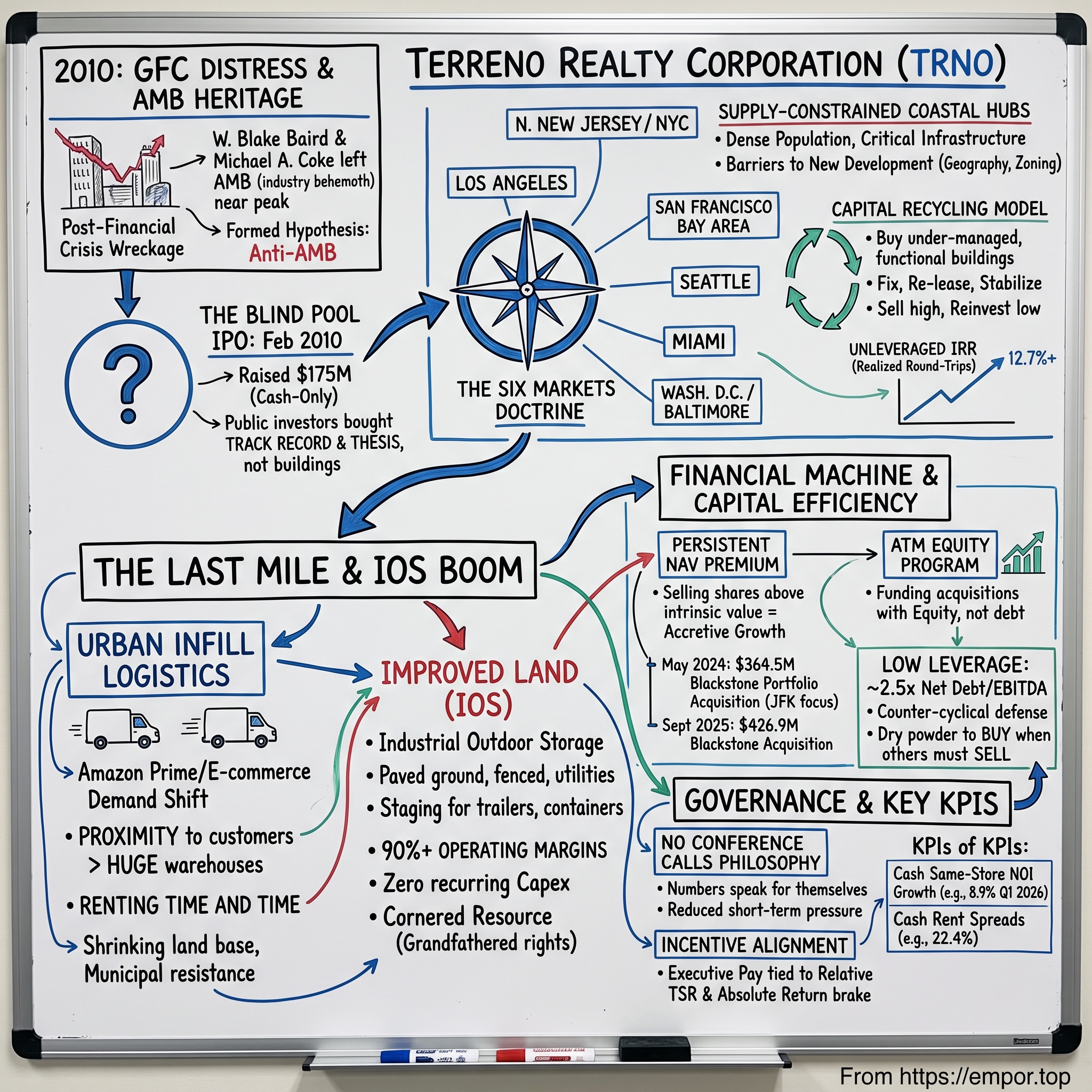
Terreno Realty Corporation: The Coastal Infill Powerhouse
I. Introduction & Episode Roadmap
Picture the American real estate business in the winter of 2010. The Great Financial Crisis has not so much passed as it has left the industry lying in the road. Commercial property values have fallen by roughly a third from their 2007 peak. Banks are holding portfolios of loans they cannot value and do not want to sell. Transaction volume has essentially frozen — buyers and sellers stare at each other across a chasm of uncertainty, and almost nobody is writing checks. The largest industrial developers on earth, companies that had spent the boom years building speculative warehouses across four continents and financing them with mountains of debt, are fighting for their survival.
Into this wreckage walked two men with an unusual pitch. They had no properties. They had no portfolio. What they had was a track record, a thesis, and the audacity to ask public investors for $175 million on the strength of both. In February 2010, Terreno Realty Corporation went public on the New York Stock Exchange as a "blind pool" — a company whose entire asset base, on the day it listed, was cash.2 The two men were W. Blake Baird and Michael A. Coke, and only a few years earlier they had been the president and chief financial officer of AMB Property Corporation, the very company that in 2011 would merge with Prologis to form the largest industrial landlord in the world.3
Here is the puzzle worth sitting with. How did two executives from the predecessor of the industry's global behemoth walk away at the peak of the cycle, and then reappear in the depths of the crash to build a company that does the precise opposite of everything their old employer stood for? And how did that company — which by mid-2026 carried a market capitalization in the neighborhood of seven-and-a-half billion dollars — grow into one of the most richly valued names in its sector while refusing to do the one thing every other public company treats as sacred: hold a quarterly earnings conference call?
This is the story of a business built on subtraction. No global footprint. No ground-up development at scale. No leverage to speak of. No earnings calls, no roadshow theater, no growth-for-growth's-sake empire building. What is left after all that subtraction is a strategy of almost monastic focus: buy functional, unglamorous industrial real estate in six specific coastal American markets where you physically cannot build much more of it, fix what is broken, raise the rent, and repeat.
Over the next several sections we will trace the arc. We start with the AMB heritage and the counter-cyclical hypothesis that drove Baird and Coke out the door before the storm. We move through the blind-pool IPO and the "six markets" doctrine that has governed the company ever since. We spend real time in the golden decade of infill logistics, when e-commerce turned urban dirt into one of the scarcest resources in American real estate — and on the quieter bet, "improved land" and industrial outdoor storage, that may be the most interesting part of the whole enterprise. We examine the financial machine that ties it all together: the persistent premium to net asset value and the at-the-market equity program that converts that premium into growth. Then we war-game the competition, stress-test the risks, and lay out the honest bull and bear cases.
A word on posture before we begin. This is not an investor-relations document, and Terreno's own considerable skill at telling its story should make a careful analyst more skeptical, not less. Management makes claims. Some of those claims are backed by fifteen years of audited numbers; others are narrative. We will try, throughout, to keep the two separate — to ask not whether the story is compelling but whether it is true, what evidence supports it, and what would break it.
 Subscribe on LinkedIn
II. The Genesis: AMB Property Corp & The Great Resignation
To understand why Terreno exists, you have to understand what its founders were running away from. And to understand that, you have to understand AMB Property Corporation in its glory.
AMB was a San Francisco–based industrial REIT that had spent the 2000s becoming a global logistics powerhouse. It built and owned warehouses near major airports, seaports, and highway interchanges — not just in the United States but increasingly in Mexico, Europe, and Asia. It was a growth story, and growth stories in real estate run on two fuels: development pipelines and debt. AMB had both in abundance. Within that machine, W. Blake Baird served as president and a director, and Michael A. Coke served as chief financial officer and executive vice president. Baird had spent roughly eight years at AMB, Coke about nine — Baird as the architect of much of the company's industrial strategy, Coke as the man who ran the balance sheet.2 These were not junior executives with a hunch. They were the people who had helped build the very model they would later renounce.
And then, near the top of the cycle, they left. Baird stepped away from AMB in late 2006; Coke followed in early 2007. Consider the timing, because it is the whole point. This was the moment of maximum optimism in American real estate — cap rates were compressed to historic lows, credit was nearly free, and the consensus view was that the good times would roll indefinitely. To resign the presidency and the CFO's chair of a marquee REIT at that exact moment was to walk away from the party while the music was still loud. It is easy, from the comfort of hindsight, to call that prescient. It is worth pausing on how uncomfortable it must have been in real time.
What did they see? By their own later account, they saw a set of red flags that were structural rather than tactical: the relentless global expansion into markets the company understood less well, the enormous multi-year development pipelines that committed capital years before the demand was proven, and the escalating leverage required to fund all of it. Each of these was a source of return in a rising market. Each was also a source of catastrophic fragility if the market turned. In development, you spend cash today against rents you hope to collect in three years; if credit freezes in year two, you own a half-finished building and a loan you cannot roll.
That is precisely what happened. When the financial crisis hit in 2008 and 2009, the highly leveraged global developers were caught exactly where their models were most exposed. Credit markets seized. Half-built projects became liabilities. Property values fell and the debt did not, which is the arithmetic that destroys equity. AMB and its eventual merger partner Prologis both came through the crisis alive but badly bruised — the 2011 combination that created the enlarged Prologis, a roughly $8.8 billion merger of equals, was in no small part a response to a world that had punished scale and leverage severely.3 The men who had left were vindicated by the wreckage.
But leaving is not a strategy. The more interesting thing Baird and Coke did was form a hypothesis about what to build next. In 2007 they founded Terreno Capital Partners and began, quietly, to design the anti-AMB.2 The thesis was almost a point-by-point inversion of the pre-crisis playbook. Instead of a global footprint, an exclusive focus on a handful of domestic coastal markets. Instead of speculative ground-up development, the acquisition of existing, functional buildings below the cost of replacing them. Instead of debt as a lever to amplify returns, debt treated as a hazard to be minimized. The idea was to build an industrial real estate company designed to be strongest exactly when the industry was weakest — a company that would have dry powder when everyone else was scrambling for liquidity.
There is a temperamental dimension to this that the résumés do not capture. Baird, who would take the chairman and chief executive roles, was the strategist and the outward face — the person who had to persuade skeptical institutional investors, in the depths of the crisis, that a company with no assets was worth backing. Coke, who took the president and chief financial officer seats, was the balance-sheet mind, the discipline behind the numbers.2 What the two shared, and what shaped everything that followed, was a hard-won respect for the destructive power of the real estate cycle. They had watched, from the inside, how the same leverage and development that produced spectacular returns on the way up could vaporize a company's equity on the way down. That experience is the psychological core of Terreno: a management team that had personally seen the downside was always going to build a company obsessed with surviving it, even at the cost of some upside in the good years. Conviction born of scar tissue tends to be stickier than conviction born of a spreadsheet.
It is a compelling origin story, and we should be careful with compelling origin stories, because they are usually cleaned up after the fact. What is verifiable is this: two experienced operators left a leveraged global developer near the top, sat out the worst of the storm, and then organized a vehicle to deploy capital into distress. Whether that was foresight or good fortune, the discipline that followed would have to be proven over the ensuing fifteen years, not asserted. The first test came almost immediately, and it was a strange one — asking strangers for $175 million to buy nothing at all.
III. The GFC Launch & The Blind-Pool IPO
A "blind pool" is one of the harder things to sell in finance. You are asking investors to hand you money before you have told them what you will buy with it. There is no portfolio to underwrite, no in-place cash flow to value, no assets to kick the tires on. You are, quite literally, selling the jockey and not the horse — because there is no horse yet. In good times, blind-pool offerings carry a whiff of the speculative. In February 2010, with the real estate market still smoking, it took a particular kind of credibility to pull one off.
Terreno pulled it off. The company completed its initial public offering on the NYSE in February 2010, raising $175 million with essentially nothing on the asset side of the balance sheet but cash.2 Investors were not buying buildings. They were buying the proposition that Baird and Coke could deploy that cash into distressed industrial real estate more skillfully than the next manager, and that the timing — buying when transaction markets were frozen and sellers were forced — would prove to be the opportunity of a decade. In effect, the IPO monetized the founders' reputation and their thesis, and asked the market to price both.
The genius of launching into a frozen market is counterintuitive but real. When nobody can transact, the buyers who can transact hold enormous power. A REIT with a clean, all-cash balance sheet in 2010 was not competing in a crowded auction; it was often the only bidder in the room able to close without a financing contingency. That is a structural advantage that only exists at the bottom of the cycle, and it evaporates the moment credit returns. Terreno was designed to exploit exactly that window.
With capital in hand, the company set its most important and most durable constraint: geography. Terreno would invest only in what it called the six major coastal U.S. markets. The list has been the company's north star ever since: the Northern New Jersey / New York City corridor; Los Angeles; the San Francisco Bay Area; Seattle; Miami; and Washington, D.C. / Baltimore.2 What unites these six is not that they are big — plenty of big markets were excluded. It is that they are supply-constrained. Each sits against a hard physical boundary — an ocean, a bay, a mountain range — and each is wrapped in dense population, expensive land, busy ports and airports, and layers of local zoning and environmental regulation that make new industrial construction slow, costly, and often impossible. The thesis in one line: own the industrial real estate that is very hard to reproduce, in the places where demand is densest and new supply is most tightly capped.
Inside that geographic box, the operating playbook was equally specific, and it is worth understanding because it is the engine of Terreno's reported returns. The company calls it capital recycling. The idea is to buy properties that are, in some way, sub-optimal — high vacancy, near-term lease expirations, deferred maintenance, a lazy or under-capitalized prior owner leaving money on the table. These "hair-on-it" assets can be purchased at a discount precisely because they require work. Terreno then does the work: it releases the vacant space, renews or repositions the tenancy, invests the capital the prior owner would not, and stabilizes the building's cash flow. A stabilized building in a supply-constrained coastal market commands a low capitalization rate — which, in real estate, means a high price. So once the value has been created and the property's forward return has compressed, Terreno's discipline is to sell it at that high price and recycle the proceeds into the next under-managed asset, where the return on new capital is higher. Buy the problem, fix the problem, sell the solution, repeat.
Does the recycling actually work, or is it a nice slide in an investor deck? Here the numbers offer real, if imperfect, evidence. According to the company's 2025 annual report, since its inception in 2010 Terreno had sold 45 properties for an aggregate price of roughly $1.1 billion and a total gain of about $570 million, producing an unleveraged internal rate of return of approximately 12.7% on those completed round-trips.4 The "unleveraged" qualifier matters: this is the return the real estate itself generated before any benefit from borrowing, which makes it a cleaner read on underlying skill than a levered number would be. By the middle of 2026 the tally had grown to roughly four dozen dispositions, and management continued to add to it every quarter, harvesting stabilized assets to fund the next vintage of value-add.1 A low-double-digit unlevered IRR compounded across a decade and a half of realized sales is genuinely strong for core-flavored industrial real estate — it is the single most concrete piece of evidence that the recycling model is more than marketing. The caveat a skeptic should hold onto is that a realized-deal IRR is a survivorship-flavored statistic; it tells you how the properties they chose to sell performed, not the return on every dollar ever deployed. Still, fifteen years of realized results is not nothing, and it is far more than most REITs will show you.
The recycling engine explains what Terreno buys and sells. It does not, by itself, explain the extraordinary tailwind that arrived just as the company was getting started — the one that turned a sensible value strategy into a decade-long boom. That tailwind was e-commerce, and it changed the physics of what urban warehouse space was worth.
IV. The Golden Decade of Infill: E-Commerce & The Last Mile
For most of the twentieth century, warehouses were about volume. The economics of distribution rewarded scale: build the biggest possible box on the cheapest possible land, stack goods to the rafters, and move them efficiently in bulk. Location mattered mainly in relation to highways and freight. Land near cities was too expensive to waste on storage, so warehouses marched outward, away from where people actually lived.
Then Amazon Prime happened, and the arithmetic of logistics inverted. Once the promise became two-day, then next-day, then same-day delivery, the binding constraint in the supply chain shifted from the cost of storing a good to the cost and time of getting it into a customer's hands on the last leg of its journey — the "last mile." And the last mile does not care how tall your warehouse is. It cares how close you are to the doorstep.
This is the single most important concept in the Terreno story, so it is worth slowing down and making it concrete. The industry's giants, Prologis foremost among them, built their empires on big-box distribution: buildings of 500,000 square feet and up, with 36-foot clear ceiling heights, sited on inexpensive land far outside the urban core. Clear height — the vertical space from floor to the lowest overhead obstruction — is a big deal in a regional distribution center, because more height means more pallet positions and more storage density per dollar of land. Terreno went the opposite way. Its typical infill building is a fraction of that size, often in the 50,000-to-100,000-square-foot range, with modest clear heights of perhaps 18 to 24 feet, sitting on expensive dirt inside the city.
Why would anyone pay a premium for a smaller, shorter building? Because in the last-mile business, the tenant is not really renting cubic feet — the tenant is renting time and proximity. Think about a delivery van serving Manhattan or West Los Angeles. If its depot sits forty miles out, it can complete perhaps one or two round trips a day, burning driver hours and fuel on the highway. If its depot sits inside the urban core, that same van can make multiple round trips, each one shorter, cheaper, and faster. The savings in transportation cost, labor, and delivery speed swamp any rent premium the closer building commands. In a world of same-day delivery, an extra fifteen feet of ceiling height in the exurbs is worth far less than fifteen fewer miles to the customer. Terreno's bet was that the market would come to price urban proximity as the scarce input, and it was right.
The scarcity was not static — it was, remarkably, getting worse in exactly the direction that favored the incumbent owner. In the six coastal markets, the stock of industrial land has been shrinking. As cities grew and land values climbed, old industrial sites became more valuable as something else: luxury condominiums, shiny retail, and increasingly data centers, all of which can outbid a warehouse for a given parcel. Every time a municipality rezones a gritty industrial block into housing, the supply of the thing Terreno owns gets a little smaller and the value of what remains ticks a little higher. Layer on top the physical and regulatory barriers — you cannot manufacture new land in South San Francisco or Brooklyn, and even where land exists, environmental remediation, community opposition, and anti-truck local politics make new warehouse permits agonizingly hard to obtain — and you have a supply curve that is not just inelastic but actually bending backward.
The result, by the mid-2020s, was a portfolio concentrated in the densest, most contested corners of the American coast. As of the company's early-2026 reporting, its core operating buildings numbered in the low 300s and totaled roughly 19.9 million rentable square feet, driving the large majority of revenue.1 The geographic concentration of that revenue tells the strategic story better than any narrative could. Measured by annualized base rent, the New York City / Northern New Jersey corridor stood as the single largest driver at roughly 28.6% — a portfolio heavily clustered around the Port of New York and New Jersey and the industrial districts hugging JFK Airport. Miami, the San Francisco Bay Area, and Los Angeles each contributed in the neighborhood of 16%, Seattle around 12%, and Washington, D.C. close to 10%.4 This is not a diversified sprawl; it is a deliberate concentration in six chokepoints of American consumption.
It is worth pausing here on a piece of consensus narrative that deserves fact-checking, because the infill story is often told too simply. The myth is that Terreno "beat Prologis" by being smarter about the last mile — that the giant missed the trend and the nimble upstart cleaned up. The reality is more precise and more interesting. Prologis did not miss the last mile; it is an enormous owner of urban logistics and last-touch facilities in its own right, and it has vastly more capital than Terreno will ever command. What actually separates the two is not insight but structure. Prologis's scale means it is most efficient buying and building large facilities in size; a single 70,000-square-foot infill building in Queens moves the needle for Terreno and is a rounding error for a company that owns roughly a billion square feet globally. Terreno's edge, in other words, is not that it saw something Prologis could not — it is that it is small enough, and local enough, for the small deals to matter. That is a real and durable advantage, but it is an advantage of fit, not of foresight, and it comes with a corollary the bulls sometimes forget: the same small scale that lets Terreno win 60,000-square-foot deals also means it can never deploy capital as fast as a giant, which caps how quickly it can grow.
There is a second piece of the story that gets romanticized: the idea that infill rents only ever go up because land only ever gets scarcer. The scarcity is real, but rent is set by the balance of supply and demand, and demand is cyclical even when supply is fixed. The boom-era spreads were as much about a demand surge — a once-in-a-generation reallocation of retail into e-commerce logistics — as about the shrinking land base. When that demand normalized, spreads came down even though not a single acre of new coastal industrial land had appeared. Holding both facts at once — permanent supply constraint, cyclical demand — is the key to reading the numbers honestly, and it is the frame we will carry into the risk section.
What does the concentration tell an investor? Two things, pulling in opposite directions. On the bullish side, it is evidence of genuine focus and of pricing power in the highest-barrier submarkets — the company has voted with its capital for depth over breadth, and the rent metrics we will come to suggest the market is paying for that proximity. On the bearish side, concentration is concentration: a portfolio anchored so heavily in the New York / New Jersey gateway and in a handful of coastal metros is exposed to the fortunes, politics, and physical hazards of a small number of places. Focus is a source of edge and a source of fragility at the same time, and honest analysis has to hold both. But the buildings were only ever half of Terreno's design. The other half was something most of its peers did not bother to break out at all: paved, empty ground.
V. The Secret Weapon: Improved Land & The Institutionalization of IOS
Walk past a fenced lot near a port — rows of parked trailers, stacked shipping containers, a fleet of trucks, maybe some construction equipment, all sitting on graded gravel or asphalt behind a chain-link fence — and your eye slides right over it. It is the least glamorous thing in real estate. There is no building to photograph, no lobby, no architecture. For most of the industry's history, institutional capital treated it as a rounding error, the leftover ground you owned while you waited to build something real on it.
Terreno looked at that lot and saw one of the best businesses in commercial real estate. The company calls it "improved land" — parcels that have been graded, paved, fenced, and hooked up to utilities, and are leased out for what the industry now calls industrial outdoor storage, or IOS: the open-air staging of trailers, containers, vehicles, and equipment that the logistics economy cannot function without. And the economics of it are quietly spectacular, for a reason that becomes obvious once you say it out loud.
Start with the margins. A traditional warehouse is a machine with many moving parts that all cost money to maintain: a roof that leaks, HVAC units that fail, structural systems that age, tenant spaces that must be rebuilt each time an occupant changes. Improved land has none of that. It is, functionally, paved ground behind a fence. There is no roof to replace, no mechanical system to service, no interior to renovate. As a result, operating margins on improved land can run above 90%, and — just as importantly — the recurring capital expenditure that eats into a warehouse landlord's cash flow is close to zero.7 In real estate, the gap between what a tenant pays and what the landlord actually keeps after maintaining the asset is where fortunes are made or quietly lost. Improved land keeps almost all of it. When a tenant rolls over, you are not spending hundreds of thousands of dollars on tenant improvements and leasing commissions to re-let a building; you are, more or less, handing over a key to a gate.
Then there is scarcity, which is the part that makes this durable rather than merely profitable. Cities do not like outdoor storage. It is unlovely, it generates truck traffic, and it occupies land that a planning commission would rather see turned into housing or a park or anything with a nicer facade. So municipalities almost never approve new IOS zoning in dense coastal areas, and they frequently rezone the existing sites out of existence. That means the supply of legally permitted outdoor storage yards near the coast is not just fixed — it is a set of grandfathered rights that cannot be recreated. In the language of competitive strategy, each permitted IOS parcel near a major port is close to a cornered resource: a scarce, non-reproducible asset whose value comes precisely from the fact that no one can make another one.
Terreno did two things that separated it from the crowd here. First, it built real scale in the asset class deliberately rather than by accident — as of the middle of 2026, the company owned 46 improved-land parcels totaling roughly 147 acres.1 Second, and more tellingly, it broke improved land out as its own reported operating segment, one of the few public REITs to treat paved ground as a distinct, material line of business rather than burying it in a footnote.4 That disclosure choice is itself a small piece of evidence: a company does not carve out a separate segment for something it considers trivial. It was, in effect, Terreno announcing to the market that IOS was an institutional asset class years before Wall Street agreed.
The evidence that the bet is paying off shows up in the pricing. In the first quarter of 2026, even as the broader logistics market cooled from its pandemic-era fever, Terreno's improved-land portfolio was roughly 96.6% leased and continued to command strong pricing power on rolling leases, reflecting the extreme scarcity of permitted outdoor yards near coastal ports.1 The read-through for an investor is that the improved-land thesis is not a promise about the future — it is already producing high-margin, low-capex cash flow with occupancy at the top of the range. The honest counterweight, which we will return to in the risk section, is that Terreno was early but is no longer alone: the same scarcity that makes IOS attractive has drawn a wave of well-funded private capital into the space, and being first is a durable advantage only until the crowd arrives.
One more point sharpens why this matters for how you read Terreno's financials. Because improved land carries almost no recurring capital expenditure, the cash a warehouse landlord must plow back into the building to keep it rentable — the tenant improvements, the leasing commissions, the roof and mechanical reserves — simply does not exist for a paved yard. That gap is invisible in a headline rent number but enormous in cash terms. Two landlords can report the same nominal rent per square foot and keep wildly different amounts of it after the capital treadmill; improved land sits at the high-retention end of that spectrum. For a company whose entire growth model, as we will see, depends on generating and reinvesting internal cash while keeping leverage low, a growing slice of near-zero-capex, 90%-plus-margin income is worth more than its share of square footage would suggest. It is, in a sense, the highest-quality cash flow the company produces.
For now, hold onto this: the least photogenic asset in the portfolio may be the one with the widest moat. Which raises a question about the people running it — because a management team that institutionalizes gravel lots and refuses to hold earnings calls is clearly playing a different game than most. Let us look at how they are wired.
VI. The "No Conference Calls" Philosophy & Management Credibility
Every quarter, across corporate America, a familiar ritual unfolds. Executives dial into a scripted conference call, read prepared remarks polished by investor-relations professionals, and then field questions from sell-side analysts in a carefully managed dance of guidance and reassurance. It is theater with real stakes, and almost every public company treats participation as non-negotiable.
Terreno simply does not do it. The company does not hold live quarterly earnings conference calls. Instead, it issues a detailed quarterly operating, investment, and capital-markets release and an exhaustive supplemental package of data, and then it goes back to buying and managing real estate.1 There is no CEO narrating the quarter, no analyst Q&A to spin, no forward guidance theater. The posture is essentially: the numbers are here, in full; read them.
It is easy to romanticize this as pure signal-over-noise virtue, and management is happy to let you. A more neutral reading is that it is a deliberate — and unusual — allocation of the disclosure surface. There is a genuine benefit: management is not spending its energy managing quarterly expectations or getting anchored to short-term guidance, and the absence of a call arguably reduces the temptation to over-promise. There is also a genuine cost, and an analyst should name it: the lack of a live Q&A removes the single best mechanism investors have for pressing management with unscripted questions about a miss, a strategy shift, or a competitor. You cannot cross-examine a press release. When things eventually go wrong — and in a cyclical industry they will — the absence of a forum to explain them is a governance feature that cuts both ways. The right conclusion is not that the practice is good or bad, but that it raises the burden on the written disclosure to be complete, and raises the burden on the observer to verify the story from the filings rather than from management's tone.
Where the alignment story becomes more concrete — and more testable — is in how the company pays its executives. Many REITs, implicitly or explicitly, reward management for growing the size of the enterprise: bigger assets under management, more buildings, a larger balance sheet. The problem with that incentive is well known. It rewards acquisitions even when those acquisitions dilute value on a per-share basis, because the executive's scoreboard is total size, not per-share worth. It is the machine that manufactures empire-building.
Terreno's compensation is structured to attack that failure mode directly. According to the company's proxy statement, its long-term executive incentive pay is tied to rolling three-year total shareholder return measured against industry benchmarks — the MSCI US REIT Index and the FTSE Nareit Equity Industrial Index — rather than to the sheer size of the portfolio.8 Two design choices stand out. The reward is relative, so management is measured against how industrial REITs as a group performed, not against an easy absolute bar. And there is a downside brake: if Terreno's own absolute total shareholder return over a performance period is negative, the potential payout is cut sharply — by half — even if the company outperformed its peers on a relative basis.8 In plain English, beating a falling market is not enough to be fully paid if shareholders still lost money. That is a genuinely shareholder-friendly wrinkle, and it is the kind of structural detail that tends to shape behavior more reliably than any mission statement.
Reinforcing all of this is skin in the game. The founders, Baird and Coke, have long held meaningful personal ownership in the company, and management's stated focus is on per-share growth in funds from operations and net asset value rather than on gross scale.8 For a fundamental investor, the relevant discipline is to test that claim against behavior over time, and here the fifteen-year record is largely corroborating: the company has consistently prioritized per-share metrics, has grown through disciplined recycling rather than transformational acquisitions, and has not lurched into unexplained strategy shifts. That is credibility earned through consistency, which is the only kind worth much.
The clearest expression of the whole philosophy sits on the balance sheet. Where many peer REITs run leverage in the range of five to seven times net debt to EBITDA — using borrowed money to amplify returns — Terreno operates with net debt to EBITDA of roughly 2.5 times as of early 2026, with only modest near-term maturities.1 To a growth-at-any-cost investor, that looks like timid, under-optimized capital management: why leave return on the table? To Terreno's way of thinking, low leverage is not laziness; it is the entire point. It is what lets the company keep buying when credit is scarce and everyone else is a forced seller — the same counter-cyclical liquidity advantage that its founders left AMB to capture. Whether that conservatism is prudence or foregone return is a judgment that depends on where you think we are in the cycle. But it is not an accident, and it is not free. It is a deliberate trade of upside in good times for durability in bad ones — and it is directly linked to the second half of Terreno's machine, the one that turns a strong balance sheet and a rich valuation into growth.
VII. The Cost of Capital Machine: NAV Premium & The ATM
To understand the financial engine that powers Terreno, you have to understand a concept that sits at the heart of how REITs create or destroy value: the relationship between a REIT's stock price and its net asset value, or NAV — the estimated market value of its real estate, less its debt, divided by its shares. Whether the stock trades above or below that intrinsic figure is not a cosmetic detail. It determines whether the company's own shares are a weapon or a wound.
Here is the mechanism, stripped to its logic. When a REIT issues new stock to raise money, it is selling a piece of the existing portfolio to new investors. If the stock trades at a discount to NAV, issuing shares means selling that portfolio for less than it is worth — every new share dilutes the existing owners, handing away real estate at a markdown. Growth funded this way actively destroys per-share value, which is why REITs trading at deep discounts are effectively frozen; they cannot raise equity without hurting the very shareholders they answer to. But flip it around. If the stock trades at a premium to NAV, issuing shares means selling ownership for more than the underlying assets are worth. The company raises a dollar of real estate value for, say, a dollar-ten of cash, and the extra ten cents accretes to existing shareholders. At a premium, issuing equity is not dilutive — it is a machine for manufacturing per-share value.
Terreno has spent most of its public life on the right side of that line. Because of its focused, high-barrier portfolio, its fortress balance sheet, and a long record of operating execution, the stock has historically traded at a persistent premium to the estimated value of its underlying real estate — often on the order of ten percent or more.10 That premium is not a vanity metric. It is a cost-of-capital advantage. A company that can reliably raise equity above NAV has a cheaper cost of growth capital than a private buyer paying all cash, or than a leveraged peer whose stock trades at a discount. In the auction for a coastal warehouse, the bidder with the lowest cost of capital can pay the most and still earn an acceptable return — and often, that bidder is Terreno.
The tool that converts the premium into growth is the at-the-market equity program, or ATM. Rather than the old-fashioned, lumpy, discounted secondary offering, an ATM lets the company sell shares directly into the open market in a steady drip, at prevailing prices, whenever it chooses. The workflow is elegant: identify a property worth buying, issue shares at a premium to raise the cash, and close the acquisition with little or no new debt. The result is a company that can scale its asset base while its leverage stays low or even falls — funding growth with accretive equity instead of borrowed money, and strengthening the balance sheet in the very act of expanding it. In the first quarter of 2026 alone, Terreno issued roughly 2.08 million shares through its ATM at an average price of about $64.85, raising approximately $135 million in gross proceeds, and paired that with a new $200 million five-year unsecured term loan — equity-led funding, topped up with cheap, term debt.1
Nothing sharpens the picture of this machine at work like a real transaction, and the best case study arrived in May 2024. Terreno acquired a multi-market industrial portfolio from Blackstone — the world's largest owner of commercial real estate and about as sophisticated a seller as exists — for approximately $364.5 million.5 The portfolio spanned New York City, Northern New Jersey, the San Francisco Bay Area, and Los Angeles, and the crown jewel was concentrated in Queens: a set of 21 properties in Springfield Gardens, directly abutting JFK Airport, for which Terreno paid about $246 million — roughly two-thirds of the entire deal value packed into one of the most supply-constrained last-mile submarkets in the country.6
The obvious question a skeptic asks is: did they overpay? Buying from Blackstone, the "smart money," you should assume the seller extracted a full price. The honest answer is that we cannot independently verify the going-in yield, and Terreno does not hold a call where an analyst could press management on it. What can be said is more circumstantial but still meaningful. Comparable infill assets near JFK were trading at that time at extraordinarily low cap rates, reflecting fierce competition for exactly this kind of dirt — which means Blackstone had every incentive and ability to run a competitive process, yet chose to transact with Terreno off-market. That points to something beyond price: Terreno's value to a seller like Blackstone was certainty of execution. Funded by accretive ATM equity and existing credit lines rather than by contingent financing, Terreno could close a large, complex, multi-market portfolio quickly and without the risk that a lender pulls out at the last minute. In a tight market, that reliability is itself worth something to the seller — and the relationship has recurred: in September 2025, Terreno again acquired an industrial portfolio from Blackstone Real Estate, this time for roughly $426.9 million.11 Being a preferred, repeat counterparty to the largest real estate owner on earth is a competitive asset that does not show up on the balance sheet.
The catch — and it is the central vulnerability of the entire model — is that this whole engine runs on the premium to NAV. As long as the stock trades above the value of the underlying real estate, the ATM manufactures value with every share sold. The day that premium disappears, the machine does not just idle; it goes into reverse. That single dependency is the hinge on which the bull and bear cases turn, and before we get there, we need to place Terreno on the competitive map.
VIII. The Competitive Landscape: Porter's 5 Forces & Hamilton Helmer's 7 Powers
Strategy frameworks can be a lazy substitute for thinking, but used honestly they are a good way to pressure-test whether a company's advantages are real and durable or merely a good run in a favorable cycle. Two lenses are worth applying to Terreno: Michael Porter's five forces, which map the structural attractiveness of an industry, and Hamilton Helmer's seven powers, which ask whether a specific company holds an advantage a competitor cannot easily copy. Run Terreno through both, and a fairly coherent picture emerges — along with the places where the moat is thinner than the story suggests.
Start with Porter. The threat of new entrants in coastal infill industrial is genuinely low, and for once the cliché is backed by physics rather than rhetoric. You cannot manufacture new land against an ocean or a bay; local zoning increasingly forbids new warehouses and outdoor storage; community and political resistance to trucks is intense; and the land that does exist is fiercely expensive. The barrier is not a patent or a brand that could erode — it is geography and law, which change slowly. The threat of substitutes is similarly low: physical goods must occupy physical space at some point between the port and the porch, and no amount of digital optimization, inventory software, or speculative talk of 3-D printing eliminates the need to stage, sort, and dispatch real parcels near real customers. The bargaining power of tenants is low to moderate: a distributor that must deliver to Manhattan or West L.A. simply has to be located near Manhattan or West L.A., and the scarcity of alternatives limits its ability to negotiate rent down — though a severe demand downturn would shift some of that power back to tenants, as vacancies always do.
Where Porter gets more interesting is the intensity of rivalry, which is best described as moderate and specific rather than cutthroat. The two names that matter most are Prologis and Rexford Industrial. Prologis is the global behemoth, vastly larger than Terreno, but it built its empire in big-box logistics, a fundamentally different product; when Prologis does compete for infill, Terreno's smaller deal sizes and dense web of local broker relationships often make it the more natural buyer of a 60,000-square-foot problem building. Rexford Industrial (REXR) is the sharper comparison — an elite, disciplined infill operator with a superb long-term record — but Rexford is concentrated essentially entirely in Southern California.10 That makes Rexford a purer bet on one market and Terreno a multi-market coastal play; each has argued its own version of the concentration-versus-diversification trade, and a fair-minded observer would call it a genuine strategic difference rather than one being clearly right. The rivalry is real, but it is fragmented by geography and product, which keeps it from turning into the margin-destroying price war that afflicts commoditized industries.
Now Helmer's seven powers, which force a harder question: which of Terreno's advantages could a well-funded competitor not simply replicate? The strongest claim is cornered resource. Terreno's ownership of scarce, effectively grandfathered industrial and IOS-zoned parcels near ports, airports, and dense highway networks is close to a textbook example — these are assets whose value derives from the fact that no one can create more of them, and no amount of capital lets a rival conjure a new permitted trailer yard in Springfield Gardens. That is the most durable thing the company owns. Second is a cost advantage, though of an unusual, capital-markets kind: the persistent premium to NAV plus the ATM gives Terreno a lower cost of equity than private-equity buyers or discount-to-NAV peers, letting it win auctions at prices that still clear its return hurdle. This is a real advantage, but it is the fragile one — it is a function of the stock's valuation, which the market can revoke, not a permanent structural feature. Third, for the improved-land and IOS tenants, there are meaningful switching costs: relocating a fleet, re-routing logistics infrastructure, and — hardest of all — obtaining municipal operating permits at a new site is disruptive and often simply not possible, which locks tenants in place and hands the landlord pricing power at renewal.
Put the two frameworks together and the honest synthesis is this: Terreno sits in a structurally attractive industry and holds at least one advantage — the cornered land — that is genuinely hard to copy. But the advantage that powers its growth, the cheap cost of capital, is contingent on a valuation premium that is not guaranteed. A moat built partly on geology and partly on the stock price is stronger than most and more fragile than the narrative admits. That fragility is exactly where the risks live.
IX. The Risk Radar & Stress Test
Every good investment thesis is a set of conditions that must hold, and the discipline of stress-testing is asking, one by one, what happens when each condition breaks. For Terreno, four risks matter enough to dwell on, and they are not the generic macro worries that pad most risk sections — they are specific mechanisms wired directly into how this particular company makes money.
The first and most important is the valuation risk hiding inside the growth engine. We have established that the ATM machine runs on the premium to NAV. That is a strength on the way up and a trapdoor on the way down. Imagine a scenario — a real estate downturn, a spike in the cost of capital, an operational stumble, or simply a rotation of sentiment away from the sector — in which Terreno's shares fall to a discount to the value of its real estate. In that world, the whole model inverts. Issuing equity through the ATM would now destroy per-share value rather than create it, so the company would have to stop, and its cheapest source of growth capital would vanish. Growth would slow sharply, and the very premium multiple that justified the growth would be at risk of compressing further in a self-reinforcing loop. This is not a tail risk bolted onto the story; it is the story's central dependency, and any investor in Terreno is, whether they realize it or not, making a bet that the premium persists.
The second is the maturation of the e-commerce tailwind. The extraordinary rent growth of the late 2010s and the pandemic surge was, in part, a one-time repricing of urban logistics space as e-commerce penetration exploded and tenants scrambled for last-mile capacity. That penetration is now normalizing rather than compounding at its old pace, and the largest logistics tenants — Amazon prominent among them — have spent recent years rationalizing footprints they had over-built. The mechanical consequence is that the eye-watering renewal spreads of the boom, when expiring leases reset thirty percent or more above their old rents, moderate toward more normal — though still healthy — levels. Terreno's first-quarter 2026 cash rent increase of 22.4% on new and renewed leases is strong, but it is a step down from the peaks, and the trajectory matters: the thesis does not require boom-era spreads, but it does require rents to keep rising faster than costs, and a demand deceleration is the thing most likely to threaten that.1
The third is the coastal exposure that is inseparable from the strategy. Terreno's entire reason for being is to own real estate in supply-constrained coastal gateways — but "coastal" is also where the physical climate risk concentrates. Miami sits in a hurricane and sea-level-rise zone; Los Angeles and the San Francisco Bay Area sit on earthquake faults. The financial expression of these hazards is not primarily catastrophic loss — it is the steady grind of rising insurance premiums, and the growing burden of municipal carbon-neutrality and building-performance regulations, both of which eat into operating margins in exactly the markets where the company is most concentrated. This is a slow, structural headwind rather than a sudden shock, but it works against the margin story over time, and it is the direct cost of the geographic focus that is otherwise the company's edge.
The fourth is competition arriving in the once-lonely corner of the portfolio. Terreno's early institutionalization of industrial outdoor storage looked visionary precisely because so little capital was chasing it. That is no longer true. Private-equity firms and specialist platforms — names like Alterra, along with capital from large institutions — have raised billions of dollars aimed specifically at IOS, drawn by the same high-margin, low-capex, scarcity-driven economics that attracted Terreno in the first place.9 More money chasing a fixed supply of permitted yards means higher acquisition prices and compressed forward yields on new improved-land deals. The moat around Terreno's existing IOS parcels — the grandfathered permits — remains intact and arguably grows more valuable as competitors bid up the scarce supply. But the ability to keep adding to the portfolio at attractive returns is genuinely harder than it was five years ago. First-mover advantage is real, but it is not the same as a permanent monopoly, and the crowd has found the trade.
Notice that three of these four risks are not external accidents but the shadow side of the company's own strengths: the premium that funds growth can evaporate, the focus that creates edge concentrates exposure, and the scarcity that draws profits also draws competitors. That is the nature of a well-built business — its risks are the inverse of its advantages. Which is exactly why the bull and bear cases are so tightly coupled.
X. Bull vs. Bear Case & Key KPIs
Set the two cases side by side and you can see that they are, in large part, the same facts read through opposite assumptions about durability. That is usually the sign of an honest debate rather than a lopsided one.
The bull case rests on the compounding of scarcity. In this view, the supply of coastal infill industrial land keeps shrinking as cities rezone old warehouse districts into housing and higher-value uses, so the assets Terreno already owns become more valuable simply by existing while nothing new gets built to compete with them. Rents compound organically at a healthy pace — not at boom-era spreads, but comfortably ahead of inflation and operating costs — driving mid-to-high single-digit growth in same-store cash flow. The company keeps using its premium valuation and ATM to acquire value-add assets accretively, adding per-share value with each deal, while its fortress balance sheet insulates it from the refinancing shocks that punish leveraged peers in a higher-for-longer rate environment. In a downturn, low leverage becomes an offensive weapon, letting Terreno buy quality portfolios — as it did from Blackstone — when weaker owners are forced to sell. The bull is buying a compounding machine wrapped in a defensive balance sheet.
The bear case does not dispute the quality of the real estate — it disputes the price and the fragility of the engine. In this view, a genuine consumer recession cuts port volumes and logistics demand, pushing vacancy up and turning those positive renewal spreads flat or negative. As sentiment sours, the premium to NAV evaporates, the ATM machine seizes, and the growth that justified a premium multiple disappears — potentially compressing the multiple in a reflexive downward spiral. Meanwhile, coastal insurance costs and decarbonization mandates grind away at same-store margins, and a wave of private capital competes away the excess returns in IOS. The bear is not saying Terreno is a bad company; the bear is saying it is a good company priced for perfection, whose growth model is unusually dependent on a valuation that the market can withdraw at any time. Both cases, notably, agree on the underlying assets — they disagree on the multiple and on how much of the historical return was a non-repeatable tailwind.
It is worth asking what a genuinely adversarial investor — an activist or a short-seller — would attack, because the exercise reveals where the story is soft. The sharpest line of attack is not on the assets, which are hard to fault, but on the reflexivity of the model and the thinness of the disclosure surface. A skeptic would argue that a meaningful share of Terreno's historical return came from a valuation premium feeding an accretive equity machine that, in turn, justified the premium — a virtuous circle in good times that is indistinguishable, from the outside, from a momentum trade until the moment it reverses. That same skeptic would point to the absence of an earnings call not as admirable restraint but as reduced accountability: no forum in which management must defend a going-in cap rate, a moderating spread, or a capital-allocation choice under live questioning. And a value-minded activist might make the opposite critique from the growth crowd — that a 2.5-times-levered balance sheet is under-optimized, leaving return on the table that a more aggressive capital structure would capture. None of these is a knockout blow, and the fifteen-year record of per-share discipline is a strong rebuttal to the empire-building version of the critique. But a thesis that cannot survive its own strongest counterargument is not a thesis worth much, and Terreno's does have to answer for the fact that its cheapest fuel is a market opinion it does not control.
The frameworks from the last two sections adjudicate part of this. The cornered-resource advantage in scarce coastal land is real and durable, which supports the bull's claim about the asset base. But the cost-of-capital advantage that powers the growth is contingent on the premium, which supports the bear's claim about fragility. A reasonable synthesis is that the durability of the portfolio is high and the durability of the growth rate is more cyclical than the premium multiple implies.
For an investor who wants to track which way the debate is resolving in real time, three key performance indicators cut through the noise. These are the vital signs; you do not need to model them, only to watch their direction.
First, cash same-store NOI growth. This strips out the effect of acquisitions and dispositions and measures the pure organic growth of the properties the company already owns — the truest read on underlying demand and pricing power. Terreno reported same-store cash NOI growth of roughly 8.9% year over year in the first quarter of 2026, a strong figure that signals the organic engine was still running well into the post-pandemic normalization.1 Watch for whether it holds in the mid-to-high single digits or slides toward flat, because that number falling is the earliest sign the demand story is breaking.
Second, cash rent renewal spreads — the percentage increase when an expiring lease resets to current market rent. This is the direct, unfiltered measure of pricing power, of whether the scarcity thesis is still translating into landlord leverage at the negotiating table. The 22.4% increase on new and renewed leases in the first quarter of 2026 was well above a healthy baseline, even as it moderated from pandemic peaks.1 A spread that stays in the mid-teens or higher confirms pricing power; one that collapses toward zero would mean the moat is leaking.
Third, net debt to EBITDA — the health and optionality of the balance sheet. At roughly 2.5 times as of early 2026, Terreno sat far below the five-to-seven-times leverage common among peers, preserving both its defensive resilience and its ability to act as a buyer when others cannot.1 Watch for material, unexplained increases in this figure, because rising leverage would signal either that the ATM engine has stalled and debt is filling the gap, or that discipline is slipping — and low leverage is the single most load-bearing element of the entire counter-cyclical identity.
Together these three tell you almost everything about whether Terreno is still executing its model or quietly drifting from it. And that model, in the end, is really a set of durable lessons about how to build value in a cyclical, capital-intensive industry.
XI. Episode Playbook & Durable Investing Lessons
Step back from the quarter-to-quarter numbers and Terreno's fifteen-year run offers a handful of principles that generalize well beyond industrial real estate — lessons that are worth holding onto precisely because they cut against the instincts that dominate most public companies.
The first is focus over empire-building. The dominant reflex in corporate strategy, and especially in real estate, is to grow the enterprise — more markets, more assets, more scale, more of everything. Terreno's founders left the archetype of that model at its peak and built the inverse: a company deliberately confined to six markets and a narrow product, which then compounded value through depth rather than breadth. The lesson is not that focus always beats scale — Prologis has created enormous value at global scale — but that a hyper-focused position in a high-barrier niche can generate superior risk-adjusted returns without the fragility that global sprawl and heavy development pipelines carry. Constraint, chosen deliberately, can be a competitive advantage rather than a limitation.
The second is that incentive alignment is not a governance footnote — it is a strategy. By tying executive pay to relative total shareholder return, benchmarking against industry indices, and penalizing absolute negative returns, Terreno engineered its compensation to make dilutive, empire-building M&A actively unrewarding for the people who might otherwise pursue it. The broader lesson for an investor evaluating any company is to read the proxy as carefully as the income statement: what management is paid to do is, over time, what management will do. An incentive structure that rewards per-share value and punishes value destruction is worth more than any number of mission statements about "shareholder focus."
The third is the value of balance-sheet optionality in a cyclical business. It is tempting, in good times, to view low leverage as timid — capital left lazily on the table when cheap debt could juice returns. Terreno's history reframes that conservatism as both a defense and a weapon. Roughly 2.5 times net debt to EBITDA is what let the company keep buying through downturns, act as a liquidity provider when credit was scarce, and close large portfolios from sophisticated sellers without financing contingencies. In an industry defined by cycles, the willingness to give up some upside in the boom in exchange for the ability to attack in the bust is not weakness. It is the discipline that separates the survivors who compound from the aggressive players who periodically blow up.
The fourth is spotting and institutionalizing scarcity before the crowd does. Terreno's early conviction that paved, fenced, unglamorous outdoor-storage land was an institutional-grade asset class — and its decision to build scale and break it out as a distinct segment years before Wall Street cared — is a case study in the returns to seeing value where others see a rounding error. The advantage of being early is real, and it shows up in the grandfathered permits and below-replacement-cost basis that competitors, now flooding into the space, cannot replicate. But the same lesson carries its own expiration warning: first-mover advantage in an attractive niche is a window, not a fortress, and the arrival of billions in competing capital is the market's way of closing it.
That tension — between a genuinely scarce, hard-to-copy asset base and a growth model that leans on a valuation the market can revoke — is the honest heart of the Terreno story. The company was built by people who understood real estate cycles well enough to leave a party early and return to the wreckage with cash. Whether the next generation of leadership preserves that discipline, and whether the premium that fuels the machine endures through a real downturn, are the open questions that the numbers, quarter by quarter, will answer.
References
-
Terreno Realty Corporation Announces Quarterly Operating, Investment and Capital Markets Activity (Q1 2026) — Terreno Realty Corporation, 2026-04-06 ↩↩↩↩↩↩↩↩↩↩↩
-
Terreno Realty Corporation Form 424B1 Prospectus (2010 IPO) — SEC EDGAR, 2010-02 ↩↩↩↩↩↩
-
Prologis, AMB to merge, creating global industrial leader — Reuters, 2011-01-31 ↩↩
-
Terreno Realty Corporation 2025 Annual Report (Form ARS) — SEC EDGAR, 2026 ↩↩↩
-
Terreno Realty Corporation Acquires Portfolio in New York City, Northern New Jersey, San Francisco and Los Angeles for Approximately $365 Million — Terreno Realty Corporation, 2024-05-02 ↩
-
Blackstone Sells Queens Industrial Portfolio to Terreno for $246M — Commercial Observer, 2024-05-09 ↩
-
Terreno Realty's Strategy of Infill Industrial Real Estate — Nareit, 2024-11-15 ↩
-
Terreno Realty Corporation Definitive Proxy Statement (Form DEF 14A) — SEC EDGAR, 2025-03-18 ↩↩↩
-
Industrial Outdoor Storage Becomes Real Estate Investor Favorite — Bloomberg, 2024-08-10 ↩
-
Rexford vs. Terreno: Battle of Infill Industrial REIT Titans — Seeking Alpha, 2026-05-12 ↩↩
-
Blackstone Real Estate Sells Industrial Portfolio to Terreno Realty Corporation for $426.9 Million — Simpson Thacher & Bartlett, 2025-09-16 ↩
 LinkedIn
 WhatsApp
 Reddit
 Hacker News
 Email
Email Kindle
 RSS Feed
 Spotify
 Apple Podcasts
 Amazon Music
 Audible
 YouTube