First Tracks Biotherapeutics: Can a Trial Result Buy the Time to Become a Company?
I. The $200 Million Bet on a 32-Patient Signal
On October 12, 2026, a biotech company less than six months old as a public stock told the world that its lead antibody had done something rare. In a small, carefully controlled study, people with celiac disease had swallowed gluten every day for two weeks, and the ones who had received First Tracks Biotherapeutics' drug, ANB033, had largely kept the lining of their small intestine intact.[^1] The ones on placebo had not. The company called the result positive and statistically significant, held an investor webcast to walk through the slides, and laid out a plan to move the program toward a late-stage trial.[^1][^2]
Three days later came the second act. On October 15, First Tracks announced a $200 million private placement, selling new stock directly to a group of investors.[^3] The deal closed on October 19, when the company issued about 6.11 million shares at $32.75 apiece.12 When it reported third-quarter results on November 3, management said the new money lifted its pro forma cash to about $343 million, more than double the $155.6 million it had held at the end of September.[^6]1
Positive data followed by a big equity raise is not unusual in biotech. It is close to a ritual. A company that has just shown investors something exciting will never have a better moment to ask them for money, because the stock price is high, the story is fresh and the alternative, raising money after a disappointment, is far more expensive. What makes First Tracks worth a long look is the size of the gap between what the company has proved and what it is now being asked to become.
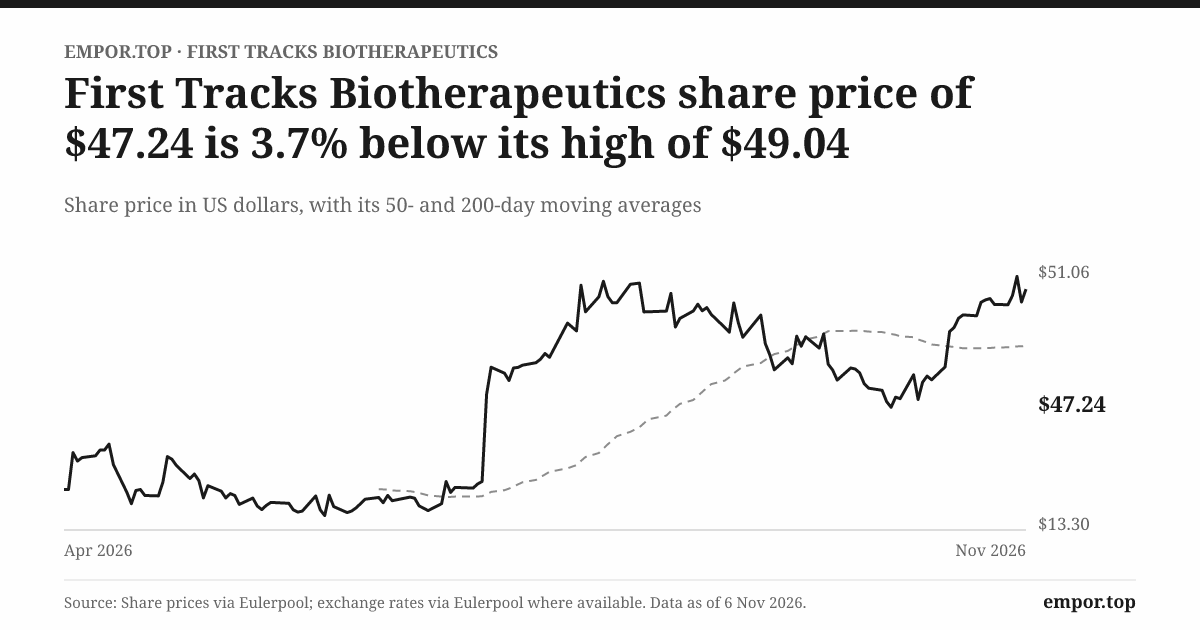
It has no product. It reported zero revenue in each of 2023, 2024 and 2025, and zero again in every quarter of 2026 so far.31 It lost about $166 million in 2025 alone.3 Its stock, which traded as low as about $15 over the past year, finished on November 6 at about $47, close to its high, giving it a market value somewhere between $1.6 billion and $1.9 billion depending on whether the October shares are counted.[^8]1
All of that value rests on a few numbers from a few dozen people. Thirty-two patients completed the first cohort of the study, 17 on drug and 15 on placebo.[^1] The headline measure, the ratio of the height of the tiny finger-like projections lining the gut to the depth of the pits between them, moved 0.49 points better on ANB033 than on placebo, with a p-value of 0.009.[^1] In plain English, there was less than a one-in-a-hundred chance of seeing a gap that large if the drug did nothing at all. That is a real result. It is also a result about a two-week challenge in a carefully selected group, not about healing a disease that people live with for decades.
The pairing of those two announcements, data on a Monday and a financing by Thursday, is worth pausing on because of what it reveals about how clinical-stage biotech is funded. A company like First Tracks has no customers to bill and no lender who would extend credit against a pipeline. Its only real source of money is the equity market, and the equity market prices clinical risk in steps. Before a readout, the stock carries the full uncertainty of the experiment.
After a good readout, some of that uncertainty is gone, the price rises, and every new share sold raises more cash for the same amount of dilution. Specialist investors who buy in private placements, often funds that read biopsy slides as fluently as balance sheets, are betting that the step up has further to go. The company is betting that it will never again be able to sell stock this cheaply in terms of ownership surrendered. Both can be right. Both can also be early.
So the story of First Tracks, at this moment, is a story about time. The October data bought the company the right to ask for money, and the money bought it time to run the experiments that will decide whether ANB033 is a medicine. Three questions sit on top of everything else. The first is whether the signal holds up when the company stops asking ANB033 to protect a healthy-looking gut from a short gluten exposure and starts asking it to heal a damaged one, which is what the second cohort of the study, due in the first quarter of 2027, is designed to test.[^6]
The second is whether First Tracks can fund that answer, and the ones after it, without returning to shareholders again and again for more stock sales. The third is whether a company that was, until April, a division of another biotech can build a standalone organization with its own costs, its own credibility and its own record.
That last question deserves emphasis because it shapes how every number in this story should be read. First Tracks shares began trading in April 2026, after AnaptysBio spun the business off to its own shareholders.41 Everything before that date is a carve-out: a set of accounts that accountants built by slicing a business out of a larger company and estimating which costs belonged to it.3 There is no long public record here, no five-year chart, no history of guidance kept or missed under the First Tracks name. There is a pipeline of antibodies, a management team that ran those programs inside their former parent, a few months of standalone reporting, and one very interesting cohort of 32 people.
The verdict at the start is a narrow one, and the rest of this story tests it. The October signal and the October cash together give First Tracks real room to develop ANB033 and its siblings. Neither one establishes that ANB033 heals the gut over time, that regulators will approve it, that doctors and insurers will pay for it, or that First Tracks is a durable business rather than a well-funded research program. To understand why the market was willing to write a $200 million check anyway, and why it might be wrong, the story has to start with the company that First Tracks used to be part of.
 Subscribe on LinkedIn
II. A Spin-Off That Had to Become a Company Overnight
On April 20, 2026, a shareholder of AnaptysBio woke up owning shares in two companies. AnaptysBio, the San Diego antibody developer, distributed about 29.1 million shares of First Tracks Biotherapeutics to its own holders on a pro rata basis, and with that a new ticker, TRAX, appeared on Nasdaq.31 There was no roadshow of the traditional kind and no initial public offering. The spin-off was the listing.4
The logic of the split was clear from the way the assets were divided. AnaptysBio kept the money that was already coming in: the royalty stream tied to GSK's cancer drug dostarlimab, and the royalty stream from Vanda Pharmaceuticals tied to imsidolimab.31 First Tracks took the research pipeline, the immunology antibodies still years away from any sale, plus the right to receive up to $35 million in specified future Vanda regulatory and sales milestones.1 None of those milestones had been recognized as of September 30, 2026.1 Put simply, the parent kept the annuity and the child got the lottery tickets, along with a modest side bet on Vanda's future success.
There is a familiar logic to splitting a company this way. Royalty streams and early-stage research appeal to different kinds of investors. A holder who wants predictable cash from an approved cancer drug does not necessarily want to fund a decade of immunology trials, and a specialist biotech fund that wants exposure to a celiac readout does not want to pay for a royalty book it cannot influence.
Housed together, each business muddies the valuation of the other. Separated, each can be priced on its own terms, and each management team can be judged on its own decisions. The cost of that clarity is that the research business loses the cushion of the royalty income. Inside AnaptysBio, a failed trial was absorbed by a company with other money coming in. Inside First Tracks, a failed trial lands directly on the only thing the company owns.
That division sets a boundary investors need to respect. When people read about AnaptysBio's royalties, its balance sheet or its historical financial strength, none of that belongs to First Tracks. The GSK-linked income does not flow to TRAX holders. The group's past cash pile is not First Tracks' cash pile, except for the specific portion that came with the separation. Any analysis that blends the two companies will make First Tracks look more self-sufficient than it is.
The accounts make the blending tempting, because the history that First Tracks publishes for 2023 through 2025 was assembled from inside AnaptysBio. Those carve-out statements reflect a world in which the parent ran centralized cash management, provided shared services such as finance, legal and human resources, and allocated a share of its research and administrative costs to the business that would become First Tracks.3
The cash and investments on those historical balance sheets, which peaked at about $391 million at the end of 2023, were part of a group treasury, not a war chest controlled by an independent board.3 The net losses, which widened from about $106 million in 2023 to about $163 million in 2024 and about $166 million in 2025, were partly the product of allocation formulas.3 Management itself warns that these historical costs may not represent what the business will cost to run on its own.3
The separation also created a web of continuing ties, which is typical of spin-offs and worth understanding because they determine the new company's true cost base. AnaptysBio and First Tracks signed a license covering shared intellectual property, described as fully paid-up and royalty-free, so neither side owes the other ongoing payments for using the technology they once shared.3
They signed a transition-services agreement, under which one side provides the other with services such as administrative support for a period after the split, designed to recover costs rather than generate profit.3 And First Tracks subleases about 45,000 square feet of space from AnaptysBio for two years.3 The former parent's lease liability went with AnaptysBio; First Tracks signed a new sublease instead, which is why the roughly $14 million of "borrowings" on the 2025 carve-out balance sheet is better understood as lease obligations than as any loan.31
So on the morning of April 20, First Tracks had a pipeline, a ticker, a management team, an office it rented from its former parent, a set of services it was still buying from its former parent, and an accounting history written by its former parent. Becoming a company overnight meant inheriting all of those things and then gradually replacing the borrowed pieces with its own. That is a process that takes time to show up in the numbers. The September quarter was the first full quarter in which First Tracks operated entirely on its own, and even its nine-month figures mix pre-spin carve-out months with post-spin standalone months.1
The financing structure of the spin added another layer. Alongside the distribution, First Tracks sold about 5.79 million new shares in an April private placement for roughly $80 million gross, money that went to the company.31 At the same time, EcoR1 Capital, a large AnaptysBio holder, sold about 4.71 million First Tracks shares it had received in the distribution.53 That second transaction is easy to misread. EcoR1's sale put money in EcoR1's pocket, not First Tracks'. It changed who owned the shares, but it added nothing to the company's treasury.
The investment conclusion from the separation is that First Tracks should be judged on its own development costs and its own assets, not on the parent's royalties or financial history. The spin gave investors a focused pipeline, unencumbered by the slower royalty business. It also gave them a company whose first year of standalone economics is still being written. The test that matters here is straightforward: in its first full standalone audited year, can First Tracks explain what it costs to run, and settle the remaining ties to AnaptysBio cleanly? Before that answer arrives, though, there is a harder question about the pipeline itself, because the antibodies First Tracks inherited came with a history that includes some very public disappointments.
III. The Pipeline Inherited a Record of Both Promise and Failure
In November 2024, AnaptysBio announced that a Phase 2b trial of ANB032 in atopic dermatitis, the itchy, inflamed skin disease often called eczema, had failed to meet its primary endpoint and its secondary endpoints.[^11] ANB032 was designed to stimulate a receptor called BTLA, a kind of brake on immune cells, in the hope of calming the overactive immune response behind the disease. It did not work well enough in the trial, and the company stopped funding it.[^11] The financial footprint of that decision is visible in the accounts: external spending on ANB032 fell from about $26.1 million in 2024 to about $48,000 in 2025.3 A program that had been absorbing tens of millions of dollars a year shrank, almost overnight, to a rounding error.
That moment belongs in the First Tracks story because ANB032 is part of the same scientific family. First Tracks' pipeline was assembled from years of AnaptysBio immunology research, and that research has produced both encouraging results and expensive failures. Understanding the record helps an investor calibrate how much a single positive study should move their beliefs.
The inherited assets that matter most today are three. ANB033 is an antibody that blocks CD122, a component of the receptor through which two immune signaling molecules, IL-2 and IL-15, tell certain immune cells to multiply and attack.1 Rosnilimab is designed to deplete pathogenic T cells, the subset of immune cells thought to drive damage in autoimmune disease, by targeting the PD-1 receptor on them.3 ANB101 targets BDCA2, a molecule on a type of immune cell called the plasmacytoid dendritic cell, which can pump out inflammatory signals in diseases such as lupus.3 Each one represents a different bet about which lever in the immune system to pull.
Rosnilimab's history shows how the same molecule can succeed in one disease and fail in another. In rheumatoid arthritis, AnaptysBio reported positive Phase 2b results in 2025.3 Then, in November 2025, its trial in moderate-to-severe ulcerative colitis, the inflammatory bowel disease, failed to meet its primary or secondary endpoints at week 12, and AnaptysBio discontinued that effort.6 Same drug, same basic mechanism of depleting harmful T cells, two very different answers. The lesson is not that rosnilimab is a bad drug. It is that immunology is a discipline in which a mechanism that looks universal in the laboratory often turns out to be disease-specific in patients.
There is older history too. Etokimab, previously known as ANB020, targeted IL-33, a signal involved in allergic inflammation. AnaptysBio discontinued its development after trials failed to meet their endpoints, which the company disclosed in early 2021.[^13] Etokimab is a different molecule with a different target, so its failure says nothing directly about ANB033. What it does say is something about base rates.
Over roughly half a decade, the organization that built First Tracks' pipeline had at least three mid-stage clinical programs or indications that did not deliver on their primary goals.[^13][^11]6 That is not unusual in biotech. Industry-wide, most drugs that enter human trials never reach approval, and immunology is no exception. But it is a reminder that the people running First Tracks have personally lived through the gap between promising biology and positive trials.
The program-level spending tells the story of how the portfolio was reshaped in response. Between 2024 and 2025, as ANB032 went to almost nothing and rosnilimab's external costs fell by about $10.7 million, spending on ANB033 rose by about $8.0 million and spending on ANB101 by about $4.8 million.3 Internal research costs, the salaries and lab work that cannot be assigned to a single program, rose by about $9.5 million.3 Money moved toward the newer programs, away from the ones that had stumbled.
It would be easy to frame that as disciplined focus, the sort of hard-nosed portfolio pruning that investors love to praise. The record supports a more modest reading. Some of the pruning was forced by failure rather than chosen by foresight: ANB032 did not shrink because management decided it was a lower priority, it shrank because its trial failed.[^11]3 The reallocation is real and sensible, but it carries real prior costs, tens of millions of dollars of research spending that produced no product. And the success of one candidate does not validate the others. A good result for ANB033 in celiac disease is evidence about ANB033 in celiac disease. It is not evidence that ANB101 will work in lupus, or that rosnilimab will find its way to market.
That record narrows the most ambitious version of the First Tracks pitch, the idea that a promising immune mechanism will translate across many diseases. It does not disprove the celiac signal. What it does is make indication-specific clinical outcomes, one disease at a time, the only proof that counts. Which brings the story back to a hospital clinic, a gluten challenge, and the 32 patients whose biopsies set the stock on fire.
IV. The Celiac Challenge Produced a Signal, Not Yet a Treatment
Imagine being one of the volunteers. People with celiac disease spend their lives avoiding gluten, the protein in wheat, barley and rye, because their immune systems treat it as an invader and, in the process, damage the lining of their small intestine. A careful patient reads every label, quizzes every waiter and still gets caught by cross-contamination. Then, in the first cohort of First Tracks' Phase 1b study, the volunteers were asked to do the opposite of everything they had learned: after receiving either ANB033 or a placebo, they ate gluten deliberately, every day, for 14 days, in an amount the company described as roughly the equivalent of two slices of bread a day.[^1]
Before and after the challenge, doctors took small biopsies of the intestinal lining. The idea was simple. If ANB033 protects the gut, the patients on drug should show far less damage at the end of two weeks than the patients on placebo.
To understand what the doctors were measuring, picture the inside of the small intestine as a shag carpet. The long fibers are villi, finger-like projections that absorb nutrients. Between them, at the base, are crypts, pits where new cells are made. In a healthy gut the fibers are long and the pits are shallow. In active celiac disease, the immune attack flattens the carpet: villi shrink and crypts deepen as the body tries to replace damaged cells. Researchers capture that with a single ratio, villus height divided by crypt depth. The higher the ratio, the healthier the carpet.
In Cohort 1, both groups saw the ratio fall during the gluten challenge, which is what you would expect, but by very different amounts. On ANB033, the ratio dropped by about 0.17. On placebo, it dropped by about 0.66.[^1] The difference between the two, the placebo-adjusted effect, was about 0.49 points in favor of the drug, with a p-value of 0.009.[^1] Put differently, patients on placebo lost almost four times as much of their gut architecture as patients on ANB033.
The second measure tells the same story from another angle. Intraepithelial lymphocytes, or IELs, are immune cells that infiltrate the gut lining when it is under attack; in celiac disease they swarm. In the placebo group, IEL density rose by about 18.8 units over the challenge, the swarm doing what it does. In the ANB033 group, it essentially did not move, falling by about 1.2.[^1] The company reported that difference as highly statistically significant, with a p-value below 0.001.[^1] The company also reported that symptoms moved in the same direction as the tissue measures and that there were no serious adverse events among participants treated with ANB033.[^1]
Here is where the biology comes in. ANB033 blocks CD122.1 In celiac disease, IL-15 in particular is thought to be a key amplifier: when the gut is exposed to gluten, IL-15 helps activate the killer-type lymphocytes that destroy the lining. Block the receptor those signals use, and you might stop the immune system from turning a gluten exposure into tissue damage.
The company believes these pathways contribute to the damaging immune-cell activity in celiac disease and several other conditions.1 The IEL result is exactly what that hypothesis would predict, and the villus result is what the patient would care about. Seeing both move together is more persuasive than a biomarker alone, because it connects a mechanism to a structural outcome and, at least directionally, to how patients felt.
The placebo arm deserves its own credit in this story. A gluten-challenge study only means something if the challenge actually hurts the people who get no protection, and here it plainly did: the placebo group's villi shrank and its immune cells swarmed, exactly as celiac biology predicts.[^1] That matters because it shows the model worked as a test. A study in which neither group was damaged would have proved nothing about the drug, however clean its p-values. Here, the challenge did real harm to the unprotected and much less to the protected, which is the cleanest form of evidence a protection study can produce.
Now the harder part: what the p-values do not say. They do not tell you how big the effect will be in a larger, more diverse population. They do not tell you the probability of approval. They do not tell you whether the drug works over months and years. With 17 patients on drug and 15 on placebo, a handful of unusual individuals can move the averages, and the confidence around the size of the effect is wide even when the direction is clear.[^1] Small studies with impressive p-values have a well-documented tendency to overstate effect sizes when they are repeated at scale.
There is also a design question worth dwelling on. A 14-day gluten challenge is a test of protection. It asks whether ANB033 can stop damage from happening in patients whose guts were in reasonable shape to begin with. That is a meaningful question, because many celiac patients follow a gluten-free diet and still suffer from accidental exposures. But it is not the same as asking whether the drug can heal a gut that is already damaged, or keep a broad range of patients healthy through the ordinary, messy reality of daily life over many months.
That is what Cohort 2 is for. It enrolled up to 40 patients and is designed to assess mucosal healing over 12 weeks, with top-line data expected in the first quarter of 2027.[^6] If Cohort 1 asked "can ANB033 shield the carpet from a spill?", Cohort 2 asks "can ANB033 help a worn carpet grow back?" A positive answer would substantially strengthen the case that ANB033 is a treatment and not merely a shield. A weak answer would leave the company with a protective signal and a much narrower commercial story.
The company has also said it plans to discuss the design of a late-stage celiac trial with regulators and anticipates starting late-stage development in 2027.[^6] ANB033 carries Fast Track designation from the U.S. Food and Drug Administration for celiac disease.[^6] Fast Track is worth understanding precisely. It allows more frequent interaction with the agency and the possibility of rolling submissions; it is granted to drugs aimed at serious conditions with unmet need. It is not a judgment that the drug works, and it is not a promise of approval, pricing or market access. Many drugs with Fast Track status never reach the market.
Then there is the optionality. Because CD122 signaling is implicated in more than one immune disease, First Tracks is testing ANB033 in eosinophilic esophagitis, or EoE, an allergic inflammatory disease of the esophagus, with Phase 1b data expected in the third quarter of 2027.[^6] It also plans Phase 2 work in vitiligo, the autoimmune condition that destroys pigment cells in the skin, and in one additional indication in the first half of 2027.[^6]
The strategic logic is plausible: if the mechanism is real, one antibody could address several diseases. The inherited record argues for caution in how much value to assign. Rosnilimab's split result between rheumatoid arthritis and ulcerative colitis is the closest thing in this company's own history to a controlled experiment on whether a mechanism travels across diseases, and the answer there was "sometimes."6
The verdict on the celiac data is that the result supports continued development and is stronger than a biomarker-only story, because tissue structure, immune infiltration and symptoms all moved in the same direction. A small, short challenge cohort cannot establish long-term healing, safety at scale or a viable late-stage path. Cohort 2 is the next meaningful test. And even if it passes, ANB033 will be entering a field where it is far from the only idea about how to protect the celiac gut.
V. A Crowded Drug Market Without a Proven Edge Yet
Today, a person newly diagnosed with celiac disease walks out of the gastroenterologist's office with no prescription. The treatment is a diet: avoid gluten, completely and forever. There is no approved drug for the disease. That absence is the opportunity every celiac program is chasing, and it is why, when First Tracks lists its competitors, the list includes names attached to some of the largest companies in the industry.
In its filings, First Tracks names FB-102, GIA632 and TEV-53408 among the competing celiac programs, the latter two developed by Novartis and Teva respectively.1 Some of these programs work on overlapping pathways and indications, which means First Tracks is not alone in betting that blocking the IL-15 axis can protect the gut.1 The company does not provide market-share estimates or comparable valuations for those competing assets, which is unsurprising: none of them is on the market either, and two sit inside giant companies where a single program's value is invisible to outside investors.1
Getting from a mechanism to revenue in this field requires clearing a long series of gates. A drug must show it improves outcomes that regulators accept, which in celiac disease is still an evolving discussion about what combination of tissue healing and symptom relief should count.
It must be safe enough for a condition that patients can, to some degree, manage with diet, which raises the bar for side effects: regulators and doctors will tolerate far more risk for a drug that treats cancer than for one that protects people from bread crumbs. It must win physician confidence, which requires clean data and clear guidance on which patients benefit. It must earn reimbursement from insurers, who will ask why they should pay for a biologic when the standard of care is a free diet. And only then does it generate revenue.
Run that landscape through the five forces that shape industry profitability, and the picture is sober. Future buyers, the insurers and health systems that pay for drugs, will have alternatives: the gluten-free diet costs them nothing, and if competing drugs reach the market, they will be able to negotiate between options. Competitive rivalry is already real in the pipeline stage, with multiple programs targeting similar biology.
The threat of substitutes is significant, from the diet itself to entirely different mechanisms other companies are pursuing. Supplier power matters because First Tracks depends on a small number of contract manufacturers and research organizations to make and test its antibodies.3 And there is no established switching cost or distribution advantage, because First Tracks has no product, no sales force and no relationships with buyers yet.
It helps to separate technical capability from commercial position. First Tracks has patents, Fast Track designation and a positive small study.1[^6][^1] Those are genuine assets. They are not evidence of durable uptake. A patent protects a molecule from copying; it does not protect a company from a competitor with a different molecule that works better. Fast Track speeds conversations with regulators; it does not speed adoption by doctors. And a positive study of 32 people says something about biology, not about whether a gastroenterologist will choose ANB033 over the next drug that comes along.
The "why win" case, stated narrowly, runs like this. If Cohort 2 confirms that ANB033 helps heal the gut, and later trials show acceptable safety and durable benefit, ANB033 could offer a useful intervention for the many patients who remain vulnerable to gluten exposure despite their best efforts at a gluten-free diet. The company's proposed advantage is biological differentiation: the idea that blocking CD122 shuts down both IL-15 and IL-2 signaling at a shared receptor, potentially offering broader protection than approaches that target only one signal. That is a hypothesis with an early clinical signal behind it.
The "why not" case is equally direct. Trial attrition is the rule, not the exception, and First Tracks' own family history includes programs that looked promising and then failed. Competing programs, some at much larger companies with deeper pockets and commercial infrastructure, could produce better data or reach the market first. There are no product economics yet: no price, no gross margin, no evidence of what payers will tolerate. Its asset turnover, the ratio of sales to assets, was zero throughout the three-year carve-out period.3 No head-to-head comparison against competing drugs exists, and none will for years.
So the honest description of ANB033's edge today is that it is a hypothesis supported by one early clinical result, not an established moat. There is no commercial proof, no pricing evidence and no comparison against rivals. That is not a criticism; it is simply where every clinical-stage biotech sits. But it frames the next question, which is about money: if the edge is still a hypothesis, how much is First Tracks spending to test it, and is that spending getting more focused or simply getting smaller?
VI. The Spending Cuts Meet the Trial Calendar
When First Tracks filed its first standalone quarterly report in November 2026, the transition became visible in the numbers it reported for the months after April.1 The headline was that spending had fallen.
Over the carve-out years, research and development spending was about $152.3 million in 2024 and about $139.6 million in 2025.3 In the first nine months of 2026, R&D was about $83.4 million, down from about $114.1 million in the same period of 2025.1 Quarterly operating losses tell the same story: from roughly $53 million in the March 2026 quarter to about $35 million in June and about $33 million in September.1 On the surface, that looks like a company getting leaner.
One more line softened the historical losses and is about to matter less. In the carve-out years, the business earned interest on its cash and investments: about $17.4 million in 2024 and about $12.9 million in 2025, enough to offset roughly a tenth of the net loss in each year.3 That income reflected a larger historical portfolio of Treasuries and corporate bonds managed alongside the parent. By September 2026, First Tracks held its cash in money-market and mutual funds, a simpler and smaller treasury.1 The October money will lift interest income again, but interest on cash is a cushion, not a business. It slows the burn slightly; it never reverses it.
The program-level detail complicates the surface. The 2025 decline was driven mostly by the collapse of ANB032 after its trial failure and by lower rosnilimab spending, while ANB033 and ANB101 spending rose.3 So the shrinking total masks two different movements: a sharp withdrawal from programs that had stumbled, and a build-up behind the programs that remained. That is a change in portfolio mix, and the mix shift is genuinely toward the asset that produced the October data.
The 2026 comparison is harder to read. The nine-month figures blend about three and a half months of carve-out accounting, when AnaptysBio was still allocating costs, with roughly five and a half months of standalone reporting.1 The comparable 2025 period is entirely carve-out. Some of the decline may reflect real savings; some may reflect the end of allocation formulas that assigned the business costs it would not have incurred on its own; some may reflect the timing of clinical work, which naturally ebbs and flows with trial enrollment. The company warns explicitly that its historical results are not a reliable guide to its standalone costs.13 Treating the year-over-year decline as a clean efficiency trend would be a mistake.
Capital spending reinforces what kind of business this is. First Tracks spent about $0.3 million on capital equipment in 2024 and about $0.1 million in 2025.3 For a company spending well over $100 million a year on research, that is almost nothing. It means First Tracks owns no significant manufacturing plant and relies on external partners, contract research organizations to run trials and contract manufacturing organizations to make the antibodies.3 That keeps the balance sheet light and the fixed costs low. It also concentrates execution risk in a small number of outside vendors, which can affect trial execution.
The question for investors is whether lower spending reflects concentration on the strongest opportunities or a slowing of the pipeline forced by economics. The filings show the mix moving toward ANB033, which supports the first reading. But lower spending does not by itself prove better productivity. A biotech can always spend less by doing less. The proof of productive spending is whether the money buys readouts on schedule.
That is why the right yardstick for First Tracks is the trial calendar, not revenue growth or utilization. Its announced 2027 trial calendar is a test of whether spending is being converted into evidence.[^6] Hitting those milestones on budget would suggest the lower cost base reflects focus. Missing them, or reaching them only by asking for more money, would suggest the cuts were constraint rather than choice.
Rosnilimab is the program to watch on this point. After the ulcerative colitis discontinuation and the decline in spending, the 2027 calendar the company has laid out centers on ANB033.6[^6] Whether rosnilimab, with its positive rheumatoid-arthritis data, gets a funded path forward will reveal a lot about how management ranks its options. And understanding the cost of those options requires looking more closely at what, exactly, the business used to pay its parent.
VII. The Parent Receivable and the Cost of Standing Alone
Buried in First Tracks' September 30, 2026 balance sheet is a line that would be unremarkable at most companies: a receivable of about $2.9 million owed by AnaptysBio.1 It is small next to the company's cash. It is not small as a symbol. Six months after the spin-off, money is still moving between parent and child, and the company does not disclose how old that balance is or when it will be settled.1
To see why that matters, look at how much of this business used to be the parent's. AnaptysBio allocated about $71.4 million of costs to the First Tracks business in 2024 and about $91.6 million in 2025.3 Against total operating expenses of about $181 million and $179 million in those years, that is roughly 39% and 51% of everything the business reported spending.3 In 2025, in other words, about half of First Tracks' historical cost base was not a bill the business paid to outsiders; it was a share of the parent's expenses, assigned by formula.
The formula used two main drivers: external R&D spending and estimated headcount.3 Programs that spent more on outside vendors and teams with more people attracted more of the parent's shared costs. That is a reasonable approach, and the auditors at KPMG gave the combined financial statements a clean opinion.3 But it is an estimate, and management itself warns that these allocated historical costs may not represent what First Tracks will actually spend as a standalone company.3 They could be higher than standalone costs, if the parent's overhead was more expensive than a lean new company needs. They could be lower, if a standalone company loses the economies of scale it enjoyed inside a larger organization.
One question this situation does answer cleanly is about revenue. At many companies with a powerful former parent, investors worry that the parent is also a big customer, propping up sales on friendly terms. That cannot happen here. Related parties supplied no share of First Tracks' revenue.31 The related-party question at First Tracks is entirely on the cost side.
The company says the continuing arrangements are designed to be neutral: transition services recover costs,3 the shared intellectual-property license is royalty-free,3 and the sublease covers 45,000 square feet for two years.3 On paper, nothing about the arrangements suggests one side is extracting value from the other.
The $2.9 million receivable should be understood for what it is. It is not a trade receivable, the kind that reflects customers paying for products, because there are no customers and no products.1 There is no history of commercial payment behavior to evaluate. The balance sheet also carries about $5.2 million of prepaid clinical development costs, money paid to vendors in advance of work.1 The parent receivable is a related-party collection question: likely a timing matter arising from transition services and shared costs, but not one the company has explained in detail.
So the filings leave a narrower open question than they might first appear to. The revenue question is settled. What remains is whether the receivable is collected promptly, what the transition services and sublease really cost on a full-year basis, and whether total standalone costs track the new structure. The settling evidence will be First Tracks' first full-year standalone audited accounts, for fiscal 2026 and especially fiscal 2027, which will show cash settlement with AnaptysBio, total transition-service charges, sublease costs and a cost base no longer shaped by allocation formulas. Until then, investors are judging a company whose true overhead is partially obscured. That makes cash, the one number that cannot be allocated away, the place to look next.
VIII. The October Raise Buys Runway—and Dilutes the Story
The October placement closed on October 19.12 The timing was not accidental. A week earlier, the company had reported its celiac data. At quarter-end, it had $155.6 million in cash and cash equivalents.1 And management had told investors that this quarter-end cash would fund its operating plan for at least 12 months.1 For a biotech planning a late-stage trial and three new indications, "at least 12 months" is not a comfortable cushion. The October raise turned it into something much larger.
The placement raised about $200 million gross.[^3]1 The company put its pro forma cash at about $343 million, below the simple sum of the September balance and the gross proceeds after offering costs.[^6] On October 26, First Tracks filed an S-1 registration statement covering the resale of those 6,106,870 shares, so the investors who bought them could sell them in the public market.2 That filing gave the company no additional money. It was the standard follow-on step to a private placement, providing the buyers with liquidity.
The capital story of First Tracks so far has three distinct pieces, and they are worth keeping straight. In April, the company sold about 5.79 million shares for about $80 million gross, which was new company capital.3 Also in April, EcoR1 sold about 4.71 million shares it had received in the spin-off, which was a sale by a holder and brought the company nothing.5 In October, the company sold 6.11 million new shares for about $200 million gross, again new company capital.1 So First Tracks has raised about $280 million in new money in six months.
That money came at a cost to existing holders. Start with the roughly 29.1 million shares distributed in the spin-off. The April placement added about 20% to that count; the October placement added roughly another 17% to the enlarged base.31 Taken together, First Tracks has gone from about 29 million shares to about 41 million in six months, an increase of roughly 40%. Investors who received their shares in the spin-off now own a meaningfully smaller slice of the company, though a slice of a company with far more cash and, after October, a stronger clinical case.
The October buyers, for their part, paid $32.75 a share for stock that closed at about $47 on November 6, which suggests the market saw the price as attractive and the dilution as worth bearing.1[^8] This also matters for valuation: a market value computed on the pre-October share count, around $1.6 billion, understates the value of the company as it now exists, which on roughly 41 million shares is closer to $1.9 billion.
Now set the cash against the burn. In the first nine months of 2026, First Tracks used about $81.5 million in operating cash.1 Over the three carve-out years from 2023 through 2025, operating cash outflow totaled about $360 million against about $435 million of net losses.3 The gap between those two figures, roughly $75 million, is mostly explained by noncash expenses, chiefly stock-based compensation, which ran at about $27 million in 2024 and $32 million in 2025, plus timing effects in working capital and accounting adjustments on investments.3
In the first nine months of 2026, the same pattern held: about $28.7 million of stock compensation and other noncash items narrowed the gap between a loss of about $115 million and the $81.5 million cash outflow.1 The gap does not mean the business is closer to breaking even than its losses suggest. It means some of the cost is paid in shares rather than cash, which is its own form of dilution.
The business model explains why this cash disappears so quickly. Trials require hospitals, investigators and patients, coordinated by CROs that bill for every site and every visit. Antibodies require manufacturing by CMOs, often with batch commitments made long before a trial starts. All of that money flows out years before any product revenue could come in. And some vendor agreements carry cancellation or termination costs, meaning that if First Tracks wants to stop a trial or delay a manufacturing run, it may still owe minimum payments.3 That rigidity matters: it makes it harder to cut spending quickly if data disappoint or priorities change.
Are there sources of money that do not require selling stock? A few, and they are small. The right to up to $35 million of Vanda milestones depends on another company's regulatory and commercial progress, and none has yet been earned.1 Going the other way, First Tracks owes up to $10 million of contingent milestones under an agreement with Centessa, plus possible low-single-digit royalties on any future product sales.1 Netted against a budget measured in hundreds of millions, these contingent flows barely move the picture. For the foreseeable future, the equity market remains First Tracks' banker, unless a partner decides to share the cost of a program in exchange for a share of its future.
So how long does $343 million last? At the nine-month pace of 2026, which annualizes to roughly $110 million, the arithmetic suggests something like three years. But that pace was set before a late-stage celiac trial, before an expanded EoE program and before Phase 2 work in vitiligo and another indication.[^6] Late-stage trials cost far more than Phase 1b studies because they enroll many more patients over longer periods. Running a broadening pipeline will almost certainly push the burn rate higher. The honest framing is that the October raise materially strengthens near-term liquidity and funds a wider clinical plan, but the length of the runway depends on trial scope, enrollment costs and manufacturing commitments that the company has not yet fully priced in public.
A skeptical investor would ask a specific question here: if enrollment runs slow or trial costs run above plan, what gets cut first? The company has described the plan but has not, in public, ranked its programs under a constrained scenario. That ranking will reveal more about management's judgment than any slide.
There is no acquisition history to benchmark, and no buyback.13 First Tracks has deployed capital almost entirely into research and has raised it almost entirely through equity. The scorecard is therefore unusually clean: how much cash it spends per clinical milestone, and how much dilution it needs to reach each one. That scorecard is ultimately a judgment on the people making the decisions, which is where the story goes next.
IX. The CEO's Old Pipeline Is Now the New Company's Test
Daniel Faga runs First Tracks as its chief executive officer, president and a director.3 Before the spin-off, he was the CEO of AnaptysBio.3 That means the man now asking investors to back ANB033 is the same man who oversaw the programs that came before it, including ANB032's failure in atopic dermatitis, rosnilimab's positive result in rheumatoid arthritis and its failure in ulcerative colitis.[^11]63 Few new companies have a leader whose track record is so directly relevant to the bet investors are being asked to make.
He is joined by two other leaders central to the decisions ahead. Paul Lizzul is chief medical officer, responsible for trial design and the clinical program, and like Faga he was an AnaptysBio executive before the split.31 Ajim Tamboli became chief financial officer at the spin-off, and his job is to manage the cash runway and the financing choices that follow.31 The latest quarterly filing lists no CEO or CFO departure.1
The record of this team inside AnaptysBio cuts both ways. They delivered the October Cohort 1 data on the schedule they had given, and they closed a large financing within days.[^1][^3] Those are concrete executions. But the inherited record also includes costly clinical failures, programs that consumed tens of millions of dollars before ending.[^11]63 The evidence supports neither a broad claim of exceptional execution nor the opposite conclusion that the current program will repeat past failures. Failure in mid-stage trials is common enough in immunology that it is not, by itself, an indictment of management. The more useful test is behavioral: did they set realistic expectations, explain the misses clearly and redirect resources quickly? The ANB032 spending collapse suggests they cut funding promptly once the data were in.3
Compensation and ownership tell the incentive side. According to the prospectus, Faga held about 2.9% of First Tracks and executive officers and directors together held about 6.5% at the stated measurement date.3 That gives leadership a meaningful personal stake in the outcome. In 2025, Faga received about $6.13 million in total compensation, including about $3.35 million in option awards and a cash incentive of about $466,000, down from about $13.63 million in 2024, a year that included performance units tied to AnaptysBio share-price targets.3
Lizzul's reported totals were about $2.37 million in 2025 and $4.58 million in 2024.3 Those amounts were paid by AnaptysBio before the spin-off; the company says First Tracks itself had no executive officers or compensation in 2025.3 Standalone First Tracks pay is only now taking shape.
The tool for that pay is the 2026 equity incentive plan, which reserved about 4.17 million shares, with an automatic annual increase of up to 5% under its terms.3 Stock options, restricted stock units and performance awards can align leaders with the long development cycle of a biotech, because their value depends on the share price years from now. They also dilute shareholders, and the automatic increase means the reserve can grow without a fresh vote each year. The stock-based compensation already running through the cash-flow statement, roughly $29 million in the first nine months of 2026, shows that this is not a theoretical cost.1
Governance has a solid formal foundation. Six of seven directors were deemed independent.3 As an emerging growth company, First Tracks provides reduced compensation disclosure, and no standalone shareholder vote record is yet available, so there is no evidence of how holders feel about pay or board composition.31 Large institutional holders, EcoR1 with about 9.1% after the spin-off and TCG Crossover with about 8.3% as of June 30, are significant owners but not evidence of shareholder approval of any particular decision.57
How management talks about the program matters as much as what it reports. In the October data release and webcast, the company emphasized the consistency of tissue, immune and symptom results and laid out the path to late-stage development.[^1][^2] The Q3 update placed the next milestones on a single 2027 calendar.[^6] The natural questions for a skeptical analyst are about cohort limitations, how Cohort 2's design differs, how cash will be prioritized across a widening pipeline and when the former-parent receivable will be settled. The answers to those questions in future calls, and their consistency over time, will be more informative than any single presentation.
The verdict is that management has delivered the stated Cohort 1 timing and completed a major financing. Its inherited record also includes failures. Future guidance against readouts and cash use should decide how much trust to extend, and the next year provides an unusually clean set of dates to measure against.
X. The Next Trial Is the Real Scorecard
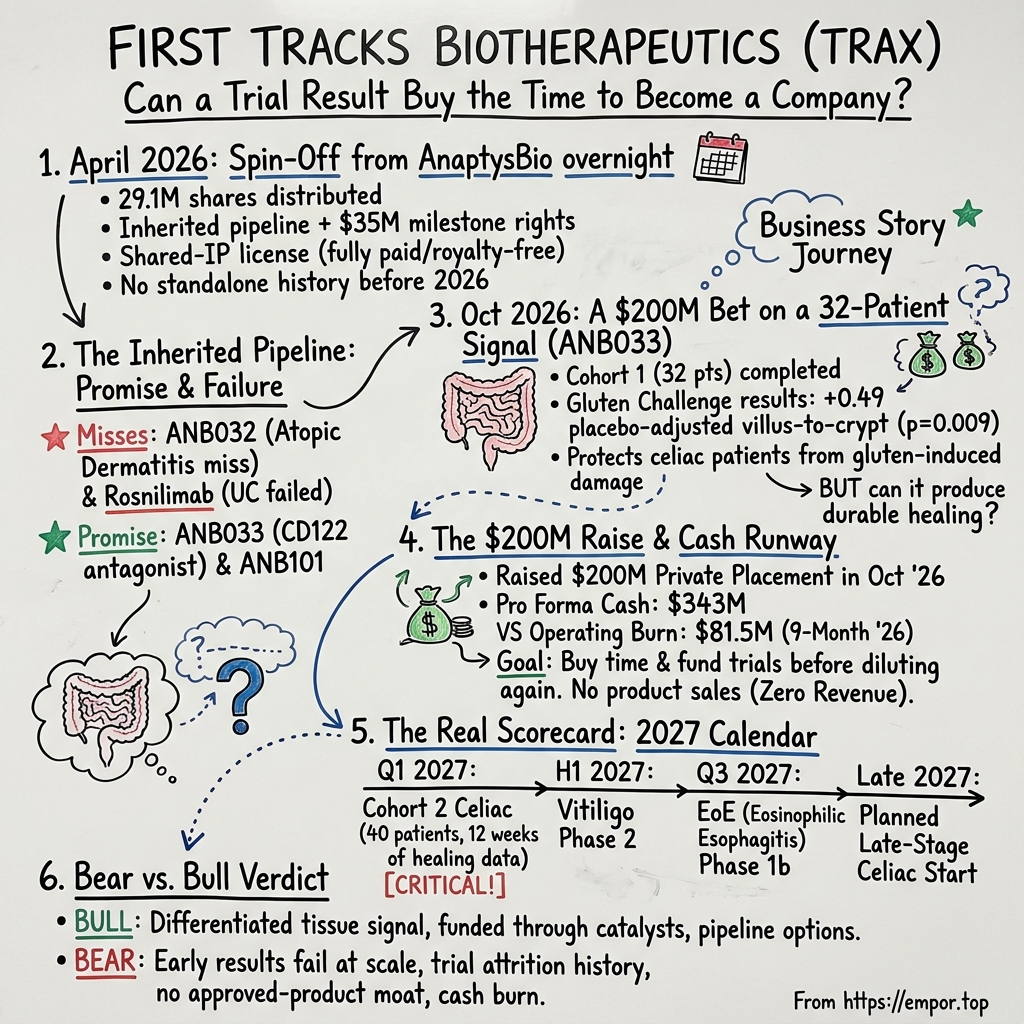
When First Tracks reported third-quarter results on November 3, 2026, it laid out the next year of its life on a single page. Cohort 2 celiac data in the first quarter of 2027. EoE Phase 1b data in the third quarter. Late-stage celiac development starting during the year. Phase 2 work in vitiligo and one more indication in the first half.[^6] It is an ambitious calendar for a company of this size, and it is also, crucially, a plan rather than evidence. Each date is a promise. The coming year will show which promises are kept.
Of all the things an investor could track, three measures matter most. The first is the Cohort 2 celiac result: whether ANB033 delivers meaningful mucosal healing and symptom benefit over 12 weeks in up to 40 patients.[^6] The latest reading is Cohort 1's protective signal; the direction from here is binary in the sense that the result will either strengthen or weaken the case for late-stage development.
The second is execution against the calendar: whether Cohort 2 reports in the first quarter, whether EoE data arrive in the third, whether the late-stage trial actually begins in 2027. So far, the company is one for one, having delivered Cohort 1 on schedule.[^1] The third is operating cash burn against pro forma runway: about $81.5 million in the first nine months of 2026 against $343 million in pro forma cash.1[^6] The direction to watch is upward, as new trials start.
A fourth check will become available when First Tracks reports a full year of results from standalone operations, for fiscal 2027: the true cost of running the company, including all payments and charges involving AnaptysBio. That number will determine whether the cash burn of the transitional year is a reliable baseline or an artifact of the split.
The material risks follow from the model. Clinical execution is the obvious one: a trial can fail, enroll slowly or produce ambiguous results. Cash consumption is the second: every delay adds cost without adding evidence. The third is concentration in the supply chain: the company depends on a small number of raw-material suppliers, CROs and CMOs.3 If one of them falters, a trial can stall. Vendor cancellation terms mean that changing plans can be expensive, and trial delays raise the cost of producing the same evidence.3 The company also runs trials in countries that bill in euros, pounds, Australian dollars and Canadian dollars and does not hedge foreign-exchange risk, though it judged a 10% currency move would not materially affect its statements.3
Some conventional measures simply do not apply. Credit ratings do not exist because First Tracks has no funded borrowing in its latest standalone filing.1 Inventory turns, debtor days and sales growth mean nothing at zero revenue.1 The company is not party to any material legal proceedings.1 The questions that matter are clinical and financial, not commercial.
Valuation deserves proportion. On November 6, 2026, TRAX traded at about 11 times book value, and its enterprise value, market value less net cash, was roughly $1.5 billion on the pre-October share count.[^8]1 EV-to-sales is mechanically meaningless at zero revenue. There is no five-year trading history to compare against, because the stock began trading in April. The stock's one-year volatility is extreme, and it has tripled from its 52-week low near $15.[^8]
What the price appears to assume is that ANB033 has a real chance of becoming a commercial drug in celiac disease and possibly beyond, enough to justify a valuation many times the cash on hand. That assumption will be tested, first and most directly, by Cohort 2. Which brings the story to the central debate: is this a funded chance to prove something, or an expensive claim on an uncertain outcome?
XI. Analysis & Bear vs. Bull Case
Picture two investors reading the same filing. The first starts with the October celiac signal, the new cash and the 2027 calendar, and sees a company with a concrete catalyst, enough money to run more than one study and a mechanism that could work in several diseases. The second starts with zero revenue, a family history of programs that failed in mid-stage trials and a share count enlarged by about 40% in six months, and sees a high price for a small study. Both are reading the facts correctly. They disagree about how to weigh them.
The bull case begins with the data. Cohort 1 showed directionally consistent effects on tissue structure, immune infiltration and symptoms, with no serious adverse events among treated participants.[^1] That is a more coherent picture than many early-stage studies produce. Cohort 2 tests the harder question, healing, in a broader population, and the company has the cash to run it and the trials that follow.[^6] EoE, vitiligo and an additional indication add pipeline optionality, each a separate shot on goal using the same antibody.[^6] The capital position is strong: about $343 million in pro forma cash against a nine-month operating burn of about $81.5 million.[^6]1 And there is no debt to service, no refinancing pressure and no covenant that could force the company's hand.1
The bear case begins with the base rates. Early results in small trials frequently fail to reproduce in larger ones, and the effect sizes often shrink. The organization that built First Tracks' pipeline has seen this firsthand: ANB032 failed in atopic dermatitis, rosnilimab failed in ulcerative colitis after succeeding in rheumatoid arthritis, and etokimab was discontinued after failing its endpoints.[^11]6[^13] Those failures do not predict ANB033's fate, but they show that this company's mechanism bets do not always translate across diseases. No approved-product economics exist to offset R&D. Competing celiac programs, two of them at Novartis and Teva, are advancing in overlapping biology.1 And continued development will consume cash and, quite possibly, more equity before any commercialization.
Then there is the question of competitive position, which deserves one full accounting. Using Porter's five forces as a synthesis: there is no buyer lock-in because there is no product and no customers; future insurers will have the gluten-free diet and possibly competing drugs as alternatives. There is no commercial channel advantage because First Tracks has no sales force or distribution. There is no demonstrated pricing power. Rivals are real and resourced. Suppliers of manufacturing and clinical services hold leverage over a company that depends on a small number of them.3
Hamilton Helmer's seven powers framework makes the same point from another angle. Scale economies, network effects, switching costs, brand and process power all require a commercial business, which First Tracks does not yet have. Counter-positioning does not apply. The only power plausibly in play is a cornered resource: proprietary intellectual property on a differentiated antibody, protected by patents.1 But a cornered resource is only valuable if the resource itself proves superior, which is precisely what the trials are designed to determine. The relevant advantage remains a clinical hypothesis.
The management test is clear. The team delivered Cohort 1 on its stated schedule and raised capital efficiently. It needs to show consistent milestones, transparent tradeoffs when trials surprise and a clear use-of-cash plan as the pipeline broadens. The skeptical-investor test is sharper still. What is the minimum clinical evidence required before ANB033 expands into more indications? If Cohort 2 is mixed, does the company keep spending on vitiligo and the additional indication, or does it concentrate on celiac? Which programs would be cut first if cash burn or trial costs rise? A company that answers those questions clearly in advance has a discipline that the market can value. One that answers them only after the fact does not.
An activist looking at First Tracks would not find the usual targets. There is no sprawling conglomerate to break up, no leverage to cut, no vanity acquisition to unwind. The pressure points are subtler. The first is breadth: a company with one encouraging study is planning work in four indications at once, and every additional program raises the cash burn before the lead program has proved healing.[^6]
The second is dilution: the share count has risen by roughly 40% since the spin-off, and an equity plan with an automatic annual top-up will keep adding to it.31 The third is disclosure: the company has not yet given investors a post-placement runway estimate reconciled to trial budgets, nor a public explanation of the timing of the AnaptysBio receivable.1 None of these is a red flag. Each is a place where a demanding shareholder would ask for more.
There is no conventional acquisition to benchmark and no acquisition premium to judge. The capital-allocation record to date is research spending, program discontinuations, a spin-off and two primary financings. Judged on that record, the company has redirected money away from failures promptly and raised capital at an opportune moment. It has not yet shown it can convert spending into approvals, because no program in its history has reached that stage.
So the bull case has a concrete clinical catalyst and enough capital to run more than one study. The bear case is that a small early result fails to reproduce as healing, competitors produce better evidence and development consumes cash and equity before commercialization. Neither case has an established product moat or a revenue base to stand on. The deciding evidence is the next cohort, and that is where the lessons of this story begin.
XII. Lessons from the Pipeline
Two moments sit side by side in the history of this pipeline: ANB032's failure and subsequent spending cut,[^11]3 and ANB033's early signal and the raise that followed.[^1][^3] Both came from the same scientific portfolio, the same organization and, largely, the same leaders. They carry very different weights of evidence, and the difference between them is the first lesson.
In biotech, a promising pathway is a reason to run the trial; the trial is the reason to keep the program. ANB032's elegant BTLA mechanism did not matter once the data came back. Rosnilimab's results differed by disease. For founders, the lesson is to resist selling a mechanism as if it were a medicine. For investors, it is that the value of an immunology company is built one indication at a time, and a success in one disease buys the right to test the next, not the right to assume it.
The second lesson belongs to the spin-off. A spin-off creates a ticker in a day; a standalone cost base takes a full year to reveal itself. The carve-out accounts and September balance sheet still reflected ties to AnaptysBio.31 Only the first full standalone year will show what it costs on its own. Anyone valuing a spin-off on its carve-out history is valuing an estimate.
The third lesson concerns the cash. Cash runway is time to learn, not proof that the answer will be yes. The October raise gave First Tracks cash to run several studies.[^6] It did not change the probability that any one of them succeeds. Money buys the experiment; it does not choose the result. And because every financing dilutes existing holders, the true price of the runway is paid in ownership as well as dollars.
The fourth lesson is quieter. A positive early result is the moment of maximum leverage for a biotech, and First Tracks used it. Raising money three days after good data is rational, and the October buyers' quick paper gains suggest the market agreed. But that leverage cuts both ways. A company that raises on a signal sets its own expectations for the next readout. Cohort 2 now carries the weight of a $200 million check and a stock priced near its high.
XIII. Epilogue
Tonight, First Tracks Biotherapeutics is a seven-month-old public company with about $343 million in pro forma cash, a lead antibody with one encouraging study behind it, a pipeline of siblings with mixed histories, and a calendar that will decide most of its future within about a year.[^6] It has no revenue and no debt.1 It still rents its offices from its former parent and still has money owed to it by that parent.31
The first moment that will decide the story comes in the first quarter of 2027, when Cohort 2 reports whether ANB033 helps heal the damaged celiac gut over 12 weeks.[^6] A clear healing signal, consistent with Cohort 1's protective result and safe in a larger group, would turn ANB033 from a shield into a plausible treatment and give the company a credible case for late-stage development. A mixed result would leave a protective drug with a narrower commercial story and a harder late-stage design. A negative one would test management's willingness to reprioritize, the same discipline it showed when ANB032 failed.
Then comes the regulatory conversation about late-stage trial design, which will shape how expensive and how long the path to approval becomes. The company anticipates starting late-stage development in 2027.[^6] The design regulators accept will determine the size of the trial, and the size of the trial will determine how much of the $343 million it consumes.
In the third quarter of 2027, EoE Phase 1b data will show whether ANB033's mechanism travels beyond celiac disease, and the vitiligo and additional-indication work planned for the first half of the year will show whether the company is spreading its bet carefully or too thinly.[^6] Each new indication will have to earn its own evidence.
If the data hold, the next question will be whether First Tracks can finance a pivotal path without disproportionate dilution, or whether a partner, perhaps one of the large companies already working in the field, becomes the more economical route. If the data do not hold, the question will be how quickly management reallocates spending and whether the pipeline behind ANB033 is strong enough to justify the company's independence.
And quietly, behind the clinical drama, the accounts will settle. The first full standalone audited year will reveal the true cost of running First Tracks, the full charges for transition services and the sublease, and whether the receivable from AnaptysBio has been collected. That will be the first clean picture of the company's economics, free of the allocation formulas that shaped its history.
The tension that remains is simple to state and hard to resolve. First Tracks has bought itself time. Whether it has bought itself a medicine, and a company, depends on what that time reveals.
XIV. Outro
Somewhere in a clinic, a person with celiac disease finished the challenge that produced First Tracks' most important evidence.[^1] Within days, investors had written a $200 million check on its strength.[^3]
That is the image that captures First Tracks right now: a small group of patients, a short exposure, and a whole company leaning on what their biopsies showed. A 32-person study can open the door. Only the next cohort can show how far it opens.
References
-
Form 10-Q for the quarter ended September 30, 2026 — First Tracks Biotherapeutics, SEC, 2026-11-03 ↩↩↩↩↩↩↩↩↩↩↩↩↩↩↩↩↩↩↩↩↩↩↩↩↩↩↩↩↩↩↩↩↩↩↩↩↩↩↩↩↩↩↩↩↩↩↩↩↩↩↩↩↩↩↩↩↩↩↩↩↩
-
Form S-1 resale registration statement — First Tracks Biotherapeutics, SEC, 2026-10-26 ↩↩↩
-
Form 424B3 prospectus with audited 2024–2025 combined financial statements — First Tracks Biotherapeutics, SEC, 2026 ↩↩↩↩↩↩↩↩↩↩↩↩↩↩↩↩↩↩↩↩↩↩↩↩↩↩↩↩↩↩↩↩↩↩↩↩↩↩↩↩↩↩↩↩↩↩↩↩↩↩↩↩↩↩↩↩↩↩↩↩↩↩↩↩↩↩↩
-
Form 10-12B/A registration statement — First Tracks Biotherapeutics, SEC, 2026-03-27 ↩↩
-
AnaptysBio Announces Phase 2 Trial of Rosnilimab Did Not Meet Primary or Secondary Endpoints at Week 12 in Moderate-to-Severe Ulcerative Colitis — GlobeNewswire, 2025-11-10 ↩↩↩↩↩↩↩
 LinkedIn
 WhatsApp
 Reddit
 Hacker News
 Email
 Kindle
 RSS Feed
 Spotify
 Apple Podcasts
 Amazon Music
 Audible
 YouTube